


saveyourassetsfirst3 |
- Gold scarce, India's silver jewellery exports double
- New York Fed contradicts its former vice president about gold accounts
- BULLION BANKS ATTEMPTING TO SET UP SPECS TO TAKE THE BLAME FOR COMING PM FUTURES MASSACRE!
- BLM Confiscating Land to Back Currency With After Coming Hyperinflation?
- Falling Euro would have distress element positive for gold
- Gold moving on Ukraine crisis escalation
- Selling gold and piling up debt is crazy, Embry tells KWN
- Gold Derivatives, Gold Lending, Official Management Of The Gold Price (Lima, 2002)
- Bullion Banks Attempting to Set Up Specs to Take the Blame for Coming PM Futures Massacre!
- Will Silver Break Free From The $20 Price Range?
- Bank gold and silver analysts: out of touch, out of context and off the mark
- New Physical Gold Exchange Launches In Singapore!
- Gold Possible Resistance is at 1334
- Plunging GOFO Rates
- The Global Banking Game Is Rigged, and the FDIC Is Suing
- Economists notwithstanding, Indians know how to put their gold to work
- Gold and bail-ins
- Fourth Reversals in The Gold and Silver Charts
- This metal's price is forecasted to be 37% higher than gold's
- The Story the MSM Won’t Tell: The Collapse in Newspaper & Magazine Subscriptions
- Fortuna Silver says Q1 silver, gold production hit records
- Platinum or gold: Which is the better bet?
- Jim Willie: US On the Brink! (of Hyperinflation, Shortages, & Riots!)
- Large Decline Of Shanghai & Comex Silver Stocks
- Technical Trading: Watch Bull Channel Support In Gold
- Palladium surges
- Gold to resume a decline by the end of the year
- Silver Prices "Ready to Break Out" as Futures Betting Jumps to Pre-Crash Level
- Palladium, Gas And Wheat Surge On Russian Supply Fears
- Turning back the clock on shale investing
- Links 4/14/14
- Jim Rickards: Money Printing Will Destroy Confidence At Some Point
- Gold and Silver
- Quebec Voters Reject the Parti Québécois and Elect a Liberal Government
- Gold finds resistance beneath 1328 but bias remains bullish
- Gold begins with strong positivity – Analysis - 14/04/2014
- Gold and Silver Forecast for April 14-18
- Crude Oil Spikes While Gold Cracks $1,320 As Ukrainian Turmoil Escalates
- More Weakness Ahead for Precious Metals
- US Dollar Chart Setup Hints at Bounce, SPX 500 Hits Two-Month Low
- The Semantic Subversion of the Gold Standard and Free Banking
- A Critique of the Quantity Theory of Money
- Glossary of Terms in Precious Metals
- Why some experts still think platinum a better buy than gold
- T. Ferguson: We’re Past the Point of NO RETURN: Inflationary Collapse Ahead!
- Are Dimon & JPMorgan Throwing Blythe Masters Under the Bus?
- Alasdair Macleod: Higher Silver Prices Likely to Trigger a Vicious Bear Squeeze!
- Report Finds Los Angeles at Risk of Decline
- Ukraine still hotting up as a potential black swan for global markets
| Gold scarce, India's silver jewellery exports double Posted: 14 Apr 2014 04:32 PM PDT Shortage of gold as a raw material and the consequent decline in gold jewellery exports has opened up new avenues of growth for silver jewellery. |
| New York Fed contradicts its former vice president about gold accounts Posted: 14 Apr 2014 01:31 PM PDT GATA |
| BULLION BANKS ATTEMPTING TO SET UP SPECS TO TAKE THE BLAME FOR COMING PM FUTURES MASSACRE! Posted: 14 Apr 2014 01:22 PM PDT
|
| BLM Confiscating Land to Back Currency With After Coming Hyperinflation? Posted: 14 Apr 2014 01:00 PM PDT
 Real estate expert Fabian Calvo thinks the recent standoff between the Bureau of Land Management (BLM) and Nevada cattle rancher Cliven Bundy is about much more than grazing rights. Even though this standoff is over, we find out It's really about sweetheart deals for federal land. Calvo says, "The hair on the back of my neck stood up when I [...] The post BLM Confiscating Land to Back Currency With After Coming Hyperinflation? appeared first on Silver Doctors. |
| Falling Euro would have distress element positive for gold Posted: 14 Apr 2014 12:42 PM PDT Gold moves up today, but a stronger dollar is limiting the rise as the Euro is being talked down – but a distressed fall in the euro could end up being positive for the gold price |
| Gold moving on Ukraine crisis escalation Posted: 14 Apr 2014 12:41 PM PDT New Ukrainian tensions have seen the gold price rise in trading today as the West remains nervous about further escalation and the possible imposition of more rigorous economic sanctions. |
| Selling gold and piling up debt is crazy, Embry tells KWN Posted: 14 Apr 2014 12:31 PM PDT GATA |
| Gold Derivatives, Gold Lending, Official Management Of The Gold Price (Lima, 2002) Posted: 14 Apr 2014 12:12 PM PDT Frank Veneroso |
| Bullion Banks Attempting to Set Up Specs to Take the Blame for Coming PM Futures Massacre! Posted: 14 Apr 2014 12:00 PM PDT
 The disaggregated COT numbers reveal all the action last week was in the producer merchant, the evil bullion banks as we know them and “love” them (loathe them actually), and they added 5,960 longs and 7,018 shorts. The bullion banks are reaffirming their intention to massacre the metals price and they do this for no [...] The post Bullion Banks Attempting to Set Up Specs to Take the Blame for Coming PM Futures Massacre! appeared first on Silver Doctors. |
| Will Silver Break Free From The $20 Price Range? Posted: 14 Apr 2014 11:58 AM PDT The price of silver remained nearly unchanged during last week. On the other hand, gold bounced back following the release of the minutes of the last FOMC meeting. Will silver resume its rally anytime soon? Or will it tumble down? Let's analyze the recent news that may affect silver and the silver ETFs. The stagnation of silver is reflected in the little change in demand for silver ETFs such as iShares Silver Trust (SLV). Last week, the Silver Trust's price inched up by 0.16%. Conversely, other Silver investments such as Silver Wheaton (SLW) continued their descent and dropped by 2.2%. Looking forward, Janet Yellen's speech, U.S retail sales, Philly Fed index, the progress of gold and the U.S dollar could affect silver. Let's examine these issues and start with last week's release of the minutes of the last FOMC meeting. The minutes of FOMC and silver Following the |
| Bank gold and silver analysts: out of touch, out of context and off the mark Posted: 14 Apr 2014 10:54 AM PDT The major bank analysts whose gold and silver price predictions have an undue influence on metal prices may have a hidden agenda. |
| New Physical Gold Exchange Launches In Singapore! Posted: 14 Apr 2014 10:30 AM PDT
 I was tipped of by one my readers on the launch of a new gold exchange operating in Singapore; Allocated Bullion Solutions Singapore. After taking a look on their website I asked their public relations desk for the details of their business. Websites can be incomplete and I wanted to be sure on what kind of exchange [...] The post New Physical Gold Exchange Launches In Singapore! appeared first on Silver Doctors. |
| Gold Possible Resistance is at 1334 Posted: 14 Apr 2014 10:30 AM PDT |
| Posted: 14 Apr 2014 10:29 AM PDT As expected, London gold forward rates are plunging again during the New York Comex delivery month. In the recent past, this signal of tight physical supplies has correlated with higher prices. So, are we on the verge of another rally? |
| The Global Banking Game Is Rigged, and the FDIC Is Suing Posted: 14 Apr 2014 09:16 AM PDT Taxpayers are paying billions of dollars for a swindle pulled off by the world's biggest banks, using a form of derivative called interest-rate swaps; and the Federal Deposit Insurance Corporation has now joined a chorus of litigants suing over it. According to an SEIU report:
It is not just that local governments, universities and pension funds made a bad bet on these swaps. The game itself was rigged, as explained below. The FDIC is now suing in civil court for damages and punitive damages, a lead that other injured local governments and agencies would be well-advised to follow. But they need to hurry, because time on the statute of limitations is running out. The Largest Cartel in World History On March 14, 2014, the FDIC filed suit for LIBOR-rigging against sixteen of the world's largest banks – including the three largest US banks (JPMorgan Chase, Bank of America, and Citigroup), the three largest UK banks, the largest German bank, the largest Japanese bank, and several of the largest Swiss banks. Bill Black, professor of law and economics and a former bank fraud investigator, calls them "the largest cartel in world history, by at least three and probably four orders of magnitude." LIBOR (the London Interbank Offering Rate) is the benchmark rate by which banks themselves can borrow. It is a crucial rate involved in hundreds of trillions of dollars in derivative trades, and it is set by these sixteen megabanks privately and in secret. Interest rate swaps are now a $426 trillion business. That's trillion with a "t" – about seven times the gross domestic product of all the countries in the world combined. According to the Office of the Comptroller of the Currency, in 2012 US banks held $183.7 trillion in interest-rate contracts, with only four firms representing 93% of total derivative holdings; and three of the four were JPMorgan Chase, Citigroup, and Bank of America, the US banks being sued by the FDIC over manipulation of LIBOR. Lawsuits over LIBOR-rigging have been in the works for years, and regulators have scored some very impressive regulatory settlements. But so far, civil actions for damages have been unproductive for the plaintiffs. The FDIC is therefore pursuing another tack. But before getting into all that, we need to look at how interest-rate swaps work. It has been argued that the counterparties stung by these swaps got what they bargained for – a fixed interest rate. But that is not actually what they got. The game was rigged from the start. The Sting Interest-rate swaps are sold to parties who have taken out loans at variable interest rates, as insurance against rising rates. The most common swap is one where counterparty A (a university, municipal government, etc.) pays a fixed rate to counterparty B (the bank), while receiving from B a floating rate indexed to a reference rate such as LIBOR. If interest rates go up, the municipality gets paid more on the swap contract, offsetting its rising borrowing costs. If interest rates go down, the municipality owes money to the bank on the swap, but that extra charge is offset by the falling interest rate on its variable rate loan. The result is to fix borrowing costs at the lower variable rate. At least, that is how it's supposed to work. The catch is that the swap is a separate financial agreement – essentially an ongoing bet on interest rates. The borrower owes both the interest on its variable rate loan and what it must pay out on this separate swap deal. And the benchmarks for the two rates don't necessarily track each other. As explained by Stephen Gandel on CNN Money:
Historically, Sifma and LIBOR moved together. But that was before the greatest-ever global banking cartel got into the game of manipulating LIBOR. Gandel writes:
The two rates had decoupled, and it was chiefly due to manipulation. As noted in the SEUI report:
Changing the Focus to Fraud Suits to recover damages for collusion, antitrust violations and racketeering (RICO), however, have so far failed. In March 2013, SDNY Judge Naomi Reece Buchwald dismissed antitrust and RICO claims brought by investors and traders in actions consolidated in her court, on the ground that the plaintiffs lacked standing to bring the claims. She held that the rate-setting banks' actions did not affect competition, because those banks were not in competition with one another with respect to LIBOR rate-setting; and that "the alleged collusion occurred in an arena in which defendants never did and never were intended to compete." Okay, the defendants weren't competing with each other. They were colluding with each other, in order to unfairly compete with the rest of the financial world – local banks, credit unions, and the state and local governments they lured into being counterparties to their rigged swaps. The SDNY ruling is on appeal to the Second Circuit. In the meantime, the FDIC is taking another approach. Its 24-count complaint does include antitrust claims, but the emphasis is on damages for fraud and conspiring to keep the LIBOR rate low to enrich the banks. The FDIC is not the first to bring such claims, but its massive suit adds considerable weight to the approach. Why would keeping interest rates low enrich the rate-setting banks? Don't they make more money if interest rates are high? The answer is no. Unlike most banks, they make most of their money not from ordinary commercial loans but from interest rate swaps. The FDIC suit seeks to recover losses caused to 38 US banking institutions that did make their profits from ordinary business and consumer loans – banks that failed during the financial crisis and were taken over by the FDIC. They include Washington Mutual, the largest bank failure in US history. Since the FDIC had to cover the deposits of these failed banks, it clearly has standing to recover damages, and maybe punitive damages, if intentional fraud is proved. The Key Role of the Federal Reserve The rate-rigging banks have been caught red-handed, but the greater manipulation of interest rates was done by the Federal Reserve itself. The Fed aggressively drove down interest rates to save the big banks and spur economic recovery after the financial collapse. In the fall of 2008, it dropped the prime rate (the rate at which banks borrow from each other) nearly to zero. This gross manipulation of interest rates was a giant windfall for the major derivative banks. Indeed, the Fed has been called a tool of the global banking cartel. It is composed of 12 branches, all of which are 100% owned by the private banks in their districts; and the Federal Reserve Bank of New York has always been the most important by far of these regional Fed banks. New York, of course is where Wall Street is located. LIBOR is set in London; but as Simon Johnson observed in a New York Times article titled The Federal Reserve and the LIBOR Scandal, the Fed has jurisdiction whenever the "safety and soundness" of the US financial system is at stake. The scandal, he writes, "involves egregious, flagrant criminal conduct, with traders caught red-handed in e-mails and on tape." He concludes:
Bill Black concurs, stating, "Our system is completely rotten. All of the largest banks are involved—eagerly engaged in this fraud for years, covering it up." The system needs a complete overhaul. In the meantime, if the FDIC can bring a civil action for breach of contract and fraud, so can state and local governments, universities, and pension funds. The possibilities this opens up for California (where I'm currently running for State Treasurer) are huge. Fraud is grounds for rescission (terminating the contract) without paying penalties, potentially saving taxpayers enormous sums in fees for swap deals that are crippling cities, universities and other public entities across the state. Fraud is also grounds for punitive damages, something an outraged jury might be inclined to impose. My next post will explore the possibilities for California in more detail. Stay tuned. ______ Ellen Brown is an attorney, founder of the Public Banking Institute, and a candidate for California State Treasurer running on a state bank platform. She is the author of twelve books, including the best-selling Web of Debt and her latest book, The Public Bank Solution, which explores successful public banking models historically and globally. |
| Economists notwithstanding, Indians know how to put their gold to work Posted: 14 Apr 2014 09:03 AM PDT GATA |
| Posted: 14 Apr 2014 09:00 AM PDT
 I am often asked whether or not western governments are likely to confiscate gold, and my answer has invariably been on the lines of “unlikely at the moment, because so few people own gold”. However, given low stock levels in western vaults and that bail-ins are on the agenda, the answer to the question should [...] The post Gold and bail-ins appeared first on Silver Doctors. |
| Fourth Reversals in The Gold and Silver Charts Posted: 14 Apr 2014 08:10 AM PDT marketoracle |
| This metal's price is forecasted to be 37% higher than gold's Posted: 14 Apr 2014 08:00 AM PDT Platinum and gold are often traded relative to each other… but platinum has the edge this year. In fact, analysts are forecasting platinum could cost 37% more than gold at the end of the year. Platinum is forecasted to increase 10% to $1,600 per ounce by the end of this year. This would be its highest price in 12 months. Gold is forecasted to drop 11% to $1,170 per ounce. This would be the lowest price for gold since 2009. There are three reasons why platinum is forecasted to beat gold…
 
More on platinum: Forget gold and silver... This rare metal could be starting a MAJOR breakout Amber Lee Mason: The answer to a BIG question you're probably asking about stocks Resource master Rick Rule answers the biggest questions in the resource world today |
| The Story the MSM Won’t Tell: The Collapse in Newspaper & Magazine Subscriptions Posted: 14 Apr 2014 08:00 AM PDT
 When I recently cancelled my USA Today subscription, I told the nice clerk I spoke to that I was just trying to save money. However, I also mentioned that I didn't agree with the paper's economic writers, writers who routinely reported on "low inflation" and how the economic recovery was on-going. I pointed out that the rack-sale [...] The post The Story the MSM Won’t Tell: The Collapse in Newspaper & Magazine Subscriptions appeared first on Silver Doctors. |
| Fortuna Silver says Q1 silver, gold production hit records Posted: 14 Apr 2014 07:50 AM PDT seekingalpha |
| Platinum or gold: Which is the better bet? Posted: 14 Apr 2014 07:30 AM PDT Bloomberg's Mia Saini explains what has caused platinum to be worth 37% more than gold  |
| Jim Willie: US On the Brink! (of Hyperinflation, Shortages, & Riots!) Posted: 14 Apr 2014 07:01 AM PDT
 For the last 30 years we’ve been exporting price inflation. Now we’re going to import 200% price inflation. This is going to be a nightmare of price inflation and product shortages, you will have violence at the supermarkets, at the gas stations, and at the ATM machines- Martial law is a guarantee! Jim Willie discusses [...] The post Jim Willie: US On the Brink! (of Hyperinflation, Shortages, & Riots!) appeared first on Silver Doctors. |
| Large Decline Of Shanghai & Comex Silver Stocks Posted: 14 Apr 2014 07:00 AM PDT
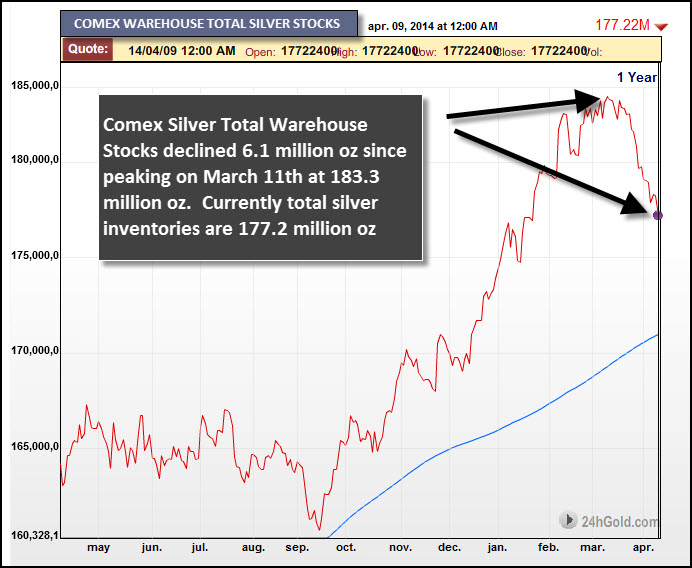 Something interesting took place at the Comex and Shanghai silver warehouses over the past month. Silver stocks at both these warehouses peaked at about the same time, March 10th. However, for the past month, a substantial amount of silver has been removed from both warehouses. From The SRSRocco Report: In the chart below, we [...] The post Large Decline Of Shanghai & Comex Silver Stocks appeared first on Silver Doctors. |
| Technical Trading: Watch Bull Channel Support In Gold Posted: 14 Apr 2014 06:30 AM PDT forbes |
| Posted: 14 Apr 2014 06:13 AM PDT Gold, silver, palladium, platinum and oil rose while European stocks fell for a third day after Russia called an emergency session of the United Nations Security Council. |
| Gold to resume a decline by the end of the year Posted: 14 Apr 2014 06:05 AM PDT Despite gains gold could come under pressure in 2014. |
| Silver Prices "Ready to Break Out" as Futures Betting Jumps to Pre-Crash Level Posted: 14 Apr 2014 05:06 AM PDT Bullion Vault |
| Palladium, Gas And Wheat Surge On Russian Supply Fears Posted: 14 Apr 2014 04:03 AM PDT gold.ie |
| Turning back the clock on shale investing Posted: 14 Apr 2014 04:00 AM PDT From Matt Badiali, editor, S&A Resource Report: Imagine if we could turn back the clock on Pioneer Natural Resources (PXD). In 2000, shares of this oil and gas explorer traded for less than $10. And then the shale revolution kicked in. PXD shares peaked at $225 in October 2013. That's a remarkable 2,150% gain over the past 14 years. Every $1,000 invested in 2000 is worth $21,500 today. Pioneer's not alone. We have seen this kind of dramatic increase in value in dozens of companies. 2000 was a tremendous investment opportunity... if you saw it coming. The good news is, I see a repeat of the shale revolution starting in the near future. It should give us an opportunity to find the next Pioneer Natural Resources. However, it isn't in the U.S. More important, it won't suffer the same natural gas price collapse we went through in the U.S. The location of the next shale boom is Australia. According to the U.S. Energy Information Administration (EIA), Australia has 396 trillion cubic feet of technically recoverable shale gas. That's almost 400 years' worth of domestic demand. While Australia doesn't use much gas now (roughly 1 trillion cubic feet (TCF) per year), it does export nearly as much as they consume. But that's about to go up substantially. By 2017, Australia's liquefied natural gas (LNG) exports will be larger than Qatar's (which currently tops the world export list at 3.75 TCF per year). That will make it the largest natural gas exporter in the world. That's why I don't believe Australia has to worry about a price collapse. Australia's natural gas industry is built to send gas to Asia. It has already tapped some large offshore gas fields, which will export LNG. However, those companies are already looking for future supplies. That's where the shale comes in. Australia's shale industry is more than 10 years behind the U.S. A big part of the problem is infrastructure. Unlike the U.S., which has a massive system of pipelines, Australia does not. That's going to take a while to develop. I've seen estimates as far out as 20 to 30 years. However, the so-called experts are wrong far more often than they are right. I'm far more optimistic. The industry knows about Australia's shale basins. There is exploration going on now. And those giant LNG projects are going to need natural gas soon. There is no time to waste... for them or for us. Crux note: Matt Badiali is our resident oil and gas guru at Stansberry and Associates. He digs up some of the best resource stocks out there. And right now has uncovered 5 small oil companies ready to break out. Click here for the details.
You can read more from Matt Badiali on The Crux right here. |
| Posted: 14 Apr 2014 03:55 AM PDT Global warming forcing Mongolian nomads to change lifestyles Asahi Shimbun IPCC: Cost of Avoiding Dangerous Climate Change Super-Affordable if We Act Now Jeff Masters, Weather Underground The Mellon Lifestyle as a Brand Times. Wretched excess. A room with a view: Homeless building snug studios into the Manhattan Bridge Daily Mail Criminalizing People Who Live in Cars Is a New Low in the War on the Poor Truthout Let them eat McMansions! The 1 percent, income inequality, and new-fashioned American excess Salon Real-Estate Crowdfunding Finds Its Footing Online WSJ Slowdown puts 1bn middle class at risk FT Tensions over money flows bode poorly for global economy Reuters ARE SPECULATIVE BUBBLES GOOD? The New Yorker Tech insiders dumped shares ahead of slide FT Pay for Performance? It Depends on the Measuring Stick Gretchen Morgenson, Times Banks fiddled while Rome burned: how to predict the next global financial crisis Guardian Ukraine
Are Americans really jingoistic yahoos? A cautionary statistical tale Princeton Election Consortium Big Brother Is Watching You Watch
The Democratic Party’s Phony Populists Are Hijacking U.S. Moves toward Equality Alternet How LBJ Saved the Civil Rights Act The Atlantic Democrats settle on fairness issues hoping to avoid a repeat of 2010 midterm disaster WaPo. Five years too late. 10 questions that could decide Election 2014 Politico ObamaCare
The other Social Security battle: the squeeze on customer service Reuters. A bit stale, but check this on why some people still like paper: “They’re not that comfortable putting their financial information on Internet.” But why?! America’s Energy Edge Foreign Affairs Post-Fukushima Japan Chooses Coal Over Renewable Energy Bloomberg Grand Visions Fizzle in Brazil Times Thailand's Political Tensions Are Rekindling Ethnic and Regional Divisions Times Contrary to popular and academic belief, Adam Smith did not accept inequality as a necessary trade-off for a more prosperous economy British Politics and Policy Notes and Finger Exercises on Thomas Piketty's "Capital in the Twenty-First Century": The Honest Broker for the Week of April 19, 2014 The Equitablog Insights from the Counterculture, Part 4: William S. Burroughs Who What Why THE DECLINING EFFECTIVENESS OF VIOLENCE Monkey Business The Slaughter Bench of History The Atlantic Antidote du jour:
See yesterday’s Links and Antidote du Jour here. |
| Jim Rickards: Money Printing Will Destroy Confidence At Some Point Posted: 14 Apr 2014 03:24 AM PDT In a recent online presentation organized by bullion service provider GoldCore, Jim Rickards explained the current economic environment and what it means to gold investors. His main premise is that central bank intervention is very destructive in the long term and that there is no economic recovery. Gold investors should keep part of their wealth in physical form, not as an investment, but rather as wealth protection. Jim Rickards on deflation and the risk of collapse:
On the fact that the economy is in a depression:
On the myth that the economy is recovering:
On the myth that it is not important how much is printed:
On the 2 second attention span:
Even Warren Buffett is buying hard assets:
On gold manipulation:
On making money with gold vs preserving wealth:
READ ALSO: Jim Rickards' Newest Book “The Death Of Money”, Gold Price Could Double Overnight In US Dollar Crisis, World Currency System Moving Towards Catastrophe. |
| Posted: 14 Apr 2014 02:25 AM PDT The Silver GoldSpot |
| Quebec Voters Reject the Parti Québécois and Elect a Liberal Government Posted: 14 Apr 2014 12:55 AM PDT By Lambert Strether of Corrente. Yesterday, readers mentioned this wonderful artwork[1] from 2012′s Printemps érable in Montreal[1]. And today we have election results from Quebec.[2] The Real News Network interviews Leo Panitch, Canada Research Chair in Comparative Political Economy and a distinguished research professor of political science at York University in Toronto. Here’s the video: When I lived in Quebec, I thought separatism as advocated by the Parti Québécois (PQ) was madness, because I was invested with the idea that Federalism can support a mosaic of cultures; but now that Harper and the Canadian Conservatives are busily turning Canada into a reactionary petro-state — for which 47 Quebeckers paid with their lives in the Lac-Mégantic oil train explosion — I’m not so sure. Be that as it may, today’s electoral developments in Quebec are entertaining and interesting, both electorally and as partisan politics. First, a once-progressive[3] party, the PQ, was punished for cynically pretending they were still progressive while at the same time moving right. (It never does to project one’s own electoral politic onto another country, but still; does that sound familiar?)
Second, the party voted in, the Quebec Liberals, necessarily has a weak mandate, because it’s corrupt. (Ditto.)
It will be interesting to see what happens when the offical inquiry resumes! Third, a good deal of the voting was strategic.
Fourth, there are signs of hope for an emergent party to break the PQ/Quebec Liberal duopoly.
So, a sophisticated, engaged electorate is doing interesting things. But then, with the round bacon they’ve got to cope with up there, sophisticated and engaged is just what they’d have to be. Basically, I’m just arguing for a watching brief, here; this post is background. The Printemps érable came out of nowhere and was very creative in its methods and achieved some results. All it takes — one hopes — is a single tear in the painted canvas of our Potemkin village for the wind to tear the entire fabric and carry the whole flimsy structure away. Notes[1] The artworK scrolls horizontally. For whatever reason, swiping works on the iPad but dragging no longer works on my laptop. YMMV! [2] Canada counts paper ballots by hand in public: The gold standard, because the likelihood of corruption is far less than with the electronic voting machines we in the United States use. All the ballots are counted in one night. [3] OK, OK, I know “progressive” doesn’t really mean anything any more, but you know what I mean. Panitch comments:
[4] Canada has a “first past the post” system, so Québec Solidaire would have had to have won a majority in those districts. |
| Gold finds resistance beneath 1328 but bias remains bullish Posted: 14 Apr 2014 12:55 AM PDT fxstreet |
| Gold begins with strong positivity – Analysis - 14/04/2014 Posted: 14 Apr 2014 12:55 AM PDT economies |
| Gold and Silver Forecast for April 14-18 Posted: 14 Apr 2014 12:15 AM PDT forexfactory |
| Crude Oil Spikes While Gold Cracks $1,320 As Ukrainian Turmoil Escalates Posted: 13 Apr 2014 11:15 PM PDT dailyfx |
| More Weakness Ahead for Precious Metals Posted: 13 Apr 2014 11:00 PM PDT The Daily Gold |
| US Dollar Chart Setup Hints at Bounce, SPX 500 Hits Two-Month Low Posted: 13 Apr 2014 10:30 PM PDT dailyfx |
| The Semantic Subversion of the Gold Standard and Free Banking Posted: 13 Apr 2014 10:30 PM PDT Mises.org |
| A Critique of the Quantity Theory of Money Posted: 13 Apr 2014 10:00 PM PDT Gold University |
| Glossary of Terms in Precious Metals Posted: 13 Apr 2014 09:30 PM PDT CMI Gold and Silver |
| Why some experts still think platinum a better buy than gold Posted: 13 Apr 2014 08:57 PM PDT Platinum is still the favorite of some precious metal experts who think it a better play on industrial output expansion than gold. That assumes the world economy will continue its recent recovery and not slowdown further. With gold up to $1,327 an ounce this morning Bloomberg TV reports… |
| T. Ferguson: We’re Past the Point of NO RETURN: Inflationary Collapse Ahead! Posted: 13 Apr 2014 08:00 PM PDT
 In this MUST LISTEN interview with Finance & Liberty’s Elijah Johnson, T. Ferguson explains why we are past the point of NO RETURN, and states that a full-blown inflationary collapse is DEAD AHEAD!! The post T. Ferguson: We’re Past the Point of NO RETURN: Inflationary Collapse Ahead! appeared first on Silver Doctors. |
| Are Dimon & JPMorgan Throwing Blythe Masters Under the Bus? Posted: 13 Apr 2014 07:52 PM PDT
 The Doc & Eric Dubin are back for the Metals & Markets to discuss: Gold & silver capped by the cartel at $1300 & $22- is a big move on the horizon? The Dollar’s death by a thousand cuts suffers numerous flesh wounds as Russia prepares major oil deal with China The Doc updates listeners [...] The post Are Dimon & JPMorgan Throwing Blythe Masters Under the Bus? appeared first on Silver Doctors. This posting includes an audio/video/photo media file: Download Now |
| Alasdair Macleod: Higher Silver Prices Likely to Trigger a Vicious Bear Squeeze! Posted: 13 Apr 2014 04:01 PM PDT
 Unlike gold, where Comex volume is moderate, silver volume is high indicating very strong support at current levels. The obvious conclusion is that bullion banks trying to balance their silver books cannot do so at current prices. Yet higher prices are likely to trigger a vicious bear squeeze, so it appears the bullion banks with [...] The post Alasdair Macleod: Higher Silver Prices Likely to Trigger a Vicious Bear Squeeze! appeared first on Silver Doctors. |
| Report Finds Los Angeles at Risk of Decline Posted: 13 Apr 2014 02:34 PM PDT The Los Angeles 2020 Commission presented a catalog of failings that it said were a unique burden to the city: widespread poverty and job stagnation, huge municipal pension obligations, a struggling port and tourism industry and paralyzing traffic that would not be eased even with a continuing multibillion-dollar mass transit initiative... Read |
| Ukraine still hotting up as a potential black swan for global markets Posted: 13 Apr 2014 02:28 PM PDT Ukraine has given pro-Russian separatists a deadline to disarm this morning or face a ‘full-scale anti-terrorist operation’ by its armed forces, raising the risk of a military response from Moscow. This hardly looks like a geopolitical crisis fully resolved by the annexation of the Crimea. Angered by the death of a state security officer and the wounding of two of his comrades near the flashpoint eastern city of Slaviansk, rebels occupying state buildings in the eastern areas of the country have been give until this morning to lay down their weapons. Moscow blamed The interim government blames Russia, which opposed a pro-Europe uprising that forced Moscow-backed former president Viktor Yanukovich to flee, for being behind the rash of rebellions across Russian-speaking towns in eastern Ukraine. With East-West relations in crisis, NATO described the appearance in eastern Ukraine of men with specialised Russian weapons and identical uniforms without insignia – as previously worn by Moscow’s troops when they seized Crimea – as a ‘grave development’. After the successful invasion and annexation of the Crimea Russian president Vladimir Putin issued a long statement explaining the action and very clearly stating that there would be no further action in the Ukraine. Ukraine occupation? However, Russia would not be expected to standby if the Russian speaking population is under threat or contrived to be perceived to be under threat. That was the pretext used to seize the Crimea. US ambassador to the United Nations, Samantha Powers told ABC’s ‘This Week’ show, she feared Russian President Vladimir Putin’s territorial ambition stretched to occupying the whole of Ukraine, despite repeated reassurances to the contrary. As far as financial markets are concerned the showdown with Russia and the rest of the international community is also a problem that is not going away. The sanctions imposed so far on Moscow have been pathetic but could be increased and that will invite a response. Black swan? With global financial markets in a very fragile state after the sell-off that started last week any kind of a black swan event – like Russia deciding to sell US treasuries or oil for gold, for example – would be a catalyst for a much larger fall. So far the sell-off on Wall Street has been mainly a homegrown phenomenon linked to a bubble in tech stocks. The external threat has not been taken seriously. Expect a rapid response if things go awry in Ukraine again this week with gold and silver the biggest winners. |

| You are subscribed to email updates from Gold World News Flash 2 To stop receiving these emails, you may unsubscribe now. | Email delivery powered by Google |
| Google Inc., 20 West Kinzie, Chicago IL USA 60610 | |

No comments:
Post a Comment