


saveyourassetsfirst3 |
- Gold smuggling arrests jump 750% YoY in India
- Unpacking the London Gold Fix - Phillips
- Hugely outnumbered – Western gold bears by Asian gold enthusiasts
- Yuan steps closer to free convertibility with cross border trading - Phillips
- JIM WILLIE: US DOLLAR FUNERAL AT HAND!
- Gundlach: global economy 'deflationary scare' could happen again
- The West’s Slow-Motion Collapse
- US Gold coin prices could shoot up on reduction in mintage
- Gold's Gory Crash, One Year On
- Forget Peak Oil. We may be hitting "Peak Instability." Here's how to avoid destruction.
- India Gold, Silver imports fall by 40% y y to 33.46 billion FY14
- April 11, 2014: The crux of today's Web in 45 seconds
- Koos Jansen: New physical gold exchange in Singapore
- Alasdair Macleod: China’s Demand For Gold Has Trapped The West’s Central Banks
- My Look At Kostohryz's U.S. 2014 Outlook: Implications For The U.S. Dollar And Other Currencies
- Slurry sampling design parameters key to gold extraction efficiencies
- Real U.S. Silver Money Would Consume Nearly Half Of Total Mine Supply
- Militias Are On Route: Is the 2nd American Revolution Starting in Bunkerville, Nevada?
- Monetary Metals Explains How Speculators Could Crash Silver to $12!
- Chinese Gold Demand 559 MT YTD, Up 16 %
- Escalating mining costs likely to boost silver prices
- Gold continues recovery
- Sunshine Mint Silver Eagles 95 Cents Over Spot, ANY QTY!
- Prepare For Dollar Collapse With 10% To 33% Allocation To Gold – Rickards
- Prepare For Dollar Collapse With 10% To 33% Allocation To Gold - Rickards
- China’s gold demand ROSE 41% in 2013 – and this doesn’t include scrap and home production
- Gold trades below two-week high as China weighed against Fed
- More weakness ahead for precious metals
- UBS trims 2014 Silver price forecast from $22.30 to $21.80 Oz
- U.S. Mined Silver Output Continues to Fall—USGS
- Is the U.S. or the World Coming to an End? — Paul Craig Roberts
- Five King World News Blogs/Audio Interviews
- Chris Martenson and Alasdair Macleod discuss China's corner on gold
- U.S. mined silver output continues to fall--USGS
- Lawrence Williams: Silver being left behind in latest gold price surge – but don’t despair!
- Gold Price meets resistance
- $1320 - Gold negotiates the key resistance – Analysis - 11/04/2014
- Metals Pack Fundamental Analysis April 11, 2014 Forecast – Silver & Copper
- Gold Prices Forecast April 11, 2014, Technical Analysis
- CHARTS - Gold Recovery Continues, SPX 500 Vulnerable to Deeper Losses
- Gold Traders Resolve Tested
- Gold begins tentative recovery
- Gold Shines, But Rally May Be Short-Lived
- Foreign Central Bank Holdings of US Treasuries back on the Rise again
- Chris Martenson and Alasdair Macleod discuss Chinas corner on gold
- More Weakness Ahead for Precious Metals
- If inflation is really not dead but resting then precious metals and oil are the thing to be buying
- Gold Moves Higher as Marc Faber Warns of 87-Style Stock Market Crash
- Another smashing of gold unlikely because it would unleash demand, Kaye says
- april 10/Slight downward change in GLD gold/no change in silver inventory/both gold and silver advance/Dow and Nasdaq in a free fall/
| Gold smuggling arrests jump 750% YoY in India Posted: 11 Apr 2014 05:53 PM PDT With gold hauls at almost all international airports in India, the chorus to reduce import duty on gold gains momentum |
| Unpacking the London Gold Fix - Phillips Posted: 11 Apr 2014 05:34 PM PDT Does the Gold Price reflect true gold Demand and Supply? |
| Hugely outnumbered – Western gold bears by Asian gold enthusiasts Posted: 11 Apr 2014 02:50 PM PDT Western citizenry is hugely outnumbered by a rapidly growing Eastern middle class with gold purchasing aspirations which has to be having a strong cumulative effect on the long term gold price. |
| Yuan steps closer to free convertibility with cross border trading - Phillips Posted: 11 Apr 2014 01:05 PM PDT The Yuan moves closer to greater convertibility on international markets. Julian Phillips argues once it makes the final leap, gold will shine. |
| JIM WILLIE: US DOLLAR FUNERAL AT HAND! Posted: 11 Apr 2014 11:32 AM PDT
Click here for the latest Hat Trick Letter on the USDollar Funeral: |
| Gundlach: global economy 'deflationary scare' could happen again Posted: 11 Apr 2014 11:22 AM PDT DoubleLine Capital's Jeffrey Gundlach - who helps manage $49B - warns of deflation and highlights gold as safe haven investment. |
| The West’s Slow-Motion Collapse Posted: 11 Apr 2014 11:14 AM PDT Many analysts outside the mainstream herd have been making dire predictions about the collapse of the economies of the Western bloc for the past several years, myself included. Those predictions have not come to pass. Does this mean that we were wrong, or at best woefully premature in our thinking? Simply, no. Analysis (and prediction) is based upon the rational assessment of data. It is (or at least is supposed to be) a purely logical extrapolation based upon existing trends and parameters. Part of this "rational assessment" is the presumption that the various actors and authorities in our markets and economies will respond to these trends and parameters in a rational manner. This is not merely a reasonable basis for engaging in analysis, it is the only basis. The only option to expecting rational behavior from these various participants would be to expect irrational/arbitrary behavior. However, by definition, irrational/arbitrary behavior is unpredictable. Thus such an approach is no longer "analysis" at all. It devolves into a mere guessing-game. So we expect rational behavior and rational responses to various economic/market stimuli because we have no other choice, and when we don't see such behavior this inevitably skews all analysis based on such rational expectations. What is important to note, however, is that irrational/arbitrary behavior (and thinking) does not invalidate such rational assessments and predictions – at least not those based upon Big Picture trends/parameters – it merely alters the time-horizon. These Big Picture trends are the economic equivalent of the proverbial "irresistible force", because boiled-down, they are nothing but manifestations of simple arithmetic. Any nation which chooses the (suicidal) economic policy of permanent deficits will default on its debts; it's just simple arithmetic (i.e. compounding interest on that debt). Any nation which allows its money-printing to spiral higher will produce hyperinflation, it's just simple arithmetic (if you keep adding water to the lemonade, you will dilute the lemonade). The purpose of this piece is thus not to defend (no-brainer) predictions which must come true, just as certainly as "2 + 2" will always equal four. Rather, the purpose of this piece is to identify the factors which have prevented these predictions from being validated (so far), and to alert readers to the grave danger of assuming that this slow-motion collapse of Western economies will continue at the same rate. If there is one thing we have learned with our Wonderland Matrix, it is that the puppet-masters of the One Bank are seemingly "masters of illusion." But such a conclusion gives these bankers (and their servants in government and the media) far too much credit. Framed more negatively; we have populations of Sheep across the Western world who have been rendered so myopic through the saturation brainwashing of Western media that they would not "see" a brick wall directly in front of their own eyes – unless/until they were first told to look for it. The proof is in the numbers, the numbers from the real world. It would be impossible for any of the Sheep to believe the lies of "jobs, jobs, jobs" in the U.S. economy, if they simply saw with their own eyes that there are less people working in the U.S. economy each month.
It would be impossible for any of the Sheep to believe the lies that "inflation is too low", if they simply saw with their own eyes the hyperinflationary spiral of U.S. money-printing (and money-printing across the Western world). |
| US Gold coin prices could shoot up on reduction in mintage Posted: 11 Apr 2014 10:43 AM PDT GoldCoin.net spokesman Keith Kelly says based on past years the reduction in mintage could cause prices for those coins to skyrocket as the year progresses, regardless of the gold spot price. |
| Gold's Gory Crash, One Year On Posted: 11 Apr 2014 10:38 AM PDT Gold price crash or massive Asian investment? Certainly redeployed available metal... A YEAR AGO this Friday, writes Adrian Ash at BullionVault, a leaked IMF-EU paper told Cyprus to sell a chunk of its tiny gold reserves. It never did. No Eurozone central bank has sold gold since France quit in 2009. But already advised that week to sell short by Goldman Sachs, the market took fright. No one owning gold or silver in April 2013 needs reminding of the gory details. (Horror fans will find gold's $1 trillion crash explained here.) But with hindsight, and without the need for valium, three points deserve comment today. #1. Gold met very strong demand last April. Just not in the form of financial securities or derivatives traded on Western exchanges. So while the spot price "gapped down" on the morning of Monday 15 April, 2013...with few buyers daring to catch it...the surge in China and India's retail bargain-buying clearly put a floor under the market. #2. Such wrenching shifts in price, and also in who owns what gold where, changed the gold market's dynamics, of course. Price aside, the 2013 sell-off by Western investment funds was just as much a huge investment purchase by Asian savers. So to serve those respective customers better, the bullion market has re-deployed its available stockpiles. Some odd things result...

#3. Albeit perversely, last year's crash also proved gold's insurance function, forcing through almost half of last year's 30% price drop. That loss mirrored the boom in world and particularly US equities, as our asset performance comparison table shows. Today that boom is now being compared with the S&P's bull market ending October 1987, and while many "scary charts" linking today with Black Monday look stretched, equity valuations are stretched further. Gold's two-day crash in April 2013 wasn't its worst percentage fall (that was January 1980, just after its famous $850 top). New York's Dow Jones stock index lost twice as much in the Great Crash of 28-29 October 1929. The London stock market matched last year's gold drop in one session alone in October 1987. Back then, UK shares dropped another 12% the day after Black Monday as well. So yes, gold can be volatile. No, it won't protect you from wrenching losses or sleepless nights. Last spring's crash was horrid. But stockmarkets can be worse. Gold jumped 5% on Black Monday 1987, and it rose 5-fold in terms of the business assets it could buy during the Great Depression that followed the 1929 crash. Investors wanting financial insurance might want to get some before the rush. It is, after all, much cheaper than early April last year. |
| Forget Peak Oil. We may be hitting "Peak Instability." Here's how to avoid destruction. Posted: 11 Apr 2014 10:02 AM PDT Editor's note: There's no doubt the instability in the world today is reaching a fever pitch. From the military crisis in Russia and Ukraine... to unending wars across the Middle East... to the Fed's dollar-destroying, 0% interest monetary policy... it seems almost impossible to protect one's wealth in this age of chaos. But this is a narrow point of view. What if you understood world events from the vantage point of 2500 years of history? That's what The Crux's friend and "super-scholar" Richard Maybury does. Regular Crux readers know Richard -- editor of the U.S. and World Early Warning Report -- is on the other end of our "red phone." He's the man we want to hear from first, when the next geopolitical shock sends global markets reeling. If you're wondering what to make of the chaos in the world today--and how to profit from it instead of being destroyed--read the excerpt below, from January 2012's "EWR."
From Richard Maybury, editor, The U.S. and World Early Warning Report:
This is one of the most difficult reports I've ever had to write. It's a monumental task.
I'm confident now that the historic economic calamity EWR and others have been predicting for decades has finally arrived, and this is leading to a third American Revolution. (The second revolution was the Civil War.)
So, what can I write about it that won't be a repeat of what I've already said many times?
There's this: to me, the biggest surprise of the whole thing is that it isn't confined to America. The economic havoc and political violence from the death of socialism are engulfing the whole world. More importantly, it's all happening at the same time!
If you are like me, you are suffering from information overload. In the attempt to deal with it, I've organized the most important data into a series of micro-briefings.
If you are a long-time reader of EWR, some of the micro-briefings will contain information you have read before — in effect, they are I-told-you-so's — but I think you will find they paint the Big Picture we all need for decision-making in our businesses, careers and investments. Here we go.
Micro-briefing 1: It's Happened Before
Judging by 2,500 years of economic history, the world experiences political catastrophes at the rate of about one or two per century.
The previous one, from 1914 to 1945, was by far the worst ever. It was the two world wars plus the Great Depression, along with the epidemics of influenza and socialism that slithered up out of the trenches of WWI.
Five global train wrecks in 31 years. I call it the Megacaust. (More on this next month.)
That was 67 years ago, so we are due for the next political catastrophe, and I think there is a 95% probability the economic turmoil of the past four years has been the beginning.
As in all such cases, a lot of new millionaires will be created. More on that, beginning on page 4.
Micro-briefing 2: The Pessimism is Ridiculous
One of my favorite old movies is about flying saucers attacking Washington, DC. I always root for the saucers, especially when they zap the Federal Reserve building.
Worldwide, the Fed has made such a mess that I am continually seeing references to "Armageddon," "gloom-and-doom" and "end of civilization." The prestigious ECONOMIST magazine writes, "European leaders can still avoid the apocalypse, but only if they act boldly and quickly."
What nonsense. When times grow hard, people do not just give up, sit down on the curb, and keel over.
After studying 2,500 years of economic history, I can tell you for a fact that when times become hard, people rise to the occasion.
For those who are prepared, this massive turmoil is a welcome housecleaning that will clear the way for a new golden age of liberty and abundance.
Micro-briefing 3: Exactly What Will Happen?
The map above was almost unchanged for about five years, then in 2011 it began to worsen. Yet the mainstream press hardly mentions how widespread the turmoil is, much less what you can do to cope with it and profit from it.
Those of us who have spent decades sounding warnings about the political and economic catastrophe that has now arrived have often been asked something like, "When these socialist experiments finally explode, what exactly will happen?"
I've long said, everything.
It won't all occur in the same place or at the same time, but I'm sure you can see from this map that violence and general chaos are becoming pervasive.
Upheavals in Tunisia, Egypt, Syria and Libya have been triggered by the rising price of food.
Escalating food prices are a symptom of the falling value of money, caused by governments printing money to pay their mountainous debts.
I think the overthrow of regimes in Cairo, Tunis and Tripoli are just the vanguard of what's coming worldwide, including in the US.
Micro-briefing 4: The Constitutional Crisis
As the existing rob-Peter-to-subsidize Paul welfare states commit economic suicide or are overthrown, they are being replaced by new states.
In the US, after the bankrupt federal government goes under, the replacement process will likely take the form of a Constitutional crisis.
What will be the character of the new US government?
In virtually all such cases throughout history, it's been whatever is chosen by the military. Whoever they decide to back will be the new rulers.
In 1787, the Founding Fathers made General George Washington the head of the Constitutional Convention partly because he was the person the army, navy and militias would support.
As explained in the 10/99, 8/06 and 9/10 EWRs, today I think the military branch that will do most of the deciding will be the Marines. Who would dare oppose them?
When will it happen?
Impossible to know. I think in three years or so, but that's just an educated guess; none of this is an exact science.
Micro-briefing 5: Adaptability
To me, a very good description of the word human is, the most adaptable creature on the planet. I've been told that the only other critter that comes close is the cockroach. Reportedly, the cockroach originated long before the dinosaurs, and it is still here, while they aren't. The cockroach survived the big asteroid strike.
So, the brown bug is tougher than Tyrannosaurus Rex, and we are tougher than the bug. We will adapt. You can use this crisis to grow richer.
The most important point to keep in mind is that hard times will not last forever. I think we will hit bottom in somewhere between three to five years, and then enough lessons will have been learned by the general public that the size and power of government will be shrunk to, eventually, ten percent or so of its present dimensions.
As government shrivels, a vast new golden age will arise. This is what happened after the 1776 revolution, and I think it will again.
Study what is happening. Take the steps necessary to glide through it comfortably and profitably. Then reap the rewards the new era of liberty and abundance will generate after the revolution.
Micro-briefing 6: Look at the Debt
Is the economic crisis really big enough to cause a revolution?
Visit www.usdebtclock.org. With paper and pencil, write down the numbers for US Federal Tax Revenue (the government's income) and US Federal Spending (the government's outgo).
Scratch the last 8 digits of both numbers.
Pretend that the remaining 5-digit numbers are the income and outgo for a single family.
Do you not agree that a family with these habits must be fast headed for some kind of crack-up?
Micro-briefing 7: The New Golden Age
Under socialist and Keynesian economics, governments around the world have been experimenting on us extensively ever since the Federal Reserve was launched in 1914. The Fed's high-falutin "monetary policy" is really just a handful of bureaucrats experimenting with our investments, careers and businesses.
If you know someone who has been impoverished during the past few years, it is almost certainly the Fed's fault, same as in the Great Depression.
We are the government's guinea pigs, but this sad condition is ending. Revolution is on the way. We will make a fresh start. But in what direction?
The popularity of the Tea Party, Ron Paul and Ayn Rand's book ATLAS SHRUGGED means millions have begun to seek out and relearn the wisdom of the American founders. This gives us a very good chance to create a new American golden age of liberty and abundance.
Micro-briefing 8: The Job of Early Warning Report...
... is to help you get through this mayhem as comfortably and profitably as possible.
This requires, more than anything else, that you understand what is happening and be prepared.
If you are knowledgeable and ready, I don't think these hard times will be very difficult for you. We are not going back to the Dark Ages. I doubt it will be worse for you than living through a few months of 1930. Worst case, 1900.
But again, that's if you understand what is happening… and are prepared. If so, then chances are good your exposure to the revolution will amount to little more than watching it on TV.
Micro-briefing 9: Summary
The global economic crisis will blow hot and cold from country to country, but it will generally grow worse until it triggers worldwide revolution. We hope the US portion will be peaceful, but judging by last year's riots, that's not the way to bet.
We've been here before. Political cataclysms happen once or twice per century. Lots of people come out of them better off than they went in, and you can be one of them. Just stay informed and adaptable, and talk with like-minded people who are aware that times are changing. Ask if they'd like to form a group in which you can be helpful to each other.
If you are new to EWR and need help preparing, we at Henry Madison Research have assembled a 12-page collection of previous EWR articles titled GETTING STARTED — YOUR STRATEGIC PLAN. These are articles on investing, economics, and emergency preparedness from the 1/09, 4/10, 2/11, 4/11, 6-7/11, 8/11, and 10/11 EWRs. To learn more about how to get the report, click here.
More from Richard Maybury: What the media's not saying as the top two nuclear powers square off in Ukraine War! In Russia, it has already been declared... This "clairvoyant" 2006 essay explains how the U.S. and NATO are creating "Czar Putin I" |
| India Gold, Silver imports fall by 40% y y to 33.46 billion FY14 Posted: 11 Apr 2014 10:01 AM PDT Gold and silver imports into India fell by 40% year-on-year during the fiscal year 2013-2014, according to the trade ministry source. |
| April 11, 2014: The crux of today's Web in 45 seconds Posted: 11 Apr 2014 09:54 AM PDT Editor's note: Below, you'll find the crux of what's important across the Internet right now...
  |
| Koos Jansen: New physical gold exchange in Singapore Posted: 11 Apr 2014 09:33 AM PDT GATA |
| Alasdair Macleod: China’s Demand For Gold Has Trapped The West’s Central Banks Posted: 11 Apr 2014 09:15 AM PDT
 “In the rest of the world and particularly Asia, people do not think like we do. As far as they’re concerned, gold is the only long term asset worth holding. It is the family pension fund… the financial press in the West, the mainstream media, basically rely for their information on analysts in the bullion banks. [...] The post Alasdair Macleod: China’s Demand For Gold Has Trapped The West’s Central Banks appeared first on Silver Doctors. |
| My Look At Kostohryz's U.S. 2014 Outlook: Implications For The U.S. Dollar And Other Currencies Posted: 11 Apr 2014 08:39 AM PDT US Consumers May Be Able To Spend-But Are They Willing? If So, What Are The Likely Scenarios For USD, Other Currencies? Of all the forecasts for the rest of 2014, James Kostohryz's recently released 2014 Q2-Q4 US forecast is better and more though provoking than most. It's worth everyone's time to read. That said, it has a few flaws that his many followers, myself included, need to consider. Summary Of Kostohryz's Forecast In case you missed it, here are his key points. 1. Rising Consumer Spending: Improved liquidity plus rising pent-up demand for US households will drive consumer spending. Beneficiaries include the consumer durables and discretionaries sectors. 2. Rising Business Spending: Similarly improved liquidity plus rising pent-up demand will drive higher capex spending and hiring. 3. Higher Than Expected US GDP Growth: Driven by the above unexpectedly strong consumer and business spending 4. Rising Yields: Benchmark US 10 year |
| Slurry sampling design parameters key to gold extraction efficiencies Posted: 11 Apr 2014 08:30 AM PDT South African minerals extraction specialist Multotec has enormous experience working with gold slurry sampling and knows that correct design is critical |
| Real U.S. Silver Money Would Consume Nearly Half Of Total Mine Supply Posted: 11 Apr 2014 08:00 AM PDT
 The U.S. Treasury would consume nearly half of total mine supply if U.S coins still contained silver. Prior to 1965, the U.S. Mint included silver in its coinage. The U.S. dime, quarter and half-dollar consisted of 90% silver. However, today they are nothing more than base metal slugs. It cost the U.S. Mint $172 million [...] The post Real U.S. Silver Money Would Consume Nearly Half Of Total Mine Supply appeared first on Silver Doctors. |
| Militias Are On Route: Is the 2nd American Revolution Starting in Bunkerville, Nevada? Posted: 11 Apr 2014 07:45 AM PDT
 An area just outside of the little town of Bunkerville, Nevada, with a population of around a thousand people, may go down in history. This little spot in the desert may be compared with Concord, Massachusetts, the site of the "shot heard round the world" – the first shot fired in the American Revolution. Because it [...] The post Militias Are On Route: Is the 2nd American Revolution Starting in Bunkerville, Nevada? appeared first on Silver Doctors. |
| Monetary Metals Explains How Speculators Could Crash Silver to $12! Posted: 11 Apr 2014 07:25 AM PDT
 Incredible as it may seem, at the low price of $20, speculation in silver is rampant. Market participants are trying to front-run a big price move. Due to rumors or gut feel or for whatever reason, they are expecting not only that silver will outperform gold, but that the silver price will rocket to a [...] The post Monetary Metals Explains How Speculators Could Crash Silver to $12! appeared first on Silver Doctors. |
| Chinese Gold Demand 559 MT YTD, Up 16 % Posted: 11 Apr 2014 07:15 AM PDT
 In the week ending 3/28/14, another 36 metric tonnes of gold were withdrawn from the vaults of the Shanghai Gold Exchange. The weekly average of the last four weeks was 35 metric tonnes. Submitted by Koos Jansen, In Gold We Trust: This is the fourth week in a row withdrawals are below the weekly average [...] The post Chinese Gold Demand 559 MT YTD, Up 16 % appeared first on Silver Doctors. |
| Escalating mining costs likely to boost silver prices Posted: 11 Apr 2014 06:53 AM PDT Escalating mining costs and rising Asian demand likely to boost silver prices. |
| Posted: 11 Apr 2014 06:27 AM PDT Gold has eked out further gains today and is trading near its highest in 2 and a 1/2 weeks. |
| Sunshine Mint Silver Eagles 95 Cents Over Spot, ANY QTY! Posted: 11 Apr 2014 06:00 AM PDT
 Sunshine Mint Silver Eagles With Microengraved Security Feature Only 95 Cents Over Spot, ANY QTY!! Click or call 800-294-8732 to place your order! The post Sunshine Mint Silver Eagles 95 Cents Over Spot, ANY QTY! appeared first on Silver Doctors. |
| Prepare For Dollar Collapse With 10% To 33% Allocation To Gold – Rickards Posted: 11 Apr 2014 05:38 AM PDT Rickards does not expressly say one should put 33% of one's wealth in gold but suggests that an allocation of between 10% and 33% would be prudent. In this regard, he echos Dr Marc Faber who suggested a 25% allocation to precious metals to us last week.
Today's AM fix was USD 1,317.25, EUR 948.62 & GBP 785.71 per ounce. Gold gained $6.90 or 0.53% yesterday to $1,318/oz. Silver rose $0.17 or 0.86% to $20.05/oz.
Gold has eked out further gains today and is trading near its highest in 2 and a 1/2 weeks. It is on track for its best week in a month after equities fell sharply and due to renewed concerns that the U.S. Federal Reserve continuing their unprecedented ultra loose monetary policies. Spot gold was steady at $1,322.10 an ounce by 11:37 GMT, after three straight days of gains. The precious metal is up 1.4% for the week, having hit a high of $1,324.40 on Thursday – its highest since March 24. Gold looks set to continue its recovery from last year's battering due to still robust demand from India, China and increased safe haven demand due to much more pronounced geopolitical risk. The technicals have reversed and they and momentum are favouring gold again. Bullion, already supported by significant tensions between the West and Russia, got a further boost on Wednesday when the Fed’s March meeting minutes showed that the Fed are not keen on increasing interest rates straight after the wind-down of bond purchases. Certain members of the Fed appear to realise that the economy and asset markets are now very dependent on near zero per cent interest rates and continuing debt monetisation.
The Fed’s tapering is largely priced into the gold market. What is not priced in is the real possibility that a weakening U.S. and global economy will lead to the Fed having to increase QE to previous levels and possibly even increase QE above the $85 billion level. The market is completely discounting this and we believe that this is a not negligible risk. Quarter ends appear to be a good time to buy as seen on June 28th 2013, December 31st 2013 and now on March 31st, 2014. These anomalies would appear to more than coincidental. They may be due to traders painting the tape or manipulation through HFT and computer trading. Goldman Sachs have been very vocal in their bearishness on gold at quarter ends. It is worth considering whether there is an attempt to “jaw bone” gold prices lower. Silver continues to be favoured by contrarian investors who see it as oversold and very undervalued vis a vis other assets, including gold.
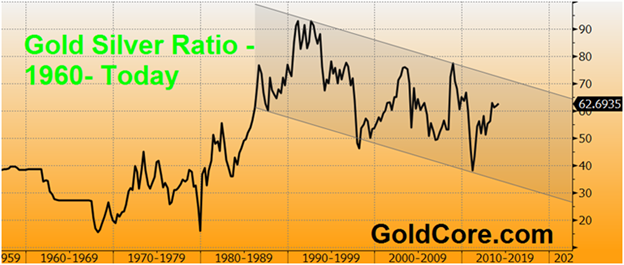
The gold/silver ratio is now at 65, meaning that with one ounce of gold, one can buy 65 ounces of silver. The historic average throughout most of history is 15 to 1. Even in the 20th Century, the century in which silver was demonetised, the gold silver ratio averaged around 40. GoldCore believe the ratio will revert to the mean average again in the coming years. There are a number of reasons that silver should revert to the long term historical mean but the two primary ones are the fact that geologically in the earth's crust there are fifteen parts of silver to every one part of gold.
Secondly, silver is used in many industrial, medical and technological applications today including photovoltaic cells in solar panels. Since the Industrial Revolution and in recent times, a huge amount of silver has been used up in industry. Silver is unlike gold in this regard. Rather it is akin to oil and other consumable commodities in this regard.
Thus, importantly silver is an attractive hybrid of commodity and precious metal used by investors as a store of value. Thus, for every ounce of gold in the world today, there is less than 15 ounces of silver. Passionate silver buyers or "silver stackers" say the actual ratio of above ground refined silver to above ground refined gold is close to 1 to 1. Even if one uses a conservative number of 20 to 1, it shows that silver remains very undervalued versus gold. The supply demand equation in silver has gotten much more favourable in recent years and gets more favourable with every passing year. For this reason we remain very confident that silver will surpass its 1980 record nominal high of $50/oz in the coming years. Indeed, the inflation adjusted high of $140/oz remains a viable price target in the long term. Silver will in the coming years reward the patient, long term investor and buyer. PREPARE FOR DOLLAR COLLAPSE WITH 10% TO 33% ALLOCATION TO GOLD James Rickards, author of best selling book, Currency Wars and now The Death of Money: The Coming Collapse of the International Monetary System has done another great interview, this time with Erik Schatzker and Stephanie Ruhle from Bloomberg Television's "Market Makers. Topics covered included the risk of a deflationary collapse and depression, the risks of printing and creating too many dollars, the manipulation of gold and the importance of focusing on the long term and not just trying to make money in the short term but rather on preserving wealth. DEFLATION AND THE RISK OF COLLAPSE "Are you going to believe me or the IMF? I have a little better track record." "The ultimate thesis is that deflation is the biggest problem in the world." "The world wants to deflate but central banks and governments cannot have deflation – it increases the debt-to-GDP ratio, destroys tax collection, creates bad debts and hurts the banks." "So central banks will do anything to avoid deflation. The way they do this is to print money. But if you print too much money then you'll collapse confidence in the U.S. dollar." "The U.S. dollar is ultimately backed by confidence, as also said by Paul Volcker." "The FEed is insolvent on a mark to market basis. I came to this conclusion himself, but insiders have also told me this privately…they won't say it publicly." "Money is a perpetual non-interest-bearing note issued by an insolvent central bank. DEPRESSION He admits that "if the Fed had not done everything they've done, then things would have been much worse than they were in 2010. No question about that — unemployment would have been higher and growth would have been lower. "But we should have been much stronger today. We should be having 7% growth now. We can't have 7% for a long time, but we can for a short time while people come back into the workforce. Instead we're Japan — we've got 1.9% growth as far as the eye can see. "So I would much rather have a little pain up front and then have robust growth". "Everyone wants a 'V' shape recovery, but you can't have a 'V' unless you get to the bottom. We didn't get to the bottom because the Fed truncated the 'V'. WHY SHOULD PEOPLE CARE HOW MUCH MONEY THE FED PRINTS? "If the money printing could go on indefinitely then you would be right and I would agree with you but it cannot go on indefinitely." "The Fed could legally print more than the $4 trillion they've already created — $8 trillion, $12 trillion, $16 trillion. Some people say that they can do that — legally they can but my view is that that will destroy confidence at some point." "People say why doesn't the Fed just forgive the Treasury debt and make $4 trillion go away? They could do it legally but what would that do to the confidence?" ECONOMY NOT RECOVERING "The Fed said we had "green shoots" in 2009. Timothy Geithner declared a recovery in 2010. Nobody has a worse forecasting record than the FED. They do a one-year forward forecast each year…they have been wrong and off by orders of magnitude every year." When asked who cares, Jim says, "listen to yourself …who cares about unlimited printing of money, who cares about bad forecasting, who cares about destroying confidence. "I care. I think we all should all care." THE CURSE OF THE 2 SECOND ATTENTION SPAN "WARREN BUFFETT IS BUYING HARD ASSETS AS FAST AS HE CAN" "I talk about this in Chapter 3 of The Death of Money’ the Fed is manipulating every market in the world with zero interest rates…I don't like to be in manipulated markets…I'd rather be in things that retain their value". RESULTS: GOLD VERSUS STOCKS In answer to this question regarding gold's underperformance versus stocks since stocks bottom in 2009, Rickards says, "this is exactly the chart I would expect to see if the market is manipulated by zero interest rates and margins sending stocks higher, and gold being manipulated lower." GOLD MANIPULATION "If you manipulate stocks higher and manipulate gold lower, then you'll see the chart from 2009 looking as it does." DATA MINING MAKE MONEY OR PRESERVE WEALTH "Do you want to make money or do you want to preserve wealth?" Because you could make money today and lose it tomorrow. Or you can preserve wealth. We talk about the 'old money' in the U.S. , the 100 year money, and the 'new money'. When you go to Europe, some of that money is 400 or 500 years old…and you say how did you survive the Thirty Years War, Napoleon and World War I etc. and they will say… A third — a third — a third… One third gold. One third art. One third land. And a little cash to run your jet and your yacht" he jested. "That's how you preserve wealth for the long run. If you want a short pop go buy some stocks." It is a very interesting interview and we like the conclusion where he said investors can all make money in the short term but we can lose it just as easily. Rickards does not expressly say one should put 33% of one's wealth in gold but suggests that an allocation of between 10% and 33% would be prudent. In this regard, he echoes Dr Marc Faber who suggested a 25% allocation to precious metals to us last week. Wealth preservation is something we have talked about since 2003. Indeed, our mission statement is to protect, preserve and grow the wealth of our clients. The interview with James Rickards can be watched here: Should Investors Prepare for a Dollar Doomsday? |
| Prepare For Dollar Collapse With 10% To 33% Allocation To Gold - Rickards Posted: 11 Apr 2014 05:32 AM PDT gold.ie |
| China’s gold demand ROSE 41% in 2013 – and this doesn’t include scrap and home production Posted: 11 Apr 2014 04:17 AM PDT Regular readers will no doubt be aware that the real story of 2013 wasn't about the drubbing the gold price got, rather, it was really about massive Chinese gold buying, and the flow of gold from... [[ This is a content summary only. Visit my website for full links, other content, and more! ]] |
| Gold trades below two-week high as China weighed against Fed Posted: 11 Apr 2014 04:07 AM PDT Gold traded below a two-week high in London as investors weighed signs of slowing demand from China. |
| More weakness ahead for precious metals Posted: 11 Apr 2014 03:54 AM PDT Miners have done little to confirm gold weakness following the bearish Fed minutes. |
| UBS trims 2014 Silver price forecast from $22.30 to $21.80 Oz Posted: 11 Apr 2014 03:15 AM PDT Zurich based UBS trimmed its this year average silver price forecast from $22.30 an ounce to $21.80 an ounce, saying the metal struggled to fully benefit from gold's safe-haven first-quarter gains. |
| U.S. Mined Silver Output Continues to Fall—USGS Posted: 11 Apr 2014 02:26 AM PDT "The sellers of last resort were at battle stations once again" ¤ Yesterday In Gold & SilverThe price action in gold on Thursday was very similar in most respects to the price action on Tuesday---and you can see that in the Kitco chart below. There were a couple of short, sharp rallies in Far East trading between the New York open on Wednesday evening, right up until 9 a.m. Hong Kong time on their Thursday morning. Then the price traded flat until the 8 a.m. BST London open. The rally continued at that point, as did the efforts of the sellers of last resort. However it all ended minutes after Comex trading began in New York yesterday morning---and it was all downhill into the close from there. The low and high ticks were recorded by the CME Group as $1,311.0 and $1,324.90 in the June contract. Gold finished the Thursday session at $1,318.10 spot, up $5.80 on the day. Volume, net of May, was 134,000 contracts, with well over a third of that amount occurring before the London a.m. gold fix, as the HFT boyz did what was necessary to prevent the gold price from blowing out to the upside and taking out the 50-day moving average with any kind of authority---which it would have done handily if the not-for-profit sellers hadn't intervened. It was virtually the same story in silver---and one can only imagine the rather large handle the silver price would have closed at if JPMorgan et al hadn't interfered. The low and high ticks were recorded as $19.86 and $20.40 in the May contract, an intraday move of almost 3%. Silver closed the trading day barely above the $20 spot mark at $20.03---up 18.5 cents on the day---but "da boyz" took it back below twenty bucks 45 minutes later, the moment that trading began in the Far East on their Friday. Gross volume was over 80,000 contracts once again, but it all netted out to around 38,000 contracts, about the same volume as Tuesday. Platinum and palladium had similar chart patterns, but their prices weren't capped for the final time until noon in New York. Both closed with very decent gains on the day. Here are the charts. The dollar index closed in New York late on Wednesday afternoon at 79.53---and then didn't do much of anything until the equities markets opened in New York yesterday morning. Then the index dropped down to its 79.35 low around 11:20 a.m. EDT---and from there it rallied a handful of basis points into the close. The index finished the Thursday session at 79.41---down 12 basis points on the day. Here's the 6-month dollar index chart---and you can see the damage that has been done during the last five trading sessions. Although the gold stocks gapped up a bit at the open on the positive gold price action, they probably got caught up in the general sell-off in the U.S. equity markets---and down they went as well. The HUI finished the day down 1.77%. It was the same for the silver stocks, as Nick Laird's Intraday Silver Sentiment Index got clocked to the tune of 2.29%. The CME's Daily Delivery Report showed that 46 gold and 20 silver contracts were posted for delivery within the Comex-approved depositories on Monday. Credit Suisse was the short/issuer on 45 of the gold contracts---and JPMorgan and Canada's Scotiabank stopped 38 of them. In silver, Morgan Stanley and JPM were the two issuers---and Canada's Scotiabank stood for delivery on all 20 contracts. The link to yesterday's Issuers and Stoppers Report is here. There was a tiny withdrawal from GLD yesterday, as an authorized participant took out 8,429 troy ounces. I would guess that this would represent a fee payment of some kind. And as of 10:05 p.m. EDT yesterday evening, there were no reported changes in SLV. Joshua Gibbons, the "Guru of the SLV Bar List," updated his website with the goings-on over at SLV for the reporting week that ended on Wednesday---and here's his report: "Analysis of the 09 April 2014 bar list, and comparison to the previous week's list---672,916.9 oz were added (all to Brinks London), 145,919.6 oz were removed, no bars had a serial number change." "The bars added were from: KGHM Poland (0.4M oz), Solar Applied Materials (0.2M oz and 2 others. The bars removed from were: KCM SA (0.1M oz), and 2 others. As of the time that the bar list was produced, it was overallocated 39.6 oz. All daily changes are reflected on the bar list." The link to Joshua's website is here. The U.S. Mint had sales report yesterday, but it was on the skinny side. They sold 3,000 troy ounces of gold eagles---25,000 silver eagles---and 300 platinum eagles. Over at the Comex-approved depositories on Wednesday, they reported receiving 14,202 troy ounces---and shipped out zip. All of the gold went into Brink's, Inc. The link to that 'activity' is here. Of course it was a lot busier in silver, as a chunky 1,123,832 troy ounces were reported received---and nothing was shipped out. The link to that action is here. If you haven't noticed from the CME warehouse report yet---and just as a point of interest---JPMorgan Chase is the top dog in physical silver as well, as their depository now hold 45.49 million troy ounces of the stuff---a couple of million more than does HSBC USA. One has to wonder how much more silver they may have stashed away, either in other Comex depositories [or elsewhere] in good delivery form that we just don't know about. Then there's the question of who the mystery buyer is of all those silver eagles that have been sold for the last year or so. Ted Butler suspects JPMorgan---and I'm not about to argue the point. I have the usual number of stories for a week-day column---and I hope you find some in here that interest you. ¤ Critical Reads Marc Faber's dire warning for the marketMarc says that the 2014 crash will be worse than 1987. This 11:52 minute video clip was posted over at the CNBC website very early yesterday afternoon EDT---and today's first news item is courtesy of reader Ken Hurt.  US Budget Deficit Falls In March To $37 BillionThe U.S. government's budget deficit shrank to just $37 billion in March from $107 billion in the same month last year, the latest sign of improvement in the nation's finances. The deficit was the lowest for the month of March in 14 years. The deficit fell partly because revenue jumped 16 percent to $216 billion, the Treasury Department said in its monthly budget report Thursday. Individual income and Social Security tax receipts have increased as employers have steadily hired more workers in the past year. And if you believe that's actually true, then I really do have this bridge I'd like to unload---and you look like the perfect buyer. This AP story showed up on the kitco.com Internet site at 2 p.m. EDT yesterday---and I thank West Virginia reader Elliot Simon for bringing it to our attention.  Internet giants to government: We can spy on customers' data, you shouldn'tSilicon Valley has been largely speaking out as of late against the United States government’s controversial surveillance programs, but some say the nation’s top cyber firms are scared that their own abilities to collect info could soon be eroded. Months into the ongoing and always heated debate about the U.S. National Security Agency’s spy operations, President Barack Obama said last December that he had appointed a small panel of experts to assess the NSA programs in question that had been exposed after former contractor Edward Snowden started to disclose classified documents earlier that year. That review group has since presented a few dozen recommendations to the White House, and last month President Obama asked Congress to codify into law changes concerning the way that the US government gets access to certain sensitive records — namely the telephony metadata created by telecommunication companies and currently gathered in bulk by the NSA, as exposed by Mr. Snowden. In January, however, the president also said a separate group would reach out to privacy experts, technologists and business leaders to inspect the way that “big data” is created, collected and used by both the public and private sector, and “whether we can forge international norms on how to manage this data and how we can continue to promote the free flow of information in ways that are consistent with both privacy and security.” This article showed up on the Russia Today website late yesterday afternoon Moscow time---and it's the first offering of the day from Roy Stephens.  More than 40,000 signed for 'Alaska Back to Russia' petitionThe petition on Alaska going back to Russia, posted on the White House website on March 21st 2014, has since been signed by over 40,000 people. It should be signed by at least 100,000 by April 20th so the US authorities come up with an official response. The petition points out that those residing in Siberia crossed into Alaska via Bering Strait ages ago. Russians became the first Europeans to appear in Alaska on August 21st 1732. The actual discoverers are the St. Gabriel ship crew under land surveyor Gvozdev and junior sailing master Fyodorov, who were part of the 1729-1735 Shestakov and Pavlutsky-led expedition. This rather amusing news item appeared on the Voice of Russia website early yesterday evening Moscow time---and if you're looking for a short history of Alaska before the U.S bought it from the Russians for a song in 1867---this is a must read. It's the second offering in a row from Roy Stephens, for which I thank him.  Draghi Seen Easing Policy by June as ECB Readies Rate CutMario Draghi will probably take action within two months against the threat of deflation, economists said. Almost two-thirds of respondents in the Bloomberg Monthly Survey predicted the European Central Bank president will ease policy by June. Of those economists, just under half said he may implement multiple measures ranging from interest-rate cuts to asset purchases and long-term loans. With euro-area inflation at the weakest in more than four years, Draghi says he has “unanimous” backing from policy makers for unconventional measures if needed. Even so, recent comments show officials haven’t yet agreed on which tools to use, setting them up for discussions on whether to take an unprecedented leap into quantitative easing or rely on smaller and more-targeted initiatives. This Bloomberg article, filed from Frankfurt, was posted on their website in the wee hours of Thursday morning Denver time---and I thank reader Ward Pace for sending it our way.  Christine Lagarde: Huge Government and banks debts risk new financial crashGeorge Osborne is to tell an audience of free-market campaigners in Washington that the UK's economic turnaround will defy those who say austerity and low wage growth will lead to long-term stagnation. In his first major speech in the US, the chancellor will attempt to demolish claims that a further five years of austerity will restrict growth and hurt workers' living standards. Osborne will argue at the American Enterprise Institute that low interest rates, the Bank of England's creation of new money through massive bond purchases under its quantitative easing programme and a strengthened banking sector can secure a bright future for the UK. Osborne's speech comes after head of the International Monetary Fund, Christine Lagarde, issued a warning to world leaders that they need to do more to deal with huge government and bank debts that she said continue to drag down growth and undermine the stability of the financial system. Speaking at the IMF's spring conference, Lagarde said leaders needed to co-operate in their efforts to repair public sector and bank finances to protect against a repeat of the 2008 crash. This article from The Guardian has had a major headline change, as you'll find out if you click on the link. It now reads a much softer sounding "George Osborne to use first major U.S. speech to rebuke critics of austerity." It was posted on their website early yesterday afternoon BST---and I thank South African reader B.V. for digging it up on our behalf.  Top economists warn Germany that EMU crisis as dangerous as everThe eurozone debt crisis is deepening and threatens to re-erupt on a larger scale when the liquidity cycle turns, a leading panel of economists warned in a clash of views with German officials in Berlin. "Debts above 130pc of GDP for Italy and 170pc for Greece are a recipe for disaster once we go into the next downturn," said Professor Charles Wyplosz, from Geneva University. "Today's politicians believe the crisis is over and don't want to hear any more about it, but they have not tackled the core issues of fiscal union and public debt," he said, speaking at Euromoney's annual Germany conference. This Ambrose Evans-Pritchard offering showed up on the telegraph.co.uk Internet site very early on Wednesday evening BST---and I thank Roy Stephens for another contribution to today's column. Angela Merkel denied access to her NSA fileThe U.S. government is refusing to grant Angela Merkel access to her NSA file or answer formal questions from Germany about its surveillance activities, raising the stakes before a crucial visit by the German chancellor to Washington. Merkel will meet Barack Obama in three weeks, on her first visit to the US capital since documents leaked by whistleblower Edward Snowden revealed that the NSA had been monitoring her phone. The face-to-face meeting between the two world leaders had been intended as an effort to publicly heal wounds after the controversy, but Germany remains frustrated by the White House's refusal to come clean about its surveillance activities in the country. This story is from theguardian.com Internet site---and it was posted there very early yesterday evening British Summer Time. It's certainly worth reading. Eight Ukraine/Crimea/Russia-related stories1. Putin tells Europe Ukraine gas debt 'critical', transit threatened: Russia Today 2. Russia Plotting for Ukrainian Influence, Not Invasion, Analysts Say: The New York Times 3. Politics aside, western financiers still want to do business with Russia: Russia Today 4. NATO uses crisis in Ukraine to justify its existence – Russian Foreign Ministry: Russia Today 5. Russian delegation leaves PACE session in protest at Ukraine resolution: Russia Today 6. NATO's images of Russian troops allegedly deployed on Ukrainian borders were taken in August 2013 - Russian Military: The Voice of Russia 7. Ukraine in talks with separatists, offers amnesty: Reuters 8. Russian oil firm says Asian buyers willing to use euros: Reuters 9. World Bank warns IMF terms will eat into consumption, investment in Ukraine: Russia Today [My thanks go out to reader B.V., Casey Research's own Laurynas Vegys---and Roy Stephens for providing the above stories] Is the U.S. or the World Coming to an End? — Paul Craig Roberts2014 is shaping up as a year of reckoning for the United States. Two pressures are building on the US dollar. One pressure comes from the Federal Reserve’s declining ability to rig t |
| Is the U.S. or the World Coming to an End? — Paul Craig Roberts Posted: 11 Apr 2014 02:26 AM PDT Is the U.S. or the World Coming to an End? — Paul Craig Roberts 2014 is shaping up as a year of reckoning for the United States. Two pressures are building on the US dollar. One pressure comes from the Federal Reserve’s declining ability to rig the price of gold as Western gold supplies shrivel and market knowledge of the Fed’s illegal price rigging spreads. The evidence of massive amounts of naked shorts being dumped into the paper gold futures market at times of day when trading is thin is unequivocal. It has become obvious that the price of gold is being rigged in the futures market in order to protect the dollar’s value from QE. The other pressure arises from the Obama regime’s foolish threats of sanctions on Russia. Other countries are no longer willing to tolerate Washington’s abuse of the world dollar standard. Washington uses the dollar-based international payments system to inflict damage on the economies of countries that resist Washington’s political hegemony. Russia and China have had enough. As I have reported---and as Peter Koenig reports, Russia and China are disconnecting their international trade from the dollar. Henceforth, Russia will conduct its trade, including the sale of oil and natural gas to Europe, in rubles and in the currencies of its BRICS partners. This commentary by Paul falls into the must read category as far as I'm concerned, especially for any serious student of the New Great Game. I thank Luxembourg reader Rudi Staudinger for bringing it to our attention. |
| Five King World News Blogs/Audio Interviews Posted: 11 Apr 2014 02:26 AM PDT  Five King World News Blogs/Audio Interviews Five King World News Blogs/Audio Interviews 1. William Kaye [#1]: "Gold Delivery Strains Reappear---and What Might Destroy COMEX" 2. Art Cashin: "Critical Metric is Now Over 1,000 Times Higher Than Normal!" 3. Jean-Marie Eveillard: "U.S. Gold Gone---and What 52 Years in This Business Taught Me" 4. William Kaye [#2]: "The Secret That Has U.S. and Western Leaders Truly Terrified" 5. The audio interview is with Gerald Celente |
| Chris Martenson and Alasdair Macleod discuss China's corner on gold Posted: 11 Apr 2014 02:26 AM PDT Chris Martenson and Alasdair Macleod discuss China's corner on gold Market analyst Chris Martenson and GoldMoney's Alasdair Macleod discuss China's increasing control of the gold market, anti-gold propaganda in the Western financial news media, the likelihood that Western governments will commandeer the gold of private investors, and other provocative topics in an interview posted this week in audio and text versions at Martenson's Internet site, peakprosperity.com |
| U.S. mined silver output continues to fall--USGS Posted: 11 Apr 2014 02:26 AM PDT  U.S. mined silver output continues to fall--USGS U.S. mined silver output continues to fall--USGS U.S. mines produced 80,900 kilograms (2,600,995 troy ounces) of silver in November 2013, a 14% decrease from the 94,300 kg (3,031,815 oz) produced in November 2012, the U.S. Geological Survey reported. Monthly silver production continued on a downward trend that began in June 2013, the USGS observed. Average daily U.S. silver production in November 2013 was 2,700 kg (86,807 oz), compared with 3,140 kg (100,953 oz) in November 2012. The Silver State of Nevada led silver production in November 2013 with 19,700 kg (633,369 oz) of output, while the combined total production of Alaska, Arizona, California, Colorado, Idaho, Missouri, Montana, New Mexico, South Dakota and Utah was 60,900 kg (1,957,980 oz). Total U.S. silver output from January to November 2013 totaled 956,000 kg (30,736,114 oz), said the Geological Survey. Wow! U.S. silver production is even worse than I imagined it to be---only a bit over 33 million ounces per year based on current production rates. That means that the U.S. Mint has to import about 10 million ounces of silver per year just to meet demand. One has to wonder how much more has to be imported on a yearly basis to meet the rest of U.S. silver demand. I would bet that it's a lot. The above five paragraphs are all there is to this news item that was posted on the mineweb.com Internet site just after midnight Reno time this morning, but it's worth reading a second time if you've already read it. By the way, here's a link to the Top 10 silver producers in 2013. |
| Lawrence Williams: Silver being left behind in latest gold price surge – but don’t despair! Posted: 11 Apr 2014 02:26 AM PDT Lawrence Williams: Silver being left behind in latest gold price surge – but don't despair! Silver investors will have been a little disappointed by the metal’s performance vis-à-vis the gold price following the latter’s gains after the release of the latest U.S. FOMC meeting minutes. The minutes suggested that the low interest rate regime may well continue longer than expected and resulted in a major boost to the stock market and a significant uptick in the gold price. But it had rather less impact on silver which initially remained stuck below the $20 mark, although this morning’s trade has at last see it move up above this mark. Perhaps European investors are less pessimistic about silver’s investment credentials. Now silver usually moves with gold, but in a more exaggerated manner so the silver investors could have been forgiven for expecting that the near 2% rise in the gold price since Tuesday would be accompanied by an even greater rise in silver in percentage terms. This may yet happen should the gold price continue its latest mini-surge, but silver has been more volatile and indeed the price actually fell back sharply on some adverse comment in the U.S. before recovering quite well in this morning’s trade… But over the same 3 day period that gold rose the 2% mentioned above the silver price was, in effect, following a very sharp temporary dip yesterday. So why is silver behaving in this manner. Perhaps the short answer is China. That's not the short answer---and Lawrie knows it. But why he won't say it in the public domain is beyond me. Silver analyst Ted Butler says that JPMorgan Chase has a 20,000 contract short-side corner in the Comex futures market in silver---which represents 16% of the total net open interest as of last Friday's Commitment of Traders Report. They, along with the smaller Commercial traders, run the show in silver---and the other three precious metals as well. End of story. If you read this commentary, I would do it for entertainment purposes only. |
| Posted: 11 Apr 2014 02:25 AM PDT invezz |
| $1320 - Gold negotiates the key resistance – Analysis - 11/04/2014 Posted: 11 Apr 2014 12:45 AM PDT economies |
| Metals Pack Fundamental Analysis April 11, 2014 Forecast – Silver & Copper Posted: 11 Apr 2014 12:25 AM PDT fxempire |
| Gold Prices Forecast April 11, 2014, Technical Analysis Posted: 10 Apr 2014 11:15 PM PDT fxempire |
| CHARTS - Gold Recovery Continues, SPX 500 Vulnerable to Deeper Losses Posted: 10 Apr 2014 11:10 PM PDT dailyfx |
| Posted: 10 Apr 2014 10:55 PM PDT marketoracle |
| Gold begins tentative recovery Posted: 10 Apr 2014 10:55 PM PDT cityindex |
| Gold Shines, But Rally May Be Short-Lived Posted: 10 Apr 2014 10:50 PM PDT actionforex |
| Foreign Central Bank Holdings of US Treasuries back on the Rise again Posted: 10 Apr 2014 10:16 PM PDT A while back, I posted a chart of the Custodial Holdings of Treasuries for Foreign Central Banks that revealed a sharp drop in the number held from over $3.021 trillion to near $2.855 trillion, or about $166 billion. At the time I mentioned it was rather remarkable and thus warranted monitoring. Shortly after the number became public, we had the usual "end of the world" scenarios for the US Dollar as the perma-gold bull community began talking up their usual the "run on the Dollar has begun" thesis. Many were talking Russian dumping of US Treasuries as a move away from the Dollar that was going to snowball. Of course, implied in all this was talk of gold shooting to the moon again. Well, here we are exactly 4 weeks after hitting the low point in those reported Treasury holdings and we are back to $2.972 trillion, not far off the all-time peak noted above and the largest number since January 30, 2014. Apparently the run on the Dollar has not begun in earnest among foreign central banks. Here is the chart:  |
| Chris Martenson and Alasdair Macleod discuss Chinas corner on gold Posted: 10 Apr 2014 09:32 PM PDT GATA |
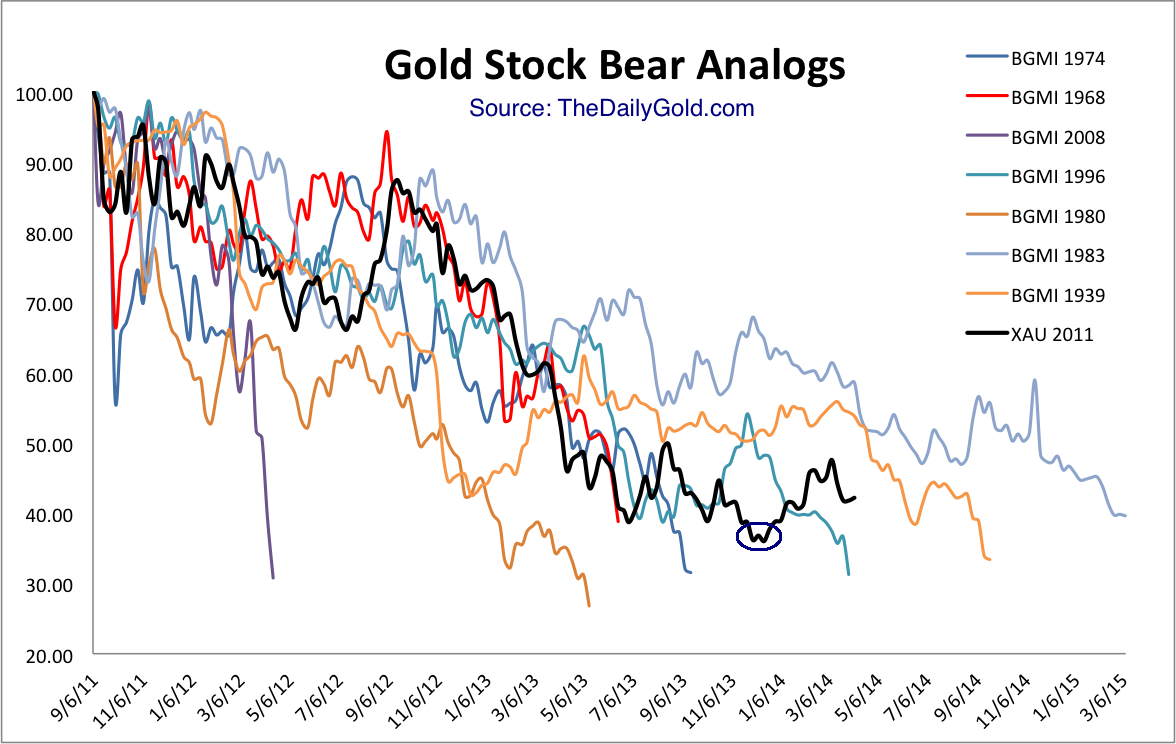
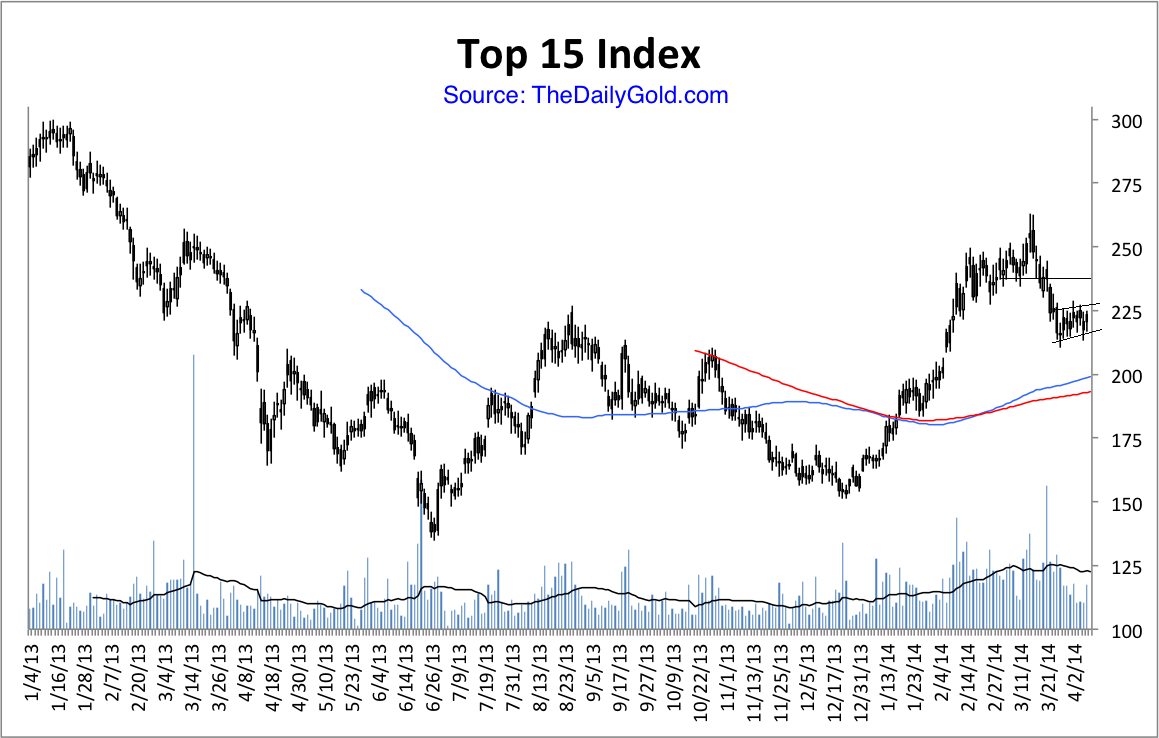
| More Weakness Ahead for Precious Metals Posted: 10 Apr 2014 08:31 PM PDT The Fed minutes were dovish and this helped push Gold above $1310 to $1320. However, the miners, which usually lead the metals did little to confirm the rise. In fact, the miners have been relatively weak in recent days and had a bearish reversal on Thursday. Their rebound from an oversold condition has petered out. Another point is Gold, during this rebound has made no progress against foreign currencies. It's starting to show some strength against the equity market but it needs to show strength against all currencies and not function only as the inverse of the US Dollar. Be on alert as the short-term trend for precious metals (especially the miners) could resume to the downside. Looking further out, forthcoming weakness shouldn't last that long in the big picture. The miners have been basing for quite a while and started to gain traction in Q1. The next low at worst could be a double bottom or otherwise would mark the first higher low in this bottoming process. In the chart below we plot GDX (large caps), GDXJ (juniors), SIL (silver stocks) and GLDX (explorers). We note how much each would have to decline to test its December low. Our gold stock bear analogs chart, which helped us call the June 2013 low and anticipate the December 2013 low, makes a strong argument that the final low (on a weekly basis) occurred in December. The low is circled but we kept the plot going for further comparison. Compared to the present, there are only two bears that lasted longer and at present both were down less than 50%. Note that at the December low when gold stocks were down 64%, the three bears which lasted longer were off no more than 50%. The 1996-1999 bear which ended at this time down 69% is an interesting case. It did reach lower levels in 2000 before the current secular bull started. However, after the 1999 low gold stocks exploded led by the GDM index (forerunner to GDX) which surged 75% in a few months. Then the stocks consolidated for many months before popping again. During this brief 14-month respite the GDM gained 90%, the XAU 83% and the HUI 68%. After the bottom in 1999, GDM and XAU broke to new lows two years and two months later. The HUI, which was more attached to the epic junior bubble of the mid 1990s, reached new lows one year and nine months later. Considering this history, even the most bearish person would have to admit that the market needs to consolidate for a while (as in way more than a year) to have any chance to reach new sustained lows. Gold stocks enjoyed a huge short covering rally shortly after the 1999 low. Yet even after the short covering ended the preceding bear market low wasn't breached for roughly two years! Why is this bottom taking so long? A few weeks ago we posited that it could be because of the extended topping process in 2011-2012. Perhaps that unusual topping process is giving way to an unusual bottoming process. In any event, the best plan is to wait patiently for the next oversold condition or in case we are wrong, wait for the next breakout. I don't expect a breakout anytime soon. The indices look weak and TheDailyGold Top 15 Index (15 of our favorite companies) also appears to have downside potential in the coming days and weeks. Nevertheless, I am actively researching companies as well as watching their price action. The coming months could be your last best chance to accumulate the companies poised to benefit from the coming revival in precious metals. If you'd be interested in learning about the companies poised to outperform, then we invite you to learn more about our service. Good Luck! Jordan Roy-Byrne, CMT The post More Weakness Ahead for Precious Metals appeared first on The Daily Gold. |
| If inflation is really not dead but resting then precious metals and oil are the thing to be buying Posted: 10 Apr 2014 07:22 PM PDT Buying stocks on the momentum trade as central banks around the world gradually hiked their monetary bases over the past five years has been a winning hand. However, the next stage of the central bank plan is to overshoot on monetary expansion and force inflation to reduce the real burden of debt on the global economy. It has to be done. Central banks have a long history of talking one way and acting in another. They talk about low inflation, for example, while pumping money into the economy like mad to prevent deflation. And it is deflation that worries the central banks most. A deflationary debt spiral is a slam dunk for a global depression. Central bank errors Now history also shows that central banks are very bad at fine tuning their policies. Why did the Fed keep interest rates for so long that the US got its subprime housing bust? By trying to avoid one bust they just ended up getting a bigger one, and they are now doing exactly the same thing. For if the money printing goes on long enough then it does produce inflation, and that can only happen as the major economies enter a recovery stage as we see in the US, UK, EU and maybe Japan this year. This is the unexpected consequence that comes back to bite the market. Now what happens next? Interest rates will rise. Bond markets will tank. Pension funds will be screaming. Equities also take a hit because their dividends will be too low in comparison with bond yields, and lower share prices will boost equity yields to compete. This is where you get back to the classic win-win market for real assets like oil and gold that last existed in its purest form in the late 1970s. It ought to be great news for ArabianMoney and our investors in the Gulf States. Energy prices will let rip. Is that why Warren Buffett likes energy and inflation-protected assets these days? Gold and especially silver would be the obvious other beneficiaries in a flight from bonds and many equities. The stock market would become as skewed towards Big Oil and precious metal stocks as in the late 1970s. Gold top Eventually markets would settle enough for a Paul Volcker substitute to enter and pull away the punch bowl. Mrs Yellen would take her late retirement. Then it would be a time to rotate back out of real assets and buy into bonds or depressed major stocks or real estate. The problem for readers is that this analysis requires a leap of imagination. It is far from the consensus view. But if you think about it this is far less off-the-wall than just projecting an exhausted stock market rally into the blue yonder. The reversal is starting to happen now, first in tech stocks. Just because experts are confused about where markets move next will not stop them moving… |
| Gold Moves Higher as Marc Faber Warns of 87-Style Stock Market Crash Posted: 10 Apr 2014 05:58 PM PDT Marc Faber is warning that a large stock market crash could be coming. How will gold perform in such an environment? In the past five days that the S&P 500 is down 3%, gold is up 3%. Year to date gold is up 9%, the GDX mining stock index is up 16% and the S&P [...] |
| Another smashing of gold unlikely because it would unleash demand, Kaye says Posted: 10 Apr 2014 05:02 PM PDT GATA |
| Posted: 10 Apr 2014 03:27 PM PDT |




| You are subscribed to email updates from Gold World News Flash 2 To stop receiving these emails, you may unsubscribe now. | Email delivery powered by Google |
| Google Inc., 20 West Kinzie, Chicago IL USA 60610 | |

No comments:
Post a Comment