


Gold World News Flash |
- Does the Gold Price reflect true gold Demand and Supply?
- Remarkable Events Taking Place As The War In Gold Heats Up
- The Gold Market’s Big First Quarter Surprise
- U.S. Mined Silver Output Continues to Fall
- 70 Militarized Federal Agencies & A Standoff In Nevada Later, US Tyranny At All-Time High
- Meltdown America: The Movie
- Peak "Hope"
- Shipbuilding Orders Evaporate As Baltic Dry Collapses
- Paul Craig Roberts – 2014 Will Be Year Of Reckoning For U.S.
- The Gold Price Gained $15.50 this Week Ending at $1,303.20
- The Gold Price Gained $15.50 this Week Ending at $1,303.20
- As The Bitcoin Bubble Bursts, Digital Currencies Have A Dilution Problem
- Chief Economist Of Central Banks' Central Bank: "It's Extremely Dangerous... I See Speculative Bubbles Like In 2007"
- Goldman Summarizes The Rout: "Derisking Is The Name Of The Game"
- Gold Daily and Silver Weekly Charts - Flight To Safety
- Gold Daily and Silver Weekly Charts - Flight To Safety
- There Is No Direct Relationship Between Gold Price And ETF Stocks
- Investment Solutions in an Age of Monetary Madness
- Paul Craig Roberts - 2014 Will Be Year Of Reckoning For U.S.
- Palladium Breaks $800 As Economic Sanctions Stifle Russian Miners
- The West’s Slow-Motion Collapse
- Gold's Gory Crash, One Year On
- Gold's Gory Crash, One Year On
- Gold's Gory Crash, One Year On
- IMF lies about U.S. and U.K. economies, von Greyerz tells KWN
- More on the Gold Fix
- More on the Gold Fix
- Asia Still Wants Physical Gold
- Asia Still Wants Physical Gold
- The Dollar? A Currency, Not Investment
- The Dollar? A Currency, Not Investment
- Debt: Destroyer of Lives, Businesses, and Countries
- GDX Gold Stocks Benchmark
- Better Tone to Gold and Silver
- Gold and Bail-ins
- Silver Price Finally Outperforms – How Bullish Is That?
- Does the Gold Price reflect true gold Demand and Supply?
- The Gold Market’s Big First Quarter Surprise
- More Weakness Ahead for Gold and Silver
- Precious Metals Market Report with Franklin Sanders
- Limits to Employment Participation, and Societal Change
| Does the Gold Price reflect true gold Demand and Supply? Posted: 11 Apr 2014 11:30 PM PDT In short, no it doesn't! We will look at why not, in this article. by Julian D. W. Phillips, Gold Seek:
Despite the furore surrounding the Gold Fix [unfairly, we believe] it is a singularly determined attempt amongst commodities to set a twice daily price that does reflect demand and supply of gold, at those moments. To understand this we have to see what happens at the Fixing sessions. | |||||||||||||||||||||||||||||||||||||||||||||||||||||||||||||||||
| Remarkable Events Taking Place As The War In Gold Heats Up Posted: 11 Apr 2014 09:01 PM PDT  With the end of a wild week of trading coming to a close, today one of the great veterans of the gold world sent King World News an extraordinary piece covering the remarkable events we are seeing take place in the war on gold, as well as a stunning look at the big picture for this key market. Below is the outstanding piece, which includes 5 fantastic charts, by John Hathaway of Tocqueville Asset Management. With the end of a wild week of trading coming to a close, today one of the great veterans of the gold world sent King World News an extraordinary piece covering the remarkable events we are seeing take place in the war on gold, as well as a stunning look at the big picture for this key market. Below is the outstanding piece, which includes 5 fantastic charts, by John Hathaway of Tocqueville Asset Management.This posting includes an audio/video/photo media file: Download Now | |||||||||||||||||||||||||||||||||||||||||||||||||||||||||||||||||
| The Gold Market’s Big First Quarter Surprise Posted: 11 Apr 2014 09:00 PM PDT by Frank Holmes, Daily Reckoning.com.au:
The mission of the Asia Mining Club is to promote education among its members, and one way to achieve this is by hearing from experts in the financial markets, notably those focused on resources and commodities. During the club's sell-out event, I too, confirmed a great deal about the commodity "buzz" on that side of the world, especially on gold… | |||||||||||||||||||||||||||||||||||||||||||||||||||||||||||||||||
| U.S. Mined Silver Output Continues to Fall Posted: 11 Apr 2014 08:20 PM PDT by Ed Steer, Casey Research:
There was a tiny withdrawal from GLD yesterday, as an authorized participant took out 8,429 troy ounces. I would guess that this would represent a fee payment of some kind. And as of 10:05 p.m. EDT yesterday evening, there were no reported changes in SLV. | |||||||||||||||||||||||||||||||||||||||||||||||||||||||||||||||||
| 70 Militarized Federal Agencies & A Standoff In Nevada Later, US Tyranny At All-Time High Posted: 11 Apr 2014 08:00 PM PDT by Jeff Berwick, Dollar Vigilante:
It has been one of the major untold stories of the Barack Obama presidency. The US federal government has militarized more than 70 agencies, from the post office to park rangers. Even the Social Security office and the International Revenue Service are a part of the shocking trend which should raise red flags for all Americans or anyone living in the US. Since 2009 The Dollar Vigilante Blog has brought you story after story covering federal purchases of hollow-point ammunition, firearms, even tanks for federal agencies like the US Postal Service and Social Security. In 2008 Barack Obama promised to create a private civilian army as strong and well-funded as the military. This is now the reality. | |||||||||||||||||||||||||||||||||||||||||||||||||||||||||||||||||
| Posted: 11 Apr 2014 07:12 PM PDT Listening to the Canary, submitted by Casey Research By Terry Coxon, Senior Economist During World War II, the British Royal Air Force (RAF) undertook a plan of misdirection to allow a squadron of bombers to approach an exceptionally valuable target in Europe undetected. The target was so heavily guarded that destroying it would require more than the usual degree of surprise. Although the RAF was equipped to jam the electronic detection of aircraft along the route to the target (a primitive forebear of radar was then in use), they feared that the jamming itself would alert the defending forces. Their solution was to "train" the defending German personnel to believe something that wasn't true. The RAF had a great advantage in undertaking the training: The intended trainees were operating equipment that was novel and far from reliable; and those operators were trying to interpret signals without the help of direct observation, such as actually seeing what they were charged with detecting. At sunrise on the first day, the RAF broadcast a jamming signal for just a fraction of minute. On the second day, it broadcast a jamming signal for a bit longer than a minute, also around sunrise. On each successive day, it sent the signal for a somewhat longer and longer time, but always starting just before sunrise. The training continued for nearly three months, and the German radar personnel interpreted the signals their equipment gave them in just the way the British intended. They concluded that their equipment operates poorly in the atmospheric conditions present at sunrise and that the problem grows as the season progresses. That mistaken inference allowed an RAF squadron to fly unnoticed far enough into Europe to destroy the target. People will get used to almost anything if it goes on for long enough. And the getting-used-to-it process doesn't take long at all if it's something that people don't understand well and that they can't experience directly. They hear about Quantitative Easing and money printing and government deficits, but they never see those things happening in plain view, unlike a car wreck or burnt toast, and they never feel it happening to themselves. QE has become just a story, and it's been going on for so long that it has no scare value left. That's why so few investors notice that the present situation of the US economy and world investment markets is beyond unusual. The situation is weird, and dangerously so. But we've all gotten used to it. Here are the four main points of weirdness:
Almost no one imagines that the current situation can continue indefinitely. But is there a way for it to end nicely? For most investors, the expectation (or perhaps just the hope) that things can gracefully return to normal rests on confidence that the people in charge, especially the Federal Reserve governors, are really, really smart and know what they're doing. The best minds are on the job. If the best minds were in charge of designing a bridge, I would expect the bridge to hold up well even in a storm. If the best minds were in charge of designing an airplane, I would expect it to fly reliably. But if the best minds were in charge of something no one really knows how to do, I would be ready for a failure, albeit a failure with superb academic credentials. Despite all the mathematics that has been spray-painted on it, economics isn't a modern science. It's a primitive science still weighted with cherished beliefs and unproven dogma. It's in about the same stage of development today that medicine was in the 17th century, when the best minds of science were arguing whether the blood circulates through the body or just sits in the veins. Today economists argue whether newly created cash will circulate through the economy or just sit in the hands of the recipients. Let's look at the puzzle the best minds now face. If the Federal Reserve were simply to continue on with the money printing that began in 2008, the economy would continue its slow recovery, with unemployment drifting lower and lower. Then the accumulated increase in the money supply would start pushing up the rate of price inflation, and it would push hard. Only a sharp and prolonged slowdown in monetary growth would rein in price inflation. But that would be reflected in much higher interest rates, which would push the federal deficit back above the trillion-dollar mark and also push the economy back into recession. So the Fed is trying something else. They've begun the so-called taper, which is a slowing of the growth of the money supply. Their hope is that if they go about it with sufficient precision and delicacy, they can head off catastrophic price inflation without undoing the recovery. What is their chance of success? My unhappy answer is "very low." The reason is that they aren't dealing with a linear system. It's not like trying to squeeze just the right amount of lemon juice into your iced tea. With that task, even if you don't get a perfect result, being a drop or two off the ideal won't produce a bad result. Tinkering with the money supply, on the other hand, is more like disarming a bomb—and going about it according to the current theory as to whether it's the blue wire or the red wire that needs to be cut means a small failure isn't possible. Adjusting the growth of the money supply sets off multiple reactions, some of which can come back to bite. Suppose, for example, that the taper proceeds with such a light touch that the US economy doesn't tank. But that won't be the end of the story. Stock and bond markets in most countries have been living on the Fed's money printing. The touch that's light enough for the US markets might pull the props out from under foreign markets—which would have consequences for foreign economies that would feed back into the US through investment losses by US investors, loan defaults against US lenders, and damage to US export markets. With that feedback, even the light touch could turn out not to have been light enough. To see what the consequences of economic mismanagement can be, and how stealthily disaster can creep up on you, watch the 30-minute documentary, Meltdown America. Witness the harrowing tales of three ordinary people who lived through a crisis, and how their experiences warn of the turmoil that could soon reach the US. Click here to watch it now.
| |||||||||||||||||||||||||||||||||||||||||||||||||||||||||||||||||
| Posted: 11 Apr 2014 06:46 PM PDT The gap between current Q1 reality and forward-looking, hope-stuffed, unicorn-tear-fueled expectations for US economic growth has reached a new peak of Keynesian 'faith'. This week saw "economists" downgrade Q1 GDP expectations once again to a mere 1.6% growth (from 2.6% in January) - meaning that cold weather is responsible for a 46% collapse in US economic growth expectation. As the chart below 'hints' at, it appears we have reached "peak hope."
h/t @Not_Jim_Cramer | |||||||||||||||||||||||||||||||||||||||||||||||||||||||||||||||||
| Shipbuilding Orders Evaporate As Baltic Dry Collapses Posted: 11 Apr 2014 06:14 PM PDT The silence is deafening still about the ongoing collapse in the Baltic Dry Index among mainstream media types (as it just might challenge the hope/hype that growth is coming back). At the dismal level of 1002, BDIY is at 8-month lows and has fallen 14 days in a row... but now it is having a real world impact. As Sea News reports, Korean shipping companies are failing to place orders for large vessels and anxiety over the future is forcing some local companies to dispose of their assets despite the relatively low shipbuilding costs as of late.
The Baltic Dry is down 14 days in a row at $1002 - its lowest in 8 months (and worst start to a year on record)
It seems Korea is particularly hard hit since its government won't subsidize the losing proposition like Denmark and China is willing to...
We are sure the fact that the industry has been overbuilt - based on Keynesian-policy-inspired mal-investment and mispriced signals from global markets - will be used as the excuse for the collapsing price of shiiping dry bulk... but that argument s entirely circular and fallacious as it merely reinfoces the unintended consequences of the oh so visible hand in the world's markets and leaves more zombie entities clogging up any potential economic growth that is possible in a world of peak debt. | |||||||||||||||||||||||||||||||||||||||||||||||||||||||||||||||||
| Paul Craig Roberts – 2014 Will Be Year Of Reckoning For U.S. Posted: 11 Apr 2014 06:06 PM PDT Dear CIGAs, Today former US Treasury official, Dr. Paul Craig Roberts, warned King World News that 2014 will be a dangerous year of reckoning for the United States. Dr. Roberts also warned a collapse is coming that will be so powerful it will overrun the Exchange Stabilization Fund and other measures now in place by... Read more » The post Paul Craig Roberts – 2014 Will Be Year Of Reckoning For U.S. appeared first on Jim Sinclair's Mineset. | |||||||||||||||||||||||||||||||||||||||||||||||||||||||||||||||||
| The Gold Price Gained $15.50 this Week Ending at $1,303.20 Posted: 11 Apr 2014 05:21 PM PDT
The GOLD PRICE backed down $1.40 (0.7%) today to $1,318.70, while that rascal silver gave up 14.5 cents (0.1$) to 1993.3. Gold's loss signifieth nothing, as it remains above its 200 ($1,298), 50 ($1,314), and 20 (1,311.25) day moving averages, as well as support/resistance at roughly $1,318. Every indicator I watch points higher, so why am I gnawing my nails? Gold's moving slowly and that scoundrel silver won't climb up high enough to confirm gold's move. Of course, that is easily explained by the weakness in stocks, but still . . . The GOLD PRICE weekly chart shows upward bias, too, and gold stands above its 18 week MA ($1,284.43) and 50 week MA ($1,312.79) and barely above its downtrend line from August 2011. All burners lit. The SILVER PRICE actually fell back from its 20 DMA (2007c) today and closed below it. 2015c keeps stopping it. In fact, silver needs to throw a leg over 2050c and run. Yes, yes, all the indicators point higher, but this is awfully slow and trying. Back off and review the last year. The gold price must better its $1,434 peak from last August, then climb over $1,550 where it was clobbered last April. Silver needs to beat its recent 2218c high, then its 2512c August high, and then 225c where it fell off a year ago. Until gainsaid, the double bottom in June and December says silver and gold prices won't drop any lower, and that they have begun their next leg up. Bull markets always climb a wall of worry, so y'all ought to expect that now. Meanwhile gold and silver's best friends remain the Federal Reserve, world central banks, and the yankee government since their policies are bound to send them higher. Wall Street bled and bled this week, and no bandaids are in sight, let alone tourniquets. US dollar index broke, too, while silver and gold held up and the white metals (platinum and palladium) also gained. Nothing normal about this situation, and a stock market rout always carries in its bosom the threat of contagion to other markets. 2008 was not so long ago. Stocks had their worst week since memory runneth not to the contrary, and today only opened more blood vessels. Technically the damage astounds me. Dow lost 385.96 points this week or 2.4%, 143.47 points today (0.89%) 7 closed at 16,026.75. That's 3.3% lower than the high close on 3 April. Damage doesn't stop there. Dow closed today beneath its 50 day moving average ((16,172) -- 20 DMA (16,331.25) was left behind yesterday. Recall that in November last year the Dow "threw over" its upper boundary line. Today it crossed beneath it again, and for good measure punched thru the bottom Bollinger Band. February's low was 15,340.89. The Dow could fall much, much further as Don't overlook the Nasdaq Composite. It's lost 8.3% since its downtrend began on 5 March. Since 2 April it has lost 6.5%. It, too, languisheth far below its 20 and 50 DMA, and treadeth not far from its 200 DMA (3,936.25). Then there's the S&P500. Down 2.6% this week, it lost 17.39 (0.9%) today to end at 1,815.69. 200 DMA stands at $1,761.43 and the last (February) low at 1,737.92. Why do I mention the 200 DMA? In a rising market the price spends most of its time ABOVE the 200 DMA. From time to time in large corrections it will re-visit its 200 DMA, and wide knowledge of this fact means that investors will wait to buy there, and thus support the market. A bfreak below the 200 DMA is very bad juju. This is a rout, like First Manassas. The blue army is running back to Washington and throwing away rifle and knapsack as they flee. Mark, however: it is not impossible for stocks to return and make one last high in May. Dow in Silver dropped 0.54% today (4.36 oz) to 802.94 oz (S$1,038.14 silver dollars) in what appears to be a downtrend renewed after the correction from March through 1 April. Dow in Gold has really tanked. Dropped another 0.91% today to 12.16 oz (G$251.37 gold dollars) and skidded to a stop smack atop the 200 DMA. Bottom of that correction was 11.62 oz (G$240.21) so the DiG has not far to travel to confirm unequivocally a new downleg. US dollar index experienced a Niagara week, and waterfalls don't flow up. Gained 10 basis points today to end at 79.57. Stinks. Sits below its 20 and 50 DMA, but won't confirm a new debacle until it closes below 79. Euro has been the chief beneficiary of the dollar's woes, but is now stuck below its last peak. Ended today flat at $1.3876. Yen has met its major downtrend line and top of its 2 month trading range. Must fish or cut bait or row back to the dock. Flat at 98.42 cents/Y100. Could escape skyward. I watch the Philadelphia Bank Stock index divided by Gold because that reveals which way the investing public's confidence is leaning. The spread is a fraction, with the bank stock index as the numerator and the gold price as denominator. Thus when gold is rising faster than the Bank Stock Index the denominator is growing faster than the numerator so the graph falls. Voilà, chart is here: http://bit.ly/1sOiOAy This spread peaked early in January, sank with the gold rally/stock correction into end-February, rose as stocks rallied and gold corrected, and since 1 April has cascaded down to close at its 200 DMA today. It has twice already reached this point in March, not a hopeful sign. This suggests investors appetite for risk and confidence in financial markets is dropping as they adopt the motto, "In gold we trust, not banks." Another measure of dropping confidence or panic, call it which you will, is the yield on the 10 year treasury note. It has also looked like Iguaçu Falls lately, and has even fallen below its uptrend line to 2.619%. Bear in mind that yields (interest rates) fall as bonds rise, and bonds rise because there is more demand for the safety they offer. Sizeable shift like this rolls snake-eyes for stocks. Y'all enjoy your weekend! Aurum et argentum comparenda sunt -- -- Gold and silver must be bought. - Franklin Sanders, The Moneychanger The-MoneyChanger.com © 2014, The Moneychanger. May not be republished in any form, including electronically, without our express permission. To avoid confusion, please remember that the comments above have a very short time horizon. Always invest with the primary trend. Gold's primary trend is up, targeting at least $3,130.00; silver's primary is up targeting 16:1 gold/silver ratio or $195.66; stocks' primary trend is down, targeting Dow under 2,900 and worth only one ounce of gold or 18 ounces of silver. or 18 ounces of silver. US $ and US$-denominated assets, primary trend down; real estate bubble has burst, primary trend down. WARNING AND DISCLAIMER. Be advised and warned: Do NOT use these commentaries to trade futures contracts. I don't intend them for that or write them with that short term trading outlook. I write them for long-term investors in physical metals. Take them as entertainment, but not as a timing service for futures. NOR do I recommend investing in gold or silver Exchange Trade Funds (ETFs). Those are NOT physical metal and I fear one day one or another may go up in smoke. Unless you can breathe smoke, stay away. Call me paranoid, but the surviving rabbit is wary of traps. NOR do I recommend trading futures options or other leveraged paper gold and silver products. These are not for the inexperienced. NOR do I recommend buying gold and silver on margin or with debt. What DO I recommend? Physical gold and silver coins and bars in your own hands. One final warning: NEVER insert a 747 Jumbo Jet up your nose. | |||||||||||||||||||||||||||||||||||||||||||||||||||||||||||||||||
| The Gold Price Gained $15.50 this Week Ending at $1,303.20 Posted: 11 Apr 2014 05:21 PM PDT
The GOLD PRICE backed down $1.40 (0.7%) today to $1,318.70, while that rascal silver gave up 14.5 cents (0.1$) to 1993.3. Gold's loss signifieth nothing, as it remains above its 200 ($1,298), 50 ($1,314), and 20 (1,311.25) day moving averages, as well as support/resistance at roughly $1,318. Every indicator I watch points higher, so why am I gnawing my nails? Gold's moving slowly and that scoundrel silver won't climb up high enough to confirm gold's move. Of course, that is easily explained by the weakness in stocks, but still . . . The GOLD PRICE weekly chart shows upward bias, too, and gold stands above its 18 week MA ($1,284.43) and 50 week MA ($1,312.79) and barely above its downtrend line from August 2011. All burners lit. The SILVER PRICE actually fell back from its 20 DMA (2007c) today and closed below it. 2015c keeps stopping it. In fact, silver needs to throw a leg over 2050c and run. Yes, yes, all the indicators point higher, but this is awfully slow and trying. Back off and review the last year. The gold price must better its $1,434 peak from last August, then climb over $1,550 where it was clobbered last April. Silver needs to beat its recent 2218c high, then its 2512c August high, and then 225c where it fell off a year ago. Until gainsaid, the double bottom in June and December says silver and gold prices won't drop any lower, and that they have begun their next leg up. Bull markets always climb a wall of worry, so y'all ought to expect that now. Meanwhile gold and silver's best friends remain the Federal Reserve, world central banks, and the yankee government since their policies are bound to send them higher. Wall Street bled and bled this week, and no bandaids are in sight, let alone tourniquets. US dollar index broke, too, while silver and gold held up and the white metals (platinum and palladium) also gained. Nothing normal about this situation, and a stock market rout always carries in its bosom the threat of contagion to other markets. 2008 was not so long ago. Stocks had their worst week since memory runneth not to the contrary, and today only opened more blood vessels. Technically the damage astounds me. Dow lost 385.96 points this week or 2.4%, 143.47 points today (0.89%) 7 closed at 16,026.75. That's 3.3% lower than the high close on 3 April. Damage doesn't stop there. Dow closed today beneath its 50 day moving average ((16,172) -- 20 DMA (16,331.25) was left behind yesterday. Recall that in November last year the Dow "threw over" its upper boundary line. Today it crossed beneath it again, and for good measure punched thru the bottom Bollinger Band. February's low was 15,340.89. The Dow could fall much, much further as Don't overlook the Nasdaq Composite. It's lost 8.3% since its downtrend began on 5 March. Since 2 April it has lost 6.5%. It, too, languisheth far below its 20 and 50 DMA, and treadeth not far from its 200 DMA (3,936.25). Then there's the S&P500. Down 2.6% this week, it lost 17.39 (0.9%) today to end at 1,815.69. 200 DMA stands at $1,761.43 and the last (February) low at 1,737.92. Why do I mention the 200 DMA? In a rising market the price spends most of its time ABOVE the 200 DMA. From time to time in large corrections it will re-visit its 200 DMA, and wide knowledge of this fact means that investors will wait to buy there, and thus support the market. A bfreak below the 200 DMA is very bad juju. This is a rout, like First Manassas. The blue army is running back to Washington and throwing away rifle and knapsack as they flee. Mark, however: it is not impossible for stocks to return and make one last high in May. Dow in Silver dropped 0.54% today (4.36 oz) to 802.94 oz (S$1,038.14 silver dollars) in what appears to be a downtrend renewed after the correction from March through 1 April. Dow in Gold has really tanked. Dropped another 0.91% today to 12.16 oz (G$251.37 gold dollars) and skidded to a stop smack atop the 200 DMA. Bottom of that correction was 11.62 oz (G$240.21) so the DiG has not far to travel to confirm unequivocally a new downleg. US dollar index experienced a Niagara week, and waterfalls don't flow up. Gained 10 basis points today to end at 79.57. Stinks. Sits below its 20 and 50 DMA, but won't confirm a new debacle until it closes below 79. Euro has been the chief beneficiary of the dollar's woes, but is now stuck below its last peak. Ended today flat at $1.3876. Yen has met its major downtrend line and top of its 2 month trading range. Must fish or cut bait or row back to the dock. Flat at 98.42 cents/Y100. Could escape skyward. I watch the Philadelphia Bank Stock index divided by Gold because that reveals which way the investing public's confidence is leaning. The spread is a fraction, with the bank stock index as the numerator and the gold price as denominator. Thus when gold is rising faster than the Bank Stock Index the denominator is growing faster than the numerator so the graph falls. Voilà, chart is here: http://bit.ly/1sOiOAy This spread peaked early in January, sank with the gold rally/stock correction into end-February, rose as stocks rallied and gold corrected, and since 1 April has cascaded down to close at its 200 DMA today. It has twice already reached this point in March, not a hopeful sign. This suggests investors appetite for risk and confidence in financial markets is dropping as they adopt the motto, "In gold we trust, not banks." Another measure of dropping confidence or panic, call it which you will, is the yield on the 10 year treasury note. It has also looked like Iguaçu Falls lately, and has even fallen below its uptrend line to 2.619%. Bear in mind that yields (interest rates) fall as bonds rise, and bonds rise because there is more demand for the safety they offer. Sizeable shift like this rolls snake-eyes for stocks. Y'all enjoy your weekend! Aurum et argentum comparenda sunt -- -- Gold and silver must be bought. - Franklin Sanders, The Moneychanger The-MoneyChanger.com © 2014, The Moneychanger. May not be republished in any form, including electronically, without our express permission. To avoid confusion, please remember that the comments above have a very short time horizon. Always invest with the primary trend. Gold's primary trend is up, targeting at least $3,130.00; silver's primary is up targeting 16:1 gold/silver ratio or $195.66; stocks' primary trend is down, targeting Dow under 2,900 and worth only one ounce of gold or 18 ounces of silver. or 18 ounces of silver. US $ and US$-denominated assets, primary trend down; real estate bubble has burst, primary trend down. WARNING AND DISCLAIMER. Be advised and warned: Do NOT use these commentaries to trade futures contracts. I don't intend them for that or write them with that short term trading outlook. I write them for long-term investors in physical metals. Take them as entertainment, but not as a timing service for futures. NOR do I recommend investing in gold or silver Exchange Trade Funds (ETFs). Those are NOT physical metal and I fear one day one or another may go up in smoke. Unless you can breathe smoke, stay away. Call me paranoid, but the surviving rabbit is wary of traps. NOR do I recommend trading futures options or other leveraged paper gold and silver products. These are not for the inexperienced. NOR do I recommend buying gold and silver on margin or with debt. What DO I recommend? Physical gold and silver coins and bars in your own hands. One final warning: NEVER insert a 747 Jumbo Jet up your nose. | |||||||||||||||||||||||||||||||||||||||||||||||||||||||||||||||||
| As The Bitcoin Bubble Bursts, Digital Currencies Have A Dilution Problem Posted: 11 Apr 2014 05:02 PM PDT There was a time when people followed every gyration of bitcoin with pathological curiosity, peaking roughly five months ago when after having generated an epic return for 2013 as more and more momentum chasers got on board, the digital currency flirted with the $1000 (in USD terms) level on a daily basis. Then it peaked, almost to the day when this article came out, and ever since then it has been a slow, painful grind lower both for its holders and for its proponents, as can be seen on the chart below.
Needless to say, now that the bitcoin bubble popped, both the interest, and the momentum has been lost, as has the desire to "mine" bitcoin, which as we profiled previously, requires massive, expensive computer workstations. Or rather required. Because as Bloomberg reports, the Bitcoin mining bubble has also burst.
End result: Ebay is suddenly flooded with supercomputers whose only purpose was to create more bitcoins, and whose upkeep now that the price of bitcoin has tumbled, costs more than the profit from selling mined bitcoins.
To be sure, while smaller operators have thrown in the flag, mining is still profitable for the scale operators who are crowding out minor players.
However, the biggest losers are not the miners, especially if they can take the accelerated tax depreciation write off on their supercomputers (unless these can somehow be converted into HFT trading machines), but the sellers of these same machines.
And there is of course NVidia, whose video cards experienced a dramatic surge in popularity as a cheaper alternative to self contained workstations, only to feel the sudden pullback in demand now (and if it hasn't yet, it will soon). But the biggest irony is the following:
Spot the irony yet? As the bitcoin bubble bursts, the residual price momentum and "mining" bubbles remain only in those currencies where the "mining" of bitcoin is easier. This explains the shift from bitcoin to litecoin. In other words, where it is easier to create digital currencies out of thin air and where there is still a momentum-based surge in popularity. In yet other words - to permit a faster dilution of the existing currency pool. But what is it that those who oppose fiar rage against? Why the eagerness and desire of central bankers to dilute said fiat at the first deflationary whim in order to protect their banking "custodians." Who would have though that the digital currency crew would so promptly fall for the same "dangling carrot" incentives that all the fiat proponents are so tempted by on a daily basis... Then again, monetary alchemy is nothing new - after all people were trying to convert lead into gold centuries before the US Dollar was the reserve currency. Luckily, they failed. | |||||||||||||||||||||||||||||||||||||||||||||||||||||||||||||||||
| Posted: 11 Apr 2014 03:05 PM PDT Yet again, it seems, once senior political or economic figures leave their 'public service' the story changes from one of "you have to lie, when it's serious" to a more truthful reflection on reality. As Finanz und Wirtschaft reports in this great interview, Bill White - former chief economist of the Bank for International Settlements (who admittedly has been quite vocal in the past) - warns of grave adverse effects of the ultra loose monetary policy everywhere in the world... "It all feels like 2007, with equity markets overvalued and spreads in the bond markets extremely thin... central banks are making it up as they go along." Some very uncomfortable truths in this crucial fact-based interview.
William White is worried. The former chief economist of the Bank for International Settlements is highly sceptical of the ultra loose monetary policy that most central banks are still pursuing. "It all feels like 2007, with equity markets overvalued and spreads in the bond markets extremely thin", he warns. Mr. White, all the major central banks have been running expansive monetary policies for more than five years now. Have you ever experienced anything like this?
But didn’t the extreme circumstances after the collapse of Lehman Brothers warrant these extreme measures?
So, the first quantitative easing in November 2008 was warranted?
But they should have stopped these kinds of policies long ago?
But wouldn’t large-scale debt write-offs hurt the banking sector again?
Where do you see the most acute negative effects of this monetary policy?
Do you see outright bubbles in financial markets?
So are we mostly seeing what the Fed has been doing since 1987 – provide liquidity and pump markets up again?
What about the moral hazard of all this?
Do you have any indication that the Yellen Fed will be different than the Greenspan and Bernanke Fed?
The markets seem to assume that the tapering will run very smoothly, though. Volatility, as measured by the Vix index, is low.
How?
And what is the third scenario?
Which of the major central banks runs the highest risk of something going seriously wrong?
Many people have warned of inflation in the past five years, but nothing has materialized. Isn’t the fear of inflation simply overblown?
The Swiss National Bank has increased its balance sheet the most in relation to Swiss GDP. Should the Swiss be worried?
While that policy is in place, Swiss domestic interest rates are too low. Should the SNB be worried about a real estate bubble?
| |||||||||||||||||||||||||||||||||||||||||||||||||||||||||||||||||
| Goldman Summarizes The Rout: "Derisking Is The Name Of The Game" Posted: 11 Apr 2014 02:37 PM PDT From Goldman's Sales & Trading Team, The equity rout continued. Growth tech names felt the heat once again as Nasdaq led the way down, but the weakness was truly wide spread as all sectors ended in the red – both in domestic and overseas developed markets. Earnings season continued, but derisking is the name of the game in these markets. Financial feel the most pain (-1.1%) on a headline earnings miss, while Oil&Gas and Utilities finished at the top of the pack with only minor weakness. Closing levels SPX -1.0% to 1815.69 (-2.9% for the week); DJIA -0.9% to 16026.75 (-2.4% week); Nasdaq -1.3% to 3999.73 (-4.3% week). The VIX marches higher +1.23 to 17.12. Negative sentiment in equities gave way to a quieter day in FX. The majority of G10 near flat on the day, with light flows. USDJPY drops to a low of 101.38 but recovers to trade above 101.50 for most of the day with little trading post 'BOJ GOVERNOR KURODA: JAPAN ONLY HALFWAY THROUGH MEETING BOJ'S PRICE TARGET'. EURUSD also unchanged despite dovish central bank commentary, with no reaction from headlines 'ECB'S COEURE SAYS THE STRONGER THE EURO THE GREATER THE NEED FOR MONETARY ACCOMMODATION'. Elsewhere in EM, BRL is the outlier down -0.60% as any gains reversed intraday as the currency played catchup to its peers. 10y treasuries traded in a 2bp range during NY hours on a fairly quiet day. Flows in cash were a combination of real money selling in the long end and fast money selling in the belly, while in swaps we saw some risk-off hedges in the form of back end receiving. Gold chopped around within a $10 range in the London session and then within a $4 range once NY got it. The only interesting element to the precious complex today was a steep 1.53% rally in palladium which occurred after headlines flashed stating "NATO SEES PUTIN SEEKING FULL UKRAINE OCCUPATION, BILD SAYS", Brent rallied along with palladium on the headline but ended up down on the day following a very weak close. Nickel maintained its recent momentum trading up another 2.31%, nickel has advanced almost $1000 in the last 3 trading sessions. | |||||||||||||||||||||||||||||||||||||||||||||||||||||||||||||||||
| Gold Daily and Silver Weekly Charts - Flight To Safety Posted: 11 Apr 2014 01:19 PM PDT | |||||||||||||||||||||||||||||||||||||||||||||||||||||||||||||||||
| Gold Daily and Silver Weekly Charts - Flight To Safety Posted: 11 Apr 2014 01:19 PM PDT | |||||||||||||||||||||||||||||||||||||||||||||||||||||||||||||||||
| There Is No Direct Relationship Between Gold Price And ETF Stocks Posted: 11 Apr 2014 01:15 PM PDT This is a guest post by Bron Suchecki from GoldChat. A great article by Keith Weiner explaining why open interest in gold has fallen but in silver it has increased – hint: to do with profit from carrying gold. Apart from that, it is also useful for those who falsely think that if the price goes up (or down) then open interest should increase (or fall), and also that ETF holdings should increase (or decrease). It does puzzle me why people think there should be a direct relationship between open interest or ETF stocks and price, given that they don’t have any problem understanding that the price of a company’s shares can go up and down while the number of shares on issues doesn’t change. For a company ownership of shares is just transfered between buyer and seller and that doesn’t drive price. Price is a function of there being more buying pressure resulting in buyers not being willing to sit around waiting for people to accept their bids and instead accepting seller’s offers (and vice versa). The same can happen with precious metal ETFs. ETFs shares are only created or redeemed if the person on the other side of the trade is someone with no interest in the ETF (ie a market maker). Where existing holders sell to new buyers no new shares need to be created, yet the price can still go up if the buyers are willing to accept the seller’s offers (and the non-market maker sellers are adjusting their offers to match gold prices on Comex or the spot market. Also, check out Warren’s latest bullion bars project post, where he notes that 70% of bars added to GLD during 2013 where previously in the GLD list, demonstrating that “there is a really large stock of gold in London and that it doesn’t necessarily all vanish instantly to China”. He also predicts the return of specific bar numbers by July 30th – now that’s a real forecast, no vague hedged cop out wording. | |||||||||||||||||||||||||||||||||||||||||||||||||||||||||||||||||
| Investment Solutions in an Age of Monetary Madness Posted: 11 Apr 2014 12:55 PM PDT I am always stung by criticism, like how I am lazy (usually phrased as "stinking lazy") because I don't particularly like work in general, and how I have actually grown hostile to work in particular as it pertains to, you know, ME doing it. Okay, I admit that I could have been a better person in many, many ways, and that I've grown increasingly weird and paranoid since 1987, which was the "date which will live infamy" when the evil demon from hell, known as Alan Greenspan, was chairman of the Federal Reserve and started this insane inflation in the money supply. As a result, my relationships with both my career and my family have deteriorated, as both of them are always hounding me, wanting me to "at least show up and do my damned job", perform my "family responsibilities" and act like a real "father" instead of a frightened, paranoid old man who is terrified of inflation in the money supply because it results in ruinous inflation in prices, and yadda, yadda, yadda we're freaking doomed. WHAT could we have been thinking to have screwed things up this badly? The sorry fact is that I am so freaking terrified that all I can POSSIBLY care about is my own personal survival, saving myself from the horrific collapse of the economy, the banks, assets and the buying power of the dollar, everyone and everything all ruined by the price inflation caused by the murderous inflation of the money supply, caused by the evil Federal Reserve creating the excess currency and credit to cause massive inflation in the prices of now-too-big-to-pop bubbles in stocks, bonds, houses, personal debt, college debt, and, most outrageously, to fund unbelievable, suicidal, massive, trillion-dollars-plus-per-year federal government deficit-spending! Unbelievable! Naturally paralyzed with understandable fear, you can surely understand how I am left with a shuddering, paranoid hysteria and a seething hatred born of betrayal, seemingly immune to butthead bosses yelling, "Shut up about gold, silver and oil and do some work around here!" and pitiful entreaties to "Just say you love us! Please, daddy! Please love us!" Fortunately, after frantically double-locking the doors, setting security systems to "Maximum Lethal Response," and settling into a comfortable, quiet, armed-to-the-teeth paranoia in the closet under the stairs, one finds that one has a lot of time to leisurely eat microwave burritos, drink beer, and to think about things. Things like, "What in the hell is that smell?" (It was my socks). Flush with success in handling that mystery, I turned my attention to the next burning question, which is, "How can we have been so, so, So Freaking Stupid (SFS) as to ignore the glories of the Austrian School of economics, based on capitalism, free enterprise and a stable money supply, and instead destroy ourselves with the suicidal Keynesian stupidity of crushing debts everywhere and a behemoth federal government deficit-spending a constantly-expanding money supply?" I mean, WHAT could we have been thinking to have screwed things up this badly? Well, in that regard, Junior Mogambo Ranger (JMR) Phil S. has sent me several articles over the last few weeks about the horrifying cornucopia of hormones and chemicals that are in our water, the food we eat, and the air we breathe, which is not to mention the vast invasion of foreign species of plants and animals all over the place, which is certainly something else to worry about besides the economic Armageddon bearing down on us. Then there is the recent discovery that, almost unbelievably, behavior is inherited in one's DNA! Astounding! This means that if you are a lazy, bad parent, a sub-standard husband, or a worthless, dim-witted employee, then my kids will be, too! Oops! Too bad for them! And now we have the new science of epigenics, which is "genetic control by factors other than an individual’s DNA sequence," like the aforementioned pollutants and a million other things actually altering your DNA, which will thus alter your behavior in unpredictable ways! Yikes! This thing is compounding! Now, as you obviously observe from the horrified look on my petrified face, I am more despondent and crazed with fear than (gulp!) ever! Ever! And much, much more paranoid, too! But this genetics stuff not only explains the bizarre behavior I see all around me, but it handily explains why the majority of people are not rushing out, stampeding in a frantic, frightened frenzy, to buy gold and silver. It's because their DNA is so damaged that they are now too stupid! But, then again, it takes a Special Kind Of Stupid (SKOS) to, firstly, realize that nothing in economics has changed for thousands of years. There has always been money, debt, interest, taxes and government regulation. Nothing new. And when one easily discovers that bankruptcy and economic ruin occur every time in history where the money supply was vastly expanded, then a Special Kind Of Stupid (SKOS) becomes a tangible thing with every new dollar created by the evil Federal Reserve. I hear your pleas. "Oh, woe is us!" you say. "Help us, Wonderful And Wise Mogambo (WAWM), whose incandescent intelligence and powerful economic mojo illuminate this entire sector of the galaxy! So tell us, exalted sublime master and aforementioned WAWM, in a karma, yin-yang, mumbo-jumbo, universe-in-balance kind of way, there must be a Special Kind Of Brilliant (SKOB) to even things out, surely!" To begin with, to paraphrase Leslie Nielsen in the movie Airplane!, "Stop calling me Shirley!" And as for an SKOB, rejoice in that I, again with the egomaniacal WAWM thing introduced in the previous paragraph, do hereby answer your prayers! As history CLEARLY shows, those people that are buying gold, silver and oil right now will be the Special Kind Of Brilliant (SKOB) people riding the inevitable bubbles in gold and silver up, up, up to their inevitable tops, as a brilliant and perfectly logical way to amass a relative fortune. When will the market top for gold and silver happen? Easy! After everything else has finished turning to crap! So simple. So elegant. So, "Whee! This investing stuff is easy!" Well, maybe not so pleasant, but, you gotta admit, easy! Regards, The Mogambo Guru Ed. Note: With every rant about inflation, money printing and the money supply, the Mogambo grows ever stronger, waiting impatiently for the day when he can break free and destroy the damnable Federal Reserve he so vehemently detests. But until that day comes, you can keep current with his vaguely coherent ramblings by signing up for the FREE Daily Reckoning email edition, right here. | |||||||||||||||||||||||||||||||||||||||||||||||||||||||||||||||||
| Paul Craig Roberts - 2014 Will Be Year Of Reckoning For U.S. Posted: 11 Apr 2014 12:24 PM PDT  Today former US Treasury official, Dr. Paul Craig Roberts, warned King World News that 2014 will be a dangerous year of reckoning for the United States. Dr. Roberts also warned a collapse is coming that will be so powerful it will overrun the Exchange Stabilization Fund and other measures now in place by central planners to protect against such catastrohic market events. Below is what Dr. Roberts had to say in this remarkable interview. Today former US Treasury official, Dr. Paul Craig Roberts, warned King World News that 2014 will be a dangerous year of reckoning for the United States. Dr. Roberts also warned a collapse is coming that will be so powerful it will overrun the Exchange Stabilization Fund and other measures now in place by central planners to protect against such catastrohic market events. Below is what Dr. Roberts had to say in this remarkable interview.This posting includes an audio/video/photo media file: Download Now | |||||||||||||||||||||||||||||||||||||||||||||||||||||||||||||||||
| Palladium Breaks $800 As Economic Sanctions Stifle Russian Miners Posted: 11 Apr 2014 11:48 AM PDT For weeks, I warned you that palladium was on the verge of a breakout past $800. Now it is hitting new two year highs as the U.S. threatens Russia, the world’s largest supplier of this precious and industrial metal used to control pollution from automobiles.
In addition, strikes from miners in South Africa, the second biggest palladium producer is putting strain on the supply side. Demand for automobiles is growing most notably from China who needs palladium desperately to reduce toxic air emissions in their smog filled urban areas. Demand is exceeding supply now for several years. I recently interviewed Wellgreen's (WG.V or WGPLF) CEO Greg Johnson about recent developments both from a corporate and technical perspective which can be seen below. Remember Wellgreen (WG.V or WGPLF) has over 7 million ounces of PGM’s and gold, 2 billion pounds of nickel and copper. Nickel and copper are two industrial metals to own that are rebounding on increased resource nationalism fears from Indonesia and the Philippines. A rising nickel and copper price could really improve the economics on Wellgreen (WG.V or WGPLF). Greg Johnson is well known in the mining industry as he co-founded Novagold and is financially competent as he raised around $650 million in his career. The new management team and shareholder base gives me confidence that Wellgreen could be a major story in 2014 as the PGM market rebounds. Further information about the Company and its projects can be found at www.wellgreenplatinum.com or call +1.888.715.7528 (Toll Free) Disclosure: Author owns WG and company is a website sponsor. ___________________________________________________________________________ Sign up for my free newsletter by clicking here… Sign up for my premium service to see new interviews and reports by clicking here… Please see my disclaimer and full list of sponsor companies by clicking here… Accredited investors looking for relevant news click here… Please forward this article to a friend. To send feedback or to contact me click here… Listen to other interviews with movers and shakers in the mining industry below or by clicking here… Listen to internet radio with goldstocktrades on BlogTalkRadio
| |||||||||||||||||||||||||||||||||||||||||||||||||||||||||||||||||
| The West’s Slow-Motion Collapse Posted: 11 Apr 2014 11:14 AM PDT Many analysts outside the mainstream herd have been making dire predictions about the collapse of the economies of the Western bloc for the past several years, myself included. Those predictions have not come to pass. Does this mean that we were wrong, or at best woefully premature in our thinking? Simply, no. Analysis (and prediction) is based upon the rational assessment of data. It is (or at least is supposed to be) a purely logical extrapolation based upon existing trends and parameters. Part of this "rational assessment" is the presumption that the various actors and authorities in our markets and economies will respond to these trends and parameters in a rational manner. This is not merely a reasonable basis for engaging in analysis, it is the only basis. The only option to expecting rational behavior from these various participants would be to expect irrational/arbitrary behavior. However, by definition, irrational/arbitrary behavior is unpredictable. Thus such an approach is no longer "analysis" at all. It devolves into a mere guessing-game. So we expect rational behavior and rational responses to various economic/market stimuli because we have no other choice, and when we don't see such behavior this inevitably skews all analysis based on such rational expectations. What is important to note, however, is that irrational/arbitrary behavior (and thinking) does not invalidate such rational assessments and predictions – at least not those based upon Big Picture trends/parameters – it merely alters the time-horizon. These Big Picture trends are the economic equivalent of the proverbial "irresistible force", because boiled-down, they are nothing but manifestations of simple arithmetic. Any nation which chooses the (suicidal) economic policy of permanent deficits will default on its debts; it's just simple arithmetic (i.e. compounding interest on that debt). Any nation which allows its money-printing to spiral higher will produce hyperinflation, it's just simple arithmetic (if you keep adding water to the lemonade, you will dilute the lemonade). The purpose of this piece is thus not to defend (no-brainer) predictions which must come true, just as certainly as "2 + 2" will always equal four. Rather, the purpose of this piece is to identify the factors which have prevented these predictions from being validated (so far), and to alert readers to the grave danger of assuming that this slow-motion collapse of Western economies will continue at the same rate. If there is one thing we have learned with our Wonderland Matrix, it is that the puppet-masters of the One Bank are seemingly "masters of illusion." But such a conclusion gives these bankers (and their servants in government and the media) far too much credit. Framed more negatively; we have populations of Sheep across the Western world who have been rendered so myopic through the saturation brainwashing of Western media that they would not "see" a brick wall directly in front of their own eyes – unless/until they were first told to look for it. The proof is in the numbers, the numbers from the real world. It would be impossible for any of the Sheep to believe the lies of "jobs, jobs, jobs" in the U.S. economy, if they simply saw with their own eyes that there are less people working in the U.S. economy each month.
It would be impossible for any of the Sheep to believe the lies that "inflation is too low", if they simply saw with their own eyes the hyperinflationary spiral of U.S. money-printing (and money-printing across the Western world). | |||||||||||||||||||||||||||||||||||||||||||||||||||||||||||||||||
| Gold's Gory Crash, One Year On Posted: 11 Apr 2014 10:38 AM PDT Gold price crash or massive Asian investment? Certainly redeployed available metal... A YEAR AGO this Friday, writes Adrian Ash at BullionVault, a leaked IMF-EU paper told Cyprus to sell a chunk of its tiny gold reserves. It never did. No Eurozone central bank has sold gold since France quit in 2009. But already advised that week to sell short by Goldman Sachs, the market took fright. No one owning gold or silver in April 2013 needs reminding of the gory details. (Horror fans will find gold's $1 trillion crash explained here.) But with hindsight, and without the need for valium, three points deserve comment today. #1. Gold met very strong demand last April. Just not in the form of financial securities or derivatives traded on Western exchanges. So while the spot price "gapped down" on the morning of Monday 15 April, 2013...with few buyers daring to catch it...the surge in China and India's retail bargain-buying clearly put a floor under the market. #2. Such wrenching shifts in price, and also in who owns what gold where, changed the gold market's dynamics, of course. Price aside, the 2013 sell-off by Western investment funds was just as much a huge investment purchase by Asian savers. So to serve those respective customers better, the bullion market has re-deployed its available stockpiles. Some odd things result...

#3. Albeit perversely, last year's crash also proved gold's insurance function, forcing through almost half of last year's 30% price drop. That loss mirrored the boom in world and particularly US equities, as our asset performance comparison table shows. Today that boom is now being compared with the S&P's bull market ending October 1987, and while many "scary charts" linking today with Black Monday look stretched, equity valuations are stretched further. Gold's two-day crash in April 2013 wasn't its worst percentage fall (that was January 1980, just after its famous $850 top). New York's Dow Jones stock index lost twice as much in the Great Crash of 28-29 October 1929. The London stock market matched last year's gold drop in one session alone in October 1987. Back then, UK shares dropped another 12% the day after Black Monday as well. So yes, gold can be volatile. No, it won't protect you from wrenching losses or sleepless nights. Last spring's crash was horrid. But stockmarkets can be worse. Gold jumped 5% on Black Monday 1987, and it rose 5-fold in terms of the business assets it could buy during the Great Depression that followed the 1929 crash. Investors wanting financial insurance might want to get some before the rush. It is, after all, much cheaper than early April last year. | |||||||||||||||||||||||||||||||||||||||||||||||||||||||||||||||||
| Gold's Gory Crash, One Year On Posted: 11 Apr 2014 10:38 AM PDT Gold price crash or massive Asian investment? Certainly redeployed available metal... A YEAR AGO this Friday, writes Adrian Ash at BullionVault, a leaked IMF-EU paper told Cyprus to sell a chunk of its tiny gold reserves. It never did. No Eurozone central bank has sold gold since France quit in 2009. But already advised that week to sell short by Goldman Sachs, the market took fright. No one owning gold or silver in April 2013 needs reminding of the gory details. (Horror fans will find gold's $1 trillion crash explained here.) But with hindsight, and without the need for valium, three points deserve comment today. #1. Gold met very strong demand last April. Just not in the form of financial securities or derivatives traded on Western exchanges. So while the spot price "gapped down" on the morning of Monday 15 April, 2013...with few buyers daring to catch it...the surge in China and India's retail bargain-buying clearly put a floor under the market. #2. Such wrenching shifts in price, and also in who owns what gold where, changed the gold market's dynamics, of course. Price aside, the 2013 sell-off by Western investment funds was just as much a huge investment purchase by Asian savers. So to serve those respective customers better, the bullion market has re-deployed its available stockpiles. Some odd things result...
#3. Albeit perversely, last year's crash also proved gold's insurance function, forcing through almost half of last year's 30% price drop. That loss mirrored the boom in world and particularly US equities, as our asset performance comparison table shows. Today that boom is now being compared with the S&P's bull market ending October 1987, and while many "scary charts" linking today with Black Monday look stretched, equity valuations are stretched further. Gold's two-day crash in April 2013 wasn't its worst percentage fall (that was January 1980, just after its famous $850 top). New York's Dow Jones stock index lost twice as much in the Great Crash of 28-29 October 1929. The London stock market matched last year's gold drop in one session alone in October 1987. Back then, UK shares dropped another 12% the day after Black Monday as well. So yes, gold can be volatile. No, it won't protect you from wrenching losses or sleepless nights. Last spring's crash was horrid. But stockmarkets can be worse. Gold jumped 5% on Black Monday 1987, and it rose 5-fold in terms of the business assets it could buy during the Great Depression that followed the 1929 crash. Investors wanting financial insurance might want to get some before the rush. It is, after all, much cheaper than early April last year. | |||||||||||||||||||||||||||||||||||||||||||||||||||||||||||||||||
| Gold's Gory Crash, One Year On Posted: 11 Apr 2014 10:38 AM PDT Gold price crash or massive Asian investment? Certainly redeployed available metal... A YEAR AGO this Friday, writes Adrian Ash at BullionVault, a leaked IMF-EU paper told Cyprus to sell a chunk of its tiny gold reserves. It never did. No Eurozone central bank has sold gold since France quit in 2009. But already advised that week to sell short by Goldman Sachs, the market took fright. No one owning gold or silver in April 2013 needs reminding of the gory details. (Horror fans will find gold's $1 trillion crash explained here.) But with hindsight, and without the need for valium, three points deserve comment today. #1. Gold met very strong demand last April. Just not in the form of financial securities or derivatives traded on Western exchanges. So while the spot price "gapped down" on the morning of Monday 15 April, 2013...with few buyers daring to catch it...the surge in China and India's retail bargain-buying clearly put a floor under the market. #2. Such wrenching shifts in price, and also in who owns what gold where, changed the gold market's dynamics, of course. Price aside, the 2013 sell-off by Western investment funds was just as much a huge investment purchase by Asian savers. So to serve those respective customers better, the bullion market has re-deployed its available stockpiles. Some odd things result...
#3. Albeit perversely, last year's crash also proved gold's insurance function, forcing through almost half of last year's 30% price drop. That loss mirrored the boom in world and particularly US equities, as our asset performance comparison table shows. Today that boom is now being compared with the S&P's bull market ending October 1987, and while many "scary charts" linking today with Black Monday look stretched, equity valuations are stretched further. Gold's two-day crash in April 2013 wasn't its worst percentage fall (that was January 1980, just after its famous $850 top). New York's Dow Jones stock index lost twice as much in the Great Crash of 28-29 October 1929. The London stock market matched last year's gold drop in one session alone in October 1987. Back then, UK shares dropped another 12% the day after Black Monday as well. So yes, gold can be volatile. No, it won't protect you from wrenching losses or sleepless nights. Last spring's crash was horrid. But stockmarkets can be worse. Gold jumped 5% on Black Monday 1987, and it rose 5-fold in terms of the business assets it could buy during the Great Depression that followed the 1929 crash. Investors wanting financial insurance might want to get some before the rush. It is, after all, much cheaper than early April last year. | |||||||||||||||||||||||||||||||||||||||||||||||||||||||||||||||||
| IMF lies about U.S. and U.K. economies, von Greyerz tells KWN Posted: 11 Apr 2014 10:29 AM PDT 1:25p ET Friday, April 11, 2014 Dear Friend of GATA and Gold: Swiss gold fund manager Egon von Greyerz today explains to King World News how the International Monetary Fund's rosy evaluation of the U.S. and U.K. economies is a huge lie: http://kingworldnews.com/kingworldnews/KWN_DailyWeb/Entries/2014/4/11_Gl... CHRIS POWELL, Secretary/Treasurer ADVERTISEMENT Silver mining stock report for 2014 comes with 1-ounce silver round Future Money Trends is offering a special 18-page silver mining stock report about how to profit with the monetary and industrial metal in 2014, and it comes with a free 1-ounce silver round. Proceeds from the report's sales are shared with the Gold Anti-Trust Action Committee to support its efforts to expose manipulation in the monetary metals markets. To learn about this report, please visit: Join GATA here: Porter Stansberry Natural Resources Conference Committee for Monetary Research and Education http://www.cmre.org/news/spring-meeting-2014/ Canadian Investor Conference 2014 http://cambridgehouse.com/event/25/canadian-investor-conference-2014-inc... * * * Support GATA by purchasing DVDs of our London conference in August 2011 or our Dawson City conference in August 2006: http://www.goldrush21.com/order.html Or by purchasing a colorful GATA T-shirt: Or a colorful poster of GATA's full-page ad in The Wall Street Journal on January 31, 2009: http://gata.org/node/wallstreetjournal Help keep GATA going GATA is a civil rights and educational organization based in the United States and tax-exempt under the U.S. Internal Revenue Code. Its e-mail dispatches are free, and you can subscribe at: To contribute to GATA, please visit: ADVERTISEMENT Buy metals at GoldMoney and enjoy international storage GoldMoney was established in 2001 by James and Geoff Turk and is safeguarding more than $1.7 billion in metals and currencies. Buy gold, silver, platinum, and palladium from GoldMoney over the Internet and store them in vaults in Canada, Hong Kong, Singapore, Switzerland, and the United Kingdom, taking advantage of GoldMoney's low storage rates, among the most competitive in the industry. GoldMoney also offers delivery of 100-gram and 1-kilogram gold bars and 1-kilogram silver bars. To learn more, please visit: http://www.goldmoney.com/?gmrefcode=gata | |||||||||||||||||||||||||||||||||||||||||||||||||||||||||||||||||
| Posted: 11 Apr 2014 09:33 AM PDT How the London Gold Fix reflects marginal demand & supply of gold... The FURORE surrounding the London Gold Fix is unfairly, we believe, writes Julian Phillips at The GoldForecaster. The Fix is a singularly determined attempt amongst commodity markets to set a twice daily price that does reflect demand and supply of gold, at those moments. To understand this we have to see what happens at the Fixing sessions. The five banks involved in finding the morning and afternoon Fix gold price open a conference line to each other at 10.30am and again at 3.00pm. At the same time, each bank opens their lines to contact their main clients, who could include mining companies, refiners of gold, jewellers, investors, gold dealers and all the main professionals in the gold market. In turn these professionals can open their lines to their main clients, who again could include central banks as well as wealthy individuals and other gold markets. These then react to a price put up by the Chairman of the Fix, representing his bank. This price is sent down the lines and each participant states the amount they would be net buyers or sellers of at that price. Each bank 'nets out' the demand and supply among its own clients before passing on the net order to the Fixing. At each price, orders down the line change, changing the net balance, and so the price is adjusted accordingly. Once the market is agreed upon a particular price, with net orders balances, all transactions are done at that price. However, the amounts dealt do not include all the gold bought and sold in the market at that time. Many dealers, miners and jewellers refer to the Fixing price of gold, and contract to deal at a price that reflects, usually, the afternoon Fix. This is deemed to be the most reflective of global demand and supply, at that particular moment, in time. But the fact that amounts of gold are dealt outside the market, with reference to the Fixing price, tells us that much of the world's gold and supply does not go through the London market. The claim that 90% of gold's demand and supply goes through the London market is therefore conjecture, not fact. It is impossible to say just how much gold is priced by reference to this Fix and not dealt in the market place, but it is substantial. For instance, we believe that the bulk if not all of China's internal gold production does not pass through the Shanghai Gold Exchange, but is sold directly to the agency that buys gold for the People's Bank of China. This is around 430 tonnes per annum currently. These miners, it is thought, are paid in the Yuan equivalent of the Gold Fixing price. Refiners selling directly to clients (who can be central banks dealing directly with them, banks taking stock, for delivery to markets elsewhere, large jewellers seeking a reliable, regular, source of gold, etc.) will follow the same practice. Most gold-backed US exchange-traded funds use the London afternoon gold fix to calculate their net asset value, which in turn is used by ETF custodians to calculate their fees. The US Mint and Royal Canadian Mint also price their products based on daily London PM Gold fix, or average weekly fixes. Many miners are active listeners to the fixing process as sellers. Therefore, as it the case with most commodity markets, the amount of gold actually bought and sold during the Fixing may well reflect the marginal demand and supply that falls outside the large contracts due to unforeseen changes in demand and supply. It is also where speculators who deal in physical gold buy and sell often to support their positions in the futures and Options markets on Comex in the US. The Comex, while a huge financial gold market, only sees around 5% of these contracts result in a physical movement of gold. That's after one party or the other gives notice that he wants physical delivery or supply. Charges that insider trading goes on in the Fixing, we believe are false. What does happen is that clients accessing the Fixing process then deal in the gold market on Comex on the basis of the process. Add to this high frequency trading, and you can see where the profit opportunities are. But we believe that few of these operators would risk dealing in physical gold in the Fixing, as that may work against them, increasing their risks. More profit lies in dealing in futures and options, on the side and away from the physical market, we feel. Hence the changing daily prices at the Fix, while not representing the total amount of gold bought and sold, are the only reasonable reflection of the current gold price. We therefore expect that price to be treated as a reliable reflection of the current demand and supply of gold. | |||||||||||||||||||||||||||||||||||||||||||||||||||||||||||||||||
| Posted: 11 Apr 2014 09:33 AM PDT How the London Gold Fix reflects marginal demand & supply of gold... The FURORE surrounding the London Gold Fix is unfairly, we believe, writes Julian Phillips at The GoldForecaster. The Fix is a singularly determined attempt amongst commodity markets to set a twice daily price that does reflect demand and supply of gold, at those moments. To understand this we have to see what happens at the Fixing sessions. The five banks involved in finding the morning and afternoon Fix gold price open a conference line to each other at 10.30am and again at 3.00pm. At the same time, each bank opens their lines to contact their main clients, who could include mining companies, refiners of gold, jewellers, investors, gold dealers and all the main professionals in the gold market. In turn these professionals can open their lines to their main clients, who again could include central banks as well as wealthy individuals and other gold markets. These then react to a price put up by the Chairman of the Fix, representing his bank. This price is sent down the lines and each participant states the amount they would be net buyers or sellers of at that price. Each bank 'nets out' the demand and supply among its own clients before passing on the net order to the Fixing. At each price, orders down the line change, changing the net balance, and so the price is adjusted accordingly. Once the market is agreed upon a particular price, with net orders balances, all transactions are done at that price. However, the amounts dealt do not include all the gold bought and sold in the market at that time. Many dealers, miners and jewellers refer to the Fixing price of gold, and contract to deal at a price that reflects, usually, the afternoon Fix. This is deemed to be the most reflective of global demand and supply, at that particular moment, in time. But the fact that amounts of gold are dealt outside the market, with reference to the Fixing price, tells us that much of the world's gold and supply does not go through the London market. The claim that 90% of gold's demand and supply goes through the London market is therefore conjecture, not fact. It is impossible to say just how much gold is priced by reference to this Fix and not dealt in the market place, but it is substantial. For instance, we believe that the bulk if not all of China's internal gold production does not pass through the Shanghai Gold Exchange, but is sold directly to the agency that buys gold for the People's Bank of China. This is around 430 tonnes per annum currently. These miners, it is thought, are paid in the Yuan equivalent of the Gold Fixing price. Refiners selling directly to clients (who can be central banks dealing directly with them, banks taking stock, for delivery to markets elsewhere, large jewellers seeking a reliable, regular, source of gold, etc.) will follow the same practice. Most gold-backed US exchange-traded funds use the London afternoon gold fix to calculate their net asset value, which in turn is used by ETF custodians to calculate their fees. The US Mint and Royal Canadian Mint also price their products based on daily London PM Gold fix, or average weekly fixes. Many miners are active listeners to the fixing process as sellers. Therefore, as it the case with most commodity markets, the amount of gold actually bought and sold during the Fixing may well reflect the marginal demand and supply that falls outside the large contracts due to unforeseen changes in demand and supply. It is also where speculators who deal in physical gold buy and sell often to support their positions in the futures and Options markets on Comex in the US. The Comex, while a huge financial gold market, only sees around 5% of these contracts result in a physical movement of gold. That's after one party or the other gives notice that he wants physical delivery or supply. Charges that insider trading goes on in the Fixing, we believe are false. What does happen is that clients accessing the Fixing process then deal in the gold market on Comex on the basis of the process. Add to this high frequency trading, and you can see where the profit opportunities are. But we believe that few of these operators would risk dealing in physical gold in the Fixing, as that may work against them, increasing their risks. More profit lies in dealing in futures and options, on the side and away from the physical market, we feel. Hence the changing daily prices at the Fix, while not representing the total amount of gold bought and sold, are the only reasonable reflection of the current gold price. We therefore expect that price to be treated as a reliable reflection of the current demand and supply of gold. | |||||||||||||||||||||||||||||||||||||||||||||||||||||||||||||||||
| Asia Still Wants Physical Gold Posted: 11 Apr 2014 09:16 AM PDT In case of doubt, Asia's gold demand rolls on. Love or fear...? RECENTLY I visited the breathtaking city of Hong Kong to speak at the seventh-annual Mines and Money conference, writes Frank Holmes at US Global Investors. It's Asia-Pacific's premier event for mining investment deal-making and capital-raising. And during my time in Asia I had the additional privilege of addressing the audience of the Asia Mining Club, alongside my good friend Robert Friedland, Executive Chairman and Founder of Ivanhoe Mines. The mission of the Asia Mining Club is to promote education among its members, and one way to achieve this is by hearing from experts in the financial markets, notably those focused on resources and commodities. During the club's sell-out event, I too, confirmed a great deal about the commodity "buzz" on that side of the world, especially on gold prices. The demand for the precious metal in Asia is truly phenomenal! In smaller countries like Indonesia, Thailand and Vietnam, consumption of gold totaled 300 tonnes in 2013, and according to Bloomberg, in 2014 mainland Chinese buyers purchased a total of 125 tonnes in February (including scrap). This number tops the 102.6 tonnes purchased in January and 97.1 tonnes purchased a year ago. As I wrote about in February, Switzerland plays a role in the movement of physical gold into Asia as well. Home to many of the big gold refiners, Switzerland released monthly gold trade data this year for the first time in over 30 years, with the report showing that 80% of shipments went straight into Asia. If we continue to see these large movements of the physical metal, especially from the West to the East, it's only a matter of time until these supply-and-demand factors lift the gold price. I often say there are two sides to the gold equation: the Love Trade and the Fear Trade. While Asia's cultural affinity for gold continues to feed the Love Trade, concern over government policies which increase inflation and devalue currencies, fuel the Fear Trade. The Fear Trade demanded attention again on the back of Janet Yellen's talk of the Federal Reserve raising interest rates in the next six months. While low interest rates make it less expensive to borrow money, measures to keep rates low also chip away the value of the Dollar and cause concern of accelerating inflation. Once real rates start rising, gold isn't as attractive to those who trade on fear. A key driver in gold prices is the real interest rate environment – the real rate of return taking into account the level of inflation. Low to negative real interest rates mean gold prices historically turn positive, because there is no opportunity cost to hold the metal. The lower the real rates, the better gold tends to do. So, Yellen's initial hint of rising rates sent gold prices falling. Last Friday the March US jobs number came in at 192,000. While the number is in line with expectations and clearly shows that hiring in the US is rising, it fell a bit short of the 200,000 jobs projected. The number was just enough of a miss to disturb investor confidence and drive some to seek refuge in hard assets, spurring the price of gold again. 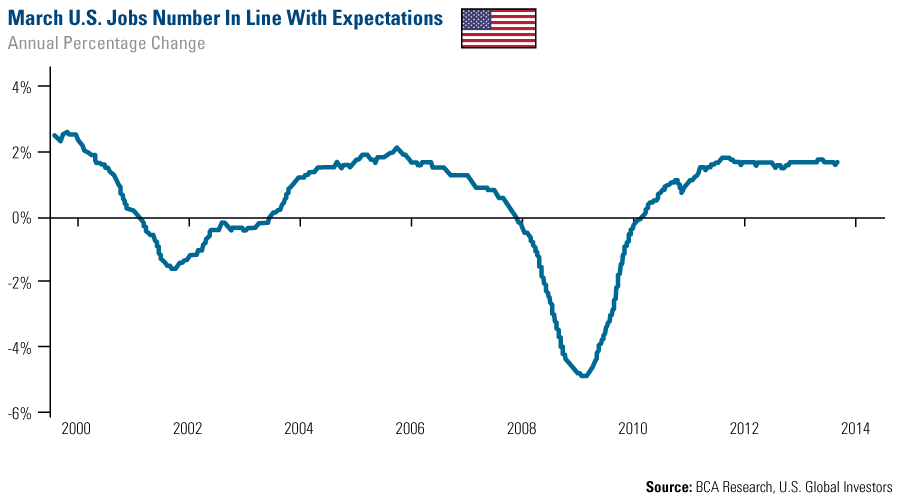 BCA Research believes that after Friday's report, the current pace of employment will be sustained. Although the movement is gradual, hiring is going up. BCA continued by commenting that,"The data will underscore the Fed's view: that the need for quantitative easing or other non-conventional tools is waning, but that there is no rush to normalize interest rates." In my opinion, even with job numbers in line with expectations, the Fed is still going to focus on long-term job creation and keeping interest rates low, or at least not rushing to normalize them as BCA research stated. If inflation starts to rise while these rates are low, we could see a higher movement in the price of gold. | |||||||||||||||||||||||||||||||||||||||||||||||||||||||||||||||||
| Asia Still Wants Physical Gold Posted: 11 Apr 2014 09:16 AM PDT In case of doubt, Asia's gold demand rolls on. Love or fear...? RECENTLY I visited the breathtaking city of Hong Kong to speak at the seventh-annual Mines and Money conference, writes Frank Holmes at US Global Investors. It's Asia-Pacific's premier event for mining investment deal-making and capital-raising. And during my time in Asia I had the additional privilege of addressing the audience of the Asia Mining Club, alongside my good friend Robert Friedland, Executive Chairman and Founder of Ivanhoe Mines. The mission of the Asia Mining Club is to promote education among its members, and one way to achieve this is by hearing from experts in the financial markets, notably those focused on resources and commodities. During the club's sell-out event, I too, confirmed a great deal about the commodity "buzz" on that side of the world, especially on gold prices. The demand for the precious metal in Asia is truly phenomenal! In smaller countries like Indonesia, Thailand and Vietnam, consumption of gold totaled 300 tonnes in 2013, and according to Bloomberg, in 2014 mainland Chinese buyers purchased a total of 125 tonnes in February (including scrap). This number tops the 102.6 tonnes purchased in January and 97.1 tonnes purchased a year ago. As I wrote about in February, Switzerland plays a role in the movement of physical gold into Asia as well. Home to many of the big gold refiners, Switzerland released monthly gold trade data this year for the first time in over 30 years, with the report showing that 80% of shipments went straight into Asia. If we continue to see these large movements of the physical metal, especially from the West to the East, it's only a matter of time until these supply-and-demand factors lift the gold price. I often say there are two sides to the gold equation: the Love Trade and the Fear Trade. While Asia's cultural affinity for gold continues to feed the Love Trade, concern over government policies which increase inflation and devalue currencies, fuel the Fear Trade. The Fear Trade demanded attention again on the back of Janet Yellen's talk of the Federal Reserve raising interest rates in the next six months. While low interest rates make it less expensive to borrow money, measures to keep rates low also chip away the value of the Dollar and cause concern of accelerating inflation. Once real rates start rising, gold isn't as attractive to those who trade on fear. A key driver in gold prices is the real interest rate environment – the real rate of return taking into account the level of inflation. Low to negative real interest rates mean gold prices historically turn positive, because there is no opportunity cost to hold the metal. The lower the real rates, the better gold tends to do. So, Yellen's initial hint of rising rates sent gold prices falling. Last Friday the March US jobs number came in at 192,000. While the number is in line with expectations and clearly shows that hiring in the US is rising, it fell a bit short of the 200,000 jobs projected. The number was just enough of a miss to disturb investor confidence and drive some to seek refuge in hard assets, spurring the price of gold again. BCA Research believes that after Friday's report, the current pace of employment will be sustained. Although the movement is gradual, hiring is going up. BCA continued by commenting that,"The data will underscore the Fed's view: that the need for quantitative easing or other non-conventional tools is waning, but that there is no rush to normalize interest rates." In my opinion, even with job numbers in line with expectations, the Fed is still going to focus on long-term job creation and keeping interest rates low, or at least not rushing to normalize them as BCA research stated. If inflation starts to rise while these rates are low, we could see a higher movement in the price of gold. | |||||||||||||||||||||||||||||||||||||||||||||||||||||||||||||||||
| The Dollar? A Currency, Not Investment Posted: 11 Apr 2014 09:09 AM PDT A convert to MMT writes... I WAS at a conference when I took out a Dollar bill and waved it in front of the audience, writes Chris Mayer at Agora Financial's Capital & Crisis. I asked, "Why does this piece of paper have value?" It's interesting the range of answers I got.
The answer is one that (some) economists have known about for a long time. I'll tell you about it below along with three other counterintuitive and seemingly bizarre conclusions about the twisted world of modern money. I don't think you would draw it up this way if you had the chance – but it's the way the system works. Government debt...is a form of savings for the private sector. Tax liabilities give otherwise worthless paper value. The US Dollar has value because the government levies $3 trillion in tax liabilities annually and accepts only US Dollars in payment – which only it issues. And there is the credible threat of penalties if you don't settle up with Dollars. In so doing, the government turns all of us into Dollar chasers. It's how a state, any state, can turn worthless pieces of paper into valued currency. "The modern state can make anything it chooses generally acceptable as money," economist Abba Lerner wrote in 1947. "If the state is willing to accept the proposed money in the payment of taxes and other obligations to itself, the trick is done." Brilliantly devious, isn't it? A Dollar is, essentially, a tax credit. Economists call this the tax-driven view of money, and it is at least as old as Adam Smith. It is also one of the core principles of Modern Monetary Theory, or MMT. (This is a macroeconomic school of thought that has taken the deep dive into the plumbing of how modern money works.) The principles of MMT have a certain forceful logic. And they can lead to some shocking and uncomfortable conclusions. One example is that government deficits increase financial savings. It sounds outrageous. How can government deficits increase savings? Well, how else is the nongovernment sector supposed to get Dollars? The only way is for the government to spend more than it collects – hereby leaving money in the economy. Or think of it this way, as economist Warren Mosler puts it: "When the government spends, only two things can happen to that money...the money can be used to pay taxes, or it isn't used to pay taxes. In which case, somebody out there still has it." So deficit spending equals financial savings at the macro level. Government debt, then, is a form of savings for the private sector. Everywhere there is a Treasury security there is someone who owns it. For that holder, it is a part of his financial wealth, or savings. But aren't government deficits and debt too large? They can be too large, which then causes the Dollar to lose value. However, in a fiat currency system, it is natural for the government to be in deficit, because the private sector usually wants to save something. In fact, there is a good argument that any attempt to balance the budget is futile. It will simply lead people to cut spending in an effort to get back to a desired savings level. This also has the effect of contracting the economy and driving tax receipts lower, thereby putting the government back into deficit. The trouble with budget surpluses is they take money out of the economy. That puts pressure on private-sector balance sheets. It may not be so surprising to learn, then, that economic depressions have followed every major surplus in US history. Another conclusion is that Government doesn't need taxes and bond sales to finance spending. Most people think that the government collects taxes and sells bonds to finance its spending. But remember, the government issues Dollars. It can't run out. This sounds scary, but it's the naked truth of a fiat currency system. The US government faces zero solvency risk. It can always meet all of its bills. Of course, there are consequences when government spends. If it spends "too much" relative to what Dollars can buy and the desire to save, then the Dollar can lose value. (Which is what's happened over the last century. I see no reason why this trend will end.) But the government clearly doesn't need to borrow or collect something it issues in order to spend. That's the point. Further, think about it from the beginning: What must a government do before it collects its own money in taxes? It has to spend the money first. That's how people get the Dollars to meet the tax. So logically, spending precedes tax collection. There is a classic paper by Stephanie Bell (now Kelton) that demonstrates that "proceeds from taxation and bond sales are technically incapable of financing government spending" and that governments actually finance their spending by creating money directly. (See 'Can Taxes and Bonds Finance Government Spending?'). It's a bit technical, but I believe it is correct and I mention it here in case you want to hunt it down. It's free online. There is another key insight that follows from this.
The US government is not at the mercy of foreign creditors. You've surely heard that the US is in debt to China, because China holds some large amount of US Treasury debt. Politicians even used this rhetoric around election time, saying how we are borrowing from the thrifty Chinese to pay for our lavish lifestyle. It's not true. And in fact, it can't be true. Let me cite economist L.Randall Wray, who put it in no uncertain terms: Those who claim that the US government must borrow Dollars from thrifty Chinese don't understand basic accounting. The Chinese do not issue Dollars – the United States does. Every Dollar the Chinese "lend" to the United States came from the United States. The US government never borrows from the Chinese to "finance" its budget deficit. Again, think through how the Chinese got the Dollars. They sold stuff to Americans. Presumably, they did this because they wanted to acquire Dollars. That can change, and the foreign exchange value of the Dollar will change, too, to reflect the desire of foreigners to hold Dollars. But the point I want to make is simply that the US issues Dollars; China and other foreign governments do not. Therefore, the US doesn't rely on foreign creditors to finance its spending. As I told you, the world of modern money is a seemingly bizarre world, but it does have its own logic and principles. I've only touched on a few of the most surprising conclusions here. (I would humbly suggest that the best introductory guide to this monetary maze is Wray's Modern Money Theory: A Primer on Macroeconomics for Sovereign Money Systems.) At least you have a good answer why the US Dollar has value – albeit, a value that bleeds out over time. It's a currency, not an investment vehicle. | |||||||||||||||||||||||||||||||||||||||||||||||||||||||||||||||||
| The Dollar? A Currency, Not Investment Posted: 11 Apr 2014 09:09 AM PDT A convert to MMT writes... I WAS at a conference when I took out a Dollar bill and waved it in front of the audience, writes Chris Mayer at Agora Financial's Capital & Crisis. I asked, "Why does this piece of paper have value?" It's interesting the range of answers I got.
The answer is one that (some) economists have known about for a long time. I'll tell you about it below along with three other counterintuitive and seemingly bizarre conclusions about the twisted world of modern money. I don't think you would draw it up this way if you had the chance – but it's the way the system works. Government debt...is a form of savings for the private sector. Tax liabilities give otherwise worthless paper value. The US Dollar has value because the government levies $3 trillion in tax liabilities annually and accepts only US Dollars in payment – which only it issues. And there is the credible threat of penalties if you don't settle up with Dollars. In so doing, the government turns all of us into Dollar chasers. It's how a state, any state, can turn worthless pieces of paper into valued currency. "The modern state can make anything it chooses generally acceptable as money," economist Abba Lerner wrote in 1947. "If the state is willing to accept the proposed money in the payment of taxes and other obligations to itself, the trick is done." Brilliantly devious, isn't it? A Dollar is, essentially, a tax credit. Economists call this the tax-driven view of money, and it is at least as old as Adam Smith. It is also one of the core principles of Modern Monetary Theory, or MMT. (This is a macroeconomic school of thought that has taken the deep dive into the plumbing of how modern money works.) The principles of MMT have a certain forceful logic. And they can lead to some shocking and uncomfortable conclusions. One example is that government deficits increase financial savings. It sounds outrageous. How can government deficits increase savings? Well, how else is the nongovernment sector supposed to get Dollars? The only way is for the government to spend more than it collects – hereby leaving money in the economy. Or think of it this way, as economist Warren Mosler puts it: "When the government spends, only two things can happen to that money...the money can be used to pay taxes, or it isn't used to pay taxes. In which case, somebody out there still has it." So deficit spending equals financial savings at the macro level. Government debt, then, is a form of savings for the private sector. Everywhere there is a Treasury security there is someone who owns it. For that holder, it is a part of his financial wealth, or savings. But aren't government deficits and debt too large? They can be too large, which then causes the Dollar to lose value. However, in a fiat currency system, it is natural for the government to be in deficit, because the private sector usually wants to save something. In fact, there is a good argument that any attempt to balance the budget is futile. It will simply lead people to cut spending in an effort to get back to a desired savings level. This also has the effect of contracting the economy and driving tax receipts lower, thereby putting the government back into deficit. The trouble with budget surpluses is they take money out of the economy. That puts pressure on private-sector balance sheets. It may not be so surprising to learn, then, that economic depressions have followed every major surplus in US history. Another conclusion is that Government doesn't need taxes and bond sales to finance spending. Most people think that the government collects taxes and sells bonds to finance its spending. But remember, the government issues Dollars. It can't run out. This sounds scary, but it's the naked truth of a fiat currency system. The US government faces zero solvency risk. It can always meet all of its bills. Of course, there are consequences when government spends. If it spends "too much" relative to what Dollars can buy and the desire to save, then the Dollar can lose value. (Which is what's happened over the last century. I see no reason why this trend will end.) But the government clearly doesn't need to borrow or collect something it issues in order to spend. That's the point. Further, think about it from the beginning: What must a government do before it collects its own money in taxes? It has to spend the money first. That's how people get the Dollars to meet the tax. So logically, spending precedes tax collection. There is a classic paper by Stephanie Bell (now Kelton) that demonstrates that "proceeds from taxation and bond sales are technically incapable of financing government spending" and that governments actually finance their spending by creating money directly. (See 'Can Taxes and Bonds Finance Government Spending?'). It's a bit technical, but I believe it is correct and I mention it here in case you want to hunt it down. It's free online. There is another key insight that follows from this.
The US government is not at the mercy of foreign creditors. You've surely heard that the US is in debt to China, because China holds some large amount of US Treasury debt. Politicians even used this rhetoric around election time, saying how we are borrowing from the thrifty Chinese to pay for our lavish lifestyle. It's not true. And in fact, it can't be true. Let me cite economist L.Randall Wray, who put it in no uncertain terms: Those who claim that the US government must borrow Dollars from thrifty Chinese don't understand basic accounting. The Chinese do not issue Dollars – the United States does. Every Dollar the Chinese "lend" to the United States came from the United States. The US government never borrows from the Chinese to "finance" its budget deficit. Again, think through how the Chinese got the Dollars. They sold stuff to Americans. Presumably, they did this because they wanted to acquire Dollars. That can change, and the foreign exchange value of the Dollar will change, too, to reflect the desire of foreigners to hold Dollars. But the point I want to make is simply that the US issues Dollars; China and other foreign governments do not. Therefore, the US doesn't rely on foreign creditors to finance its spending. As I told you, the world of modern money is a seemingly bizarre world, but it does have its own logic and principles. I've only touched on a few of the most surprising conclusions here. (I would humbly suggest that the best introductory guide to this monetary maze is Wray's Modern Money Theory: A Primer on Macroeconomics for Sovereign Money Systems.) At least you have a good answer why the US Dollar has value – albeit, a value that bleeds out over time. It's a currency, not an investment vehicle. | |||||||||||||||||||||||||||||||||||||||||||||||||||||||||||||||||
| Debt: Destroyer of Lives, Businesses, and Countries Posted: 11 Apr 2014 08:38 AM PDT Dear Reader, “Raise your hand if you’re scared of flying.” The professor of my Intro to Psychology course made this request of the class on the very first day of college. Of the 30 or so students in the room, six raised their hands. “OK, put them down. Now raise your hand if you’re scared of driving.” Not a hand was raised. “Statistically, you’re much more likely to die in a car than a plane.” Thirty blank stares awaited an explanation. “You see, we humans aren’t as rational as we like to think. Driving is more dangerous than flying, but almost everyone is more scared to fly. That’s why the study of psychology is important: so we can identify and modify irrational thoughts.” Even as a dumb 18-year-old, I knew my professor’s example was bogus. The mathematical odds of death are just one of several valid reasons to fear something. Another is a lack of control: flying makes me nervous because I’m putting my life in the hands of a stranger. There’s nothing irrational about that. Debt worries me much more than flying, but for the same reason: I have no control over it. Not personal debt, of course: I have 100% control over my credit card, auto, student loan, and mortgage debt. I’m talking about Uncle Sam’s big, fat federal debt, which today stands at over $17.5 trillion. As one of 115 million taxpayers, my own personal portion of that is $152,000. Add in my wife’s share, and we’re up to $304,000. Do we have to include that in our net-worth calculation when we apply for a mortgage? Nothing is as destructive as a government drowning in debt. Though the time it takes to play out varies, the narrative is always the same:
Unfortunately, it often doesn’t end there. Several of the most horrific atrocities in human history were committed by hopelessly indebted governments. Having just watched Meltdown America, a brand-new documentary produced by Casey Research that examines how a financial crisis can turn a once-prosperous country into a literal war zone, this fact is fresh in my mind. Meltdown America follows the stories of three regular folks who lived in the wrong country at the wrong time. One is former Serbian businessman Mica Miljkovic, who, during Yugoslavia’s hyperinflation, was exchanging foreign currency with a taxi driver. Taxi drivers often become de facto currency dealers during severe inflation because they have easy access to cash. Plus, they’re moving targets, so they’re difficult for a government to crack down on. During the transaction, Mica spotted an Uzi underneath the cab driver’s seat. It turned out that this particular cabbie, in addition to dealing currency, was also peddling guns to people who feared civil war—a fear that eventually came true. Personally, I like peeking into the lives of ordinary people who experienced extraordinary things. Hearing their firsthand experiences is eye-opening and, at least for me, carries the added benefit of piercing the “It can’t happen here” psychological defense mechanism that causes so many to downplay a potential crisis until it arrives on their doorstep. You can watch Meltdown America here. Click here. Moving along, because Alex Daley’s account of moving to Puerto Rico generated a record number of comments and a whopping 600 emails last week, we’re following up with a Q&A on that same topic. This time, Nick Giambruno joined Alex to discuss the almost-too-good-to-be-true tax benefits of relocating to the Caribbean island. Then we’ll hear from medical doctor Jeffrey Green, a runner-up in our recent storytelling contest, with an entertaining story about the exact moment he transformed from a liberal into a libertarian. Puerto Rico's Tax Benefits—More Than "The Better Florida"A Q&A with Nick Giambruno and Alex DaleyNick Giambruno is the senior editor of InternationalMan.com and coauthor of a comprehensive report on an incredible new set of tax incentives in Puerto Rico which encourage entrepreneurs, investors, and others to relocate to the Caribbean island. Alex Daley, beyond being Casey’s chief technology investment strategist, is a resident of Puerto Rico and is taking advantage of some of its tax incentives to build new businesses. He coauthored the report and can share his firsthand experience. Casey Research: First, in case some of our readers aren’t familiar with the details, can you give us the gist of the new tax incentives in Puerto Rico? Alex Daley: Sure. The first thing readers should understand is that for Americans, this is truly a unique option and a tremendous opportunity for the right people. Puerto Rico recently passed what are known as Act 22 and Act 20, or the Individual Investors Act and the Export Services Act. The Individual Investors Act allows new residents of Puerto Rico to be completely exempted from Puerto Rican taxation on their capital gains, dividend, and interest income. And the Export Services Act provides for a top 4% tax rate on earnings from businesses that perform services—like professional consulting, asset management, research and development, computer programming, and so forth—in Puerto Rico for clients outside of Puerto Rico. Before Puerto Rico’s new laws, it was immensely difficult for Americans to take advantage of incentives like these. For decades, programs in countries like Panama and Singapore sought to attract investors by providing tax breaks—but Americans couldn’t take advantage of them because US nonresident citizens are taxed on their worldwide income. The only exceptions have been in far smaller jurisdictions—never before in a country with the modern infrastructure and a deep labor pool that Puerto Rico offers. Nick Giambruno: When I first heard about these tax incentives, I thought for sure they were too good to be true, which motivated me to dig deeper. After extensive research, it became clear that the benefits were not an illusion and were 100% legitimate. For many Americans, including individuals operating on a modest scale, they are a huge opportunity that could really be game-changing. They’ve already helped a couple of my colleagues at Casey Research, like Alex. Casey Research: Alex, tell us your rationale for moving to Puerto Rico. How is life there working out for you? Alex: I was no stranger to Puerto Rico and had been to the island a number of times previously. I had long been considering relocating to the Caribbean. Of course, Act 20 and Act 22 were a huge draw, but so is the tropical weather, beautiful white sand beaches, lower cost of living, and the adventure of it all. Just like everywhere else, of course, Puerto Rico has its negatives. Make a decision like mine and inevitably you will hear something about the crime. But to extrapolate PR’s urban crime statistics to the entire island is a mistake. It would be like not moving to Michigan because there is crime in Detroit. Like any state with a dense metropolitan area, there’s crime in some areas. If you steer clear of those areas or take the same precautions you would in any big city around the world, you’ll be fine. In fact, one of my colleagues lives right on the beach in the touristy Condado neighborhood and just loves walking to the nice restaurants. Casey Research: So what makes these incentives in Puerto Rico different from, say, the Cayman Islands or other low-tax jurisdictions? Alex: For non-Americans, the differences are subtle—better infrastructure, more familiar goods from home, but no tax advantages. However, if you’re an American citizen, there’s all the difference in the world. This is because the US is the only country that effectively taxes its nonresident citizens on their income no matter where they live and no matter where they earn their money. This means that while a Canadian could relocate to a place like the Cayman Islands and pay zero tax, an American could not. An American living in the Cayman Islands would still have to pay taxes to Uncle Sam. There was really no escape for Americans… until now. Nick: Yes, that’s exactly right. This is where Puerto Rico comes in. Puerto Rico is an unincorporated territory of the US; it’s not quite a state and not quite a foreign country—it’s a commonwealth, which allows it to have a unique tax situation. Namely, Puerto Rican residents who derive their income from Puerto Rican sources do not pay taxes to the US government—they pay them to the Puerto Rican government. The same is true of the US Virgin Islands. Combine this commonwealth status with the new tax incentives, and mainland US citizens have a window to legally lower some of the burdens of US taxation. There isn’t another jurisdiction in the world that offers such an opportunity for Americans. It’s like obtaining most of the tax benefits of renunciation without giving up your US passport. Casey Research: Why does Puerto Rico offer such an attractive deal to new residents? Nick: Quite simply, the Puerto Rican economy needs it. The island needs to boost its economy to reduce its debt burden, and that’s what gave impetus to Act 20 and Act 22. So in that sense, Puerto Rico’s economic troubles are a blessing in disguise. Puerto Rico is no novice at sculpting tax rules to attract foreign investors and expatriates. For decades, the country has offered tax incentives to many types of businesses, especially manufacturers, which is why today you’ll find plants belonging to Praxair, Merck, Pfizer, and other big names dotting the island’s lush interior. However, after watching India attract knowledge workers and Singapore attract asset managers, it was glaringly obvious that Puerto Rico could up its game to bring in less environmentally impactful businesses. After all, Puerto Rico has some built-in advantages: the populace is well educated, speaks English more fluently as a whole, and doesn’t have to man the graveyard shift to work with American customers due to time-zone differences. So, the government set out to attract service businesses. Casey Research: Couldn’t the US government force Puerto Rico to change its tax incentives? Alex: Of course they could pressure the government here, but it likely wouldn’t affect those who’ve already obtained the benefits. Such an action would just close it off to new participants. But we believe even that is unlikely. The US government understands that Puerto Rico needs to boost its economy to help it address its debt problem. Act 20 and Act 22 help the island do just that. The last thing that the US government wants is a disorderly default or to have to come to the rescue in the form of an unpopular bailout. As of right now, it looks like Act 20 and Act 22 are here to stay. Nick: There’s also the issue of Puerto Rico becoming the 51st state or its legal status otherwise changing. This would end the tax incentives. However, this issue has languished for decades; Puerto Ricans themselves are divided—some want statehood, some want the status quo, and others want complete independence. I think it is very unlikely that Puerto Rico’s current commonwealth status will change anytime soon. Casey Research: Where can people go to find more information? Alex: Nick, some of our other colleagues at Casey Research, and I have put together the definitive guide on the Puerto Rico option. It’s been reviewed by dozens of professional sources in Puerto Rico and the mainland US, including top law firms and accountants in the area. It’s an A-Z guide with information you won’t find anywhere else. If you’re considering taking advantage of the programs here, get started with this guide, as it will save you a lot of time in the process. I certainly wish there had been a resource like this when I made my move. You’ll find the report by clicking here. | |||||||||||||||||||||||||||||||||||||||||||||||||||||||||||||||||
| Posted: 11 Apr 2014 08:07 AM PDT The American GDX Gold Miners ETF is slowly becoming the de-facto standard for measuring gold-stock performance. Nearing its eighth birthday, GDX has even usurped the venerable HUI gold-stock index as this sector’s metric of choice in many circles. While GDX has advantages and disadvantages compared to the traditional HUI, it is an excellent gold-stock benchmark. But it still falls far short of individual stock picking. | |||||||||||||||||||||||||||||||||||||||||||||||||||||||||||||||||
| Better Tone to Gold and Silver Posted: 11 Apr 2014 08:03 AM PDT Gold and silver prices gained modestly over the week, during which the latest FOMC minutes were released. These were generally read to be more dovish compared with the previous month. FOMC members appear from the minutes to be confused. The previous month’s conclusion, that if it wasn’t for the weather the economy is improving and so interest rates will increase a little earlier than expected, is replaced with renewed anxiety about the outlook now the weather has improved. And who can blame them: after QE1, 2 and 3, some iffy numbers like unemployment have fallen, but where’s the price inflation? The overriding concern for all central bankers is still the prospect of deflation. | |||||||||||||||||||||||||||||||||||||||||||||||||||||||||||||||||
| Posted: 11 Apr 2014 07:57 AM PDT I am often asked whether or not western governments are likely to confiscate gold, and my answer has invariably been on the lines of "unlikely at the moment, because so few people own gold". However given low stock levels in western vaults and that bail-ins are on the agenda the answer to the question should be reconsidered. | |||||||||||||||||||||||||||||||||||||||||||||||||||||||||||||||||
| Silver Price Finally Outperforms – How Bullish Is That? Posted: 11 Apr 2014 07:55 AM PDT Briefly: In our opinion the speculative short positions (full) in gold, silver, and mining stocks are justified from the risk/reward perspective. We sent out 2 Gold & Silver Trading Alerts yesterday and the situation at this time remains just as we described it in the second of them. Consequently, we will mostly quote it, illustrate the phenomena mentioned, and add more comments when necessary. Let’s start with gold (charts courtesy of http://stockcharts.com). | |||||||||||||||||||||||||||||||||||||||||||||||||||||||||||||||||
| Does the Gold Price reflect true gold Demand and Supply? Posted: 11 Apr 2014 07:50 AM PDT In short, no it doesn't! We will look at why not, in this article. The Gold Fix Despite the furore surrounding the Gold Fix [unfairly, we believe] it is a singularly determined attempt amongst commodities to set a twice daily price that does reflect demand and supply of gold, at those moments. To understand this we have to see what happens at the Fixing sessions. | |||||||||||||||||||||||||||||||||||||||||||||||||||||||||||||||||
| The Gold Market’s Big First Quarter Surprise Posted: 11 Apr 2014 06:00 AM PDT Recently I visited the breathtaking city of Hong Kong to speak at the seventh-annual Mines and Money conference, Asia-Pacific's premier event for mining investment deal-making and capital-raising. During my time in Asia I had the additional privilege of addressing the audience of the Asia Mining Club, alongside my good friend Robert Friedland, Executive Chairman and Founder of Ivanhoe Mines. The mission of the Asia Mining Club is to promote education among its members, and one way to achieve this is by hearing from experts in the financial markets, notably those focused on resources and commodities. During the club's sell-out event, I too, confirmed a great deal about the commodity "buzz" on that side of the world, especially on gold… The demand for the precious metal in Asia is truly phenomenal! In smaller countries like Indonesia, Thailand and Vietnam, consumption of gold totaled 300 tonnes in 2013, and according to Bloomberg, in 2014 mainland Chinese buyers purchased a total of 125 tonnes in February (including scrap). This number tops the 102.6 tonnes purchased in January and 97.1 tonnes purchased a year ago. As I wrote about in February, Switzerland plays a role in the movement of physical gold into Asia as well. Home to many of the big gold refiners, Switzerland released monthly gold trade data this year for the first time in over 30 years, with the report showing that 80 percent of shipments went straight into Asia. If we continue to see these large movements of the physical metal, especially from the West to the East, it's only a matter of time until these supply-and-demand factors lift the gold price. I often say there are two sides to the gold equation: the Love Trade and the Fear Trade. While Asia's cultural affinity for gold continues to feed the Love Trade, concern over government policies which increase inflation and devalue currencies, fuel the Fear Trade. The Fear Trade demanded attention again on the back of Janet Yellen's talk of the Federal Reserve raising interest rates in the next six months. While low interest rates make it less expensive to borrow money, measures to keep rates low also chip away the value of the dollar and cause concern of accelerating inflation. Once real rates start rising, gold isn't as attractive to those who trade on fear. As I've written about recently, a key driver in gold prices is the real interest rate environment — the real rate of return taking into account the level of inflation. When real interest rates are negative to low, gold prices historically turn positive because there is no opportunity cost to hold the metal. The lower the real rates, the better gold tends to do. So, Yellen's initial hint of rising rates sent gold prices falling. On Friday the March U.S. jobs number came in at 192,000. While the number is in line with expectations and clearly shows that hiring in the U.S. is rising, it fell a bit short of the 200,000 jobs projected. The number was just enough of a miss to disturb investor confidence and drive some to seek refuge in hard assets, spurring the price of gold again.
BCA Research believes that after Friday's report, the current pace of employment will be sustained. Although the movement is gradual, hiring is going up. BCA continued by commenting that,"The data will underscore the Fed’s view: that the need for quantitative easing or other non-conventional tools is waning, but that there is no rush to normalize interest rates." In my opinion, even with job numbers in line with expectations, the Fed is still going to focus on long-term job creation and keeping interest rates low, or at least not rushing to normalize them as BCA research stated. If inflation starts to rise while these rates are low, we could see a higher movement in the price of gold. Another headline-maker for gold last week was Yamana Gold's purchase of 50 percent of Osisko's mining assets. I think our Portfolio Manager Ralph Aldis said it best in a recent BNN interview with Howard Green regarding the takeover; "This deal is both sweet and sour." The sour part is that by our models, which look at relative value of assets, it appears that both Osisko and Yamana are paying too much on this deal. On the flip side, the sweet part is that this bid caused companies like Mirasol, Pretium and SEMAFO to immediately rise. The structure of the entire deal is a complicated one, but witnessing these stocks finally waking up, is a change in the sentiment for the gold sector that, in my opinion, needed to be seen. At U.S. Global Investors we are always watching for opportunity, while concurrently managing risk. Along with the "sweetness" of the Osisko deal, I find additional encouragement for the broader commodities space, as well as for gold, from Stifel Nicolaus' Barry Banister. His strategy for the second quarter of the year is that we may see a one-year rally in commodity-related stocks. Based on the breakout of the Continuous Commodities Futures (CRB) Index, along with the movement in the U.S. dollar, he forecasts that commodities could rise 15 percent year-over-year in 2014.
High Frequency Trading became a household word overnight when bestselling author Michael Lewis gave an interview to 60 Minutes in advance of his new book, "Flash Boys." Lewis' allegations of high frequency trading practices that result in a rigged stock market have prompted a firestorm of support from Charles Schwab to Mark Cuban. I agree with Schwab, chairman of Charles Schwab Corp., who said "high frequency trading has run amok and is corrupting our capital market system by creating an unleveled playing field for individual investors and driving the wrong incentives for our commodity and equity exchanges." I'm glad to see this issue getting the attention it deserves. From short selling to overreaching regulation, over the years I've shared my opinions on practices that harm individual investors and create unjust advantages in our free market system. I believe that investing is key to long-term wealth creation and that investor confidence in the system is key to capitalism. The first quarter of the year has certainly provided surprises for the gold market, but remember that every coin has two sides. Every downward data point has an upside opportunity. Follow the smart money, stay diversified and remain a curious investor. Regards, Frank Holmes Ed. Note: To get a better understanding of the gold market, including expert commentary and regular chances to discover actionable profit opportunities in the metals market, sign up for the FREE Daily Resource Hunter email edition, right here. Article posted on Daily Resource Hunter | |||||||||||||||||||||||||||||||||||||||||||||||||||||||||||||||||
| More Weakness Ahead for Gold and Silver Posted: 11 Apr 2014 05:03 AM PDT The Fed minutes were dovish and this helped push Gold above $1310 to $1320. However, the miners, which usually lead the metals did little to confirm the rise. In fact, the miners have been relatively weak in recent days and had a bearish reversal on Thursday. Their rebound from an oversold condition has petered out. Another point is Gold, during this rebound has made no progress against foreign currencies. It’s starting to show some strength against the equity market but it needs to show strength against all currencies and not function only as the inverse of the US Dollar. Be on alert as the short-term trend for precious metals (especially the miners) could resume to the downside. | |||||||||||||||||||||||||||||||||||||||||||||||||||||||||||||||||
| Precious Metals Market Report with Franklin Sanders Posted: 11 Apr 2014 05:00 AM PDT | |||||||||||||||||||||||||||||||||||||||||||||||||||||||||||||||||
| Limits to Employment Participation, and Societal Change Posted: 11 Apr 2014 04:44 AM PDT Raymond Matison writes: Ever since the calamitous financial meltdown in 2008, economists, market analysts, and media pundits persistently have envisioned an economic recovery, with an attendant increase in employment. However, critics maintain that such a recovery has never really occurred – prompting the pundit response that ours is a jobless recovery. Recently, President Obama promoted raising the minimum wage, and increasing payment for overtime work, as a means to help provide a higher wage for workers. This effort is good politics, but is not really a sound bureaucratic practice. The direction and future of unemployment is easy to see, as is the future employment participation rate, and the resulting direction of national income. Globally embedded, strategic economic trends are more powerful than presidential edict and the Federal Reserve Bank, and so economics will trump central planning. This article discusses a possible outcome of these trends. |
 The Gold Fix
 Recently I visited the breathtaking city of Hong Kong to speak at the seventh-annual Mines and Money conference, Asia-Pacific's premier event for mining investment deal-making and capital-raising. During my time in Asia I had the additional privilege of addressing the audience of the Asia Mining Club, alongside my good friend Robert Friedland, Executive Chairman and Founder of Ivanhoe Mines.
 The CME’s Daily Delivery Report showed that 46 gold and 20 silver contracts were posted for delivery within the Comex-approved depositories on Monday. Credit Suisse was the short/issuer on 45 of the gold contracts—and JPMorgan and Canada’s Scotiabank stopped 38 of them. In silver, Morgan Stanley and JPM were the two issuers—and Canada’s Scotiabank stood for delivery on all 20 contracts. The link to yesterday’s Issuers and Stoppers Report is
.png)


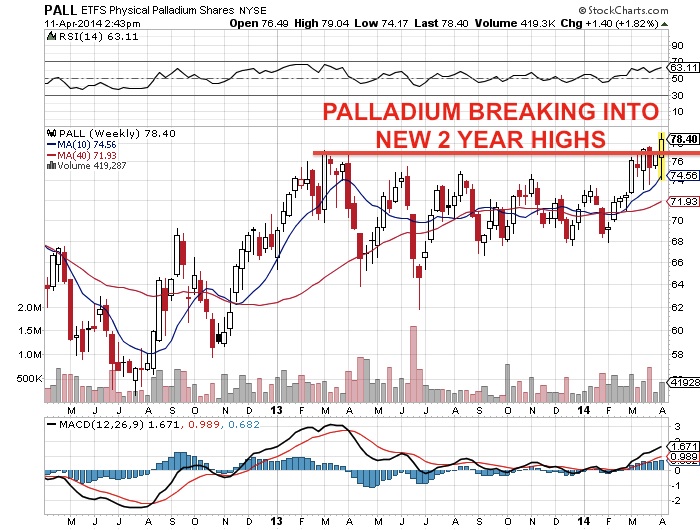


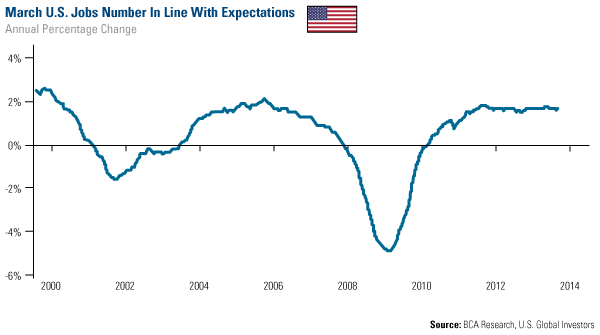
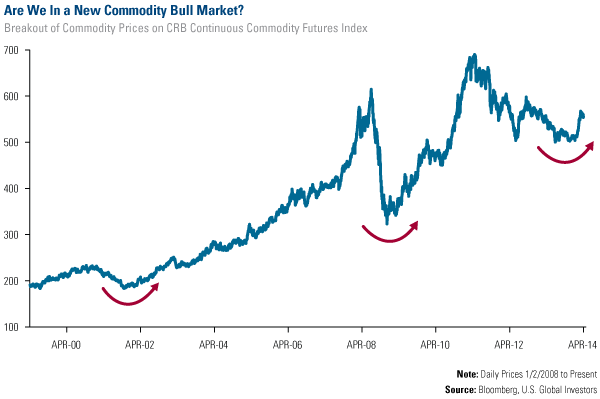
| You are subscribed to email updates from Save Your ASSets First To stop receiving these emails, you may unsubscribe now. | Email delivery powered by Google |
| Google Inc., 20 West Kinzie, Chicago IL USA 60610 | |


No comments:
Post a Comment