


Gold World News Flash |

- Prepping on the Cheap: The $5 a Week Shopping Challenge
- Our Money Is Dying: Don’t Let Your Wealth Die With It
- Eric Sprott Seeks MORE PHYSICAL SILVER for PSLV: Announces Follow-on Offering of Trust Units
- ‘We're Gonna See the Price of SILVER With a Zero Behind It' …$250, $350, $450
- Rick Rule – We Are Near An Epic Collapse in Confidence
- Gold May Have Been Manipulated Like Libor - Ned Naylor-Leyland
- Government Will Soon Be Able to Know Your Adrenaline Level, What You Ate Breakfast and What You’re Thinking … from 164 Feet
- Silver Update 7/11/12 Broken Hedges
- January 4, 2012 SILVER Chart REVISTED:
- Crucial Chart & What to Expect From US Dollar, Euro & Gold
- In Gold We Trust, 2012 Edition
- 'Allocated' gold isn't there and 'all hell will break loose,' Leeb tells King World News
- The Seeds For An Even Bigger Crisis Have Been Sown
- Gold to Outshine Dollar?
- All Hell is Going to Break Loose on the Upside in Gold
- Guest Post: The Deleveraging Trap
- The Gold Price Closed Comex $1,575.20 the Silver Price Rose
- A good example why you shouldn't believe everything you read
- Browns Bottom: Why Gordon Brown Sold Englands Gold On the Cheap To Bail Out the Banks
- Guest Post: The Collectivist War Against Cultural Heritage
- Democracy Reaches Its Limit
- LIBOR Manipulation Leads To Questions Regarding Gold Manipulation
- Gold to Outshine U.S. Dollar?
- Grade Is King: Andrew Richmond
- A Betrayal of Trust
- Unscary Reasons to Add Gold
- Gold Daily And Silver Weekly Charts
- Gold Seeker Closing Report: Gold and Silver End Slightly Higher
- The War Between Manipulation and Buying
| Prepping on the Cheap: The $5 a Week Shopping Challenge Posted: 12 Jul 2012 01:04 AM PDT  One of the biggest excuses that people make for not prepping is that they can't afford it. "I can't even afford the groceries we eat every week as it is!" they complain when urged to start buying extra food. One of the biggest excuses that people make for not prepping is that they can't afford it. "I can't even afford the groceries we eat every week as it is!" they complain when urged to start buying extra food.This week I made a trip to three different stores. I went to Wal-Mart, the dollar store and a grocery store. Not to locate the best prices but to locate the regular prices on common food items that might find their way into a prepper's pantry. The following list is not based on mega-markdown loss leaders – it is based on the normal price and availability. Here are 52 stock-ups – one for each week!

This posting includes an audio/video/photo media file: Download Now | ||
| Our Money Is Dying: Don’t Let Your Wealth Die With It Posted: 12 Jul 2012 01:01 AM PDT  A question on the minds of many people today (increasingly those who manage or invest money professionally) is this: How do I preserve wealth during a period of intense official intervention in and manipulation of money supply, price, and asset markets? A question on the minds of many people today (increasingly those who manage or invest money professionally) is this: How do I preserve wealth during a period of intense official intervention in and manipulation of money supply, price, and asset markets?As every effort to re-inflate and perpetuate the credit bubble is made, the words of Austrian economist Ludwig Von Mises lurk ominously nearby: There is no means of avoiding the final collapse of a boom brought about by credit expansion. The alternative is only whether the crisis should come sooner, as the result of a voluntary abandonment of further credit expansion, or later, as a final and total catastrophe of the currency system involved. (Source) Because every effort is being made to avoid abandoning the credit expansion process — with central banks and governments lending and borrowing furiously to make up for private shortfalls — we are left with the growing prospect that the outcome will involve some form of "final catastrophe of the currency system"(s). This report explores what the dimensions of that risk are. It draws upon both historical and modern examples to try to shed some light on how the currency collapse process will likely unfold this time around. Plus, we'll address how best to avoid its pernicious wealth destroying effects. Read more.... 
This posting includes an audio/video/photo media file: Download Now | ||
| Eric Sprott Seeks MORE PHYSICAL SILVER for PSLV: Announces Follow-on Offering of Trust Units Posted: 12 Jul 2012 12:19 AM PDT from Sprott Physical Silver Trust Media Room:
The Trust will use the net proceeds of the Offering to acquire physical silver bullion in accordance with the Trust's objective and subject to the Trust's investment and operating restrictions described in the prospectus related to the Offering. Under the trust agreement governing the Trust, the net proceeds of the Offering per Unit must be not less than 100% of the most recently calculated net asset value per Unit of the Trust prior to, or upon determination of, pricing of the Offering. The Units are listed on NYSE Arca and the Toronto Stock Exchange under the symbols "PSLV" and "PHS.U", respectively. The Offering will be made simultaneously in the United States and Canada by underwriters led by Morgan Stanley and RBC Capital Markets in the United States and RBC Capital Markets and Morgan Stanley in Canada. Read More @ SprottPhysicalSilverTrust.MediaRoom.com
| ||
| ‘We're Gonna See the Price of SILVER With a Zero Behind It' …$250, $350, $450 Posted: 11 Jul 2012 11:50 PM PDT
Let's get in-depth with precious metals analyst and writer Jeff Nielson. Jeff and I cover the latest criminal exploits of the Bankster cartel, and Jeff says as this paper charade melts down, we will see the price of silver with a ZERO behind it. For you home gamers, that's a multiple of 10 times the current price… for starters. In Part 2, we cover the mystery of the Treasuries market… there are NO actual buyers, just the FED's primary dealers doing the bidding for their master. Jeff reminds listeners, your PAPER will soon go to ZERO. Jeff is the Senior Metals Analyst at SilverGoldBull and founder of BullionBullsCanada.
| ||
| Rick Rule – We Are Near An Epic Collapse in Confidence Posted: 11 Jul 2012 11:38 PM PDT from KingWorldNews:
Rule, who is now part of Sprott Asset Management, also issued the following warning: "The world has been trying to solve a solvency problem with liquidity. Obviously the problem becomes, at some point in time, the issuers, be it the US government or the ECB or whoever the issuer is, runs into a problem where they can't sell more paper. There is nobody to fund it." "One of the things that comes to my mind is that what has passed for quantitative easing and refinancing in this market, is, in effect, counterfeiting. We have a situation where one of the biggest buyers of government bonds is the government. Rick Rule continues @ KingWorldNews.com
| ||
| Gold May Have Been Manipulated Like Libor - Ned Naylor-Leyland Posted: 11 Jul 2012 11:32 PM PDT "It is effectively an intervention in two ways;... [[ This is a content summary only. Visit my website http://goldbasics.blogspot.com for full Content ]] 
| ||
| Posted: 11 Jul 2012 11:26 PM PDT Do You Know How Far Government Spying Has Gone?You might have heard that police are deploying scanners – not only in airports – but also on trains, buses, ferries, sporting events and on the streets. And see this. You probably know that the National Security Agency is building a $2 billion dollar facility in Utah which will use the world’s most powerful supercomputer to monitor virtually all phone calls, emails, internet usage, purchases and rentals, break all encryption, and then store everyone’s data permanently. And that the CIA is trying to tap your communications as well. You may have heard that drones will soon be flown all over America to spy on us. For example, ABC News reported:
The military is already using drones over the American homeland to gather information on Americans. See this and this. AP notes that the American public is wary of drones:
If you want to see the unbelievable flight maneuverability of the new generation of drones, watch this, this and this. And drones can be as small as golf balls, birds ... or even insects. And see this. That’s nothing. Government Will Be Able to Tell What You Ate for Breakfast – Or How Much Adrenaline You’ve Got – from 164 Feet AwayGizmodo reports today:
(Researchers at Cornel university are working on ways to scan which are even cheaper … leading to the possibility that these type of scanners could one day be ubiquitous.) I Heard That …Moreover, as Newsweek, Telegraph, the Daily Record and many other mainstream sources have reported on experiments showing that mind-reading machines have gone from the realm of science fiction to engineering fact. Newsweek points out:
Indeed, patents were granted for machines which can read people’s thoughts at a distance 35 years ago, and IBM predicts that mind-reading machines will be everywhere in 5 years. We posted numerous videos in December showing mind-reading machines in action:
| ||
| Silver Update 7/11/12 Broken Hedges Posted: 11 Jul 2012 10:46 PM PDT from BrotherJohnf: He that diggeth a pit shall fall into it; and whoso breaketh an hedge, a serpent shall bite him.
| ||
| January 4, 2012 SILVER Chart REVISTED: Posted: 11 Jul 2012 10:18 PM PDT
I just recieved this note from SGTreport reader 'John', who wrote: "Sean, your friend Stefan, who was helping you out with this website, had a chart which at the time seemed to be a little bearish on Silver, but I think his chart was more or less on the money.. I don't trade paper Silver but why not wait for the deals on the physical? I'm curious if that chart is available?" Thanks for that reminder John. Here ya go. On January 4, 2012 we briefly presented a bearish silver chart that was created by our contributor Stefan B. Here's the original post. Stefan felt strongly that the raids on silver – and the resulting weak technicals would continue through the summer of 2012. At the time, Stefan explained that he believed silver would revisit the mid $20′s, and he was diligently keeping his powder dry until that time (and his e-mails to me bore this out, he did not buy in the $30′s). Ultimately, Stefan's chart and his prediction has proven to be spot on. With technical analysis this accurate, it's time to revisit that chart and ask: Will silver 'Lift Off' in Q3 of 2012 as Stefan predicted so many months ago? We shall soon see.
| ||
| Crucial Chart & What to Expect From US Dollar, Euro & Gold Posted: 11 Jul 2012 10:02 PM PDT  On the heels of continued strength in the US dollar, many are wondering what to expect going forward in both the currency and gold markets. So today King World News interviewed highly acclaimed trader, Dan Norcini, to get his take on the situation. Norcini told KWN, "Technically, on the US dollar chart, there isn't much overhead resistance once the dollar clears 84." Norcini also noted, "... just as the grains have defied the macro-trend, gold may very well do the same thing." On the heels of continued strength in the US dollar, many are wondering what to expect going forward in both the currency and gold markets. So today King World News interviewed highly acclaimed trader, Dan Norcini, to get his take on the situation. Norcini told KWN, "Technically, on the US dollar chart, there isn't much overhead resistance once the dollar clears 84." Norcini also noted, "... just as the grains have defied the macro-trend, gold may very well do the same thing." Norcini let KWN readers know exactly what to expect from gold, but first, here is what Norcini said about the strength in the US dollar: "The price charts are definitely friendly to the dollar. The US dollar hit a two year high yesterday. When you look at the dollar, particularly on a monthly basis, it's been in a very broad range going all the way back to the eruption of the credit crisis in the summer of 2008."
This posting includes an audio/video/photo media file: Download Now | ||
| In Gold We Trust, 2012 Edition Posted: 11 Jul 2012 09:30 PM PDT by Pater Tenebrarum, Acting-Man.com:
We are happy to present the new Gold Report 'In Gold We Trust' from our good friend Ronald Stoeferle of Erstegroup in Vienna to our readers (the download link is at the end of this article). Among analysts employed by mainstream financial institutions, Ronald is one of the very few who actually understand the gold market. As we have often pointed out in these pages, most analysts commit the cardinal error of analyzing the gold market as they would any other commodity market. A recent example of this erroneous approach is provided by an article at Alphaville, whose author muses about the effects of a few hundred tons of gold buying by central banks per year and waning jewelry demand on the gold price. Apparently it didn't occur to the author to wonder how it was possible for the gold price to rise through eleven years of net central bank selling. An analysis by Moody's is mentioned in the article as well, which argues that the recent trend toward net central bank buying is a reason to be bullish on gold. It is not necessarily a bearish datum of course, but it is certainly per se not a good reason to be bullish. In fact, it is quite difficult to interpret central bank buying of gold as a bullish event, given that central bankers are on average the worst traders on the planet. The only reason not to be overly worried is that the central banks that have been selling gold in the past are not the same ones that are buying it nowadays. The buyers are generally Asian central banks that are drowning in fiat money denominated reserves which they understandably are eager to diversify.
| ||
| Posted: 11 Jul 2012 08:48 PM PDT 10:45p ET Wednesday, July 11, 2012 Dear Friend of GATA and Gold: Fund manager Stephen Leeb tells King World News that investment banks are leasing their customers' supposedly "allocated" gold to keep the monetary metal's price down and "all hell is going to break loose" as the scheme fails: http://kingworldnews.com/kingworldnews/KWN_DailyWeb/Entries/2012/7/11_Al... Meanwhile, fund manager Eric Sprott tells Bloomberg News that there is too much unpayable debt in the world for there to be much downside risk in the gold price: http://www.bloomberg.com/news/2012-07-11/gold-22-rally-to-record-seen-by... CHRIS POWELL, Secretary/Treasurer ADVERTISEMENT Sona Discovers Potential High-Grade Gold Mineralization From a Company Press Release VANCOUVER, British Columbia -- With its latest surface diamond drilling program at its 100-percent-owned, formerly producing Blackdome gold mine in southern British Columbia, Sona Resources Corp. has discovered a potentially high-grade gold-mineralized area, with one hole intersecting 13.6 grams of gold in 1.5 meters of core drilling. "We intersected a promising new mineralized zone, and we feel optimistic about the assay results," says Sona's president and CEO, John P. Thompson. "We have undertaken an aggressive exploration program that has tested a number of target zones. Our discovery of this new gold-bearing structure is significant, and it represents a positive development for the company." Sona aims to bring its permitted Blackdome mill back into production over the next year and a half, at a rate of 200 tonnes per day, with feed from the formerly producing Blackdome mine and the nearby Elizabeth gold deposit property. A positive preliminary economic assessment by Micon International Ltd., based on a gold price of $950 per ounce over eight years, has estimated a cash cost of $208 per tonne milled, or $686 per gold ounce recovered. For the company's complete press release, please visit: http://www.sonaresources.com/_resources/news/SONA_NR18_2011-opt.pdf Join GATA here: Toronto Resource Investment Conference New Orleans Investment Conference * * * Support GATA by purchasing DVDs of our London conference in August 2011 or our Dawson City conference in August 2006: http://www.goldrush21.com/order.html Or by purchasing a colorful GATA T-shirt: Or a colorful poster of GATA's full-page ad in The Wall Street Journal on January 31, 2009: http://gata.org/node/wallstreetjournal Help keep GATA going GATA is a civil rights and educational organization based in the United States and tax-exempt under the U.S. Internal Revenue Code. Its e-mail dispatches are free, and you can subscribe at: To contribute to GATA, please visit: ADVERTISEMENT Prophecy Platinum Announces Wellgreen Preliminary Economic Assessment: Company Press Release VANCOUVER, British Columbia, Canada -- Prophecy Platinum Corp. (TSX-V: NKL, OTC-QX: PNIKF, Frankfurt: P94P) reports the results of an independent NI 43-101-compliant preliminary economic assessment for its fully owned Wellgreen nickel-copper-platinum group metals project in the Yukon Territory. The independent assessment, prepared by Tetra Tech, evaluated a base case of an open-pit mine (with a mining rate of 111,500 tonnes per day), an on-site concentrator (with a milling rate of 32,000 tonnes per day), and an initial capital cost of $863 million. The project is expected to produce (in concentrate) 1.959 billion pounds of nickel, 2.058 billion pounds of copper, and 7.119 million ounces of platinum, palladium, and gold during a mine life of 37 years with an average strip ratio of 2.57. The financial highlights of the preliminary economic assessment, shown in U.S. dollars, are as follows: Payback period: 3.55 years Prophecy Chairman John Lee says: "We are pleased with the preliminary economic assessment results. The numbers indicate that Wellgreen is one of most exciting mineral projects in the Yukon. The company is drilling to upgrade and expand the resource base. The infrastructure is excellent as the project is only 1,400 meters in altitude and 14 kilometers from the paved Alaska Highway, which leads to the Haines deep seaport. Discussions are under way with support from local stakeholders regarding permitting and logistics." For the complete press release, please visit: http://prophecyplat.com/news_2012_june18_prophecy_platinum_announces_res...
| ||
| The Seeds For An Even Bigger Crisis Have Been Sown Posted: 11 Jul 2012 08:30 PM PDT from Lars Schall:
By Lars Schall The following exclusive interview was conducted for Matterhorn Asset MGMT / GoldSwitzerland in Zurich, Switzerland, and it's posted here: http://goldswitzerland.com/the-seeds-for-an-even-bigger-crisis-have-been-sown/. The report written by Ronald Stoeferle is available here: http://www.erstegroup.com/en/Downloads/0901481b800bb26c.pdf. Here's a snippet: The foundation for new all-time-highs is in place. As far as sentiment is concerned, we definitely see no euphoria with respect to gold. Skepticism, fear, and panic are never the final stop of a bull market. In the short run, seasonality seems to argue in favor of a continued sideways movement, but from August onwards gold should enter its seasonally best phase. USD 2,000 is our next 12M price target. We believe that the parabolic trend phase is still ahead of us, and that our long-term price target of USD 2,300/ounce could be on the conservative side.
| ||
| Posted: 11 Jul 2012 08:00 PM PDT by Axel Merk, 321Gold.com:
I am no gold bug. But I hold a substantial portion of my personal assets in the yellow metal. To understand why, let me give a little bit of background. When I wrote the book 'Sustainable Wealth: Achieve Financial Security in a Volatile World of Debt and Consumption' in early 2009, my editors wanted me to talk about the financial crisis in the past tense. I balked, arguing that the crisis will be far from over by the time the book would be published later that year. The crisis has long been in the making and may be far from over. Indeed, I started investing in gold back in 2002 and made it part of my family's "golden college savings plan" (discussed in the book) in 2003:
| ||
| All Hell is Going to Break Loose on the Upside in Gold Posted: 11 Jul 2012 07:30 PM PDT from KingWorldNews:
Here is what Leeb had to say about the scandal: "Examples that people like Eric Sprott have given, where an individual depositing gold in 2009, when they asked to get their gold back there were long delays. And the gold bars they got back were certainly not the gold they deposited because they came back dated 2011. What's that all about?" "What's amazing to me right now, Eric, it's come down to a world where the war is between those who believe in capitalism and those who don't. What is interesting is that you have people on the right and the left that have banded together. They don't trust government and they don't trust the system, and who can blame them? Stephen Leeb continues @ KingWorldNews.com
| ||
| Guest Post: The Deleveraging Trap Posted: 11 Jul 2012 05:39 PM PDT Submitted by John Aziz of Azizonomics The Deleveraging Trap Hayekians and Minskians agree on one key thing: an increase in debt beyond the underlying productive economy is unsustainable. In my view, the key figures in defining this are total debt as a percentage of GDP, and its relationship with industrial production. Debt as a percentage of GDP tracks how much debt there is relative to one measure of economic activity, GDP. Yet GDP is a very limited tool of measurement; all GDP really tracks is the circulation of money. To get a clearer sense of the true relationship with underlying productivity, it is useful to compare the ratio of debt-to-GDP with the level of industrial production.
Up 'til the '70s, debt-to-GDP grew more slowly than industrial production. That is healthy and sustainable. While the total market debt may grow in tandem with GDP, and with industrial production — indeed, this can be the case even under a gold exchange standard (as the gold supply increases) — there is no sensible reason for the ratio of debt-to-GDP to grow faster than industrial production. Indeed, this is symptomatic of just one thing — consumption without income, enjoyment without effort, living beyond the means of productivity. This is just an unsustainable bubble. As the '90s turned to the '00s and the United States gains in industrial production ceased to accumulate, while GDP and most concerningly (and hilariously) while the debt-to-GDP ratio continued to increase. This was classical bubble behaviour, and the end came very poetically; the recession and the industrial production collapse hit just as growth in the debt to GDP ratio (as indexed against 1953 levels) finally surpassed growth in industrial production. Indeed, I hypothesise that a very strong indicator of a Minsky moment — when excessive indebtedness forces systemic deleveraging, leading to price falls, leading to widespread economic contraction — is the point when long-term growth in the debt-to-GDP ratio exceeds long-term growth in industrial output. The debt-to-GDP ratio is gradually falling, yet it is still at a far higher level than the historical average, and it is still proportionately higher than industrial output. And at the same time, consumers are re-leveraging, and government debt is soaring. And industrial production is barely above where it it was a decade ago, and far below its pre-2000 trend line. We have barely started, and already this has been a slow and grinding deleveraging; rather than the quick and brutal liquidation like that seen in 1907 where the banking system was effectively forced into bailing itself out, the stimulationist policies of low rates, quantitative easing and fiscal stimulus have kept in business zombie companies and institutions carrying absurd debt loads. Like Japan who experienced a similar debt-driven bubble in the late '80s and early '90s, we in the West appear to have embarked on a low-growth, high-unemployment period of deleveraging; and like Japan, we appear to be simply transferring the bulk of the debt load from the private sector to the public, without making any real impact in the total debt level, or any serious reduction in the debt-to-GDP ratio. Cutting spending — for both the private sector and public sector — is problematic. My spending is your income; as spending falls, income falls, which leads to more consumers, producers and governments attempting to deleverage. This leads to more monetary easing, simply to keep the zombie system stable, and keep the zombie debt serviceable. More consumers and producers can take on debt, at least for a time, but the high residual debt level makes any great expansion of productivity or growth challenging, as consumers and producers remain focussed on paying down the pre-existing debt load. It is a vicious cycle. Quantitative easing does not even tackle the main challenge: reducing the debt load. In fact, it is targeted at precisely the opposite — increasing the debt load, by encouraging lending. But lending into a society that is already heavily indebted leads to no great uptick in productivity, because consumers and producers are already over-indebted to begin with, so few can afford new debt. And banks — flush with cash — have no real incentive to lend; the less they lend, the more deflationary conditions are prone to become, increasing the purchasing power of their excess reserves (on which the central bank already pays interest). The outcome is greater economic stagnation, 'til the next round of monetary easing which leads to a brief uptick, and then further stagnation. To break out of the deleveraging trap, the debt load needs to be drastically reduced. In my mind there are three potential pathways there, each with various drawbacks and advantages:
Certainly, the current status quo of high unemployment, low growth, sustained over-indebtedness and zombie banks and corporations surviving on government handouts is not sustainable in the long run. We shall see which route out of the deleveraging trap we take. Liquidationism seems unlikely, as central banks are afraid of the concept. Inflation (or its unintentional corollary, currency collapse) seems risky and dangerous. A debt jubilee would at least address the real problem of excessive debt, although it is in modern times uncharted territory, and would surely face much political opposition.
| ||
| The Gold Price Closed Comex $1,575.20 the Silver Price Rose Posted: 11 Jul 2012 04:35 PM PDT Gold Price Close Today : 1575.20 Change : -4.10 or -0.26% Silver Price Close Today : 2699.5 Change : 14.4 or 0.54% Gold Silver Ratio Today : 58.352 Change : -0.466 or -0.79% Silver Gold Ratio Today : 0.01714 Change : 0.000136 or 0.80% Platinum Price Close Today : 1428.90 Change : -23.40 or -1.61% Palladium Price Close Today : 581.65 Change : -15.35 or -2.57% S&P 500 : 1,341.45 Change : -0.02 or 0.00% Dow In GOLD$ : $165.41 Change : $ (0.19) or -0.11% Dow in GOLD oz : 8.002 Change : -0.009 or -0.11% Dow in SILVER oz : 466.92 Change : -4.31 or -0.92% Dow Industrial : 12,604.53 Change : -48.59 or -0.38% US Dollar Index : 83.49 Change : 0.093 or 0.11% For the GOLD PRICE 'twas another day of the Mysterious Big Jiggle, where a climbing gold market is suddenly smacked with huge selling. No matter, gold's low came at $1,567.30 and it closed the day on Comex down $4.10 at $1,575.20. No matter, it remains within the confines of that even-sided triangle. Frustration, thy name is triangle. The SILVER PRICE gainsaid gold's drop by rising 14.4 cents to 2699.5, a number one-half a symbolic cent below 2700c. Generally silver trend up from yesterday, with a low at 2684.1c but a high at 2725c. It's on the low side of the Bollinger Bands, but other than today's little rise, gives little sign of chafing at its low estate or planning a sudden rally. About the time I become complacent is when something big happens, I remind myself. Today's action changes nothing. The SILVER and GOLD PRICE are still working through a correction off last year's highs, and stand smack in the midst of usual seasonal lows and weakness. I do not expect we will see prices lower than already witnessed. Premiums on physical silver point to very strong demand, whether that is showing up in the paper price or not. I reckon there are worse things than being a natural born fool from Tennessee, and surely one of 'em is being that sort of fool who believes government promises. I'm foolish, but I ain't THAT foolish. MF Global turned keel up and took a billion dollars in client money down with it, and the CEO (Criminal Entwined with Obama) Jon Corzine walked off scot-free. That ought to have told even the hard-boiledest fool that all the government promises of regulating and overseeing markets and -- har-de-har-har! -- justice and even trustworthy markets had all been shattered forever and ever. Well, not many months later and a few days ago Peregrine Financial Group turned keel up, and the same tricks are suspected. Where were the regulators? Where the CFTC overseers? The SEC? Quis custodiet custodes ipsos? All the custodes had gone for a nap, it seems. Y'all, this fundamentally alters the entire map. If markets and brokerages themselves cannot be trusted, the North Pole has shifted and y'all had better shift for yourselves, and stop falling for those government promises like a bunch of gullible tourists from up North. The FOMC released minutes of its June meeting and those showed growing sentiment for printing more money to "stimulate" (read: "ruin") the economy. That ought to have sent the dollar down and stocks up, one might surmise, but not so. The 83.50 mark once again contained the US dollar index, which rose today only 9.3 basis points to 83.494. Ahh, a pretty picture, the 24 hour chart! Dollar breaks out upside about 10:00 a.m., gets slammed about 11:15, bounces up again as high as 83.61, but does a breakout through support attract any buyers? Not by the hair on the Nice Government Men's chinny-chin-chin! Nay, it closed down below the symbolic 83.50. The suspicious observer can only surmise that the dollar must be contained lest the euro fall utterly and suddenly to complete worthlessness. Once again today the euro made a new low, $1.2213 and closed down 0.13% at $1.2237. All this has the feel of last summer when the euro crisis smoldered steadily on but never quite burst into flame. Yen waxed impertinent today and rose above 126 cent resistance, only to have its jaws slapped. Ended down 0.41% at 125.49c/Y100 (Y79.69/US$1). Stocks found no comfort in the widely bruited suspicion the Fed draweth nigher to speedier inflation. Dow lost 48.59 (0.38%) and closed at 12,604.53. That's below the neckline of the Head and Shoulders Top formed March - May, below the 20 day moving average (12,708) and the 50 DMA (12,655.70). All this signals lower prices. A close below 12,450 puts the petal to the metal downside. The S&P500 has never rallied over the neckline of its HandS, only up to it. It closed today nearly unchanged, down 0.02 at 1,341.45, barely below the 20 DMA (1,343) and barely above the 50 DMA (1,336). Hark! The winds from the future blow the sounds of weeping, wailing, and gnashing teeth. Argentum et aurum comparenda sunt -- -- Gold and silver must be bought. - Franklin Sanders, The Moneychanger The-MoneyChanger.com 1-888-218-9226 10:00am-5:00pm CST, Monday-Friday © 2012, The Moneychanger. May not be republished in any form, including electronically, without our express permission. To avoid confusion, please remember that the comments above have a very short time horizon. Always invest with the primary trend. Gold's primary trend is up, targeting at least $3,130.00; silver's primary is up targeting 16:1 gold/silver ratio or $195.66; stocks' primary trend is down, targeting Dow under 2,900 and worth only one ounce of gold; US$ or US$-denominated assets, primary trend down; real estate bubble has burst, primary trend down. WARNING AND DISCLAIMER. Be advised and warned: Do NOT use these commentaries to trade futures contracts. I don't intend them for that or write them with that short term trading outlook. I write them for long-term investors in physical metals. Take them as entertainment, but not as a timing service for futures. NOR do I recommend investing in gold or silver Exchange Trade Funds (ETFs). Those are NOT physical metal and I fear one day one or another may go up in smoke. Unless you can breathe smoke, stay away. Call me paranoid, but the surviving rabbit is wary of traps. NOR do I recommend trading futures options or other leveraged paper gold and silver products. These are not for the inexperienced. NOR do I recommend buying gold and silver on margin or with debt. What DO I recommend? Physical gold and silver coins and bars in your own hands. One final warning: NEVER insert a 747 Jumbo Jet up your nose. No, I don't. 
| ||
| A good example why you shouldn't believe everything you read Posted: 11 Jul 2012 04:02 PM PDT If you were to do a Google search under "gold investment" you would note that the third entry down the page is headlined "Why Gold is the Worst Investment Right Now." Being the careful web denizen that you are, you probably would note too that the date of the entry is "July 12, 2010″ and you might pass it by as being a dated article and go about your business of finding something more current. Always curious why an article might get Google's attention, I decided to click on the link anyway just to see what the writer (in this case James Altucher) had to say. It was a Wall Street Journal column titled "Financial Adviser: News and insight for financial advisers, wealth managers, and their clients." I was struck by this rather bold statement: "Everyone is touting gold as a hedge against economy, markets, family troubles, etc., but I think buying gold right now would be a horrible mistake." Just to satisfy my curiosity I decided to dig for the gold price on that day, July 12, 2010 just to see how right or wrong Mr. Althucher might have been. It closed in London at $1205.50. By 12/30/2010, it traded at $1405.50 — 17% higher — and by September, 2011, it traded its interim high of $1895 — 57% higher. Now two years later, it is trading at $1575 — still 31% higher. So much for the "horrible mistake."
| ||
| Browns Bottom: Why Gordon Brown Sold Englands Gold On the Cheap To Bail Out the Banks Posted: 11 Jul 2012 04:01 PM PDT Jesse's café
| ||
| Guest Post: The Collectivist War Against Cultural Heritage Posted: 11 Jul 2012 03:30 PM PDT Submitted by Brandon Smith from Alt-Market The Collectivist War Against Cultural Heritage Naturally, every age thinks that all ages before it were prejudiced, and today we think this more than ever and are just as wrong as all previous ages that thought so. How often have we not seen the truth condemned! It is sad but unfortunately true that man learns nothing from history. -Carl Jung
Two things make man what he is; his soul, and his memory. Lose one, or both, and he ceases to exist. He might as well buzz over his own garbage like an insect. When a society is drawn into the repugnant shadow of totalitarianism and collectivism, it is usually because the masses have abandoned (or been enticed to abandon) a piece of their inner and outer heritage, something which kept the darkness at bay, a lesson from the past, or a principle long honored. In the wretched and psychotic quest for the "perfect" establishment system, we are even often encouraged by the elitist ilk to slough off the warm remnants of our cultural inheritance like so much skin and "look forward" to a bright and more promising tomorrow, where everything will be different, and certainly, better than today. The ideological brand of so-called progress that we call "collectivism" relies heavily on the notion that the values of the past are inadequate to the requirements of the future. We are taught by the peddlers of collectivist propaganda that our beliefs and our principles must evolve along with the perceived growth of our species as a whole. They see themselves as visionaries and prophets foretelling a grand reinvention of the world that we laymen are unequipped to imagine or understand. We cling to the old ways because we are "afraid of change", or too ignorant to fathom the beauty of their Utopian beyond… Pretentious bile? Absolutely. However, within the rhetoric and strategies of the collectivist agenda there are treasures to behold; reoccurring themes and indicators that can be found in nearly every modern tyranny and most ancient tyrannies that have ever existed. Words and actions that warn us of the true intent of the elite. The fact is, collectivists drive so hard to admonish respect for the past because every lie they tell us now has been told before a thousand times, to build a thousand gruesome empires. The Futurists To gain an insight into the stunted philosophy that underlies collectivism, globalization, centralism, socialism, communism, fascism, etc., it is important to acknowledge the ways in which these systems seduce the public. Many people find themselves inadequate to the era in which they are born, or, believe their era inadequate to them. They wish they could live in a more enlightened age. They wish they could leap ahead in time and know what the next generations will know. They fear that they will die as obscure beings in an obscure moment of history devoid of discovery or legacy. People prone to collectivist fantasies seek to escape the struggles of their present life and transport themselves to a place where mankind has triumphed over the adversities of the "mundane" to frolic like gods amongst the stars. Now, imagine you are one of these desperate men or women, and someone promises you in a rather convincing manner that their system of social structure and governance will bring that sterling-silver-gravity-defying-Star-Trek-future to you. What would you be willing to trade for even a glimpse into the next epoch? Some, sadly, are willing to trade everything, including their freedoms. A movement from the early 1900's called Futurism is a perfect example of this obsession with progress that sacrifices the lessons of the past. A quasi-art movement that also included political activism, the Futurists believed that in order for a society to flourish, it had to amputate its past. For them, all that was old was now useless, and only technological and cultural supremacy over nature could redeem humanity. In the 1920's and 1930's, the Futurists reveled in the rise of Fascism in Italy and Germany and supported it fully until they found their club did not necessarily fit into the social engineering programs of Mussolini and Hitler. In Russia, the Futurists also embraced Communism, searching for that far off prosperous sci-fi land. Leon Trotsky even wrote of the Futurists, though he attempted to separate Communist Futurists from the more "vulgar" and "naïve" Fascist Futurists: "...Futurism is against mysticism, against the passive deification of nature, against the aristocratic and every other kind of laziness, against dreaminess, and against lachrymosity – and stands for technique, for scientific organization, for the machine, for planfulness, for will power, for courage, for speed, for precision, and for the new man, who is armed with all these things. The connection of the aesthetics "revolt" with the moral and social revolt is direct; both enter entirely and fully into the life experience of the active, new, young and untamed section of the intelligentsia of the left, the creative Bohemia. Disgust against the limitations and the vulgarity of the old life produces a new artistic style as a way of escape, and thus the disgust is liquidated. In different combinations, and on different historic bases, we have seen the disgust of the intelligentsia form more than one new style. But that was always the end of it. This time, the proletarian Revolution caught Futurism in a certain stage of its growth and pushed it forward. Futurists became Communists..." The value of Futurism, for Trotsky, was measured by the extent to which the movement extolled communist virtues (he felt that they were not living up to his standards). In his mind, of course, the two systems (fascism/communism) were different. For the Futurists, though, each form of despotism held the same magnetic charm. They were collectivists at heart, and to them, the two systems were essentially the same. Both demanded that society cast off large portions of the past that were seen as "archaic" and stifling to progress. Both systems waged war on values long held by the citizenry. The Purge A distaste or hatred of heritage is very common at the onset of any collectivist restructuring. These restructurings usually target principles of individual liberty and self governance while masquerading as a fight against oppression or corruption. The old principles are either presented as too outdated and insufficient to deal with the new problems of a culture, or, they are presented as the actual SOURCE of the problems of that culture. In either case, the elites wielding the collectivist machine inevitably call for a purge of all bygone ideals. In Communist China, Mao instituted the Cultural Revolution, which encouraged the mindlessly mesmerized collectivists in the Chinese populace to destroy everything which represented the past. Artwork, buildings, historical artifacts, books; even teachers and proponents of any brand of pre-communist heritage were targeted. In Fascist Germany, the Nazis destroyed countless books and manuscripts, rewrote German history, censored and removed thousands of artworks, instituting state designated artforms that depicted the collectivist vision of the new society. In Russia, the Communists focused intently not only on liquidating manuscripts extolling the methods of different eras, but also the people who wrote them. Under Lenin and Stalin, the goal was to annihilate the memory of the world before, even if it meant annihilating the masses along with it. A complete reformation of educational infrastructure came next. The children of the collectivist age had to be indoctrinated as if there had never been another way of doing things. These purges, as numerous examples have shown, are only temporary. The great conundrum for the elites has not only been the obstacle of memory, but the obstacle of the soul; that inherent quality in human beings that compels us to pursue freedom, balance, and truth, regardless of the constraints of our environment. The documents and remnants of heritage that oligarchs seek to destroy are ultimately only expressions of our inborn consciences. Deep down in each person, no matter what they have been conditioned to believe, there is a well-spring of vital ideas that conflict with the mechanizations of collectivism. Individualism finds a way to surface, and so, the central rulers must start over once again, looking for an insurmountable method of control. One simple fact remains: As long as Americans continue to esteem the vision expressed in the U.S. Constitution, Bill Of Right, and Declaration Of Independence, there can be no collectivism in this country. The Constitutional Republic formed through revolution against despotism by the Founding Fathers is a solid antithesis to outright tyranny. So, it only follows that the "Futurists" of today and the puppeteers who pull their strings would do absolutely everything in their power to distance the public as far as possible away from the heritage of those documents and that time. Much like the Cultural Revolution in China, though moving at a slower and more subversive pace, our history is being purged and rewritten to accommodate a centralized dream of the new America. This dream hinges on the suggestion that the Constitutional structure is outdated, and that it must be remodeled to accommodate the burgeoning Globalist paradigm. Our own sitting president has voiced similar arguments in the past: "…the Supreme Court never ventured into the issues of redistribution of wealth, and of more basic issues such as political and economic justice in society. To that extent, as radical as I think people try to characterize the Warren Court, it wasn't that radical. It didn't break free from the essential constraints that were placed by the Founding Fathers in the Constitution, at least as it's been interpreted, and the Warren Court interpreted in the same way, that generally the Constitution is a charter of negative liberties. Says what the states can't do to you. Says what the federal government can't do to you, but doesn't say what the federal government or state government must do on your behalf…" http://socialize.morningstar.com/NewSocialize/forums/p/227830/2584303.aspx While the mainstream media reiterates the message of the "antiquated" Constitution with greater regularity: American Futurists complain that the Constitution is too restrictive on government, and that it prevents the establishment from making changes quickly. But where they see a lack of adaptation, I see critical checks and balances. Where they see archaic law, I see timeless principles of conscience that will remain relevant for all eternity. Where they see progress in globalism, socialism, and collectivism, I see a devolvement into the dark ages of feudalism. How "new" and progressive is Globalism really? Is it not more reasonable to say that the idea of a free decentralized and sovereign republic whose first mission is to protect personal rights is much more rare and advanced than yet another elitist stab at centralized domination? Is the Constitution a "perfect document"? No. I don't know that there is such a thing. What I do know, though, is that there is no one currently in government with the wisdom or intelligence needed to rewrite the document to be more balanced than it already is. I welcome critics to name any person they think is legitimately qualified. The Founders designed the Constitution to limit the powers of federal government for a reason! Take a look at the stunning array of liberty rending executive orders that Barack Obama has issued in the course of the past four years. Now imagine that he and Congress had free reign to etch those orders into the Constitution at will. What possible meaning would the document have then? The Constitution was never meant to be a tool of government. It was meant to be a tool (a necessary tool) for the people to restrain government. The futurists muse like children over this concept but fail tragically to grasp it. Despite the obvious faulty logic within the "outdated" argument, the propaganda has hit full steam in recent years. In federally funded schools around the country, American history before the Civil War is no longer taught, and Constitutional studies are almost unheard of: http://www.foxnews.com/story/0,2933,584758,00.html?mep http://www.floridastandards.org/Courses/PublicPreviewCourse1723.aspx The space in curriculum created by the removal of the American Revolution and everything else important to the birth of the country has been filled with what teachers now refer to as "Global Studies". What do global studies entail? Why not ask the organizations that write the study guidelines, like 'Facing The Future': "I use Facing the Future [lessons] to complement many other materials. I have all of the kids read Global Issues and Sustainable Solutions, as an introductory overview. Then students break into groups to research some of the topics, like governance, climate change, or world view. They have different ways of looking at the future after reading this…" "We use United Nations materials. I bring in a lot of guest speakers, even someone that was a defense attorney in the World Court. I've brought in scientists who are experts on climate change, we use Al Gore's film [An Inconvenient Truth], lots of websites that I just let kids dig into…" http://www.facingthefuture.org/ForEducators/ClassroomExamples/PaulaESScience/tabid/546/Default.aspx Or, we could ask children in Seattle private schools, who are being taught the "evils" of property rights, and how individual ownership hurts the collective: "…the students had been building an elaborate "Legotown," but it was accidentally demolished. The teachers decided its destruction was an opportunity to explore "the inequities of private ownership." According to the teachers, "Our intention was to promote a contrasting set of values: collectivity, collaboration, resource-sharing, and full democratic participation." The children were allegedly incorporating into Legotown "their assumptions about ownership and the social power it conveys." These assumptions "mirrored those of a class-based, capitalist society -- a society that we teachers believe to be unjust and oppressive...." http://www.ideasinactiontv.com/tcs_daily/2007/02/leggo-my-lego.html This eradication of original American values is taking place on every level of our society, even in law enforcement, which is now infamously illustrated by the FEMA indoctrination of police officers in the video below to consider the Founding Fathers "terrorists" If attacks on foundational heritage are a warning sign of centralized oligarchy and collectivism as this article outlines, then America is in imminent peril. These changes never go quietly, and are invariably surrounded by economic depression, collapse, war, and death. From the ashes of confusion and decay inspired by collectivists, the next elitist experiment is born. The mad science of the Futurists must not be allowed to prevail here…
| ||
| Posted: 11 Jul 2012 03:11 PM PDT Government finance at all levels seems to be unraveling. The city of Stockton, California declared bankruptcy. North Las Vegas, Nevada would be in the same boat if the state of Nevada allowed for it. Michigan's state government has taken over the management of four cities, and the state's largest city — Detroit — has a $200 million deficit and has made a deal with the governor for the state to have a hand in fixing the city's financial problems. On the federal level, the bond rating agencies — S&P and Moody's — have dared to downgrade the government's debt. On the other side of the pond, Greece is an accident that keeps on crashing. Spain's government is propping up its banks with European Union help, so that these banks can keep proping up the government by buying the government's bonds — the equivalent of two drunks holding each other up. And the sad fact is Italy, Portugal and possibly France are not far behind. In a recent interview, Hans-Hermann Hoppe — the author of the forthcoming The Great Fiction: Property, Economy, Society and the Politics of Decline — explained: "… it is democracy that is causally responsible for the fatal conditions afflicting us now. The number of productive people is constantly decreasing, and the number of people parasitically consuming the income and wealth of this dwindling number of productive people is increasing steadily. This can't work in the long run." Democracy is just a wealth-distribution (and ultimately wealth-destruction) scheme that pits the taxpayers vs. the tax eaters. In the case of Europe, Germany and the Netherlands produce and save, while Greece, Spain, Portugal and the rest consume. Eventually, a bankruptcy will bring to light the truth about democracy, which, Hoppe explains: "…is nothing more than an especially insidious form of communism, and that the politicians who have wrought this immoral and economic madness and who have thereby enriched themselves personally (never, of course, being liable for the damages they have caused!), are nothing more than a despicable bunch of communist crooks." Over here, the day of reckoning for the US may not be far off. Alan Hall, writing for the May edition of The Socionomist, writes that the era of big entitlement spending in America is over. Since the Great Depression, government entitlements have exploded, up 17-fold, as a percentage of total personal income. Hall uses Elliott Wave nomenclature to describe the phenomenon: "advance in entitlements from the Great Depression fits within a classic parallel trend channel drawn off the lows of waves 2 and 4. Elliotticians will also observe that wave 4 in entitlements is testing the upper parallel of the channel and needs only one more decline and rally to complete the pattern." Socionomics is all about the collective mood of society and how it is reflected in financial markets, politics, fashion and so on. Hall points out that entitlement growth slows during positive mood changes (3% average gain) and accelerates dramatically (215% on average) during negative mood phases. Americans are more dependent on government benefits than any time in history, according to Hall's work. "Seventy-five years of positive mood trend has entrenched the idea that the state can afford to support an ever-expanding percentage of its citizens, including even the more affluent," Hall writes. Government help is not just for poor people anymore. Binyamin Appelbaum and Robert Gebeloff point out in a New York Times article that government benefits to the bottom fifth of households had declined from 54% in 1979 to 36% in 2007. Applebaum and Gebeloff write: "The government safety net was created to keep Americans from abject poverty, but the poorest households no longer receive a majority of government benefits. A secondary mission has gradually become primary: maintaining the middle class from childhood through retirement." The Congressional Budget Office (CBO) figures that with an aging population, the trend is clear: Benefit programs will increase nonstop for the next 25 years. But the Socionomist folks at Elliott Wave Intl. believe there will be a major negative mood extreme around 2016, and there will be a reversal of historic proportions four years from now. Even the Treasury Department concedes there will be a problem by 2080, when entitlement expenditures could exceed 60% of GDP, "making the federal government's fiscal path even more unsustainable…" However, government's largesse will hit the wall long before then. Entitlement spending reached 102% of total federal tax receipts last year, so paying for the rest of government is covered by borrowing and printing, only allowed because of the dollar's reserve currency status. But the last grain of sand is about to hit the bottom of the reserve currency hourglass. Professor Hoppe doesn't make his points with graphs and waves, but instead uses logic to theorize that democracy is not the wonderful system that American presidents spend so much money and so many lives spreading around the world. Democracy, simply, in Hoppe's view, decivilizes society. Civilized people save and plan so as to take care of themselves and their families in the present and future. Fiscal conservatism and prudence is valued in a nondemocratic society, as are sound ethics. Democracy undoes the tendency for people to act cooperatively and responsibly. Politicians constantly look to appease voters with more benefits to care for them from cradle to grave, so as to win the next election. At the same time, the bureaucracy that hands out the benefits grows larger and larger and is unaccountable to anyone — especially voters. As the old saying goes, "No matter who wins, the government is always elected." In order to distribute these benefits, the government must violate property rights. Government produces nothing; it must take from one group in order to give to another. Hoppe makes the case that individuals are powerless to protect themselves from government theft and view taxation as they would natural disasters. This alters the behavior of producers, who will tend to be less future-oriented, given that government is constantly stealing from them. This continuous theft, overtly through taxation and subversively by way of inflation, raises the producers' time preferences, and they divert resources from producing future goods to present consumption. Over time, democracy leads to a lower level of capital being accumulated. With less capital, society is not only poorer, but less civilized. In Democracy: The God That Failed, Hoppe explains: "if government property-rights violations take their course and grow extensive enough, the natural tendency of humanity to build an expanding stock of capital and durable consumer goods and to become increasingly more farsighted and provide for evermore distant goals may not only come to a standstill, but may be reversed by a tendency toward decivilization: Formerly provident providers will be turned into drunks or daydreamers, adults into children, civilized men into barbarians and producers into criminals." So what has kept this destructive force — democracy — alive for so long? Ironically, capitalism. Hoppe responds: "That the whole democratic house of cards has not yet completely collapsed speaks volumes about the still tremendous creative power of capitalism, even in the face of ever-increasing governmental strangulation. And this fact also allows us to conjecture about what economic 'miracles' would be possible if we had unimpeded capitalism liberated from such parasitism." So many people mistakenly tie democracy and capitalism together, when in fact democracy keeps capitalism from making all producers prosperous. Laissez-faire is not a matter of electing the right person; it means simply "leave it alone," something politicians cannot seem to do. Regards, Douglas French, Democracy Reaches Its Limit originally appeared in the Daily Reckoning. The Daily Reckoning, published by Agora Financial provides over 400,000 global readers economic news, market analysis, and contrarian investment ideas. Recently Agora Financial released a video titled "What Causes Gas Price to Increase?".
| ||
| LIBOR Manipulation Leads To Questions Regarding Gold Manipulation Posted: 11 Jul 2012 02:36 PM PDT Today's AM fix was USD 1576.50, EUR 1284 and GBP 1012.91 per ounce. Yesterday’s AM fix was USD 1594.50, EUR 1293.29 and GBP 1026 per ounce. Gold fell by $19.40 in New York yesterday and closed down 1.2% at $1,568.40/oz. Silver fell 1.8% or 50 cents to $26.84/oz.
| ||
| Posted: 11 Jul 2012 02:26 PM PDT As the price of gold has gone up fivefold over the past 10 years, why would one buy it at today's prices? For the same reason an investor would buy any other asset: if one believed it would be a good investment now, that is if one believed it may appreciate in value and add portfolio diversification benefits. A key reason to hold gold today might be to prepare for the crisis tomorrow.
| ||
| Grade Is King: Andrew Richmond Posted: 11 Jul 2012 02:25 PM PDT The Gold Report: Andrew, you do a lot of work vetting deposits. You have worked on epithermal gold, copper-gold porphyries, iron and coal deposits—just to name a few. We're here today to help retail investors gain a better understanding of NI-43-101-compliant resources and deposit grades. Let's start with resource classifications. Andrew Richmond: The Canadian Institute of Mining, Metallurgy and Petroleum (CIM) defines an "Inferred mineral resource" as that part of a mineral resource for which quantity and grade or quality can be estimated on the basis of geological evidence, limited sampling and reasonably assumed, but not verified, geological and grade continuity. The estimate is based on limited information and sampling gathered through techniques from locations such as outcrops, trenches, pits, workings and drill holes. An "Indicated mineral resource" is that part of a mineral resource for which quantity, grade or quality, densities, shape and physical characteristics can be est...
| ||
| Posted: 11 Jul 2012 02:25 PM PDT The 5 min. Forecast July 11, 2012 10:58 AM Dave Gonigam – July 11, 2012 [LIST] [*]Not again: Commodities brokerage implodes, customer accounts vaporize [*]Even Swiss banks can’t be trusted: When physical gold fails to protect you from a crooked system… and one step that will allow you to sleep at night [*]Gold languishes below $1,600… China says, “We’ll take some, thank you very much” [*]“A sop to sordid reality”: Byron King on the sham of Western sanctions against Iranian oil [*]A mock trade update… a motel chain’s reminder of what a dollar once bought… who’s “despicable” now?… and more! [/LIST] “Bankers lose millions of dollars, but seem not to care,” says Niall Ferguson, diagnosing a moral rot within the financial sector. “Once, they’d have committed suicide for less,” adds the historian and author — who we expect will deliver a rousing start to th...
| ||
| Posted: 11 Jul 2012 02:21 PM PDT Gold is of course for kooks and weirdos only - those doom-mongers who, bothering to read history, think printing money risks massive inflation, and who also fear banking and even government default today. Can you imagine! Read More...
| ||
| Gold Daily And Silver Weekly Charts Posted: 11 Jul 2012 02:21 PM PDT | ||
| Gold Seeker Closing Report: Gold and Silver End Slightly Higher Posted: 11 Jul 2012 02:17 PM PDT Gold climbed up to $1583.00 in Asia before it fell back to as low as $1567.21 immediately after the fed's minutes were released, but it then bounced back higher in late trade and ended with a gain of 0.52%. Silver slumped to $26.816 before it also bounced back higher and ended with a gain of 0.93%.
| ||
| The War Between Manipulation and Buying Posted: 11 Jul 2012 02:09 PM PDT **Originally posted July 6, 2012** My Dear Extended Family, Next week is the war between manipulation of gold by the West, and appetite for buying gold in the East, both from friendlies and enemies. Anyone that does not see today's gold market as a rig is blind or brain dead. There is a Continue reading The War Between Manipulation and Buying
|
 ORONTO, July 11, 2012 /CNW/ – Sprott Physical Silver Trust (the "Trust") (NYSE: PSLV / TSX: PHS.U), a trust created to invest and hold substantially all of its assets in physical silver bullion and managed by Sprott Asset Management LP, announced today that it has launched a follow-on offering (the "Offering") of transferable, redeemable units of the Trust ("Units").
 With global stocks struggling, the US dollar very close to a breakout, and gold ignoring US dollar strength by trading higher, today King World News interviewed one of the wealthiest and most street-smart pros in the business, Rick Rule. Rule warned, "…for those who are looking for signs of a collapse in confidence, if past is prologue, you should examine our experience in 2008 and begin to look for immediate signs of structural stress."
 Above:
 The New Gold Report from Erstegroup
  On occasion of the publication of his new gold report, Ronald Stoeferle talked with financial journalist Lars Schall about fundamental gold topics such as: "financial repression"; market interventions; the oil-gold ratio; the renaissance of gold in finance; "Exeter's Pyramid"; and what the true "value" of gold could actually look like.
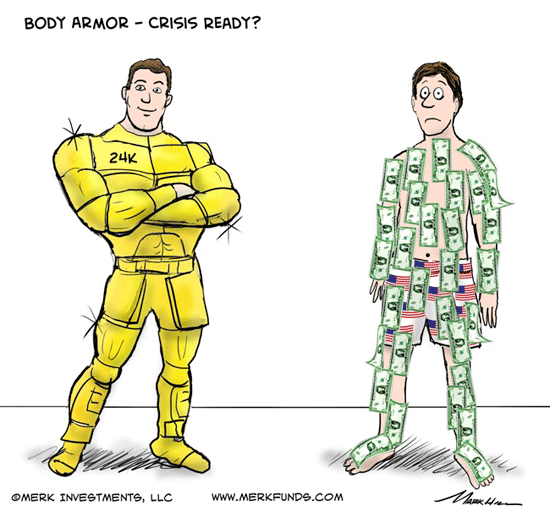 As the price of gold has gone up fivefold over the past 10 years, why would one buy it at today's prices? For the same reason an investor would buy any other asset: if one believed it would be a good investment now, that is if one believed it may appreciate in value and add portfolio diversification benefits. A key reason to hold gold today might be to prepare for the crisis tomorrow.
 With the US dollar hitting fresh two year highs, stock markets struggling around the world, and gold holding firm, today King World News interviewed acclaimed money manager Stephen Leeb, Chairman of Leeb Capital Management, to get his take on what is happening. Leeb told KWN there is a huge scandal because "…the banks don't have the gold the customers are paying them to have on deposit," and "all hell is going to break loose on the upside."

| You are subscribed to email updates from Save Your ASSets First To stop receiving these emails, you may unsubscribe now. | Email delivery powered by Google |
| Google Inc., 20 West Kinzie, Chicago IL USA 60610 | |


No comments:
Post a Comment