


Gold World News Flash |

- A Grievous Evil
- Public-Sector Unions and the Cannibalization of Youth
- Silver Update 6/20/12 The Silver Bomb 3
- Buying Time When the End is Near: David Schectman
- Eventual Rise in Interest Rates Will Be Downfall of U.S. ? Here?s Why
- The Slow Sucking of Mosquito Economics
- Raw and Unplugged: Max Keiser and The Silver Liberation Army
- Markets Losing Hope After China PMI Hits 7 Month Low
- Norcini - Wild Trading After Fed Release, What to Expect Next
- Gold and Silver on the Verge of Something Huge! - Are You Ready?
- Gold Slips but Larger Break Expected Soon
- Doug Casey on Facebook and Beyond, Part 2
- In The News Today
- Gold Seeker Closing Report: Gold and Silver End Lower In Mixed Trade after Fed
- China's Central Bank Willing To Share $3 Trillion
- Spain and Italy to be Bailed Out in £600bn Deal
- The "American Exceptionalism" Paradigm Is Broken
- What the Aussie Dollar Says About Global Risk
- GATA secretary scheduled for CNBC Asia appearance
- CFTC aims to define high-frequency trading so it might be regulated
- The Gold Price Fell $7.40 to Close at $1,614.80 I Expect the Uptrend Line to Hold
- Capital Controls Coming
- Economic Growth Versus Austerity: A U.S. Dollar Perspective
- Guest Post: Abandoning Ship - The Eurozone Is Failing At An Accelerating Rate
- Gold Stocks, How Undervalued?
- Commodities Crumble As Stocks Only Stumble
- Gold Daily and Silver Weekly Charts - More Wiggle Waggle
- Major Mineral Opportunities Uncovered in an Unexpected Place, Mongolia: Eric Zurrin
- Gold Market Update - June 20, 2012
| Posted: 20 Jun 2012 06:23 PM PDT Bullion Vault
|
| Public-Sector Unions and the Cannibalization of Youth Posted: 20 Jun 2012 06:10 PM PDT from stefbot: Did you know that public-sector unions and governments have set aside about five cents for every dollar they owe in healthcare costs? Stefan Molyneux, host of Freedomain Radio, dissects the upcoming financial apocalypse.
|
| Silver Update 6/20/12 The Silver Bomb 3 Posted: 20 Jun 2012 05:39 PM PDT |
| Buying Time When the End is Near: David Schectman Posted: 20 Jun 2012 05:35 PM PDT
The Fed and Central Banks around the world are just buying time before the collapse, but the end of this debt-based Ponzi scheme is near. I talk with David Schectman, the Founder of Miles Franklin to get his views on the worldwide collapse, and David helps us keep the big picture in clear view.
|
| Eventual Rise in Interest Rates Will Be Downfall of U.S. ? Here?s Why Posted: 20 Jun 2012 05:30 PM PDT Everyone who purchases a Treasury bond is purchasing a depreciating asset. Moreover, the capital risk of investing in Treasuries is very high. The low interest rate means that the price paid for the bond is very high. A rise in interest rates, which must come sooner or later, will collapse the price of the bonds and inflict capital losses on bond holders, both domestic and foreign. The question is: when is sooner or later? The purpose of this article is to examine that question. Words: 2600 So says Dr. Paul Craig Roberts ([url]www.intrepidreport.com[/url]) in edited excerpts from his original* 3700 word article.* [INDENT] Lorimer Wilson, editor of [B][COLOR=#0000ff]www.munKNEE.com (Your Key to Making Money!), has edited the article below for length and clarity – see Editor's Note at the bottom of the page. This paragraph must be included in any article re-posting to avoid copyright infringement.[/COLOR][/B] [/INDENT] Roberts goes on to say, in part: How can the Federal Reser...
|
| The Slow Sucking of Mosquito Economics Posted: 20 Jun 2012 05:05 PM PDT from Silver Vigilante:
Thus, the lullaby management of the U.S. Dollar. It and its people get sung to sleep by the steady nattering of condensed television vibrations. For academics and investors, the suppression of alternative currencies is top of the agenda, because the U.S. Dollar can only be laid to rest so easily amid a San Andreas earthquake. Still, despite the clamor outside, the value of the Dollar, along with all other phantasmagorical fiat monies, is being brought down in a pre-programmed and constantly managed manner. This is nothing like 9/11, fast as the towers crumbled to the relenting concrete below. This is attempt two in fifty years of the ultimate one-two punch of economic depression and world war. Expect things this time to not unfold so quickly.
|
| Raw and Unplugged: Max Keiser and The Silver Liberation Army Posted: 20 Jun 2012 04:55 PM PDT
|
| Markets Losing Hope After China PMI Hits 7 Month Low Posted: 20 Jun 2012 04:40 PM PDT HSBC's Flash Manufacturing PMI printed at 48.1 - its lowest in 7 months as contraction continues in the world's growth engine - as inventories rise at a faster rate and new export orders plunged at the fastest rate since March 2009. Risk markets were already leaking lower before this but extended losses with ES down 6pts from the close (and over 11 from the day's highs). Treasuries are bleeding a little lower in yield but the real action is an exaggerated slide in WTI (which is rapidly heading towards a sub-$80 handle) and EURUSD which has dropped back to the day's lows around 1.2660. Copper, Gold, and Silver are also sliding lower as AUD weakens (as we suggested last night) back to 1.0150.
Commodities continue to slide...
and S&P futures catch up to broad risk asset weakness for now...
Charts: Bloomberg and Capital Context
|
| Norcini - Wild Trading After Fed Release, What to Expect Next Posted: 20 Jun 2012 04:01 PM PDT  With the Fed increasing Operation Twist by $267 billion, and European leaders meeting today, King World News interviewed highly acclaimed trader Dan Norcini. Norcini told KWN that "After traders realized QE3 was not off the table, up gold and silver went and they closed well off their lows for the day." Norcini also had this to say regarding the markets: "As someone who has actively traded these markets for over two decades, I find what our markets have deteriorated into to be very distressing." But first, here is what he had to say about the move by the Fed: "The Fed took the safest, most conservative route they could at this stage of the game. Some of us have argued that it was a little early for the Fed to pull out their big gun of QE3. By going with this type of increase in Operation Twist, it leaves the Fed with more room if we are right back where we are now in a few months." With the Fed increasing Operation Twist by $267 billion, and European leaders meeting today, King World News interviewed highly acclaimed trader Dan Norcini. Norcini told KWN that "After traders realized QE3 was not off the table, up gold and silver went and they closed well off their lows for the day." Norcini also had this to say regarding the markets: "As someone who has actively traded these markets for over two decades, I find what our markets have deteriorated into to be very distressing." But first, here is what he had to say about the move by the Fed: "The Fed took the safest, most conservative route they could at this stage of the game. Some of us have argued that it was a little early for the Fed to pull out their big gun of QE3. By going with this type of increase in Operation Twist, it leaves the Fed with more room if we are right back where we are now in a few months."
This posting includes an audio/video/photo media file: Download Now |
| Gold and Silver on the Verge of Something Huge! - Are You Ready? Posted: 20 Jun 2012 03:36 PM PDT Gold and silver have taken more of a back seat over the past 12 months because of their lack of performance after topping out in 2011. Since then prices have been trading sideways/lower with declining volume. The price action is actually ... Read More...
|
| Gold Slips but Larger Break Expected Soon Posted: 20 Jun 2012 03:30 PM PDT courtesy of DailyFX.com June 20, 2012 02:09 PM Weekly Bars Prepared by Jamie Saettele, CMT No change as gold is sloshing back and forth aimlessly before the next big move (down?). “The latest move off of the high is impulsive (5 waves) which favors lower prices from the current level to at least Friday’s low at 1553. The bearish RSI reversal signal that was in place for gold last week is now in place for USD crosses.” The mentioned 5 wave decline was succeeded by a 3 wave advance into former congestion (resistance). Look lower as long as price is below 1641. Exceeding that level would shift focus to the May high at 1672. LEVELS: 1527 1553 1584 1641 1672 1697...
|
| Doug Casey on Facebook and Beyond, Part 2 Posted: 20 Jun 2012 03:29 PM PDT Synopsis: Breakthroughs in biotechnology could one day force everyone into a genetics "arms race." (Interviewed by Louis James, Editor, International Speculator) [Editor's Note: When we left our intrepid heroes hanging on an intellectual cliff, Doug Casey was saying: Doug: The future is taking shape right on our screens. The question is where this will ultimately lead…] L: Okay, realizing that I'm asking for a "forward-looking statement," where do you think it will lead? Doug: Speciation, for starters. L: The human race will evolve into something else? Doug: Several something elses. It's already started. Homo sapiens appeared around 200,000 years ago. Migration to Asia is thought to have occurred about 50,000 years ago, ultimately leading to visibly different racial characteristics. The evolution of light skin appears to have happened about 12,000 years ago in Europe. It's politically correct to say that this divergence and the differences are cosmetic only and don't matter. And as far as I'm concerned, they don't in most cases, simply because I treat people as individuals. I judge them first and foremost on their character. Intellectual and physical abilities are secondary. But there are differences that are more than skin deep. Look at dogs. Greyhounds are very fast, but dachshunds have short legs. Poodles are smart, but Irish setters are dumb as posts. Those differences have developed – depending on the breed – over only a few hundred years, or a few hundred dog generations. It's been accentuated and accelerated by human intervention, of course. Humans also have breeds; we call them races, and skin color is only one differentiating physical factor. There are probably scores of races. In Africa alone, the pygmies of the Ituri rainforest and the tall athletes of west Africa are as different as greyhounds and dachshunds. But you're not supposed to talk about these things in today's politically correct environment; it invites some fool to accuse you of racism. In any event, because of quantum leaps in travel technology, the various racial strains, having developed over hundreds of generations, are now reintegrating. My guess is that, just as humans started differentiating into breeds by living in isolated backwaters, they're heading in the opposite direction now. At least here on earth. But suppose the first human colonies in space are put there by governments – not unreasonable, given the near-monopoly governments have on space access right now. The Chinese will set up a 100% Han colony, and the Indians will do similarly, as will the Europeans. A private company, likely based in the US, is much more likely to choose astronauts based on ability, as opposed to nationalistic considerations. In any event, while we remain in this solar system, there would likely be very little genetic exchange between the colonies, simply because of the time and money involved. That would result in isolation, like that of prehistoric times – or at least the European colonial period. And as soon as they start sending missions out to the stars, the seed stock would evolve in even greater isolation. L: Assuming the speed of light really is the natural cosmic speed limit, that follows. Doug: As someone with solipsist leanings, I'd like to think that anything that can be imagined can be done – at least, given enough time and capital. But for now, let's stick with what's known to be possible. With objects in space limited to traveling at some fraction of the speed of light, even the closest stars are many years apart. The closest is more than four light-years away. And we're likely to have to go farther than the nearest stars to find more earth-like planets. L: Or planets that can be terraformed. Doug: Yes. Once humans get established in space, evolution will take over – and take off. Before then, however, and likely even before we leave the planet, I'll bet there's going to be a lot of intentional, as opposed to natural, genetic alteration. It will start with efforts to eliminate undesirable genes that predispose one to heart disease, cancer, or genetic disorders. But while we're at it, why not also select for blue eyes, taller, more muscular frame, greater intelligence, and anything else people might want their children to have? Some people won't want to go that route, preferring to leave things to nature, but their children will be at a disadvantage to those whose parents have selected superior genes. That could lead to speciation along several lines. L: It would be like an arms race. You might not want to pursue "unnatural" options, but if you don't, your posterity will be at the mercy of those who do. Doug: Exactly. It would be a genetic Olympics – "citius, altius, fortius: swifter, higher, stronger." I despise limitations. And I don't buy all the "only natural is good" nonsense circulating today – death is natural. But take it further. Who can be sure where it might lead in different places? People working in a low-gravity environment will need very different bodies from those on a planet with twice the gravity of earth. New subspecies with vastly different mental characteristics will come into being. For years, I've said – only half joking – that while it's quite possible for a libertarian to mate with a socialist physically, it's about as possible to mate with them psychologically as to do so with a chimpanzee. And what if people from one new subspecies couldn't breed with those of a different one? Let's just hope we can evolve ethically and morally at the same rate… although I expect that may be much harder. L: Hm. We don't need to go out to space to look for aliens – we could be making them ourselves soon enough. Sounds pretty wild, Doug. Doug: It does, but my read is that this isn't far-future stuff. The technology is right around the corner. Because of the "arms-race" psychology you pointed out, absent global war or some other cataclysm that leads to a new Dark Age, I don't see any way this can be – or should be – avoided. I take a laissez-faire view toward evolution, as toward just about everything. L: What if there were a global ban on genetic manipulation? Doug: Who would want to risk being left behind by the first people to break the rule in secret? L: Not me. I guess it could be fun living in a world with real mermaids and mermen, and other interesting and different people, but I'm not sure I'd enjoy a world in which everyone was an order of magnitude smarter than I am – and I sure wouldn't want my children left at a disadvantage. Or maybe grandchildren, by then. Doug: Right. But whether you would like it or not doesn't matter. I'm sure the Romans didn't like it when the Goths sacked Rome for the first time, but they didn't have a choice – nor the power to stop it. It's the same thing here; we're talking about technological trends that will have the force of history behind them. Much of the ongoing revolution in biology lends itself to low-cost research and entrepreneurialism of the type that gave birth to Apple. Undoubtedly, governments and political busybodies will try to stop or slow down progress, but they'll be unsuccessful. People may be able to influence how and when certain things happen, but I don't think they'll be able to stop what's coming. When there's a steamroller coming at you, it's best to jump on it, not lie down in front of it. I've always been a fan of Timothy Leary's concept of "SMIILE": Space Migration, Intelligence Increase, Life Extension. I'm sorry he was born a generation or two before he could have joined the party he predicted. L: Well, an unstoppable trend appeals to me as a speculator – is there a way to play that? Doug: Significant investments in the biotech companies most likely to lead the charge in this field would seem like the way to go. One thing in particular I think would be a sure ticket to big profits, if it comes along, would be to invest in a company that develops technology to change or augment existing, adult humans. As the human lifespan is getting longer, it won't be enough for most people to just give their children and grandchildren all the advantages possible. Like you, others won't want to live in a world in which all the younger people are smarter, faster, and stronger than they ever could be. But that's science fiction right now. It all starts with designer babies – and the technology is leading us in that direction. L: Makes me think about what you said about "punctuated equilibrium." Despite of the advent of the 21st century, the world looks much as it has for decades. We still drive cars on roads instead of flying around like the Jetsons. Robots are still just complex, glorified screwdrivers, not the mechanical life forms we imagined. Maybe we need times of slower change to allow time for people to adapt to the changes thus far. Be that as it may, if you're right about our species being on the brink of branching out, we might just be alive to witness one of the periods of sudden, drastic change. Doug: Periods of great change are like markets with great volatility; many people are going to get wiped out, but those who can call the trends accurately stand to make fortunes. Nobody likes volatility; it's scary. But I'm afraid the world is going to be getting more, not less, volatile. L: On the other hand, things could go down a different track – we've talked before about the "technology singularity." Do you think that could really happen? The pace of technological change accelerates to where it goes vertical, and life as we know it will be altered beyond recognition, possibly even beyond imagination? Doug: I don't know. I can see technological punctuated equilibrium providing an alternative future scenario to the technology singularity, but I can also see technology improving to the point of improving itself, and that leading to an acceleration of change right off the charts. As you say, it's hard to even imagine what life would be like under such circumstances. L: By "improving itself" you mean machines designing better machines – ultimately, artificial intelligence? Doug: That's part of it, sure. If the rate of compounding in computing power – Moore's Law – stays on track, it seems likely that computers will eventually have more "intelligence" than people. And that's just while we're using silicon. Quantum computers might come into their own. And biocomputers. The coming genetic changes we talked about are another vector for greatly accelerated change. L: As a matter of theory – or perhaps philosophy – do you think artificial intelligence is even possible? Doug: I don't see why not. A human brain is just a fatty mass of electrical connections – why should an equally complex system of silicon or other electrical connections be unable to produce behavior we can call intelligent? L: Why not, indeed… In your view, would an intelligent machine be a person? Doug: Perhaps this development will allow us to get a definitive answer to whether the soul exists. That is actually, perhaps, the most important question of all. I'd be most interested in real proof, as opposed to conjecture. I'm absolutely open to the possibility, if only because I believe in mind over matter. But, possible spiritual implications aside, I could have as much fun talking to a smart machine as I do a smart collection of meat, bones, and brains. If the machine could pass the Turing test, in other words, I don't see how I'd be able to exclude it from personhood. L: But you could mass produce millions of identical "persons" that way – isn't individuality part of what makes a person a person, not just intelligence? Doug: I didn't say that any intelligent machine would be a person. I said that if I couldn't tell if a person I was interacting with has human or mechanical, I'd have to count him, her, or it as a person – and that would take some pretty unique interaction, perhaps even completely individual interaction. A difference that makes no difference is no difference. L: I suppose, even if you produced a million identical robots with human-level intelligence, the moment you turned them on, each would start accumulating its own experiences, and each individual would become more and more unique as time went on. Doug: Not so different from human babies, which start as single, undifferentiated cells. Even when born, babies are pretty much just fat pink tubes that eat, burp, eliminate, and make various noises to go with those functions. L: They smile, too – when they aren't barfing on you or staining the new sofa brown… Doug: I'm sure they do. The point, however, is that while there's individuality among them, that becomes much greater as time passes – even between identical twins. L: Okay, okay, I get it. What about fears that a true AI might be hostile to its creators – or to all life forms other than itself? How do you control something that is an independent living being? Doug: You don't. That would be slavery. But we don't ask these questions about humans before creating them – parents have children knowing they won't be able to control them, only influence them, as most. That doesn't stop them from having children, and it won't stop us from developing smarter and smarter machines – such machines will just be too useful not to be developed. Again, it's like an arms race. Progress leads to more progress, innovation sparks innovation. It's a pity that the concept of an arms race has such bad connotations. Look, there's no reason for machine persons to be hostile to other life forms. Why should they be? Maybe some will grow that way, but others will not, and machine society could evolve like human society, with a mixture of different views. Could that mixture evolve towards a consensus that's hostile to humans? Maybe, but I'm willing to bet that there will always be things humans are better at than machines and vice versa, so what really emerges is a symbiotic relationship. That's one reason I love science fiction and sci-fi movies. They explore the nature of existence more than any other category of storytelling can. L: I can see what you mean, but I guess there's no way to know – and if you're right, there really isn't a way to stop this from happening, not without pulling the plug on our whole civilization. Doug: We may well get to see the answers. Maybe not tomorrow, nor next year, but I'd be surprised if we didn't see real artificial intelligence within one generation. L: Wow – so how do you invest? Doug: I'm definitely interested in companies working on AI applications now, but the first AIs may well come from university labs. Watching for commercial applications around that time would seem crucial. Where is the next Apple, or Intel, or Microsoft that's still in its embryonic stages? We're looking, but there are no sure things. AI may be some way down the road, but innovators in the computer industry can and will make better mousetraps of every sort, and that will yield high returns for investors. Related to this, there's a loot of cutting-edge technology being deployed in the gaming industry, and I think there's a lot of money to be made there as well. And as we discussed before, one of the best places to speculate in our changing technological world is in the biotech/medical sphere. I think there are fortunes to be made there, not just on new treatments and cures, but on life-extension technologies. But it's best to refer readers to Alex Daley and our technology letter for more on that. The main point now is that the future is unstoppable. That's in the nature of time itself. You can either look forward and try to prepare or get left behind. I keep telling people who call me a bear that I'm an optimist. You questioned my optimism earlier in this conversation. Well, unless we do blow ourselves back into the Stone Age or worse, I do think that even though the global economy is about to go through the wringer – and it's going to be even worse than I think it's going to be – the future beyond that is going to be even better than I think it will be. No cancer, no AIDS – no aging. No being stuck on one planet. It is literally going to be even better than we imagine. Or perhaps better than we can imagine. L: Bravo. Well, I kept asking for a more upbeat topic; I'm glad we got one. Doug: My pleasure. But I'm not trying to humor you; I'm still just calling 'em like I see 'em. L: Noted and appreciated. 'Til next time. Doug: Until next time. It may seem hard to believe that we'll one day be able to produce a race of superhumans, but it wasn't so long ago that splitting the atom, space travel, and the quantum leaps in communications we all take for granted – the Internet and smartphones – were little more than pipe dreams. And while a race of genetically perfect people may not be imminent, the same cannot be said of life-saving breakthroughs in disease prevention and treatment. Nowhere is this more evident than in the treatment of cancer, where several little-known biotech firms have developed treatments for this dreaded disease that sound like something out of a science-fiction novel. But they're real enough to the FDA, which has approved a number of these therapies and is considering approving many more. Alex Daley, the chief technology investment strategist at Casey Research, and his team have put together a report on some of these revolutionary treatments in great detail.
|
| Posted: 20 Jun 2012 02:15 PM PDT
Jim Sinclair's Commentary More really bad news for the US dollar. The biggest mistake ever made was using the SWIFT system as an economic weapon. This is the formation of a BRIC Swift system and ad hoc united central bank mechanism. China's Central Bank Willing To Share $3 Trillion Brazil, Russia, India Continue reading In The News Today
|
| Gold Seeker Closing Report: Gold and Silver End Lower In Mixed Trade after Fed Posted: 20 Jun 2012 02:00 PM PDT by Chris Mullen, Gold Seek:
Gold fell $28.82 to as low as $1590.78 just after the fed's announcement before it climbed back above $1620 over the next couple of hours of trade, but it then fell back off into the close and ended with a loss of 0.82%. Silver slipped to $27.73 just after the fed's announcement before it also bounced back higher, but it then dropped again in late trade and ended with a loss of 1.23%. Euro gold fell to about €1266, platinum lost $19.50 to $1455, and copper fell 6 cents to about $3.37. Gold and silver equities fell over 2% in the first 40 minutes of trade before they rose to see about 1% gains after the fed's announcement, but they then fell back off again in late trade and ended with almost 1% losses.
|
| China's Central Bank Willing To Share $3 Trillion Posted: 20 Jun 2012 01:30 PM PDT by Kenneth Rapoza, Forbes:
Regardless of the amount of difficulty involved, the big four emerging markets plus South Africa said earlier this week they were considering setting up a foreign-exchange reserve pool and a currency-swap arrangement in an effort to avoid any credit crisis stemming from the advanced economies.
|
| Spain and Italy to be Bailed Out in £600bn Deal Posted: 20 Jun 2012 01:00 PM PDT from Silver Doctors:
The will he or won't he QE debate is meaningless. The Western Central banks will print unfathomable amounts- when it is required. They can pretend it is not currently required, but delaying the implementation will only require a bigger counterfeiting gun when the time comes. European leaders are poised to announce a £600 billion deal to bail out Spain and Italy, it emerged at the G20 summit on Tuesday night.
|
| The "American Exceptionalism" Paradigm Is Broken Posted: 20 Jun 2012 12:45 PM PDT By Jeff Snider, President & CIO, Atlantic Capital Management There Is Little "Value" Under Untenable Circumstances Even now, in the third year of the recovery without a recovery, there is still a good deal of mystery as to why and how US investors should be wary of Europe. The intentional opacity of the global banking/financial system contributes to this effect, but all that is taking place in Spain and Italy will directly impact US asset prices at some point. The biggest lesson of the Great Depression was supposed to be limiting the spread of "contagion" through bond market prices, yet the modern interbank wholesale money system of securitization and financialization has gone far beyond what they ever dreamed possible in the 1930's. The connections between Spanish insolvency and the fallacy of the US dollar safe haven have never been greater, and given the propensity of sovereign euro debt to act as a global catalyst, it pays to at least review why US stock investors should be extremely mindful of monetary flows in seemingly unrelated global pockets. On one side of the Atlantic, there is the "bull" case for US stocks as a safe haven from the European turmoil, particularly since stocks are supposedly cheap compared to corporate earnings (more on this below). On the European side, there remains faith in policymakers to finally coalesce around a workable and serious solution. But that faith misses what might be the unmovable object in this financial equation, just as the irresistible force of contagion is unleashed, again. The real worry about the Spanish banks, as it has always been, is not even solvency, per se, it is that 1930's-style contagion of pricing. With Greek debt, Eurozone banks were afforded the margin to at least unload or even sit tight and take their mark-to-market losses; it was never going to rise to a fatal amount. But Spanish and Italian sovereign and bank debt remains embedded within Euro banks, particularly those in France. These are bonds that are, from what I have seen and given how this unraveled with Greece, currently embedded within "bank books" - not "trading books" - which means free from mark-to-market losses. OECD sovereign debt itself is still considered risk free, and thus not applicable in a mark-to-market structure. That is, until a market "event" which forces banks to recognize and legitimize any impairments. That is the fear of Spain, as a restructuring event akin to Greece would probably destroy several large institutions (how close were we on December 8, 2011?) under the weight of previously "undisclosed" losses that are currently tucked away in "bank books" everywhere. It has been amazing over the past four years just how assets go from perfectly fine, valued at or near par, to serious other-than-temporary-impairments overnight. The more likely it appears that Spain needs to restructure, the more likely the Eurozone banking system ends up taking these large embedded, but still unmarked, losses. As far as Spanish banks, we know that they are overexposed to the sovereign, including being over-represented in the LTRO's, so we need only go back in time to see what prices they were likely buying at. We also have some idea as to the extent to which the Spanish banks are still holding local RMBS (and especially CMBS of land developers) unmarked in their bank books through institutions that have already been "outed" in failure. Bankia's EUR5bn capital shortfall quickly turned into EUR9bn and then EUR15bn on the way to EUR19bn. Those bailout losses are unmarked assets that are getting "reviewed" by the national "receiver" - thus the company's small posted profit for 2011 is completely reversed into a multi-billion euro loss on a mark-to-market, ex post facto basis. Bankia is/was a conglomeration of 7 previous regional cajas, so it is not likely unique and therefore gives us some insight into the intentionally opaque world of Eurozone banking in 2012. What we need to know now is the proximate cause of Bankia's fall - a loss of retail deposits or no access to repo funding (because there was no unencumbered/quality collateral left to be pledged at acceptable terms). What is driving fear here is not whether Europe can solve its debt problems, but how to do so without bankrupting large swaths of its own banking system. Even if Spain had the leeway to restructure its debt, it would still not be enough since losses at Spanish (and other) banks would be catastrophic, and would be spread throughout the global system. Thus the game has been played out at the ECB of trying to get sovereign bonds to float at "reasonable" levels (the SMP purchases, LTRO's), while bailing out each country to avoid a restructure that triggers mark-to-market. That process has always been finite, and was even intended to be due to the overconfidence of policymakers in the efficacy of their own policies and interventions. The question for them was how much growth they could "engineer" and how much bank capital breathing room would follow before that shelf-life expired. As that over-confidence has faded into the reality of the structural economic overhang and very real re-recession (even in the core; see Holland), market gullibility has fallen in proportion. Just in these past two weekends we have seen a Spanish bank "bailout" and the "right" Greek election result, but no massive relief rallies in both credit and equities. If anything, credit markets are marginally worse, at best no better (see Swiss bond yields). This is a complete change, ominously, from the 2011 pattern. The market is very fickle right now with how it is reacting to the same old playbook. What worked well in stoking investor gullibility last year, providing breathing room then, does not seem to possess the same type of market magic. There have been no two-standard deviation up days in concurrence with each "positive" event. As all this unfolds in Europe, the calls of US decoupling and the safe haven of US stocks grow louder. Yet, it would be a huge mistake to forget that the "safe haven" of the US stock market has experienced at least an 18% decline in each of the past four years, largely as a result of the dollar overhang/dollar shortage. Euro-based banks' modus operandi has been "hub and spoke" for more than two decades, meaning that they have gathered local deposits in their domestic areas, swapped them for dollars (creating the dollar shortage/crowded trade) and investing those phantom eurodollars in US dollar-denominated assets (they were a major source of housing bubble credit, and the shortage of dollars due to the hub and spoke was why the Fed was forced into the dollar swap business in 2008, and again in 2011/12). The dollar overhang has been problematic in the breakdown of the interbank wholesale money markets as institutions find themselves periodically unable to easily rollover that dollar shortage. As that inability to find dollar financing rises systemically, banks are pushed into a forced short covering of the dollar swaps/shorts (the dollar rises not in a flight to safety, but a short covering rally), including the wholesale selling of dollar denominated assets. In the Spring of 2012, however, the dollar rollover problem may be intersecting with local deposit funding means. If retail deposits are fleeing from afflicted institutions, that "spoke" issue will put even greater pressure on the "hub". No one knows just how big the dollar shortage is, but even the IMF has estimated that it is likely greater than $2 trillion (with upper bound estimates of $6.5 trillion). In a crowded trade, that is a hell of a lot of marginal selling pressure into what conventional wisdom says is a "safe haven". The optimistic, bull case always falls back on company earnings, but market earnings, in and of themselves, do not drive markets. Earnings do drive individual stock prices, but I do think there is a fallacy of composition here (and I hate the fallacy of composition usage in economics). Market prices are driven by the supply of money related to psychology. For example, at the last bear market nadir, in April 1980, the PE on the S&P 500 was 6.79. As late as 1973, the market PE was 18+. Over the intervening seven years, earnings on the S&P 500 grew 135%. Nominal prices over the same period fell 12% (including that pretty severe correction in 1974). The rise in corporate earnings was no protection against conspiring economic forces; in this case inflation. You can actually extend this analysis backward to 1971, the PE-apex for the decade, and even to 1961 and the cycle PE peak (22.5x). Despite a very good economic run in the 1960's, including corporate earnings, at best the market PE fell slightly throughout the decade (or at a more exaggerated pace, dependent on your start date and end date). Close to the bottom of the 1937-38 re-depression, the market's PE had risen to 20x. Over the next four years of turmoil, largely unrelated to the global economy as it somewhat recovered (including the Keynesian uber dream of government spending for large scale war), the market PE fell to 7.69 in 1942, despite the fact that earnings rose 62%. Earnings are secondary considerations to investors' collective perceptions of getting paid for the risk of holding equities, and that risk perception is, historically speaking, largely unrelated to earnings fundamentals themselves (the converse is true for rising market PE's where earnings largely do not keep pace - the dot-com bubble, for example, had little to do with corporate earnings growth). Currently, despite the overall move of the market higher since 2009, markets are more concerned with factors independent of earnings, namely gaming monetary intervention episodes. That non-fundamental driving factor is balanced by the potential psychological parameters that "council" avoiding US stocks, especially the four straight years of large systemic declines (this massive volatility is very much on par with inflation of the late 1970's in terms of the psychology of investor avoidance of stocks). Add in the demographic shift to usage of retirement assets (particularly as that shift is being forced by the lack of wage income) and we really do not need double-digit inflation to see a single-digit PE in US stocks, perhaps even a sustained low multiple. The evolution of investor perceptions of financial risk is really just the continuation of the secular bear market process that began twelve years ago. Everything that has happened in the financial sphere during this run is but a reminder that long-term risk prospects are not on the side of simply holding equities. So the intersection of that long-term trend with the analysis of this bear market rally is the point at which all this monetary intervention reaches that inevitable shelf-life. The near-term bear market rally succumbs to the longer-term bear market gravity at some point, and I think there are any number of candidates in this discussion alone to demonstrate such an inflection (especially, again, the seeming change of asset markets to accept these policy interventions at face value - that is the essence of what this bear market rally has been and it seems to be reversing before our eyes). For the market to keep moving higher, to get to 1600 on the S&P 500, for example, will require, in my opinion, full removal of all economic (statistical estimates of unemployment below 7.5% on a sustainable trajectory lower) and financial uncertainty (stable funding regimes). Or hyperinflation. We "enjoyed" the past three decades of eurozone dollar creation (the London hub of the eurodollar market), now we (US dollar assets) are stuck with the millstone of euro problems. Earnings growth or strength in US companies simply will not mitigate against this potential wholly unrelated selling pressure, particularly since strength of earnings has been little comfort in each of the past two years. Add to that the fact that the very investors that would be buyers of stock fundamentals are exactly the ones that are exiting due to demographics and a plain lack of funds. Outside of the financial sphere, the real economy is less and less a source of comfort, though mainstream economists will remain optimistic all the way to the end. Just as they were convinced the recovery was finally at hand in early 2012 (for the third time in as many years), they will remain stalwart optimists adhering to the textbook principles of monetary "science". One of these days low interest rates will work since that is Chapter 1, Page 1 of the monetary handbook. As the Beveridge Curve and Okun's Law undergo significant revisions (http://www.zerohedge.com/news/guest-post-its-far-deeper-broken-okun), perhaps the monetary handbook will get a rewrite in the face of the epic failure of Extend and Pretend. In the real world, however, the uncomfortable payroll report for May has been matched by an almost universal downward trend in the real economy from the US to Europe to China. The latest JOLTS survey merely confirms the unexpected deterioration in growth prospects; right on schedule. If we put all of this together, we are seeing a warning signal, a confluence of trends that portends an abnormal summer. In the context of the post-crisis, volatile markets of the non-existent recovery, that is saying something. In the context of financial risk, optimists are simply betting on reflation through monetary intervention overcoming the financial gravity of a continuously contagion-prone system that cannot seem to find sufficient quality collateral despite the trillions in fresh government borrowing globally. The financial risks to asset prices in so many markets are tied directly to the utter chaos and mess of the intractable problem of euro bank symbiosis to their local governments because financial markets still largely operate under textbook economic and financial assumptions. This is also true, to a large extent, of investor expectations of asset prices and financial risks. The revaluation that is underway now is beyond the simple scope of corporate earnings valuations, going to the very core of the system itself. Just like the equity pricing regime (and investor expectations for equity assets) needs to adjust to the twelve-year-old bear market reality, pricing within the global banking system as a whole needs to adjust to the reality that the artificial growth of the economic textbook is not replicable. The economic truth of 2012 is that much of the science of economics, and the foundation that gives to finance and financial pricing, was a temporal anomaly befitting only those specific conditions of that bygone era. In other words, the entire financial world needs to reset itself outside the paradigm of pre-2008. The secular bear market in US equities is one strand of this changing landscape, perhaps the first stirring of the collapse of the activist central bank experiment. In the end, the potential selling pressure of the dollar shortage is irresistible, no matter how "cheap" stock prices are to earnings, but none of it may matter in the grander scheme of a dramatic reset to the global system. The inability of that global system to escape this critical state, to simply move beyond crisis and function "normally" again, demonstrates conclusively, in my opinion, the foundational transformation that is still taking place well beyond the stock bear. Everything is a locked feedback loop of negative pressures in this age, no matter how much we want to see "value" where and how it used to exist. Paradigm shifts are rarely orderly, but there are warning signs.
|
| What the Aussie Dollar Says About Global Risk Posted: 20 Jun 2012 11:30 AM PDT Being a true contrarian investor isn't just about investing in unloved sectors of the market or specific stocks. It's also about conducting research and discovering indicators that the crowd doesn't follow — indicators that can help give clues as to the next probable direction of risk assets. I'm always on the lookout for such indicators, and have compiled many of them over my years of trading and investing. [Here's just one that bares scrutiny. Take a look.] Words: 610 So says Tom Essaye ([url]www.moneyandmarkets.com[/url])*in edited excerpts from his original article*. [INDENT]Lorimer Wilson, editor of [B][COLOR=#0000ff]www.munKNEE.com (Your Key to Making Money!), has edited the article below for length and clarity – see Editor's Note at the bottom of the page. This paragraph must be included in any article re-posting to avoid copyright infringement.[/COLOR][/B] [/INDENT]Essaye goes on to say, in part: The crowd, for example,*often looks at the U.S. dollar as an indicator of risk...
|
| GATA secretary scheduled for CNBC Asia appearance Posted: 20 Jun 2012 11:17 AM PDT 7:08a HKT Thursday, June 21, 2012 Dear Friend of GATA and Gold: Your secretary/treasurer is scheduled to be interviewed on CNBC Asia in Hong Kong by news anchor Bernie Lo at about 9:40 a.m. Hong Kong time Friday, June 22. That would be 9:40 p.m. Thursday Eastern time in the United States -- not that any financial journalists in the West would be allowed to pay any attention to gold market manipulation. CHRIS POWELL, Secretary/Treasurer ADVERTISEMENT Prophecy Platinum Announces Wellgreen Preliminary Economic Assessment: Company Press Release VANCOUVER, British Columbia, Canada -- Prophecy Platinum Corp. (TSX-V: NKL, OTC-QX: PNIKF, Frankfurt: P94P) reports the results of an independent NI 43-101-compliant preliminary economic assessment for its fully owned Wellgreen nickel-copper-platinum group metals project in the Yukon Territory. The independent assessment, prepared by Tetra Tech, evaluated a base case of an open-pit mine (with a mining rate of 111,500 tonnes per day), an on-site concentrator (with a milling rate of 32,000 tonnes per day), and an initial capital cost of $863 million. The project is expected to produce (in concentrate) 1.959 billion pounds of nickel, 2.058 billion pounds of copper, and 7.119 million ounces of platinum, palladium, and gold during a mine life of 37 years with an average strip ratio of 2.57. The financial highlights of the preliminary economic assessment, shown in U.S. dollars, are as follows: Payback period: 3.55 years Prophecy Chairman John Lee says: "We are pleased with the preliminary economic assessment results. The numbers indicate that Wellgreen is one of most exciting mineral projects in the Yukon. The company is drilling to upgrade and expand the resource base. The infrastructure is excellent as the project is only 1,400 meters in altitude and 14 kilometers from the paved Alaska Highway, which leads to the Haines deep seaport. Discussions are under way with support from local stakeholders regarding permitting and logistics." For the complete press release, please visit: http://prophecyplat.com/news_2012_june18_prophecy_platinum_announces_res... Join GATA here: Standard Chartered's Earth Resources Conference Hong Kong Gold Investment Forum Toronto Resource Investment Conference New Orleans Investment Conference * * * Support GATA by purchasing DVDs of our London conference in August 2011 or our Dawson City conference in August 2006: http://www.goldrush21.com/order.html Or by purchasing a colorful GATA T-shirt: Or a colorful poster of GATA's full-page ad in The Wall Street Journal on January 31, 2009: http://gata.org/node/wallstreetjournal Help keep GATA going GATA is a civil rights and educational organization based in the United States and tax-exempt under the U.S. Internal Revenue Code. Its e-mail dispatches are free, and you can subscribe at: To contribute to GATA, please visit: ADVERTISEMENT Sona Discovers Potential High-Grade Gold Mineralization From a Company Press Release VANCOUVER, British Columbia -- With its latest surface diamond drilling program at its 100-percent-owned, formerly producing Blackdome gold mine in southern British Columbia, Sona Resources Corp. has discovered a potentially high-grade gold-mineralized area, with one hole intersecting 13.6 grams of gold in 1.5 meters of core drilling. "We intersected a promising new mineralized zone, and we feel optimistic about the assay results," says Sona's president and CEO, John P. Thompson. "We have undertaken an aggressive exploration program that has tested a number of target zones. Our discovery of this new gold-bearing structure is significant, and it represents a positive development for the company." Sona aims to bring its permitted Blackdome mill back into production over the next year and a half, at a rate of 200 tonnes per day, with feed from the formerly producing Blackdome mine and the nearby Elizabeth gold deposit property. A positive preliminary economic assessment by Micon International Ltd., based on a gold price of $950 per ounce over eight years, has estimated a cash cost of $208 per tonne milled, or $686 per gold ounce recovered. For the company's complete press release, please visit: http://www.sonaresources.com/_resources/news/SONA_NR18_2011-opt.pdf
|
| CFTC aims to define high-frequency trading so it might be regulated Posted: 20 Jun 2012 11:04 AM PDT By Scott Patterson and Jenny Strasburg http://online.wsj.com/article/SB1000142405270230337920457747700314637280... U.S. regulators are about to take a big step toward reining in high-frequency trading: defining what it is. On Wednesday, a Commodity Futures Trading Commission subcommittee is expected to propose a roughly 60-word definition of high-frequency trading that would define it broadly, a bad sign for traders who had hoped for narrower language. The announcement follows three months of sometimes contentious meetings by an industry group that was formed by the CFTC to help the agency wrestle with the impact of rapid-fire trading on financial markets. Such trades now generate more than half of all U.S. stock- and futures-trading volume, and critics claim the surge in high-frequency trading has left Wall Street more vulnerable to computer-driven failures that sap investor confidence. ... Dispatch continues below ... ADVERTISEMENT Sona Discovers Potential High-Grade Gold Mineralization From a Company Press Release VANCOUVER, British Columbia -- With its latest surface diamond drilling program at its 100-percent-owned, formerly producing Blackdome gold mine in southern British Columbia, Sona Resources Corp. has discovered a potentially high-grade gold-mineralized area, with one hole intersecting 13.6 grams of gold in 1.5 meters of core drilling. "We intersected a promising new mineralized zone, and we feel optimistic about the assay results," says Sona's president and CEO, John P. Thompson. "We have undertaken an aggressive exploration program that has tested a number of target zones. Our discovery of this new gold-bearing structure is significant, and it represents a positive development for the company." Sona aims to bring its permitted Blackdome mill back into production over the next year and a half, at a rate of 200 tonnes per day, with feed from the formerly producing Blackdome mine and the nearby Elizabeth gold deposit property. A positive preliminary economic assessment by Micon International Ltd., based on a gold price of $950 per ounce over eight years, has estimated a cash cost of $208 per tonne milled, or $686 per gold ounce recovered. For the company's complete press release, please visit: http://www.sonaresources.com/_resources/news/SONA_NR18_2011-opt.pdf In response, officials at the CFTC and Securities and Exchange Commission have been exploring ways to track the orders and trades of high-speed firms, which use powerful computers to jump in and out of markets, trying to exploit fleeting price moves. Much as the proposed "Volcker rule" has spurred sweeping changes on trading desks, the official definition of high-frequency trading likely will guide regulators as they seek to crack down on trading that allegedly is manipulative or undermines investor trust. The Volcker rule would restrict bets banks could make with their own money. In a sign of the effort's importance, the process of crafting a definition is being overseen by the CFTC's enforcement division. The subcommittee that meets Wednesday is part of the CFTC's Technology Advisory Committee, led by Scott O'Malia, a Republican commissioner who has spearheaded the effort to increase oversight of computer-driven trading at the agency. According to a draft version reviewed by The Wall Street Journal, a subcommittee working group is proposing to define high-frequency trading as a form of trading that uses sophisticated computer programs to make automated decisions in the markets, with no human decision-making involved in individual transactions. The draft also defines such trading as using technology to amplify the speeds at which firms send orders to exchanges and other trading venues, and generating large volumes of messages, orders and cancellations compared with other, slower types of trading. The subcommittee still could make changes before Wednesday's meeting. The definition, which isn't subject to approval by the full commission, eventually could help guide the CFTC's rule-making process as it ramps of regulation of high-speed trading. The subcommittee faces a tough balancing act between writing a definition narrow enough to apply to specific trading activities and broad enough to rope in a wide swath of firms. The wording in the draft version is potentially wide-ranging enough to include the algorithmic-trading desks at big Wall Street firms that help clients buy and sell securities, as well as smaller firms specializing in high-frequency trading. But the definition also may be so broad that it could be difficult to enforce and might face challenges in court, according to a person involved in the discussions about the definition. High-frequency trading firms and others, including members of the CFTC's advisory groups, have argued that it is fruitless to try to define a group of market participants before identifying what exact behaviors should concern regulators. Doing so could mean tagging certain players while others slip through the cracks or potentially change their behaviors to elude scrutiny. Some involved in discussing the definition wanted it to be "toothless" to ward off what they view as potentially harmful regulation, according to two people involved in the discussions. The definition-writing group includes representatives of high-frequency trading firms Virtu Financial and Getco LLC, Deutsche Bank AG, research firm Tabb Group LLC, and Themis Trading LLC, a New Jersey broker and critic of some high-frequency trading practices, as well as NYSE Euronext. The rise of high-frequency trading also will get attention Wednesday at a hearing of the House Financial Services Committee's subcommittee on capital markets. The hearing is focused on the health of the financial markets for investors and companies seeking to raise capital by selling stock. Likely to dominate at least part of the hearing: Facebook Inc.'s glitch-riddled initial public offering on the Nasdaq Stock Market last month. Last week, officials from Nasdaq OMX Group Inc. and NYSE Euronext told House subcommittee members in a joint presentation that the proliferation of trading venues such as dark pools, in which orders are posted by firms away from public exchanges, has hurt the quality of the market and investor confidence. The two exchange operators claimed that such trading operations helped trigger the May 6, 2010, flash crash, when stocks plunged sharply in a short period. "Liquidity evaporates quickly when it is spread too thinly" across the market, the presentation said. In testimony for Wednesday's hearing, Dan Mathisson, head of U.S. stock trading at Credit Suisse Group, compared the Facebook offering to the flash crash, saying the bungled stock sale caused "significant chaos in the markets." NYSE Euronext Chief Executive Duncan Niederauer is scheduled to testify at the hearing, as well as executives of high-frequency trading firms and securities firms. Mr. Niederauer will urge regulators for measures that would bring trading back onto public exchanges, according to prepared testimony. "We should not wait for another May 6 to address" questions such as why "the volume of securities trading in dark pools tripled" in recent years. Nasdaq CEO Robert Greifeld declined an invitation to appear at the hearing, according to a subcommittee spokeswoman. A Nasdaq spokesman declined to comment on Mr. Greifeld's decision not to attend the hearing. Join GATA here: Hong Kong Gold Investment Forum Toronto Resource Investment Conference New Orleans Investment Conference * * * Support GATA by purchasing DVDs of our London conference in August 2011 or our Dawson City conference in August 2006: http://www.goldrush21.com/order.html Or by purchasing a colorful GATA T-shirt: Or a colorful poster of GATA's full-page ad in The Wall Street Journal on January 31, 2009: http://gata.org/node/wallstreetjournal Help keep GATA going GATA is a civil rights and educational organization based in the United States and tax-exempt under the U.S. Internal Revenue Code. Its e-mail dispatches are free, and you can subscribe at: To contribute to GATA, please visit: ADVERTISEMENT Prophecy Platinum Announces Wellgreen Preliminary Economic Assessment: Company Press Release VANCOUVER, British Columbia, Canada -- Prophecy Platinum Corp. (TSX-V: NKL, OTC-QX: PNIKF, Frankfurt: P94P) reports the results of an independent NI 43-101-compliant preliminary economic assessment for its fully owned Wellgreen nickel-copper-platinum group metals project in the Yukon Territory. The independent assessment, prepared by Tetra Tech, evaluated a base case of an open-pit mine (with a mining rate of 111,500 tonnes per day), an on-site concentrator (with a milling rate of 32,000 tonnes per day), and an initial capital cost of $863 million. The project is expected to produce (in concentrate) 1.959 billion pounds of nickel, 2.058 billion pounds of copper, and 7.119 million ounces of platinum, palladium, and gold during a mine life of 37 years with an average strip ratio of 2.57. The financial highlights of the preliminary economic assessment, shown in U.S. dollars, are as follows: Payback period: 3.55 years Prophecy Chairman John Lee says: "We are pleased with the preliminary economic assessment results. The numbers indicate that Wellgreen is one of most exciting mineral projects in the Yukon. The company is drilling to upgrade and expand the resource base. The infrastructure is excellent as the project is only 1,400 meters in altitude and 14 kilometers from the paved Alaska Highway, which leads to the Haines deep seaport. Discussions are under way with support from local stakeholders regarding permitting and logistics." For the complete press release, please visit: http://prophecyplat.com/news_2012_june18_prophecy_platinum_announces_res...
|
| The Gold Price Fell $7.40 to Close at $1,614.80 I Expect the Uptrend Line to Hold Posted: 20 Jun 2012 10:47 AM PDT Gold Price Close Today : 1614.80 Change : -7.40 or -0.46% Silver Price Close Today : 2838.3 Change : -2.1 or -0.07% Gold Silver Ratio Today : 56.893 Change : -0.218 or -0.38% Silver Gold Ratio Today : 0.01758 Change : 0.000067 or 0.38% Platinum Price Close Today : 1479.00 Change : -13.70 or -0.92% Palladium Price Close Today : 628.25 Change : -9.90 or -1.55% S&P 500 : 1,355.69 Change : -2.29 or -0.17% Dow In GOLD$ : $164.17 Change : $ 0.60 or 0.37% Dow in GOLD oz : 7.942 Change : 0.029 or 0.37% Dow in SILVER oz : 451.83 Change : -0.12 or -0.03% Dow Industrial : 12,824.39 Change : -12.94 or -0.10% US Dollar Index : 81.38 Change : -0.570 or -0.70% Today proved me wrong and right. A sharp, sudden decline came, but the $1,610 GOLD PRICE didn't hold, sort of, and it sort of did. The GOLD PRICE closed at $1,614.80, down $7.40, but intraday it reached $1,591.50. Gold's chart today mirrors all the other bizarre charts today, including the dollar and stocks. It declined into 12:30, waiting for the FOMC's announcement, shot up on the announcement, wallowed in indecision, then gave up about $7 of a $30 climb. Central banks simply wreak havoc on markets. The GOLD PRICE hit its 20 DMA ($1,598.83) but closed above that and above its 50 DMA ($1,613.8). Today gold nearly touched its uptrend line from the May low. Maybe that's the limit of the move, maybe it goes lower. I expect that uptrend line to hold, but my crystal ball is broken, so I will roll when it punches me. More I think about that euro and those European banks, the more I think about 2008. The more I think about 2008, the more I remember that although paper silver and gold dropped sharply, you couldn't get physical metal except at premiums 50% or more above market. The more I think about all paper money and banks and central banks, the more gold and silver I want to own. The SILVER PRICE dropped as low as 2775 cents but closed down only 2.1c at 2838.3c. Which way next? Since its May trough, silver has formed an even-sided triangle and today touched the bottom boundary. Even- sided triangles don't tell you which way they will break out, up or down, only that they will break out soon. Upside that boundary stands about 2875c, below at 2775c. MACD wants to roll over downward, not an encouraging sign. Today's comeback, though was strong. This sort of frustration and meaningless back and forth is liable to continue through July. However, I don't believe the downside risk is great here, and I think silver will hold its own, although may prove me a fool. But wait! That's all I claim to be anyway, a natural born fool from Tennessee, so I have nothing whatever to lose by voicing my opinion. This is great: when you ain't nobody, you ain't got nothing to lose! It's like a bank going bankrupt -- How could it? It's already insolvent! Markets were thoroughly confused today. Long ago I gave up expecting any rational reaction out of markets, addicted as they are to government spending and "stimulus." Today the Federal Reserve Open Market Committee said it expects "to maintain a highly accommodative stance for monetary policy" keeping interest rates at "exceptionally low levels for the federal funds rate at least through late 2014." Plus the FOMC extended Operation Twist -- selling short term treasure debt and buying long term -- until year end. Supposedly this will drive down long term interest rates and increase lending. (All of which is grade B hogwash, as it will only further prolong the depression by preventing the market from adjusting with higher interest rates.) Although the Fed handed stock investors the plum they were expecting -- more inflation, 'cause that's what a "highly accommodative monetary stance" means -- stocks spent most of the day underwater, barely poking their nose above the surface, only to sink again vigorously. S&P 500 and Dow dropped, other indices rose slightly. This may be the level where stocks stall, 1,405 S&P target notwithstanding. Dow today lost 12.94 (0.1%) to close 12,824.39. S&P500 lost 2.29 (0.17%) and ended at 1,355.69. STOCKS -- you can't get into the Poor House without 'em. Currencies reacted a bit more logically to the FOMC announcement. US dollar index lost 57 basis points (0.69%) to end at 81.38. This changeth not the chart, since today's low struck about the same spot as yesterday's (81.16). It catches my eye that this is the 50% correction level of the rise from the May low to the 1 June high. Thus it becomes a candidate for a turnaround, since the dollar remains in an uptrend as long as it remains above 80.90. Don't short dollars for the short term. The Yen threw down its cards today and fled the room. Dropped 0.73% to 125.76c/Y100 (Y79.52/US$1). It busted clean through its 20 DMA (126.35) and fell for the 50 DMA (125.22). One more down day establishes a down trend with two lower lows and a lower high. The euro tried to make good its upward escape today, rising 0.17% to $1.2708. Never mind: just below $1.2800 the euro will meet starchy resistance. Long term, the euro is cooked. Roasted. Poached. Toasted. Crispy fried. Read a clear-eyed and insightful analysis last night by Steve Belmont of Options Edge. Euro members have basically three choices: default, ditch the euro, or pool all the debt and print enough money to inflate the burden away. This is like being offered the option of death by barbed wire, burning, or boiling in a vat of acid. No matter the method chosen, the euro is cooked. Oh, and those European banks? They're so insolvent that they make US banks look good. This ain't a recipe for economic progress. If any road leads to safety other the gold and silver road, I don't know it. Argentum et aurum comparenda sunt -- -- Gold and silver must be bought. - Franklin Sanders, The Moneychanger The-MoneyChanger.com 1-888-218-9226 10:00am-5:00pm CST, Monday-Friday © 2012, The Moneychanger. May not be republished in any form, including electronically, without our express permission. To avoid confusion, please remember that the comments above have a very short time horizon. Always invest with the primary trend. Gold's primary trend is up, targeting at least $3,130.00; silver's primary is up targeting 16:1 gold/silver ratio or $195.66; stocks' primary trend is down, targeting Dow under 2,900 and worth only one ounce of gold; US$ or US$-denominated assets, primary trend down; real estate bubble has burst, primary trend down. WARNING AND DISCLAIMER. Be advised and warned: Do NOT use these commentaries to trade futures contracts. I don't intend them for that or write them with that short term trading outlook. I write them for long-term investors in physical metals. Take them as entertainment, but not as a timing service for futures. NOR do I recommend investing in gold or silver Exchange Trade Funds (ETFs). Those are NOT physical metal and I fear one day one or another may go up in smoke. Unless you can breathe smoke, stay away. Call me paranoid, but the surviving rabbit is wary of traps. NOR do I recommend trading futures options or other leveraged paper gold and silver products. These are not for the inexperienced. NOR do I recommend buying gold and silver on margin or with debt. What DO I recommend? Physical gold and silver coins and bars in your own hands. One final warning: NEVER insert a 747 Jumbo Jet up your nose. No, I don't. 
|
| Posted: 20 Jun 2012 10:04 AM PDT For the past few months depositors have been emptying their Greek and Spanish bank accounts and moving the funds to safer places like Germany and Switzerland. This is not surprising. What is surprising is that anyone still has accounts in Greek and Spanish banks. This is a trend with a limited lifespan. Either sentiment stabilizes and capital starts flowing back into peripheral eurozone countries (possible but unlikely), or the slow-motion bank run continues until the Greek and Spanish banks are empty, or the trickle becomes a torrent as everyone heads for the exits at once, thus crashing those countries' banking systems. In the second and third scenarios, the result will be capital controls ranging from bank closures (like FDR's 1933 bank holiday), to expropriation of bank accounts (as when Argentina converted dollar-based accounts to pesos in 2002), to restrictions on the movement of wealth across borders. Planing for such capital controls is well under way:
Some Thoughts Meanwhile, talking about capital controls risks making them a self-fulfilling prophecy, since holders of Greek, Spanish, and Italian bank accounts who read the above will now have an even more compelling reason to empty those accounts. It's not a big intuitive leap from a temporary freeze on ATM access to a permanent daily limit on withdrawals. Or from Argentina converting dollar-based accounts into pesos to the US converting IRAs full of gold mining stocks into portfolios of treasury bonds. For investors, this means that it's possible to make exactly the right asset allocation decisions and still lose because of government confiscation. This new layer of complexity makes geographic diversification even more crucial.
|
| Economic Growth Versus Austerity: A U.S. Dollar Perspective Posted: 20 Jun 2012 09:53 AM PDT Austerity versus Growth? Which economic model is sustainable? If it weren’t for those pesky bond vigilantes, it may be only politics. Let’s not get too excited that either path will work. Let’s look at the implications for investors with a focus on the U.S. dollar.
|
| Guest Post: Abandoning Ship - The Eurozone Is Failing At An Accelerating Rate Posted: 20 Jun 2012 09:36 AM PDT
Submitted by Alasdair Macleod, PeakProsperity.com contributing editor Abandoning Ship The Eurozone Is Failing At An Accelerating Rate It will be no surprise to readers that the news coming out of the Eurozone just gets worse and worse. The reality is that Ireland, Portugal, Spain, Italy, Belgium, Greece, and France (in no particular order) are all in debt traps from which there is no escape. A debt trap is sprung when bankruptcy becomes the only outcome. With corporations, this usually becomes readily apparent and directors are forced by law to stop trading, but countries conceal this reality by printing money. Otherwise there is no difference in the two cases, despite what politicians and neoclassical economists would have us believe. This is why we are painfully aware that the Eurozone is in trouble, since nation states are unable to cover and conceal their obligations by printing money, having surrendered this role to the European Central Bank (ECB). The ECB is meant to be independent of politics and political pressures. But the reality facing any central banker is that s/he cannot stand by and let politicians drown in their own mess. The politicians know this, and it's what is behind current attempts to move away from austerity towards Keynesian growth. The plea is exactly the same as that of the spendthrift who tells his bank manager that the only chance he has of getting his money back is to increase the overdraft to allow him to trade his way out of difficulty. So the ECB knows, in its role as bank manager, that the argument is flawed. But unlike spendthrift individuals, politicians have real power, and the ECB has an ultimate responsibility not to upset the apple cart. And that is why the election of a new socialist French president is important. President Hollande is leading the charge away from austerity in Europe, and he has powerful allies, including President Obama in his own election year. Unfortunately, the ECB and the politicians lack a proper understanding of their economic condition because they continue to operate within the neoclassical framework that has led them into this mess. The lack of understanding of the relationship between the elements of hard-to-predict future consumer preferences, as well as the entrepreneurial function and the role of time in their calculations, has led to a reliance on sterile economic models. These leave no room for the dynamic and unpredictable creativity of human nature that gives us real economic progress. It is the difference between a proper understanding of the role of free markets, and thinking they can be manipulated to achieve an outcome preferred by the state without adverse consequences. An important consequence has been the creation of credit-induced business cycles leading to escalating levels of debt in both private and public sectors, which is why so many countries have become ensnared in debt traps. This statement of the obvious is not recognised by Keynesians and monetarists who continue to argue that the solution is yet more debt, more stimuli, and the avoidance of deflation at all costs. And it is neoclassical Keynesians and monetarists that populate the central banks and advise politicians. This brings us to an important consideration: Despite what her officials say publicly, austerity has limited support within the ECB itself, because it is run at the top by neoclassical economists. Instead, the real constraint is Germany, whose citizens' savings are on the line and which faces the prospect of its third currency collapse in a century. So this is where the lines are drawn up: spendthrifts desperate for more money, a conflicted central bank, and Germany. Angela Merkel has made considerable progress in pushing the German electorate in a direction that is completely against its instincts by playing the political card marked "there is no alternative." With her considerable political skills, she may be able to push her people some more, but it is becoming increasingly difficult, because everyone in Germany can see that committing real savings to bailing out the spendthrifts only wipes out the savings. These are not euros simply conjured out of thin air, because the Bundesbank cannot print them and probably wouldn't do so anyway. But the pressure is mounting on her, and she is being squeezed by governments such as the British and the Americans, who are now panicking over the consequences of failure. This is why both countries went public last week, with David Cameron even visiting Merkel in person. It is a sure indication that major governments outside the Eurozone are beginning to expect the worst, and that unless Germany gives way, it will happen quickly. Eurozone bank lendingWhile there is a stalemate at government and central bank level, this is far from the case in commercial banking. The period of expanding bank credit, which gave rise to unsustainable levels of debt, ended with the banking crisis in 2008, and since then, central banks have been dealing with the aftermath. The Eurozone countries facing problems today were beneficiaries of bank credit expansion, and thus are badly hit by the subsequent contraction. The chart below illustrates how Eurozone bank lending is collapsing, and represents European cross-border bank lending between European countries, rebased to 100 at 31 December 2007. The total is shown by the heavy black line, along with lending to selected Eurozone countries.
It becomes clear from this chart why the ECB offered its long-term refinancing operation last February, when it injected €530bn in raw cash into the banks. The contraction of cross-border lending was accelerating, having completely absorbed the November injection of €489bn. And it tells us that more LTRO injections will be needed very soon. The underlying picture is more complex than shown by one chart. The lending shown is to both private and public sectors, and the drop in cross-border lending to governments was partially replaced by increased lending from domestic sources on the back of the ECB's LTRO, and also by US banks (see below). But given that the Eurozone's banks are already highly exposed to their individual governments, this increase in loan concentration has undermined their creditworthiness; hence the continuing ratings agency downgrading of the banks involved. A further concern is that government borrowing is crowding out the private sector. Private sector borrowers are being badly squeezed, not only for capital investment funding but also for their working capital requirements. The consequence is that governments with large budget deficits are not going to get the future tax revenues assumed in economic forecasts. This is why the only solution to the Eurozone's problems is a round of massive and immediate cuts in public spending. Without these cuts, the destruction of real savings, vital to the economic wellbeing of society itself, continues. In the past, this destruction was a relatively slow process, but the speed at which it is now happening has accelerated exponentially. The importance of cutting public spending has become more urgent; unfortunately, the election of President Hollande in France has delayed this process. Help from outsiders only delays the inevitable and increases their exposure to the Eurozone's problems. Lending to Eurozone countries by US banks has expanded in all the cases shown in the chart below, though lending totals have fluctuated widely. But total lending (the heavy black line) is still up 67% from December 2007. A cynic might say that the Fed has encouraged US banks to increase their lending to the Eurozone, on the basis that no banker in his right mind would have otherwise done so. But if this is true, the Fed has little flexibility to continue with this support, given that commercial bankers will be increasingly reluctant to commit further funds. It explains President Obama's interest in the current state of the Eurozone, because if it goes down, there will have to be a major capital injection into US banks to keep them solvent. We get used to trillions being thrown around, but that is government spending and money-printing; in the context of the Wall Street banks, the quantities are not small, with the lending total at end-December 2011 being $347bn.
It is hard to conclude anything other than that all of the avenues for resolution have been explored and substantial sums of money thrown at the problem, much of it without the public's knowledge. The ECB has expanded its balance sheet to offset cross-border lending contraction, and other central banks, particularly the Fed, have done their bit. Germany has committed enough of her own citizens' savings to fill what is obviously a bottomless pit. New investors, except wild speculators, are non-existent. And without more outside help, Eurozone institutions do not have the resources to avoid a financial collapse. That outside help is not there. The result is that the Eurozone is failing at an accelerating rate. George Soros is on record as giving Euroland three months. It will be lucky to last that long. Points arisingWhile it's impossible to foresee the precise order of events in this accelerating collapse, in Part II: The Most Predictable Next Events, we detail the inevitable developments that will almost certainly arise over the course of Europe's struggle. Remember that most commentators have little understanding of the true position, or are trained in neoclassical economics (if at all), and are generally recycling someone else's take on things. Also bear in mind that the Eurozone's politicians are desperate to allow no steps backwards in their cherished project, because they suspect that any regression will kill not only the euro, but the whole EU project. Everything will be done to prevent countries from leaving the Eurozone, including ignoring problems in the hope they will go away. And the bigger the country, the more resolute everyone will be to stop them from leaving. Click here to access Part II of this report (free executive summary; paid enrollment required for full access).
|
| Posted: 20 Jun 2012 09:27 AM PDT This article is really about potential energy. The coming gold stock mania is gathering essential potential ahead of the most exciting capital growth opportunity we may witness in our lifetimes. As if this was not valuable enough, it will occur as other assets continue to devalue. This is the role of gold for investors in a crisis. For the banks it may well assist them to regain confidence once it is completely lost.
|
| Commodities Crumble As Stocks Only Stumble Posted: 20 Jun 2012 08:24 AM PDT Gold and Treasuries tipped their hands a little pre-FOMC and risk assets plunged immediately on the release's lack of an explicit and immediate print-fest gratification. But between short-squeezes (and stating the obvious news) from Europe and a dangling-chad of hope for future QE as the economy was marked down to a 'must-do-better' grade by Bernanke, we ripped higher in most risk-sensitive assets to test the day's highs. We then plunged back down to the lows of the day as the press-conference went on and left most wanting more kool-aid than Ben was willing to deliver. However, with 10 minutes to go in the day, EURUSD staged an impressive squeeze higher of shorts and that dragged stocks up to VWAP and beyong for a green close. What a shit-show - excuse our French. Gold had outperformed for much of the sell-off and recovery and Treasury yields, the USD, and stocks had stayed in sync with one another - until the last few minutes when stocks and the USD went vertical and overshot gold. Commodities were generally decimated on the day (with WTI -2.7% on the week, Silver -2%, Gold -1.2%, and Copper unch) while the USD is modestly lower -0.23% on the week ending the day practically unch having given all its gains back in the last few mins. Stocks trading very technically, stalling the sell-off at Friday's closing level, pivoting on volume around VWAP and Monday's opening highs, and closing at basically yesterday's day-session close. Despite stocks lack of excitement (though intraday bipolarism), VIX managed to drop notably - down 1.2 vols to close at almost 17.00% (its lowest in 7 weeks). Treasuries ended the day mixed with the long-end lower in yield (not participating in the selloff that dragged the rest of the curve higher by 4-5bps). EURUSD squeezed back up over 1.27 by the close and HYG outperformed (ending notably rich to stocks and its own fair-value). ES traded on some very clear technical levels today with low average trade leading us up into the close and the bigger players capping the run at the close just above Monday's opening highs...
Financials round-tripped from the pre-FOMC levels and enjoyed their high-beta lift into the close...
Stocks also benefitted from the seeming exuberance in HYG today which pushed to notably rich levels over its intrinsics (lower pane) and also over stocks...
Gold was leading up and down for a while there but into the close the squeeze for 1.27 EURUSD dragged ES to outperform post FOMC...
It would seem that the Feds is apt to squeeze shorts wherever it can find them and that helped bring us to a perfectly UNCH close in ES. The chaos is commodities was remarkable but more than anything is was clear that Oil was not happy about no new QE...
and Treasuries split with the long-end outperforming as the short-end sold off back into the close...
amnd the flucrum security today was...drum roll please... EURUSD where the maginot line of 1.2700 was key to defending US equities - even as correlations across the other asset classes dropped...
Charts: Bloomberg
|
| Gold Daily and Silver Weekly Charts - More Wiggle Waggle Posted: 20 Jun 2012 08:06 AM PDT |
| Major Mineral Opportunities Uncovered in an Unexpected Place, Mongolia: Eric Zurrin Posted: 20 Jun 2012 07:50 AM PDT The Gold Report: Thanks for joining us today, Eric. Mongolia has a population of fewer than 3 million people and most investors don't really have it on their radar. Why do you think they should and how did you happen to become involved in that country's investment markets? Eric Zurrin: Mongolia will be one of the key global mining stories for the next 20 years. It's a simple story driven by emerging market demand for resources, primarily from China, which accounts for 90% of Mongolia's exports. The importance for investors is the speed of the country's growth and how to get exposure to it. In the first quarter of 2012, gross domestic product (GDP) grew by 17% real, 30% nominal (year-on-year Q1 growth). For 2011, real growth was 8%, but we're expecting to see real growth of 15% in 2012. So as an investment destination, particularly in today's climate of lower global growth, Mongolia is extremely attractive. I found myself in Mongolia due to my mining background in investment banking...
|
| Gold Market Update - June 20, 2012 Posted: 20 Jun 2012 07:24 AM PDT Clive Maund The outcome of the Greek vote at the weekend was not favorable for the markets, or for Precious Metals in particular. This is because it did not precipitate an immediate worsening of the acute crisis in Europe, and thus did not create the pressure needed to bring forward the major QE that must eventually come in order to delay Europe's eventual complete collapse. Why then have markets not caved in already? - because investors are "smoking the hopium pipe" and waiting for the Fed to pull a rabbit out of the hat at Wednesday's FOMC meeting, by making positive noises to the effect that QE3 is ready to be rolled out. What is likely to happen instead is that they will come out with the same old line about "being ready to act when the SHTF" but other than that remain vague and non-commital. If this is what they do then markets are likely to throw a tantrum and sell off, and the charts are indicating that it could be hard. The broad market is believed to be at a goo...
|

 Afoot remains the concerted effort of ages to suppress real money, gold and silver, from the public mind. Much of the threat tied to the mainstreaming of alternative money is the psychological burden bore to the system. To be embedded in the US Dollar System, as we are, is a psychological condition as much as it is an economic one. Fear of independence, and the uncertainty tied to it, leads people to not question the paper or much else.


 The Metals:
 Brazil, Russia, India and China, the BRIC countries, are back to talking about creating a unified financial system where they can avoid euro and dollar volatility. This time, a pooling of Central Bank dollars from the countries in case liquidity dried up as the world tracks the West's crisis momentum.
 While the market is fixated on $267 billion in TWIST but no new QE announcement, the G20 has proposed a £600 billion bailout for Spain & Italy.
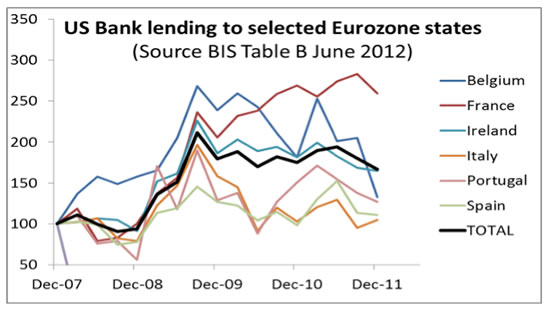


| You are subscribed to email updates from Save Your ASSets First To stop receiving these emails, you may unsubscribe now. | Email delivery powered by Google |
| Google Inc., 20 West Kinzie, Chicago IL USA 60610 | |


No comments:
Post a Comment