


Gold World News Flash |

- David Morgan and James Turk on the gold/silver ratio
- Gold Seeker Weekly Wrap-Up: Gold and Silver Fall Over 2% on the Week
- Kill JP Morgan With A Silver Bullet - Crash JP Morgan - Max Keiser
- Gold To Swing $100 To $300 In A Day
- In The News Today
- Can Gold Do Now What The Rentenmark Did For Germany In 1923?
- Jim Sinclair - Gold to Swing $100 to $300 in a Day
- David Rosenberg Busts Out 16 Fresh Threats Facing The Economy
- Cramer Apologizes Over Twitter Rant
- Truth and Consequences - November 12, 2010
- Obama Strikes Out Twice At G-20
- George Washington Would Not Be Smiling
- Sterilizing Money at the QE Corral
- What Commodity ETF would Jesus Buy? None.
- Price Volume Action Signals Counter Trend Move In U.S. Dollar and Gold
- Fear Returns
- SLV ETF Adds Massive 523 Tonnes Of Silver In Current Week
- Bernanke Equally Handy With Paintbrush, Printing Press
- Gold Price Correction to $1,323.95, Take Advantage and Load your basket down with Gold and Silver at Momentarily Reduced Prices
- Relax And Enjoy Your Weekend
- Hourly Action In Gold From Trader Dan
- Jim?s Mailbox
- Using a Long-Term Calendar Spread to Trade Gold
- Guest Post: Silver - Still The Investment Of A Lifetime
- China Helps Out The Bankers
- European Double Dip Begins, As Continent Finds Its Monetary Policy At Mercy Of New York Fed
- Monetary Reforms and Silver Consolidation
- Silver Toppings
- The Gold Bubble Begins
- Junk Science
- American Silver Eagle Coins Hit Record
- Inside the Forbes & Manhattan Summit
- A Bad Plan Poorly Disguised
- James Turk: Kamikaze attacks in the silver market
- LGMR: Gold & Silver Give Back Weekly Rise in Dollars as Irish Crisis
- James Turk - Kamikaze Attacks in the Silver Market
- HI YO SIL-----VER....
- How to Analyse and Trade Currencies with Elliot Waves
- Trading Gold Options with Long-term Calendar Spreads
- Inflation Hedges
- A Revamped Management Prepares for Silver Production in Idaho
- Silver Consolidation and Monetary Reforms Give Gold Seal of Approval
- Stock Market Remains Vulnerable Short-Term
- No inflation? Tell it to your Thanksgiving turkey
- Max Keiser: "Buy A Silver Coin, Destroy JP Morgan"
- The Morning Gold Report
- Golden Rentenmark, 2010
- The Real Effects of Printing Money and Creating Debt
- Move Your Money Part 2: Buy Silver to Help Stop Market Manipulation and Show Too Big To Fail Banks Like JP Morgan Who Is Boss
- Jim's Mailbox
| David Morgan and James Turk on the gold/silver ratio Posted: 12 Nov 2010 05:13 PM PST
| ||||
| Gold Seeker Weekly Wrap-Up: Gold and Silver Fall Over 2% on the Week Posted: 12 Nov 2010 04:00 PM PST Gold fell almost 2% in Asia before it rebounded in London to see a loss of just $9.05 at $1395.15 at about 9:30AMEST, but it then fell back off for most of trade in New York and ended near its early afternoon low of $1359.75 with a loss of 2.73%. Silver climbed back to as high as $27.29 at about 10AMEST before it also fell back off for most of the rest of trade and ended near its early afternoon low of $25.81 with a loss of 5.04%.
| ||||
| Kill JP Morgan With A Silver Bullet - Crash JP Morgan - Max Keiser Posted: 12 Nov 2010 03:29 PM PST
| ||||
| Gold To Swing $100 To $300 In A Day Posted: 12 Nov 2010 01:20 PM PST Dear CIGAs, Eric King of KingWorldNews.com was kind enough to interview me on today's market action. Click here to listen to the interview…
| ||||
| Posted: 12 Nov 2010 01:18 PM PST Jim Sinclair's Commentary So far this weekend. Bank Closing Information – November 12, 2010 Copper Star Bank, Scottsdale, AZ
Jim Sinclair's Commentary Roubini discovers Tanzania: Roubini Favors Africa Over 'Crowded' Emerging Markets Economist Nouriel Roubini said in an interview out today that investors should stop chasing "crowded" trades in emerging markets. He believes that African markets such as Ghana, Kenya, Nigeria and Tanzania are better bets. The distinction is that such African countries are most often categorized as so-called frontier markets, even smaller and less-developed than emerging markets. You can get plenty of exposure to Africa (about 16%) taking a more diversified approach through the Guggenheim Frontier Markets ETF (FRN).
Jim Sinclair's Commentary South Korea sees the best opportunity outside of minerals. South Korea to farm Tanzania site TANZANIA expects South Korea to begin farming 15000 hectares of land in the east African country early next year for food production and processing. Aloyce Masanja, director-general of Tanzania's State-run Rufiji Basin Development Authority (Rubada), said yesterday that the initial cost of the Korea Rural Community Corp (KRC) project was estimated at 50 million (about R340m). State-run KRC signed a memorandum of understanding in August and will develop the land in partnership with Rubada over the next five years. "A feasibility study is ongoing, which means the final cost of the project could change once the study is completed. We expect to start working on the land in the next farming season that starts in March 2011," Masanja said. Countries like China, South Korea and the arid Gulf states are buying large swathes of land in Africa and Asia to secure food supplies.
Jim Sinclair's Commentary From our three favourite brothers. Quantitative Easing Explained:
Jim Sinclair's Commentary Put away your razor blade, get out of the bathtub and turn off you gold quote machine. What is it that Martin Armstrong said? It is Only Time. California is the dollar's Ireland and Greece put together. Schwarzenegger Declares Emergency, Calls Special Budget Session Nov. 12 (Bloomberg) — California Governor Arnold Schwarzenegger, citing a $25.4 billion budget gap over the next 19 months, declared a fiscal emergency and called lawmakers to a special session next month to begin dealing with the problem. Schwarzenegger, a Republican whose term ends in January, late yesterday ordered the session to start Dec. 6, the day newly elected legislators are sworn in. He wants to take steps to erase an officially estimated $6.1 billion gap that has already emerged in the budget enacted last month. In addition to the gap forecast for the fiscal year through June, the nonpartisan Legislative Analyst's Office yesterday projected a $19 billion gap in the following 12 months. By Jan. 10, Governor-elect Jerry Brown, a Democrat who will be sworn in Jan. 3, must propose a plan to erase the next year's deficit. "The LAO's estimate is a sobering reminder that California's economy is still struggling," Schwarzenegger, 63, said in a statement. "I have spoken to all four legislative leaders and they know what we are up against. They know it won't be easy, but they also know they cannot wait to take action." The authority to declare a fiscal emergency comes from ballot measures Schwarzenegger championed in 2004, when he won approval to borrow $15 billion to fill that year's budget gap.
Jim Sinclair's Commentary What he is talking about is currency induced cost push inflation destined to go to critical mass in the West. This is not yet understood by any expert. Think about that with QE attached. Expert: China has no inflation problem China has no inflation problem because the current commodity prices hike were caused by supply shortage and not by an excessive amount of currency being issued, said Wang Guogang, head of institute of finance and banking at Chinese Academy of Social Sciences, at the academy's annual forum held on Thursday. "If a country's consumer price index (CPI) is higher than three percent in six successive months, it can be defined as inflation by Western standards," Wang said. "But the price changes of agricultural products are not included when Western countries calculating their CPIs." Agricultural products account for one third of the goods used to calculate China's CPI, he said, adding that the high prices of agricultural products were caused by this year's frequently occurring natural disasters. Hu Xiaolian, deputy governor of the People's Bank of China, said that the country's short-term inflation pressure is not so bad. The central bank will continue to monitor the market and implement more flexible measures to stabilize the prices, and hasn't ruled out the possibility of increasing the interest rates again, she said.
Jim Sinclair's Commentary The major question is whether or not a rider to some innocuous bill will trample all over state's rights and legalize illegal seizure of property. I think so.
Jim Sinclair's Commentary "Almost 3 million Americans, including 140,000 Floridians, are losing federal benefits." 140,000 Floridians losing federal unemployment benefits TAMPA – Three federally funded unemployment programs are ending soon. The programs are the additional compensation pay program, the emergency pay, and extended benefits. Unless lawmakers intervene with another emergency package, the federal benefits will begin to expire starting Nov. 30 through Dec. 11. Almost 3 million Americans, including 140,000 Floridians, are losing federal benefits. For some people searching for work, these benefits are their last safety net. It's a position Camisha Kemp never expected to be in. Earlier this year, the mother of four re-married. Her husband, Antoine, was working for the state. She was running an at-home-daycare. Then the bottom fell out.
Jim Sinclair's Commentary These guys will never stop. Hong Kong H-Shares Tumble After Goldman Advises Exit Nov. 12 (Bloomberg) — China's Hong Kong-listed shares fell after Goldman Sachs Group Inc. recommended clients exit a bet the stocks will gain, citing concern the central bank will raise borrowing costs to tame inflation. The Hang Seng China Enterprises Index of 40 companies slumped 3 percent to 13,663.14, the most since May 25, at the 4 p.m. close in Hong Kong. Investors who followed the New York- based firm's advice would have earned a return of 11.3 percent as the index rose above 14,000 from 12,616.01 since April 1, when the trade was initiated, analysts Robin Brooks and Dominic Wilson wrote in a research note yesterday. The recommendation was among the nine "Top Trades" Goldman Sachs made for 2010. China's annual inflation rate jumped to a two-year high of 4.4 percent in October while retail sales rose 18.6 percent from a year earlier, the statistics bureau said yesterday. China increased reserve requirements for some banks twice this week, taking the total increase to 100 basis points, according to two people with direct knowledge of the situation. Inflation is above policy makers' "comfort zone" and more "tightening" will likely occur, the New York-based analysts wrote in the report. "The near-term risk-reward for this position also looks unappealing as we approach the year-end 'roll-off,'" they said.
| ||||
| Can Gold Do Now What The Rentenmark Did For Germany In 1923? Posted: 12 Nov 2010 01:00 PM PST Just as the Rentenmark anchored currency in a post-hyperinflation nation, gold can bring such an anchor to global money. It will be unpopular until it is sorely needed because of one or more major nation's profligate behavior regarding their own currencies. This has already started as we can see in the G-20 nation meeting of this week. The cautionary note is that it worked because the nation was desperate having exhausted all other alternatives.
| ||||
| Jim Sinclair - Gold to Swing $100 to $300 in a Day Posted: 12 Nov 2010 12:35 PM PST  With gold getting hit hard today, King World News interviewed legendary trader Jim Sinclair. When asked about the volatility in gold Sinclair stated, "I think from this point forward you are going to see unprecedented volatility. You'll see $100 swings to $150 swings in a day, and if you go back to 1979 to 1980 we had $150 in one direction. So if we had $150 in one direction back then, what's to stop this market from doing $300?" With gold getting hit hard today, King World News interviewed legendary trader Jim Sinclair. When asked about the volatility in gold Sinclair stated, "I think from this point forward you are going to see unprecedented volatility. You'll see $100 swings to $150 swings in a day, and if you go back to 1979 to 1980 we had $150 in one direction. So if we had $150 in one direction back then, what's to stop this market from doing $300?"
This posting includes an audio/video/photo media file: Download Now | ||||
| David Rosenberg Busts Out 16 Fresh Threats Facing The Economy Posted: 12 Nov 2010 12:10 PM PST Here's a sample of 3.....• Didn't the Fed just use the words "slow", "weak", "depressed" and "constrained" to describe various aspects of the U.S. economic environment? You can look this up in the opening salvo of the November 3 post-FOMC meeting press release. • The rally in gold to new all-time highs in virtually every currency is testament to the lingering concerns over the integrity of the global monetary system. • Currency wars typically lead to trade wars and protectionism is coming our way soon (see Leaders Warn on Doha Deadlock and Failure on US-Korea Accord Hits Trade Hopes on page 2 of the FT). This is bullish for hard assets like commodities and precious metals.
| ||||
| Cramer Apologizes Over Twitter Rant Posted: 12 Nov 2010 12:06 PM PST
And now for some late night amusement from head CNBC entertainer Cramer: "I lost my temper on Twitter this morning. The chatter was that I had put people in the market at the top and taken them out at the bottom. I have done a bunch of things wrong in my life and in my trading career, but that combination is not one of them. There were also the attacks on me about buying gold at the top. What am I supposed to do about this one?"... We can't help Cramer there, but here is what we had to say about Cramer's apoplectic invocation for a surge in gold, mere hours before its biggest one-day price drop in years:
What are we supposed to say about this one, besides: top ticking swiss watch. As Cramer is nothing more than a (tragi)comedian, we applaud his collapse to the level of one Dennis Kneale, whose last gimmick before ending his CNBC career, was engaging the blogo/twittersphere. We are delighted that Mr. Cramer has finally "succumbed" to the same terminal level. As for actually going through Cramer's desperate protest and refuting misrepresentation after misrepresentation, that action is certainly not worth our time: a mere google search should be sufficient.
| ||||
| Truth and Consequences - November 12, 2010 Posted: 12 Nov 2010 11:12 AM PST Truth and Consequences - Casey's Daily Dispatch [LIST] [*]Sign Up Now! [*]| [*]RSS Feed [*]| [*]Print this [*]| [*]Visit the Archives [*]| [*]Email to a Friend [*]| [*]Back to All Publications [/LIST] November 12, 2010 | [url]www.CaseyResearch.com[/url] Dear Reader, In yesterday's edition, I asked for your ideas for plausible scenarios under which the long gold bull market could be brought to a sharp stop - in much the same way as happened when then-Fed Chairman Volcker jacked up interest rates going into 1980. The response to this request has been nothing less than stunning - with dozens,...
| ||||
| Obama Strikes Out Twice At G-20 Posted: 12 Nov 2010 10:46 AM PST
This article originally appeared in The Daily Capitalist. In a follow-up to yesterday's post on foreign exchange ("Hot Money, Gold, Foreign Exchange And The Fallout From QE"), the G-20 meeting in Seoul was not a good one for the Obama Administration and President Obama in particular. Mr. Obama was unable to conclude a free trade agreement with South Korea, and China told him to stop meddling in their internal affairs and put his own house in order first. Of course China's President Hu said that in polite, diplomatic language. The whole controversy is about international "imbalances" which is a deceptive diplomatic code word. To everyone but China, Germany, Brazil, South Korea, and Taiwan, all successful exporters, it means that these exporters have to shoot themselves in the leg to give everyone else a "fair" chance in the foreign marketplace. To do that it means that China has to allow the yuan to rise in value (which it would if it was unpegged) and to open up their markets wide to imports from less successful countries. China isn't going to do that for obvious reasons:
What he is saying is that the U.S. (the dollar being the major reserve-currency) is being reckless by pursuing QE2, and that the resulting devaluation of the dollar will make Chinese goods more expensive and therefore will hit their main industry (exports) hard which will harm their economy. If, as they would privately argue, you guys can't compete because you have harmed your industrial base from past reckless monetary and fiscal policies, don't expect us to take the hit for you to recover. Another Chinese minister put it more bluntly:
They are absolutely right for the most part. The part where they are wrong is the pact they made with the devil by pegging the yuan to the currency of their biggest buyer--the U.S. dollar. In a system of freely floating exchange rates, China's yuan, off-peg, would have been revalued long ago to the rate which the FX markets determined was correct based on the supply and demand for yuan and dollars. That would have made Chinese goods more expensive, U.S. exports to China would be more attractive, and the trade balances would be distorted far less. What the Chinese didn't foresee or chose to ignore was that our profligate government would use monetary policy as a mercantilistic tool to make U.S. goods more competitive. This G-20 meeting has been a disaster for President Obama and his Administration. It shows you how great countries decline. By pursuing reckless fiscal and monetary policies, the dollar has been substantially devalued, our citizens will be burden for generations by high debt and high taxes, our ability to compete on world markets is weakened, and we lose our status and influence. I can't blame this on Obama alone. He was preceded by a hundred years of politicians who have chipped away at our freedoms and the free market. They have spent and promised more than they can deliver and we will have to pay for it through the destruction of our capital and/or high taxes. There is a solution to all this foreign exchange mess and that is for nations to adopt the gold standard. In my studies of it I believe it would act to reign in the destruction of currencies and act to fairly balance foreign trade and foreign exchange. I am aware of all the claims of how it failed during the 1920s and that FDR abandoned it as a "barbaric metal" in place of "modern money." These views are incorrect and reflect a statist Keynesian approach to political economy. Interestingly, Robert Zoellick, former U.S. Treasury official and now president of The World Bank, has floated the idea that gold should be used in foreign exchange as a "reference point." As he said in the Financial Times, "Although textbooks may view gold as the old money, markets are using gold as an alternative monetary asset today.” What he means is that in real terms gold has not increased so much as that currencies, especially the dollar, have devalued, and that is why people are buying it. The FT sneered at this suggestion saying that "most economists" believe it would lead to tight monetary policies [true] which restrict growth [false]. In fact Martin Wolf came out with an article examining the possibility of returning to the gold standard. In his inimitable way, he appears to give it a serious analysis and then dismisses it as an impossible return to the 19th Century. Mr. Wolf's "inimitability" is to set up a straw man and then demolish it. Don't take him seriously. Tight money (read "real money") would actually lead to growth. If we could print our way to riches, then we'd all have been rich long ago. That would be another article. But I think we can all agree that the post-Bretton Woods systems haven't worked and the solutions proposed on all sides will make things worse. I don't see any realistic solution to come out of any G-20 meeting on the topic of "global imbalances." There are no such imbalances; it is just an invention of countries like the U.S. to pin the blame for their policy mistakes on the Chinese. If I were China, I wouldn't worry about the long-term because the result of QE will be to weaken our economy by destroying capital which will lead to sluggish growth and be less of a threat to them despite a "cheap" dollar.
| ||||
| George Washington Would Not Be Smiling Posted: 12 Nov 2010 10:00 AM PST It seems the only people on the planet who don't think the Federal Reserve is manipulating the value of the U.S. dollar are President Barack Obama, Treasury Secretary Tim Giethner, and the man with his hands on the electronic printing presss – Fed Chief Ben Bernanke.
From the Jim Morin archive at the Miami Herald.
| ||||
| Sterilizing Money at the QE Corral Posted: 12 Nov 2010 10:00 AM PST There are a lot of intricacies in the Federal Reserve's evil ways, especially as concerns creating $900 billion in the next six months in another round of quantitative easing, and one of them is explained by Daniel R. Amerman of DanielAmerman.com. He says, "There is something else essential for investors and savers to understand about the process which the Federal Reserve has just outlined. The Federal Reserve is not directly purchasing treasury bonds from the US government. Instead, US banks are purchasing the bonds from the US Treasury to fund the deficit, and then selling an equal amount of other bonds (likely at a nice profit) to the Federal Reserve." If you are a normal person, then you are positively terrified by the prospect of inflation, which means that you are terrified of the Federal Reserve creating so much, so incredibly much, so staggeringly much, so unbelievably much money – which is to be almost $900 billion in the first six months of 2011 – because a lot less monetary insanity than this gigantic clot of extra money caused ruinous inflations in stocks, inflations in bonds, inflation in consumer prices, inflation in housing, inflation in the sheer suffocating size of government and severe, bankrupting macroeconomic distortions and mal-investments. Obviously, then, I am on to something when I say that "Inflation is the worst thing that can happen, other than the Earth being invaded by creatures from outer space to make us their slaves, forcing us to mine di-lithium crystals on some barren planet in the faint, farthest reaches of the Federation of Planets." So, besides keeping an eye on the skies for alien invaders from outer space and watching the neighbors to see what nefarious schemes they are plotting against me, I keep tabs on the money supply. Mr. Amerman, whom I now suspect of being in concert with my wife to cause me to have a heart attack and die on the spot from the sheer horror of it all, writes that "by the end of the Federal Reserve's mortgage security purchase program (the previous 'quantitative easing'), about 10% of the approximately $12 trillion in US banking system assets consisted of sterilized money held at the Federal Reserve." Sterilized money? What's that? It sounds a lot like the end-days of my relationship with Susan, when she suddenly announced that, from now on, if I wanted to kiss her, I had to first sterilize my lips with boiling water. As you can probably guess, things went downhill pretty fast after the first few times! Parenthetically, looking back on it, it was not worth it. My amorous misadventures aside, the answer is that "while a (desperate) central bank wants to be able to spend money without limits, letting that new money escape into the general money supply can lead to major inflation in a hurry. So with the previous rounds, the Fed and ECB each used their 'sterilization' powers to essentially put a corral up around the new money, and keep it from escaping out into the economy." He goes on that "because the banks can't really spend their 'sterilized' money, but must have an ever larger share of their balance sheet assets consist of those economically meaningless excess reserve balances." He figures that by June of next year this would mean "about 16% of total US bank assets would consist of 'sterilized money', i.e. balances at the Federal Reserve that can't be used anywhere else." I immediately saw this as a chance to get my own economic house in order! At breakfast, I happily told the kids that I was going to quadruple their allowances! This wonderful news made them, as they said, "Happy for the first time in our miserable lives!" I admit that I positively reveled in smug self-satisfaction as they fell all over themselves apologizing for hating my guts, and apologizing about how they regret calling me a horrible, stingy, miserly, gold-bug, silver-bug, worthless loser of a father who spends every dime on gold, silver and oil stocks so that I can make a lot of money when their prices shoot "to the moon" when the monetary insanity of the Federal Reserve creating so freaking much money, so that the insane Obama administration can deficit-spend almost $2 trillion a year, makes inflation in consumer prices start climbing to hyperinflationary levels. After I was finished eating and having had enough basking in the fawning adulation, I broke it to them that while I was indeed quadrupling their allowances, being the generous, loving father that I am, I was "sterilizing" the money by making them keep it in my bank account. Well, their reaction was immediate outrage, as compared to the lack of it demonstrated by the silly "journalists" (in every sneering, disrespectful, pejorative use of the word) of the mainstream media and neo-Keynesian econometric halfwits infesting the majority of the nation's universities at such a monetary monstrosity. Their loud hostility was not quelled one iota by my gently reminding them that the Federal Reserve was doing this same thing right now, and the Fed's bank account has risen by more than a trillion dollars in one year, and which is apparently okay with the "silly 'journalists' (in every sneering, disrespectful, pejorative use of the word) of the mainstream media and neo-Keynesian econometric halfwits infesting the majority of the nation's universities" as mentioned so prominently in the previous paragraph. Well, what started out as a delightful breakfast with the family soon devolved into a distressing shouting match of sorts, with the kids telling me, "We hate you more now than we ever hated you before!" me yelling at them, "Morons! If you knew the kind of inflationary horror that is going to happen to us because of the Federal Reserve creating so much money, then you would happily give up one of your three generous portions of cold gruel per day to let me buy MORE gold, silver and oil!" and my wife pleading, "Everybody please shut up and calm down!" to no avail. It was scene of insane pandemonium for awhile, which we can all agree shows the degree of insanity rampant in the world today, as is this sterilized quantitative easing, which Mr. Amerman says is "an insane strategy for a government that is desperately trying to revive the private sector economy, which is one of the reasons I find further sterilization to be unlikely." With all due respect to Mr. Amerman, I figure that the money was not actually sterilized at all, and although it did not enter the economy as a result of business and consumer loans, it entered into the economy via government deficit-spending. Which, if either, is worse than the other from an economic standpoint is, of course, a matter for rigorous theoretical analysis, which means that it won't come from me because it sounds like work, and I hate even the word "work,", even if I could do the analysis, which I can't because I haven't a clue how to even start. But I like making money without working, and I know (thanks to the Austrian Business Cycle Theory and 4,500 years of history) that buying gold, silver and oil will make me a lot of money because of all of this monetary and fiscal insanity. And all without lifting a finger, which is so deliciously brainless that I say, "Whee! This investing stuff is easy!" The Mogambo Guru Sterilizing Money at the QE Corral originally appeared in the Daily Reckoning. The Daily Reckoning, offers a uniquely refreshing, perspective on the global economy, investing, gold, stocks and today's markets. Its been called "the most entertaining read of the day."
| ||||
| What Commodity ETF would Jesus Buy? None. Posted: 12 Nov 2010 09:20 AM PST This week's commodity oddity comes via this item at FT Alphaville in which a religious group thinks the world might be better off if people avoided investing in hard assets due to the negative impact this increased demand will have on the population as a whole.
The rightly caution that, given the Fed's determination to print money until the economy improves, they shouldn't be too disappointed if they're investment returns fall short at some point in the future. Then again, investment funds could just buy gold as no one needs dumb 'ol gold coins to heat their house or feed their family.
| ||||
| Price Volume Action Signals Counter Trend Move In U.S. Dollar and Gold Posted: 12 Nov 2010 09:15 AM PST Price action that comes after a major announcement reveals a lot about underlying economic trends and the psychology of the market. Leading up to the election investors became enthusiastic on precious metals and commodities as QE2 was ...
| ||||
| Posted: 12 Nov 2010 09:12 AM PST The 5 min. Forecast November 12, 2010 01:15 PM by Addison Wiggin [LIST] [*] Fear returns to the markets... but quirky trades give 88% and 105% gains to readers this week... [*] Snub heard ‘round the world: The U.S. gets “written off” as “a monetary basket case”... [*] Rescuing ARM borrowers by skewering savers… late-breaking developments in the housing market that will floor you [*] Actor’s foreclosure property finally clears the market… at 71% off... readers sound off about Medicare and Social Security (again!)... Rancho Chill 3.0 Sold Out! [/LIST] In the hurly-burly of the markets, this week the looming demise of the dollar has been overtaken by more immediate concerns… and has delivered some very interesting gains to readers who are paying attention. For starters, rumors continue mount that Ireland will soon ask for and get a bailout from the European Union. Or the International M...
| ||||
| SLV ETF Adds Massive 523 Tonnes Of Silver In Current Week Posted: 12 Nov 2010 09:06 AM PST
There were some very odd occurrences in the world's largest silver ETF, the iShares SLV. After the exponential increase of the price of silver in the spot market, almost hitting $30/share on November 9, the SLV ETF, which like GLD purports to holding the underlying precious metal, saw a massive basket creation demand, amounting to a whopping 523 tonnes of actual silver added to the fund's holdings (equivalent to 16.8 million ounces, at a cost of about $456 million) for the week ending November 12, currently at a record 10,718 tonnes. While we don't purport to knowing how much free silver is available in the open market, the possibility that any one entity could have manged to purchase such a massive amount of actual silver, of which 352 tonnes was supposedly acquired on November 10, without completely destabilizing the actual supply and demand mechanics, and creating a vicious loop where basket creation leads to a further surge in prices, is just slightly mind boggling. As we have speculated earlier, we expect comparable activity in the GLD ETF to follow suit. Additionally, we will shortly look at this week's CFTC COT data to determine just how massively JPM's silver short has impacted the firm's P&L. P.S. for those who may be wondering, the custodian, i.e., entity in charge of vaulting the "silver", is good ole RICO-lawsuit embroiled HSBC. (full SLV prospectus link)
| ||||
| Bernanke Equally Handy With Paintbrush, Printing Press Posted: 12 Nov 2010 08:57 AM PST The G-20 meeting wraps up in Seoul today with little more to solve currency devaluation than a 30-page report. In it, the Group of 20 proposes that the IMF help the situation by offering guidance toward more market-determined exchange rates… not exactly a sure-fire plan. All the while, President Obama played his expected role, blaming China for manipulating the yuan as most other nations were more inclined to level criticism against the US' own monetary shenanigans. The US was the proverbial pot calling the kettle black, and in the unilateral fashion that seems reminiscent of a previous presidency, the US once again goes it alone.
Bernanke Equally Handy With Paintbrush, Printing Press originally appeared in the Daily Reckoning. The Daily Reckoning, offers a uniquely refreshing, perspective on the global economy, investing, gold, stocks and today's markets. Its been called "the most entertaining read of the day."
| ||||
| Posted: 12 Nov 2010 08:49 AM PST Gold Price Close Today : 1,365.40 Gold Price Close 5-Nov : 1,397.30 Change : -31.90 or -2.3% Silver Price Close Today : 2593.8 Silver Price Close 5-Nov : 2674.4 Change : -80.60 or -3.0% Gold Silver Ratio Today : 52.64 Gold Silver Ratio 5-Nov : 52.25 Change : 0.39 or 0.8% Silver Gold Ratio : 0.01900 Silver Gold Ratio 5-Nov : 0.01914 Change : -0.00014 or -0.7% Dow in Gold Dollars : $ 169.45 Dow in Gold Dollars 5-Nov : $ 169.31 Change : $ 0.15 or 0.1% Dow in Gold Ounces : 8.197 Dow in Gold Ounces 5-Nov : 8.190 Change : 0.01 or 0.1% Dow in Silver Ounces : 431.51 Dow in Silver Ounces 5-Nov : 427.91 Change : 3.60 or 0.8% Dow Industrial : 11,192.58 Dow Industrial 5-Nov : 11,444.08 Change : -251.50 or -2.2% S&P 500 : 1,199.21 S&P 500 5-Nov : 1,225.85 Change : -26.64 or -2.2% US Dollar Index : 78.093 US Dollar Index 5-Nov : 76.602 Change : 1.49 or 1.9% Platinum Price Close Today : 1,680.70 Platinum Price Close 5-Nov : 1,767.50 Change : -86.80 or -4.9% Palladium Price Close Today : 675.50 Palladium Price Close 5-Nov : 684.45 Change : -8.95 or -1.3% The GOLD PRICE got rode hard and put away wet today. Once it breached that $1,385 line in the ground all the guards starting shooting. Gold tried to rise after the New York open, reached $1,395, then ran for cover, hitting $1,379.5 by 12:30. Comex close came at $1,365.40, $37.70 lighter than yesterday. Gold has since levelled off between $1,365 and $1,370. Whither gold? From the 9 November high, assuming that Gold is correcting its July - November move, a 20% correction would reach $1,361.52. That target was reached today. A 38.2% correction would reach $1,317.59, and a 50% correction would reach $1,289.10. I state no opinion here, I only crunch numbers. That $1,360 level also sports strong lateral chart support, as does $1,315. I would be really surprised if gold reached $1,289.10 (that is an opinion.) The 50 DMA also offers another echo at $1,323.95. 20 DMA stands at $1,361.82. Now, I've thrown all the eggs into the bowl -- y'all stir them up and pick out whichever one you like. The SILVER PRICE was innocently walking down an alley when a mob of muggers jumped out of the corner at 2650c and commenced pounding silver's head with a tire iron (in some parts of the South pronounced "tar-arn.") That happened in broad daylight, around 10:45, and they knocked silver clean to the ground and down a manhole, all the way to 25.77. Silver managed to gather enough strength to climb out of the manhole and crawl along the pavement between 2585c and 2620c. On Comex it closed down a massive 146.3c at 2593.8c. From July to 9 November 2010 silver rose from 1742.3c to 2890.2c, 1147.9c. Whew. Think about that. The chart shows lots of lateral support around 2500c and the 20 DMA lieth also there at 2497c. 50 DMA stands at 2288c. A 20% correction lands silver at 2660.6c, a little above today's activity. A 38.2% correction reaches 2451.7c. A 50% correction would reach 2316c. Now for an opinion, a plethora of which I always go armed with. Looking at the chart, that 2500c jumps out and grabs your eyeballs. If today marked not the bottom of the move, then 2500c will surely contain it. Bear in mind that silver, as a smaller market, is always more volatile than gold. That's what makes life interesting. Now let us ponder this week's markets. Behold, the gold and silver chickens flew off the roost this week, extending their correction. US dollar appears to have turned up, and stocks are turning down and wallowing in the Slough of Despond, Bubba Bernanke notwithstanding. Before the weekend many traders close out positions, taking profits and flattening positions so they can enjoy their martinis on Long Island over the weekend -- thus the dollar's behavior today, losing 12.4 basis points (0.16%) and trading to 78.093 after a very strong week. Move started at 76.6 and moved to 78.09, adding 149 basis points. By closing above 77 and then 78, and its 20 day moving average, the dollar has confirmed, re-confirmed, and re-re-confirmed its reversal. Likely targets overhead lie at 78.77, the 50 DMA, the 80, the last low, then 83.56, the last high. 200 DMA also has a bull's eye on it at 81.79. The lower the dollar reaches, the weaker we will know it is. After such a long fall (83.56 - 76.14) so re-bound, even the meaningless writhing of a snake you ran over with your Ford pickup, is inevitable. Me, I'm laying my bets on 80 at least. What is a "downtrend"? That is a series of lower highs and lower lows. What has the stock market been doing the last six days? Making lower highs and lower lows. Even my public- school educated logic tells me that is a downtrend. But then, does that surprise anyone other than stockbrokers, Wall Street, and TV and NPR pundits? All the rest of us know that PRIMARY DOWN TRENDS (those that last 15 - 20 years) always resume their gravity-led trajectory after brief bear market rallies. And stocks are in a primary downtrend that will last until 2015 or 2020. See now why I shun stocks? Today the Dow lost 90.52 points to close at 11,192.58 S&P 500 lost 14.33 points to close at 1,199.21. Lift up your eyes to the horizon, and call to mind the SILVER and GOLD PRICE performance the last nine years: 'tis a bull market, and a bull market it remains. Take advantage of this opportunity to load your basket down with gold and silver at momentarily reduced prices. One little prayer request: my wife Susan has to have a pacemaker implanted on 26 November. I would deeply appreciate your prayers for her. Y'all enjoy your weekend. Argentum et aurum comparenda sunt -- -- Gold and silver must be bought. - Franklin Sanders, The Moneychanger The-MoneyChanger.com © 2010, The Moneychanger. May not be republished in any form, including electronically, without our express permission. To avoid confusion, please remember that the comments above have a very short time horizon. Always invest with the primary trend. Gold's primary trend is up, targeting at least $3,130.00; silver's primary is up targeting 16:1 gold/silver ratio or $195.66; stocks' primary trend is down, targeting Dow under 2,900 and worth only one ounce of gold; US$ or US$-denominated assets, primary trend down; real estate in a bubble, primary trend way down. Whenever I write "Stay out of stocks" readers inevitably ask, "Do you mean precious metals mining stocks, too?" No, I don't. 
| ||||
| Posted: 12 Nov 2010 08:30 AM PST View the original post at jsmineset.com... November 12, 2010 11:59 AM Dear Friends, How many times in the past five years have you heard China’s growth is finished, and that would tank commodities hard? Goldman Sachs, now Gold Sachs forecasting $1600 today, gave a warning on investing in China. The media was going wild on Ireland. That should mean the bottom on the euro is in. Algorithms had a coronary calling on the hedge funds to sell all long commodities which is by definition an order to shift the position to the short side in the same amount as long. Gold actually did better than copper on a percentage basis. QE fell on its rear in the bond market as rates increased after the QE exercise which indicated that the size of QE has to be larger to hold even short rates down. It looks like the $900 billion will have to be increased. The net result was to murder the highly leveraged public futures traders that always seem to have a death wish. I have seen people g...
| ||||
| Hourly Action In Gold From Trader Dan Posted: 12 Nov 2010 08:30 AM PST View the original post at jsmineset.com... November 12, 2010 11:47 AM Dear CIGAs, Overnight news that China was hiking rates in an effort to remove some of the inflationary pressures that have been building in its economy served as a catalyst for the hedge funds to unload everything that remotely resembled a commodity. There was not a single commodity that was higher today no matter what its current fundamentals may have been. Even the soybean and corn markets, both which have a strong set of bullish fundamentals were sold off as hedgies unloaded some of their longs once their algorithms tripped into the sell mode. Ditto for gold – it was not spared even though the Dollar was repulsed from its overnight gains. It initially bounced off a support level at this week's low but then another wave of selling appeared after mid-morning which obliterated that level and dropped it down towards the next support level shown on the price chart near the $1,368 mark. That too did not hold as the...
| ||||
| Posted: 12 Nov 2010 08:30 AM PST View the original post at jsmineset.com... November 12, 2010 09:50 AM Jim, All of the selling we are seeing across the entirety of the commodity complex is related to the news that China is hiking rates again. The fear is that this will cause a slowdown in the Chinese economy which will negatively impact demand for commodities across the board. I am seeing every single commodity being sold regardless of any current fundamentals. It is even showing up in the soybean and corn markets which have very strong fundamentals. In other words, it is purely a function of hedge fund algorithms being tripped to sell because some downside technical levels have been violated. The fact that it is occurring even with the Dollar showing weakness tells me that it is a pure money game right now so fundamentals are taking a back seat to the flow of money out of commodities today. Gold would have to get down below $1,345 and stay there to give me any reason for concern on the charts. Even at that, ...
| ||||
| Using a Long-Term Calendar Spread to Trade Gold Posted: 12 Nov 2010 08:15 AM PST At this point anyone following financial markets realizes that current market conditions are directly impacted by the movement of the U.S. dollar. Recently the dollar has shown strength and could potentially be putting in an ...
| ||||
| Guest Post: Silver - Still The Investment Of A Lifetime Posted: 12 Nov 2010 08:08 AM PST
By Giordano Bruno Of Neithercorp Press Silver: Still The Investment Of A Lifetime Silver is the common man’s currency. It always has been, and it always will be. While gold holds its place in history as the great stabilizer of economies and the shield against hyperinflation, its shine and its safety should not distract us from its brother, silver, whose uses are numerous and whose value is often more attainable for those seeking a solid investment outside of precarious paper securities. Gold’s unprecedented upsurge in price the past year alone is now becoming the stuff of legend, and it is also something we at Neithercorp have been predicting for a while now: http://neithercorp.us/npress/?p=184 http://neithercorp.us/npress/?p=579 As I write this, gold is holding after a spectacular drive at around $1390, which is in line with my prediction of $1350 to $1450 by winter 2010, and on track to meet my prediction of $1500 by the beginning of next year. We’ll have to wait and see, but what seemed absolutely out of reach during this summer is now looking rather simple to achieve today. Of course, silver has been a bit harder to put a finger on, and there are many unfortunate reasons for this. The silver market was wholly dominated for at least two decades by only a few corporate banks, but primarily through the infamous JP Morgan and the HSBC. Using coordinated naked short selling and massive amounts of capital, they have been able to knock silver down every time its value fell below a certain ratio to gold; usually 60:1. Only recently has that ratio moved slightly closer to the true wealth of silver. The historical average ranges between 16-33 ounces of silver for every ounce of gold. These banks have also been issuing paper silver securities, usually in the form of ETF’s, which have no REAL silver backing them. These securities give investors the illusion that there is too much silver on the market, and not enough buyers. This causes devaluation in the metal. Gold has suffered from the same manipulation in the past, but the silver market is even more tightly controlled, at least, until this year… In November of 2009, a metals trader in London by the name of Andrew Maguire contacted the CFTC with inside information that JP Morgan Chase Bank was deliberately interfering with the silver market on an enormous scale. He not only told the CFTC how the bankers were doing it, he PREDICTED when they would do it again! Maguire gave two days advanced warning that JP Morgan would attack silver on Feb 5, 2010. The market played out exactly as he said it would: The bankers were now caught red handed. The market could only go up from there…. Indeed, silver is now holding at around $27 an ounce, up from less than $10 an ounce two years ago, closing in on a 300% gain. If you bought silver in 2008 as I did, then you’ve made out incredibly well in a very minimal time span. But what about people who were afraid to dive into the market back then, or who just weren’t aware of silver as an investment at all? Have they missed out? Is the $30 mark as good as it gets? I believe that silver still has a long way to go before it peaks, and room yet for millions of new buyers who are in need of a safe haven against the imploding dollar but don’t have the finances to purchase gold. Here’s why… Bank Fraud Exposure Hitting Mainstream The Andrew Maguire incident was just the beginning and the event acted as a springboard. Both JP Morgan and HSBC are now under investigation for silver manipulation pending a lawsuit filed in New York. The suit accuses the banks of using their 85% commercial net short position in the silver market to control its value on the COMEX: CFTC Commissioner Bart Chilton has announced his belief that there is, in fact, manipulation of the silver market. In his statement he said: “I believe that there have been repeated attempts to influence prices in the silver markets. There have been fraudulent efforts to persuade and deviously control that price. Based on what I have been told by members of the public, and reviewed in publicly available documents, I believe violations to the Commodity Exchange Act (CEA) have taken place in silver markets and that any such violation of the law in this regard should be prosecuted.” http://www.cftc.gov/PressRoom/SpeechesTestimony/chiltonstatement102610.html This is an extremely rare admission by the CFTC, which has for many years ignored all complaints and evidence pointing to bank interference in precious metals. The Department of Justice has also launched a parallel probe into criminal wrongdoing on the part of JP Morgan (though I doubt much good will come out of the DOJ): http://www.nypost.com/p/news/business/feds_probing_jpmorgan_trades_in_gZzMvWBqOJpB55M7Rh9vwM The bottom line is that the corruption in silver trade has been brought into the light of day, which means banks will have to, at the very least, back away from their activities to a point, which will allow PM’s to grow according to free market fundamentals, instead of global banking whims. This explains why silver has jumped to $27 an ounce so quickly, but it also signals the possibility of even greater gains in the near future, especially in light of QE2 and the weakening dollar. Silver Supply Declining Just as with gold, silver availability, from mining to inventories, is in decline. This would not be so much of a catalyst if demand remained at levels similar to a decade ago. That is not the case. Demand is skyrocketing. In June, the U.S. Mint announced it had run out of silver bullion blanks for the production of coins like the American Eagle: http://www.zerohedge.com/article/us-mint-runs-out-silver While COMEX silver inventories continue to decline because of constant customer withdrawals of physical bullion: http://news.coinupdate.com/comex-silver-inventories-continue-to-decline-0368/ Mining in many areas is also beginning to fall, including in Peru, a major source of metals like copper, gold, and, of course, silver: http://www.commodityonline.com/news/Copper-gold-silver-production-down-in-Peru-33052-3-1.html On top of all this, silver is used in the making of many industrial and consumer products, including electronics, photography, batteries, and engine components. This puts an extra strain on silver supplies that is not felt as prominently with gold. Meaning, the ability of silver to outperform gold in terms of demand and investment potential is very high. Dollar On Its Last Leg The private Federal Reserve has been injecting fiat into our financial system for quite some time. The acceleration in 2008 heralded a new stage, however, in the devaluation of the dollar. Contrary to popular belief, the bailouts and quantitative easing implemented that year never actually ended. The bailouts of Fannie Mae and Freddie Mac, for instance, have continued non-stop every quarter since the mortgage crisis unfolded. Without a full audit of the Fed’s accounts, there is no way of telling how much money has been created out of thin air. We do know that it is enough to drive foreign investors and central banks out of the dollar and into gold and silver en masse: http://www.commodityonline.com/news/Why-Central-Banks-continue-to-buy-gold-32803-2-1.html As gold climbs into the $1500 range, the effect on silver will be evident. Gold will be less and less attainable by average people with lower incomes, but these same people will still be exposed to dollar devaluation, and the need for a hedge against inflation; enter silver. I believe silver will become the single most important investment of our age, filling the void in the wage gap gold leaves behind. As gold shoots into the stratosphere, it will be silver that people turn to most for smaller investment needs, which means much higher demand and much greater returns for those who are smart enough to buy now. $27 an ounce is incredibly affordable, especially when considering that the metal has the potential to reach $75-$100 an ounce in the next two years (and that is a conservative estimate). There is little doubt that the dollar plunge will continue to drive people towards PM’s. While Ben Bernanke and Timothy Geithner have both made claims pre-G20 that QE2 is not a move to devalue, the rest of the world is unconvinced. Reuters recently called the meeting in Seoul, Korea “G19 plus 1”, as foreign nations become infuriated with the Federal Reserve’s actions: http://www.reuters.com/article/idUSTRE6A62BC20101107 Even Alan Greenspan has come out in opposition to QE2, saying it is a dangerous act of devaluation: http://www.reuters.com/article/idUSTRE6AA00320101111 Now, why is Greenspan of all people suddenly coming out against blasting the financial system with fiat? It’s hard to say. We have written here often at Neithercorp about the deliberate destabilization of the American economy in order to remove the dollar as the world reserve currency and replace it with the IMF’s Special Drawing Rights (the SDR). We have also written about the possibility that the IMF will attempt to insinuate itself into the U.S. system as a “savior”, implementing supranational control over our fiscal infrastructure, just as it is trying to do in Ireland today: It is perhaps possible that the Fed itself (the institution, not the people who run it) may one day be offered up to Americans as a sacrificial proxy to be torn down as the lone culprit of global collapse, only to then be replaced with the IMF (which is worse, because they don’t even live in this country). In any case, the dollar is going for a ride into the backwaters of historical infamy, and it will take us all with it if we do not protect ourselves from its demise. Gold, and most especially silver, give us the power to do this. The Return Of Real Money While many people in the Liberty Movement are preparing diligently for the inevitable dollar plunge, some have still not delved into the world of PM’s, either because they are afraid it will be too complicated, or because they feel it is unnecessary. Obviously, survival goods are absolutely imperative, along with a solid plan for keeping one’s self and his family safe. However, the need for an alternative economic outlet to take the place of the failing dollar should not be overlooked, even by the average prepper. A system of barter is a tremendous starting point for such an alternative, but eventually, expanded trade also requires some form of currency. Preferably, one based on a tangible commodity that can’t be recreated to infinity. Precious metals have fulfilled this role for thousands of years, outliving every fiat currency ever printed. Of these metals, silver was always the one most commonly used. Beans and bullets aside, Americans need a way to protect their savings from what is coming, as well as a way to support a replacement market outside of elitist control. There is a reason why central banks across the globe are stocking up on PM’s; because they know full well that the dollar’s days are numbered, and they plan to capitalize on its death. If the banks are allowed to dominate the supply of PM’s, simply because only a few people had the good sense to stock them while they were readily available, then our options for a free economy grow that much slimmer. There will always be dips, corrections, and fluctuations in metals, and this should not deter us psychologically from their ultimate benefits. Every citizen of this country can and should purchase at least some insurance against hyperinflation and monetary catastrophe, and the most affordable insurance with the greatest potential today is physical silver, bar none.
| ||||
| Posted: 12 Nov 2010 07:51 AM PST Given that markets are "buzzing" with respect to the latest ambush by Wall Street of global commodities markets, and especially precious metals, I may start reverting to shorter-and-more frequent pieces than what I've generally been writing. In particular, I want to help people who are still newer to this sector to follow recent events, since the greatest "fear" is always that of the unknown. With China first raising bank-reserve requirements, and now with the government clearly "leaking" rumors of another increase in China's interest rates, we can see that China and Wall Street (i.e. the U.S. government) have reached a "deal". To understand this deal requires revisiting the Wall Street engineered "Crash of '08". There were two (and only) two sets of "winners" in that previous event. The short-term winners were the banksters, who with various forms of blackmail, fraud, and theft managed to avoid having to declare their own, obvious bankruptcy. The long-term winner from the Crash of '08 was China. At the time that event was taking place, I wrote that the best possible "stimulus" for Canada's economy was for our government to go on a multi-billion dollar commodities shopping-spree. It would have allowed the government to reap huge, windfall process on buying these commodities at fire-sale prices and it would have obviously provided tremendous support for Canada's commodities-dependent economy. Instead, our Prime Minister Stephen Harper (the "economist") first said we didn't need any stimulus, and then weeks later, he sprayed around billions of dollars in such a reckless, mindless manner, that it would have even made the spendthrift Conservatives of the Mulroney regime blush. And what did Canada get from this wild spending? Certainly no "profits", but we did get more than a $100 billion in extra needless debt. One government did see the commodities buying-opportunity: China. It went on what was (at the time) the largest/fastest commodities buying spree in human history. Now we appear to be seeing a repeat – except that instead of China opportunisticly capitalizing on what was purely a Wall Street "operation" in '08, China is clearly a willing partner in what is happening now. | ||||
| European Double Dip Begins, As Continent Finds Its Monetary Policy At Mercy Of New York Fed Posted: 12 Nov 2010 07:49 AM PST
With everyone's attention focused squarely on Ireland and whether or not the country would be finally put out of its misery, one thing that most missed is that after today's release of subpar economic data, Europe has now entered a double dip. While this is not news to Zero Hedge readers, as we were confident this would happen when the EURUSD passed 1.30 for the first time several months ago, it may take others by surprise. Unfortunately Europe's troubles are only going to get worse. The only way to stimulate organic growth now, read create another export-led bounce, requires the devaluation of the euro. However, that would mean that the ECB would have to not only launch a comparable program to QE, which would paradoxically anger an inflation-weary Germany (whose economy would benefit the most from an export boom) but far more importantly, anger the New York Fed. And this Europe can not afford - keep in mind that in Europe's rickety financial structure in which a whole lot of countries are kept on life support, the ECB is only the second to last (and far less reliable) provider of resuscitation services. The last one is the New York Fed, which courtesy of its FX swap lines, now has infinite leverage over what happens in Europe. Should there be another crisis, and there will be, the Fed's generosity will be tested again. As will the IMF... to whose various credit lines America just happens to be the biggest sole contributor. There is a word for this type of arrangement: total leverage. In exchange for all these assorted mechanisms that allow Europe to continue its failed EUR experiment, the Fed now is the ultimate dictator of European monetary policy. Therefore in the global race to the bottom, Europe is now guaranteed not to finish first as the Fed's tentacles have made sure that the quid pro quo arrangement is all too clear. Which simply means that the material drop in GDP will accelerate, as Europe finds itself with its monetary options cut off, even as America reaps the benefits of a weak dollar (if not vis-a-vis China, then certainly with regard to Europe). Markit Economic Research summarizes today's barrage of very unpleasant European data best:
So let's summarize this week's developments: China is overheating and will hike rates soon in an attempt to neutralize the madman's liquidity tsunami, Europe's sovereign crisis will soon take its next two casualties even as the continent no longer can rely on even pipe dreams of EURUSD parity, and most importantly, the self-fulfilling prophecy of POMO updays is now over.... One wonders what the InTrade odds of the GM IPO being pulled at this point are. Full Markit Report link h/t Frode Haukenes
This posting includes an audio/video/photo media file: Download Now | ||||
| Monetary Reforms and Silver Consolidation Posted: 12 Nov 2010 07:45 AM PST Now it's official! The yellow metal has gotten the golden seal of approval. This week none other than the President of the World Bank said leading economies should consider readopting a modified global gold standard to guide currency movements.
| ||||
| Posted: 12 Nov 2010 07:07 AM PST Adam Hamilton November 12, 2010 2508 Words Since emerging out of the usual summer doldrums, silver’s performance has been dazzling. Buyers are returning to this hyper-speculative metal en masse, driving some fast-and-furious gains. And the Fed poured rocket fuel on silver’s hot rally last week when it announced its newest inflationary campaign. The broad commodities rally the Fed sparked helped catapult silver up a massive 11.4% in just 3 trading days! This amazing surge capped a total run of 58.3% in the several months since silver’s summer lows. It’s been a lot of fun watching some life return to this long-neglected metal, and we’ve enjoyed some big realized gains in silver stocks thanks to this si...
| ||||
| Posted: 12 Nov 2010 07:03 AM PST Brian Kelly submits: For market uber-geeks like us, November 22, 2010 will be a day to remember – no, it is not the anniversary of a market crash or the birthday of a famous economist – it is in fact the first day in modern financial history that gold will be eligible collateral for energy futures and CDS trades. ICE Europe has announced that it will begin accepting gold bullion as initial margin for crude oil and natural gas futures trading as of November 22, 2010. The criticism of gold as investment category is that it has limited use – the best description we have heard is that gold is simply a rock that you pay someone else to dig out of the ground and then pay another person to watch it. True enough ... until now. Prior to this announcement, acceptable collateral at the ICE was cash and government bonds. With this announcement ICE has effectively made gold equivalent to cash and government bonds. Not to be outdone, LCH Clearnet has said it has considered allowing gold as collateral, but has yet to put a date when this will take effect. In our view, it is only a matter of time before the CME, NYSE and NASDAQ follow. Two of the essential elements of a bubble are credit and leverage. Many will recall the heady days when a stock portfolio could be used to obtain a home mortgage – the result was a housing bubble. In our view, this announcement by ICE marks the beginning of the remonetization of gold. The yellow metal can now be used to buy oil on margin, thus making gold a usable and credit worthy currency. We remain happily long [[GLD]]. Complete Story »
| ||||
| Posted: 12 Nov 2010 07:00 AM PST "The most ignorant remarks ever made by a central banker." "When I started my economics studies at 16," wrote Paul A. Samuelson not long before he died last year at aged 93, "Carlyle was right to call economics a 'dismal science.' Thanks to modern science and better economic knowledge, this Malthusian curse has been vanquished. Good modern economics make economics the Hopeful Science. At last!" Lucky professor Samuelson! Like an aparatchik who joined the shades before 1989, he went to his reward with his delusions intact. This week, the scientists began to have doubts. Like the pope wondering about the resurrection, or the Mormons questioning the veracity of the angel Moroni, the head of the World Bank, Robert Zoellick, shocked the learned world. It's time to start discussing a gold-backed currency, he said. Maybe the crown of creation of modern economics – its centrally managed money – was not such a good idea after all. Like Christianity, the dollar only has value as long as people have faith in it. But that is true of almost every trick up the modern economist's sleeve. If people stop believing, the spell is broken and they're worthless. Two years ago, when the financial world was melting down, we were told that the volcano needed to be appeased. Without immediate injection of funds, the whole system would blow up, they said. Where was the science behind that? The financial system melted down countless times in the past. No central bank came to its aid before the 1930s. Or how about the corollary article of faith: that the public had to rescue the big banks, a tout prix? It was practically a universal constant – like the Golden mean or Brownian motion. When bankers make profits, it is theirs to keep. When they lose money, the losses are moved onto the public. The US bailed out its banks. Britain, Ireland, and Iceland did the same. But where was the evidence that bank failures were so horrible? During America's Great Depression 9,000 banks failed. And history is full of the wrecks of banks that were "too big to fail." A hick Congressman from one of the corn states once proposed to round off pi to 3 to make it easier for schoolchildren to remember. He must have been joking. In the world of science, water boils at 212 degrees Fahrenheit, at sea level, whether you believe or not. Pi is always a long string of digits. The mathematicians can sweat and shake all they want; it doesn't change. But modern economists take the joke seriously. They think they can command water to run uphill and reset the Periodic Table with fancier china. That's why they hate gold: they can't control it. And it reminds them that they imposters, no more effective than witchdoctors or marriage counselors. As of this writing, it takes more than $1,400 to buy a single ounce of gold – a new record. Why? Isn't it obvious? People are losing faith. Last week, the US Federal Reserve said it was creating another $600 billion to buy US Treasury debt. That will mean a total of $2.3 trillion added to America's monetary footings since the Fed began its QE program almost two years ago. This will also mean that Ben Bernanke has added three times as many dollars to America's core money supply as ALL THE TREASURY SECRETARIES AND FED CHAIRMEN WHO CAME BEFORE HIM PUT TOGETHER. "Easier financial conditions will promote economic growth," wrote Mr. Bernanke, in The Washington Post, "…higher stock prices will boost consumer wealth and help increase confidence, which can also spur spending. Increased spending will lead to higher incomes and profits that, in a virtuous circle, will further support economic expansion." Where is the proof? Where is the controlled test? Where is the peer review? Such an extravagant assertion ought to be accompanied by extravagant evidence. But there is none at all. Throwing virgins into a volcano would be no less scientific. The virgins appeased the gods; that was the theory. Mr. Bernanke has a voodoo theory too. He says all that new money will make people feel richer…and then they will act richer…and then they will be richer! John Hussman, also an economist with a loyal following of his own, read Mr. Bernanke's explanation and pronounced judgment: "the most ignorant remarks ever made by a central banker." The latest $600 billion gamble may or may not increase stock market prices, he says. Even if it does, it is unlikely to produce the "wealth effect" that Ben Bernanke is counting on. People spend and borrow when they think they have permanent wealth. World stock markets have suffered two major shocks in the last ten years…with no net gains for investors. An increase in stock prices now – driven by the Fed's printing press – is unlikely to create the kind of expectations that lead people to spend money. Especially when they don't have any. Which makes us wonder too. If modern economists are scientists, it makes us suspicious of the rest of them. What about the physicists? The molecular biologists? The archeologists? Are they all quacks too? Bill Bonner Junk Science originally appeared in the Daily Reckoning. The Daily Reckoning, offers a uniquely refreshing, perspective on the global economy, investing, gold, stocks and today's markets. Its been called "the most entertaining read of the day."
| ||||
| American Silver Eagle Coins Hit Record Posted: 12 Nov 2010 06:58 AM PST "Insider stock selling reaches all-time record high. Another law firm joins the silver manipulation class-action pig pile. Bank of Canada governor rejects gold as money. Richard Russell says all fiat currencies will fail. G-20 wiener roast in Seoul is a bust... and much more. " Yesterday in Gold and Silver Gold didn't do much in Far East trading on Thursday, but began showing some signs of life shortly after London opened. That rally lasted until almost lunchtime local time... and set the high price of the day, which was around $1,418 spot, before getting sold off right into the London p.m. gold fix at 3:00 p.m. local time... 10:00 a.m. Eastern. The low around 10:30 a.m. Eastern was the low of the day... which was recorded at $1,396.40 spot. From that low, gold struggled back and closed up about five bucks from Wednesday's closing price. Silver's price path looked nearly identical to gold's... with the highs and lows of the day occurring at the same t...
| ||||
| Inside the Forbes & Manhattan Summit Posted: 12 Nov 2010 06:51 AM PST Source: Brian Sylvester of The Gold Report 11/12/2010 Globalization is bringing everything just a little closer to home, especially investment opportunities. That was the premise underpinning Forbes & Manhattan's decision to stage its first Annual Resource Summit in early November at the Breakers Hotel in West Palm Beach, Florida. Forbes, a Toronto-based merchant bank, invited an impressive panel of industry experts and guests to its summit. In this Gold Report exclusive, we give you their perspectives on our changing world and the investment opportunities change has wrought. At the first annual Forbes & Manhattan Resource Summit, Dundee Wealth Inc. Chief Economist Martin Murenbeeld was quick to answer the title question of his session, How long will the bull market continue? "I don't have a clue," Murenbeeld said wryly. Instead, Murenbeeld presented his "Nine Bullish Arguments for Gold," which clearly make a strong case for further commodity cycle momentum. "The sho...
| ||||
| Posted: 12 Nov 2010 06:46 AM PST [FONT=Arial,Helvetica,sans-serif] [FONT=Arial,Helvetica,sans-serif][COLOR=#000000][FONT=Arial]Below please find the latest commentary from John Browne, Senior Market Strategist at Euro Pacific Capital. [/COLOR][/FONT]With our economy sagging and our international clout waning, one of the few assets upon which the United States can rely is the confidence that the rest of the world has traditionally showered upon us. That confidence is the reason why the US dollar was elevated to global reserve status more than 65 years ago. With so much riding on perception, Treasury Secretary Tim Geithner's recent statements denying the existence of a dollar debasement campaign could not be seen as anything less than foolhardy. Responding to a critique made in a Financial Times opinion piece by former Fed Chairman Alan Greenspan, Geithner asserted, "We will never seek to weaken our currency as a tool to gain competitive advantage or to grow the economy." Instead, he attributed recent do...
| ||||
| James Turk: Kamikaze attacks in the silver market Posted: 12 Nov 2010 06:44 AM PST 2:45p ET Friday, November 12, 2010 Dear Friend of GATA and Gold (and Silver): Interviewed by King World News, GoldMoney founder and GATA consultant James Turk wasn't much impressed by today's attack on gold and silver. The silver supply, Turk says, is in fact tighter than ever and today's attack will only remove more real metal from the market. Excerpts from Turk's interview are headlined "Kamikaze Attacks in the Silver Market" and can be found at the King World News Internet site here: http://kingworldnews.com/kingworldnews/KWN_DailyWeb/Entries/2010/11/12_J... Or try this abbreviated link: CHRIS POWELL, Secretary/Treasurer ADVERTISEMENT Sona Drills 85.4g Gold/Ton Over 4 Metres at Elizabeth Gold Deposit, Company Press Release, October 27, 2010 VANCOUVER, British Columbia -- Sona Resources Corp. reports on five drillling holes in the third round of assay results from the recently completed drill program at its 100 percent-owned Elizabeth Gold Deposit Property in the Lillooet Mining District of southern British Columbia. Highlights from the diamond drilling include: -- Hole E10-66 intersected 17.4g gold/ton over 1.54 metres. -- Hole E10-67 intersected 96.4g gold/ton over 2.5 metres, including one assay interval of 383g of gold/ton over 0.5 metres. -- Hole E10-69 intersected 85.4g gold/ton over 4.03 metres, including one assay interval of 230g gold/ton over 1 metre. Four drill holes, E10-66 to E10-69, targeted the southwestern end of the Southwest Vein, and three of the holes have expanded the mineralized zone in that direction. The Southwest Vein gold mineralization has now been intersected over a strike length of 325 metres, with the deepest hole drilled less than 200 metres from surface. "The assay results from the Southwest Zone quartz vein continue to be extremely positive," says John P. Thompson, Sona's president and CEO. "We are expanding the Southwest Vein, and this high-grade gold mineralization remains wide open down dip and along strike to the southwest." For the company's full press release, please visit: http://sonaresources.com/_resources/news/SONA_NR19_2010.pdf Support GATA by purchasing a colorful GATA T-shirt: Or a colorful poster of GATA's full-page ad in The Wall Street Journal on January 31, 2009: http://gata.org/node/wallstreetjournal Or a video disc of GATA's 2005 Gold Rush 21 conference in the Yukon: * * * Help keep GATA going GATA is a civil rights and educational organization based in the United States and tax-exempt under the U.S. Internal Revenue Code. Its e-mail dispatches are free, and you can subscribe at: To contribute to GATA, please visit: ADVERTISEMENT Prophecy Receives Permit To Mine at Ulaan Ovoo in Mongolia VANCOUVER, British Columbia -- Prophecy Resource Corp. (TSX-V:PCY, OTCQX: PRPCF, Frankfurt: 1P2) announces that on November 9, 2010, it received the final permit to commence mining operations at its Ulaan Ovoo coal project in Mongolia. Prophecy is one of few international mining companies to achieve such a milestone. The mine is production-ready, with a mine opening ceremony scheduled for November 20. Prophecy CEO John Lee said: "I thank the government of Mongolia for the expeditious way this permit was issued. The opening of Ulaan Ovoo is a testament to the industrious and skilled workforce in Mongolia. Prophecy directly and indirectly (through Leighton Asia) employs more than 65 competent Mongolian nationals and four expatriots. The company also reaffirms its commitment to deliver coal to the local Edernet and Darkhan powerplants in Mongolia." The Ulaan Ovoo open pit mine is 10 kilometers from the Russian border and within 120km of the Nauski TransSiberian railway station, enabling transportation of coal to Russia and its eastern seaports. Thermal coal prices are trading at two-year highs at Russian seaports due to strong demand from Asian economies. For the complete press release, please visit: http://prophecyresource.com/news_2010_nov11.php
| ||||
| LGMR: Gold & Silver Give Back Weekly Rise in Dollars as Irish Crisis Posted: 12 Nov 2010 06:44 AM PST London Gold Market Report from Adrian Ash BullionVault 11:05 ET, Fri 12 Nov. Gold & Silver Give Back Weekly Rise in Dollars as Irish Crisis & Chinese Rate-Hike Fears Hit Global Markets THE PRICE OF GOLD gave back the last of this week's move to new Dollar and Sterling record-highs in London trade on Friday, but held nearly 1.8% stronger for Eurozone investors as the Irish debt crisis forced a joint statement from European leaders attending the G20 summit in Seoul. US stock markets opened the day 0.5% lower – and broad commodity markets fell over 1.5% – as rumors spread of a possible tightening in Chinese interest rates following yesterday's stronger-than-expected consumer price inflation figures. Silver prices meantime fell below last Friday's finish against all major currencies, losing more than 10% from Tuesday's 30-year high above $29 per ounce. Government-bond prices also fell worldwide, pushing 10-year UK gilt yields towards 3-month highs above 3.25%. The G20 su...
| ||||
| James Turk - Kamikaze Attacks in the Silver Market Posted: 12 Nov 2010 06:20 AM PST  With gold and silver in retreat, King World News interviewed James Turk out of Spain. When asked about silver specifically James said, "They are not dislodging physical silver by running the paper market down. In fact the silver market is getting tighter and tighter. That's why I am perplexed at why they are trying to run this paper market lower. If they want to get physical silver they are going to have to take the price higher, not lower." With gold and silver in retreat, King World News interviewed James Turk out of Spain. When asked about silver specifically James said, "They are not dislodging physical silver by running the paper market down. In fact the silver market is getting tighter and tighter. That's why I am perplexed at why they are trying to run this paper market lower. If they want to get physical silver they are going to have to take the price higher, not lower."
This posting includes an audio/video/photo media file: Download Now | ||||
| Posted: 12 Nov 2010 06:16 AM PST
Yes, that is him ;-)
| ||||
| How to Analyse and Trade Currencies with Elliot Waves Posted: 12 Nov 2010 06:11 AM PST On November 1, the EUR/USD -- the euro-dollar exchange rate and the most actively-traded forex pair -- was trading the $1.38 range, near the level it is today. But if you look at what the EUR/USD did between November 1 and 9, you'll see a huge 400-point (or pip, in forex lingo) rally into the November 4 top -- and an equally huge decline back to the levels we see today.
| ||||
| Trading Gold Options with Long-term Calendar Spreads Posted: 12 Nov 2010 06:04 AM PST At this point anyone following financial markets realizes that current market conditions are directly impacted by the movement of the U.S. dollar. Recently the dollar has shown strength and could potentially be putting in an intermediate or potentially longer term bottom. At this point it is a fool’s game making predictions, but the current Dollar Index daily chart shows that the price is above the 20 day simple moving average which is generally a bullish signal. The daily chart of the Dollar Index (.DXY) can be seen below.
| ||||
| Posted: 12 Nov 2010 06:00 AM PST The Federal Reserve recently announced a second wave of quantitative easing — promising to put $600 billion into the markets by buying up U.S. Treasuries. But instead of propping up the economy, the move really just opens the door to a wave of massive inflation. It could get very ugly, so you need to understand exactly what's about to happen and how to prepare for it. Of course, as far as the Fed is concerned, inflation is firmly under control. After all, the core consumer price index — which excludes volatile things like food and energy costs — is very low. So low, in fact, that many investors believe we're on the verge of a great deflation. Trouble is, central bankers don't seem to understand what inflation really is. Rising prices themselves aren't inflation — they're merely one of many potential outcomes of inflation. True inflation is an increase in the supply of money in an economy. As Milton Friedman once said, "Inflation is always and everywhere a monetary phenomenon." So by that classical definition, the Fed injecting $600 billion into the economy fosters inflation. The message is, since we can't grow our way out of this recession, the Fed will have to try to inflate our way out. But don't expect see its affect on prices for awhile. The Fed can control the amount of money in the system. But it can't control what happens to that cash next. That is, it can't force banks to lend it out. It can't force consumers or corporations to spend it. Without their cooperation, the velocity of money slows down to a crawl — and stagnant money has no effect on consumer prices. But at some point, people realize their dollars are losing value, especially if there are rock-bottom interest rates. There will be a sudden urge to put their money into things with better yields… or to at least spend their dollars before they become worth even less. The surge in spending increases money velocity — fast. And just as quickly, prices increase. Forget the CPI jumping to 6%… it could easily go to 12%…or 25%…or 100%. Then there are the people holding U.S. Treasuries to consider. America is going to need to borrow an additional $1.6 trillion this year. And then keep borrowing $1 trillion-plus for years and years to come. There are no surpluses — ever again — in any plausible budget forecasts. As you probably know, a good portion of that money will come from tax revenues. But the recent elections seek to lower those taxes. And if spending doesn't follow suit, the government will need to rely even more on bondholders. But what will the bondholders make of this? How long will they keep buying U.S. government debt before they worry about the government's ability to pay it back? What if they see inflation increasing? (As inflation increases, their returns plummet because each dollar they receive is worth less.) What if the Fed buying decreases bonds' value? And what if the bondholders revolt — becoming the dreaded "bond vigilantes" — dumping their bonds and using the proceeds for other, more lucrative investments? Exactly how it will play out is beyond the scope of the Daily Reckoning. Besides, we don't know. But we do know what investments make the best inflation hedges. Gold is at the top of the list. It's what people always buy when they fear a crack-up in the monetary system. And that's part of the reason the yellow metal is hitting historic highs. Currently, you see ads for companies offering to buy your gold — in exchange for paper dollars. If people knew what was coming, they'd hold onto every piece of gold they own. Another place to put your dollars while they still have value is Asia. The continent's fast-growing economies promise strong returns as the America wanes. Our favorite stock markets are China, India and Vietnam. And the preferred sectors are precious metals (of course), energy and industrials. Together these are likely to generate superior long-term returns. Michael McLeod Inflation Hedges originally appeared in the Daily Reckoning. The Daily Reckoning, offers a uniquely refreshing, perspective on the global economy, investing, gold, stocks and today's markets. Its been called "the most entertaining read of the day."
| ||||
| A Revamped Management Prepares for Silver Production in Idaho Posted: 12 Nov 2010 05:50 AM PST According to Charles Pitcher, the new CEO of United Mining Group, the toughest challenge for any junior mining company is "determining when you cut off the exploration and really get into development." In hiring Pitcher and new director Chip Clark, UMG has made that decision, and the market has given its assent—UMG's share price has nearly doubled in the last month.
| ||||
| Silver Consolidation and Monetary Reforms Give Gold Seal of Approval Posted: 12 Nov 2010 05:49 AM PST Now it’s official! The yellow metal has gotten the golden seal of approval. This week none other than the President of the World Bank said leading economies should consider readopting a modified global gold standard to guide currency movements. Writing in the Financial Times, Robert Zoellick, the bank’s president since 2007, says we need a successor to what he calls the “Bretton Woods II” system of floating currencies.
| ||||
| Stock Market Remains Vulnerable Short-Term Posted: 12 Nov 2010 05:15 AM PST On November 9th, in the Dollar, Euro, Gold, Silver, and the VIX are Poised for Reversals, we outlined numerous concerns related to the elevated odds of short-to-intermediate term reversal of the "risk-on" trade.
| ||||
| No inflation? Tell it to your Thanksgiving turkey Posted: 12 Nov 2010 05:12 AM PST Turkey Prices Hit Record Before Thanksgiving on Feed Costs By Elizabeth Campbell http://www.bloomberg.com/news/2010-11-12/turkey-jumps-to-record-before-t... Americans will be paying more for their Thanksgiving turkeys this month after rising feed costs led to reduced output in the U.S. U.S. wholesale, frozen turkeys jumped to $1.09 a pound on average yesterday, the highest price ever and up 28 percent from a year earlier, according to Russell Whitman, the vice president of the poultry division at commodity researcher Urner Barry in Toms River, New Jersey. At the end of September, stockpiles of turkey meat slid 23 percent from a year earlier, government data show. Production will decline 1.3 percent this year to 5.514 billion pounds (2.5 million metric tons), the U.S. Department of Agriculture said on Nov. 9. Before today, the price of corn, which makes up about 70 percent of turkey feed, was up 47 percent in the past year. ... Dispatch continues below ... ADVERTISEMENT Prophecy Receives Permit To Mine at Ulaan Ovoo in Mongolia VANCOUVER, British Columbia -- Prophecy Resource Corp. (TSX-V:PCY, OTCQX: PRPCF, Frankfurt: 1P2) announces that on November 9, 2010, it received the final permit to commence mining operations at its Ulaan Ovoo coal project in Mongolia. Prophecy is one of few international mining companies to achieve such a milestone. The mine is production-ready, with a mine opening ceremony scheduled for November 20. Prophecy CEO John Lee said: "I thank the government of Mongolia for the expeditious way this permit was issued. The opening of Ulaan Ovoo is a testament to the industrious and skilled workforce in Mongolia. Prophecy directly and indirectly (through Leighton Asia) employs more than 65 competent Mongolian nationals and four expatriots. The company also reaffirms its commitment to deliver coal to the local Edernet and Darkhan power plants in Mongolia." The Ulaan Ovoo open pit mine is 10 kilometers from the Russian border and within 120km of the Nauski TransSiberian railway station, enabling transportation of coal to Russia and its eastern seaports. Thermal coal prices are trading at two-year highs at Russian seaports due to strong demand from Asian economies. For the complete press release, please visit: http://prophecyresource.com/news_2010_nov11.php "The fundamental reason why you're seeing record-high turkey prices is the fact we're seeing record-high costs of raising turkeys," said Tom Elam, president of FarmEcon LLC, an agriculture and food-industry consultant in Carmel, Indiana. "When both stocks are down and production is down, then you get a double hit on the amount available to be consumed." Retailers in the U.S. sold whole frozen turkeys for an average of $1.57 a pound in September, up 7.7 percent from a year earlier and the highest level since at least 1980, the Labor Department said on Oct. 15. While those government statistics don't capture the holiday discounting by grocers this month, retail prices probably will be up 20 percent from Thanksgiving last year, said FarmEcon's Elam. The birds are traditionally the main course for meals on Thanksgiving, an annual holiday that Americans will celebrate on Nov. 25 this year. Stores usually cut prices to spur sales on accompanying items for the holiday dinner including cranberry sauce, green beans, or stuffing mix, Elam said. Retail prices, even with specials, will be higher this year, he said. Last year, Wal-Mart Stores Inc., the world's largest retailer, cut prices on turkeys, selling whole 12-pound (5.4 kilogram) turkeys for 40 cents a pound. That level of pricing probably won't be around this year, Elam said. Bentonville, Arkansas-based Wal-Mart won't disclose its turkey pricing until Nov. 17, Melissa Hill, a company spokeswoman, said in an e-mail. Some retailers probably are going to lose money because customers still expect discounts, Whitman said. "Retailers stand the very real possibility of losing more money than last year due to high wholesale prices," Whitman said. "The consumer has really come to expect low-price turkeys even during the most popular time of year for it." Most grocers secure their supply in February and March, and they had an incentive to do that this year because stockpiles were expected to be tight by November, Elam said. For those who didn't buy early or need more now, they will be forced to pay "top dollar" to preserve customer loyalty by making sure there is enough turkey at Thanksgiving, Whitman said. "There'll be enough to go around," said Kelly Zering, associate professor and extension specialist in the department of agricultural and resource economics at North Carolina State University in Raleigh. "It might be that if you wait until the last minute, you might have fewer to choose from than you had last year." Per-capita consumption will be 16.2 pounds this year, the lowest level since 1988, according to the USDA. That is down from 16.9 pounds in 2009. The main reason for the decline is lower turkey output, said David Harvey, a USDA agricultural economist in Washington. Record grain prices in 2008 led some producers to reduce their flocks, he said. The U.S. corn crop will be 1 percent smaller than forecast a month ago, the Department of Agriculture said on Nov. 9, after flooding in June and hot, dry weather in August lowered Midwest yields. Feed is about 25 percent of the retail cost of turkeys, Elam said. Turkey producers have seen their profits dwindle after the jump in feed costs, and some may lose money during a seasonal drop in demand in January, Elam said. Some may trim or abandon plans to expand, he said. Support GATA by purchasing a colorful GATA T-shirt: Or a colorful poster of GATA's full-page ad in The Wall Street Journal on January 31, 2009: http://gata.org/node/wallstreetjournal Or a video disc of GATA's 2005 Gold Rush 21 conference in the Yukon: * * * Help keep GATA going GATA is a civil rights and educational organization based in the United States and tax-exempt under the U.S. Internal Revenue Code. Its e-mail dispatches are free, and you can subscribe at: To contribute to GATA, please visit: ADVERTISEMENT Sona Drills 85.4g Gold/Ton Over 4 Metres at Elizabeth Gold Deposit, Company Press Release, October 27, 2010 VANCOUVER, British Columbia -- Sona Resources Corp. reports on five drillling holes in the third round of assay results from the recently completed drill program at its 100 percent-owned Elizabeth Gold Deposit Property in the Lillooet Mining District of southern British Columbia. Highlights from the diamond drilling include: -- Hole E10-66 intersected 17.4g gold/ton over 1.54 metres. -- Hole E10-67 intersected 96.4g gold/ton over 2.5 metres, including one assay interval of 383g of gold/ton over 0.5 metres. -- Hole E10-69 intersected 85.4g gold/ton over 4.03 metres, including one assay interval of 230g gold/ton over 1 metre. Four drill holes, E10-66 to E10-69, targeted the southwestern end of the Southwest Vein, and three of the holes have expanded the mineralized zone in that direction. The Southwest Vein gold mineralization has now been intersected over a strike length of 325 metres, with the deepest hole drilled less than 200 metres from surface. "The assay results from the Southwest Zone quartz vein continue to be extremely positive," says John P. Thompson, Sona's president and CEO. "We are expanding the Southwest Vein, and this high-grade gold mineralization remains wide open down dip and along strike to the southwest." For the company's full press release, please visit: http://sonaresources.com/_resources/news/SONA_NR19_2010.pdf
| ||||
| Max Keiser: "Buy A Silver Coin, Destroy JP Morgan" Posted: 12 Nov 2010 05:10 AM PST
Max Keiser shares his brilliantly simple plan to bring down the precious metal manipulation cartel (those two terrific guys, JPM and HSBC who have recently been implicated in an avalanche of lawsuits involving silver price manipulation): "if everyone in America buys a silver coin" (which today costs much less then yesterday courtesy of Jim Cramer's wholehearted, and about 2 years overdue, endorsement of gold last night - a far better contrarian signal than even Goldman's FX desk ever could be), a plan originally proposed by ZH contributor Mike Krieger, "it would crash JP Morgan" presumably as the margin calls result in a cash collateral requirement in the billions of dollars. The premise, of course, is that since there is not nearly enough silver to satisfy demand, it would by definition, result in an explosion in the price of the precious metal. It will be interesting to see how far this meme carries.
| ||||
| Posted: 12 Nov 2010 05:03 AM PST Gold Extends Corrective Losses Gold has fallen to new lows for the week on pledges of cooperation from G20 members and Chinese promises to stimulate domestic consumption. Silver has dropped rather dramatically as well intraday. The G20 communiqué was yet another vague melange of promises, woefully lacking in specific measures. The G20 acknowledged that current account imbalances must the addressed, but every member nation has a self-serving opinion in how they should be addressed, largely dependent on which side of the ledger their balance fall upon. They want to move toward "indicative guidelines" to measure such imbalances, but opted to wait on even discussing that preliminary mechanism until some time next year. The G20 also pledged to move toward "market-determined" exchange rates. This is a pretty tepid reaction to what was probably the biggest issue the G20 faced. It is reflective of just how contentious the topic of currency manipulation is, whether it's direct intervention in the FX market or indirect intervention through the bond market via quantitative easing. I think this piece of the communiqué sums things up nicely: Risks remain. Some of us are experiencing strong growth, while others face high levels of unemployment and sluggish recovery. Uneven growth and widening imbalances are fueling the temptation to diverge from global solutions into uncoordinated actions. However, uncoordinated policy actions will only lead to worse outcomes for all. Despite the risk of "worse outcomes for all," I fear that without a clear alternative path from the G20, member nations will continue down the existing path of self-serving "uncoordinated actions." And today's launch of QE2 is a prime example. Chinese President Hu Jintao told the rest of the G20 that his country would be taking steps to boost domestic demand, which would in theory chip away at their massive trade surplus. While President Hu avoided the thorny topic of the undervalued yuan, it seems he couldn't resist getting in a shot at the US, saying, "nations that issue the world's key reserve currencies should adopt responsible policies and keep exchange rates relatively stable." The not-so veiled implication is that our current policies are irresponsible. I can't argue with Mr. Hu on that one. Hu's comments — or perhaps despite Hu's comments — sparked concerns that China would raise interest rates to reign in inflation risks, even though such actions tend to have a negative impact on consumption. If rates in China are raised, and the yuan follows, perhaps it lessens the need for additional unconventional measures here in the US, beyond the first 8-months of QE2.
| ||||
| Posted: 12 Nov 2010 05:02 AM PST Could Gold Bullion do now what the Rentenmark did for Germany in 1923...? WHAT WAS a "Rentenmark"? asks Julian Phillips at the Gold Forecaster. Here you see a one billion Mark note, among the last printed notes of the Weimar Republic which saw the dreadful hyperinflation from WWI's end to August 1923.  Further below, you see the currency that replaced it and which helped terminate the hyperinflation that infested Europe, but was at its worst in Germany. This was at a time when gold was completely accepted as money internationally. Due to the economic crises in Germany after the Great War, however, there was no Gold Bullion available to back the currency. Therefore the Rentenbank in November 1923 issued the Rentenmark, a currency backed by mortgaged land and industrial goods worth 3.2 billion Rentenmark.  The Rentenmark was pegged to the US Dollar at a rate of 4.20 RM. Five years earlier, at the end of the First World War, the Deutschmark had been valued at 4.63 to the US Dollar. But the rate of the Rentenmark to the Papiermark – Germany's intervening currency – was 1 to 1,000,000,000,000 (1 trillion Papiermark). The Rentenmark was only a temporary currency and was not legal tender. It was, however, accepted by the population and effectively stopped the inflation. The Reichsmark became the new legal tender on 30 August 1924, equal in value to the Rentenmark. Together with the responsible fiscal policy of Chancellor of Germany Gustav Stresemann and Finance Minister Hans Luther, it brought the inflation in Germany to an end. The Rentenbank continued to exist after 1924 and the notes and coins continued to circulate. The last Rentenmark notes were valid until 1948. Why did it work? The first question to ask is, how could the German people, so devastated by the previous abuse of un-backed paper money, have accepted this new piece of paper? For a start no-one ever has a choice when it comes to everyday cash needs. Even when Zimbabwean notes were worthless, when they were printed with an expiry date, the people in that country were forced to use it, by government order. The Germans had developed all sorts of ways to bypass the use of this paper. And then the system had flopped. Well before then, foreigners had refused to accept German paper and the government had sold the German Gold Bullion off overseas. So what made the German people accept this new paper currency? It was secured against something the people believed was unprintable and valuable, industrial goods and land. This appeared to strictly limit the volume of money that could be printed against it. It inspired confidence again. But a closer look showed why it was credible:
Currency, or government issued paper can only succeed when it is trusted and reliable. The moment it loses that trust and reliability as the Weimar Republic money had, it is worthless! Today such a scheme would not work because of the devastation or property values in so many parts of the world and the dangers that such values would fluctuate too much. Mr Robert Zoellick has now set the cat amongst the pigeons this week by suggesting that Gold Bullion should be used as a reference point for currencies at the current time, a time when confidence in currencies is declining fast. Why did he choose gold, you may well ask? Yes, it has always been seen as money except for the last 40 years when the world has trusted the behavior of governments and their currencies. There is little chance that a Gold Standard could work in its past form that would be too restrictive of money supply. Beside the small quantity of gold available would make each piece of gold too valuable to make it a practical money. But that does not mean to say that gold could not do the job used in another way. The head of the World Bank suggested it be used as a reference for currency values, not as money itself. This is entirely different. What virtues could gold bring to the monetary table?
Just as the Rentenmark anchored Germany's economy in its post-hyperinflation phase, gold could bring such an anchor to global money. It will be unpopular until it is sorely needed because of one or more major nation's profligate behavior regarding their own currencies. This has already started as we can see in the G-20 nation meeting of this week. The cautionary note is that it worked because the nation was desperate having exhausted all other alternatives. This desperation may be needed before gold takes on that role internationally. Then gold will value each currency at its internationally exchangeable value. In such a role, you can be sure that each national government will want to control the gold in its own Jurisdiction at some point in time! Buying Gold for your own private reserves today...?
| ||||
| The Real Effects of Printing Money and Creating Debt Posted: 12 Nov 2010 04:50 AM PST "Debt delenda est," we told our audience in London this morning. "This is a debt story. It's not a liquidity story. It's not a 'capitalism has failed' story. It's not a regulatory story. It's the story of debt. Too much debt. Too much to pay back. "So how does the story develop? That's what we're watching. Ultimately, when you have too much debt, there's no point in refinancing it. There's no point in rescheduling it. There's no point in delaying the inevitable. You need to destroy the bad debt. As fast as possible." The Dow was down 73 yesterday. Where is the follow through? Hmmm… The Fed promises $600 billion to speculators. Alan Greenspan, writing in yesterday's Financial Times, says the Fed is out to lower the value of the dollar. Ben Bernanke says the Fed wants to increase asset prices. And still stocks don't go up. They go down. What is the meaning of it? The whole idea of pumping money into the bond market – Bernanke admitted himself – was to get asset prices up. What else could it be? Higher asset prices are supposed to make people feel richer. Then, they're supposed to act richer. What do rich people do? They spend money! And before you can say "prestidigitation" they WILL be richer. How exactly does that work? Oh never mind the details…it's…like…magic! Ben Bernanke, one of the world's leading economists…and certainly the most powerful economist in the world says it works. Do you believe it, dear reader? We don't. If you could make people richer simply by printing money well, heck, we'd print it night and day. Maybe even weekends too. But of course, it doesn't work. So what DOES all that money printing do? Well, that's what we're going to find out. One thing it doesn't seem to do – at least not yet – is the very thing it was supposed to do: raise asset prices. Instead, investors seem to be wary. It is as if they didn't trust it. And why should they? Investors aren't stupid. They can put two and two together. Sometimes. They know as well as we do that all this money printing MIGHT do is to create a speculative, short-term bubble. As it looks now, they don't seem to have an appetite for that kind of thing. So, as near as we can tell, our Great Correction hypothesis is still the best explanation of what is going on. The US (and other nations) went into bubble mode in the 2002-2007 period. The bubble blew up. And now they're paying the price. It will take years to clean up the damage – even under the best of circumstances. With Bernanke and the Feds doing even more mischief, it could take decades. But the big risk is that the Feds will make so many mistakes…and such big mistakes…that it will be impossible to correct them in a calm, orderly way. The private sector can fix itself up. All the feds have to do is to get out of the way. The banks and corporations that can't stand on their own two feet will fall down; we'll be better off without them. That's the way it has always worked. The markets can destroy bad debt. They don't need any help from the feds. It won't be painless. It may not even be fast – about 7 to 10 years was our estimate. But if it is allowed to happen, the economy can once again get on solid ground. But enter the feds…the ever earnest, world-improving meddlers…power-mad and reckless. They really believe the economy would be much better if it would just do as they say. "Stop destroying debt," they tell us. So, they stopped the wobbly banks from going bust. They saved Fannie and Freddie – at a cost of a third of a trillion dollars, according to the latest estimate from the Federal Housing Finance Agency. They pumped. They bailed. They jury-rigged. And they commanded. "Let there be light," they say. And darkness covers the economy. The economy responds to these commands – just like any economy would respond to such central planning: it slumps and gets worse. While the private sector cuts debt, the feds add to it. This latest $600 billion from the Fed sounds like free money. But it is debt. These are Federal Reserve Notes they're issuing. They are claims against the wealth of the US government directly and against taxpayers indirectly. If you have these notes, you can exchange them for goods and services. They're lawful tender…it says so right on the green paper. You can use this "money" to get toaster ovens or granite countertops…or a cup of coffee. But the more of this "money" there is…the fewer goods and services are available to it. Simple, huh? A classic case, right? The dollar goes down; the price of stuff goes up. Private debt goes down. Public debt goes up. And then, the markets destroy public debt too. Bill Bonner The Real Effects of Printing Money and Creating Debt originally appeared in the Daily Reckoning. The Daily Reckoning, offers a uniquely refreshing, perspective on the global economy, investing, gold, stocks and today's markets. Its been called "the most entertaining read of the day."
| ||||
| Posted: 12 Nov 2010 04:50 AM PST
Leading economists and financial experts say that our economy cannot recover until the too big to fails are broken up. See this and this. The giant banks have been sucking money out of the real economy and making us all poorer. But the government is refusing to even rein in the mega-banks, let alone break them up. One of the too big to fails - JP Morgan - manipulates the silver market. See this, this, this and this. Mike Krieger and Max Keiser have an idea for attacking the weak underbelly of the seemingly invincible too big to fail banks and market manipulators ... all at the same time. Specifically, they say that if everyone buys just 1 ounce of silver, it will force JP Morgan - a giant manipulator of the silver market - to cover its short positions, and drive it out of business. Watch these short videos for an explanation:
Silver is way down today, so it is a perfect time to buy. Disclaimer: I'm not an investment adviser and this should not be considered investment advice. No, I'm not short JPM or any bank or financial. I own some silver, but am not leveraged through a 2X ETF etc.
| ||||
| Posted: 12 Nov 2010 04:50 AM PST Jim, All of the selling we are seeing across the entirety of the commodity complex is related to the news that China is hiking rates again. The fear is that this will cause a slowdown in the Chinese economy which will negatively impact demand for commodities across the board. I am seeing every single commodity being sold regardless of any current fundamentals. It is even showing up in the soybean and corn markets which have very strong fundamentals. In other words, it is purely a function of hedge fund algorithms being tripped to sell because some downside technical levels have been violated. The fact that it is occurring even with the Dollar showing weakness tells me that it is a pure money game right now so fundamentals are taking a back seat to the flow of money out of commodities today. Gold would have to get down below $1,345 and stay there to give me any reason for concern on the charts. Even at that, it would still be okay although the chart picture would be a bit less positive. Only two closes below $1,320 would turn the chart bearish. Best wishes from your pal, Dear LT, I heard there was yelling behind the scenes of the G20 meeting in Korea. These people are going to save us from the mess we are mired in? My money is on bullion. Best, Pessimism Pervades As G20 Leaders Show Sharp Split SEOUL, South Korea — A strong sense of pessimism shrouded the start of an economic summit of rich and emerging economies Thursday, with President Barack Obama and fellow world leaders arriving in Seoul sharply divided over currency and trade policies. The Group of 20 summit, held for the first time in Asia, has become the centerpiece of international efforts to revive the global economy and prevent future financial meltdowns. Failure in Seoul could have severe consequences. The risk is that countries would try to keep their currencies artificially low to give their exporters a competitive edge in global markets. That could lead to a destructive trade war. Countries might throw up barriers to imports – a repeat of policies that worsened the Great Depression. Hopes had been high that the Group of 20 – encompassing rich nations such as Germany and the U.S. as well as growing giants such as China and Brazil – could be the world forum for hashing out an economic way forward from financial crisis.
Dear Jim, In spite of G20 I find it hard to understand why gold is falling hard while QE2 is being ignited and EU problems are all over the place. What am I missing in this picture? Respectfully yours, Dear Arlen, 1. Chinese price controls discussion. All of this is temporary, but from now on all gold moves will come with unprecedented volatility. All the best, Gold Is the World's Premier Currency Eric, I don't have the technical skills to prove that We have a de-coupling taking place in Our precious metals from the 'not so almighty" dollar is this indeed what We are witnessing, sure would appear that these last few days the case could be made, imagine that perhaps the light of day when another short squeeze failed to work this time. Bob C Gold is the world's permier currency, but don't expect many to officially recognize it as such. While the inverse correlation of the US dollar, gold, and stocks is still present, it has "loosened" against gold. That is, rallies in the U.S. dollar no longer create as large of a downside reaction in gold. This loosening will continue as long as confidence in paper continues to deteriorate at an accelerating rate. The relative direction in the U.S. dollar, gold, and stocks can be view in the chart below. U.S. Dollar Index, Gold London PM Fixed, and S&P 500: A better indication of the decoupling of gold from fiat will be revealed by a higher order (parabolic) trend acceleration of gold priced in major currencies. This trend, which has already started, will intensify once the upper trading channel (2001) is broken to the upside. Gold London PM Fixed and U.S. Dollar Major Currencies Index Ratio:
The Jump Line For Gold & Silver Is Growing I know the line for the office window jump is growing for gold and silver, but it's certainly not worth the wait. Today's action reflects nothing the smell of burning electronics black box computers running algorithms unable to process selling strength and buying weakness. Breakout gaps, such as the ones formed on strong volume on 11/04 in gold and silver, are almost always filled shortly after their formation. The sell-off in stocks is little more than a retest of April gap resistance as support. See charts below. Paper Gold: Paper Silver: S&P 500: The hard sell-off, coordinated to redirect attention and instill fear, will be repaired. Investors with the discipline to avoid the jump line will come to see today's action as just another daily hiccup within an increasingly volatile trend. When enough "cause" is built, the run will resume. As I have said many times before, TIME is more important than price. The window of time does not become restrictive until 2011. Gold Cycles:
|


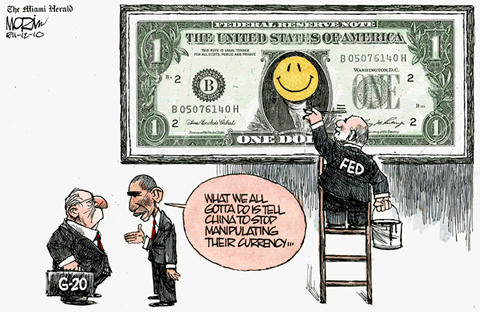


![clip_image001[1]](https://blogger.googleusercontent.com/img/b/R29vZ2xl/AVvXsEj_5YPG8AaVcNGqCY7P0By8k39o6JeZsTuELm7y4JCoSsn50OoKpIyei8IQhMXhPdlQdAWkGJ4OEFVVhs_OyO_k_bRxWr0NzPPvJkjR47daFAjYOCE0Oz-E3ItCOKqOJu4DN2o-BNCL96s/s1600/Gld.JPG "clip_image001[1]")
![clip_image002[1]](https://blogger.googleusercontent.com/img/b/R29vZ2xl/AVvXsEj4yT7fWfqBI6kCh3rUQy4wr1RSTg_dsS4rNhH087dcY4oLmb6tFlAigSnMT4uPP91tnOQe1tKNzSWYYS1hO8hXjgn7XbK7wdekhWCYCIMFMzkx5QFuxIPgFWXDEe43JGIhqICpezvSm6I/s1600/slv.JPG "clip_image002[1]")


| You are subscribed to email updates from Save Your ASSets First To stop receiving these emails, you may unsubscribe now. | Email delivery powered by Google |
| Google Inc., 20 West Kinzie, Chicago IL USA 60610 | |

No comments:
Post a Comment