


Gold World News Flash |

- GoldSeek.com Radio Gold Nugget: Robert Prechter Jr. & Chris Waltzek
- GOLD – a LOOK BACK, and a LOOK FORWARD.
- Federal Reserve ups its money printing for 2013, good for oil, gold and silver prices
- 日本の投資家にとってのテールリスクと金の役割 The Role of gold for Japanese investors during tail risk events
- Margin Debt Continues To Climb
- TSA Moves to Sovietize Internal Travel
- Buy Gold - Fed To Print Over $1,000,000,000,000 Per Year
- All Of My Bags Were Searched & They Were Looking For Money
- Gold Seeker Closing Report: Gold and Silver Close With Gains
- Standstill: The Charts That Prove The Global Economy Is In Serious Trouble
- First Hong Kong, Now Aussie Central Bank Gets Ugly Case Of Truthiness
- Whoops - that Didn't Last Long!
- Paper gold presents problems for investors
- Is the Correction Over in Gold?
- Surprise! MOPE RAID: Gold & Silver Hammered in Globex After QE4 Announcement
- Gold - It's Time
- Precious Metals Market Report – December 13
- Why Silver Could Be the Best Investment in 2013
- Commodity Technical Analysis: Gold Reverses Sharply to Close Near Open
- Gold and Real Estate Are My Hedges for the Fiscal Cliff
- How Davy Crockett Would Have Fixed America
- Fed Continues Monthly $ 85 Billion Bond Buying – Gold Price Volatile
- The Gold Price Posted a Higher High and Higher Low Closing Up $8.40 at $1,716.60
- And That's Checkmate Bernanke
- Lee Quaintance and Paul Brodsky: For gold market rigging, look east too
- Silver: Outlook For 2013
- Turk – Why Everyone should Own Precious Metals
- Gold up on FOMC news but fails to clear Resistance
- Gold Daily And Silver Weekly Charts - FOMC and 12-12-12
- Porter Stansberry: Gold and Real Estate Are My Hedges for the Fiscal Cliff
| GoldSeek.com Radio Gold Nugget: Robert Prechter Jr. & Chris Waltzek Posted: 13 Dec 2012 08:23 AM PST GoldSeek.com Radio Gold Nugget: Robert Prechter Jr. & Chris Waltzek |
| GOLD – a LOOK BACK, and a LOOK FORWARD. Posted: 13 Dec 2012 08:17 AM PST Featured is the five year weekly gold chart. The green boxes highlight pullbacks from overbought conditions. The blue boxes show the testing of a breakout from below the 50 week moving average. The green arrows point to the expected upward direction upon the completion of this test. |
| Federal Reserve ups its money printing for 2013, good for oil, gold and silver prices Posted: 13 Dec 2012 08:05 AM PST The Federal Reserve chairman Ben Bernanke yesterday moved his money printing into a higher gear with an additional $45 billion in asset purchases a month on top of the existing $40 billion program and set a target of 6.5 per cent unemployment before he would start to reverse this monetary stimulus. |
| 日本の投資家にとってのテールリスクと金の役割 The Role of gold for Japanese investors during tail risk events Posted: 13 Dec 2012 02:30 AM PST 日本市場において過去発生したテールイベント時に、5%金をポートフォリオの中に組み入れて保有することで、ほぼ全てのテールイベントの期間で損失抑制効果が確認できた。為替ヘッジ(対ドル)を付けて金を保有する場合と、為替ヘッジせずに円ベースで保有する場合の2通りについて分析。 また、将来発生するかもしれないテールリスクのシナリオを3つ想定し、ある最適化ポートフォリオが被る損失を推計、金を組み入れることによる損失抑制効果についても試算。テールイベント時のヘッジツールとしての可能性を示唆する結果となった。 |
| Margin Debt Continues To Climb Posted: 13 Dec 2012 12:37 AM PST The NYSE released October margin debt data and to nobody's surprise total margin debt rests at $317 billion, the highest since April 2011 ($320 billion), leaving inquiring minds to ask just how much purchasing is being done on margin (Free Credit less Total Margin Debt)? The answer is $43.9 billion, the highest since June of 2011 ($45.9 billion). The level of investor net worth has only been postive 4 times since September 2009, the same month Bernanke claimed the recession was "technically" over, lagging 3 months behind ZH's number 1 fan Dennis Kneale. When the Fiscal Cliff goes unresolved and headline reading algo's rip orders off a neverending stream of rehashed articles, margin calls will accelerate heavily and usually stable assets like Gold and Silver are likely to experience volatility as investors computer programs liquidate in a mad-faced fashion. Rogue traders with unauthorized postions, off book loses, and fat fingers beware. |
| TSA Moves to Sovietize Internal Travel Posted: 12 Dec 2012 10:30 PM PST by Kurt Nimmo, InfoWars:
McElroy spotlights an application on page 71431 of Volume 77, Number 231 of the Federal Register that "constitutes a preliminary step toward systematically expanding TSA's authority from airports to highways and almost every other means of public travel." The effort will eliminate the ability to travel anonymously around the country and remove "one of the last remaining differences between the US and a total police state," McElroy writes. "The total police state you experience at airports wants to spill into roads and bus stops, to subways and trains. Or, rather, the TSA wants to solidify and spread the fledgling and erratic presence it already has." |
| Buy Gold - Fed To Print Over $1,000,000,000,000 Per Year Posted: 12 Dec 2012 10:01 PM PST  Today acclaimed money manager Stephen Leeb spoke with King World News about the FOMC meeting and what is happening with gold and silver. Here is what Leeb had to say: "Eric, yesterday was Fed day and the Fed didn't surprise too many people when they announced they were going to buy $85 billion worth of government paper each month. If you do the calculations that comes to $1 trillion per year. This leaves me speechless $1 trillion worth of paper each year." Today acclaimed money manager Stephen Leeb spoke with King World News about the FOMC meeting and what is happening with gold and silver. Here is what Leeb had to say: "Eric, yesterday was Fed day and the Fed didn't surprise too many people when they announced they were going to buy $85 billion worth of government paper each month. If you do the calculations that comes to $1 trillion per year. This leaves me speechless $1 trillion worth of paper each year."This posting includes an audio/video/photo media file: Download Now |
| All Of My Bags Were Searched & They Were Looking For Money Posted: 12 Dec 2012 10:00 PM PST from KingWorldNews:
Today a legend in the business told King World News, "When I entered the country a couple of days ago, all of my bags were searched for money." Keith Barron, who consults with major gold companies around the world and is responsible for one of the largest gold discoveries in the last quarter century, spoke with KWN about his bags being searched on his travels and what is going to cause gold to explode higher. He also spoke about the chaos in Argentina. Here is what Barron had to say: Today we saw the gold price on the move as a result of the FOMC meeting. The Fed verified that quantitative easing is going to continue and the numbers are getting bigger each month. The reality is we have populations in Europe pushing back on governments trying to impose austerity." |
| Gold Seeker Closing Report: Gold and Silver Close With Gains Posted: 12 Dec 2012 10:00 PM PST Gold gained $8.94 to $1718.94 at about 9:45AM EST before it fell back to $1707.55 in the next hour of trade, but it then rose to a new session high of $1723.20 following today's fed announcement and ended with a gain of 0.08%. Silver climbed $0.43 to $33.38 before it fell back near unchanged in late morning trade, but it then surged to as high $33.78 in afternoon trade and ended with a gain of 1.43%. |
| Standstill: The Charts That Prove The Global Economy Is In Serious Trouble Posted: 12 Dec 2012 09:30 PM PST by Mac Slavo, SHTFPlan:
But despite their best efforts to fabricate positive employment numbers, GDP growth, currency stability and stock market health, the stark reality is that the global economy is at a standstill, and has been since before the crash of 2008. Economic growth is measured by how much we produce and consume, and before the bursting of the bubble there was an unprecedented level of consumption in America and throughout the rest of the world. But when credit markets and lending froze in response to a loss of confidence in the financial system following the collapse of investment giants Bear Stearns and Merrill Lynch, the economy as we had come to know it fell apart. |
| First Hong Kong, Now Aussie Central Bank Gets Ugly Case Of Truthiness Posted: 12 Dec 2012 09:06 PM PST It seems the AsiaPac central bankers did not get the 'shut up and print' memo as today during another speech, an Australian central banker followed Hong Kong's lead and pronounced quantitative easing as potentially harmful and the volatility-dampening effects of excess monetary policy as "ultimately inimical to financial stability and hence macroeconomic stability." In the speech below Glenn Stevens (RBA Governor) provides some much-needed doses of sanity to the grossly addicted world desirous of moar money printing.
Why are these AsiaPac bankers breaking ranks with the status quo? Perhaps they see a looming threat and prefer to front-run their governments' demands to "get to work". Must Read:
Challenges Of Central Banking - Glenn Stevens (RBA Governor) Monday marked the 70th anniversary of the commencement of operations of the Bank of Thailand, on 10 December 1942. Conceived under war-time occupation, the Bank has grown to be a key institution in Thailand. It is a pleasure and an honour to come to Bangkok to take part in one of a series of events to mark the anniversary, and I want to thank Governor Prasarn for the invitation. The Reserve Bank of Australia has long enjoyed a strong relationship with the Bank of Thailand. In 1997, the RBA was among those central banks to enter a swap agreement with the Bank of Thailand shortly after the crisis broke. This was the first part of Australian assistance to the regional partners who were under pressure, which later extended to Korea and Indonesia. In fact, Australia and Japan were the only countries that offered direct financial support to all three countries. It was a predecessor of mine, Bernie Fraser, who made the suggestion 17 years ago that cooperation in the Asian region might be improved by the establishment of a dedicated institution, along the lines of the Bank for International Settlements in Basel – the 'Asian BIS'. Such a body has not come to pass – at least not yet! – but it is fair to say that this suggestion and others like it helped to spur the Basel BIS to reach out to Asia. The central banks of the region, taking the initiative through the Executives Meeting of East Asian and Pacific central banks – EMEAP (not the most attractive acronym) – have improved cooperation substantially over the years. Thanks to long-term efforts at building relationships, and the vision of key governors and deputy governors, including at the Bank of Thailand, EMEAP has developed into a mature forum for sharing information, and continues to develop its ability to find common positions on global issues and to promote crisis readiness. Yet as the central banks have grown closer and become more effective in their cooperation, the challenges we face have only increased. Today I want to speak about three of them. First, I will talk about the framework for monetary policy and the need to allow that to consider financial stability. Secondly, I will make some observations about the more prominent role for central banks' own balance sheets that we are seeing in some countries. Then, thirdly, I will offer some observations about international spillovers. In so doing, I am not seeking to deliver any particular messages about the near-term course of monetary policy in either Australia or Thailand. Monetary Policy and Financial StabilityIt is more than two decades since the framework of Inflation Targeting (IT) was pioneered in New Zealand and Canada. The United Kingdom was an enthusiastic early adopter from 1992. Australia adopted IT in 1993. Among the early adopters, the move to IT was driven by a mixture of principle and pragmatism. The key principle was that monetary policy was, in the end, about anchoring the value of money – that is, about price stability. The pragmatism arose because one or more previous approaches designed to achieve that – monetary targeting, exchange-rate targeting, unconstrained discretion – had proved at best ineffective, and at worst destabilising, for the countries concerned. Hence many of the adopters shared a desire to strengthen the credibility of their policy frameworks. As the initial adopters came to have a measure of success in combining reasonable growth with low inflation, other countries were attracted to the model. According to the IMF, more than 30 countries now profess to follow some form of IT. The euro area could also be counted among this group though it also professes adherence to the 'second pillar' of 'monetary analysis'. Even the United States can, I think, be counted as a (fairly recent) IT adopter, since the Federal Open Market Committee is these days quite explicit about its desired inflation performance. The Bank of Thailand was one of a number of emerging economies that adopted IT around the turn of the century. Twelve years on, Thailand can boast an impressive record of price stability under this framework. A high level of transparency has ensured that financial market participants understand the framework, and view it as credible. Moreover, price stability has not come at the cost of subdued economic growth, with output expanding at a brisk pace in the 2000s. While inflation targeting is not for everyone, the Thai experience illustrates that, when done well, it can enhance economic outcomes. I can endorse the favourable verdict offered on the Thai experience delivered by Grenville and Ito (2010). So I think that the adoption of IT, including in Thailand, can be seen as a success in terms of the straightforward objectives set for it. To make such a claim is not, however, to claim that controlling inflation is, alone, sufficient to underwrite stability in a broader sense. If there were any thought that controlling inflation over a two or three year horizon was 'enough', we have been well and truly disabused of that by experience over the past half decade. Price stability doesn't guarantee financial stability. Indeed it could be argued that the 'great moderation' – an undoubted success on the inflation/output metric – fostered, or at least allowed, a leverage build-up that was ultimately inimical to financial stability and hence macroeconomic stability. The success in lessening volatility in economic activity, inflation and interest rates over quite a lengthy period made it feasible for firms and individuals to think that a degree of increased leverage was safe. But higher leverage exposed people to more distress if and when a large negative shock eventually came along. This explanation still leaves, of course, a big role in causing the crisis – the major role in fact – for poor lending standards, even fraud in some cases, fed by distorted incentives and compounded by supervisory weaknesses and inability to see through the complexity of various financial instruments. That price stability was, in itself, not enough to guarantee overall stability, should hardly be surprising, actually. It has been understood for some time that it is very difficult to model the financial sector, and that in many of the standard macroeconomic models in use, including in many central banks, this area was under-developed. Mainstream macroeconomics was perhaps a bit slow to see the financial sector as it should be seen: that is, as having its own dynamic of innovation and risk taking; as being not only an amplification mechanism for shocks but a possible source of shocks in its own right, rather than just as passively accommodating the other sectors in the economy. Notwithstanding the evident analytical difficulties, the critique being offered in some quarters is that central banks paid too little attention in the 2000s to the build-up of credit and leverage and to the role that easy monetary policy played in that. It is hard to disagree, though I would observe that this is somewhat ironical, given that IT was a model to which central banks were attracted after the shortcomings of targets for money and credit quantities in the 1980s. It could be noted as well that the ECB always had the 2nd pillar, but the euro area still experienced the crisis – in part because of credit granted in or to peripheral countries, and in part because of exposures by banks in the core countries to excessive leverage in the US. The upshot is that the relationship between monetary policy and financial stability is being re-evaluated. As this occurs, we seem to be moving on from the earlier, unhelpful, framing of this issue in terms of the question as to whether or not monetary policy should 'prick bubbles' and whether bubbles can even be identified. The issue is not whether something is, or is not, a bubble; that is always a subjective assessment anyway in real time. The issue is the potential for damaging financial instability when an economic expansion is accompanied by a cocktail of rising asset values, rising leverage and declining lending standards. One can remain agnostic on the bubble/non-bubble question but still have concerns about the potential for a reversal to cause problems. Perhaps more fundamentally, although the connections between monetary policy and financial excesses can be complex, in the end central banks set the price of short-term borrowing. It cannot be denied that this affects risk-taking behaviour. Indeed that is one of the intended effects of low interest rates globally at present (which is not to say that this is wrong in an environment of extreme risk aversion). It follows that broader financial stability considerations have to be given due weight in monetary policy decisions. This is becoming fairly widely accepted. The challenge for central banks, though, is to incorporate into our frameworks all we have learned from the recent experience about financial stability, but without throwing away all that is good about those frameworks. We learned a lot about the importance of price stability, and how to achieve it, through the 1970s, 80s and 90s. We learned too about the importance of institutional design. We shouldn't discard those lessons in our desire to do more to assure financial stability. We shouldn't make the error of ignoring older lessons in the desire to heed new ones. Rather, we have to keep both sets of objectives in mind. We will have to accept the occasional need to make a judgement about short-term trade-offs, but that is the nature of policymaking. And in any event, over the long run price stability and financial stability surely cannot be in conflict. To the extent that they have not managed to coexist properly within the frameworks in use, that has been, in my judgement, in no small measure because the policy time horizon was too short, and perhaps also because people became too ambitious about fine-tuning. We also must, of course, heed the lesson that, whatever the framework, the practice of financial supervision matters a great deal. Speaking of supervisory tools, these days it is, of course, considered correct to mention that there are other means of 'leaning against the wind' of financial cycles, in the form of the grandly-labelled 'macroprudential tools'. Such measures used to be more plainly labelled 'regulation'. They may be useful in some instances when applied in a complementary way to monetary policy, where the interest rate that seems appropriate for overall macroeconomic circumstances is nonetheless associated with excessive borrowing in some sector or other. In such a case it may be sensible to implement a sector-specific measure – using a loan to value ratio constraint or a capital requirement. (This is entirely separate to the case for higher capital in lending institutions in general). We need, however, to approach such measures with our eyes open. Macroprudential tools will have their place. But if the problem is fundamentally one of interest rates being too low for a protracted period, history suggests that the efforts of regulators to constrain balance-sheet growth will ultimately not work. If the incentive to borrow is powerful and persistent enough, people will find a way to do it, even if that means the associated activity migrating beyond the regulatory perimeter. So in the new-found, or perhaps re-learned, enthusiasm for such tools, let us be realists. The Limits of Central BankingThat policy measures of any kind have their limitations is a theme with broader applications, especially for central banks. The central banks of major countries were certainly quite innovative in their responses to the unfolding crisis. Numerous programs to provide funding to private institutions, against vastly wider classes of collateral, were a key feature of the central bank response to the situation. In essence, when the private financial sector was suddenly under pressure to shrink its balance sheet, the central banks found themselves obliged to facilitate or slow the balance-sheet adjustment by changing the size of their own balance sheets. This is the appropriate response, as dictated by long traditions of central banking stretching back to Bagehot. Conceptually, at least initially, these balance-sheet operations could be seen as distinct from the overall monetary policy stance of the central bank. But as the crisis has gone on such distinctions have inevitably become much less clear as 'conventional' monetary policy reached its limits. It was fortuitous for some, perhaps, that the zero-lower bound on nominal interest rates – modern parlance for what we learned about as the 'liquidity trap' – had gone from being a text book curiosum to a real world problem in Japan in the 1990s. Japan subsequently pioneered the use of 'quantitative easing' in the modern era. This provided some experiential base for other central banks when the recession that unfolded from late 2008 was so deep that there was insufficient scope to cut interest rates in response. So in addition to programs to provide funding to intermediaries in order to prevent a collapse of the financial system when market funding dried up, there have been programs of 'unconventional monetary policy' in several major countries over recent years. These have been varyingly thought of as operating by one or more of:
As a result of such policy innovation, the balance sheets of central banks in the major countries have expanded very significantly, in some cases approaching or even surpassing their war-time peaks (Graph 1). Further expansion may yet occur. Graph 1 It is no criticism of these actions – taken as they have been under the most pressing of circumstances – to observe that they raise some very important and difficult questions for central banks. There is discomfort in some quarters that central banks appear to be exercising an unprecedented degree of discretion, introducing new policies yielding uncertain benefits, and possible costs. One obvious consideration is that central banks, in managing their own balance sheets, need to assess and manage risk across a wider and much larger pool of assets. Gone are the comfortable days of holding a modest portfolio of bonds issued by the home government that were seen as of undoubted credit quality. Central bank portfolios today have more risk. To date in the major countries, this has worked well in the sense that long-term yields on the core portfolios have come down to the lowest levels in half a century or more. Large profits have been remitted to governments. But at some point, those yields will surely have to rise. Of course large central bank balance sheets carrying sizeable risk is hardly news around Asia. Once again, the Bank of Thailand has made an excellent contribution to the international discussion here, having recently held a joint conference with the BIS on central bank balance sheets and the challenges ahead. The difference is that in Asia the risks arise from holdings of foreign-currency assets which have been accumulated as a result of exchange-rate management. There is obviously valuation risk on such holdings. There is also often a negative carry on such assets since yields on the Asian domestic obligations which effectively fund foreign holdings are typically higher than those in the major countries. In effect the citizens of Asia continue to provide, through their official reserves, very large loans to major country governments at yields below those which could be earned by deploying that capital at home in the region. For the major countries a further dimension to what is happening is the blurring of the distinction between monetary and fiscal policy. Granted, central banks are not directly purchasing government debt at issue. But the size of secondary market purchases, and the share of the debt stock held by some central banks, are sufficiently large that it can only be concluded that central bank purchases are materially alleviating the market constraint on government borrowing. At the very least this is lowering debt service costs, and it may also condition how quickly fiscal deficits need to be reduced. There is nothing necessarily wrong with that in circumstances of deficient private demand with low inflation or the threat of deflation. In fact it could be argued that fiscal and monetary policies might actually be jointly more effective in raising both short and long-term growth in those countries if central bank funding could be made to lead directly to actual public final spending – say directed towards infrastructure with a positive and long-lasting social return – as opposed to relying on indirect effects on private spending. The problem will be the exit from these policies, and the restoration of the distinction between fiscal and monetary policy with the appropriate disciplines. The problem isn't a technical one: the central banks will be able to design appropriate technical modalities for reversing quantitative easing when needed. The real issue is more likely to be that ending a lengthy period of guaranteed cheap funding for governments may prove politically difficult. There is history to suggest so. It is no surprise that some worry that we are heading some way back towards the world of the 1920s to 1960s where central banks were 'captured' by the Government of the day. Most fundamentally, the question is whether people are fully understanding of the limits to central banks' abilities. It is, to repeat, not to be critical of actions to date to wonder whether private market participants, and perhaps more importantly governments, recognise what central banks cannot do. Central banks can provide liquidity to shore up financial stability and they can buy time for borrowers to adjust. But they cannot, in the end, put government finances on a sustainable course and they cannot create the real resources that need to be found from somewhere to strengthen bank capital. They cannot costlessly correct earlier misallocation of real capital investment. They cannot shield people from the implications of having mis-assessed their own life-time budget constraints and as a result having consumed too much. They cannot combat the effects of population aging or drive the innovation that raises productivity and creates new markets. Nor can they, or should they, put themselves in the position of deciding what real resource transfers should take place between countries in a currency union. One fears, in short, that while the central banks have been centre stage – rightly in many ways – in the early responses to the crisis, and in buying time for other adjustments by taking bold initiatives over the past couple of years, the limits of what they can do may become more apparent in the years ahead. A key task for central banks is to try to communicate these limits, all the while doing what they can to sustain confidence that solutions can in fact be found and pointing out from where they might come. Challenges with SpilloversTalking about the challenges associated with large balance-sheet activities leads naturally into a discussion about international spillovers. In one sense, this is not a new issue. It has been a cause of anxiety and disagreement since the latter days of the Bretton Woods agreement at least. The remark attributed to the then Secretary of the US Treasury in regard to European concerns about the weakness of the US dollar in the 1970s of 'it's our currency, but your problem' was perhaps emblematic of the spillovers of that time. There have been other episodes since. In a much earlier time there was, of course, the 'beggar thy neighbour' period of the 1930s – something which carries cogent lessons for current circumstances. In recent years, as interest rates across a number of major jurisdictions have fallen towards zero and as central bank balance-sheet measures have increased, these developments have been seen as contributing to cross-border flows of capital in search of higher returns. The extent of such spillovers is still in dispute. And, to the extent that they are material, some argue that a world in which extraordinary measures have been taken to prevent crises may still be a better place for all than the counterfactual. The degree of disquiet in the global policymaking community does seem, however, to have grown of late. Perhaps one reason is the following. In past episodes expansionary policies in major countries, while having spillovers through capital flows, did demonstrably stimulate demand in the major countries. It is open to policymakers in those countries to claim that unconventional policies are having an expansionary effect in their own economies compared with what would otherwise have occurred. But the slowness of the recovery in the US, Europe and Japan, I suspect, leaves others wondering whether major countries are relying more on exporting their weaknesses than has been the case in most previous recoveries. One response to that can be efforts in emerging economies to make their financial systems more resilient to volatile capital flows, such as by developing local currency bond markets and currency hedging markets. This type of work is underway in various fora, such as the G-20 and EMEAP. But that takes time. Meanwhile people in the emerging economies, and for that matter several advanced economies, feel uncomfortable about the spillovers. At the same time, it has to be said that spillovers go in more than one direction. While it was common for Asian (and European) policymakers to point the finger at the US for many years over the US current account deficit, with claims that the US was absorbing too great a proportion of the world's saving, the fact was that those regions were supplying excess savings into the global capital market because they did not want to use them at home. That surely had an impact on the marginal cost of capital, to which borrowers and financial institutions in parts of the advanced world responded. We may want to say, in hindsight, that policymakers in the US and elsewhere should have worried more about the financial risks that were building up by the mix of policies that they ran. But we would also have to concede that the US policymakers sought to maintain full employment in a world that was conditioned by policies pursued in parts of the emerging world and especially Asia. Not only do spillovers go in more than one direction, but those which might arise from policies in this region are much more important now than once was the case. The rapid growth in Asia's economic weight means that policy incompatibilities which partly arise on this side of the Pacific have greater global significance. The traditional Asian strategy of export-driven growth assisted by a low exchange rate worked well when Asia was small. Asia isn't small anymore and so the rest of the world will not be able to absorb the growth in Asian production in the same way as it once did. More of that production will have to be used at home. This is understood by Asian policymakers and progress has been made in reorienting the strategy. I suspect more will be needed. For central banks in particular, there has been talk about spillovers from monetary policy settings being 'internalised' into individual central banks' framework for decision making. Exactly how that might be done is not entirely clear, and discussion is in its infancy; a consensus is yet to emerge. The IMF does useful work on spillovers and the IMF offers, at least in principle, a forum where incompatibilities can be at least recognised and discussed. One more far reaching proposal is for there to be an 'international monetary policy committee'. That seems a long way off at present. For spillovers to be effectively internalised, mandates for central banks would need to allow for that. At the present time most central banks are created by national legislatures, with mandates prescribed in national terms. (The ECB of course is the exception, with a mandate given via an international treaty). It would be a very big step to change that and it certainly won't occur easily or soon, though national sovereignty over monetary policy within the euro area was given up as part of the single currency – so big changes can occur if the benefits are deemed to be sufficient. Whether or not such a step eventually occurs, it is clear that spillovers are with us now. All countries share a collective interest in preserving key elements of the international system, even as individual central banks do what it takes to fulfil their current mandates. It is vital, then, that central banks continue to ta |
| Whoops - that Didn't Last Long! Posted: 12 Dec 2012 07:30 PM PST [url]http://www.traderdannorcini.blogspot.com/[/url] [url]http://www.fortwealth.com/[/url] Watching the late session price action in the Emini S&P 500 is quite disconcerting if you were expecting the market to greet the Fed's announcement of another $45 BILLION/Month in Bond purchases with a hearty round of wild-eyed buying. It sure looked like that is exactly what it did when the news came out but from that point onward, it has been SELLING and not buying which is dominating. I am not sure whether this is a classic case of "BUY THE RUMOR; SELL THE FACT" since it was no secret that the Fed was going to announce a replacement program for the expired Operation Twist and since the number had already been in the market for the previous couple of weeks. The bulls had better hope that is all that this is (BUY THE RUMOR; SELL THE FACT) because if it is not, and IF this is the market basically yawning in the face of what amounts to a relatively open-ended HALF A TRILLION in Dollar creation ... |
| Paper gold presents problems for investors Posted: 12 Dec 2012 07:30 PM PST by Rob Varnon, Connecticut Post:
Chasing after gold in hopes of finding fortune isn't a new strategy, but investors seeking out shiny coins and bars today might end up owning nothing more than paper. This year the U.S. Commodities Futures Trading Commission issued a warning on gold scams and then earlier this month brought charges of fraud against Las Vegas-based Hunter Wise Commodities and 11 other firms for allegedly selling off-exchange gold contracts while promising to deliver the real stuff and also providing phantom loans to investors for the purchases. In all, the CFTC says Hunter Wise took in $46 million in funds in the course of a year for gold it didn't have. On Tuesday, gold settled at $1,711.30 an ounce, off $3.20 from the previous day. The metal is up 7 percent in the last six months from $1,598.60. |
| Is the Correction Over in Gold? Posted: 12 Dec 2012 07:23 PM PST Gold has been less rewarding this year than most gold watchers probably hoped. In fact, price overall has gone sideways since mid-2011. To those readers who follow the gold market closely, we hope you are occasionally able ... Read More...  |
| Surprise! MOPE RAID: Gold & Silver Hammered in Globex After QE4 Announcement Posted: 12 Dec 2012 07:07 PM PST from Silver Doctors:
Another counter-intuitive smash of gold and silver prices is in progress, as gold has been smashed $30 and under $1700 from it's post QE4 announcement high near $1725, and silver has been smashed $1.15 from $33.92 to $32.77. |
| Posted: 12 Dec 2012 05:58 PM PST Authored by Lee Quaintance and Paul Brodsky of QBAMCO, Gold bugs can't understand how the public can be so unaware, how highly intelligent policy makers can be so immoral, and how the mainstream media can be so incurious. We can't understand why more men and women in the investment business haven't joined some of the more successful ones that have come around to precious metals and have taken substantial positions in them for their funds and personal accounts. The list of high profile independent-minded investors that have come out of the proverbial closet is impressive and growing: Kyle Bass, John Paulson, David Einhorn, George Soros, Bill Gross and Paul Singer, to name only a few. Conventional financial asset selection guidelines for professional investors are becoming increasingly uneconomic and problematic. Current macroeconomic conditions leave little doubt as to why. A zero-bound rate structure across developed economies, heavy monetary policy intervention, guaranteed negative real returns of benchmark financial assets and cash, impossible discount cash flow models,cacophonous (and economically meaningless) fiscal political wrangling diverting attention from legitimate budget arithmetic ($800 billion over ten years when we're running $1 trillion-plus annual deficits?), dubious short and intermediate-term prospects in already-emerged emerging economies, and non-trending financial markets, all suggest something has changed. Regardless of whether one is investing personally or as a fiduciary, conventional financial asset allocation models and procedures are obviously failing and the reason is simple: the currencies in which financial assets are denominated are gravely flawed – levered beyond reconciliation and incapable of generating positive real returns for assets denominated in them, or ongoing consumer and business confidence while the leverage is being transferred from banks to central banks, and from central banks to government balance sheets. The political/policy dimension is boxed. We think prudence demands stepping away from conventional financial asset allocation models. Here is what matters... |
| Precious Metals Market Report – December 13 Posted: 12 Dec 2012 05:49 PM PST |
| Why Silver Could Be the Best Investment in 2013 Posted: 12 Dec 2012 05:40 PM PST by Alex Cowie, SilverBearCafe.com:
The Best Investment of 2012 to Repeat in 2013?Toward the end of last year, the editors here at Port Phillip Publishing got up on stage at our Doomers' Ball, to give our 'Big prediction for 2012′. To paint the picture, at the end of 2011 the market had been well and truly beaten up. The Metals and Mining index (XMM), Small Ords (XSO) and Emerging Companies indices (XEC) all fell more than 22% over the year. So it was a bit challenging to find a sunny patch in the market to get excited about for a 'big call for 2012′. |
| Commodity Technical Analysis: Gold Reverses Sharply to Close Near Open Posted: 12 Dec 2012 05:30 PM PST courtesy of DailyFX.com December 12, 2012 02:44 PM Daily Bars Chart Prepared by Jamie Saettele, CMT Commodity Analysis: “Viewed in light of the 3 wave advance from 1672.50, the trend is lower.” Friday’s JS Spike right at mentioned support (1685) will probably propel gold to at least the 61.8% retracement of the decline from the 11/12 high at 1727. There is trendline resistance to keep an eye on as well. Commodity Trading Strategy: Previous comments were “look to short strength from 1727 to 1738 with a 1754 stop.” After today’s spike and reversal, gold might not reach 1727. Wait for at least a day for the near term pattern to clear up before jumping into something at a less than ideal level. LEVELS: 1673 1683 1704 1727 1738 1754... |
| Gold and Real Estate Are My Hedges for the Fiscal Cliff Posted: 12 Dec 2012 05:20 PM PST by Karen Roche, The Gold Report:
Porter Stansberry: You can be sure of a couple of things from Washington. One is spending will not slow down. The increase to spending in 2013, 2014, 2015 will be the same kind of increases we have seen in previous years. We will continue to spend 24% of GDP at the federal level. TGR: And what else can we be sure about? PS: Some actions will be taken to increase the tax rates on some taxpayers, but they will produce no material change in revenue. The government will continue to take in far less than 20% of GDP in taxes, probably only 16% or 17% of GDP. Further, those changes also will narrow the tax base, which is to say that fewer people will be asked to pay more in taxes. |
| How Davy Crockett Would Have Fixed America Posted: 12 Dec 2012 05:08 PM PST Davy Crockett, Congressman from Tennessee …. his first speech is pretty funny and cutting. Loved the insults!! The second speech regarding Government Welfare is well known …. and, well fogotten, unfortunately. Somebody please send it to Obama. ===================================================== The broken fenced state of the nation, the broken banks, broken hearts, and broken pledges of my brother Congressman here around me, has raised the boiler of my indignation clear up to the high pressure point, and therefore I have raised to let off the steam of my whole hog patriotism without the trimmings. The truth wants no trimmings for in her clear naked state of nature she's as graceful as a colt sucking in the sunshine. Mr. Speaker! What in the name of sheep-dog rascality is the country coming to? Where is all the honor? Nowhere! And there it'll stick! The State revenue? Everywhere but where it ought to be! Why, Mr. Speaker, don't squint with horror, when I tell you that last Saturday morning Uncle Sam hadn't the first flip to give at the barbeque! The banks suspend payment, and the starving people suspend themselves by ropes! Old Currency is flat on his back, the bankers have sunk all funds in the safe art of speculation, and some of these chaps grinning around me are as deep in the mud as a heifer in a horse-pond! Where's the political honesty of my fellow congressmen? Why, in bank bills and five acre speeches! Where's all their patriotism? In slanted slurs, challenges, and hair trigger pistols! Where's all their promises? Everywhere like a bitch in heat! Where's all their performances on them? Nowhere, and the poor people bellowing after them everywhere like a drove of buffaloes after their lazy keepers that, like the officers here, care for no one's stomach, but their own eternal internals! What in the nation have you done this year? Why, waste paper enough to calculate all your political sins upon, and that would take a sheet for each one of you as long as the Mississippi. and as broad as all Kentucky. You've gone ahead in doing nothing backwards, till the whole nation's done up. You've spouted out a Mount Etna of gas, chewed a whole Allegheny of tobacco, spit a Niagara of juice, told a hail storm of lies, drunk a Lake Superior of liquor, and all, as you say, for the good of the nation; but I say, I swear, for her eternal bankruptification! Therefore, I move that the only way to save the country is for the whole nest of you political weasels to cut stick home instantly, and leave me to work Uncle Sam's farm, till I restore it to its natural state of cultivation, and shake off these state caterpillars of corruption. Let black Dan Webster sitting there at the other end of the desk turn Methodist preacher. Let Jack Calhoun setting right before him with his hair brushed back in front like a huckleberry bush in a hurricane, after Old Hickory's topknot, turned horse-jockey. Let Harry Clay sitting there in the corner with his arms folded about his middle like grape vines around a black oak, go back to our old Kentucky and enrich lawyers and other black sheep. Let old Daddy Quincy Adams sitting right behind him there, go home to Massachusetts, and write political primers for the sucking politicians. Let Jim Buchanan go home to Pennsylvania and smoke long nine, with the Dutchmen. Let Tom Benton, bent like a hickory sapling with hull rolling, take a roll home and make candy mint drops for the babies. For they've all worked Uncle Sam's farm with the all scratching harrow of rascality, until it's as gray as a stone fence, as barren as barked clay, and as poor as a turkey fed on gravel stones! And, to conclude, Mr. Speaker, the nation can no more go ahead under such a state of things, than a fried eel can swim upon the steam of a tea kettle; if it can, then take these your legs for your hall pillars." ======================================================== = I will not go into an argument to prove that Congress has no power to appropriate this money as an act of charity. Every member upon this floor knows it. We have the right, as individuals, to give away as much of our own money as we please in charity; but as members of Congress we have no right so to appropriate a dollar of the public money. Some eloquent appeals have been made to us upon the ground that it is a debt due the deceased. Mr. Speaker, the deceased lived long after the close of the war; he was in office to the day of his death, and I have never heard that the government was in arrears to him. This government can owe no debts but for services rendered, and at a stipulated price. If it is a debt, how much is it? Has it been audited, and the amount due ascertained? If it is a debt, this is not the place to present it for payment, or to have its merits examined. If it is a debt, we owe more than we can ever hope to pay, for we owe the widow of every soldier who fought in the War of 1812 precisely the same amount. There is a woman in my neighborhood, the widow of as gallant a man as ever shouldered a musket. He fell in battle. She is as good in every respect as this lady, and is as poor. She is earning her daily bread by her daily labor; but if I were to introduce a bill to appropriate five or ten thousand dollars for her benefit, I should be laughed at, and my bill would not get five votes in this House. There are thousands of widows in the country just such as the one I have spoken of, but we never hear of any of these large debts to them. Sir, this is no debt. The government did not owe it to the deceased when he was alive; it could not contract it after he died. I do not wish to be rude, but I must be plain. Every man in this House knows it is not a debt. We cannot, without the grossest corruption, appropriate this money as the payment of a debt. We have not the semblance of authority to appropriate it as a charity. Mr. Speaker, I have said we have the right to give as much of our own money as we please. I am the poorest man on this floor. I cannot vote for this bill, but I will give one week's pay to the object, and if every member of Congress will do the same, it will amount to more than the bill asks." |
| Fed Continues Monthly $ 85 Billion Bond Buying – Gold Price Volatile Posted: 12 Dec 2012 04:58 PM PST The US Fed decided on today's FOMC meeting to continue with its monthly $85 billion bond purchases AND keep interest rates near zero until unemployment drops. The gold price reacted initially with a short rally, but closed the day flat. Reuters commented as follows on the Fed announcements:
In a short video clip on Bloomberg, Ben Bernanke defended the need to find a solution for the fiscal cliff, as he believes the effect of not getting over it would be too impactful. Dan Norcini commented on his weblog on the crazy idea of expecting additional monetary stimulus to achieve a specific unemployment rate. Moreover he wrote that the latest US deficit figures were published today. Compare the annualized figure he calculates with annualizing the announced bond purchase program.
How did gold react on all this news? Well, there was quite some volatility and the typical drops appeared right before the speech of Mr Bernanke, as visible on the intraday chart. The speech was follewed by an initial spike but the gold price closed the day more or less flat. Where are we on the daily chart? From a technical point of view, the gold price is just below its 20 and 50 day moving average. The coming days will be important in the sense that support should hold. Lastly, Jim Sinclair himself sent a short e-mail to his subscribers pointing to the fiscall cliff folly:
|
| The Gold Price Posted a Higher High and Higher Low Closing Up $8.40 at $1,716.60 Posted: 12 Dec 2012 04:40 PM PST Gold Price Close Today : 1716.60 Change : 8.40 or 0.49% Silver Price Close Today : 33.707 Change : 0.766 or 2.33% Gold Silver Ratio Today : 50.927 Change : -0.929 or -1.79% Silver Gold Ratio Today : 0.01964 Change : 0.000352 or 1.82% Platinum Price Close Today : 1644.90 Change : 6.40 or 0.39% Palladium Price Close Today : 699.65 Change : 4.35 or 0.63% S&P 500 : 1,430.63 Change : 2.79 or 0.20% Dow In GOLD$ : $159.68 Change : $ (0.63) or -0.40% Dow in GOLD oz : 7.724 Change : -0.031 or -0.40% Dow in SILVER oz : 393.38 Change : -8.81 or -2.19% Dow Industrial : 13,259.61 Change : 11.17 or 0.08% US Dollar Index : 79.82 Change : -0.232 or -0.29% The silver and GOLD PRICE have slapped me so many times, but I'm going to try again today. I don't reckon I'll ever learn. The GOLD PRICE gained $8.40 (0.5%) to $1,716.60 while silver added 76.6 cents (2.33%) to close Comex at 3370.7c. Once again, it begins to look like both metals have bottomed. Today gold scored a higher high ($1,722.50 v. $1,714.30 yesterday) and a higher low ($1,708.55 v. $1,705.45 yesterday). This leaves behind a double bottom at $1,672.50 in early November and $1,684.10 last week. Stayed well above that $1,705 support. What's missing? Confirmation by closing over $1,725. However, that's liable to come in a one day jump. GOLD could only gainsay my interpretation that the bottom is in by closing below $1,705. Otherwise, it will move higher from here. That SILVER PRICE was jumpy today, and all toward the ceiling. Low came at 3292c in European trading (about midnight NY time). By 9:00 a.m. silver had reached 3325c and was tugging at the leash. Somebody hit it, it fell back instantly to 3300c, then took off for the clouds, gapping and leaping to 3373.2. Rest of the day it backed off, but stayed mostly above 3340c. 'Twas a good day. Great day, matter of fact. On the 4 month chart silver broke out upside from an even- sided triangle, and stands above its 50 (3298c) and 20 (3335c) day moving averages. Momentum indicators have turned or are turning up. 3400c may snag its feet for a minute, but silver should be headed for 3550c -- SOON. The comrades on the Federal Open Market Committee announced a boon for the printer's union: more "accommodation." This comes in two forms, (1) the Fed buying Mortgage Backed Securities to the tune of $40 billion a month, and, after December, buying $45 bn a month in long term US treasuries. (Apparently the banks' balance sheets have not been fixed up yet, so the Fed must continue soaking up their bad paper.) Using my lightning mathematics skills, I make that $85 billion a month of new money the Fed will create, or $1.02 Trillion in 2013. FOMC also promised "more accommodation" (translation: "creating more money") and that it would keep the Fed Funds rate between zero and one-quarter percent till unemployment (now 7.5%) drops below 6-1/2%. Now quick! Tell me what $1.02 trillion in new dollars will do to the value of already-existing dollars? There! I see that hand! Yes, it WILL lower the value of all those existing dollars. So all you trembling silver and gold investors who were fretting that the Fed might stop inflating, just rest easy. They just told you they will be inflating away all next year. I keep telling y'all, the Fed and Ben Bernanke are the best friends silver and gold have. But maybe not stocks' best friends. Dow reached a high of 13,329 today, but finished the day nearer its 13,227 low. Dow gained 11.17 (0.08%) to close 13,259.61. S&P500 rode the same roller coaster, ending up only 2.79 (0.2%) at 1,430.63. Technically, that performance can be explained another way. The Dow and the S&P500 both hit significant overhead resistance today, at 13,300 and 1,440. Both have reached that "pull the fuse or throw the dynamite" stage, and 'tain't clear to me which choice they'll make. Given the time of year I suspect both will rally further. Besides, both are above all their moving averages, so momentum is up. There's more: both have scratched out unbroken uptrends since mid-November. However, momentum indicators are warning that there's a limit to this rally -- not yet, but shortly. Naturally the dollar fell like a mule had kicked it in the jaw. Dropped through support at 80 like a man walking into a manhole and lost 23.2 basis points (0.3%) to end at 79.821. Given the FOMC's announcement, I'm surprised it wasn't worse. Gives you an inkling how brain-scrubbed the public is. What about the other two scrofulous, scabby, no-good, low-down trashy, sorry-as-gully-dirt fiat currencies? Makes little sense: euro rose 0.49%, yen fell 0.77%. At $1.3067 the euro bumped its head plumb against the overhead resistance. If it can break thru, it will sprint for $1.3400. Yen, on the other hand, lost a huge 0.77% to end at 120.26c/Y100. Gapped down again. Now I don't know, but if I were the Japanese Nice Government Men and I saw the dollar dropping and the Fed announcing plans to inflate like a puffer fish, I'd be selling yen and buying dollars to push down the rates. Especially if I ever wanted my economy to export to the US again. US$1=Y83.15=E0.7653=0.029 667 oz Ag=0.000 583 oz Au. Just to show you that no matter how healthy an animal or country is, the parasites are always ready to pounce, on 12 December 1791 the First Bank of the United States opened. It was part of the statist Alexander Hamilton's plan to create a central bank. Jefferson and Madison had beaten back the plan a year earlier, claiming the bank was unconstitutional and that it benefited merchants and investors at the people's expense. The bank lasted until its charter expired in 1811. The First Bank of the US was the SECOND attempt at foisting a central bank on the country, after the Bank of North America. CHRISTMAS IS COMING! But y'all still have time to order At Home in Dogwood Mudhole for your gift list. There is time, that is, if you act promptly and go to www.dogwoodmudhole.com Got a complaint from one reader yesterday. She said the book stuck to her hands. Every time she picked it up, she couldn't put it down. Worse yet, she said the folks in the lunch room were looking at her funny because she kept bursting out in fits of laughter. Don't take my word for it, or hers, either. Go get yourself a copy of At Home in Dogwood Mudhole. Argentum et aurum comparenda sunt -- -- Gold and silver must be bought. - Franklin Sanders, The Moneychanger The-MoneyChanger.com 1-888-218-9226 10:00am-5:00pm CST, Monday-Friday © 2012, The Moneychanger. May not be republished in any form, including electronically, without our express permission. To avoid confusion, please remember that the comments above have a very short time horizon. Always invest with the primary trend. Gold's primary trend is up, targeting at least $3,130.00; silver's primary is up targeting 16:1 gold/silver ratio or $195.66; stocks' primary trend is down, targeting Dow under 2,900 and worth only one ounce of gold; US$ or US$-denominated assets, primary trend down; real estate bubble has burst, primary trend down. WARNING AND DISCLAIMER. Be advised and warned: Do NOT use these commentaries to trade futures contracts. I don't intend them for that or write them with that short term trading outlook. I write them for long-term investors in physical metals. Take them as entertainment, but not as a timing service for futures. NOR do I recommend investing in gold or silver Exchange Trade Funds (ETFs). Those are NOT physical metal and I fear one day one or another may go up in smoke. Unless you can breathe smoke, stay away. Call me paranoid, but the surviving rabbit is wary of traps. NOR do I recommend trading futures options or other leveraged paper gold and silver products. These are not for the inexperienced. NOR do I recommend buying gold and silver on margin or with debt. What DO I recommend? Physical gold and silver coins and bars in your own hands. One final warning: NEVER insert a 747 Jumbo Jet up your nose. No, I don't.   |
| And That's Checkmate Bernanke Posted: 12 Dec 2012 04:12 PM PST
Today the US Federal Reserve announced that it would be implementing QE 4: a policy of spending $45 billion per month buying Treasuries on the long-end of the yield curve until employment falls to 6.5%.
So between this and QE 3 which was announced just two and a half months ago, the Fed will be printing $85 billion per month.
First and foremost there is no evidence that QE creates jobs. Consider the case of the UK.
Since the crisis began, the Bank of England (BoE) has announced QE efforts equal to $598 billion in the UK. The UK’s GDP is $2.43 trillion. So the BoE has engaged in QE equal to over 20% of the UK’s GDP.
Despite this massive amount of QE, 2.53 million people are out of work today in the UK, up from 2 million at the start of the Great Crisis in 2007. Similarly, the UK’s GDP remains well below its peak.
In simple terms, QE fails to generate economic growth or jobs. End of story. The BoE spent 20% of the UK’s GDP on QE (a truly staggering amount) and more people are unemployed now than when it started. And GDP has yet to get even close to its pre-Crisis highs.
The same can be said of Japan which has implemented QE over 20% of its GDP. There, as has been the case in the UK, there is no evidence that QE has created jobs or even economic growth.
So the Fed is flat out lying in its claim that QE will create jobs. There is no evidence that this QE does this. So the Fed is announcing this new program for a different reason.
Regardless of the reasons, Ben’s got a major problem on his hands. That problem is the fact that Treasuries are on the verge of breaking their upward sloping trendline. If Treasuries begin to collapse at a time when the Fed is buying up over 70% of debt issuance, then the Great Treasury Bubble is finally about the burst:
If we take out this line when the Fed is buying as much Treasuries as it is, then it’s game set and match for the Fed. Take out this line and you’re on your way to ending the 30+ year bull market in bonds.
Which means:
We’ll have to wait to see how this plays out, but we’re getting dangerously close to a US debt crisis that will make 2008 look small in comparison.
On that note, we’ve recently prepared a Free Special Report outlining how to prepare for this as well as the coming economic collapse. It’s called: Preparing Your Portfolio For Obama’s Economic Nightmare and it outlines several investments that will profit from Obama’s misguided economic policies, including one targeted at potentially huge returns when the US Debt bubble bursts.
You can pick up your FREE copy here:
http://gainspainscapital.com/obama-nightmare/
Best Regards
Graham Summers |
| Lee Quaintance and Paul Brodsky: For gold market rigging, look east too Posted: 12 Dec 2012 03:40 PM PST In their latest market letter, Lee Quaintance and Paul Brodsky of QB Asset Management in New York add credence to speculation that the gold price could not have been so restrained lately without the assistance of China and Russia and maybe even Japan and South Korea, all eager to hedge their dollar exposure with gold but unable to get it in size without a long period of price suppression. |
| Posted: 12 Dec 2012 03:39 PM PST We just attended the webinar organized by GoldCore (trusted precious metals service since 2003) with a guest presentation from global silver expert David Morgan. This articles presents the highlights of the online seminar with regards to the silver price outlook for 2013. Outlook for silver in 2013David Morgan presented his outlook for the silver price in 2013, starting off with two long term silver price charts, both adjusted for inflation. The first of the two charts is using the CPI as measured by the US government. The chart shows the peak price of silver in 1980 (adjusted for today's inflation) which is $ 125. The upside potential for silver is clear. Chart courtesy: ShareLynx. Now it's often mentioned that silver touched $ 50 in 2011, speculating that it has passed its peak in the current bull market. The matter of the fact is that it was a one day event and it happened only in the futures market. In the physical market for instance, there was a "bid back" situation, which means the buy / sell spread was very large (dealers were buying physical silver at $ 35 an ounce and selling at $ 50). Moreover, the fact that it took only one day doesn't make the market. When looking at the same chart taking the SGS inflation into account, we see a totally different picture. That's a measurement that is used by Shadowstats.com and is using the CPI with the same calculatation methodology as in 1980 (which was obviously than today's calculation). By doing so, the picture becomes more extreme. David Morgan explains that a move from today's $ 33 to $ 100 would indeed be a threefold move up, but still significantly low compared to the historic peak. Chart courtesy: ShareLynx. Still, these prices are rather irrelevant, as the price of precious metals reflects the value of currencies. In the extreme scenario where an infinite amount of money would be printed, the price of the metals could go to infinity (obviously a theoretical example). It makes more sense to look at the long term trend, which is clearly up. David Morgan used several charts in that respect:
The long term trend of the silver price in all major currencies was shown in the following graph. Mark O'Byrne shows two concerete examples that prove the idea that silver is a store of wealth:
Paper currencies are losing value over time, and today even more significantly than ever before. There is a probability that cash will become trash, which is against the general belief that cash is king (at least, in the current environment).
Questions & AnswersWe've selected the following questions from the Q&A.
|
| Turk – Why Everyone should Own Precious Metals Posted: 12 Dec 2012 03:15 PM PST The setup for this video reads: "GoldMoney Chairman James Turk outlines the reasons why "everyone should have a precious metals portfolio." James outlines the stark fiscal facts about government debt problems across the developed world, and why central banks' determination to devalue the currencies they issue is causing a bull market in precious metals. He demonstrates why gold remains undervalued, despite the great gains seen in its price over the last 11 years, and a means of assessing whether or not the yellow metal is fairly valued or not. James argues that we are living in "fiat currency bubble", similar though many magnitudes greater than the recent housing bubbles seen in America, Ireland, Spain and other countries, or the "Tech bubble" in NASDAQ stocks in the late 1990s. The USA is racing towards hyperinflation, courtesy of the Federal Reserve's monetisation of US government deficits. Click on the following link for more details about our special month-long discount on buying and storing metal in Singapore...." Continued at the link below.
Source: GoldMoney Direct video link on YouTube: |
| Gold up on FOMC news but fails to clear Resistance Posted: 12 Dec 2012 02:32 PM PST [url]http://www.traderdannorcini.blogspot.com/[/url] [url]http://www.fortwealth.com/[/url] Gold is thus far responding to news coming out of the FOMC meeting as could have been expected. It is moving higher as traders build in a more inflationary scenario due to the addition (not at all unexpected by now) of a $45 billion/month Treasury purchase program by the Fed to replace the expired Operation Twist. Again, this is old news as most pundits were already anticipating exactly this amount for last few weeks now. My guess is that the FOMC was afraid of disappointing the markets with anything lower as the last thing they want heading into the end of the year is a disappearing equity market, which is exactly what they would have gotten had they done anything less than $40 billion. With the $40 billion in MBS buying from QE3 and this $45 billion in what amounts to QE4, the Fed has now committed to $85 billion/month worth of dollar creation out of thin air for the foreseeable future. Ann... |
| Gold Daily And Silver Weekly Charts - FOMC and 12-12-12 Posted: 12 Dec 2012 02:16 PM PST  This posting includes an audio/video/photo media file: Download Now |
| Porter Stansberry: Gold and Real Estate Are My Hedges for the Fiscal Cliff Posted: 12 Dec 2012 02:00 PM PST The Gold Report: Not a day goes by that we don't hear or read something about the fiscal cliff. To what extent are you worried about the fiscal cliff? Or do you foresee a resolution? Porter Stansberry: You can be sure of a couple of things from Washington. One is spending will not slow down. The increase to spending in 2013, 2014, 2015 will be the same kind of increases we have seen in previous years. We will continue to spend 24% of GDP at the federal level. TGR: And what else can we be sure about? PS: Some actions will be taken to increase the tax rates on some taxpayers, but they will produce no material change in revenue. The government will continue to take in far less than 20% of GDP in taxes, probably only 16% or 17% of GDP. Further, those changes also will narrow the tax base, which is to say that fewer people will be asked to pay more in taxes. [INDENT]"People should fear not going over the cliff." [/INDENT]Those two things—more spending and higher tax rates for some taxp... |


 Amid growing concern that the global economy is teetering on the edge of a total collapse, governments in Europe, China and the United States continue to manipulate statistics in an effort to paint a picture of recovery and a return to normalcy.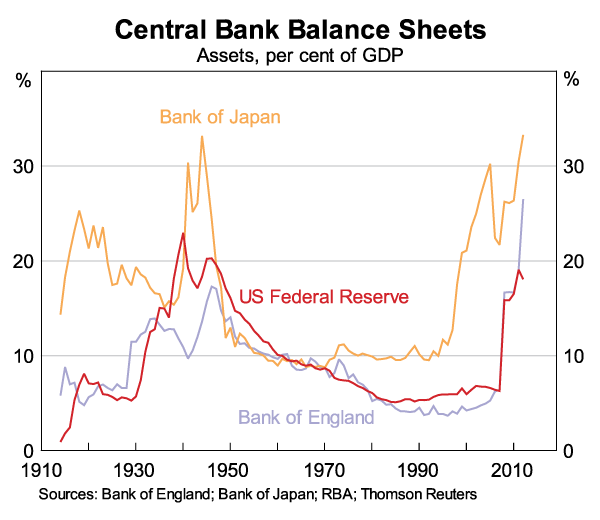

 The manipulation of gold and silver prices by the Western bullion banking cartel is all about the management of the perception of economics: Investors MUST NOT protect themselves from currency debauchery by acquiring hard assets such as gold and silver to preserve their capital.
 The Gold Report: Not a day goes by that we don't hear or read something about the fiscal cliff. To what extent are you worried about the fiscal cliff? Or do you foresee a resolution?


| You are subscribed to email updates from Save Your ASSets First To stop receiving these emails, you may unsubscribe now. | Email delivery powered by Google |
| Google Inc., 20 West Kinzie, Chicago IL USA 60610 | |


No comments:
Post a Comment