


Gold World News Flash |
- 2008 Redux Times 10 Is Brewing
- BROKEN BAZOOKAS!
- Treasury Drops a Bombshell: Fed’s Stress Tests Get It Wrong
- The Brazilian ‘Earthquake’ & The Empire Of Chaos
- ECB Panic Money Printing to Save Euro-zone from Economic Collapse as BrExit Looms
- Mario Draghi's 'Shock and Awe' Market Campaign Morphs into 'Shock and Aw Shucks'
- Keep The Money Game Churning
- The Brazilian 'Earthquake' & The Empire Of Chaos
- Goldman Is About To Be Stopped Out Of Its Gold Short
- Price of Gold Closed at $1,272 up $15.40 or 1.25%
- The Coming Collapse Of Saudi Arabia
- Ambrose Evans-Pritchard: ECB's Draghi plays his last card to stave off deflation
- Gold Daily and Silver Weekly Charts - Credibility Trapped
- What to Do Ahead of Next Week’s FOMC Meeting
- Siyata Mobile (SIM.V or SIMFF) Breaks Into New 7 Month Highs on Record Sales
- Donald Trump interview FULL Video Trump one on one with Anderson Cooper 3/9/16
- Dr. Jim Willie Warns End Game Is Underway
- Alasdair Macleod: Gold is the only sound money
- Is This The End? Draghi Fires His Bazooka And Markets Turn Away In Disgust
- None of the Current Rallies Pass the “Sniff Test”
- The Economic Bubbles Are Leaking And Once They Pop, Game Over: Wolf Richter
- Bonds, Debt and Gold - Keep The Money Game Churning
- John Stossel - The Toxic Appeal of Socialism
- RBNZ Surprises With a Rate Cut
- Stocks Celebrate Huge Milestone – May Be Their Last
- Silver Cheapest To Gold In 7 Years – ETF Holdings Surge
- The US Dollar, What If Everybody is Wrong ?
- ECB cuts rates, increases asset buys more than expected
- Why poor man's gold may be about to get more investor love
- Silver Price Forecast: Silver Peak Likely Only After Dow Crash & Major Bottom
- Kiss the Gold Bear Goodbye (But Wear a Helmet). . .
- Stock Market Smart Money is Quietly Getting Out of Dodge
- Hedge Fund Chief Warren Irwin's Blockbuster Uranium Call and His Best Metal and Oil Plays
- A Dollar Crisis Threatens Egypt's Economy
| 2008 Redux Times 10 Is Brewing Posted: 11 Mar 2016 12:30 AM PST by Dave Kranzler, InvestmentResearchDynamics:
A reader asks: "if the jobs market is so good why did my bilingual daughter, who graduated with a 3.8 GPA from Ga. Tech [Dr. Paul Craig Roberts' undergrad school], not get a job offer for two months until someone I know hired her?" A funny thing, those Government compiled, manipulated and propagated reports. I answered with: "She was fishing in the wrong fishing hole for jobs – she should have been sending her resume to Burger King and Starbucks. But it sounds like the service sector is starting to shed jobs as well. I honestly don't know how they are coming up with their jobs reports. As for the jobless claims, it makes sense that the claims are dropping like this. As the labor force shrinks, especially the component that would qualify for jobless benefits, the number of people who file for jobless benefits shrinks, right?" The first time I read "1984," I tried to imagine Orwell's vision superimposed on the United States. Now I don't have to imagine. Instead of Big Brother spying on us through our televisions (and they might through "smart" tvs), the Government monitors us through our cell phones, emails and web-browsing. It's truly frightening and it's quite stunning how so few in this country understand – or are willing to accept – the degree to which it occurs on a daily basis. While the Ministry of Propaganda spins its wheels convincing the public of a new bull market in stocks and a robust economic recovery are both in process – bolstered by a job market with more alleged openings than bodies willing to fill those alleged openings – the underlying structure of the economic and financial system is quickly rotting away. Zerohedge reports today that the yield spread between 2-yr and 30-yr Treasuries is at its lowest (the difference between the yield on the 2yr Treasury and the 30yr Treasury) since its low-point in 2008 – A Flat Yield Curve Spells Recession. There's yet another comparison between 2008 and now. The fundamental problems which caused the 2008 de facto financial collapse were never fixed. Instead, they were "treated" with money printing and the massive expansion of credit. While this enabled the operators benefiting from these subtle and insidious this wealth transfer mechanisms, it also seeded the next big systemic earthquake, which has the potential to be 10x worse than 2008. | ||||||||||||||||||||||||||||||||||||||||||||||||||||
| Posted: 10 Mar 2016 11:15 PM PST [pictured: Mario Draghi, President of the European Central Bank] by Bill Holter, JS Mineset, via SGT Report:
First it was the Fed, then it was the Bank of Japan, now the ECB (and maybe even China). Mario Draghi finally let loose this morning with everything left in his monetary “bazooka” and gone as far as the Bundesbank will let him. He also has to face the BIS restrictions in the next three weeks which are far from certain to be in favor of his actions.
Looking backward first, the Fed unsettled markets in mid December with a rate hike. Japan lit gold’s fuse in January with the announcement of negative interest rates. Today, Mario Draghi spent and fired his last shot, it will be seen as a blank. Now we will get to see what sort of reaction is received from the markets. Initially the markets went in the “favored” directions, that only lasted for about an hour. The Euro is again strengthening, gold going higher and stock markets have turned negative as if asking “now what? Do you have anything else”? Before going further I want to break down what they are trying to do into its most basic form. Systemically (including Europe) the world ran into “debt saturation” back in 2007. The plan was to cure too much debt with …more and more debt. The “experiment” has not worked and will not work …and Mario Draghi just ran into a wall where this is it, he has no more room to “experiment”. No doubt this is being done now to try to support the Italian (Spanish and others) debt that has gone bad. There is another little problem that few are talking about, the BIS. The Bank for International Settlements has warned Mr. Draghi not to go to this wall of negative interest rates and further outright monetization. The BIS has the ability to force Draghi to not only stop the madness but also reverse it. So not only are the markets asking “what’s next?”, it is also wondering whether or not the BIS will step in. We also have another piece to add to this puzzle, China. They just announced they will begin to take equity stakes for non performing loans via the banking system. “Nationalization” no matter what they call it. It had been speculated China would have to devalue the yuan in an effort to make their massive corporate debt payable and industry more competitive. I would suggest this is simply wiping out current debt in an effort to make room available to create more debt and to reflate. We will see how this works out but I do not believe this is any more credible than any of the other “serial reflators”. Many times it is said “OK, so you see the problem but what’s the answer”? The answer is obvious and we will get to it after looking at the true problem. The world hit debt saturation in 2007, sovereign treasuries and central banks stepped in and sacrificed (destroyed) their own balance sheets in an effort to reflate. We know it has not worked and the global economy (pie) is no longer growing. The ONLY way for a country or region to “grow” is by taking an inordinate size of the pie and the only way to do this is by devaluing currency faster than your competitors. The problem today is ALL currencies are competing against each other in debasing (devaluing). If you devalue too slowly you lose. If you devalue but not enough, again you lose. This is the problem with and misunderstanding of the USDX index, the currencies are all valued against each other and NONE OF THEM ARE REAL! The “answer” as it was back in 2008 is still the same, rather than race “against” each other THEY ALL need to collectively devalue! The only way to do this is to collectively devalue against “something” …and that something is what it always has been, GOLD! A collective devaluation will do several things. First, it will create “inflation” and thus make the existing debt payable if the devaluation is deep enough. Business will get “reflated” and main street will actually participate in the better business conditions. Most importantly, for those nations who actually do hold gold, their balance sheet holes will be filled up and patched. Sovereign treasuries with gold will suddenly see their coffers filled. There is of course the problem of nations who either do not hold gold or have lied and no longer hold what they said they did. In this case, these nations become the world’s new “cheap labor” and begin to dig their way out via industrial/commercial production. This is a very long and hard process which also involves a huge drop in the standard of living. Do I know what the level needs to be for gold to perform its function as central bank reserve? No, the number could be $25,000, $50,000 or $5 million or more, I do not have the answer. The biggest holder(s) of gold on the planet could simply “mandate” a price or do it via the physical markets over a reasonable period of time …but they will do this as it is the only viable solution. We now have a situation where central banks have lost their credibility. This will lead to a loss of confidence in all things paper. Either the central banks revalue their balance sheets with a wildly high gold price or the markets will do this for them by voting with their feet so to speak. We are on the cusp of absolutely wild market gyrations and obscene price levels for gold. So obscene you will either be in or you will be out forever. Do not try to time anything, these last bazookas fired with blanks will be seen as a very large starting gun! Standing watch, Bill Holter | ||||||||||||||||||||||||||||||||||||||||||||||||||||
| Treasury Drops a Bombshell: Fed’s Stress Tests Get It Wrong Posted: 10 Mar 2016 10:00 PM PST by Pam Martens and Russ Martens, Wall Street on Parade:
The researchers note that the Fed's stress test "looks exclusively at the direct loss concentration risk, and does not consider the ramifications of indirect losses that may come through a shared counterparty, who is systemically important." By focusing on "bank-level solvency" instead of the system as a whole, the Fed may be ignoring the real problem of systemic risks in the system. The researchers write: "A BHC [bank holding company] may be able to manage the failure of its largest counterparty when other BHCs do not concurrently realize losses from the same counterparty's failure. However, when a shared counterparty fails, banks may experience additional stress. The financial system is much more concentrated to (and firms' risk management is less prepared for) the failure of the system's largest counterparty. Thus, the impact of a material counterparty's failure could affect the core banking system in a manner that CCAR [one of the Fed's stress tests] may not fully capture." [Italic emphasis added.] To put some simple language perspective on this, what Wall Street effectively did in the lead up to the crash of 2008, was to make the big insurer, AIG, its bitch. Some of the biggest Wall Street banks, like Goldman Sachs, Citigroup, and Merrill Lynch, got AIG to sell them credit default swaps. The swaps were a wager that if a financial institution, like Lehman Brothers, should fail, the Wall Street banks would collect billions of dollars from AIG. When Lehman failed, AIG didn't have the money to cover the bets so a gun was put to the head of the taxpayer to make these Wall Street banks whole – at the outrageous rate of 100 cents on the dollar. | ||||||||||||||||||||||||||||||||||||||||||||||||||||
| The Brazilian ‘Earthquake’ & The Empire Of Chaos Posted: 10 Mar 2016 08:58 PM PST by Pepe Escobar, Sputnik News, via Zero Hedge:
t’s no coincidence that three major BRICS nations are simultaneously under attack – on myriad levels: Russia, China and Brazil. The concerted strategy by the Masters of the Universe who dictate the rules in the Wall Street/Beltway axis is to undermine by all means the BRICS’s collective effort to produce a viable alternative to the global economic/financial system, which for the moment is subjected to casino capitalism. It’s unlikely Lula, by himself, will be able to stop them.
This is the stuff Hollywood is made of. And that was exactly the logic behind the elaborate production. The public prosecutors of the two-year-old Car Wash investigation maintain there are “elements of proof” implicating Lula in receiving funds — at least 1.1 million euros — from the dodgy kickback scheme involving major Brazilian construction companies connected to Petrobras. Lula might — and the operative word is “might” — have personally profited from it mostly in the form of a ranch (which he does not own), a relatively modest seaside apartment, speaking fees in the global lecture circuit, and donations to his charity. Lula is the ultimate political animal — on a Bill Clinton level. He had already telegraphed he was waiting for such a gambit, as the Car Wash machine had already arrested dozens of people suspected of embezzling contracts between their companies and Petrobras — to the tune of over $2 billion — to pay for politicians of the Workers’ Party (PT), of which Lula was leader. Lula’s name surfaced via the proverbial rascal turned informer, eager to strike a plea bargain. The working hypothesis — there is no smoking gun — is that Lula, when he led Brazil between 2003 and 2010, personally benefited from the corruption scheme with Petrobras at the center, obtaining favors for himself, the PT and the government. Meanwhile, inefficient President Dilma Rousseff is herself under attack engineered via a plea bargain by the former government leader in the Senate. Lula was questioned in connection to money laundering, corruption and suspected dissimulation of assets. The Hollywood blitz was cleared by federal judge Sergio Moro — who always insists he’s been inspired by the Italian judge Antonio di Pietro and the notorious 1990s Mani Pulite (“Clean Hands”) investigation. And here, inevitably, the plot thickens. Round up the usual media suspectsMoro and the Car Wash prosecutors justified the Hollywood blitz insisting Lula refused to be interrogated. Lula and the PT vehemently insist otherwise. And yet Car Wash investigators had consistently leaked to mainstream media words to the effect, “We can’t just bite Lula. When we get to him, we will swallow him.” This would imply, at a minimum, a politicization of justice, the Federal Police and the Public Ministry. And would also imply that the Hollywood blitz may have been supported by a smoking gun. As perception is reality in the frenetic non-stop news cycle, the “news” — instantly global — was that Lula was arrested because he’s corrupt. Yet it gets curioser and curioser when we learn that judge Moro wrote an article in an obscure magazine way back in 2004 (in Portuguese only, titled Considerations about Mani Pulite, CEJ magazine, issue number 26, July/September 2004), where he clearly extols “authoritarian subversion of juridical order to reach specific targets ” and using the media to intoxicate the political atmosphere. All of this serving a very specific agenda, of course. In Italy, right-wingers saw the whole Mani Pulitesaga as a nasty judicial over-reach; the left, on the other hand, was ecstatic. The Italian Communist Party (PCI) emerged with clean hands. In Brazil, the target is the left — while the right, at least for the moment, seems to be composed of hymn-singing angels. The pampered, cocaine-snorting loser candidate of the 2014 Brazilian presidential election, Aecio Neves, for instance, was singled out for corruption by three different accusers — and it all went nowhere, without further investigation. Same with another dodgy scheme involving former president Fernando Henrique Cardoso — the notoriously vainglorious former developmentalist turned neoliberal enforcer. What Car Wash has already forcefully imprinted across Brazil is the perception that corruption only pays when the accused is a progressive nationalist. As for Washington consensus vassals, they are always angels — mercifully immune from prosecution. That’s happening because Moro and his team are masterfully playing to the hilt Moro’s self-described use of the media to intoxicate the political atmosphere — with public opinion serially manipulated even before someone is formally charged with any crime. And yet Moro and his prosecutors’ sources are largely farcical, artful dodgers cum serial liars. Why trust their word? Because there are no smoking guns, something even Moro admits. And that leads us towards the nasty scenario of a made in Brazil media-judicial-police complex possibly hijacking one of the healthiest democracies in the world. And that is supported by a stark fact: the right-wing Brazilian opposition’s entire “project” boils down to ruining the economy of the 7thlargest global economic power to justify the destruction of Lula as a presidential candidate in 2018. Elite Plundering RulesNone of the above can be understood by a global audience without some acquaintance with classic Braziliana. Local legend rules that Brazil is not for beginners. Indeed; this is an astonishingly complex society — which essentially descended from a Garden of Eden (before the Portuguese “discovered” it in 1500) to slavery (which still permeates all social relations) to a crucial event in 1808: the arrival of Dom John VI of Portugal (and Emperor of Brazil for life), fleeing Napoleon’s invasion, and carrying with him 20,000 people who masterminded the “modern” Brazilian state. “Modern” is an euphemism; history shows the descendants of these 20,000 actually have been raping the country blind for the past 208 years. And few have ever been held accountable. Traditional Brazilian elites compose one of the most noxious arrogant-ignorant-prejudiced mixes on the planet. “Justice” — and police enforcement — are only used as a weapon when the polls do not favor their agenda. Brazilian mainstream media owners are an intrinsic part of these elites. Much like the US concentration model, only four families control the media landscape, foremost among them the Marinho family’s Globo media empire. I have experienced, from the inside, in detail, how they operate. Brazil is corrupt to the core — from the comprador elites down to a great deal of the crass “new” elites, which include the PT. The greed and incompetence displayed by an array of PT stalwarts is appalling — a reflection of the lack of quality cadres. Corruption and traffic of influence involving Petrobras, construction companies and politicians is undeniable, even if it pales compared to Goldman Sachs shenanigans or Big Oil and/or Koch Brothers/Sheldon Adelson-style buying/bribing of US politicians. If this was a no-holds-barred crusade against corruption — which the Car Wash prosecutors insist it is — the right-wing opposition/vassals of the old elites should have been equally exposed in mainstream media. But then the elite-controlled media would simply ignore the prosecutors. And there would be nothing remotely on the scale of the Hollywood blitz, with Lula — pictured as a lowly delinquent — humiliated in front of the whole planet. Car Wash prosecutors are right; perception is reality. But what if it backfires? No consumption, no investment, no creditBrazil couldn’t be in a gloomier situation. GDP was down 3.8% last year; probably will be down 3.5% this year. The industrial sector was down 6.2% last year, and the mining sector down 6.6% in the last quarter. The nation is on the way to its worst recession since…1901. There was no Plan B by the — incompetent — Rousseff administration for the Chinese slowdown in buying Brazil’s mineral/agricultural wealth and the overall global slump in commodity prices. The Central Bank still keeps its benchmark interest rate at a whopping 14.25%. A disastrous Rousseff neoliberal “fiscal adjustment” actually increased the economic crisis. Today Rousseff “governs” — that’s a figure of speech — for the banking cartel and the rentiers of Brazilian public debt. Over $120 billion of the government’s budget evaporates to pay interest on the public debt. Inflation is up — now in double-digit territory. Unemployment is at 7.6% — still not bad as many a player across the EU — but rising. The usual suspects of course are gloating, spinning non-stop how Brazil has become “toxic” for global investors. Yes, it’s bleak. There’s no consumption. No investment. No credit. The only way out would be to unlock the political crisis. Maggots in the opposition racket though have a one-track obsession; the impeachment of President Rousseff. Shades of good ol’ regime change; for these Wall Street/Empire of Chaos vassals, an economic crisis, fueled by a political crisis, must by all means bring down the elected government of a key BRICS player. And then, suddenly, out of left field, surges…Lula. The move against him by the Car Wash investigation may yet backfire — badly. He’s already on campaign mode for 2018 — although he’s not an official candidate, yet. Never underestimate a political animal of his stature. | ||||||||||||||||||||||||||||||||||||||||||||||||||||
| ECB Panic Money Printing to Save Euro-zone from Economic Collapse as BrExit Looms Posted: 10 Mar 2016 08:24 PM PST A little over a month on from the Bank of Japan's panic announcement of negative interest rates and money printing. Now it's the turn of the ECB to PANIC by firing it's own inflation bazooka in what is commonly termed as the currency wars (competitive devaluations) as nations attempt to import inflation and export deflation by means of manipulating exchange rates. This weeks ECB PANIC followed euro-zone inflation turning negative again (CPI -0.2%) and with virtually the whole of southern europe in a permanent economic depression, with debt mountains continuing to balloon in a perpetual state of imminent bankruptcy of the whole of southern europe as ALL central banks ONLY really have ONE objective which is to INFLATE debt mountains away for which they CREATE INFLATION by means of MONEY PRINTING and so without inflation the debt cannot be serviced. | ||||||||||||||||||||||||||||||||||||||||||||||||||||
| Mario Draghi's 'Shock and Awe' Market Campaign Morphs into 'Shock and Aw Shucks' Posted: 10 Mar 2016 08:23 PM PST In a series of stunning market reversals, ECB president Mario Draghi's "Shock and Awe" campaign quickly morphed into "Shock and Aw Shucks". Earlier this morning, Draghi pulled out a Bazooka Package that was supposed to sink the Euro and save the eurozone from the alleged evils of deflation. Draghi's plan worked for all of 15 minutes. The market then had second thoughts on the Euro, on gold, on the German stock market, and on equities in general. | ||||||||||||||||||||||||||||||||||||||||||||||||||||
| Posted: 10 Mar 2016 08:00 PM PST by Gary Christenson, Deviant Investor:
There is money to be made so the game must be played… It's always "ShowTime" in the financial markets. What is the game plan? Levitate the bond market. See chart below. Keep those interest rates dropping so the bond market continues its 35 year climb. Oops – $7 Trillion in bonds with negative interest rates, at last count, with more from Japan this week. Have we reached a limit? Probably not, but what could go wrong lending money to insolvent governments who guarantee they will return less than they borrowed in 10 years? Currencies must retain some purchasing power. No Argentina or Zimbabwe devaluations will be allowed. When the dollars/euros/yen/pounds barely buy groceries the crowds will get restless and that must be avoided. So keep the currencies strong – which is code for devalue them slowly enough that people don't riot. Remember when you could deliver a baby in a hospital in the U.S. for under $100? Really! It was a long time ago and the dollar has devalued considerably since then. Increase debt exponentially. The bubbles must not implode and that requires continual inflating and massively more debt each year. What could go wrong with exponential debt increases? Hint: One penny invested at 6% per year for 1,000 years exponentially grows to $200,000,000,000,000,000,000,000. (Yes, really!) Exponential growth of debt mathematically cannot continue forever. | ||||||||||||||||||||||||||||||||||||||||||||||||||||
| The Brazilian 'Earthquake' & The Empire Of Chaos Posted: 10 Mar 2016 06:00 PM PST Authored by Pepe Escobar, originally posted at SputnikNews.com,
This is the stuff Hollywood is made of. And that was exactly the logic behind the elaborate production. The public prosecutors of the two-year-old Car Wash investigation maintain there are "elements of proof" implicating Lula in receiving funds — at least 1.1 million euros — from the dodgy kickback scheme involving major Brazilian construction companies connected to Petrobras. Lula might — and the operative word is "might" — have personally profited from it mostly in the form of a ranch (which he does not own), a relatively modest seaside apartment, speaking fees in the global lecture circuit, and donations to his charity. Lula is the ultimate political animal — on a Bill Clinton level. He had already telegraphed he was waiting for such a gambit, as the Car Wash machine had already arrested dozens of people suspected of embezzling contracts between their companies and Petrobras — to the tune of over $2 billion — to pay for politicians of the Workers' Party (PT), of which Lula was leader. Lula's name surfaced via the proverbial rascal turned informer, eager to strike a plea bargain. The working hypothesis — there is no smoking gun — is that Lula, when he led Brazil between 2003 and 2010, personally benefited from the corruption scheme with Petrobras at the center, obtaining favors for himself, the PT and the government. Meanwhile, inefficient President Dilma Rousseff is herself under attack engineered via a plea bargain by the former government leader in the Senate. Lula was questioned in connection to money laundering, corruption and suspected dissimulation of assets. The Hollywood blitz was cleared by federal judge Sergio Moro — who always insists he's been inspired by the Italian judge Antonio di Pietro and the notorious 1990s Mani Pulite ("Clean Hands") investigation. And here, inevitably, the plot thickens. Round up the usual media suspectsMoro and the Car Wash prosecutors justified the Hollywood blitz insisting Lula refused to be interrogated. Lula and the PT vehemently insist otherwise. And yet Car Wash investigators had consistently leaked to mainstream media words to the effect, "We can't just bite Lula. When we get to him, we will swallow him." This would imply, at a minimum, a politicization of justice, the Federal Police and the Public Ministry. And would also imply that the Hollywood blitz may have been supported by a smoking gun. As perception is reality in the frenetic non-stop news cycle, the "news" — instantly global — was that Lula was arrested because he's corrupt. Yet it gets curioser and curioser when we learn that judge Moro wrote an article in an obscure magazine way back in 2004 (in Portuguese only, titled Considerations about Mani Pulite, CEJ magazine, issue number 26, July/September 2004), where he clearly extols "authoritarian subversion of juridical order to reach specific targets " and using the media to intoxicate the political atmosphere. All of this serving a very specific agenda, of course. In Italy, right-wingers saw the whole Mani Pulite saga as a nasty judicial over-reach; the left, on the other hand, was ecstatic. The Italian Communist Party (PCI) emerged with clean hands. In Brazil, the target is the left — while the right, at least for the moment, seems to be composed of hymn-singing angels. The pampered, cocaine-snorting loser candidate of the 2014 Brazilian presidential election, Aecio Neves, for instance, was singled out for corruption by three different accusers — and it all went nowhere, without further investigation. Same with another dodgy scheme involving former president Fernando Henrique Cardoso — the notoriously vainglorious former developmentalist turned neoliberal enforcer. What Car Wash has already forcefully imprinted across Brazil is the perception that corruption only pays when the accused is a progressive nationalist. As for Washington consensus vassals, they are always angels — mercifully immune from prosecution. That's happening because Moro and his team are masterfully playing to the hilt Moro's self-described use of the media to intoxicate the political atmosphere — with public opinion serially manipulated even before someone is formally charged with any crime. And yet Moro and his prosecutors' sources are largely farcical, artful dodgers cum serial liars. Why trust their word? Because there are no smoking guns, something even Moro admits. And that leads us towards the nasty scenario of a made in Brazil media-judicial-police complex possibly hijacking one of the healthiest democracies in the world. And that is supported by a stark fact: the right-wing Brazilian opposition's entire "project" boils down to ruining the economy of the 7th largest global economic power to justify the destruction of Lula as a presidential candidate in 2018. Elite Plundering RulesNone of the above can be understood by a global audience without some acquaintance with classic Braziliana. Local legend rules that Brazil is not for beginners. Indeed; this is an astonishingly complex society — which essentially descended from a Garden of Eden (before the Portuguese "discovered" it in 1500) to slavery (which still permeates all social relations) to a crucial event in 1808: the arrival of Dom John VI of Portugal (and Emperor of Brazil for life), fleeing Napoleon's invasion, and carrying with him 20,000 people who masterminded the "modern" Brazilian state. "Modern" is an euphemism; history shows the descendants of these 20,000 actually have been raping the country blind for the past 208 years. And few have ever been held accountable. Traditional Brazilian elites compose one of the most noxious arrogant-ignorant-prejudiced mixes on the planet. "Justice" — and police enforcement — are only used as a weapon when the polls do not favor their agenda. Brazilian mainstream media owners are an intrinsic part of these elites. Much like the US concentration model, only four families control the media landscape, foremost among them the Marinho family's Globo media empire. I have experienced, from the inside, in detail, how they operate. Brazil is corrupt to the core — from the comprador elites down to a great deal of the crass "new" elites, which include the PT. The greed and incompetence displayed by an array of PT stalwarts is appalling — a reflection of the lack of quality cadres. Corruption and traffic of influence involving Petrobras, construction companies and politicians is undeniable, even if it pales compared to Goldman Sachs shenanigans or Big Oil and/or Koch Brothers/Sheldon Adelson-style buying/bribing of US politicians. If this was a no-holds-barred crusade against corruption — which the Car Wash prosecutors insist it is — the right-wing opposition/vassals of the old elites should have been equally exposed in mainstream media. But then the elite-controlled media would simply ignore the prosecutors. And there would be nothing remotely on the scale of the Hollywood blitz, with Lula — pictured as a lowly delinquent — humiliated in front of the whole planet. Car Wash prosecutors are right; perception is reality. But what if it backfires? No consumption, no investment, no creditBrazil couldn't be in a gloomier situation. GDP was down 3.8% last year; probably will be down 3.5% this year. The industrial sector was down 6.2% last year, and the mining sector down 6.6% in the last quarter. The nation is on the way to its worst recession since…1901. There was no Plan B by the — incompetent — Rousseff administration for the Chinese slowdown in buying Brazil's mineral/agricultural wealth and the overall global slump in commodity prices. The Central Bank still keeps its benchmark interest rate at a whopping 14.25%. A disastrous Rousseff neoliberal "fiscal adjustment" actually increased the economic crisis. Today Rousseff "governs" — that's a figure of speech — for the banking cartel and the rentiers of Brazilian public debt. Over $120 billion of the government's budget evaporates to pay interest on the public debt. Inflation is up — now in double-digit territory. Unemployment is at 7.6% — still not bad as many a player across the EU — but rising. The usual suspects of course are gloating, spinning non-stop how Brazil has become "toxic" for global investors. Yes, it's bleak. There's no consumption. No investment. No credit. The only way out would be to unlock the political crisis. Maggots in the opposition racket though have a one-track obsession; the impeachment of President Rousseff. Shades of good ol' regime change; for these Wall Street/Empire of Chaos vassals, an economic crisis, fueled by a political crisis, must by all means bring down the elected government of a key BRICS player. And then, suddenly, out of left field, surges…Lula. The move against him by the Car Wash investigation may yet backfire — badly. He's already on campaign mode for 2018 — although he's not an official candidate, yet. Never underestimate a political animal of his stature. Brazil is not on the ropes. If reelected, and assuming he could purge the PT from a legion of crooks, Lula could push for a new dynamic. Before the crisis, Brazilian capital was going global — via Petrobras, Embraer, the BNDES (the bank model that inspired the BRICS bank), the construction companies. At the same time, there might be benefits in breaking, at least partially, this oligarchic cartel that control all infrastructure construction in Brazil; think of Chinese companies building the high-speed rail, dams and ports the country badly lacks. Judge Moro himself has theorized that corruption festers because the Brazilian economy is too closed to the outside world, as India's was until recently. But there's a stark difference between opening up some sectors of the Brazilian economy and let foreign interests tied to the comprador elites plunder the nation's wealth. So once again, we must go back to the recurrent theme in all major global conflicts. It's the oil, stupidFor the Empire of Chaos, Brazil has been a major headache since Lula was first elected, in 2002 (for an appraisal of complex US-Brazil relations, check the indispensable work of Moniz Bandeira). A top priority of the Empire of Chaos is to prevent the emergence of regional powers fueled by abundant natural resources, from oil to strategic minerals. Brazil amply fits the bill. Washington of course feels entitled to "defend" these resources. Thus the need to quash not only regional integration associations such as Mercosur and Unasur but most of all the global reach of the BRICS. Petrobras used to be a very efficient state company that then doubled as the single operator of the largest oil reserves discovered in the 21st century so far; the pre-salt deposits. Before it became the target of a massive speculative, judicial and media attack, Petrobras used to account for 10% of investment and 18% of Brazilian GDP. Petrobras found the pre-salt deposits based on its own research and technological innovation applied to exploring oil in deep waters — with no foreign input whatsoever. The beauty is there's no risk; if you drill in this pre-salt layer, you're bound to find oil. No company on the planet would hand this over to the competition. And yet a notorious right-wing opposition maggot promised Chevron in 2014 to hand over the exploitation of pre-salt mostly to Big Oil. The right-wing opposition is busy altering the juridical regime of pre-salt; it's already been approved in the Senate. And Rousseff is meekly going for it. Couple it to the fact that Rousseff's government did absolutely nothing to buy back Petrobras stock — whose vertiginous fall was deftly engineered by the usual suspects. The meticulous dismantling of Petrobras, Big Oil eventually profiting from the pre-salt deposits, keeping in check Brazil's global power projection, all this plays beautifully to the interests of the Empire of Chaos. Geopolitically, this goes way beyond the Hollywood blitz and the Car Wash investigation. It's no coincidence that three major BRICS nations are simultaneously under attack — on myriad levels: Russia, China and Brazil. The concerted strategy by the Masters of the Universe who dictate the rules in the Wall Street/Beltway axis is to undermine by all means the BRICS's collective effort to produce a viable alternative to the global economic/financial system, which for the moment is subjected to casino capitalism. It's unlikely Lula, by himself, will be able to stop them.
| ||||||||||||||||||||||||||||||||||||||||||||||||||||
| Goldman Is About To Be Stopped Out Of Its Gold Short Posted: 10 Mar 2016 05:50 PM PST Given China's new focus on a basket of currencies, rather than pegging to the dollar alone, today's record-breaking reversal in EUR has sparked a yuuge 300 pips rally in Offshore Yuan (from 6.5270 to 6.4940) pushing to its strongest level since mid-December. At the same time, Gold is accelerating as China opens, pushing up to $1288 - new 13-month highs. Most critical is we are within $5 of Goldman Sachs "short gold" stop at $1291... Yuan surges to 3-month highs...
As Gold spikes to fresh 13-month highs...
Goldman went short gold on 2/15 at around $1205...
Tonight we are getting very close to Goldman's stop-loss...
Leaving Goldman clients pensive...
| ||||||||||||||||||||||||||||||||||||||||||||||||||||
| Price of Gold Closed at $1,272 up $15.40 or 1.25% Posted: 10 Mar 2016 05:17 PM PST
Though we needed it not, once again we were treated to the turmoil caused by the very central banks who exist supposedly to "stabilize" economies. Right, like putting a heroin addict in charge of the drug room to "stabilize" the narcotics supply. The turmoil began even as Head European Central Bank Criminal Mario Draghi was speaking -- or so I am told. I was not there. I was out in our barn helping build a new chicken brooder. Anyhow, while the words were still drooling off his lips, the euro tanked, the dollar shot up, and stocks rallied -- for a minute. Then they all reversed, and the dollar suffered its worst one day fall this year. What did he say? That the ECB would 1. CUT INTEREST RATES. ECB cut it benchmark lending rate to zero from 0.05%, and lower the rate it pays on bank reserves deposits with it from negative 0.3% to negative 0.4%. He also said that would be the last rate cut for a long time. 2. INCREASED QUANTITATIVE EASING. ECB had been buying bonds at rate of €60 billion a month & will ramp that up to €80 bn. And will now include corporate bonds. 3. WILL PAY BANKS TO LEND. Through 4 year Targeted Longer-Term Refinancing Operations or TLTROS the ECB will loan banks money a 0% and pay them up to 0.4% -- yes, yes, I said ECB will PAY the banks to borrow -- if their loan book gets big enough. So on one hand they are charging banks interest to hold their reserves, but paying them interest to loan. Today's turmoil clearly shows that central bank credibility has evaporated. Logicking that if the ECB lowers rates the Fed can be the only central bank on the planet to raise rates, traders dumped dollars as if they showed active symptoms of Black death AND cholera. On a colossal range of 251 basis points, the dollar first slammed itself unconscious against 98.50, then fell down the stairs to 95.99. Limp & barely awake, it closed at 96.12, down 104 bps or 1.07%. On the other side of that trade the euro ranged from $1.0822 to $1.1217, and rose 1.63% to $1.1179, and broke into a rally. The Yen added 0.18% to 88.37. Thrice now since December we have watched the US dollar skinned in a single day by its fellow central banks. On 3 December 2015 it was the ECB, then on 3 February the Japanese with negative rates, & now today the ECB again. Here's a 4 month chart to show what I mean. Does this look to y'all like a market advancing, or that wants to advance? If it closed below 95.28, it will sink all the way to the critical 92.50. We keep getting these very loud messages -- look like Exclamation Points on a chart -- screaming that all those analysts who expect a higher dollar and the Fed to raise rates are wrong. Colossal slides are not usual in markets, & show massive fear and indecision sending money shooting from one direction to another. I repeat: central bank credibility is evaporating. The ECB has tried everything, & availed nothing. The Fed has tried everything, & accomplished nothing. Statistical tricks aside, the central bank's nakedness is showing. The king is buck naked -- no clothes. If you can't trust central banks, who can you trust? Only silver & gold. Well, in this world, I mean. Stocks spent 2/3 of the day falling, then rallied back enough to end the day down only pennies. S&P500 actually rose 0.31 point to 1,989.57. Dow industrials lost 5.23 to 16,995.13. Charts I am inclined to be led by the most, the Dow in Gold & Dow in Silver, both point to lower stocks and higher metals. Even the Dow in Silver, which in the upward correction that began 11 February rose almost to its 200 day moving average (1,136 oz against about 1,149 oz), has dropped. Chart looks as if the correction might have ended. In its correction the Dow in Gold barely stuck a toe over its 20 DMA. Today it fell again, to 13.35 oz. Longing to fall down. Well, I ain't fool enough to insist I'm right when the rain is pouring down my face & I've got two flats and an empty gas tank. I'm a pretty big durn nat'ral born fool from Tennessee, but not fool enough for that. Maybe. The GOLD PRICE refused to accommodate my expectations and fall. Instead, after a two day drop, it cam back to chalk down its highest closed since this year's rally began, $1,272, up $15.40. That flirt SILVER rose 19.1¢ to 1554.6¢, not near its 1599¢ highest close. Well, maybe I am that big a fool after all. I just hate to make a decision on a day central bank lunacy has been distorting markets. Still, if gold closes up here for the week, what can I do but throw in the durned towel? Or drown in my own cold sweat. Silver's trading today agrees with a cup-and-handle formation on its chart. By that I mean it broke out of the handle, then touched back to the handle boundary, and shot up. Handle boundary happens to coincide almost with the 20 dma. I've been whomped by silver and gold so many times in the last 4-1/2 years that I'm a little whomp-shy now. I'd like silver to close above 1600¢, and not a little, before I say say, yes, both metals are moving higher. I jes' wanna see what they'll do tomorrow. Ain't no doubt today they were stronger than a garlic milkshake. Aurum et argentum comparenda sunt -- -- Gold and silver must be bought. - Franklin Sanders, The Moneychanger The-MoneyChanger.com © 2016, The Moneychanger. May not be republished in any form, including electronically, without our express permission. To avoid confusion, please remember that the comments above have a very short time horizon. Always invest with the primary trend. Gold's primary trend is up, targeting at least $3,130.00; silver's primary is up targeting 16:1 gold/silver ratio or $195.66; stocks' primary trend is down, targeting Dow under 2,900 and worth only one ounce of gold or 18 ounces of silver. US $ and US$-denominated assets, primary trend down; real estate bubble has burst, primary trend down. WARNING AND DISCLAIMER. Be advised and warned: Do NOT use these commentaries to trade futures contracts. I don't intend them for that or write them with that short term trading outlook. I write them for long-term investors in physical metals. Take them as entertainment, but not as a timing service for futures. NOR do I recommend investing in gold or silver Exchange Trade Funds (ETFs). Those are NOT physical metal and I fear one day one or another may go up in smoke. Unless you can breathe smoke, stay away. Call me paranoid, but the surviving rabbit is wary of traps. NOR do I recommend trading futures options or other leveraged paper gold and silver products. These are not for the inexperienced. NOR do I recommend buying gold and silver on margin or with debt. What DO I recommend? Physical gold and silver coins and bars in your own hands. One final warning: NEVER insert a 747 Jumbo Jet up your nose. | ||||||||||||||||||||||||||||||||||||||||||||||||||||
| The Coming Collapse Of Saudi Arabia Posted: 10 Mar 2016 05:10 PM PST Submitted by Nick Giambruno via InternationalMan.com, They met in secret to plan a devastating attack... Two powerful men, colluding at a palace in the Middle East. In September 2014, U.S. Secretary of State John Kerry flew to Saudi Arabia. He was there to meet with King Abdullah, the country’s ruler and one of the richest men in the world. Informed observers say Kerry and Abdullah drew up a plan at this meeting to destroy their common enemies: Russia and Iran. To carry out the attack, they wouldn’t use fighter jets, tanks and ground troops. They would use a much more powerful weapon… Oil. Oil is the world’s most traded commodity. Saudi Arabia is the world’s largest oil exporter. It has arguably more control over the price of oil than any other country does. Insiders say Saudi Arabia agreed to flood the oil market at this secret meeting. The purpose was to drive down the price of oil. This would hurt Russia’s and Iran’s economies. They both depend heavily on oil sales. They wanted to hurt Russia for supporting their regional foe, Syrian President Bashar al-Assad. They wanted to hurt Iran for the same reason. Iran is the Saudis’ fierce geopolitical rival in the region. Their strategy has had some success. As you can see in the chart below, the price of oil has plummeted over 70% since John Kerry’s secret meeting with King Abdullah in September 2014.
There’s so much conflict in the Middle East—but oil prices are falling. And despite China’s economic slowdown…it still imported more oil in 2015 than in 2014. China is the world’s number two oil consumer behind the U.S. Turmoil plus demand says oil should be going up, not down. But the mystery is explained by the Saudis’ oil war and their strategy of flooding the market to bankrupt competitors. Saudi Arabia’s Other TargetThe Saudis have also declared war on the U.S. shale oil industry. In the 1990s, the U.S. imported close to 25% of its oil from Saudi Arabia. Today—because of high U.S. shale oil production—we import only 5%. By keeping the market saturated with oil, the Saudis are driving down the price. They hope to drive it down low enough and long enough to bankrupt the shale industry…since shale oil costs more than Saudi oil to produce. This would knock out a major competitor and let the Saudis regain lost market share. But economic warfare doesn’t always go according to plan. I think the Saudis made a colossal mistake… Impaled on Their Own SwordI think the Saudis have overplayed their hand...big time. Oil makes up 90% of Saudi government revenue. So the price drop has been very painful. They’re bleeding through their reserves. The market is putting more pressure on their currency peg than at any time in its history. For over 30 years, Saudi Arabia has pegged its currency at 3.75 riyals per U.S. dollar. To maintain this, it needs a large stash of U.S. dollars. With its historically large reserves, this has never been a problem. But now, the Saudi budget is under serious pressure. The government is only staying afloat by draining its foreign exchange reserves. This threatens Saudi Arabia’s ability to support its currency peg. If the currency peg breaks—which is exactly what the current market expects—the riyal would be devalued. This would increase the cost of living for Saudis across the board. It would also increase social unrest. The Saudis are also losing billions underwriting foolhardy wars in Yemen and Syria. The Saudis thought they could support armed Syrian rebels and topple the Assad government in a matter of months. They figured Assad would fall just as easily as Gadhafi did in Libya in 2011. It was a gross miscalculation. There’s also the Saudi war in Yemen, Saudi Arabia’s southern neighbor. The Saudis launched the war in March 2015. They wanted to reinstate a Saudi-friendly government. The Saudis thought the intervention would last a few months, then they’d declare “mission accomplished” and go home. That’s not what happened. The political and economic stars are aligning against the Saudis. It’s their most vulnerable moment since the kingdom was founded in 1932. Crisis Investing 101The Saudis are having some success. In the past year, at least 67 U.S. oil companies have filed for bankruptcy. Analysts estimate as many as 150 could follow. The shale oil industry is in “survival mode.” And the crisis in the oil market could spread. That’s because many banks made big loans to these distressed shale oil companies. A wave of bankruptcies means those loans could go bad, which would be a huge threat to those banks. It has the potential to trigger another meltdown in the financial system. The warning signs are there. I wouldn’t own any bank that has big exposure to risky shale plays...nor keep my life savings there. The Saudis have damaged the U.S. shale oil industry. And they’ll continue to cause more damage. But they won’t bankrupt every producer. The shale industry has more staying power than Saudi Arabia. Some producers now say they’re profitable with $40 oil. And their pace of innovation will drive that even lower. The industry will survive. All the Saudis have done is create an existential crisis for themselves. If the Saudis don’t stop flooding the market—and there are no signs they will—they won’t be shooting themselves in the foot... but in the head. Saudi Arabia will either collapse or surrender—and stop flooding the market. Either way, oil will eventually go a lot higher. | ||||||||||||||||||||||||||||||||||||||||||||||||||||
| Ambrose Evans-Pritchard: ECB's Draghi plays his last card to stave off deflation Posted: 10 Mar 2016 04:56 PM PST By Ambrose Evans-Pritchard The European Central Bank has pulled out all the stops to avert a dangerous deflation trap, launching a blast of triple stimulus despite angry criticism from Germany that it is entirely unnecessary and will do more harm than good. The markets reacted wildly to the package of measures, surging at first and then plummeting on creeping fears that the bank has exhausted its policy options and may be defenseless against a fresh shock. Mario Draghi, the ECB's president, no longer seems able to conjure confidence with his former panache. His magic has, for now, deserted him. The ECB cut the deposit rate by 10 basis points to a historic low of -0.4 percent and stepped up the pace of quantitative easing from E60 billion to E80 billion a month. It buttressed the effect with unlimited four-year loans to banks at near-zero cost, hoping this will limit the damaging side-effects of negative rates for banks. ... ... For the remainder of the commentary: http://www.telegraph.co.uk/business/2016/03/10/ecbs-draghi-plays-his-las... ADVERTISEMENT Buy metals at GoldMoney and enjoy international storage GoldMoney was established in 2001 by James and Geoff Turk and is safeguarding more than $1.7 billion in metals and currencies. Buy gold, silver, platinum, and palladium from GoldMoney over the Internet and store them in vaults in Canada, Hong Kong, Singapore, Switzerland, and the United Kingdom, taking advantage of GoldMoney's low storage rates, among the most competitive in the industry. GoldMoney also offers delivery of 100-gram and 1-kilogram gold bars and 1-kilogram silver bars. To learn more, please visit: http://www.goldmoney.com/?gmrefcode=gata Join GATA here: Mines and Money Asia http://asia.minesandmoney.com/ Mining Investment Asia http://www.mininginvestmentasia.com/ Support GATA by purchasing recordings of the proceedings of the 2014 New Orleans Investment Conference: https://jeffersoncompanies.com/landing/2014-av-powell Or by purchasing DVDs of GATA's London conference in August 2011 or GATA's Dawson City conference in August 2006: http://www.goldrush21.com/order.html Or a colorful poster of GATA's full-page ad in The Wall Street Journal on January 31, 2009: http://gata.org/node/wallstreetjournal Help keep GATA going GATA is a civil rights and educational organization based in the United States and tax-exempt under the U.S. Internal Revenue Code. Its e-mail dispatches are free, and you can subscribe at: To contribute to GATA, please visit: | ||||||||||||||||||||||||||||||||||||||||||||||||||||
| Gold Daily and Silver Weekly Charts - Credibility Trapped Posted: 10 Mar 2016 01:37 PM PST | ||||||||||||||||||||||||||||||||||||||||||||||||||||
| What to Do Ahead of Next Week’s FOMC Meeting Posted: 10 Mar 2016 01:25 PM PST This post What to Do Ahead of Next Week’s FOMC Meeting appeared first on Daily Reckoning. The Federal Open Market Committee, FOMC, meets March 15–16 under Janet Yellen's leadership to decide interest rate policy for the Federal Reserve System. The consensus of economists and the fed funds futures market is that the Fed will not raise rates. My view is that a rate hike is still on the table. That's a debate worth having, but the truth is it doesn't matter. The U.S. economy, indeed the global economy is heading for a recession later this year. A rate hike or a pause by the Fed won't change that. Fed policy may affect markets in the short run, and may affect the exact timing of the recession, but it can't change the outcome. The economy is bigger than Fed policy, and it will have its way. The argument for a rate hike is straightforward. Job creation remains strong, and labor force participation has begun to rise. Of course, wage growth is weak, and the jobs being created are not the type of high paying jobs needed to boost aggregate demand. Still jobs are better than no jobs, and Obama's second term in office is on track to match the job creation prowess of the Reagan and Clinton years. The Atlanta GDP "nowcast" shows first quarter GDP on track to grow 2.2%. That's not great growth, but it's in line with the growth trend since 2009. More importantly, it's an improvement over a relatively weak 2015, and an especially weak fourth quarter of 2015. Core CPI in January 2016 was 2.2% on a year-over-year basis. Employment costs for civilian workers increased 2% (nominal) for all of 2015. Oil prices, and commodity prices seem to be off the bottom. Yellen has been ridiculed for her reliance on the word "transitory" to describe falling energy prices for the past 32 months. Still, nothing lasts forever, and if oil prices stabilize and then rise, inflation will not be far behind. Yellen has been insistent on the Fed's need to stay ahead of price increases for the obvious reason the monetary policy works with significant lags. This combination of unemployment at 4.9%, GDP growth at 2.2% (trending higher), and core inflation at 2.2% (trending higher) meets or exceeds the rate hike criteria laid out by Yellen in her speech in Providence, Rhode Island on May 22, 2013. That speech was her road map to liftoff, which occurred last December. It is still a good guide to how Yellen thinks about the need to normalize interest rates. The case for doing nothing at the March FOMC meeting is equally neat. Stock markets were in turmoil from January 1, 2016 to Feb. 11, 2016 as a direct consequence of the Fed's rate hike in December, and the prospect of a strong dollar hurting exports and overseas corporate earnings. A host of other indicators point to a likely recession. World trade is contracting (a highly unusual circumstance almost always associated with recession or depression). Manufacturing indices in the U.S. are showing contraction. (It is frequently said that manufacturing is a relatively small part of U.S. GDP. This ignores the difference between final value added (counted for GDP), and gross B2B sales in the entire supply chain (netted out for GDP). The gross sales figure is important for hiring and investment by individual firms in the supply chain even if they do not produce final sales. Also, manufacturing jobs are higher-paying on average than service jobs so a slowdown in manufacturing has a disproportionate impact on aggregate demand). In any case, weakness in manufacturing is now having spillover effects in the service side of the U.S. economy. Traditionally, the Fed's job is to raise rates when the economy overheats, and to cut rates when the economy is cooling off too fast. On balance, it makes no sense to raise rates in the face of the broad-based economic weakness that the data reveals. Still, the Fed has never accurately forecast a recession. It's not even clear that Fed models are capable of forecasting recessions because of their equilibrium-based assumptions about the impact of policy changes. While the Fed should not raise rates in a recession, they may raise them anyway because they don't see it coming. In a nutshell, those are the arguments for and against a rate hike. The rate hike camp sees inflation right around the corner due to tight labor markets. The no hike camp sees recession right around the corner due to the manufacturing slump and strong dollar. Ironically, both camps may be right. There is a name for rising inflation in a recession. It's called "stagflation," a condition last seen in the U.S. in the late 1970s. Which brings me back to my original question. Does it matter if the Fed hikes rates or not? A large body of evidence is now emerging that monetary policy today is ineffective at stimulating growth. When Ben Bernanke launched quantitative easing, QE, he relied on the "portfolio channel effect" (low-to-zero rates on safe investments would force investors into stocks and real estate), and the "wealth effect" (rising stock and real estate prices would spur spending). This policy is now widely seen as a failure. The portfolio channel effect worked, but the wealth effect did not. (The reason for this is the collapsing velocity of money; a psychological phenomenon beyond the Fed's competence to change.) The result is asset bubbles in stocks and real estate that Janet Yellen now navigates at her peril. Likewise, negative interest rates do not work as advertised. The idea is that negative interest rates make saving unattractive. In turn, savers will spend rather than leave their money in the bank. Bankers will lend money rather than leave their money in excess reserves. The combination of lending and spending by banks, consumers, and businesses, all in response to negative rates was expected to stimulate economies that tried the policy. In fact, negative rates send a signal that deflation is a real threat. Consumers respond by saving more (to make up for lost interest), and spending less (in anticipation of price declines in future). The result is more saving and less spending — the exact opposite of what the central banks want. If monetary policy cannot stimulate the economy, and if the economy is heading toward a recession (for reasons beyond the Fed's control), then sitting tight on March 16 will not prevent a recession. In fact, most of the benefit of not raising rates in March is already priced in. The reality of no rate hike in March will not produce higher stock prices or a weaker dollar because those market moves have already happened in anticipation of no hike. We've had our ease already. Of course, if Yellen does raise rates in March, that will produce a shock that will send stocks down, bonds up, and the dollar higher. In effect, stocks, bonds and currencies will rapidly reprice based on an unexpected policy move by the Fed. The Fed may not care about this repricing. Today they are in the business of guiding the U.S. economy, not propping up stock markets. (Efforts at a wealth effect are long gone.) The fact that stock markets have rallied smartly since mid-February has actually given the Fed a "cushion" to drive them back down again without reaching critical levels (say, S&P 1650) should they choose to raise rates. Such is the power of feedback loops between the Fed and the markets. Larry Summers recently estimated that the Fed needs to be able to cut rates 300 basis points to offset the impact of a recession. Starting from 25 basis points today, with a gradualist approach, it seems impossible that the Fed could get to 300 basis points before the next recession hits. On the other hand, if the Fed raises rates at all, they may accelerate the very recession they most fear. Yet if they don't raise rates now (to gain some ammunition) when will they raise rates? Perhaps never. These countervailing forces and conflicting arguments make this week a good time to sell stocks. If the Fed does not hike rates, there's not much upside left; it's already priced in. A recession is coming regardless of what the Fed does. If the Fed does hike rates, stocks will violently reprice to the downside in a repeat of the January action (and last August). Either way, stocks have had their fun. It's time to sell, and reallocate to cash, bonds and gold. Then move to the sidelines, sit back, and watch the show. Regards, Jim Rickards P.S. Be sure to sign up for The Daily Reckoning — a free and entertaining look at the world of finance and politics. The articles you find here on our website are only a snippet of what you receive in The Daily Reckoning email edition. Click here now to sign up for FREE to see what you're missing. The post What to Do Ahead of Next Week’s FOMC Meeting appeared first on Daily Reckoning. | ||||||||||||||||||||||||||||||||||||||||||||||||||||
| Siyata Mobile (SIM.V or SIMFF) Breaks Into New 7 Month Highs on Record Sales Posted: 10 Mar 2016 12:54 PM PST In November I introduced a Tech Deal that came public on the TSX Venture Exchange which is headquartered in Israel. A lot of Motorola’s Research comes out of Israel and I was quite fascinated by this unique deal that was growing at an impressive pace in a huge multi billion dollar telecommunications sector. Israel is one of the best incubators of telecommunication technology in the world. See that article from a few months ago by clicking on the following link: Siyata Mobile (SIM.V or SIMFF) makes vehicle-mounted communications platform over advanced mobile networks that connects cell operators to commercial vehicle fleets throughout Canada, US, Europe, Australia and the Middle East. These devices are used in trucks, vans, buses, ambulances…etc. Siyata recently announced unaudited revenue of $9.9 million in 2015 a 34% increase year over year showing increased demand for their 3G Commercial Vehicle Devices. According to Siyata, the company has seen four straight years of consistent growth building partnerships with mobile carriers such as Telus and Bell. Over the last four years, sales of the Truckfone and Voyager devices have consistently increased in multiple jurisdictions around the world, while Siyata partnered with multiple mobile carriers and distributors to meet the needs of commercial fleets and vehicles with aging devices. See the Press Release on reporting record sales by clicking on the following link: http://www.siyatamobile.com/news/siyata-reports-record-sales-of-9-9m-in-2015/ "We are very pleased with our continued growth in 2015 and industry acceptance amongst mobile carriers, distributors, and their clients," states Marc Seelenfreund, CEO of Siyata. "We anticipate 2016 to be another year of strong sales growth as we enter the North American market." Stay tuned to news as they are partnered with Telus and Bell in Canada. I hope to hear news that they are expanding in the United States and partner with a US carrier. Recently Siyata also announced that one of its long term customers, a large mobile carrier in Israel ordered 850 devices during February to meet demand. This is a monthly record amount as fleets need to update to 3G compatible devices as 2G is shutting down. There are millions of vehicles on the road that need to update to 3G and Siyata Mobile (SIM.V or SIMFF) could continue to hit record achievements.
Siyata Mobile (SIM.V or SIMFF) is breaking out into new 7 month highs and has a little more resistance when it first started trading at $.34. After it breaks through this area it will be in new high territory and could have little resistance moving up to the warrant strike price area at $.60 over the next few months. Listen to my interview with Siyata Mobile CEO Marc Seelenfreund by clicking on the following link. https://www.youtube.com/watch?v=IQZUcfEPCNE Disclosure: I own shares of Siyata Mobile and the company is a website sponsor. Please do your own due diligence and be aware of the numerous risks when investing in early stage public companies. __________________________________________________________________________ Sign up for my free newsletter by clicking here… Order premium service by clicking here… Please see my disclaimer and full list of sponsor companies by clicking here… To send feedback or to contact me click here… Tell your friends! Please forward this article to a friend or share the link on Facebook, Twitter or Linkedin. For informational purposes only. This is not investment advice. May contain forward looking statements. | ||||||||||||||||||||||||||||||||||||||||||||||||||||
| Donald Trump interview FULL Video Trump one on one with Anderson Cooper 3/9/16 Posted: 10 Mar 2016 11:00 AM PST Donald Trump interview FULL Video Trump one on one with Anderson Cooper 3/9/16 The Financial Armageddon Economic Collapse Blog tracks trends and forecasts , futurists , visionaries , free investigative journalists , researchers , Whistelblowers , truthers and many more [[ This is a content summary only. Visit http://www.newsbooze.com or http://www.figanews.com for full links, other content, and more! ]]  | ||||||||||||||||||||||||||||||||||||||||||||||||||||
| Dr. Jim Willie Warns End Game Is Underway Posted: 10 Mar 2016 10:30 AM PST Dr. Jim Willie Warns End Game Is Underway Economic collapse and financial crisis is rising any moment. Getting informed about collapse and crisis may earn you, or prevent to lose money. Do you want to be informed with Max Keiser, Alex Jones, Gerald Celente, Peter Schiff, Marc Faber, Ron Paul,Jim... [[ This is a content summary only. Visit http://www.newsbooze.com or http://www.figanews.com for full links, other content, and more! ]]  | ||||||||||||||||||||||||||||||||||||||||||||||||||||
| Alasdair Macleod: Gold is the only sound money Posted: 10 Mar 2016 10:28 AM PST 1:28p ET Thursday, March 10, 2016 Dear Friend of GATA and Gold: GoldMoney research director Alasdair Macleod writes today that technical analysis of gold price trends is "notoriously fallible" and that the most important fundamental analysis of the gold price doesn't involve gold itself but rather the steady debasement of government currencies. Macleod's analysis is headlined "Gold Is the Only Sound Money" and it's posted at GoldMoney's Internet site here: https://www.goldmoney.com/our-research/goldmoney-insights/gold-is-the-on... CHRIS POWELL, Secretary/Treasurer ADVERTISEMENT Buy precious metals free of value-added tax throughout Europe Europe Silver Bullion is a fast-growing dealer sourcing its products from renowned mints, refiners, and distributors. Because of a legal loophole that will close soon, you can acquire the world's most popular bullion coins free of value-added tax throughout the European Union. You can collect your order in person at our headquarters in Tallinn, Estonia, or have it delivered in any of the 28 EU countries. Europe Silver Bullion is owned and operated by North American and European experts in selling, storing, and transporting precious metals. We have an extensive product inventory of silver, gold, platinum, and palladium, and our network spans the world. Visit us at www.europesilverbullion.com. Join GATA here: Mines and Money Asia http://asia.minesandmoney.com/ Mining Investment Asia http://www.mininginvestmentasia.com/ Support GATA by purchasing DVDs of GATA's London conference in August 2011 or GATA's Dawson City conference in August 2006: http://www.goldrush21.com/order.html Or a colorful poster of GATA's full-page ad in The Wall Street Journal on January 31, 2009: http://gata.org/node/wallstreetjournal Help keep GATA going GATA is a civil rights and educational organization based in the United States and tax-exempt under the U.S. Internal Revenue Code. Its e-mail dispatches are free, and you can subscribe at: To contribute to GATA, please visit: | ||||||||||||||||||||||||||||||||||||||||||||||||||||
| Is This The End? Draghi Fires His Bazooka And Markets Turn Away In Disgust Posted: 10 Mar 2016 10:18 AM PST ECB chair Mario Draghi delivered big-time this morning, by announcing lower interest rates and a new round of debt monetization. Historically, this kind of thing has sent the financial markets into Pavlovian ecstasy, with stocks soaring and the local currency falling. Sound money people have for years been warning that such New Age monetary policies are poison and that the markets would eventually wise up and react accordingly. Today, finally, that’s what they did. European stocks popped on the news — then dropped.
The euro did the opposite, dropping then popping:
And the US dollar, which in a rational Keynesian world should soar as its main competitor is inflated away, fell hard:
US stocks, as this is written at 1 pm EST on Thursday, are down and gold is up big, which implies that markets now view negative interest rates and central banks buying corporate bonds and equities as signs of profound failure rather than innovative genius. It is now clear that the only reason a government would resort to such things is that its previous policies haven’t worked. In which case there’s no reason to think the next batch will do any better. Which in turn implies that financial assets are a dangerous place to be while chastened monetary authorities sort out their misconceptions and rework their models. | ||||||||||||||||||||||||||||||||||||||||||||||||||||
| None of the Current Rallies Pass the “Sniff Test” Posted: 10 Mar 2016 09:53 AM PST This post None of the Current Rallies Pass the “Sniff Test” appeared first on Daily Reckoning. But you can’t tame the monster of speculative, legalized looting and financialization. Everything from iron ore to copper to the Baltic Dry Index to stocks to bat guano is rallying. The problem is not a single rally passes “the sniff test:” is the rally the result of changing fundamentals, or is it merely short-covering and/or speculative hot money leaping from one rally to the next?
Every one of these rallies is bogus, a travesty of a mockery of a sham of price discovery, supposedly the core function of markets. What shift in fundamentals drove this rally? Higher profits? No, profits are declining, especially once the phony adjustments are stripped away. Is the global economy strengthening? Don’t make us laugh! As Chris Martenson and many others have noted, “price discovery” is a joke now, as markets are either propped up by central bank “we got your back” guarantees or outright asset purchases, or driven up and down by speculative hot money flows. Even the recent (and overdue) run-up in gold has a speculative-fever feel. Whatever the market, the game is the same: traders goose the markets higher with futures purchases, pile on with buying that attracts latecomers, who are then sold the rally at the top and left holding the bag when the rally inevitably deflates, once the speculative hot money exits. This is not capitalism, or a functioning market: this is the end-game of legalized looting and financialization. What’s the value of real estate? If interest rates are pushed negative, then that gooses housing demand, as the cost of interest on a mortgage declines to near-zero in real terms. What would the value be at 5% mortgage rates? What would the interest rate be in a truly private mortgage market, one that wasn’t dominated by government agencies and central banks? Nobody knows. Once you lower interest to zero, the market can no longer price the difference between a mal-investment and a sound investment. Price and risk discovery are dead. Prop up asset bubbles with direct asset purchases, and markets abandon valuations in favor of following the manipulation. Price discovery is dead. Create trillions in near-zero interest hot money seeking a quick return, and markets can no longer price anything but hot-money capital flows of the moment. Hot money is flowing in–rally! Hot money is exiting–bust! The financialization snake is eating its own tail. Once everything has been financialized and commoditized, the price is set not by fundamentals but by state/central bank manipulation (politely called “intervention”) and the capital flows chasing the manipulations. The game requires being one step ahead. The leap out of stocks into iron ore, then out of iron ore into oil, then out of oil into gold, then out of gold into the shippers, then out of the shippers into bat guano–the game is speeding up as the markets become completely detached from any fundamental valuation price discovery. The price is what the next flipper will pay. This is now the foundation of the global economy: central banks have destroyed price discovery to prop up asset bubbles that serve the power of the privileged few, and a global financial system awash in trillions of dollars of hot money, unsecured debt, derivatives, shadow banking loans, petrodollars and sovereign wealth funds is chasing the next hot sector. The more the monster thrashes, the faster the cycles of boom and bust and the greater the manipulations the central planners must impose to keep the beast alive. Is there any greater desperation possible than negative interest rates, which scream there is no way out, we are clueless, this is our last best idea to save the monster from destroying itself. But you can’t tame the monster of speculative, legalized looting and financialization. The monster is thrashing about, smashing everything it touches. Anyone who thinks negative interest rates will tame this monster is delusional. Regards, Charles Hugh Smith P.S. Ever since my first summer job decades ago, I've been chasing financial security. Not win-the-lottery, Bill Gates riches (although it would be nice!), but simply a feeling of financial control. I want my financial worries to if not disappear at least be manageable and comprehensible. And like most of you, the way I've moved toward my goal has always hinged not just on having a job but a career. You don't have to be a financial blogger to know that "having a job" and "having a career" do not mean the same thing today as they did when I first started swinging a hammer for a paycheck. Even the basic concept "getting a job" has changed so radically that jobs–getting and keeping them, and the perceived lack of them–is the number one financial topic among friends, family and for that matter, complete strangers. So I sat down and wrote this book: Get a Job, Build a Real Career and Defy a Bewildering Economy. It details everything I've verified about employment and the economy, and lays out an action plan to get you employed. I am proud of this book. It is the culmination of both my practical work experiences and my financial analysis, and it is a useful, practical, and clarifying read. The post None of the Current Rallies Pass the “Sniff Test” appeared first on Daily Reckoning. | ||||||||||||||||||||||||||||||||||||||||||||||||||||
| The Economic Bubbles Are Leaking And Once They Pop, Game Over: Wolf Richter Posted: 10 Mar 2016 09:30 AM PST Credit card rates aren't negative! This is for the rich! The Financial Armageddon Economic Collapse Blog tracks trends and forecasts , futurists , visionaries , free investigative journalists , researchers , Whistelblowers , truthers and many more [[ This is a content summary only. Visit http://www.newsbooze.com or http://www.figanews.com for full links, other content, and more! ]]  | ||||||||||||||||||||||||||||||||||||||||||||||||||||
| Bonds, Debt and Gold - Keep The Money Game Churning Posted: 10 Mar 2016 09:17 AM PST There is money to be made so the game must be played… It’s always “ShowTime” in the financial markets. What is the game plan? Levitate the bond market. See chart below. Keep those interest rates dropping so the bond market continues its 35 year climb. Oops – $7 Trillion in bonds with negative interest rates, at last count, with more from Japan this week. Have we reached a limit? Probably not, but what could go wrong lending money to insolvent governments who guarantee they will return less than they borrowed in 10 years? | ||||||||||||||||||||||||||||||||||||||||||||||||||||
| John Stossel - The Toxic Appeal of Socialism Posted: 10 Mar 2016 09:00 AM PST Pollster Frank Lutz points to his focus group studies to illustrate the vulnerability of the young to seemingly compassionate system of socialism The Financial Armageddon Economic Collapse Blog tracks trends and forecasts , futurists , visionaries , free investigative journalists ,... [[ This is a content summary only. Visit http://www.newsbooze.com or http://www.figanews.com for full links, other content, and more! ]]  | ||||||||||||||||||||||||||||||||||||||||||||||||||||
| RBNZ Surprises With a Rate Cut Posted: 10 Mar 2016 07:23 AM PST This post RBNZ Surprises With a Rate Cut appeared first on Daily Reckoning. And now… today's Pfennig for your thoughts… Good day, and a Tub Thumpin’ Thursday to you! We had some stuff going on yesterday that moved the markets, and there’s more in store for today, as the European Central Bank (ECB) is meeting while I write! Front and center this morning, the Reserve Bank of New Zealand (RBNZ) surprised the markets with a 25 Basis Points rate cut last night. I told you going into yesterday that the call to cut rates or not was 50/50, and that the recent kiwi strength was not going to make RBNZ Gov. Wheeler very happy. In fact, in his press conference following the rate announcement, Wheeler had this to say about kiwi:
And guess what happened? Kiwi got sold like funnel cakes at a state fair. So, Wheeler got his wish. UGH! Thirteen years ago, I created a currency basket CD titled: The Prudent Central Bank CD. This was back in the day when I could name the CD’s I created without any outside interference, and thus the Prudent Central Bank (PCB) was created and named. It consisted of four central banks that I deemed to be prudent, because at that time, we already had some central banks that were getting jiggy with their policies. And the RBNZ was one of the “prudent central banks” that made up the CD. That was 13 years ago. And as they say, that was then, and this is now. And right now, the RBNZ wouldn’t even be my last choice as a Prudent Central Bank! They have really let me down, folks. They have basically bowed to the masters of the Currency Wars, and given in to the global easing pressures. And kiwi? Well, it got taken to the woodshed, and it deserved the trip! At first, the Aussie dollar (A$) shrugged off the selling in kiwi and rallied to 75-cents, but has since fallen victim to the sympathy trade, as kiwi gets sold by the bushel full. And with the RBNZ bowing down to the easing pressures, how long will it be until the Reserve Bank of Australia (RBA) has to do the same? The Bank of Canada (BOC) left rates unchanged yesterday, which was somewhat of a surprise to me, given the recent loonie strength. But the BOC said that the currency was basically trading near their assumptions. Well, hearing that, traders received green traffic lights all the way downtown and they took this to push the currency appreciation envelope for the loonie. Don’t look now, but the loonie, which just a couple of months ago, looked as if it were being left on the side of the road to die, has really responded favorably since. And the BOC sounded quite positive about the prospects for the Canadian economy. I liked hearing this from the BOC. Unfortunately, I don’t see how they will meet their target GDP for 2016 of 1.4%. They will be lucky to achieve half of that figure. But keep the optimism, because if there’s one thing I’ve learned over the years, is that the optimism can’t hurt! In addition, PIMCO says that the BOC is on hold for the rest of the year. Hmmm… The Chinese renminbi was allowed to appreciate last night in the fixing, but this time the appreciation amount was of the usual size. So, maybe we’re getting back to normal now that the U.S. has come and gone, and the Party’s Annual Meeting is over. In China overnight, their latest CPI (consumer inflation) printed, and really surprised the markets and observers by how strong inflation was. The February CPI printed 2.3% year on year, (consensus was for a 1.8% increase), but one has to be careful thinking that this indicates a robust economy returning to the China. I think it probably has more to do with the Lunar New year celebrations than anything else. As I said at the top today, the ECB is meeting as I write. First there will be a rate announcement, and here I wouldn’t be surprised to see ECB president Draghi, announce a rate cut, which would take their already negative rates deeper into the negative territory. And then 45 Minutes after the rate announcement, Draghi will speak and give his thoughts on the economy, whether or not the ECB cut rates, and any announcement of additional stimulus. I read on Bloomberg this morning that the euro has taken over the role of the worst performing currency. Hmmm, I don’t see it that way. In a quick check of the currency returns year to date, the euro is beating the Swiss franc, kiwi, Mexican peso, and British pound. So, how does one come up with the worst performing currency anyway? Even if you narrow the search down to just G10 currencies, the euro still beats, francs, kiwi and pounds! The currencies are mixed again today, with the Russian ruble the best performer overnight, and kiwi the worst performer in the same period.. In between we have the Chinese renminbi, Brazilian real, S. African rand, Indian rupee all carving out gains vs. the dollar, while the A$, yen, pound, franc and a few others are flat on the day or up/down a bit. Today starts a very important week folks. It starts with what Draghi will do at the ECB meeting and statement afterward, and ends next week with a Fed Meeting. Will they, or won’t they hike rates next week. We could end up with this HUGE divide between the U.S. and the Eurozone, should the Fed opt to hike rates, and the ECB moves their rates into deeper negative territory, and adds additional stimulus. It would set the U.S. off on a voyage in uncharted waters. I was minding my own business yesterday, when I saw an email come through from a commodities guy that I’ve known for a long time, he seemed excited about something, so I stopped what I was doing (reading a book) to take a look-see at what he was excited about. And I’m so glad I did! What he was telling me is that some commodities are starting to rise in price again, something we hadn’t seen in a few years. And he sent me a graph that even illustrated what he was saying. The important thing to this is that “some commodities” are seeing rising prices, like iron ore, which just a few weeks ago had fallen to a price of $285, has risen to $420. And the CRB (commodities index) has risen from a 160 level to 170. I love it when a plan comes together. A few months ago, I sent a note to Chris Gaffney, telling him that I thought the next MarketSafe should be a commodity MarketSafe, as commodities were beaten, tarred and feathered by investors who hated them immensely. And that’s when it hit me, that I’ve always told people to buy on weakness, sell into strength. And you couldn’t get much weaker than the commodities were at that time. Now, does this mean we’re going into a bull market again for commodities? Shoot Rudy, if I knew that, I would be spending my time on an island in Fiji, with an umbrella drink in my hand and my toes in the sand! I’m just trying to point out that we COULD be at the beginning here. Could, would, should, and a nickel will get you nowhere! Gold is getting sold again this morning and has really dropped by a lot since reaching for the stars earlier this week.. I wonder what the gold Traders see today that’s different than what they saw earlier in the week when gold was nearing $1,300? Come on boys, share it with us all, for we all want to know! Oh, you don’t have anything for us? This weakness came about from paper trading? Ahhh, the old blame it on something, or someone else. The problem here is that I believe them! So, let’s get through this rough patch and then form a new base and move onward and upward! The price of oil reached for $38 overnight, trading above the figure briefly, before falling back below the figure. The Russian ruble, Mexican pesos, Norwegian krone, and Brazilian real are all carving out gains on this bump up in oil’s price. The U.S. Data Cupboard continues to be a barren box in need of some data prints! Sure we’ll see the usual Weekly Initial Jobless Claims today, but the real meat comes tomorrow, when February Retail Sales will print. I can tell you right here, right now, that the BHI has indicated to me that this report will be disappointing once again. Well, here’s another TJATP item for today. I really didn’t think that I would be doing this every day, but, when the opportunity to point something out arises, then I must take advantage! Today’s piece comes from a Bloomberg article that may have slipped past quite a few people and that’s why you haven’t really heard about this problem. But, according to Bloomberg, there’s a shortage of benchmark ten-year Treasury Notes in the market for borrowing and lending, and with all the trading of this benchmark Treasury, uncompleted trades are soaring! These uncompleted trades are called “fails”. And fails surged into the billions of dollars in recent days for the newest 10-year Treasury. The interesting part of all this is that if it weren’t for an anonymous informant, no-one outside of the Treasury bond market circle would know about it, because these figures aren’t made public. My first job in a brokerage house back office, after I came out of the mail room, was the “fail desk”, where I had to deal with clients that had failed to pay for their stocks trades, or delivered their stock on sales. This was not a pleasant job, for dealing with people that didn’t want to pay for their stock because it fell in price after they bought it, was a real treat. NOT! But these were retail trades, not the institutional size trades that are failing with the 10-year Treasury Note! Liquidity, is never a problem until it is one. My good friend Dennis Miller sent me this last night and after reading it I just knew it belonged in the Pfennig today. So, let me set this up, and it’s going to take some participation from you. “PowerLineBlog” recently held a competition for $100,000 for whomever could most effectively and creatively dramatize the significance of the federal debt crisis. Several entries have gotten a lot of attention, but the one that has gone most viral so far is ‘The Doorbell.’ If you haven’t yet seen it, watch it here. It runs just under one minute. Chuck again. yes, now that’s what I call a dramatization. And so truthful! I’ve got to send this to my kids! So, they see that what I’ve been warning them about isn’t just their grumpy old dad, complaining about rising debt, when it doesn’t make a difference in their lives. I tell them all the time, either listen to me, or I’m cutting you out of the will. And then they laugh hysterically, because I have nothing in the will to give them, just some reminder notes that I was the one that tried to warn them about rising debt. HA! That’s it for today. No news yet from the ECB, so I’m going to have to go to press without something from the ECB. No worries, we’ll talk about it tomorrow. I hope you have a tub thumpin’ Thursday and remember to be good to yourself! Regards, Chuck Butler P.S. Be sure to sign up for The Daily Reckoning — a free and entertaining look at the world of finance and politics. The articles you find here on our website are only a snippet of what you receive in The Daily Reckoning email edition. Click here now to sign up for FREE to see what you're missing. The post RBNZ Surprises With a Rate Cut appeared first on Daily Reckoning. | ||||||||||||||||||||||||||||||||||||||||||||||||||||
| Stocks Celebrate Huge Milestone – May Be Their Last Posted: 10 Mar 2016 07:01 AM PST This post Stocks Celebrate Huge Milestone – May Be Their Last appeared first on Daily Reckoning. You busted out the champagne yesterday and lit a cigar, right? After all, it was the bull market's birthday! The financial press reminds us that the bull market turned seven yesterday. Stocks bottomed out all the way back in March 2009 after the housing meltdown and subsequent financial crisis. The rest is history. The S&P 500 has gained more than 200% in the seven years since. What about the 19.9% drop in 2011? Doesn't count. Gotta hit 20% to officially gain bear status. So this bull's officially been running for seven straight years. But as MarketWatch says, concerns about the global market have put its run in jeopardy. You don't say?
The third-oldest bull in history is getting a bit long in the tooth. And most folks don't think it's going to be around much longer. "Although stocks may appear healthy again for now, this market looks to me more like the walking dead," Howard Gold says. "I don't believe we're on the cusp of a zombie apocalypse, but I do think a long, slow deadman's walk already may have begun." This idea isn't new territory for you. We've been riding the bear market bandwagon since last summer when stocks first started to crack. And after a furious 3-week relief rally we're starting to see signs that the market is once again running out of gas. Just look at the garbage stock rallies that are beginning to fall apart. These stocks were the best bottom-bouncers money could buy just a few weeks ago. Now they're giving it all back.
After enjoying a furious comeback in February, perennial loser Groupon got back to what it does best: finding lower prices. Shares slipped more than 10% yesterday. Groupon wasn’t the only garbage tech sock taking a beating. Yelp's rally fizzled after an analyst downgrade. It dropped 3% on the day. Even Twitter's comeback move began to fall apart. The stock lost almost 4% by late afternoon… Don't get me wrong— I'm glad the stock market's snapback rally off its February lows stuck around for a few weeks. It created some killer opportunities for us. Different stocks were popping double-digits every single day. Even energy stocks forced their way into the mix. But the Great Squeeze of 2016 might already be running out of steam. So we're going to have to take some more cash off the table. Even if the major averages try to sneak higher in the coming weeks, many of the comeback names we've targeted (and profited from!) look like they're starting to roll over. Remember, we've taken profits on half of your Alcoa Inc. (NYSE:AA) position and 3D Systems Corp. (NYSE:DDD). Today, you should take some more money off the table. Depending on how the markets finish up the trading day, we might grab some additional miner gains tomorrow. Keep a close eye on your trades and your finger on the trigger… Sincerely, Greg Guenthner P.S. Make money in a falling market–sign up for my Rude Awakening e-letter, for FREE, right here. Stop missing out. Click here now to sign up for FREE. The post Stocks Celebrate Huge Milestone – May Be Their Last appeared first on Daily Reckoning. | ||||||||||||||||||||||||||||||||||||||||||||||||||||
| Silver Cheapest To Gold In 7 Years – ETF Holdings Surge Posted: 10 Mar 2016 06:09 AM PST Silver hasn’t been so cheap relative to gold for more than seven years and with silver ETF holdings having surged in recent days, silver coin and bar demand very robust and mine supplies forecast to contract this year, there are signs that silver is set to resume its bull market and outperform gold once again. | ||||||||||||||||||||||||||||||||||||||||||||||||||||
| The US Dollar, What If Everybody is Wrong ? Posted: 10 Mar 2016 06:02 AM PST It’s been awhile since we last looked at the US dollar which has been consolidating its big impulse move up. The reason I haven’t posted it much is because it’s stuck in a sideways trading range going back over a year now. 99.9% of Market participants are either Bullish the Dollar , with all the implications including Lower Gold Prices or Bearish the Dollar, with the opposite implications . However there are not two but THREE possible outcomes to this present trading range. | ||||||||||||||||||||||||||||||||||||||||||||||||||||
| ECB cuts rates, increases asset buys more than expected Posted: 10 Mar 2016 05:53 AM PST By Balazs Koranyi and Francesco Canepa FRANKFURT, Germany -- The European Central Bank cut all three of its interest rates and expanded its asset-buying program today, delivering a bigger-than-expected cocktail of actions to boost the economy and stop ultra-low inflation becoming entrenched. The ECB cuts its deposit rate deeper into negative territory, charging banks more for parking their cash, and increased monthly asset buys to 80 billion euros from 60 billion euros, exceeding expectations for an increase to 70 billion. Surprising markets, it cut its main refinancing rate to zero from 0.05 percent. The euro fell around 1 percent against the dollar. Hoping to boost lending, consumption, and inflation, the ECB said it would also start buying corporate debt and would also launch four new rounds of cheap loan packages, to be extended by banks to the real economy. ... ... For the remainder of the report: http://www.reuters.com/article/us-ecb-policy-idUSKCN0WC0YI ADVERTISEMENT Silver mining stock report comes with 1-ounce silver round Future Money Trends is offering a special 18-page silver mining stock report about how to profit with the monetary and industrial metal, and it comes with a free 1-ounce silver round. Proceeds from the report's sales are shared with the Gold Anti-Trust Action Committee to support its efforts to expose manipulation in the monetary metals markets. To learn about this report, please visit: Join GATA here: Mines and Money Asia http://asia.minesandmoney.com/ Mining Investment Asia http://www.mininginvestmentasia.com/ Support GATA by purchasing DVDs of GATA's London conference in August 2011 or GATA's Dawson City conference in August 2006: http://www.goldrush21.com/order.html Or a colorful poster of GATA's full-page ad in The Wall Street Journal on January 31, 2009: http://gata.org/node/wallstreetjournal Help keep GATA going GATA is a civil rights and educational organization based in the United States and tax-exempt under the U.S. Internal Revenue Code. Its e-mail dispatches are free, and you can subscribe at: To contribute to GATA, please visit: | ||||||||||||||||||||||||||||||||||||||||||||||||||||
| Why poor man's gold may be about to get more investor love Posted: 10 Mar 2016 05:42 AM PST Ranjeetha Pakiam and Eddie Van Der Walt Silver hasn't been so cheap relative to gold for more than seven years and with mine supplies forecast to contract this year that may be a sign it's ready to come out of the yellow metal's shadow. Mine production of silver will probably drop in 2016 for the first time in over a decade and demand is set to outstrip supply for a fourth straight year, says Standard Chartered Plc. Much of the world's silver is extracted from the ground with other minerals, and output cuts announced by the biggest miners will hurt supplies of the metal as well as others such as copper and zinc. Silver's 10 percent advance this year has trailed gold's 18 percent surge as financial turmoil and worries about a global slowdown sent investors flocking to the yellow metal as a haven. An ounce of gold bought about 83 ounces of silver last month, more than any time since the financial crisis of 2008. That's a signal to some that it's relatively undervalued and will narrow the gap. ... ... For the remainder of the report: http://www.bloomberg.com/news/articles/2016-03-10/why-poor-man-s-gold-ma... ADVERTISEMENT USAGold: Coins and bullion since 1973 USAGold, well known for its Internet site, USAGold.com, offers contemporary bullion coins and bullion-related historic gold coins for delivery to private investors in the United States, Europe, Canada, Australia, and New Zealand. It is one of the oldest and most respected names in the gold industry, with thousands of clients and an approach to investment that emphasizes guidance and individual needs over high-pressure sales tactics. The firm's zero-complaint record at the Better Business Bureau makes it an ideal match for the conservative, long-term investor looking for a reliable contact in the gold business. Please call 1-800-869-5115x100 and ask for the trading desk, or visit: USAGold: Great prices, quick delivery -- all the time. Join GATA here: Mines and Money Asia http://asia.minesandmoney.com/ Mining Investment Asia http://www.mininginvestmentasia.com/ Support GATA by purchasing DVDs of GATA's London conference in August 2011 or GATA's Dawson City conference in August 2006: http://www.goldrush21.com/order.html Or a colorful poster of GATA's full-page ad in The Wall Street Journal on January 31, 2009: http://gata.org/node/wallstreetjournal Help keep GATA going GATA is a civil rights and educational organization based in the United States and tax-exempt under the U.S. Internal Revenue Code. Its e-mail dispatches are free, and you can subscribe at: To contribute to GATA, please visit: | ||||||||||||||||||||||||||||||||||||||||||||||||||||
| Silver Price Forecast: Silver Peak Likely Only After Dow Crash & Major Bottom Posted: 10 Mar 2016 05:16 AM PST Hubert Moolman | ||||||||||||||||||||||||||||||||||||||||||||||||||||
| Kiss the Gold Bear Goodbye (But Wear a Helmet). . . Posted: 10 Mar 2016 01:45 AM PST Friday's morning action in gold has been at once both terrific and frothy, wonderful and scary, and redemptive and soothing, says precious metals expert Michael Ballanger. My hedges are all getting blown to smithereens with the miniscule damage to my net worth being vastly outdone by the gargantuan damage to my ego as the power of the physical market is beating on the Commercials like rented mules and rag-dolling gold bears like common farm animals. The CNBC crowd are all taking complete ownership of the "gold trade" and everyone here in Toronto is scrambling for last-minute hotel rooms for PDAC inclusion. | ||||||||||||||||||||||||||||||||||||||||||||||||||||
| Stock Market Smart Money is Quietly Getting Out of Dodge Posted: 10 Mar 2016 12:36 AM PST It appears that SPX may close between 1894.35 and 1992.69 as an “inside day.” This denotes uncertainty in the market. However, there is no uncertainty. This is the best it can do to prevent an all-out collapse. ZeroHedge comments, “One week ago, when looking at the latest BofA client flow trend monitor, we noticed something strange: despite the S&P's surge higher due to either a record short squeeze or because it is merely another bear market rally, the smart money was selling. | ||||||||||||||||||||||||||||||||||||||||||||||||||||
| Hedge Fund Chief Warren Irwin's Blockbuster Uranium Call and His Best Metal and Oil Plays Posted: 10 Mar 2016 12:00 AM PST The event-driven hedge fund Rosseau LP has beat its benchmark by over 50% since inception in 1998, and its founder and CIO Warren Irwin says it does so by going deep, looking at very specific events or situations that are special within industry sectors. Irwin made his name by shorting Bre-X some 20 years ago and hasn't looked back. In this interview with The Gold Report, Irwin gives us a peek into Rosseau's portfolio, discussing opportunities that he is excited about in metals, uranium and oil. | ||||||||||||||||||||||||||||||||||||||||||||||||||||
| A Dollar Crisis Threatens Egypt's Economy Posted: 09 Mar 2016 04:00 PM PST Egypt's economy is once again in crisis. Cairo, unwilling to move more quickly on the painful economic reforms that would ease its heavy deficit burden, has all but drained its foreign exchange reserves. But its people have grown accustomed to... |
 Using the "jobless claims" metric, the financial media and snake oil salesmen would have us believe that the Government-compiled jobs market metrics indicate "sustained strength in the labor market that should further dispel fears of a recession" – Reuters' Animal Farm.
 “There is a tide in the affairs of men, Which taken at the flood, leads on to fortune. Omitted, all the voyage of their life is bound in shallows and in miseries. On such a full sea are we now afloat. And we must take the current when it serves, or lose our ventures.” William Shakespeare
 Four days after the Federal Reserve Board of Governors held an open meeting to



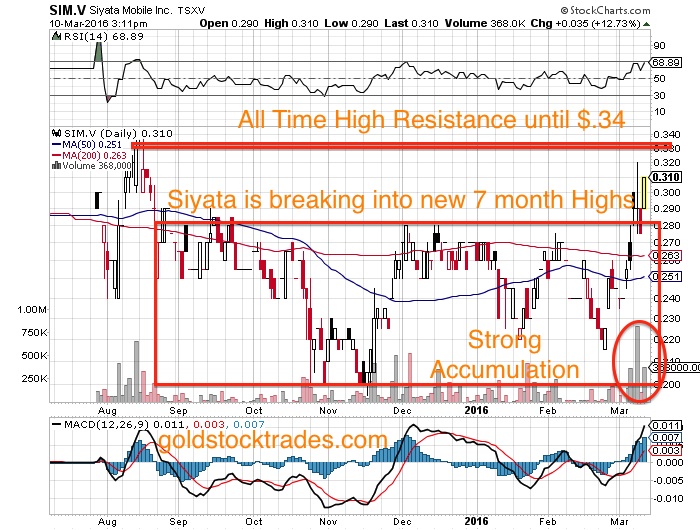
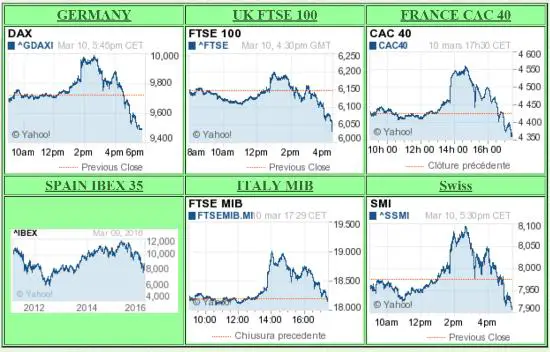
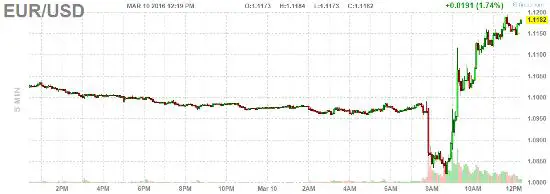
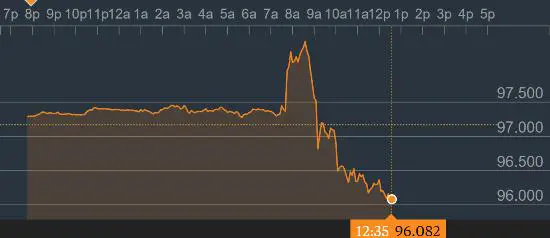


| You are subscribed to email updates from Save Your ASSets First. To stop receiving these emails, you may unsubscribe now. | Email delivery powered by Google |
| Google Inc., 1600 Amphitheatre Parkway, Mountain View, CA 94043, United States | |

No comments:
Post a Comment