


Gold World News Flash |

- Gibson's Paradox - Revisited
- Commodity Technical Analysis: Gold Bounces Following Strong Sell Off
- Silver and the Risk Trade
- 34 Signs That America Is In Decline
- Richard Russell – Bursting Bubbles Will Make Things Far Worse
- Another Stroll Through Time w/ the HUI-Gold Ratio
- Gold: Solution to the Banking Crisis
- What Japan Is Going To Do To Light The Gold Market On Fire
- Gold Seeker Closing Report: Gold Gains and Silver Surges
- Silver Update 11/29/12 Silver Questions
- JP Morgue, Silver & the Precious Metals Cartel
- Ned Naylor-Leyland: LBMA smoke signals on silver smell fishy
- After a bashing, Bank of Japan weighs 'big bang' war on deflation
- Gold: The Solution To The Banking Crisis?
- Peter Grandich: Space helmets on, Captain Video
- Chris Waltzek: Gibson's gold law
- Doug Casey: The US Is Now The United (Police) State Of America
- Paul van Eeden says gold is (still) overvalued
- The Latest Bubble: Hong Kong Parking Space Sells For Double Average US Home Price
- Most Netherlands gold vaulted abroad 'because trading is easier'
- Visualizing The World's Gold Mines And Deposits
- Spain Now Faces a Systemic, Societal, and Sovereign Collapse
- The Gold Price Gained $10.70 a Very Big and Long Rally is Just Starting Buy Now
- Fed To Commit To A Staggering $1 Trillion Of QE For 2013
- Gold and silver advance/large reduction in OI for both gold and silver
- Silver Industrial Demand to Reach New High in 2014
- The McDonalds Economic Index
- Testing, Testing: Analyst Kevin DeGeeter on Five Good Bets in Cancer Diagnostics
- Bob English on Geithner Leaving Derivatives Backdoor Open as he Walks Out the Front!
- Tom Cloud: Wholesale Gold Inventories Evaporating
| Posted: 30 Nov 2012 08:05 AM PST While preparing for this week's Goldseek.com Radio show, my attention was drawn to a little known economic theory proposed by a British economist 90 years hence. In 1923 Alfred Herbert Gibson published a paper regarding the negative correlation between gold price and real interest rates in Banker's Magazine (Wiki, 2012). John Maynard Keynes, later coined the term Gibson's Paradox in 1930 (Keynes, 1930).
| ||
| Commodity Technical Analysis: Gold Bounces Following Strong Sell Off Posted: 30 Nov 2012 12:34 AM PST courtesy of DailyFX.com November 29, 2012 04:39 PM Daily Bars Chart Prepared by Jamie Saettele, CMT Commodity Analysis: I wrote yesterday that “weakness off of the 61.8% retracement demands respect but a drop below 11/20 high (1735.51) would create overlap and suggest that an important top is in place.” Gold didn’t just create overlap…the price nearly broke the 11/15 low. Viewed in light of the 3 wave advance from 1672.50, the trend is lower. Commodity Trading Strategy: Given market conditions lately, there is nothing at this point that would surprise me but a move back to former resistance at 1735 would present a short opportunity against the 11/23 high. LEVELS: 1673 1684 1705 1735 1745 1754...
| ||
| Posted: 29 Nov 2012 11:56 PM PST [url]http://www.traderdannorcini.blogspot.com/[/url] [url]http://www.fortwealth.com/[/url] I have posted the following composite chart without any easily discernible labels to illustrate why I analyze the silver market in the manner that I have been doing for some time now. Both charts use last November 2011 as the starting point and carry on through the present trading session. See if you can pick out which one is the Continuous Commodity Index and which one is the Silver price. Surprised? You should not be. As I have stated repeatedly, silver is moving in near perfect tandem with the RISK TRADE. When risk assets are in vogue, silver will move higher; when risk aversion is the play, silver will move lower along with the rest of the commodity complex. There are occasional deviations from this pattern but as the chart clearly demonstrates, the connection between the two is undeniable. The Fed is basically doing everything within its power to keep Wall Street happy and the he...
| ||
| 34 Signs That America Is In Decline Posted: 29 Nov 2012 11:15 PM PST from The Economic Collapse Blog:
Read More @ TheEconomicCollpaseBlog.com
| ||
| Richard Russell – Bursting Bubbles Will Make Things Far Worse Posted: 29 Nov 2012 11:00 PM PST from KingWorldNews:
With gold, silver and stocks on the move, the Godfather of newsletter writers, Richard Russell, issued this warning in a note to subscribers: "I continue to believe that we are in a primary bear market, one that is, and has been, disguised by the Federal Reserve's series of QEs. Bernanke's theory is that if the Fed creates enough "money," then sooner or later deflation and sluggish growth must turn into inflation and faster growth. The problem with Bernanke's theory is that the economic world is caught in a massive world-wide cycle of deflation — more goods produced than can be consumed. Normally, the deflationary trend would fully express itself through a primary bear market that would get rid of the weak hands and those who don't deserve to survive. This would result in stocks declining to the point where they would once again represent great values." Richard Russell continues @ KingWorldNews.com
| ||
| Another Stroll Through Time w/ the HUI-Gold Ratio Posted: 29 Nov 2012 10:57 PM PST Biwii
| ||
| Gold: Solution to the Banking Crisis Posted: 29 Nov 2012 10:47 PM PST by Eric Sprott & David Baker, Sprott Global:
| ||
| What Japan Is Going To Do To Light The Gold Market On Fire Posted: 29 Nov 2012 10:01 PM PST  Today 25-year veteran Caesar Bryan told King World News that the Japanese are getting ready to enter the gold market in size. Here is what Bryan, from Gabelli & Company, had to say about this fascinating situation: "Last time we spoke we talked a little bit about what was going on in Japan. Two days ago a former advisor to the LDP, Abe, came out with some advice that the Bank of Japan should add another $60 trillion yen, which is about $750 billion, to the monetary base." Today 25-year veteran Caesar Bryan told King World News that the Japanese are getting ready to enter the gold market in size. Here is what Bryan, from Gabelli & Company, had to say about this fascinating situation: "Last time we spoke we talked a little bit about what was going on in Japan. Two days ago a former advisor to the LDP, Abe, came out with some advice that the Bank of Japan should add another $60 trillion yen, which is about $750 billion, to the monetary base."
This posting includes an audio/video/photo media file: Download Now | ||
| Gold Seeker Closing Report: Gold Gains and Silver Surges Posted: 29 Nov 2012 10:00 PM PST Gold edged down to $1717.25 in Asia, but it then rose to as high as $1728.23 in New York and ended with a gain of 0.37%. Silver slipped to as low as $33.51 in Asia, but it then jumped to as high as $34.36 in New York and ended with a gain of 1.51%.
| ||
| Silver Update 11/29/12 Silver Questions Posted: 29 Nov 2012 09:44 PM PST from BrotherJohnF:
| ||
| JP Morgue, Silver & the Precious Metals Cartel Posted: 29 Nov 2012 09:40 PM PST from Unconventional Finance:
| ||
| Ned Naylor-Leyland: LBMA smoke signals on silver smell fishy Posted: 29 Nov 2012 09:33 PM PST GATA's Chris Powell, writes: In a market letter today, Ned Naylor-Leyland of Cheviot Asset Management in London elaborates on remarks made Tuesday to King World News by GoldMoney's James Turk (http://www.gata.org/node/11966) that the London Bullion Market Association is hiding data that would show the silver market in serious backwardation, a sign of shortage. Naylor-Leyland writes: "It seems to me there are a lot of coincidences layering themselves all over the silver market. ... These backwardation smoke signals are as black as they can be and indicate that a move to much higher ground is imminent." The Cheviot market letter is titled "LBMA Smoke Signals Smell Fishy" and it's posted in JPG format here: Thanks to GATA for the heads up on this interesting and timely piece of intel. Source: GATA http://www.gata.org/node/11974
| ||
| After a bashing, Bank of Japan weighs 'big bang' war on deflation Posted: 29 Nov 2012 09:14 PM PST By Leika Kihara http://www.reuters.com/article/2012/11/30/us-japan-boj-idUSBRE8AT0042012... TOKYO -- Bank of Japan Governor Masaaki Shirakawa was feeling the heat in February when he was summoned to parliament five times to explain what he planned to do to get Japan out of its deflation doldrums. Shirakawa tried to defend his cautious approach to easing monetary policy, but his tremulous voice was often drowned out by jeers from the benches. "We need a new governor," one MP shouted during one session. Some angry lawmakers even questioned whether the Bank of Japan should retain its independence from the government. Shirakawa had been opposed to another round of policy easing, though most members of his policy board were actually arguing for it at that time, according to sources familiar with the bank's internal discussions. ... Dispatch continues below ... ADVERTISEMENT Fred Goldstein and Tim Murphy open All Pro Gold Longtime GATA supporters Fred Goldstein and Tim Murphy have brought their many years of experience in the precious metals and numismatic coins to All Pro Gold as metals brokers who specialize in the delivery of gold and silver bullion bars and coins as well as numismatic gold and silver coins. Fred and Tim follow these markets closely and are assisted by a team of consultants in monitoring market trends. All Pro Gold offers GATA supporters competitive pricing on all bullion products and welcomes inquiries. Tim can be reached at 602-299-2585 and Tim@allprogold.com, Fred at 602-799-8378 and Fred@allprogold.com. Ask about their ratio strategy and the relationship of generic $20 dollar gold pieces to 1-ounce gold bullion coins. Visit their Internet site at http://www.allprogold.com/. The threat from lawmakers to withdraw the BOJ's charter granting its independence was what changed his mind, the sources said. So the central bank surprised the markets in February by setting an inflation target for the first time of 1 percent and announcing a $122 billion increase in its asset-buying program. Those five days of intense grilling and the ones that have followed have been among the most intense ever faced by a Japanese central bank governor. Shirakawa has been summoned 29 times so far in 2012, a decade-long record. And the pressure is having a big impact: it was the catalyst for a radical rethink in central bank policy. The full effect of that pivot is expected after April when Shirakawa is due to step down, according to more than a dozen interviews with those involved in the process. "The central bank, as an institution, was under threat and people there were getting pretty desperate, feeling that something had to be done," said a former BOJ official who remains in touch with central bank executives. The 63-year-old Shirakawa, a University of Chicago-trained economist, insists monetary policy can have only a limited impact in the battle against persistent deflation that has come to define two decades of Japan's economic stagnation. Pumping unlimited amounts of cash into the banking system or underwriting government debt, the solutions pushed by his critics, could thrust Japan into a financial crisis, he says. But the terms of the debate are already changing within the BOJ's nine-member policy board, where Shirakawa is now outflanked by newcomers who pushed - unsuccessfully for now - for a bolder commitment to an ultra-easy policy last month, minutes released by the board in November showed. Members of the BOJ's elite monetary affairs department have been drawing up plans for a bolder set of policy options since late last year, people with knowledge of those discussions say. One unifying concern, many of those interviewed say, is a belief that in order to keep lawmakers from undermining its legal independence the BOJ needs to step into uncharted territory by running an ultra-loose policy for years to come. Masaaki Kanno, a former BOJ official and now chief economist at JPMorgan Securities in Japan, said Shirakawa will go down in history as the last "normal" governor of the central bank. "Shirakawa is unpopular because he tells the hard truth people don't want to hear," Kanno said. "He may not necessarily be the best cheerleader, but then, do we really want the central bank governor to be just a good cheerleader?" Shirakawa has also become a lightning rod. With a series of headline-grabbing comments that jolted financial markets, Shinzo Abe, the former prime minister whose Liberal Democratic Party (LDP) is favored to return to power after a nationwide election on December 16, has made BOJ bashing a centerpiece of his campaign. Abe has called on the BOJ to set an inflation target of at least 2 percent -- doubling its current target -- and to commit to open-ended monetary easing. Short-term interest rates should be set below zero, he has said, and the central bank should stand ready to buy all the bonds needed to finance public works investment from the market - an extreme step economists warn is dangerously close to "monetizing" debt, or directly underwriting debt from the government. If needed, Abe also says, the 1998 law that granted the BOJ its long-sought independence should be rewritten. Proposals to rewrite the law governing the BOJ first came from a number of junior Democratic Party lawmakers who formed an "Anti-Deflation League" in 2010. Initially seen as a fringe initiative without real chance of succeeding, their ideas gradually drew allies from other parties and has become a cross-party movement, winning endorsements from party heavyweights such as Abe. As a 130-year-old institution, the BOJ is proud of its traditions and of having been on the right side of Japan's modern history. Visitors to the bank's hulking Meiji-era headquarters are told how the central bank had the foresight to buy one of Japan's first elevators -- and a vault that withstood the bombing of Tokyo by the U.S. military. They are sometimes shown a portrait of Korekiyo Takahashi, a former BOJ governor and later prime minister, who stands as something of a martyr for economic policy. Known as Japan's Keynes, Takahashi advocated fiscal expansion and an abandonment of the gold standard and is credited with pulling the economy out of the Great Depression. He was assassinated in 1936 by military officers who blamed him for cuts in arms spending. The BOJ's legal independence came only in 1998 after officials had argued for decades for more autonomy. The bank's previous charter, based on the Reichsbank of Nazi Germany, was enacted as part of Japan's World War Two-era mobilization. Its independence was granted in part because of a string of financial scandals and the fallout from the collapse of Japan's asset bubble in 1991. The charter states the BOJ's objective is to pursue "price stability." But Japan's long bout of falling prices, which began back in mid-1998, has actually destabilized the economy, undermining the central bank's ability to claim the intellectual high ground. Somewhat like Germany's central bankers, whose collective memory is seared by hyper-inflation nearly a century ago, Bank of Japan officials were shaped by past bouts of asset bubbles and price inflation -- an impulse they found hard to abandon. In December 2011, a group of the most senior bureaucrats from the Monetary Affairs Department decided it was time for bold action that would impress both lawmakers and markets alike, with an objective of fighting deflation more forcefully. They were worried that the old approach -- doling out monetary stimulus in measured doses at times of heightened market stress, usually coinciding with yen rallies -- was no longer working. Although final policy decisions are made by the BOJ's nine-member board, the bank's Monetary Affairs Department hammers out policy options. Nearly all of the 50 or so members of the predominately male group were recruited from the University of Tokyo with degrees in law or economics. All have done stints with other departments at the BOJ before being called in to serve in the inner sanctum of policy. "It's a very close-knit society. Most of us have known each other for a long time," one member said. Many officials in the current team had their first stint at the bank in the late 1990s when Japan was struggling with a banking crisis that forced the BOJ to cut interest rates to zero. "Dealing with inflation isn't really on the minds of the younger generation. They seem to doubt whether Japan may ever see inflation driven by economic strength," said a person in regular contact with central bank officials. Some inside this circle advocate a shock to the system with a "big-bang" increase in government bond buying to the tune of 100 trillion yen ($1.22 trillion) in one go, instead of the much-criticized baby-step approach of incremental increases, people familiar with the discussions say. Another idea being floated would have the BOJ buy foreign bonds, a step intended in part to drive down the value of the yen and ease pressure on exporters such as Toyota Motor and beleaguered consumer electronic giants like Sony and Panasonic. Carrying out the latter step would require creating a new fund to give the BOJ legal cover, those familiar with the discussions say. The emerging shift in central bank strategy carries risks: the BOJ would be expanding its balance sheet at a time when Japan's public debt is already off the charts because of the ballooning costs of providing healthcare and pensions to its rapidly ageing population. If it goes too far, some worry, it could trigger a loss of confidence and a debt crisis. But among the firebreaks against runaway price increases is a banking sector that keeps pouring money into government bonds, rather than lending it out, and individuals who continue to save against uncertainty, rather than splurging. The same factors could give the BOJ more room to buy government bonds aggressively without igniting panic-inducing price increases, or so the argument goes. Those who have worked for the soft-spoken Shirakawa describe him as a workaholic and a perfectionist. His few pleasures outside work include listening to the music of the Beatles and catching an occasional movie. A recent favorite: "Always Sunset on Third Street," a 2005 drama that captures Tokyo on the cusp of economic boom in 1958. Shirakawa joined the BOJ in 1972, months before inflation began sharply rising to near 25 percent. The chaos of those months around the oil price shock was a formative experience for him, as was the "asset bubble" that formed in the late 1980s, people close to him say. He was among the cadre of BOJ officials who masterminded the central bank's previous spell of quantitative easing, which involved pumping vast amounts of money into the financial system. That spell lasted for five years until 2006 and helped Japan emerge from a domestic banking crisis. But he remains wary of the risks of that policy. Shirakawa declined to be interviewed for this story. One worrying trend Shirakawa and others have cited to support their caution over easing monetary policy was that much of the money the BOJ has injected into the economy recently has simply been piling up in bank accounts, rather than feeding into the productive economy via bank loans. That poses the risk of inflating financial assets, if the account holders plough it into stocks. Until the mid-1990s, cash and deposits held by companies and households were around 1.1 times the size of Japan's GDP. They have now grown to 1.7 times GDP, the highest among major economies. The real problem is that the economy has been running below its potential for years, according to a paper published in July by a team of BOJ researchers. They identified the yawning "output gap" as a key factor behind Japan's long-running, mild deflation. Market and consumer psychology was one reason for the weak output and falling prices, the study concluded. Japanese companies and consumers had come to expect prices would fall and were behaving accordingly, the study noted. In fact, inflation expectations had been in retreat since 1990 and plunged in 2008. The BOJ researchers believe expectations of falling prices could become dangerously self-fulfilling. Advocates of an ultra-easy monetary policy argue that cycle could be broken by pumping a river of money into the system - economist Paul Krugman, a commentator Shirakawa is said to admire -- has urged the BOJ to do just that and "credibly commit to being irresponsible." Masayoshi Amamiya was a key figure in the Monetary Affairs Department group that is overhauling BOJ policy. He oversaw the division until May this year when he was sent to head the bank's Osaka branch, a step expected to set him up for an eventual stint on the bank's policy board. A 57-year-old fan of the music of Bartok and Prokofiev, who jokes he feels more comfortable talking about classical scores than monetary policy, won praise for bringing a newfound flexibility to BOJ policy since the previous round of quantitative easing. Admirers inside the bank refer to "Amamiya magic" for his skill at handling communication with lawmakers, and coming up with creative banking ideas. Amamiya was at the center of deliberations leading up to the BOJ's surprise easing in February, when it announced an inflation target of 1 percent and raised its asset-buying target by 10 trillion ($122 billion). Amamiya also helped make the case for a follow-up easing in April on the belief that, when necessary, the central bank must aim for a "shock" effect. The most recent appointments to the policy board -- former economists Takehiro Sato and Takahide Kiuchi -- are also more strongly committed to an easing policy. Both warned on October 30 that the central bank's consumer price inflation forecasts were too optimistic. Their appointments came after the Diet turned down a nominee -- Ryutaro Kono, an economist at BNP Paribas -- because lawmakers thought he would not be aggressive enough. Rarely if ever has a government nominee for a board member been rejected in parliament. Kono's rejection and the recent board appointments sent a clear message to the central bank that it needed to change, said Hideo Kumano, chief economist at Dai-Ichi Life Research Institute in Tokyo and a former central bank official. "It will certainly have an effect on who will be chosen as governor." At the working level, the BOJ is preparing for a leadership change next spring when the terms of Shirakawa and both of his deputies expire. The bank has appointed 50-year-old Shinichi Uchida as head of the Monetary Affairs Department, making him the youngest of the bank's 15 department heads and surprising many in an organization where posts are almost universally assigned according to seniority. Miyako Suda, who served on the BOJ board for a decade before leaving in March 2011, had been Shirakawa's last dependable ally. Suda stood out as the only woman on the policy board during her tenure, and because she was so open with her dissent. Suda warned that too much easing might forestall more important economic reforms, such as deregulation and opening up Japanese markets to foreign competition. For Shirakawa, Suda also had been something of a soulmate and sounding board, someone who shared his core set of beliefs, people close to the policy board say. The pressure for a shakeup at the BOJ has mounted both from the LDP and key members of the ruling Democratic Party. The new generation of BOJ critics mostly started their careers during Japan's lost decades. They have witnessed how fiscal policy tools such as subsidies, tax breaks and massive public works failed to jolt the economy back to life. As a matter of tradition the top BOJ job long rotated between career central bankers and finance ministry bureaucrats, though BOJ insiders have dominated the post for the past 15 years. Now lawmakers and finance ministry officials are putting on the pressure to bring in someone from outside to replace Shirakawa. That favors candidates such as Toshiro Muto, 69, a former finance ministry bureaucrat who served as deputy governor from 2003 to 2008 and Kazumasa Iwata, 66, a former deputy governor who now sits on a government panel discussing ways to boost Japan's productivity. Both advocate a radical expansion of the BOJ bond-buying program and both play down the threat of inflation or another market bubble. "The effect of non-traditional policy may not be clear, but neither are the side-effects. The chance of Japan seeing inflation flare up soon is small," Muto told Reuters. The BOJ's post-Shirakawa policies could have global reverberations. If the experiment with radical monetary expansion fails, it would strengthen the opponents of quantitative easing policies that have been in vogue among central banks across the world. Foes warn of its diminishing returns and risks for long-term financial stability. Success in Japan would have the opposite effect, perhaps ushering in a new era of experimental central banking -- with an additional side effect of realignment among major currencies, weakening the yen in a lasting manner. There is no guarantee the BOJ will succeed. The last time price increases were over 2 percent was in 1992, just after the collapse of the bubble in property and stock prices. That was the end of the boom era when growth had averaged over 4 percent for nearly two decades. Bolstered by a pioneering round of quantitative easing Shirakawa helped engineer as a working-level official, Japan's economy staggered back to average growth of 1.6 percent between 2002 and 2007. But the 2008 global financial crisis sent Japan into recession as did the March 2011 earthquake and tsunami. Some members of the BOJ's policy board have warned the third recession since Shirakawa took the central bank's helm may have begun in the past quarter. Some economists say Shirakawa did well guiding the economy through crisis, though failing to win allies or communicate effectively with markets and lawmakers. Others are not so kind. When asked to grade Shirakawa's nearly five-year tenure, economists at major Tokyo banks surveyed by Reuters at the end of September gave him a grade of 60 percent. Twelve of 16 said they expected him to leave when his term ends in April. Most rejected the need to change the BOJ law. Yasutoshi Nishimura, 50, a LDP lawmaker who is expected to have a big say in the choice of the next BOJ chief, underscores the consensus. "The next governor should be someone who does not have the 'inflation fighter' DNA," Nishimura told Reuters. Join GATA here: Vancouver Resource Investment Conference * * * Support GATA by purchasing DVDs of our London conference in August 2011 or our Dawson City conference in August 2006: http://www.goldrush21.com/order.html Or by purchasing a colorful GATA T-shirt: Or a colorful poster of GATA's full-page ad in The Wall Street Journal on January 31, 2009: http://gata.org/node/wallstreetjournal Help keep GATA going GATA is a civil rights and educational organization based in the United States and tax-exempt under the U.S. Internal Revenue Code. Its e-mail dispatches are free, and you can subscribe at: To contribute to GATA, please visit: ADVERTISEMENT Opinion Around the World Is Changing When Deutschebank calls gold "good money" and paper "bad money". ... http://www.gata.org/node/11765 When the president of the German central bank, the Bundesbank, pays tribute to gold as "a timeless classic". ... http://www.forbes.com/sites/ralphbenko/2012/09/24/signs-of-the-gold-stan... When a leading member of the policy committee of the People's Bank of China calls the gold standard "an excellent monetary system". ... http://www.forbes.com/sites/ralphbenko/2012/10/01/signs-of-the-gold-stan... When a CNN reporter writes in The China Post that the "gold commission" plank in the 2012 Republican platform will "reverberate around the world". ... http://www.thegoldstandardnow.org/key-blogs/1563-china-post-the-gop-gold... When the Subcommittee on Domestic Monetary Policy of the U.S. House of Representatives twice called on economist, historian, and gold standard advocate Lewis E. Lehrman to testify. ... World opinion is changing in favor of gold. How can you learn why and what it will mean to you? Read the newly updated and expanded edition of Lehrman's book, "The True Gold Standard." Financial journalist James Grant says of "The True Gold Standard": "If you have ever wondered how the world can get from here to there -- from the chaos of depreciating paper to a convertible currency worthy of our children and our grandchildren -- wonder no more. The answer, brilliantly expounded, is between these covers. America has long needed a modern Alexander Hamilton. In Lewis E. Lehrman she has finally found him." To buy a copy of "The True Gold Standard," please visit: http://www.thegoldstandardnow.com/publications/the-true-gold-standard
| ||
| Gold: The Solution To The Banking Crisis? Posted: 29 Nov 2012 09:03 PM PST Authored by Eric Sprott and David Baker of Sprott Global Resource Investment, The Basel Committee on Banking Supervision is an exclusive and somewhat mysterious entity that issues banking guidelines for the world's largest financial institutions. It is part of the Bank of International Settlements (BIS) and is often referred to as the Central Banks' central bank. Ever since the financial meltdown four years ago, the Basel Committee has been hard at work devising new international regulatory rules designed to minimize the potential for another large-scale financial meltdown. The Committee's latest 'framework', as they call it, is referred to as "Basel III", and involves tougher capital rules that will force all banks to more than triple the amount of core capital they hold from 2% to 7% in order to avoid future taxpayer bailouts. It doesn't sound like much of an increase, and according to the Basel group's own survey, the 100 largest global banks will only require approximately €370 billion in additional reserves to comply with the new regulations by 2019. Given that the Spanish banks alone are believed to need well over €100 billion today simply to keep their capital ratios in check, it is hard to believe €370 billion will be enough protect the world's "too-big-to-fail" banks from future crises, but it is indeed a step in the right direction. Initial implementation of Basel III's capital rules was expected to come into effect on January 1, 2013, but US banking regulators issued a press release on November 9th stating that they wouldn't meet the deadline, citing a large volume of letters (ie. complaints) received from bank participants and a "wide range of views expressed during the comment period". It has also been revealed that smaller US regional banks are loath to adopt the new rules, which they view as overly complicated and potentially devastating to their bottom lines. The Independent Community Bankers of America has even requested a Basel III exemption for all banks with less than $50 billion in assets,"in order to avoid large-scale industry concentration that would curtail credit for consumers and business borrowers, especially in small communities." The long-term implementation period for all Basel III measures actually extends to 2019, so the delays are not necessarily meaningful news, but they do illustrate the growing rift between the US banking cartel and its European counterpart regarding the Basel III framework. JP Morgan's CEO Jamie Dimon is on record having referred to Basel III regulations as "un-American" for their favourable treatment of European covered bonds over US mortgage-backed securities. Readers may also remember when Dimon was caught yelling at Mark Carney, Canada's (soon to be former) Central Bank Governor and head of the Financial Stability Board, during a meeting in Washington to discuss the same topic. More recently, Deutsche Bank's co-chief executive Juergen Fitschen suggested that the US regulators' delay was "hurting trans-Atlantic relations" and creating distrust... stating, "when the whole thing is called un-American, I can only say in disbelief, who can still believe in this day and age that there can be purely European or American rules." Suffice it to say that Basel III implementation has not gone as smoothly as planned. One of the more relevant aspects of Basel III for our portfolios is its treatment of gold as an asset class. Documents posted by the Bank of International Settlements (which houses the Basel Committee) and the United States FDIC have both referenced gold as a "zero percent risk-weighted item" in their proposed frameworks, which has launched spirited rumours within the gold community that Basel III may define gold as a "Tier 1" asset, along with cash and AAA-government securities. We have discovered in delving further that gold's treatment in Basel III is far more complicated than the rumours suggest, and is still, for all intents and purposes, very much undecided. Without burdening our readers with the turgid details, it turns out that the reference to gold as a "zero-percent risk-weighted item" only relates to its treatment in specific Basel III regulation related to the liquidity of bank assets vs. its liabilities. (For a more comprehensive explanation of Basel III's treatment of gold, please see the Appendix). But what the Basel III proposals do confirm is the regulators' desire for banks to improve their liquidity position by holding a larger amount of "high-quality", liquid assets in order to improve their overall solvency in the event of another crisis. Herein lies the problem, however: the Basel III regulators have stubbornly held to the view that AAA-government securities constitute the bulk of those high quality assets, even as the rest of the financial world increasingly realizes they are anything but that. As banks move forward in their Basel III compliance efforts, they will be forced to buy ever-increasing amounts of AAA-rated government bonds to meet post Basel III-compliant liquidity and capital ratios. As we discussed in our August newsletter entitled, "NIRP: The Financial System's Death Knell", the problem with all this regulation-induced buying is that it ultimately pushes government bond yields into negative territory - as banks buy more and more of them not because they want to but because they have to in order to meet the new regulations. Although we have no doubt in the ability of governments' issue more and more debt to satiate that demand, the captive purchases by the world's largest banks may turn out to be surprisingly high. Add to this the additional demand for bonds from governments themselves through various Quantitative Easing programs… AND the new Dodd Frank rules, which will require more government bonds to be held on top of what's required under Basel III, and we may soon have a situation where government bond yields are so low that they simply make no sense to hold at all. This is where gold comes into play. If the Basel Committee decides to grant gold a favourable liquidity profile under its proposed Basel III framework, it will open the door for gold to compete with cash and government bonds on bank balance sheets – and provide banks with an asset that actually has the chance to appreciate. Given that US Treasury bonds pay little to no yield today, if offered the choice between the "liquidity trifecta" of cash, government bonds or gold to meet Basel III liquidity requirements, why wouldn't a bank choose gold? From a purely 'opportunity cost' perspective, it makes much more sense for a bank to improve its balance sheet liquidity profile through the addition of gold than it does by holding more cash or government bonds – if the banks are given the freedom to choose. The world's non-Western central banks have already embraced this concept with their foreign exchange reserves, which are vulnerable to erosion from 'Central Planning' printing programs. This is why non-Western central banks are on track to buy at least 500 tonnes of net new physical gold this year, adding to the 440 tonnes they collectively purchased in 2011. In the un-regulated world of central banking, gold has already been accepted as the de-facto forex diversifier of choice, so why shouldn't the regulated commercial banks be taking note and following suit with their balance sheets? Gold is, after all, one of the only assets they can all own simultaneously that will actually benefit from their respective participation through pure price appreciation. If banks all bought gold as the non-Western central banks have, it is likely that they would all profit while simultaneously improving their liquidity ratios. If they all acted in concert, gold could become the salvation of the banking system. (Highly unlikely… but just a thought). So far there have only been two banking jurisdictions that have openly incorporated gold into their capital structures. The first, which may surprise you, is Turkey. In an unconventional effort to increase the country's savings rate and propel loan growth, Turkish Central Bank Governor Erdem Basci has enacted new policies to promote gold within the Turkish banking system. He recently raised the proportion of reserves Turkish banks can keep in gold from 25 percent to 30 percent in an effort to attract more bullion into Turkish bank accounts. Turkiye Garanti Bankasi AS, Turkey's largest lender, now offers gold-backed loans, where "customers can bring jewelry or coins to the bank and take out loans against their value." The same bank will also soon "enable customers to withdraw their savings in gold, instead of Turkish lira or foreign exchange." Basci's policies have produced dramatic results for the Turkish banks, which have attracted US$8.3 billion in new deposits through gold programs over the past 12 months - which they can now extend for credit. Governor Basci has even stated he may make adjusting the banks' gold ratio his main monetary policy tool. The other banking jurisdiction is of course that of China, which has long encouraged its citizens to own physical gold. Recent reports indicate that the Shanghai Gold Exchange is planning to launch an interbank gold market in early December that will "pilot with Chinese banks and eventually be open to all." Xie Duo, general director of the financial market department of the People's Bank of China has stated that, "[China] should actively create conditions for the gold market to become integrated with the international gold market," which suggests that the Chinese authorities have plans to capitalize on their growing gold stockpile. It is also interesting to note that China, of all countries, has been adamant that its 16 largest banks will meet the Basel III deadline on January 1, 2013. We can't help but wonder if there is any connection between that effort and China's recent increase in physical gold imports. Could China be positioning itself for the day Western banks finally realize they'd prefer gold over Treasuries? Possibly – and by the time banks figure it out, China may have already cornered most of the world's physical gold supply. If global banks' are realistically going to improve their balance sheet diversification and liquidity profiles, gold will have to be part of that process. It is ludicrous to expect the global banking system to regain a sure footing through the increased ownership of government securities. If anything, we are now at a time when banks should do their utmost to diversify away from them, before the biggest "crowded trade" of all time begins to unravel itself. Basel III liquidity rules may be the start of gold's re-emergence into mainstream commercial banking, although it is still not guaranteed that the US banking cartel will adopt all of the Basel III measures, and they still have years to hammer out the details. If regulators hold firm in applying stricter liquidity rules, however, gold is the only financial asset that can satisfy those liquidity requirements while freeing banks from the constraints of negative-yielding government bonds. And while it strikes us as somewhat ironic that the banking system may be forced to turn to gold out of sheer regulatory necessity, that's where we see the potential in Basel III. After all – if the banks are ultimately interested in restoring stability and confidence, they could do worse than holding an asset that has gone up by an average of 17% per year for the last 12 years and represented 'sound money' throughout history. Appendix: Gold's treatment in Basel III Basel III is a much more complex "framework" than Basel I or II, although we do not claim to be experts on either. It should also be mentioned that Basel II only came into effect in early 2008, and wasn't even adopted by the US banks on its launch. Post-meltdown, Basel III is the Basel Committee's attempt to get it right once and for all, and is designed to provide an all-encompassing, international set of banking regulations designed to avoid future bailouts of the "too-big to fail" banks in the event of another financial crisis. Without going into cumbersome details, under the older Basel framework (Basel I), the lower the "risk weighting" regulators applied to an asset class, the less capital the banks had to set aside in order to hold it. CNBC's John Carney writes, "The earlier round of capital regulations… government-rated bonds rated BBB were given 50 percent riskweightings. A-rated bonds were given 20 percent risk weightings. Double A and Triple A were given zero risk weightings — meaning banks did not have to set aside any capital at all for the government bonds they held." Critics of Basel I argued that the risk-weighting system compelled banks to overweight their exposure to assets that had the lowest riskweightings, which created a herd-like move into same assets. This was most evident in their gradual overexposure to European sovereign debt and mortgage-backed securities, which the regulators had erroneously defined as "low-risk" before the meltdown proved them to be otherwise. The banks and governments learned that lesson the hard way. Basel III (and Basel II) takes the same idea and complicates it further by dividing bank assets into two risk categories (credit and market risk) and risk-weighting them depending on their attributes. Just like Basel I, the higher the "riskweight" applied to an asset class, the more capital the bank is required to hold to offset them.
It is our understanding that gold's reference as a "zero percent risk-weighted asset" in the FDIC and BIS literature only applies to gold's "credit risk" - which makes perfect sense given that gold isn't anyone's counterparty and cannot default in any way. Gold still has "market-risk" however, which stems from its price fluctuations, and this results in the bank having to set aside capital in order to hold it. So for banks who hold physical gold on their balance sheet (and we don't know of any who do, other than the bullion dealers), the gold would not be treated the same as cash or AAA-bonds for the purposes of calculating their Tier 1 ratio. This is where the gold community's conjecture on gold as a "Tier 1" asset has been misleading. There really isn't such a thing as a "Tier 1" asset under Basel III. Instead, "Tier 1" is merely the ratio that reflects the capital supporting a bank's risk-weighted assets. HOWEVER, Basel III will also be adding an entirely new layer of regulation concerning the relative liquidity of the bank's assets and liabilities. This will be reflected in two new ratios banks must calculate starting in 2015: the Liquidity Coverage Ratio (LCR) and Net Stable Funding Ratio (NSFR).
Just as Basel III requires risk-weights for the asset side of a bank's balance sheet (based on credit risk and market risk), Basel III will also soon require the application of risk-weights to be applied to the LIQUIDITY profile of both the assets and liabilities held by the bank. The idea here is to address the liquidity constraints that arose during the 2008 meltdown, when banks suffered widespread deposit withdrawals just as their access to wholesale funding dried up. This is where gold's Basel III treatment becomes more interesting. Under the proposed LIQUIDITY component of Basel III, gold is currently labeled with a 50% liquidity "haircut", which is the same haircut that is applied to equities and bonds. This implicitly assumes that gold cannot be easily converted into cash in a stressed period, which is exactly the opposite of what we observed during the crisis. It also requires the bank to maintain a much more stable source of funding in order to hold gold as an asset on its balance sheet. Fortunately, there is a strong chance that this liquidity definition for gold may be changed. The World Gold Council has in fact been lobbying the Basel Committee, the Federal Reserve and the FDIC on this issue as far back as 2009, and published a paper arguing that gold should enjoy the same liquidity profile as cash or AAA-government securities when calculating Basel III's LCR and NSFR ratios. And as it turns out, the liquidity definitions that will guide banks' LCR and NSFR calculations have not yet been finalized by the Basel Committee. The Basel III comment period that ended on October 22nd resulted in the deadline being pushed back to January 1, 2013, and given the recent delays with the US bank regulators, will likely be postponed even further next year. Of specific interest to us is how the Basel Committee will treat gold from a liquidity-risk perspective, and whether they decide to lower gold's liquidity "haircut" from 50% to something more reasonable, given gold's obvious liquidity superiority over that of equities and bonds. The only hint we've heard thus far has come from the World Gold Council itself, which suggested in an April 2012 research paper, and re-iterated on a recent conference call, that gold will be given a 15% liquidity "haircut", but we have not been able to confirm this with either the Basel Committee or the FDIC. In fact, all inquiries regarding gold's treatment made to those groups by ourselves, and by other parties that we have spoken with, have been met with silence. We get the sense that the regulators have no interest in stirring the pot by mentioning anything related to gold out of turn. Given our discussion above, we can understand why they may be hesitant to address the issue, and only time will tell if gold gets the proper liquidity treatment it deserves.
| ||
| Peter Grandich: Space helmets on, Captain Video Posted: 29 Nov 2012 08:22 PM PST 10:19p ET Thursday, November 29, 2012 Dear Friend of GATA and Gold: Market analyst and mining company consultant Peter Grandich remarks of yesterday's smashing of the gold price on the New York open that no one sells that way without a motive to do more than simply liquidate a position. Grandich also shows that there's high fashion in tin-foil hats. His commentary is headlined "Space Helmets On, Captain Video" and it's posted here: CHRIS POWELL, Secretary/Treasurer ADVERTISEMENT Opinion Around the World Is Changing When Deutschebank calls gold "good money" and paper "bad money". ... http://www.gata.org/node/11765 When the president of the German central bank, the Bundesbank, pays tribute to gold as "a timeless classic". ... http://www.forbes.com/sites/ralphbenko/2012/09/24/signs-of-the-gold-stan... When a leading member of the policy committee of the People's Bank of China calls the gold standard "an excellent monetary system". ... http://www.forbes.com/sites/ralphbenko/2012/10/01/signs-of-the-gold-stan... When a CNN reporter writes in The China Post that the "gold commission" plank in the 2012 Republican platform will "reverberate around the world". ... http://www.thegoldstandardnow.org/key-blogs/1563-china-post-the-gop-gold... When the Subcommittee on Domestic Monetary Policy of the U.S. House of Representatives twice called on economist, historian, and gold standard advocate Lewis E. Lehrman to testify. ... World opinion is changing in favor of gold. How can you learn why and what it will mean to you? Read the newly updated and expanded edition of Lehrman's book, "The True Gold Standard." Financial journalist James Grant says of "The True Gold Standard": "If you have ever wondered how the world can get from here to there -- from the chaos of depreciating paper to a convertible currency worthy of our children and our grandchildren -- wonder no more. The answer, brilliantly expounded, is between these covers. America has long needed a modern Alexander Hamilton. In Lewis E. Lehrman she has finally found him." To buy a copy of "The True Gold Standard," please visit: http://www.thegoldstandardnow.com/publications/the-true-gold-standard Join GATA here: Vancouver Resource Investment Conference * * * Support GATA by purchasing DVDs of our London conference in August 2011 or our Dawson City conference in August 2006: http://www.goldrush21.com/order.html Or by purchasing a colorful GATA T-shirt: Or a colorful poster of GATA's full-page ad in The Wall Street Journal on January 31, 2009: http://gata.org/node/wallstreetjournal Help keep GATA going GATA is a civil rights and educational organization based in the United States and tax-exempt under the U.S. Internal Revenue Code. Its e-mail dispatches are free, and you can subscribe at: To contribute to GATA, please visit: ADVERTISEMENT Fred Goldstein and Tim Murphy open All Pro Gold Longtime GATA supporters Fred Goldstein and Tim Murphy have brought their many years of experience in the precious metals and numismatic coins to All Pro Gold as metals brokers who specialize in the delivery of gold and silver bullion bars and coins as well as numismatic gold and silver coins. Fred and Tim follow these markets closely and are assisted by a team of consultants in monitoring market trends. All Pro Gold offers GATA supporters competitive pricing on all bullion products and welcomes inquiries. Tim can be reached at 602-299-2585 and Tim@allprogold.com, Fred at 602-799-8378 and Fred@allprogold.com. Ask about their ratio strategy and the relationship of generic $20 dollar gold pieces to 1-ounce gold bullion coins. Visit their Internet site at http://www.allprogold.com/.
| ||
| Chris Waltzek: Gibson's gold law Posted: 29 Nov 2012 08:05 PM PST 10:05p ET Thursday, November 29, 2012 Dear Friend of GATA and Gold: GoldSeek Radio's Chris Waltzek tonight hauls out one of GATA's foundation stones, the discovery 90 years ago by the British economist Alfred Herbert Gibson that the gold price ordinarily is inversely correlated with the real rate of interest -- that is, the rate of interest minus the rate of inflation. As economics professor at Harvard in 1988, future U.S. Treasury Secretary Lawrence Summers and his colleague at the University of Michigan, Robert Barsky, wrote an academic study analyzing Gibson's discovery and implicitly rationalizing the Western central bank gold price suppression scheme: Using the inflation calculations of Shadowstats proprietor John Williams, Waltzek figures that "Gibson's Gold Law" can be used to predict the gold price, and that if real interest rates remain even slightly negative, gold should reach $5,500 per ounce in five years. Of course such a prediction may presume that governments obey Gibson's law, which has never been GATA's presumption any more than John Williams has presumed that he could believe the U.S. government's Consumer Price Index. But all this is an excellent reminder that negative interest rates are supportive for gold. Waltzek's commentary is headlined "Gibson's Gold Law" and it's posted at GoldSeek Radio here: http://radio.goldseek.com/gibsonsgoldlaw.php CHRIS POWELL, Secretary/Treasurer ADVERTISEMENT Prophecy Platinum Intercepts Best Pt+Pd+Au Grades Yet Company Press Release VANCOUVER, British Columbia -- Prophecy Platinum Corp. (TSX-V: NKL, OTC-QX: PNIKF, Frankfurt: P94P) announces more results of its 2012 drill program on the company's fully-owned Wellgreen platinum group metals, nickel, and copper project in southwestern Yukon Territory, Canada. Four surface holes and four underground holes all intercepted significant mineralized widths, ranging from 28.5 meters (WS12-201) and up to 459.5 metres (WS12-193). Highlights include WU12-540, which returned 8.9 metres of 5.36 grams per tonne platinum, palladium, and gold; 1.73 percent copper; and 1.01 percent nickel within 304.5 meters of 0.66 g/t platinum-palladium-gold, 0.20 percent copper, and 0.27 percent nickel. The surface drill program started in June and has completed 16 holes (assays pending for 12 holes) with two rigs now on site. The surface program continues to progress at a steady pace. Prophecy Chairman John Lee commented: "Wellgreen is a very large nickel, copper, and platinum group metals project with near-surface high-grade zones. High-grade intercepts will be incorporated into resource modeling and mine planning in the pre-feasibility study. We expect further positive drill results from Wellgreen shortly." Wellgreen features a low 2.59-to-1 strip ratio, is situated at an altitude of 1,300 meters, and is only 15 kilometers from the two-lane paved Alaska Highway. Those factors significantly minimize the project's indirect costs. For the complete company statement with full tabulation of the drilling results, please visit: http://prophecyplat.com/news_2012_sep11_prophecy_platinum_drill_results.... Join GATA here: Vancouver Resource Investment Conference * * * Support GATA by purchasing DVDs of our London conference in August 2011 or our Dawson City conference in August 2006: http://www.goldrush21.com/order.html Or by purchasing a colorful GATA T-shirt: Or a colorful poster of GATA's full-page ad in The Wall Street Journal on January 31, 2009: http://gata.org/node/wallstreetjournal Help keep GATA going GATA is a civil rights and educational organization based in the United States and tax-exempt under the U.S. Internal Revenue Code. Its e-mail dispatches are free, and you can subscribe at: To contribute to GATA, please visit: ADVERTISEMENT GoldMoney adds Toronto vaulting option In addition to its precious metals storage facilities in Hong Kong, Switzerland, and the United Kingdom, GoldMoney customers now can store their gold and silver in a high-security vault operated by Brink's in Toronto, Ontario, Canada. GoldMoney also has recently partnered with Rhenus Freight Logistics to offer another gold storage option in Switzerland. The Rhenus vault is in the secured zone of Zurich Airport and offers customers superb security as well as the ability to inspect their gold. Storage at the new vaults in Canada and Switzerland is available at GoldMoney's lowest fees. Customers can select their storage location when placing their buy order. GoldMoney customers can take delivery of any number of gold, silver, platinum, and palladium bars from any GoldMoney vault, as well as personally collect their bars stored in the Hong Kong, Switzerland, and U.K. vaults. It's easy to open an account, add funds, and liquidate your investment. For more information, visit: http://www.goldmoney.com/?gmrefcode=gata
| ||
| Doug Casey: The US Is Now The United (Police) State Of America Posted: 29 Nov 2012 08:03 PM PST Submitted by Doug Casey of Casey Research, Louis: Doug, after conversations like the one we had last week, we often get letters from angry readers who accuse you of hating America, disloyalty, and perhaps even treason. These people don't know or understand what I do about you – that you love the idea that was America. It's the United State it has become for which you have nothing but contempt. Perhaps we should try to explain this to them? Doug: I doubt it would work; it's a tough row to hoe, trying to explain things to people who are so set in their thinking that they truly and literally don't want to hear anything that might threaten their notions. A person who feels threatened by ideas and who responds with emotion is acting irrationally. How can we have a discussion with someone whose emotion trumps their reason? How do we even begin to untangle the thinking of people who will gather this week to give thanks for the bounty produced by freedom and hard work – the famous puritan work ethic – by eating a turkey bought with food stamps? But we can outline the ideas, for the record. Louis: I'll bring a copy if they ever do put you on trial for thoughtcrime – which is frighteningly close to being real these days and called treason to boot. Doug: It's not just close; it's here. Just try telling an unapproved joke in a security line in an airport these days. Louis: True enough. Where to begin? Doug: At the beginning. America was founded as a confederation of independent countries – that's what a state is. Or was, in our language. The original United States of America was a confederation of countries that banded together for protection against larger and more powerful countries they feared might be hostile. This is not a disputed interpretation of history, but as solid a fact as the study of history produces – and yet a largely neglected one. Louis: We did cover this ground briefly in our conversations on the Civil War and the Constitution. Doug: So we did... the short version being that the US Constitution was essentially a coup; the delegates to what we now call the Constitutional Convention were not empowered to replace the existing government – only to improve upon the Articles of Confederation between the then-independent states. The framers of the Constitution drafted it with the notion of a national government already in place, but calmed fears of loss of state sovereignty by calling the new government the "United States of America" – a verbal sleight of hand that worked for over half a century. Then the southern states decided to exercise what these words imply, their right to leave the union. While slavery was and is a wholesale criminal activity I object to in every way possible, the southern states did have the right to secede, both legally and ethically. But the question was settled by force, not reason, and the wrong side won. Louis: Another coup? Doug: More like an exposure of the first one for the whole world to see. But by then it was way too late. Despite this, the relative freedom of the US – because it was for many years far freer than other countries – made it possible for artists, engineers, inventors, and businesspeople to flourish and create a society more wealthy and powerful than any the world had ever seen. This is what I call the idea of America – the America That Was. But the seeds of destruction were already sown at the very beginning – with the Alien and Sedition Acts being perhaps the first highly visible step in the wrong direction. Then came the forceful assertion of one national government, with states reduced to administrative regions via the War of Southern Secession, from 1861-'65. I'm no fan of state governments, incidentally, but at least they're smaller and closer to their subjects than the federal government. Another major step in the wrong direction occurred with the Spanish-American War of 1898, where the US acquired an overseas empire by force. The next major step downhill was the creation of the Federal Reserve and the income tax, both in 1913, just in time for World War I. It took time for these things to make the system crash, because it was still a fairly free economy. Louis: But crash it did in 1929… Doug: Yes. And it led to the Great Depression of 1929-'46, which lasted so long entirely because of the unmitigated disaster of the New Deal (which we discussed recently). The New Deal injected socialist-fascist ideas into mainstream American thought like a poisonous acid, corrupting the heart of the idea of America that once made the place great. The process was completed with Lyndon Johnson's Great Society, which really established the basis of the welfare-warfare state. It truly set the stage for the total ethical, economic, social, political, and even military disaster now unfolding before our eyes. Still, the beating heart of the idea of America – which is to say both social and economic freedom – took time to corrupt. Like a strong man who doesn't know he's headed for a heart attack, American culture didn't really peak until the 1950s. The bullet-finned 1959 Cadillac is a symbol of this peak, in my mind. Louis: Then we had Johnson and his "guns and butter" policy – War in Vietnam and War on Poverty at the same time – followed by tricky Dick kicking the last leg out of under the stool by taking the dollar off an even theoretical gold standard. Doug: Yes. Nixon was arguably even a worse president than Johnson, with the devaluation of the dollar in 1971 and his creation of the War on Drugs. Things have spiraled out of control since then. In The Casey Report, we've written reams about these last decades and how they led to and shaped what's happening now. But I have to say, the focus has been largely financial. Louis: Which is as it should be, in a publication designed to help investors navigate these turbulent times. Doug: Yes, but the corruption goes way beyond that, beyond even the senseless wars and idiotic foreign policy we discussed last week. America, once the land of the brave and the home of the free, is well on its way to becoming a police state – worse than any we've seen in the past, including the Soviet Union and Nazi Germany. Louis: How could it get worse than that? Doug: Because Big Brother has better technology now, allowing possible manipulation and control of the population that Stalin and Hitler never dreamed of. And because the US used to be such a great place, a lot of people have been tricked into believing it's the same as it was. But there's no more resemblance between the America of old and the US of today than there was between the Rome of the Republic and the Rome of the later emperors. Furthermore, most Americans have conflated the government with society. They're not only different things, but often antithetical. Louis: I thought you said you're an optimist! Doug: I am. But that's for the survivors who make it through the wringer the global economy – and every person on this planet – is about to go through. I keep telling you that the coming Greater Depression is going to be even worse than I think it is. You may think I'm joking, but I'm not. I do think that, primarily for reasons we discussed in our conversation on technology, what comes next will not only be even better than I imagine, it will be better than I can imagine… but first we have to go through the wringer. I see no way around it. I truly don't. Louis: Okay, I know you believe that. Can you substantiate the police-state claim? Doug: Well, rather than give you anecdotal evidence – of which there are masses more each day – let me refer to a rather perceptive blog post by a George Washington law professor named Jonathan Turley, titled 10 Reasons Why the US Is No Longer the Land of the Free. I'm sure I don't see everything the way the professor does, but the list struck me as quite accurate and very important for people to understand. Louis: I'm sure I don't want to hear this, but okay, shoot. Doug: [Chuckles] Maybe you don't, but I know you value the truth. These points underline something I've said for years: the Bill of Rights is a completely dead letter. It's essentially meaningless and rarely even gets the benefit of lip service. Quoting it will result in derision, if not arrest as a dangerous radical. Frankly, I didn't think the civil liberties situation could get worse than it was under Cheney-Bush, but it has. Obama has repealed none of what they did – and added more. So, let's go through the list. First: Assassination of US citizens: "President Obama has claimed, as President George W. Bush did before him, the right to order the killing of any citizen considered a terrorist or an abettor of terrorism." Of course the very concept of terrorism is highly malleable, with over 100 definitions floating about – as we've discussed. But apart from that, it's now accepted that the president and his minions have the right to kill almost anyone. This conceit will get completely out of control after the next real or imagined major terrorist incident. Louis: This reminds me of the extraordinary powers given to government agents to battle the War On Some Drugs – like the RICO statutes – which have now been turned against ordinary citizens who have nothing to do with the drug trade. Doug: Exactly. Once you give the state a power – for whatever good reason you imagine it needs it – it will use that power for whatever those in charge feel is in their interests. And those in charge are never saints. Next: Indefinite detention: "Under the law signed last month, terrorism suspects are to be held by the military; the president also has the authority to indefinitely detain citizens accused of terrorism." This was a precedent set by Guantánamo, where scores of the accused continue to rot without even a kangaroo-court trial. Arbitrary justice: "The president now decides whether a person will receive a trial in the federal courts or in a military tribunal, a system that has been ridiculed around the world for lacking basic due process protections. Bush claimed this authority in 2001, and Obama has continued the practice." As the government becomes more powerful, it's completely predictable that everything – including the justice system – will become ever more politicized. And government very rarely relinquishes a power it's gained. I particularly like the Supreme Court ruling in April 2012 that allows anyone who's arrested for anything – including littering or jaywalking – to be strip-searched. Louis: Note to readers: you can't hear Doug's voice, but I assure you that his use of the word "like" is sarcastic. Doug: Just so. Moving right along: Warrantless searches: "The president may now order warrantless surveillance, including a new capability to force companies and organizations to turn over information on citizens' finances, communications and associations. Bush acquired this sweeping power under the Patriot Act in 2001, and in 2011, Obama extended the power, including searches of everything from business documents to library records." Privacy is now a completely dead concept, from both a legal and a practical point of view. If you want to retain privacy, you now have no alternative to relocating outside the US. Louis: Or any advanced Western country. I've read that there are more surveillance cameras per square mile in London than anywhere else. Doug: I've heard that too. The opposite being true in rural Argentina is one of the things I like about it. Back to the list: Secret evidence: "The government now routinely uses secret evidence to detain individuals and employs secret evidence in federal and military courts. It also forces the dismissal of cases against the United States by simply filing declarations that the cases would make the government reveal classified information that would harm national security…" "National security" essentially amounts to nothing more than government security, which amounts to cover for the individuals in the government. Nazi Germany and the USSR were national-security states. As I've tried to explain in the past, once a critical mass is reached, it's impossible to reform a government. I believe we've reached that state in the US. War crimes: "The world clamored for prosecutions of those responsible for waterboarding terrorism suspects during the Bush administration, but the Obama administration said in 2009 that it would not allow CIA employees to be investigated or prosecuted for such actions. This gutted not just treaty obligations but the Nuremberg principles of international law." Torture by field operatives under the stress of combat is one thing; torture as official policy is something else again. But torture is now accepted in the US. Worse, there are far more serious war crimes than torture being committed in the name of the US that are going unpunished. Louis: This is, after all, a far darker version of the same US government that deliberately infected black US citizens with syphilis just to see what would happen, and sent US citizens of Japanese descent to concentration camps during WWII. Doug: Exactly. The next point is: Secret court: "The government has increased its use of the secret Foreign Intelligence Surveillance Court, which has expanded its secret warrants to include individuals deemed to be aiding or abetting hostile foreign governments or organizations. In 2011, Obama renewed these powers, including allowing secret searches of individuals who are not part of an identifiable terrorist group." You no longer live in a free country when there's zero privacy for citizens, but 100% secrecy for the government and those it employs. Immunity from judicial review: "Like the Bush administration, the Obama administration has successfully pushed for immunity for companies that assist in warrantless surveillance of citizens, blocking the ability of citizens to challenge the violation of privacy." The government has outsourced some of its functions – not least the use of contractors in war zones. Increasingly, being associated with the government gives you a "get out of jail free" card. In the USSR they called this a "krisha" – a roof. Continual monitoring of citizens: "The Obama administration has successfully defended its claim that it can use GPS devices to monitor every move of targeted citizens without securing any court order or review." Bad as this is, it's just one example. There's also the use of domestic drones, and hundreds of thousands of cameras that take pictures of everyone everywhere. Extraordinary renditions: "The government now has the ability to transfer both citizens and noncitizens to another country under a system known as extraordinary rendition, which has been denounced as using other countries, such as Syria, Saudi Arabia, Egypt and Pakistan, to torture suspects." Yes, if someone is kidnapped, there's plausible deniability if the torturing is done abroad by a third party. And they're likely to have even fewer compunctions. Louis: That's a pretty depressing list, Doug. Doug: And this is just the beginning. As I've said before, I don't call the shots – just try to tell the truth as I see it. The point is that you couldn't assemble a list like this even 15 years ago. But now it's part of the firmament. Worse, it's going to grow. As the economy turns down over the next few years, the people – acting like scared chimpanzees – will ask the government to "do something." And it will. The trend is going hyperbolic. Louis: I can't argue… and I agree it is not likely to be stopped. So if this is a sure trend, are there investment implications? Doug: This just goes to reinforce what I've been saying for some time. As great as a US citizen's risk is in the marketplace these days, the greatest single risk to their wealth and health is the government. People simply must internationalize to diversify their political risk. I can't stress that strongly enough. Louis: Would you go so far as to say that being a taxpayer in the US now is like being a Jew in Germany in the mid-1930s? Doug: That's a good analogy. It's costly and upsetting to uproot, but the risk if you don't is unimaginably worse. And I would warn people in other countries to take the same precautions. All of these nation-states are dying dinosaurs that will cause a lot of damage as they thrash about in their death throes. No place is completely safe, but you improve your odds by not putting your eggs all in one basket. Louis: Okay, I guess we've covered that plenty of times. Is there a "police-state play" – any investments one could make before the new Iron Curtain slams down? Handcuff manufacturers? Doug: Nah – they have those plastic zip-binder things now; they're so cheap that I doubt the manufacturer can even make big money in volume. But I do remember a speech I attended in the '90s given by William Bennett, the ex-Drug Czar, who recommended investing in prisons. I excoriated him as a sociopath at that meeting – but he was right. However, that ship has sailed; it's hard to believe the US can incarcerate more than the current 2.3 million people. Besides, I find it morally offensive to capitalize on what I consider to be criminal enterprises. No, for now the only absolutely crystal-clear imperative is as above: You've got to have a Plan B ready in case you need to get out of Dodge – and you need it pronto. And to those who celebrate Thanksgiving, I urge you to remember that it was hard work and the freedom to profit from it that created the bounty the pilgrims celebrated. It was this enterprising spirit and the liberty to exercise it that was the heart of the idea of the America That Was – the idea that made America great. Those corrupt politicians who have been undermining these values for so long and the willfully ignorant ideologues who support them are responsible for turning this country into the United (Police) State of America. They should be criticized and opposed at every opportunity. Louis: Okay, Doug. Thanks for another challenging but enlightening conversation. Doug: My pleasure.
| ||
| Paul van Eeden says gold is (still) overvalued Posted: 29 Nov 2012 07:22 PM PST 9:38p ET Thursday, November 29, 2012 Dear Friend of GATA and Gold: Gold is overvalued, market analyst and fund manager Paul van Eeden tells The Gold Report's J.T. Long this week, based on his formula for calculating what he calls "the Actual Money Supply," a measure he created because he found conventional measures of money supply to be inaccurate. By Van Eeden's measure the value of gold is barely half the price reported tonight, $900 per ounce, and gold has been overvalued for five or six years. Few people in the gold world are likely to argue with van Eeden's criticism of the conventional money supply measures. But there are two problems here. First is that van Eeden, who for many years wrote a financial letter and market commentaries prior to his retirement from that undertaking in 2008, always argued that gold was overvalued. He has been one of those supposed advocates of gold ownership who, like Kitco's Jon Nadler and CPM Group's Jeff Christian, maintain that everyone should own gold as long as he bought it long ago and that, unlike with real estate, now is never the time to buy. ... Dispatch continues below ... ADVERTISEMENT GoldMoney adds Toronto vaulting option In addition to its precious metals storage facilities in Hong Kong, Switzerland, and the United Kingdom, GoldMoney customers now can store their gold and silver in a high-security vault operated by Brink's in Toronto, Ontario, Canada. GoldMoney also has recently partnered with Rhenus Freight Logistics to offer another gold storage option in Switzerland. The Rhenus vault is in the secured zone of Zurich Airport and offers customers superb security as well as the ability to inspect their gold. Storage at the new vaults in Canada and Switzerland is available at GoldMoney's lowest fees. Customers can select their storage location when placing their buy order. GoldMoney customers can take delivery of any number of gold, silver, platinum, and palladium bars from any GoldMoney vault, as well as personally collect their bars stored in the Hong Kong, Switzerland, and U.K. vaults. It's easy to open an account, add funds, and liquidate your investment. For more information, visit: http://www.goldmoney.com/?gmrefcode=gata Second is that while van Eeden recognizes that the conventional measures of money supply are not reliable, he assumes that the conventional measures of the gold supply are reliable. There's no hint from van Eeden or the others that central banks report gold in their vaults and gold that has been leased and likely to have been sold into the market as the same line item, no hint that there may be substantial unreported and unofficial hoards of gold, and no hint that gold swaps among central banks and the explosion of gold derivatives may have created huge hoards of imaginary gold whose inaccessibility, if discovered, could transform perceptions of value. That is, gold is the murkiest of markets, if indeed it is a market at all. That's why GATA doesn't bother much with proprietary formulas and technical analysis of what are probably just holograms half the time but instead seeks transparency from the major market participants, particularly central banks and their agents the bullion banks. We're not an investment advisor but rather a civil rights and educational organization, so we don't advocate buying gold for potential profit as much as for the commission of a revolutionary act on behalf of the sovereignty of the individual and the brotherhood of man and against those who make everything murky. In this sense, at least, gold can never be overvalued. The Gold Report's interview with van Eeden is headlined "Paul van Eeden on Why Gold Is Overvalued" and it's posted here: http://www.theaureport.com/pub/na/14790 CHRIS POWELL, Secretary/Treasurer Join GATA here: Vancouver Resource Investment Conference * * * Support GATA by purchasing DVDs of our London conference in August 2011 or our Dawson City conference in August 2006: http://www.goldrush21.com/order.html Or by purchasing a colorful GATA T-shirt: Or a colorful poster of GATA's full-page ad in The Wall Street Journal on January 31, 2009: http://gata.org/node/wallstreetjournal Help keep GATA going GATA is a civil rights and educational organization based in the United States and tax-exempt under the U.S. Internal Revenue Code. Its e-mail dispatches are free, and you can subscribe at: To contribute to GATA, please visit: ADVERTISEMENT Prophecy Platinum Intercepts Best Pt+Pd+Au Grades Yet Company Press Release VANCOUVER, British Columbia -- Prophecy Platinum Corp. (TSX-V: NKL, OTC-QX: PNIKF, Frankfurt: P94P) announces more results of its 2012 drill program on the company's fully-owned Wellgreen platinum group metals, nickel, and copper project in southwestern Yukon Territory, Canada. Four surface holes and four underground holes all intercepted significant mineralized widths, ranging from 28.5 meters (WS12-201) and up to 459.5 metres (WS12-193). Highlights include WU12-540, which returned 8.9 metres of 5.36 grams per tonne platinum, palladium, and gold; 1.73 percent copper; and 1.01 percent nickel within 304.5 meters of 0.66 g/t platinum-palladium-gold, 0.20 percent copper, and 0.27 percent nickel. The surface drill program started in June and has completed 16 holes (assays pending for 12 holes) with two rigs now on site. The surface program continues to progress at a steady pace. Prophecy Chairman John Lee commented: "Wellgreen is a very large nickel, copper, and platinum group metals project with near-surface high-grade zones. High-grade intercepts will be incorporated into resource modeling and mine planning in the pre-feasibility study. We expect further positive drill results from Wellgreen shortly." Wellgreen features a low 2.59-to-1 strip ratio, is situated at an altitude of 1,300 meters, and is only 15 kilometers from the two-lane paved Alaska Highway. Those factors significantly minimize the project's indirect costs. For the complete company statement with full tabulation of the drilling results, please visit: http://prophecyplat.com/news_2012_sep11_prophecy_platinum_drill_results....
| ||
| The Latest Bubble: Hong Kong Parking Space Sells For Double Average US Home Price Posted: 29 Nov 2012 07:16 PM PST After recently selling the most expensive per-square-foot residential property in the world recently, the liquidity slooshing around the world has been modestly stymied by Hong Kong's curbs on home-buying in the world's most expensive market. But there is always a greater fool to sell to, right? So, that Fed-sponsored liquidity has found a new yield-grabbing spot - parking spaces! Average HK parking space prices have started to surge (up 6.7% in Q3) to its second highest on record and as Bloomberg Businessweek notes, a parking space in the exclusive Repulse Bay are sold for $387,000 (yes, that's a place to park your car; and no, it doesn't come with a happy ending) - double the average US home price! "There's just too much liquidity in the market," said Simon Lo, Hong Kong-based executive director of research and advisory at property broker Colliers International. "The government has set up a firewall for residential properties, but all this money still needs to find a place." Once again we are reminded of the Fed mantra - repeat in monotone: 'there is no inflation and money-printing has no adverse effect'.
| ||
| Most Netherlands gold vaulted abroad 'because trading is easier' Posted: 29 Nov 2012 06:38 PM PST And so is fiddling around with it. * * * Doubts on Dutch Gold Reserves From Algemeen Nederlands Persbureau http://www.nisnews.nl/public/291112_2.htm THE HAGUE, Netherlands -- The Christian Democratic Appeal (CDA) and Socialist Party (SP) opposition parties are questioning whether it is desirable for Dutch state gold reserves to be largely stored abroad. More and more citizens, politicians, and economists in Europe are questioning whether the foreign gold reserves, which their country possesses on paper, are still in fact physically there. Germany decided last month to move to verification. In the next three years the German Bundesbank is to recall about 4 percent of its gold reserves from America, at the same time looking to see if the ingots are pure. CDA and SP want to know whether the Netherlands will follow the German example and physically check the genuineness of the precious metal. For now, the answer appears to be no. "Repatriation is not yet on the agenda at the moment," De Nederlandsche Bank (DNB) spokesman Remko Vellenga said yesterday. ... Dispatch continues below ... ADVERTISEMENT Fred Goldstein and Tim Murphy open All Pro Gold Longtime GATA supporters Fred Goldstein and Tim Murphy have brought their many years of experience in the precious metals and numismatic coins to All Pro Gold as metals brokers who specialize in the delivery of gold and silver bullion bars and coins as well as numismatic gold and silver coins. Fred and Tim follow these markets closely and are assisted by a team of consultants in monitoring market trends. All Pro Gold offers GATA supporters competitive pricing on all bullion products and welcomes inquiries. Tim can be reached at 602-299-2585 and Tim@allprogold.com, Fred at 602-799-8378 and Fred@allprogold.com. Ask about their ratio strategy and the relationship of generic $20 dollar gold pieces to 1-ounce gold bullion coins. Visit their Internet site at http://www.allprogold.com/. The Dutch government says it has 612 tonnes of gold -- with a value of around E24 billion -- and is thereby in the top 10 of countries with gold reserves. The bulk of the Dutch gold reserves is in America and, to a lesser extent, in Canada and the United Kingdom. The rest, about 10 percent, is in Amsterdam. DNB does not wish to say exactly how much gold is at each location, but it is willing to say why it is there. "We pursue a location policy. The gold is spread out because trading is easier in this way. London, for example, is a big gold market," Vellenga said. DNB receives an annual survey from the other central banks in which all gold data is reported. "This survey is valued annually," Vellenga said. "The internal accountant of the foreign central bank also reports to our internal accountant. For us, this is sufficient." Join GATA here: Vancouver Resource Investment Conference * * * Support GATA by purchasing DVDs of our London conference in August 2011 or our Dawson City conference in August 2006: http://www.goldrush21.com/order.html Or by purchasing a colorful GATA T-shirt: Or a colorful poster of GATA's full-page ad in The Wall Street Journal on January 31, 2009: http://gata.org/node/wallstreetjournal Help keep GATA going GATA is a civil rights and educational organization based in the United States and tax-exempt under the U.S. Internal Revenue Code. Its e-mail dispatches are free, and you can subscribe at: To contribute to GATA, please visit: ADVERTISEMENT Opinion Around the World Is Changing When Deutschebank calls gold "good money" and paper "bad money". ... http://www.gata.org/node/11765 When the president of the German central bank, the Bundesbank, pays tribute to gold as "a timeless classic". ... http://www.forbes.com/sites/ralphbenko/2012/09/24/signs-of-the-gold-stan... When a leading member of the policy committee of the People's Bank of China calls the gold standard "an excellent monetary system". ... http://www.forbes.com/sites/ralphbenko/2012/10/01/signs-of-the-gold-stan... When a CNN reporter writes in The China Post that the "gold commission" plank in the 2012 Republican platform will "reverberate around the world". ... http://www.thegoldstandardnow.org/key-blogs/1563-china-post-the-gop-gold... When the Subcommittee on Domestic Monetary Policy of the U.S. House of Representatives twice called on economist, historian, and gold standard advocate Lewis E. Lehrman to testify. ... World opinion is changing in favor of gold. How can you learn why and what it will mean to you? Read the newly updated and expanded edition of Lehrman's book, "The True Gold Standard." Financial journalist James Grant says of "The True Gold Standard": "If you have ever wondered how the world can get from here to there -- from the chaos of depreciating paper to a convertible currency worthy of our children and our grandchildren -- wonder no more. The answer, brilliantly expounded, is between these covers. America has long needed a modern Alexander Hamilton. In Lewis E. Lehrman she has finally found him." To buy a copy of "The True Gold Standard," please visit: http://www.thegoldstandardnow.com/publications/the-true-gold-standard
| ||
| Visualizing The World's Gold Mines And Deposits Posted: 29 Nov 2012 06:34 PM PST After examining data from all public, private, and government sponsored companies, research shows there are 439 undeveloped deposits or producing mines in the world. Visual Capitalist provides the following infographic showing that there are 113.9 billion tonnes of in-situ gold on earth, where it is located, and how rare are the largest gold deposits.
and the full report here:
NRH Research 2012 World Gold Deposits
| ||
| Spain Now Faces a Systemic, Societal, and Sovereign Collapse Posted: 29 Nov 2012 06:30 PM PST by Graham Summers, Gains Pains & Capital:
If you've been reading me for some time, you know that Spain has already experienced a bank run equal to 18% of total deposits this year alone (another story the mainstream media is avoiding). However, what you likely don't know is that an on annualized basis, Spain has experienced portfolio and investment outflows GREATER THAN 50% OF ITS GDP. To give this number some context, Indonesia only saw outflows equal to 23% of its GDP during the Asian Financial Crisis. Spain is experiencing more than DOUBLE this. Read More @ GainsPainsCapital.com
| ||
| The Gold Price Gained $10.70 a Very Big and Long Rally is Just Starting Buy Now Posted: 29 Nov 2012 06:07 PM PST Gold Price Close Today : 1727.20 Change : 10.70 or 0.62% Silver Price Close Today : 34.348 Change : 0.664 or 1.97% Gold Silver Ratio Today : 50.285 Change : -0.674 or -1.32% Silver Gold Ratio Today : 0.01989 Change : 0.000263 or 1.34% Platinum Price Close Today : 1618.00 Change : 7.90 or 0.49% Palladium Price Close Today : 685.20 Change : 12.05 or 1.79% S&P 500 : 1,415.95 Change : 6.02 or 0.43% Dow In GOLD$ : $155.85 Change : $ (0.51) or -0.33% Dow in GOLD oz : 7.539 Change : -0.025 or -0.33% Dow in SILVER oz : 379.11 Change : -6.38 or -1.66% Dow Industrial : 13,021.83 Change : 36.71 or 0.28% US Dollar Index : 809.20 Change : -0.094 or -0.01% The GOLD PRICE gained $10.70 to $1,727.20 (up 0.62%), nor did silver lag behind, up 66.4 cents to 3434.8c, a 1.97% gain. Solid action, controverting, gainsaying, and nailing the lid on any downside outcome. The GOLD PRICE needed to climb over $1,720 - $1,725 resistance. Good enough, well done, but still must wipe away yesterday's shame by closing above $1,740 -- reasonable chance of accomplishing that in the sunny morning. On a four month chart Gold has validated the imperishable (Oh, I hope I don't have to eat THAT word) strength and solidity of that neckline support around $1,705. It leapt up today, vaulting over the 20 DMA (1,722.93) with ease. In the teeth of yesterday's fright, the market has spoken, and it said, "No further!" The SILVER PRICE fall yesterday pictures a classic spike bottom Today it began rising at the New York open, and by 9:30 gapped up, then gapped again, from 3390c to 3425c. Made one little dip to 3395 late in the day, unless that is some artifact on my chart, then snapped right back. Four month chart tells an even stronger tale, with silver posting its highest interday price since October 11, 3449c. The SILVER PRICE stands way above all its moving averages (50 = 3318, 200 = 3098, 20 = 3277, 300=3127). Little to say here outside, "Next stop, 3550c!" Of course, I could be wrong, being nothin' more than a natural born fool from Tennessee. But y'all know, now, that sometimes in the play the fool turns out to be the wisest person around? Think about King Lear. But shucks! We don't have no kings in Tennessee, only fools. Buy silver and gold. A very big and long running rally is just now starting. Buy. Sometimes I feel like the only sane person in the whole durned lunatic asylum. Silver and gold came right back today while Republicans and Democrats dashed hopes of dodging the fiscal cliff by sniping at each other. The corruption, self-centeredness, and self-serving waffling from business, finance, and government are all undermining all loyalty and confidence from the core supporters of US society, namely, the middle class. I sweat bullets and weep thinking about what sort of hideous false prophet they are paving a road for, loudly and repetitively spouting his nostrums so that the weak, weary, and distrusting flock to him -- not because he has solutions indeed, but because he consistently preaches the same line, like Hitler, Lenin, Stalin, Roosevelt, Mussolini, Peron. Their solutions never worked, they just kept on repeating them so long that folks believed they might, and because they were so desperate to hear ANYBODY with a plan. Having hacked up that bone from my throat, I'll look at markets now. The scabby, ragged US dollar turned down again today, having spent all it could beg on yesterday's drunk. It quickly sank again to the gutter bottom just above 80 at 80.021. Last four days have left behind a head and shoulders top with a neckline bare basis points above 80. Eight month chart hovers just above catastrophe. Words like "seismic event" and "Krakatoa" come to mind. 50 DMA stands at 80.08, and just a few basis points under that some long term support. Once the dollar falls though that all those gamblers who had been shorting the euro until the NGM shooed them off will rush to short the dollar. Won't be pretty. RSI and MACD chant together in a Russian bass "Down down down DOWN!" Euro rose a scootch today, up 0.15% to $1.2978. Trying to peek through the downtrend line and stands barely above its clustered moving averages. Likely to run to $1.3150 at least, maybe higher. Will stink just as foully at $1.3150 as it does here, no, worse. Yen ended down 0.04% at 121.80 cents/Y100. I imagine some sort of understanding exists among the gentlemen central bankers that the 120 - 118 number is about as low as the yen will be allowed to fall. US$1=Y82.10=E0.7705=0.029114 oz Ag=0.000579 oz Au. Stocks beat the 13,000 resistance today, and so will run a little higher. Dow gained 36.71 (0.28%) to 13,021.83. S&P500 added 6.02 to 1,415.95 (up 0.43%). Gain today was more than revealed by a 36.71 point skip. Stocks broke through the downtrend line left by their October - end-November fall, plus crossing above their 20 DMA (12,890) and 200 DMA (12,995). That sets the Dow up for a test of the 50 DMA (13,209) and resistance at 13,300. Investors are all besotted with hopeful economic news, but just like a drunk in a bind, any old alcohol will do, it doesn't have to be single malt Scotch. Thus the on again, off again fiscal cliffs talk thrills them, or if that fails, housing climbing some meaningless fraction of a point. If it wasn't that, it's be stray dogs. Maybe I am just a sourpuss. Maybe, or maybe I see that fundamental purging and repairs to the economy have not even been attempted. Just the opposite, the flood of money has prevented them. Yet the answer out of the Potomac swamp will be the same: another wave of liquidity. Print until we die, and after us, the flood! Can't be fixed. Argentum et aurum comparenda sunt -- -- Gold and silver must be bought. - Franklin Sanders, The Moneychanger The-MoneyChanger.com 1-888-218-9226 10:00am-5:00pm CST, Monday-Friday © 2012, The Moneychanger. May not be republished in any form, including electronically, without our express permission. To avoid confusion, please remember that the comments above have a very short time horizon. Always invest with the primary trend. Gold's primary trend is up, targeting at least $3,130.00; silver's primary is up targeting 16:1 gold/silver ratio or $195.66; stocks' primary trend is down, targeting Dow under 2,900 and worth only one ounce of gold; US$ or US$-denominated assets, primary trend down; real estate bubble has burst, primary trend down. WARNING AND DISCLAIMER. Be advised and warned: Do NOT use these commentaries to trade futures contracts. I don't intend them for that or write them with that short term trading outlook. I write them for long-term investors in physical metals. Take them as entertainment, but not as a timing service for futures. NOR do I recommend investing in gold or silver Exchange Trade Funds (ETFs). Those are NOT physical metal and I fear one day one or another may go up in smoke. Unless you can breathe smoke, stay away. Call me paranoid, but the surviving rabbit is wary of traps. NOR do I recommend trading futures options or other leveraged paper gold and silver products. These are not for the inexperienced. NOR do I recommend buying gold and silver on margin or with debt. What DO I recommend? Physical gold and silver coins and bars in your own hands. One final warning: NEVER insert a 747 Jumbo Jet up your nose. No, I don't. 
| ||
| Fed To Commit To A Staggering $1 Trillion Of QE For 2013 Posted: 29 Nov 2012 05:30 PM PST from KingWorldNews:
Goldman Sachs expects, next month, for the Fed to come out of their policy meeting announcing QE4. It will be a purchase of $45 billion each month in Treasuries. This number will be in addition to the already existing QE3, which is $40 billion per month in mortgage-backed security debt." Dan Norcini continues @ KingWorldNews.com
| ||
| Gold and silver advance/large reduction in OI for both gold and silver Posted: 29 Nov 2012 04:40 PM PST by Harvey Organ, HarveyOrgan.Blogspot.ca:
Gold closed up today by $10.50 to finish the comex session at $1726.70. Silver, however was the standout rising by 63 cents to $34.31. Today gold and silver held up pretty good especially for the day prior to first day notice. Yesterday's raid no doubt scared away many longs as they pitched their contracts instead of taking delivery. This has been the ploy of the crooked bankers for many years. Our CFTC commissioners just look the other way to this blatant manipulation. We have many stories to cover today but before we do let us now head over to the comex and assess trading today….. The total comex gold open interest complex fell by a huge 27,244 contracts as suddenly it seems that many players decided to pitch rather than roll to the next contract month. The contango is tiny (the cost to roll) so it seems rather strange that all of a sudden the huge raid yesterday had this deleterious effect on our longs. Read More @ HarveyOrgan.Blogspot.ca
| ||
| Silver Industrial Demand to Reach New High in 2014 Posted: 29 Nov 2012 04:40 PM PST by Michelle Smith, SilverBearCafe.com:
GFMS states that not only does the industrial sector play an important role in consumption, but it is also crucial in offsetting the declining use of the white metal in photography and silverware. These two segments accounted for over one-third of silver fabrication demand in 2000, but fell to only 13 percent in 2011. Read More @ SilverBearCafe.com
| ||
| Posted: 29 Nov 2012 04:36 PM PST by Jeff Nielson, Bullion Bulls Canada:
Any/every economic index is (supposedly) "derived from" economic fundamentals, while hiding the raw data from us upon which the index is based. This makes these indices wonderful propaganda tools. Much like many forms of "processed food" strip-out most/all of the food-value of the raw material which went into them, the same is true (in economic terms) with these indices. I thus offer readers a refreshing change: an economic index which actually means something. Presenting the "McDonalds Economic Index." The premise behind the index is simple. With McDonalds now being firmly established across the (decaying) economies of the West, and rapidly becoming established in the (dynamic) "emerging economies" of much of the Rest of the World; McDonalds sales now provide a useful snapshot of overall global economic health. Read More @ BullionBullsCanada.com
| ||
| Testing, Testing: Analyst Kevin DeGeeter on Five Good Bets in Cancer Diagnostics Posted: 29 Nov 2012 04:34 PM PST The Life Sciences Report: It feels like we have seen a continual wave of new prognostic biomarkers come to market. Have we come to a point of diminishing returns? Does the new data really affect a clinician's treatment plan or patient behavior? Kevin DeGeeter: There has always been this question with diagnostics. There is information that's nice to have and seems interesting, and then there's information that is actionable. This has always been the crux of what generates value for clinicians, patients and, ultimately, for investors. Some biomarkers tell you what your risk is—usually risk of recurrence with cancer—but it could be prognostic for other purposes as well. The issue is just how powerful the prognostic marker is. We find very few silver bullets or single prognostic markers that rise to a level of getting doctors to change their opinions. However, combinations of various biomarkers using certain algorithms to make sense of patterns can be incredibly powerful. The quintess...
| ||
| Bob English on Geithner Leaving Derivatives Backdoor Open as he Walks Out the Front! Posted: 29 Nov 2012 04:32 PM PST from Capital Account: In Washington, not all deadlines are as pressing as the Fiscal Cliff. The date for the final draft of the Volcker Rule has been pushed back, from end of this year to possibly the first quarter of 2013, according to CNBC. Does this simply leave more time for bank lobbying wins like the one scored from the Treasury over foreign exchange swaps? According to Bloomberg, big banks, including UBS and Deutsche Bank, lobbied for the regulatory exemption of foreign exchange swaps from Dodd-Frank. This effort comes as no surprise since foreign exchange contracts were the second largest source of derivatives trading revenue for US bank holding companies in Q2 of 2012. Moreover, foreign exchange swaps and forwards are part of a 4 trillion dollar global daily foreign exchange market. But is that all? Might there be a way through some tricky maneuvering to use foreign exchange swaps as a simulation of interest rate swaps? If so, this would also exempt the 379 trillion dollar interest rate swap derivatives market from Dodd-Frank. Our guest, Bob English, contributing editor for Zerohedge and guest contributing editor for EconomicPolicyJournal.com, tells us how Geithner exempted 410.8 trillion dollars (or 64%) of OTC Derivative Swaps from Dodd-Frank with the stroke of a pen.
| ||
| Tom Cloud: Wholesale Gold Inventories Evaporating Posted: 29 Nov 2012 04:26 PM PST by John Rubino, DollarCollapse.com:
In this week's interview with gold dealer Tom Cloud of National Numismatic Associates, we cover one very timely topic – the sudden decline in gold inventories – and one perennial question – how can an individual put physical precious metals in an IRA. DollarCollapse: Good to talk to you again Tom. Let's start with your observation that the major gold wholesalers don't seem to have their usual level of inventory. Why the sudden tightness? Tom Cloud: Of the seven or eight major wholesalers that send me price sheets, almost every one is having supply issues. Some [coins and bars] I can get right away, but most take between a few days and two weeks. Read More @ DollarCollapse.com
|
 The United States is clearly in an advanced state of decline. Many people around the world (and even inside America) rejoice at this, but not me. I mourn for the country that I was born in and that I still love. Yes, the United States has never been perfect, but the Republic that our Founding Fathers started truly has been a light to the rest of the world in a lot of ways over the centuries. Unfortunately, our foundations are badly rotting and our nation is collapsing all around us. Many Americans like to think that the United States is greater today than it has ever been before, but the truth is that America is like a patient that has stage 4 cancer that has spread to almost every area of the body. Our nation is being destroyed in thousands of different ways, and more distressing news emerges with each passing day. This article will mainly focus on the economic decline of America, but much could also be said about our social, political, moral and spiritual decline as well. We are simply not the same country that we used to be. Americans are proud, selfish, greedy, arrogant, ungrateful, treacherous and completely addicted to entertainment and pleasure. Our country is literally falling apart all around us, but most Americans are so plugged into entertainment that they can't even be bothered to notice what is happening. Most Americans seem to assume that we will always have endless prosperity just because of who we are, but unfortunately that simply is not true. We inherited the greatest economic machine the world has ever seen and we have wrecked it, and now a very painful day of reckoning is approaching. But most people will not understand until it is too late.
 The Basel Committee on Banking Supervision is an exclusive and somewhat mysterious entity that issues banking guidelines for the world's largest financial institutions. It is part of the Bank of International Settlements (BIS) and is often referred to as the Central Banks' central bank. Ever since the financial meltdown four years ago, the Basel Committee has been hard at work devising new international regulatory rules designed to minimize the potential for another large-scale financial meltdown. The Committee's latest 'framework', as they call it, is referred to as "Basel III", and involves tougher capital rules that will force all banks to more than triple the amount of core capital they hold from 2% to 7% in order to avoid future taxpayer bailouts. It doesn't sound like much of an increase, and according to the Basel group's own survey, the 100 largest global banks will only require approximately €370 billion in additional reserves to comply with the new regulations by 2019.1 Given that the Spanish banks alone are believed to need well over €100 billion today simply to keep their capital ratios in check, it is hard to believe €370 billion will be enough protect the world's "too-big-to-fail" banks from future crises, but it is indeed a step in the right direction.2



 Today acclaimed trader Dan Norcini told King World News the Fed is about to commit to more than $1 trillion of QE for 2013. Norcini stated that because of this, "Anyone who does not own physical gold is committing financial suicide." Here is what the acclaimed trader had to say about this stunning situation and what it will mean for the gold market: "One of the things that may have been overlooked by a lot of people, but it certainly wasn't overlooked by some of us in the trade, was a report that was published by Goldman Sachs dealing with the Federal Reserve and its upcoming policy meeting.
 Good evening Ladies and Gentlemen:
 Investment demand for silver often takes center stage, but industrial demand should not be overlooked. In 2011, industrial demand was strong for the first three quarters, but then saw close to a 4 percent decline and fell sharply towards year end. A newly released report from Thomson Reuters GFMS states that the Silver Institute commissioned GFMS to conduct an investigation against a backdrop of uncertainty carried over from 2011 to 2012. The results reveal a decline and recovery cycle that will see industrial demand reach a new high in 2014.
 Business news readers are not only continually bombarded with various "indices" concocted by the Corporate Media, but we are regularly having new ones inflicted upon us. The purpose of these contrived numbers is obvious.
| You are subscribed to email updates from Save Your ASSets First To stop receiving these emails, you may unsubscribe now. | Email delivery powered by Google |
| Google Inc., 20 West Kinzie, Chicago IL USA 60610 | |

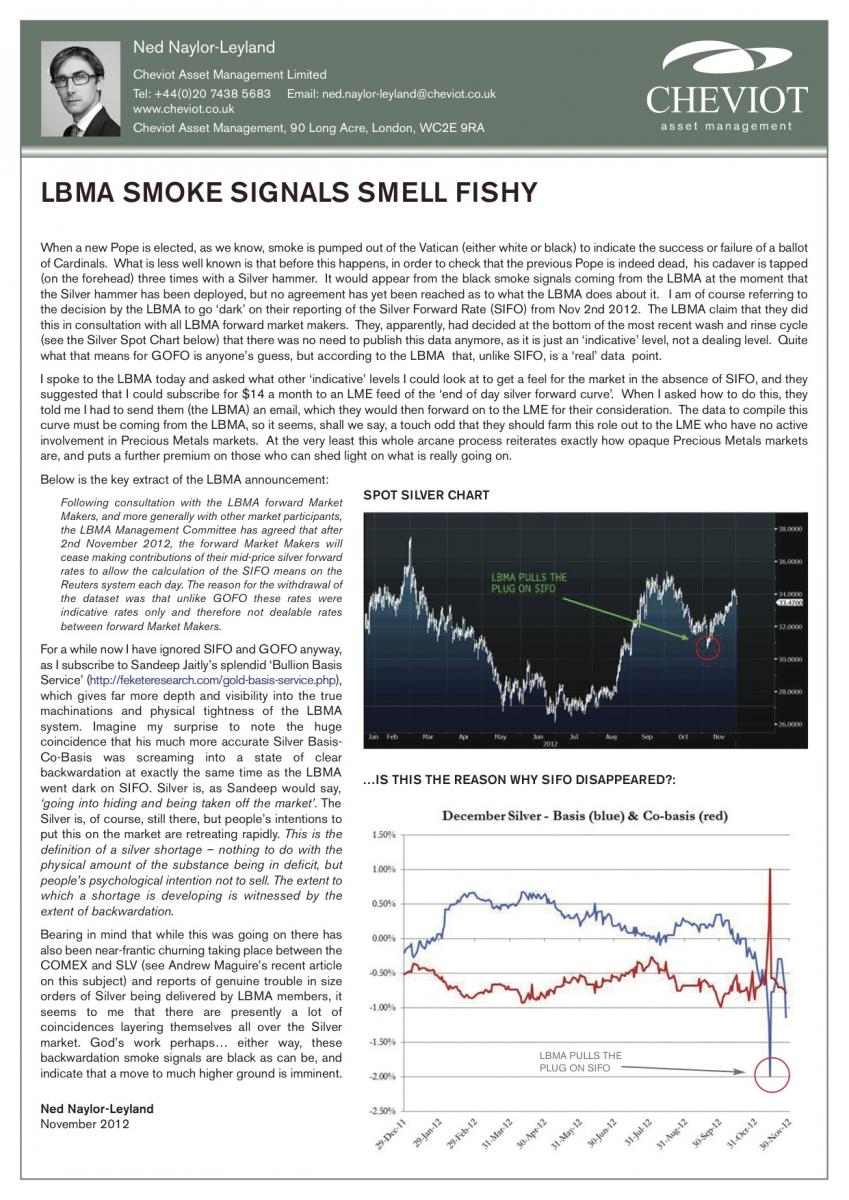
No comments:
Post a Comment