


Gold World News Flash |

- GoldSeek.com Radio Gold Nugget: Charles Goyette & Chris Waltzek
- 55 Facts About The Debt And U.S. Government Finances That Every American Voter Should Know
- Asian Metals Market Update
- Tom Cloud: When is a Kangaroo Better Than an Eagle?
- Golds Final Leg Down in Progress
- Euro-Gold Hits 6-Week Low, Pullback to US$1700
- Gold Seeker Closing Report: Gold and Silver Fall With Stocks
- Trends in Motion
- Gold 1715 Viewed as Probable Support
- Richard Russell - What Current & Future Generations Face
- Guest Post: Should Central Banks Cancel Government Debt?
- JP Morgan Enron Chase
- Nigeria’s Oil and Gas Fiasco
- Guest Post: Thoughts On Roman Circuses (And Ours)
- Citi On The Election: "Ignore Pundits & Partisans; HuffPo Data Says Obama"
- The Gold Price Lost $8.20 Closing at $1,743.30 Keep Watching for Great Buying Opportunities
- All markets in pre-election rigging, Embry tells King World News
- Breakout!
- Supply Demand Fundamentals Point To Powerful Rebound In Uranium Mining Stocks
- Embry - London Trader, Commercials & A Spike In Gold
- Will an OPEC Nation's Runaway Inflation Spark an Oil Bull Market?
- Will an OPEC Nation’s Runaway Inflation Spark an Oil Bull Market?
- China Grabs Aussie Gold. Sales Soar 900%
- Gold Daily and Silver Weekly Charts - It Never Gets Old
- Uranium Stocks at Two-Year Lows, Investors Pounce Now and Ride the Upswing
- Gold’s Final Leg Down in Progress
- Gold's Final Leg Down in Progress
- Gold’s Final Leg Down in Progress
- Correction in Gold and Silver Stocks Nearing End
- Von Greyerz sees 'incredible' intervention against gold and silver
| GoldSeek.com Radio Gold Nugget: Charles Goyette & Chris Waltzek Posted: 19 Oct 2012 09:00 AM PDT GoldSeek.com Radio Gold Nugget: Charles Goyette & Chris Waltzek
|
| 55 Facts About The Debt And U.S. Government Finances That Every American Voter Should Know Posted: 19 Oct 2012 01:00 AM PDT from The Economic Collapse Blog:
Read More @ TheEconomicCollpaseBlog.com
|
| Posted: 19 Oct 2012 12:05 AM PDT Gold and silver traded with a softer bias yesterday as demand from India was muted. Below par demand from India at the beginning of festival season has dashed hopes of higher sales for the rest of the festival demand. A weaker Indian rupee against the US dollar has resulted in a rise in Indian gold prices.
|
| Tom Cloud: When is a Kangaroo Better Than an Eagle? Posted: 19 Oct 2012 12:00 AM PDT Dollar Collapse
|
| Golds Final Leg Down in Progress Posted: 18 Oct 2012 10:56 PM PDT Gold Scents
|
| Euro-Gold Hits 6-Week Low, Pullback to US$1700 Posted: 18 Oct 2012 10:21 PM PDT Bullion Vault
|
| Gold Seeker Closing Report: Gold and Silver Fall With Stocks Posted: 18 Oct 2012 10:00 PM PDT Gold bumped up to $1751.29 in Asia before it fell to $1737.90 by about 8:30AM EST and then rallied back higher into midday, but it then fell back off again in afternoon trade and ended with a loss of 0.44%. Silver slipped to as low as $32.67 and ended with a loss of 1.24%.
|
| Posted: 18 Oct 2012 09:41 PM PDT [B]This outlook applies to Gold, Silverand the XAU since their structure, trends and cycles are quite similar and isan update to "Expectations" posted earlier.[/B] [B]The daily time frame TDI trendsfor these markets continue negative. The weekly trend is still positive and themonthly time frame is work in progress. [/B] Monthly Trend in Motion First, a brief history on the critical monthly trend which is themain event on a long term basis. To reiterate from the 9/22/12 article"Autumn Gold" [COLOR=#e06666]here....[/COLOR] "A [COLOR=#e06666]monthly[/COLOR] trend change is still work in progress and in October,will require some patience. In particular, note that the XAU has gained 32%since its last double bottom low, gold 16% and silver 32%. Not a good placefor new positions. If a successful monthly TDI trend change occurs inthe next six weeks, it would be a crucial event that would... [LIST] [*]Imply a multi-month advance in gold, silver and the XAU with all daily and wee...
|
| Gold 1715 Viewed as Probable Support Posted: 18 Oct 2012 09:30 PM PDT courtesy of DailyFX.com October 17, 2012 04:27 PM Daily Bars Prepared by Jamie Saettele, CMT “Gold has finally done something after consolidation at the top of the multiyear range for several weeks. The sharp break has resulted in a test of the 23.6% retracement of the advance from the late 2011 low. The area is also defined by September congestion. This is a level that could produce a low although 1715 (9/13 low) is probably stronger. The drop has shifted reward/risk to bulls against the 9/7 low at 1689.” LEVELS: 1715 1728 1737 1754 1770 1780...
|
| Richard Russell - What Current & Future Generations Face Posted: 18 Oct 2012 09:23 PM PDT  Today the Godfather of newsletter writers, Richard Russell, writes, "My kids and your kids and grandkids will curse the day when the Federal Reserve was secretly made master of the US monetary system." Russell discussed gold, the Fed, market timing, and even Google in his latest note to subscribers. Here are Russell's thoughts: "I'm torn between two emotions. I want to be bullish for the good of the nation and for the good of my five kids. But I'm miffed at myself because I wasn't bolder and because I didn't tell my subscribers to hop in on the bull side and play this rally." Today the Godfather of newsletter writers, Richard Russell, writes, "My kids and your kids and grandkids will curse the day when the Federal Reserve was secretly made master of the US monetary system." Russell discussed gold, the Fed, market timing, and even Google in his latest note to subscribers. Here are Russell's thoughts: "I'm torn between two emotions. I want to be bullish for the good of the nation and for the good of my five kids. But I'm miffed at myself because I wasn't bolder and because I didn't tell my subscribers to hop in on the bull side and play this rally."
This posting includes an audio/video/photo media file: Download Now |
| Guest Post: Should Central Banks Cancel Government Debt? Posted: 18 Oct 2012 08:38 PM PDT Submitted by Pater Tenebrarum of Acting-Man blog, [Take a breath, grab a drink, and read this - it is lengthy BUT important!] Ron Paul's Foray Into Monetary EducationReaders may recall that Ron Paul once surprised everyone with a seemingly very elegant proposal to bring the debt ceiling wrangle to a close. If you're all so worried about the federal deficit and the debt ceiling, so Paul asked, then why doesn't the treasury simply cancel the treasury bonds held by the Fed? After all, the Fed is a government organization as well, so it could well be argued that the government literally owes the money to itself. He even introduced a bill which if adopted, would have led to the cancellation of $1.6 trillion in federal debt held by the Fed. Paul argued that given the fact that the Fed had simply created the money to buy the bonds from thin air, no-one would be hurt by this selective default. Moreover, he reckoned that this would likely neuter the Fed and make it less likely to manipulate the money supply in the future – if it could no longer rely on the treasury honoring its debt, there would be no point in buying more of it. He also considered the Fed's 'exit' talk to be spurious: the inflation of the money supply its bond buying had inaugurated would likely never be reversed anyway (we agree on this point). Of course the proposal was not really meant to be taken serious: rather, it was meant to highlight the absurdities of the modern-day monetary system. Paul himself pointed out in subsequent interviews that the proposal would naturally never be adopted. In short, it was essentially an educational foray on his part - he wanted to encourage people to think. Ron Paul has always been an exception among politicians – he regarded educating people about monetary policy matters as part of his remit. We live in an age where a pure credit money is used – a fiat money, that has been created by stripping money substitutes of their backing by money proper and imposing 'legal tender' laws. This means that certain conventions have to be followed by the official engines of inflation, the central banks, if they want to be successful in their vain (and dangerous) endeavor to create what they term a 'stable money' (in reality, 'stability' is held to be an arbitrarily chosen decline in money's purchasing power of 2% per year. This neither represents 'stability', nor is it even possible to realize such a plan. The purchasing power of money certainly exists, but it cannot be measured). These conventions need to be adhered to in order to hold 'inflation expectations' in check. As long as a critical mass of individual actors in the economy remains convinced that the central bank is indeed capable of guaranteeing a fairly 'stable value of money', it is unlikely that they will react to inflationary policy by trying to quickly get rid of their cash balances in the expectation that its purchasing power will rapidly decline. As a rule, it takes a long time for people to abandon this misguided faith, but when they finally do, we often get to observe a discontinuous, sudden change in the money relation. Anyway, it is one thing for Ron Paul to employ the idea of canceling the Fed's bond holdings as a means of educating people, it is quite another when modern day mainstream economic observers and even policymakers begin to discuss the possibility in earnest.
The Financial Times Latches on to the TopicSometimes the bien-pensants that regularly supply us with their plans to rescue the economy come up with strikingly bizarre ideas. The Financial Times is a well-known staging area for armchair monetary quackery, led by its chief economics commentator Martin Wolf, whose in our opinion absurd notions we have occasionally addressed in the past. At least Mr. Wolf is fairly straightforward – instead of hiding behind technocratic babble and euphemisms, he gives his articles titles that tell one right away where he is coming from (consider for example: "Why it is right for central banks to keep printing"). What might be considered the 'piece de resistance' in this context has recently been covered in the pages of the FT in an article by Gavyn Davies entitled: "Will central banks cancel government debt?". The article discusses the very proposal Ron Paul has more or less made in jest (and as a means to educate people) as a policy step that is receiving serious consideration. To his credit, Mr. Davies informs us that he is actually not supportive of the idea. He merely reports that it is an option that a number of people have begun to earnestly debate and lays out the effects as he sees them (we differ with him on a number of points regarding 'QE as it is currently practiced', see below). In a way, we would actually not necessarily be entirely inimical to the idea, for similar reasons Ron Paul had in mind: it would no doubt speed up the inevitable demise of the fiat money system. Although we fear that the current fiat money system would then simply be replaced by another one, this is still the only reasonable chance we see for the conditions that could enable a return to a sound market-based monetary system to come about. It should be clear that today's political class and the banking cartels led by the central banks would never consider the adoption of a sound market-based money voluntarily. Too many 'free lunches' would be at stake for those profiting from the system. An enormous shift in economic and political power would result. Governments would have to shrink dramatically and central economic planners and their myriad advisers and intellectual handmaidens would all be out of a job. Banks would find credit expansion more risky and difficult. In short, from the point of view of today's bureaucratic and intellectual elites, the idea of voluntarily adopting a sound market-based money is ruled out completely. To them it is undoubtedly the most toxic subject imaginable. This is also why the system as such is very rarely questioned in the mainstream press or by mainstream economists. It is a topic that is not even up for debate – everybody proceeds as though it were perfectly normal that money and interest rates are subject to central planning. The only debates revolve around how to 'improve on the plan', not on whether it might actually be better to abandon the plan altogether. If a mainstream economist were to suggest that central banks and fiat money should be abolished, it would be akin to farting in church. So in this sense, Davies' article may be regarded as one of those 'how the inflationary policy might be improved' missives (even though he is personally not in favor of the proposal). It calmly discusses the possibility that central banks might indeed agree to cancel the government debt they hold in order to 'ease fiscal pressures' and 'boost the economy'. We will look at a few excerpts from the article in below and add our comments.
Should Central Banks Cancel Government Debt?The article begins as follows:
We already have a problem with the very first paragraph. Davies asserts what we regard as a misguided premise: namely that 'loose fiscal policy' (read: deficit spending) is required to create economic growth. The government does not possess resources of its own – every cent it spends must be taken from the private sector in one way or another. The government can not add one iota of new wealth to the economy – it can only dispose of already existing wealth by taking it from the private sector. It matters not if this is done by means of taxation or borrowing – the latter method is merely a means of deferring the former (we will discuss inflation further below). In order to believe that this will create 'economic growth', one has to believe that government bureaucrats are better at allocating scarce resources than the private sector. This seems an absurd proposition to us. Since government bureaucrats are not driven by the profit motive in their allocation decisions, they have no means of ascertaining the opportunity costs of their actions. They are faced with a somewhat milder form of the socialist calculation problem – 'milder' only because they can observe prices in the market economy and are thus not entirely groping in the dark. The only sense in which government spending can be said to add to 'growth' is the fact that it is treated as a positive contributor to GDP. However, this merely reveals that GDP is a very flawed measure of wealth creation. Davies continues:
There is a good reason why no central banker has entertained the idea yet, at least not publicly. The manner in which the banking system is organized today is inter alia designed to obfuscate the realities of the monetary system. It is important to realize that fiat money is indeed 'backed' by absolutely nothing. In a fiat money system, the bank notes issued by the central bank literally are standard money. Banknotes once were money substitutes, this is to say they represented a claim to gold held in reserve by the issuing bank. Their use as money was merely a matter of convenience – but it was clear that the bearers of such notes could actually redeem them at any time for what was then considered money proper, i.e., gold or silver. In essence, such banknotes were simply warehouse claims on deposited money. Fiat money by contrast consists of bank notes that have been stripped of this feature: they are irredeemable. Their 'moneyness' has been established by fiat, this is to say, what renders them the sole legal means of final payment for goods on the market and the 'discharge of debt, both public and private' are legal tender laws. The 'backing' in the form of assets held by the central bank is in this sense a fiction: no-one can go to the central bank and demand that it redeem its banknotes for a portion of the assets it holds. However, from the central bank's point of view, it is important to uphold the vague idea that 'something stands behind' the money it issues. Moreover, it uses the assets it holds as the main tools to conduct monetary policy, i.e., to manipulate interest rates and the size of the money stock. The much-touted 'credibility' of central banks today rests crucially on the idea that they can and will take back the money supply inflation engendered by 'quantitative easing' at any time, 'if necessary' – i.e., if the purchasing power of money begins to decline at an accelerated rate that violates the tenets of the 'stability' policy. The danger that this could happen is very real, considering the expansion in central bank credit in recent years and the vast monetary inflation that has taken place since the end of the great asset mania of the 1990's (to be sure, a lot of money supply inflation has occurred earlier as well – but it has accelerated enormously since the year 2000). As an example, consider US money supply data:
The broad US money supply measure TMS-2 since the year 2000. (Chart via Michael Pollaro – for an in-depth explanation of the money supply measure TMS-2, visit his definitions and references page, where all the required information can be conveniently found in one place) – click chart for better resolution.
It is worth noting that the broad US money supply TMS-2 has increased by more than 200% since January of 2000 (from approximately $2.9 trillion to $8.8 trillion today). Prior to the crisis of 2008, the main driver of the money supply expansion was the commercial banking system, which in the course of expanding credit to the private sector created a lot of deposit money from thin air via the fractional reserve banking multiplier. The Fed was only passively aiding and abetting the process, supplying new bank reserves as needed and keeping the federal funds rate artificially low by means of open market operations. Since 2008 the role of the Fed has become more active: the policy of 'quantitative easing' has created a lot of new deposit money directly through the acquisition of assets from non-banks, while vastly increasing the excess reserves of banks (for details on this process, readers may want to take a look at two previous articles: "Quantitative Easing Explained" and "The Difference Between Money and Credit"). The latter are not considered part of the money supply as long as they remain deposited with the Fed – but they can of course be used as the basis to create more credit and with it, additional fiduciary media in the form of new deposit money. The extent to which banks may want to use their excess reserves for this purpose will largely depend on their assessment of future economic conditions and their own financial health, as well as credit demand. The interest rate paid by the Fed on excess reserves is also an important determining factor.
A chart of Federal Reserve credit outstanding: since 2008, the central bank has become the active driving force behind money supply inflation – click chart for better resolution.
Obviously, from the central bank's point of view there is a not inconsiderable risk that the extremely large money supply expansion over the past 13 years could lead to a sudden loss of faith in the future purchasing power of money (it is no coincidence that Ben Bernanke repeatedly dwells on the subject of 'inflation expectations'). Presumably there is a threshold at which the ongoing increase in the money supply will no longer be sufficiently counterbalanced by the increase in the demand for money that has undoubtedly taken place in recent years. To be sure, there is no way for us to measure the demand for money. We can only infer that it must have increased from the fact that economic uncertainty has been uncommonly high since the 2008 crisis and from the fact that the the monetary inflation has not yet resulted in a large increase in consumer goods prices. However, keep in mind that we can also not ascertain how much lower consumer goods prices would have been absent the inflationary policy; and it is clear that many prices in the economy have indeed risen sharply, chiefly stocks, bonds and commodities. In other words, the absence of large consumer goods price increases is not evidence of the absence of inflationary effects. If central banks were indeed to simply cancel the government debt they hold, economic actors would likely rapidly lose their faith that central banks have 'inflation under control'. Here is Davies explaining why:
However, the central banks have indeed 'printed' the money to buy government bonds and other assets in their 'QE' operations. Obviously this does not involve the 'restraining factor' of government bond sales to the public as discussed by Davies above. The question is really whether the so far hypothetical 'exit' from these operations will ever take place. It should be noted here that by buying bonds in the secondary market rather than directly from the government, the inflationary potential of these central bank purchases is mitigated somewhat (for an explanation of this point see the above mentioned article on the mechanics of QE). Here is what Davies has to say to the 'exit' question and why he thinks the 'restraining effect' of conventional deficit financing still applies:
(emphasis added) However, as we have already mentioned above: what makes everyone so sure that these bonds are only 'temporarily parked at the central bank'? Both the ECB and the Fed have frequently talked about how easy it will be for them to exit the vast positions they have amassed under their unconventional policies (the ECB's policies have thus far been technically slightly different from the Fed's, but have involved just as big an increase in central bank credit). In practice, they have not only not 'exited' thus far, they have massively expanded their balance sheets further and have promised to engage in even further rounds of monetary pumping going forward. The 'exit' talk is just that: talk.
The vast increase in ECB credit (chart via Michael Pollaro) – click chart for better resolution. Moreover, the money supply expansion e.g. the Fed has engendered is very real. It would certainly not make any sense to assert that it has had no economic effects, regardless of Davies' hopeful and probably erroneous expectation that "in the long run the amount of government debt held by the public is not reduced by QE". Does anyone seriously expect the Fed to actively deflate the money supply at some point in the future? Conceivably the Fed may attempt to reduce excess bank reserves, if the commercial banks started extending inflationary credit again at a sufficient pace to keep the money supply expansion going. However, we know from the Bank of Japan's attempt to do just that in 2006 that such balance sheet contractions enacted by the central bank don't tend to last very long these days. When the BoJ reduced Japan's monetary base by 25% almost overnight in 2006, it inadvertently issued a death sentence for numerous bubbles abroad, as the yen was used as a major funding currency for 'carry trades'. One of the bubbles it probably helped to deflate was the US housing bubble (to be sure, US and euro area money supply growth had also decelerated into the low double digits by 2006, so there was a marked reduction in the pace of monetary pumping everywhere). Almost needless to say, the BoJ has pumped its balance sheet back up again following the 2008 crisis. In addition to denying that there are any significant economic effects stemming from 'QE' type debt monetization (why should there be no economic effects? If that were true, why would central banks engage in 'QE' at all?), Davies falls prey to another error. This is actually an argument frequently forwarded by the chartalists as well (or proponents of 'MMT' as it is called today) – he denies that there is a fundamental difference between money and credit instruments:
(emphasis added) Money is not merely a somewhat 'more liquid asset' than a bond. Money is the medium of exchange, the means of final payment for all goods and services on the market. It makes a big difference if the public suddenly holds more money instead of holding the bonds the central bank has acquired. A bondholder must first sell his bonds to someone else in the private sector before he can spend the money invested in them. This means though that the buyer now holds a credit instrument instead of money that he can spend (respectively allocate to other investments or his cash balance). There are in fact a great many economic effects – it seems to us that they are not exactly 'limited' in scope at all. We already mentioned the distortion in relative prices that is the inevitable result of the inflationary policy. In fact, it is impossible for the price system as a whole not to be entirely revolutionized by an expansion in the money supply. It is a good bet that nearly every price in the economy is different from what it would have been in the absence of the money supply increase. Below is a chart that we have already shown on previous occasions that documents one of the major economic effects that this price distortion furthers (admittedly it affords us only a very rough glimpse of what is a very complex process):
The ratio of spending on bu |
| Posted: 18 Oct 2012 08:32 PM PDT from Silver Vigilante:
The bank remains standing tall above the regulator offices of the US. Either individuals are worried that a Mexico-style fatwa on opposition to the debt-dealers will foment or they merely are living a bit more comfortably with the hours they've picked up moonlighting for banks. Or maybe the regulators know the wrath that will befall the public if the bank's become truly reigned in.
|
| Posted: 18 Oct 2012 07:18 PM PDT Wolf Richter www.testosteronepit.com www.amazon.com/author/wolfrichter Mass violence is just about a daily occurrence in Nigeria. This week, for example, “at least” 24 people were killed in Maiduguri, a city of over 1 million people in Borno State, north-eastern Nigeria, when the military skirmished with the radical Islamist sect Boko Haram. On Wednesday, a bomb exploded in Potiskum, a city of 200,000 people, in Yobe State, killing a police officer. Boko Haram likely targeted the military, which responded with door-to-door searches and burned down “at least” four houses. Gunshots were fired throughout the day. The same day, police disclosed that “at least” 30 people were killed in Benue State in Central Nigeria, when nomadic Muslim herdsmen attacked a village of Christian Tiv people. The oil industry in the Niger Delta hasn’t been spared either. Nigeria is the largest oil producer in Africa and has the ninth largest proven natural gas reserves in the world. Oil accounts for 95% of its export income and 40% of its government revenues. The sector currently produces about 2.13 million barrels per day (bbl/d), though it has the capacity to produce over 3 million bbl/d, if it weren’t for this nightmarish scenario—described in the dry manner of the US Energy Information Agency:
Development of natural gas resources has been handicapped by limited infrastructure, such as pipelines and LNG export terminals. Even natural gas from oil wells cannot be used for electricity generation and is therefore flared. Why? According to an estimate by the International Energy Agency, the electrification rate for the country is only 50%, leaving 76 million people without access to electricity. And those with access don’t get very much: installed capacity is only 6 GW, the equivalent of three larger power plants in the US—for a country of 170 million people. Hence, of its total energy consumption, 82% is from wood, waste, and similar materials used for heating, cooking, etc., particularly in rural areas. So the government is talking about plans to improve the electricity infrastructure and create 40 GW of new gas-fired capacity by 2020—a huge jump. These plants would be able to use the gas that is now flared ... which would require equipment and infrastructure to treat and transport the gas, which is the problem to begin with. And so, plans have a way of dissipating into the urban muck. Take the Petroleum Industry Bill (PIB). Introduced in 2008, it was supposed to finally create a regulatory framework for the oil and gas industry and alleviate some of the investment headaches. It’s still not passed. So the nightmare continues:
Nigeria has a big goal: increase production to 4 million bbl/d. In 2005, it reached 2.63 bbl/day. But then militant violence surged, including kidnappings of workers and takeovers of rigs. Companies withdrew their people. By 2009, production had plunged 25%. That year, an amnesty deal was negotiated with the militants. But it didn’t stop the problems. Pipeline vandalism and oil theft skyrocketed 224% in 2011 from prior year—thieves might puncture pipelines, or steal the black gold from the wellhead, or, ingeniously, fill up their tankers at the export terminal. Some of this crude ends up at illegal refineries in the swampy area of the delta, some of it on the international markets. In April alone, the staggering quantity of 400,000 bbl/d was pilfered, pushing official oil sales down 17%. Incidentally, the US is still the largest export market for Nigerian crude. But rising production in the US has driven down all crude imports, with a disproportionate impact on Nigerian crude, down to a 5% share, from 11% in 2010 [ The Coming American Energy Independence]. Sabotage, theft, and decrepit infrastructure have caused about 2,400 oil spills between 2006 and 2010, contaminating soil and water, destroying fish stocks and agriculture, and depriving locals of their livelihoods—which has given rise to additional tensions. And there are pirates: in the Gulf of Guinea, 53 piracy attacks occurred in 2011, up from 47 the year before, resulting in harmed crew members and stolen crude, and impacting deepwater operations that had mostly been spared. When I traveled overland through Africa, I ran into Nigeria for the first time in Togo. The official language is French in Togo, but Nigerians speak English—and they were everywhere. One evening, an acquaintance in Lomé unloaded: Nigerians were crooks and thieves, he said, and no one wanted to deal with them. He had gotten hit. Three times. With stolen credit cards and forged CFA francs. Nigeria was falling apart, he said, and Nigerians were spreading out all over the place. They were economic refugees, so he wanted to give them the benefit of the doubt, but…. And his voice trailed off. That life-changing journey through 24 African countries is subject of a forthcoming book, the third in the series. The first is available now: BIG LIKE: CASCADE INTO AN ODYSSEY—a “funny-as-hell nonfiction book about wanderlust and traveling abroad,” a reader tweeted. Read the first few chapters for free on Amazon. And here is Marin Katusa’s must read: Will Iran’s Runaway Inflation Spark an Oil Bull Market?
|
| Guest Post: Thoughts On Roman Circuses (And Ours) Posted: 18 Oct 2012 06:48 PM PDT Submitted by Jim Quinn of The Burning Platform blog, From history, we can glean more than just the bare facts of the decline and fall of the Roman Empire. First, one has to understand that before Rome slowly toppled into dust, it was a very prosperous place. There was distinct upper, middle, lower and slave classes and, all in all, there was more than enough to eat and time to spare for numerous sports. Also, the Roman Legions were the largest and strongest, best trained and fed, best equipped with hardware aplenty of any nation-state-empire in the world at that time. Very similar, in fact to the U.S.A. (less a lot of technology).
Like all civilizations, once in a position of being fairly rich, having food aplenty and the good life, the better classes of Roman citizens got bored with it all. I mean how often can you discuss the latest conquest of some unknown and barbaric place, long removed from Rome or a new and flavorsome dish imported for some outpost of the Empire, or the latest dalliance of the current Emperor with some Egyptian babe. So, what to do. A bored lower, middle and upper class of citizens tend to get into mischief when not productively employed and, with having slaves in good supply, can afford a minimal workload. As time progressed and the spoils of Empire Building and Conquering, Inc. flowed into Imperial Rome, there was a natural impulse on the part of the ruling elite to pass along a bit more of the spoils to the populous lest they become jealous or perhaps a bit rowdy at the obvious top-heavy distribution of the goodies. The elites lived very well in Imperial Rome. But food and trinkets will stretch only so far—ah, what to do after you've eaten your fill, tummy full and had a nap? Well, you play, that's what. You need something to fill those idle full-stomached hours and so the elite once again come to the rescue. Let's have some circuses come to town. Starting out with traveling entertainment groups, shows were put on of many sorts from dancing and singing to – ah – traveling trollops who entertained in their own inimitable way. And another thing. We've got plenty of captured enemy soldiers, why don't we build a pit, toss a few into it – well armed with, perhaps, some novel weapons like nets and forks and cudgels and see who comes out alive! What a wonderful idea. While we're at it, there are a few pesky Christians we have to house and feed, perhaps they might like to play with some of those marvelous feline creatures our Legions have captured and sent back from places afar. We'll starve the kitties for a few days, put a small group of trouble making religious bigots into the pit and see if they can play with a hungry cat or two. Such fun! The smell of blood, guts and glory in the afternoon would be just the thing to entertain those bored citizens and keep their mind off the fact that we (the elite) are robbing them blind while doling out just enough for the lesser classes to keep them quiet, satiated and out of trouble. And so the grand Colosseum and other assorted playgrounds were constructed to provide a location for circuses while markets were built to provide free food and handouts to those of lower wealth and standing.
Does anything about this description ring a faint bell? Let's pop our trusty time machine forward a few thousand years to, let's say, 2012 CE. (for those who wonder about the "C.E.", that's scientific notation for "Current Era". Prior to year zero, it becomes "B. C. E." for "Before Current Era" thereby erasing any Christian influence from our dating system. This is in wide and accepted use now in scientific circles.) In 2012 in the Nation called "America", we have some interesting and disturbing parallels to ancient Rome. Such as, you ask? Oh, let us do a few comparisons. In America, as in Rome, the elites are promising the middle and lower classes more and more bribes (food stamps, welfare, disability, housing subsidies, unemployment checks, social security, free medical care and so on and so on) to stay quiet and behave. As with Rome, this was only successful until the food, circuses, graft, and thievery caused such a drain on the treasury that the Roman Legions found themselves running short of funding and consequently shrank a bit, thereby reducing the booty shipped back home. This, in turn, reduced the freebies to be distributed to the "needy". A viscous circle was then in place in which each cut to the military caused a drop in booty that caused the military to shrink and Rome itself to become a Lesser Power with Lesser Influence on its world. After all, we can't cut the freebies to the "needy" so money is diverted from other activities (can you spell "clipping" and dilution of gold and silver from the coinage or as we might say, "inflation"?) to cover the ever increasing costs of bread and circuses and military. In our miserable case, American elites can only promise and pay for freebies to the masses as long as other nations of the world keep buying Treasury debt and the purchases of Federal debt by the Federal Reserve do not become so excessive that the rest of the world (and American citizens) lose confidence in our veracity and begin to think of the U.S. Government as merely a group of thieves and knaves, unworthy of their further donations of hard earned (or printed) cash. Which, of course, they already are and just are not branded as such. But they are about to be. At the same time, American circuses are in full swing across the land of the not-so-free and the home of the responsible-no-more. Thanks to the ever advancing thing called technology, clever humans have invented virtual circuses; circuses that require no tents, no clowns, no bearded ladies, no strong men or midgets, no motordrome with motorcycles roaring, no ferris wheel or tilt-a-whirl or cotton candy or too heavy bottles to knock over with a too light a ball. Real gladiators need not apply. Oh no!! Our circuses are virtual in that you carry them around with you, by the hundreds, in your pocket or purse or have it on your desktop. You are now – whether rich, middle class or poor, working or not – always within instant reach of your virtual circus. Within that virtual circus lies unlimited feasts of every kind: games, blogs, movies, tweets and books of faces, bank accounts and grocery stores, every retailer on the planet, Russian TV and – horrors – blogs (for those who yearn for news not to be found on our toothless and pap-filled U.S. mass media), maps and translators, idiots and morons, sages and teachers of every level and veracity. It is an infinite circus, running 24 hours a day, 8 days a week and you can spend an infinite amount of time browsing the sweet and bitter end of it at no charge. (Those sites that have the temerity to charge admission can safely be ignored.) Now, does that beat a Christian being munched by a tiger or two hulks beating each other to the death? Well, perhaps not the later as professional wrestling is one of the most popular events for the masses to gobble – so maybe even totally fake and choreographed gladiators still have a place in the proletariat heart. I personally believe that the ever evolving circus (next comes 3D! and perhaps a touch screen that works in reverse?) beats the living bejeebus out of a Roman version and is, as a consequence, contributing to the destruction of the human spirit. Why work when your food and cave are furnished to you by a benevolent nanny Government which leaves you to be entertained by your virtual circus (access to which is probably paid for by that nanny caregiver as well)??? Why become self-sufficient and independent amid all this largess? Paid for, of course, by borrowing from foreigners and a generation or two down the line who won't know what hit them until far too late. Such fun! Perhaps we are indeed on the cusp of a Romanesque disaster, a slow motion collapse that took Rome several hundreds of years to do, getting poorer and poorer and more violent and less populated as time goes on. History will certainly repeat, but never the same way twice. This time, the very framework of those circuses – what they exist on and in – will enable the fall of the current empire(s) to be much swifter and just as violent and deadly. Our ability to communicate worldwide in a flash at the the speed of light enables information – both good and bad – to be heard and seen round the Earth in mere milliseconds and the only delay is the relative slowness of citizens to find, read or watch and comprehend the disaster that will tip it all into the pit. So here we stand, on the edge, citizens mostly well fed, clothed, housed and most of all, thoroughly entertained. What happens to all of us when the plug is pulled?
|
| Citi On The Election: "Ignore Pundits & Partisans; HuffPo Data Says Obama" Posted: 18 Oct 2012 05:16 PM PDT With less than 20 days to go to the election, the Presidential race has tightened following Romney's performances in the debates, as the Republican challenger has overtaken the president in the national averages for the first time this year (and RealClearPolitics has him with an edge in the electoral college also). But ever the fair-and-balance bank, Citi believes that Obama's advantages remain substantial, as an incumbent president in an improving economic environment. In this broad discussion, the Pandit-less bank addresses 'the data' driving their Obama call, what would have to happen for a Romney win, the Senate and House split, The Tea Party (and other unusual events), and the 'bungee jump'-causing headline risk of the pending Fiscal Cliff debate.
Via RealClearPolitics (today):
Citi: The Data-Driven Case for an Obama Victory Since August, we've argued that President Barack Obama is likely to be re-elected to a second term. Our view, based on a political science assessment, derives from Obama's year-long lead in the polls and from the marginal improvement in the US economy. While the race has tightened over the past two weeks, we nevertheless reiterate our call, while underscoring that the president's lead has narrowed and the race has returned to the state of play of late summer, prior to the conventions. In our view, investors should focus on the political fundamentals. With over 500 polls having been conducted in the United States this year, we pay attention to the totality of the data and to the main trends. This focus on rolling averages makes more statistical sense, and it avoids the 'house effects' that come along with a reliance on any individual polling outfit. Despite Governor Mitt Romney's recent bounce, Obama maintains his lead in the Pollster.com rolling average. The Real Clear Politics average is subject to more volatility, and showed Romney leading between October 9 and October 16.
This year-long lead is important because, historically, incumbent presidents who have led their challengers all year have gone on to be re-elected, while incumbent presidents who fall behind have been defeated. These incumbents were often behind as early as May (i.e. five months ago). The conventional wisdom is often flatly incorrect here. As we discuss later, 'come from behind' victories are incredibly rare, if indeed they've ever happened. At the same time, as we noted in September, the US economy hit its lows three years ago and is not in recession today, and the swing states have added almost a million jobs. Looking at other elections in mature industrialized economies in the past year, leaders presiding over countries with positive economic growth, even nominal growth, have tended to be re-elected, while those where the economic indicators were going into reverse have been voted out of office.
Why Not Romney (Yet)? Governor Mitt Romney's poll numbers have surged since his strong performance in the first debate on October 3. Will it be enough to see him to victory? After a week, some commentators suggest that the Romney bump may already be receding, with all eyes focused to see if the momentum can continue. Romney's favorable ratings, long a persistent liability, have improved six points over the past month and 15 points since the peak of the grueling Republican primaries. Romney enters the end of October a far more popular candidate, but still one struggling to win over a majority of voters. Favorability ratings are highly correlated with election results, and Romney was hampered by his "upside down" ratings all year.
Bush-Gore Redux? No. The closeness of the race raises the possibility of a Bush-Gore situation, where the victorious candidate wins the Electoral College but loses the popular vote. This eventuality, which has only happened once in the past 124 years, is highly unlikely. Obama still leads overall, and in an electorate of 140 million even a 1% victory means a margin of almost 1.5 million votes. Furthermore, arithmetic suggests that Obama's margins of victory in the larger swing states of Ohio and Pennsylvania should more than balance out Romney's margins should the latter win Florida. Anything is possible in politics, but we feel comfortable putting a negligible probability on this scenario.
'Come From Behind' Elections, and the Lack Thereof That Romney has been able to repair his image, damaged by hard-fought Republican primaries and gaffes like his "47%" comment, is significant. This trend is the best single argument to be made for new strength underlying the Romney campaign. Favorability is far better correlated with electoral outcomes than economic indicators which, as we've demonstrated, are not very predictive. So with three weeks left, what are the prospects that Romney can come from behind to win? A review of past elections shows that the leader in Gallup's October polling has gone on to win in almost every case since 1948. This year, Obama is the October leader. A rolling average of Gallup's polling this month, provided by Pollster.com, shows Obama with a 2-point lead.
And even Gallup's two 'come from behind' cases are problematic. The 1948 campaign is remembered for Truman's relentless whistle-stop tour and that famous "Dewey Defeats Truman" headline. But polling was in such a primitive state at the time, it's difficult to know whether Truman's campaign was truly in jeopardy. As we have previously noted, the typical narrative of the 1980 campaign, where Reagan swung the election in the final weeks, is flatly wrong. As usual, we look at the totality of the data. Carter – hobbled by vigorous opposition inside the Democratic Party, economic "malaise" and the Iran hostage crisis – trailed Reagan as early as May. This year, a number of commentators have been quick to point this out. As mentioned, endangered incumbent presidents trail their challengers long before Election Day. Should Romney manage to buck this trend, it would be a first in modern presidential history. To us, the rarity of this event is another argument in favor of our base-case scenario: Obama by a nose in November. Democrats on Top in US Senate We also reiterate our earlier view that the political status quo will continue after the US election: Obama in the White House, Republicans in the US House, and Democrats in the Senate. Republican chances to win the Senate have receded since our last update. Of the ten Senate races we identified as competitive according to the polling data, Republicans lead today in three (Arizona, Indiana, Nevada), none of which is held by Democrats. Democrats lead in seven (Connecticut, Massachusetts, Missouri, Montana, North Dakota, Virginia and Wisconsin). Retirements will be a wash: Democrats will pick up Maine, while Republicans will pick up Nebraska. Other races, like Florida and Ohio, are not competitive and will be Democratic holds. Republicans need four seats to take control, but a Democratic lead in GOP-held Massachusetts may mean that Republicans could even lose a seat. Republicans appear to have fallen behind in Montana, North Dakota and Wisconsin, not to mention Missouri, where they led earlier in the cycle. Democrats hold only small leads there, as in Virginia and Connecticut. These states will be the chief battlegrounds over final three weeks.
Fiscal Cliff: 'Bungee Jumping' & Headline Risk After the election, Washington's focus will shift to the fiscal cliff. The outgoing 'lame duck' Congress will meet for another two months. Our basic thesis on the fiscal cliff has been simple: if you have the same players and the same situation, you should expect the same outcomes. Our base-case scenario is that the players remain the same: Obama in the White House and a divided Congress. We expect another piecemeal, short-term fiscal deal that temporarily resolves the fiscal cliff problem. The question is the timing: during the lame duck Congress, or in January after tax rates expire and sequestration begins? Only a handful of legislative leaders will be key players in fiscal cliff negotiations. This is a positive development for the prognosticator, because it means one can ignore the press statements from the pundits and even from most Members of Congress, because they will not be in the room when a deal is cut.
With the resolution of the fiscal cliff buried in the minds of only a few, it's impossible to forecast accurately how the sausage will be made.
Even so, we highlight these possibilities for investors:
The Unlikely Scenarios Though multiple outcomes are possible, we feel comfortable putting low to negligible probabilities on these cases:
A Note on the Tea Party In our view, the numbers don't support the argument by some observers over the past few years that there is undue 'Tea Party influence' over the US budget process. Today the Tea Party Caucus has 60 members, a fraction of the 241 Republicans in the US House.9 This proportion is enough neither to block legislation nor to unseat the Republican leadership, should they want to pressure Speaker John Boehner on these issues. (There are four Tea Party members in the US Senate, out of 47 Republicans there.) It is worth noting that despite Tea Party influence in the 2010 Congressional midterms, Mitt Romney is not a Tea Party member. Rather he was regarded as an establishment candidate in the Republican primaries, not the representative of any ideological or issue-based faction. (Congresswoman Michele Bachmann was the Tea Party candidate.) Congressman Paul Ryan is also not a Tea Party member. He would be considered a budget hawk, although many Tea Party members would certainly support him. So conservatives and Tea Party members would not see a Romney loss as a rejection of their beliefs. Almost all these members sit in strong Republican districts and will be re-elected this year. To us, this factors into the psychology of Members as they react to the elections and turn their focus to the fiscal cliff as we've described.
What Next? The next US President will face significant tests at home and abroad. The pressing issues of debt and the deficit will remain prominent, and foreign policy challenges will return to the fore. With January elections in Israel pushing back the imminent threat of an attack on Iran, the civil war in Syria at a stalemate, and the continued dynamics of a post-Arab Spring region, the Middle East will remain in the foreground in 1H 2013. Likewise, US policymakers will deal with the persistent economic crisis in Europe and with new leaders in China. 2012 has been a very political year for the United States, but worldwide political risk shows no sign of abating in 2013.
Source: Citi
|
| The Gold Price Lost $8.20 Closing at $1,743.30 Keep Watching for Great Buying Opportunities Posted: 18 Oct 2012 05:12 PM PDT Gold Price Close Today : 1743.30 Change : -8.20 or -0.47% Silver Price Close Today : 32.838 Change : -0.359 or -1.08% Gold Silver Ratio Today : 53.088 Change : 0.327 or 0.62% Silver Gold Ratio Today : 0.01884 Change : -0.000117 or -0.62% Platinum Price Close Today : 1641.20 Change : -26.80 or -1.61% Palladium Price Close Today : 647.50 Change : -6.20 or -0.95% S&P 500 : 1,457.34 Change : -3.57 or -0.24% Dow In GOLD$ : $160.66 Change : $ 0.67 or 0.42% Dow in GOLD oz : 7.772 Change : 0.033 or 0.42% Dow in SILVER oz : 412.60 Change : 4.22 or 1.03% Dow Industrial : 13,548.94 Change : -8.05 or -0.06% US Dollar Index : 79.38 Change : 0.298 or 0.38% Metals had a right bad day. The GOLD PRICE lost $8.20 of yesterday's $6.80 gain to leave it at $1,743.30. The SILVER PRICE also dug a deeper hole, losing 35.9 cents to 3283.2c. Platinum gave back $26.80 of the $25.30 it gained yesterday. Palladium coughed up $6.20 of yesterday's $14.45 gain. You all can rant and throw rocks at me if you want, but all I see on that five day chart is gold and silver rolling over in rounding tops. If gold breaks $1,730 and silver and silver 3240c, the waterfall commences. Of course, that is by no means a sure thing, but so saith the market today. Be careful, keep watching, a great buying opportunity is near. Since I'm nothing more than a natural born fool from Tennessee and not in the news business, I can do what they never can: admit that nothing much happened today. I don't even have to make a big deal out of same little mouse burp event or go searching around the globe for grisly dismemberments, murders, etc. I can just say, "Not much happened." Let's look at the not much. Currencies: $1.00 = Y79.26 = E0.7652. Yen and euro continue to diverge. Both fell today by 0.4% (wonder why?) to 126.16 cents/Y100 and $1.3068/euro. Yen gapped down again and closed nearly plumb on its 200 DMA (126.11) while the euro again demonstrated that the September $1.3172 high makes the euro feel like Kryptonite makes Superman feel. Maybe it will continue higher, but my, O, my it looks green sick and trashy to me. US dollar index surprised everybody, me included, by bouncing off 70 by 29.8 basis points and rising 0.38%. I'm tired of it lying to me. It might have made a bottom yesterday just below 79, as a kind of rounding bottom appears on the 5 day chart. HOWEVER, it must o'erleap 79.40 to prove it has turned around. None of these currency antics did the metals or stocks any good. Dow stayed about as near flat as the top of my head all day, tried to push through 13,580 and got the snot slapped out of it instead and ended the day lower by 8.06 at 13,548.94. S&P500 lost 3.57 (0.24%) to 1,457.34. I wish I was smart like them Wall Street fellers. (You got to be smart to mash your feet into them pointy-toed shoes.) I look at the stock chart and only see a broadening top, the harbinger of grief, pain, sorrow, and whopping loss. They see stocks going lots higher permanently. Clearly I AM a fool. Argentum et aurum comparenda sunt -- -- Gold and silver must be bought. - Franklin Sanders, The Moneychanger The-MoneyChanger.com 1-888-218-9226 10:00am-5:00pm CST, Monday-Friday © 2012, The Moneychanger. May not be republished in any form, including electronically, without our express permission. To avoid confusion, please remember that the comments above have a very short time horizon. Always invest with the primary trend. Gold's primary trend is up, targeting at least $3,130.00; silver's primary is up targeting 16:1 gold/silver ratio or $195.66; stocks' primary trend is down, targeting Dow under 2,900 and worth only one ounce of gold; US$ or US$-denominated assets, primary trend down; real estate bubble has burst, primary trend down. WARNING AND DISCLAIMER. Be advised and warned: Do NOT use these commentaries to trade futures contracts. I don't intend them for that or write them with that short term trading outlook. I write them for long-term investors in physical metals. Take them as entertainment, but not as a timing service for futures. NOR do I recommend investing in gold or silver Exchange Trade Funds (ETFs). Those are NOT physical metal and I fear one day one or another may go up in smoke. Unless you can breathe smoke, stay away. Call me paranoid, but the surviving rabbit is wary of traps. NOR do I recommend trading futures options or other leveraged paper gold and silver products. These are not for the inexperienced. NOR do I recommend buying gold and silver on margin or with debt. What DO I recommend? Physical gold and silver coins and bars in your own hands. One final warning: NEVER insert a 747 Jumbo Jet up your nose. No, I don't. 
|
| All markets in pre-election rigging, Embry tells King World News Posted: 18 Oct 2012 05:05 PM PDT 7p ET Thursday, October 18, 2012 Dear Friend of GATA and Gold: Sprott Asset Management's John Embry tells King World News tonight that all markets are being rigged, gold most of all, in advance of the U.S. presidential election but that demand for real metal has put a floor under the price and he expects a big move up after the election. An excerpt from the interview is posted at the King World News blog here: http://kingworldnews.com/kingworldnews/KWN_DailyWeb/Entries/2012/10/18_E... CHRIS POWELL, Secretary/Treasurer ADVERTISEMENT Prophecy Platinum Intercepts Best Pt+Pd+Au Grades Yet Company Press Release VANCOUVER, British Columbia -- Prophecy Platinum Corp. (TSX-V: NKL, OTC-QX: PNIKF, Frankfurt: P94P) announces more results of its 2012 drill program on the company's fully-owned Wellgreen platinum group metals, nickel, and copper project in southwestern Yukon Territory, Canada. Four surface holes and four underground holes all intercepted significant mineralized widths, ranging from 28.5 meters (WS12-201) and up to 459.5 metres (WS12-193). Highlights include WU12-540, which returned 8.9 metres of 5.36 grams per tonne platinum, palladium, and gold; 1.73 percent copper; and 1.01 percent nickel within 304.5 meters of 0.66 g/t platinum-palladium-gold, 0.20 percent copper, and 0.27 percent nickel. The surface drill program started in June and has completed 16 holes (assays pending for 12 holes) with two rigs now on site. The surface program continues to progress at a steady pace. Prophecy Chairman John Lee commented: "Wellgreen is a very large nickel, copper, and platinum group metals project with near-surface high-grade zones. High-grade intercepts will be incorporated into resource modeling and mine planning in the pre-feasibility study. We expect further positive drill results from Wellgreen shortly." Wellgreen features a low 2.59-to-1 strip ratio, is situated at an altitude of 1,300 meters, and is only 15 kilometers from the two-lane paved Alaska Highway. Those factors significantly minimize the project's indirect costs. For the complete company statement with full tabulation of the drilling results, please visit: http://prophecyplat.com/news_2012_sep11_prophecy_platinum_drill_results.... Join GATA here: New Orleans Investment Conference * * * Support GATA by purchasing DVDs of our London conference in August 2011 or our Dawson City conference in August 2006: http://www.goldrush21.com/order.html Or by purchasing a colorful GATA T-shirt: Or a colorful poster of GATA's full-page ad in The Wall Street Journal on January 31, 2009: http://gata.org/node/wallstreetjournal Help keep GATA going GATA is a civil rights and educational organization based in the United States and tax-exempt under the U.S. Internal Revenue Code. Its e-mail dispatches are free, and you can subscribe at: To contribute to GATA, please visit: ADVERTISEMENT GoldMoney adds Toronto vaulting option In addition to its precious metals storage facilities in Hong Kong, Switzerland, and the United Kingdom, GoldMoney customers now can store their gold and silver in a high-security vault operated by Brink's in Toronto, Ontario, Canada. GoldMoney also has recently partnered with Rhenus Freight Logistics to offer another gold storage option in Switzerland. The Rhenus vault is in the secured zone of Zurich Airport and offers customers superb security as well as the ability to inspect their gold. Storage at the new vaults in Canada and Switzerland is available at GoldMoney's lowest fees. Customers can select their storage location when placing their buy order. GoldMoney customers can take delivery of any number of gold, silver, platinum, and palladium bars from any GoldMoney vault, as well as personally collect their bars stored in the Hong Kong, Switzerland, and U.K. vaults. It's easy to open an account, add funds, and liquidate your investment. For more information, visit: http://www.goldmoney.com/?gmrefcode=gata
|
| Posted: 18 Oct 2012 05:01 PM PDT Are Gold and Silver preparing for another upside breakout? The battle is between the bullion banks with large short positions; and investors and hedge funds, (along with Asian central banks), that are protecting all or part of their net worth by owning some gold. It has been eleven weeks since my last article. In that article titled: “Gold and Silver Update” I indicated that the summer doldrums appeared to be over. Gold was trading at $1620 and silver at $28.03. I wrote that article with the observation that both metals were ready to rise, and I write today’s article with a similar observation. The fundamentals have seldom been more favourable for the bull market in precious metals than they are today. The floodgates of monetary inflation are wide open. Central banks are buying – no longer selling. South African output contin...
|
| Supply Demand Fundamentals Point To Powerful Rebound In Uranium Mining Stocks Posted: 18 Oct 2012 04:15 PM PDT |
| Embry - London Trader, Commercials & A Spike In Gold Posted: 18 Oct 2012 04:06 PM PDT  Today John Embry told King World News, "What the London Trader was discussing with you was the fact that we were within $10 of a commercial signal failure, which is just astonishing." Embry also stated, "These commercials are incredibly short ... So if this market starts going against them, the price rise will be extraordinary." Today John Embry told King World News, "What the London Trader was discussing with you was the fact that we were within $10 of a commercial signal failure, which is just astonishing." Embry also stated, "These commercials are incredibly short ... So if this market starts going against them, the price rise will be extraordinary." Here is what Embry, who is chief investment strategist at Sprott Asset Management, had to say: "Im focused on two things in the short-term. I'm not too concerned with the fact that gold is being knocked around here. There are two factors at work. One, and the 'London Trader' spoke so eloquently of it in your interviews with that source, is this massive short position by the bullion banks."
This posting includes an audio/video/photo media file: Download Now |
| Will an OPEC Nation's Runaway Inflation Spark an Oil Bull Market? Posted: 18 Oct 2012 02:44 PM PDT In the third century, greed got the best of Rome's emperors. As they spent through the silver in the treasury, one emperor after another reduced the amount of precious metal in each denarius until the coins contained almost no silver whatsoever. Read More...
|
| Will an OPEC Nation’s Runaway Inflation Spark an Oil Bull Market? Posted: 18 Oct 2012 02:43 PM PDT By Marin Katusa, Casey Research In the third century, greed got the best of Rome's emperors. As they spent through the silver in the treasury, one emperor after another reduced the amount of precious metal in each denarius until the coins contained almost no silver whatsoever. It was the world's first experience with currency debasement [...]
|
| China Grabs Aussie Gold. Sales Soar 900% Posted: 18 Oct 2012 02:13 PM PDT By Michael Salisbury and Sarah-Jane Tasker | The Australian, Sydney - Gold has soared past coal as Australia's second most valuable physical export to China, with sales up a whopping 900 per cent for the first eight months of the year, bringing in $4.1 billion. Chinese buyers are hoarding the precious metal amid a slowing economy, [...] 
This posting includes an audio/video/photo media file: Download Now |
| Gold Daily and Silver Weekly Charts - It Never Gets Old Posted: 18 Oct 2012 02:13 PM PDT |
| Uranium Stocks at Two-Year Lows, Investors Pounce Now and Ride the Upswing Posted: 18 Oct 2012 01:27 PM PDT Jeb Handwerger, Gold Stock Trades editor, says coal and natural gas lobbyists are kicking the uranium industry while it's down in the shadow of the Fukushima nuclear accident. It's still stormy out there, but the sector may prove be the pot at the end of the rainbow for contrarian investors. In this interview with The Energy Report, Jeb Handwerger challenges investors to take a calculated risk on a sector with major potential. The Energy Report: Jeb, in a September post on www.goldstocktrades.com, you opined that nuclear energy is essentially being kicked while it's down. Can you explain that for our readers?
|
| Gold’s Final Leg Down in Progress Posted: 18 Oct 2012 01:17 PM PDT In my last article I warned traders that markets, especially gold, were at risk of a profit-taking event. This was due to the fact that the dollar had found an intermediate bottom and begun a counter trend rally. I think the second stage of that rally is probably beginning today. I'm looking for the dollar index to test the downward sloping 200 day moving average before rolling over and continuing the secular trend.
|
| Gold's Final Leg Down in Progress Posted: 18 Oct 2012 01:07 PM PDT In my last article I warned traders that markets, especially gold, were at risk of a profit-taking event. This was due to the fact that the dollar had found an intermediate bottom and begun a counter trend rally. Read More...
|
| Gold’s Final Leg Down in Progress Posted: 18 Oct 2012 12:39 PM PDT In my last article I warned traders that markets, especially gold, were at risk of a profit-taking event. This was due to the fact that the dollar had found an intermediate bottom and begun a counter trend rally. I think the second stage of that rally is probably beginning today. I'm looking for the dollar index to test the downward sloping 200 day moving average before rolling over and continuing the secular trend.
|
| Correction in Gold and Silver Stocks Nearing End Posted: 18 Oct 2012 12:25 PM PDT We expected a correction after the gold and silver shares ran into predictable resistance that coincided with October seasonal resistance. That was predictable. Now we are 19 days into the correction and we see some stealth signs of ... Read More...
|
| Von Greyerz sees 'incredible' intervention against gold and silver Posted: 18 Oct 2012 12:25 PM PDT 2:17p ET Thursday, October 18, 2012 Dear Friend of GATA and Gold: Swiss gold fund manager Egon von Greyerz today tells King World News that there lately is "an incredible amount of intervention and manipulation" in the gold and silver markets but that Switzerland, with the bulk of the world's gold refining capacity, will never confiscate gold and well might remonetize it soon. An excerpt from the interview is posted at the King World News blog here: http://kingworldnews.com/kingworldnews/KWN_DailyWeb/Entries/2012/10/18_G... CHRIS POWELL, Secretary/Treasurer ADVERTISEMENT Fred Goldstein and Tim Murphy open All Pro Gold Longtime GATA supporters Fred Goldstein and Tim Murphy have brought their many years of experience in the precious metals and numismatic coins to All Pro Gold as metals brokers who specialize in the delivery of gold and silver bullion bars and coins as well as numismatic gold and silver coins. Fred and Tim follow these markets closely and are assisted by a team of consultants in monitoring market trends. All Pro Gold offers GATA supporters competitive pricing on all bullion products and welcomes inquiries. Tim can be reached at 602-299-2585 and Tim@allprogold.com, Fred at 602-799-8378 and Fred@allprogold.com. Ask about their ratio strategy and the relationship of generic $20 dollar gold pieces to 1-ounce gold bullion coins. Visit their Internet site at http://www.allprogold.com/. Join GATA here: New Orleans Investment Conference * * * Support GATA by purchasing DVDs of our London conference in August 2011 or our Dawson City conference in August 2006: http://www.goldrush21.com/order.html Or by purchasing a colorful GATA T-shirt: Or a colorful poster of GATA's full-page ad in The Wall Street Journal on January 31, 2009: http://gata.org/node/wallstreetjournal Help keep GATA going GATA is a civil rights and educational organization based in the United States and tax-exempt under the U.S. Internal Revenue Code. Its e-mail dispatches are free, and you can subscribe at: To contribute to GATA, please visit: ADVERTISEMENT Opinion Around the World Is Changing When Deutschebank calls gold "good money" and paper "bad money". ... http://www.gata.org/node/11765 When the president of the German central bank, the Bundesbank, pays tribute to gold as "a timeless classic". ... http://www.forbes.com/sites/ralphbenko/2012/09/24/signs-of-the-gold-stan... When a leading member of the policy committee of the People's Bank of China calls the gold standard "an excellent monetary system". ... http://www.forbes.com/sites/ralphbenko/2012/10/01/signs-of-the-gold-stan... When a CNN reporter writes in The China Post that the "gold commission" plank in the 2012 Republican platform will "reverberate around the world". ... http://www.thegoldstandardnow.org/key-blogs/1563-china-post-the-gop-gold... When the Subcommittee on Domestic Monetary Policy of the U.S. House of Representatives twice called on economist, historian, and gold standard advocate Lewis E. Lehrman to testify. ... World opinion is changing in favor of gold. How can you learn why and what it will mean to you? Read the newly updated and expanded edition of Lehrman's book, "The True Gold Standard." Financial journalist James Grant says of "The True Gold Standard": "If you have ever wondered how the world can get from here to there -- from the chaos of depreciating paper to a convertible currency worthy of our children and our grandchildren -- wonder no more. The answer, brilliantly expounded, is between these covers. America has long needed a modern Alexander Hamilton. In Lewis E. Lehrman she has finally found him." To buy a copy of "The True Gold Standard," please visit: http://www.thegoldstandardnow.com/publications/the-true-gold-standard
|
 The future of the United States of America is being systematically destroyed by our politicians, but unfortunately most Americans don't really grasp exactly what is happening. 30 years ago, our national debt had just crossed the one trillion dollar mark. Just recently, it crossed the 16 trillion dollar mark. Prior to every election, politicians from both parties swear up and down that they will do something about our exploding debt, but it never happens. Once again this year, our politicians are making all kinds of grand promises about getting U.S. government finances under control. But they are also promising all kinds of new plans and programs which are going to cost a lot more money on top of what we are already spending. For the average American, all of this can be incredibly confusing. That is why I have put together a list of facts about the debt and U.S. government finances below. These are things that every voter should know. The federal government is stealing more than a trillion dollars a year from our children and our grandchildren, and they are spending that money in some of the most foolish ways that you could ever imagine. We have accumulated the largest mountain of debt in the history of the world, but our politicians just can't help themselves – they appear to be absolutely addicted to spending money. If we continue on the path that we are currently on, our entire financial system and our entire economy will be destroyed by all of this debt. Time is running out and urgent action is needed to address this crisis.


 JP Enron Chase Morgan has urged FERC not to force it out of the power market after FERC has slapped on the wrist multiple banks, such as Deutsche Bank, in the past year for electricity market manipulation. The order is separate from the FERC lawsuit that JP Morgan currently faces. As The Morgue would, it apologized to the US energy regulator on Thursday for misleading the agency on the electricity market. It claimed the misleading was done inadvertently. The biggest bank in the US, to be sure, has not apologized to California residents.



 Jeb Handwerger, Gold Stock Trades editor, says coal and natural gas lobbyists are kicking the uranium industry while it's down in the shadow of the Fukushima nuclear accident. It's still stormy out there, but the sector may prove be the pot at the end of the rainbow for contrarian investors. In this interview with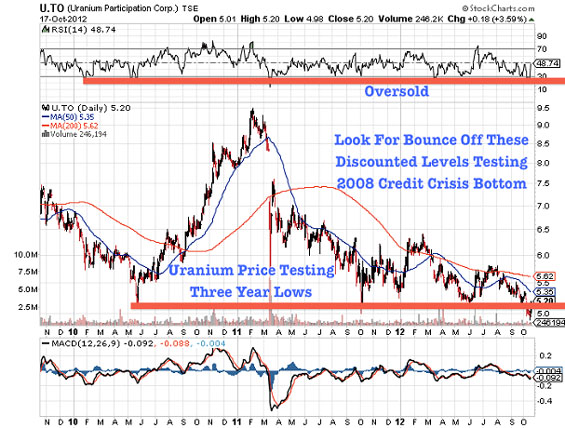

| You are subscribed to email updates from Save Your ASSets First To stop receiving these emails, you may unsubscribe now. | Email delivery powered by Google |
| Google Inc., 20 West Kinzie, Chicago IL USA 60610 | |


No comments:
Post a Comment