


Gold World News Flash |

- The Corn Is Dying All Over America
- Gold preserves capital and protects against risk for UK investors, latest World Gold Council research shows
- Dr. Doom: “The 2013 Perfect Storm Scenario Is Unfolding”
- Silver Update 7/9/12 Paper Promises
- Citi’s Fitzpatrick - Euro Under Pressure, Ready to Collapse
- Bill Murphy: Gold and silver manipulation scandal going mainstream soon
- Gold said to be in 'lockdown' as new financial system approaches
- Grant Williams: If they can rig LIBOR, they can rig gold and silver
- Gold is manipulated just as LIBOR was and for same reason, Naylor-Leyland tells CNBC
- Gold Enters 9th Week of Consolidation
- Peru Overview: Mining, Oil & Gas Analysis
- How to Open a Bank Account that Pays 16%
- Gold May Have Been Manipulated Like LIBOR - St. Louis Fed Starts Tracking London Gold Prices
- ★GOLD MANIPULATION EXPOSED★ – Bill Murphy
- “Nielsen's Critics” Attack For His Treasuries Market Theory
- On Gold As A Hyperinflation Put
- Guest Post: Election Year 2012: Two Landslides in the Making?
- The Gold Price Coiling Up for a Big Move but Which Way Will it Break Out?
- The Big Banks are Amateurs When It Comes to Manipulating Interest Rates
- Gold's Secular Bull Market: Past, Present & Future
- New Riches from Old Headlines
- Gold Daily and Silver Weekly Charts.
- GOLD Deja Vous?
- $15 Trillion To Be Added To Money Supply & Gold To Ascend
- Gold and Silver Disaggregated COT Report (DCOT) for July 9
- Gold "Alternating Between Up and Down Weeks", More QE "Appropriate" for US Economy
- Gold Seeker Closing Report: Gold and Silver End Modestly Higher
- Stocks Bear Market Focus Point: Yet again, Another Bull Trap in the Making
- Dismal Equity Volume Day As Gold And Treasuries Surge
- Can Gold, Silver Prices Rise in a Growing Global Economy?
| The Corn Is Dying All Over America Posted: 10 Jul 2012 01:14 AM PDT from The Economic Collapse Blog:
Read More @ TheEconomicCollapseBlog.com
| ||||
| Posted: 10 Jul 2012 01:00 AM PDT
| ||||
| Dr. Doom: “The 2013 Perfect Storm Scenario Is Unfolding” Posted: 09 Jul 2012 11:58 PM PDT  There is no hiding the fact that the global economy is now teetering on the real possibility of a complete meltdown – one that promises to be far worse than the financial crisis of 2008. There is no hiding the fact that the global economy is now teetering on the real possibility of a complete meltdown – one that promises to be far worse than the financial crisis of 2008.Dr. Doom Nouriel Roubini, often cited by mainstream and alternative analysts alike, says that we are now in the midst of the "perfect storm" he detailed at the 2012 Skybridge Alternative Conference in Las Vegas in which he forecast a world-wide economic "train wreck". Among other things, Roubini warned that the United States would fall back into recession, stock markets would go into a tailspin, Europe would begin to break up, emerging markets – namely China – would experience major slowdowns, and military conflict in Iran would lead to further geo-political turbulence. According to Roubini, that 'Perfect Storm" scenario has now taken hold: "The 2013 perfect storm scenario I wrote on months ago is unfolding," Roubini said… … Roubini said that unlike in 2008 when central banks had "policy bullets" to stimulate the global economy, this time around policymakers are "running out of rabbits to pull out of the hat." Read more..... 
This posting includes an audio/video/photo media file: Download Now | ||||
| Silver Update 7/9/12 Paper Promises Posted: 09 Jul 2012 10:49 PM PDT | ||||
| Citi’s Fitzpatrick - Euro Under Pressure, Ready to Collapse Posted: 09 Jul 2012 10:29 PM PDT  Today King World News wanted to share with its global readers a portion of top Citibank analyst, Tom Fitzpatrick's latest report. Fitzpatrick, a 28 year veteran and top analyst at Citibank, which has $1.3 trillion in assets, covered the two key markets, the euro vs the dollar and bonds. Below were his comments with two important charts: Today King World News wanted to share with its global readers a portion of top Citibank analyst, Tom Fitzpatrick's latest report. Fitzpatrick, a 28 year veteran and top analyst at Citibank, which has $1.3 trillion in assets, covered the two key markets, the euro vs the dollar and bonds. Below were his comments with two important charts:
This posting includes an audio/video/photo media file: Download Now | ||||
| Bill Murphy: Gold and silver manipulation scandal going mainstream soon Posted: 09 Jul 2012 09:58 PM PDT 11:50p ET Monday, July 9, 2012 Dear Friend of GATA and Gold: GATA Chairman Bill Murphy's special "Midas" commentary at LeMetropoleCafe.com over the weekend was headlined "It Won't Be Too Long Before the Gold/Silver Market Manipulation Scandal Goes Mainstream .. Big-Time." Today's developments quickly began to vindicate him: http://www.gata.org/node/11554 http://www.gata.org/node/11555 http://www.gata.org/node/11556 Murphy's commentary is posted at GoldSeek here: http://news.goldseek.com/LemetropoleCafe/1341831900.php And at 24hGold here: http://www.24hgold.com/english/news-gold-silver-it-won-t-be-long-before-... CHRIS POWELL, Secretary/Treasurer ADVERTISEMENT Sona Discovers Potential High-Grade Gold Mineralization From a Company Press Release VANCOUVER, British Columbia -- With its latest surface diamond drilling program at its 100-percent-owned, formerly producing Blackdome gold mine in southern British Columbia, Sona Resources Corp. has discovered a potentially high-grade gold-mineralized area, with one hole intersecting 13.6 grams of gold in 1.5 meters of core drilling. "We intersected a promising new mineralized zone, and we feel optimistic about the assay results," says Sona's president and CEO, John P. Thompson. "We have undertaken an aggressive exploration program that has tested a number of target zones. Our discovery of this new gold-bearing structure is significant, and it represents a positive development for the company." Sona aims to bring its permitted Blackdome mill back into production over the next year and a half, at a rate of 200 tonnes per day, with feed from the formerly producing Blackdome mine and the nearby Elizabeth gold deposit property. A positive preliminary economic assessment by Micon International Ltd., based on a gold price of $950 per ounce over eight years, has estimated a cash cost of $208 per tonne milled, or $686 per gold ounce recovered. For the company's complete press release, please visit: http://www.sonaresources.com/_resources/news/SONA_NR18_2011-opt.pdf Join GATA here: Toronto Resource Investment Conference New Orleans Investment Conference * * * Support GATA by purchasing DVDs of our London conference in August 2011 or our Dawson City conference in August 2006: http://www.goldrush21.com/order.html Or by purchasing a colorful GATA T-shirt: Or a colorful poster of GATA's full-page ad in The Wall Street Journal on January 31, 2009: http://gata.org/node/wallstreetjournal Help keep GATA going GATA is a civil rights and educational organization based in the United States and tax-exempt under the U.S. Internal Revenue Code. Its e-mail dispatches are free, and you can subscribe at: To contribute to GATA, please visit: ADVERTISEMENT Prophecy Platinum Announces Wellgreen Preliminary Economic Assessment: Company Press Release VANCOUVER, British Columbia, Canada -- Prophecy Platinum Corp. (TSX-V: NKL, OTC-QX: PNIKF, Frankfurt: P94P) reports the results of an independent NI 43-101-compliant preliminary economic assessment for its fully owned Wellgreen nickel-copper-platinum group metals project in the Yukon Territory. The independent assessment, prepared by Tetra Tech, evaluated a base case of an open-pit mine (with a mining rate of 111,500 tonnes per day), an on-site concentrator (with a milling rate of 32,000 tonnes per day), and an initial capital cost of $863 million. The project is expected to produce (in concentrate) 1.959 billion pounds of nickel, 2.058 billion pounds of copper, and 7.119 million ounces of platinum, palladium, and gold during a mine life of 37 years with an average strip ratio of 2.57. The financial highlights of the preliminary economic assessment, shown in U.S. dollars, are as follows: Payback period: 3.55 years Prophecy Chairman John Lee says: "We are pleased with the preliminary economic assessment results. The numbers indicate that Wellgreen is one of most exciting mineral projects in the Yukon. The company is drilling to upgrade and expand the resource base. The infrastructure is excellent as the project is only 1,400 meters in altitude and 14 kilometers from the paved Alaska Highway, which leads to the Haines deep seaport. Discussions are under way with support from local stakeholders regarding permitting and logistics." For the complete press release, please visit: http://prophecyplat.com/news_2012_june18_prophecy_platinum_announces_res...
| ||||
| Gold said to be in 'lockdown' as new financial system approaches Posted: 09 Jul 2012 09:47 PM PDT 11:44p ET Monday, July 9, 2012 Dear Friend of GATA and Gold: MineWeb's Lawrence Williams today reports about market analyst Paul Mylchreest's new Thunder Road Report, which describes gold as being in "lockdown," presumably by central banks straining to maintain their market-rigging power. Williams says Mylchreest "believes we are heading into a truly mega-financial crisis. He foresees the financial decimation of the middle class and reckons the crisis is going to result in the transition to a new financial system as the current one implodes. His best guess is that it will be either happening or perfectly obvious that it's going to happen within six to 12 months." Williams' report is headlined "'Idiots' Controlling the World's Economies -- Gold in Lockdown" and it's posted at MineWeb here: http://www.mineweb.com/mineweb/view/mineweb/en/page72068?oid=154699&sn=D... Mylchreest's new Thunder Road Report is titled "Death March: Approaching a New Financial System" and it's posted at MineWeb here: http://www.mineweb.com/mineweb/action/media/downloadFile?media_fileid=20... CHRIS POWELL, Secretary/Treasurer ADVERTISEMENT Sona Discovers Potential High-Grade Gold Mineralization From a Company Press Release VANCOUVER, British Columbia -- With its latest surface diamond drilling program at its 100-percent-owned, formerly producing Blackdome gold mine in southern British Columbia, Sona Resources Corp. has discovered a potentially high-grade gold-mineralized area, with one hole intersecting 13.6 grams of gold in 1.5 meters of core drilling. "We intersected a promising new mineralized zone, and we feel optimistic about the assay results," says Sona's president and CEO, John P. Thompson. "We have undertaken an aggressive exploration program that has tested a number of target zones. Our discovery of this new gold-bearing structure is significant, and it represents a positive development for the company." Sona aims to bring its permitted Blackdome mill back into production over the next year and a half, at a rate of 200 tonnes per day, with feed from the formerly producing Blackdome mine and the nearby Elizabeth gold deposit property. A positive preliminary economic assessment by Micon International Ltd., based on a gold price of $950 per ounce over eight years, has estimated a cash cost of $208 per tonne milled, or $686 per gold ounce recovered. For the company's complete press release, please visit: http://www.sonaresources.com/_resources/news/SONA_NR18_2011-opt.pdf Join GATA here: Toronto Resource Investment Conference New Orleans Investment Conference * * * Support GATA by purchasing DVDs of our London conference in August 2011 or our Dawson City conference in August 2006: http://www.goldrush21.com/order.html Or by purchasing a colorful GATA T-shirt: Or a colorful poster of GATA's full-page ad in The Wall Street Journal on January 31, 2009: http://gata.org/node/wallstreetjournal Help keep GATA going GATA is a civil rights and educational organization based in the United States and tax-exempt under the U.S. Internal Revenue Code. Its e-mail dispatches are free, and you can subscribe at: To contribute to GATA, please visit: ADVERTISEMENT Prophecy Platinum Announces Wellgreen Preliminary Economic Assessment: Company Press Release VANCOUVER, British Columbia, Canada -- Prophecy Platinum Corp. (TSX-V: NKL, OTC-QX: PNIKF, Frankfurt: P94P) reports the results of an independent NI 43-101-compliant preliminary economic assessment for its fully owned Wellgreen nickel-copper-platinum group metals project in the Yukon Territory. The independent assessment, prepared by Tetra Tech, evaluated a base case of an open-pit mine (with a mining rate of 111,500 tonnes per day), an on-site concentrator (with a milling rate of 32,000 tonnes per day), and an initial capital cost of $863 million. The project is expected to produce (in concentrate) 1.959 billion pounds of nickel, 2.058 billion pounds of copper, and 7.119 million ounces of platinum, palladium, and gold during a mine life of 37 years with an average strip ratio of 2.57. The financial highlights of the preliminary economic assessment, shown in U.S. dollars, are as follows: Payback period: 3.55 years Prophecy Chairman John Lee says: "We are pleased with the preliminary economic assessment results. The numbers indicate that Wellgreen is one of most exciting mineral projects in the Yukon. The company is drilling to upgrade and expand the resource base. The infrastructure is excellent as the project is only 1,400 meters in altitude and 14 kilometers from the paved Alaska Highway, which leads to the Haines deep seaport. Discussions are under way with support from local stakeholders regarding permitting and logistics." For the complete press release, please visit: http://prophecyplat.com/news_2012_june18_prophecy_platinum_announces_res...
| ||||
| Grant Williams: If they can rig LIBOR, they can rig gold and silver Posted: 09 Jul 2012 09:35 PM PDT 11:28p ET Monday, July 9, 2012 Dear Friend of GATA and Gold: In this week's edition of his "Things That Make You Go 'Hmmm'" letter, Grant Williams argues that if the LIBOR interest rate, probably the most important financial data point in the world, could have been manipulated for so long even as suspicions about it were expressed openly, manipulation of the gold and silver markets may not be crazy "conspiracy theory" after all. Williams writes: "If the long-stated claims about government-sanctioned, bank-led manipulation of precious metals markets put forward so eloquently by the likes of Ted Butler, Bill Murphy and Chris Powell at GATA, as well as Messrs. [Eric] Sprott, [Jim] Sinclair, [Ben] Davies, et al. are eventually proven to have any validity whatsoever, the fallout from the LIBOR scandal will prove to be (to use the words of Jamie Dimon) just another "tempest in a teapot," as the precious metals are the very underpinnings of the entire global financial system. Conspiracy or no, it would be a blessed relief to get closure no matter what the truth turns out to be." Williams' letter is posted in PDF format here: http://www.gata.org/files/Hmmm-July-8-2012.pdf CHRIS POWELL, Secretary/Treasurer ADVERTISEMENT Sona Discovers Potential High-Grade Gold Mineralization From a Company Press Release VANCOUVER, British Columbia -- With its latest surface diamond drilling program at its 100-percent-owned, formerly producing Blackdome gold mine in southern British Columbia, Sona Resources Corp. has discovered a potentially high-grade gold-mineralized area, with one hole intersecting 13.6 grams of gold in 1.5 meters of core drilling. "We intersected a promising new mineralized zone, and we feel optimistic about the assay results," says Sona's president and CEO, John P. Thompson. "We have undertaken an aggressive exploration program that has tested a number of target zones. Our discovery of this new gold-bearing structure is significant, and it represents a positive development for the company." Sona aims to bring its permitted Blackdome mill back into production over the next year and a half, at a rate of 200 tonnes per day, with feed from the formerly producing Blackdome mine and the nearby Elizabeth gold deposit property. A positive preliminary economic assessment by Micon International Ltd., based on a gold price of $950 per ounce over eight years, has estimated a cash cost of $208 per tonne milled, or $686 per gold ounce recovered. For the company's complete press release, please visit: http://www.sonaresources.com/_resources/news/SONA_NR18_2011-opt.pdf Join GATA here: Toronto Resource Investment Conference New Orleans Investment Conference * * * Support GATA by purchasing DVDs of our London conference in August 2011 or our Dawson City conference in August 2006: http://www.goldrush21.com/order.html Or by purchasing a colorful GATA T-shirt: Or a colorful poster of GATA's full-page ad in The Wall Street Journal on January 31, 2009: http://gata.org/node/wallstreetjournal Help keep GATA going GATA is a civil rights and educational organization based in the United States and tax-exempt under the U.S. Internal Revenue Code. Its e-mail dispatches are free, and you can subscribe at: To contribute to GATA, please visit: ADVERTISEMENT Prophecy Platinum Announces Wellgreen Preliminary Economic Assessment: Company Press Release VANCOUVER, British Columbia, Canada -- Prophecy Platinum Corp. (TSX-V: NKL, OTC-QX: PNIKF, Frankfurt: P94P) reports the results of an independent NI 43-101-compliant preliminary economic assessment for its fully owned Wellgreen nickel-copper-platinum group metals project in the Yukon Territory. The independent assessment, prepared by Tetra Tech, evaluated a base case of an open-pit mine (with a mining rate of 111,500 tonnes per day), an on-site concentrator (with a milling rate of 32,000 tonnes per day), and an initial capital cost of $863 million. The project is expected to produce (in concentrate) 1.959 billion pounds of nickel, 2.058 billion pounds of copper, and 7.119 million ounces of platinum, palladium, and gold during a mine life of 37 years with an average strip ratio of 2.57. The financial highlights of the preliminary economic assessment, shown in U.S. dollars, are as follows: Payback period: 3.55 years Prophecy Chairman John Lee says: "We are pleased with the preliminary economic assessment results. The numbers indicate that Wellgreen is one of most exciting mineral projects in the Yukon. The company is drilling to upgrade and expand the resource base. The infrastructure is excellent as the project is only 1,400 meters in altitude and 14 kilometers from the paved Alaska Highway, which leads to the Haines deep seaport. Discussions are under way with support from local stakeholders regarding permitting and logistics." For the complete press release, please visit: http://prophecyplat.com/news_2012_june18_prophecy_platinum_announces_res...
This posting includes an audio/video/photo media file: Download Now | ||||
| Gold is manipulated just as LIBOR was and for same reason, Naylor-Leyland tells CNBC Posted: 09 Jul 2012 09:07 PM PDT 11p ET Monday, July 9, 2012 Dear Friend of GATA and Gold: Cheviot Asset Management Investment Director Ned Naylor-Leyland seemed to make his fellow panelists on CNBC Europe very uncomfortable today as he asserted that the gold and silver markets have been manipulated just as the LIBOR interest rate was manipulated, and for the same reason -- to disguise trouble in the world financial system. Naylor-Leyland also said that market manipulation was also the purpose of the British gold sales of a decade ago. Looks like the gold and silver manipulation issue is becoming irresistible. Naylor-Leyland's interview is not quite five minutes long and it's posted at the CNBC video archive here: http://video.cnbc.com/gallery/?video=3000100465&lay=1 CHRIS POWELL, Secretary/Treasurer ADVERTISEMENT Sona Discovers Potential High-Grade Gold Mineralization From a Company Press Release VANCOUVER, British Columbia -- With its latest surface diamond drilling program at its 100-percent-owned, formerly producing Blackdome gold mine in southern British Columbia, Sona Resources Corp. has discovered a potentially high-grade gold-mineralized area, with one hole intersecting 13.6 grams of gold in 1.5 meters of core drilling. "We intersected a promising new mineralized zone, and we feel optimistic about the assay results," says Sona's president and CEO, John P. Thompson. "We have undertaken an aggressive exploration program that has tested a number of target zones. Our discovery of this new gold-bearing structure is significant, and it represents a positive development for the company." Sona aims to bring its permitted Blackdome mill back into production over the next year and a half, at a rate of 200 tonnes per day, with feed from the formerly producing Blackdome mine and the nearby Elizabeth gold deposit property. A positive preliminary economic assessment by Micon International Ltd., based on a gold price of $950 per ounce over eight years, has estimated a cash cost of $208 per tonne milled, or $686 per gold ounce recovered. For the company's complete press release, please visit: http://www.sonaresources.com/_resources/news/SONA_NR18_2011-opt.pdf Join GATA here: Toronto Resource Investment Conference New Orleans Investment Conference * * * Support GATA by purchasing DVDs of our London conference in August 2011 or our Dawson City conference in August 2006: http://www.goldrush21.com/order.html Or by purchasing a colorful GATA T-shirt: Or a colorful poster of GATA's full-page ad in The Wall Street Journal on January 31, 2009: http://gata.org/node/wallstreetjournal Help keep GATA going GATA is a civil rights and educational organization based in the United States and tax-exempt under the U.S. Internal Revenue Code. Its e-mail dispatches are free, and you can subscribe at: To contribute to GATA, please visit: ADVERTISEMENT Prophecy Platinum Announces Wellgreen Preliminary Economic Assessment: Company Press Release VANCOUVER, British Columbia, Canada -- Prophecy Platinum Corp. (TSX-V: NKL, OTC-QX: PNIKF, Frankfurt: P94P) reports the results of an independent NI 43-101-compliant preliminary economic assessment for its fully owned Wellgreen nickel-copper-platinum group metals project in the Yukon Territory. The independent assessment, prepared by Tetra Tech, evaluated a base case of an open-pit mine (with a mining rate of 111,500 tonnes per day), an on-site concentrator (with a milling rate of 32,000 tonnes per day), and an initial capital cost of $863 million. The project is expected to produce (in concentrate) 1.959 billion pounds of nickel, 2.058 billion pounds of copper, and 7.119 million ounces of platinum, palladium, and gold during a mine life of 37 years with an average strip ratio of 2.57. The financial highlights of the preliminary economic assessment, shown in U.S. dollars, are as follows: Payback period: 3.55 years Prophecy Chairman John Lee says: "We are pleased with the preliminary economic assessment results. The numbers indicate that Wellgreen is one of most exciting mineral projects in the Yukon. The company is drilling to upgrade and expand the resource base. The infrastructure is excellent as the project is only 1,400 meters in altitude and 14 kilometers from the paved Alaska Highway, which leads to the Haines deep seaport. Discussions are under way with support from local stakeholders regarding permitting and logistics." For the complete press release, please visit: http://prophecyplat.com/news_2012_june18_prophecy_platinum_announces_res...
| ||||
| Gold Enters 9th Week of Consolidation Posted: 09 Jul 2012 08:53 PM PDT courtesy of DailyFX.com July 09, 2012 12:50 PM Weekly Bars Prepared by Jamie Saettele, CMT No change…I’m looking lower as long as gold is below 1641. There is very little to say as gold is in its 8th week of consolidation. In fact, gold has oscillated on both sides on 1600 since May 2011. This length of consolidation will probably fuel an impressive break…eventually. The sideways trading from the May 2012 low is taking on the form of a head and shoulders continuation pattern (bearish) but a break below 1548 is needed to confirm. Exceeding 1641 would shift focus to 1671 (May high). LEVELS: 1527 1548 1576 1597 1625 1641...
| ||||
| Peru Overview: Mining, Oil & Gas Analysis Posted: 09 Jul 2012 08:41 PM PDT By: Chris Callahan & Joelle Fricot Monday, July 9, 2012 Peru’s strong economic performance in recent years can be attributed to a combination of solid monetary and fiscal policies. This can be seen when looking at Peru’s GNI per Capita, and GDP on Figures 1 and 2.hese policies have helped to promote: [LIST] [*] Macroeconomic stability [*] Prudent fiscal spending [*] High international reserve accumulation [*] External debt reduction [*] Achievement of investment grade status [*] Fiscal surpluses [/LIST] Economy Peru’s economic performance has been tightly connected to the country’s exports. Exports provide Peru with hard currency allowing them to finance imports and external debt payments. Peru`s main exports are copper, zinc, chemicals, gold, textiles, manufactures, machinery, and services. China, Brazil, EU, Chile, and the United States are all major tra...
| ||||
| How to Open a Bank Account that Pays 16% Posted: 09 Jul 2012 08:41 PM PDT I just opened a bank account that pays me 16.2% annually. All I had to do was deposit a minimum of $180. I got the one-year time deposit, which means I have to leave the money alone for a year. But if I decide I want my money back sooner, I still get the “default interest rate” of 4%. That’s a lot more than I get back home, which is pretty much nothing. You can open such an account too. But it’s not easy. If it were easy, then the opportunity would’ve disappeared already. And there is a catch. What’s the catch? Well, it’s in a bank in Mongolia. And there is no deposit insurance. It’s a speculation on a booming country and a currency — the Mongolian tugrik — that could be one of the best performers against the U.S. dollar over the next year or two. I think of it as buying a stock that pays me 16% per year with the potential for added capital gains if the tugrik rises against the dollar. In what follows, I’ll tell you ...
| ||||
| Gold May Have Been Manipulated Like LIBOR - St. Louis Fed Starts Tracking London Gold Prices Posted: 09 Jul 2012 08:38 PM PDT
| ||||
| ★GOLD MANIPULATION EXPOSED★ – Bill Murphy Posted: 09 Jul 2012 07:45 PM PDT | ||||
| “Nielsen's Critics” Attack For His Treasuries Market Theory Posted: 09 Jul 2012 07:15 PM PDT by Jeff Nielsen, Silver Gold Bull:
A journalist should never be concerned with winning any "popularity contests". This is a point about which I like to frequently remind myself – since I will certainly never win any such contest with my own work. An example of this harsh reality has surfaced again after my recent commentary "The Continuing Mystery of the U.S. Treasuries Market", written just before I joined Silver Gold Bull as their precious metals analyst. It has ruffled a few feathers – both inside and outside the precious metals community. An example of someone from the latter group is a writer for "Business Insider", Joe Weisenthal. Given that Mr. Weisenthal repeatedly spelled my name incorrectly, I presume he's someone not familiar with my previous work, and my extensive writing on this subject. Putting aside the spelling mistakes (no publicity is bad publicity?), I have a few qualms with Mr. Weisenthal's attack. At the top of the list is the fact that there is not one word in this critique concerning the question I considered so important that I highlighted it in bold: who is buying this worthless paper? With that huge question remaining unanswered, I might have a few more words on this subject at a future date… Read More @ SilverGoldBull.com
| ||||
| On Gold As A Hyperinflation Put Posted: 09 Jul 2012 07:10 PM PDT from Zero Hedge:
| ||||
| Guest Post: Election Year 2012: Two Landslides in the Making? Posted: 09 Jul 2012 06:11 PM PDT Submitted by Charles Hugh Smith from Of Two Minds Election Year 2012: Two Landslides in the Making? If the economy continues declining into late October, there may be two landslides in the making: the stock market and the presidential election. The stock market is precariously close to slipping into a landslide. If the economy and stock market both continue declining into late October, the presidential election could also turn into a landslide--against the incumbent. There is nothing particularly partisan about this possibility; people who vote tend to vote their pocketbooks, and a re-election campaign that boils down to "hey, it's not as bad as The Great Depression" is unlikely to inspire great loyalty in voters who are already culturally predisposed to tire quickly of presidents, wars and a tanking economy. If the economy and stock markets are both slip-sliding away, the opponent need only be "not the incumbent" to win. Presidents facing re-election in deteriorating economic conditions find their support in the critical non-partisan middle is a mile wide and an inch deep. A recessionary economy acts like a drought on that shallow lake of support, and when it dries up then the incumbent loses, and often loses big. Let's consider the critical backdrops of the economy and stock market: household income and corporate profits. Market bulls like to tout rising profits as the reason the market can keep climbing higher in a global recession, but before we get too euphoric let's recall that the earnings of 90% of American households have been flat since 1970. All those fabulous profits were built on two now-crumbling edifices: astounding levels of household debt and a declining U.S. dollar that boosted the critical overseas profits (40% of all profits) via currency devaluation. Now that the dollar has broken out of a multi-decade downtrend and has been rising for a year, those tailwinds have turned into headwinds. I have yet to read even one market bull who has considered the negative impact of the strengthening dollar on overseas profits. That is a fatal flaw in their argument for ever-higher profits and stocks. Can the top 5% push corporate profits into the stratosphere?
Do trees grow to the sky? Corporate profits have risen at geometric rates. Does a recessionary global economy and a debt-crushed, declining-income 90% of households support the bullish claim that profits can soar to the moon?
Here's a chart of the ECRI's Weekly Leading Index courtesy of dshort.com. I have marked it up to show the megaphone top pattern and the downtrend since 2007 of lower highs. This is unambiguously bearish. In effect, trillions of dollars in stimulus, bailouts, subsidies, giveaways and backstops have simply slowed the deterioration. Every time the economy threatened to sink into recession, another "save" was pulled out of the magic hat.
Once again the economy is on the edge of recession, only this time there are no more "saves" in the hat except QE3, and that can't be unleashed (and the sugar high won't last long) until 1) the market tanks and 2) the election is over. When systems that have failed are not allowed to fail because of resistance by vested interests, the inevitable implosion is only delayed. Please consider this chart from Tony at Macro Story, who kindly shared this comparison chart of the S&P 500 (SPX) for 2011 and 2012. Tony counted a remarkably similar 16-point pattern in the two charts, and offered this commentary:
Thank you, Tony. If the stresses that have been countered since December 2008 with endless rounds of interventions, threats/promises of QE, etc. can no longer be constrained, then the bottom could be much lower than most technicians and pundits expect. Some analysts have been claiming that presidential election years are strongly bullish. Longtime correspondent B.C. separated election years in secular Bull markets from those in secular Bear markets, and reached a considerably more Bearish conclusion.
Bullish analysts consider 1,180 SPX a remote possibility. SPX 880 is not on their radar. Since nobody knows what will happen tomorrow, much less in October, all this is merely "food for thought." But confident Bulls might want to look ahead a year and study B.C.'s chart for the first year in a presidentail cycle.
Once again, if we separate secular Bull and Bear markets, the oft-touted Bullish trends for the election year and first year of the presidential cycle vanish. If stocks start cascading in a landslide the enfeebled, failed Fed cannot stop, the sitting president may face a landslide as well.
| ||||
| The Gold Price Coiling Up for a Big Move but Which Way Will it Break Out? Posted: 09 Jul 2012 06:03 PM PDT Gold Price Close Today : 1588.60 Change : 10.30 or 0.65% Silver Price Close Today : 2741.0 Change : 52.2 or 1.94% Gold Silver Ratio Today : 57.957 Change : -0.742 or -1.26% Silver Gold Ratio Today : 0.01725 Change : 0.000218 or 1.28% Platinum Price Close Today : 1443.20 Change : -23.40 or -1.60% Palladium Price Close Today : 582.60 Change : -15.35 or -2.57% S&P 500 : 1,352.46 Change : -2.22 or -0.16% Dow In GOLD$ : $165.73 Change : $ (1.54) or -0.92% Dow in GOLD oz : 8.017 Change : -0.074 or -0.92% Dow in SILVER oz : 464.66 Change : -10.37 or -2.18% Dow Industrial : 12,736.29 Change : -36.18 or -0.28% US Dollar Index : 83.12 Change : -0.256 or -0.31% Today the GOLD PRICE gained $10.20 to close at $1,588.60. I'm just a natural born fool from Tennessee and I don't know nothin' at all, but I can still look at that gold chart and see the Invisible Hand just a-working away. What do you say when a market spikes up, then in 15 minutes or so is slammed down below resistance? Every day. It's just not a pattern one sees often in nature, but then, I am notoriously suspicious, I confess. Never mind, I'd like to point y'all's attention to the longer term gold chart, where the GOLD PRICE has scratched out an even-sided triangle, harbinger of a big break but silent as to which way. From the May $1,526.70 intraday low through the end-June $1,547.60 low draw your bottom boundary. From the June highs at $1,642.40 and $1,635.40 to July's $1,625.70 draw your upper boundary. You'll see that Friday's low didn't even come close to that bottom boundary, then about $1,550. As long as the GOLD PRICE remains in that triangle it is merely coiling up for a big move, and since this is a bull market, that will most likely be a move up. Meanwhile, as exciting as all the up and down may be, it doesn't say anything really until gold breaks above that upper boundary or below the lower. The SILVER PRICE has formed a similar but not identical triangle. Inside a large declining triangle silver formed a downward-pointing or falling wedge. Normally these resolve with an upside breakout. Lower boundary today is about 2600c, upper boundary is about 2800c. SILVER today gained 52.2c to close 2741.1c. This came in a very tight range between 2704c and 2749c. A reader rebuked me for crediting my wife's speedy recovery to the grace of God and the prayers of his people. Ahh, I should also have mentioned by name her surgeon, Dr. Michael Petracek, who also was a means of God's grace to Susan. Sorry I didn't make myself clear. Speaking of God's grace, on 9 July 1991, twenty-one years ago today, my wife Susan and I along with 14 others were acquitted in Federal court on charges of conspiracy and willful failure to file income tax returns. Y'all can read about it at http://the-moneychanger.com/answers/the_most_dangerous_man_in_the_mid_south The Tennessee mouse was away, but the RATS kept on playing overtime -- gummit rats, that is. Let's start with what is most painful to the truthful and fastidious mind, the filthy, low white-trash scrofulous US dollar index. It rallied last week and has reached the ceiling, defined as the last (1 June) high at 83.54. Friday it hit 83.40, but today those high numbers hit it like Kryptonite hits Superman. Fell off 25.6 basis points (0.33%), but let's face it: the dollar's trend (nasty and untouchable as it is) points up. It must, however, break through that 83.54 to continue. Odds are stacked higher against that, because the dollar hasn't seen prices higher than that since, oh, June 2010. More than technicals stacked against it are the needs of those needy central bankers, who like everything to stay on an even keel. Rather than an even keel, the euro is sinking out of sight against the dollar and the yen. This cannot please The Mighty Charged With Managing The World. I doubt that criminal Bernanke wants to see the euro plunge deeper, let alone that criminal in charge of the ECB, Draghi. And what the Nice Government Men want, they generally manipulate to get. The euro's chart grows weaker daily. Now there's a chance that Friday's intraday low at $1.2260 makes a double bottom with 1 June's $1.2288. It was the lowest euro price since July 2010. It's amusing in sort of a wry, "The Whole Universe is Looney" way that the yen remains buoyant. It is, after all, the worst of the three big currencies, by a couple of parsecs. But who ever said fiat currency values were based on anything but government moonbeams anyway? Yen closed today up 0.1%at 125.68c/Y100 (Y79.6/US$1). Yen's 50 day moving average stands at 125.71, 20 DMA at 125.7, with the 20 headed down. Other indicators are neutral. Technically the trend is down. Stocks took a beating last week. On Tuesday, stocks' only gainful day, the Dow closed at 12,943.66, but in punishment was whipped and beaten the rest of the week, closing today 200 points lower at 12,740.87 (down 31.6 or 0.25% for the day). S&P500 followed right along, closing today down 2.22 at 1,352.77. RSI has turned down and the MACD is rolling over, not signs to cheer a stock investor's heart. Later in the summer some very painful times are coming for stock owners. Argentum et aurum comparenda sunt -- -- Gold and silver must be bought. - Franklin Sanders, The Moneychanger The-MoneyChanger.com 1-888-218-9226 10:00am-5:00pm CST, Monday-Friday © 2012, The Moneychanger. May not be republished in any form, including electronically, without our express permission. To avoid confusion, please remember that the comments above have a very short time horizon. Always invest with the primary trend. Gold's primary trend is up, targeting at least $3,130.00; silver's primary is up targeting 16:1 gold/silver ratio or $195.66; stocks' primary trend is down, targeting Dow under 2,900 and worth only one ounce of gold; US$ or US$-denominated assets, primary trend down; real estate bubble has burst, primary trend down. WARNING AND DISCLAIMER. Be advised and warned: Do NOT use these commentaries to trade futures contracts. I don't intend them for that or write them with that short term trading outlook. I write them for long-term investors in physical metals. Take them as entertainment, but not as a timing service for futures. NOR do I recommend investing in gold or silver Exchange Trade Funds (ETFs). Those are NOT physical metal and I fear one day one or another may go up in smoke. Unless you can breathe smoke, stay away. Call me paranoid, but the surviving rabbit is wary of traps. NOR do I recommend trading futures options or other leveraged paper gold and silver products. These are not for the inexperienced. NOR do I recommend buying gold and silver on margin or with debt. What DO I recommend? Physical gold and silver coins and bars in your own hands. One final warning: NEVER insert a 747 Jumbo Jet up your nose. No, I don't. 
| ||||
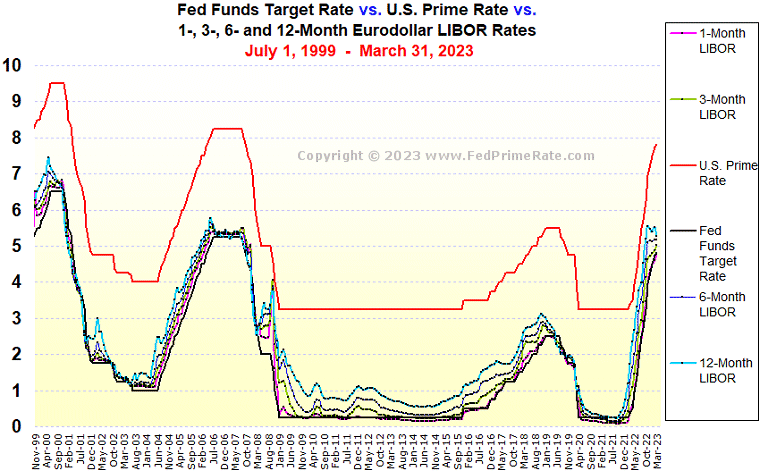
| The Big Banks are Amateurs When It Comes to Manipulating Interest Rates Posted: 09 Jul 2012 04:31 PM PDT The Biggest Manipulators of AllPeople are justifiably furious over the big banks' manipulation of hundreds of trillions of dollars of assets. This violates the banks' most central function: loaning money based upon the going rate. Indeed, the Libor manipulation is so serious that even mainstream economists are starting to call for heads to roll. The Bank of England and Federal Reserve's encouragement of Libor manipulation is not an isolated incident. Rather than being an aberration, it is their central effort. Indeed, the big banks are rank amateurs when it comes to manipulating interest rates. Central banks have been manipulating rates for a hundred years or more. David Zervos - Managing Director and Chief Market Strategist for Jefferies, with $3 billion under management - points out:
Indeed, one of the core functions of central banks is buying or selling government bonds to keep market interest rates at a specified target value. For example as the BBC notes:
The Federal Reserve's key policy lever is its "Federal Funds Rate", which is the base interest rate that many other rates (generally including Libor, and see this and this) key off of. As the Financial Industry Regulatory Authority - the largest independent regulator for all securities firms doing business in the United States - explains:
The express purpose of the central banks' emergency actions since 2007 is to effect interest rates. For example, the express purpose of quantitative easing is:
And of operation twist:
Indeed, central banks are now forcing private companies to buy government bonds as a way to further drive down interest rates. CNBC reports:
And the Financial Times notes:
Indeed, manipulating interest rates is one of the Fed's 3 core, express mandates:
"Moderating" interest rates means acting on interest rates so that free market forces do not set the rates. In other words, it means manipulating those rates. So one of the Fed's 3 primary reasons for existence is to manipulate rates. Central Banks Have Been Doing a Terrible Job of Manipulating Interest RatesAustrian school economists have said for decades that interest rates which are too low destroy the economy. For example, Walter Block told me:
Hayek won the Nobel prize in 1974 partly for arguing that artificially low interest rates lead to the misallocation of capital and to bubbles, which in turn lead to busts. But its not only Austrians. The central banks' central bank - the Bank of International Settlements - which is the world's most prestigious mainstream financial body, has repeatedly said that interest rates which are too low can destroy the economy. BIS' chief economist William White warned against overly lax monetary policy as early as 2003. As Spiegel reported:
The Telegraph noted:
In 2009, BIS released a paper amplifying on this point:
Indeed, BIS documents that interest rates which are too low are a grave risk financial to stability. See this, this and this. The Fed's low rate policies also reward speculators and punish savers, and quantitative easing helps the big guy at the expense of the little guy. So the Fed - and central banks worldwide - have been manipulating interest rates, and have been doing a horrible job for the economy. Central Banks Have Propped Up The Giant Banks' Bad BehaviorNot only have central banks been doing a horrible job of manipulating interest rates themselves, but they have built, propped up and enabled the giant private banks to manipulate the system. We've previously noted:
Shah Gilani writes at Forbes, in an article entitled "It's Not Libor Stupid, Central Banks Are The Problem":
Central Banks Have Failed To Provide Market StabilityWhile central banks' too-low interest rates have led to an unstable economy, at least - one would hope - they've helped the consumer in other ways. But as the following chart of historical Dow Jones Industrial Average - courtesy of the St. Louis Federal Reserve Bank - shows, the stock market has been more volatile since the Fed was formed in 1913 than before:  Moreover, the value of the dollar has been destroyed since 1913: | ||||
| Gold's Secular Bull Market: Past, Present & Future Posted: 09 Jul 2012 04:11 PM PDT Special Report by Michael J. Kosares A secular bull market, according to Investopedia, is one "driven by forces that could be in place for many years, causing the price of a particular investment or asset class to rise or fall over a long period of time. In a secular bull market, strong investor sentiment drives prices higher, as there are more net buyers than sellers. . . Secular markets are typically driven by large-scale national and worldwide events, which occur in combination. For example, wars, demographic/population shifts and governmental/political policies are all events that could drive secular markets. A secular bull market will have bear market periods within it, but it will not reverse the overlying trend of upward asset values. For example, most economists agree that U.S. equities were in a secular bull market from about 1980 to 2000, even though the stock market crash of 1987 occurred within the same time period." ...
| ||||
| Posted: 09 Jul 2012 03:51 PM PDT The 5 min. Forecast July 09, 2012 12:42 PM Dave Gonigam – July 9, 2012 [LIST] [*]50 jobs (at least) doomed by the latest federal do-gooding: The 5 mourns for a lost loophole… [*]Earnings, scandals, numbers: How “boring” headlines can pad your portfolio in under a week [*]Looking for a turning point: Greg Guenthner finds a market indicator at a 15-year low [*]A sign that rare earths have “jumped the shark”… readers reminisce about what a dollar used to buy… an update on Vancouver recordings… and more! [/LIST] It was fun while it lasted — a rare chance for consumers to save money, for entrepreneurs to make hay and for everyone to stick it to the feds. And now it’s over. The roll-your-own cigarette machine has been rendered a useless relic. We already saw their days numbered last November in The 5, when city governments scattered across the land moved to ban them. Tobacco shops bought them in recent years because folk...
| ||||
| Gold Daily and Silver Weekly Charts. Posted: 09 Jul 2012 03:05 PM PDT | ||||
| Posted: 09 Jul 2012 02:45 PM PDT Thanks to the FED’s recent addition of the London PM fix data, April 1968 to date, we have uncovered an unmistakeable repetitive pattern in Gold. The chart below displays the price data for the entire period.
| ||||
| $15 Trillion To Be Added To Money Supply & Gold To Ascend Posted: 09 Jul 2012 02:29 PM PDT  KWN has been getting bombarded from readers around the world on the Michael Pento piece titled, "This Major Fed Move Is About To Cause Gold To Skyrocket." Today we followed up with Michael Pento because there was such tremendous interest in knowing more about this major move he expects from the Fed. Today Pento told King World News that this move he is predicting could add a staggering $15 trillion to the money supply. KWN has been getting bombarded from readers around the world on the Michael Pento piece titled, "This Major Fed Move Is About To Cause Gold To Skyrocket." Today we followed up with Michael Pento because there was such tremendous interest in knowing more about this major move he expects from the Fed. Today Pento told King World News that this move he is predicting could add a staggering $15 trillion to the money supply. Pento, of Pento Portfolio Strategies, also said that if this move happens, "you will see the gold market fly far past its nominal record high in extremely short order." Here is what Pento had to say: "So let me put it together for your listeners. We have $1.42 trillion of excess reserves. We are now going to be told that there will be no capital reserve requirements on owning sovereign debt. You will have commercial banks flooding the market with the purchase of sovereign debt. Not just US debt, Portuguese debt, Spanish debt, Greek debt, all of that debt will have zero capital requirements."
This posting includes an audio/video/photo media file: Download Now | ||||
| Gold and Silver Disaggregated COT Report (DCOT) for July 9 Posted: 09 Jul 2012 02:24 PM PDT HOUSTON -- This week's Commodity Futures Trading Commission (CFTC) disaggregated commitments of traders (DCOT) report was released at 15:30 ET Monday (today), delayed from the usual Friday time because of the U.S. Independence Day holiday. Our recap of the changes in weekly positioning by the disaggregated trader classes, as compiled by the CFTC, is just below.
In the DCOT table above a net short position shows as a negative figure in red. A net long position shows in black. In the Change column, a negative number indicates either an increase to an existing net short position or a reduction of a net long position. A black figure in the Change column indicates an increase to an existing long position or a reduction of an existing net short position. The way to think of it is that black figures in the Change column are traders getting "longer" and red figures are traders getting less long or shorter. All of the trader's positions are calculated net of spreading contracts as of the Tuesday disaggregated COT report. Vultures, (Got Gold Report Subscribers) please note that updates to our linked technical charts, including our comments about the COT reports and the week's technical changes were delayed by the late CFTC reports, but should be completed by sometime Tuesday. As a reminder, the linked charts for gold, silver, mining shares indexes and important ratios are located in the subscriber pages. In addition Vultures have access anytime to all 30-something Vulture Bargain (VB) and Vulture Bargain Candidates of Interest (VBCI) tracking charts – the small resource-related companies that we attempt to game here at Got Gold Report. Continue to look for new commentary directly in the charts often. That is all for now.
| ||||
| Posted: 09 Jul 2012 02:16 PM PDT U.S. DOLLAR gold prices held above $1580 an ounce Monday morning in London – broadly in line with last week's close – while major European stock markets were broadly flat on the day, with the exception of Spain's Ibex. Gold prices ended down last week, falling back below $1600 on Friday, following the release of June's US nonfarm payroll data, which showed the economy added 80,000 private sector jobs last month. Although this was lower than many analysts' forecasts, it was higher than a month earlier. April and May's nonfarms figures were revised higher, while unemployment held steady at 8.2%.
| ||||
| Gold Seeker Closing Report: Gold and Silver End Modestly Higher Posted: 09 Jul 2012 02:15 PM PDT Gold saw slight losses in Asia, but it then bounced back higher in New York and ended not far from its early afternoon high of $1592.80 with a gain of 0.25%. Silver surged to as high as $27.504 and ended with a gain of 0.85%.
| ||||
| Stocks Bear Market Focus Point: Yet again, Another Bull Trap in the Making Posted: 09 Jul 2012 02:09 PM PDT The extraordinary end of month move up in the prices of currencies, oil, gold, copper and equities on June 29th, should be a warning to all of the financial markets’ propensity for large and highly volatile short term moves. Moves facilitated by hedge funds using similar trading tools all making similar trading decisions at the same time. In this case it appeared to be initiated by rather intense end of quarter short covering exacerbated by a rather over-hyped prop-up style financial agreement in Euroland. Timing of this agreement just could not have been better, with very little media coverage at the time pointing out the insignificance of the amounts of money involved in bank support agreements, compared to the trillions of dollars at risk associated with a deteriorating world economy. My earlier discussion on end of month trading shenanigans by the hedge funds in my last commentary on June 4th, was certainly well timed.
| ||||
| Dismal Equity Volume Day As Gold And Treasuries Surge Posted: 09 Jul 2012 02:08 PM PDT UPDATE: AA beats (headlines - at first glance) though Adjusted EBITDA is half Q2 2011's) and is holding modest gains after-hours - though well of initial knee-jerk reaction highs. And AMD (-7% after-hours) just pre-announced cutting revenue from sequentially +3% to -11%!! Despite the ubiquitous late-day surge to day-session highs in S&P 500 e-mini futures (ES), equities ended the day marginally lower - rejecting the late-Friday surge unreality (as VIX also snapped back up and went sideways at pre-Friday-surge levels all day). The narrowest range in two months for the day-session in stocks (with major financials underperforming and only the Healthcare sector green on the day) was the antithesis of the strength in Treasuries with 5Y at record-low yields and 10Y testing back to 1.50%. Gold also led the day - notably outperforming both the USD-implied weakness and stocks - though the two now-QE-sensitive assets converged into the close - leaving Treasuries in the dust. ES drifted lower all night through the European session and converged with broad risk asset's far less sanguine levels from Friday into the US day-session. CONTEXT and ES tracked each other very well all day long until the last 30 minutes or so when stocks pushed 4-5pts rich. Credit modestly outperformed equities on the day but this was more catch-up from Friday than a new leg up as markets were dismally quiet in both stocks and bonds today - much quieter than Thursday and Friday of last week with ES (day) closing below its 50DMA (despite the late-day grind). EURUSD roundtripped from opening strength to weakness and back to modest strength leaving USD -0.2% (and only AUD weaker against the USD on the day). Gold outperformed all day but note the convergence pull between gold and stock into the close today - even as Treasury yields just kept dropping to that 1.50 handle...
Stocks recoupled with broad risk assets into the day-session close - shrugging off Friday';s late day exuberance - but the again into the close today they pushed to their own new reality...
The USD roundtripped from its modestly weaker open after jumping into the European open last night and then leaking back all day - providing some momentum for both stocks and commodities. USD ended the day -0.2% from Friday's close (interestingly with only AUD weaker against the USD among the majors)...
But stocks remain notably hopeful relative to Treasuries as they drift lower and lower in yield...
Alcoa reported better than expected earnings and is +1.4% After-Hours (but the reality is not so pretty):
and AMD dismal pre-announcement (and -6% after-hours):
Charts: Bloomberg
| ||||
| Can Gold, Silver Prices Rise in a Growing Global Economy? Posted: 09 Jul 2012 02:00 PM PDT A perception has grown that says that, in a recovering global economy and in particular a growing developed world economy, the gold and silver prices will fall because right now their prices reflect economic uncertainty and fear. Any recovery will therefore remove that uncertainty and fear, so gold and silver prices should then fall. This article looks at that concept and its validity.
|
 All over America the corn is dying. If drought conditions persist in the middle part of the country, wheat and soybeans will be next. Weeks of intense heat combined with extraordinarily dry conditions have brought many U.S. corn farmers to the brink of total disaster. If there is not significant rainfall soon, many farmers will be financially ruined. This period of time is particularly important for corn because this is when pollination is supposed to happen. But the unprecedented heat and the extremely dry conditions are playing havoc with that process. With each passing day things get even worse. We have seen the price of a bushel of corn soar
 Gold has had an amazing recent run. From December 1999 to March 2012 the U.S. dollar price of gold rose more than 15.4% per annum, the U.S. Consumer Price Index increased by 2.5% per annum, while U.S. stock and bond markets registered annual gains of 1.5% and 6.4%, respectively. It is not surprising then that there is so much disagreement about gold's future and it is this


| You are subscribed to email updates from Save Your ASSets First To stop receiving these emails, you may unsubscribe now. | Email delivery powered by Google |
| Google Inc., 20 West Kinzie, Chicago IL USA 60610 | |




No comments:
Post a Comment