


saveyourassetsfirst3 |

- Satyajit Das: Personal versus Personalities
- Evaluating a Gold Producer
- By the Numbers for the Week Ending June 22
- Haitian Metals Represent Shining Hope for Haitian People
- How Does Gold Fare During Hyperinflationary Periods?
- EM: Silver Charts & 3 Possible Outcomes 6.22.12
- Today’s Winners and Losers
- Iceland: A Silver Bullet for the World Economic Crisis
- Is There Really A Silver Shortage?
- Tekoa: Precious Metals Investing & More
- Could this make Ben Bernanke a Soviet dictator?
- Celente: Old-Man Europe, Romney, & Gold
- RawDiggity: Silver & Gold Aint Money
- Elite Orgasms in Rome: The Phoniness of Modern Leadership
- SF: “Why you should buy gold now”
- The View From Atop the Junk Bond Bubble
- Andy Hoffman: Precious Metals Update
- HUI Chart Pattern Needs Some Help
- 6 Profitable Small Cap Healthcare Stocks Holding Large Cash Reserves
- Stocks Dump Into Close After Help From Oil And Bonds All Day
- Capitalists Who Fear Change
- Why the Gold Price Is Surprisingly Strong
- RED ALERT : Seven Events that Will Precede the US Economic Collapse in Autumn 2012
- Gold Stocks Like Royal Gold And Franco Nevada Do Better When Insiders Own Too
- Silver Charts Bullish
- How Will You Know When It's Time To Sell Your Gold?
| Satyajit Das: Personal versus Personalities Posted: 22 Jun 2012 04:44 PM PDT By Satyajit Das, derivatives expert and the author of Extreme Money: The Masters of the Universe and the Cult of Risk (2011) Jonathan Fenby (2012) Tiger Head, Snake Tails: China Today, How It Got There and Where It is Heading Robert Frank (2011) Who Repo'd My Jet: the manic millionaires, and why they'll lead us to the next boom and bust John Coates (2012) The Hour Between Dog and Wolf: Risk Taking, Gut Feelings and the Biology of Boom and Bust Personal – relating to an individual or what serves the interest of that individual. Personality – distinctive assemblage of qualities which defines an individual, frequently in modern life conflated with celebrity. These three books deal with the 'personal' and 'personality' in the financial world. In an increasingly crowded list of books purporting to explain China, Jonathan Fenby's Tiger Head, Snake Tails is a standout, providing very personal insights into the Middle Kingdom rarely found elsewhere. Mr. Fenby is in an excellent position to write about the subject, having been the Editor of the South China Morning Post in HK for many years. His resistance to the newspaper following an overt pro-China line as demanded by the owner may have been a factor in his contract not being renewed. He continues to be closely involved with China, heading a team at the research service – Trusted Sources. His direct knowledge and immediate experience provides the substance that defines the work. Most books on China are polemical tracts, rooted in Sino-philia or Sino-phobia, sometimes both simultaneously. Sino-philia believes in the Chinese "model". For example, The Economist asserts that: [Chinese leaders make] "rational decisions that balance the needs of all citizens over the long term". Francis Fukuyama and Nancy Birdsell believe that "China can avoid the delays of 'a messy democratic process' because the bureaucracy at its upper levels is capable of managing and coordinating sophisticated policies". Sino-phobes fear that China is hell-bent on conquering the world, capturing its resources and enslaving its peoples. They hold China accountable for everything, including the unsolved death of Marilyn Monroe and the mysterious forces behind the assassination of an American president in Dallas. The discussion and binary opinions are driven by the fact that economically and politically China is being called upon to play a central role in the world. The debate is focused on what the world requires rather than what China sees as its own interests and a realistic assessment of its abilities. Treading a nuanced path, Tiger Head, Snake Tails develops the thesis of an emerging country, seeking to deal with complex problems of economic development, social structure, political system and the unshakeable legacy of its history. Nothing illustrates this better than Chinese income levels. Despite its status as the world's second largest economy, China ranks 98 out of 181 nations in the World Bank's ranking of GDP per capita. Based on forecasts, wealth per capita in 2016 will be only equivalent to US$13,700 against $57,300 for the US and US$48,000 for Germany. This does not take into account the massive income inequalities in China, where a large portion of the population lives on less than US$1.25 a day. Mr. Fenby outlines China's challenges, giving detailed examples and evidence. For example, to test the sustainability of its debt fuelled investment model, Mr. Fenby examines the Chinese Railway system, now one of the most extensive in the world. The Ministry of Railways employs 2 million people, has its own 70,000 strong police force and a court system employing 7,000 staff which includes judges with no legal training. It leader –Liu Zhijun- was a cadre, whose major qualification was that he was Deng Xiaping's bridge partner. The very fast trains are based on design by Kawasaki of Japan. The Chinese have "indigenously re-innovated" the technology and now compete with Kawasaki to build high speed trains throughout the world. The route structure is erratic. The first super-fast train route puzzlingly connected Guangzhou and Wuhan (where Liu hailed from) rather than one in the more obvious North East. The trains were found to be faulty and their speed (rated at 300 KPH) has been throttled back in the interest of safety. A large number of faults have been discovered, including bridges built of gravel and garbage rather than cement. Liu himself and his deputy were dismissed for corruption and bribery. During this period, Chinese Railways debt tripled to around US$300 billion. The example is not isolated. Mr. Fenby painstakingly documents the endemic inefficiency, environmental abuse, lack of intellectual property rights, weak economic and managerial foundations of the economy, lack of rule of law, absence of rights, injustice, corruption and social problems. Mr. Fenby's analysis highlight that any view of China through the prism of Western constructs is flawed. Central to China is the role of the Chinese Communist Party ("CCP"), which Mr. Fenby compares to the secretive, insular world of imperial rule that dominated China throughout much of its history. As Richard McGregor documented in his work The Party, the CCP plays a vital part in every aspect of Chinese life. CCP cells make most important decisions in all enterprises, even those that are publicly owned and have significant foreign shareholders. China's economic, social and political systems are the product of its own history, as interpreted by the CCP. The central belief is that the fate of the CCP and China are intrinsically the same. Fear of instability and uncertainty form the background to every decision of a leadership that despite its outward appearance is deeply insecure. Comprehensive and provocative, some readers may find the organisation of the book idiosyncratic. Some may find its density challenging. But the book's detail and richness is its strength, eschewing pat simplistic explanations. The text will reward carefully reading and re-reading. Tiger Head, Snake Tails is an antidote to the shallow narratives about China found in airport shops, which frequently form the basis of policy debates at least on TV chat shows and in business circles. Robert Frank, a journalist for the Wall Street Journal and author of the Richistan, takes the personality route. Who Repo'd My Jet is a slim volume of stories about people who belong to the nouveau rich whose wealth –mansions, cars, private jets etc- was eviscerated by the events of 2008. Mr. Frank has compiled a well written, breezy set of tales whose dominant theme seems to be: got rich, mainly through luck and a generous dose of borrowed money, mistook the source of success as genius, spent too much money on various toys mainly to impress who knows whom, became overextended in business, investments, personal lifestyle or all of the above, then the bank called the loans in causing the entire pack of cards to collapse. While diverting and at time entertaining (the description of Aspen's annual Gatsby Party and phrases like seasonal homes which are "cruise ships on land"), Who Repo'd My Jet suffers from the shallowness of its analysis, paralleling the people portrayed. Mr. Frank's attempt to develop an over-arching theme –that the rich are important because they manically create wealth, booms and busts- is not convincing and the evidence he relies on does not support the conclusions. The book lacks the power of the apocryphal short exchange between F. Scott Fitzgerald and Ernest Hemingway. Included in The Crack-Up, compiled by Edmund Wilson. as entries from his notebooks, Fitzgerald is quoted as saying: "The rich are different from you and me"; to which, Hemingway responds: "Yes, they have more money." Who Repo'd My Jet is Schadenfreude stretched thin. The Hour Between Dog and Wolf is about explaining the trader's personality via his biology. It wades into the "nurture versus nature" debate, trying to relate risk taking behaviour in financial markets to neurobiology, in particular to testosterone levels of traders. The author John Coates is a former trader at Goldman Sachs, Merrill Lynch, and Deutsche Bank who has earned a doctorate in neuroscience from the University of Cambridge. His thesis is simple. Male traders perform better when they have elevated testosterone levels. As prices increase and decrease, traders experience chemical changes. Euphoria caused by boosted testosterone levels from successful trades drives higher risk taking. Losses or reversals increase levels of the defensive steroid cortisol leading to risk-aversion. While a provocative and well argued thesis, Dr. Coates' arguments are thin as the experimental data relied on is limited at this stage. Dr. Coates also draws a distinction between the masculine world of risk-taking traders and the more feminised world of asset managers. The evidence presented is less than convincing. Most importantly, the analysis disregards environmental and cultural factors, documented by ethnographers such as Dr. Karen Ho in Liquidated. This includes matters such as incentive structures, risk control systems and peer performance pressures. Dr. Coates' thesis is not all encompassing. For example, cautious investors and traders also make and lose money, suggesting that biology cannot be the only driver. John Maynard Keynes's "animal spirits" may not be so easily reduced to a series of simple chemicals and their effects on humans. The book proposes positive steps that banks and fund managers can take to manage risk. Some of the proposals are well known – changing bonus systems and implementing mandatory cooling-off periods. Dr. Coates proposed hiring more women and older men. But Dr. Coates is coy about the potential for artificially manipulating the biology of traders and investment managers to improve performance. It is not hard to imagine a future where traders will need to have their supplements –uppers and downers (in the old parlance)- at hand to improve trading, similar to the experience of competitive sports where drugs have become relatively commonplace to improve performance. It is also not hard to imagine internal risk mangers and regulators insisting on regular monitoring of hormone levels as part of the compliance regime, with attendant cheating. This is not far fetched. Already, organisations are adopting unusual initiatives to gain a critical edge. A trader at Steve Cohen's SAC Capital was allegedly forced by his boss to take female hormones and wear articles of women's clothing at work, leading to a sexual relationship between the men, one of whom was married. The bizarre behaviour was to eliminate the trader's aggressive male attitude, making him a more obedient and detail-oriented trader. One suspects that neurobiology of the business cycle and all things financial and economic will become a burgeoning field. Like Freakonomics, the quack application of a discipline or cognitive construct to everything and everybody may be entertaining but it may be too simple to provide a complete explanation. However, it does offer a convincing excuse to losses akin to the dog ate my homework – "it was beyond my control, it was my hormone levels!" Whether personal or personality driven, these books share complicated titles. Tiger Head, Snake Tails refers to a Chinese saying with complex multiple meanings. The "tiger head" is the popular views of China but the "snake tail" details of how the country operates on the ground, which will shape its future. The Hour Between Dog and Wolf refers to a French expression that denotes twilight: "entre chien et loup". It is an ambiguous light, in which it is difficult to distinguish between a dog and a wolf. In Dr. Coates' interpretation, it is the time when it is difficult to distinguish whether a trader has become over confident and is taking unreasonable risks. At least, Who Repo'd My Jet does not need any explanation.
|
| Posted: 22 Jun 2012 04:30 PM PDT Seeking Alpha |
| By the Numbers for the Week Ending June 22 Posted: 22 Jun 2012 12:12 PM PDT This week's closing table is just below.
|
| Haitian Metals Represent Shining Hope for Haitian People Posted: 22 Jun 2012 12:00 PM PDT Just 30 months ago, the world watched in horror the suffering and misery of hundreds of thousands of Haitians in the aftermath of a magnitude 7 earthquake that left an estimated 250,000 dead and 1.5 million displaced. Even as international aid poured into the country, many despaired that Haiti, one of the world's poorest nations and plagued by generations of corruption and violence, would ever have the means to truly recover. The tiny island nation and its 10 million inhabitants, already so vulnerable and struggling against seemingly insurmountable odds, appeared to have been dealt a knock-out punch. |
| How Does Gold Fare During Hyperinflationary Periods? Posted: 22 Jun 2012 11:46 AM PDT
from caseyresearch.com: Inflation is a natural consequence of loose government monetary policy. If those policies get too loose, hyperinflation can occur. As gold investors, we'd like to know if the precious metals would keep pace in this extreme scenario. Hyperinflation is an extremely rapid period of inflation, but when does inflation (which can be manageable) cross the line and become out-of-control hyperinflation? Philip Cagan, one of the very first researchers of this phenomenon, defines hyperinflation as "an inflation rate of 50% or more in a single month," something largely inconceivable to the average investor. While there can be multiple reasons for inflation, hyperinflation historically has one root cause: excessive money supply. Debts and deficits reach unsustainable levels, and politicians resort to diluting the currency to cover their expenses. A tipping point is reached, and investors lose confidence in the currency. "Confidence" is the key word here. Fiat money holds its purchasing power largely on the belief that it is stable and will preserve that power over time. Once this trust is broken, a flight from the currency ensues. In such scenarios, citizens spend the money as quickly as possible, typically buying tangible items in a desperate attempt to get rid of currency units before they lose value. This process increases the velocity of money, setting off a vicious cycle that destroys purchasing power faster and faster. The most famous case of hyperinflation is the one that occurred in Germany during the Weimar Republic, from January 1919 until November 1923. According to Investopedia, "the average price level increased by a factor of 20 billion, doubling every 28 hours." One would expect gold to fare well during such an extreme circumstance, and it did – in German marks, quite dramatically. In January 1919, one ounce of gold traded for 170 marks; by November 1923, that same ounce was worth 87 trillion marks. Take a look.
Inflation was at first benign, then began to grow rapidly, and quickly became a monster. What's important to us as investors is that the price of gold grew faster than the rate of monetary inflation. The data here reveal that over this five-year period, the gold price increased 1.8 times more than the inflation rate. The implication of this is sobering: while hyperinflation wiped out most people's savings, turning wealthy citizens into poor ones literally overnight, those who had assets denominated in gold experienced no loss in purchasing power. In fact, their ability to purchase goods and services grew beyond the runaway prices they saw all around them. One can't help but wonder how the people whose wealth evaporated in Germany during this time felt. In effect, they were robbed by the government – they were on the losing end of a massive transfer of wealth. Of course, there are two sides to the story, as those who held significant amounts of gold and silver were the recipients. We can't help but speculate about whether most citizens dismissed the idea of inflation during the calm period in 1920-'21. Did respected economists scoff at the idea that Germany could suffer hyperinflation, just before it struck? Did some politicians proclaim that "a little inflation would be good?" Keep on reading @ caseyresearch.com |
| EM: Silver Charts & 3 Possible Outcomes 6.22.12 Posted: 22 Jun 2012 11:38 AM PDT |
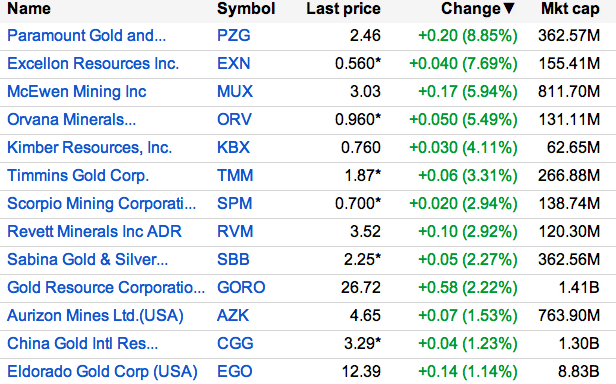
| Posted: 22 Jun 2012 11:28 AM PDT GDX declined by -0.56% while GDXJ gained by 0.78% and SIL declined by -0.54% Today's best silver and gold stocks:
|
| Iceland: A Silver Bullet for the World Economic Crisis Posted: 22 Jun 2012 11:16 AM PDT
from hangthebankers.com: The United States government is set to spend about $2.4 trillion this year. The mainstream propagandists are telling us that if Spain and Greece fold on their debt, it will wipe out oureconomy. Spain is in debt $2.4 trillion and Greece is in debt $553 billion. These are not little numbers by any stretch of the imagination, but the fact remains the total is about $553 billion more than we spend in a year. Considering we do not owe the Greek debt nor the Spanish debt, how could this relatively small amount wipe up out? Are we a part of some kind of bizarre internationalinsurance pool wherein the guy across town totals his Volkswagen and we lose our farm? This is all not but one big con. Since when did we the people of the United States become responsible for the debts of other nations? You will say we are not being told we have to pay that debt, but the fact is the central banks in Spain and Greece have already gotten billions in bailout moneys from the Federal Reserve borrowed in our names. Keep on reading @ hangthebankers.com |
| Is There Really A Silver Shortage? Posted: 22 Jun 2012 11:13 AM PDT V: The other night I posted a video where Don Harrold discussed a few of Mike Maloney's lofty expectations for Ag. And if you disagree Mike has some overly ambitious Ag predictions, you might be a silver zombie. For posting that video I received more than one hate mail from fellow stackers. One even suggested I was a shill working for Rothschild. Don will never stop making silver videos and is back tonight with another. Comments Open. A little research on the "silver shortage" story. from daytradeshow: ~TVR |
| Tekoa: Precious Metals Investing & More Posted: 22 Jun 2012 11:12 AM PDT tekoadasilva: Gold & Silver Bottoming, Harnessing Metals Manipulation, & BRICS Breaking Free from tekoadasilva: Top 12 Ways To Make Money With Gold & Silver… ~TVR |
| Could this make Ben Bernanke a Soviet dictator? Posted: 22 Jun 2012 11:12 AM PDT
from sovereignman.com: More than two decades after the fall of the Soviet Union, the Iron Curtain is still alive and well in an often forgotten corner of Eastern Europe… albeit a kindler, gentler version. Keep on reading @ sovereignman.com |
| Celente: Old-Man Europe, Romney, & Gold Posted: 22 Jun 2012 11:11 AM PDT Germany and Greece faced off today in the Eurocup 2012 with German newspapers pushing headlines like "bye Greeks, we can't save you today." But can anyone in Europe save the monetary union from itself? from capitalaccount: Mario Monti, Italy's technocrat prime minister says there is only one week left to do it, but looking back at older headlines, it appears there have been many times Europe had only "one week left," or "ten days left." What's up with that? And while we are on the topic of déjà vu…more ratings downgrades were issued yesterday. This time, it was Moody's downgrading 15 of the largest global banks, and its become a bit like white noise. We get it, worries are widespread, so the question is where is the safest place tohide from the tale risk of a worst-case scenario? Will we see another credit crunch, or is the best case just more "muddling through?" And last but not least, Friday is viewer feedback day, when Lauren answers some of your comments and tweets. From campaign contributions to rent seekers and Voltron, Lauren responds to you! ~TVR |
| RawDiggity: Silver & Gold Aint Money Posted: 22 Jun 2012 11:10 AM PDT V: I don't watch much of RawDiggity for obvious reasons but found SOME entertainment in this one. I do know he was stacking Ag like last week. What up raw? BrotherJohnF EXPERT Silver analyst and Bitcoin extraordinaire! from sirrawdoglet: ~TVR |
| Elite Orgasms in Rome: The Phoniness of Modern Leadership Posted: 22 Jun 2012 11:10 AM PDT
from thedailybell.com: Euro's big four seek way out of crisis in Rome … The leaders of Germany, France, Italy and Spain will try to find common ground in Rome on Friday to restore confidence in the euro zone ahead of a full EU summit next week, with German Chancellor Angela Merkel likely to be outnumbered. Dangerously high borrowing costs for Spain and Italy have eased a little on market hopes for policy initiatives at the Brussels summit on June 28/29. If it falls short, both countries may be pushed closer to eventually needing sovereign bailouts. Friday's meeting will search for ways to achieve fiscal and banking union in the euro zone and, more urgently, it may also be the occasion for Spain to formally request assistance of up to 100 billion euros for its struggling banks … Merkel is expected to resist any pressure from Monti, French President Francois Hollande and Spanish Prime Minister Mariano Rajoy for less stringent euro zone fiscal policies or the issuance of common euro zone bonds. – Reuters Dominant Social Theme: If these four did not meet in Italy the world would collapse. Free-Market Analysis: So … the "big four" – Merkel, Monti, Rajoy and Hollande – are meeting in Rome today. Reuters, a bought-and-paid-for media facility of the power elite, will be present to report on the scene and to remind us that our world depends on these four individuals. Three of the four are relative newcomers to politics; two were recently elected and one (Hollande) can count his rise to power in weeks rather than months. Keep on reading @ thedailybell.com |
| SF: “Why you should buy gold now” Posted: 22 Jun 2012 11:05 AM PDT silverfuturist: "Why you should buy gold now" Martin Armstrong DISCLAIMER: I am NOT telling you to buy gold, I am summarizing Martin Armstrong's article: http://www.martinarmstrong.org/files/Why%20You%20Should%20Buy%20Gold/index.htm from silverfuturist: ~TVR |
| The View From Atop the Junk Bond Bubble Posted: 22 Jun 2012 11:04 AM PDT
from dailyreckoning.com: 06/22/12 If you're like most investors, you may not know where to turn right now. Worrying about the collapse of Europe and what that might do to your portfolio before the opening bell might have you opting for sleep, instead of speculation. Added up, that's why money has been rushing out of the stock market and into junk bond funds at a record pace. If that sounds like you, I urge you to reconsider the "junky stuff." More on that in a moment. First, let's look at the numbers… After net outflows in May, last week, more than half a billion dollars flowed into high-yield debt, and close to $18 billion of investor money has flowed into the junky stuff thus far in 2012. If the money keeps coming into high-yield mutual and exchange-traded funds, the record amount set in 2009, when the S&P sank to 666, will be beat. Corporate America is taking advantage. Companies with junk credit ratings have bellied up to the debt trough like at no other time in history. The first quarter of 2012 will go down as the most active for junk bond issuance since 1980, when Thomson Reuters began keeping track, with 130 companies floating $75 billion in debt offerings. Keep on reading @ dailyreckoning.com |
| Andy Hoffman: Precious Metals Update Posted: 22 Jun 2012 11:04 AM PDT Precious Metals Update with Ranting Andy Hoffman ~TVR |
| HUI Chart Pattern Needs Some Help Posted: 22 Jun 2012 11:03 AM PDT
from traderdannorcini.blogspot.ca: As has been the case with the mining shares for some time, (going back as far as the first round of QE in late 2008), they require a shift in trader sentiment away from a DEFLATIONARY scenario towards one of INFLATION. The latter is what has resulted from each round of stimulus launched by the Federal Reserve. This week's lack of an imminent launch of a QE3, has set mining shares, as well as bullion, back on their heels as traders have made the shift back towards expecting a further slowdown in global growth and more of a deflationary environment. This shift is showing up in the decidedly bearish chart pattern now forming in the HUI once again. If you take a look at the Fibonacci Retracement Levels noted as well as the horizontal support and resistance levels I have marked on this chart, you can see just how closely both correspond with the other. Keep on reading @ traderdannorcini.blogspot.ca |
| 6 Profitable Small Cap Healthcare Stocks Holding Large Cash Reserves Posted: 22 Jun 2012 10:39 AM PDT By ZetaKap: Many investors are aware of the aging baby-boomer demographic in the US, but not everyone knows how to cash in on it. Healthcare companies with strong profits and large cash reserves is one way to invest in the inverting population model. When healthcare companies can build up their cash, they gain the ability to make smart investments and acquisitions, as well as fund new research and development. Today we focused on healthcare companies of this nature, and we think you'll find our list rather interesting. The Operating Profit Margin is a profitability ratio that measures the effectiveness of the company's operating efficiency. This metric allows investors to see how much profit is left after all variable costs are covered. If the company's margin is increasing over time, this means that it's earning more per dollar of sales. Finding trends in the Operating Profit Margin helps investors identify companies that are Complete Story » |
| Stocks Dump Into Close After Help From Oil And Bonds All Day Posted: 22 Jun 2012 10:39 AM PDT
from zerohedge.com: Early weakness in Treasuries (rising yields) and an acceleration in WTI prices back over $80 provided the 'contextual' support for an almost perfect 38.2% retracement bounce in S&P 500 e-mini futures today. Key support/resistance at the 1330 level was restested on dismal volume with a late-day surge but average trade size and activity picked up rather notably into the bell and ES cracked back almost 7 points to a 'mysterious' VWAP close. HYG outperformed today (as did VXX – and implicitly VIX which closed around 18% dropping 2 vols) but it appeared medium-term that equities were reverting to HYG's less sanguine view of the last month rather than HYG really leading. Financials were strong performers but all of those gains were at the open with XLF (and JPM which was unable to break VWAP in the afternoon) unch from 930ET and MS/GS/BAC/C all down 0.7% to 1.6% from the open (with a late day give back). Gold, Silver, and Copper are pretty much unchanged from the 4pmET close levels of yesterday while WTI is up over 2% closing back above $80. The long-bond underperformed +7bps on the day but outperformed on the week (as the 7Y and 10Y underperformed on the week) and provided the support for equity's levitation but this seemed as much QE-hope unwind as any implicit weakness. FX markets were dead with slight strength in AUD and EUR and weakness in JPY as USD basically trod water +0.8% on the week. S&P 500 e-mini futures perfectly hit the Fibonacci 38.2% retracement and sold back off (and although the chart doesn't show it, ES drifted all the way back to the light blue line which is VWAP)… Keep on reading @ zerohedge.com |
| Posted: 22 Jun 2012 10:00 AM PDT Digital technology is reinventing our whole world, in service of you and me. It's free enterprise on steroids. It's bypassing the gatekeepers and empowering each of us to invent our own civilization for ourselves, according to our own specifications. The promise of the future is nothing short of spectacular - provided that those who lack the imagination to see the potential here don't get their way. Sadly, but predictably, some of the biggest barriers to a bright future are capitalists themselves who fear the future. A good example is the current hysteria over 3-D printing. This technology has moved with incredible speed from the realm of science fiction to the real world, seemingly in a matter of months. You can get such printers today for as low as $400. These printers allow objects to be transported digitally and literally printed into existence right before your very eyes. It's like a miracle! It could change everything we think we know about the transport of physical objects. Rather than sending crates and boats around the world, in the future, we will send only lightweight digits. The potential for bypassing monopolies and entrenched interests is spectacular. Here is what Andrew Myers reported in Wired magazine last week:
"Last winter, Thomas Valenty bought a MakerBot - an inexpensive 3-D printer that lets you quickly create plastic objects. His brother had some Imperial Guards from the tabletop game Warhammer, so Valenty decided to design a couple of his own Warhammer-style figurines: a two-legged war mecha and a tank. There we have it. The American Chamber of Commerce - the supposed defender of free enterprise - is in a meltdown panic about new technology, determined to either crush 3-D printing in its crib or at least to make sure it doesn't grow past its toddler period. In the 1940s, Joseph Schumpeter said that the capitalists would ultimately destroy capitalism by insisting that their existing profitability models perpetuate themselves in the face of change. He said that the capitalist class would eventually lose its taste for innovation and insist on government rules that brought it to an end, in the interest of protecting business elites. Here's an example: When books and music started going digital, there was an outcry. How would authors and musicians survive this onslaught? The truth is that there was no onslaught. It was a windfall for consumers that turned into the greatest boon for music and literature ever. Today, we see how this is working. And not only working, but there are more authors and musicians making money today than ever before. My best example is the emerging utopia of the Laissez Faire Club. No one could have thought of such a thing a few years ago. Now its burgeoning membership is enjoying the highest-quality literature delivered every Friday for a ridiculously low membership fee. This is the sort of institution free enterprise creates, one that uses imagination and the service ethic to do wonderful things for the world. The methods could never have been anticipated in advance. Some give away their content and sell their performances. Some have found interesting new methods of distributing content behind pay walls that are affordable and convenient. Authors are starting to self-publish through a fantastic number of venues. I've been touring museums lately, and I've begun to realize something important about the long process of technological improvement. Through our long history of improvement, every upgrade and every shift from old to new inspired panic. The biggest panic typically comes from the producers themselves who resent the way the market process destabilizes their business model. It was said that the radio would end live performance. No one would learn music anymore. With records, everything would be performed one time and recorded for all time, and that would be the end. Of course, that didn't happen. Tapes were next, and everyone predicted doom for recorded music, since music could be so easily duplicated ("Home taping is killing music"). It was the same with digital music: Surely, this would be the death of all music! And think back to the mass ownership of books in the 19th century. Many people predicted that these would destroy new authors because people would just buy cheap and affordable books by old authors. New authors would starve, and no one would write anymore. There is a pattern here. Every new technology that becomes profitable causes people to scream about the plight of existing producers. Then it turns out over time that the sector itself thrives as never before but in ways that no one really expected. The great secret of the market economy is that it embodies a long-run tendency to dissipate profits under existing production and distribution methods. This is how competition works. This is how competition not only inspires improvement, but makes it unavoidable. And this is one reason that so many capitalists hate capitalism. The process goes like this. The new thing comes along and it earns high profits. Then the copycats come along and do the same thing cheaper and better, robbing the first producer of the monopoly status. Profits eventually fall to zero, and then something even better has to come along to attract new business, earn new profits and elicit new copycats. And the whole thing starts all over again. I've never understood why leftists complain about profits going to capitalists. In a vibrant market economy, profits are the temporary exception to the rule. They accrue only to the most innovative and efficient firms, the ones that serve the consumer best, and the gains are never permanent. As soon as the company loses its edge, entrepreneurial profit vanishes. Under free market competition, writes Ludwig von Mises, the trajectory of existing production and distribution models is always to reduce profits to zero. For those who want to hang onto profits, there can be no rest. "New and improved" must be an everyday experience. There must be a ceaseless striving to serve consumers in ways that are ever more excellent. This is why business is always running to government for protection. Kill this crazy new technology! Stop these imports! Raise the costs on the competition! Give us a patent so that we can clobber the other guys! Impose antitrust law! Protect me with a copyright! Regulate the newcomers out of existence! Give us a bailout! Aside from this, there is a public fear of the new. Otherwise, people would not find the self-interested protests of the existing establishment to be persuasive. Here is a striking fact about the human mind: We have great difficulty imagining solutions that have yet to present themselves. It doesn't matter how often the market resolves seemingly intractable problems. We still can't become accustomed to this reality. Our minds think in terms of existing conditions, and then we predict all kinds of doom. We too often fail to consistently expect the unexpected. This poses a serious problem for the market economy, which is all about the ability of the system to inspire discovery of new ideas and new solutions to prevailing over problems. The problems posted by change are obvious enough, but the solutions are "crowd sourced" and emerge from places, people and institutions that cannot be seen in advance. Capitalism is not for wimps who don't want to improve. If you want guaranteed profits for the few, rather than prosperity and abundance for the many, socialism and fascism really are better systems. The push to stop market progress won't work in the end, of course. Technology eventually mows down the forces of resistance. The mercantilists can only delay, but never finally suppress, the human longing for a better life. Regards, Jeffrey Tucker From the Archives... The Disconnect Between US Household Wealth and GDP Growth Playing The Financial Markets - The Greatest Game of All The RBA's Mortgage Market Denial Spanish "Assistance" or "Bailout" Priming Your Investment Returns
|
| Why the Gold Price Is Surprisingly Strong Posted: 22 Jun 2012 09:59 AM PDT The Gold Price in 2012 has in truth proven strong, given the challenges it faces... Next up, the world's heaviest physical buyers – Indian households. Now overtaken by Chinese consumers, India buyers are always quiet this time of year (what with the monsoon season, a lack of auspicious festivals, and the post-harvest wedding and Diwali season still four months off). But New Delhi's active policy of trying to stem Gold Bullion imports in 2012, plus the record-high prices set by the fast-sinking Rupee, have chewed up this massive support for global demand by perhaps 30% or more on best estimates. That's had a big impact on the wholesale physical market – still centered in London, more than 80 years after Britain abandoned its Gold Standard. Physical investment demand from the big institutions has clearly eased off as well. Here's what the market-making bullion banks say they're turning over each day on average between themselves. You can size it up by 5 times or more to get the true market-wide volume.  As you can see, London's volume by value has sunk one-third by value since last summer's peak. Yet the Gold Price has lost only 11% on its monthly average. Perhaps that gap will be closed. Some speculative traders in the futures and options market think so – and they think it will be closed by prices falling still further, as well. See the red line in our first chart above. Speculative traders haven't held this big a short position in gold since the price was down at $400 or so. But given these 3 factors all weighing on price, the "plunge" in fact looks more resilient. Existing sellers are refusing to slash their offers, and new buyers are still paying historically strong prices to acquire metal today. Lucky for them, however, gold's unique mix of inflation and default insurance is currently cheaper than its peak price of 12 months ago. Looking to Buy Gold today...? Adrian Ash, 22 Jun '12
|
| RED ALERT : Seven Events that Will Precede the US Economic Collapse in Autumn 2012 Posted: 22 Jun 2012 09:45 AM PDT My favorite European Think Group tells me today that "the trumpets of Jericho will ring out seven times" to alert the world just prior to the "new and improved" global economic crisis -- which is due to arrive this Fall, apparently... Read |
| Gold Stocks Like Royal Gold And Franco Nevada Do Better When Insiders Own Too Posted: 22 Jun 2012 08:54 AM PDT By Marc Courtenay:
Many of us realize that a massive, worldwide "quantitative easing" of monetary policies is in progress and the spigots have been turned on for at least four years now. The official U.S. National Debt, we are told, is nearing $16 trillion. That's what the federal government reports. According to The Institute for Truth in Accounting, the real National Debt is over $76 quadrillion dollars, and increasing daily. To make that number, $76 quadrillion, a little more personal, that equates to over $247,000 for every man, woman and child in the Complete Story » |
| Posted: 22 Jun 2012 07:41 AM PDT By Skyler Greene: Precious metals investors were disappointed after the recent Fed meeting failed to provide further quantitative easing. Silver plunged 5%. Yesterday, I determined that short-term silver prices were likely to move strongly based on price action near the support line. (See: Silver Prices Ready For A Move?). I stated that if silver closed below support, a quick sell-off would ensue and the near-term prospects for silver would be dull. However, the support was tested and held today, and silver closed on strong volume. See the two charts below. (The iShares Silver Trust ETF (SLV) is used as a proxy.) (click to enlarge) Source: FreeStockCharts.com Silver entered a downtrend at 10 a.m. and threatened to break support right before 11. However, it saw a strong bounce and then entered an uptrend for the rest of the day, never retesting the support. The most bullish sign is the strong close on volume -- Complete Story » |
| How Will You Know When It's Time To Sell Your Gold? Posted: 22 Jun 2012 07:35 AM PDT By Katchum: I have pointed out previously how James Turk uses his Gold Money Index to estimate the fair value of gold (GLD). You can read it in this article. In that article we estimate that gold should be at around $12000/ounce in 2011 if we compare the gold price with the amount of foreign currency reserves held by the central banks around the world. Apparently, Jim Sinclair is using another metric: he divides the amount of federal reserve custodials by the amount of gold at the federal reserve (260 million ounces since 2006). This metric has been rising very quickly since 2008 (green line on chart 1) and is estimated at $7000/ounce. Historically, the gold price would follow these metrics (see Chart 1 1970-1988). But after 1988, the gold price lagged the money creation by central banks until 2000. From 2000 onwards, gold is trying to catch up with the growing Complete Story » |







| You are subscribed to email updates from Gold World News Flash 2 To stop receiving these emails, you may unsubscribe now. | Email delivery powered by Google |
| Google Inc., 20 West Kinzie, Chicago IL USA 60610 | |

No comments:
Post a Comment