


Gold World News Flash |

- Surprise Strength in Gold
- Is Gold About to Rally? USD Index and Crude Oil Prices Suggest Otherwise
- Why Stocks Outperformed All Other Gold Investments
- Down Days
- Silver Collateral Damage in Oil War Between Washington & Moscow?
- Why Is No One Buying Silver Anymore?
- Arensberg explains trading juniors; Davies sees gold supplanting bonds
- An Ending Made For Gold
- Blythe on Gold - Silver Tells the Story
- Forget the PIIGS, the EU as a Whole is Insolvent
- In The News Today
- Ben Davies - Eurozone, Deleveraging & Gold to Break $6,000
- Europe’s train-wreck and the inevitable collapse of the global economy
- Central banks around the world are continuing to stock up on gold.
- Gold Chart and Comments
- "One Cannot Operate A Capitalist System If The State Can Borrow At A Negative Cost"
- In India gold pits the people against the government -- as it does almost everywhere
- Blythe Master's Next Move - Silver Leads Again
- Gold Price Imminent Breakdown
- Turns Out China IS Lying About Everything
- This Past Week in Gold
- Why Stocks Outperformed All Other Gold Investments
- Iceland Mocks EU's Struggle With Collapse: Iceland is speeding ahead on its bid to join the bloc and even delivered a pep talk Friday to those struggling to hold it together.
- Gold Investors Gaining from Economic Exposés and Realities
| Posted: 23 Jun 2012 06:45 PM PDT "GOLD PRICE PLUMMETS" is the obvious headline right now. But fact is, the gold price has in truth been surprisingly strong so far this year. First up, the US gold futures and options market. These contracts rarely run to physical settlement, but still they wag the dog of physical prices near-term. Because the price of gold for future delivery of course affects how much people ask or bid for metal today.
| ||||||||||||||||||||
| Is Gold About to Rally? USD Index and Crude Oil Prices Suggest Otherwise Posted: 23 Jun 2012 06:41 PM PDT Congratulations. Let's all take a collective deep sigh of relief. Instead of a new crisis, we're just going to keep having the same old one. Greeks voted to stay in the European Union with a narrow victory for the center-right New Democracy party. A global crisis has been averted—for now. But as we take a deep sigh of relief let's keep in mind that the euro is already on a slippery slope to oblivion.
| ||||||||||||||||||||
| Why Stocks Outperformed All Other Gold Investments Posted: 23 Jun 2012 06:38 PM PDT Ian Gordon of Longwave Analytics and Longwave Strategies believes we're on the precipice of very difficult and frightening times and predicts complete financial collapse. But it's in those periods of darkness that gold really shines. Gordon, who recently published a special edition of his Investment Insights entitled "The Gold Rush of the 1930s Will Rise Again," believes that companies with gold in the ground now will be the ones to prosper. In this exclusive Gold Report interview, Gordon discusses where he thinks the Dow will bottom.
| ||||||||||||||||||||
| Posted: 23 Jun 2012 06:35 PM PDT Gold fell 3.8% this past week, mostly on Thursday after Wednesday's break of the uptrend line. It was a very ugly day out there Thursday and one best forgotten. It's all paper games though and the physical remains under heavy accumulation.
| ||||||||||||||||||||
| Silver Collateral Damage in Oil War Between Washington & Moscow? Posted: 23 Jun 2012 06:01 PM PDT from Silver Vigilante:
For example, it is often publicized how Putin keeps oil magnates and titans waiting not only for meetings, but even for potential deals. According to Reuters, Putin recently left global oil executives waiting, thus leaving "little doubt as to who was the master of the world's largest energy reserves." According to Reuters: "But the chief executives of BP, ConocoPhillips , Shell and Chevron stood with a dozen colleagues in a dark, chairless foyer, shifting from foot to foot on Thursday as they waited three hours for an audience."
| ||||||||||||||||||||
| Why Is No One Buying Silver Anymore? Posted: 23 Jun 2012 04:04 PM PDT | ||||||||||||||||||||
| Arensberg explains trading juniors; Davies sees gold supplanting bonds Posted: 23 Jun 2012 03:53 PM PDT 11:47a HKT Sunday, June 24, 2012 Dear Friend of GATA and Gold: At the Got Gold Report, Gene Arensberg demonstrates a strategy for using long-term price charts for trading some of the junior mining companies that lately have been beaten down to extreme lows: http://www.gotgoldreport.com/2012/06/ggr-courtesy-sample-simple-secret-w... And at King World News, Hinde Capital CEO Ben Davies expects bonds to lose their appeal and gold to gain it as Asia continues to find precious metals more attractive: http://kingworldnews.com/kingworldnews/KWN_DailyWeb/Entries/2012/6/23_Be... CHRIS POWELL, Secretary/Treasurer ADVERTISEMENT Sona Discovers Potential High-Grade Gold Mineralization From a Company Press Release VANCOUVER, British Columbia -- With its latest surface diamond drilling program at its 100-percent-owned, formerly producing Blackdome gold mine in southern British Columbia, Sona Resources Corp. has discovered a potentially high-grade gold-mineralized area, with one hole intersecting 13.6 grams of gold in 1.5 meters of core drilling. "We intersected a promising new mineralized zone, and we feel optimistic about the assay results," says Sona's president and CEO, John P. Thompson. "We have undertaken an aggressive exploration program that has tested a number of target zones. Our discovery of this new gold-bearing structure is significant, and it represents a positive development for the company." Sona aims to bring its permitted Blackdome mill back into production over the next year and a half, at a rate of 200 tonnes per day, with feed from the formerly producing Blackdome mine and the nearby Elizabeth gold deposit property. A positive preliminary economic assessment by Micon International Ltd., based on a gold price of $950 per ounce over eight years, has estimated a cash cost of $208 per tonne milled, or $686 per gold ounce recovered. For the company's complete press release, please visit: http://www.sonaresources.com/_resources/news/SONA_NR18_2011-opt.pdf Join GATA here: Hong Kong Gold Investment Forum Toronto Resource Investment Conference New Orleans Investment Conference * * * Support GATA by purchasing DVDs of our London conference in August 2011 or our Dawson City conference in August 2006: http://www.goldrush21.com/order.html Or by purchasing a colorful GATA T-shirt: Or a colorful poster of GATA's full-page ad in The Wall Street Journal on January 31, 2009: http://gata.org/node/wallstreetjournal Help keep GATA going GATA is a civil rights and educational organization based in the United States and tax-exempt under the U.S. Internal Revenue Code. Its e-mail dispatches are free, and you can subscribe at: To contribute to GATA, please visit: ADVERTISEMENT Prophecy Platinum Announces Wellgreen Preliminary Economic Assessment: Company Press Release VANCOUVER, British Columbia, Canada -- Prophecy Platinum Corp. (TSX-V: NKL, OTC-QX: PNIKF, Frankfurt: P94P) reports the results of an independent NI 43-101-compliant preliminary economic assessment for its fully owned Wellgreen nickel-copper-platinum group metals project in the Yukon Territory. The independent assessment, prepared by Tetra Tech, evaluated a base case of an open-pit mine (with a mining rate of 111,500 tonnes per day), an on-site concentrator (with a milling rate of 32,000 tonnes per day), and an initial capital cost of $863 million. The project is expected to produce (in concentrate) 1.959 billion pounds of nickel, 2.058 billion pounds of copper, and 7.119 million ounces of platinum, palladium, and gold during a mine life of 37 years with an average strip ratio of 2.57. The financial highlights of the preliminary economic assessment, shown in U.S. dollars, are as follows: Payback period: 3.55 years Prophecy Chairman John Lee says: "We are pleased with the preliminary economic assessment results. The numbers indicate that Wellgreen is one of most exciting mineral projects in the Yukon. The company is drilling to upgrade and expand the resource base. The infrastructure is excellent as the project is only 1,400 meters in altitude and 14 kilometers from the paved Alaska Highway, which leads to the Haines deep seaport. Discussions are under way with support from local stakeholders regarding permitting and logistics." For the complete press release, please visit: http://prophecyplat.com/news_2012_june18_prophecy_platinum_announces_res...
| ||||||||||||||||||||
| Posted: 23 Jun 2012 03:30 PM PDT by Frank Holmes, CEO and Chief Investment Officer – U.S. Global Investors US Funds.com:
In the ongoing eurocrisis, we won't know the details of how Europe will clean up its debt mess for a while, but we're pretty confident the story ends well for gold. In one possible outcome presented by Bank of America-Merrill Lynch, austerity is "not the answer on its own" when it comes to restoring confidence in fiscal policies. Take a look at the levels of household and bank debt in the U.S. compared to Europe. Over the past few years, debt in the U.S. has decreased as the private sector has delevered. In the eurozone, though, you'll see that banks and households have maintained status quo when it comes to their levels of debt. On all three measures, loan/deposit, household debt/disposable income and debt/income, ratios have remained around the same level, according to BofA.
| ||||||||||||||||||||
| Blythe on Gold - Silver Tells the Story Posted: 23 Jun 2012 01:34 PM PDT But, the real battle is in gold, not silver and I will tell you why. The gold market is huge and the shorts JPM and HSBC have are tremendous and they are the key that shows JPM must get out of these before the crash of Europe because if they ... Read More...
| ||||||||||||||||||||
| Forget the PIIGS, the EU as a Whole is Insolvent Posted: 23 Jun 2012 12:56 PM PDT
Europe is heading into a full-scale disaster.
You see, the debt problems in Europe are not simply related to Greece. They are SYSTEMIC. The below chart shows the official Debt to GDP ratios for the major players in Europe.
As you can see, even the more “solvent” countries like Germany and France are sporting Debt to GDP ratios of 75% and 84% respectively.
These numbers, while bad, don’t account for unfunded liabilities. And Europe is nothing if not steeped in unfunded liabilities.
Let’s consider Germany. According to Axel Weber, the head of Germany’s Central Bank, Germany is in fact sitting on a REAL Debt to GDP ratio of over 200%. This is Germany… with unfunded liabilities equal to over TWO times its current GDP.
To put the insanity of this into perspective, Weber’s claim is akin to Ben Bernanke going on national TV and saying that the US actually owes more than $30 trillion and that the debt ceiling is in fact a joke.
What’s truly frightening about this is that Weber is most likely being conservative here. Jagadeesh Gokhale of the Cato Institute published a paper for EuroStat in 2009 claiming Germany’s unfunded liabilities are in fact closer to 418%.
And of course, Germany has yet to recapitalize its banks.
Indeed, by the German Institute for Economic Research’s OWN admission, German banks need 147 billion Euros’ worth of new capital.
To put this number into perspective TOTAL EQUITY at the top three banks in Germany is less than 100 billion Euros.
And this is GERMANY we’re talking about: the supposed rock-solid balance sheet of Europe. How bad do you think the other, less fiscally conservative EU members are?
Think BAD. As in systemic collapse bad.
Indeed, let’s consider TOTAL debt sitting on Financial Institutions’ balance sheets in Europe. The below chart shows this number for financial institutions in several major EU members relative to their country’s 2010 GDP.
Source: IMF
As you can see, financial institutions in Germany, France, Italy, Spain, the UK, and Ireland are all ticking time bombs.
Indeed, taken as a whole, European financial institutions have more debt than Europe’s ENTIRE GDP. Let’s compare the situation there to that in the US banking system.
Taken as a whole, the US banking system is leveraged at 13 to 1. Leverage levels at the TBTFs are much much higher… but when you add them in with the 8,100+ other banks in the US, total US bank leverage is 13 to 1.
The European banking system as a whole is leveraged at nearly twice this at over 26 to 1. That’s the ENTIRE European Banking system leveraged at near Lehman levels (Lehman was 30 to 1 when it collapsed).
To put this into perspective, with a leverage level of 26 to 1, you only need a 4% drop in asset prices to wipe out ALL capital. What are the odds that European bank assets fall 4% in value in the near future as the PIIGS continue to collapse?
These leverage levels alone position Europe for a full-scale banking collapse on par with Lehman Brothers. Again, I’m talking about Europe’s ENTIRE banking system collapsing.
This is not a question of “if,” it is a question of “when.” And it will very likely happen before the end of 2012.
The reason that this is guaranteed to happen before the end of 2012 is that a HUGE percentage of European bank debt needs to be rolled over by the end of 2012.
I trust at this point you are beginning to see why any expansion of the EFSF or additional European bailouts is ultimately pointless: Europe’s ENTIRE BANKING SYSTEM as a whole is insolvent. Even a 4-10% drop in asset prices would wipe out ALL equity at many European banks.
On that note I believe we have at most a few months and possibly even as little as a few weeks to prepare for the next round of the EU Crisis. On that note, I recently published a report showing investors how to prepare for this. It’s called How to Play the Collapse of the European Banking System and it explains exactly how the coming Crisis will unfold as well as which investments (both direct and backdoor) you can make to profit from it. This report is 100% FREE. You can pick up a copy today at: http://www.gainspainscapital.com
Good Investing!
Graham Summers
PS. We also feature numerous other reports ALL devoted to helping you protect yourself, your portfolio, and your loved ones from the Second Round of the Great Crisis. Whether it’s a US Debt Default, runaway inflation, or even food shortages and bank holidays, our reports cover how to get through these situations safely and profitably. And ALL of this is available for FREE under the OUR FREE REPORTS tab at: http://www.gainspainscapital.com
| ||||||||||||||||||||
| Posted: 23 Jun 2012 11:09 AM PDT Jim Sinclair's Commentary Mr. Fred reports no change whatsoever on gold fundamentals. However, he did retreat to his house due to the amount of noise coming from MSM and other gold haters. Jim Sinclair's Commentary There is a big problem brewing again in the OTC derivative market. A major international financial auditing Continue reading In The News Today
| ||||||||||||||||||||
| Ben Davies - Eurozone, Deleveraging & Gold to Break $6,000 Posted: 23 Jun 2012 08:14 AM PDT  With tremendous volatility in global markets around the world, today King World News interviewed Ben Davies, CEO of Hinde Capital. Davies told KWN, "it would have been lovely to have had an extreme event happen so that we get to the end of this process." Here is what Davies had to say about what is taking place: "I think the mini-boom that we had in the nominal gold price, up to $1,900, we've been working off that mini-excess sideways. The disinflationary pressures from this concept of credit dying is worrying, and I think it weighs on all assets prices. But gold is doing what it should be doing." With tremendous volatility in global markets around the world, today King World News interviewed Ben Davies, CEO of Hinde Capital. Davies told KWN, "it would have been lovely to have had an extreme event happen so that we get to the end of this process." Here is what Davies had to say about what is taking place: "I think the mini-boom that we had in the nominal gold price, up to $1,900, we've been working off that mini-excess sideways. The disinflationary pressures from this concept of credit dying is worrying, and I think it weighs on all assets prices. But gold is doing what it should be doing."
This posting includes an audio/video/photo media file: Download Now | ||||||||||||||||||||
| Europe’s train-wreck and the inevitable collapse of the global economy Posted: 23 Jun 2012 07:55 AM PDT  ECONOMY – Yes, it is officially time to start freaking out about the global economy. The European financial system is falling apart and it is going to go down hard. If Europe was going to be saved, it would have happened by now. The big money insiders have already pulled their funds from vulnerable positions and they are ready to ride the coming chaos out. Over the next few months, the slow motion train-wrecks currently unfolding in Europe will continue to play out and things will likely really start really heating up in the fall, once summer vacations are over. ECONOMY – Yes, it is officially time to start freaking out about the global economy. The European financial system is falling apart and it is going to go down hard. If Europe was going to be saved, it would have happened by now. The big money insiders have already pulled their funds from vulnerable positions and they are ready to ride the coming chaos out. Over the next few months, the slow motion train-wrecks currently unfolding in Europe will continue to play out and things will likely really start really heating up in the fall, once summer vacations are over.Most Americans greatly underestimate how much Europe can affect the global economy. Europe actually has a larger population than the United States does. Europe also has a significantly larger economy and a much larger banking system. The world is more interconnected today than ever before, and a collapse of the financial system in Europe will cause a massive global recession. Once the global economy slides into another major recession, it is going to take years to recover. The pain is going to be immense. Yes, that is going to include the United States. Sadly, we never recovered from the last recession, and it is frightening to think about how much farther this next recession is going to knock us down. Read more..... 
This posting includes an audio/video/photo media file: Download Now | ||||||||||||||||||||
| Central banks around the world are continuing to stock up on gold. Posted: 23 Jun 2012 05:17 AM PDT Gold Becomes a Tier 1 Asset Class for Banks
| ||||||||||||||||||||
| Posted: 23 Jun 2012 05:04 AM PDT [url]http://www.traderdannorcini.blogspot.com/[/url] [url]http://www.fortwealth.com/[/url] Gold did not have a good week ending down $61 or 3.7% from the prior week's closing print. As we all know by now, disappointment by bulls who had bought out ahead of the FOMC meeting and statement, was quickly reflected in the initial drop lower when the statement hit the wires. However, during that same day, there was a reconsideration after parsing the statement and the price rebounded taking back most of the losses. After further reflection overnight, the sentiment once again soured and down it went plunging through $1600 in the process and closing near the low of the week and the session. Quite frankly, until traders become convinced that some sort of policy move by Central Bank Planners which will stem the downward economic spiral is forthcoming, they are not going to buy. It will be up to the big physical market buyers, mainly the Asian Central Banks, who are valued based buyers, to put a...
| ||||||||||||||||||||
| "One Cannot Operate A Capitalist System If The State Can Borrow At A Negative Cost" Posted: 23 Jun 2012 04:23 AM PDT The following extract from Charles Gave's (of GaveKal ) latest letter to clients is a must read for all, especially for the central planning members of the FOMC. The punchline is this statement which is so simple and obvious, it is no wonder virtually noone in control has figured it out yet: "One Cannot Operate A Capitalist System If The State Can Borrow At A Negative Cost." From GaveKal Research: Obsessed by Negative Real Rates Deflation and crisis Consumption bubbles fuelled by negative real rates always contain the seeds of their own destruction. Debt levels get too high and force household deleveraging; meanwhile the currency falls, which improves competitiveness in the global marketplace. The combined effect is a narrowing of the current account deficit. When the world's reservecurrency nation experiences such a narrowing, the supply of dollars outside of the US falls, and inevitably catches some countries out. The best way to look at global dollar supply is to remove China and oil from the US current account balance; this is because of the incredible competitiveness of China, and the scarcity-value of oil producers. Excluding oil and China, the annualized US current account has moved from a deficit of 3% of GDP in 2003 to a recent surplus of 1% of GDP. This improvement in the current account position has taken place despite the fact that most of the world is growing well below its potential. In effect, the US economy has exercised an immense deflationary pressure on the margins of companies outside of the US, and in so doing has managed to "recover" roughly 4 % of its GDP. This turnaround underlines just how low the value of the US dollar fell after years of dilutive monetary policy. Moreover, the pressure of a cheap dollar has been compounded by mercantilist China's de facto peg to the US dollar. No wonder so many current account crises are percolating around the world—countries from Egypt to Italy to India have had to deal simultaneously with a hypercompetitive dollar, an undervalued renminbi and higher oil prices:
While the oil producers and China may still be sitting on a ton of US dollars—which they are recycling into USTs and thus keeping US government borrowing costs at bargain-basement levels—the dollar supply elsewhere in the world has fallen sharply. The countries which have no access to the US currency have to start using their foreign exchange reserves to meet their payments (very often to oil producers and China), thus amplifying the problem. When a country is forced to sell reserves, then it has to follow restrictive monetary and budget policies to depress domestic demand and recreate a current account surplus. The cost of capital rises sharply for the private sector. India today offers a prime example of a country stuck in this corner. In the chart below , I am showing the 12-month variations of foreign central bank reserves deposited at Fed—this is excluding China (I would also exclude the oil producers, but could not find a way of estimating their forex reserves). Past periods of rundowns in global forex reserves always have been associated with crises.
When the US current account deficit starts closing, the dwindling supply of dollars eventually leads to a panicked rush for dollars. Non-US companies that binged on dollars when the money was cheap and the dollar was forever going down, now find themselves caught out. Every entity with a negative cash flow in dollars scrambles for dollars — even through selling local assets and converting the proceeds — depressing risk assets everywhere. The US dollar and USTs outperform everything, including industrial metals (see chart overleaf). And of course equities are not spared (see chart overleaf). Needless to say, if one has to be invested in equities in these periods, stay in the US stock market (as US companies will not have such troubles) and avoid non-US equities except when they become extraordinarily cheap versus the US market (e.g., a ratio below 1.2x).
I could go on and on with other examples, but let's just get to the point: one cannot operate a capitalist system if the state can borrow at a negative cost. Years of irresponsibly loose monetary policy in the US has led to cheap funding for the US (and other) governments, but difficult credit conditions for the private sector all around the world. As I underlined in How The World Works, negative real rates leads to misallocation of capital which ends in asset deflation, while simultaneously limiting the capacity for recovery by driving out the private sector. The Fed has been managed by a bunch of Keynesians who care nothing about the role of the dollar as a reserve currency and who probably believed they were managing the central bank of Belorussia or Zimbabwe! So what's an investor to do? Now at this point, the reader may feel I am about to suggest buying a ranch in Oklahoma, a few guns and some nuggets of gold. This is not my recommendation—at least not yet. In fact, for more than a year now, we have been recommending assets with a positive cash flow in US dollars. The big question is whether there is scope for more sane central banking, and an improvement in liquidity conditions. In some ways I feel hope: • Oil prices have come down a lot, and the US dollar is rising (despite the Fed's frenetic distribution of swaps). • China is internationalizing the RMB and increasingly widening its capital account, to provide another source of liquidity. • If non-US assets become cheap enough, then more risk capital will start flowing in that direction (a break-down of the euro would be very useful here in so far as it would instantly create a lot of very cheap assets in Italy, Spain, France, etc.) In an ideal world, central banks would stop manipulating prices and would return to the Wicksellian rule which worked so well from 1983 to 2002—i.e., they would decide to put short rates gradually back at a level consistent with the growth in the local private sector GDP. I know full well that allowing short rates to go up at this time flies against the current Keynesian orthodoxy at the Fed. A few Fed officials have already acknowledged that with the Fed balance sheet as enormously large as it, future QE action will simply have much less bang for the buck. Unfortunately, with Wednesday's FOMC announcement on additional funds for Operation Twist, it is clear that any voice of reason in that organisation will be drowned out the by Keynesians on board. I can only take solace from the fact that political winds also do not seem to be blowing in the Fed's direction. We may have to wait for November—to see if the voters fire the Fed. Such an outcome would be very bullish for global risk assets.
| ||||||||||||||||||||
| In India gold pits the people against the government -- as it does almost everywhere Posted: 23 Jun 2012 03:09 AM PDT Gold Always Glitters in India: Will Curbing Its Import Save the Economy? By Sreeja Vn http://www.ibtimes.com/articles/355601/20120623/gold-imports-india.htm "An inch of time is an inch of gold, but you can't buy that inch of time with an inch of gold." Is this Chinese proverb proving correct in the case of Indians who invest in the yellow metal for good times tomorrow? Or is the craze for the glittering object really ruining the country's economy? Time and again the Indian government, economists, and experts have ridiculed the people's obsession with gold and pointed out the need to curtail imports of the yellow metal to reduce the nation's trade deficit. Indians have an irresistible temptation to buy gold -- either as ornaments or as investment. Their obsession with the gold jewelry has roots in their culture, tradition, and in the economic realities in the rural and grassroots levels of society. As an investment, gold has been an easier bet to hedge against inflation and other risks. Indians have been buying and trading in gold since time immemorial, and they continue to buy even now, when it is more expensive than ever. ... Dispatch continues below ... ADVERTISEMENT Be Part of a Chance to Discover Northaven Resources Corp. (TSX-V:NTV) is advancing five gold and silver projects in highly prospective and politically stable British Columbia, Canada. Check out the exploration program on our Allco gold/silver project : -- A large (13,000 hectare) property, covering more than 15 square kilometers of a regional mineralized trend just 3km from a recently announced 1.2-million-ounce gold and 15-million-ounce silver deposit. -- The property hosts historic high-grade silver workings and many mineral showings as well as former mines at the property's northern and southern boundaries. -- A deep-penetrating airborne geophysics survey has just been completed on the entire property and neighboring deposits and its results are eagerly awaited. To learn more about the Allco property or Northaven's other gold and silver projects, please visit: http://www.northavenresources.com Or call Northaven CEO Allen Leschert at 604-696-3600. The government and experts believe that high gold imports are fatal to the economy and Indians should stop investing in gold. They say this would solve India's economic problems, erase the current account deficit, appreciate the rupee, and boost growth. They say the country's balance of payments is negative because of gold import. "Quantum of import of gold ... is a clear indication that a large section of community ... wants investment in a dead asset only with expectation that the value would appreciate," Finance Minister Pranab Mukherjee said at a function in Mumbai last week. He added, "There is a need to spread financial literacy to encourage people to invest in market instruments" and to dissuade them from investing in gold. The government believes that India's common people can easily save the country's faltering economy by sacrificing their passion for gold. However, the people who have spent their fortunes on gold and a section of analysts have a different point of view. They say that though gold imports affect the country's balance-of-payments position in the short term, India's gold reserves will benefit the people and the country in the longer run. They feel that there is no justification for saying that gold is an idle asset. "From the investors' point of view, gold is not an idle asset. When it is appreciating, it is not a dead asset for the holder," says Jayesh Nathwani of FXWire. To understand both the standpoints, one needs to understand what gold means for Indians and the cultural and economic reasons associated with this: -- India is the world's largest importer of gold. India accounts for nearly a third of total world demand for gold. India's gold imports were higher than those of 12 of its states' gross state domestic products in the year 2010-11. -- Gold's share of the total import bill of the country has gone up from 8.1 percent in 2001-02 to 9.6 percent in 2010-11. The average rate of growth in gold imports in the last three years was 26.8 percent. At this rate, the gold import bill will be approximately $100 billion by 2015-16. -- According to a World Gold Council report, India has a savings rate of about 30 percent, and 10 percent of this is in gold. It says that gold reserves in India, both private and government, were around 20,000 tons at the end of 2011 and are worth roughly Rs 54 lakh crore, which is 60 percent of the nominal GDP of India in 2011-12. -- Gold import value for the year 2010-11 was higher than the budget-estimated expenditure on urban development, housing, and family welfare for the year 2010-11. -- According to the gold council report, gold jewelry accounted for about 75 percent of total Indian gold demand in 2009, the remainder being investment (23 percent) and decorative and industrial use (2 percent). -- Demand for gold in India is not dependent on international prices but on seasonal demands in the country, like weddings and festivals. So people tend to buy gold whatever may be the price in these seasons. ... India's Golden Tradition Gold is a part and parcel of India's culture and traditions. As money, jewelry, status symbol, and investment, gold has played a crucial role in the lives of Indians for centuries. A family's wealth was determined by the gold and land it had. Gold is considered "Lakshmi," the Hindu goddess of wealth, and a symbol of prosperity. Traditionally and as a religious practice, an Indian woman wears ornaments throughout her life. Gold is her favorite jewelry. Normally, from childhood to the end of her life, gold adorns her in several forms depending on her wealth and status. Though the trend is tilted toward platinum and white gold in recent times among the urban elite, for middle- and lower-class families, jewelry means only gold. Nothing could replace gold's stature and importance in the Indian society. In south India the first food a newborn consumes will include gold. According to the tradition, the elder family member will make a paste of a local herb and a minute amount of gold and feed the baby. This is believed to bring wealth and prosperity to the baby. Gold is also part of the religious practices at homes and temples. In several states the yellow metal is worshipped as a symbol of Lakshmi and wealth. No wedding is complete without gold, and gold ornaments are exchanged during the wedding ceremony, no matter which religion the bride and groom belong to. Mangalsutra -- a neck chain with a mandatory gold pendant -- is tied by the groom to the bride during the ceremony. Apart from this, Indian brides are normally decked in gold during their weddings. Though dowry is banned in India, it still exists in practice and gold is the most common form of dowry given to the daughters at their wedding. The "Akshaya Trithiya" is an auspicious day in the Hindu calendar to buy gold. Devotees celebrate this day (usually in April) by buying gold. In recent years this festival became highly commercialized as the jewelers started promoting sales with discounts. Gold ornaments worth millions of rupees are purchased across the country in this one-day festival. ... Economic Importance The importance of gold in the Indian society lies in its money, investment, and risk aversion quotient. Traditionally, gold was the unit of currency. In India there is no difference between rural and urban or rich and poor when it comes to investing in gold. Irrespective of the caste and creed, gold is considered the most tangible form of investment by the people. Gold remains the easiest asset and investment for the rural poor because of its availability and liquidity. About 60 percent of India's gold demand is from rural areas. It is their best tool for risk aversion and to hedge inflation and is their insurance against losses. It is also linked to the rural economy and the agricultural and trade sector. Farmers buy gold after the harvest as an investment. They often sell or pawn gold during the farming season to meet their expenses. This helps them insulate themselves from the claws of rural creditors who charge exorbitant interest on money borrowings. Rural and urban middle- and lower-class income groups use their investment in gold they made over time to raise money for weddings and renovation of houses and to meet unforeseen expenses, either by selling it or pawning it. So India's demand for gold is seasonal and dependent on domestic factors, not on international factors and prices. Gold purchases go high during harvest, wedding, and festival seasons and come down during the monsoon season. ... The Debate The economists, worried about India's current account deficit, argue that Indians are importing gold when gold prices are too high in the international market. Since India depends on imports to meet more than 80 percent of its gold requirements and gold as a commodity on its own, it doesn't add much to the economic productivity. "We have to pay in dollars to buy gold. A huge part of our forex resources, which could have been used to import productive goods, are wasted on it," says Mangalore-based economy expert Jayadeva Prasad Moleyar. "Most of gold is in the form of ornaments with the private people in households or is piled in bank lockers most of the time. Gold doesn't have economic value; it has only emotional value. And considering the heavy pressure its puts on imports, it is an investment better avoided," Jayadeva added. Experts also warn that it is unscientific to buy gold at current high prices that are showing signs of declining. They also argue that money that gets wasted in gold should be used for productive purposes in the country, considering the poverty and lack of social infrastructure in India. But other experts and common people don't agree. They argue that the theory that gold is an idle investment is wrong. "There was a time when gold was used mainly for jewelry. But now all over the world the trend has changed and gold is an investment option. All over the globe, asset managers and funds are holding gold as an investment tool. Even in India people depend on gold to hedge inflation," Jayesh says. Unlike international investors and lenders who invest in markets and trade, most Indian investors in gold aim at long-term benefits and hence they can hedge the short-term price volatility in the price of gold. They also opine that the government and financial experts who want to reduce gold imports are not considering that gold is the best and least risky investment tool to cope with inflation. If the government wants to reduce investment in gold, then it should provide the people with an alternative. But there is no alternative to gold now. For the rural people, who are the greatest consumers of gold, bank deposits and real estate are the only investment options easily accessible. As the inflation is higher than nterest rates, bank deposits are unattractive. Real estate prices have skyrocketed even in rural areas, making it difficult for the middle class and poor people to invest in. People blame bad governance for the trade deficit in the country and opine that instead of attempting to change the centuries-old obsession of the people, the government should try to reduce inflation to save the economy. "Why does the government tell people to save the economy when it is the government's duty to do it? Why can't they take steps to improve exports to solve the trade deficit rather than curtailing imports?" asks Jayashree Chakkere, a lecturer in Bangalore. Considering that the cultural affinity for gold has roots in its ancient history, convincing the people not to buy gold looks impossible. "When a marriage happens we need gold, for both bride and groom. How can I marry off my daughter without giving her any gold? Even by borrowing money I will have to buy gold for her marriage. Though it is a burden on me, I am sure it will help her in bad times," says K. Narayan, a farmer in south Indian state of Kerala. ... Difficulties in Reducing Gold Imports Economists are aware of the difficulty in dissuading people from buying gold. In the past the government tried to regulate gold prices by controlling its supply, limiting supply and increasing tariffs. Until the mid-1960s, the government had tight control over gold transactions as it barred the manufacturing of gold ornaments with more than 14 carats of purity. Even in the last budget, the government raised taxes on gold. But experts feel that raising taxes on gold will not be any help as it will lead only to higher prices in the domestic market. Due to social factors, people cannot avoid buying gold and a rise in price will only cause gold smuggling, black-market trade, and hawala transactions, as happened in Vietnam when the government imposed a ban on gold imports. "India has to live with gold imports. Gold imports cannot be banned, as it is citizen's fundamental right to buy gold. Further, any such measure will increase anti-social activities like smuggling. The government can only request citizens not to buy. But no one will listen to the government. Though gold importing hurts the economy, it is not the only thing that is blocking growth or depreciating the rupee. The government should look into policy issues and improve exports. Even global issues like the euro-zone problems affect the economy. Reducing gold imports to correct the balance-of-payments problem is a temporary solution," Jayadeva says. "The government is resorting to a short-term approach. It has increased the tax on gold from 1 percent to 4 percent and is successful in reducing imports by roughly 30-35 percent. It has affected business badly. The notion that gold is non-productive is wrong. When millions of people use it as a security and investment, it cannot be non-productive. Moreover, the government that asks the people not to buy gold itself purchased around 200 tons of gold recently," says S. Venkatesh Babu, a wholesale bullion importer and president of the Jewelers Association of Karnataka. Venkatesh says it is better for the government to improve its policies and governance before passing the buck to the common man. "The government should bring in the right reforms and economic policy to solve the economic crisis rather than controlling bullion imports," he adds. So the government's efforts to dissuade the people from investing in the yellow metal may not work in India since it appears that Indians feel that an inch of gold can buy an inch of good time in future. Join GATA here: Hong Kong Gold Investment Forum Toronto Resource Investment Conference New Orleans Investment Conference * * * Support GATA by purchasing DVDs of our London conference in August 2011 or our Dawson City conference in August 2006: http://www.goldrush21.com/order.html Or by purchasing a colorful GATA T-shirt: Or a colorful poster of GATA's full-page ad in The Wall Street Journal on January 31, 2009: http://gata.org/node/wallstreetjournal Help keep GATA going GATA is a civil rights and educational organization based in the United States and tax-exempt under the U.S. Internal Revenue Code. Its e-mail dispatches are free, and you can subscribe at: To contribute to GATA, please visit:
| ||||||||||||||||||||
| Blythe Master's Next Move - Silver Leads Again Posted: 23 Jun 2012 02:02 AM PDT We have seen hundreds of articles in the last couple of weeks that the bottom is in for the PMs and they are about to go upward and onward... Not so, I have been telling everyone for months that prices are headed down, down, down. But down is a very good thing for us who are in the physical scene because we can add far more ounces to our stash for the same fiat money number we have sitting on the sidelines.
| ||||||||||||||||||||
| Posted: 23 Jun 2012 01:58 AM PDT Below is a weekly chart of the gold price – courtesy stockcharts.com. This chart is reaching for a significant decision and the portents are bearish: Last week, the gold price failed to penetrate above the downward pointing resistance trend line notwithstanding all the chaos in Europe. The Fibonacci resistance level also held The gold price is now sitting on the first support line of the descending right-angled triangle The MACD histograms deteriorated. Further deterioration will cause downside penetration of that first support line
| ||||||||||||||||||||
| Turns Out China IS Lying About Everything Posted: 23 Jun 2012 01:46 AM PDT In what may come as a shocking surprise to exactly nobody, the next great discovery as more and more layers of the global ponzi onion are exposed, is that China was, in fact, lying about everything. Yes, we know, stunning.
Even that lonely indicator that some, even us, had considered somewhat realistic: electric output, is a mirage.
In other words, the chart we showed a month ago showing already collapsing Chinese power production is far, far worse in reality.
So why is everything piece of data out of China a lie (and by implication, why are all talking heads and pundits who preach the China "bull case" full of it)? One simple reason: politics.
When all is said and done, the reality is that China, which according to idiotic press rumors that resurface every 2 weeks is supposed to bailout, is in a condition that is worse than even where it was after the Lehman collapse:
So... let's see here: huge disparity between what is represented and what the reality is... a crucial political election... and a regime that many have accused of misreporting critical data for years (even if others captured media outlets accuse the former of being conspiracy theorists)... Why... could this possibly mean that every piece of data out of the US is just as made up and just as meaningless? Now that would be truly unpossible.
| ||||||||||||||||||||
| Posted: 23 Jun 2012 01:43 AM PDT Summary: Long term - on major sell signal. Short term - on mixed signals. Most ETFs are back on sell signals this week. Counter trend trades often fail and that is why unless risks are manageable, we remain in cash often during ... Read More...
| ||||||||||||||||||||
| Why Stocks Outperformed All Other Gold Investments Posted: 23 Jun 2012 01:36 AM PDT Ian Gordon of Longwave Analytics and Longwave Strategies believes we're on the precipice of very difficult and frightening times and predicts complete financial collapse. But it's in those periods of darkness that gold really shines. Gordon, who recently published a special edition of his Investment Insights entitled "The Gold Rush of the 1930s Will Rise Again," believes that companies with gold in the ground now will be the ones to prosper. In this exclusive Gold Report interview, Gordon discusses where he thinks the Dow will bottom and what companies will come out on top.
| ||||||||||||||||||||
| Posted: 22 Jun 2012 11:32 PM PDT Iceland Plans to Join European Bloc Despite Economic Turmoil
| ||||||||||||||||||||
| Gold Investors Gaining from Economic Exposés and Realities Posted: 22 Jun 2012 11:23 PM PDT “The U.S. economy looks weaker than it did when the Fed last met in April. Growth was more sluggish in the first three months of the year than first estimated. “Job growth averaged only 73,000 in April and May, after average gains of 226,000 per month in the first three months of the year. “The number of people seeking unemployment benefits has risen about 5 percent in the past six weeks, and employers posted sharply fewer jobs openings in April compared to the previous month.
|
 If there are doubts to be thrown at the theory of globalization as power consolidation by few international players, which amounts to a very narrow pyramid structure for the global society with demise-of-the-state globalists running the show, Russia might be one of them. Even stalwarts of the theory of a New World Order run by corporate heads and bankers who have engineered the once-society of nations into an international society with dimming borders are perplexed at explaining Russia's place in the system. Much points to the idea that Putin is an obstacle in the way of western powers' goal of a hegemonic system spanning across the entire globe.
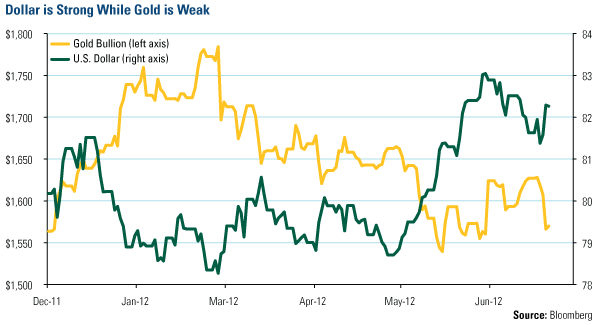 Over the past several months, the markets have tested investors' conviction to gold. Since February, the price of the yellow metal has steadily stepped lower, rallying somewhat in May before falling again when Ben Bernanke disappointed by not providing the U.S. with more stimulus. Meanwhile, the dollar gained ground as global investors fled the euro.


| You are subscribed to email updates from Save Your ASSets First To stop receiving these emails, you may unsubscribe now. | Email delivery powered by Google |
| Google Inc., 20 West Kinzie, Chicago IL USA 60610 | |


No comments:
Post a Comment