


Gold World News Flash |

- Silver Bubble who?
- Gold: The Win-Win Asset
- Horse’s Arse
- Report from Greece: Limited Capital Controls Implemented
- Richard Russell - Financial Knockout, Gold & Zuckerberg
- LISTEN NOW – Stock Market is a Farce, We're at the End Game, Gold, Miners & More – Bill Fleckenstein
- Vaporized: Americans’ Wealth Collapses 40% Over Last Three Years
- The Euro Takes the Road Well Traveled
- On Debt Ceilings, Fiscal Cliffs, And Krugman's Deficit Debacle
- Gold Reward to Risk Favor Shorts at Current Level
- Gold & Silver Miners: What?s the Best Time to Invest in the Producers ? and in the Juniors?
- Those Who See Will Survive the Coming Monetary System Collapse
- This Is Exactly What Will Move Key Markets Going Forward
- Next installment of financial disaster will glorify monetary metals, Embry says
- This may do wonders for inflation and gold in Argentina
- The Tricky Calculus of Oil Price Differentials
- Innovators Outrunning the Wealth Destroyers
- Learning from the Best: Inflation Lessons from Argentina
- This Is Exactly What Will Move Key Markets Going Forward
- "Why Would Politicians Allow The Free Market To Work And Expect To Be Re-elected?"
- The Gold Price Rose $17.20 to Close Comex $1,612.70 Expect Gold to Continue Upward
- Small Package, Tons of Truth
- Markets Dead Cat Bounce Back To Friday's Close
- Gold Seeker Closing Report: Gold and Silver Gain About 1%
- Gold Daily and Silver Weekly Charts - Metals Move Higher With Stocks
- The Shape & Future of Indian Gold Demand – Part 1/2
- Gold in the Face of Shrinking Dollars
- Dollar Still Makes a Negative Impact on Gold
- Gold and Silver, Are You Brave Enough to Buy Low?
| Posted: 12 Jun 2012 07:20 PM PDT
|
| Posted: 12 Jun 2012 06:25 PM PDT Graceland Update
|
| Posted: 12 Jun 2012 05:18 PM PDT by Andrew Hoffman, MilesFranklin.com:
Like all other negative traits, dishonesty tends to exponentially multiply during times of duress. I have written volumes of my experiences with human nature since mining stocks peaked in April 2007, particularly since the commencement of Global Meltdown I in late 2008. Individually, mankind has produced countless men and woman of strong moral fiber. However, as a species, experience has made me less sanguine. Life does that to you, and living on the cusp of FINANCIAL ARMAGEDDON, I suspect we "ain't seen nothing yet." This weekend, I was shocked to see the racehorse I'll Have Another scratched from the Belmont Stakes – the last leg of the U.S. "Triple Crown" of Horse Racing. I am not a horse racing fan per se, but watching these three races – the Belmont, Preakness, and Kentucky Derby – are an American tradition.
|
| Report from Greece: Limited Capital Controls Implemented Posted: 12 Jun 2012 05:05 PM PDT from John Galt FLA:
The concerns of the ongoing bank run by depositors in Greek banks have created the basis for a second leg of the domestic financial crisis which will collapse the system if the elections result in a conflict with the Troika and ECB regarding aid to the Greek financial system and potential default.
|
| Richard Russell - Financial Knockout, Gold & Zuckerberg Posted: 12 Jun 2012 04:01 PM PDT  With continued volatility in global markets, the Godfather of newsletter writers, Richard Russell, cautioned that "The most bearish action would be the Fed triggering QE3 and the market failing to rally." Russell also warned of a "rising risk of a financial catastrophe." Here is what Russell had to say: "That bear market signal in early May -- did it work or was something else going on? From its April low, the Dow has rallied back strongly, and I've been wondering, 'Is something else going on, something more ominous than simply a bear signal for the economy and stocks in the United States?'" With continued volatility in global markets, the Godfather of newsletter writers, Richard Russell, cautioned that "The most bearish action would be the Fed triggering QE3 and the market failing to rally." Russell also warned of a "rising risk of a financial catastrophe." Here is what Russell had to say: "That bear market signal in early May -- did it work or was something else going on? From its April low, the Dow has rallied back strongly, and I've been wondering, 'Is something else going on, something more ominous than simply a bear signal for the economy and stocks in the United States?'"
This posting includes an audio/video/photo media file: Download Now |
| Posted: 12 Jun 2012 04:00 PM PDT from KingWorldNews:
LISTEN NOW @ KingWorldNews.com
|
| Vaporized: Americans’ Wealth Collapses 40% Over Last Three Years Posted: 12 Jun 2012 03:42 PM PDT  …It might be well if you would ask yourself, are you better off than you were four years ago? Is it easier for you to go and buy things in the stores than it was four years ago? Is there more or less unemployment in the country than there was four years ago? Is America as respected throughout the world as it was? Do you feel that our security is as safe, that we're as strong as we were four years ago? …It might be well if you would ask yourself, are you better off than you were four years ago? Is it easier for you to go and buy things in the stores than it was four years ago? Is there more or less unemployment in the country than there was four years ago? Is America as respected throughout the world as it was? Do you feel that our security is as safe, that we're as strong as we were four years ago?President Ronald Reagan President Reagan may just as well be speaking to us today. The answer, as it was in November of 1980, is a resounding NO. The Great Recession wiped out nearly two decades of Americans' wealth, according to government data released Monday, with middle-class families bearing the brunt of the decline. The Federal Reserve said the median net worth of families plunged by 39 percent in just three years, from $126,400 in 2007 to $77,300 in 2010. That puts Americans roughly on par with where they were in 1992. The biggest drops occurred among middle-income Americans, whose wealth was inextricably linked to the housing market boom and bust. It's hard to overstate how serious the collapse in the economy was," said Mark Zandi, chief economist for Moody's Analytics. "We were in freefall." Read more...... 
This posting includes an audio/video/photo media file: Download Now |
| The Euro Takes the Road Well Traveled Posted: 12 Jun 2012 03:36 PM PDT The Euro Takes the Road Well Traveled Last week I presented two possible scenarios for the coming wave in the EUR.USD, both possibilities yielding the same end result. The pair played out just as projected retracing 38.2% of the previous downtrend to form a strong "B" wave and then pivoted for the reversal.
The Euro rallied against the dollar last week making a strong climb to1.2670 for a 38.2% reversal of the previous downtrend and then began to pivot for the reversal. This new rally was the projected "B" mentioned above and is just about over. My projection for the coming "C" wave is that it will zigzag down similarly to what we saw in wave "A". This decline should fall to a conservative target of 1.1891 before demonstrating any sign of a significant trend reversal. 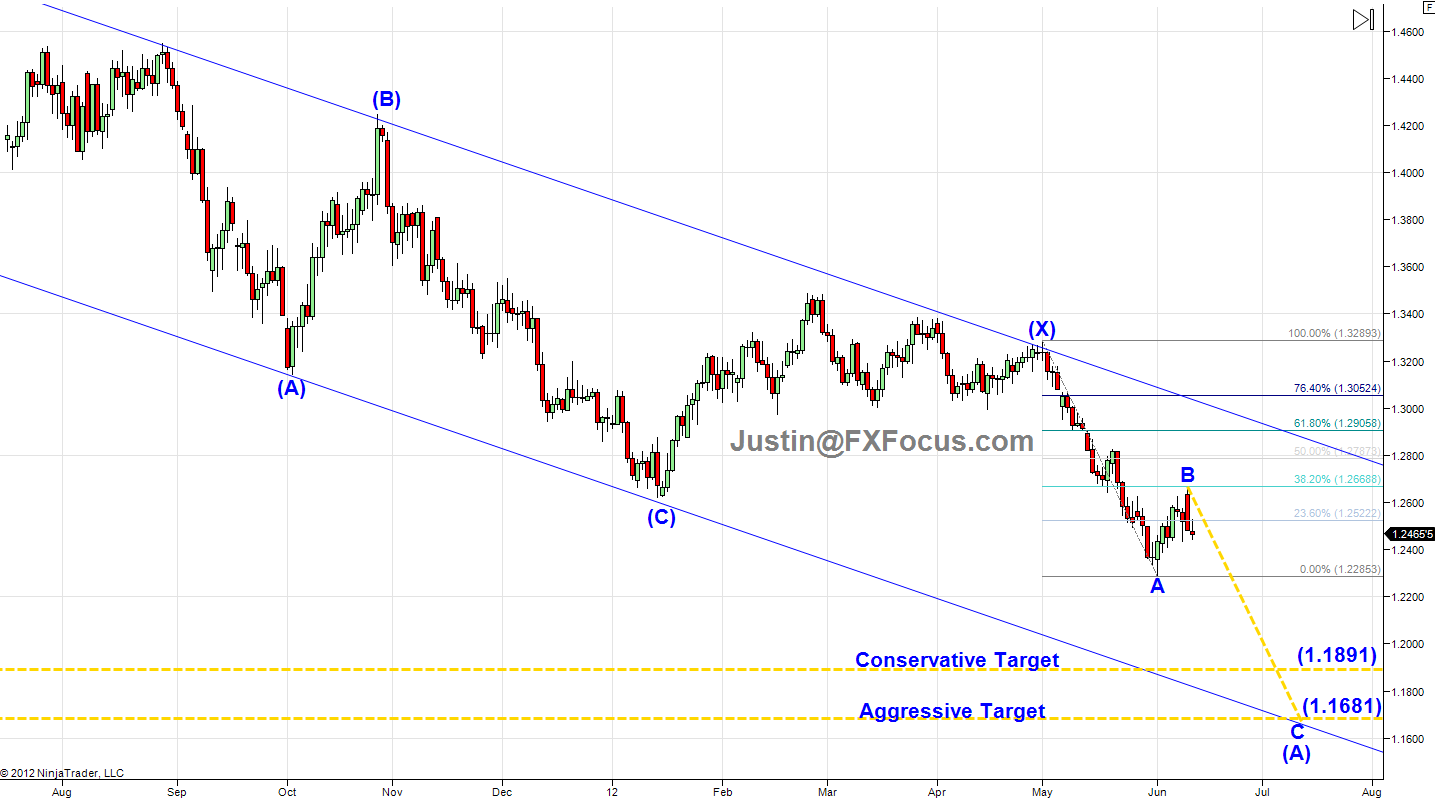
Disclosure: I have no positions in any stock mentioned, and no plans to initiate any position within the nxt 72 hours. 
|
| On Debt Ceilings, Fiscal Cliffs, And Krugman's Deficit Debacle Posted: 12 Jun 2012 03:29 PM PDT With all the buzz about the 'Fiscal Cliff' – that toxic combination of tax increases and spending cuts due to take hold in a few months – the subject of ongoing Federal budget deficits has fallen by the wayside. ConvergEx's Nic Colas believes that's a temporary phenomenon, for Congress will have to hammer out agreements to raise the debt ceiling right alongside its negotiations over the 'Cliff' items. His back-of-the-envelope attempt to quantify how much a multi-year debt limit increase would run to take this burdensome legislative issue off the Congressional docket for 5, 10 or even 20 years is worrisome at best. Using the most recent Office of Management and Budget's numbers, we get to $3.4 trillion for the 5-year runway, but this assumes a high level of incremental taxation. Against more modest expectations for government revenues (consistent with adjustments to forestall the 'Cliff'), the number could be as high as $4.5 trillion. As for the longer time horizon debt runways, think in terms of an incremental $6.5-9.5 billion for a 10 and 20 year horizon. And without significant changes to taxes and/or spending, more. Much more. Nic Colas, ConvergEx: Jimmy Cliff, Paul Krugman, and the Federal Deficit - The Harder They Come... This summer will mark the 40th anniversary of one of the great pop music movies of all time – the 1972 film The Harder They Come, starring Jamaican reggae artist Jimmy Cliff. The movie came with a full-length album for a soundtrack, replete with songs that have become reggae classics in the intervening four decades. It made Cliff an international star and ambassador of the genre, with songs like "Sitting in Limbo," "You Can Get It if You Really Want It," and the title track. The album is regularly mentioned in music industry magazines "Top Albums of All Time" lists. The success of The Harder They Come paved the way for other, now perhaps better known, acts like Bob Marley and Peter Tosh. The year 1972 has another, less happy distinction, known only to students of U.S. economic history: it is a reasonable starting point for the modern trend of American government spending much more than it receives in receipts every single year. The Vietnam War had been tough on the Federal Budget, as had other spending programs, and 1971 and 1972 saw back-to-back deficits of $23 billion apiece. That is about $126 billion today, adjusted for inflation. Prior to this period, the only greater annual deficits had been in 1968 ($25 billion) and during World War II (an average of $43 billion annually from 1942-1945, or $570 billion today). All the historical data is easy enough to find (click here and go to Table 1.1 http://www.whitehouse.gov/omb/budget/Historicals). Here are a few further observations:
Fast forward to the present day, and these deficits have morphed from history lesson to political football. The reason for this is the Federal Debt Ceiling, as we all learned in gory detail during last year's Congressional debate on the topic. The limit on Federal debt currently stands at $16.4 trillion. We've included a handy table for the historically inclined reader on every past increase to the limit since 1940. There are 79 increases on the list, ranging anywhere from less than 1% (1987 was the last time) to +25% (1990 for that case). At the current pace of spending and receipts, the U.S. government will be out of debt capacity this calendar year, even if Treasury can massage outcome to push another debate into 2013. Since the last debate was so fractious, I wondered what it would take to get an increase to Debt Limit that might last the country for 5, 10 or even 20 years. Based on the OMB Budget (see that prior link for the exact numbers) as currently presented by the White House, here are some baseline numbers:
Here's the rub, however: the expectations in the OMB Budget as presented on its website are highly optimistic on tax and withholding receipts because they assume that the "Fiscal Cliff" of higher tax rates and lower spending kick in with full force in 2013. Just one number to make the point here: OMB's deficit numbers assume that tax/withholding receipts increase from $2.5 trillion this year to $3.9 trillion in 2017. Compounded growth rate: 9.3%, meaning no recession in the next five years and a pretty much straight shot higher for employment. So what are the "Real numbers?" The Congressional Budget Office just took a stab at those calculations in a recent report (http://www.cbo.gov/sites/default/files/cbofiles/attachments/06-21-Long-T...). Their "Alternative Fiscal Scenario" – essentially a realistic "Keep things as they are" projection – shows debt increasing by approximately double the current base, adjusted for inflation. That would put the 20 year debt limit amount at closer to $24 billion, assuming 2 percent inflation. This is where the "Fiscal Cliff" debate that Congress must have before the end of 2012 dovetails with the debt ceiling debate, and I would argue that forcing lawmakers to vote on a 10-20 year horizon would actually help the process along. The CBO and OMB have some decent models for what the world looks like under the current order of things, as well as under some pretty drastic changes. If you just consider a one-off increase to the debt ceiling and some kick-the-can solutions to the Fiscal Cliff, you'll never really address the whole picture. That's where Congress is heading, but it doesn't have to be. I also cannot help but think about Paul Krugman as I stare at these numbers. His recent book, End this Depression Now, proposes that "A quick, strong recovery is just one step away, if our leaders can find the intellectual clarity and political will to end this depression now." This "One step" is deficit spending that is orders of magnitude greater than anything spent already. Honestly, I have no idea if he really believes any of this, since it is politically impossible. He's a smart man, and he clearly knows this. And he's got a Nobel, yes, but so did the guys at Long Term Capital. Still, I bet this modest proposal would meet with his approval, and maybe even Paul Ryan (R- WI), the fiscally conservative Congressman. Let's have the whole debate, using the real long term numbers, and let the chips fall where they may. And, lastly, the whole conversation of how the U.S, will square the circle of the debt ceiling/Fiscal Cliff debate brings me back to Jimmy Cliff and the track "Too Many Rivers to Cross" from The Harder They Come:
|
| Gold Reward to Risk Favor Shorts at Current Level Posted: 12 Jun 2012 02:53 PM PDT courtesy of DailyFX.com June 12, 2012 02:04 PM 240 Minute Bars Prepared by Jamie Saettele, CMT As mentioned yesterday, gold has been trading between its 2nd standard deviation Bollinger bands recently. “The latest move off of the high is impulsive (5 waves) which favors lower prices from the current level to at least Friday’s low at 1553. The bearish RSI reversal signal that was in place for gold last week is now in place for USD crosses.” The mentioned 5 wave decline was succeeded by a 3 wave advance into former congestion (resistance). Look lower. LEVELS: 1522 1553 1582 1617 1641 1672...
|
| Gold & Silver Miners: What?s the Best Time to Invest in the Producers ? and in the Juniors? Posted: 12 Jun 2012 02:31 PM PDT While juniors, mid-tiers and large producers will usually bottom around the same time, they each outperform at different times. In this missive we look at some charts to decipher when its*time to buy*[each category*and when*one or the other]*should be avoided. Words: 470 So writes Jordan Roy-Byrne ([url]www.thedailygold.com[/url]) in edited excerpts from his original article*. [INDENT]Lorimer Wilson, editor of [B][COLOR=#0000ff]www.munKNEE.com (Your Key to Making Money!), has edited the article below for length and clarity – see Editor's Note at the bottom of the page. This paragraph must be included in any article re-posting to avoid copyright infringement.[/COLOR][/B] [/INDENT] Roy-Byrne*goes on to say, in part: In the first chart we plot the HUI and the CDNX (S&P/TSX Venture Exchange) against the HUI. The CDNX is a proxy for juniors. It is comprised mostly of Gold-related companies but also some energy and technology companies. We mark the start and the end of each cyclical bull...
|
| Those Who See Will Survive the Coming Monetary System Collapse Posted: 12 Jun 2012 02:02 PM PDT Certainly, the nearly universal public indoctrination system is responsible for the low level of displayed awareness on Earth today. Just comparing Leonardo da Vinci to an equally famous person of today, Barack Obomba, is proof of the devolution. Read More...
|
| This Is Exactly What Will Move Key Markets Going Forward Posted: 12 Jun 2012 02:00 PM PDT from KingWorldNews:
On the heels of a significant rally in stocks, along with gains in gold, silver and oil, today King World News interviewed acclaimed money manager Stephen Leeb, Chairman & Chief Investment Officer of Leeb Capital Management. Leeb told KWN what factor will be moving key markets going forward. But first, here is what Leeb had to say about the situation in Europe: "Spanish bond yields hit record highs, at least since the euro was formed. Investors gave a big thumbs down to this way of bailing out banks or even individual countries. The market still wants a broad based bailout, and the major roadblock there remains Germany." Stephen Leeb continues @ KingWorldNews.com
|
| Next installment of financial disaster will glorify monetary metals, Embry says Posted: 12 Jun 2012 11:35 AM PDT 7:32a HKT Wednesday, July 13, 2012 Dear Friend of GATA and Gold: Sprott Asset Management's John Embry tells King World News that the next installment of the world financial disaster will be worse than the others and will reveal gold and silver as the true safe havens. An excerpt from the interview is posted at the King World News blog here: http://kingworldnews.com/kingworldnews/KWN_DailyWeb/Entries/2012/6/12_Em... CHRIS POWELL, Secretary/Treasurer ADVERTISEMENT Prophecy Platinum (TSXV:NKL) Announces Encouraging Rhodium, Ruthenium, Osmium, Company Press Release VANCOUVER, British Columbia, Canada -- Prophecy Platinum Corp. (TSX-V: NKL; OTC-QX: PNIKF; Frankfurt: P94P) is pleased to provide results of full spectrum 6E (Platinum, Palladian, Rhodium, Ruthenium, Osmium, and Iridium) analysis of platinum group elements on the first batch of samples from the company's wholly-owned Wellgreen PGM-Ni-Cu project in the Yukon Territory, Canada. The company enlisted Activation Laboratories (Actlabs) of Ancaster, Ontario, to conduct a full-spectrum 6E analysis of samples taken from the 2011 drill hole WS11-188. Adding Rh, Ru, Os, and Ir to Pt and Pd increased the total PGE content (6E) by an average of 28 percent, based on a population of 90 samples, most of which are from disseminated sulphide-type mineralization. Assay results with 6E exceeding 0.50 ppm (0.5 g/t) (excluding copper and gold assays) are tabulated at Prophecy's Internet site and are available with assay results from the entire batch of 90 samples here: http://prophecyplat.com/news_2012_may25_prophecy_platinum_announces_rare... Join GATA here: Standard Chartered's Earth Resources Conference Hong Kong Gold Investment Forum Toronto Resource Investment Conference New Orleans Investment Conference * * * Support GATA by purchasing DVDs of our London conference in August 2011 or our Dawson City conference in August 2006: http://www.goldrush21.com/order.html Or by purchasing a colorful GATA T-shirt: Or a colorful poster of GATA's full-page ad in The Wall Street Journal on January 31, 2009: http://gata.org/node/wallstreetjournal Help keep GATA going GATA is a civil rights and educational organization based in the United States and tax-exempt under the U.S. Internal Revenue Code. Its e-mail dispatches are free, and you can subscribe at: To contribute to GATA, please visit: ADVERTISEMENT Sona Discovers Potential High-Grade Gold Mineralization From a Company Press Release VANCOUVER, British Columbia -- With its latest surface diamond drilling program at its 100-percent-owned, formerly producing Blackdome gold mine in southern British Columbia, Sona Resources Corp. has discovered a potentially high-grade gold-mineralized area, with one hole intersecting 13.6 grams of gold in 1.5 meters of core drilling. "We intersected a promising new mineralized zone, and we feel optimistic about the assay results," says Sona's president and CEO, John P. Thompson. "We have undertaken an aggressive exploration program that has tested a number of target zones. Our discovery of this new gold-bearing structure is significant, and it represents a positive development for the company." Sona aims to bring its permitted Blackdome mill back into production over the next year and a half, at a rate of 200 tonnes per day, with feed from the formerly producing Blackdome mine and the nearby Elizabeth gold deposit property. A positive preliminary economic assessment by Micon International Ltd., based on a gold price of $950 per ounce over eight years, has estimated a cash cost of $208 per tonne milled, or $686 per gold ounce recovered. For the company's complete press release, please visit: http://www.sonaresources.com/_resources/news/SONA_NR18_2011-opt.pdf
|
| This may do wonders for inflation and gold in Argentina Posted: 12 Jun 2012 11:30 AM PDT Of course, a government that can nullify contracts can expropriate gold, but first the government would have to find it, and it might be a challenge if it was held outside the country. * * * Argentina Proposes Bill to Allow Dollar Contract Payments in Pesos By Taos Turner http://online.wsj.com/article/BT-CO-20120611-714077.html BUENOS AIRES -- Argentine President Cristina Kirchner has submitted a bill to Congress that would allow debtors to pay U.S. dollar-denominated contracts in pesos. The bill comes amid a broad government push to wean Argentines off their long-held preference to use dollars for major transactions. It's unclear if the bill will apply retroactively or if it could affect government debt. In early August the government faces a $2.2 billion payment on the Boden 2012 dollar-denominated bond. A spokesman for Mrs. Kirchner didn't immediately respond to requests for comment. The bill, as currently written, would allow debtors to "free themselves" from paying from the dollar payment requirement by paying "the equivalent amount" in pesos. The federal tax agency AFIP, which vets foreign-currency purchases, is thought to have approved very few requests to buy dollars in May. That fueled perceptions that a dollar-hungry government might resort to more draconian measures to make sure it has enough dollars on hand to pay creditors later this year. ... Dispatch continues below ... ADVERTISEMENT Prophecy Platinum (TSXV:NKL) Announces Encouraging Rhodium, Ruthenium, Osmium, Company Press Release VANCOUVER, British Columbia, Canada -- Prophecy Platinum Corp. (TSX-V: NKL; OTC-QX: PNIKF; Frankfurt: P94P) is pleased to provide results of full spectrum 6E (Platinum, Palladian, Rhodium, Ruthenium, Osmium, and Iridium) analysis of platinum group elements on the first batch of samples from the company's wholly-owned Wellgreen PGM-Ni-Cu project in the Yukon Territory, Canada. The company enlisted Activation Laboratories (Actlabs) of Ancaster, Ontario, to conduct a full-spectrum 6E analysis of samples taken from the 2011 drill hole WS11-188. Adding Rh, Ru, Os, and Ir to Pt and Pd increased the total PGE content (6E) by an average of 28 percent, based on a population of 90 samples, most of which are from disseminated sulphide-type mineralization. Assay results with 6E exceeding 0.50 ppm (0.5 g/t) (excluding copper and gold assays) are tabulated at Prophecy's Internet site and are available with assay results from the entire batch of 90 samples here: http://prophecyplat.com/news_2012_may25_prophecy_platinum_announces_rare... Dollar scarcity has fueled a vibrant black market where Argentines can obtain the currency at a hefty premium over the official exchange rate. The black-market rate now hovers around ARS5.90, according to local media. In contrast, the peso closed at ARS4.49 on the local wholesale foreign-exchange market Monday. In an attempt to assuage public concern, Deputy Economy Minister Axel Kicillof recently said the government has no plans to ban the use of dollars in the domestic economy or convert dollar-denominated loans and contracts into pesos. In recent weeks, Mrs. Kirchner and her ministers have declared a "cultural war" against Argentines' love affair with the dollar. In a recent speech, the president said she would voluntarily swap her dollar savings into pesos, as "it's more profitable." According to local news reports, Mrs. Kirchner declared just over $3 million in dollar-denominated savings in her latest tax declaration. But talk of a forced or coerced "pesofication" of the economy isn't going away and it hurt some bonds Monday, according to Adrian Mayoral, a trader at his family brokerage. "There is a lot of speculation about supposed plans to 'pesofy' the economy," Mr. Mayoral said. "I can't say if any of this is more than speculation, but it's affecting the market." The Bonar 2015 dollar-denominated bond fell about 3.4% to ARS458.5 in part on speculation that the government might try to get out of making dollar payments on its debt. Join GATA here: Standard Chartered's Earth Resources Conference Hong Kong Gold Investment Forum Toronto Resource Investment Conference New Orleans Investment Conference * * * Support GATA by purchasing DVDs of our London conference in August 2011 or our Dawson City conference in August 2006: http://www.goldrush21.com/order.html Or by purchasing a colorful GATA T-shirt: Or a colorful poster of GATA's full-page ad in The Wall Street Journal on January 31, 2009: http://gata.org/node/wallstreetjournal Help keep GATA going GATA is a civil rights and educational organization based in the United States and tax-exempt under the U.S. Internal Revenue Code. Its e-mail dispatches are free, and you can subscribe at: To contribute to GATA, please visit: ADVERTISEMENT Sona Discovers Potential High-Grade Gold Mineralization From a Company Press Release VANCOUVER, British Columbia -- With its latest surface diamond drilling program at its 100-percent-owned, formerly producing Blackdome gold mine in southern British Columbia, Sona Resources Corp. has discovered a potentially high-grade gold-mineralized area, with one hole intersecting 13.6 grams of gold in 1.5 meters of core drilling. "We intersected a promising new mineralized zone, and we feel optimistic about the assay results," says Sona's president and CEO, John P. Thompson. "We have undertaken an aggressive exploration program that has tested a number of target zones. Our discovery of this new gold-bearing structure is significant, and it represents a positive development for the company." Sona aims to bring its permitted Blackdome mill back into production over the next year and a half, at a rate of 200 tonnes per day, with feed from the formerly producing Blackdome mine and the nearby Elizabeth gold deposit property. A positive preliminary economic assessment by Micon International Ltd., based on a gold price of $950 per ounce over eight years, has estimated a cash cost of $208 per tonne milled, or $686 per gold ounce recovered. For the company's complete press release, please visit: http://www.sonaresources.com/_resources/news/SONA_NR18_2011-opt.pdf
|
| The Tricky Calculus of Oil Price Differentials Posted: 12 Jun 2012 09:41 AM PDT Synopsis: A variety of factors – some decades in the making – are wreaking havoc on North American oil prices, creating record differentials in the cost of crude that are here to stay. By Marin Katusa, Chief Energy Investment Strategist One of oil's most important characteristics is its fungibility, which means that a barrel of refined oil from Texas is equivalent to one from Saudi Arabia or Nigeria or anywhere else in the world. The global oil machine is built upon this premise – tankers take oil wherever it is needed, and one country pays almost the same as the next for this valuable commodity. Well, that's true aside from two factors that can render this equivalency void. In fact, crude oil prices range a fair bit according to the quality of the crude and the challenge of moving it from wellhead to refinery. Those factors are currently wreaking havoc on oil prices in North America: a range of oil qualities and a raft of infrastructure issues are creating record price differentials. And with no solution in sight, we think those differentials are here to stay. The Parameters of Pricing The first factor in oil pricing is quality. The best kind of crude is light and sweet: "light" means its hydrocarbon molecules average on the small side within the oil range; and "sweet" means it does not contain much sulfur. Light, sweet crudes are the easiest to refine into petroleum products, which makes them more desirable than heavy, sour crudes. No two reservoirs produce identical oil, though reservoirs in the same region often produce similar crudes. For example, conventional oils from Texas are generally lighter and sweeter than the crudes that make up the European benchmark Brent blend; this is why West Texas Intermediate crude oil carried a premium over Brent crude for years. Similarly, Bonny Light oil from Nigeria is a bit heavier and sourer than Algeria's Saharan Blend and therefore receives a slight price discount. But wait, you say – isn't Brent more expensive than WTI? Yes, today it is. This graph shows the two prices' movements over the last 25 years.
(Click on image to enlarge) For most of the graph the prices track very closely, with the green WTI line sitting just above the black Brent line. Then, in the second half of 2010, the relationship starts to shift: WTI prices started to lose ground against Brent. The differential was only a dollar in November 2010, but by September 2011 Brent crude was worth US$27.31 or 32% more than WTI. The differential narrowed in December but has recently opened up again, with the spot price of Brent closing US$13.88 above that of WTI yesterday. The characteristics of WTI and Brent crude oils did not change during 2010, so the pricing reversal must have stemmed from the other factor that impacts crude-oil prices: infrastructure. More specifically, WTI prices started to slide because of a lack of infrastructure. North America's Fantastically Flawed System North America has a long history of oil production and processing. Decades of producing oil and consuming lots of petroleum products have left the continent with a pretty good system of pipelines and refineries… but pipelines are annoyingly stagnant things that tend to stay where you build them. And it turns out that the pipelines of yesterday are in the wrong places to serve the oil fields and refineries of today. America's oil infrastructure was built around two inputs – some domestic production and large volumes of imports. You see, while the Middle East may be the biggest producer of crude oil in the world, most of the refining occurs in the United States, Europe, and Asia. There are two reasons for this. The first is that it's easier to ship massive volumes of one product (crude oil) than smaller volumes of multiple products (gasoline, diesel, jet fuel, and so on). The second reason is that refineries are generally built within the regions they serve, so that each facility can be tailored to produce the right kinds and amounts of petroleum products for its customers. During World War II, the US War Department (now the Department of Defense) divided the United States into five regions to facilitate oil allocation. The regions were called "Petroleum Administration for Defense Districts," or PADDs.
The United States is split into five oil districts to help with regional administration of a crucial asset. Today, refineries in PADD I on the East Coast process oil shipped to the district's Atlantic ports from all over the world. Its refineries produce enough petroleum products to meet about one-third of regional demand; the rest comes from imports of refined products, primarily from the Gulf Coast but also from Europe. PADD V, on the West Coast, processes domestic oil from California and Alaska, as well as imported oil. While the East- and West-Coast PADDs are not connected to the rest of the crude oil system, PADDs II, III, and IV have become very interdependent. PADD III, on the Gulf Coast, has more refining capacity than anywhere in the world and accounts for 45% of total US capacity, with 45 refineries processing more than 8 million barrels of oil per day from countries like Mexico and Venezuela as well as domestic sources. Refineries in the Midwest and California push the US's total refining capacity to 18 million barrels of oil a day. While domestic production has always helped meet the US's oil needs, imported oil has long ruled the day. The US has relied on imported oil so heavily for so long that the country's oil infrastructure is built primarily around refining imported oil and then moving refined products – gasoline and diesel and the like – north, from the Gulf Coast to the Midwest, or inland, from refineries on the coasts to customers in the interior. It was not, it is important to note, designed to move oil from the interior of the country to refineries. But that is what is needed today. Oil's a-Flowing, But with Nowhere to Go North American oil production is on the rise in a serious way, and there are two prime culprits: the Bakken shale and the oil sands. The Bakken shale formation underlying North Dakota gets most of the credit for the resurgence in US domestic output, though some of the shales in Texas are also contributing notably. Production in the Bakken is so booming that North Dakota's crude output topped half a million barrels a day for the first time in November, up from just 300,000 bpd in 2010. The state is on track to surpass both California (539,000 bpd) and Alaska (555,000 bpd) this year to become the number-two oil-producing state in the United States. Oil from the Bakken is generally mid-weight and fairly sweet. Ideally it should stay in the Midwest, because the refineries around Cushing are still designed to process light sweet oil. However, the other area where North American oil production is booming produces just the opposite. In fact, oil from the Canadian oil sands is so heavy that it has earned a distinct moniker: "bitumen." And there is a tsunami of bitumen on the way. The two million bpd being produced in the oil sands today is set to increase 50% in just the next three years. However, Canada's oil sands are not the only place in the world producing heavy oil. In general, global production is gradually moving towards heavier, sourer crudes because the easy deposits of light, sweet crude are being tapped out. And that has forced refineries to evolve. A refinery designed to handle light, sweet WTI crude cannot switch to heavy, sour oil sand bitumen without some serious upgrades. To that end, US refineries have invested billions in upgrades over the last decade to enable them to process heavy oil. The catch is, now the refinery army along the Gulf Coast needs heavy oil – just as they couldn't easily switch from light to heavy, they can't switch from heavy back to light. The obvious source is the oil sands. It's a win-win: Oil-sands producers want to get their oil to suitable refineries, and the heavy oil refiners on the Gulf Coast want Canadian crude, because without access to bitumen they are being forced to pay a premium for to secure heavy oil supplies from Venezuela. But that potential win-win is instead a losing predicament for all, because the pipelines to move that oil simply don't exist. Remember how the US's oil pipelines were designed primarily to move refined products from the Gulf region and the coastal refineries to inland customers? Well, those pipelines of yesterday now run the wrong way. Today what North America's oil machine needs are pipelines running from the oil sands to the Gulf Coast. At the moment there is just enough capacity to get bitumen partway there – it gets to Cushing, the oil hub. And then it gets stuck.
This chart tells the story perfectly. The vast majority of Canada's bitumen is ending up in PADD II – in Cushing – where it simply sits in tanks because there is no heavy oil refining capacity in the Midwest, and there is very limited pipeline capacity to move oil south. Cushing is overwhelmed. The storage tanks at Cushing are at record levels, housing no less than 46.7 million barrels of oil. The recent reversal of the Seaway pipeline is helping – Seaway used to move refined products north from the Gulf Coast but has now been flipped to carry oil south. It is currently moving some 150,000 barrels of oil a day; volumes are expected to rise through the year to reach 400,000 bpd by early 2013. The pipeline's owners would ideally like to twin the pipe, but regulatory proceedings for that project are not yet under way. The much-debated Keystone XL pipeline will also help. While routing and approval for the northern section of the pipeline are still under debate, construction of the southern leg of the project, running from Cushing to the Gulf Coast, is set to begin this summer. It could be operational before the end of next year. No matter what happens with the Keystone pipeline, the US will face ever-increasing competition for Canada's oil. In fact, competition over oil from Canada – and around the world – is creating a new Cold War between the US and China. But even with Seaway reversed and Keystone XL's southern leg in place, the glut of oil at Cushing will continue to grow. Production from the oil sands and the Bakken is simply growing too quickly for infrastructure to keep up. And when oil becomes landlocked, it loses that key characteristic – fungibility – that helps make it so valuable. North American Oil Differentials: Here to Stay With so much supply landlocked, Canadian oil prices are taking a serious hit. The benchmark price for Canadian heavy oil is Western Canada Select (WCS), which is currently trading at just US$59.33 per barrel. By contrast, WTI is priced at US$82.70, which means the differential is a whopping US$23.37 per barrel, or 28% higher.
(Click on image to enlarge) Even Canadian synthetic – a partially upgraded bitumen product that has historically carried a premium to WTI – is trading at a discount to its American peer: Canadian synthetic is at US$79.13 per barrel. It's a double-whammy differential: Canadian oil is heavy, which discounts its price; and the system to move it to suitable refineries is clogged up, creating another discount. Neither of those situations is going to change any time soon, and that means oil-sands projects may soon be on the chopping block. The oil sands is one of the costliest oil regions in the world to develop; and with WCS prices so low, the economics behind many new oil-sands projects have become pretty weak. New oil-sands mines require a price of around US$80 per barrel to break even. If an upgrader is part of the plans, that break-even price rises to almost US$100. In-situ projects, which use wells and underground steam injection to extract oil from the sands in place, usually carry a break-even price near US$60 per barrel. But even with some projects postponed and others slowed, bitumen production is still expected to climb rapidly. Estimates range, but most observers agree that it is likely the oil sands will be producing close to 2.7 million barrels a day by 2016, up from 1.6 million bpd last year. That kind of investment means that every time new pipeline and refining capacity is built, supply will catch up and the system will remain chockablock. And that means the differential between Canadian and US oil prices is settling in for a long stay. There are ways to benefit from this differential, but given the complexity of the situation, only informed investors will be able to take advantage.
|
| Innovators Outrunning the Wealth Destroyers Posted: 12 Jun 2012 09:33 AM PDT Dave Gonigam – June 12, 2012
"It" is the existence of a property tax. A referendum to abolish it is on the ballot today in North Dakota, a place historian Clay Jenkinson has described as "the most Jeffersonian state in America." Meanwhile, Hamiltonian factions ranging from the Chamber of Commerce to the unions are lined up against it. "Great idea," you might be thinking. "What's the catch?" "Measure 2, as the proposal is called on the ballot, would require state government to make up for property tax revenue lost by local governments," according to USA Today, "but doesn't specify how." Hmmm… Could get interesting.
Well no, it the Fed doesn't acknowledge having anything to do with it… but the central bank's every-three-years "Survey of Consumer Finances" finds the median family's net worth plunged nearly 40% from 2007-10.  True, it was imaginary wealth tied up in housing, conjured into existence by the "serial bubble blowers" (Addison's phrase in The Little Book of the Shrinking Dollar) at the Fed. But here's the real kick in the teeth: Adjusted for inflation, the typical family's net worth is no better now than it was in 1992.
"There can only be two reasons. First, the proliferation of debt finance is providing a temporary illusion" — a point eloquently made, by the way, in The Little Book. "Second, the technological revolution came just in time to vastly increase the efficiency of just about everything industry and households do, thereby enabling more blood to be extracted from the economic turnip than anyone ever thought possible." "We are surviving and even somewhat thriving despite how we are getting ever poorer. This is an interesting economic paradox. The tools that we work with today — cloud computing, instantaneous communication, the time cost of operations reduced from years to minutes — have saved us from something that might have made the Great Depression seem fantastic by comparison." [Ed. Note: An interesting wrinkle, this line of thought, on "Innovate or Die" — the theme of this year's Agora Financial Investment Symposium in Vancouver. Jeffrey will appear for the first time. Innovators like Juan Enriquez and Dr. Michael West will make return appearances, along with our own seeker of transformational technologies, Patrick Cox. Seats are filling up fast, but there's still time to register for our event July 24-27.]
It will also transform the energy industry, he says. "This specialty metal has properties scientists have only dreamed of, up until now. Think: cheaper, more reliable energy, more-efficient computer and hand-held device designs and much longer battery life." "The versatile metal," he explains, is poised to be a crucial component in the next revolutionary computer chip. It's a chip design that emulates the most-impressive computer on the planet, the human brain." For all the advances of computer technology in the last 60 years, the brain remains 10,000 times more "dense" and efficient than any computer. "It uses only one extremely efficient network of capillaries and blood vessels to transport heat and energy, all at the same time," says Bruno Michel of IBM's Zurich Research Laboratory. With a design inspired by the brain, aided by this "liquid metal," Michel and his team are on the verge of something huge. "They've already proven their fluidic channel design will work," says Byron. "And they expect to have a fully functioning prototype chip within 18 months." "Once they do, watch out because Bruno believes it could power Watson-like supercomputers the size of smart phones and tablet PCs. We're talking Star Trek fantasy come to life." This "liquid metal" is one of three substances Byron says will bring about earth-shaking changes in the years to come… no matter what governments and central banks do to screw up other things. "History has proven," he says, "that it is in seemingly dark times like these the biggest surprises are hiding — and some of the greatest fortunes are made." Just think of the shale energy boom that caught on even as the U.S. economy tanked in 2008-09 and Americans' incomes and net worth plunged. This phenomenon has blessed the aforementioned North Dakota with the nation's lowest unemployment rate. "Now," says Byron, "it looks as though an even bigger transformation is set to quietly sweep across our nation." To say nothing of delivering staggering levels of wealth to investors who climb aboard early. We know these are bold claims… but Byron says if you're skeptical, your mind could easily change in less than two weeks — on Tuesday June 26, to be exact. Let him explain exactly what he means when you follow this link.
Not enough to make up for yesterday's losses, but once again, the Dow is back above 12,500.
At 94.4, the index is essentially unchanged from last month… and it's identical to the November 2007 figure, one month before the "official" start of the recession.  We always find the "single most important problem" portion of the survey revealing. This month, "taxes" has clearly pulled out in front at 22%, followed by poor sales and government regulations. Last month, the three categories were essentially tied. A year ago, "poor sales" was the leader at 25%. Only 3% cite "financing and interest rates." Contrary to the blather from Washington, access to credit is not an issue for small business.
"Eight Ferrari drivers were caught speeding in a convoy along a public expressway in China over the weekend," according to The Wall Street Journal. One clocked 132 miles an hour. Evidently, this is not an isolated incident among China's nouveau riche. And sometimes they travel as lone wolves. Last month, a Chinese man driving in Singapore plowed his Ferrari into a taxi, killing himself and two people in the cab. In March, a Ferrari smacked into a bridge in Beijing, killing the driver and injuring two other people. "We train our new drivers, teaching them to drive responsibly and to put safety first, but we cannot put a police car behind everyone," says Ferrari China's CEO Edwin Fenech. The learning curve will be steep, indeed: The average age of a Ferrari driver in China is 35. Elsewhere, it's closer to 45-50.  [Photo by Sovxx] We can only imagine this phenomenon getting worse: If China's one-child policy has resulted in a ratio of 130 boys born for every 100 girls… that'll be a lot of testosterone looking for an outlet in the years to come.
"Look it up! How could corporations possibly refrain from issuing debt at record-low interest rates? Any CFO that didn't build a war chest of cash by issuing debt at these rates should be fired." "Back in 2008 when the debt window closed, many corporations found themselves cash strapped and struggling to survive. Any executive management team that forgot that lesson after only three years should have been sacked. So they issued debt hand over fist and sat on a stash of cash waiting for either for the STHTF or for things to get better. Either way, building ready cash was prudent. In fact, it would have been irresponsible not to build cash." "But the notion that corporations should be spending this cash hoard when 1) final demand is weak 2) higher taxes are coming and 3) we have the most business hostile administration in history manning (abandoning?) the wheelhouse… is absurd. You don't borrow to spend, you borrow to invest, and why invest when you are running at 67% capacity? "There is no record 'cash on the sidelines,' as anybody who can read a balance sheet (none of the media) has always known. It is more than offset by record liabilities."
"So as far as the broker's reply yesterday I agree it wasn't a solution, but the losing [my] freedom part is what seems to be happening already; hence, the self-protection tactics." "Fortunately for me, each of these houses were short sales, meaning they never reached the foreclosure stage, whereby the lender, usually a bank, agrees to sell the debt to a private party, me, for an agreed-upon price: less than what is owed by the borrower. Furthermore, each house had only one mortgage (no second mortgages or other lienholders). I did the title searches before considering the purchases." "So as long as we still have property rights… (long pause) …these houses are legally mine." "By the way, I am not a 'disgruntled' owner. I am merely in awe of the direction our nation is headed; and I'm preparing for what is to come, probably sooner, rather than later."
"Months after closing and while working on the property on a sunny Sunday, Mother's Day, there was a knock at the door. The anxious couple was holding a list of distressed properties that included a description of ours as it was over a year earlier." "When we told them it wasn't for sale and the information incorrect, they were sure we must be the losers that failed to keep up on the payments. They further insisted that their list must be correct because they paid $350 for it. Running out of patience, we asked them to leave the property and closed the door." "While we watched them in animated discussion as they walked to the car, I Googled the name of the list provider. Of course, the first several hits were scam alerts and warnings." "It never ceases to amaze me that someone or some group, understanding that a market shift could mean opportunity, thought it was a better idea to address it through a scam than a legitimate investment. It is equally amazing that the list buyers didn't take the five seconds to type the company name into Google." "Thanks for the daily dose of sanity with The 5." The 5: And thank you for the heads-up. Cheers, Dave Gonigam P.S. Chris Mayer penned a brief note yesterday from Mongolia — home of the world's fastest-growing economy. "I've come to understand the boom here in ways I didn't before." He met with three of the four largest banks in the country. He's scoped out the stock exchange and the largest broker. He's also checked out a few investment properties. Details — and photos — to follow later this week.
|
| Learning from the Best: Inflation Lessons from Argentina Posted: 12 Jun 2012 09:20 AM PDT Spain was down again before we noticed it was up. Yesterday morning, stocks all over the world were rising on hopes of a solution to the euro problem. By afternoon, the rally was over. The Dow ended the day down 142 points. But that's the way the euro rescues go. The effects are more and more short-lived. Pretty soon, investors will realize they don't work at all…and then there won't be any up-surge, A new rescue plan will be announced. Investors will realize it is just another scammy fix. And stocks will go down. When that happens the game will be over. We might not be far from that point now. Meanwhile, the US is worried too. About Europe, which is on the verge of total breakdown? Maybe. About China, which is growing at its slowest pace in 13 years? Maybe. About the US itself…where the 'recovery' went missing? Almost certainly. Here at our Daily Reckoning headquarters, we remain sans soucis. Which is another way of saying, we're enjoying the show. What will the fixers do next, we wonder? Every fix makes things worse. But they keep at it. For the benefit of Dear Readers with skin in the game, we leave our "Crash Alert" flag up for a few more days. This market could go to hell in a hurry. If you've got skin in the game, get it out. And, for the benefit of everyone, we cast our weary eyes down to the pampas. Is there any policy so foolish the Argentines have not had a go at it? Is there any financial disaster so catastrophic the gauchos haven't repeated it at least two or three times? Is there any trick so dishonest or so transparently fraudulent that the politicians south of the Rio de la Plata don't make a regular habit of it? Our Bonner Family Office chief investment strategist, Rob Marstrand, who makes his home in Buenos Aires, is visiting us in the US this week. He tells us that it is said to be a crime in Argentina to mention the "parallel" market in dollars. On the official market, the peso still trades at about 4.4 to the dollar. On the unofficial exchanges, that is, on the parallel market, the "blue" peso trades at less than 5.1 to the greenback. But it's apparently illegal to mention it. So is it supposedly illegal to publish the real inflation rate. The Argentine feds have their rate; it's a crime to contradict them. The government is also trying to get Argentines to stop using the dollar as a protection against peso inflation. The president says she is converting her own dollar deposits to pesos, to set an example. "I guarantee you she is not converting her accounts in Switzerland," says Rob. But the typical Argentine wasn't born yesterday. He's been around the block a few times. He knows that when the government gets in financial trouble, it can't be trusted. He knows that it will seize whatever money it can get its hands on — especially if it is foreign currency. So, if he's saved dollars, he's hiding them…or getting them out of the country. Here's the Reuters report: BUENOS AIRES, June 8 (Reuters) — Argentine banks have seen a third of their US dollar deposits withdrawn since November as savers chase greenbacks in response to stiffening foreign exchange restrictions, local banking sources said on Friday. Depositors withdrew a total of about $100 million per day over the last month in a safe-haven bid fueled by uncertainty over policies that might be adopted as pressure grows to keep US currency in the country. The chase for dollars is motivated by fear that the government may further toughen its clamp down on access to the US currency as high inflation and lack of faith in government policy erode the local peso. From May 11 until Friday, data compiled by Reuters from private banks showed $1.9 billion in US currency had been withdrawn, or about 15 percent of all greenbacks deposited in the country. Feisty populist leader Fernandez was re-elected in October vowing to "deepen the model" of the interventionist policies associated with her predecessor, Nestor Kirchner, who is also her late husband. She wants Argentines to end their love affair with the greenback and start saving in pesos despite inflation clocked by private economists at about 25 percent per year. Fernandez set an example on Wednesday by vowing to swap her only dollar-denominated savings account for a fixed-term deposit in pesos. But savers in crisis-prone Argentina are notoriously jittery. Why would they be jittery? Because their dollar deposits were seized and forcibly converted to pesos 10 years ago? Because the peso was devalued by 66% in the last crisis? Or because the Argentine peso of 50 years ago has been devalued by approximately 42 trillion percent. We don't know how such a thing is mathematically possible…but that's the report we've read. Defaults, devaluations, hyperinflations — the Argentines have seen it all. Americans have a lot to learn. And another thought… The British writer AA Gill once noted that… "Europe is an allegory for the ages of man. You are born Italian, relentlessly infantile and mother-obsessed. In childhood, you are English: chronically shy, tongue-tied clicky and only happy kicking balls or pulling the legs off things. Teenagers are French: pretentiously philosophical, embarrassingly vain, ridiculously romantic yet simultaneously insecure. During Middle-Age, we become either Irish and fun loving, or Swiss and serious. Old age is German: ponderous, pompous and pedantic. And finally, we regress into being Belgian, with no idea of who we are at all." Bill Bonner Learning from the Best: Inflation Lessons from Argentina originally appeared in the Daily Reckoning. The Daily Reckoning, published by Agora Financial provides over 400,000 global readers economic news, market analysis, and contrarian investment ideas. Recently Agora Financial released a video titled "What Causes Gas Price to Increase?".
|
| This Is Exactly What Will Move Key Markets Going Forward Posted: 12 Jun 2012 09:18 AM PDT  On the heels of a significant rally in stocks, along with gains in gold, silver and oil, today King World News interviewed acclaimed money manager Stephen Leeb, Chairman & Chief Investment Officer of Leeb Capital Management. Leeb told KWN what factor will be moving key markets going forward. But first, here is what Leeb had to say about the situation in Europe: "Spanish bond yields hit record highs, at least since the euro was formed. Investors gave a big thumbs down to this way of bailing out banks or even individual countries. The market still wants a broad based bailout, and the major roadblock there remains Germany." On the heels of a significant rally in stocks, along with gains in gold, silver and oil, today King World News interviewed acclaimed money manager Stephen Leeb, Chairman & Chief Investment Officer of Leeb Capital Management. Leeb told KWN what factor will be moving key markets going forward. But first, here is what Leeb had to say about the situation in Europe: "Spanish bond yields hit record highs, at least since the euro was formed. Investors gave a big thumbs down to this way of bailing out banks or even individual countries. The market still wants a broad based bailout, and the major roadblock there remains Germany."
This posting includes an audio/video/photo media file: Download Now |
| "Why Would Politicians Allow The Free Market To Work And Expect To Be Re-elected?" Posted: 12 Jun 2012 08:57 AM PDT Between discussions of gold-backed debt issuance in Europe (from Rick Santelli) and why Europe's problem is not merely a banking crisis but far worse (with the need for large-scale default and deleveraging as opposed to constant political intervention to makes things worse - quoting our earlier note on Italy's insanity), Michael Pento asks, rhetorically we pre-supposed: "What is wrong with letting the free markets work here? Let's let what is going to happen, happen!" But Bill Griffeth provides the truth-quote-of-the-day (in a stunning kimono-opening for the CNBC-watching public at large) when he opines on Pento's question that "There is not a single politician who hopes to let the free markets work and be reelected." Indeed - as Santelli adds: "You Nailed It!"
|
| The Gold Price Rose $17.20 to Close Comex $1,612.70 Expect Gold to Continue Upward Posted: 12 Jun 2012 08:48 AM PDT Gold Price Close Today : 1612.70 Change : 17.20 or 1.08% Silver Price Close Today : 2894.30 Change : 33.70 or 1.18% Gold Silver Ratio Today : 55.720 Change : -0.055 or -0.10% Silver Gold Ratio Today : 0.01795 Change : 0.000018 or 0.10% Platinum Price Close Today : 1452.90 Change : 5.10 or 0.35% Palladium Price Close Today : 622.45 Change : -1.35 or -0.22% S&P 500 : 1,324.18 Change : 15.25 or 1.17% Dow In GOLD$ : $161.17 Change : $ 0.39 or 0.24% Dow in GOLD oz : 7.797 Change : 0.019 or 0.24% Dow in SILVER oz : 434.43 Change : 0.57 or 0.13% Dow Industrial : 12,573.80 Change : 162.57 or 1.31% US Dollar Index : 82.42 Change : 0.176 or 0.21% The GOLD PRICE made good my suspicions that it was headed higher by crossing the psychological $1,600 barrier today, along with the $1,600 - $1,608 technical barrier. It rose $17.20 to shutter Comex at $1,612.70. Next barrier is $1,630. Expect the GOLD PRICE to continue its upward march. The SILVER PRICE still failed to pierce that 2900 cent barrier, although it did touch 2904c. Not it becomes crucial for silver to step across that 2900c line and take gold's hand in agreement and rise to the occasion. Expect that tomorrow. I always love for people to send me opinions opposite to mine because it forces me to check my own conclusions (well, unless it's from some Wall Street do-do who doesn't' know "sic 'em" from "come here" to begin with.) Anyhow, I saw one the other day that was right well reasoned, claiming that Gold could drop yet again to $1,435. Good technical observations, but with a wrong conclusion, I humbly demur. Reason is that silver is now into its 13th month of correction and gold into its 9th month, and that ought to suffice to have reached a bottom and begin slowly to turn up. Humility and long experience with chastening makes me add, "But I could be wrong." Mercy, here's something that'll surprise y'all, a headline from the New York Times (motto: "All the news that fits"): "Bailout in Spain Leaves Taxpayers Holding the Bag." Now THERE'S a surprise, a bank bailout that leaves taxpayers with the tab. They get the profits, we get the shaft. Dog bites man, bankers bite taxpayers. Of the two possible outcomes I laid out for stocks yesterday, it appears, since stocks rose today instead of crashing through that 12,400 neckline, that they will form the right shoulder of a head and shoulders top before they plunge further. This will paint out a rise to 12,600 or so over a day (maybe two), then drop toward that neckline. A close above Dow 12,650 would gainsay that outlook and point stocks higher. Today the Dow rose 162.57 points (1.31%) to end at 12,573.80. S&P500 rose 15.25 (1.17%) to 1,324.18. Dow dropped 143 yesterday rose 163 today. This is wheel-spinning, burning up buying fuel and friends alike. Euro rose a little today, up 0.25% to $1.2506. Remains below it's 20 DMA at 125.65. Peeteeful. Yen went sideways but looks weaker and weaker lost 0.09% to 125.84 cents/Y100 (Y79.47/US$1). US dollar index lost 17.6 basis points (0.23%) to end at 82.419. Five day chart is whispering and hinting that the dollar has turned, but must clear 82.85 to confirm that. Argentum et aurum comparenda sunt -- -- Gold and silver must be bought. - Franklin Sanders, The Moneychanger The-MoneyChanger.com 1-888-218-9226 10:00am-5:00pm CST, Monday-Friday © 2012, The Moneychanger. May not be republished in any form, including electronically, without our express permission. To avoid confusion, please remember that the comments above have a very short time horizon. Always invest with the primary trend. Gold's primary trend is up, targeting at least $3,130.00; silver's primary is up targeting 16:1 gold/silver ratio or $195.66; stocks' primary trend is down, targeting Dow under 2,900 and worth only one ounce of gold; US$ or US$-denominated assets, primary trend down; real estate bubble has burst, primary trend down. WARNING AND DISCLAIMER. Be advised and warned: Do NOT use these commentaries to trade futures contracts. I don't intend them for that or write them with that short term trading outlook. I write them for long-term investors in physical metals. Take them as entertainment, but not as a timing service for futures. NOR do I recommend investing in gold or silver Exchange Trade Funds (ETFs). Those are NOT physical metal and I fear one day one or another may go up in smoke. Unless you can breathe smoke, stay away. Call me paranoid, but the surviving rabbit is wary of traps. NOR do I recommend trading futures options or other leveraged paper gold and silver products. These are not for the inexperienced. NOR do I recommend buying gold and silver on margin or with debt. What DO I recommend? Physical gold and silver coins and bars in your own hands. One final warning: NEVER insert a 747 Jumbo Jet up your nose. No, I don't. 
|
| Posted: 12 Jun 2012 08:45 AM PDT Economic trends today are a litany of awful: high personal debt, stratospheric government debt, persistent trade deficits, declining living standards, government out of control, cycles of bubbles, zero return on savings, unemployment, and the ever-higher cost of living. Everyone complains about these all the time. They make it hard to live a normal life. They produce vast anxiety. Some in this list are wrecking lives every day. They make us feel trapped with no options. And the problems are mounting by the day. Solutions seem beyond the political system as we know it. What if all these problems have the same fundamental cause, the same root? This is the argument of Addison Wiggin and Samantha Buker in their fantastic book The Little Book of the Shrinking Dollar. There is a lot of truth packed in these pages. It is just about the best primer on the problem I've ever seen. I take it back: It is the best primer on the subject now in print. While reading, I kept thinking this is the book I'll give Mom, my neighbor, my dentist, that guy at the church who puzzles about economics and my outlook in particular, and maybe I need a stack of them to hand out to people who are deeply frustrated about the way things are going. To find the answers to today's burning economic questions, it is not enough to watch the business news or comb through the papers. Nor should it be necessary to plough through a 1,000-page treatise to figure out what's wrong with the world. Wiggin and Buker explain all the essential points and connect the dots between many seemingly disparate problems, but in a small and entertaining book. And the answers make sense. The merit of this book is that it ties all these far-flung things together and points to a unified cause. As they argue, these are not acts of nature or historical accidents that just so happen to be visited upon this generation. The dollar, for example, is shrinking for a specific institutional reason. So it is with the bubbles, the debt, the rising prices, the stock market instability and the falling living standards. Wiggin and Buker manage to explain them all in an analytically rigorous way that doesn't put the reader to sleep. Here's the key thing. Something absolutely game changing happened in 1971. The dollar was untied from its last link to gold. The regime proclaimed it to be a new day. No more golden fetters! From now on, money would be backed by nothing but itself. Just paper, nothing more. The age of liquidity had arrived! This was just one of many awful political decisions made by the Nixon administration, and there is no evidence that the administration thought it would turn out to be that significant. But the problems started immediately. They could be summed up in one word: inflation, meaning a constantly falling purchasing power of money. But that was just the beginning. The problems grew and grew, and the issues spread like a disease, eventually affecting the whole of life. And here we are 41 years later and the problems are spreading and are too numerous to list. The solution is to make the money sound again and eliminate impediments to economic adjustment, but these ideas are regarded as too drastic and far flung. To solve the problem is not a technical one; instituting a gold standard or permitting competing currencies or allowing private alternatives to the dollar are all great ideas that could be put in place without much trouble. The real problem is that none of these solutions would not benefit the elites; on the contrary, the solutions to our problem would unseat the elites. As a result, the spreading of the problem gets ever worse. It's like that scene in the Dr. Seuss book The Cat in the Hat Comes Back. Think of the pink color as fiat money. As Wikipedia describes the plot: "The mother has left Sally and her unnamed brother alone for the day, but this time, they are instructed to clear away a huge amount of snow while she is out. While they are working, the cat turns up and snacks on a cake in the bathtub with the water running, and leaves a pink residue. Preliminary attempts to clean it up fail, as they only transfer the mess elsewhere, including a dress, the wall, a pair of $10 shoes, a rug, the bed and then eventually outside. The cat reveals that Little Cat A is nested inside his hat. Little Cat A doffs his hat to reveal Little Cat B, who reveals C and so on. A 'spot killing' war then takes place between the mess and Little Cats A through V, who use an arsenal of primitive weapons, including pop guns, bats and a lawn mower. Unfortunately, the initial battle to rid the mess only makes it into an entire yard-covering spot." Paper money is that pink residue that is spreading and spreading. But unlike in The Cat in the Hat Comes Back, there is not Little Cat Z to clean up the mess before Mom gets home. Government cannot and will not control spending so long as the money grows on trees courtesy of the Fed. The Fed will not stop printing so long as its sponsoring government needs more money. With the paper money proliferation comes ever more indebtedness on the part of individuals, business and government. With this comes cycle of booms and busts, with each bust being "cured" by more of the thing that made the boom happen in the first place. It is sheer madness, since debt on this level amounts to a serious interference with freedom itself. I've waited a long time for someone to write a tract that covers all the problems that paper money causes in our time. There are so many, and it takes a sophisticated mind to put it all together and a talented writer to make the argument sparkle. Consider this passage on the absurd heights of the federal debt, and the silly idea that getting the rich to pay more can cure the problem. Wiggin writes: "…charming gesture from a dead man in Coral Gables, Fla. He left his home and $1 million in cash to the government — for the purpose of paying down the national debt. His 1929 Spanish-style home — 3,900 square feet, six bedrooms/five baths, in need of 'updates' — grossed $1.175 million at auction. The deceased's generosity won't go very far: Uncle Sam blew through his inheritance in less time than it took you to read about this — 17 seconds." That passage had me laughing out loud. Actually, there are passages on every page that just make your eyes pop. He is also a very challenging intellectual, offering surprises at every turn. For example, he thinks that the Occupy Movement isn't so bad after all, that deflation would be very much welcome, that it doesn't matter that much which political party is in control, that nations can and will fully default on their loan portfolios, that the decline in American prosperity (in some forms) actually stretches back 60 years and that there is a case for renouncing your citizenship. There are provocative arguments like this on every page. There is another feature of this book that makes it unique. It is not just about explaining how the world works. It is about treating the serious financial problems that people face right now. It is not easy to get a return on your money in today's environment, but I'm pretty sure that if there are ways to do so, you will find them in this book. Every few pages, he offers a small call-out that is a financial workaround anyone can use. In this sense, this book is actually very subversive. It explains things you aren't supposed to know. It offers opinions that are not supposed to be spoken aloud. And it offers tricks and tips for getting around the problem. He writes as if he is convinced that there is always an escape hatch for a person who is determined not to get fleeced. He digs very deep to find these, and offers them to readers who are gracious enough to buy and spend time with this little gem of a book. Personally, I can't think of anyone who wouldn't benefit from The Little Book of the Shrinking Dollar. The business page will never look the same, if you even bother to read it after soaking in all the pithy wisdom in these pages. Regards, Jeffrey Tucker, Small Package, Tons of Truth originally appeared in the Daily Reckoning. The Daily Reckoning, published by Agora Financial provides over 400,000 global readers economic news, market analysis, and contrarian investment ideas. Recently Agora Financial released a video titled "What Causes Gas Price to Increase?".
|
| Markets Dead Cat Bounce Back To Friday's Close Posted: 12 Jun 2012 08:42 AM PDT Reasonable volume but decidedly low average trade size suggests today creep higher (and late-day acceleration) to Friday's closing level for stocks and bonds was more dead-cat-bounce (DCB) than BTFD. Treasuries sold off notably but in context merely retraced 50% of the high yield to low yield range from yesterday. S&P 500 e-mini futures (ES) also retraced perfectly 50% of the high to low swing of yesterday and closed almost to the tick at Friday's closing price. The USD drifted very gently lower today (-0.08% from Friday) on Cable strength (GBP) and the ubiquitous post European-close rally in EURUSD. The late-day AUD strength was probably the most notable (just what ES needed to get the correlation-driven asset up to unch for the week). Oil bounced ebulliently off its disaster lows of yesterday with WTI now only -0.8% from Friday as Gold, Silver, and Copper are up around 1.5% on the week (though gold lagged a little today). High beta equity outperformed - Materials, Industrials, and Financials up 1.5-1.8% as the major financials managed decent bounces - though all remain weaker than yesterday's open. Notably JPM's stock popped 3% while its CDS drifted wider still ahead of Dimon's denouement tomorrow. Equities outperformed credit today once again but IG and HY did rally/squeeze into the close - though remain cheap/wide to stock's exuberance. VIX stumbled about 1.5 vols but remains above 22% as cross-asset-class correlations fell notably into the European close but picked up in the afternoon as risk-assets in general led stocks higher - rather surprisingly syncing to fair-value at the close. ES managed to bounce perfectly to a 50% retracement and Friday's close...
as did Treasuries...
as average trade size (lower pane) continues to fall for ES...
as Financials rallied significantly but remain well off the opening highs of yesterday...
and the divergence between JPM (for example) CDS and stock is growing today...
and ES managed to jump up to its broad risk-asset-based CONTEXT at the close as cross-asset-class correlations popped...
So for now ES has run out of steam to drag it higher from other risk assets and the close at Friday's levels and perfect 50% retrace (along with low average trade size) have the smell of algos lifting for some better exits (and sure enough the last few minutes of the day saw average trade size pick up into the rally)... Charts: Bloomberg and Capital Context
|
| Gold Seeker Closing Report: Gold and Silver Gain About 1% Posted: 12 Jun 2012 08:17 AM PDT Gold fell $13.81 to $1586.39 by a little before 6AM EST, but it then shot back higher in morning New York trade and ended near its midday high of $1617.38 with a gain of 0.71%. Silver surged to as high as $29.042 and ended with a gain of 1.29%.
|
| Gold Daily and Silver Weekly Charts - Metals Move Higher With Stocks Posted: 12 Jun 2012 08:16 AM PDT |
| The Shape & Future of Indian Gold Demand – Part 1/2 Posted: 12 Jun 2012 08:00 AM PDT Morgan Stanley has just issued a solid report on Indian Gold demand and its shape. We at Gold Forecaster believe it gives very good insight into the Indian gold investors' thinking. The addition of some background on the Indian culture helps us to get a perspective of Indian gold investor psyche and to his social structure and how it contributes to his attitude to gold. Morgan Stanley conducted a survey of 2,019 urban and rural gold buyers across 16 Indian cities for urban consumers and 8 Indian states for rural consumers.
|
| Gold in the Face of Shrinking Dollars Posted: 12 Jun 2012 07:20 AM PDT While the Germans and Argentines are old hat at shrinking currencies, the Yanquis may not be quite hip to the game. In other words, they've got a thing or two to learn about shrinking dollars. Recently, Samantha Buker, co-author with Addison Wiggin of The Little Book of the Shrinking Dollar, appeared on The Street to explain. Gold in the Face of Shrinking Dollars originally appeared in the Daily Reckoning. The Daily Reckoning, published by Agora Financial provides over 400,000 global readers economic news, market analysis, and contrarian investment ideas. Recently Agora Financial released a video titled "What Causes Gas Price to Increase?".
|
| Dollar Still Makes a Negative Impact on Gold Posted: 12 Jun 2012 07:02 AM PDT Remember the disaster movie, "The Day After Tomorrow," in which melting polar ice causes disruption to the north Atlantic currents precipitating a new Ice Age? The main character, a paleoclimatologist played by ... Read More...
|
| Gold and Silver, Are You Brave Enough to Buy Low? Posted: 12 Jun 2012 06:54 AM PDT Louis James, Casey Research writes: This time last week, I was at the Cambridge House World Resource Investment Conference in Vancouver, BC. Usually the show is quite hopping, but this time, while there was the usual mob and there was standing room only at several of the events Doug, the Casey crew, and I participated in, the mood was decidedly low-key. But here's the interesting part: it was low-key, but not depressed.
|
 My all-time pet peeve is dishonesty.
 The reports of capital controls being implemented should Greece leave the Eurozone have been flying throughout the internet over the last twenty-four hours, leaving many to wonder if the European Union is about to descend into the status of a large latte sipping banana republic. Switzerland's central bank (SCB) is already rumored to have a plan in place to freeze all incoming funds at their borders and penalize anyone attempting to convert deteriorating Euros into Swiss Francs along with currency exchange controls (See ZeroHedge, Bruce Krasting's May 28th article –
  Bill Fleckenstein: President of Fleckenstein Capital – Bill also writes a popular column 'Contrarian Chronicles' for MSN Money as well as the daily Market Rap column for his Web site at Fleckenstein Capital. He is often quoted in both national and international media. Bill has appeared at one time or another in virtually all financial media including Bloomberg, CNBC, The New York Times, MSN, Marketwatch, Barron's and more. Bill is a highly sought after speaker, successful author of "Greenspan's Bubbles" and has been in the financial sector for over 25 years.


 "It means all of us are renters — none of us are homeowners," says homemaker Charlene Nelson.
 The Federal Reserve has fessed up the incalculable damage it wreaked during the run-up to the 2007-09 financial crisis.
 "This is not a sustainable pattern of family finance," says Jeffrey Tucker in a sneak preview of an essay running tomorrow at
  "There's a huge change brewing for the computer industry," says Byron King, eyeing one innovation… and the huge demand it will spur for what he calls "liquid metal."
 U.S. stock traders have put aside their worries about Spain and Italy for the moment — rising bond yields notwithstanding — and driven the major indexes up this morning.
 Small-business owners feel little different about their prospects than they did a month ago, judging by the National Federation of Independent Business' optimism index.
 Like stocks, precious metals are getting a lift today. Gold has marched up $17, to $1,613. Silver is on the cusp of $29.
 We had no idea that an emerging market's growing pains could manifest themselves in the form of… rogue Ferrari drivers speeding in packs.
 "The 'cash on the sidelines' mantra has always been a crock of crap," a reader writes after our take yesterday on the Fed's Z.1 report. "The record cash and cash equivalents just so happen to coincide with record corporate debt."
 "After realizing the photographer was really just doing his job," writes the gentleman who had a strange encounter with real estate fraud in Friday's episode of The 5, "I did feel bad for running him off in the manner that I did."
 "Another wrinkle on the housing scams," writes a reader. "We bought a short-sale fixer in an extremely desirable area. It was an unspeakable pain to get through the process, but we prevailed."


| You are subscribed to email updates from Save Your ASSets First To stop receiving these emails, you may unsubscribe now. | Email delivery powered by Google |
| Google Inc., 20 West Kinzie, Chicago IL USA 60610 | |


No comments:
Post a Comment