


Gold World News Flash |

- Natural Resource-Related Stocks Show Promise
- Most Popular Gold and Silver Coins and Bars
- Stash of £156BILLION in gold bars"Found" Stored Underground in London Still Not Explained
- The World's Friend for 5,000 Years
- Agnico CEO Calls for $3,000+ Gold for the First Time Ever
- We're ‘One Recession Away’ From Next Bull Market
- Silver Update 5/21/12 Random Walk
- Gold – The World’s Friend for 5,000 Years
- Rawles: “It Would Be Impossible to Disarm the People of This Country”
- The Confiscation Conundrum in Europe
- Gold lives! — An interview With Bill Murphy
- The Gold Price Down $3.20 Closing $1,588.40
- Mark Spitznagel: The Austrians And The Swan - Birds Of A Different Feather
- China doesn't trust Wall Street to handle its Treasury bond orders
- Paul Krugman’s Economic Blinders
- FUSS
- Rick Rule and Alasdair Macleod on why gold bullion is insurance
- Leeb – Israel Prepping for War, Junior Gold Shares Set to Soar
- Stupidest thing I have ever seen
- JP Morgan's Regulatory Arbitrage of turning Financial Loss into Political Profit
- Gold attempting to get to that "16" Handle
- Gold: The World's Friend for 5,000 Years
- QE3 "Not Off the Table" as Euro Crisis Gives Gold Significant Upside
- The Heroic And Brave Mogambo (THABM)
- Full-Fledged European Bank Run Underway; Monetarist Fools are Everywhere; Believe in Gold
- The Bottom Line #10 - In the Land of the Blind, the One-Eyed Man is Canadian
- JPM, Facebook, Gold … And The Potential of A Titanic Financial Market Event
- Invisible Technology
- DAVID MORGAN: SILVER “Bottoms Up?” (Ellis Martin Report)
| Natural Resource-Related Stocks Show Promise Posted: 21 May 2012 08:04 PM PDT From gold and silver to energy and oil services, Frank Barbera, editor of The Gold Stock Technician Newsletter, sees a bright future for commodities and their equities. In this exclusive Gold Report interview, Barbera cites large blue-chip and midtier mining companies, especially those now paying dividends, as favorites and suggests that investors looking to protect retirement savings invest in bond funds outside the U.S.
|
| Most Popular Gold and Silver Coins and Bars Posted: 21 May 2012 06:01 PM PDT Silverstockreport
|
| Stash of £156BILLION in gold bars"Found" Stored Underground in London Still Not Explained Posted: 21 May 2012 06:00 PM PDT Charleston Voice
|
| The World's Friend for 5,000 Years Posted: 21 May 2012 05:20 PM PDT "As I mentioned in yesterday's column, the world's economic, financial and monetary systems are floating off the rails with no hope of survival." [COLOR=#7f4028] Yesterday in Gold and Silver Gold did nothing in Far East trading on their Friday. Then about half an hour after London opened, a smallish rally began that added about twenty dollars onto the gold price...and took it up to around the $1,595 spot level by 11:00 a.m. British Summer Time. From that point it did next to nothing...although there was a feeble rally in the direction of the $1,600 mark that ran out of gas before 11:00 a.m. in New York. After that it was pretty quiet price-wise. Gold's low price tick was around $1,568 spot just over an hour before London opened...and the high [1,598.80 spot] came around 10:40 a.m. Eastern. Gold closed Friday trading at $1,592.10 spot...up $17.80 on the day. Net volume was down from Wednesday and Thursday, but still pretty chunky at 145,000 contrac...
|
| Agnico CEO Calls for $3,000+ Gold for the First Time Ever Posted: 21 May 2012 05:01 PM PDT  Today one of the top CEO's in the world told King World News that gold will trade over $3,000 within twenty four months. Sean Boyd, CEO of $6.5 billion Agnico Eagle, also stated that prior to this, "I've never been at the $3,000+ number, ever, in 27 years." Boyd also discussed the mining shares, but first, here is what Boyd had to say about the action in the gold market: "I think you're in a situation right now where the problems in Europe are front page and it has hurt the euro. So the US dollar is stronger. If you look at the US dollar, that story is on page 3 or 4. It will be a front page story soon. The debt ceiling has to be raised and we really haven't fixed a lot of the issues, whether it's in the US or in Europe." Today one of the top CEO's in the world told King World News that gold will trade over $3,000 within twenty four months. Sean Boyd, CEO of $6.5 billion Agnico Eagle, also stated that prior to this, "I've never been at the $3,000+ number, ever, in 27 years." Boyd also discussed the mining shares, but first, here is what Boyd had to say about the action in the gold market: "I think you're in a situation right now where the problems in Europe are front page and it has hurt the euro. So the US dollar is stronger. If you look at the US dollar, that story is on page 3 or 4. It will be a front page story soon. The debt ceiling has to be raised and we really haven't fixed a lot of the issues, whether it's in the US or in Europe."
This posting includes an audio/video/photo media file: Download Now |
| We're ‘One Recession Away’ From Next Bull Market Posted: 21 May 2012 04:26 PM PDT  Money manager John Mauldin says there's another recession yet to come before the next true bull market. Money manager John Mauldin says there's another recession yet to come before the next true bull market."We're still in a secular bear market" which will last another three years, Mauldin told MarketBeat. "We're only a recession away." After that, "we're going to see the end of this whole debt supercycle, this whole debt crisis," after which a new bull market will start that will last 15-17 years, says Mauldin. "We all get to be geniuses in just another two or three years," he says. According to Mauldin, the U.S. economy is stalled, and if Europe has a meltdown, that will be enough to drag the U.S. back into recession. Just given the anemic growth itself, he said, a U.S. recession is likely. Greece's bank runs are "an endgame" that will probably be enough to tip the U.S. into another recession and force Greece to leave the euro. Read more..... 
This posting includes an audio/video/photo media file: Download Now |
| Silver Update 5/21/12 Random Walk Posted: 21 May 2012 04:12 PM PDT |
| Gold – The World’s Friend for 5,000 Years Posted: 21 May 2012 03:30 PM PDT from Frank Holmes, CEO and Chief Investment Officer – U.S. Global Investors GoldSilver.com:
Last November, the IPO deal of the day was Groupon. On the first day of trading, shares rose to a high of $31 from an initial offering price of $20. By Thanksgiving, the stock had fallen below the IPO price, and only a few months later, uncertainty popped up around the company's accounting methods and financial controls. The stock fell further, with the market devaluing Groupon by about 50 percent in only six months. How's that for a group buy? It's interesting to note that the value of Groupon's stock has lost more than $13 billion since the peak on the first trading day through April 30.
|
| Rawles: “It Would Be Impossible to Disarm the People of This Country” Posted: 21 May 2012 03:11 PM PDT by Mac Slavo, SHTFPlan:
How likely is it that we will actually experience a disaster that brings down our national power grid? Will the government seize all guns in the United States? If Continuity of Government response plans are initiated, will they be able to effectively lock down every major city and the country as a whole under a martial law scenario? Is an economic collapse in our near future? These and a host of other critical topics are covered in the latest interview from SGT Report with Survival Blog editor James Rawles. Rawles on Gun Confiscation:
|
| The Confiscation Conundrum in Europe Posted: 21 May 2012 03:01 PM PDT Wolf Richter www.testosteronepit.com No one likes paying taxes. You’d think. And it’s not just income taxes but a slew of other taxes. In San Francisco, we already have an 8.5% sales tax—but propositions to increase the state portion are worming their way onto the November ballot. At least we get to vote on it. And if it passes, it’s our own @#%& fault. In Japan, efforts to raise the national consumption tax from 5% to 8% by 2014 and to 10% by 1015 have led to a groundswell of opposition and a nasty political fight—yet Japan is the one country of all developed countries whose budget deficit and national debt are truly catastrophic. But if my premise is correct that no one likes paying taxes, what the heck happened in Europe? Eurostat has just published Taxation Trends in the European Union, and it leaves reasonable people gasping. The good news first—or the bad news, depending on the point of view.... There has been a phenomenal race to the bottom in corporate income taxes across the 27-member European Union, as countries compete to attract businesses. While the debt crisis has slowed this trend, it has not stopped it. The graph below shows the decline of the average top tax rate in the EU, and the parallel decline in the Effective Average Tax Rate (EATR):
For 2012, France is king of the hill with 36.1%, followed by Malta with 35%, and Belgium with 34%. At the bottom are Ireland with 12.5% (it maintained the rate despite heavy pressures from other EU countries to raise it in exchange for bailout payments) and Bulgaria and Cyprus with 10%. How long the race to the bottom can continue is uncertain; people who are experiencing the effects of “austerity” may show some impatience with the corporate sector. Insidiously, personal income tax rates in the EU, and in particular in the Eurozone (EA-17), have been rising since the beginning of the debt crisis, after many years of declines. In 2010, beleaguered Greece [for an awesome and at once shocking video of the brutal street clashes last year, check out.... "Horrific Moments in Greece"] jacked up its top rate by 5 percentage points to 49%, and the UK hit the magic 50%. In 2011, Spain, France, Italy, Luxembourg, Portugal, and Finland raised their personal income tax rates. In 2012, French President François Hollande has vowed to impose a 75% top rate. However, the averages have been kept from skyrocketing by the Eastern Member States that have cut their top rates—Hungary, for example, knocked it from 40% to 16% in 2011.
The greatest personal income tax sinners are Belgium with a top rate of 53.7%, Denmark with 55.4%, and Sweden, congratulations, with 56.6%. Among the heroes: the Czech Republic and Lithuania with 15% and Bulgaria with a lovely 10%. But the shocker in Europe is the Value Added Tax. Unlike a sales tax, a VAT is levied at each stage from production to retail on the difference between input costs and sales price, hence on the “value added.” Countries have large administrations to police this complex system that is rife with fraud. The VAT is applied to services as well—so the base is broad. And the rates are not only confiscatory for most part, but they’re suddenly shooting up:
VAT rates vary from 15% in Luxembourg to 25% in Hungary, Denmark, and Sweden, and a vertigo-inducing 27% in Cyprus—why not make it 100%? Germany is an example of recent trends. The top personal income tax rate dropped from 53.8% in 2000 to 47.5% in 2012, the top corporate income tax rate dropped from 51.6% to 29.8%, and the VAT dropped from 16% to.... Oops! It didn’t drop. It rose to 19%. Thus, people have to pay 18.7% more for the same goods—hitting disproportionately those who spend all the money they make, a good part of the population. Countries may have lower VAT rates for certain categories. In France, where the standard VAT is 19.6%, the rate for restaurant meals (excluding alcohol) was lowered in 2009 to 5.5%. Other items were already in the 5.5% category, such as cable TV or some pesticides. But restaurants are a significant part of the French economy with €80 billion in sales and 800,000 jobs. As France was getting dragged into the debt crisis, it needed to reduce its budget deficits. Voilà, as of January 1, 2012, the VAT on restaurant meals has been raised to 7%, and President Hollande has threatened to raise it further. For the EU, tax revenues from all taxes and compulsory social security contributions in 2010 were 38.4% of GDP. On the reasonable end: Lithuania 27.1%, Romania 27.2%, Latvia 27.3%, and Bulgaria 27.4%. At the top: Belgium 43.9%, Sweden 45.8%, and drumroll, Denmark with 47.6% of GDP. Okay, the people may get a lot for it, but by golly, does the government have to confiscate nearly half of the country’s economic output? This is how the EU stacks up against the US and Japan:
Then there is gold. For many years, a meme has floated around that the worldwide prices of gold and silver are manipulated, which is to say suppressed, by various powers of darkness. Not an unreasonable assertion. Read.... Precious Metals Market Manipulation? And here is a hilariously pungent cartoon by Ben Garrison that applies to the European debacle as well.... "Welcome to SH*T CREEK."
|
| Gold lives! — An interview With Bill Murphy Posted: 21 May 2012 03:00 PM PDT By Kevin Michael Grace, Financial Post:
Q: What do you make of the recent gyrations in the gold price? A: It's fascinating because as of [Wednesday], the entire investment world had said that gold was no longer a safe haven, Dennis Gartman and everyone else. It's ludicrous. The price of gold was orchestrated down, first after February 29, and then about two-and-a-half weeks ago when the insiders knew what the problem was at JPMorgan. Then they got everyone and their mother to sell and short, and everyone was giving up the ship. And Thursday was one of the most stunning days I've ever seen; it was up 3% at one point. Everyone was just stunned, the stock market was in the tank; the dollar was higher; other markets were lower. Something dramatically changed or kicked in. Then, [Friday], with another 1% [gain], but the gold cartel was back with their 1%-rule. Normally, they try to calm down excitement, but Thursday gold was back on the radar screen again, with everyone talking about it. I think it's exhilarating. Yesterday, the open interest on Comex, the common view was thinking it was short covered, but was it was a stunning increase of 16,000 contracts with no buying. This is a really big-league development. I think this bodes extremely well for gold
Q: What is current play in gold manipulation?
|
| The Gold Price Down $3.20 Closing $1,588.40 Posted: 21 May 2012 02:37 PM PDT Gold Price Close Today : 1,588.40 Change : -3.20 or -0.2% Silver Price Close Today : 28.30 Change : -.39 or -1.4% Platinum Price Close Today : 1,459.50 Change : 2.40 or 0.2% Palladium Price Close Today : 610.50 Change : 7.25 or 1.2% Gold Silver Ratio Today : 56.13 Change : 0.65 or 1.01% Dow Industrial : 12,369.38 Change : -73.11 or -0.6% US Dollar Index : 81.08 Change : -0.42 or -0.5% Franklin will be away until June 4th and wont be publishing commentary until that time. Argentum et aurum comparenda sunt -- -- Gold and silver must be bought. - Franklin Sanders, The Moneychanger The-MoneyChanger.com 1-888-218-9226 10:00am-5:00pm CST, Monday-Friday © 2012, The Moneychanger. May not be republished in any form, including electronically, without our express permission. To avoid confusion, please remember that the comments above have a very short time horizon. Always invest with the primary trend. Gold's primary trend is up, targeting at least $3,130.00; silver's primary is up targeting 16:1 gold/silver ratio or $195.66; stocks' primary trend is down, targeting Dow under 2,900 and worth only one ounce of gold; US$ or US$-denominated assets, primary trend down; real estate bubble has burst, primary trend down. WARNING AND DISCLAIMER. Be advised and warned: Do NOT use these commentaries to trade futures contracts. I don't intend them for that or write them with that short term trading outlook. I write them for long-term investors in physical metals. Take them as entertainment, but not as a timing service for futures. NOR do I recommend investing in gold or silver Exchange Trade Funds (ETFs). Those are NOT physical metal and I fear one day one or another may go up in smoke. Unless you can breathe smoke, stay away. Call me paranoid, but the surviving rabbit is wary of traps. NOR do I recommend trading futures options or other leveraged paper gold and silver products. These are not for the inexperienced. NOR do I recommend buying gold and silver on margin or with debt. What DO I recommend? Physical gold and silver coins and bars in your own hands. One final warning: NEVER insert a 747 Jumbo Jet up your nose. No, I don't. 
|
| Mark Spitznagel: The Austrians And The Swan - Birds Of A Different Feather Posted: 21 May 2012 02:36 PM PDT Submitted by Mark Spitznagel, CIO of Universa Investments LP: a white paper The Austrians and the Swan: Birds of a Different Feather On Induction: If it looks like a swan, swims like a swan… By now, everyone knows what a tail is. The concept has become rather ubiquitous, even to many for whom tails were considered inconsequential just over a few years ago. But do we really know one when we see one? To review, a tail event—or, as it has come to be known, a black swan event—is an extreme event that happens with extreme infrequency (or, better yet, has never yet happened at all). The word "tail" refers to the outermost and relatively thin tail-like appendage of a frequency distribution (or probability density function). Stock market returns offer perhaps the best example:
Over the past century-plus there have clearly been sizeable annual losses (of let's say 20% or more) in the aggregate U.S. stock market, and they have occurred with exceedingly low frequency (in fact only a couple of times). So, by definition, we should be able to call such extreme stock market losses "tail events." But can we say this, just because of their visible depiction in an unconditional historical return distribution? Here is a twist on the induction problem (a.k.a. the black swan problem): one of vantage point, which Bertrand Russell famously described exactly one-hundred years ago with his wonderful parable (of yet another bird):
My friend and colleague Nassim Taleb incorporates Russell's chicken parable as the "turkey problem" very nicely in his important book The Black Swan. The other side of the coin, which Nassim also significantly points out, is that we tend to explain away black swans a posteriori, and our task in this paper is to avoid both sides of that coin The common epistemological problem is failing to account for a tail until we see it. But the problem at hand is something of the reverse: We account for visible tails unconditionally, and thus fail to account for when such a tail is not even a tail at all. Sometimes, like from the chicken's less "refined views as to the uniformity of nature," what is unexpected to us was, in fact, to be expected. II. Not Just Bad Luck: The Austrian Case Perhaps more refined views would be useful to us, as well. This notion of a "uniform nature" is reminiscent of the neoclassical general equilibrium concept of economics, a static conception of the world devoid of capital and entrepreneurial competition. As also with theories of market efficiency, there is a definite cachet and envy of science and mathematics within economics and finance. The profound failure of this approach—of neoclassical economics in general and Keynesianism in particular—should need no argument here. But perhaps this methodology is also the very source of perceiving stock market tails as just "bad luck." Despite the tremendous uncertainty in stock returns, they are most certainly not randomly-generated numbers. Tails would be tricky matters even if they were, as we know from the small sample bias, made worse by the very non-Gaussian distributions which replicate historical return distributions so well. But stock markets are so much richer, grittier, and more complex than that. The Austrian School of economics gave and still gives us the chief counterpoint to this naïve vew. This is the school of economic thought so-named for the Austrians who first created its principles3, starting with Carl Menger in the late 19th century and most fully developed by Ludwig von Mises in the early 20th century, whose students Friedrich von Hayek and Murray Rothbard continued to make great strides for the school.
To Mises, "What distinguishes the Austrian School and will lend it immortal fame is precisely the fact that it created a theory of economic action and not of economic equilibrium or non-action." The Austrian approach to the market process is just that: "The market is a process." Moreover, the epistemological and methodological foundations of the Austrians are based on a priori, logic-based postulates about this process. Economics loses its position as a positivist, experimental science, as "economic statistics is a method of economic history, and not a method from which theoretical insight can be won." Economic is distinct from noneconomic action—"here there are no constant relationships between quantities." This approach of course cannot necessarily provide for precise predictions, but rather gives us a universal logical structure with which to understand the market process. Inductive knowledge takes a back seat to deductive knowledge, where general principles lead to specific conclusions (as opposed to specific instances leading to general principles), which are logically ensured by the validity of the principles. What matters most is distinguishing systematic propensities in the entrepreneurial-competitive market process, a structure which would be difficult to impossible to discern by a statistician or historian. To the Austrians, the process is decidedly non-random, but operates (though in a non-deterministic way, of course) under the incentives of entrepreneurial "error-correction" in the economy. In a never ending series of steps, entrepreneurs homeostatically correct natural market "maladjustments" (as well as distinctly unnatural ones) back to what the Austrians call the evenly rotating economy (henceforth the ERE). This is the same idea as equilibrium, but, importantly, it is never considered reality, but rather merely an imaginary gedanken experiment through which we can understand the market process; it is actually a static point within the process itself, a state that we will never really see. Entrepreneurs continuously move the markets back to the ERE—though it never gets (or at least stays) there. Rothbard called the ERE "a static situation, outside of time," and "the goal toward which the market moves. But the point at issue is that it is not observable, or real, as are actual market prices." Moreover, "a firm earns entrepreneurial profits when its return is more than interest, suffers entrepreneurial losses when its return is less…there are no entrepreneurial profits or losses in the ERE." So "there is always competitive pressure, then, driving toward a uniform rate of interest in the economy." Rents, as they are called, are driven by output prices and are capitalized in the price of capital—enforcing a tendency toward a mere interest return on invested capital. We must keep in mind that capitalists purchase capital goods in exchange for expected future goods, "the capital goods for which he pays are way stations on the route to the final product—the consumers' good." From initial investment to completion, production (including of higher order factors) requires time. By about one hundred years ago, the Austrians gave us an a priori script for the process of boom and bust that would repeatedly follow from repeated inflationary credit expansions. Without this artificial credit, entrepreneurial profit and loss ("errors") would remain a natural part of the process, except that, for the most part, they would naturally happen quite independently of one-another. Central to the process is the "price of time": the interest rate market. This market conveys tremendous information to entrepreneurs due to the aggregate time preference (or the degree to which people prefer present versus future satisfaction) which determines it and is reflected in it. Interest rates are indeed the coordinating mechanism for capital investment in factors of production. Non-Austrian economists typically depict capital as homogeneous, as opposed to the Austrians' temporally heterogeneous and complex view of the capital structure. We see this in the impact of interest rate changes. Low rates entice entrepreneurs to engage in otherwise insufficiently profitable longer production periods, as consumers' lower time preference means they prefer to wait for later consumption in the future, and thus their additional savings are what move rates lower; high rates tell entrepreneurs that consumers want to consume more now, and the dearth of savings and accompanying higher rates make longer-term production projects unattractive and should be ignored in order to attend to the consumers' current wants. The present value of marginal higher order (longer production) goods is disproportionately impacted by changes in their discount rates, as more of their present value is due to their value further in the future. Variability in time preferences changes interest and capital formation. If lower time preference and higher savings and lower interest rates created higher valuations in earlier-stage capital (factors of production) which initiates a capital investment boom, this newfound excess profitability would be neutralized by lower demand for present consumption goods and lower valuations in that later-stage capital. (John Maynard Keynes' favored paradox of thrift is completely wrong, as it ignores the effect on capital investment of increased savings, and resulting productivity—and ignores the destructiveness of inflation, as well.) But there is an enormous difference between changes in aggregate time preference and central bank interest rate manipulation. Where this is all heading: The Austrian theory of capital and interest leads to the logical explication of the boom and bust cycle. To the logic of the Austrians, extreme stock market loss, or busts—correlated entrepreneurial errors, as we say—are not a feature of natural free markets. Rather, it is entirely a result of central bank intervention. When a central bank lowers interest rates, what essentially happens is a dislocation in the market's ability to coordinate production. The lower rates make otherwise marginal capital (having marginal return on capital) suddenly profitable, resulting in net capital investment in higher-order capital goods, and persistent market maladjustments. Despite the signals given off by the lower interest rates, the balance between consumption and savings hasn't changed, and the result is an across-the-board expansion—rather than just capital goods at the expense of consumption goods. What the new owners of capital will find is that savings are unavailable later in the production process. These economic cross currents—more hunger for investment by entrepreneurs seizing perceived capital investment opportunities, and consumers not feeding that hunger with savings, but rather actually consuming more—creates a situation of extreme unsustainable malinvestment that ultimately must be liquidated. The only way out of the misallocated, malinvestment of capital, is a buildup of actual resources (wealth) in the economy in order to support it. This could result from lower time preferences (but as we know compressed interest rates actually inhibit savings)—or of course by accumulated reinvested profits over time (but of course time will not be on the side of marginal malinvested capital earning economic losses). Credit expansion raises capital investment in the short run, only to see the broad inevitable collapse of the capital structure. Eventually the economic profit from capital investment and the lengthening of the production structure are disrupted, as the low interest rates that made such otherwise unprofitable, longer term investment attractive disappear. As reality sets in, and as time preferences dominate the interest rates again (even central banks cannot keep asset valuations rising forever), projects become untenable and must be abandoned. Despite the illusory signs from the interest rate market, the economy cannot support all of the central bank-distorted capital structure, and the boom becomes visibly unsustainable. "In short," wrote Rothbard, "and this is a highly important point to grasp, the depression is the 'recovery' process, and the end of the depression heralds the return to normal, and to optimum efficiency. The depression, then, far from being an evil scourge, is the necessary and beneficial return of the economy to normal after the distortions imposed by the boom. The boom, then, requires a 'bust.'" Aggregate, correlated economic loss—the correlated entrepreneurial errors in the eyes of the Austrians—is not a random event, not bad luck, and not a tail. Rather, it is the result of distortions and imbalances in the aggregate capital structure which are untenable. When it comes to an end, by necessity, it does so ferociously due to the surprise by entrepreneurs across the economy as they discover that they have all committed investment errors. Rather than serving their homeostatic function of correcting market maladjustments back to the ERE, the market adjusts itself abruptly when they all liquidate. What follows—to those who see only the "uniformity of nature"—is a dreaded tail event.
The paper continues - Read on below (full pdf)
|
| China doesn't trust Wall Street to handle its Treasury bond orders Posted: 21 May 2012 02:31 PM PDT U.S. Lets China Bypass Wall Street for Treasury Orders By Emily Flitter http://www.reuters.com/article/2012/05/22/us-usa-treasuries-china-idUSBR... NEW YORK -- China can now bypass Wall Street when buying U.S. government debt and go straight to the U.S. Treasury, in what is the Treasury's first-ever direct relationship with a foreign government, according to documents viewed by Reuters. The relationship means the People's Bank of China buys U.S. debt using a different method than any other central bank in the world. The other central banks, including the Bank of Japan, which has a large appetite for Treasuries, place orders for U.S. debt with major Wall Street banks designated by the government as primary dealers. Those dealers then bid on their behalf at Treasury auctions. ... Dispatch continues below ... ADVERTISEMENT Prophecy Platinum (TSXV: NKL) and Ursa Major Minerals Company Press Release VANCOUVER, British Columbia, Canada -- Prophecy Platinum Corp. (TSX-V: NKL, OTC-QX: PNIKF, Frankfurt: P94P) and Ursa Major Minerals Inc. have signed a binding letter of agreement for a business combination through a proposed all-share transaction. In doing so Prophecy and Ursa have acted at arm's length and the transaction has been negotiated at arm's length. Prophecy will issue one common share in exchange for every 25 outstanding common shares of Ursa. Ursa options and warrants will be exchanged for options and warrants of Prophecy on an agreed schedule. Prophecy's offer represents a value of about $0.15 per each common share of Ursa based on Prophecy's share price of $3.70 as at March 1, representing a premium of 130 percent to Ursa's March 1 closing price of $0.065. Prophecy is to subscribe for $1 million common shares of Ursa by way of private placement financing at $0.06 per share, subject to regulatory approval. Upon placement completion, John Lee and Greg Hall, current Prophecy directors, will be appointed to Ursa's board. Prophecy thus will become a mid-tier resource company with a robust and diversified pipeline of platinum nickel projects, including: -- The fully permitted open-pit Shakespeare PGM-Ni-Cu mine close to Sudbury, Ontario, infrastructure with near-term production capabilities. -- The flagship Wellgreen (Yukon) PGM-Ni-Cu project with more than 10 million ounces of Pt-Pd-Au inferred resource. Drilling is under way and a preliminary economic assessment study is pending. -- Manitoba's Lynn Lake Ni-Cu project with more than 262 million pounds Ni and 138 million pounds Cu measured and indicated. For the complete announcement, please visit Prophecy Platinum's Internet site here: http://www.prophecyplat.com/news_2012_mar02_prophecy_platinum_ursa_major... China, which holds $1.17 trillion in U.S. Treasuries, still buys some Treasuries through primary dealers, but since June 2011, that route hasn't been necessary. The documents viewed by Reuters show the U.S. Treasury Department has given the People's Bank of China a direct computer link to its auction system, which the Chinese first used to buy two-year notes in late June 2011. China can now participate in auctions without placing bids through primary dealers. If it wants to sell, however, it still has to go through the market. The change was not announced publicly or in any message to primary dealers. "Direct bidding is open to a wide range of investors, but as a matter of general policy we do not comment on individual bidders," said Matt Anderson, a Treasury Department spokesman. While there is been no prohibition on foreign government entities bidding directly, the Treasury's accommodation of China is unique. The Treasury's sales of U.S. debt to China have become part of a politically charged public debate about China's role as the largest exporter to the United States and also the country's largest creditor. The privilege may help China obtain U.S. debt for a better price by keeping Wall Street's knowledge of its orders to a minimum. Primary dealers are not allowed to charge customers money to bid on their behalf at Treasury auctions, so China isn't saving money by cutting out commission fees. Instead, China is preserving the value of specific information about its bidding habits. By bidding directly, China prevents Wall Street banks from trying to exploit its huge presence in a given auction by driving up the price. It is one of several courtesies provided to a buyer in a class by itself in terms of purchasing power. Although the Japanese, for example, own about $1.1 trillion of Treasuries, their purchasing has been less centralized. Buying by Japan is scattered among institutions, including pension funds, large Japanese banks, and the Bank of Japan, without a single entity dominating. Granting China a direct bidding link is not the first time Treasury has gone to great lengths to keep its largest client happy. In 2009, when Treasury officials found China was using special deals with primary dealers to conceal its U.S. debt purchases, the Treasury changed a rule to outlaw those deals, Reuters reported last June. But at the same time it relaxed a reporting requirement to make the Chinese more comfortable with the amended rule. Another feature of the U.S.-China business relationship is discretion: The Treasury tried to keep its motivation for the 2009 rule change under wraps, Reuters reported. Documents dealing with China's new status as a direct bidder again demonstrate the Treasury's desire for secrecy -- in terms of Wall Street and its new direct bidding customer. To safeguard against hackers, Treasury officials upgraded the system that allows China to access the bidding process. Then they discussed ways to deflect questions from Wall Street traders that would arise once the auction results began revealing the undeniable presence of a foreign direct bidder. "Most hold the view that foreign accounts submit only 'indirect bids' through primary dealers. This will likely cause significant chatter on the street and many questions will likely come our way," wrote one government official in an email viewed by Reuters. In the email, the official suggested providing basic, general answers to questions about who can bid in Treasury actions. "For questions more extensive or probing in nature, I think it prudent to direct them to the or Treasury public relations area," the official wrote. The granting to China of direct bidder status may be controversial because some government officials are concerned that China has gained too much leverage over the United States through its large Treasury holdings. For example, economist Brad Setser, who is a member of the National Economic Council and has also served on the National Security Council, has argued China's large Treasury holdings pose a national security threat. Writing for the Council on Foreign Relations in 2009, Setser posited that China's massive U.S. debt holdings gave it power over U.S. policy via the threat of a swift, large sale of U.S. debt that could send the market into turmoil and drive up interest rates. But Treasury officials have long maintained that U.S. debt sales to China are kept separate from politics in a business relationship that benefits both countries. The Chinese use Treasuries to house the dollars they receive from selling goods to the United States, while the U.S. government is happy to see such strong demand for its debt because it keeps interest rates low. A spokesman for the Chinese embassy in Washington did not respond to calls and emails seeking comment. The United States has, however, displayed increasing anxiety about China as a cybersecurity threat. The change Treasury officials made to their direct bidding system before allowing access to China was to limit access to the system to a specially designed private network connection controlled by the Treasury. China is among the most sensitive topics for bankers and government officials who court the country as a financial client because of its size and importance, and none would agree to comment on the record for this story. A former debt management official at the Treasury who did not want to be identified said that as China's experience in the U.S. Treasury market has deepened over time, Chinese officials may have felt more comfortable taking the reins in the management of their holdings. Their request to bid directly, in his view, came from a confidence that their money managers could buy U.S. debt more efficiently on their own than through Wall Street banks, which can often drive up the price of Treasuries at an auction if they know how much large clients are willing to pay. Such a practice that is not specifically illegal, though most traders would deem it unethical. Evidence of China's growing sophistication as a money manager in the U.S. markets is clear in its expansion of operations in New York. Its money management arm, the State Administration for Foreign Exchange (commonly called SAFE), has an office in Midtown Manhattan and a seasoned chief investment officer -- former Pacific Investment Management Co derivatives head Changhong Zhu -- in Beijing. A woman who answered the phone at SAFE's New York office said no one in the office was authorized to talk to the media. Join GATA here: Vancouver World Resource Investment Conference Standard Chartered's Earth Resources Conference Hong Kong Gold Investment Forum Toronto Resource Investment Conference New Orleans Investment Conference * * * Support GATA by purchasing DVDs of our London conference in August 2011 or our Dawson City conference in August 2006: http://www.goldrush21.com/order.html Or by purchasing a colorful GATA T-shirt: Or a colorful poster of GATA's full-page ad in The Wall Street Journal on January 31, 2009: http://gata.org/node/wallstreetjournal Help keep GATA going GATA is a civil rights and educational organization based in the United States and tax-exempt under the U.S. Internal Revenue Code. Its e-mail dispatches are free, and you can subscribe at: To contribute to GATA, please visit: ADVERTISEMENT Sona Discovers Potential High-Grade Gold Mineralization From a Company Press Release VANCOUVER, British Columbia -- With its latest surface diamond drilling program at its 100-percent-owned, formerly producing Blackdome gold mine in southern British Columbia, Sona Resources Corp. has discovered a potentially high-grade gold-mineralized area, with one hole intersecting 13.6 grams of gold in 1.5 meters of core drilling. "We intersected a promising new mineralized zone, and we feel optimistic about the assay results," says Sona's president and CEO, John P. Thompson. "We have undertaken an aggressive exploration program that has tested a number of target zones. Our discovery of this new gold-bearing structure is significant, and it represents a positive development for the company." Sona aims to bring its permitted Blackdome mill back into production over the next year and a half, at a rate of 200 tonnes per day, with feed from the formerly producing Blackdome mine and the nearby Elizabeth gold deposit property. A positive preliminary economic assessment by Micon International Ltd., based on a gold price of $950 per ounce over eight years, has estimated a cash cost of $208 per tonne milled, or $686 per gold ounce recovered. For the company's complete press release, please visit: http://www.sonaresources.com/_resources/news/SONA_NR18_2011-opt.pdf
|
| Paul Krugman’s Economic Blinders Posted: 21 May 2012 02:11 PM PDT Paul Krugman's Economic BlindersCourtesy of Michael Hudson Paul Krugman is widely appreciated for his New York Times columns criticizing Republican demands for fiscal austerity. He rightly argues that cutting back public spending will worsen the economic depression into which we are sinking. And despite his partisan Democratic Party politicking, he warned from the outset in 2009 that President Obama's modest counter-cyclical spending program was not sufficiently bold to spur recovery. These are the themes of his new book, End This Depression Now. In old-fashioned Keynesian style he believes that the solution to insufficient market demand is for the government to run larger budget deficits. It should start by giving revenue-sharing grants of $300 billion annually to states and localities whose budgets are being squeezed by the decline in property taxes and the general economic slowdown. All this is a good idea as far as it goes. But Mr. Krugman stops there – as if that is all that is needed today. So what he has done is basically get into a fight with intellectual pygmies. Thus dumbs down his argument, and actually distracts attention from what is needed to avoid the financial and fiscal depression he is warning about. Here's the problem: To focus the argument against "Austerian" advocates of fiscal balance, Mr. Krugman hopes that economists will stop distracting attention by talking about what he deems not necessary. It seems not necessary to write down debts, for example. All that is needed is to reduce interest rates on existing debts, enabling them to be carried. Mr. Krugman also does not advocate shifting taxes off labor onto property. The implication is that California can afford its Proposition #13 – the tax freeze on commercial property and homes at long-ago levels, which has fiscally strangled the state and led to an explosion of debt-leveraged housing prices by leaving the site value untaxed and hence free to be pledged to banks for larger and larger mortgage loans instead of being paid to the public authorities. There is no hint in Mr. Krugman's journalism of a need to reverse the tax shift off real estate and finance (onto income and sales taxes), except to restore a bit more progressive taxation. The effect of Mr. Krugman's suggestions is for the government to subsidize the existing financial and tax structures, leaving the debts intact and ignoring the largely regressive, unfair and inefficient system of taxation. It is unfair because the profits of the rich – and even worse, their asset-price ("capital") gains are taxed at lower rates and riddled with tax loopholes and giveaways. The wealthy benefit from the windfall gains delivered by the public infrastructure investment advocated by Mr. Krugman, but there is not a word about the public recouping this investment. Governments are indeed able to create their own money as an alternative to taxing, but some taxes – above all, on windfall gains, like locational value resulting from public investment in roads or other public transportation – are justified simply on grounds of economic fairness. So it is important to note what Mr. Krugman does not address these issues that once played so important a role in Democratic Party politics, before the Wall Street faction gained control via the campaign financing process – even before the Citizens United case. For over a century, economists have recognized the need for financial and fiscal reform to go together. Failure to proceed with a joint reform has led the banking and financial sector – along with its major client base, the real estate sector – to scale back property taxes and "free" the economy with taxes so that the revenue can be pledged to the banks as interest to carry larger loans. The effect is to load the economy at large down with private and public debt. In Mr. Krugman's reading, private debts need not be written down or the tax system made more efficient. It is to be better subsidized – mainly with easier bank credit and more government spending. So I am afraid that his book might as well have been subtitled "How the Economy can Borrow its Way Out of Debt." That is what budget deficits do: they add to the debt overhead. In Europe, which has no central bank permitted to monetize the deficit spending, this pays interest to transfers to the bondholders (and their descendants). In the United States, the Federal Reserve can monetize this indebtedness – but the effect is to subsidize domestic debt service. Mr. Krugman has become censorial regarding the debt issue over the last month or so. In last Friday's New York Times column he wrote: "Every time some self-important politician or pundit starts going on about how deficits are a burden on the next generation, remember that the biggest problem facing young Americans today isn't the future burden of debt." Unfortunately, Mr. Krugman's failure to see today's economic problem as one of debt deflation reflects his failure (suffered by most economists, to be sure) to recognize the need for debt writedowns, for restructuring the banking and financial system, and for shifting taxes off labor back onto property, economic rent and asset-price ("capital") gains. The effect of his narrow set of recommendations is to defend the status quo – and for my money, despite his reputation as a liberal, that makes Mr. Krugman a conservative. I see little in his logic that would oppose Rubinomics, which has remained the Democratic Party's program under the Obama administration. Many of Mr. Krugman's readers find him the leading hope of opposing even worse Republican politics. But what can be worse than the Rubinomics that Larry Summers, Tim Geithner, Rahm Emanuel and other Wall Street holdovers from the Democratic Leadership Committee have embraced? Perhaps I can prod Mr. Krugman into taking a stronger position on this issue. But what worries me is that he has moved sharply to the "Rubinomics" wing of his party. He insists that debt doesn't matter. Bank fraud, junk mortgages and casino capitalism are not the problem, or at least not so serious that more deficit spending cannot cure it. Criticizing Republicans for emphasizing structural unemployment, he writes: "authoritative-sounding figures insist that our problems are 'structural,' that they can't be fixed quickly. … What does it mean to say that we have a structural unemployment problem? The usual version involves the claim that American workers are stuck in the wrong industries or with the wrong skills." Using neoclassical sleight-of-hand to bait and switch, he narrows the meaning of "structural reform" to refer to Chicago School economists who blame today's unemployment as being "structural," in the sense of workers trained for the wrong jobs. This diverts the reader's attention away from the pressing problems that are genuinely structural. The word "structural" refers to the systemic imbalances that neoclassical economists dismiss as "institutional": the debt overhead, the legal system – especially unfair and dysfunctional bankruptcy and foreclosure laws, regulations against financial fraud, and wealth distribution in general. In 1979, for example, I juxtaposed economic structuralism to Chicago School monetarism in my monograph on Canada in the New Monetary Order. I have elaborated that discussion in my textbook on Trade, Development and Foreign Debt (new ed. 2010). The tradition is grounded in the Progressive Era's reform program. Correcting such structural and institutional defects, parasitism and privilege seeking "free lunches" is what classical political economy was all about – and what the neoclassical reaction sought to exclude from the economic curriculum. But from the perspective of neoclassical writers through Rubinomics deregulators, the problem of massive, unpayably high debt expanding inexorably by compound interest (and penalty fees) simply disappears. So the great problem today is whether to stop the siphoning off of income and wealth to financial institutions at the top of the economic pyramid, or reverse the polarization that has taken place over the past thirty years between creditors and debtors, financial institutions and the rest of the economy. I realize that it is more difficult to criticize someone for an error of omission than for an error of commission. But the distinction was erased a month ago when Mr. Krugman got lost in the black hole of banking, finance and international trade theory that has engulfed so many neoclassical and old-style Keynesian economists. Last month Mr. Krugman insisted that banks do not create credit, except by borrowing reserves that (in his view) merely shifts lending savings from wealthy people to those with a higher propensity to consume. Criticizing Steve Keen (who has just published a second edition of his excellent Debunking Economics to explain the dynamics of endogenous money creation), he wrote:
But "velocity" is just a dummy variable to "balance" any given equation – a tautology, not an analytic tool. As a neoclassical economist, Mr. Krugman is unwilling to acknowledge that banks not only create credit; in doing so, they create debt. That is the essence of balance sheet accounting. But writing like a tyro, Mr. Krugman offers the mythology of banks that can only lend out money taken in from depositors (as though these banks were good old-fashioned savings banks or S&Ls, not what Mr. Keen calls "endogenous money creators"). Banks create deposits electronically in the process of making loans. Mr. Krugman then doubled down on his assertion that bank debt creation doesn't matter. People decide how much income they want to save, or decide how much to borrow to buy goods that their stagnant wage levels no longer enable them to afford. Everything is a matter of choice, not a necessity ("price-inelastic" is the neoclassical euphemism) said Krugman:
Not only do banks create new credit – debt, from the vantage point of their customers – but in the absence of government spending and regulation along more progressive lines, this new debt creation is the only way that the economy has avoided a sharp shrinking of consumption as real wages have remained stagnant since the late 1970s. The banks offer is one most people can't refuse: "Take out a mortgage or go without a home," or "Take out a student loan or go without an education and try to get a job at McDonald's." In other words, "Your money or your life." It is what banks have been saying throughout the ages. The difference is that they can now create credit freely – and as Alan Greenspan has pointed out to Senate committees, workers are so debt-burdened ("one check away from homelessness") that they are afraid that if they complain about working conditions, ask for higher salaries (to say nothing of trying to unionize), they will be fired. If they miss a paycheck their credit-card rates will soar to about 29%. And if they miss a mortgage payment, they may face foreclosure and lose their home. So the banking system has cowed the population with its credit- and debt-creating power. Mr. Krugman's blind spot with regard to the debt overhead derails trade theory as well. If Greece leaves the Eurozone and devalues its currency (the drachma), for example, debts denominated in euros or other hard currency will rise proportionally. So Greece cannot leave without repudiating its debts in today's litigious global economy. Yet Mr. Krugman believes in the old neoclassical nonsense that all that is needed is "devaluation" to lower the cost of domestic labor. It is as if he is indifferent to the suffering that such austerity imposes – as Latin American countries suffered at the hands of IMF austerity plans from the 1970s onward. Costs can "be brought in line by adjusting exchange rates." The problem thus is simply one of exchange rates (which translates into labor costs in short order). Currency depreciation will (in Mr. Krugman's trade theory) reduce labor's cost and other domestic costs to the point where governments can export enough not only to cover their imports, but to pay their foreign-currency debts (which will soar in depreciated local-currency terms). If this were the case, Germany could have paid its reparations debt by depreciating the mark in 1921. But it did so by a billion-fold and even this did not suffice to pay. Neither neoclassical trade theorists nor Chicago School monetarists get the fact that when public or private debts are denominated in a foreign (hard) currency, devaluation devastates the economy. The past half-century has shown this again and again (most recently in Iceland). Domestic assets are transferred into foreign hands – including those of domestic oligarchies operating out of their offshore dollar or Swiss-franc accounts. Blindness to the debt issue results in especial nonsense when applied to analysis of why the U.S. economy has lost its export competitiveness. How on earth can American industry be expected to compete when employees must pay about 40 percent of their wages on debt-leveraged housing, about 10 percent more on student loans, credit cards and other bank debt, 15 percent on FICA, and about 10 to 15 percent more in income and sales taxes? Between 75 and 80 percent of the wage payment is absorbed by the Finance, Insurance and Real Estate (FIRE) sector even before employees can start buying goods and services! No wonder the economy is shrinking, sales are falling off, and new investment and hiring have followed suit. How will the government running a larger deficit cope with today's dimension of the debt problem – except by taking Mr. Krugman's suggestion to enable states and localities to spend marginally more revenue and avoid further layoffs, while the military industrial complex steps up its "Pentagon capitalism"? So far, the great increase in recent government debt has been to bail out the banking sector, not to help the "real" economy recover. Increasing the debt burden of European nations has the same dire consequences. Germany balks at bailing out Greece unless Greece moves to streamline its bloated government and inefficient bureaucracy, stop tax evasion by the wealthy, clean up corruption and, in a word, be more Germanic. The U.S. "Austerian" budget cutters whom Mr. Krugman criticizes likewise can point to wasteful government spending, failing to distinguish positive infrastructure investment from pork-barrel "roads to nowhere" and tax loopholes promoted by Congressional politicians whose campaigns are sponsored by special financial interests, real estate and monopolies. But I fear that Mr. Krugman is being drawn into the gravitational pull of Rubinomics, the Democratic Party's black hole from which the light of clarity dealing with the debt issue and bad financial and legal structures simply cannot escape. The only variables he admits are structure-free: The federal government can indeed spend more and reduce interest rates (especially on mortgages) so that the higher mortgage debt, student debt, personal debt and corporate debt overhead can be afforded more easily. No need to write any of these debts down. That seemingly obvious and sensible structural solution lies outside the scope of Mr. Krugman's neoclassical economics. He fails to recognize that debts that can't be paid, won't be. This is the immediate problem facing the U.S. and European economies today – and the way in which it is resolved will shape the coming generation. The problem with Mr. Krugman's analysis is that bank debt creation plays no analytic role in Mr. Krugman's proposals to rescue the economy. It is as if the economy operates without wealth or debt, simply on the basis of spending power flowing into the economy from the government, and being spent on consumer goods, investment goods and taxes – not on debt service, pension fund set-asides or asset price inflation. If the government will spend enough – run up a large enough deficit to pump money into the spending stream, Keynesian-style – the economy can revive by enough to "earn its way out of debt." The assumption is that the government will revive the economy on a broad enough scale to enable the individuals who owe the mortgages, student loans and other debts – and presumably even the states and localities that have fallen behind in their pension plan funding – to "catch up." Without recognizing the role of debt and taking into account the magnitude of negative equity and earnings shortfalls, one cannot see that what is preventing American industry from exporting more is the heavy debt overhead that diverts income to pay the Finance, Insurance and Real Estate (FIRE) sector. How can U.S. labor compete with foreign labor when employees and their employers are obliged to pay such high mortgage debt for its housing, such high student debt for its education, such high medical insurance and Social Security (FICA withholding), such high credit-card debt – all this even before spending on goods and services? In fact, how can wage earners even afford to buy what they produce? The problem interfering with the circular flow between producers and consumers ("Say's Law") is not "saving" as such. It is debt payment. And unless debts are written down, the U.S. economy will shrink just as will the economies of Greece, Spain, Portugal, Italy, Ireland, Iceland and other countries subjected to the Washington Consensus of neoliberal austerity. Michael Hudson's new book summarizing his economic theories, "The Bubble and Beyond," will be available in a few weeks on Amazon.
|
| Posted: 21 May 2012 01:23 PM PDT from TF Metals Report:
Looks like it's time to add a new acronym. As discussed here ad nauseam for the past several weeks, our current battle is against the spec shorts, both large and small. These momentum-following, bandwagon-jumping leeches were the primary culprits in driving price all the way down to $1528 and $27. After the initial squeeze on Thursday, the heat was turned up even higher on Friday. Overnight and earlier today, these HFTers tried to push things back down but have since been stymied on the Comex. Let's hope this continues but don't expect them to give up easily. Over the weekend, Trader Dan pointed out that gold had moved back above its 10-day moving average. This is step one in alleviating the pressure and flipping the WOPRs to "buy" from "sell". Step two will be getting above the 20-day near 1615. He's right about this. Remember, many WOPRs are programmed to run off of technical signals so moving back above key moving averages will help to halt the barrage of sell orders generated by the downside momentum. http://www.traderdannorcini.blogspot.com/2012/05/gold-continues-its-bounce.html Read More @ TF Metals Report.com
|
| Rick Rule and Alasdair Macleod on why gold bullion is insurance Posted: 21 May 2012 12:50 PM PDT from GoldMoneyNews: Rick Rule, of Sprott Asset Management, and Alasdair Macleod of the GoldMoney Foundation, talk about the role of gold bullion as a financial insurance and how to invest in gold mining stocks. They also discuss the current state of the global financial system. With regards to the current fall in precious metal prices, Rule points out that even extreme cyclical variations are to be expected in a secular bull market. He illustrates this point by bringing to mind how the gold price declined by 50% in 1975 before making its greatest gains soon thereafter. Both men agree that gold bullion should not be bought to make money, but as insurance as part of a long-term wealth preservation strategy. When investing in mining equities Rule points out that he makes his decisions on a net present value foundation, and not based on expectations of future metal prices.
|
| Leeb – Israel Prepping for War, Junior Gold Shares Set to Soar Posted: 21 May 2012 12:30 PM PDT from KingWorldNews:
Leeb continues @ KingWorldNews.com
|
| Stupidest thing I have ever seen Posted: 21 May 2012 12:30 PM PDT I have seen some stupid things in my life, but this must surely be Gold Medal Stupid:
|
| JP Morgan's Regulatory Arbitrage of turning Financial Loss into Political Profit Posted: 21 May 2012 12:10 PM PDT from CapitalAccount: Bloomberg reports investors are worried JP Morgan is planning to pull back in the European mortgage bond market in the wake of the CIO disaster, causing significant volatility. JP Morgan is the biggest buyer of European home-loan bonds. Is this just one of many examples of how JP Morgan's reckless 2 billion dollar trading loss may be felt most by other people and firms, while JP Morgan could, perversely enough, actually be the firm to benefit most? The numbers seem to indicate that when there is a crisis in the financial industry, there is a push towards more regulation. Our guest on today's Capital Account, ZeroHedge contributing editor Bob English, argues that the real problem is moral hazard and lack of personal accountability. Combine this with free money lent by the Fed, and you have an environment that is not only hospitable, but ideal for Whales like the one we saw in JP Morgan. And former Goldman Sachs director Rajat Gupta goes on trial for insider trading today, while entire too big to fail firms arguably engage in this behavior as a matter of normal business by front running their own clients. Meanwhile, it is revealed that the same guy managing risk in JP Morgan's CIO was fired from a firm a few years ago for overseeing trading losses that resulted in a regulatory probe. So, despite billions of dollars more spent on financial regulation over the years, what are we left with? We'll talk about what's missing and why it will continue to fall short of preventing the next systemic crisis.
|
| Gold attempting to get to that "16" Handle Posted: 21 May 2012 12:01 PM PDT [url]http://www.traderdannorcini.blogspot.com/[/url] [url]http://www.fortwealth.com/[/url] Gold put in a decent performance in today's session but was stymied at that psychological resistance level of $1600. It seems as if traders are basically standing around looking at each other to see who is going to commit first to buying it above this level. Right now there is a general hesitation to get too aggressive as there is yet another, (sigh!) summit this week in Europe, this time in Brussels on Wednesday, where the market will have to digest whatever fodder these clowns want to utter. Look for more of the same talk that we got from this weekend's gathering in Chicago - namely - growth instead of austerity which translates to money printing. At some point this will have the anticipated inflationary impact but not until we see something actually take place besides more talk. The moment, and I do mean the moment, we get confirmation that the ECB and the Fed are going to do the only thin...
|
| Gold: The World's Friend for 5,000 Years Posted: 21 May 2012 11:36 AM PDT Facebook's highly anticipated initial public offering today helped the company raise $16 billion, a record for tech IPOs. It's refreshing to see investor excitement rally around the stock, as the U.S. needs innovative businesses to thrive ... Read More...
|
| QE3 "Not Off the Table" as Euro Crisis Gives Gold Significant Upside Posted: 21 May 2012 10:48 AM PDT WHOLESALE MARKET spot gold prices hit a 7-session high just below $1600 per ounce in London trade early Monday, before dropping back through last week's finish at $1593 as European stock markets rose for the first time in two weeks. Spanish and Portuguese bond prices both fell, as did "safe haven" German and US debt.
|
| The Heroic And Brave Mogambo (THABM) Posted: 21 May 2012 10:30 AM PDT I woke up alone in the Mogambo Bad Mood Bunker (MBMB), drenched in sweat, exhausted from tossing and turning all night, tormented by the same horrific nightmare. It's the age-old horror story where vast hordes of desperate, starving people cannot afford to buy food because prices are so high and rising so fast, all because their idiot central bankers are creating so much excess money that the economy gets twisted by odious mal-investments and ruinous inflation in prices into a cancerous economic grotesquerie, and then the people had nothing to eat except dead people, and then they ate the dead people, and then it turned them into zombies with the undead stumbling through the long, shadowy night seeking screaming victims so as to kill them and eat their brains. And, in the middle of it all, there I am, The Heroic And Brave Mogambo (THABM), shooting the hell out of hordes of moaning zombies with twin .50 caliber machine guns, one in each hand, the rope-like sinews of my brawny, muscular arms standing out like taut cords as I mow down zombies with a hail of red-hot lead. Many people, when I tell them that I have had that nightmare, cavalierly say "Who cares about you or your stupid dream? Quit stealing my French fries and breathing on my food!" So, being the kind and grandfatherly kind of stranger who only wants to help people, I gently turn and politely inform their children that they, and their parents, are going to suffer a painful, prolonged economic death, probably ending up wallowing in the filth and dirt of the gutter, eating bugs and weeds and dead people to survive, and that they had better enjoy that burger and fries while they can. In a kind of "out the mouths of babes" surprise, the kids are suddenly all ears, and they want to know what will happen next! Well, "What will happen next" is a subject upon which I am somewhat of an expert since the same thing has always -- as in Every Freaking Time (EFT) in the last few thousands of years -- happened when any stupid government is so stupid as to get so stupidly indebted for one stupid reason or another, and it usually involves desperate people with nothing to lose making an angry mess of things. In my particular nightmare, the new twist was the inclusion of a remark by Ben "Butthead" Bernanke, laughable chairman of the Federal Reserve. As he said in reality he says again in the nightmare, telling the frenzied mobs of zombies "Don't panic! Everything will be fine! Just do NOT try to buy food or energy with your money! Invest your money instead, and maybe you will earn a return that will offset the inflation in prices that I am causing!" This is, surprisingly, not actually exactly what he said, as I have, of course, paraphrased his actual remarks so that it is insultingly skewed towards making him look like the arrogant, lowlife, ignorant bastard that he is, but the disgusting, treacherous gist is all in there, in spades. To be fair, he is exactly like all neo-Keynesian econometric trash infesting universities across this great land, land of the brave, home of the free, from sea to shining sea, who embarrass themselves by bleating on and on about the Consumption Function and how to manipulate it with algebra and calculus to say anything they want! To triple-digit decimal precision! Hahahaha! What buffoonery! And I am likewise viciously scornful to anybody else who does not advocate for a stable money supply, as required by the Constitution of the United States, and as guaranteed by gold. The more astute of you will notice that I am rude and disrespectful in a loud disdainful voice, full of contempt for anybody with a differing opinion, which is because I have heard the prattling of all those neo-Keynesian econometric opinions for decades, and thus I am completely sure that, as economists, they are all incompetent blowhards, which I prove by merely asking you to get up off of your fat butt and go over to the window to merely look out at the world ruined by the Federal Reserve creating so much, so damnably much, so idiotically much money and credit -- and dollar-for-dollar attendant debt! -- for the last half century, but especially in the last few decades, and most especially in the last two decades, and most especially, especially most, in the last three years as the evil Federal Reserve created enough money to buy an astounding $5 trillion of US government debt! Why worry? Because only with a stable money supply can aggregate prices not rise, and thus aggregate prices do not rise because there is no extra money with which to pay higher prices, and there is no extra money since the money supply could not grow. To be fair, Bernanke actually said that inflation in prices was only a problem for people who buy things or stick their money under a mattress to save it, but that if people invested the money, then they would find that, hopefully, inflation in prices will be no problem. Thus he has given himself and the Federal Reserve the "green light" to create as much monetary inflation and as much price inflation as he wants, as completely insane as that obviously is, as completely contrary to what was clearly intended by the Constitution of the United States as that obviously is, and as completely contrary to the mission of the Federal Reserve to maintain stable prices and a stable dollar as that obviously is. And thus this should give you the "green light" to panic, frantically hop in your car, turn the radio up loud, and screech the tires as you burn out to buy as much gold, silver and oil as you possibly can as quickly as you possibly can. And if you do not, then you will soon have an epiphany about the phrase We're Freaking Doomed (WFD)! Or end up as a zombie. We'll see. 
|
| Full-Fledged European Bank Run Underway; Monetarist Fools are Everywhere; Believe in Gold Posted: 21 May 2012 10:11 AM PDT One chart is all it takes to prove a full-fledged European bank run on the banks is well underway in the Club-Med countries and Ireland.
|
| The Bottom Line #10 - In the Land of the Blind, the One-Eyed Man is Canadian Posted: 21 May 2012 10:01 AM PDT By: Paul Azeff and Kory Bobrow Thursday, May 17, 2012 [INDENT] “It’s a complete tempest in a teapot.” -Jamie Dimon, CEO of JP Morgan on April 13th, discussing large derivatives trades that became known as the “London Whale” trade. “In hindsight, the new strategy was flawed, complex, poorly reviewed, poorly executed and poorly monitored.” -Jamie Dimon, on May 10th, after disclosing that the losses on the “London Whale” trades exceeded $2 billion in less than six weeks. "I think gold is a great thing to sew into your garments if you're a Jewish family in Vienna in 1939, but I think civilized people don't buy gold. They invest in productive businesses." –Charlie Munger, Vice-Chairman of Berkshire Hathaway “Whoever controls the volume of money in our country is absolute master of all industry and commerce&helli...
|
| JPM, Facebook, Gold … And The Potential of A Titanic Financial Market Event Posted: 21 May 2012 09:58 AM PDT Bill Murphy | LeMetropoleCafe "The way I see it, if you want the rainbow, you gotta put up with the rain." … Dolly Parton GO GATA!!! The reason for this rare, extra commentary over a weekend is to focus on a couple of points which really stand out in their particular significance and are worth pondering in terms [...] 
This posting includes an audio/video/photo media file: Download Now |
| Posted: 21 May 2012 09:19 AM PDT May 21, 2012 [LIST] [*]Facebook investors do a facepalm... While the financial media ask what went wrong, The 5 scopes out tech opportunities further afield... [*]Making money from the stuff tech customers don't care about: "Invisible technology" that will power the Facebooks of the future [*]Gold holds its own: One chart that indicates the bottom is either near... or here [*]Readers slam a skeptical Doug Casey... An old shirt and a patch of concrete point up the folly of central bank engineering... an old-timer sees a "Berlin Wall" going up around Americans' money... and more! [/LIST] How badly is Facebook tanking on its second day of trading as a public company? Enough that within a few minutes of the open, the vaunted "circuit breakers" kicked in to limit short sales. The financial media are frittering away scads of bandwidth asking, "What went wrong?" Did the underwriters, chiefly Morgan Stanley, price the shares too high? Was the Nasdaq prepared for the vo...
|
| DAVID MORGAN: SILVER “Bottoms Up?” (Ellis Martin Report) Posted: 21 May 2012 09:08 AM PDT
|
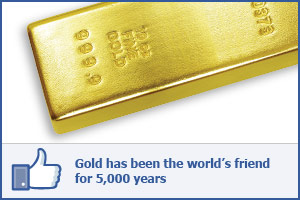 Facebook's highly anticipated initial public offering today helped the company raise $16 billion, a record for tech IPOs. It's refreshing to see investor excitement rally around the stock, as the U.S. needs innovative businesses to thrive and attract capital. However, as behavioral finance warns, be cautious of a herd mentality.


 Bill Murphy, Chairman of the


 With most major markets trending higher, today King World News interviewed acclaimed money manager Stephen Leeb, Chairman & Chief Investment Officer of Leeb Capital Management. Leeb told KWN that Israel is prepping for war and one of the key mining indexes should be up ten-fold in the next few years. Here is what Leeb had to say about the situation: "Back in the 1980s I looked at the Dow and the S&P and I wrote a book about it that the Dow could triple. It turned out I was conservative. But it's rare, in fact I can't remember ever looking at an index where I could actually say this is an index that could easily go up ten-fold within the next two to three years."
| You are subscribed to email updates from Save Your ASSets First To stop receiving these emails, you may unsubscribe now. | Email delivery powered by Google |
| Google Inc., 20 West Kinzie, Chicago IL USA 60610 | |


No comments:
Post a Comment