


saveyourassetsfirst3 |

- 4 Buy Ideas From Top-Performing Commodity Stocks Of 2012
- China Slowdown May Impact Forex Trading
- Russell – Gold Threatening Dollar’s Reserve Currency Status
- HUI $ Gold Stocks Forecast: Gold Stocks To Rally Like During The Great Depression And Early 70s
- Why Gold Is Shining Bright & What the Fed is Doing
- Chinese Gold Rush -Year of Dragon First Week Sees Record Sales– Up 49.7%
- View From the Turret: Technical Resistance
- Why the Fed's dollar-crushing policies are completely insane
- This mistake could cost you a lot of money
- Morning Outlook from the Trade Desk 01/30/12
- LISTEN: Andy Hoffman talks with SGT
- Gold & Silver Market Morning, January 30, 2012
- L'euro fête ses dix ans : quel choix faut-il faire ?
- Junior Gold Stocks Rebound from Lows
- How Currencies Die and Gold Prospers — Part I
- Gold Standard Vs. a Commodity Basket Standard
- A Shrinking Trust Horizon - And Hard Times In The City
- Registered Silver Ounces At the Comex
- Gold price has best start to year for 22 years
- Satyajit Das: Top Secret – The Chinese Envoy’s Briefing Paper On Australia’s Economy (Part I)
- The Fed’s Unattainable Government Goals
- La Parrilla Mill Expansion to 2,000 tpd Completed: Del Toro Construction Update
- ARGUING WITH THE MARKET
- The US Constitution Gone Wrong
- A Question of Currency: Should Australians Invest in the Fourth Reich?
- Jason Burack 1-27
| 4 Buy Ideas From Top-Performing Commodity Stocks Of 2012 Posted: 30 Jan 2012 05:53 AM PST By Lalit Sharma: The following is a list of top commodity stocks which have significantly outperformed the broader markets year-to-date in 2012. As compared to S&P500's gain of 4.67% since the start of this year, these stocks have posted gains of at least 20% so far in 2012.
I see further upside potential in Freeport-McMoRan Copper, Agrium, CF Industries and LyondellBasell Industries NV. Freeport-McMoRan Copper & Gold Inc. Complete Story » | ||||||||||||||||||||||||||||||||||||||||||||
| China Slowdown May Impact Forex Trading Posted: 30 Jan 2012 04:55 AM PST By Paulo Santos: I've been writing a series of articles on how China's slowdown, particularly an investment slowdown, will have a significant impact on several sectors, such as steel and copper. China's investment slowdown, however, won't just impact certain sectors and products. It will probably also have an impact on some foreign exchange rates. This happens because a few countries now have China as their main export destination, and these exports are concentrated on sectors that will be affected by the investment slowdown. Two of the most obvious victims are the Australian dollar (AUD) and the Brazilian real (BRL). Australian Dollar China is now Australia's main export destination, and the crushing majority of what Australia sells to China is minerals, iron ore chief among them. In 2010, 67.2% of Australia's exports to China were minerals. Since steel is bound to be one of the sectors most affected by the investment slowdown, iron ore Complete Story » | ||||||||||||||||||||||||||||||||||||||||||||
| Russell – Gold Threatening Dollar’s Reserve Currency Status Posted: 30 Jan 2012 03:46 AM PST With the Fed announcement sending gold soaring more than 4% this week and silver almost 7%, Richard Russell is talking about gold replacing the dollar in international transactions, and taking over as the 'King of Currencies.' | ||||||||||||||||||||||||||||||||||||||||||||
| HUI $ Gold Stocks Forecast: Gold Stocks To Rally Like During The Great Depression And Early 70s Posted: 30 Jan 2012 03:30 AM PST Note that there is more detailed analysis (including fractal analysis) in the Gold Mining Fractal Analysis Report. For more of this kind of analysis on silver and gold, you are welcome to subscribe to my free silver and gold newsletter or premium service. I have also recently completed a fractal analysis report for gold [...]  This posting includes an audio/video/photo media file: Download Now | ||||||||||||||||||||||||||||||||||||||||||||
| Why Gold Is Shining Bright & What the Fed is Doing Posted: 30 Jan 2012 03:24 AM PST "I believe that banking institutions are more dangerous to our liberties than standing armies. If the American people ever allow private banks to control the issue of their currency, first by inflation, then by deflation, the banks and corporations that will grow up around [the banks] will deprive the people of all property until their children wake-up homeless on the continent their fathers conquered. The issuing power should be taken from the banks and restored to the people, to whom it properly belongs." ~ Thomas Jefferson ~ Well here we are, caught between resistance in the S&P 500 around the 1,330 area and support around the 1,300 price level. My last two articles have discussed why I was expecting a top in the coming days and weeks ahead, but prices just continued to work higher. One of the things that I pride myself in as a person who trades and writes about financial markets in public is that I am always honest. If I blow a call I fess up and admit it. When I have made mistakes in the past, I always try to learn something new from them and I discuss losing trades publicly with readers and members of my service. This time is different. I honestly do not know if I am going to be right or wrong. The price action in the S&P 500 Thursday was certainly bearish short term, but a back test of 1,300 or possibly even 1,280 could give rise to a Phoenix. Granted, the Phoenix is nothing more than Ben Bernanke's pet, but that is a topic for a different time. I have scanned through my list of indicators which discuss sentiment based on momentum, put/call ratio, the advance/decline line, Bullish Percent Indicators, and several ratio based indicators and they are all SCREAMING that a top is near. The interesting thing about the previous statement is that it would have been true a week ago and mostly true two weeks ago, yet prices have continued to climb. The daily chart of the S&P 500 Index demonstrates the recent price action that has continued to climb the "Wall of Worry" for several weeks: S&P 500 Daily Chart
The culmination of the massive run higher for the S&P 500 was the dovish comments coming from Ben Bernanke during Wednesday's press release and press conference. The U.S. & European Central Banks are seemingly in a perpetual race to debase their underlying fiat currencies. The race will not end well. In fact, this type of situation smells like a Ponzi scheme where Ben Bernanke and Mario Draghi (ECB President) are the wizards behind the curtains. Their loose monetary policies and forced reflation are synthetic drugs that juice risk assets higher and ultimately Mr. Market will have his vengeance in due time. At this point, it seems like Ben Bernanke will do anything to juice equity prices higher. I think his hope is that they will be able to artificially keep the game going until the recovery is on a more sound footing. However, when the entire recovery is predicated on cheap money and liquidity and is not supported by organic economic growth it just prolongs the inevitable disaster. As an example, the daily chart of the Dow Jones Industrial Average is shown below. I would point out that that Dow came within 35 points (0.27%) from testing the 2011 highs. Furthermore, the Thursday high for the Dow was only 1,356 points (10.55%) from reaching the all-time 2007 October high. Dow Jones Industrial Average Daily Chart
I have argued for quite some time that the economy and the stock market are two different things. If Bernanke and his cronies succeed in reflating the financial markets and the Dow reaches its October 2007 high in the near term, more retail investors will regard equity markets as being rigged. Who could blame them for viewing financial markets as a giant rigged casino that stands to win while they continue to lose their hard earned capital? We all recognize that the current economy is nowhere near as strong as it was in 2007. But alas, the regular retail investor does not recognize that the stock market and the economy do not portray the same meaning. One specific underlying catalyst that has gone largely unnoticed by most of the financial media during this sharp run higher in stocks is the total lack of volume associated with the march higher. The NYSE volume over the past 2 months has been putrid when compared to historical norms. As a trader, I am forced to take risk through a variety of trade structures. However, the idea that a crash could be coming seems hard pressed as long as Big Bad Ben is at the wheel. If the Russell 2000 drops 10%, I am convinced that Ben will be out making announcements that the Fed stands ready to intervene with all of the supposed tools they have at their disposal. Let's be honest here, they really have one tool comprised of 3 separate functions which are all a mechanism to increase liquidity in the overall system. To express this liquidity, the following chart from the Federal Reserve shows the M2 money supply levels: Current M2 Money Supply
The 3 functions are the printing of currency, the monetization of U.S. Treasury debt (QE, QE2, QE2.5, Operation Twist), and exceptionally low interest rates (ZIRP) near 0 for an "extended period of time (2014)." Since monetary easing is all that the Federal Reserve has done since the financial crisis began, it begs to reason that the Federal Reserve has no other solutions or tools available. If they did, they seemingly would have used them by now. The first bubble they created due to loose monetary policy was the massive bubble in oil in 2008. Fast forward to the present, and they are currently supporting another bubble in U.S. Treasury obligations. The bubble that they will create in the future when the game finally ends will be in precious metals. The precious metals bubble will be building while the Federal Reserve and the U.S. Treasury attempt to keep the Treasury Bond bubble from bursting. At this point in time, if we continue down this path stocks will not protect investors adequately from inflation should the Treasury bubble burst. I would argue that the central planning and monetary policy we have seen the past few years continues in the United States and Europe that gold, silver, and other precious metals are likely to begin their own bubble of potentially epic proportions. As the weekly chart of gold futures illustrates below, gold has recently pulled back sharply and has broken out. I will likely be looking for any pullbacks in gold as buying opportunities as long as support holds. Gold Weekly Chart
In closing, for longer term investors the stock market might have some serious short term juice as cheap money and artificially low interest rates should juice returns. However, eventually equities will start to underperform. At that point, gold will be in the final stages of its bubble and the term parabolic could likely be applied. If central banks around the world continue to print money there are only a few places to hide. Precious metals and other commodities like oil will vastly outperform stocks in the long run if the Dollar continues to slide. The real question we should be asking is who will win the race to debase, Draghi or Bernanke? By: Chris Vermeulen – Free Weekly ETF Reports & Analysis: www.GoldAndOilGuy.com | ||||||||||||||||||||||||||||||||||||||||||||
| Chinese Gold Rush -Year of Dragon First Week Sees Record Sales– Up 49.7% Posted: 30 Jan 2012 01:40 AM PST | ||||||||||||||||||||||||||||||||||||||||||||
| View From the Turret: Technical Resistance Posted: 30 Jan 2012 12:45 AM PST
So it was only natural last week to see equities slow their advance, and trade a bit lower on Thursday and Friday. Fundamentally, the minor pullback was blamed on a disappointing GDP number that showed growth below expectations. But the technical overhead resistance likely played a big part in the decline as investors lighten up exposure that has finally reached profitable levels from purchases halfway through last year. This week, we turn the calendar page to a new month, and continue to sort through a full slate of earnings announcements. We've all read the Trader's Almanac statistics about how January sets the tone for the entire year, and how the US election cycle creates a bullish background for equities this year. At the same time, economic uncertainty both domestically and abroad create plenty of overhead risks that offset the "statistical advantage" of a positive January in an election year. All of these cross currents make for a very active trader's market. New pieces of information are coming to the market daily, and being interpreted different ways by different parties. Long-term decisions invest in growth initiatives may sacrifice short-term performance (as in the case with Netflix Inc.). A Greek restructuring may force debtholders to take a haircut, but lead to a more stable environment. From our perspective as traders, we're much less interested in forecasting how the trends will ultimately play out – and more interested in capturing profits from the price swings along the way. This falls in line with our theme of "being right versus making money." This week, we are watching the overhead resistance levels carefully, and focusing more on positions that have room to run before hitting key technical barriers. Fertilizer producers, gold stocks, and steel manufacturers all have plenty of overhead room before hitting the 2011 peak areas. There are also some good shorting opportunities setting up, should the resistance areas hold. Below are a few of the areas we are most interested in this week…
Want to trade like a Global Macro pro? Learn the secrets of the Global Macro titans. Sign up for your FREE Report now! Fed Juices Precious Metal Stocks Last week, Ben Bernanke and Co. announced that they were committed to keeping interest rates at historical lows well into 2014. The Fed's action cleared the way for gold stocks to ramp higher… This new rebound for precious metals – and the companies that produce gold and silver – comes at an interesting technical juncture. Since mid 2011, precious metals have been in a bearish pattern as the dollar strengthened and institutional investors gained more confidence in "traditional" equities. Four to six months of fading action has helped to cool the gold bugs' enthusiasm and reset the sector from a technical perspective. But with rates staying at low levels, and the Fed keeping its options open for more bond purchases, inflation concerns are once again rising. The current environment is especially interesting for silver which has the qualities of both precious AND industrial metals. The broad economy continues to grow (albeit more slowly than expected), which drives demand for industrial metals. At the same time, inflation concerns drive demand for precious metals and silver fits both of those profiles. The Mercenary Live Feed now has a number of positions in this area including a covered call setup mentioned in last week's View From the Turret along with a few swing trades in precious metal miners. As spot prices for precious metals ramp, small and mid-cap miners will benefit more than their large-cap brethren. Typically, blue chip producers have distribution contracts and hedges in place to insulate themselves from price swings. But small cap producers are more likely to be able to raise funding for additional development based on higher gold and silver prices – not to mention enjoying higher margins on current production. The Market Vectors Junior Gold Miners (GDXJ) is a good proxy for small and mid-cap gold miners, and also includes exposure to silver producers. More importantly, a list of the ETFs components is a great place to shop for individual producers with good chart patterns and strong fundamentals.
Middle Class Retailers Compete With Discounters  Last week's announcement by JCPenny (JCP) creates a new dynamic for discount retailers. The department store will be embracing a new pricing model where they will offer an "every day low cost" price point for all merchandise instead of the traditional model of high prices and regular mark-downs. Last week's announcement by JCPenny (JCP) creates a new dynamic for discount retailers. The department store will be embracing a new pricing model where they will offer an "every day low cost" price point for all merchandise instead of the traditional model of high prices and regular mark-downs. The company plans to make massive cost cuts (likely including a significant number of layoffs), and also beef up their marketing budget to drive more traffic. JCPenny's move is just one example of retailers moving down the value chain, catering to the budget-conscious consumer and abandoning the middle class market. It's clear that more consumers are falling into this category (which is why retailers are serving this market), but more competition will reduce profit margins for the entire area. Deep discounters like Family Dollar Stores (FDO) have had good success over the last two years as consumers have migrated to cheaper outlets for goods. But now that the major retailers are encroaching on their territory, the advantage may be lost. FDO has begun to trace out a topping pattern. Last week's rally up to the 50 EMA (after falling early in January) sets up an interesting short opportunity. With the broad market running into resistance, FDO looks like an attractive short to help counterbalance bullish exposure. It's one of the names we are watching carefully this week.
Natural Gas Producers Vulnerable Last week, Jack offered a contrarian perspective to the recent natural gas spike. Judging from some of the emails we received, the piece hit a sensitive nerve for a number of traders. This month, our Global Trend Capture service took a nice profit on a bearish natural gas trade, and the area still looks ugly from a technical perspective. Natural gas producers face an interesting dynamic in that they are able to produce more gas because of shale fracking techniques, but low prices for natural gas makes it more difficult to justify the drilling programs. The First Trust ISE Reserve Nat Gas (FCG) ETF is a good proxy for natural gas producers – and the chart has been setting up a series of lower highs since the October rally. A break from this point would catch natty bulls off-guard as many believe we simply can't go lower from here. A forced liquidation or panic flight could give the bears a pretty nice short-term trade – and the action could ultimately set an unexpected floor for the group once the last of the weak holders are flushed out.
 Options Spotlight This week's screen from the Mercenary Options Dashboard includes covered call setups that have a 70% probability rate of being assigned, expire in 50 days (the March contract), offer at least a 2.5% rate of return, and offer 15% downside protection at a minimum.
There were a number of attractive trade opportunities that fit this criteria, but Walter Energy (WLT) caught my eye particularly. The company makes coking coal which supplies the steel industry. This trade fits in with our bullish steel positioning, and offers a 19% annualized rate of return with a breakeven point at a clear support area on the chart (well below the current price). Walter Energy hasn't reported fourth quarter earnings yet, so the report adds additional risk to the covered call trade. But WLT will likely trade more on expectations for global manufacturing – rather than on past performance for the company. The overall market is opening soft this morning due to more concerns in Europe. Watch for the bulls to try to support this market (and manufacture a breakout), but keep that risk managed carefully. Trade 'em well this week!
| ||||||||||||||||||||||||||||||||||||||||||||
| Why the Fed's dollar-crushing policies are completely insane Posted: 30 Jan 2012 12:41 AM PST From Newsmax: Encima Global president David Malpass says the actions of the Federal Reserve will boost inflation and harm the U.S. dollar. "Dollar weakness doesn't work at all for economic well-being," Malpass writes in The Wall Street Journal. "The corollary to the Fed's policy of manipulating interest rates downward at the expense of savers is declining median incomes." It's no coincidence that inflation-adjusted median incomes rose in the sound-money booms of the Reagan and Clinton administrations... and fell in the weak-dollar busts during the Carter, Bush, and Obama years, according to Malpass. "When the currency weakens, the prices of staples rise faster than wages, hurting all but the rich who... Read full article... More on the U.S. dollar: What a "broken dollar" could mean for gold and stocks now Shocking gold story suggests the "End of America" has begun This is how Americans were duped into using worthless paper money | ||||||||||||||||||||||||||||||||||||||||||||
| This mistake could cost you a lot of money Posted: 30 Jan 2012 12:39 AM PST From Gold Scents: I figured out early in my career that arguing with the market (more often than not) ends up costing one money. If you are one of those people who are unable to change your mind, this business will almost certainly chew you up and spit you out. Never has that been more true than today. Folks, we are in the middle of an ongoing currency war. It is creating investing conditions unlike anything most of us have ever seen before. There's a reason why very few money managers have been able to make any profits over the last year and most of them have lost money. That reason is an ever-changing investing environment. As most of you probably already know, my investing strategy is based around... Read full article... More on investing: How the United States could "become rich" again This could be your best chance to buy gold since 2008 The three developments that could set off a real bull market | ||||||||||||||||||||||||||||||||||||||||||||
| Morning Outlook from the Trade Desk 01/30/12 Posted: 29 Jan 2012 11:30 PM PST Metals again under some pressure as the Greek solution becomes the focus, putting pressure on European equities. Portugal seems next in line. a lot of headwinds for equities coming up. If the Chinese do not step up in a big way, the commodities may run out of juice. We need new parameters before we see a surge in business. Clients have saturated these levels. Its boring to just have an insurance position, which all should have. They want to tell their friends how much they have made in gold. Ironically, this news is never accompanied by how much they lost in the other asset classes as gold moved higher. | ||||||||||||||||||||||||||||||||||||||||||||
| LISTEN: Andy Hoffman talks with SGT Posted: 29 Jan 2012 11:11 PM PST from SGTReport: Part One Part Two ~TVR | ||||||||||||||||||||||||||||||||||||||||||||
| Gold & Silver Market Morning, January 30, 2012 Posted: 29 Jan 2012 09:00 PM PST | ||||||||||||||||||||||||||||||||||||||||||||
| L'euro fête ses dix ans : quel choix faut-il faire ? Posted: 29 Jan 2012 08:00 PM PST Dix ans après sa mise en circulation officielle, l'euro affronte, le 1er janvier 2012, la pire crise de son histoire et la célébration des 10 ans de l'euro se déroule dans un contexte économique particulièrement sombre, difficile et incertain. Deux jours plus tard, c'est-à-dire le 3 janvier, le gouvernement grec déclare qu'à moins que l'Accord du deuxième prêt d'aide de 130 milliards de dollars US serait conclu dans l'immédiat avec International bonds, il y aurait risque pour la Grèce de se retirer de la Zone euro. Ainsi une décennie après la mise en circulation le 1er janvier 2002, la monnaie unique est descendue à 1,2797 dollar, son plus bas taux depuis septembre 2010 et on se demande quels genres d'autres défis se dresseront devant l'Euro et devant la Zone euro ?... Lire | ||||||||||||||||||||||||||||||||||||||||||||
| Junior Gold Stocks Rebound from Lows Posted: 29 Jan 2012 06:44 PM PST
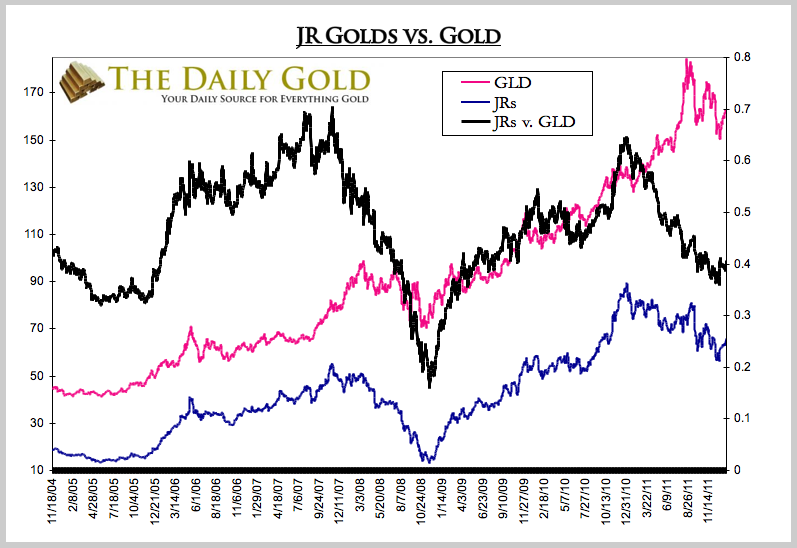
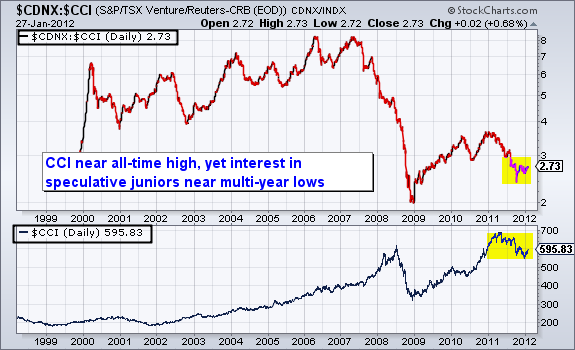
First lets take a technical look at the juniors. We show ZJG.to and GDXJ in the chart below. ZJG.to is a Canadian junior ETF which is comprised of entirely gold companies while three of the top ten companies in GDXJ are silver companies. ZJG is nearing resistance at 20-21 while GDXJ is nearing resistance at 31-33. More importantly, both markets have broken out of their downtrends against Gold. Next we show a plot of our junior gold index (call it JGI), GLD and a ratio of JGI against GLD. Note that the ratio, which peaked at 0.7 in 2007, is currently at 0.4. JGI is presently at 66. Should Gold eventually break to new highs and JGI/GLD rise back to 0.7, then junior gold stocks would gain more than 100%. With large producers reporting record cash flow and profits, it is only a matter of time before all gold equities reach higher valuations against Gold itself. Our Junior Gold index as well as the other junior indices do not include the "true junior" companies which are of the microcap variety. The CDNX is basically an index for these types of companies. Most but not all of the companies within the CDNX are gold and silver related. Thus, in the chart below we decided to compare the CDNX to the CCI (continuous commodity index). The CCI is somewhat close to an all-time high while the ratio of the junior companies to the CCI is close to multi-year lows. With commodities not far off all time highs, one would expect the junior companies to be trading at higher levels. Lately we've been writing about how gold stocks are faring in comparison to previous equity bull markets. The comparison argues that gold stocks should fare well this year and well into 2013. Even though this bull market is in its 12th year, it remains a few years away from the start of a bubble. In a bubble, valuations expand far beyond fundamentals and it continues for several years. In order for this to happen, valuations must be low prior to the start of the bubble. From early 1992 to 1995 the price to earnings ratio (PE) on the Nasdaq fell from 50 down to 20. Over the next two years, the PE ratio climbed from 20 back to 50. Then in the second half of 1997, the PE ratio surged past 50 and never looked back. From 1973 to 1983, the PE on the Nikkei (Japan) ranged from mostly 15 to 23. After 1983, the PE ratio surged to new highs and eventually peaked at 70. It is clear that prior to a market bubble, valuations are compelling. Not stretched or fair, but compelling. After all, a bubble needs time to develop and then have its final blowoff stage. Prior to the start, valuations begin to move from the low side to the high side. Then as the bubble really gets going valuations break to new records and surge to extremes. Months ago we wrote about how the PE for large cap gold stocks was near a 10 year low. Now we see that the speculative side of the precious metals sector, (the juniors), is trading at near basement valuations. This is 12 years into a bull market. Not five or eight. It will take time for valuations of precious metals companies to move back to the high end of the range. Companies that grow their business and add value could perform fantastically thanks to a likely increase in the valuation of the sector. If you'd like professional guidance in riding this bull market and uncovering the winning companies then learn about our premium service. Good Luck! Jordan Roy-Byrne, CMT
| ||||||||||||||||||||||||||||||||||||||||||||
| How Currencies Die and Gold Prospers — Part I Posted: 29 Jan 2012 05:14 PM PST The Dollar is doomed. So too are most other fiat currencies. It is the nature of fiat currencies and the nature of governments throughout history. All countries have abused their citizenry and investors via the printing press. Since the formation of the Federal Reserve in 1913, the dollar has lost 96% of its value. Most [...] | ||||||||||||||||||||||||||||||||||||||||||||
| Gold Standard Vs. a Commodity Basket Standard Posted: 29 Jan 2012 05:12 PM PST New World Economics | ||||||||||||||||||||||||||||||||||||||||||||
| A Shrinking Trust Horizon - And Hard Times In The City Posted: 29 Jan 2012 05:09 PM PST Dollar Collapse | ||||||||||||||||||||||||||||||||||||||||||||
| Registered Silver Ounces At the Comex Posted: 29 Jan 2012 05:00 PM PST Jesse's Cafe | ||||||||||||||||||||||||||||||||||||||||||||
| Gold price has best start to year for 22 years Posted: 29 Jan 2012 05:00 PM PST | ||||||||||||||||||||||||||||||||||||||||||||
| Satyajit Das: Top Secret – The Chinese Envoy’s Briefing Paper On Australia’s Economy (Part I) Posted: 29 Jan 2012 03:10 PM PST By Satyajit Das, derivatives expert and the author of Extreme Money: The Masters of the Universe and the Cult of Risk Traders, Guns & Money: Knowns and Unknowns in the Dazzling World of Derivatives – Revised Edition (2006 and 2010) Your Excellency, I am pleased to present the requested report on the economic outlook for the Great Southern Province of China, currently referred to by the local population as "Australia". For convenience I will refer to the country by this older name. Deep dependence on our great nation means Australia's future is inextricably linked to China. Given that the white European colonisers historically feared the "yellow peril", the irony of the situation will be not lost on the Politburo. Despite recent engagement with us and the rest of Asia, Australia's focus seems confused. The country's head of state remains an octogenarian British Queen. Australia also believes its security is guaranteed by the United States of America with whom it has extensive defence links. The locals continue to believe in both in its sovereignty and also its bright economic prospects. Escaping Acronyms… The popular narrative is that Australia escaped the GFC (global financial crisis – the locals are acronymic) through their own planning. The country was certainly in a better position to cope with the problems. The Federal government did not have much debt. However, some State governments have significant borrowing. Governments also systematically shifted some of their debt into public private partnerships ("PPP"). Because of the strategic nature of this infrastructure, these projects de facto enjoy the indirect support of governments. Private household debt is also high. At the start of the crisis, Australian interest rates were relatively high, providing greater flexibility. But Australia did not escape the crisis unscathed. One major bank lost nearly a billion Aussies (colloquial term for the Australian dollar, the local version of the Renminbi). Investors, including a number of charities and local councils, suffered significant losses from investments in various financial products. A number of highly leveraged infrastructure and commercial real-estate investors failed. Local banks escaped the problems of their overseas counterparts. The near death experiences in the recession of the early 1990s encouraged them to stay home eschewing overseas adventures and complex financial structures. That said, another year or so, they would not have been so lucky. The local banking regulator, APRA (Australian Prudential Regulation Authority), and politicians take credit for the banks being relatively unaffected. This is curious given that banking regulations are largely uniform around the world. One can only assume that Australia has superior regulators and politicians to the rest of the world – an example of "Australian exceptionalism". In reality, Australia's swift recovery was driven by large cuts in interest rates, government guarantees for banks, government stimulus and a commodity boom. The central bank reduced interest rates (from 7.25% per annum to 3.00% per annum). The fall of 4.25% per annum translates into a fall in monthly mortgage repayments of nearly 30 % or around $7,000 per year on a 20-year mortgage of $250,000. A government guarantee on bank deposits and borrowing ensured that financial institutions were insulated from many of the problems. Government spending minimised the effects on the real economy. Cleverly directed cash transfers to lower income households rapidly stimulated the economy. As part of the ESP (Economic Stimulus Package), government spending on education, housing and infrastructure was also increased. Some of the spending was not well directed. Environmental initiatives, subsidies for home insulation to reduce energy consumption, have proved less than successful. The long-term benefit of some spending is questionable. Your Excellency, the school across from my office has been refurbished with new gold signage and a brand new fence replacing the aluminium one that was perfectly serviceable. The economic return on this investment is unknown. The main driver of the recovery has been a commodity boom. This is not a new phenomenon in Australian history. It can be traced back to the famous gold rush of the 19th century when many of our countrymen travelled to Australia in search of their fortunes. Boom… Former Prime Minister of Australia Paul Keating, a prominent Sino-phile, recently remarked that Australians were luckier than most races having been give an entire continent. He might have added that it was also remarkably rich in mineral wealth. Australia has benefited from a substantial increase in demand for and prices for its mineral products. The country is enjoying its best terms of trade (measured as Price of Exports divided by Price of Imports, showing the quantity of imports that can be purchased theoretically from the sale of a fixed amount of exports) in 140 years. Australia's terms of trade have improved by 42%, just since 2004. The commodity boom is driven by a sharp increase in demand, supply constraints because of under-investment in mineral production and associated infrastructure and some unexpected effects of the GFC. In the 1990s, as a result of persistently low prices, mining companies did not invest sufficiently in expanding production capacity or infrastructure, such as transport, refining or processing capacity. The increase in demand from purchasers, particularly emerging economies, quickly created bottlenecks and shortages. This led to sharply higher prices as well as improved volumes for many commodities. The GFC also boosted investment in commodities. As traditional investments fared poorly (stocks, interest rates and property prices all fell), investors switched to hard assets, like commodities. The underlying logic was that these were real assets with genuine underlying uses rather than the fictions created through financial engineering. Low interest rates also assisted demand and prices as it cost less than before to buy and hold commodities, which paid no return. As central banks commenced printing money in an effort to restart growth, investment in commodities increased further as investors sought a hedge against the risk of inflation. Former Board member of the Reserve Bank of Australia, Professor Russell McKibbin suggested that perhaps as much as 40% of the improvement in Australia's terms of trade was driven by US and European monetary expansion. As your Excellency knows, one of China's priorities is to preserve the value of its foreign exchange reserves, currently around US$3.2 trillion. The bulk of these funds are invested in US dollar, Euro and Yen denominated securities. To reduce the risk of losses as these securities lose value due to the actions of governments to devalue the currency against the Renminbi, we have executed your instruction to purchase and stockpile large amounts of strategic commodities. Boomier… The economists, who failed to forecast the rise in commodity prices or the GFC, now speak of a "super" boom lasting decades. The boom is more fragile than currently understood. As growth in China and other emerging countries decelerates, demand for commodities is likely to slow. High prices have encouraged investment in expanding existing mines, building new mines and additional infrastructure as well as exploration. As new capacity and supply comes on stream, there will be pressure on prices. At your Excellency's suggestion, we have extensively studied the commodity purchasing strategies of Japan in the 1980s. Based on this analysis, we have actively cultivated new sources of supply of essential commodities. This will enable us to play suppliers off against each other to achieve more favourable prices in the long term. Westerners place great store in contracts, such as long term agreements to purchase minerals at agreed prices. In the Chinese way, these are, at best, statements of intention based on conditions existing at the time of agreement. If conditions change, then we will, like the Japanese, renegotiate the arrangements in our favour. Australian mining entrepreneurs and politicians point to a massive pipeline of projects, which will underpin Australian prosperity. The Australian Mines and Metals Association estimate that there is A$427 billion of resources in train, including A$146 billion in Liquid Natural Gas alone. A$236 billion of projects are current under way with a further A$191 billion awaiting approval. There is also A$770 billion of infrastructure spending required to renew and develop Australia's economic and social infrastructure. This will compete with commodity projects for funding. Chairman of Infrastructure Australia Rod Eddington has warned that financing will not be available for many projects. Infrastructure Australia has identified a smaller list of priority project totalling A$86 billion. Commodity projects depend on demand for the product and also on the ability to finance it. Deterioration in money market conditions and also problems in the banking system mean that the availability of funding is becoming more restricted and expensive. If previous commodity booms are a guide, then many of these projects may not eventuate. Sinophilia… Around 23 % of Australian exports now go to China. The real quantum is higher as some Australian exports to Asia are then re-exported to China. China currently faces significant challenges. Our two major trading partner – Europe and America – face serious problem which will lead to a slow down in our own exports. Recent statistics, such as the volatile Purchasing Managers Index that measures manufacturing activity, suggest a sharp slowdown. In turn, this will affect our suppliers such as Australia by way of lower demand and also lower prices for commodities. Unlike 2008, our capacity to respond to any slowdown is reduced. Then, we increased lending through our policy banks to boost demand. In 2009 and 2010, we were able to grow loans by around 30-40% of our GDP to drive growth. Unfortunately, party cadres have not used the money wisely in all cases, resulting in some unproductive investment and bad debts for the banks. The need to support our banks and cover their bad debts will restrict our ability to support the economy. As your excellency is also aware, around US$ 800 billion or 25% of our US$3.2 trillion in foreign exchange reserves is invested in "risk free" European government bonds. Continued losses in these investments and on investments in US government bonds also further restrict our flexibility. Our economic growth will be slower then widely anticipated. European Tsunamis… Australians believe that physical distance from Europe and proximity to China and Asia affords protection from European debt problems. Despite record terms of trade and high export volumes, Australia continues to run a current account deficit with the rest of the world of around 2-3% of GDP, around US$30-40 billion per year. This must be financed overseas. Sovereign debt problems and the resultant problems in the banking system will affect international money markets for some time to come. Australian borrowers will face reduced availability of funding and increased borrowing cost. Before the crisis, Australian bank deposits totalled 50-60% of loans made. The difference was funded in wholesale markets, generally from institutional investors. In 2007, deposits made up around 20% of bank borrowing down from 34% a decade earlier. Domestic wholesale borrowing and foreign wholesale borrowing were 53% and 27% of bank balance sheets. Following the GFC, increases in the cost of overseas funding and regulatory pressure, Australian banks significantly reduced their loan to deposit ratios, with deposits now around 70% of loans. They also reduced their dependence on international borrowings. Nevertheless, Australian banks face significantly international re-financing pressures, needing around A$80 billion in 2012. Around A$35 billion are AAA rated government guaranteed bonds which will need to be financed without government support, unless the policy changes. In addition, the banks have a further A$28 billion worth of bonds that mature in the domestic markets In the period before the GFC, Australian banks relied on securitisation to raise cheap funding from overseas. When these markets closed, Australian banks used debt guaranteed by the Federal Government to raise funds. With the guarantee now not available, Australian banks are increasingly using covered bonds to raise funds. Covered bonds are secured over specified assets such as a pool of mortgages, giving investors priority over depositors. Regulators have limited the quantum of covered bonds permitted to a maximum of 8% of assets, limiting the ability of banks to use this form of financing. To date, covered bonds have not proved a cheap source of finance for banks, as originally envisaged. Inaugural international issues by ANZ and Wespac have cost around 1.50% over inter-bank rates. In early 2012, the Commonwealth Bank issued at around 1.75% over interbank rates in the domestic markets. Given that the covered bonds enjoyed the highest rating of AAA, the funding cost for Australian banks for unsecured borrowings would be around 2.00-2.50% over inter-bank rates, a sharp increase over the last 6 months. This higher cost will be passed on to customers at some stage. In testimony to a parliamentary committee, John Laker, the head of APRA, acknowledged the funding challenge. He hoped that improvements in market conditions would allow the Australian banks to access the overseas funding required. Money Too Tight To Mention … Facing reduced availability and higher cost of funding, Australian banks may reduce loan volumes and increase rates to customers. The problems of international banks, especially European banks, previously active in financing local businesses, will compound the problem. These banks are required to increase capital to cover losses, including those on their sovereign bond investment. As they can't or do not want to issue equity at deeply discounted prices and the limited investor appetite for such issues, the banks may sell assets or reduce lending to raise the required capital. Estimates suggest that these banks could have to sell (up to) $2.5-3.0 trillion in assets, resulting in a sharp contraction in availability of credit. Before the GFC, European banks provided around 35% of loans to Australian corporations. This has fallen to around 16% in 2011 and is likely to decline further as a result of losses on sovereign bond holdings, pressures on bank capital and increases in US$ funding costs. European banks are actively looking to sell all or a portion of their Australian loan portfolios to alleviate the pressures. They are also cutting back on new lending to Australia clients, focusing on their home markets in Europe. The reduced participation reflects losses on sovereign bond holdings, pressures on bank capital and increases in US$ funding costs. European banks are actively looking to sell all or a portion of their Australian loan portfolios to alleviate the pressures. They are also cutting back on new lending to Australia clients, focusing on their home markets in Europe. Given that Australian companies will need to re-finance around A$80 billion of maturing loans in 2012, these pressures are not welcome. The problems of European banks, active in commodity financing, may reduce the supply of credit to the sector by about 25-30%, which would impact Australia's resources businesses. The contraction of credit will also affect Australia indirectly. The withdrawal of European banks from Asia and other emerging markets is affecting the ability of companies to finance trade and investment projects. This affects Australian exports. In 2007, European banks and US banks accounted for 30% and 10% of loan in Asia-Pacific. This has fallen by around half to 15-16% for European banks and 5-6% for US banks. The level of participation is likely to shrink further as a result of the problems of these banks. Troubled French banks account for about 11% of maturing loans in Asia Pacific. It is unlikely that these banks will maintain their level of commitment. Asia-Pacific banks have taken up the slack but are not sizeable enough to fill the gap completely. Australian companies overseas earnings also face significant pressure due to economic weakness in Europe and its affect on the other markets. A proportion of Australian retirement savings are invested overseas. These will also be affected by the problems in Europe and internationally. The European crisis has affected Australian public finances. Falls in income and capital gains have reduced tax revenue. The government is cutting expenditure and tightening taxes to offset the reduction in revenue. Falls in income on retirement savings, reduced business investment and general loss of confidence is likely to adversely affect the domestic economy. Australia may not escape the possible European tsunami.
| ||||||||||||||||||||||||||||||||||||||||||||
| The Fed’s Unattainable Government Goals Posted: 29 Jan 2012 03:03 PM PST Investors digested the big news...the Fed's announcement that it would continue handing out money, asking nothing in return, for the next three years. Stocks went down. Oil stayed under $100. The yield on the 10-year note fell under 2%. And gold just kept going up. The New York Times reported:
The Fed said that it now planned to keep short-term interest rates near zero until late 2014, continuing the transformation of a policy that began as shock therapy in the winter of 2008 into a six-year campaign to increase spending by rewarding borrowers and punishing savers. How do you like that, dear reader? The Fed has goals for unemployment and inflation. Targets. And it moves its policies around in order to achieve its goals. Of course, it doesn't necessarily hit its goals. Still, we're supposed to believe that by trying to hit them it somehow encourages them in the right direction... Most people believe they are successful. Which makes us wonder. Maybe the Fed should set goals for other things? Weight-loss goals, for example. The idea is that by changing interest rate and banking policies the Fed actually influences inflation and employment. So, there's a logic to thinking that the Fed should set targets and try to hit them. Trouble is, if it could really change things for the better, why does it put up with an 8.5% unemployment rate now - four years after the subprime crisis began? Why doesn't it exercise its magic to bring the rate down...? Well, we all know the answer. It can't. Once you've taken interest rates down to zero...and announced that you'll leave them there for the next three years...what more can you do? Drop money from helicopters? Right! But no point in getting ahead of ourselves. Right now, interest rate policy doesn't work. Because the money supply is expanded by retail and commercial bank lending, not central bank lending. The Fed lends money to the money-centre banks. They're happy to take the Fed's money. But that doesn't mean they will multiply it out by risking it in the economy. So, for the moment, they might as well set a fat goal...too... Regards, Bill Bonner | ||||||||||||||||||||||||||||||||||||||||||||
| La Parrilla Mill Expansion to 2,000 tpd Completed: Del Toro Construction Update Posted: 29 Jan 2012 01:32 PM PST First Majestic Silver Corp.'s new La Parrilla flotation/cyanidation plant was inaugurated in a ceremony at the La Parrilla silver mine in the state of Durango, Mexico, on Jan. 19, 2012, at which approximately 150 people attended including several Mexican federal, state and municipal authorities. The federal government was represented by Jimena Valverde Valdez, General Co-ordinator of Mining for the Secretary of the Economy, while the state of Durango was represented by Hector Vela Valenzuela, Ing, Secretary General of the Governor of Durango, both of whom declared the new plant as officially open. The new La Parrilla dual processing plant has a total capacity of 2,000 tonnes per day (1,000 tonnes per day in the flotation circuit and 1,000 tonnes per day in the cyanidation circuit) and is anticipated to be operating at full capacity in February, 2012. Currently the mill is operating at 1,500 tonnes per day (1,000 tonnes per day in flotation and 500 tonnes per day in cyanidation). The final components of the plant to be installed are the tailings filters, which will allow for the recirculation and recovery of 80 per cent of the water used in the process. These filters are expected to be fully operational by the end of February, 2012. Also, the dust collection system and new induction furnaces are expected to be fully operational by the end of January, 2012. As previously announced in September, 2011, the flotation circuit has been operating since Sept. 1, 2011, and reached commercial production of 1,000 tonnes per day on Oct. 1, 2011. The new 1,000-tonne-per-day cyanidation circuit was slightly delayed due to the late delivery of components and delays by the Mexican power authorities in hooking up the new 115,000-kilovolt power line which was eventually connected on Jan. 18, 2012. Once completed, annual production is estimated to be approximately 3.0 million ounces of pure silver, 6.0 million pounds of lead and 4.3 million pounds of zinc. The total investment to the end of 2011 was $35.0-million (U.S.) inclusive of mine development. The remaining balance of the $40.5-million (U.S.) budget is being expended in 2012. This major expansion project was planned not to disrupt silver production during construction. Both circuits for flotation and cyanidation continued to operate during the entire construction process and will continue to operate while the final systems are installed for the new cyanidation circuit. With this major construction project coming to an end, management can now focus on the many additional objectives planned for 2012 at the La Parrilla complex. The company has budgeted $20-million (U.S.) for the construction of a new 2,000-tonne-per-day shaft at Rosarios, near the mill, and the construction of an underground rail system that will connect the Rosarios, San Marcos, Vacas and Quebradillas mines. Upon completion, all underground mining areas will be connected by a new ore haulage level through an underground train system. The consolidation of the underground operations will significantly improve operating efficiencies and should have a positive impact overall on total cash costs. In addition, the company's exploration budget is $6.3-million (U.S.) at La Parrilla, which will include 25,000 metres of drilling. Included in this drilling program will be prospective areas defined by geophysics and geochemistry over the past year but never drilled before. In addition, a very aggressive development program consisting of 20,000 metres, including the new haulage level, is expected to be completed at La Parrilla in 2012. An updated NI 43-101 technical report is also expected to be released by the end of 2012. Keith Neumeyer, president and chief executive officer, stated: "We are very pleased with the completion of this major new expansion at La Parrilla. Our Mexican construction team should be recognized for their hard work and tireless efforts and should be congratulated for completing the construction while keeping the older mill operating." Prior to the inaugural opening ceremony, the company hosted a visit of four mining analysts at the La Encantada silver mine and the Del Toro silver mine. At Del Toro, the analysts witnessed the major earthmoving project under way in advance of foundation laying and they also visited the new underground discovery called San Nicolas, which was discovered in November, 2011, during the construction of a development ramp to access the Persaverancia mine. The preliminary economic assessment (PEA), planned to be released prior to the end of the first quarter, will include a new reserve and resource estimate and plans to construct a 4,000-tonne-per-day dual circuit mill rather than the previously planned 2,000-tonne-per-day mill. The PEA will outline a phased construction project whereby the new dual-purpose mill will reach 1,000 tonnes per day (500 tonnes per day in flotation and 500 tonnes per day in cyanidation) in the fourth quarter of 2012, 2,000 tonnes per day by the end of 2013, and 4,000 tonnes per day (2,000 tonnes per day in flotation and 2,000 tonnes per day in cyanidation) by the end of 2014. Full financial and production details will be contained in the PEA. We seek Safe Harbor.
| ||||||||||||||||||||||||||||||||||||||||||||
| Posted: 29 Jan 2012 11:08 AM PST I figured out early in my career that arguing with the market more often than not ends up costing one money. If you are one of those people who are unable to change your mind, this business will almost certainly chew you up and spit you out. Never has that been more true than today. Folks, we are in the middle of an ongoing currency war. That is creating investing conditions unlike anything most of us have ever seen before. There's a reason why very few money managers have been able to make any profits over the last year and most of them have lost money. That reason is an ever-changing investing environment. As most of you probably already know my investing strategy is based around cycles, sentiment, a long-term bull market in precious metals, and a dash of technical analysis thrown in to help spot entry and exit points. Those tools give me a rough outline of what to expect going forward. I then placed my trades based on the best odds for success. However none of that excuses me of the responsibility to change my mind if the market tells me my expectations are wrong. It is precisely the ability to reverse direction 180° that enabled us to generate a 25% plus gain in the model portfolio during the last six months. This in a market that has confounded most professional money managers. And in an unleveraged portfolio, with never more than 75% of capital invested at any one time. I daresay on a risk-adjusted basis the SMT model portfolio has outperformed probably 99% of the money managers in the world. As an example let's use my recent expectation for 2012 to be one of the worst years in history. First off let me explain how I came to that assumption. To begin with the dollars three year cycle low was due to bottom in the spring of 2011. It actually did bottom in May of 2011. The stock markets four year cycle low is due to bottom in the fall of 2012. Since most bear markets tend to last about 1 1/2-2 1/2 years it was reasonable to expect that the next bear market would begin as the dollar started to rally out of its three year cycle low. Low and behold what happened in May as the dollar cycle bottomed? That's right the stock market started to collapse as deflationary forces began to push the dollar higher and asset prices down. Everything was unfolding exactly as our cycles tool had suggested it would.  However, in late November the markets started to deviate from our expectations. As the dollar continued to rally stocks began to decouple from the strong dollar. At this point one could either stubbornly hold on to their bearish outlook and lose money or, they could accept that the market was doing something different than what they expected, change their mind, and deal with reality as it is, instead of how they wished it to be. The fact that the S&P wasn't doing what it should have been doing was the main reason I've been warning (pleading really) with traders not to sell short. This market should have begun the move down into a daily cycle low two weeks ago. The fact that it refuses to move down into that over due correction is sending a strong message that something else is going on. The inability to change one's mind when the market tells you you are wrong, is one of the toughest habits to break, but one that is absolutely necessary if you are going to make money in this business. For whatever evolutionary reason, human beings have a very hard time admitting when they are wrong, and an even harder time reversing their thinking 180° even after they know they're wrong. For the vast majority of traders it is less painful to lose money than it is to admit an error and reverse a trade. In my previous post I went over my expectation for gold to move down into its daily cycle low along with the stock market. This should have corresponded with the dollar rallying out of its cycle low. On Wednesday morning everything was set up perfectly for this to unfold. Gold had formed a swing high and was beginning the move down into its daily cycle low, stocks were in the process of reversing back down through the coil, and the dollar had bounced off of the 50 day moving average and was holding strongly above support at 80, clearly in the process of putting in a cycle bottom.  However as you can see from the chart all of that changed Wednesday afternoon on the Fed statement. The stock market reversed the early-morning weakness, closing strongly. Gold reversed dramatically, closing up over $40, and the dollar collapsed back down through 80 negating what would have almost certainly been a powerful rally out of that cycle bottom. One could either ignore what had just happened and exacerbate losing trades, or they could recognize that something fundamentally changed that afternoon and quickly get on the right side of the market. That is exactly what we did. When the dollar reversed and gold started to rally we immediately bit the bullet on our long UUP trade, took a small loss, and reentered GDX. None of our tools (cycles, sentiment, or technicals) were predicting this. However, that still doesn't give us an excuse to ignore what had happened and quickly make the correct adjustment. Bernanke didn't actually confirm QE3 Wednesday afternoon, but the market obviously perceived the Fed statement as a guarantee that QE3 is in the works. That has the potential to break the dollar's rally out of its three year cycle low and derail the expected move by stocks down into a four year cycle low later this year. If Bernanke can break the dollar rally, and get the dollar moving south again there is no way we are going to experience a deflationary bear market this year. In that scenario 2012 would be the beginning of an inflationary period, culminating in a dollar crisis at the next three year cycle low, due in late 2014. If this is what is about to unfold then we need to alter our expectations from a deflationary bear market to an inflationary bull market. The four year cycle low for stocks, instead of occurring in late 2012 would probably get stretched out to late 2014. And the recession we should experience this year will be pushed out to 2013/2014 once inflation rises high enough to poison the economy. The big question now is; did Bernanke break the dollar rally? Confirmation will come once the dollar finds its daily cycle low, and if the rally out of that low fails to move to new highs and rolls over quickly forming a new pattern of lower lows and lower highs.  If this scenario plays out then we can jettison the deflationary bear market hypothesis and begin positioning for the inflationary scenario which should culminate with a dollar crisis in late 2014. This scenario also has the potential to drive the bubble phase of the gold bull market. A lot is riding on the dollar right now.        This posting includes an audio/video/photo media file: Download Now | ||||||||||||||||||||||||||||||||||||||||||||
| The US Constitution Gone Wrong Posted: 29 Jan 2012 09:50 AM PST "If James Madison and the rest of the people who were at the constitutional convention came back to the US they wouldn't recognise it," said a man we met last night at the Watergate. "They'd be appalled. They put all that work into the US Constitution...using every trick they could think of to limit the power of the executive branch. Because they knew that if you let the executive branch get away with it, it's only a matter of time before it becomes a tyrant. It doesn't matter whether you call it a king or a dictator...or an emperor...once you put too much power in one man's hands, you will corrupt the man who has the power...and destroy the society that gave it to him. "That was the whole point of the constitution. It was to limit power. They put in checks and balances...and the Bill of Rights. They thought about it. They figured it out. They wanted to be sure that the US really was different. The people were meant to be sovereign. They were meant to be in control. "And the role of the government...and the only role of the government...was to protect the liberty and sovereignty of the people. And they knew too that the main threat to individual liberty was the government. That's why you needed warrants...you need to have a trial by a jury of your peers...you needed habeus corpus. They built all these protections into the system to protect the individual from the government. They weren't there to protect the individual from Al Qaida or from China. They were there to protect the individual citizen from the government. "And now, with this anti-terrorism bugaboo all of those protections have gone away. The president has the power to put any American citizen in jail - for life. No charges. No witnesses. No hearing. No trial. No nothing. "He can have you tortured. He can have you killed. "I mean, President Obama has powers that King George would have envied. And he got those outrageous powers without a word of protest. Nobody said anything. Congress said nothing. The people said nothing. "Yeah...I guess that's what you mean about Americans going to hell. I guess they deserve to go to hell. But, of course, that's exactly what we're trying to stop... "And now the prez has more power than Louis the 14th... And he was supposed to be an absolute monarch I mean, Louis had to pay for his wars. He had to pay for his public buildings. He had the nobility against him much of the time. He had much of Europe against him. "America was lucky. It was far from Europe. It was protected by oceans from foreign domination. Every backwoodsman had a rifle and he knew how to use it. You know that when King George sent troops to put down the revolution a letter appeared in the London paper. It came from a man who had lived in the colonies. He told his countrymen that if they were shipping out to fight the Americans they should be sure to write their Last Wills and Testaments before they left. Because the Americans all had guns and knew how to use them. "And that is also why the new government of the US went to such lengths to try to curb the power of the army. There was to be no standing army. The whole idea was a nation of free men. Armed and ready to protect themselves. And the constitution was very clear, if the president wanted to make war he had to convince congress not only to approve it...it also had to raise an army and raise the money to pay for it. "But now the president can make war on whomever he pleases with no act of Congress. He doesn't even have to ask the congress for money. There's so much money sloshing around in the Homeland Security and Pentagon budgets that he can make war on anyone. "The apologists for this kind of thing say the president will only use his new powers for good causes. But that's not what history tells us. Even if one or two presidents resist...and govern more or less benevolently, like Caesar Augustus...it won't be long before we get a Caligula, a Nero, or a Gingrich... "So now we send out drones and hit squads to kill people in Afghanistan and Pakistan. And soon - it is just a matter of time before the power corrupts the US president, if it hasn't already - that the drones and hit squads target Americans on American soil." "Yeah...you." Regards, Bill Bonner | ||||||||||||||||||||||||||||||||||||||||||||
| A Question of Currency: Should Australians Invest in the Fourth Reich? Posted: 29 Jan 2012 09:47 AM PST The Chinese character for 'crisis' is made up of two other characters - 'danger' and 'opportunity'. Europe's sovereign debt kerfuffle is obviously a crisis, and it sure is dangerous. But is it an opportunity for Australian investors? The short answer is a definitive 'maybe'. This Daily Reckoning will explore why. After explaining why we called Europe the 'Fourth Reich' in our title. It's a term that Adolf Hitler popularised. 'Reich' more or less means empire in German. The First Reich being the Holy Roman Empire, the second a German monarchy between 1871 and 1918, and the third Hitler's own. The Fourth Reich, as you might have guessed, is the European Union. Who's in charge this time around? The newly undemocratically elected President is none other than a German who goes by the name 'Schulz'. Presumably not the one of Hogan's Heroes fame. 
Sergeant Schultz's personal motto at the POW camp he works at is 'I know nothing, I see nothing.' The POWs Schultz guards know how to take advantage of this. In much the same way, the Greeks knew how to take advantage of the same mentality at the EU when it came to deficits. Anyway, back to investing in the Fourth Reich. The first thing to think about, if you're a foreign investor in another region, is currencies. Well, it may not quite be the first thing, but here is why it deserves the top spot in this article: movements in currencies can make or break investment returns. Not just in the sense that you will have to convert your hard won gains or blameless losses in foreign markets back to Aussie dollars at a changing exchange rate. No, currency moves can strongly influence the actual returns before they're even converted to your domestic currency. We've written about this in the past. The Aussie dollar gold price isn't up as much as its American equivalent because of the Aussie dollar strength. That's an example of currency moves determining entirely domestic investment returns for Australians. The ASX200 suffered a similar fate when compared to indices in the UK and US. It underperformed badly, probably because of the Aussie dollar's rise. So currency moves can influence your foreign investments in their return and in their conversion back to your own currency. But how do things look between the Euro and Aussie dollar? We asked Slipstream Trader Murray Dawes what he thought about this one year chart of the AUD/EUR. AUD/EUR 1 Year  But Murray turned out to be busy taking advantage of the AUD/USD exchange rate in Hawaii. Not that the picture isn't clear anyway. The Aussie has taken off to the upside since mid December last year. And it's up around 70% from its low reached during the panic of 2008. So the momentum and trend indicate a strengthening Aussie dollar relative to the Euro. And US dollar, to a lesser extent recently. What's odd about this is that, in normal times, this would be interpreted as positive for the Australian stock market. Money flowing into Australia should push up asset prices here. But that's not what we saw. Instead, asset prices fell to offset the rising Aussie dollar. So perhaps the rising Aussie dollar is really telling us about USD and EUR weakness? Both currencies are being printed at breakneck speeds after all. If that trend continues, investing in Europe would see you lose some of the value of your Euros once you bring them home to Australia. The flipside to this is supposed to be that the Aussie dollar could crash if another crisis breaks out. That would enhance your returns in Europe. A 50% fall in the AUD/EUR exchange rate would be a rather nice return. Assuming your investment fell less in Euro terms. There's a slight hiccup with this strategy. If Europe and the Euro are the trigger for this crisis, it could see the common currency plummet instead. Perhaps alongside the Aussie dollar. Investing in Europe could turn out to be a lose/lose scenario. That would be ironic, as our opening statement is supposedly a misconception. The Chinese character for 'crisis' is not made up of the characters 'danger' and 'opportunity'. Instead, it features 'danger' and a character that 'means something like incipient moment; crucial point (when something begins or changes)' according to this website. In other words, the opportunity you think you have could just be a dangerous crisis. Playing Devil's Financial Advisor Perhaps the best reason to invest in Europe is that it is not Australia. This seems a bit harsh. Especially considering the yarn spun on mainstream news cycles about Europe's woes. But remember, here at home, we could see a currency crash, a stock market crash, a property crash and the first recession in two decades all at the same time. Throw in a Chinese slowdown and the vast majority of the ASX could go up in smoke. Whereas in Europe, there was plenty of back burning in 2008 to clear out the brush. Theoretically, much of Europe's pain is already priced into stock markets. The mathematical inevitability of Europe's sovereign debt crisis is a pretty big hint. Whereas in Australia, a significant proportion of money managers and private investors don't remember what a severe recession looks like. If any recession at all. The big problem with having funds to invest is having to invest them somewhere. (Yes, bank deposits and even cash are investments.) And in a world of deleveraging economies and financial crises, the least bad option is probably the best one. You have the choice between the illusion of Australian stability and the obvious 'crisis' of Europe. Which you prefer is pretty much up to you. Until next week, Nickolai Hubble. | ||||||||||||||||||||||||||||||||||||||||||||
| Posted: 29 Jan 2012 08:14 AM PST Jason Burack of WallStForMainSt discusses gold and silver miners and provides a handful of specific companies one should research.
|


 After spending nearly the entire month of January moving higher, the broad market is running into its first major technical challenge this year. CNBC has been showing a ticker of the Dow, showing in real-time how close the index is to breaking the 2011 high, and the S&P 500 is also entering the price range where last year's rally stalled out.


| You are subscribed to email updates from Gold World News Flash 2 To stop receiving these emails, you may unsubscribe now. | Email delivery powered by Google |
| Google Inc., 20 West Kinzie, Chicago IL USA 60610 | |


No comments:
Post a Comment