


saveyourassetsfirst3 |

- The Year In Safe Havens
- Forbes: Gold - Panic Sellers May Be Sorry
- JP Morgan's Favorite Consumer Stocks For 2012
- PepsiCo: 'Good For You' And Your Portfolio
- Time To Get On Board Stagecoach?
- Rio Tinto Is Massively Undervalued
- Bargain Time In Gold and Silver
- BoA’s Blanch – Euro Pressure on Gold Will Give Way to Gold Rally
- GEAB est disponible! Crise systémique globale - USA 2012/2016 : Un pays insolvable et ingouvernable
- US Real Interest Rates Indicate Gold Slightly Undervalued
- ATB and Apmex Dragon
- Eurozone Government Defaults Looking Certain
- Silver Demand Growing With Old And New Uses
- Europe in Disarray
- Gold and Silver Prices Battered
- Dear Nouriel
- Folker Hellmeyer on Inflation and Gold
- This Gold Smash Will Pass
- The Song Remains The Same
- PATHOGENESIS OF CENTRAL BANK RUIN
- Gold “Looking At Long, Sideways, Volatile Action” as “Bearish Sentiment” from Eurozone Crisis Continues to Hit Markets
- Gold – 2006 Similarities & Correction Over?
- Reason For Silver Downward spiral.
- Mixed Outlook for Gold as the Market Declines
- Gold Falls due to Re-Hypothecation, Counter Party, Liquidity and Contagion Risk
- Morning Outlook from the Trade Desk - 12/15/11 - What happened yesterday?
- Many gold investors are frightened by this story
- Forget "65 years old"... This could be the new retirement age for many Americans
- Final Chance @ cheap Gold?
- Collapse Death End
| Posted: 15 Dec 2011 06:33 AM PST By Bill Luby: Earlier today, in Safe Haven Options Shrinking? I noted the recent failure of some of the safe haven trades in volatility, gold and crude oil securities to hedge the latest decline in stocks. A question many observers have is how well these "big five" safe haven trades – volatility (VXX), gold (GLD), crude oil (BNO), the dollar (UUP) and U.S. Treasuries (TLT) – have fared over the full extent of the 2011 volatility storms, from the Arab Spring and Japanese earthquake/tsunami/nuclear disaster duo during the first quarter, to the U.S. debt ceiling debacle and the seemingly endless wave of disasters associated with the European sovereign debt crisis that plagued investors for the balance of 2011. The graphic below, courtesy of ETFreplay.com, shows the year-to-date performance of big five safe haven ETPs, as well as historical volatility and drawdown data. It is worth noting that while VXX is up for the Complete Story » |
| Forbes: Gold - Panic Sellers May Be Sorry Posted: 15 Dec 2011 06:20 AM PST |
| JP Morgan's Favorite Consumer Stocks For 2012 Posted: 15 Dec 2011 06:09 AM PST By Insider Monkey: JP Morgan (JPM) has come up with a list of stocks in the consumer space that it thinks will outperform their respective industries as well as the market. Here are highlights of the top picks: Airlines Based on trends and historical data JP Morgan doesn't expect the airline industry to return to profitability in 2012. The first half of 2009 was an economic low where the airline industry was close to collapse and current trends are showing similar results. This time, though, JP Morgan says that the industry has improved despite the bankruptcy filing by American Airlines (AMR). This is seen as a beneficial outcome for the industry where profits will grow in the long term. United Continental Holdings (UAL) is JP Morgan's top pick for the airline industry due to a number of reasons. The primary reason is the increase in UAL's market share as a result of AMR's Complete Story » |
| PepsiCo: 'Good For You' And Your Portfolio Posted: 15 Dec 2011 06:06 AM PST By Eli Inkrot: I was wandering within Wal-Mart (WMT) the other day and I happened to stumble upon the chip aisle or perhaps more aptly the PepsiCo (PEP) aisle. Literally, there's an entire aisle denoted for chips and within this aisle all I could find were Frito-Lay products. Sure there were off-brands shoved to the side or consequently to the bottom shelf, but anything you wanted to buy sported that tried and true red and gold sun logo. And while Pepsi has worked for decades elbowing for its share of shelf space next to beverage behemoth Coca-Cola (KO), Frito-Lay down-right demands an entire aisle worth of attention. From PepsiCo CEO Indra Nooyi's "I want a larger share of your stomach" standpoint, this is exactly where Frito-Lay should be. From the investor's viewpoint, it might be difficult to look past the flagship Pepsi drink and see this company as anything but a competitive soft Complete Story » |
| Time To Get On Board Stagecoach? Posted: 15 Dec 2011 05:57 AM PST By The Illogical Investor: Having seen the increase in the Megabus bright orange buses around New York, my curiosity was sparked. Researching the company I was somewhat surprised to find that the franchise was owned by Stagecoach Group PLC (SAGKY.PK) of the United Kingdom. Firstly some brief background on Stagecoach. The company operates in the bus and rail transport arenas. Their bus network operates in the U.S., Canada, and the UK. Additionally, Stagecoach owns South West Trains and East Midlands Trains along with West Coast, which is a joint venture with Virgin in the UK. Now this may seem like an unlikely investment to thrive with oil hovering around +/- $100 a barrel and consumer purse strings stretched. Stagecoach seems to disagree and sees an opportunity as evidenced by consumers generally trading down and being cost conscious; just look at Dollar General (DG) and Family Dollar (FDO). This growth opportunity is demonstrated by a Complete Story » |
| Rio Tinto Is Massively Undervalued Posted: 15 Dec 2011 05:49 AM PST By Alex Rasmussen: The Industrial Metals & Minerals industry is offering up some of the best deals on the market right now. News out of China is killing these companies. The concerns are over real issues, and the problems are big. This being said, volatility is driving these companies into value territory. Everything is a buy at the right price. In my last article, I recommended Teck Resources (TCK) to Canadian Investors. I also mentioned Freeport-McMoRan (FCX) as a potential buy. Besides those two, I also looked at Rio Tinto (RIO), Cliffs Natural Resources (CLF), BHP Billiton (BHP), and Vale S.A (VALE). I went in depth on Teck previously, but here's what the rest of them do: Freeport-McMoRan 78% Copper, 18-12% Gold and 10-6% Molybdenum BHP Billiton Cliffs Natural Resources 80% of its revenue comes from the iron ore pellet market, where it has 28% market share. The remainder is coal. Rio Tinto Complete Story » |
| Bargain Time In Gold and Silver Posted: 15 Dec 2011 05:37 AM PST
This is one of those times that we have inveighed about so often. It is a typical "COM" week where markets are designed to confuse, obfuscate and misdirect the players. All thirty DOW stocks and commodities were down as Europe and Bernanke disappointed the markets with what they did not do. The markets were looking for a morsel of guidance, what they got was further silence and ambiguity.
|
| BoA’s Blanch – Euro Pressure on Gold Will Give Way to Gold Rally Posted: 15 Dec 2011 05:17 AM PST Bank of America Merrill Lynch global commodity research chief Francisco Blanch sticks to his bullish guns for gold in this roundup from CNBC below. He sees the weaker euro keeping pressure on gold in the short run, but then both the Fed and the ECB will release the QE hounds, sending gold to $2,000 the ounce next year. Source: CNBC Vultures please note that we have made a number of changes to the linked technical charts located on the password protected subscriber pages. Note especially the new comments on the gold, silver and the HUI charts. While we are on vacation we intend to communicate more often there than anywhere. |
| GEAB est disponible! Crise systémique globale - USA 2012/2016 : Un pays insolvable et ingouvernable Posted: 15 Dec 2011 04:59 AM PST - Communiqué public GEAB N°60 (15 décembre 2011) -  Comme annoncé dans de précédents GEAB, notre équipe présente dans ce GEAB N°60 ses anticipations sur l'évolution des Etats-Unis pour la période 2012-2016. Ce pays, épicentre de la crise systémique globale et pilier du système international depuis 1945, va traverser une période particulièrement tragique de son histoire au cours de ces cinq années. Déjà insolvable il va devenir ingouvernable, entraînant pour les Américains et ceux qui dépendent des Etats-Unis des chocs économiques, financiers, monétaires, géopolitiques et sociaux violents et destructeurs. Si les Etats-Unis d'aujourd'hui sont déjà bien différents de l' « hyper-puissance » de 2006, année de publication des premiers GEAB annonçant la crise systémique globale et la fin de la toute-puissance US, les changements que nous anticipons pour la période 2012-2016 sont encore plus importants, et vont transformer radicalement le pays, son système institutionnel, son tissu social et son poids économique et financier. Parallèlement, comme à chaque mois de Décembre, nous évaluons nos anticipations pour l'année écoulée. Cet exercice trop rarement pratiqué par les think-tanks, experts et médias (1) est un instrument permettant à nos abonnés (2) comme à nos chercheurs de vérifier que notre travail garde bien une forte valeur-ajoutée et qu'il est en prise directe avec la réalité. Cette année notre score s'est légèrement amélioré et LEAP/E2020 atteint ainsi un résultat de 82% de succès dans ses anticipations pour 2011. Nous détaillons par ailleurs nos recommandations concernant les devises, l'or, les bourses et les conséquences de la marginalisation du Royaume-Uni au sein de l'UE (3) sur la Livre, les Gilts et la dette britannique et nous formulons quelques conseils concernant les évolutions du système institutionnel américain (4). Dans ce communiqué public nous avons choisi de présenter un extrait de notre anticipation sur l'évolution des Etats-Unis pour la période 2012-2016. Mais avant d'aborder le cas américain, nous souhaitons faire le point sur la situation européenne (5). De la non-dislocation de l'Euroland à la dislocation du Royaume Uni Comme anticipé par notre équipe, le sommet européen de Bruxelles des 7 et 8 Décembre derniers a bien débouché sur deux évènements-clés : . la poursuite de l'intégration de l'Euroland avec une accélération et un renforcement des intégrations budgétaires et financières et l'amorce d'une intégration fiscale (6). Les gouvernements de la zone Euro, Allemagne en tête, ont confirmé leur volonté d'aller jusqu'au bout de ce processus, contrairement à tous les discours anglo-saxons et eurosceptiques qui depuis deux ans prédisaient que l'Allemagne abandonnerait l'Euro. Parallèlement, ils refusent de suivre le chemin de la Fed et de la Banque d'Angleterre en s'interdisant de faire tourner la planche à billets (Quantitative Easing) tant que la discipline budgétaire n'est pas assurée au sein de l'Euroland (7). Les échecs évidents des QE aux Etats-Unis comme au Royaume-Uni (8) confirment la pertinence de ce choix qui permettra fin 2012 d'initier la création d'Eurobonds (9).  En revanche, l' « assurance » que le cas grec, d' « imposition volontaire » d'une décote de 50% aux créanciers privés du pays, restera une exception est une promesse qui n'engage que ceux qui la croient. Elle a d'ailleurs été poussée par le président français Nicolas Sarkozy dont les concitoyens savent très bien, après cinq ans de pratique, que ses engagements n'ont aucune valeur durable et sont toujours de nature tactique (10). . la marginalisation durable (au moins 5 ans) du Royaume-Uni au sein de l'Union européenne confirmant de manière éclatante que c'est bien l'Euroland dorénavant qui dirige les affaires européennes. L'incapacité de David Cameron à pouvoir rassembler ne serait-ce que deux ou trois des « alliés traditionnels » du Royaume-Uni (11) illustre l'affaiblissement structurel de la diplomatie britannique et le manque de confiance général en Europe sur la capacité du Royaume-Uni à surmonter la crise (13). C'est aussi un indicateur fiable de la perte d'influence des Etats-Unis sur le continent puisque l'envoi du Secrétaire au Trésor Tim Geithner et du vice-président Joe Biden en maraude sur le continent quelques jours avant le sommet n'a servi à rien et n'a pas permis d'éviter l'échec britannique (13).  Ce sommet aura donc en effet été historique, mais pas encore parce qu'il aura réglé les problèmes financiers et budgétaires européens. Comme nous l'avions anticipé en Décembre 2010, et comme Angela Merkel vient de le rappeler au Bundestag, le chemin de l'Euroland est un parcours long, complexe, et chaotique, à l'image de la route parcourue depuis les années 1950 en matière d'intégration européenne (14). Mais c'est un chemin qui renforce notre continent et va placer l'Euroland au cœur du monde d'après la crise (15). Si les marchés ne sont pas contents de cette réalité, c'est leur problème. Ils vont continuer à voir leurs actifs-fantômes s'envoler en fumée, leurs banques et hedge funds faire faillite, essayant en vain de faire grimper les taux sur les dettes européennes (16) avec pour résultat de voir les notes des agences de crédit anglo-saxonne perdre toute crédibilité (17).  Ce sommet est historique car il confirme et dynamise le retour des pays fondateurs de l'UE aux commandes du projet européen et car il montre que loin d'assister à une dislocation de la zone Euro, le choc qu'a tenté David Cameron sur ordre des financiers de la City (18), aboutit à une accélération de la dislocation du Royaume-Uni (19). Outre l'affrontement entre Libéraux-Démocrates et Conservateurs qu'a initié l'attitude de Cameron, fragilisant toujours plus une coalition déjà bien mal en point, cette marginalisation britannique suscite une opposition farouche en Ecosse et au Pays de Galles dont les dirigeants proclament leur attachement à l'UE et leur volonté, pour ce qui est de l'Ecosse (20), de rejoindre l'Euro une fois le processus d'indépendance mis en route vers 2014 (21). Et, cerise sur le gâteau, la collusion entre la City et le gouvernement britannique est désormais un thème qui dépasse les frontières britanniques et renforce la détermination du continent à mettre sous contrôle définitif cette entité « hors la loi ». Comme nous l'avons décrit depuis Décembre 2009 et le début des attaques contre la Grèce et l'Euroland, la City, effrayée par les conséquences de la crise en matière de réglementation européenne, s'est lancée dans une attaque contre l'Euroland en gestation, mettant à son service le parti Conservateur et les médias financiers anglo-saxons (22). L'épisode du récent sommet de Bruxelles marque une défaite majeure pour la City dans cette guerre de plus de plus publique, exposant au passage la rancœur d'une majorité de Britanniques non pas contre l'Euroland mais contre la City (23) accusée de parasiter le pays (24). Avec 1 800 milliards £ d'argent public investis dans les banques pour éviter leur effondrement en 2008, les contribuables britanniques sont en effet ceux qui ont payé le plus cher le sauvetage des établissements financiers. Et le gouvernement anglais peut bien continuer à exclure cette somme du calcul de son endettement public en prétendant qu'elle est un « investissement », de facto, de moins en moins de monde imagine que les banques de la City se remettront de la crise, surtout depuis l'aggravation du second semestre 2011 : les actions achetés par l'Etat ne valent en fait déjà plus rien. Le « hedge fund UK » est au bord du précipice (25)… et grâce à David Cameron et à la City, il est isolé, sans personne pour lui venir en aide, ni en Europe ni aux Etats-Unis. Avec la bulle chinoise (26) sur le point de rejoindre la récession européenne et la dépression américaine, la tempête de 2012 va déterminer si David Cameron et son ministre des Finances George Osborne sont de dignes descendants des grands navigateurs britanniques.  Mais revenons maintenant à l'extrait de notre anticipation sur l'avenir des Etats-Unis pour la période 2012-2016. USA 2012/2016 : Un pays insolvable et ingouvernable Dans ce GEAB N°60, notre équipe présente donc ses anticipations à propos de l'avenir des Etats-Unis pour la période 2012-2016. Nous rappelons que depuis 2006 et les premiers GEAB, LEAP/E2020 a décrit la crise systémique globale comme un phénomène caractérisant la fin du monde tel qu'on le connaît depuis 1945, marquant l'effondrement du pilier américain sur lequel cet ordre mondial a reposé depuis près de sept décennies. Dès 2006, nous avions identifié les années 2011-2013 comme étant celles au cours de laquelle le « Mur Dollar » sur lequel est assise la puissance des Etats-Unis allait se disloquer. L'été 2011, avec la dégradation de la note de crédit des USA par l'agence S&P a marqué un tournant historique et a confirmé que l' « impossible » (27) était bien en train de se concrétiser. Il nous paraît donc essentiel de fournir aujourd'hui à nos lecteurs une vision anticipatrice claire sur ce qui attend le « pilier » du monde d'avant la crise au moment où cette crise est passée à la « vitesse supérieure » depuis l'été 2011 (28). Ainsi, selon LEAP/E2020, l'année électorale 2012 qui s'ouvre sur fond de dépression économique et sociale, de paralysie complète de l'appareil d'état fédéral (29), de fort rejet du bipartisme traditionnel et de questionnements croissants sur la pertinence de la Constitution, inaugure une période cruciale de l'histoire des Etats-Unis. Au cours des prochaines quatre années, le pays va être soumis à des chocs politiques, économiques, financiers et sociaux comme il n'en a pas connu depuis la fin de la Guerre de Sécession qui, hasard de l'Histoire, débuta très exactement il y a 150 ans en 1861. Au cours de cette période, les Etats-Unis vont être simultanément insolvables et ingouvernables, transformant en « bateau-ivre » ce qui fut le « navire-amiral » du monde de ces dernières décennies. Pour rendre compréhensible la complexité des processus en cours, notre équipe a choisi d'organiser ses anticipations en la matière autour de trois grands pôles : 1. La paralysie institutionnelle US et la dislocation du bipartisme traditionnel 2. La spirale économique infernale US: récession/dépression/inflation 3. La décomposition du tissu socio-politique US La spirale économique infernale US: récession/dépression/inflation (extrait) En effet, les Etats-Unis terminent l'année 2011 dans un état de faiblesse sans équivalent depuis la Guerre de Sécession. Ils n'exercent plus aucun leadership significatif au niveau international. La confrontation entre blocs géopolitiques s'aiguise et ils se trouvent confrontés à presque tous les grands acteurs du monde : Chine, Russie, Brésil (et plus généralement quasiment toute l'Amérique du Sud) et désormais l'Euroland (30). Parallèlement, ils n'arrivent pas à maîtriser un chômage dont le taux réel stagne autour de 20% sur fond d'une réduction continue et sans précédent de la population active (qui est tombée désormais à son niveau de 2001 (31)). L'immobilier, fondement de la richesse des ménages US avec la Bourse, continue à voir ses prix chuter année après année malgré les tentatives désespérées de la Fed (32) de faciliter les prêts à l'économie via son taux zéro. La Bourse a repris sa baisse interrompue artificiellement par les deux Quantitative Easing de 2009 et 2010. Les banques américaines, dont les bilans sont beaucoup plus chargés en produits financiers dérivés que leurs homologues européennes, s'approchent dangereusement d'une nouvelle série de faillites dont MF Global est un signe avant-coureur, démontrant l'inexistence des procédures de contrôle ou d'alerte trois ans après l'effondrement de Wall Street en 2008 (33). La pauvreté s'étend chaque jour un peu plus dans le pays où un Américain sur six dépend désormais des bons d'alimentation (34) et où un enfant sur cinq connaît des épisodes de vie dans la rue (35). Les services publics (éducation, social, police, voirie, …) ont été considérablement réduits dans tout le pays pour éviter les faillites de villes, comtés ou Etats. Le succès rencontré par la révolte des classes moyennes et des jeunes (TP et OWS) s'explique par ces évolutions objectives. Et les années à venir vont voir ces tendances s'aggraver. L'état de faiblesse de l'économie et de la société US de 2011 est paradoxalement le résultat des tentatives de « sauvetage » conduites en 2009/2010 (plans de stimulation, QE, …) et de la dégradation d'une situation « normale » pré-2008. 2012 va marquer la première année de dégradation à partir d'une situation déjà très détériorée (36). Les PME, les ménages, les collectivités locales (37), les services publics, … n'ont plus de « matelas » pour atténuer le choc de la récession dans laquelle le pays est à nouveau tombé (38). Nous avons anticipé que l'année 2012 allait voir une baisse de 30% du Dollar US par rapport aux principales devises mondiales. Dans cette économie qui importe l'essentiel de ses biens de consommation, cela se traduira par une baisse quasiment équivalente du pouvoir d'achat des ménages US sur fond d'inflation à deux chiffres. TP et OWS ont donc de beaux jours devant eux car la colère de 2011 va devenir de la rage en 2012/2013… ---------- Notes: (1) Sans même parler des agences de notation qui passent leur temps à modifier leurs évaluations, preuve qu'elles ne disposent d'aucune méthodologie fiable et qu'elles voguent au gré des pressions et des modes. (2) Qui peuvent juger ainsi directement à la fois la pertinence de nos anticipations et l'honnêteté de nos évaluations. (3) Une évolution anticipée de longue date par notre équipe. (4) A la demande de nombreux lecteurs US. (5) C'est dans le GEAB 61 ou 62 que nous présenterons nos anticipations pour l'UE 2012-2016. (6) Le président de l'UE, Herman Van Rompuy, a presque raison de dire que dans quelques années on jugera cette fin d'année 2011 comme une « annus mirabilis » pour l'Europe. Pour notre équipe, c'est 2012 qui sera en fait l'année clé. Source : Le Soir, 13/12/2011 (7) Source : New York Times, 10/12/2011 (8) La Banque des Règlements Internationaux vient de signaler au Royaume-Uni que sa politique de Quantitative Easing était en train d'échouer. Source : Telegraph, 12/12/2011 (9) Quoiqu'en dise Angela Merkel aujourd'hui. (10) Les Allemands, Néerlandais et autres pays excédentaires sont d'ailleurs bien décidés à revenir sur ce point le jour venu. Et nous maintenons notre anticipation sur le fait que 30% des dettes occidentales publiques ne seront pas remboursées en 2012 : en Europe, au Japon et aux Etats-Unis. (11) C'est-à-dire les pays européens encore inféodés à Washington comme la Tchéquie de Vaclav Klaus, les pays baltes ou la Suède. (12) Tous les pays hors zone Euro, sauf le Royaume-Uni, se sont sagement rangés derrière la bannière de la monnaie unique européenne. Mais bien entendu, ils sont sans aucun doute « irresponsables », « idiots » ou « inconscients »… à la différence des chroniqueurs des médias anglo-saxons qui eux savent que tout cela est condamné à l'échec. Tout comme avant 2008, ils étaient persuadés de l'invincibilité de la finance anglo-saxonne ou, jusqu'au second semestre 2011, que la crise était sous contrôle ! Source : Libération, 13/12/2011 (13) Ce type de visites US de haut rang ou de coup de téléphones présidentiels, largement relayés par la presse US, juste avant un sommet européen est devenu une caractéristique de l'administration Obama. Faute de pouvoir influer sur les événements - puisque les Eurolandais ont bien fait comprendre à Washington de s'occuper de ses propres affaires, cela permet de faire croire à l'opinion publique américaine que Washington est toujours le « deus ex machina » des affaires européennes ; alors même que jamais depuis 1945, l'influence US n'aura été aussi faible sur l'évolution de l'Europe. C'est vrai que sans argent, sans menace commune et sans crédibilité en matière économique et financière, la tâche des envoyés américains n'est pas facile ! (14) Source : Euronews, 14/12/2011 (15) Selon LEAP/E2020, Angela Merkel est sans conteste aujourd'hui le seul « homme d'état » européen, et même occidental. Elle n'est pas une grande visionnaire mais c'est la seule responsable politique mariant la nécessité de politiques difficiles avec une vision positive de l'avenir. Et quoiqu'on en pense, elle fait preuve d'une indéniable détermination, une qualité nécessaire pour réaliser les choses qui ont de l'importance en politique et qui sont toujours des choses difficiles. (16) Nous disons « en vain » pour deux raisons. D'une part, parce que les taux réels actuels ne sont pas du tout ceux qu'utilise la presse (voir graphique ci-dessus) ; et d'autre part, parce que, selon nos analyses, l'Euroland en 2012 ou début 2013, si les taux continuent à monter, va entreprendre de collecter directement une partie de l'immense épargne européenne pour se désengager à ses conditions des marchés financiers anglo-saxons … qui devront accepter une grosse décote. (17) A ce propos, la composition de l'actionnariat des trois agences éclaire l'absence totale d'indépendance de leurs décisions puisqu'elles sont aux mains de quelques grandes banques et fonds d'investissements US (source : Bankster, 04/11/2011). Il est temps qu'elle dégrade la note de l'Euroland de plusieurs points … pour que les investisseurs fassent leurs choix : croire les notes des agences ou se fier à leurs propres opinions (source : CNBC, 15/12/2011). Il y aura une différence in fine. Selon LEAP/E2020, ceux qui suivront les agences seront les plus gros perdants de cette crise financière. Et la tentative des gouvernements européens de « garder à tout prix leur AAA », comme c'est le cas de Nicolas Sarkozy, démontre une seule chose : ils ne font qu'écouter leurs amis financiers. Quand on est l'Euroland et qu'on est le premier bloc commercial mondial, le détenteur de la plus grosse épargne mondiale, etc…, on se moque complètement des agences de notation. On les ignore ou on leur casse les reins. Deux choses qui seront au programme de 2012 d'ailleurs. (18) Les « hedge funds » de la City sont devenus les plus gros donateurs du parti conservateur (voir graphique ci-dessus) qui de facto est leur relais politique. Et ces mêmes « hedge funds » ont bien entendu une tendresse particulière pour les Eurosceptiques britanniques dont Roger Cohen brosse un tableau particulièrement édifiant dans le New York Times du 13/12/2011 Ce que reproche les eurosceptiques britanniques à Angela Merkel, ce n'est pas qu'elle soit allemande, mais c'est qu'elle ne soit pas nazie. Si c'était le cas, leurs idées de « race supérieure » pourraient s'exprimer plus aisément au sein de l'UE. (19) Qui se retrouve privé d'influence sur les décisions qui l'affecteront de toute manière. Source : Guardian, 10/12/2011 (20) Sources : Scottish TV, 12/12/2011 ; US Real Interest Rates Indicate Gold Slightly Undervalued Posted: 15 Dec 2011 03:17 AM PST US Real Interest Rates Indicate Gold Slightly Undervalued Source: Bob Kirtley, SK Options Trading (12/13/11) "We see little downside in gold looking forward. More than likely we will see a rally in the coming months as a result of U.S. real rates dropping." We have covered the dynamics of the relationship between gold and U.S. real rates before, but for new readers and those wanting a refresher, here's an excerpt from a previous article: "Gold investors tend to focus overwhelmingly on the relationship between the U.S. dollar and gold, citing that a lower dollar leads to higher gold prices in U.S. dollars. Whilst this may be generally true, there is another relationship that does not get as much attention as we believe it deserves, and that is the relationship gold has with U.S. real interest rates. For the first few years of this gold bull market, it was sufficient simply to acknowledge the U.S. dollar down, therefore gold up dynamic, but now things have changed. Over the past couple of years gold has rallied when the greenback has been making gains, as well as when it was weakening, therefore investors must now take note of the inverse relationship between U.S. real interest rates and gold, which has been observed consistently over the last couple of years. "The basic fundamentals behind this inverse relationship are that when U.S. monetary policy is looser, real rates fall and therefore investors buy gold for a number of reasons. Firstly, lower real rates could imply higher inflationary expectations in the future therefore gold is bought as a hedge against this possible inflation. Secondly, lower real returns in treasuries drives investors into risk assets in search of a higher return. This also sends gold higher but it also sends most commodities, risk currencies and equities higher too. Thirdly, lower real returns on treasuries reduce demand of U.S. dollars, causing the dollar to fall and therefore the gold price to rise in U.S. dollars. Finally, looser monetary policy implies that the economic situation is not as rosy as many would like to believe, so if the Federal Reserve acts by loosening monetary policy and driving down real interest rates then that sends a message that the economy is in a bad place, therefore investors buy gold as a safe haven asset. There are probably many more reasons for this relationship, but we have just tried to cover the main ones." We believe the above explanation of U.S. real rates is the key tool for predicting gold movements. Our analysis and subsequent forecasts have been proved correct in the past and our current view is this: In the past few months we have observed further deterioration in 10-year U.S. real rates to their current level of 0%.  As noted this is a bullish sign for gold. We would expect gold to have risen over this period to about $1,800-$1,900/oz, but it is currently lagging below $1,700/oz. For this reason we currently see gold as slightly undervalued, however, not considerably. Any short-term weakness will see us adding to our positions. The situation in Europe looks unlikely to improve in the short- to medium-term. Economic reform is in the works, but this has a long-term focus and will not have any effect on the underlying debt issues currently upon us. Any solution arrived at by the European Central Bank (ECB) will only buy time; the problems at hand will not be resolved long-term. In fact, recent ECB comments suggest that there will be no monetary easing in Europe in the short term. Comments by Draghi such as "lending money to the IMF to buy euro bonds is not compatible with the treaty" and emphasis that the ECB's primary remit is price stability, indicates that talk of quantitative easing in Europe appears to be off the table in the short term. Therefore, whilst we still view the downside in gold as limited, the upside over the short term is now also looking more contained. The U.S. economy remains timid and additional deterioration in Europe would not help their plight. Further easing in early 2012 therefore, is more than possible. In August, the Fed promised to keep interest rates at zero for the next two years. On the back of this announcement, gold shot up 15% in a couple of weeks. With the Fed promising to keep interest rates at zero, half the equation is satisfied for real rates to stay low, at least on the short end of the curve. Further expectations of interest rate hikes (or lack of hikes) will dictate what happens at the long end of the curve, and therefore what will happen to key indicators such as the yield on 10-year treasury inflation-protected securities (TIPS). Given such definite announcements from the Fed, the direction of real rates isn't the difficult part of the question. The timing is. Real rates could possibly sit at their current level for a year or more, with gold correspondingly standing still. Or the U.S. economy could find itself in further strife, even in the coming months, and real rates could drop more in the short term. We see the second scenario the more likely of the two, but the actual outcome will lie somewhere between the two. Given the Fed's August announcement and the U.S.'s bleak economic outlook we do not see real rates increasing any time soon. Returning to Europe for a moment, we see no positive news coming out of this area of the world for some time. Whilst the impact of the euro crisis on gold isn't as direct as the impact of the U.S. economy, the secondary effect of the euro on the U.S., and hence gold, is significant. The most likely scenario is further deterioration in Europe, and the global economic outlook will lead to more difficulty in the U.S., triggering further easing, lower real rates and rising gold prices. Some are predicting the start of QE3 in early 2012. If this eventuates, one would undoubtedly see lower real rates and gold pushing the $2,000/oz mark in early 2012. We see QE3 as a very real possibility and any announcement, or hint, will have us opening fresh positions. The next month or so could well be the calm before the storm. In summary, we see little downside in gold looking forward. More than likely we will see a rally in the coming months as a result of U.S. real rates dropping, but timing is the big question. Gold is currently marginally undervalued and any short-term weakness will grab our attention. To find out what trades we are recommending and for more information on our options trading service, visit www.skoptionstrading.com http://www.theaureport.com/pub/na/12016 |
| Posted: 15 Dec 2011 03:11 AM PST Got these in the mail from Apmex yesterday. The ATB Gettysburg sorts surprised me because it came as a slabbed PCGS "MS69PL", whatever "PL" means. I'd been wanting to get a few 5 oz ATBs and when Apmex sent one of their emails offering these at spot +$2/oz, I jumped thinking I'd just get a raw coin. The ATBs must have taken a hit to be selling slabbed at spot. Any rate, the Apmex Dragons are cute but they're just bullion. Of course, given equal pricing, I'll take pretty bullion over ugly.  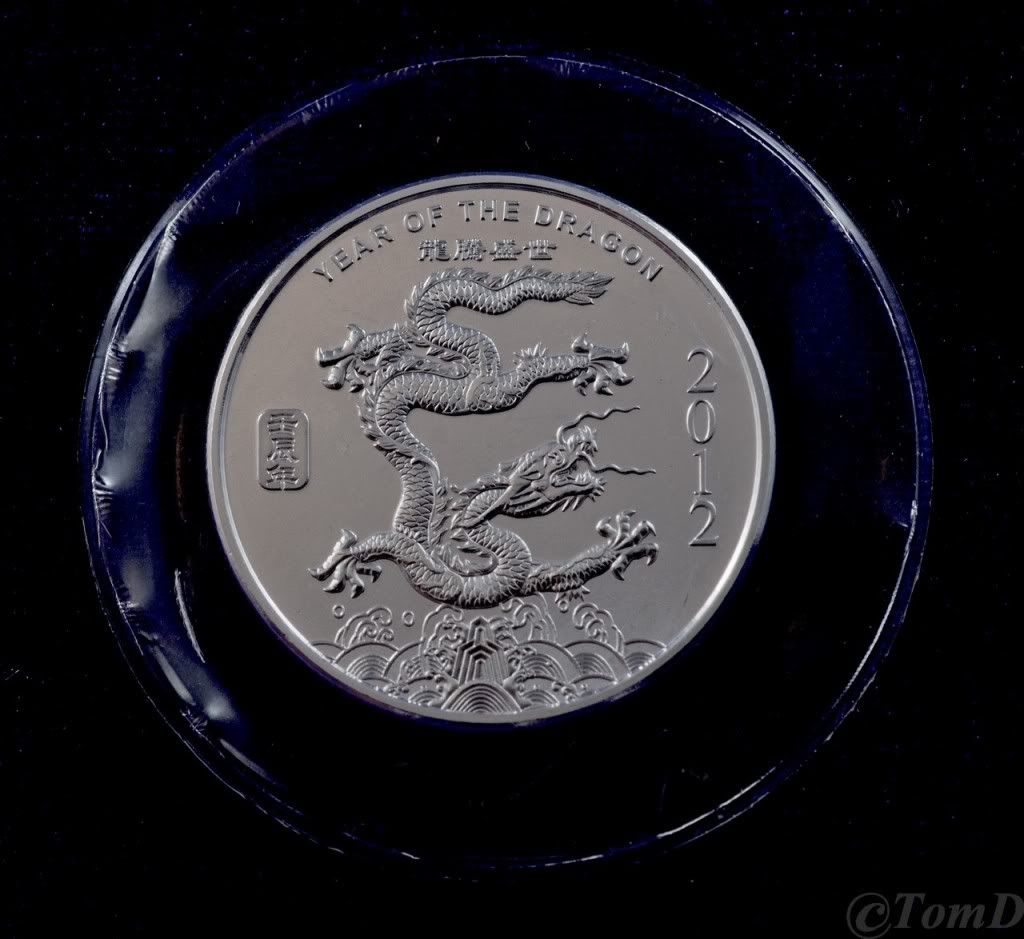  |
| Eurozone Government Defaults Looking Certain Posted: 15 Dec 2011 03:06 AM PST by Alasdair Macleod, GoldMoney.com:
Posturing over geared stability funds, financial transaction taxes, installing unelected governments, putative treaty changes and finally enhanced fiscal supervision proposals have finally convinced markets that the only outcome is widespread government defaults. There is now no alternative and the fallout will have to be managed. Read More @ GoldMoney.com |
| Silver Demand Growing With Old And New Uses Posted: 15 Dec 2011 03:05 AM PST Electronics, solar power, health care and nano-particles, along with more traditional uses, will keep silver a good investment despite latest setback by Dillon Gage, MineWeb.com: Silver rallied to $48.70 an ounce in April, and after giving back 40 percent of its value by September, started to recover before its latest setback. Silver has grown as an investment vehicle in the last decade and has a number of things going for it on the industrial side, says Dillon Gage Metals of Dallas. "Silver is much more than jewelry and sterling tableware," says Terry Hanlon, President of Dillon Gage. "It's not just for wedding presents and birthday gifts but has widespread uses throughout the economy." Strong, malleable silver can be made into various forms, wires and threads. It's a good electrical and thermal conductor for all types of circuits and connections. Silver conducts rather than absorbs heat and can endure temperature swings, making it an excellent soldering agent for joints that undergo expansion or contraction in heat and cold. It's also a reflector and has anti-bacterial properties.
Electronics, solar power, health care and nano-particles, along with more traditional uses, will keep silver a good investment despite latest setback
by Dillon Gage, MineWeb.com:
Silver rallied to $48.70 an ounce in April, and after giving back 40 percent of its value by September, started to recover before its latest setback. Silver has grown as an investment vehicle in the last decade and has a number of things going for it on the industrial side, says Dillon Gage Metals of Dallas.
"Silver is much more than jewelry and sterling tableware," says Terry Hanlon, President of Dillon Gage. "It's not just for wedding presents and birthday gifts but has widespread uses throughout the economy."
Strong, malleable silver can be made into various forms, wires and threads. It's a good electrical and thermal conductor for all types of circuits and connections. Silver conducts rather than absorbs heat and can endure temperature swings, making it an excellent soldering agent for joints that undergo expansion or contraction in heat and cold. It's also a reflector and has anti-bacterial properties.
Read More @ MineWeb.com
|
| Posted: 15 Dec 2011 03:01 AM PST by Steve Lendman:
Throwing more money at out-of-control debt problems buys delay only. Instead of swallowing painful solutions, EU leaders keep repeating the same mistakes, heading dire conditions to catastrophic ones. In fact, reactions to last week's summit were decidedly negative. On December 14, the Financial Times (FT) headlined, "Doubts about eurozone fiscal deal grow," saying: The euro selloff against the dollar "showed the strain of efforts to force through austerity policies and impose tough new spending rules." Read More @ SJLendman.Blogspot.com |
| Gold and Silver Prices Battered Posted: 15 Dec 2011 02:56 AM PST Gold and Silver Prices Battered Lower in Liquidity Panic by Roman Baudzus, GoldMoney.com:
Last week's meeting in Brussels was supposedly aimed at finding a lasting solution to the European sovereign debt crisis. Nevertheless, this week major credit rating agencies stated that existing policies were not going to soothe the financial markets. Moody´s Investors Service and Standard & Poor's warned Brussels of a possible downgrade of some of the eurozone members. Many investors have lost their faith in politics and don´t believe that the euro will be saved. The yield on 10 year Italian bonds continued to rise, even though late this summer the European Central Bank started buying large amounts of Italian and Spanish debt. The devaluation of the euro is curbing the development of dollar-denominated precious metal prices. Read More @ GoldMoney.com |
| Posted: 15 Dec 2011 02:53 AM PST Dear Nouriel Roubini: The Fundamental Case for Gold Has Not Changed; To Understand, All Roubini Need Do is Look in a Mirror
In response to Dollar Soars vs. All Major Currencies Following FOMC No Hint of QE3; Looking Ahead, What's Next? I received the following email question from a reader. Still standing by your position? The euro has tanked, US dollar has shot up, and lo-and-behold gold drops $150. Sigh. What does it take for people to realize movements in the US dollar have been irrelevant to the price of gold for nearly six years? Don't believe me? Please consider the following chart. Gold vs. the US Dollar |
| Folker Hellmeyer on Inflation and Gold Posted: 15 Dec 2011 02:49 AM PST Folker Hellmeyer and James Turk Talk About Europe, Inflation and Gold ~TVR |
| Posted: 15 Dec 2011 02:47 AM PST This Gold Smash Will Pass, the Case for Fiat is Zero from King World News:
Continue reading @ KingWorldNews.com |
| Posted: 15 Dec 2011 02:45 AM PST Fear Not Gold Bugs: The Song Remains The Same from GoldMoney.com:
So says famed gold trader Jim Sinclair, in his latest King World News interview, discussing German chancellor Angela Merkel's response to Europe's debt crisis. Jim also discusses the realities of American political life at the moment, noting that the surest way for Obama to lose the election next year is for the Fed to move away from an inflationary monetary policy. Such is the perilous state of western finances at the moment. James Turk's recent interview with Mr Sinclair can be seen at this link. Fears over the health of the European banking sector – and by extension, the global banking system – are contributing to demand for the US dollar. The gold lease rate – the rate charged for lending gold in exchange for dollars – is at its lowest rate since January 1998. Read More @ GoldMoney.com |
| PATHOGENESIS OF CENTRAL BANK RUIN Posted: 15 Dec 2011 02:33 AM PST
home: Golden Jackass website Use the above link to subscribe to the paid research reports, which include coverage of critically important factors at work during the ongoing panicky attempt to sustain an unsustainable system burdened by numerous imbalances aggravated by global village forces. An historically unprecedented mess has been created by compromised central bankers and inept economic advisors, whose interference has irreversibly altered and damaged the world financial system, urgently pushed after the removed anchor of money to gold. Analysis features Gold, Crude Oil, USDollar, Treasury bonds, and inter-market dynamics with the US Economy and US Federal Reserve monetary policy. Central banks are the current sovereign debt market. It is a vacated market. They are the majority bidders via debt monetization. The monetary inflation has become the New Normal and a travesty. In perverse fashion, the financial markets celebrate the monetized purchases, even calling for higher volume. In the process, bond and stock market integrity has been destroyed. Foreign creditors depart the USTreasury Bond market. Large European banks depart the Southern Europe sovereign debt market. Central banks step in to avert panic as the underlying structure to the global monetary system crumbles. When government bond yields rose quickly in Europe, it was not from abandonment by their central bank. The big Euro banks sell boatloads of bonds while the EuroCB buys only truckloads. The bond market integrity has been deteriorating very quickly. The dependence upon the debt monetization process is vividly clear. It is hyper monetary inflation to fill the void, thus providing the dominant bid. Ironically, the dullard stock market mavens celebrate the arrival of the central bank purchases without truly comprehending the destroyed integrity of the bond market. IQ levels are falling along with stock index levels. NEXT GROUND ZERO IS ITALY Upcoming budget impasses and bank failures will break the European Union wide open. A perceived temporary patchjob solution in Europe has been delineated. More of the same will accomplish nothing. A march toward a federation is apparent, despite the desire for decentralization. A motive to force a system failure is at work to create the federal structure. Recent appointments prove the point. Again Goldman Sachs knights arrive to the rescue in secret appointments. They earn the title technocrats, but crowds reject them as unelected leaders. Ignore the term Technocrat given both to Monti and the newly installed Mario Draghi at the Euro Central Bank. They are Syndicate loyalists. Howard Davies is former director London School of Economics, and former deputy director at the Bank of England. He calls for 1) fiscal federation with a unified central bank, 2) broad purchases of sovereign bonds, and 3) unlimited liquidity provided by the Euro Central Bank. The prescription is stark and clear for hyper monetary inflation, the central bank serving as the entire government bond market, and the installation of a federation across Europe. The last 12 years have proved without a doubt that a unified Europe is a disaster in a bottle, whose cables and levers eventually break under the pressure of grand differences and the passage of time. The raging crisis in Italy festers as it turns to a boil. Italy will serve as the agent of contagion, next to France and Spain. No solution is possible, as the summits are futile. Italy will expose the Euro Central Bank as both powerless and ruined. The focus has shifted away from Greece and squarely on Italy as the center of chaos in Southern Europe. Once more the meter for disorder is the benchmark 10-year Italian Govt Bond yield. It has surged toward the critical 7.0% mark as investors cast bond market votes against the policy in Rome and the upcoming austerity measures to be pushed through. Such level is regarded as unsustainable, given the massive Italian debts. Worker strikes have made vividly clear that Uber Leader Mario Monti will not succeed in large budget cuts without consequences. Striking Italian metal workers in Turin are shown in the photo. The biggest Italian unions (ports, highways, truckers, banks) went on strike. They oppose measures as painful hits pensioners and workers, leaving the wealthy untouched. Numerous big Italian banks are on the verge of failure. Neighboring France faces scrutiny of the bank asset feces. Markets brace for an expected debt downgrade to remove its coveted and undeserved AAA rating by Standard & Poors. Syndicate appointed (not elected) Prime Minister Mario Monti believes Italy risks a Greek-style economic collapse without approval of the hotly debated austerity package. Italy stands as the third largest economy in the EuroZone, whose borrowing costs began to approach the levels that forced Ireland, Greece, and Portugal to seek an international bailouts. The controversial package has the support of the Organization for Economic Cooperation (OECD). It is designed by Monti to save Italy. The decree plans to raise more than 10 billion Euros (=US$13.4 bn) from a property tax, impose a new levy on luxury items like yachts, raise the Value Added Tax, crack down on tax evasion, and increase the pension age. Monti supports the French and German calls for tighter controls on national budgets. He said, "If Italy were not capable of reversing the negative spiral of growth in debt and restoring confidence to international markets, there would be dramatic consequences, which could go as far as putting the survival of the common currency at risk. Italy is ready to do what it has to do but Europe must not fail to do its part. Without this package, we think that Italy would have collapsed, that Italy would go into a situation similar to that of Greece. It would be perfectly understandable that the European Commission should have the same enforcement powers in the area of budgets that it has in the area of competition." He describes loosely a federation, where Goldman Sachs sits in the thrones of Europe, in a quasi debt failure receivership role. Unfortunately, the pressure on the Euro Central Bank to purchase Italian, Spanish, and Greek Govt Bonds has put its balance sheet in total ruins. It is the buyer of last resort for fast falling toxic bonds. The only central bank more ruined is the US Federal Reserve. Felix Zulauf, the former hedge fund manager and asset manager, has very strong European knowledge and experience, a very sharp eye. He expects a depression to hit Southern Europe, and for one nation to exit the Euro Monetary Union next year. The process has no rules. The day after exit, the nation will suffer ruin of their banking system, forcing a rapid nationalization in a reverted currency. The end result will be a sovereign debt default and pure chaos across the continent. The coming depression will lay waste to the USDollar, the British Pound, and probably the Yen too. All fiat currencies will endure a powerful stress test, but based in reality, not a charade. As soon as any group of big Euro banks enter a failure and bust, the cascade of contagion will act like a fast moving virus to destroy many Western banks. We will then see a repeat of history with 20 Lehmans in bank failures, if not sooner. CENTRAL BANKS AVERTED BANK FAILURES The Euro Central Bank averted 10 to 20 Lehmans with the extended Dollar Swap Facility provided by the USFed. Money is almost free. The volume of money grants is enormous, likely never repaid. Witness the effect of the central banks showing reluctance to enter into bond purchases. The system breaks down in powerful manner. The European Central Bank said demand for three-month US$-based loans surged after it announced a broader Dollar Swap Facility for European usage. The USFed cut the cost of the financing from an ultra-low 1.0% to an almost free 0.5% rate. The USFed discount window was made cheaper for foreign banks than US banks (who pay 75 basis points), an indication of the destruction. Rumors persist that a cool $1 trillion has been made available. Five other central banks participated in the coordinated move which included the Bank of Japan. The Frankfurt-based EuroCB immediately made loans for $50.7 billion to 34 big teetering Euro banks on December 1st, the terms for 84 days at a fixed rate of 0.59 percent. That compares with the $395 million lent in the last three-month offering on November 9th at a 1.09% rate. The EuroCB also lent five banks $1.6 billion in regular weekly dollar operation on a single day as December opened, up from $352 million the previous week. The borrowing done at the Discount Window catapulted by 127-fold, from a paltry $395 million to $50.7 billion in a sudden move. The public will not be informed of which banks tapped the credit line, more like a slush fund. They claim they do not wish to put the bank at risk of unwarranted attack. My view is the attack would be to put the proper value on the bank, ZERO. My sources tell that one major French bank was on the verge of failure, probably Societe Generale. Another source of bank and gold information was very clear in telling that the USFed acted reluctantly and forcefully, in order to avert a major catastrophe. He described a situation where several big Euro banks (the usual suspects in France, Spain, and Italy) were on the verge of failure. The USFed was appealed to by the EuroCB so as to prevent an estimated 20 Lehmans from occurring overnight, as in multiple bank failures from a flash event. He went on to mention that a flash event is inevitable, which the central bankers are powerless to stop. It will come in time, with an unknown trigger event that lights a fuse. Each new $trillion credit line buys less time and covers fewer obligations. The Wall Street banks filled a void in providing liquidity in USDollar denomination to the big European banks. In doing so, the New York banks have tied themselves with a lethal financial tether to Europe. The London banks had already been connected. The connection lies in the shadowy derivative market. It used to be kept in the shadows since the contracts provided the majority of bank profit, and even supported the artificial rates in the bond market to a great extent. Now the derivative market is kept in the shadows because the big banks are mutually destroyed by insurance awards after failures. A little publicized trend was put into effect in the middle months of 2011. The big Wall Street banks filled a void. The inter-bank lending in Europe came to a halt in response to the sovereign debt crisis, a euphemism for the Southern European Govt bond market collapse. The big US banks offered a lifeline in the form of leveraged liquidity based upon unregulated derivatives whose notional value is in the $trillions. In doing so, the Anglo banks created a mutual risk factor in the umbilical cord of shadowy structures. If a handful of big European banks go bust, the contagion will be felt instantly (as in overnight) in New York and London. To claim that the US is insulated from Europe is nonsense. To claim that the European distress makes the US more attractive is patently false. Fifty major financial firms are tied around the necks with a common thick rope, weighed down by insolvency, going down together. Matters are so bad in Europe, that most banks have shut down the inter-bank lending, thus isolating the weakest. Huge funds placed at the Euro Central Bank signal the failures. The big European banks are soon to fail. They distrust each other. THE GREAT GOLD PRICE DIVERGENCE The Gold market has gone into the Twilight Zone. The ruin of the European banking system, dragged down by toxic sovereign debt, has made the big Euro banks desperate. They are tapping into the virtually unlimited Dollar Swap Facility, using borrowed money to lease gold. The Powerz have made the lease rate negative in order to attract borrowers. The supply has come from both Libya and Greece. These corrupted bankers require more gold, thus more wars and more victim nations. The system has turned to extreme abuse in order to keep a lid on the gold price, or better yet, to avert a string of Lehman-type financial firm failures in Europe. In the process, a Jackass forecast has begun to come to pass. The paper gold price (dictated by the bizarre COMEX market) is diverging from the physical gold price (determined by actual large private purchases). In late November, a great reliable global gold trader source assured that despite a posted $1740 gold price, the true physical price paid for large gold bullion purchases in the private market was more like $1950 per ounce!! That is a $200 price divergence, or 12% higher. The COMEX has been drained of gold inventory. The MF Global event was motivated by the desire to avoid meeting delivery notices. Instead, JPMorgan stole the accounts demanding delivery, a neat trick fully permitted by the Syndicate that controls the USGovt, the US regulatory bodies, and the US law enforcement. The lawsuits will be full of drama and intrigue. The integrity of the US financial system has been exposed, this time in full glory that even financial news anchors cannot deny. Here is the smoking gun. Days after the MF Global bankruptcy was filed, and a vast array of deliveries in silver were expunged. The silver vault inventory tells the story of the crime. JPMorgan simply converted what should have been MF Global client silver into JPM licensed vaults. Review the timeline. MF Global declared bankruptcy on October 31st. About a week later the CME began reporting that 1.4 million ounces of Registered silver was unaccounted for and unavailable for delivery, including 627,182 ounces from non-cartel banks. About 7 to 10 days afterwards, JPMorgan suddenly reported a deposit of 613,738 ounces into Eligible vaults. Exactly seven days later, JPMorgan adjusted this silver into Registered vaults. JPMorgan had not seen one significant silver deposit in months prior to this bountiful day. Great work on the part of the Silver Doctors to decipher the story. The charade continues before the USCongress. They are told of claims that investigators are searching avidly for the missing funds. They know where the funds are, in JPMorgan London accounts. They told us they were avidly looking for Madoff Funds too. They know where those funds are too, in the Land of Yodels. Reckoning is coming. Big bank failures are coming. Unspeakable debt monetization is coming. Flash events are coming. More vanishing acts for private accounts are coming. Divergence in the gold price is coming that will shut down the COMEX altogether during a parade of lawsuits, but probably not prosecution. National debt defaults are coming. The new 2012 year will prove to be a tumultuous year, will chaos reigning and the global monetary system laid to waste. Gold will soar, probably not for the leverage addicts who choose to play in the rigged corrupted futures contract arena, the chronic victims of fraud. If lucky, their accounts will not vanish, possibly stolen. The wise who will survive and thrive will snag the physical gold offered at attractive artificially low price. Large purchases are not available at the current posted paper price. DESPERATELY SEEKING BULLION The Powerz need more Libyas and Greeces. They tapped into 144 metric tons captured in London from the Libyan accounts and 111 metric tons seized from the Greek accounts. It is the bankers New Gold, as reported by intrepid Jeff Neilson. In a fresh sign of bankster desperation, the lease rates for gold have been pushed down to net negative levels. Contrast to the extraordinarily high premiums paid on gold purchases. Big European banks on the brink of ruin, the next Lehmans, are leasing gold in order to raise cash and stave off failure. It is simple math. The great enablers are the central banks. Cases exist of multiple sellers of the same gold bullion bars, a common trick made famous by the GLD exchange traded fund, the SPDR Gold (dis)Trust. All leasing is done without regulation, like the derivative market. Neilson concludes, "Here is where we come upon a seeming paradox with respect to the recent explosion of gold leasing. We know that the banksters have virtually run out of their own bullion, as the evidence is absolutely conclusive. The same Western central banks which were openly selling 500 tons of gold per year onto the market every year have now all totally ceased their gold sales. They have no more gold, or at least they had no more gold." The Washington Accord guided official gold sales, a completed process. The physical gold price is diverging from the false paper price directed by the COMEX and guardians like JPMorgan. If truth be known, over 40 thousand tons of gold bullion has been leased and sold that does not exist. In the coming years, reconciliation will assist in sending the gold price much higher, toward $5000 per ounce. As time passes, more criminal actions will be visible in the open, like MF Global. POLITICAL LEADERS TURN IRRELEVANT Pointless meaningless exercise in futility is seen in the big European summit meetings. They are wasting their efforts, biding time, deceiving the public, and supporting the bankers in last ditch attempts to salvage what cannot be saved. The sovereign bond market is loaded with rollover interactive explosive devices that will continue to explode without relief. The politicians offer no solutions, as Merkel and Sarkozy are the only members meeting in public eye, yet neither has any power left. They meet and sign deals only to be contradicted and countermanded later by the bankers with power and court judges reciting law. The German leaders at the summit meetings are all for public show, even financial market management. None has any power left. None is involved in the new alliance. The informed observer need not follow what they decide upon anymore, because in 2 to 3 weeks their pact will all vaporize into nothingness. Markets are impressed for minutes and no more. Witness their last several accords, none of which endured. The movie keeps repeating like Ground Hog's Day. They cannot solve the ultimate entrenched problem of toxic sovereign bonds within the PIIGS nations of Southern Europe. They have no tools in their medicine chest, only phony money and more debt, even silly new Uber-Bonds. They actively avoid putting their decisions to a public referendum vote, since the people would vote down any further bank welfare in the form of more bond redemptions or bailouts. No evidence of democracy can be seen. Politicians debate, dispute, then make accords, but their communiques are common graffiti. The dirtiest secret is that France has already been tossed into the PIIGS pen by Germany, no invitation given to join them in the next chapter. Nothing is decided anymore in Paris without Berlin approval. Germany owns over 90% of French Govt debt. Absolute desperation is seen with the string of absurd vacant meetings held by two powerless figures, Angela Merkel of Germany and Nicolas Sarkozy of France. Merkel has zero political base, yet insists on conducting more meetings that lack enduring substance. Sarkozy attends the meetings but has been stripped of his privilege to cleave with Germany, rejected. The French are going through a flailing stage beset by convulsions on the political stage without proper identification by any geopolitical doctor. Their crippled president actually claimed publicly that loss of AAA rating for government debt would not be insurmountable. Within days, the extreme pressure placed upon one US rating agency caused a delay of the debt downgrade. The key to Europe is the chain of explosive devices linked to France, Italy, and Spain. No solution exists. Rollover of their debt will exacerbate the crisis. The leaders are like witchdoctors presiding over a bonfire. The OECD has thrown some water on the faces with a forecast of government debt in industrialized nations, set to rise from $10.4 trillion to $10.5 trillion in the coming year. The prospect to finance the debt is perilous. WALL STREET SUBTERFUGE IN NEW WEAPONS Wall Street is reported to be sabotaging the Euro currency. They are using a Japanese Yen position front. They also rely upon debt rating agencies to sling key attack arrows. The belief is that what hurts the Euro currency will help the USDollar. Such shallow strategy. It will result in mutual destruction with gathering momentum, along with an unstoppable collapse of big banks in Europe, London, and the United States. A sordid story was reported by Zero Hedge last month about how the Wall Street villains had created short trades directed against the Euro currency and even the big European banks. They had created a complex network of positions designed to conceal their nefarious intentions. At the center was a funding mechanism from the Japanese Yen currency. The belief was that further damage and destruction in the European financial structure could be helpful in lifting the USDollar, or at least buying some more time. This is the very essence of the Competing Currency War and its mutually destructive tactics, so much so that analysts adroitly describe it as a race to the bottom in the protection of the export trade. Joining the subterfuge are the US-based debt rating agencies. They have been dutiful in delivering painful debt downgrade banners to fly over both government debt and corporate debt across mostly Southern Europe. Theirs are non-stop financial assaults. The very same corrupted agencies were bought off from 2000 to 2007 with rosy undeserved AAA ratings on toxic bond securities sold by their Wall Street masters. A pretty cream topping on a pile of cow manure does not make the paddy delectable to eat. The USGovt debt downgrade was followed by an endless skein of European downgrades for banks and sovereign debt, the motive being to even the wrecked playing field, and make the US not so alone, subject to intense scrutiny. The USDollar has performed well since the Greek Govt Bond disaster spread to Italy, even spreading the stench to France. Some European leaders have openly complained that the US-based debt rating agencies are doing damage with motive, ignoring the rot in US banks. HYPER INFLATION & THE FAILURE OF 0% Hyper monetary inflation is the advantage almost entirely for the banker class. It is being used to prepare for domination in the next chapter. By directing largesse to Wall Street, and obstructing it to the Main Street, the Powerz believe they are winning the battle over inflation. But they have presided over a wicked rot instead, in addition to causing a class war. The eventual cost will be lethal inflation and a thrust inevitably into the Third World. The theory is simple enough. Prevent the massive flow of monetary largesse from reaching the main channels of the USEconomy. Keep the labor wages down, even if costs are rising universally. Direct the enormous sums of money into the banking sector to cover toxic bonds, to redeem preferred stocks, and to replenish funds for executive bonuses. Then claim success over inflation after falsifying the official CPI data. Furthermore, use public disclosure with all the fanfare concerning big relief packages like the TARP Funds to distract attention away from the truly mindboggling multi-$trillion grants at 0% never to be repaid by central banks and major financial allies. The above scenario is an over-simplified account that glosses over further illegal activity in the form of forged home foreclosure documents. The end result is a profound resentment that has sparked the primary roots of a class war, and the Occupy Wall Street movement. The bitter fruits are many, such as lost market integrity from chronic interventions, lost moral fabric from moral hazard swallowed whole, and a nation that undergoes systemic failure without relief or compassion. Any actual steps toward a legitimate solution are nowhere seen, like big bank liquidation, like home loan modification, lik |
| Posted: 15 Dec 2011 02:29 AM PST Gold "Looking At Long, Sideways, Volatile Action" as "Bearish Sentiment" from Eurozone Crisis Continues to Hit Markets SPOT MARKET gold prices climbed to $1594 an ounce by Thursday lunchtime in London – 1.9% up on this morning's low – while stocks and commodities also regained some ground after recent heavy losses. Silver prices gained 2.7% to around 29.20 per ounce – still a 9.4% loss from last week's close. Despite Thursday morning's rally, gold prices too remain heavily underwater on the week – showing a 6.8% loss from last Friday's close. Wednesday alone saw gold prices drop more than 4%, breaking through the 200-day moving average – which by BullionVault's calculations was sitting around $1613 per ounce Thursday morning. "Smaller markets tend to get hurt more during periods of heavy selling," explains Ole Hansen, vice president of trading advisory at Saxo Bank in Copenhagen. "The main problem from an upside perspective is that investment decisions are not being made this time of year which should limit the upside for now." "We're in for a long sideways volatile market," adds Jeremy Friesen, Hong Kong-based commodity strategist at Societe Generale. "We can go through weeks, if not months, of slow drawn-out process, because it's ultimately a fiscal problem in Europe that needs to be resolved." On the currency markets, the Euro struggled to recover much lost ground against the Dollar Thursday morning – following three days of falls that have seen it fall 3% to below $1.30. The Dollar Index – which measures the Dollar's strength against a basket of major currencies – is at 12 month highs, up nearly 2% for the week so far. The fall in gold prices, though, is "not only because of the stronger Dollar," one trader in Shanghai tells newswire Reuters. "The year-end fund redemption and margin call demand from other markets also contributed to the sell-off…we might see further weakness in prices as the sentiment around Europe remains rather bearish." The general secretary of Germany's Free Democratic Party – a junior member of Angela Merkel's governing coalition – stepped down on Wednesday, reportedly following a poor turnout in a party referendum on the latest Eurozone rescue plan. The ballot – whose results are due to be revealed tomorrow – was prompted by an anti-bailout FDP member. Merkel now has "a dead-duck coalition partner whose actions may now become unpredictable," says Nils Diederich, professor of politics at Berlin's Free University. "That's a risk for Merkel as she tries to navigate parliament through giving up some sovereignty in the name of fiscal union as well as increase taxpayers' input into rescuing the Euro." European leaders agreed last week to lend up to €200 billion to the International Monetary Fund – which the IMF in turn could then lend to European governments. Germany's central bank will contribute up to €45 billion "as long as there is a fair distribution of the burden amongst the IMF members," Bundesbank president Jens Weidmann has said. "If these conditions are not fulfilled, then we can't agree to a loan to the IMF." Here in Britain, a spokesman for prime minister David Cameron – who opposed last Friday's agreement – has denied reports that the UK will commit €30 billion to the IMF. Cameron has reportedly told members of parliament he does not expect Britain will provide more than £10 billion of additional funding. Eurozone ministers are said to have penciled in a British contribution of up to €50 billion, according to a Financial Times report. In the US meantime, Federal Reserve chairman Ben Bernanke made it clear that he "has no intentions whatsoever of furthering US involvement in the [Eurozone] crisis," according to one Republican senator who a private meeting with Bernanke. China announced Wednesday it will impose duties on US car imports. "US vehicles benefiting from subsidies and dumping on the China market have substantially damaged China's auto industry," said a statement from China's Ministry of Commerce. General Motors vehicles will face total duties of nearly 22%, while duties on Chrysler vehicles will be 15%. Both firms were bailed out by the US government in 2009. Over in Hong Kong, the world's largest listed jewelry chain Chow Tai Fook saw its share price fall 8% in its first day of trading Thursday. Fellow debutant New China Life, Hong Kong's third-largest insurer, saw its shares drop 9.8%. "Investors are holding on to their cash, doubtful about not only new stock, but also shares in the secondary market," says Ronald Wan, managing director at China Merchants Securities in Hong Kong, which oversees about $1.5 billion. "Worries about Europe will keep investors cautious in the months to come." In India meantime – the world's number one gold bullion consumer according to the most recent World Gold Council data – the Rupee hit a fresh record low against the Dollar today at over Rs54.3 to the Dollar. The Rupee has lost more than 20% of its value against the Dollar this year, sending Rupee gold prices to record highs in recent weeks. Ben Traynor Gold value calculator | Buy gold online at live prices Editor of Gold News, the analysis and investment research site from world-leading gold ownership service BullionVault, Ben Traynor was formerly editor of the Fleet Street Letter, the UK's longest-running investment letter. A Cambridge economics graduate, he is a professional writer and editor with a specialist interest in monetary economics. (c) BullionVault 2011 Please Note: This article is to inform your thinking, not lead it. Only you can decide the best place for your money, and any decision you make will put your money at risk. Information or data included here may have already been overtaken by events – and must be verified elsewhere – should you choose to act on it.
|
| Gold – 2006 Similarities & Correction Over? Posted: 15 Dec 2011 02:22 AM PST I guess a lot of people wet their pants last night, as gold was down over 4% at some point. The chart incurred technical damage over the short term, and if current support fails to hold, gold could be headed for about $1,440 (or the equivalent of $140 GLD), as we will discuss later on. Let's first have a look at an article I wrote in August 2011 when I wrote: Gold 2006 vs Gold Today, Does It Look Familiar? When we look at the following charts, we can see that the pattern is still valid so far.
Overlay:
In the nightly report of Tuesday night, I posted the following chart, indicating GLD might drop towards 152-153.
Last night, GLD hit a low of 152.05, and thus hit the target PERFECTLY, as we can see in the chart below.
If GLD fails to hold above the green support line, we can expect a drop towards $140. When we look at the Bullish % index for mining stocks, we can see that it reached an extremely low level again at 13.79.
However, if we would get a remake of 2008, even those indicators can't stop prices from falling, so be cautious!
|
| Reason For Silver Downward spiral. Posted: 15 Dec 2011 02:11 AM PST First off, this is my own personal opinion of the recent silver sell off. You would think with recent global financial crisis gold and silver would be on the uptick. Not to mention the high demand China places on the precious metals. I believe with the downturn of the economy, silver buyers are selling off for financial reasons including the upcoming holiday season; when people are strapped for cash. Like I said this is only my opinion what do you thin |
| Mixed Outlook for Gold as the Market Declines Posted: 15 Dec 2011 02:09 AM PST
Based on the December 14th, 2011 Premium Update. Visit our archives for more gold & silver analysis. Whatever glow there might have been from last week's European summit turned to gloom as markets turned downwards Monday. Global investors drove down everything in sight, including gold which dropped nearly 3% to a seven-week low to trade under $1,660 an ounce. Gold got lumped with other assets considered risky (we live in interesting times, as gold was known to be the "safe asset" for millennia and now it's a "risky asset"). European indexes were down: Germany 3.4%, France 2.6% and Italy 3.8 %. Everyone seemed worried that the steps taken by the EU last week fell short of what is required to stabilize Europe's sinking bond markets. Stop-gap measures such as the coordinated international injection of liquidity only buy time. Can they buy a lot of it? Likely a few more years. Is the situation "taken care of" in the short term? Yes. What's making the price move lower in the short term? Emotions. And in this case? Worries. At the bottom of all this anxiety is fear of an imminent demise of the eurozone and extreme fear is something that we see around bottoms, before a rally starts. Whether the fear is currently extreme is a different matter. Tuesday, U.S. stock futures edged temporarily higher after encouraging economic-sentiment data from Germany and ahead of the U.S. Federal Reserve's announcement on monetary policy. In a knee-jerk reaction, as is the case in previous downturns in the price of precious metals, the anti-gold faction had a field day this week. Mark Gongloff in The Wall Street Journal wrote rather sarcastically: Time to check back in on how precious metals are working as safe havens: Yep, still not working. Gold and silver getting absolutely pounded today, doing much worse than the stock market, providing not one quantum of solace for anybody who'd bought them assuming they'd hold value amid a global credit apocalypse. Although it is true that we did not get much "solace" from Monday's market action, we beg to differ on Gongloff's assessment of gold as a safe haven. He himself said in his article "the global credit apocalypse still has some time to play out." Having said that, let's see how the situation might play out for precious metals in the short-term. Let's begin this week's technical part with the analysis of gold itself (charts courtesy by http://stockcharts.com.) This week, we begin with a look at the very long-term chart (if you're reading this essay at www.sunshineprofits.com, you may click on the above chart to enlarge it). With the breakdown being in place, we now must consider downside target levels. If the current decline stops fairly soon, the likely target level is around $1,550, which is a bit more than 5% below Tuesday's closing price. A continuation of the decline could bring prices down to $1,400, which seems to be a long-shot but is still a valid maximum downside target level at this time based on technical analysis of this chart. The bearish trading pattern was not expected, since triangle patterns normally are followed by a trend in the same direction as the one which preceded it. This is not what happened this time, however, although the recent breakdown could still be invalidated. However, with prices having declined significantly on corresponding high volume, the bearish scenario is more likely, and an invalidation of the breakdown does not seem very probable on Wednesday. In the past, post-bottom rallies (bottoms are marked with red ellipses on the above chart) frequently resulted in prices rising at least to the 61.8% Fibonacci retracement level (and gold has in fact moved to this level). In many cases the rally took gold even higher – to previous highs or even higher. Consequently, that was the expectation as we looked ahead last week. Instead, we have seen a breakdown from the triangle pattern and the move to the upside is no longer a likely outcome. In the past, when price levels did not pursue the level of the previous high, declines generally stopped close to the level of the original bottom and then rallied. This would coincide with our $1,550 target level from the bottom seen earlier this year, so there is a good chance that gold will rally if the decline takes it down this far. Two exceptions to this rule have been seen in recent years. One was in 2008 (gold moved significantly below its first low), which does not seem likely to repeat as overall market conditions are much different today. The general stock market also plunged at that time, and there is no sign of this on the horizon this time around. In 2004, gold's price went slightly below the level of the previous low and this is why we have a not-too-likely worst case scenario of $1,400 on the downside. Although the outlook based on this chart alone is bearish today, the next rally could still bring gold as high as $1,900 or even to the$2,200 price range. In the short-term GLD ETF chart, we see that a short-term support level has been reached. Also, an ABC correction is seen which may be an indication that we have seen the final part of this move down. Based on the breakdown below the rising support line, the situation is not as bullish as it was a few days ago but this chart is not as bearish as the long-term gold chart presented earlier. Please note that the recent move lower took place on significant volume which is a bearish confirmation. Summing up, the overall analysis of the gold charts this week shows a more bearish bias than it was the case just a few days ago. The situation for gold can best be described as mixed at this time, with more declines being possible. We will leave details i.a. regarding probabilities of up- and down-moves to our subscribers. To make sure that you are notified once the new features are implemented, and get immediate access to my free thoughts on the market, including information not available publicly, we urge you to sign up for our free e-mail list. Gold & Silver Investors should definitely join us today and additionally get free, 7-day access to the Premium Sections on our website, including valuable tools and unique charts. It's free and you may unsubscribe at any time. Thank you for reading. Have a great and profitable week! P. Radomski * * * * * Interested in increasing your profits in the PM sector? Want to know which stocks to buy? Would you like to improve your risk/reward ratio? Sunshine Profits provides professional support for Gold & Silver Investors and Traders. Apart from weekly Premium Updates and quick Market Alerts, members of the Sunshine Profits' Premium Service gain access to Gold Charts, Gold Investment Tools and Analysis of Gold & Silver Prices Naturally, you may browse the sample version and easily sign-up for a free weekly trial to see if the Premium Service meets your expectations. All essays, research and information found above represent analyses and opinions of Mr. Radomski and Sunshine Profits' associates only. As such, it may prove wrong and be a subject to change without notice. Opinions and analyses were based on data available to authors of respective essays at the time of writing. Although the information provided above is based on careful research and sources that are believed to be accurate, Mr. Radomski and his associates do not guarantee the accuracy or thoroughness of the data or information reported. The opinions published above belong to Mr. Radomski or respective associates and are neither an offer nor a recommendation to purchase or sell securities. Mr. Radomski is not a Registered Securities Advisor. Mr. Radomski does not recommend services, products, business or investment in any company mentioned in any of his essays or reports. Materials published above have been prepared for your private use and their sole purpose is to educate readers about various investments. By reading Mr. Radomski's essays or reports you fully agree that he will not be held responsible or liable for any decisions you make regarding any information provided in these essays or reports. Investing, trading and speculation in any financial markets may involve high risk of loss. We strongly advise that you consult a certified investment advisor and we encourage you to do your own research before making any investment decision. Mr. Radomski, Sunshine Profits' employees and affiliates as well as members of their families may have a short or long position in any securities, including those mentioned in any of the reports or essays, and may make additional purchases and/or sales of those securities without notice.
|
| Gold Falls due to Re-Hypothecation, Counter Party, Liquidity and Contagion Risk Posted: 15 Dec 2011 01:37 AM PST |
| Morning Outlook from the Trade Desk - 12/15/11 - What happened yesterday? Posted: 15 Dec 2011 12:25 AM PST As you all know, I have not been a fan of the metals in the past two months, but I sure didn't see yesterday coming. I expected support and short covering coming into year end, and it may still happen. I received a few calls yesterday from my trader friends and from their voices they sounded like they got caught long. Markets can humble you(me) in a hurry. Support at $1,620 level should have been massive, it was the 200 day moving average, a level gold has not been below since 2009. Its possible to recover if the panic selling yesterday is met with a bounce that closes gold above this level. If the bounce does not materialize further downside should be expected. We should expect increased volume as clients either run for cover or see this as an opportunity to get into the game. |
| Many gold investors are frightened by this story Posted: 14 Dec 2011 11:42 PM PST From Kevin Brekke, Casey Research: A new polysyllabic term has entered the Wall Street lexicon and is sweeping through the investing world like a brush fire through a dry canyon: "hypothecation." With its connection to the MF Global bankruptcy and aftermath, it engenders the kind of fear a homeowner might feel while monitoring the approaching flames. The rise of hypothecation as the lead suspect in the MF Global tragedy has caused a fair bit of confusion about what, exactly, it is – and is not. Proving the idiom that nature abhors a vacuum, the blogosphere has weighed in with all manner of explanations, many of which have been less than accurate. In an attempt to help our readers get to the heart of the matter, we will briefly review hypothecation – what it is and how it is used – and do so in plain English. There is considerable ground to cover here, so we will get right into it, starting by defining the term, then discussing the role hypothecation played in the demise of MF Global, before turning our attention to the question in the minds of many gold investors... Read full article... More on MF Global: WARNING: The MF Global "contagion" is quietly spreading This could be the most important takeaway from the MF Global disaster A simple explanation of what really happened in the outrageous MF Global fraud |
| Forget "65 years old"... This could be the new retirement age for many Americans Posted: 14 Dec 2011 11:42 PM PST From Forbes: Did you think age 65 was a long time to wait for retirement? Well, how do you feel about age 80 because that's when more Americans say they expect to stop working. Concerns about having enough for retirement are widespread across the the income spectrum, according to a study released today by Wells Fargo. Almost 20% of affluent Americans says they will need to keep working until at least the age of 80. Slightly more (25%) of middle-class Americans said the same. Says Karen Wimbish, director of Retail Retirement at Wells Fargo, "We find the rich versus poor narrative in the U.S. is more complex than we might expect... Read full article... More on retirement: The top five states for retirees to avoid Eight tips for using your retirement savings wisely What you should know about putting gold in your retirement accounts |
| Posted: 14 Dec 2011 10:41 PM PST The Coming Collapse Might Be Your Final Chance to Legally Buy Physical Gold This Decade by John Galt:
The current European implosion is bringing about a probable once in a lifetime opportunity which sadly might just be the last chance this decade to buy physical gold before capital controls worldwide and within the U.S. make it difficult if not impossible. The history of economic strife and plans by world governments to impose massive restrictions on the flow of funds to prevent internal collapse make gold an attractive target for seizure as political failings along with management of command control economies demand the removal of all instruments which could allow independent transactions by the citizenry. The central banks of the Western world are already grasping at straws as nations like Greece and Italy have already imposed stealth capital controls and the United States begins implementation of its restrictions after December 31, 2012. This imposition of restrictive monetary policies has made gold an attractive instrument for moving wealth overseas, especially using the electronic or digital gold option via the various instruments like GLD and ownership instruments in foreign vaults as in the Perth mint and elsewhere. The "paper" or digital gold will be the first precious metals seized to impose controls thus making their practicality in an economic collapse scenario such as a disintegration of the European Union. After the first round of seizures using this method however, the state, be it a foreign entity or the U.S. will begin to implement processes to tax the transactions and restrict amounts of physical gold an individual can obtain. That is why the action in the markets in 2008 and 2011 are appearing so similar but of course as the saying goes, "this time it's different," because this time, it truly is. Read More @ JohnGaltFLA.com |
| Posted: 14 Dec 2011 10:38 PM PST The Collapse Of The Euro, The Death Of The Euro And The End Of The Euro from The Economic Collapse Blog:
Read More @ TheEconomicCollapseBlog.com |
 For some time I have taken the view that rescuing eurozone governments from their financial crises was too big a job for the European Central Bank, which should stick to keeping the banking system going. The only hope was that individual governments would be forced to face up to the reality of cutting government spending hard and quickly. They have failed to even begin to address this fundamental problem. As a consequence, it is now impossible for them to roll over their maturing debt, let alone raise new money. Instead there is now a scramble into cash as banks and hedge funds prepare themselves for sovereign defaults.
 Europe's underpinnings can only hold so long. Years of entrapment under euro straightjacket rules means eventual dissolution and collapse.
 During yesterday's trading session precious metal prices were battered lower, as the markets reacted negatively to the – perceived – ongoing inertia at the Fed and European Central Bank. Many investors are worried that these banks are being too reserved in their approach to the threat of deflation. More and more voices are calling for an expansion of the Fed's bond purchasing programme. The US dollar is currently benefitting the most from this situation, as its external value continued to rise in relation to other important currencies. The euro slipped below the 1.30 mark in relation to the dollar, and experts predict that the European currency will continue drifting lower.
 With near panic in the gold and silver markets, today King World News interviewed John Embry, Chief Investment Strategist of the $10 billion strong Sprott Asset Management to get his take on where he sees gold, silver and the mining shares headed. When asked about the action in gold, Embry said, "You're always surprised at the viciousness of a decline like this. I mean this all started in the wake of the failed European Summit. At one point, after the initial communique, gold shot up to $1,760 and now it's roughly $200 lower. The reality has barely changed, but the perception of the reality appears to have swung dramatically."
 "If you think she'll accept a 1932 scenario, you're out of your mind."


 The euro was a doomed project from the start, and now we are starting to see the endgame play out. Today, the euro fell to an 11-month low against the U.S. dollar. As I write this, the EUR/USD is at 1.2983. Back in July, the EUR/USD was over 1.45. As panic has swept the financial markets, the euro has lost
 | You are subscribed to email updates from Gold World News Flash 2 To stop receiving these emails, you may unsubscribe now. | Email delivery powered by Google |
| Google Inc., 20 West Kinzie, Chicago IL USA 60610 | |


No comments:
Post a Comment