


saveyourassetsfirst3 |

- Burgers vs. Burritos – The Case for Mickey D’s
- Why are there shortages at the Mint
- Comparing The Best Biotech ETFs
- Lessons From Japan: Debt Levels Too High To Ignore
- Weekly Market Movers: October 24-28
- How To Use ETFs To Profit From The European Soap Opera
- 10 Profitable, Low-Debt Dividend Stocks Offering Real Yield
- Great Depression One In Australia
- Links 10/23/11
- The Verboten Story of Argentina’s Post-Default Economic Success
- Where do you keep your Gold ?
- Gold in the ancient world
- Bill Black: The Anti-Regulators Are the Job Killers
- This past week in gold
- Understanding Banker Manipulation of Gold & Silver
- Bank's Collapse in Europe Points to Global Risks
- Gold
| Burgers vs. Burritos – The Case for Mickey D’s Posted: 23 Oct 2011 04:08 AM PDT
But while these two companies are related by blood (metaphorically speaking), there are significant differences between the growth trajectories, risk metrics, and investor profile. Chipotle Mexican Grill (CMG) is the daughter company – a 2006 spinoff – from the restaurant behemoth parent company, McDonald's Corp. (MCD). For the last several years, CMG has been a growth darling – opening new restaurants, growing revenues and profits, and attracting investor capital by the truckload. In contrast, McDonalds has played the proverbial tortoise – plodding along with steady, predictable growth – and attracting little attention for its boring expansion profile. There are times when it makes a lot of sense to invest in exciting growth stories. CMG's 600% advance in less than 3 years is evidence of this type of environment… But there are other times when predictability commands a premium – and during those times, a cash cow like McDonald's can be a long-term investors best friend, and a nimble trader's exceptional opportunity. Let's take a look at the current environment for both of these successful restaurant leaders…
Get your 14-day Free Trial to the Live Feed See our trading book in real-time. Trade setups, execution reports and real time market commentary. Claim your 14-day trial to the Mercenary Live Feed. The Earnings Reports After the close on Thursday CMG announced third quarter earnings of $1.90 per share, representing a 25% increase over the same quarter last year. The bottom line number came in ahead of analyst expectations. For the quarter, revenue growth was 24.1%, and more importantly, same store sales increased by 11.3%. Management attributed the growth to both higher store traffic and menu price increases. Profit margins decreased by 100 basis points, due to higher commodity costs. Keep in mind, Chipotle focuses on "food with integrity" – meaning they buy premium chicken, beef and pork – and make an effort to offer customers a healthy choice for fast food – or casual dining. (Of course "healthy" is a relative term – especially if you like all of the "fixins" on your burrito like I do…) During the quarter, the company opened 32 new restaurants – including new Southeast Asian Kitchen concept stores. Management expects to open 165 stores in 2012 – continuing the rapid expansion CMG has become so well known for. On Friday, shares traded 8.6% higher, finishing at the highs of the day. Investors were encouraged by the growth – were willing to look past the profit margin issues – and of course the action was helped along by a strong day for US equities.
McDonald's earnings came in at $1.45 for the quarter – up 12% over last year and beating analyst expectations by 2 cents. Revenue was up 14% and same store sales increased by 5.6%. Considering the fact that McDonald's is a much more mature organization (with a store base that has been in place much longer), this same store sales figure is particularly impressive… Management said that the strong growth was specifically due to strong performance for the company's fruit smoothies, chicken mcnuggets, and their breakfast menu. Over the last several years, McDonald's has been focusing on improving their coffee quality and selection – and successful execution for their coffee products has led to increased demand for other breakfast items. Looking forward, MCD is also dealing with higher food inflation – and the company is guiding investors to expect 5% cost inflation for ingredients.  Similar to the reaction to Chipotle, investors plowed capital into the stock – causing the price to gap higher and finish the day 3.9% higher. It's interesting to note that while CMG shares still remain below their recent highs, MCD gapped to a new all-time high on robust volume.
Handicapping The Trading Environment Considering the positive reaction to both earnings announcements, it's going to be easy for bullish investors and traders to make a case for both of these restaurant powerhouses. But the actual reasons for owning Chipotle versus McDonalds should be in sharp contrast with each other.
None of these business or investment differences is a "right or wrong" issue. As flexible traders, we prefer to think about the metrics in terms of "what is right – right NOW?"  Looking first at the business environment, there are some significant concerns with the US consumer. Since unemployment remains stubbornly high, and the middle-class consumer is facing significant challenges, CMG could run into problems selling quality food at a premium price. Looking first at the business environment, there are some significant concerns with the US consumer. Since unemployment remains stubbornly high, and the middle-class consumer is facing significant challenges, CMG could run into problems selling quality food at a premium price. Now of course we all understand the concept of value that CMG brings to the table. I'm sure there will be emails and comments reminding me that "considering what you GET and what you PAY, Chipotle is a tremendous value. Point conceded… But considering the US consumer's shift towards saving and away from debt, consumers may be more sensitive to price increases – and more likely to trade down to McDonald's dollar menu items. Higher food costs will be a challenge for both CMG and MCD, but considering CMG's focus on premium ingredients, higher costs combined with scarcity (it's becoming tougher to find ingredients that meet the firm's quality standards), CMG could be at a disadvantage. As traders, we also have to look at the investment environment to understand where capital is more likely to flow. Even if CMG and MCD's growth rates remain stable, changing appetites from investors could cause the two stocks to vary significantly. Friday's market action showed us that the bulls are not ready to give up yet. There is still a risk appetite in the market and institutional investors are putting capital back to work. But considering the economic risks that are still in place, investors will likely be more careful in HOW they put this capital to work. High growth names with pricey multiples carry much more risk. Low multiple growth stocks with decent dividend yields are easier to justify. A manager with a mandate to hold a 3-5% allocation in the restaurant industry may very well choose to pick a blue chip company making new highs with a dividend yield, over a growth company with a PE of 38 that carries more risk. The beauty of having full discretion over our trading book is that we aren't ever required to have an allocation to any sector, group, or industry. But if the market is signaling that another bull move is underway, we want to be opportunistic while still managing our risk. This week, we'll be watching both MCD and CMG closely to see how they follow through on the recent earnings-related strength. McDonald's could easily be a buy candidate – provided we get the right setup that allows us to manage risk carefully and set up a strong reward-to-risk scenario. Chipotle, on the other hand, may be a better short candidate – but only under the right circumstances… If the stock gives up its recent gains – the broad market loses its momentum – and investors shun risk, that would be a great environment to begin nibbling on the short side.
| ||||||||||||||||||||
| Why are there shortages at the Mint Posted: 23 Oct 2011 01:46 AM PDT There has been some heavy criticism of the Perth Mint running out of retail size silver bars on the SilverStackers forum. Some good questions, some crap ones and I've tried to address them all. My first comment starts on page four of the thread and I've just posted probably my last response on page eight. Worth reading if you want to get a sense of some of the issues we face. I'll probably rework those comments along with past posts here and here covering similar material into a more definitive post on the commercial factors the Mint has to face/consider. Also worth reading is this series of three FT Alphaville posts on oil backwardation: I, II, and III. One would be silly to think that the same strategies aren't employed in the gold market, especially by those with the "the ability to internalise flow and keep it out of the public market (possibly within your own dark pool)".  | ||||||||||||||||||||
| Comparing The Best Biotech ETFs Posted: 23 Oct 2011 01:37 AM PDT By Krystof Huang: Biotechnology is a limitless resource. We may run low on oil or gold, but priceless high-technology medical discoveries will continue to be found, as well as people willing to pay the prices. In June of 2011, Morningstar analyst Robert Goldsborough wrote a very helpful brass-tacks article called Narrowing Down the List of Biotech ETFs. Writing for October of 2011, I agree with Mr. Goldsborough's conclusion that for most investors, XBI and FBT seem clearly the lead choices, but perhaps ithey could be narrowed further. Starting with the general picture, here are the top contenders. Click to enlarge
IBB, the iShares Nasdaq Biotechnology Index Fund, is by far the oldest and most popular biotech ETF. Current IBB 5-year returns are above the S&P, but primarily due Complete Story » | ||||||||||||||||||||
| Lessons From Japan: Debt Levels Too High To Ignore Posted: 23 Oct 2011 12:50 AM PDT By Parsimony Investment Research: Much has been written about Japan's so-called "lost decade". Many market forecasters and economists believe that the U.S. is headed down the path of our own lost decade. Despite the fact that Japan continues to enjoy a high standard of living and societal strife has been limited, we believe that many people feel a false sense of security with a slow, grinding Japan-like scenario. Many investors assume that normalized growth in the U.S. will return soon. We believe that this is a shortsighted and somewhat dangerous viewpoint. Fundamentals are still very poor in the U.S. and similarities with Japan should not be ignored. Due to a stagnant economy, a number of troubling things have happened to Japan over the past 20 years.
Complete Story » | ||||||||||||||||||||
| Weekly Market Movers: October 24-28 Posted: 23 Oct 2011 12:26 AM PDT The US dollar fell for another week as the panic seen early in the money continues to unwind. Will this weakness come to an end? The EU economic summit, rate decisions in Canada, Japan and New Zealand, and US housing and employment figures are the major events this week. Here is an outlook of the main market movers awaiting us. Last week, The Philly Fed Manufacturing Index scored +8.7 points, unlike predictions for a negative reading of -9, a good sign of recovery after the serious 30.7 drop in September. Nevertheless, all eyes are turned to Europe and the EU Summit this Sunday and a follow up later on. Important decisions are about to take place concerning the huge debt crisis affecting worldwide financial markets. Options are becoming limited. Let's start:
Complete Story » | ||||||||||||||||||||
| How To Use ETFs To Profit From The European Soap Opera Posted: 23 Oct 2011 12:19 AM PDT By John Nyaradi: By John Nyaradi As of market close last Friday, the fate of the CurrencyShares Euro Trust ETF(FXE) remains in play as the European soap opera continues. European leaders have scheduled yet more meetings to hash out an agreement on how to bailout the region's banks and prevent a massive panic and global shutdown. The debate seems to be split between the French and the Germans, who both have offered different ways of solving the debt crisis by offering "comprehensive" bailout packages. Analysts suggest that the current 440 billion euro dollar EFSF package is barely enough for Greece, and likely could not even touch Spain or Italy if the crisis continues. Some estimates predict that one to two trillion euro dollars more are required to save the continent and prevent a global shutdown. Whatever is happening across the Atlantic, the US stock market has responded accordingly, as the S&P 500 (SPY) Complete Story » | ||||||||||||||||||||
| 10 Profitable, Low-Debt Dividend Stocks Offering Real Yield Posted: 23 Oct 2011 12:05 AM PDT By Follow My Alpha: The investment world is currently preparing for the worst while hoping for the best. So what is the investment community focusing on right now? In our view, given that growth expectations and global economic recovery hopes have been dashed, the focus seems to be on operational efficiency. This because operational efficiency involves reviewing a company's profitability relative to costs, and risk management relative to debt. The Operating Profit Margin is a profitability metric that illustrates a company's effectiveness relative to internal operational efficiency. In particular, this ratio takes a snap shot of a company's profitability point right after all variable costs are covered. Company's that are increasing this margin over time are generally earning more on every dollar of sales. This is always a great thing to see from an investor standpoint. The Debt/Equity Ratio is a risk metric that allows investors to get a better understanding of a how Complete Story » | ||||||||||||||||||||
| Great Depression One In Australia Posted: 22 Oct 2011 10:20 PM PDT Great Depression One In Australia Resembled Tragedies On Other Continents. Key Point: They Wisely Did Not Go Keynsian And Exited Depression In 1932! In 1931, over 1000 unemployed men marched from the Esplanade to the Treasury Building in Perth, Western Australia to see Premier Sir James Mitchell. "Australia suffered badly during the period of the Great Depression of the 1930s. The Depression began with the Wall Street Crash of October, 1929 and rapidly spread worldwide. As in other nations, Australia suffered years of high unemployment, poverty, low profits, deflation, plunging incomes, and lost opportunities for economic growth and personal advancement." "The Australian economy and foreign policy generally still largely rested upon its place as a primary producer within the British Empire and Australia's important export industries, particularly primary products such as wool and wheat, suffered significantly from the collapse in international demand. Unemployment reached a record high of 23% in 1938, (although 32% has also been quoted) and gross domestic product declined by -10% between 1929 and 1931. There were also incidents of civil unrest, particularly in Australia's largest city, Sydney. Though Australian Communist and far right movements were active in the Depression, they remained largely on the periphery of Australian politics, failing to achieve the power shifts obtained in Europe, and the democratic political system of the young Australian Federation survived the strain of the period." Photo & Text Wikopedia "Thus Australia, unlike the United States, did not embark on a significant Keynsian program of spending to recover from the Depression. The Australian recovery began around 1932."         This posting includes an audio/video/photo media file: Download Now | ||||||||||||||||||||
| Posted: 22 Oct 2011 06:59 PM PDT A Silicon Valley School That Doesn't Compute New York Times The problem is not production but distribution Lambert Strether California bullet train: The high price of speed Los Angeles Times Pre-Clovis Mastodon Hunting 13,800 Years Ago at the Manis Site, Washington Science Murdoch Friend Faces Grilling in News Corp. Scandals Bloomberg Most Greek bailout money has gone to pay off bondholders Washington Post (hat tip reader Externality). I thought that was the plan. Leaked Greek bailout document: Expansionary fiscal consolidation has failed Rob Parenteau, Credit Writedowns New euro 'empire' plot by Brussels Telegraph. A single Treasury? This is an answer (most people think a fiscal authority is the only solution), but no way can it be implemented fast enough to make Mr. Market happy. And it does not solve the problem we've stressed, that of the internal imbalances. But reader Swedish Lex notes" "Love the headline! All that is missing is 'Vader' and 'Black Death.'" Doubts cast on official Gaddafi death account Aljazeera Woodrow Wilson and Barack Obama Jesse (hat tip Mark Ames) 'Gruesome' Qaddafi Video May Trigger UN Probe Bloomberg Unable to Get Simeone Fired, NPR Drops "World of Opera" David Swanson. In case you haven't done it yet (particularly if you like opera!) please tell NPR what a bunch of goons they are at 202-513-2300 or mediarelations@npr.org. Tea Partiers: The self-hating 99 per cent Aljazeera (hat tip Richard Kline) http://twitter.com/#!/DiceyTroop (hat tip Lambert Strether). Live tweeting of the NY General Assembly, if you want to get a feel for how they work. The FBI Announces Gangs Have Infiltrated Every Branch Of The Military Clusterstock (hat tip reader Timotheus) Commodity traders: The trillion dollar club Reuters (hat tip reader Typing Monkey) Antidote du jour. A Winson's Bird of Paradise, courtesy reader James B:
| ||||||||||||||||||||
| The Verboten Story of Argentina’s Post-Default Economic Success Posted: 22 Oct 2011 05:27 PM PDT Even notice nothing is ever said in the mainstream media about Argentina's economy, save that it had a big default? You'd never know the following about Argentina:
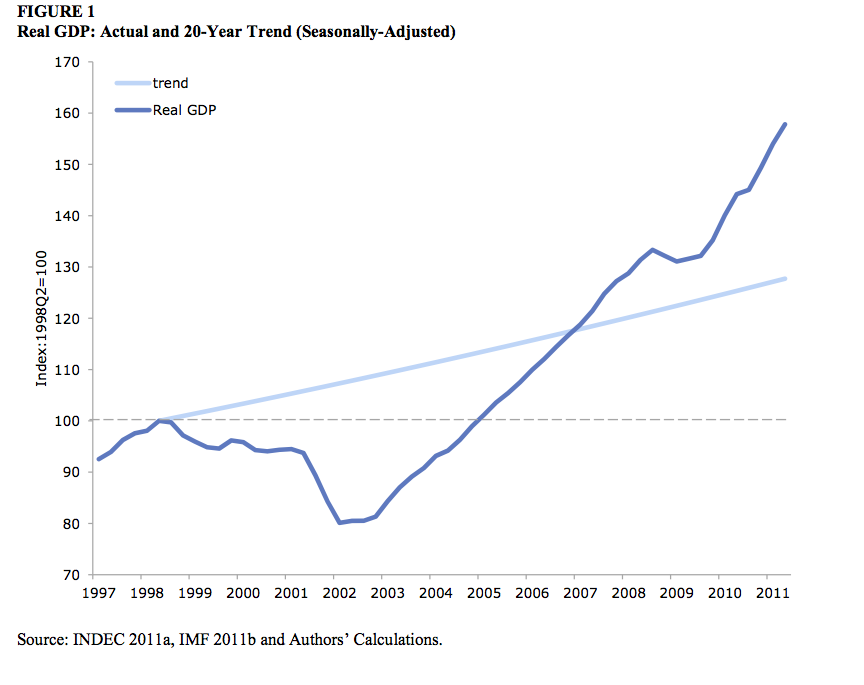
What is particularly striking is how quickly Arentina's economy rebounded after its default. From a paper by Mark Weisbrot, Rebecca Ray, Juan A. Montecino, and Sara Kozameh (hat tip reader Thomas Ross):
By contrast, the US economy contracted 6.8% in the fourth quarter of 2008, and shrank 2.6% in 2009. The US only now has reached its pre-downturn level of GDP, meaning nearly four years later versus Argentina's three. In addition, Argentina has regained its trend line of growth, while it is not clear whether the US ever will. The Carmen Reinhart and Kenneth Rogoff work on severe financial crises has found that they result in "permanent" falls in the standard of living, but that has not been the case with Argentina.
Admittedly, Argentina had an advantage the US lacked, that of a reasonable level of world growth as a backdrop. But we need to stress "reasonable" not robust. The advanced economies of the world ex Australia went into a slump in the dot-bomb era, and the US and Europe were running below potential through 2004. But the data show that Argentina's success was not export driven: Notice the Argentinian example disproves one of the Big Lie about default, that foreign capital will take a hike and the consequences will be dire. Again from the article:
Shorter version: sacrificing your economy on the altar of the Bond Gods may not be such a good idea. The one blot on Argentina's success record is its inflation rate, which has been as high as 31%. I've had Brazilian readers contend that inflation is not as terrible as we Americans have been led to believe if you have good inflation accounting (something we never developed). Unlike our experience with stagflation, it has not been an impediment to growth:
The paper closes by stressing the implications for other debt-burdened nations:
No wonder the IMF and the banksters don't want Argentina to get good press. The Eurozone countries they are wringing dry might get ideas.
| ||||||||||||||||||||
| Posted: 22 Oct 2011 04:30 PM PDT | ||||||||||||||||||||
| Posted: 22 Oct 2011 04:30 PM PDT goldipedia | ||||||||||||||||||||
| Bill Black: The Anti-Regulators Are the Job Killers Posted: 22 Oct 2011 04:10 PM PDT By Bill Black, Associate Professor of Economics and Law at the University of Missouri-Kansas City, a former senior financial regulator, and the author of The Best Way to Rob a Bank is to Own One. Cross posted from New Economic Perspectives. The new mantra of the Republican Party is the old mantra – regulation is a "job killer." It is certainly possible to have regulations kill jobs, and when I was a financial regulator I was a leader in cutting away many dumb requirements. We have just experienced the epic ability of the anti-regulators to kill well over ten million jobs. Why then is there not a single word from the new House leadership about investigations to determine how the anti-regulators did their damage? Why is there no plan to investigate the fields in which inadequate regulation most endangers jobs? While we're at it, why not investigate the areas in which inadequate regulation allows firms to maim and kill. This column addresses only financial regulation. Deregulation, desupervision, and de facto decriminalization (the three "des") created the criminogenic environment that drove the modern U.S. financial crises. The three "des" were essential to create the epidemics of accounting control fraud that hyper-inflated the bubble that triggered the Great Recession. "Job killing" is a combination of two factors – increased job losses and decreased job creation. I'll focus solely on private sector jobs – but the recession has also been devastating in terms of the loss of state and local governmental jobs.
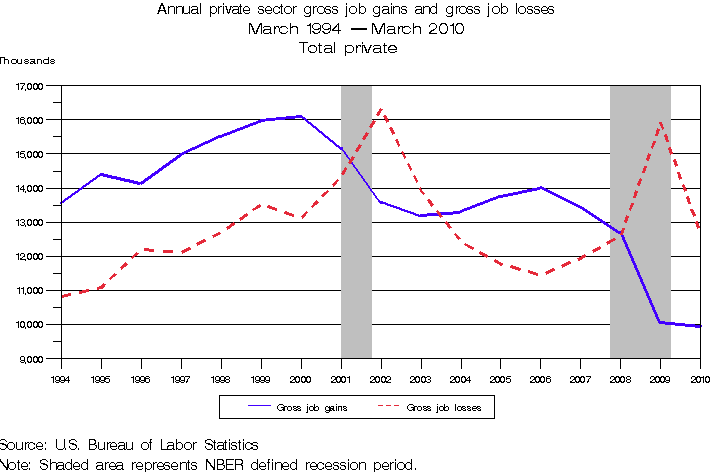
From 1996-2000, for example, annual private sector gross job increases rose from roughly 14 million to 16 million while annual private sector gross job losses increased from 12 to 13 million. The annual net job increases in those years, therefore, rose from two million to three million. Over that five year period, the net increase in private sector jobs was over 10 million. One common rule of thumb is that the economy needs to produce an annual net increase of about 1.5 million jobs to employ new entrants to our workforce, so the growth rate in this era was large enough to make the unemployment and poverty rates fall significantly. The Great Recession (which officially began in the third quarter of 2007) shows why the anti-regulators are the premier job killers in America. Annual private sector gross job losses rose from roughly 12.5 to a peak of 16 million and gross private sector job gains fell from approximately 13 to 10 million. As late as March 2010, after the official end of the Great Recession, the annualized net job loss in the private sector was approximately three million (that job loss has now turned around, but the increases are far too small). Again, we need net gains of roughly 1.5 million jobs to accommodate new workers, so the total net job losses plus the loss of essential job growth was well over 10 million during the Great Recession. These numbers, again, do not include the large job losses of state and local government workers, the dramatic rise in underemployment, the sharp rise in far longer-term unemployment, and the salary/wage (and job satisfaction) losses that many workers had to take to find a new, typically inferior, job after they lost their job. It also ignores the rise in poverty, particularly the scandalous increase in children living in poverty. The Great Recession was triggered by the collapse of the real estate bubble epidemic of mortgage fraud by lenders that hyper-inflated that bubble. That epidemic could not have happened without the appointment of anti-regulators to key leadership positions. The epidemic of mortgage fraud was centered in loans that the lending industry (behind closed doors) referred to as "liar's" loans – so any regulatory leader who was not an anti-regulatory ideologue would (as we did in 1990-1990 during the first wave of liar's loans in California) have ordered banks not to make these pervasively fraudulent loans. One of the problems was the existence of a "regulatory black hole" – most of the nonprime loans were made by lenders not regulated by the federal government. That black hole, however, conceals two broader federal anti-regulatory problems. The federal regulators actively made the black hole more severe by preempting state efforts to protect the public from predatory and fraudulent loans. Greenspan and Bernanke are particularly culpable. In addition to joining the jihad state regulation, the Fed had unique federal regulatory authority under HOEPA (enacted in 1994) to fill the black hole and regulate any housing lender (authority that Bernanke finally used, after liar's loans had ended, in response to Congressional criticism). The Fed also had direct evidence of the frauds and abuses in nonprime lending because Congress mandated that the Fed hold hearings on predatory lending. The S&L debacle, the Enron era frauds, and the current crisis were all driven by accounting control fraud. The three "des" are critical factors in creating the criminogenic environments that drive these epidemics of accounting control fraud. The regulators are the "cops on the beat" when it comes to stopping accounting control fraud. If they are made ineffective by the three "des" then cheaters gain a competitive advantage over honest firms. This makes markets perverse and causes recurrent crises. From roughly 1999 to the present, three administrations have displayed hostility to vigorous regulation and have appointed regulatory leaders largely on the basis of their opposition to vigorous regulation. When these administrations occasionally blundered and appointed, or inherited, regulatory leaders that believed in regulating the administration attacked the regulators. In the financial regulatory sphere, recent examples include Arthur Levitt and William Donaldson (SEC), Brooksley Born (CFTC), and Sheila Bair (FDIC). Similarly, the bankers used Congress to extort the Financial Accounting Standards Board (FASB) into trashing the accounting rules so that the banks no longer had to recognize their losses. The twin purposes of that bit of successful thuggery were to evade the mandate of the Prompt Corrective Action (PCA) law and to allow banks to pretend that they were solvent and profitable so that they could continue to pay enormous bonuses to their senior officials based on the fictional "income" and "net worth" produced by the scam accounting. (Not recognizing one's losses increases dollar-for-dollar reported, but fictional, net worth and gross income.) When members of Congress (mostly Democrats) sought to intimidate us into not taking enforcement actions against the fraudulent S&Ls we blew the whistle. Congress investigated Speaker Wright and the "Keating Five" in response. I testified in both investigations. Why is the new House leadership announcing its intent to give a free pass to the accounting control frauds, their political patrons, and the anti-regulators that created the criminogenic environment that hyper-inflated the financial bubble that triggered the Great Recession and caused such a loss of integrity? The anti-regulators subverted the rule of law and allowed elite frauds to loot with impunity. Why isn't the new House leadership investigating that disgrace as one of their top priorities? Why is the new House leadership so eager to repeat the job killing mistakes of taking the regulatory cops off their beat?
| ||||||||||||||||||||
| Posted: 22 Oct 2011 01:33 PM PDT By Jack Chan at www.simplyprofits.org 10/22/2011  GLD – on sell signal. SLV – on sell signal. GDX – on buy signal. Summary Disclosure
| ||||||||||||||||||||
| Understanding Banker Manipulation of Gold & Silver Posted: 22 Oct 2011 10:20 AM PDT JS Kim of SmartKnowledgeU discusses manipulation in the precious metals markets.
| ||||||||||||||||||||
| Bank's Collapse in Europe Points to Global Risks Posted: 22 Oct 2011 07:53 AM PDT As Europe's debt crisis has deepened, a recurring question is how much risk it poses to the United States economy, and especially American banks. While American financial institutions have sought to limit any damage by reducing their loans and thus lowering their direct exposure to Europe's problems, the recent rescue of the Belgian-French bank Dexia shows that there are indirect exposures that are less known and understood — and potentially worrisome... Read | ||||||||||||||||||||
| Posted: 22 Oct 2011 07:02 AM PDT
 The public now hates the fact that it bought into this gold scam. "Damn, if only I could have held out and not gotten so emotional, I would have remained calm and let our dear leaders find a solution instead of buying into this bubble" says the public. Real gold players know that the above is a necessary ingredient to preparing the ancient relic for the next leg in its bull market. But a key question remains as to gold's technical status. As we have noted all along (since the upside panic last summer) in NFTRH and on occasion here on the blog, gold has needed continued correction as measured in Euros, Loonies and to a lesser degree, Aussie Dollars. But what of its nominal price? Well, if you care about gold's price from a daily, weekly or even monthly perspective, then you are set up for disappointment. If you know the reasons that gold is rising as a long term barometer to the global financial events currently in play, you simply do not worry about the short term. While gold can qualify for support at or above 1550 – a level that is reinforced by favorable public opinion and CoT data – going strictly by the technicals, the recommendation is to ignore the cheerleaders and realize that gold can easily decline to 1450, 1300 and even lower. If you understand the desperation currently in play by powerful entities world wide, you also understand the ease with which this relatively small and relatively controllable market can be manipulated. You also understand the intensifying value proposition of gold now a few years on from the previous intense buying opportunity. Back on the chart, we note that the most recent drop in RSI to near 30 has the potential to end the correction. But if the system remains in a continuing deflation 'event', it would be worthwhile to note the crash below RSI 30 that attended the last great deflationary event in 2008. So do not rule out a decline to 1150 or even 1000. Now, the herd (and not just the gold herd, mind you) will of course be sucking its thumb if 'disaster support' – AKA support from the 2008 destruction for most stock and asset markets – is approached. I do not expect this to come about on this cycle, but it is on radar none the less. The chart leans bearish in my view. Gold has certainly qualified for a healthy correction, but when thinking about the fury and hysteria of the Euro panic that drove gold too high, too fast into an upward channel buster, it helps to keep symmetry in mind; as in the market often punishes one mania (in this case, bullish) with an equal and opposite mania. So, while I am going to manage 1450 and the channel bottom for now, I am also going to use plain old market experience to at least note the potential for continued punishment and lower levels to come about. This chart introduces another indicator, the Stochastic RSI, which is an indicator based on an indicator. The idea being that it is more sensitive to over bought and over sold levels. While it has declined toward over sold (bottom yellow dot), a smoothing 5 day moving (top yellow dot) average implies it can become more over sold short term. I realize that gold is rising strongly in pre-market this morning. But as long as it remains under the top (yellow dotted) channel line and roughly the 1700 area, it is technically vulnerable. So many stock markets – including my favored HUI Gold Bugs index – are at inflection points. It would probably pay to watch what happens in gold for signs of what may be coming for the rest of the asset spectrum with regard to whether or not the deflation event is finishing up as a mini event or has more kick left in it for potential maxi destruction.
|
 Two important restaurant companies announced earnings late last week…


| You are subscribed to email updates from Gold World News Flash 2 To stop receiving these emails, you may unsubscribe now. | Email delivery powered by Google |
| Google Inc., 20 West Kinzie, Chicago IL USA 60610 | |

No comments:
Post a Comment