A unique and safe way to buy gold and silver 2013 Passport To Freedom Residency Kit
Buy Gold & Silver With Bitcoins!

Sunday, August 14, 2011

saveyourassetsfirst3

saveyourassetsfirst3


COMEX Swap Dealers Cover Gold Shorts like a Big Dog

Posted: 14 Aug 2011 06:24 AM PDT

Largest one-week short covering by the veteran traders in our records.

HOUSTON – The CFTC commitments of traders (COT) report for this week shows significant  COMEX commercial short covering in both gold and silver futures.  Part of that short covering includes the largest short-cover by traders the CFTC classes as Swap Dealers in our records for gold futures.  


First a bit of errata. As we 'fled the scene' Friday in a rush to get to the ranch and to our beloved fishing lake, you know, anywhere but in front of the computer screens, we ended up not checking the comparative data in our closing table posted late Friday evening.  What could be simpler than gathering data points and putting them in a spreadsheet that generates our table, we might rightly ask…  Ahem!   

 
While we wish we could blame several data errors in that table on a now former intern for GGR, that's just not how we roll here.  The errata (now corrected in the previous web log post) is and was our collective blunder – for which we apologize. 

The corrected closing table is reprinted below for reference. 

20110812table 

If any of the images are too small click on them for a larger version.


Continued…


Moving on as quickly as possible, notice the unusual action in the graph just below. 

20110814goldLCNS 
Sources: CFTC, Cash Market

The graph is of the gold futures positioning for the large commercial traders as of Tuesday, August 9.  Why is it unusual?  Because as the price of gold was rising sharply (up $81 or 4.9% Tues/Tues) the largest, best funded and presumably the best informed traders of futures on the planet – the traders the CFTC classes as 'commercial' – were in the process of reducing their collective net short positioning, that's why.   Gold higher, Big Shorts less net short.

As gold rose nearly 5% to the $1,740s the commercials got the heck out of 38,428 contracts or 13.4% of their net short bets.  One way to describe it is that the Big Sellers of gold futures were in full retreat as of the Tuesday cutoff.

 
The largest portion of the net short covering this week belongs to the traders the CFTC classes as Swap Dealers.  Note the chart just below for reference.

20110814goldLCNSsds 
  
Sources: CFTC, Cash Market

The Swap Dealer traders decreased their collective net short gold positioning by 28,331 lots or 30.9% in one week.  That's the largest one-week reduction in net short positioning for the mercenary Swap Dealers in our records. They did that by adding 5,469 contracts long and covering 22,862 short contracts, by the way.

 
(For reference the second largest get-out by the Swap Dealers was in the July 31, 2007 report when they covered or offset a whopping 26,970 lots in a single week then with gold in the $650s.)

CME to the Rescue?

It should not come as any surprise then that just two days after that we learn of a 22% margin increase by the CME. The exchange does what it can to assist its hedgers in our view, but it couches margin increases in terms of 'answering higher volatility,' which is, of course, half true ...  as if people can't make the connection that they seem to only answer 'high volatility' when it is to the upside. 

   
When the exchange weighs in with margin increases it's like the college dean showing up at a wild frat party.  A rather chilling effect, but more likely than not, temporary.

That is all for now, but there is more to come.

How Will Margin Hike Impact Gold ETFs?

Posted: 14 Aug 2011 06:08 AM PDT

By Tom Lydon:

Precious metals investors are debating whether a 22% increase in margin requirements to trade gold futures contracts will be enough to seriously derail the rally in gold exchange traded funds.

"There is some concern that the rise may be a precursor to more aggressive margin increases that might spark a sell-off similar to the silver price correction in May 2011 following an 84% increase in Comex silver futures margin requirements in the April-May period," ETF Securities said in a report Friday.

However, based on current volatility levels, gold margin requirements are unlikely to be increased as sharply as those for silver in the spring, the analysts wrote.

Gold funds such as ETFs Physical Swiss Gold Shares (NYSEArca: SGOL) and SPDR Gold Shares (NYSEArca: GLD) have retreated this week after the Chicago Mercantile Exchange raised margin requirements to trade Comex gold futures contracts. Gold futures briefly traded over $1,800 an ounce


Complete Story »

3 Discount Retailers That Could Benefit From a Weaker Economy

Posted: 14 Aug 2011 05:44 AM PDT

By Cabot:

by Elyse Andrews

Back to school season is upon us, and I think that with the economy still struggling, people are more likely to frequent discount retailers where their dollar will go further. So today, in the midst of this market mayhem, I have three stocks for you to consider that could benefit from a weaker economy.

The first is Dollar Tree (DLTR), which was hot during the Great Recession in 2008 / 2009. With the economy still down in the dumps, it's hot again! As its name implies, the company sells everything for $1 or less. It has reported double-digit earnings growth for 13 straight quarters. It currently sits atop the Investor's Business Daily Retail-Discount and Variety industry group, which itself is doing well. The group now occupies the #8 spot (out of 197 industries), up from #33 just three weeks ago!

The second stock is Kohl's (KSS), which


Complete Story »

Dorothy's silver shoes or the re-monetization of the silver currency of the United States of America

Posted: 14 Aug 2011 05:16 AM PDT

Why not re-monetize the silver dollar? Re-monetization could put the silver dollar and its subsidiary silver coinage into circulation in parallel with FRNs – "Federal Reserve Notes". There are several reasons that make this action possible, and only one that might be considered as an unimportant material obstacle.

Why Dendreon's Stock Is Worth Following

Posted: 14 Aug 2011 05:10 AM PDT

By Prohost Biotech:

In yesterday's article related to the market's situation. We read:

"The question is , when would big funds and institutions, sitting on billions of dollars decide that time has come to buy at the price of sand what's much more important than gold? When would they decide to upgrade what should be upgraded and downgrade what deserves a downgrade in case any stock remained overvalued? Is this not what puts the market back on its tracks, so it could resume its function? Are there any stocks that analysts feel that they might have bottomed during the stocks' slaughtering?"

Today, we wonder:

Have analysts gone mute? Or do they not need to talk because the big bear is doing their job? Could it really be that all analysts are betting against all stocks? If not, why have they all become mute, declining to upgrade the many firms that have bottomed during the


Complete Story »

On the ECB and the sovereign debt crisis

Posted: 14 Aug 2011 02:35 AM PDT

Cross-posted from Credit Writedowns

Last month I wrote an article called "The ECB is the difference" which claimed the ECB was the pivotal institution in the European sovereign debt crisis. I presented two options that the European Central Bank had in relieving pressure on European sovereign debt markets. Option A was monetisation i.e. buying up sovereign debt or guaranteeing a specific yield or spread. Option B was Eurobonds i.e. where "the ECB buys an agreed-upon portion of the existing debt from the sovereigns and then uses these funds to back the [Eurobond] supranational debt."

My thinking at the time was that Spain and Italy were not insolvent and yet their bonds were selling off as if they were. To me, this had the hallmarks of a classic liquidity crisis which necessitated a lender of last resort to fund the solvent but illiquid sovereigns and prevent dead weight economic loss. The ECB has unlimited firepower and that makes it the only institution which can credibly end liquidity crises in Euroland. And indeed, we see that after the ECB went ahead and bought Italian and Spanish bonds as I suggested they do, yields fell dramatically – the most ever in a single week since the Euro was formed.

It has been clear to me that this was the endgame. As I said in November of last year, there are three options for the euro zone: monetisation, default, or break-up. In my view, the political costs of break-up are still too high, so monetisation and default is what we have seen and will continue to see for some time still. What was not clear, even in the hours before the ECB did decide to buy Spanish and Italian debt, is what the quid pro quo would be for the ECB to move. Elga Bartsch of Morgan Stanley said fiscal austerity would be the pre-condition – and she appears to have been right as Spain and Italy have accelerated plans for fiscal consolidation.

As to Option B, euro bonds, we are now seeing movement on that front. Reuters reports that the German government no longer rules out euro bonds based on a Welt am Sonntag article. The original German article title reads "Deutschland wird zum Zahlmeister Europas" which translates as "Germany has become the paymaster of Europe". The main point of the article is to highlight the fact that despite official denials by top politicians from the ruling coalition government, euro bonds are indeed being considered as an option to save the single currency. The article says that these bonds would cost Germany €47 billion a year in higher interest rate costs.

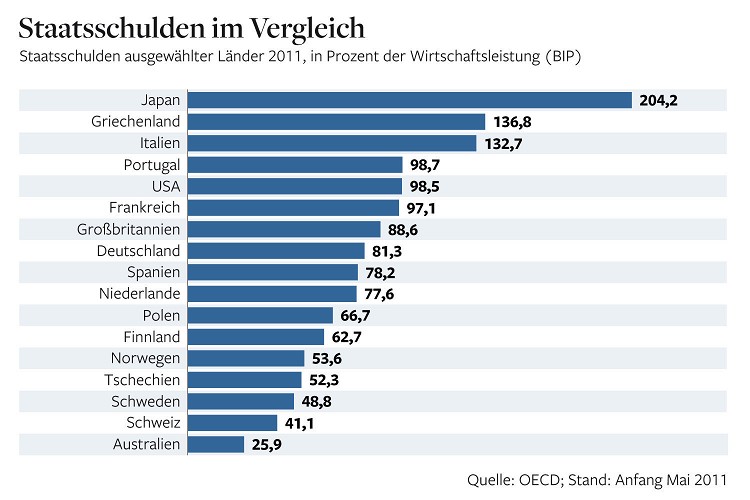
I will write further on this issue. But, for now, I want to segue into some thoughts on civil unrest and austerity. Below is a graphic in German from that article showing the relative debt load of leading developed economies.

National Debt comparison

Notice that Spain's debt load is lower than Germany's. I think "Spain is the perfect example of a country that never should have joined the euro zone" because the euro has acted like a gold standard for the country, which has forced Spain into austerity, a deflationary policy path. And that's the sort of outcome which leads to civil unrest, economic nationalism, and right political extremism.

For example, recent research suggests that the austerity we see in places like Spain and Italy will lead to social unrest. "Austerity and Anarchy: Budget Cuts and Social Unrest in Europe, 1919-2009" is the title of the paper published by the Centre for Economic Policy Research. This paper finds that:

From the end of the Weimar Republic in Germany in the 1930s to anti-government demonstrations in Greece in 2010-11, austerity has tended to go hand in hand with politically motivated violence and social instability. In this paper, we assemble cross-country evidence for the period 1919 to the present, and examine the extent to which societies become unstable after budget cuts. The results show a clear positive correlation between fiscal retrenchment and instability.

Additionally, two economists have found that "higher per capita GDP growth is significantly negatively linked to the support for extreme political positions." The German economists, Markus Brückner and Hans Peter Grüner wrote pointedly that:

Our results therefore make clear that countries should not expect right-wing parties to get majorities unless growth declines quite as much as in the 1920s. Nevertheless, even with a less significant fall in economic growth rates, a rise in support for extreme parties is likely to change political outcomes – for example through their impact on incumbent parties' political platforms.

So what we should expect is a high level of political volatility and social unrest in Italy and Spain (as well as in Ireland, Greece and Portugal) and an increase in right extremism. The same is true regarding austerity and social and political outcomes in the US, by the way. If the level of social volatility accompanying this outcome is too great, the euro zone will break apart as the future right-leaning governments there will resort to economic nationalism and repudiate their debt by defaulting.

Eurobonds would certainly lower yields across the eurozone and reduce liquidity constraints that have required front-loaded deficit reduction attempts. The effect on Germany is arguable. But, at a minimum, euro bonds would minimize the potential for the extreme outcome from social unrest which I just outlined.

P.S. – We should give the ECB some credit here. Nine days ago I was saying this is a classic liquidity crisis and that "the time to act is now." The ECB has acted.


Gold is the real safe haven

Posted: 14 Aug 2011 01:00 AM PDT

With the US bond market downgraded and European governments facing insolvency, investors are reconsidering investment risk. But in doing so, are they making the right judgements? The conventional view ...

No Relief Rally but the Dollar Squeaks By the Pound, Franc

Posted: 14 Aug 2011 12:59 AM PDT

By Dr. Duru:

The relief rally for the U.S. dollar that I expected after the S&P downgrade of U.S. government debt did not materialize last week (click to enlarge images):

No relief rally for the dollar yet, but it still refuses to go any lower

I was particularly focused on U.S. dollar rallies against the British pound (FXB or GBP/USD), Japanese yen (FXY or USD/JPY), and the Swiss franc (FXF or USD/CHF). (See the earlier post for my list of reasons). I got two out of three but with some MAJOR caveats. The U.S. dollar was able to gain about 1.6% on the British pound (using the U.S. trading day) over the first three days of the week and closed the week slightly stronger than the pound. The yen ended the week up 2.1% over the dollar. The dollar gained 1.6% over the franc BUT not until after the franc printed a parabolic


Complete Story »

David Freedom – The Unfolding EU Crisis

Posted: 13 Aug 2011 11:50 PM PDT

EU Crisis Coming into Focus
Earlier in the year I warned of a pending EU crisis that has now arrived in full force. I have been writing about the EU problems over the past month to bring them back into focus, because I believe this is the next, biggest, event on the timeline. While everyone was watching Washington Theater, the EU crisis was raging. This is a real risk to banking, currencies, and sovereign debt that is not easily fixed. Sadly, the public has very little understanding of what shapes their world, content to live ignorant until directly impacted. The majority of my writing has been about the US Money Market Mutual Fund exposure to the EU banks (in the area of 50% for some of the largest). I write about these problems not to scare, but to warn.

Funding Issues within the EU
Over the past few years, the banking industry has funded the majority of sovereign debt buying to keep the EU going. Now that this unsustainable process is coming to an end, interest rates are rising in Spain and Italy – big decisions need to be made soon. Remember the EU banks didn't get their TARP, yet. Spain's bond market is bigger than that of Greece, Portugal and Ireland's combined, at about $900B. Italy's debt market is roughly 3x the debt market of Greece, Ireland, and Portugal combined, at about $2T. The ECB will need to backstop these debt markets or else face a breakup of the EU. Ultimately the EU will cease to exist, but not yet.

Early Monday morning, August 8th, the ECB promised to "actively implement its Securities Markets Programme." This decision was made at a time when the banking system was closer to failure than most recognize. One source involved in the talks stated, "I don't see how we can survive another week like this one." SocGen, France's second largest bank, and UniCredit Banca, Italy's largest bank were both on the brink. While the ECB's intervention helped stabilize European markets and banking system for now, they will need to significantly expand their efforts in the near future.

Short Selling Ban
Similar to the ECB intervention on Monday, the recent ban on short selling financial stocks is a temporary stop-gap measure (15-days). The ban, introduced by Belgium, France, Italy and Spain on Friday, was in response to extreme pressure being applied to EU banks. They are in the midst of a bank run. People are sensing the risk in banks that have approximately 20-1 leverage on assets that are egregiously overvalued. Big money is taking deposits out of EU banks and running scared.

While the Spanish ban included derivatives, the French and Belgium bank did not apply the ban to derivatives. One side note, Germany implemented a ban of naked short selling last year, which did include credit default swaps. Nobody should expect this short-term policy to have any lasting impact or resolve the current issues. In simple terms, the damage within the banking system is too severe and there is no way to contain the derivatives. I agree naked short-selling and CDS are destructive to markets, along with government sponsored manipulation (policies), but the partial ban on short selling will not save the Eurozone markets or banks.

Crossing the Rubicon
I will offer my view on how this will play-out, but I ask that you take prudent actions to prepare for alternative outcomes. My expectation is that markets will soon pressure the EU to commit to additional and significant steps to keep the EU intact. As I've mentioned in the past, these steps are part of the global QE agenda. Before any decision is made, markets (or maybe more appropriately men who walk with canes) will make their case to the ECB loud and clear. The EU sovereign debt market and the banking system will be taken down unless more credit/debt is created. In comes the EFSF. This outcome was decided long ago, the politicians just haven't informed the underclass/uninformed yet.

This is where my concern regarding the mmkt funds comes into play. If the ECB doesn't jump quickly enough to their demands, you could have a situation where some banks are sacrificed. Since US mmkt Funds are so heavily weighted in EU banks, it is quite conceivable that some will "break the buck". Just as we hit the lowest point, the US investor could encounter a "freeze" in mmkt redemptions, unable to move out of the fire storm surely to hit western currencies. This is not high on the list of concerns of our "masters".

Defined Contribution Retirement Accounts
Don't blame retirement plans, blame the corruption and greed. Unfortunately retirement accounts are at the mercy of a broken system. Paper markets are a collapsing inverted pyramid. As the Ponzi system implodes, it will be difficult to hide within plans that limit investment options to mmkts, bonds, and general stock funds. Money will be running to safe havens, such as PMs.

Global stock markets will continue their downward move until more credit/debt is pumped in. As this unfolds (it is now), you can try to hide retirement assets (that have limited investment choices) in short-term treasuries or mmkt funds. If you are vigilant, nimble, and have a little luck, you'll be able to exit these positions before they collapse. If you can navigate this mine field, you'll then take refuge in a stock fund that will not keep pace with real inflation rates and will see many bankruptcies. The other option within these limited investment accounts is to sit in general equity funds and ride out all storms. Your choice should be based on your individual circumstances, and in either case, keep your fingers crossed that you'll be able to salvage something in the end. Within an IRA, where you have alternative investment options, my preference is to have positions in funds that hold a physical asset, such as Sprott's physical gold & silver along with resource and mining stocks.

Protective Measures
Additional credit/debts will fix nothing. The ECB and US Fed will continue to place a bid under the massive new debt issuance, leading to rampant price inflation for items of necessity. We will see lower growth, employment, wages, and cuts in entitlements, while cost of living will increase. The ugliness and ungodliness in our society will be on full display. At risk of sounding like a broken record, I am suggesting 30% of your assets be stored in physical gold & silver and holding a portion of your assets in physical cash. The main thing I want to reinforce is the purpose of holding cash. Although the outcome may be abundantly clear, current laws enforce currency which should be held for expenses, emergencies, purchases and so forth. By exiting cash completely, you forfeit your ability to protect other holdings or take advantage of future opportunities. Don't give up your financial freedom or your ability to protect yourself – in my opinion it's worth the potential cost of devaluation.

~David Freedom

Guest Post: Austerity and Runaway Inequality Lead to Violence And Instability

Posted: 13 Aug 2011 06:59 PM PDT

By Washington's Blog


Study Shows That Austerity Leads to Violence And Instability

A study this month by economists Hans-Joachim Voth and Jacopo Ponticelli shows that – from 1919 to the present – austerity has increased the risk of violence and instability:

Does fiscal consolidation lead to social unrest? From the end of the Weimar Republic in Germany in the 1930s to anti-government demonstrations in Greece in 2010-11, austerity has tended to go hand in hand with politically motivated violence and social instability. In this paper, we assemble cross-country evidence for the period 1919 to the present, and examine the extent to which societies become unstable after budget cuts. The results show a clear positive correlation between fiscal retrenchment and instability. We test if the relationship simply reflects economic downturns, and conclude that this is not the key factor. We also analyse interactions with various economic and political variables. While autocracies and democracies show a broadly similar responses to budget cuts, countries with more constraints on the executive are less likely to see unrest as a result of austerity measures.

As CNN notes:

Studying instances of austerity and unrest in Europe between 1919 to 2009, Ponticelli and Voth conclude that there is a "clear link between the magnitude of expenditure cutbacks and increases in social unrest. With every additional percentage point of GDP in spending cuts, the risk of unrest increases."

"Expenditure cuts carry a significant risk of increasing the frequency of riots, anti-government demonstrations, general strikes, political assassinations, and attempts at revolutionary overthrow of the established order. While these are low probability events in normal years, they become much more common as austerity measures are implemented."

Prominent Institutions, Economists and Politicians Have Warned For Years That Bad Economic Policy Would Lead To Unrest

Many prominent institutions, economists and politicians have been warning about this issue.

The relation between austerity and riots is so clear that former IMF chief economist and Noble prize winning economist Joseph Stiglitz coined a phrase to describe what happens after the International Monetary Fund demands austerity in return for loans to indebted countries: "The IMF Riot".

Forbes reported in February:

Harvard economist Kenneth Rogoff, co-author of a best-selling book on financial crises, "This Time It's Different," told Forbes today in an exclusive interview, that the high unemployment rate and high levels of debt in the U.S. will sooner or later trigger serious "social unrest from the income disparities in the U.S."

The Obama administration has "no clue," he told me what do about this terrible disparity in the economy that is bound to erupt sooner or later, he feels.

"I don't understand why people don't wake up to the crisis they are creating," he said to me just minutes after appearing at a Council on Foreign Relations round-table on "Currency Wars."

As I warned in February 2009 and again in December of that year:

Numerous high-level officials and experts warn that the economic crisis could lead to unrest world-wide – even in developed countries:

  • Today, Moody's warned that future tax rises and spending cuts could trigger social unrest in a range of countries from the developing to the developed world, that in the coming years, evidence of social unrest and public tension may become just as important signs of whether a country will be able to adapt as traditional economic metrics, that a fiscal crisis remains a possibility for a leading economy, and that 2010 would be a "tumultuous year for sovereign debt issuers".
  • The U.S. Army War College warned in 2008 November warned in a monograph [click on Policypointers' pdf link to see the report] titled "Known Unknowns: Unconventional 'Strategic Shocks' in Defense Strategy Development" of crash-induced unrest:
    The military must be prepared, the document warned, for a "violent, strategic dislocation inside the United States," which could be provoked by "unforeseen economic collapse," "purposeful domestic resistance," "pervasive public health emergencies" or "loss of functioning political and legal order." The "widespread civil violence," the document said, "would force the defense establishment to reorient priorities in extremis to defend basic domestic order and human security." "An American government and defense establishment lulled into complacency by a long-secure domestic order would be forced to rapidly divest some or most external security commitments in order to address rapidly expanding human insecurity at home," it went on. "Under the most extreme circumstances, this might include use of military force against hostile groups inside the United States. Further, DoD [the Department of Defense] would be, by necessity, an essential enabling hub for the continuity of political authority in a multi-state or nationwide civil conflict or disturbance," the document read.

  • Director of National Intelligence Dennis C. Blair said:
    "The global economic crisis … already looms as the most serious one in decades, if not in centuries … Economic crises increase the risk of regime-threatening instability if they are prolonged for a one- or two-year period," said Blair. "And instability can loosen the fragile hold that many developing countries have on law and order, which can spill out in dangerous ways into the international community."***

    "Statistical modeling shows that economic crises increase the risk of regime-threatening instability if they persist over a one-to-two-year period."***

    "The crisis has been ongoing for over a year, and economists are divided over whether and when we could hit bottom. Some even fear that the recession could further deepen and reach the level of the Great Depression. Of course, all of us recall the dramatic political consequences wrought by the economic turmoil of the 1920s and 1930s in Europe, the instability, and high levels of violent extremism."

    Blair made it clear that – while unrest was currently only happening in Europe – he was worried this could happen within the United States.

    [See also this].

  • Former national security director Zbigniew Brzezinski warned "there's going to be growing conflict between the classes and if people are unemployed and really hurting, hell, there could be even riots."
  • The chairman of the Joint Chiefs of Staff warned the the financial crisis is the highest national security concern for the U.S., and warned that the fallout from the crisis could lead to of "greater instability".

Others warning of crash-induced unrest include:

CNN's Jack Cafferty notes that a number of voices are saying that – if our economy continues to deteriorate (which it very well might) – we are likely headed for violence, and civil unrest is a growing certainty.

Watch the must-see CNN viewer comments on this issue:


var VideoID = "15271″; var Width = 425; var Height = 344;

People Are Furious Worldwide

Newsweek wrote in May:

Reality is beginning to break through. Gas and grocery prices are on the rise, home values are down, and vast majorities think the country is on the wrong track. The result is sadness and frustration, but also an inchoate rage more profound than the sign-waving political fury documented during the elections last fall.

***

In search of the earthly toll of this outrage, NEWSWEEK conducted a poll of 600 people, finding vastly more unquiet minds than not. Three out of four people believe the economy is stagnant or getting worse. One in three is uneasy about getting married, starting a family, or being able to buy a home. Most say their relationships have been damaged by economic woes or, perhaps more accurately, the dread and nervousness that accompany them.

Could these emotions escalate into revolt?

As the Newsweek article points out, people are furious that the Wall Street fatcats have gotten even richer, while Americans are suffering rampant unemployment:

Corporate earnings have soared to an all-time high. Wall Street is gaudy and confident again. But the heyday hasn't come for millions of Americans. Unemployment hovers near 9 percent, and the only jobs that truly abound, according to Labor Department data, come with name tags, hairnets, and funny hats (rather than high wages, great benefits, and long-term security). The American Dream is about having the means to build a better life for the next generation. But as President Obama acknowledged at a town-hall meeting in May, "a lot of folks aren't feeling that [possibility] anymore."

Former American senator (and consummate insider) Chris Dodd said in 2008:

If it turns out that [the banks] are hoarding, you'll have a revolution on your hands. People will be so livid and furious that their tax money is going to line their pockets instead of doing the right thing. There will be hell to pay.

Of course, the big banks are hoarding, and refusing to lend to Main Street. In fact, they admitted back in 2008 that they would. And the same is playing out globally.By way of background, America – like most nations around the world – decided to bail out their big banks instead of taking the necessary steps to stabilize their economies (see this, this and this). As such, they all transferred massive debts (from fraudulent and stupid gambling activities) from the balance sheets of the banks to the balance sheets of the country.

The nations have then run their printing presses nonstop in an effort to inflate their way out of their debt crises, even though that effort is doomed to failure from the get-go, and only helps the wealthy.

Quantitative easing by the Federal Reserve is causing food prices to skyrocket worldwide (and see this, this and this), without doing anything to help anyone but the wealthiest. And every country in the world that can print money – i.e. which is not locked into a multi-country currency agreement like the Euro – has been printing massive quantities of money. See these charts.

Unemployment is soaring globally – especially among youth.

And the sense of outrage at the injustice of the rich getting richer while the poor get poorer is also a growing global trend.

Countries worldwide told their people that bailout out the giant banks was necessary to save the economy. But they haven't delivered, and the "Main Streets" of the world have suffered.

Matt Stoller – former Congressman Grayson's chief legislative aide – writes:

To see what happens when a social contract falls apart, look at the massive rioting in London.

Middle-class incomes are down radically in the U.S. since 2007, as much as 15 percent according to new Internal Revenue Service data. Home equity is still falling. If cherished entitlement programs are also savaged by the politicians who destroyed our life savings, citizens might begin to question whether this whole constitutional democracy thing is worth it.

Strange and ominous political eddies are already emerging. Congressional disapproval is higher than 80 percent. This could turn ugly — as it has before in U.S. history. While we've airbrushed the legacy of political violence out of U.S. history, it's there. Labor conducted gun battles with Pinkerton private military forces in the late 19th century. Strikes often turned deadly in the 1930s. If there are serious defense cuts, the prospect of hundreds of thousands of war-weary former soldiers thrown into a terrible economy is not, shall we say, a recipe for social stability.

British rioters, Israel protesters and people worldwide are lashing out at the runaway inequality and austerity measures.

Unfortunately, that means that the unrest will likely continue …

Indeed, these pictures from Israeli protests on Rothschild Boulevard last week show that people worldwide are getting sick and tired of the wealthiest acting like despotic kings:

A guillotine on Rotschild Boulevard in Tel Aviv, sending a message to Israel's tycoons, August 10, 2011.

Pictures courtesy of Ynet and Haaretz.


PRIMED FOR A TREND REVERSAL

Posted: 13 Aug 2011 10:03 AM PDT

"Liquidity will eventually find its way into undervalued assets" Gary Savage

I think it's time for liquidity to drain out of gold and flow back into a severely beaten up stock market. Depending on how quickly the market tests the 200 day moving average will likely determine whether or not it can make marginal new highs before resuming the cyclical (and secular) bear trend.


More in the weekend report...

Need some help with a German hallmark

Posted: 13 Aug 2011 07:41 AM PDT

I bought a lot of spoons on ebay for $12+3 S&H. 4 of them are silver (925,835, and 800). The fifth is problematic. It could be partially worn, so I submit it for your consideration. The seller described the mark as an 800, but it isn't that clear to me. If it's not, I'm still ahead. The letter 4th mark on the right is a W.

Who will put the gold questions to central banks? - Chris Powell, GATA

Posted: 13 Aug 2011 12:57 AM PDT

Here is the first of many speeches from GATA's conference at the Savoy Hotel in London that I will be posting in this column.  These are GATA's secretary treasurer, Chris Powell's remarks...and if you're only going to read one speech out of the ones posted today, this is the one you should chose.  The link is here.

How Nixon stopped backing the dollar with gold and changed global finance

Posted: 13 Aug 2011 12:57 AM PDT

Here's an essay that appeared in Business Week magazine on Saturday, August 5th after I'd already posted my Saturday column before leaving for London.  It's written by Roger Lowenstein, the author of the book When Genius Failed: The Rise and Fall of Long-Term Capital Management.
 
This essay is pretty long...but put it in the absolutely positively must read pile.  I stole this piece from a GATA release.  The link is here.

No comments:

Post a Comment