


saveyourassetsfirst3 |

- If Silver Doesn't Correct Meaningfully
- The Week in Numbers
- Best Lunar Tiger coin, series 1 or 2?
- Time Magazine: October 6, 2014.
- JPMorgan et al Rush to Cover Silver Short Positions: Is a Silver Price Explosion Imminent?
- King World News Interview with Chris Whalen
- Not enough lifeboats as the major currencies fall: Murray Pollitt
- Jim Rickards Interview on King World News
- Gold Rockets to $1570 high/closes at record levels/CME raises silver margin requirements
- 5 Charts of This Week's Investment News
- Real Estate Talks Are Designed To Get Banks Off Liability Hook
- The fight over Gold has only two possible outcomes
- Investors Missing the Boat on Gold and Silver Explorers
- The Gold Miner's Vengeance-as told by Frank Usher
- Bernanke boxed in
- Itchells Manor-of Gold and Ghosts!
- GLDX Gold Explorers ETF
- 9 Million Bicycles in Washington
- Gold and USD: Launching Gold Stocks! - Morris Hubbartt article
- Mish – “The advance in Silver has been disorderly.”
- When you bought silver at $16
- Australian Silver Lunars
- Silver Backwardation ending? Plus parabolic rise? Plus generational $50 resistance?
| If Silver Doesn't Correct Meaningfully Posted: 30 Apr 2011 04:08 AM PDT If we don't get Silver near 35 or so I most likely will not buy. I would resign myself to being 100% long Gold only. I find it hard to believe after watching Silver ebb and flow since $4.50 that we don't get a large drawdown from 50 bucks. Most of the corrections have peeled anywhere from 1/3-1/2 of the price. Unless we are in the terminal runaway move now we should see a good haircut this Summer/Fall. |
| Posted: 30 Apr 2011 03:14 AM PDT This week's closing table:
This week's disaggregated commitments of traders change as of the Tuesday close.
|
| Best Lunar Tiger coin, series 1 or 2? Posted: 30 Apr 2011 02:09 AM PDT For series 1 vs 2 comparisons, I'm prejudiced in favor of 1 so far. And that's even considering that the series 2 coins to date go against the weakest of the 1st series. They will have to really come up with something to even compare with the 1st dragon. By the way, the new dragon comes out next year, you would do well to buy a bunch of them. I'm sitting on a few 2000 dragons; waiting till I can trade them for a house-- :bear_cool: Any rate, I haven't posted any PM coin shots in a while and this is a PM site, right? Have any preference between these? I think the tiger is the strongest of series 2 so far. I like the background in the last shot and have used it with several coins. Not trying to give the series 2 coin and advantage.  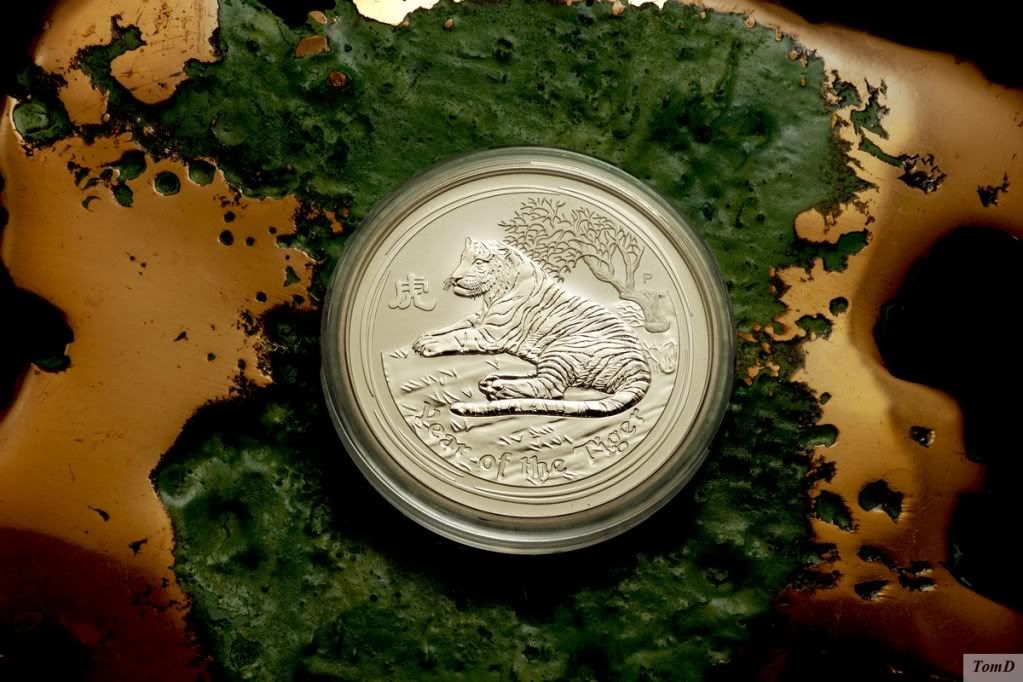 |
| Time Magazine: October 6, 2014. Posted: 30 Apr 2011 01:17 AM PDT  |
| JPMorgan et al Rush to Cover Silver Short Positions: Is a Silver Price Explosion Imminent? Posted: 29 Apr 2011 11:30 PM PDT ¤ Yesterday in Gold and SilverWhat a day it was on Friday! Gold did virtually nothing all through Far East trading, but began to develop a positive bias starting at 10:00 a.m. local time in London...which was 5:00 a.m. Eastern. This bias gained more traction the moment that London p.m. fix was in at 10:00 in New York. Then at 12:00 noon, the gold rally really picked up steam...with the high of the day [$1,570.60 spot] coming about 2:40 p.m. Eastern in electronic trading...before getting sold off a hair going into the 5:15 p.m. New York close. Volume was not overly heavy...and I'm hoping that some of Friday's price action was short covering.
Silver's price action, up until the Comex open in New York, was the same as gold's. From there, everything changed. I was as surprised as you were that silver's price action did not mirror gold, or the other two precious metals. I would give a day's pay to see who went long and who went short during Friday's New York trading session...as I'm sure it would be an education. And I would also bet serious coin that JPMorgan was at the centre of it. Ted Butler thinks so, as well. But, whatever happened, I'm not the slightest bit worried about it...as you will find out further down in this column when I discuss Friday's Commitment of Traders Report...and I hope you were out there buying this dip. I was.
The dollar didn't do much of anything on Friday. It opened a hair over 73.10...dipped about 15 basis points below 73.00...and then rallied into the close of the New York trading day a hair above 73.00. Nothing to see here, folks.
The gold shares didn't do a lot in morning trading in New York, because the gold price at that point was basically unchanged from Thursday's close. But the rally that began at noon, changed all that. The stocks did just OK...following the gold price rally pretty much tick for tick. But it was rather subdued...and you'd never know that gold set a new record high price yesterday, as the HUI finished the Friday trading session up only 1.64%. Silver was the only one of the four precious metals to do poorly...and that's only because the bullion banks were foolin' with the silver market again yesterday...as they've been doing for that last couple of weeks. Gold was up 1.95%...platinum up 2.02%...palladium was up 2.20%...and silver was sucking wind...down 1.11% Here's the 4-day HUI chart for the week that was.
With the odd exception, the silver shares stunk up the place again yesterday. This isn't entirely surprising considering the silver price action vs. the gold price action. It was another day of weak hands selling into strong hands. Here's Nick Laird's "Silver Sentiment Index" updated as of yesterday's close...and it's nowhere near its old highs.
I got a big surprise when I checked the CME's Daily Delivery Report Friday evening. Yesterday I mentioned that 19 gold and 6 silver contracts had been posted late Thursday night for delivery on Monday, May 2nd...and that this was an error, as it should have been shown as a delivery on Friday. But as it turned out, those numbers in the previous paragraph, were the deliveries on First Day Notice! This was another shocker. The gold number is no surprise, because May is not a traditional delivery month in gold...but it is for silver...and only six [6] silver contracts were posted for delivery. This is how the March delivery month in silver started out. Normally there's a big rush to deliver in the first two or three days of the delivery month, because there's no benefit to the shorts to hold back on deliveries to the longs. This is the second delivery month in a row that this has happened in silver. What it means is not know to us at the moment...but it's highly unusual...and it's as far from normal as you can get. The CME's Daily Delivery Report posted on Friday evening showed that one [1] gold, along with 4 silver contracts were posted for delivery on Tuesday...and that's the point where I found out that Thursday evening's Delivery Report was the First Day Notice report. So, in two delivery reports for the May contract in silver, a grand total of 10 silver contracts have been posted for delivery out the 1,502 that the CME's preliminary report shows still open for May. There were no reported changes in GLD...but over at SLV another 1,024,480 troy ounces were withdrawn by an authorized participant because it was needed elsewhere. The U.S. Mint had a sales report yesterday...and probably the last one of the month, although they might have a final update on Monday. Their report yesterday showed that they sold another 1,500 ounces of gold eagles...500 ounces of one-ounce 24K gold buffaloes...and no more silver eagles. The total sales figures for the month [subject to revision on Monday] stands at 108,000 ounces of gold eagles...20,500 one-ounce 24K gold buffaloes...and 2,819,000 silver eagles. The Comex-approved depositories showed that they received no silver on Thursday...and shipped 121,147 troy ounces of the stuff out the door. The link to that action is here. Yesterday's Commitment of Traders Report [for positions held at the end of trading on Tuesday, April 26th] was shockingly bullish for both metals. In silver, the Commercial net short position shrank by a whopping 10,158 contracts...50.8 million ounces...possibly the biggest one-week decline in open interest in silver, ever. Ted says that it was mostly the '4 or less' traders [read JPMorgan] and the raptors [the '8 or more' small traders in the Commercial category that were covering short positions and/or going long. The Commercial net short position in silver is now down to 212.7 million ounces...down the above 50.8 million from the previous week. The '4 or less' bullion banks' short position has declined all the way down to 182.0 million ounces...and the '8 or less' bullion banks are short 227.9 million ounces. The '8 or less' traders include the '4 or less'...so you can do the math and figure out how many ounces the '5 through 8' traders are short on their own...and it's not a lot. If you extrapolate the 10,000 or so contract decline in silver's open interest that's been reported on Wednesday and Thursday...it's obvious that JPMorgan et al are running for the hills as fast their bandy little legs will carry them. Gold's open interest changes were another big surprise...as the Commercial net short position fell a huge 17,554 contracts...or 1,755,400 ounces of gold. The Commercial net short position, which I mentioned the other day had been climbing since the first week of February, is down to 24.9 million ounces...and has declined further since Tuesday's cut-off for yesterday's COT report. The '4 or less' bullion banks are short 16.0 million ounces of gold...and the '8 or less' bullion banks are short 23.2 million ounces. Here's Ted Butler's now famous "Days to Cover Short Positions" chart updated with yesterday's COT numbers...and it's a joy to behold. Here's the link to my Saturday column from April 16th, so you can compare one graph to the other and see the two week change for yourself...and it's quite obvious in silver.
Because of the Easter long weekend, I didn't have a column last Saturday...so I have more than the usual number of stories for you today...and I hope you have the time to give them the attention that they deserve. Most of the precious metal stories I have are silver-related...which should be no surprise to you. The price management scheme by the bullion banks in both the silver and gold markets is obviously on its last legs. Silver on fire in India. Silver: Much Higher Margins Ahead for CME? SLV has another 1.0 million ounce withdrawal. Gold Rally is Thumbs Down for Bernanke. ¤ Critical ReadsSubscribeEurope Probes Goldman Sachs, JPMorgan, Investment Banks Over Default SwapsWashington state reader S.A. sent along this Bloomberg story that was posted yesterday afternoon...and the contents should be no surprise to anybody. Here are two companies that should have been allowed to go bankrupt...and their respective CEOs should be in jail for life. Goldman Sachs Group Inc., JPMorgan Chase & Co...and 14 other investment banks face the first-ever European Union antitrust probes into the swaps market, following investigations by U.S. regulators. The link to the story is here.  How Goldman Sachs Created the Food CrisisDon't blame American appetites, rising oil prices, or genetically modified crops for rising food prices. Wall Street's at fault for the spiraling cost of food. For just under a decade, the Goldman Sachs Commodity Index [GSCI] remained a relatively static investment vehicle, as bankers remained more interested in risk and collateralized debt than in anything that could be literally sowed or reaped. Then, in 1999, the Commodities Futures Trading Commission deregulated futures markets. All of a sudden, bankers could take as large a position in grains as they liked, an opportunity that had, since the Great Depression, only been available to those who actually had something to do with the production of our food. And the rest, as they say, is history. This 2-page essay, posted on Wednesday at foreignpolicy.com, was sent to me by reader Bob Fitzwilson...and is well worth your time. The link is here.  King World News Interview with Chris WhalenJim Rickards call Chris Whalen the 'best banking analyst in the world'...and this audio interview is certainly proof of that. The arbitrage between gold and paper is discussed at the end of the interview. This is certainly worth listening to...as he dissects and bisects the FOMC meeting and Bernanke's speech as well. The link is here.  Sandy Springs, Georgia: The City that Outsourced EverythingJust when you thought that every place in the United States was going down the drain...comes this wonderful story from Sandy Springs in Georgia that shows just what can happen when the citizens really decide to make a change from the old ways. It's living, breathing proof that the South will rise again! This youtube.com video runs 7:53...and is certainly worth your time. I thank Roy Stephens...and the link is here.  Inflation Speeds Up In Europe Forcing Trichet To Strike AgainEarly estimates for April eurozone inflation came out ahead of expectations, with the region's CPI rising to 2.8%, according to Eurostat. More alarming, it's all about the continent's biggest economic powers, and we don't just mean Germany. Inflation picked up in Spain and Italy, two of the eurozone's biggest economies, rising 0.2% to 3.5% and 3.0%, respectively. Will this force European interest rates higher once again? I thank reader 'David in California' for this story posted over at businessinsider.com...and the link is here.  The New Cold WarHere's one of the essay's that I've been saving for a Saturday column. This one was posted in The Wall Street Journal on April 16th...and was sent to me by Washington state reader S.A. There has long been bad blood between Iran and Saudi Arabia, but popular protests across the Middle East now threaten to turn the rivalry into a tense and dangerous regional divide. This new Middle East cold war comes complete with its own spy-versus-spy intrigues, disinformation campaigns, shadowy proxy forces, supercharged state rhetoric—and very high stakes. "The cold war is a reality," says one senior Saudi official. "Iran is looking to expand its influence. This instability over the last few months means that we don't have the luxury of sitting back and watching events unfold." This is deep background material on what's going on under the hood in the Middle East that you don't normally hear about every day. The link is here. King World News Interview with Chris Whalen Posted: 29 Apr 2011 11:30 PM PDT  Jim Rickards call Chris Whalen the 'best banking analyst in the world'...and this audio interview is certainly proof of that. The arbitrage between gold and paper is discussed at the end of the interview. This is certainly worth listening to...as he dissects and bisects the FOMC meeting and Bernanke's speech as well. The link is here. |
| Not enough lifeboats as the major currencies fall: Murray Pollitt Posted: 29 Apr 2011 11:30 PM PDT  Murray Pollitt of the brokerage firm Pollitt & Co. in Toronto writes the following..."The time is rapidly approaching when the collective exodus from the big three currencies begins in earnest. In the past these guys have supported each other, but there is nobody to support all three. When the exodus happens, it will be far more dramatic than the Asian meltdown a decade ago." The rest of Chris Powell's preamble...along with the link to the story itself...is imbedded in this GATA release...and the link to this must read article is here. |
| Jim Rickards Interview on King World News Posted: 29 Apr 2011 11:30 PM PDT  Here's an audio interview that Eric slid into my in-box in the wee hours of this morning. As you know, I have all the time in the world for whatever Jim has to say. I haven't listened to it yet, but Eric says that the gold market is discussed towards the end of the interview...but I'd bet that the rest of the interview is a must listen as well...and the link is here. |
| Gold Rockets to $1570 high/closes at record levels/CME raises silver margin requirements Posted: 29 Apr 2011 11:26 PM PDT |
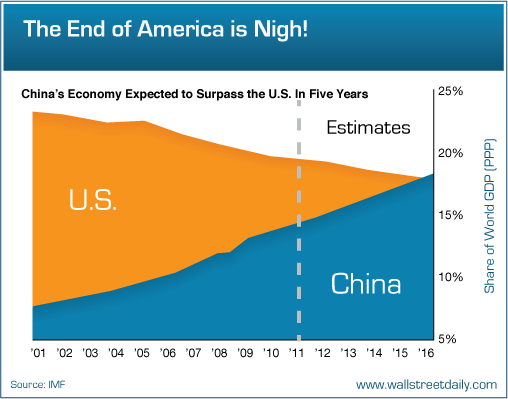
| 5 Charts of This Week's Investment News Posted: 29 Apr 2011 10:59 PM PDT Lou Basenese submits: If you weren't with us last week, every Friday I'm embracing the old adage, "A picture is worth a thousand words." As such, I'm selecting five graphics that put the week's investment news into perspective – and pictures – for you. In short, it's goodbye to longwinded commentary and hello to easy-to-understand visuals, with some quick-hit observations… The End of America is Nigh! The gloom-and-doom crowd has banged the drum on this one for years: America's global economic dominance is about to end. This week, the International Monetary Fund went a step further by officially setting a date for this changing of the guard. Based on purchasing power parity (PPP), China's economy should overtake America's as the world's largest by 2016. Skeptics caution that using PPP to calculate the transition date is too aggressive. However, there are more "accurate" calculations that still point to a transition… except not until 2030. Complete Story » |
| Real Estate Talks Are Designed To Get Banks Off Liability Hook Posted: 29 Apr 2011 10:22 PM PDT "Foreclosure Probe Talks Said to Yield Some Agreements With Banks." "Attorneys general negotiating a settlement of a 50-state investigation of foreclosure practices have reached agreements with lenders on some terms while failing so far to reach an accord on potential monetary payments by the banks, said a person familiar with the talks." "The probe was triggered by claims of faulty foreclosure practices following the housing collapse which law enforcement officials said may violate state law. Significant progress has been made on a deal with lenders, which include Bank of America Corp. (BAC) and JPMorgan Chase & Co. (JPM), with agreements in principle reached on several issues, said person, who didn't specify the areas of accord as they change as talks proceed." "Principal reductions I don't think are going to be agreed to by banks, and I don't think the banks see a need for a penalty when, in their view, they haven't done anything wrong," said Schoenthal, who represents lenders and servicers and isn't involved in the talks." (Editor: Banks made the destructive messes and should be liable). "The 50 states, along with federal agencies including the Justice Department, seek to set requirements for how banks service loans and conduct home foreclosures. Last month, the states submitted proposed settlement terms to five mortgage servicers and have been meeting with bank officials to reach a final settlement. The proposal called in part for monetary payments by banks to go toward a loan modification program that would reduce loan principals for homeowners." "In a speech to a group of attorneys general earlier this month, Bank of America Chief Executive Officer Brian Moynihan said "broad-based" principal reductions aren't "a sound policy decision for America. Fairness is a major concern," he said, according to the prepared text of the speech. "It's hard to see how we could justify reducing principal for many delinquent customers who represent a small portion of borrowers, but not for the vast majority of our customers who have stayed current on their loans." "Any agreement on principal reductions will depend on the size of the write-downs, the incentives for the servicers built into the settlement and other details, which continue to be sorted out, said the person close to the negotiations. Miller said last month after a meeting between banks and state and federal officials that the two sides had "a long way to go" to reach an agreement." 'The 14 mortgage servicing companies who reached deals with U.S. regulators agreed to conduct a review of loans that went into foreclosure in 2009 and 2010, and improve their procedures for modifying loans and seizing homes. They also agreed to stop foreclosing on homes while negotiating lower mortgage payments for borrowers." "The regulators included the Office of the Comptroller of the Currency, the Fed, The Office of Thrift Supervision and the Federal Deposit Insurance Corp." "Bank of America, JPMorgan, San Francisco-based Wells Fargo, New York-based Citigroup and Detroit-based Ally are the five companies involved in the talks with the 50 states." "A flood of borrower delinquencies caused by sub-prime loans and the collapse of housing prices led servicers to rely on workers who failed to track paperwork or, improperly signed legal documents to speed foreclosures. Reports of so-called robo-signing prompted some lenders to temporarily suspend foreclosures last year. The banks didn't admit or deny regulators' findings as part of their agreements. Iowa's Miller said the settlements with regulators wouldn't affect the larger state effort to reach a nationwide agreement." - David McLaughlin 4-18-11 Bloomberg.net         This posting includes an audio/video/photo media file: Download Now |
| The fight over Gold has only two possible outcomes Posted: 29 Apr 2011 09:30 PM PDT |
| Investors Missing the Boat on Gold and Silver Explorers Posted: 29 Apr 2011 09:00 PM PDT |
| The Gold Miner's Vengeance-as told by Frank Usher Posted: 29 Apr 2011 08:00 PM PDT The story of the life and death of George Woodfall is one of the strangest to come from the continent of Australia. The details were pieced together from Woodfall's own statement, and the accounts of the men who found his body in the strangest and apparently most unnatural circumstances. George Woodfall was an Englishman of good family who emigrated to Australia about 1850 to seek his fortune, after losing all his money in the Old Country. In February, 1851, a Californian gold-miner named Hargraves discovered gold at Summerhill Creek, which is a hundred miles or so to the north-west of Sydney. Woodfall was among the first of the immigrants in the great gold rush that followed when rich finds were also made in Victoria.:idea: Woodfall joined up with two men–Harper and Freeth–rough characters both. Harper had come out years previously on a convict ship. But neither he nor Freeth were really bad characters. Living the pioneer life brings out the best as well as the worst in men. Gold prospecting, however, is more likely to bring out the worst. Certainly it brought thousands of undesirables to Australia, to the great concern of the authorities. No one, certainly not Woodfall, pretended that Harper and Freeth were blackguards of the deepest dye, and they did not deserve the treatment meted out to them by Woodfall–an educated man and an English gentleman. Neither Harper and Freeth could write their own names, yet they were good mates to Woodfall, welcoming him when he arrived at the diggings, and sharing, as Woodfall admitted, fair and square in everything. The three teamed up together and struck gold. Between them they did well enough, traveling about in the mountains, prospecting, carrying with them their loads of gold dust and nuggets, already worth a considerable fortune.:D Indeed they had enough each to make themselves comfortable for life. But prospectors are never satisfied. Gold creates in them a fever which cannot be satisfied.:eek_ma: They want more and more of it. They were talking about going to Sydney and cashing up when they discovered a wondrous cave in what looked like a gold-bearing mountain, from which leaped a spectacular waterfall. The case was difficult to get into. They found the entrance after some arduous climbing. It was a vertical shaft in the face of the mountain, and to descend it they had to drive wooden stakes into the soft rock. When they got down they found a vast, cathedral-like cavern which reverberated to the distant thunder of the mighty waterfall. Their torches illuminated great stalactites and stalagmites, and glittered on multi-colored prisms of rock. Most exciting of all to them, they saw quartz in the great pillars which supported the roof of the cave. But this splendid and awe-inspiring place yielded little in the way of gold. The quartz, though exquisite in appearance, was poor in gold. To get it they had to break into a rock formation which was like one of those great exquisitely carved altar-piece in a cathedral. Behind this, they found a smaller cave. After searching in vain for gold in this strange and splendid place, they decided to pass the night in the small cave, before resuming their journey to Sydney. The talk that night was of their plans for the return to civilization. They each calculated the value of their gold, and came to the conclusion that they hadn't done too badly. Each said it would be the soft life for them in the future. They had had enough of roughing it, and wanted to enjoy the sweets of civilization, which their gold would enable them to do. As the talk drifted to yarns about Sydney and the wild times of the old days, George Woodfall fell unusually quiet. His thoughts ran on very different lines to those of his companions. For them their share of the gold was enough, but not for him. He had come to Australia to rebuild his fortune, and he would not be satisfied with the kind of money that these simple diggers considered riches. The total amount of their gold represented a respectable sum of money. With that for his capitol, Woodfall was convinced he could really make money.:fisheye::wub: But there was little chance of robbing his two companions and making away with the gold. He would be a marked man. That sort of thing would not be forgiven or forgotten. There was only one solution–to kill them. Harper and Freeth soon fell into a heavy sleep. Woodfall lay awake planning their murder. It would have to be done very swiftly, and before the fire they had lit in the cave burnt out. Woodfall waited until the fire was low and then he struck silently and suddenly with his razor-sharp knife. First Freeth, who was closer to him. He got him with one blow right through the heart. But though Freeth was dispatched so quicky and suddenly, Harper was instantly awake, that sixth sense which men often acquire while living in the wilds suddenly alerted. Harper stumbled to his feet and launched himself straight at Woodfall. But Harper was still half-asleep, and Woodfall had not much difficult in dealing with him. He grasped him by the throat and tore at his gullet. They fell over, fighting madly. Woodfall's knife was dropped in the desperate struggle, but he retained his hold on Harper's throat, and Harper went down in a state of semi-consciousness. Woodfall turned and picked up his knife, then came for his comrade once more to finish him off. Harper struggled up into a sitting position, his face livid, eyes protruding, mouth open and gasping. He was unable to speak, for he had been all but strangled by Woodfall. He looked up desperately at Woodfall, and put his hands together, praying for mercy. But this Woodfall did not give. He had gone too far anyway. He plunged his knife deep into Harper's chest. Harper died with a harsh and terrible cry which echoed and re-echoed through the great vaults of the cathedral-like cave nearby. Woodfall decided to leave the place at once, even though it was night-time. He collected the gold from his companions' packs, but the sight of his comrades lying there slain so treacherously by his own hand was too much for his conscience, and he decided to bury them. It would be the best way of hiding the crime, anyway. But he found digging in the hard soil extremely difficult. It was more a case of hewing than digging. After he had dug a shallow pit, he gave up the idea of burying them. After all, it was unlikely that anyone would ever discover this cave in this lovely and remote spot. And if they did there would be nothing to connect him with the bodies of Harper and Freeth. So he laid their bodies in the shallow pit he had excavated, and covered them with some loose stones. And thus he left them and went to Sydney.:lollypop: The date was 20 September. The year 1852 or 1853. No one knew him at Sydney, which in those days was a city with a population of 100,000, compared with two million today. It was a large enough place for George Woodfall to remain comparatively unknown. He told everyone he had lately arrived from England with a modest amount of capital he wished to invest. When the occasion arose Woodfall took a chance, in the same way as he had taken a chance in the cave when he robbed and murdered his two comrades. He invested nearly all of his capital in the Benambra Mine. A week later the shares rocketed and he was a very rich man.:shine: Woodfall was so pleased with his success that he forgot his crime and enjoyed himself. He brought a fine house on Pott's Point, where he entertained at first lavishly and not wisely. September came around again, and one evening about the middle of the month he was sitting alone by the open window of his house gazing across the dark waters of Port Jackson to the harbor lights at the Heads, when he fell into a fit of bitter remorse over what he had done. He would have given all his wealth to have washed the blood from his hands. In that mood he had a strong impulse to rush to the police and confess his crime. Momentarily the mood passed and he turned away from the window with the reflection that dead men could surely tell no tales. As he turned into the room, he heard a voice distinctly say: "It is time. Let us begin." Thinking at first that burglars were about, he got out his revolver and made a search. But there were no intruders around his house–no intruders from this world, that is. Woodfall put out the lights and prepared to go to bed. He picked up the candle and started for the door. He had hardly taken a step, he says, when suddenly something like a heavy body fell with a thud at his feet. As he stumbled back in alarm he began to hear sounds–sounds that had haunted him for months, but now they burst terrifying upon his ears. There was the waterfall reverberating in the background, and then, splitting his eardrums, came Harper's last cry as he died with Woodfall's knife deep in his chest. There were other noises, too, terrifying, indescribable, unspeakable noises which shook and echoed around his house. He sank into a chair, covering his ears with his hands to try and shut out the spectral sounds, but was unable to do so. He was back in the cave now, in that awful night, in a living nightmare that appalled his senses. At any moment he expected his servants to be aroused by the terrible, frightening noises which rose every now and then in a crescendo to Harper's unforgettable scream of death. But no one in the house stirred, and he soon became aware that he was the only one who could hear these sounds–this devil's concert, as Woodfall called it. When this thought was brought home to him, the sounds suddenly ceased. Then, as plain as if he was standing next to him, he heard Harper's voice. "You are growing forgetful, George. In a week's time it will be September the twentieth. We are here to remind you." George Woodfall was now in a state of uttermost terror. He was convinced of the presence not only of Harper but of Freeth in the room. But it was Harper who spoke, Harper whose death cry was a living echo in his brain. "Your time has not come yet, George, but before it does we will teach you to remember. We will expect you in the cave on the twentieth. Don't forget to come. That is the only way you will escape us.":eek_ma: "Yes, I will come," muttered Woodfall, and then his consciousness ceased. A dream? A waking nightmare prompted by his tormenting conscience? At all events Woodfall went to the cave and there he spent, he said, "a night of such agonizing horror that I wondered afterwards how I came to retain either life or reason after it." What took place in that cave can only be imagined. But it is not likely that Woodfall could have brought himself to touch the bodies of the two men he had murdered and placed in that shallow pit. This is an important point, in view of what happened later. Every year now he made this terrible pilgrimage to the cave, and spent a whole night in a kind of hellish communion with his victims, whose bodies lay rotting in the shallow pit. Each year they became more decayed, more skeletal, and yet in some unnatural way more alive. But only by going there each year did they give him peace. After the forth year, he tried not going. But there was no evading his grim pilgrimage. Harper and Freeth came and haunted him at Pott's Point–came after him and drove him to the cave for his grim annual ritual. This experience had one beneficial effect upon Woodfall. It changed his whole life. He gave up all forms of gaiety and enjoyment, and tried to make amends by good deeds. He gave to charity. He went to church regularly, and became one of Sydney's most respected citizens. No one dreamed he was a murderer, for he kept his terrible secret locked up inside him. For some reason, he could not confess to what he had done. He was quite unable to. If he did, would Harper and Freeth leave him alone in peace at last? And after twenty miserable, haunted years, and after nineteen visits to the unspeakable cave, he finally decided to make his confession. One night he wrote it out, and finished it by saying that he would make one more pilgrimage to the cave, because this, he felt, he must do. Then he would return and give himself up. And so he went on his last pilgrimage, but he never returned. Sydney mourned an upright and benevolent citizen, whose disappearance was both a sensation and a mystery. No foul play was suspected. His affairs were found to be in perfect order. He was greatly missed, and later they put up a monument to him. The mystery remained unsolved for five years. In the late 1870s two men, William Rowley, an engineer who had planed and made many canals in New South Wales, and the Rev. Charles Power, of St. Chrysostom Church, Redfern, Sydney, were spending one of those energetic holidays typical of the nineteenth century, camping and traveling in the wilds of the Blue mountains, and living off the land by eating such meat as could be shot by Rowley's gun. The Rev. Power employed his energies more suitable catching butterflies for his large Australasian collection. Both of them knew George Woodfall by reputation and by sight. It was on 20 September when they came upon the mountain from which leaped the spectacular waterfall. Here they camped for the night, enchanted by the wildly beautiful scenery, fascinated by the waterfall, and totally unaware that the day marked the anniversary of a certain grim event. After supper, while they were yarning over their pipes by the camp fire, there was a great thunderstorm, during which, by some strange trick of the eyesight perhaps, a blood-red glare settled over the waterfall, so that it appeared to them like a torrent of blood. They regarded it as a strange natural phenomenon, but when the storm passed off the red glare was still above the waterfall and right in the midst of the water, it seemed, a man appeared. They started forward, stumbling in the darkness, then stopped, transfixed to the spot, for they saw that the man had a face that was long dead, with the flesh shrunken and dried and in some places rotted away. It was a mere skeleton, a thing, they thought, from the outer darkness. It seemed suspended there in a blaze of crimson light, alternately beckoning to them and then writhing in anguish. It took them an hour and a half to climb to the spot where they had seen the ghost, and another hour to reach the summit where the waterfall leaped down the chasm. The precipice was sheer and the mountain towered above them in the night. Climbing higher, they saw a fallen ironbark tree which had been blazed with an axe and an arrow pointing directly downwards. Close by they found the entrance to the cave, now overgrown with shrubs. Rowlet cut a sapling and beat away the undergrowth, revealing the mouth of the cave which led vertically downwards. The wooden stakes made by Woodfall and his two companions twenty-five years previously were still there and just as secure. Lighting their bull's-eye lantern, Rowley and Power descended. Some minutes later they stood in wonder and astonishment in the great cathedral-like cavern. The huge rock formation made like an alter-piece particularly impressed and interested Power, and while he was admiring it Rowley went through past the broken quartz rock into the smaller cave beyond. His exclamation of horror brought Power hurrying after him. "What's the matter?" asked the clergyman. "Come, let's go back," said Rowley, obviously shaken. "This is no place for us." "For heaven's sake–what is it?" demanded Power. Rowley illuminated the scene with the bull's-eye lantern. In front of them was the shallow open grave. The earth which had been dug up to make it and piled at the side had been hardened almost to stone by the endless drip of water from above. Even the tools with which the grave had been dug were still lying there. But what took their horrified attention was the skeleton of a man, bush shirt and trousers rotted to tatters, half sitting at the side of the grave, peering into it, grinning in a way in which only a skull can grin.:biggrin: In the grave itself lay two more bodies, one of top of the other. The topmost was a skeleton similar to the one sitting at the grave-side. Underneath it was the body of a man in the last stages of decay, though he had not been dead for anything like the time which the other two had been. There was something weirdly familiar about him to the two horrified men who peered down into the grave, and when Rowley reached down with his sapling and brushed aside the upmost skeleton, they could see that the man underneath was the man who had appeared to them above the waterfall just after the thunderstorm. Both men were mystified as well as appalled by their discovery. There was something weird, unnatural, about the whole thing–in the very attitudes of the two corpses in the pit, quite apart from the apparition by the blood-red waterfall. The fact that two of the bodies had obviously been dead for many years longer than the third puzzled Rowley and Power. And how was it possible that the man who had plainly been the last to die was found lying underneath a man who had died many years before him?:bear_blink: To the Reverend Charles Power there was something devilish about the whole thing–something that smelt of the very pit of hell. They looked around the cave and found an old coat, fast falling to pieces with age, but which was obviously well tailored and of good cloth. It had the label of Schuylen, one of Sydney's best tailors. In the coat they found a flat metal box containing the inscription: "George Woodfall, Pott's Point, Sydney," and they had the answer to the mystery, for inside was the confession of how he had killed Harper and Freeth for their gold, and then been made to return to this place every year by some hideous force he was unable to resist. The answer to the mystery? It was only part of the answer. In his confession Woodfall said he would go to the cave for the last and twentieth time after writing his confession, and then give himself up. But he did not return from the cave. How then was he killed? Originally he had laid the bodies of Harper and Freeth in the grave. There they lay for nineteen years and more, and thus he found them on each wretched visited he made to this place of hideous memory. On the twentieth pilgrimage, after he had made his confession, did he arrive there to find them sitting on the edge of the grave awaiting him, knowing that he had finally delivered himself into their power? Rowley and Power buried the three bodies in the cave, and Power read the burial service over them. The clergyman never understood why Woodfall, having finally confessed to his crime, was then delivered into the power of the spirits of darkness. But he firmly believed that his and Rowley's footsteps had been guided to the cave to find Woodfall's confession, and to give the three bodies a Christian burial, so that their long-tormented spirits should rest in peace at last. Over their remains he and Rowley piled a cairn of gold-bearing quartz. |
| Posted: 29 Apr 2011 08:00 PM PDT After the first-ever Fed press conference, gold and silver rose sharply. This was hardly a vote of confidence in paper money. Perhaps the event and the Federal Open Market Committee statement that ... |
| Itchells Manor-of Gold and Ghosts! Posted: 29 Apr 2011 07:02 PM PDT  His valet, Giuseppe Mancini, was in a miserable situation. Squire Bathurst refused to buy adequate food supplies, and was slowly deteriorating both mentally and physically. The one thing he still took any pleasure in was counting his money. On many a night Giuseppe would hear him murmuring away in his locked bedroom, counting the coins he kept locked in a great trunk. Giuseppe, near starvation himself, came up with a plan to do away with Squire Bathurst, take his money, and return to his native Italy a rich man.:bandit: He first found a place to hide the squire's body—not a hard task; the man was so emaciated he could have been hidden under a couple of floorboards–, taking some of the bricks out of a certain fireplace in an upper room and making a sort of niche. Then, one night when all was dark and silent, he slipped into the squire's room, intending to smother him with a pillow. That plan went awry when the squire woke up, and Giuseppe ended up cutting his throat with a straight razor instead. Giuseppe wrapped the body in a sheet, carried it upstairs, placed it in its fireplace tomb, and replaced the bricks, being careful to use fresh mortar to seal Squire Bathurst in. He was just about to walk out forever when he was stopped in his tracks by a frantic knocking—coming from behind the bricks he had just mortared in place—and the sound of Squire Bathurst's unmistakeable voice shouting, "Let me out! LET ME OUT!":eek_ma: Giuseppe raced downstairs and dragged the trunkful of coins out to the stable, where he placed it in the one carriage Squire Bathurst had kept, hitched up the one ill-fed horse still left of an excellent stable, and tried to drive away from the house. Within a couple of miles, the horse dropped dead in the traces, the effort too much for its starved body, and the carriage collapsed under the weight of the trunkful of gold. Giuseppe, still in a panic, filled his pockets with coins and ran for the nearest seaport. Unfortunately, the money was found, the squire's squalid house searched, and a "Hue and Cry" raised for the missing valet. He was arrested, convicted, and hanged for his crime.:five::23_28_100s: Itchells Manor was inherited by Alexander Bathurst's nephew. Within a century, however, the Bathurst line died out when the only male heir was killed at Waterloo, and the house was sold to a family called Lefroy. Oddly, none of the Bathursts were ever disturbed by the squire's spirit. The Lefroys weren't so lucky. At Easter, in 1823, they threw a house party, and the murdered Squire chose then to make his presence known. On the first night of the party, one of the Lefroy servant girls was upstairs in a certain bedroom, making up the fire in a certain massive fireplace, when she was scared into flight by knockings from the chimney piece—hard enough knocks to make the bricks tremble when she touched them—and a voice roaring, "LET ME OUT!! LET ME OUT!!!":bear_blink: Casting caution and her mistress's orders to the wind, the girl raced down the great main staircase, almost losing her footing when an invisible body shoved her aside. She, and others summoned by her shriek of terror, distinctly heard a heavily-accented voice—a different voice from the dreadful one upstairs—wail, "Oh, my God! Oh, my God!" as the invisible being swept past. Steps raced across to the heavy front door, which swung open, letting in a blast of icy night wind, and all heard the sounds of a carriage rumbling off down the gravel drive—but there was no carriage to be seen. Not to mention that the door, which slammed itself shut as abruptly as it had opened, proved to have been locked all along.:lollypop: The guests were placated, somewhat, with the lame explanation that the girl had been frightened by a giant rat. The lady who occupied that room stayed elsewhere that night, and left the next day, and the room with the noises was shut up and remained so. Squire Bathurst, however, continued to scare the servants with odd knockings in various parts of the house, making it all but impossible for the Lefroys to keep staff. He and the spirit of Giuseppe, still trapped in the house like his murdered master, put on another full-scale performance in 1840, at which time the phenomena were observed by a Lefroy son who had been away at school in 1823, and a friend of the family, both of whom left written accounts.:bear_thumb: |
| Posted: 29 Apr 2011 04:46 PM PDT Zealllc |
| 9 Million Bicycles in Washington Posted: 29 Apr 2011 04:09 PM PDT Great news! As of Friday morning, the second most important piece of economic thought ever has been released. Please make sure you watch both: Fight of the Century (new) Back to the present So which European state got bailed out this week? What, none? Surprised dear reader? Isn't that a sign of the times? Instead, the action was far more interesting. Bond markets, well, credit default swap markets to be precise, have long considered Greek restructuring likely. But for God's sake, don't tell anyone. If you do, you may find Interpol knocking at your door. The Guardian is reporting that a London trader learned this the hard way. After emailing his clients that the Greeks may default, or do something of the like, he was interrogated by the international police. Would a Gestapo reference be entirely out of place here?And since when do Interpol handle securities law? Oh wait, a sovereign nation is at stake. And, perhaps more importantly, banks are at stake too. The Telegraph reports: 'On Saturday Jurgen Stark, an executive board member of the ECB, warned that a restructuring of debt in any of the troubled eurozone countries could trigger a banking crisis even worse than that of 2008. 'A restructuring would be short-sighted and bring considerable drawbacks,' he told ZDF, the German broadcaster. 'In the worst case, the restructuring of a member state could overshadow the effects of the Lehman bankruptcy.' Yes, there they are again - the threats of chaos. Bail us out or else... But who is left to do the bailing this time around is a mystery. A Business Intelligence article mentions a 'new report from Deutsche Bank ranks the US government as the world's fourth riskiest sovereign borrower, behind Greece, Ireland and Portugal, and just ahead of Italy.' (Wait, wasn't Deutsche right on top of the list of Federal Reserve rescues?) The Telegraph points out that the UK is much like Japan and also has the deficit to match the PIIGS. So who is left to let the dollars flow? *** crickets chirp *** If you think that the governments of the world will look to their money printers for help, you are probably right. But a few days ago, your editor floated a theory that may upset that sequence of events. What if the Fed and the ECB refused to go along with their respective deficit indulging countries? It seems like a laughable stretch of the imagination. But the law actually requires it. Price stability is part of the Fed's mandate and the full mandate of the ECB. If you believe, as Daily Reckoning faithful probably would, that all the money printing to date will unleash inflation eventually, there won't be much room for more money printing. Of course any genuine austerity measures would be deflationary, which might create room to print some more. But the amount of monetisation required to fund the deficits of nations around the world would be massive, even under austerity. And the more monetisation and inflation, the higher rates will go, leading to even more monetisation and inflation. Unless the Fed and the ECB hit the brakes early. Put it this way: If you were Chairman of the Fed or President of the ECB, would you want to be forever known as the one who let the inflation genie out of the bottle? Or would you prefer to let the politicians take the heat for their irresponsible deficits which they expect you to obediently monetise? Why share the blame when it rests squarely on their shoulders? We'd like to think that Bernanke and Trichet's successor will stand up to the pressure put on them by their governments. You may laugh at the idea, but remember that a bureaucratic organisation's goal is to perpetuate itself and blame other bureaucratic organisations for its mistakes. The central banks can't do that by siding with their doomed governments. And here's another bold prediction for you: The US will be the first major casualty when it comes to the debt crisis. Whether it's some form of restructuring, or inflation because of massive monetisation of debts by the Fed. Why? Here's why: MAJOR FOREIGN HOLDERS OF TREASURY SECURITIES (in billions of dollars)  Before nations restructure their debt, you'd think they'll sell off their treasury holdings, right? Adding up the holdings of countries we consider to be in fiscal trouble, you get about $1.25 trillion of treasuries. Selling them would mean added pressure on US fiscal stability. It's not all doom and gloom though. Even one of the many 'Dr Dooms' has a cheerful note: 'Gasoline has never been so cheap' quips Peter Schiff on CNBC. You just need to find an American coin minted before 1964. The silver in that coin will buy you more gasoline than it ever has! But we poor Aussies are missing out on much of the recent fun. Metal prices in Australian dollar terms aren't matching the American's parabolic rise. Even the stock market is giving up the US's strong leads to a jumping Aussie dollar. Each time you think the ASX200 will go up, the AUD rises instead. On the bright side, if the Aussie crashes, all our assets will go up, right? Unfortunately no. Having cake and eating it too is something only the world's super power has got covered. It comes with being the world's reserve currency. Here's how it works: When the US dollar falls, as it has been doing, American assets tend to go up in dollar terms. Money is worth less, so prices rise. Simple. And win/win. Either the US dollar is the stellar performer or the Dow Jones is rallying. The over-optimistic American media loves it. But for an ASX-listed stock, life is different. Each time Wall Street seems to signal a great day, the Aussie dollar eats into the gains. That's because, of late, the Wall Street rallies have been predominantly US dollar falls in disguise. And the Aussie dollar's rise is the giveaway. Any real stock market rally would hold water against currencies around the world. The US market's gains don't. So the ASX stays put. Were the Aussie dollar to fall, that would indicate a flight away from risky assets, causing the ASX 200 to fall. That's the ridiculous situation we find ourselves in. There is no prosperity growth in much of the world. The fake prosperity engineered by Bernanke in the US is exposed as a lie by every asset not measured in US dollars. All this is why Slipstream Trader Murray Dawes has been starting many of his weekly videos with analysis of the currencies. They are where the action is. Other assets are priced in terms of those currencies, so it stands to reason. And according to the latest of those videos, released only to Slipstream subscribers, the US dollar has recently fallen below a key level. Only Slipstream subscribers will know what it means though. But why is the US dollar falling? It's basic supply and demand really. Chairman Ben Bernanke prints more dollars... they become worth less. And here is the bit you need to put your thinking caps on for: If the US stock market's gains are illusory, or based on a falling dollar, does that make the stock market a bad place to be? Well, would you rather be in cash? Of course there is a third option. One which the Daily Reckoning has been harping on about since its inception. Gold. But we won't go there today. Instead, ponder this: What would the US dollar index look like if the Chinese allowed their currency to appreciate? In our mind, the drowning anchor of the dollar hasn't even been dropped on the deck of the USS Titanic. And when it does, the US dollar will really fall. Petrol will go through the roof for Americans. Suddenly, there will be 9 million bicycles in Washington. And the Chinese will be able to afford the cars they make. The politicians calling for an end to the pegged exchange rate will be in for a shock. In other topsy turvy news, it turns out that the poor have been getting richer too, not just the rich. All those academic studies which ended in the cry 'the rich get richer while the poor get poorer' conveniently left out certain types of income. We won't comment on this further because it makes our blood boil to see how manipulative these types of studies are. Yet they set the political agenda of the day. Maybe the two are linked. Before you think we've avoided talk of housing bubbles for a whole Daily Reckoning, consider this rather odd claim from Bloomberg regarding the outlook for US real estate: 'Residential real-estate prices dropped in the 12 months to February by the most in more than a year, putting the market on the verge of eclipsing the nadir reached during the U.S. recession.' It should be of no surprise that the falls in price in a year were the most in a year, as that would be the same year. Anyway, Aussie investors who went on a house purchasing holiday to the US probably don't want to hear about the double dip in US house prices. Nor would they enjoy the look of the USD/AUD exchange rate, which only adds to their worries. Closer to home, the homeless who are included in the housing shortage figures must be getting excited at the thought of falling house prices. Perhaps they will be able to afford something soon. Like in Noosa, where prices have plummeted. Daily Reckoning reader Paul has come up with a reason for pricking the housing bubble that your editor never considered: Ok a lot has been said about negative gearing via real-estate and the property bubble Now it's time to do some lateral thinking. The government wants property price to fall; why If prices start to fall investors will bail out (sell) that means they will have to pay Capital Gains Tax!! How much will the government reap if half the investors sell their properties? Hopefully more than it will cost the government to shore up the banks afterwards... But why are Australian properties so overvalued in the first place? Our theories for the US housing market boom and bust rely on irresponsible monetary and fiscal policy. Was it the same here? The evidence is not as obvious. But it's still there. Low interest rates, tax incentives and the biggest factor of all - rising house prices. What we mean is that a house price increase, once it gets off the ground, can be self-sustaining... for a while First people are pleasantly surprised when their house goes up in value. Then they realise they can make a packet by buying another house. Pretty soon, rental returns are no longer a consideration - and losses can even be a benefit for your tax bill. What makes housing affordable is the capital appreciation. Even first-home buyers can enter the market at ridiculous prices, as they can simply sell at a higher price later. Again, the expected capital gain is a part of the justification for the price. But when the trend ends, the whole process is reversed. People can expect to begin losing the value of their deposit from the moment they sign the contract. (Please don't start telling us about the cooling-off period.) This makes housing unaffordable in the same way as appreciation made it affordable. Soon, purchasers and bankers will want significant down payments to avoid being underwater. And the RBA has gone about demonstrating yet another way central banks create instability. If, as they claim, the inflation Australia is experiencing is caused by the likes of cyclone Yasi, how does increasing interest rates help? Surely it just makes life more difficult for those struggling with the inflation. The RBA has got itself in a muddle over what inflation really is. If a cyclone causes increased prices because supply is wiped out, that is a supply and demand issue. It is not inflation. Increasing interest rates in the face of a damaged economy is a stupid thing to do. But Ian Verrender at The Age has other ideas: 'Prices are determined by supply and demand. That means you can have two types of inflation, price rises caused by excess demand or price hikes resulting from restricted supplies.' This is painfully incorrect. Real inflation is 'everywhere and always a monetary phenomenon' - an increase in the money supply - according to Nobel Laureate Milton Friedman. This usually leads to rising prices. The solution to that is to stop the money supply from increasing. It really is that simple. And if the RBA adhered to that definition of inflation, it wouldn't be putting the squeeze on Australians already suffering from a cyclone. To believe that all price changes are inflation or deflation makes the concept completely useless. Nickolai Hubble |
| Gold and USD: Launching Gold Stocks! - Morris Hubbartt article Posted: 29 Apr 2011 03:54 PM PDT |
| Mish – “The advance in Silver has been disorderly.” Posted: 29 Apr 2011 01:35 PM PDT Take Your Silver Profits
For the sake of full disclosure, my physical precious metals holdings are now entirely at GoldMoney and I have an affiliate relationship with them. As a result of that relationship, I will likely be back in silver soon, but in small amounts, and hopefully at decreasing prices. If silver crashes, I will consider switching a considerable percentage of my gold for an equal dollar value of silver. This is not a top call. I have no idea how high silver will go. No one else does either. I came close to cashing out near $30 but figured I would ride out a correction to low to mid $20's. That correction never came. However, one thing I have learned is parabolic moves seldom end well. Please consider the following charts. Silver Monthly Chart
Gold Monthly Chart
Disorderly Silver Advance Parabolic spikes in anything typically retrace a significant part of the move, sometimes all of it. Note the spike in silver from $4 to $8.50 retraced all the way back to $5.45 and the spike from $5.45 to $21.40 retraced all the way back to $8.40. Parabolic Spikes Unstable Both gold and silver seem susceptible to a pullback, but especially silver because of the unstable nature of its advance. For now, I will take my chances with gold. ~Mish, Global Economic Analysis |
| Posted: 29 Apr 2011 11:45 AM PDT its kinda hard to buy more at $50. Anyone feel the same? |
| Posted: 29 Apr 2011 09:04 AM PDT Anyone sold the one ounce coins in their original capsules? I have seen some insanely high sell prices for these on APMEX and was wondering what they pay. |
| Silver Backwardation ending? Plus parabolic rise? Plus generational $50 resistance? Posted: 29 Apr 2011 08:40 AM PDT Hmm.. Silver's backwardation ending, plus it has been on a parabolic rise, plus it is sitting just under hard psychological generational resistance at $50.. Will she at least take a breather? http://goldandsilverlinings.com/?p=847 Silver Silver on the other hand had a fairly flat day and was the total opposite of gold for the first time in a long time. It did close at $47.92 for the day up $.35/oz. The more interesting part was that the backwardation gap has narrowed and been eliminated on a shorter time frame. The Dec 2015 contract closed at $47.69 up $.93/oz, so a bit of backwardation here but the Dec 2013 contracts that closed at $48.54 up $1.38 clearly ending the backwardation over this timeframe. It would seem that everything is being thrown at constraining silver but there is likely a bit of moving back to gold given the recent run up in silver. Keeping in mind that silver had to deal with not one but two margin increases this week. Also of note is that the US dollar was barely able to hold around 73, one has to assume its being supported to even hold this level. |


 I have held physical silver and gold investments continuously for 5 years, and on and off before that. Today I cashed out of silver, trading it for an equal dollar value of gold.

| You are subscribed to email updates from Gold World News Flash 2 To stop receiving these emails, you may unsubscribe now. | Email delivery powered by Google |
| Google Inc., 20 West Kinzie, Chicago IL USA 60610 | |

No comments:
Post a Comment