


Gold World News Flash |

- The REAL silver high is probably closer to $500 an ounce once you adjust for REAL inflation
- Silver reaches within 20 cents of $50
- Goldrunner: “$52 to $56 Silver by Mid-year” Update
- In The News Today
- Jim's Mailbox
- Silver's Jaw-Dropping Rise in Context
- Got Gold Report – Silver COMEX Registered Inventory Drops 5 Million Oz
- Wake us up when China stops talking and actually sells the damn dollars
- A Guide to Looting When the SHTF (And Your Counter-Strategies)
- '$52 to $56 Silver by Mid-year' Update
- What Gold Is – and Why It’s Hated
- Silver
- Guest Post: Debunking Anti-Gold Propaganda
- Richard Russell ? The Great Gold Tsunami Lies Ahead
- Updated: Notes on the Dollar, Currencies & HUI/Gold Ratio
- Stock World Weekly: Convergence of Trouble
- Richard Russell – The Great Gold Tsunami Lies Ahead
- “What the so-called silver experts neglect to account for in their models and projections is that the fiat money experiment has failed. And in this context, we believe the Market has assigned world reserve currency status to gold — not the USD
- Why MIT Is Not Willing To Unleash Real-Time, Dynamic-Purchasing Inventory Control Systems; Or The "Real" Reason For The Culling Of MIT's Billion Prices Project
- US Dollar DX Index Very Long Term Charts
- Deepening Economic Crisis: Inflation, Rising Interest Rates, Surge in the Price of Gold and Silver
- Geopolitics and the World's Gold Holdings
- Silver Forecast $52 to $56 by Mid 2011 Update
- Things That Make You Go Hmmm.... The Ben Bernanke Flying Circus
- With no relief in sight for the dollar on any of those fronts, the downward pressure on the dollar is widely expected to continue
- Three Words That Could Help Fix the US Monetary System
- Currency Wars
- Alasdair Macleod: Will governments confiscate gold and silver?
- Why America Should Relinquish Reserve Status for its Dollar
| The REAL silver high is probably closer to $500 an ounce once you adjust for REAL inflation Posted: 24 Apr 2011 07:29 PM PDT Stick A Fork In Them! Share this:
|
| Silver reaches within 20 cents of $50 Posted: 24 Apr 2011 05:25 PM PDT [url]http://www.traderdannorcini.blogspot.com/[/url] [url]http://www.fortwealth.com/[/url] Silver is on fire in Asian trading this evening moving to a session high of $49.82 after which is rapidly dropped a full $1.00 in price before bouncing back over $49 again. It is extremely volatile right now and I mean "VOLATILE". The price is swinging all over the place within mere seconds. Its strength is helping to pull Gold higher as well which has gone on to hit a new all time high at $1518.40 as I write this. What is remarkable about this is that the Dollar is actually higher this evening in Asian trade. ...
|
| Goldrunner: “$52 to $56 Silver by Mid-year” Update Posted: 24 Apr 2011 04:11 PM PDT Silver’s Parabolic Path Continues as Previously Predicted Back on February 18th I wrote an editorial showing that [B]Silver could rocket up to $52 to $56 by mid-year.* At the time of the writing Silver was sitting a little above $32 on the price chart.* The original chart work was based off of the fractal chart work I do with Silver from previous fractal time periods.* So far the rise in Silver appears to be right on track for our expected targets to be approached into mid-year.[/B]*[Let me review the details with you.] Words: 1069 So*says**Goldrunner (www.GoldrunnerFractalAnalysis.com)*in*an article which Lorimer Wilson, editor of www.munKNEE.com, has reformatted*and edited* below for the sake of clarity and brevity to ensure a fast and easy read. (Please note that this paragraph must be included in any article re-posting to avoid copyright infringement.)*Goldrunner*goes*on to say: Silver has entered the more parabolic path of this historic PM Bull very much like it did back ...
|
| Posted: 24 Apr 2011 02:32 PM PDT
Shri Sathya Sai Baba In the midst of our world, the madness we discuss every day, there are great and beautiful things. One such event happened yesterday. Shri Sathya Sai Baba transitioned from body yesterday. The world is an infinitely better place since he visited here. Baba and his teachings to all faiths will be with us forever. Dearest friend, friend to all men and spiritual preceptor; gone to the eyes but eternal in our hearts.
Jim Sinclair's Commentary Concerning reports that China has declared financial war by threatening to sell significiant amounts of US Treasuries: I feel it is as impossible for China to cut 2/3 of it US Treasury holdings as it is for the US to cease Quantitative Easing. The most probable result is that China continues to liquidate US treasuries and does not roll over maturities as they are now while the Fed in June changes the name of QE to investing rollovers by utilizing the funds to purchase other US debt issues. The final determinant of all these political / financial manoeuvres is the condition of the US dollar as it applies to gold. The US dollar is headed to .7200, will bounce and then continue lower. Gold is heading to $1650 and higher.
Jim Sinclair's Commentary Consider for a moment what things would have looked like if QE did not exist in the US as well as other major Western financial systems. What would this so called recovery look like? Now think how things will look if the Fed, pressured politically, ceases QE. Then think how fast and big the next program (with a new name for QE) will be to manufacture money before all legislators, Democrats and Republicans, get sent home along with the Administration in 2012. Be realistic. Before our beloved politicians give up their power forever the master of the financial universe will burn down the dollar barn. Gold is locked and loaded for $1650 and higher. Stimulus by Fed Is Disappointing, Economists Say WASHINGTON — The Federal Reserve's experimental effort to spur a recovery by purchasing vast quantities of federal debt has pumped up the stock market, reduced the cost of American exports and allowed companies to borrow money at lower interest rates. But most Americans are not feeling the difference, in part because those benefits have been surprisingly small. The latest estimates from economists, in fact, suggest that the pace of recovery from the global financial crisis has flagged since November, when the Fed started buying $600 billion in Treasury securities to push private dollars into investments that create jobs. As the Fed's policy-making board prepares to meet Tuesday and Wednesday — after which the Fed chairman, Ben S. Bernanke, will hold a news conference for the first time to explain its decisions to the public — a broad range of economists say that the disappointing results show the limits of the central bank's ability to lift the nation from its economic malaise. "It's good for stopping the fall, but for actually turning things around and driving the recovery, I just don't think monetary policy has that power," said Mark Thoma, a professor of economics at the University of Oregon, referring specifically to the bond-buying program. Mr. Bernanke and his supporters say that the purchases have improved economic conditions, all but erasing fears of deflation, a pattern of falling prices that can delay purchases and stall growth. Inflation, which is beneficial in moderation, has climbed closer to healthy levels since the Fed started buying bonds.
Jim Sinclair's Commentary Gold's increased value reflects the weakness of debt, not only at the Federal levels but everywhere in the Western world economies. It found its birth amongst the still smug OTC derivative manufacturers and distributors. The flushing of Lehman pulled the cork out of the financial debacle's bottle. FASB sold their souls when they conspired with Wall Street to hide the damage. QE put the sheeple to sleep. Now it is all coming home. US Default Could Be Disastrous Choice for Economy The United States has never defaulted on its debt and Democrats and Republicans say they don't want it to happen now. But with partisan acrimony running at fever pitch, and Democrats and Republicans so far apart on how to tame the deficit, the unthinkable is suddenly being pondered. The government now borrows about 42 cents of every dollar it spends. Imagine that one day soon, the borrowing slams up against the current debt limit ceiling of $14.3 trillion and Congress fails to raise it. The damage would ripple across the entire economy, eventually affecting nearly every American, and rocking global markets in the process. A default would come if the government actually failed to fulfill a financial obligation, including repaying a loan or interest on that loan. The government borrows mostly by selling bonds to individuals and governments, with a promise to pay back the amount of the bond in a certain time period and agreeing to pay regular interest on that bond in the meantime. Among the first directly affected would likely be money-market funds holding government securities, banks that buy bonds directly from the Federal Reserve and resell them to consumers, including pension and mutual funds; and the foreign investor community, which holds nearly half of all Treasury securities.
Jim Sinclair's Commentary No, gold is not rising only because the US is broke. It is rising because the debt of the entire Western world is BROKEN. Is gold rising because America is broke? – Gold Matters Gold prices shot up to a new record of $1,512.50 an ounce in New York late on Friday, posting a record weekly gain and maintaining a six-week winning streak. While a lot of gold investors are laughing all the way to bank the world over, gold's super cycle rally could have ominous meanings for the Us economy. Analysts have pointed out that gold's advance into what is termed as a super cycle does not bode well for the US economy. A sustained gold and oil boom indicates that the dollar is slipping into grave danger and the economy closer to collapse, according to Daily Markets analyst Michael Snyder. "… when these commodities go up in price it is a sign that the U.S. dollar is dying and that our country is getting closer to economic collapse," Snyder wrote recently.
|
| Posted: 24 Apr 2011 02:28 PM PDT Dear Jim, It matters more what 1.3 billion Chinese who have a growing middle class think now and in the future than 350 million Americans with a declining middle class! Cheap gold and silver is a thing of the past. The share shorts are in for a religious experience very soon. Best, China to lead world economy CHINA is about to overtake the United States as the world's biggest economy, creating profound changes in the balance of global power. In forecasts inserted quietly on its website in recent days, the International Monetary Fund has projected that, by 2016, China will overtake the US in real economic output – the first time in the modern era that any country has done so. Economic historian Angus Maddison estimated that the Soviet Union at its peak produced only a third as many goods and services as the US; Japan's economy at its peak was still less than half the size of the US economy. China's ascension has been startlingly different, in speed and size. If it grows at anything like the 10 per cent rate it has averaged since 1980, its economy will be far bigger than that of the US within a generation. Australian National University professor of strategic studies Hugh White said the looming end of US economic dominance marked a turning point for the world, and had serious implications for Australia.
|
| Silver's Jaw-Dropping Rise in Context Posted: 24 Apr 2011 02:26 PM PDT Clusterstock - (22 Apr 11)
|
| Got Gold Report – Silver COMEX Registered Inventory Drops 5 Million Oz Posted: 24 Apr 2011 01:14 PM PDT Trust in the world's reserve currency, the U.S. dollar, is understandably under assault given the current captain, cast and crew in Washington D.C. and their apparent inability to understand that the U.S. does not have a revenue problem, it has a decades-in-the-making problem with too much borrowing to pay for way too much government spending.
|
| Wake us up when China stops talking and actually sells the damn dollars Posted: 24 Apr 2011 12:19 PM PDT China Should Cap Forex Reserves at 1.3 Trillion U.S. Dollars, China Banker Says From Xinhua News Agency, Beijing http://news.xinhuanet.com/english2010/china/2011-04/23/c_13842843.htm BEIJING -- China should reduce its excessive foreign exchange reserves and further diversify its holdings, Tang Shuangning, chairman of China Everbright Group, said on Saturday. The amount of foreign exchange reserves should be restricted to between $800 billion to $1.3 trillion in U.S. dollars, Tang told a forum in Beijing, saying that the current reserve amount is too high. China's foreign exchange reserves increased by $197.4 billion in the first three months of this year to $3.04 trillion by the end of March. Tang's remarks echoed the stance of Zhou Xiaochuan, governor of China's central bank, who said on Monday that China's foreign exchange reserves "exceed our reasonable requirement" and that the government should upgrade and diversify its foreign exchange management using the excessive reserves. Meanwhile, Xia Bin, a member of the monetary policy committee of the central bank, said on Tuesday that $1 trillion U.S. dollars would be sufficient. He added that China should invest its foreign exchange reserves more strategically, using them to acquire resources and technology needed for the real economy. Tang also said that China should further diversify its foreign exchange holdings. He suggested five channels for using the reserves, including replenishing state-owned capital in key sectors and enterprises, purchasing strategic resources, expanding overseas investment, issuing foreign bonds, and improving national welfare in areas like education and health. However, these strategies can treat only the symptoms but not the root cause, he said, noting that the key is to reform the mechanism of how the reserves are generated and managed. ADVERTISEMENT Canuc Resources Pursues Ecuador and Nova Scotia Gold Projects Canuc Resources Corp. (TSX: CDA) has confirmed high-grade gold and the potential for large-tonnage, low-grade copper and gold mineralization at its primary asset, property in the historic Nambija gold mining district in southeastern Ecuador. Last November Canuc took an option on the Mill Village gold property in southwestern Nova Scotia, which includes two past-producing mines. Canuc plans to begin surface and underground exploration at Mill Village in the next several weeks, financed by $2 million recently raised through a private placement. To generate immediate income, Canuc is acquiring MidTex Oil and Gas Co., owner of a producing gas well and a lease on 320 acres in Stephens County, Texas. Canuc's CEO, Gary Lohman, has more than 30 years of experience in the mining industry, primarily as a geologist, and the company's officers include similarly experienced people. For more information about Canuc, please visit http://www.canucresources.ca/. Join GATA here: An Evening with Bill Murphy and James Turk World Resource Investment Conference Gold Rush 2011 https://www.amsterdamgold.eu/gata/index.asp?BiD=12 Or by purchasing a colorful GATA T-shirt: Or a colorful poster of GATA's full-page ad in The Wall Street Journal on January 31, 2009: http://gata.org/node/wallstreetjournal Or a video disc of GATA's 2005 Gold Rush 21 conference in the Yukon: Help keep GATA going GATA is a civil rights and educational organization based in the United States and tax-exempt under the U.S. Internal Revenue Code. Its e-mail dispatches are free, and you can subscribe at: To contribute to GATA, please visit: http://www.gata.org/node/16 ADVERTISEMENT The Gold Standard Now: It Can Work Today a dollar is worth 80 percent less than it was 40 years ago, and less than 5 percent of its value a hundred years ago. We deserve a dollar that is as good as gold, a dollar that will hold its value from year to year so we can be financially secure and our economy can generate more and better jobs. For most of America's history, our dollar was literally as good as gold. But on August 15, 1971, our politicians destroyed the link between gold and the dollar. They destroyed the foundations of our economic system. A new Internet site, TheGoldStandardNow.org, provides news and cutting-edge analysis about this most important issue and explains how the gold standard worked in the past and how it can work in the future. Visit us today: http://www.thegoldstandardnow.org/about/137-welcome-newsmax
|
| A Guide to Looting When the SHTF (And Your Counter-Strategies) Posted: 24 Apr 2011 12:19 PM PDT Law and order will be the first casualty when the shit hits the fan. Recent historical examples the world over, including New Orleans, Haiti, and Chile show that without policing, looting will become an immediate danger. The following Guide to Looting When the SHTF by Thomas Northrop of No Bullshit Survival shows that survival and preparedness planning does not include just storing food, supplies, guns, and medicine, or creating tactical defense plans for your home and property. There will be organized gangs, whose sole method of acquiring necessities will be through looting. A friend recently mentioned that when discussing possible collapse scenarios at the water cooler, one of his office coworkers suggested that he would simply take what he needs from other people if it came down to it. Thus the looter mentality is not as isolated as we may think. In all likelihood, this person has already considered what he would do, how he would do it, and how far he was willing to go. This is a reality, so understanding and accepting it as such is important now – so that you are fully prepared to deal with it if ever confronted by such a situation. 
|
| '$52 to $56 Silver by Mid-year' Update Posted: 24 Apr 2011 11:07 AM PDT To some extent, Silver is like the canary in the coal mine when it comes to the Vth Wave advance of the Precious Metals Bull. The price of Silver acted the same way in the 1970's PM Bull Market since it takes a lot less speculative money to ... Read More...
|
| What Gold Is – and Why It’s Hated Posted: 24 Apr 2011 10:57 AM PDT Debunking Anti-Gold Propaganda Share this:
|
| Posted: 24 Apr 2011 10:55 AM PDT Share this:
|
| Guest Post: Debunking Anti-Gold Propaganda Posted: 24 Apr 2011 10:06 AM PDT
Over the weekend, Dian Chu proposed the "precious metals (and specifically silver) are a bubble" argument to a rather vociferous reaction from readers. Today, to keep the argument balanced, we present the counterpoint from Doug Casey: basically, there is no spoon...or bubble. Submitted by Doug Casey of Casey Research Debunking Anti-Gold Propaganda A meme is now circulating that gold is in a bubble and that it's time for the wise investor to sell. To me, that’s a ridiculous notion. Certainly a premature one. It pays to remain as objective as you can be when analyzing any investment. People have a tendency to fall in love with an asset class, usually because it’s treated them so well. We saw that happen, most recently, with Internet stocks in the late ‘90s and houses up to 2007. Investment bubbles are driven primarily by emotion, although there's always some rationale for the emotion to latch on to. Perversely, when it comes to investing, reason is recruited mainly to provide cover for passion and preconception. In the same way, people tend to hate certain investments unreasonably, usually at the bottom of a bear market, after they've lost a lot of money and thinking about the asset means reliving the pain and loss. Love-and-hate cycles occur for all investment classes. But there’s only one investment I can think of that many people either love or hate reflexively, almost without regard to market performance: gold. And, to a lesser degree, silver. It’s strange that these two metals provoke such powerful psychological reactions – especially among people who dislike them. Nobody has an instinctive hatred of iron, copper, aluminum or cobalt. The reason, of course, is that the main use of gold has always been as money. And people have strong feelings about money. Let’s spend a moment looking at how gold’s fundamentals fit in with the psychology of the current market. What Gold Is – and Why It’s HatedLet me first disclose that I’ve always been favorably inclined toward gold, simply because I think money is a good thing. Not everyone feels that way, however. Some, with a Platonic view, think that money and commercial activity in general are degrading and beneath the “better” sort of people – although they’re a little hazy about how mankind rose above the level of living hand-to-mouth, grubbing for roots and berries. Some think it’s “the root of all evil,” a view that reflects a certain attitude toward the material world in general. Some (who have actually read St. Paul) think it’s just the love of money that’s the root of all evil. Some others see the utility of money but think it should be controlled somehow – as if only the proper authorities knew how to manage the dangerous substance. From an economic viewpoint, however, money is just a medium of exchange and a store of value. Efforts to turn it into a political football invariably are a sign of a hidden agenda or perhaps a psychological aberration. But, that said, money does have a moral as well as an economic significance. And it’s important to get that out in the open and have it understood. My view is that money is a high moral good. It represents all the good things you hope to have, do and provide in the future. In a manner of speaking, it’s distilled life. That’s why it’s important to have a sound money, one that isn’t subject to political manipulation. Over the centuries many things have been used as money, prominently including cows, salt and seashells. Aristotle thought about this in the 4th century BCE and arrived at the five characteristics of a good money:
Of the 92 naturally occurring elements, gold (secondarily silver) has proved the best money. It’s not magic or superstition, any more than it is for iron to be best for building bridges and aluminum for building airplanes. Of course we do use paper as money today, but only because it recently served as a receipt for actual money. Paper money (currency) historically has a half-life that depends on a number of factors. But it rarely lasts longer than the government that issues it. Gold is the best money because it doesn’t need to be “faith-based” or rely on a government. There’s much more that can be said on this topic, and it’s important to grasp the essentials in order to understand the controversy about whether or not gold is in a bubble. But this isn’t the place for an extended explanation. Keep these things in mind, though, as you listen to the current blather from talking heads about where gold is going. Most of them are just journalists, reporters that are parroting what they heard someone else say. And the “someone else” is usually a political apologist who works for a government. Or a hack economist who works for a bank, the IMF or a similar institution with an interest in the status quo of the last few generations. You should treat almost everything you hear about finance or economics in the popular media as no more than entertainment. So let’s take some recent statements, assertions and opinions that have been promulgated in the media and analyze them. Many impress me as completely uninformed, even stupid. But since they’re floating around in the infosphere, I suppose they need to be addressed. Misinformation and DisinformationGold is expensive. This objection is worth considering – for any asset. In fact, it’s critical. We can determine the price of almost anything fairly easily today, but figuring out its value is as hard as it’s ever been. From the founding of the U.S. until 1933, the dollar was defined as 1/20th of an ounce of gold. From 1933 it was redefined as 1/35th of an ounce. After the 1971 dollar devaluation, the official price of the metal was raised to $42.22 – but that official number is meaningless, since nobody buys or sells the metal at that price. More importantly, people have gotten into the habit of giving the price of gold in dollars, rather than the value of the dollar in gold. But that’s another subject. Here’s the crux of the argument. Before the creation of the Federal Reserve in 1913, a $20 bill was just a receipt for the deposit of one ounce of gold with the Treasury. The U.S. official money supply equated more or less with the amount of gold. Now, however, dollars are being created by the trillion, and nobody really knows how many more of them are going to be shazammed into existence. It is hard to determine the value of anything when the inch marks on your yardstick keep drifting closer and closer together. The smart money is long gone from gold. This is an interesting assertion that I find based on nothing at all. Who really is the smart money? How do you really know that? And how do you know exactly what they own (except for, usually, many months after the fact) or what they plan on buying or selling? The fact is that very few billionaires (John Paulson perhaps best known of them) have declared a major position in the metal. Gold and gold stocks, as the following chart shows, are only a tiny proportion of the financial world’s assets, either absolutely or relative to where they've been in the past:
Gold is risky. Risk is largely a function of price. And, as a general rule, the higher the price the higher the risk, simply because the supply is likely to go up and the demand to go down – leading to a lower price. So, yes, gold is riskier now, at $1,400, than it was at $700 or at $200. But even when it was at $35, there was a well-known financial commentator named Eliot Janeway (I always thought he was a fool and a blowhard) who was crowing that if the U.S. government didn’t support it at $35, it would fall to $8. In any event, risk is relative. Stocks are very risky today. Bonds are ultra risky. Real estate is in an ongoing bear market. And the dollar is on its way to reaching its intrinsic value. Yes, gold is risky at $1,400. But it is actually less risky than most alternatives. Gold pays no interest. This is kind of true. But only in the sense that a $100 bill pays no interest. You can get interest from anything that functions as money if it is lent out. Interest is the time premium of money. You will not get interest from either your $100 or from your gold unless you lend them to someone. But both the dollars and the gold will earn interest if you lend them out. The problem is that once you make a loan (even to a bank, in the form of a savings account), you may not even get your principal back, much less the interest. Gold pays no dividends. Of course it doesn’t. It also doesn't yield chocolate syrup. It’s a ridiculous objection, because only corporations pay dividends. It’s like expecting your Toyota in the driveway to pay a dividend, when only the corporation in Japan can do so. But if you want dividends related to gold, you can buy a successful gold mining stock. Gold costs you insurance and storage. This is arguably true. But it’s really a sophistic misdirection to which many people uncritically nod in agreement. You may very well want to insure and professionally store your gold. Just as you might your jewelry, your artwork and most valuable things you own. It’s even true of the share certificates for stocks you may own. It’s true of the assets in your mutual fund (where you pay for custody, plus a management fee). You can avoid the cost of insurance and storage by burying gold in a safe place – something that’s not a practical option with most other valuable assets. But maybe you really don’t want to store and insure your gold, because the government may prove a greater threat than any common thief. And if you pay storage and insurance, they’ll definitely know how much you have and where it is. Gold has no real use. This assertion stems from a lack of knowledge of basic chemistry as well as economics. Yes, of course people have always liked gold for jewelry, and that’s a genuine use. It’s also good for dentistry and micro-circuitry. Owners of paper money, however, have found the stuff to be absolutely worthless hundreds of times in many score of countries. In point of fact, gold is useful because it is the most malleable, the most ductile and the most corrosion resistant of all metals. That means it’s finding new uses literally every day. It’s also the second most conductive of heat and electricity, and the second most reflective (after silver). Gold is a hi-tech metal for these reasons. It can do things no other substance can and is part of the reason your computer works so well. But all these reasons are strictly secondary, because gold’s main use has always been (and I’ll wager will be again) as money. Money is its highest and best use, and it’s an extremely important one. The U.S. can, or will, sell its gold to pay its debt, depressing the market. I find this assertion completely unrealistic. The U.S. government reports that it owns 265 million ounces of gold. Let’s say that’s worth about $400 billion right now. I’m afraid that’s chicken feed in today’s world. It’s only a quarter of this year’s federal deficit alone. It’s only half of one year’s trade deficit. It represents only about 5% of the dollars outside the U.S. The U.S. government may be the largest holder of gold in the world, but it owns less than 5% of the approximately 6 billion ounces above ground. From the ‘60s until about 2000, most Western governments were selling gold from their treasuries, working on the belief it was a “barbarous relic.” Since then, governments in the advancing world – China, India, Russia and many other ex-socialist states – have been buying massive quantities. Why? Because their main monetary asset is U.S. dollars, and they have come to realize those dollars are the unbacked liability of a bankrupt government. They’re becoming hot potatoes, Old Maid cards. But the dollars can be replaced with what? Sovereign wealth funds are using them to buy resources and industries, but those things aren’t money. And in the hands of bureaucrats, they’re guaranteed to be mismanaged. I expect a great deal of gold buying from governments around the world over the next few years. And it will be at much higher dollar prices. High gold prices will bring on huge new production, which will depress its price. This assertion shows a complete misunderstanding of the nature of the gold market. Gold production is now about 82.6 million ounces per year and has been trending slightly down for the last decade. That’s partly because at high prices miners tend to mine lower-grade ore. And partly because the world has been extensively explored, and most large, high-grade, easily exploited resources have already been put into production. But new production is trivial relative to the 6 billion ounces now above ground, which only increases by about 1.3% annually. Gold isn’t consumed like wheat or even copper; its supply keeps slowly rising, like wealth in general. What really controls gold’s price is the desire of people to hold it, or hold other things – new production is a trivial influence. That’s not to say things can’t change. The asteroids have lots of heavy metals, including gold; space exploration will make them available. Gigantic amounts of gold are dissolved in seawater and will perhaps someday be economically recoverable with biotech. It’s now possible to transmute metals, fulfilling the alchemists dream; perhaps someday this will be economic for gold. And nanotech may soon allow ultra-low-grade deposits of gold (and every other element) to be recovered profitably. But these things need not concern us as practical matters in the course of this bull market. You should have only a small amount of gold, for insurance. This argument is made by those who think gold is only going to be useful if civilization breaks down, when it could be an asset of last resort. In the meantime, they say, do something productive with your money… This is poor speculative theory. The intelligent investor allocates his funds where it’s likely they’ll provide the best return, consistent with the risk, liquidity and volatility profile he wants to maintain. There are times when you should be greatly overweight in a single asset class – sometimes stocks, sometimes bonds, sometimes real estate, sometimes what-have-you. For the last 12 years, it’s been wise to be overweight in gold. You always want some gold, simply because it’s cash in the most basic form. But ten years from now, I suspect that will be a minimum. Right now it’s a maximum. The idea of keeping a constant, but insignificant, percentage in gold impresses me as poorly thought out. Interest rates are at zero; gold will fall as they rise. In principle, as interest rates rise, people tend to prefer holding currency deposits. So they tend to sell other assets, including gold, to own interest-earning cash. But there are other factors at work. What if the nominal interest rate is 20%, but the rate of currency depreciation is 40%? Then the real interest rate is minus 20%. This is more or less what happened in the late ‘70s, when both nominal rates and gold went up together. Right now governments all over the world are suppressing rates even while they’re greatly increasing the amount of money outstanding; this will eventually (read: soon) result in both much higher rates and a much higher general price level. At some point high real rates will be a factor in ending the gold bull market, but that time is many months or years in the future. Gold sentiment is at an all-time high. Although gold prices are at an all-time high in nominal terms, they are still nowhere near their highs in real terms, of about $2,500 (depending on how much credibility you give the government’s CPI numbers), reached in 1980. Gold sentiment is still quite subdued among the public; most of them barely know it even exists. Some journalists like to point out that since there are a few (five, perhaps) gold dispensing machines in the world, including one in the U.S., that there’s a gold mania afoot. That’s ridiculous, although it shows a slowly awakening interest among people with assets. Journalists also point to the numerous ads on late-night TV offering to buy old gold jewelry (generally at around a 50% discount from its metal value) as a sign of a gold bubble. But this is even more ridiculous, since the ads are inducing the unsophisticated, cash-strapped booboisie to sell the metal, not buy it. You’ll know sentiment is at a high when major brokerage firms are hyping newly minted gold products, and Slime Magazine (if it still exists) has a cover showing a golden bull tearing apart the New York Stock Exchange. We’re a long way from that point. Mining stocks are risky. This is absolutely true. In general, mining is a horrible business. It requires gigantic fixed capital expense to build the mine, but only after numerous, expensive and unpredictable permitting issues are handled. Then the operation is immovable and subject to every political risk imaginable, not infrequently including nationalization. Add in continual and formidable technical issues of every description, compounded by unpredictable fluctuations in the price of the end product. Mining is a horrible business, and you’ll never find Graham-Dodd investors buying mining stocks. All these problems (and many more that aren’t germane to this brief article), however, make them excellent speculative vehicles from time to time. Mineral exploration stocks are very, very risky. This is very, very true. There are thousands of little public companies, and some are just a couple steps up from a prospector wandering around with a mule. Others are fairly sophisticated, hi-tech operations. Exploration companies are often classed with mining companies, but they are actually very different animals. They aren’t so much running a business as engaging in a very expensive and long-odds treasure hunt. That’s the bad news. The good news is that they are not only risky but extraordinarily volatile. The most you can lose is 100%, but the market cyclically goes up 10 to 1, with some stocks moving 1,000 to 1. That kind of volatility can be your best friend. Speculating in these issues, however, requires both expertise and a good sense of market timing. But they’re likely to be at the epicenter of the gold bubble when it arrives – even though few actually have any gold, except in their names. Warren Buffett is a huge gold bear. This is true, but irrelevant – entirely apart from suffering from the logical fallacy called “argument from authority.” But, nonetheless, when the world’s most successful investor speaks, it’s worth listening. Here's what Buffett recently said about gold in an interview with Ben Stein, another goldphobe: "You could take all the gold that's ever been mined, and it would fill a cube 67 feet in each direction. For what that's worth at current gold prices, you could buy all – not some, all – of the farmland in the United States. Plus, you could buy 10 Exxon Mobils, plus have $1 trillion of walking-around money. Or you could have a big cube of metal. Which would you take? Which is going to produce more value?" I’ve long considered Buffett an idiot savant – a genius at buying stocks but at nothing else. His statement is quite accurate, but completely meaningless. The same could be said of the U.S. dollar money supply – or even of the world inventory of steel and copper. These things represent potential but are not businesses or productive assets in themselves. Buffett is certainly not stupid, but he’s a shameless and intellectually dishonest sophist. And although a great investor, he’s neither an economist or someone who believes in free markets. Gold is a religious statement. Actually, since most religions have an otherworldly orientation, they’re at least subtly (and often stridently) anti-gold. But it is true that some promoters of gold seem to have an Elmer Gantry-like style. That, however, can be said of True Believers in anything, whether or not the belief itself has merit. In point of fact, I think it’s more true to say goldphobes suffer from a kind of religious hysteria, fervently believing in collectivism in general and the state in particular, with no regard to counter-arguments. Someone who understands why gold is money and why it is currently a good speculative vehicle is hardly making a religious statement. More likely he’s taking a scientific approach to economics and thinking for himself. &nb
|
| Richard Russell ? The Great Gold Tsunami Lies Ahead Posted: 24 Apr 2011 09:53 AM PDT View the original post at jsmineset.com... April 24, 2011 11:58 AM Dear CIGAs, With gold and silver continuing on their historic run, the Godfather of newsletter writers Richard Russell had this to say in his latest commentary, "Gold — The desperate battle to keep gold below 1500 continues. I watched the erratic action of gold near yesterday’s close. I’m fascinated to see whether June gold can close above 1500 or whether the anti-gold contingent can manage to knock gold down (again) below 1500. The action is now so blatant that it literally screams of manipulation. At its high yesterday, June gold sold at 1506.50. At yesterday’s close, June gold was trading at 1498.10. It’s almost embarrassing to watch the action. What we’re seeing is the anti-gold crowd and the manipulators vs. the great primary trend of gold." Russell continues: "I’ve tried to emphasize this, but the key here is PURCHASING POWER. When the dollar price of a loaf of bread...
|
| Updated: Notes on the Dollar, Currencies & HUI/Gold Ratio Posted: 24 Apr 2011 09:53 AM PDT As mentioned in earlier postings, the dollar is having trouble getting any kind of upward acceleration even with the present unfavorable world economic and political events. Money flows have been going into other stronger currencies during this period including the Swiss Franc. This does not bode well for the dollar as the "go to" place to be in crisis situations as it was in the past. In addition, more countries are doing bilateral trade deals in each others currencies with increasing frequency. These include bilateral agreements between Russia and China, China and Brazil, Germany and Russia and also between India and Iran. These developments say it all as to the future trend and use of the US dollar. World dollar transaction use is still high at 84.9% but in a declining trend. Most interestingly, an April 20th Wall Street front page article entitled "China Speeds Yuan Push" noted the following: "[FONT=Tahoma][COLOR=#3d85c6][FONT=Arial]Further evidence that Beijing is reducing i...
|
| Stock World Weekly: Convergence of Trouble Posted: 24 Apr 2011 09:21 AM PDT
Here's the new Stock World Weekly: Convergence of Trouble
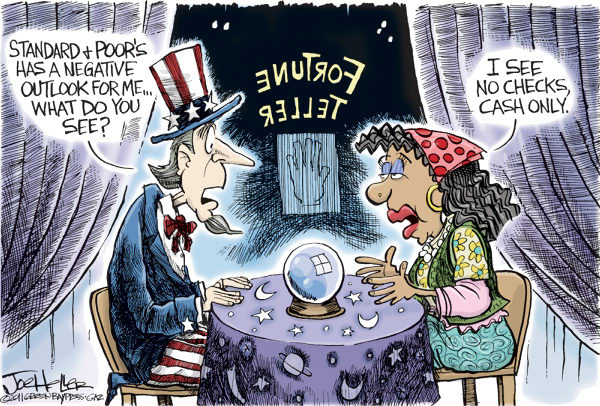
Excerpt: Lee Adler of The Wall Street Examiner wrote last week, “The market sailed through a week of light Treasury supply with reduced POMO support. A big Treasury paydown this week put extra cash in dealer trading accounts and it did exactly what we expected it to. S&P threw a little glitch into things on Monday by putting the US on a negative watch. They probably just had a big client with a huge buy order outstanding. A little negative news and Voila! Done! Next week, Lee thinks, will be a little more interesting. “POMO will be insufficient to absorb $52 billion in new supply. With that much paper to sell, the government will want to see yields lower. So be on the lookout for a 3 AM stock futures selloff in the pre market probably Tuesday and/or Wednesday. There’s nothing like a little stock market liquidation to get a buying panic going in Treasuries. If that doesn’t happen, then something will need to take a hit around May 2. That’s settlement day for $45 billion in new notes. We would need to keep an eye on the technicals for clues to which market would bear the brunt of that if there’s no pre auction liquidation of stocks.” (The Wall Street Examiner, subscription required) Quantitative easing (QE2) is scheduled to expire at the end of June. In a recent interview with Jon Hilsenrath of the Wall Street Journal, Fed Chairman Ben Bernanke indicated that QE will not be pursued once the current program runs its course. In an interview with John Nyaradi of Wall Street Sector Selector, Phil pointed out that this is not actually the case. “QE2 isn’t going to end. This is a misnomer about QE2 because what’s going to end is the new funding. About 50% of what’s going in from the Fed now is rollover money... (The Fed) is buying 85% of the Treasury notes. They can’t stop. How could they stop? Who’s going to buy?” When QE2 was announced, the budget for the program was set at $600Bn plus additional funds made available by reinvesting principal payments from agency debt and agency mortgage-backed securities. Those additional funds boosted the total budget for QE2 to somewhere between $850Bn to $900Bn. In other words, the Fed had between $250Bn and $300Bn available to use for buying Treasuries during QE2, funds made available from the performance of assets it owned at that time. Imagine how much more could be available to the Fed once it has completed purchasing another $850Bn to $900Bn worth of assets by the end of June? So where does this end? In Phil’s opinion, it will eventually end in hyperinflation. “There’s no end game to what we’re doing other than hyperinflation because we have to pay off our debt ultimately. Look at how ridiculous it is. We owe $15 trillion. And we go another $1.5 trillion into debt every year.” There’s no chance to pay off a $15 trillion dollar debt by adding another $1.5 trillion in debt each year. At this rate, in ten years, we’ll owe $30 trillion. According to Phil, “There’s no realistic way to pay off this debt other than gross inflation. That means we need inflation, and it has to be hyperinflation because the inflation has to occur faster than our debts are mounting.” So we have to grow the GDP so fast through inflation that it dwarfs the rising interest rates on the debt that we have. Then, with devalued Dollars, “we may be able to start making some payments.” (Phil Davis Discusses Options and Today’s Markets) Jesse, at Jesse’s Cafe Americain argues that many years of stagflation is a likely outcome of the Fed’s 'managed inflation' policy. “The problem or twist this time around comes when the monetary stimulus does not increase jobs and the median wages, because of some inherent and unreformed tendency in the economy to focus money creation and its benefits to a narrow portion of the populace. The result of this is stagflation which although not indefinitely sustainable can be maintained for decades.” Whatever the flationary route, Jesse concludes, “the reissue of the dollar with a few zeros gone is inevitable.” This week’s newsletter trade idea comes from Pharmboy,... read on. Archives here > Try Stock World Weekly/Phil's Stock World here >
|
| Richard Russell – The Great Gold Tsunami Lies Ahead Posted: 24 Apr 2011 07:58 AM PDT Dear CIGAs, With gold and silver continuing on their historic run, the Godfather of newsletter writers Richard Russell had this to say in his latest commentary, "Gold — The desperate battle to keep gold below 1500 continues. I watched the erratic action of gold near yesterday's close. I'm fascinated to see whether June gold can close above 1500 or whether the anti-gold contingent can manage to knock gold down (again) below 1500. The action is now so blatant that it literally screams of manipulation. At its high yesterday, June gold sold at 1506.50. At yesterday's close, June gold was trading at 1498.10. It's almost embarrassing to watch the action. What we're seeing is the anti-gold crowd and the manipulators vs. the great primary trend of gold." Russell continues: "I've tried to emphasize this, but the key here is PURCHASING POWER. When the dollar price of a loaf of bread rises from $1.90 to $2.10 that means something to the average American. But when the Dollar Index drops from 75 to 73.97 the average American doesn't understand it and isn't the least bit interested. Why the battle to keep gold below 1500? Markets tend to stop at big even numbers. Many of us old timers remember the battle of "Dow one thousand." We remember how the Dow fought month after month to close decisively above 1,000. Then, once above 1,000 the Dow was on its way to 2,000, 3,000, 4,000 and finally 5,000. From there the Dow battled to move above 5,000 — on its way to 10,000. The battle about gold closing above 1500 is that once above 1500, technically gold will be on its way to 2,000. And from there 5,000 will be the target. So 1500 is a psychological barrier that, from the bull's standpoint, must be bettered. But from the anti-gold crowd's standpoint, gold must be held (on a closing basis) below 1500. The answer: As I see it, the primary trend of gold remains bullish. In due time, gold will gather the strength to close above 1500. The gold-bears will be defeated. It's only a matter of time. The Coming Gold Tsunami — We're moving nearer and nearer to the edge of the hurricane. I can feel it in my bones. Every newspaper now carries an ad for gold. Is there a gold bubble? Are you kidding me? Here's an ad that somebody paid for suggesting that people should turn in their gold (!!) for Federal Reserve Notes. They're not telling you to buy gold during one of the greatest bull markets in history — hardly, they're asking you to throw parties in which the object is to get ignorant people to SELL their gold. I can feel them caressing my face — the early breezes. They are blowing gently and hinting of the forthcoming gold hurricane that will sweep across the US and the planet with all the force and power that was seen when gold was first discovered at Sutter's Creek during the California gold rush of 1849. The gold rush of the 2000s is in the wings. The old phrase is ringing in my ears again (I haven't heard it since the late '70s), "There's no fever like gold fever."
|
| Posted: 24 Apr 2011 07:28 AM PDT Eric Sprott and Andrew Morris: Follow the money into silver There is a global gold standard emerging; something that was not possible before the internet, globalization, and a growing global acceptance of PM's as the cure for fiat madness. This is the first post-internet boom attempt at introducing a global PM standard and it will [...]
|
| Posted: 24 Apr 2011 06:05 AM PDT
From Kevin Price Is MIT willing to unleash real-time, dynamic-purchasing inventory control systems? A graduate student playing around with a billion dollar price project has unwittingly stumbled upon the financial equivalent of the internet, and it was Zero Hedge where the implications of this financial search engine were reported first. The implications are enormous. This could be what Alan Greenspan called "a once in a generation acceleration in productivity," but only if MIT allows widespread use. Instead it appears that MIT is going to keep it secret to benefit the oligarchs and the connected at the expense of the many. Imagine real time continuously updated pricing data on all available products, raw inputs, and professional services. This new financial search engine has the ability to track anything. How about product pricing at Wal Mart? Drill bits, rolled steel, truckloads of wheat at the grain elevator level? You see you can monitor in real time the input costs and output prices of any industry or specific corporation. You could monitor your competitor and as soon as he has a sale your financial search engine will alert you and automatically match his prices.
And since there are two sides to every story, here is reader Dave Narby following up with an MIT teammember, and getting direct feedback in the aftermath of our post from Friday disclosing the effective culling of the MIT Billion Price Project. The response may stun some people as to why MIT canceled any relevant public disclosure from the Billion Price Project. (emphasis added)
Subject: Re: Why did you cripple the Billion Prices Project? i really do not know what the zerohedge website is, but i have no problem at all. one important thing is that i cannot outsource this. either i have to do it at mit or i have to do it in a private firm. there is very important IP that alberto and i have developed after 9 years of research that needs protection and unfortunately cannot be patented. for the last 4 years i have financed this entirely by me. i'm the senior faculty in the team and everything has been done with voluntary work from mit students, and the junior faculty. because they are my responsibility, i had to make the call and direct them in the correct path if they are planning to follow a career in academia. i know people think that the government is pressuring us (i have received the hundreds of emails in that regards) but in the last 4 years i have received not a single cent from them, nor i plan to even ask. i can assure you the data is there, and the indexes are there. we will have 40 countries and one of them has already tried to fine me or sue me. i can take the distractions but the other 20 people here can't. i will find a way to do this. my goal is very simple, i want to change the way in which economic data is collected on earth. not only inflation, but real estate, financial performance, environmental impact, and unemployment. those are my four long term projects. and i can assure you i will do it. the advantage of not having the indexes public is that eliminates all the distractions the team is receiving. all the best. rr. thanks david, but we are not going to continue publishing the country information. it has become extraordinarily difficult for us to deal with this as we do not have the staff required to maintain the indexes and more importantly the requests from the users. we are tying to find an alternative way of distributing the indexes and when we find a solution we'll post it on the web. for the moment we need to concentrate on the research... sorry about that. there is nothing to speculate about except that it is taking far too much of our time and we need to publish papers and not indexes... all the best. rr. Dear Prof. Cavallo and Rigobon, Dave Narby
|
| US Dollar DX Index Very Long Term Charts Posted: 24 Apr 2011 05:48 AM PDT The DX Index I normally show is the continuous futures contract on the DX index. The front month is now June. The Fed also publishes two other dollar indices: major currency index, and the broad currency index. The major currency index is essentially the basis for the Wall Street DX futures index.
|
| Deepening Economic Crisis: Inflation, Rising Interest Rates, Surge in the Price of Gold and Silver Posted: 24 Apr 2011 05:43 AM PDT Economic recovery does not seem to be taking effect in spite of more massive expenditures by Congress and the Fed. The IMF says financial stability has improved, but then again their vision is almost always clouded. US tax revenues are not increasing in a meaningful way, manufacturing struggles to expand and Wall Street flourishes in a cascade of mega salaries and bonuses. In another six months the US will be three years what the government, the media and Wall Street call a deep recession. We call it an inflationary depression, which has existed for 26 months. After eight years of increasing money and credit, and the creation of a real estate bubble, the Fed has been fighting off asset destruction with ever more money and credit accompanied by debt deflation. Part of the Fed’s policy has been zero interest rates, which has helped Wall Street and banking and to a limited extent real estate, but has destroyed the purchasing power of retirees and has driven funds into speculation, which in many cases has ended in ever more losses and less buying power.
|
| Geopolitics and the World's Gold Holdings Posted: 24 Apr 2011 05:39 AM PDT Both the US dollar and the Euro currency systems are in crisis. During a period of waning currencies, where the value of money (in paper and/or electronic form) is tumbling, the strategic control over gold reserves and gold production is of paramount importance. The issue is not only who controls the stock of central bank gold reserves, but who, namely which countries, control the production of mine gold.
|
| Silver Forecast $52 to $56 by Mid 2011 Update Posted: 24 Apr 2011 05:15 AM PDT Back on February 18th I wrote an editorial showing that Silver could rocket up to $52 to $56 by mid-year. At the time of the writing Silver was sitting a little above $32 on the price chart. The original chart work was based off of the fractal chart work I do with Silver from previous fractal time periods. So far the rise in Silver appears to be right on track for our expected targets to be approached into mid-year. I will post a link to the original article, below, for your perusal.
|
| Things That Make You Go Hmmm.... The Ben Bernanke Flying Circus Posted: 24 Apr 2011 04:43 AM PDT
From Grant William's latest Things that Make You Go Hmmm....
Full note: Hmmm Apr 24 2011[2]
|
| Posted: 24 Apr 2011 04:37 AM PDT The Dollar And Gold: A 20-Year Perspective Faros – The Day the Dollar Died Share this:
|
| Three Words That Could Help Fix the US Monetary System Posted: 24 Apr 2011 04:33 AM PDT Choppy week in the markets, wouldn't you say? Gap down one day, gap up the next. That's what you get when the tub is full of Fed-faked funny-money. Bigger waves…more tumult…less predictability. And a whole lotta motion sickness along the way. Markets are always and forever in a process of price discovery, torn between demand for lower prices from buyers on one side, and the profit motive from sellers on the other. Somewhere in the middle, the two parties will come together to exchange their goods and services. In other words, they "discover" an agreeable price at which everyone finds value. This is what the free market does naturally. Low prices invite demand…driving prices higher. High prices invite competition (supply)…driving prices lower. Obviously, therefore, you expect a bit of movement, a bit of price fluctuation as buyers and sellers jostle for position. What you don't expect is multi-hundred point daily swings in the stock markets. You don't expect gold to jump $20, $30 or more in a 24-hour period. (Remember, before FDR confiscated all the gold in the land back in 1933, an ounce of gold was only "worth" $20. More correctly, a dollar was worth 1/20th an ounce of gold. Then, in one fell swoop, the original New Dealer "revalued" the metal to $35 an ounce, thereby devaluing the dollar to 1/35th an ounce of gold.) The point is, a $20 or $30 movement in the price of gold back then would have been unthinkable (but for political strong-arming). Today, with the dollar having been beaten, bludgeoned and fisticuffed down to less than 1/1,500th an ounce of gold, twenty bucks here or there is hardly worth mentioning, such is the woeful state of the world's leading fiat money. Of course, markets don't demand fiat currencies. Free individuals don't wake up one day and say to themselves, "Gee… Wouldn't it be nice if we had an unquestionable, unaccountable, centrally controlled monopoly on counterfeiting to help debase our medium of exchange, saddle the populace with that most insidious of all taxes – inflation – and to sell our kiddies future down the drain? I know, let's create a Federal Reserve!" Such institutions don't come about "naturally." They require political pull and the gun-for-rent that is the government. They take cover behind rooking legalese, as is found in "The Federal Reserve Act of 1913," and the absurd prevarications of its "dual mandate," which is, at present, sold to the terminally credulous public under the noble-sounding, though entirely erroneous mission statement of "price stability and maximum employment." Anyone with a basic, non-Ivy League-approved understanding of economics knows this to be a ridiculous goal in the first place. For one, gold takes care of price stability itself. Has done for thousands of years. Price instability is the direct result of fiat monies and manipulation of the money supply by self-serving central banking cartels. From tulipmania to techmania, one can find, at the rotten heart of every inflationary crisis, a central banker with an equally rotten brain and/or heart. As for the "fetish of full employment," as Henry Hazlitt so eloquently explains in his classic, Economics in One Lesson: "The progress of civilization has meant the reduction of employment, not its increase. It is because we have become increasingly wealthy as a nation that we have been able virtually to eliminate child labor, to remove the necessity of work for many of the aged and to make it [financially] unnecessary for millions of women to take jobs. "The real question," continued Hazlitt, writing in 1946, "is not how many millions of jobs there will be in America ten years from now, but how much shall we produce, and what, in consequence, will be our standard of living?" The Fed is the work of Woodrow…a creature of Congress. As George F. Will, writing in The Post, once put it, mission creep is part of the "metabolic urge" of government agencies. The Fed is no different. It is an Ouroboros running out of tail on which to feed. There's nothing free market about this beast, Fellow Reckoner…and nothing free market about the economy that stands on its sunken shoulders. Without space for competing currencies, the invisible hand is bound and cuffed, unable to feel around in the dark, to set reliable prices. Value is distorted, malinvestment promoted. In the end, you get unpredictable stock market volatility and a dollar shaved to within 1/1,500th of its life. Exactly what you'd expect, in other words. The solution? Here, a modest suggestion: End…The…Fed. Instead, allow competing banks to issue competing currencies. Allow the fundamental underpinning of an economy – it's medium of exchange – to discover its own "fair value." Witness competition weed out banks that lend imprudently and that rip off customers, to the favor of those operating with prudence and fiscal integrity. Watch institutions that choose to issue baseless, paper money go bust without federal bailout funds and those that adhere – freely, without let or hindrance – to a gold standard garner the public trust their thrift and judiciousness earns them. Wishful thinking, you say? Well, until such a time comes to pass, here's another suggestion, courtesy of our Reckoner-in-Chief, Bill Bonner: "Buy gold. Be happy." Cheers, Joel Bowman Three Words That Could Help Fix the US Monetary System originally appeared in the Daily Reckoning. The Daily Reckoning recently featured articles on stagflation, best libertarian books, and QE2 .
|
| Posted: 24 Apr 2011 04:30 AM PDT The international monetary system is stacked in favour of the United States. It has been that way since the Bretton Woods conference in 1944 placed the US dollar at the system's centre, thereby ...
|
| Alasdair Macleod: Will governments confiscate gold and silver? Posted: 24 Apr 2011 04:06 AM PDT 12:06p ET Sunday, April 24, 2011 Dear Friend of GATA and Gold (and Silver): Writing for GoldMoney, economist and former banker Alasdair Macleod reflects on the possibility of confiscation by Western governments of privately held gold. Macleod concludes that confiscation would serve mainly to enrich Asians while impoverishing the few Americans who own gold, without gaining much for the U.S. government. The rationale for the gold confiscation in the United States in 1933, Macleod notes, no longer applies, since gold long ago ceased being part of the country's circulating money stock. Macleod's commentary is headlined "Will Governments Confiscate Gold?" and you can find it at GoldMoney's research section here: http://www.goldmoney.com/gold-research/will-governments-confiscate-gold.... Six years ago, after much prodding through a member of Congress, GATA managed to engage the U.S. Treasury Department in extensive correspondence about the department's attitude toward confiscation of privately held precious metals. The Treasury Department replied that, under certain circumstances, it indeed claims the power to confiscate privately held gold and silver -- as well as the power to confiscate every other financial asset held by citizens of the land of the free and the home of the brave. That correspondence is headlined "Treasury Claims Power to Seize Gold and Silver -- and Everything Else" and you can find it in the GATA archive here: CHRIS POWELL, Secretary/Treasurer ADVERTISEMENT The Gold Standard Now: It Can Work Today a dollar is worth 80 percent less than it was 40 years ago, and less than 5 percent of its value a hundred years ago. We deserve a dollar that is as good as gold, a dollar that will hold its value from year to year so we can be financially secure and our economy can generate more and better jobs. For most of America's history, our dollar was literally as good as gold. But on August 15, 1971, our politicians destroyed the link between gold and the dollar. They destroyed the foundations of our economic system. A new Internet site, TheGoldStandardNow.org, provides news and cutting-edge analysis about this most important issue and explains how the gold standard worked in the past and how it can work in the future. Visit us today: http://www.thegoldstandardnow.org/about/137-welcome-newsmax Join GATA here: An Evening with Bill Murphy and James Turk World Resource Investment Conference Gold Rush 2011 https://www.amsterdamgold.eu/gata/index.asp?BiD=12 Or by purchasing a colorful GATA T-shirt: Or a colorful poster of GATA's full-page ad in The Wall Street Journal on January 31, 2009: http://gata.org/node/wallstreetjournal Or a video disc of GATA's 2005 Gold Rush 21 conference in the Yukon: Help keep GATA going GATA is a civil rights and educational organization based in the United States and tax-exempt under the U.S. Internal Revenue Code. Its e-mail dispatches are free, and you can subscribe at: To contribute to GATA, please visit: http://www.gata.org/node/16 ADVERTISEMENT Canuc Resources Pursues Ecuador and Nova Scotia Gold Projects Canuc Resources Corp. (TSX: CDA) has confirmed high-grade gold and the potential for large-tonnage, low-grade copper and gold mineralization at its primary asset, property in the historic Nambija gold mining district in southeastern Ecuador. Last November Canuc took an option on the Mill Village gold property in southwestern Nova Scotia, which includes two past-producing mines. Canuc plans to begin surface and underground exploration at Mill Village in the next several weeks, financed by $2 million recently raised through a private placement. To generate immediate income, Canuc is acquiring MidTex Oil and Gas Co., owner of a producing gas well and a lease on 320 acres in Stephens County, Texas. Canuc's CEO, Gary Lohman, has more than 30 years of experience in the mining industry, primarily as a geologist, and the company's officers include similarly experienced people. For more information about Canuc, please visit http://www.canucresources.ca/.
|
| Why America Should Relinquish Reserve Status for its Dollar Posted: 24 Apr 2011 04:01 AM PDT [B][B]U.S. Should Take Lead in Shifting to a Multi-currency Reserve[/B][/B] Conspiracy theory notwithstanding, claims that the reserve status of the U.S. dollar unfairly benefits the U.S. are no longer true. On the contrary, it has become a burden, both for America and the world. [Let me explain.] Words: 825 So*says**Michael Pettis*([url]http://www.FinancialTimes.com/[/url]) inan article* which*Lorimer Wilson, editor of www.munKNEE.com,* has further edited ([* ]), abridged (…) and*reformatted*below**for the sake of clarity and brevity to ensure a fast and easy read. Please note that this paragraph must be included in any article re-posting to avoid copyright infringement. Pettis*goes*on to say:* Reserve currency status is a global public good that comes with a cost [and] no currency [other than that of the U.S.]*has the necessary characteristics to allow it, plausibly, to serve the needs of the global economy – and neither any other country, nor the EU, will be willing to pay ...
|


| You are subscribed to email updates from Save Your ASSets First To stop receiving these emails, you may unsubscribe now. | Email delivery powered by Google |
| Google Inc., 20 West Kinzie, Chicago IL USA 60610 | |

No comments:
Post a Comment