


Gold World News Flash |

- Debunking Anti-Gold Propaganda
- Silver Set to Soar as Paper Folds?
- Metals Market Equations Are No Longer Simple
- Very Long Term US Dollar DX Index Chart
- Richard Russell - The Great Gold Tsunami Lies Ahead
- Faros - The Day the Dollar Died
- Silver-Investor.com's David Morgan Analyzes a Dollar Collapse, using Alan Pakula's “ROLLOVER” released in 1981
- Gold Seeker Weekly Wrap-Up: Gold and Silver Gain Over 1% and 8% on the Week
- Americans don't need Nazi's to steal their gold, they volunteer it.
- US Dollar posts the lowest Weekly Close in 32 Months
- The “Other” White Rock
- Silver Price Up 8.2% in One Week - Gold Price Closes at 1503.20
- Will the SP 500, Silver, Gold, and Oil Breakout?
- James Turk: $400 Silver Coming
- In The News Today
- Jim's Mailbox
- "The Risk of a Nuclear Catastrophe ... Could Total Trillions of Dollars and Even BANKRUPT A COUNTRY"
- Technology and Your Fourth-Amendment Rights
- Dollar Freefall
- Basically, we now have the one and only thing we were missing: an official denial of all the “rumors.” It may now be time to abandon the SLV
- Jim Grant Explains Why QE3 Is Coming
- The “Other” White Rock
- BlackRock Issues Refutation Of SLV Fraud Allegations; Is It Time To Panic For SLV Holders?
- Gold miners African Barrick and Petropavlovsk hit by rising costs
- Physical silver trades over $50
- Making Sense of Gold’s Strength and Goldman’s Weakness
- CMEGroup (Nymex and Comex) markets closed for trading tomorrow
- Gold Daily and Silver Weekly Charts - Somebody Throw Some Water on Blythe, She's Smokin!
- Gold settles at record above $1,500
- Gold's next frontier: $1,650
| Debunking Anti-Gold Propaganda Posted: 24 Apr 2011 07:00 AM PDT A meme is now circulating that gold is in a bubble and that it's time for the wise investor to sell. To me, that's a ridiculous notion. Certainly a premature one. It pays to remain as objective as you can be when analyzing any investment. People have a tendency to fall in love with an asset class, usually because it's treated them so well. We saw that happen, most recently, with Internet stocks in the late '90s and houses up to 2007. Investment bubbles are driven primarily by emotion, although there's always some rationale for the emotion to latch on to. Perversely, when it comes to investing, reason is recruited mainly to provide cover for passion and preconception.
|
| Silver Set to Soar as Paper Folds? Posted: 24 Apr 2011 03:05 AM PDT As a result of active "demonetization" efforts by the IMF and its member central banks, gold and silver have experienced the type of volatility that has given conservative investors reasons not to perceive the metals as dependable cash alternatives. Instead gold and silver have become known as the asset class to hold as a hedge against inflation.
|
| Metals Market Equations Are No Longer Simple Posted: 24 Apr 2011 03:03 AM PDT Gold and silver have continued barreling higher thanks to insurance buying, inflation expectations, and the currency picture. Given the underlying chaos in global affairs there is room for gold and silver to continue their gains, in US Dollar terms at least, as long as negative real rates persist in the US. Around that upward bias will be traders moving in and out of the safety trade and other short term sentiments. Expect volatility.
|
| Very Long Term US Dollar DX Index Chart Posted: 21 Apr 2011 05:01 PM PDT |
| Richard Russell - The Great Gold Tsunami Lies Ahead Posted: 21 Apr 2011 04:15 PM PDT  With gold and silver continuing on their historic run, the Godfather of newsletter writers Richard Russell had this to say in his latest commentary, "Gold -- The desperate battle to keep gold below 1500 continues. I watched the erratic action of gold near yesterday's close. I'm fascinated to see whether June gold can close above 1500 or whether the anti-gold contingent can manage to knock gold down (again) below 1500. With gold and silver continuing on their historic run, the Godfather of newsletter writers Richard Russell had this to say in his latest commentary, "Gold -- The desperate battle to keep gold below 1500 continues. I watched the erratic action of gold near yesterday's close. I'm fascinated to see whether June gold can close above 1500 or whether the anti-gold contingent can manage to knock gold down (again) below 1500. The action is now so blatant that it literally screams of manipulation. At its high yesterday, June gold sold at 1506.50. At yesterday's close, June gold was trading at 1498.10. It's almost embarrassing to watch the action. What we're seeing is the anti-gold crowd and the manipulators vs. the great primary trend of gold."
This posting includes an audio/video/photo media file: Download Now |
| Faros - The Day the Dollar Died Posted: 21 Apr 2011 04:11 PM PDT  With the US dollar continuing its decline, today Faros sent KWN a piece about the outlook for the battered currency. "March 31st, 2011 marked a significant change in the 'Grand Bargain' we have alluded to many times since late 2010. The pace of CNY appreciation going into March 11th was set by China, but tempered somewhat by the only country that had no inflationary forces begging for a stronger currency, and an export sector anxious about a stronger currency. That country was Japan. With the US dollar continuing its decline, today Faros sent KWN a piece about the outlook for the battered currency. "March 31st, 2011 marked a significant change in the 'Grand Bargain' we have alluded to many times since late 2010. The pace of CNY appreciation going into March 11th was set by China, but tempered somewhat by the only country that had no inflationary forces begging for a stronger currency, and an export sector anxious about a stronger currency. That country was Japan.
This posting includes an audio/video/photo media file: Download Now |
| Posted: 21 Apr 2011 04:01 PM PDT Share this:
|
| Gold Seeker Weekly Wrap-Up: Gold and Silver Gain Over 1% and 8% on the Week Posted: 21 Apr 2011 04:00 PM PDT Gold climbed to a new all-time high of $1509.01 in London before it fell back to $1500.20 at around 9AM EST, but it then rallied back higher into the close and ended with a gain of 0.34%. Silver surged to a new 31-year high of $46.34 in the last half hour of trade and ended with a gain of 3.27%.
|
| Americans don't need Nazi's to steal their gold, they volunteer it. Posted: 21 Apr 2011 03:14 PM PDT People Are Now Literally Plucking Their Gold Teeth Out In The Middle Of The Pawn Shop Share this:
|
| US Dollar posts the lowest Weekly Close in 32 Months Posted: 21 Apr 2011 11:50 AM PDT [url]http://www.traderdannorcini.blogspot.com/[/url] [url]http://www.fortwealth.com/[/url] Not much more needs to be said about the US Dollar than this headline. They managed to push it just barely above the support level ahead of the long holiday weekend but it certainly looks weak heading into next week. The problem is even though the "short Dollar" trade is crowded, there does not yet exist a fundamental reason to buy the Greenback. That bodes poorly moving forward, oversold, crowded or extreme bearish sentiment notwithstanding. ...
|
| Posted: 21 Apr 2011 11:40 AM PDT The silver market has been on a tear, no doubt about it. The price of this shiny white rock has soared 50% in 2011, alone. There's good reason for this huge move (Hint: His name is Ben Bernanke). But I want to tell you about a different white rock – one that's also quite precious. The rock is called phosphate. There is no substitute for it. It is crucial to the world's food supply, for which it serves as a fertilizer. And most of the world's mines are in decline. Foreign Policy magazine recently called it "the gravest resource shortage you've never heard of." Demand for the rock is growing as demand for food rises. As I write, food prices are surging. Wheat is up 110% over the last 12 months. Corn is up 87%; soybeans, 59%; and sugar, 22%. Soaring food prices helped set off protests in Tunisia and Egypt, toppling regimes and threatening to spread similar uprisings to other poor countries in the region. There is no quick remedy. Many of the trends that created today's situation h...
|
| Silver Price Up 8.2% in One Week - Gold Price Closes at 1503.20 Posted: 21 Apr 2011 11:38 AM PDT Gold Price Close Today : 1,503.20 Gold Price Close 15-Apr : 1,485.30 Change : 17.90 or 1.2% Silver Price Close Today : 4606.2 Silver Price Close 15-Apr : 4256.6 Change : 349.60 or 8.2% Gold Silver Ratio Today : 32.634 Gold Silver Ratio 15-Apr : 34.894 Change : -2.26 or -6.5% Silver Gold Ratio : 0.03064 Silver Gold Ratio 15-Apr : 0.02866 Change : 0.00198 or 6.9% Dow in Gold Dollars : $ 171.98 Dow in Gold Dollars 15-Apr : $ 171.79 Change : $ 0.19 or 0.1% Dow in Gold Ounces : 8.320 Dow in Gold Ounces 15-Apr : 8.310 Change : 0.01 or 0.1% Dow in Silver Ounces : 271.50 Dow in Silver Ounces 15-Apr : 289.98 Change : -18.47 or -6.4% Dow Industrial : 12,505.99 Dow Industrial 15-Apr : 12,343.16 Change : 162.83 or 1.3% S&P 500 : 1,337.38 S&P 500 15-Apr : 1,319.68 Change : 17.70 or 1.3% US Dollar Index : 74.096 US Dollar Index 15-Apr : 74.873 Change : -0.777 or -1.0% Platinum Price Close Today : 1,816.50 Platinum Price Close 15-Apr : 1,791.50 Change : 25.00 or 1.4% Palladium Price Close Today : 768.85 Palladium Price Close 15-Apr : 769.70 Change : -0.85 or -0.1% Our office will be closed to observe Good Friday, Easter, and Easter Monday. We will return on Tuesday, 26 April. Yet another week to stretch your credulity: the SILVER PRICE up 8.2%, the GOLD PRICE up 1.2%. No, those are not typos. All else besides seems anemic. What has come clear this week? That Bernard O'Bama and Blundering Ben Bernanke are destroying the dollar, yes, stringing it up by the hooves, slitting its belly, and gutting it. Had I been a fly on the wall, I could now report when the decision was made in the Bushite administration to depreciate the dollar, and when Bernard and Ben decided they would fix the economy by eviscerating the dollar. Or mayhap there is some deeper conspiracy, some destroy the dollar and replace it with the Bongo or whatever Frankenstein currency our Great Ones desire. This much is clear: they balk not at stealing the wealth of every American by depreciating the dollar. What loosed this tirade? US DOLLAR INDEX today dropped 27.2 basis points to 74.096, down 0.35% and most critically, through the Dec 2011 low at 74.23. Next logical target is 71.25, maybe the 2001-2008 low at 70.70. As yet the chart signals no turnaround. The moldy euro reacted by making a new high for the move at $1.4542. Yen gapped up to Y81.83/$ (122.2c/Y100). Did y'all ever walk through a house of mirrors at a fair? Remember how the mirrors distort everything, some make you skinny, some fat, some make your head tiny and your body huge? That's how the stock market makes me feel. No economic outlook is pushing it higher, no fundamental strength, yet it powers higher, driven by mysterious forces with the initials NGM. Clearly, they have taken over the Potemkin stock market to cast before the mushrooms' eyes the illusion of prosperity. It is never a smart idea to mock reality, because reality always has the last word. The stock market is riding a wave of new money and government manipulation. This will end badly. Investing in stocks is like substituting oven cleaner for Wildroot Hair Oil. It won't make your hair shine and you'll have to part your scalp. SILVER and GOLD PRICES are just about as crazy. The SILVER PRICE up 8.2% in one week? What's bad about this? Y'all are going to start expecting it all the time, and this is not a normal move. It is NOT different this time, and it never is. What is it then? It is a bull market in a fiercely strong upwave, and all that has been accelerated by Ben Bernanke's Bundles of Bucks. Yet I am not pointing to its end, because the GOLD PRICE could reach $1,600 and the SILVER PRICE 5000c. Seasonal highs almost without exception occur before mid-May, and June, July, August, and September have not for the last eleven years shown any high. And if some goof tells you silver and gold prices are "in a bubble," just smile and don't squander any words enlightening his darkness. Compared to the 1980 peaks, silver and gold prices are hardly moving. No, I am not joking, and have the charts to prove it. The precious metals bull market has AT LEAST 3 to 10 more years to run, and silver may nearly quadruple from here while gold rises another four times, too. Here's what makes trading or investing so hard: you have to look at the sturdy present and envision the unseen future. At its 400c low, who could imagine silver at 4600c, over 11 times as high? A few did. In the same way, you must look at the markets everyone is panting after and envision them when the fickle crowd has cast them aside. Think "real estate." "Beanie babies." "Tech stocks." TODAY the gold price hammered clean through $1,500 resistance to close at $1,503.20, up $4.90. The real barrier here is $1,505 (as $1,405 was earlier). When gold breaches that breastwork, probably next week, it will shoot higher still and you will drop quoting it in the fourteens and get used to quoting it in the fifteen hundreds. GOLD's short term chart has a wedgey look I don't like, so next week might see some correcting before bursting through $1,505. As long as gold remains above $1,490 it will continue rallying. SILVER rose 159.7c today to close at 4606.2c. It's following a pattern of breaking into new high ground during the day, then adding 30 - 50c in the aftermarket. Right now it's trading 4664. The only argument against silver right now is its own success. Its rise is looking more and more parabolic, and that usually signals the end of a move. It's more overbought than sushi at a tom cat convention. I confess, there's not much way to predict where it will run, or where it will stop, but the wilder it gets, the worse will be the eventual hangover. Still, as long as silver remains about 4500 or 4550c, it will keep on raging. That 115c discount on the wholesale buy side of US 90% silver coin leaves me very antsy. On this glorious day in 1836 the Republic of Texas made good its independence by defeating the army of Santa Anna at San Jacinto. Y'all enjoy your Easter holiday. Argentum et aurum comparenda sunt -- -- Gold and silver must be bought. - Franklin Sanders, The Moneychanger The-MoneyChanger.com Phone: (888) 218-9226 or (931) 766-6066 © 2011, The Moneychanger. May not be republished in any form, including electronically, without our express permission. To avoid confusion, please remember that the comments above have a very short time horizon. Always invest with the primary trend. Gold's primary trend is up, targeting at least $3,130.00; silver's primary is up targeting 16:1 gold/silver ratio or $195.66; stocks' primary trend is down, targeting Dow under 2,900 and worth only one ounce of gold; US$ or US$-denominated assets, primary trend down; real estate in a bubble, primary trend way down. Whenever I write "Stay out of stocks" readers inevitably ask, "Do you mean precious metals mining stocks, too?" No, I don't. 
|
| Will the SP 500, Silver, Gold, and Oil Breakout? Posted: 21 Apr 2011 11:13 AM PDT The price action in the financial markets this week has added to the continued confusion about where equity prices are headed. Precious metals and oil prices have been working higher for quite some time, but equity prices have been ... Read More...
|
| James Turk: $400 Silver Coming Posted: 21 Apr 2011 10:55 AM PDT listen at 5:50 mark 
This posting includes an audio/video/photo media file: Download Now |
| Posted: 21 Apr 2011 10:02 AM PDT Dear CIGAs, Here is Sweet Pea's new home if the Rescue approves me. I hear it is touch and go.
Jim Sinclair's Commentary They have no idea how ugly the US economy would look like 90 days after QE ceased. The madness of thinking such an event would benefit the dollar via interest rates shows no understanding of economic history, no understanding of the impact of loss of confidence means to a currency, not even a memory of 1968 to 1980 which was only a dress rehearsal. Nation's Mood at Lowest Level in Two Years, Poll Shows Americans are more pessimistic about the nation's economic outlook and overall direction than they have been at any time since President Obama's first two months in office, when the country was still officially ensnared in the Great Recession, according to the latest New York Times/CBS News poll. At a time of rising gas prices, stubborn unemployment and a cacophonous debate in Washington over the federal government's ability to meet its future obligations, the poll presents stark evidence that the slow, if unsteady, gains in public confidence earlier this year that a recovery was under way are now all but gone. Capturing what appears to be an abrupt change in attitude, the survey shows that the number of Americans who think the economy is getting worse has jumped 13 percentage points in just one month. Though there have been encouraging signs of renewed growth since last fall, many economists are having second thoughts, warning that the pace of expansion might not be fast enough to create significant numbers of new jobs. The dour public mood is dragging down ratings for both parties in Congress and for President Obama, the poll found. Disapproval of Mr. Obama's handling of the economy has never been worse — up to 57 percent of Americans — a warning sign as he begins to set his sights on re-election in 2012. And a similar percentage disapprove of how Mr. Obama is handling the federal budget deficit, though more disapprove of the way Republicans in Congress are. Still, for all the talk of cutting the deficit in Capitol Hill and Wall Street, only 29 percent said it would create more jobs — the issue of greatest concern — while 27 percent believed it would have no effect on the employment outlook, and 29 percent said it would actually cost jobs.
Jim Sinclair's Commentary Why not? $6 gas? Could happen if dollar keeps getting weaker. A dollar plumbing three-year lows is hitting Americans squarely in the gas tank, and one economist thinks it could drive prices as high as $6 a gallon or more by summertime under the right conditions. With the greenback coming under increased pressure from Federal Reserve policies and investor appetite for more risk, there seems little direction but up for commodity prices, in particular energy and metals. Weakness in the US currency feeds upward pressure on commodities, which are priced in dollars and thus come at a discount on the foreign markets. One result has been a surge higher in gasoline prices to nearly $4 a gallon before the summer driving season even starts, a trend that economists say will be aggravated as demand increases and the summer storm season threatens to disrupt oil supplies. "All we have to have is a couple badly placed hurricanes which could constrain some of the refinery output capacity in some key locations," says Richard Hastings, strategist at Global Hunter Securities in Charlotte, N.C. "If you get weakness in the dollar concurrent with the strong driving season concurrent with the impact of one or two hurricanes in the wrong place, prices could go up in a quasi-exponential manner."
Jim Sinclair's Commentary The USDX is going to take out .7200 and lock below. Gold will leave $1650 in the dust. History will be written this year.
Jim Sinclair's Commentary The developments in the Middle East are best described as from "order" to "disorder." This has accelerated the concept of peak oil into present time. Gold will make a huge percentage of its hyperbolic gain in this situation that is now taking full foundation. It will re-enter the monetary system in the way I have explained at least 100 times, including in yesterday's interview. China's Sinopec cuts off oil exports: state media Chinese oil giant Sinopec has stopped exporting oil products to maintain domestic supplies amid disruption concerns caused by Middle East unrest and Japan's earthquake, a report said Wednesday. The state-run Xinhua news agency did not say how long the suspension would last but it reported that the firm had said it also would take steps to step up output "to maintain domestic market supplies of refined oil products". Sinopec would ensure supplies met the "basic needs" of the southern Chinese special regions of Hong Kong and Macao, but they also should expect an unspecified drop in supply, Xinhua quoted an unnamed company official as saying. AFP was not immediately able to reach a Sinopec spokesman by phone for comment. The report said Sinopec has raised output of refined oil products this year, with its first-quarter production reaching 31.55 million tonnes, an increase of 6.2 percent from the same period last year. Sinopec last month said its 2010 net profit rose nearly 14 percent on higher oil prices and strong domestic demand for refined oil and chemical products.
|
| Posted: 21 Apr 2011 10:00 AM PDT Good afternoon Jim, Just a short note to say thank you for securing our future retirement. Our Canadian registered retirement savings plans are now over $1,ooo,ooo. We are now able to have the freedom to choose what we want to do. One of the 2 Canadian senior's charities that I work for is being questioned as to why half of our investments are in real gold. Some authorities consider this a "risky" investment! Our charity has doubled its investment value and we are still getting complaints. What is the best way to answer? Again, you have helped us personally and our charities. Thank you so much for all you do for us seniors. Best wishes, Dear CIGA M, How do you answer fools? You can never convert the party that thinks US T bills are no risk, and gold is a risk. They have been socialized into Financial Terminal Ignorance (FTI, an incurable virus that affects sheeple only). Jim
|
| "The Risk of a Nuclear Catastrophe ... Could Total Trillions of Dollars and Even BANKRUPT A COUNTRY" Posted: 21 Apr 2011 09:52 AM PDT
Preface: I am not against all nuclear power, solely the unsafe type we have today. Future designs - like thorium reactors (see this and this) - may be a different animal altogether.
AP has a good article (via the Washington Post) on nuclear power economics:
As I've previously noted:
But AP notes that doesn't include the real costs:
Japan's economy was already on the ropes prior to Fukushima. America's economy is already on the ropes, and yet a U.S. nuclear accident could be a lot worse than Japan As I wrote on April 8th:
And as I noted the same day, nuclear accidents, oil spills and financial meltdowns all happen for the same reason ... the big boys cutting every possible corner in order to make more money:
|
| Technology and Your Fourth-Amendment Rights Posted: 21 Apr 2011 09:51 AM PDT syndicate: 1 Author: Vedran Vuk Synopsis: Michigan State Police have launched a pilot program, having traffic cops search mobile phone data from speeders; Alex Daley comments on the new intrusion on our privacy. Also in this edition: Physical delivery of gold seems to become more and more popular… and Vedran Vuk explains why, like a fine wine, propaganda gets better with age. Dear Reader, Today, I wanted to touch on a few housekeeping points. Most importantly, Doug Casey will make a speaking appearance on May 14 at the Global Currency Expo in La Jolla, CA. Olivier Garret and Jeff Clark will also be in attendance. Of course, Doug's fundamental analysis on the dollar is something you don't want to miss. So, if you're in the area, grab a reservation. The organizers have said that there are few seats left. While f...
|
| Posted: 21 Apr 2011 09:51 AM PDT The 5 min. Forecast April 21, 2011 12:34 PM by Addison Wiggin – April 21, 2011 [LIST] [*]Dollar index breaks below 74… the rumor that could send it to the woodshed… [*]Abe Cofnas on a pivotal week next week… and offers trades that could help you profit [*]New napkin math: Debt ceiling could be reached well before May 16… [*]New study from GAO suggests Congress considering withholding passports… [*]Reader rage: "Where's the empathy?" one asks… "Equal time" demands another… "Take it to the board" we say… [/LIST] Fear is as cheap as it's been in nearly four years. The volatility index (VIX) — measuring the volume of S&P 500 index options — broke below 15 this morning. The VIX, also known as the "fear gauge," is now its lowest since the summer of 2007 — when Ben Bernanke was assuring us the subprime mortgage crisis was "contained." Ah, memories. At the same time, the dollar index is ...
|
| Posted: 21 Apr 2011 09:38 AM PDT BlackRock Issues Refutation Of SLV Fraud Allegations; Is It Time To Panic For SLV Holders? Share this:
|
| Jim Grant Explains Why QE3 Is Coming Posted: 21 Apr 2011 09:34 AM PDT
Once again we are reminded why we like Jim Grant so much. From his latest Grant's Interest Rate Observer (which, trust us, is worth the subscription): "Almost 30% of the respondents to a poll conducted by UBS a few weeks back said they anticipate a third round of so-called quantitative easing... We count ourselves among the expectant 30%. To its congressional directed dual mandate the Bernanke Fed has unilaterally added a third. It has undertaken to make the markets rise. The chairman himself has more than once taken credit for the post-2008 bull market (on one such occasion in January, he reminded the CNBC audience how far the Russell 2000 had come under Fed ministrations). Could he therefore stand idly by in the face of a new bear market. Byron Wien, vice chairman of Blackstone Advisory Services, went on record the other day predicting a summer swoon in stocks following the scheduled winding down of QE2 in June. Let us say that Wien is right, and that, furthermore, drooping stocks are accompanied by sagging house prices and a weakening labor market. Bernanke was hard put to explain why he chose to let Lehman go while acting to save Bear Stearns. He would be harder put to explain why he chose to implement QE1 and QE2 but, in another hour of need, refused to launch QE3." And "Sooner or later, gravity turns speculative markets into investment markets. When this transformation occurs, the Fed will confront the need to bail out the innocents it had previously bailed in. Hence, QE3." And therein lies the rub. Simple, sweet, and, for the US dollar, suicidal.
|
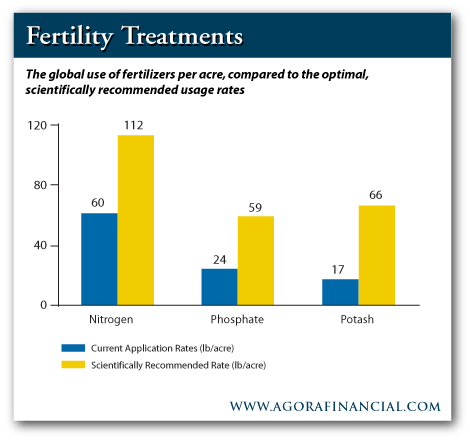
| Posted: 21 Apr 2011 09:30 AM PDT The silver market has been on a tear, no doubt about it. The price of this shiny white rock has soared 50% in 2011, alone. There's good reason for this huge move (Hint: His name is Ben Bernanke). But I want to tell you about a different white rock – one that's also quite precious. The rock is called phosphate. There is no substitute for it. It is crucial to the world's food supply, for which it serves as a fertilizer. And most of the world's mines are in decline. Foreign Policy magazine recently called it "the gravest resource shortage you've never heard of." Demand for the rock is growing as demand for food rises. As I write, food prices are surging. Wheat is up 110% over the last 12 months. Corn is up 87%; soybeans, 59%; and sugar, 22%. Soaring food prices helped set off protests in Tunisia and Egypt, toppling regimes and threatening to spread similar uprisings to other poor countries in the region. There is no quick remedy. Many of the trends that created today's situation have been long in the making. The world population continues to grow. The amount of arable land per person continues to fall. Gains in crop yields have slowed. And more people around the world are eating a more calorie-rich diet. Prosperity in China, India, Brazil and other places have added millions of middle-class consumers eating more meat and processed foods. Plus, let's not forget biofuels, which place energy and food in direct competition. These happenings are no secret. I've written about them for the last couple of years. Now these things are on the front pages of newspapers and magazines. And – not surprisingly – the stocks of many agricultural firms have soared. But there is still one story that has gotten little play from investors so far. It's about a rock called phosphate, a key ingredient in making fertilizers. It is one of the three main nutrients for crops (nitrogen and potash being the other two). It's hard to overstate the importance of these fertilizers right now. About 40% of the world's food supply depends directly on the application of these three nutrients. Yet the world still applies far less than the scientifically recommended rates.
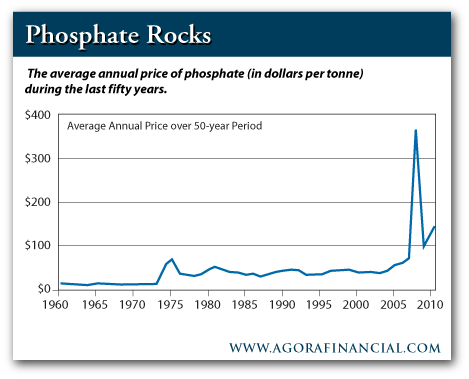
Phosphate itself is important for root development and water efficiency. But most critically, like all fertilizers, it boosts crop yields. You get more per acre using it than not. In a world where arable land per person is falling and food consumption per capita is rising, crop yields are key. Plus, consider the path of phosphate prices. In the last food crisis of 2008, the price of phosphate rock soared to nearly $400/tonne. Then it crashed, like everything else. But it's been making its way back up. Today, it's about $150/tonne.
With all that's happening right now, doesn't it seem reasonable to think we'll see another test of that peak? I think so. The price of many commodities spiked in 2008, and then crashed in 2009, only to subsequently recover. Oil was over $140 per barrel, and dropped below $30, only to rebound strongly. As with oil, long-term demand and supply issues created phosphate's spike too, and remain unresolved. When I ask myself what's changed from 2008, my answer is not much. In fact, the oil analogy is not a bad one. As with oil, phosphate production is concentrated. Whereas some 75% of the world's oil reserves are in the hands of OPEC, about 90% of the world's phosphate is in the hands of just five countries: Morocco, China, South Africa, Jordan and the US. As with oil, more and more countries need to import it, and it is getting hard to find big, low-cost supplies. The US is the largest consumer of phosphate and has long been an importer. Mosaic is one of the big producers down in Florida, which is the main source of phosphate in the US. But Mosaic has had trouble lately expanding that mine. They've actually had to stop mining from their Fort Meade facility over permitting issues. The US ought to import for many years to come. Latin America imports even more. And Asia imports even more still. India, for example, doesn't have any phosphate and will become a major importer in years ahead. Hence, the world begins its scramble to find more sources of phosphate. We've already seen a flurry of activity among the fertilizer companies last year. For example, Vale (the big Brazilian fertilizer and iron ore company) picked up phosphate mines and processing facilities from Bunge and Fosfertil. Mosaic took a 60% stake in a Peruvian phosphate project, Bayovar, with Vale the other partner. Vale bought Bayovar, an undeveloped phosphate deposit, for $300 million in 2005. The 2010 deal valued it at $1.1 billion. Still, based on what we know today, there is no significant new supply coming until at least 2014. All of the above will make phosphate a hot commodity in the next few years. Therefore, buy phosphate. Regards, Chris Mayer, The "Other" White Rock originally appeared in the Daily Reckoning. The Daily Reckoning recently featured articles on stagflation, best libertarian books, and QE2 .
|
| BlackRock Issues Refutation Of SLV Fraud Allegations; Is It Time To Panic For SLV Holders? Posted: 21 Apr 2011 09:06 AM PDT
That over the past few years there has been a substantial push to expose some of the chicanery at the SLV iShares silver ETF, especially among the non-indoctrinated blogosphere, is no surprise. After all fear of a massive paper silver wipe out is not only the reason for success of Eric Sprott's physical silver ETF, but for the massive and consistently record premium over NAV of the PSLV. Yet up until now, we were not all that concerned about such allegations (despite having written about this ourselves on several occasions). After all, the one thing that would essentially validate such, at time exorbitant, allegations, was missing: a formal refutation. That is, until now. Kevin Feldman, a Managing Director in the iShares unit of BlackRock, has just blasted out the following email which we were lucky enough to become privy to. Basically, we now have the one and only thing we were missing: an official denial of all the "rumors." It may now be time to abandon the SS SLV, because if this letter is the best defense iShares can muster, then SLV holders may be in trouble. But better confirmation than. And leaving the content of the letter aside, its existence, and that BlackRock itself is willing to engage the tinfoil hat clad blogosphere, is the biggest red flag so far... What’s in the iShares Silver ETF? Silver.
Source: BlackRock 4/28/06 (launch date) – 4/1/2011
|
| Gold miners African Barrick and Petropavlovsk hit by rising costs Posted: 21 Apr 2011 09:02 AM PDT Blue-chip gold miner African Barrick Gold (ABG) said that first quarter pre-tax profits slipped 2pc, despite the soaring gold price, after the cost of mining each ounce rose. 
This posting includes an audio/video/photo media file: Download Now |
| Physical silver trades over $50 Posted: 21 Apr 2011 09:00 AM PDT Monex Silver American Eagles Pass $50/Ounce Share this:
|
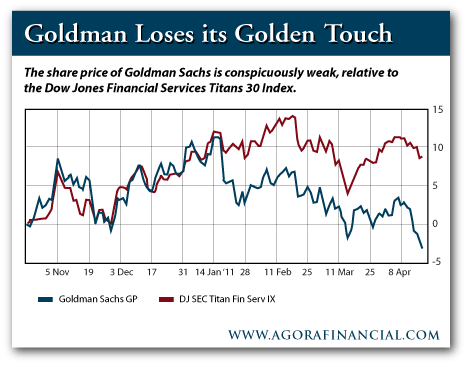
| Making Sense of Gold’s Strength and Goldman’s Weakness Posted: 21 Apr 2011 08:44 AM PDT The stock market "rallied huge" yesterday…and it continues rallying today – lifting the Dow Jones Industrial Average to a new three-year high. But the shares of market leader, Goldman Sachs (NYSE:GS), haven't been doing much of anything. The conspicuously feeble performance of GS is not the only curiosity of recent trading action… In no particular order: Gold has jumped decisively through $1,500 an ounce to new all-time highs, silver is on a moon-shot that won't quit – rising to new three-decade highs almost every trading day, the dollar is imploding faster than a Tokyo sidewalk, and sovereign financial conditions – from Athens to Lisbon to Washington – remain disasters-in-progress. Your editors have no idea what these freakish macro-economic juxtapositions portend. But if forced to guess, we would guess that the strongest trends in the marketplace are the most important trends…and the ones most deserving of attention…and investment. The strongest trends on the planet right now remain what they have been for more than a decade: "precious metals up." A related trend – and almost as strong – would be "oil up," followed closely by an all-encompassing "commodities up." These robust trends are both chicken and egg to a very strong, offsetting trend: "dollar down." As these strong trends interact with one another, a variety of other financial markets thrash around in the resulting crosscurrents. Stocks, for example, are probably as much a "dollar down" trade as anything else. We have suggested this idea numerous times here in The Daily Reckoning. In a world of near-zero interest rates and a rapidly declining dollar, coincident with rising inflation and rising inflation expectations, the precious metals are the most obvious refuge for capital. Oil and the rest of the commodity complex offer similar appeal. But commodities are not the only game in town for dollar-phobic investors. Stocks provide a different kind of refuge. While inflation tends to punish stocks over the short term, stocks do "re-price" to inflation over longer time frames. Furthermore, stocks, as partial shares of capitalistic enterprises, provide growth potential that commodities do not. Net, net, a great, big ugly bear market in stocks does not seem very likely very soon…as long as you are measuring the performance of stocks in dollars. Year-to-date, the Dow is up a robust 8.7% in dollar terms, but up only 2.5% in Brazilian reals…and down 1% in Norwegian kroner terms. Heaven forbid, you conduct this calculation in terms of gold or silver! Since the end of 2009, the Dow has chalked up a hefty total return of 24%…in dollar terms. But in gold terms, the gain flips to a 10% loss, and in silver terms, a 50% loss! However, since most folks count their stock market winnings or losing in dollars, we'll do the same. Thus, in dollar terms, an imminent, great, big ugly bear market in stocks seems unlikely…at least not until and unless Ben Bernanke discontinues flooding the financial system with dollars. However, a series of small, annoying bear markets seems very plausible. From a technical standpoint, the shares of Goldman Sachs seem to portend stock market weakness. The shares of the market-leading, world-beating financial wizard have been conspicuously weak lately.
According to a variety of Wall Street analysts, the stock is weak because of "earnings-sustainability concerns." But the analysts here at The Daily Reckoning offer an alternative analysis: the stock is weak because the stock is weak. The growth profile of Goldman Sachs has been taking a beating for months, and yet the stock continued rising. No matter that widespread public contempt for the firm arose from the ashes of the 2008 crisis, and that the SEC sued the firm for a variety of fraudulent activities and that the Dodd-Frank law forced Goldman to divest extremely profitable operations and/or discontinue extremely profitable corporate activities, no matter that various banking reforms have forced the firm to reduce the leverage that contributed to its strong results, the shares of Goldman Sachs continued rising…day after day. But now that the shares are falling, everyone's got a reason why. We say the stock is falling because it is falling. And the only other thing we would say is that when market-leading stocks fall for no reason – or for any reason – while the rest of the stock market is continuing to rise, bad things often happen. Eric Fry Making Sense of Gold's Strength and Goldman's Weakness originally appeared in the Daily Reckoning. The Daily Reckoning recently featured articles on stagflation, best libertarian books, and QE2 .
|
| CMEGroup (Nymex and Comex) markets closed for trading tomorrow Posted: 21 Apr 2011 08:40 AM PDT [url]http://www.traderdannorcini.blogspot.com/[/url] [url]http://www.fortwealth.com/[/url] Gold and silver will not be trading on the Comex tomorrow in observance of the upcoming Easter Holiday according to the CME press release. They will reopen Sunday evening. Thursday, Apr 21 NYMEX & COMEX® and DME Products on CME Globex [FONT=Arial]1615 CT / 1715 ET – Regular CME Globex close for trade date Thursday, Apr 21 [/FONT]Friday, Apr 22 [FONT=Arial]CME Globex is closed [/FONT]Sunday, Apr 24 [FONT=Arial]1700 CT / 1800 ET – Regular CME Globex open for trade date Monday, Apr 25 [/FONT]...
|
| Gold Daily and Silver Weekly Charts - Somebody Throw Some Water on Blythe, She's Smokin! Posted: 21 Apr 2011 08:24 AM PDT |
| Gold settles at record above $1,500 Posted: 21 Apr 2011 08:20 AM PDT By Claudia Assis Gold for June delivery, the most active contract, added $4.90, or 0.3%, to settle at $1,503.80 an ounce on the Comex division of the New York Mercantile Exchange. The metal hit an intraday high of $1,509.60 an ounce, according to a preliminary tally on CME Group's website. CME owns Comex. Silver settled at a 31-year high past $46 an ounce. Gold has been on a record-breaking tear since Friday, and Monday's move by Standard & Poor's Ratings Services, which revised its outlook for U.S. debt to negative, and the start of the dollar's rout merely "added fuel to the fire" for those looking to the metal as an alternative to currencies, said Bill O'Neill, a principal at Logic Advisors in New Jersey. Investors also didn't want to spend a three-day weekend without some sort of protection in gold, he added. Most financial markets will be closed in observance of Good Friday. [source]
|
| Posted: 21 Apr 2011 08:03 AM PDT by David Berman … He estimates that a 3.5 per cent increase in mine output combined with a 3 per cent increase in scrap isn't enough. "Hence, only a higher price can balance supply and demand," he said. [source]
|



| You are subscribed to email updates from Save Your ASSets First To stop receiving these emails, you may unsubscribe now. | Email delivery powered by Google |
| Google Inc., 20 West Kinzie, Chicago IL USA 60610 | |


No comments:
Post a Comment