


Gold World News Flash |

- Can You Pass The 2011 Gold Quiz?
- Stock Market Uptrend Resuming
- Texas university endowment's gold investment will prompt others, Lassonde tells King World News
- A Golden Tipping Point: University of Texas Takes Delivery Of $1 Billion In Physical Gold
- Pierre Lassonde - Texas University Buys $1 Billion of Gold Bars
- Doubling Down To (DXY) Zero: Has The Fed, In Its Stealthy Synthetic Bet To Keep Long-Term Yields Low, Become The Next AIG?
- Trends in the Market Health Indicator
- The Establishment Train Is Going Off a Cliff
- Will Gold Drop to $1,200 Before Spurting to $2,000?
- What?s Next for the Price of Gold?
- Jim Grant On Inflation: "There Will Be A Lot Of It Suddenly" Because Our Interest Rate Structure Is "Beyond Strange"
- Insurance, Weather, Goldie and the SNB
- What Is Silver Screaming About?
- Hedge Fund Ratio Spread Trades Continue to Distort the Value of the Mining Shares
- Mining shares priced for 2001 gold and silver prices, Norcini tells KWN
- Alasdair Macleod: Anatomy of a short squeeze
- Belarus Central Bank Halts Sales of Gold For Roubles
- Extremely good news
- This is incredibly bullish for silver – all of these deniers will be panic buying after the price crosses $100 per Oz.
- Public Pensions Betrayed by Fraud and Abuse?
- So What Is Silver Shouting About?
- THE Nobel Keynesian ASS
- “There has been so much physical buying that it’s widely reported that the mints are having difficulty obtaining coin strip in the face of overwhelming coin (read: Silver Keisers) demand.”
- Anatomy of a short squeeze
- In The News Today
- Hourly Action In Gold From Trader Dan
| Can You Pass The 2011 Gold Quiz? Posted: 16 Apr 2011 05:09 PM PDT By Jeff Clark, BIG GOLD CPM Group recently released their 2011 Gold Yearbook, an invaluable resource for us gold analysts. Mostly a reference book, even a gold enthusiast might find it dry reading. But I loved it, and as I studied it on a plane, I kept finding data that made me perk up. To have a little fun with it, I thought I'd summarize what I read in the form of a quiz. See how many you can get correct. Regardless of your score, I'm sure you'll agree with the ramifications each point makes for the gold market. I'll start off easy… 1) The main driver behind rising gold prices over the past decade is: a) Increased jewelry demand in India b) Greater industrial uses of the metal c) Investment demand Worldwide investment demand for gold totaled 44 million ounces in 2010. Because of the growing demand by investors, prices have been forced upward. →Five exchanges began trading gold contracts for the first time in 2010, and three more introduced ...
|
| Posted: 16 Apr 2011 01:55 PM PDT Last week the world indices did quite well while the US struggled. This week the US held its own while the world indices were solidly in the red. For the week the SPX/DOW were -0.45%, and the NDX/NAZ were -0.60%. Asian indices were -1.0%, Europe dropped 1.6%, the Commodity equity group lost 3.4%, and the DJ World was -1.1%. Bonds were +1.2%, Crude lost 2.8%, Gold added 0.8% and the USD was flat.
|
| Texas university endowment's gold investment will prompt others, Lassonde tells King World News Posted: 16 Apr 2011 12:28 PM PDT 9:11p ET Saturday, April 16, 2011 Dear Friend of GATA and Gold: Interviewed today by King World News, gold mining entrepreneur Pierre Lassonde predicts that the huge investment in gold by the endowment fund of the University of Texas will prompt other institutional investors to invest in real metal. An excerpt from the interview has been posted at the King World News blog here: http://kingworldnews.com/kingworldnews/KWN_DailyWeb/Entries/2011/4/16_Pi... A Bloomberg News report about the investment is appended. CHRIS POWELL, Secretary/Treasurer * * * Texas University Endowment Storing About $1 Billion in Gold Bars By David Mildenberg and Pham-Duy Nguyen http://www.bloomberg.com/news/2011-04-15/texas-university-endowment-hold... The University of Texas Investment Management Co., the second-largest U.S. academic endowment, took delivery of almost $1 billion in gold bullion as the metal reaches a record, according to the fund's board. The fund, whose $19.9 billion in assets ranked it behind Harvard University's endowment as of August, according to the National Association of College and University Business Officers, last year added about $500 million in gold investments to an existing stake, said Bruce Zimmerman, the endowment's chief executive officer. The holdings reached about $987 million yesterday, as Comex futures closed at $1,486 an ounce. ... Dispatch continues below ... ADVERTISEMENT Sona Drills 85.4g Gold/Ton Over 4 Metres at Elizabeth Gold Deposit, Company Press Release, October 27, 2010 VANCOUVER, British Columbia -- Sona Resources Corp. reports on five drillling holes in the third round of assay results from the recently completed drill program at its 100 percent-owned Elizabeth Gold Deposit Property in the Lillooet Mining District of southern British Columbia. Highlights from the diamond drilling include: -- Hole E10-66 intersected 17.4g gold/ton over 1.54 metres. -- Hole E10-67 intersected 96.4g gold/ton over 2.5 metres, including one assay interval of 383g of gold/ton over 0.5 metres. -- Hole E10-69 intersected 85.4g gold/ton over 4.03 metres, including one assay interval of 230g gold/ton over 1 metre. Four drill holes, E10-66 to E10-69, targeted the southwestern end of the Southwest Vein, and three of the holes have expanded the mineralized zone in that direction. The Southwest Vein gold mineralization has now been intersected over a strike length of 325 metres, with the deepest hole drilled less than 200 metres from surface. "The assay results from the Southwest Zone quartz vein continue to be extremely positive," says John P. Thompson, Sona's president and CEO. "We are expanding the Southwest Vein, and this high-grade gold mineralization remains wide open down dip and along strike to the southwest." For the company's full press release, please visit: http://sonaresources.com/_resources/news/SONA_NR19_2010.pdf The decision to turn the fund's investment into gold bars was influenced by Kyle Bass, a Dallas hedge fund manager and member of the endowment's board, Zimmerman said yesterday at its annual meeting. Bass made $500 million on the U.S. subprime mortgage collapse. "Central banks are printing more money than they ever have, so what's the value of money in terms of purchases of goods and services?" Bass said today in a telephone interview. "I look at gold as just another currency that they can't print any more of." Gold reached an all-time high of $1,489.10 an ounce today in New York as sovereign debt concerns boosted demand for the metal as a store of value. Gold has climbed 28 percent in the past year on Comex. The endowment, which oversees funds held by the University of Texas System and Texas A&M University, has 6,643 bars of bullion, or 664,300 ounces, in a Comex-registered vault in New York owned by HSBC Holdings Plc, the London-based bank, according to a report distributed at yesterday's meeting in Austin. Join GATA here: An Evening with Bill Murphy and James Turk Gold Rush 2011 Support GATA by purchasing gold and silver commemorative coins: https://www.amsterdamgold.eu/gata/index.asp?BiD=12 Or a colorful GATA T-shirt: Or a colorful poster of GATA's full-page ad in The Wall Street Journal on January 31, 2009: http://gata.org/node/wallstreetjournal Or a video disc of GATA's 2005 Gold Rush 21 conference in the Yukon: Help keep GATA going GATA is a civil rights and educational organization based in the United States and tax-exempt under the U.S. Internal Revenue Code. Its e-mail dispatches are free, and you can subscribe at: To contribute to GATA, please visit: ADVERTISEMENT The Gold Standard Now: It Can Work Today a dollar is worth 80 percent less than it was 40 years ago, and less than 5 percent of its value a hundred years ago. We deserve a dollar that is as good as gold, a dollar that will hold its value from year to year so we can be financially secure and our economy can generate more and better jobs. For most of America's history, our dollar was literally as good as gold. But on August 15, 1971, our politicians destroyed the link between gold and the dollar. They destroyed the foundations of our economic system. A new Internet site, TheGoldStandardNow.org, provides news and cutting-edge analysis about this most important issue and explains how the gold standard worked in the past and how it can work in the future. Visit us today: http://www.thegoldstandardnow.org/about/137-welcome-newsmax
|
| A Golden Tipping Point: University of Texas Takes Delivery Of $1 Billion In Physical Gold Posted: 16 Apr 2011 11:59 AM PDT
Tipping points are funny: for years, decades, even centuries, the conditions for an event to occur may be ripe yet nothing happens. Then, in an instant, a shift occurs, whether its is due a change in conventional wisdom, due to an exogenous event or due to something completely inexplicable. That event, colloquially called a black swan in recent years, changes the prevalent perception of reality in a moment. This past week, we were seeing the effect of a tipping point in process, with gold prices rising to new all time highs day after day, and the price of silver literally moving in a parabolic fashion. What was missing was the cause. We now know what it is: per Bloomberg: "The University of Texas Investment Management Co., the second-largest U.S. academic endowment, took delivery of almost $1 billion in gold bullion and is storing the bars in a New York vault, according to the fund’s board." And so, the game theory of a nearly 100 year old system of monetary exchange has seen its first defector, but most certainly not last. With an entity as large as the University of Texas calling the bluff of the Comex, the Chairman, and fiat in general in roughly that order, virtually every other asset manager is now sure to follow, considering there is not nearly enough physical gold to satisfy all paper gold in existence by a factor of about 100x. The proverbial Nash equilibrium has just been broken. From Bloomberg:
Years from now, when historians attempt to define who may have started it all, one name may emerge...
In summary - the fiat tide is now going out. And among those who will first be observed swimming naked are the very same people whose fate has been so very intrinsically linked to the perpetuation of a flawed regime (and who coined this very saying). In the meantime, hold on to your hats: should a scramble for delivery ensue, the recent parabolic move in various precious metals will seem like a dress rehearsal for what is about to transpire. The only open question is who was the broker with enough gold to deliver to the UofT. We hope to find out soon enough. We also hope that the UofT is smart enough, and that Kyle Bass advised it, that if they are getting "delivery" in a Comex vault in New York, the gold has likely already been leased out at least several times to various entities demanding paper allocations...
|
| Pierre Lassonde - Texas University Buys $1 Billion of Gold Bars Posted: 16 Apr 2011 10:46 AM PDT  With gold closing at new all-time highs and silver closing at new multi-decade highs, today King World News received word from legendary Pierre Lassonde, former CEO of Newmont Mining, that Texas University now holds $1 billion worth of gold bars. Lassonde stated, "This is another turning point in the gold market. It's the first large institutional holding of gold and they are quite public about it." With gold closing at new all-time highs and silver closing at new multi-decade highs, today King World News received word from legendary Pierre Lassonde, former CEO of Newmont Mining, that Texas University now holds $1 billion worth of gold bars. Lassonde stated, "This is another turning point in the gold market. It's the first large institutional holding of gold and they are quite public about it."
This posting includes an audio/video/photo media file: Download Now |
| Posted: 16 Apr 2011 08:41 AM PDT
When looking back at the Great Financial Crisis of 2008, the primary catalyst the pushed the system over the edge and required central banks around the world to institute a global bailout of unprecedented scale was one simple thing: the layering upon layering upon layering of bets (using "other people's money" and courtesy of recently unleashed "financial innovation" in the form of virtually margin-free securities such as credit derivatives, demonstrated best by this chart) that interest rates would keep dropping, primarily in the form of exponentially tiered credit structures such as synthetic CDOs (all the way to the cubed degree) together with CDS sold on such layered synthetic derivatives. Of course, when the black swan event occurred and rates surged, this relentless leveraging of wrong-sided bets promptly resulted in the liquidation of any institution that was on the wrong side of such bets. Most notably AIG. In essence, AIG took the "logic" that since a rate blow up would likely result in the collapse of the US (and thus worldwide) funding structure, it would invoke the biggest central bank Put of all: either the Fed would rescue the world, or capitalism as we knew it would end. As it turned out, AIG was right, and following the sacrifice of Lehman Brothers, every other institution on the wrong side of the levered "rate" trade was saved by the Fed. But at what price? Simply said, the Fed, in bailing out the world (a meme that has only now received popular acceptance following the release of formerly classified Fed documents, despite our claims precisely to that end from back in October 2009) has become the world's largest hedge fund and with a DV01 of over $1.5 billion by now, has taken on virtually unlimited interest rate risk (a topic discussed back in April 2010). As such controlling inflation expectations, or more specifically, Long-Term rates (the part on the curve that Quantitative Easing is powerless to control) is the most critical aspect of the viability of the monetary system. Stunningly, today we learn that to keep long rates low, the Fed may have resorted to nothing short of the same suicidal trade that destroyed AIG FP and brought the entire system to its knees. Namely, Ben Bernanke is now quite possibly the second coming of Joe Cassano, since in order to keep rates low, Bernanke is forced to a last resort action of selling billions upon billions of Treasury puts to "pin" rates low contrary to natural supply-demand mechanics. If so, the Fed is now basically AIG Financial Products, although instead of being synthetically long mortgages (and thus betting on a rate decline) and selling hundreds of billions in CDS to amplify its bet, Bernanke has done the same thing, only this time with Treasurys. Of course, Ben has the printing press on his side apologists will claim. Alas, that will have no impact whatsoever, if indeed the Fed has been reduced to finding ever fewer counterparties to a synthetic bet to keep long-term rates low, as very soon, with inflation ticking up, all hell may break loose in an identical replay of what happened to AIG once the Fed's put is called against it. Only this time there will be nobody to bail out the ultimate backstopper, resulting in the long overdue end of the current failed monetary system experiment. Some may recall that over a year ago we made a curious discovery: by looking at the composition of securities held in the Fed's Maiden Lane I portfolio (than inherited from the collapse of Bear Stearns, which not even JP Morgan wanted) we uncovered that as part of the portfolio of toxic assets, which most recently was valued at $25.6 billion, the risk managed in charge of the book BlackRock had also put on a variety of synthetic hedges: "the FRBNY holds 5000 TYM0 puts, 3825 TYH0 puts, short 4000 FVH0, short 7828 TYH0, short 2240 USH0, and is short a bunch of eurodollar positions." The issue as we correctly specified, is that "while the Fed is pretending to care about interest rate concerns in an increasing rate environment and is hedging ML1, it has one billion DV01 risk for its house bailout package...This is a stunning number: the second rates commence creeping higher, you can kiss all that profit on TARP and what not not only goodbye, but the losses on the SOMA books will likely destroy America." We then concluded: "the Fed has decided to protect against a major hike in rates [in the Maiden Lane I portfolio]. Yet that which is truly relevant, the Fed's nearly $2.4 trillion in holdings of MBS, Agency and Treasuries is completely unhedged [the number is now $2.7 trillion and will be nearly $3 trillion by the time QE2 ends]. Good luck finding the counterparty that would be willing to put on a $200 trillion gross notional interest rate swap with the Fed." In other words, we were wondering why is the Fed not actively hedging its multi-trillion SOMA portfolio (including MBS, Agencies and Treasuries) if it was willing to do so with the far smaller Maiden Lane I subsegment of its holdings. Naturally, it may well have been doing so as there is no place in the Fed's weekly report (H.4.1) update that lists explicit derivative positions (more on this in a second). Ironically, it seems that we had the entire situtation backwards: it appears that far from being worried about hedging its SOMA book synthetically, the Fed may well have be constantly doubling down on its risk exposure in the form of off-book derivative contracts in order to "pin" Long-Term rates (read the 10 Year) by constantly selling Puts on Long Dated Treasurys at opportune times when there is no incremental buying of the underlying security, yet when, as the CDO and upcoming ETF debacles have so well demonstrated, the price of the derivative actually impacts the price of the underlying! The missing sequential link in (lack of) logic comes from a report by Market Skeptics' Eric deCarbonnel who has combed through the June 24-25, 2003 FOMC minutes to find what could well explain the ongoing paradoxical flatlining in long-term rates even despite the threat of an end in QE2, which implies the removal of a buyer of some 83.4% of net Treasury securities, as well as the ongoing inflation threat so well described by James Grant earlier. What deCarbonnel has found is that as per then Fed secretary and economist, Vince Reinhart, and SOMA manager Dino Kos, the Fed has explicit authority and has in the past, sold puts on securities in order to bring various parts of the curve in line with "market expectations." The fragment from Dino Kos' transcript which implies that the Fed is likely actively pursuing a derivative feedback loop to keep long-term yields low (and thus prices high), is the following. Below, Kos discussed the "alternative approaches that would involve changes to how the Desk operates" in order to achieve the "conduct of monetary policy at very low short-term interest rates." To wit:
As deCarbonnel points out, 1 and 2 have already been either explicitly or implicitly utilized by the Fed in order to prevent the yield curve from exploding, due to the fundamental dichotomy of Fed operations: the Fed can keep short term rates at zero easily, it is the long-term ones that are a key threat to tipping the Fed's unhedged book over. Which leaves only option 3: "using derivative instruments" to keep LT rates low. And this is where it gets both interesting... and very disturbing. Going back to Dino Kos' speech:
And the stunner:
At this point the lightbulb should slowly be starting to glow:
Summary: not only does the Fed admit that it has already sold off asset derivatives as a means of controlling short and/or long-term rates, but the Fed in essence is willing to do with rates derivatives what Warren Buffet did with equities in the form of his gargantuan index put sales, and Joe Cassano has done with CDS sales on his CDO holdings. Here the Fed, as any rational investor seeking to manipulate the price of an underlying instrument, although with the benefit of having a printer, expresses the logical concern: what happens if options are excercised, or in other words, what might happen if the "pin" bogey on the underlying is crossed and the Fed suddenly finds itself in a losing "In The Money" position:
Ironically this is precisely what Jos Cassano thought... Until of course Goldman changed the rules in the middle of the game, hiked collateral requirements and forced a toxic feedback loop whereby AIG had to undergo a liquidation waterfall putting it deeper and deeper underwater, until ultimately it was so far undercapitalized it had to be bailed out by taxpayers. Kos logically realized that it is far easier to manipulate short-term rates than long-term and as such advocated initially merely dabbling in repurchase options, which only impact ultra-short term rates: i.e., those critical to bank functioning whereby banks can borrow cheap and lend rich.
We get even warmer:
Kos' verdict: the Fed would need to sell a huge amount of Treasury puts to regain credibility that it would continue to sell even more puts should the situation require it: i.e., be the seller of only resort, and calm a Treasury liquidation wave by the market.
To be sure, Kos appreciated the downside risk associated with going all in on a losing bet, and then leveraging some more:
And that is the kicker. In essence the Fed may well be undergoing a program whereby via one of its Primary Dealers, most likely JP Morgan due to the banks key position as one of only two clearers of the repo system, it is selling Treasury puts, which would have an impact of pushing Treasury prices higher, and thus yields lower, contrary to all expectations in order to pin rates to specific levels. And as Kos admitted, the more long-term yields would run up, the more puts the Fed would be forced sell. Since derivatives have little to no initial (or maintenance) margin requirements, especially not with a counterparty such as the Fed which can just print money any time there is a margin call, the Fed would be able to virtually print an endless amount of Treasury puts to keep underlying, and very much delta hedged, position, read THE YIELD ON THE 10 YEAR precisely where it wants it! The Fed says as much in Exhibit 8 to the June 24-25, 2003 minutes:
And before skeptics say the Fed would never do this in reality, Vince Reinhart admits that the Fed did very much that just over a decade earlier:
With lack of data availability one can only speculate how much options, most likely in the form of swaptions, the Fed would need to sell currently to keep 10 Year yields low, although if past is any indication, if the SOMA desk sold nearly $250 billion in repo puts back in 2000 when the Fed's balance sheet was a fraction of what it is now, it is safe to assume that a comparable amount currently would have to be in the trillions, if not tens or hundreds, considering the far lower notional impact on a security with material duration compared to one to impacted (and impacting) by merely ultra-short term rates. As for the Fed's justification to impact the market in such a covert and off-balance sheet manner some might say, it provides the following justification:
Of course when the Fed sees the economy as the market, such as now, it is critical that the Fed do all in its power to prevent an efficient price discovery process from occurring. For those for whom this is still unclear, basically what the Fed may well have done (and has admitted to doing in the past) is what the market does each and every day, when ETF buying results in a long/short gamma trade that pulls or pushes component securities higher or lower. There is a reason why the SPY and the ES are the two most liquid securities in the market: control these, and what happens to the underlying stocks is irrelevant. In very much the same way, the Fed which still continues to load up on Treasury securities (albeit far less so as the longer-end of the curve), is now most likely pursuing a goal of keep the curve as flat as possible and not losing the long end. As a reminder, during QE Lite/QE 2, the Fed has practically forsaken the 30 Y sector of the curve, or the part the most reliant on long-term inflation expectations. Why would the Fed do this in the cash market unless it had some other way to definitively impact demand via synthetic instruments?
A synthetic off-book short put position also explains the confusion of those such as Bill Gross: when the Fed supposedly exits the monetization game, regardless for how short, rates would traditionally be expected to rise. Yes... but only if the Fed was not concurrently selling massive amounts of volatility. And while the actual buying and selling would remain hidden from public view, the aftermath would be visible in downstream market effects. Indeed, this is precisely the case. As can be seen on the below chart which maps the yield on the 30 Year during various QE regimes, and the level of the MOVE Treasury volatility index, during times when the 30 Year appears poised to break out higher in anticipation of a QE end, yet merely trades rangebound, the level of MOVE plummets.
Obviously, plunging vol ends up having an offsetting impect on prices. Were the vol not to drop so materially, the upward drift in Long-Term yields would be very pronounced, and result in the 30 Year breaking out north of 5%, after which the Fed would likely lose all control of the curve. The question then becomes: who is selling all this vol ahead of such a risky event as the end of a Quantitative Easing episode. Our bet: none other than the current Manager of the System Open Market Account: Brian Sack. This however leaves open th
|
| Trends in the Market Health Indicator Posted: 16 Apr 2011 07:40 AM PDT The XAU Market Health indicator is a measurement of price change, price range and trend. The chart for this metric is at the bottom of this page. This indicator has now formed potential base patterns in both the daily and weekly charts. However, it has not reached anywhere near the new all time highs as demonstrated by the prices of gold and silver. A positive trend in this indicator will come but only after a considerable period of backing and filling activity. Clearly, more work needs to be done in both time frames and this will take some time to accomplish. On a positive note, the primary weekly [COLOR=#e06666]TDI and GC trend indicators continue in a positive alignment. They are our primary guide to the performance of the XAU and will go a long way toward resolving the trend in the Market Health indicator. It is simply a matter of time and patience.[/COLOR] -------------------------------------------------------------- Notes on the Dollar, Currencies and the HUI/Gold Ratio. ...
|
| The Establishment Train Is Going Off a Cliff Posted: 16 Apr 2011 05:42 AM PDT "A billion dollars doesn't go as far as it used to." – Bunker Hunt, 1980 That was Mr. Hunt's comment on his losses – at least $2 billion – in his attempt to profit from the silver market, which peaked at $49.50 in January 1980. The price fell by 75% over the next few months. Win some, lose some. At the time, he was regarded as the biggest financial loser in modern history. This was accurate, since seven years earlier, Mohammar Gadaffi had nationalized his oil operations in Libya. At the time, Hunt was the richest private citizen on earth. When Gadaffi got away with this in June of 1973, OPEC caught on and tripled the price of oil in October. That led to a worldwide recession in 1974-75. Win some, lose some.
|
| Will Gold Drop to $1,200 Before Spurting to $2,000? Posted: 16 Apr 2011 05:41 AM PDT [B]Is $1,200 Gold in the Cards?[/B] In the long run developments in the financial markets and around the world seem to conspire to whip up a perfect storm for the gold price, taking it up towards $2,000 and further. That new upleg, however,*could very well start from a much lower level than now. There are quite a few developments that could easily send the gold price lower in the coming months. Is $1,200 gold in the cards? Words: 774 So*says**Edin Mujagic ([URL]http://www.ecrresearch.com/[/URL]) inan article* which*Lorimer Wilson, editor of www.munKNEE.com,* has further edited ([* ]), abridged (…) and*reformatted*below**for the sake of clarity and brevity to ensure a fast and easy read. Please note that this paragraph must be included in any article re-posting to avoid copyright infringement.**Mujagic goes*on to say:* [B]Is a Tighter Monetary Policy Coming?[/B] Although the Fed Board is at odds now whether or not to tighten monetary policy, it is quite conceivable that the Fed will...
|
| What?s Next for the Price of Gold? Posted: 16 Apr 2011 05:41 AM PDT Timing Is Everything When*Assessing the Price of Gold A*basic understanding of gold price phases throughout the year [provides the answer to the question:] “What’s next for the price of gold?”* Let me explain. Words: 758 So*says*Marco G.*([url]http://goombarhsedge.blogspot.com/[/url])*inan article* which*Lorimer Wilson, editor of www.munKNEE.com,* has*further edited ([* ]), abridged (…) and*reformatted*below**for the sake of clarity and brevity to ensure a fast and easy read. Please note that this paragraph must be included in any article re-posting to avoid copyright infringement.* Marco goes*on to say:* A review of [recent] history…. [shows that]*there seems to be 6 definite phases that…gold prices move through during*the year… [according to] the following chart [over the past] two years of daily closing prices: (The author did not use 2008, as the economic disruptions at that time may give unreliable data. Also the years prior to 2008 were ...
|
| Posted: 16 Apr 2011 05:20 AM PDT
One of our favorite economic commentators - Jim Grant of Grant's Interest Rate Observer - was on Consuelo Mack continuing his ongoing crusade against Ben Bernanke's lunacy, and the monetary central planning of the Federal Reserve, particularly focusing on the topic of pernicious inflation which for good reason has received much attention of the past year. Grant, who unlike Steve Liesman correctly observes that inflation is now rampant (those who need a reminder can do so at the only objective source for actual inflation tracking, MIT's Billion Price Index), is eating away at the standard of living of the bulk of the population, even as this same population can not benefit from anything beyond minimal rates on their saving deposits. "The Fed is unconscionably complacent about the consequences of what it is doing, and let us not blink at what it is doing: it has imposed the lowest money market interest rates anyone remembers, it has expanded its balance sheet into something grotesque all in the space of a couple of years. These are monetary events that have never before been seen, and indeed, never before imagined...The Fed's policies are certainly great for one class of society: the speculative classes.... We have socialized risk, we have privatized gains, much to the relief of Greenwich, CT where our zillionaires live, and the unconscionable and indefensible fallout of this is that savers get zero on their savings balances, and the speculative classes get to borrow in wholesale markets at zero and get to make their zillions all over again... The Chairman is whistling by the graveyard in this manner of 2% inflation rate being harmless." On Grant's expectations for inflation rates: "there will be a lot of suddenly - 4 or 5% let us say...So much of our speculative apparatus is powered on these zero percent interest rates... Think how hard it is to hold back a cash reserve in this economy... Your stupid neighbor who is watching this program is making a lot fo money in the stock market: how hard is it not to participate? You can't do it... But 4% inflation would mean that the party is over... Everything would fall out of bed... Gold and silver would right themselves, because they are money that would come into their own at the end of the cycle of disillusionment but for a time there would be terrific chaos in investment markets." As for the gold standard: "If I am right about the dynamics of the Federal debt, not only is the mathematics for a gold standard compelling but so are the politics." In other words, and this should be no surprise to anyone, the transition to real money will continue until the fraud that is unbacked fiat is finally eliminated, with or without the Fed's support.
|
| Insurance, Weather, Goldie and the SNB Posted: 16 Apr 2011 04:07 AM PDT
I Hate United Healthcare


Weather is Changing – Hang on Gulf Coast
La Niña weakened for the third consecutive month, as reflected by increasing surface and subsurface ocean temperatures across the equatorial Pacific Ocean.
Nearly all of the ENSO models predict La Niña to continue weakening in the coming months, and the majority of models indicate a return to ENSO-neutral by May-June-July 2011.


The Goldie Call

Who’s losing in FX?


|
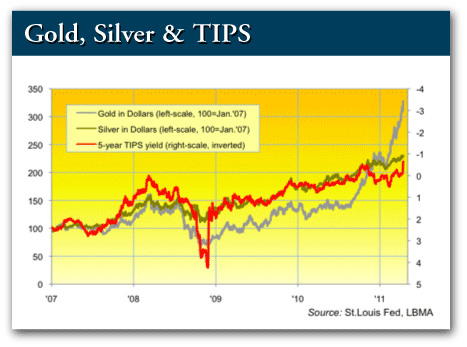
| What Is Silver Screaming About? Posted: 16 Apr 2011 04:00 AM PDT The current surge in bids to buy silver might seem dramatic, but it's more measured by far – to date, at least – than the true silver bubble of September 1979 to January 1980. Even so, you may as well call this a record price. In real terms, as Matt Turner at Mitsubishi told me this week, one ounce of silver briefly rose above 40 of today's US dollars per ounce in 1864, when the American Civil War neared its climax. In nominal dollars, the Hunt brothers' multi-billion-dollar corner only saw it more highly priced on 5 trading days in January 1980. And while US investors waiting to buy silver are also still waiting for it to record a new intra-day high, it's already broken new ground against the British pound and for most of the Eurozone, too. The cause? Gold investors have long tried to explain how the metal is "telling us" something. "First warning" of the looming financial crisis, said Marc Faber in his Gloom, Boom & Doom Report of September '07, was when "the price of gold more than doubled in nominal terms and against the Dow Jones Industrial Average [because of] ultra-expansionary US monetary policies with artificially low interest rates." In which case, and with global interest rates further below zero today after inflation than at any time since 1980, what in the hell is silver telling us now?
"TIPS pay a lower rate of interest than regular Treasuries," explained Bloomberg News when the yield offered by 5-year Treasury Inflation Protected Securities briefly dipped below zero (and $20 silver broke a 28-year high) back in March 2008. "[That's] because their principal rises in tandem with a version of the consumer price index which includes food and energy prices. Rising demand for TIPS [which pushes up prices and so pushes down the nominal yield] indicates investors expect the inflation adjustment to make up the difference." What great expectations TIPS buyers must have of Uncle Sam's "inflation adjustment" today! They're buying 5-year index-linked bonds with a nominal yield of minus 0.6%, anticipating a full 2.8% per year fillip from Washington when compared with the annual yield now offered by conventional 5-year bonds. And what greater hopes still must the new rush of silver investment hold…rejecting TIPS in favor of metal, and breaking silver's tight connection with both gold prices and TIPS yields as our chart above shows. Note the point at which silver breaks higher – right when Fed chairman Bernanke vowed to begin QE2 in summer last year. That a fast-growing nugget of the world's private wealth is fearful of the result is clear. That silver looks a turbo-charged play is clearer still. Because as an industrial as well as monetary metal, silver is exposed to strong economic growth – as well as loose central-bank policy – in a way that its cousin, gold bullion, isn't. You could point to 2010's record levels of Indian and Chinese gold demand coming off their continued economic booms, but Asia's silver investment demand is surging faster still. And the aim of all this easy money, remember, is to keep GDP stoked, whether in Beijing, Washington, Frankfurt or London. Little wonder then that Chinese, US, Eurozone and UK inflation is rising sharply. And so no wonder either then that…
There's no bull market like a silver bull market, in short – just ask the Hunt brothers ahead of their bankruptcy, eight years after their corner blew up with the big inflation-fueled 1970s' bull market. Double-digit Fed interest rates popped the bubble back then (plus a good dose of anti-speculative action by regulators and the exchanges, otherwise known as "saving the system" of course. It was sparked in turn by the Hunt brothers' own naked greed, otherwise known to them as "inflation protection"). The most recent time silver got hot, however, it took oil at $150 and then the Lehman Brothers' collapse to do to GDP growth and commodity prices what central bankers wouldn't dare. Because raising interest rates to double digits to kill a "speculative frenzy" wasn't politically possible. Silver's bull run, unlike gold's, is all about inflation. Which is worth bearing in mind whether you're quitting, holding, ignoring or looking to buy silver today. Regards, Adrian Ash What Is Silver Screaming About? originally appeared in the Daily Reckoning. The Daily Reckoning recently featured articles on stagflation, best libertarian books, and QE2 .
|
| Hedge Fund Ratio Spread Trades Continue to Distort the Value of the Mining Shares Posted: 16 Apr 2011 04:00 AM PDT [url]http://www.traderdannorcini.blogspot.com/[/url] [url]http://www.fortwealth.com/[/url] I hope to have further on this topic sometime this weekend depending on time constraints but I wanted to at least get some charts up to demonstrate how severely undervalued many of the mining shares are in relation to the underlying metal as a result of the plying of this particular trading strategy. One of the factors that I believe are involved with this severe underperformance of the shares in general is the advent of the ETF's. Those who want LEVERAGED EXPOSURE to either or both gold and silver can now use the ETF's to do so. Formerly, there were two methods available - commodity futures or mining shares. Since the charters of some funds prevents them from investing or trading in commodity futures, funds who wanted this leveraged exposure to the metals were forced to go into the mining shares in the past. That implied that bull markets in the metals were going to see substantial money flo...
|
| Mining shares priced for 2001 gold and silver prices, Norcini tells KWN Posted: 16 Apr 2011 02:39 AM PDT 10:38a ET Saturday, April 16, 2011 Dear Friend of GATA and Gold: The weekly review of the precious metals markets at King World News finds Bill Haynes of CMI Gold & Silver reporting that retail demand remains strong, and futures market expert Dan Norcini reporting that gold and silver mining shares are priced as if the metals were still trading at their 2001 prices. You can listen to the interview here: http://kingworldnews.com/kingworldnews/Broadcast/Entries/2011/4/16_KWN_W... Audio of the recent King World News interview with James Grant of Grant's Interest Rate Observer has been posted here: http://kingworldnews.com/kingworldnews/Broadcast/Entries/2011/4/16_James... And audio of the recent King World News interview with resource company broker Rick Rule has been posted here: http://kingworldnews.com/kingworldnews/Broadcast/Entries/2011/4/16_Rick_... CHRIS POWELL, Secretary/Treasurer ADVERTISEMENT Sona Drills 85.4g Gold/Ton Over 4 Metres at Elizabeth Gold Deposit, Company Press Release, October 27, 2010 VANCOUVER, British Columbia -- Sona Resources Corp. reports on five drillling holes in the third round of assay results from the recently completed drill program at its 100 percent-owned Elizabeth Gold Deposit Property in the Lillooet Mining District of southern British Columbia. Highlights from the diamond drilling include: -- Hole E10-66 intersected 17.4g gold/ton over 1.54 metres. -- Hole E10-67 intersected 96.4g gold/ton over 2.5 metres, including one assay interval of 383g of gold/ton over 0.5 metres. -- Hole E10-69 intersected 85.4g gold/ton over 4.03 metres, including one assay interval of 230g gold/ton over 1 metre. Four drill holes, E10-66 to E10-69, targeted the southwestern end of the Southwest Vein, and three of the holes have expanded the mineralized zone in that direction. The Southwest Vein gold mineralization has now been intersected over a strike length of 325 metres, with the deepest hole drilled less than 200 metres from surface. "The assay results from the Southwest Zone quartz vein continue to be extremely positive," says John P. Thompson, Sona's president and CEO. "We are expanding the Southwest Vein, and this high-grade gold mineralization remains wide open down dip and along strike to the southwest." For the company's full press release, please visit: http://sonaresources.com/_resources/news/SONA_NR19_2010.pdf Join GATA here: An Evening with Bill Murphy and James Turk Gold Rush 2011 Support GATA by purchasing gold and silver commemorative coins: https://www.amsterdamgold.eu/gata/index.asp?BiD=12 Or a colorful GATA T-shirt: Or a colorful poster of GATA's full-page ad in The Wall Street Journal on http://gata.org/node/wallstreetjournal Or a video disc of GATA's 2005 Gold Rush 21 conference in the Yukon: Help keep GATA going GATA is a civil rights and educational organization based in the United States and tax-exempt under the U.S. Internal Revenue Code. Its e-mail dispatches are free, and you can subscribe at: To contribute to GATA, please visit: ADVERTISEMENT The Gold Standard Now: It Can Work Today a dollar is worth 80 percent less than it was 40 years ago, and less than 5 percent of its value a hundred years ago. We deserve a dollar that is as good as gold, a dollar that will hold its value from year to year so we can be financially secure and our economy can generate more and better jobs. For most of America's history, our dollar was literally as good as gold. But on August 15, 1971, our politicians destroyed the link between gold and the dollar. They destroyed the foundations of our economic system. A new Internet site, TheGoldStandardNow.org, provides news and cutting-edge analysis about this most important issue and explains how the gold standard worked in the past and how it can work in the future. Visit us today: http://www.thegoldstandardnow.org/about/137-welcome-newsmax
|
| Alasdair Macleod: Anatomy of a short squeeze Posted: 16 Apr 2011 01:59 AM PDT 10a ET Saturday, April 16, 2011 Dear Friend of GATA and Gold (and Silver): Writing at GoldMoney, economist and former banker Alasdair Macleod tells a story explaining how short squeezes can drive values to fantastic levels even when the relevant fundamentals are terrible. Short squeeze circumstances, Macleod writes, apply in gold and silver today even as their fundamentals are powerful. Macleod's commentary is headlined "Anatomy of a Short Squeeze" and you can find it at GoldMoney here: http://www.goldmoney.com/gold-research/anatomy-of-a-short-squeeze.html CHRIS POWELL, Secretary/Treasurer ADVERTISEMENT Sona Drills 85.4g Gold/Ton Over 4 Metres at Elizabeth Gold Deposit, Company Press Release, October 27, 2010 VANCOUVER, British Columbia -- Sona Resources Corp. reports on five drillling holes in the third round of assay results from the recently completed drill program at its 100 percent-owned Elizabeth Gold Deposit Property in the Lillooet Mining District of southern British Columbia. Highlights from the diamond drilling include: -- Hole E10-66 intersected 17.4g gold/ton over 1.54 metres. -- Hole E10-67 intersected 96.4g gold/ton over 2.5 metres, including one assay interval of 383g of gold/ton over 0.5 metres. -- Hole E10-69 intersected 85.4g gold/ton over 4.03 metres, including one assay interval of 230g gold/ton over 1 metre. Four drill holes, E10-66 to E10-69, targeted the southwestern end of the Southwest Vein, and three of the holes have expanded the mineralized zone in that direction. The Southwest Vein gold mineralization has now been intersected over a strike length of 325 metres, with the deepest hole drilled less than 200 metres from surface. "The assay results from the Southwest Zone quartz vein continue to be extremely positive," says John P. Thompson, Sona's president and CEO. "We are expanding the Southwest Vein, and this high-grade gold mineralization remains wide open down dip and along strike to the southwest." For the company's full press release, please visit: http://sonaresources.com/_resources/news/SONA_NR19_2010.pdf Join GATA here: An Evening with Bill Murphy and James Turk Gold Rush 2011 Support GATA by purchasing gold and silver commemorative coins: https://www.amsterdamgold.eu/gata/index.asp?BiD=12 Or a colorful GATA T-shirt: Or a colorful poster of GATA's full-page ad in The Wall Street Journal on January 31, 2009: http://gata.org/node/wallstreetjournal Or a video disc of GATA's 2005 Gold Rush 21 conference in the Yukon: Help keep GATA going GATA is a civil rights and educational organization based in the United States and tax-exempt under the U.S. Internal Revenue Code. Its e-mail dispatches are free, and you can subscribe at: To contribute to GATA, please visit: ADVERTISEMENT The Gold Standard Now: It Can Work Today a dollar is worth 80 percent less than it was 40 years ago, and less than 5 percent of its value a hundred years ago. We deserve a dollar that is as good as gold, a dollar that will hold its value from year to year so we can be financially secure and our economy can generate more and better jobs. For most of America's history, our dollar was literally as good as gold. But on August 15, 1971, our politicians destroyed the link between gold and the dollar. They destroyed the foundations of our economic system. A new Internet site, TheGoldStandardNow.org, provides news and cutting-edge analysis about this most important issue and explains how the gold standard worked in the past and how it can work in the future. Visit us today: http://www.thegoldstandardnow.org/about/137-welcome-newsmax
|
| Belarus Central Bank Halts Sales of Gold For Roubles Posted: 16 Apr 2011 01:40 AM PDT ¤ Yesterday in Gold and Silver On Friday, the gold price spent most of the day trading around the $1,475 price mark. But once the London fix was in at 3:00 p.m. local time [10:00 a.m. in New York] the gold price rose about $13...and then traded sideways for the rest of the New York trading session, which ended at 5:15 p.m. Eastern time. Volume was decent. Silver's low of the day was a bit under $42...but once it broke above that price level around 11:00 a.m. in London [6:00 a.m. in New York], the price never looked back...and closed above $43 spot for the first time in thirty-one years. Volume was heavy. The dollar spent all of Friday gaining a bit over ten basis points via a very circuitous route...and was obviously not a factor in the precious metals yesterday. Considering the fact that gold was up almost $30 on Thursday and Friday...and silver up $2.40 during the same time period...the gold and silver stocks sure stunk up the place. Having said that, th...
|
| Posted: 16 Apr 2011 12:12 AM PDT University Of Texas Invests Nearly $1 Billion In Gold Because Kyle Bass Told Them It Was A Good Idea University endowments, pension funds, retirement accounts and the entire ‘passive money’ world of many trillions in wealth will start to nibble at gold and silver. Within 5 years, gold and silver will go from representing .07% [...]
|
| Posted: 15 Apr 2011 11:51 PM PDT Hi Max, You're right…. Tried the theory; spoke to a couple of friends about the pound and the fact it is a fiat currency (used the term faith based currency) and how it was being debased etc. Just as a conversation, no evangelical zeal or drum banging. I espoused the merits of PM's and the [...]
|
| Public Pensions Betrayed by Fraud and Abuse? Posted: 15 Apr 2011 11:37 PM PDT
Elliot Blair Smith of Bloomberg reports, Runaway Public Pensions Betrayed by Fraud, Abuse:
|
| So What Is Silver Shouting About? Posted: 15 Apr 2011 11:13 PM PDT |
| Posted: 15 Apr 2011 11:05 PM PDT
THE NOBEL KEYNESIAN ASS (The Donkey, G.K. Chesterton) WilliamBanzai7
When fishes flew and forests walked And figs grew upon thorn, Some moment when a neo-Keynesian pissed green ink Then surely I was born;
With monstrous head and sickening cry And ears like errant wings, A walking dollar travesty Of all monetarily fraudulent things.
The tattered outlaw of the earth, Of ancient crooked will; Starve, scourge, deride me: I am dumb, I keep my PhD letters still.
Fools! For I also had my hour; One far fierce hour and sweet: There was a shout about my ears, And a gold nobel before my feet
|
| Posted: 15 Apr 2011 10:54 PM PDT Rick Rule – Extreme Silver Tightness Causing Delivery Problems Share this:
|
| Posted: 15 Apr 2011 07:45 PM PDT The shortage of gold and silver is the driving force behind the bull markets in these metals. Quite simply, the outstanding obligations in these commodities exceed the stock available. I vividly ...
|
| Posted: 15 Apr 2011 07:31 PM PDT View the original post at jsmineset.com... April 15, 2011 07:57 PM Today’s Best Trade I gave my daughter a car which requires no less than 91 octane. In return she owes me four baby doll sheep, two goats and two horses. Historically, any country on the path of liquidity as deeply as that which has occurred, gets the sought after title of Banana Republic. Jim Sinclair’s Commentary The making of the Squid! "When plunder becomes a way of life for a group of men living together in society, they create for themselves in the course of time a legal system that authorizes it and a moral Code that glorifies it." –Frederic Bastiat Jim Sinclair’s Commentary Gold is debt. Debt is set. Gold will go ballistic soon. Jim Sinclair's Commentary Gold is going to and through $1650 like it did not exist. Why gold could hit $5,000 Fears of inflation and global turmoil have sent precious metals surging, with gold trading near ...
|
| Hourly Action In Gold From Trader Dan Posted: 15 Apr 2011 07:31 PM PDT View the original post at jsmineset.com... April 15, 2011 12:17 PM Dear CIGAs, Click chart to enlarge in PDF format with commentary from Trader Dan Norcini For further market analysis and commentary, please see Trader Dan's website at www.traderdan.net ...
|




| You are subscribed to email updates from Save Your ASSets First To stop receiving these emails, you may unsubscribe now. | Email delivery powered by Google |
| Google Inc., 20 West Kinzie, Chicago IL USA 60610 | |


No comments:
Post a Comment