


saveyourassetsfirst3 |

- David Morgan calls for $29 silver, (10-20% correction)
- This past week in gold
- Silver Shortages--Really? FSN Metals Update with David Morgan
- Will you have your chair before the music stops?
- Japan in danger of Nuclear Meltdown/Raid foiled in silver and gold
- Investing in Calamity: Gold vs. Oil
- A Comeback for Gold-Backed Money?
- A Real-Life "Italian Job": Thieves Steal 100 kg of Gold
- QE is dead! Long live QE!
- The New Abnormal
- Martenson: “The Coming Rout”
- Revisionist View Of The Great Depression (1 and 2)
- Revisionist View Of The Great Depression Part One
- Gold, Silver Technical Update
- Who Cares About Tax?
- The Probability of More Quantitative Easing
- Crude Oil, Gold, and Silver – Important Timing Connection?
- The Sprotts Expect Silver to Keep on Sizzling
- Friday ETF Roundup: EWJ Sinks on Earthquake Aftermath, UNG Surges on Rig Count
- Is JP Morgan Actually Net LONG Silver and Manipulating it HIGHER?
- Redefining Labor Productivity
- Has The Tsunami In Japan Destroyed The Japanese Economy?
- A new gold standard could be coming faster than anyone expects
| David Morgan calls for $29 silver, (10-20% correction) Posted: 12 Mar 2011 06:17 AM PST Okay...fair enough. Click link and listen then come back here. Click here for David Morgan Interview In fact, if its 20%, hes saying we should see $29 again. How is silver overbought here when in inflation adjusted terms, not even considering a 90% depletion in real physical since then, spot should be at $80...how can he say its overbought? Overbought like on a daytraders timetable? |
| Posted: 12 Mar 2011 05:06 AM PST 3/12/2011  GLD – on buy signal.  SLV – on buy signal. GDX – sell signal this week. Summary Disclosure End of update
|
| Silver Shortages--Really? FSN Metals Update with David Morgan Posted: 12 Mar 2011 02:37 AM PST |
| Will you have your chair before the music stops? Posted: 12 Mar 2011 02:02 AM PST CRIMEX/COMEX NEWS: Gold: -Lots of rolling into April delivery month, and June is the BIG month Silver: -705,207 oz withdrawal from customer -only 35 notices sent down, another representation that there is fuck all left in the vaults -still have 9.1 million ounces standing this month -COT report says JPM et al. covered 1945 contract this week...? This cant be right. -SLV loses 536,951 oz ( |
| Japan in danger of Nuclear Meltdown/Raid foiled in silver and gold Posted: 12 Mar 2011 01:13 AM PST |
| Investing in Calamity: Gold vs. Oil Posted: 12 Mar 2011 12:14 AM PST Bruce Pile submits: With inflation and Gadhafi rearing their ugly heads and disasters like the biggest earthquake to hit Japan in 140 years, an investor has to consider upping his weighting in oil and gold. But which is better? I say gold, and here's why. Both commodities will probably be making their way higher in the face of revolutionary unrest and dollar weakness. But a key difference is their demand picture. With oil, you have a definite demand destruction problem if the price climbs too fast. From where we are now at around $100 to where the price climb starts to defeat itself - most economists say around $115 or so - is not that much of a percentage move. To cipher it up, it's only a measly 15%. As oil goes over $115, the stock market will not like it, and the oil stocks tend to follow the SPX. Things like hurricanes Complete Story » |
| A Comeback for Gold-Backed Money? Posted: 11 Mar 2011 11:45 PM PST  Thanks to reader Peter Handley, here's a story that was posted on Casey Research's website yesterday. Author Andrey Dashkov writes that... "No one can predict exactly how this will all shake out, but Doug Casey has long said that a return to a gold standard, or some modern equivalent, is almost inevitable." This is a short read...and definitely worth your time. The link is here. |
| A Real-Life "Italian Job": Thieves Steal 100 kg of Gold Posted: 11 Mar 2011 11:45 PM PST  My last story today is courtesy of North Carolina reader Bob Dillon...and is a posting over at infiniteunknown.net. Police are hunting for a gang of thieves who carried out an Italian Job-style heist by locking down an entire village to steal more than £3 million worth of gold. The spectacular operation is already being dubbed the crime of the century. Detectives believe the job was organised by the mafia and took months to plan. It's an interesting read...and the link is here. |
| Posted: 11 Mar 2011 11:45 PM PST ¤ Yesterday in Gold and SilverThe gold price was up about seven bucks shortly after London opened on Friday morning...and then suffered the same fate as silver, but to a much lesser degree...as it was obvious that the bullion banks were really going after the white metal. The low came at noon in London, with a secondary low around 9:30 a.m. in New York...and then, it too, climbed to its high of the day [$1,425.50 spot] just minutes after the Comex close...but gave up a lot of those gains, as it got sold off in electronic trading.
Well, the cliff that JPMorgan manufactured for silver to dive off early yesterday morning, found a bottom at the daily London silver fix at twelve o'clock noon GMT...7:00 a.m. in New York. The silver price recovered from there, had a secondary bottom at precisely 9:30 a.m. Eastern...and then ran up to its high of the day...$36.20...which occurred just minutes after Comex trading ended at 1:30 p.m. The silver price then traded sideways into the close of electronic trading at 5:15 p.m. in New York.
The dollar meandered about ten basis points either side of 77.2 cents yesterday. The buck then curled up its toes at exactly 8:30 a.m. New York time...and fell almost 65 basis points from its high to its low of the day at 76.73 cents. It was another day where the dollar actions never quite mirrored the gold price action. As I said yesterday, it matters not what other markets are doing when JPMorgan et al are on the hunt.
The gold shares had a mind of their own yesterday...peaking at least an hour before the high price for both gold and silver were in. From that high, the HUI gave back about a percent of its gains, but closed up 1.69% on the day. And, as a group, the silver stocks did much better than their golden brethren. Here's the HUI for the week that was.
Just to put everything silver related into some sort of perspective, here's Nick Laird's "Silver Sentiment Index" updated as of Friday's close.
Friday's CME Delivery Report showed that zero gold and 72 silver contracts were posted for delivery on Tuesday. The biggest issuer with 64 contracts was the Bank of Nova Scotia, with the biggest stopper being Barclays with 40 contacts. Not much to see here...but here's the link if you wish to have a look. There were smallish declines in both GLD and SLV yesterday. GLD was down 58,521 ounces...and SLV was down 536,951 ounces. The U.S. Mint reported selling another 3,000 ounces of gold eagles...but didn't report selling any silver eagles. The Comex-approved depositories received 62,396 ounces of silver on Thursday...but shipped out a rather large 767,603 ounces. The link to that action is here. Ted Butler said that Friday's Commitment of Traders report was pretty much as he expected. The bullion banks improved their net short positions in both metals by small amounts. In silver, they covered 1,110 contracts...which is 5.55 million ounces. In gold they covered 3,132 contracts...or 313,200 ounces. As of the Tuesday's cut-off, the '8 or less' bullion banks were short 276.3 million ounces of silver along with 22.9 million ounces of gold. One can only imagine what the prices of both precious metals would be if JPMorgan et al weren't there to keep the proverbial cork in the bottle. Nick Laird over at sharelynx.com was kind enough to provide silver analyst Ted Butler's updated "Days of World Production to Cover Short Contracts" graph. Silver and gold are still the standout features on this chart...but the bullion banks' short positions in both platinum and palladium are starting to sneak up there as well.
One has to wonder just how long JPMorgan is going to beat the snot out of silver...with Friday's price action being a classic example of the mark of the beast. A Comeback for Gold-Backed Money? A Real-Life "Italian Job": Thieves Steal 100 kg of Gold. Interviews with Jim Rickards, Jim Sinclair, and Rob McEwen ¤ Critical ReadsSubscribeJapan's Magnitude 8.9 EarthquakeThe big story yesterday was the monster subduction earthquake just off the coast of Japan. As bad as the earthquake was, and it was catastrophic, it was the resulting tsunami that did the most damage close to the epicenter. Washington state reader S.A. sent me the following cnn.com blog on all of this...and the photos and video clips are horrendous...and more are being added all the time. There are quite a few videos imbedded in this link, so it may take some time for the web page to download...but they're all worth viewing, so please be patient. The link is here.  iPad price remark gets Fed's Dudley an earfulToday's first story is courtesy of reader Scott Pluschau...and it's a posting over at finance.yahoo.com. Memo to central bankers: Best not to cite the price of the new iPad as an example of why inflation isn't a problem when you head into a working-class neighborhood. In Queens, New York, on Friday, New York Fed President William Dudley did just that. He got an earful. "When was the last time, sir, that you went grocery shopping?" one audience member asked. "I can't eat an iPad," another said...and it was all downhill from there. The link to the story is here.  Portugal cuts deeper as EU nations hold crisis meetingRoy Stephens first offering today is this piece from yesterday's edition of The Telegraph. Portugal unveiled further spending cuts on Friday to try to restore confidence in its finances as eurozone leaders met to discuss the crisis in the single currency. The yield on Portuguese five-year debt hit a new high of 7.99pc amid mounting speculation that it will join Ireland and Greece in seeking a rescue package. Yields on Greek and Irish sovereign debt also rose, making it more expensive for them to borrow. The link is here.  The World from Berlin: Sarkozy's Libya Move 'Shows Testosterone Level, Not Logic'Roy's next offering is a posting over at the German website spiegel.de. French President Nicolas Sarkozy surprised and upset many on Thursday by unilaterally calling for "targeted air strikes" against the Gadhafi regime and recognizing the rebel Libyan government a day before EU members convened at a summit to hammer out a common approach to the crisis. German commentators were not impressed. The link is here.  QE is dead. Long live QE: Jim RickardsHere's an interview with Jim Rickards that's posted over at the King World News website. There was a blog based on this interview that was posted at the KWN website yesterday...but this is the full interview itself. As you know, I have all the time in the world for what Jim has to say...and this interview is of particular interest...and I consider it a must listen...and the link is here.  Interview With Jim SinclairThe first of my precious metals related stories is this King World News interview that was sent to me by Roy Stephens. I believe I posted this as a blog earlier this week...but here's the complete interview. I haven't had a chance to listen to it, but Roy says it's great...and the link is here.  Interview With Rob McEwenI ran the blog on this a couple of days ago...and Eric King sent me the full interview in the wee hours of this morning. Like the Sinclair interview above, I've had no time to listen to this one, either...but I will sometime this weekend. The link is here.  A Comeback for Gold-Backed Money?Thanks to reader Peter Handley, here's a story that was posted on Casey Research's website yesterday. Author Andrey Dashkov writes that... "No one can predict exactly how this will all shake out, but Doug Casey has long said that a return to a gold standard, or some modern equivalent, is almost inevitable." This is a short read...and definitely worth your time. The link is here.  A Real-Life "Italian Job": Thieves Steal 100 kg of GoldMy last story today is courtesy of North Carolina reader Bob Dillon...and is a posting over at infiniteunknown.net. Police are hunting for a gang of thieves who carri |
| Posted: 11 Mar 2011 09:37 PM PST Why Gold And Silver Will Diverge From Most Other Markets. Analysts and traders have been watching precious metals closely in recent years wondering when and if the metals would separate from the trading influence of the broader stock markets. We've noticed a very gradual departure on the edges. It has been so gradual most would not notice it. We see it in several connected markets during rallies and sell-offs and in other related markets signals-indicators. Will we get a fast break away or will the gradual approach prevail? I suspect a hard breakaway arrives when the broader global stock markets take a hard tumble. However, between now and then there could be many more months of trading required to settle this idea within the psyche of trading and investing minds. Understand that most participants in global markets still believe in the old paradigm of fundamentals. They are believers in buy and hold forever and follow the New York investment community's mantra as their Washington government lapdogs work in concert to "Keep The Big Game In Play," encouraging all, that this too shall pass. We don't think so. And, with the new spreading violence in the middle East followed by subsequent rising energy prices, the "New Normal" or, should we say the "New Abnormal" has arrived and its not leaving any time soon. "If the US Government and their counterparts in other nations would write-off ALL the bad debts, cut government spending in half and dramatically reduce taxes for all to just 10% of net for companies and 10% for the Sheeple, then the entire world would quickly turn around creating a boom."
Not a chance. Not even one chance in a million. The reason is the fat cats in New York, Washington, and those in global corporations like things just as they are. The Sheeple are used just for voting and paying taxes. They are considered just useful dirt under the feet of these controllers. Further, as one entrenched politico told us, "all decisions in Washington are carefully planned and on purpose." Nothing happens that is not deliberate.
Included in those decisions are debasement of the US Dollar, the inflation of credit and the giant housing smash. Further, they planned the shipment of assets and jobs overseas to delete labor costs and the destruction of the entire American middle class stealing their jobs, homes, savings and retirement funds. On the surface, sharp readers and thinkers in the Sheeple Herd keep throwing verbal barbs calling these bankers, congressional thugs and goons "Stupid." Yes, they are stupid in what they are doing but its being stupid with a smart and deliberate purpose… and that purpose is to decimate and steal credit and assets of honest Americans and similar folks in other countries. One global currency and one government is the goal.
This is about power and control of whole nations…of the whole world. It has been planned since the Napoleonic Wars when the Rothchild banking cabal in France loaned piles of cash to BOTH SIDES OF THE WARS TO MAKE MONEY. All the bad stuff seen in this decade and some in prior decades is part of a grand plan to create a one- world government, have one currency and have all important decisions made by a handful of crooks. The only way things are going to change is when fiat currency has no value and the international criminal cabal is smashed into the ground by their own failing bond markets. If this happens, the Sheeple Herd has a small chance. Watch what's happened in Iceland and Ireland. These folks have no intention of paying bankers back for the bad loans they instigated. After Ireland gives the Euro-bankers the one fingered salute, it is going to spread very fast and then Euro-banking sinks into a smoldering pile of wreckage and cracked-up bond markets. With no fiat money to spread around and no takers for their specious bonds, bills and other paper; stock and credit markets as we know them now are finished. Then we'll see real old fashioned goods trading, black markets, expanding regional gangs and unbelievable backlash against the instigators. One American pundit said 50 years ago that "Violence is as American as Apple Pie." I did not quote it precisely, but you get the drift. We've heard the gun population within the USA is anywhere from 100-400 million. We have no idea and could never even come close to a guesstimate. However, we do know one thing; the real American patriots are loading for bear and with the current open attitudes on the street, they intend to take no prisoners. We've quoted before from the great book "When Money Dies," by Adam Fergesson, that over 400 politicians were assassinated in the 1920-1921 Austrian-Weimar Germany hyperinflation. This is what happens when things go very desperate. I am a peaceful non-violent journalist interested in the truth and being of service to my readers, friends, traders and investors. I want no part in any violence but I am a smart student of history. I believe history repeats and that day of "Refreshing the Tree Of Liberty" is not very far away. Not far at all. Most nations and those with freedom and liberty have a shelf life of approximately 250 years. America is now in our 235th year if the baseline is 1776. This means if those cycles hold true, that within the next 15 years or less, the Grand American Experiment is duly ready for some "Tree Refreshing." When you steal a man's home, his job, his savings, his future, and his retirement, that man is going to go gunning. The Sheeple Boyz have got the guns and there are probably lots of girls that do too. The rule of law in the USA has long since gone down the drain. Congress, and our president are imposing laws at will and do so in violation of the U.S. Constitution and our Bill of Rights and, of course, the most important Ten Commandments. While a long hot summer appears to be arriving in the states' this summer, those kinds of violent riots, fires and other mayhem will at first be smothered by the cops; both local and regional. However, when the dollar and the bond markets are toast, we begin to enter The New Abnormal as breakdowns occur everywhere. All the freaks, crooks, psychopaths and greedy bankers and politicians will have no where to hide. If I was in that camp I would be extricating myself from these gangs and finding a place for a new life. We do not encourage or wish violence on anyone. However history books tell us and, have proven time and time again, this is what lies ahead under these circumstances. Do not go to violence. Be peaceful and stay out of the way.         This posting includes an audio/video/photo media file: Download Now |
| Martenson: “The Coming Rout” Posted: 11 Mar 2011 09:20 PM PST Below is a copy of Chris Martenson's weekly summary. I encourage all investors to read "The Coming Rout" which is the first article listed. Weekly Newsletter for Registered Members Below is the content published on ChrisMartenson.com within the last seven days. Included are Chris Martenson's blog posts, the Daily Digest, What Should I Do?, Martenson [...] |
| Revisionist View Of The Great Depression (1 and 2) Posted: 11 Mar 2011 04:00 PM PST Gold University |
| Revisionist View Of The Great Depression Part One Posted: 11 Mar 2011 04:00 PM PST Gold University |
| Posted: 11 Mar 2011 02:21 PM PST Super Force Signals A Leading Market Timing Service We Take Every Trade Ourselves! Email: trading@superforcesignals.com trading@superforce60.com Morris Hubbartt Weekly Market Update Excerpt Mar 11, 2011 US Stock Market QQQQ (Nasdaq Proxy) 6 Month Chart  QQQQ Chart Analysis
UUP (US Dollar Proxy) Chart
Gold and Precious Metals
SGOL 14 Month Chart
Gold Juniors GDXJ Chart GDXJ Chart Analysis:
GDX 6 Month Chart
SIVR (Silver Proxy) 6 Mth Chart
Unique Introduction For Web Readers: Send me an email to alerts@superforcesignals.com and I'll send you 3 of my next Super Force Surge Signals, as I send them to paid subscribers, to you for free! If you want more details on the system itself, send me an email to clarity@superforcesignals.com and I'll send you the 3 set video series I'm putting together! Thank-you! The SuperForce Proprietary SURGE index SIGNALS: 25 Super Force Buy or 25 Super Force Sell: Solid Power. Stay alert for our Super Force Signal Alerts, sent by email to subscribers, for both the daily charts on Super Force Signals at www.superforcesignals.com and for the 60 minute charts at www.superforce60.com About Super Force Signals: Frank Johnson: Executive Editor, Macro Risk Manager. Email:
|
| Posted: 11 Mar 2011 02:19 PM PST "China reported an unexpected $7.3 billion trade deficit in February" reports Bloomberg. In an entirely unrelated story, Bloomberg also reports "Australian Employers Unexpectedly Cut Workers in February." Yes, unrelated... Australia may be in for a nasty shock if, as Dan Denning puts it, the "dragon exits". But Canberra is busy with other matters. Resource Super Profits Tax, Mineral Resources Rent Tax, Emissions Trading Scheme, Flood Levy, Carbon Tax, ... Did we miss any? But who really cares about taxes? Of course, taxpayers do. Taxes are theft of income after all. Backed up with the threat of police violence. The thing is that, in a really academic theory kind of way, taxes are spent on something that is supposed to be beneficial. Well, at least taxes go to providing something. Even when that is jobs for government bureaucrats. What we mean by asking "who really cares about taxes" is why are they important? Think about it this way. What came first; the government spending or the tax? Obviously, the government decided at some point that it would like to spend some money on something. And so it used its power to inflict a tax on the people it had power over. But it was the desire to spend that came first. Without it, there needn't be a tax. The point being that it is spending which is the key to government finances. A government will borrow or inflate if it cannot pay for its spending via tax. And if the government borrows, it must tax in the future to make up the difference. Borrowing is just deferred taxation. And inflation is equally a tax. The key is that taxing, borrowing and inflation are just ways to deal with deficits, which are the result of the spending. Have you ever heard of a government saving up a surplus? Not just paying down debt, but actually having money saved up. That state of affairs doesn't last very long, does it? So if it is government spending which matters in the long run, with tax and inflation merely being the inescapable shadow, shouldn't political debate simply focus on spending? Why not simply say of tax, borrowing and inflation that it will be at whatever level the spending requires? This would allow us to focus on spending only and take it for granted that more spending requires more tax, borrowing or inflation. But it's not quite that simple. This is where the politician comes in with his free lunch. And we don't mean the taxpayer funded soirée. We mean the political promise of delivering more than tax, borrowing (future tax) and inflation (hidden tax) take away. Politicians, instead of making these free lunch promises, should be justifying that their proposed spending outweighs the damage of tax, borrowing or inflation, which must follow the spending. This implies that they must be capable economists... And you thought the ramblings thus far were farfetched! But, to clarify, they must have evidence that they are at least aware of the corresponding costs implied in the proposed spending. And they must weight up the two. A government which spends a small percentage of GDP is likely to be spending it on very valuable projects. As government grows, the projects become more difficult to justify, as all the obviously good projects have already been taken up. Correspondingly, small taxes are politically justifiable, whereas increasing already high taxes is difficult to justify. That's why more spending and more tax would be more and more difficult to justify if both sides of the coin were considered. And if another dollar of spending will incur a debt at high rates of interest, the politician would have an even higher burden of proof that the proposed spending should be taken up. Again, the politician must be aware of both sides of the coin. At the moment, it seems politicians think that spending is free and, thus, that spending should be undertaken for every worthy cause. Taxes are considered separately. But if you weigh up additional spending with additional tax, the game is up. If the politician desires to increasing spending, tax or inflation must follow at some point. And when the politician or economist begins to recognise the cost of their policy, they will no longer be able to justify it. That's because the private sector would have done anything that is financially sensible to do. It would have weighed up the projects benefits and its costs. If the benefits outweigh the costs, there would be a profit opportunity. And the private sector would fulfil it. And the private sector is significantly more efficient, which means it would consider more projects viable than the government under the same constraints. So, by definition, the government's activities are situations when the costs outweigh the benefits. Unless the government has prohibited the private sector from taking up the opportunity. In other words, we know our taxes will amount to more than the benefit we receive from the spending. Of course, the media sees it differently. Any government spending is either for a worthy cause or, where the cause is less worthy, spending is justified as stimulus. The tax to pay for all this is a separate issue to journalists. And the problems that come with indebtedness? Well, you just blame whatever triggers the funding crisis. Whether its falling house prices which reduce property tax revenue, or higher oil prices, which increase the cost of providing public transport. In Europe they blame the speculators who correctly predict that nobody will want bonds which will be defaulted upon or inflated away. Yes, it's never the spending that causes a government's fiscal crisis. Of course, it's never just the government which is doing the meddling. The central banks of the world also have legal authority over the people. They decide the price of money - the interest rate. Some central banks peg exchange rates instead. The only difference between the two policies is their stated goal. Their methods are identical: Money printing. According to those who refuse to connect money printing with higher prices, inflation in commodities is caused by foreigners buying more of them. But why are foreigners buying so many commodities? Because they are so cheap. It's just like when Americans buy from China because their products are cheap. Why are Chinese products cheap? Because the Chinese central bank pegged the Yuan to the dollar. In other words, they print money, which devalues the Yuan relative to the dollar. But now that Bernanke has been printing, US dollar denominated assets have become cheaper for everyone else. And commodities are US dollar denominated. People who accept China's currency manipulation as being the cause for unfair competition must also accept that Bernanke's dollar printing is what is causing commodity prices to rise. You can't have your dumplings and eat them. And here is where it gets interesting for Aussie stock holders. If the Australian stock market is dominated by commodity and resource shares and those shares rely on commodity prices, that could mean the Aussie market is set to have a negative correlation to the US market. If US stock markets fall because of higher oil and other prices, the ASX's resource stocks should rise. And you have Chairman Bernanke to thank for the trend of higher resource prices. On the day I'm writing this, that appears to be the case. The Age reports: "Australian stocks remained lower today, with resources stocks falling due to lower commodities and metals prices." US stocks rose, but the ASX didn't follow the lead because the resource sector got hurt by the lower commodity prices. Maybe the Aussie resource sector will become the inflation hedge of choice for overseas investors. After all, it produces the commodities whose prices are being inflated, and the Aussie dollar would continue its uptrend as the dollar falls. A win-win under quantitative easing conditions. But you do still have to pick the right stocks. And that's what our very own Stock Doc Alex Cowie does here in St Kilda with his newsletter Diggers and Drillers. Ever seen those managed fund brochures? Where they try to con you into giving them money? Well, you will usually see a number of metrics reported in them. Among these indicators are the fund's 1 year return and the 5 year return. Academics claim to have proven that fund managers can't outperform the index, so let's check out the index's performance over a 1 year and 5 year timeframe. The ASX 200 is about flat on both counts. Those poor finance professionals must be feeling really deflated. Remember, this is Australia in boom times. Maybe the strong Aussie dollar is encouraging money to leave the country? To places like Aspen, Colorado, where Australians are disproportionately represented in the property market. Could you join them? Taking a look at the Stock Doc's portfolio in his latest issue certainly suggests it's within reach for Diggers and Drillers subscribers. The average 50% gain is remarkable. His first 2011 pick is up almost 37% as I write this! But the USA may not be the best place to go with your "hard won" investment profits. In an attempt to keep his hands clean, Barack "Peace Prize" Obama has asked the democratic civil libertarians which rule in Saudi Arabia to supply the Libyan uprising with weapons. And he has given Gitmo the go ahead to continue its activities. And he has continued handing out waivers from his landmark healthcare law - for selected entities. More than 1000 waivers have been granted. So America is looking pretty shaky. But Obama has had some limited success. His desire to "spread the wealth around" is being put to practice: "Government payouts-including Social Security, Medicare and unemployment insurance-make up more than a third of total wages and salaries of the U.S. population, a record figure that will only increase if action isn't taken before the majority of Baby Boomers enter retirement." According to its proponents, socialism is inevitable. Except it's too expensive to work, so capitalism is inevitable. Sometimes, political systems escape this cycle and inject some corporatism, which is like socialism for the benefit of the big companies and their chiefs. Obama seems to have combined socialism and corporatism remarkably well. Bailouts and handouts. Redistributions and tax breaks. Wars and peace prizes. Even the supposedly independent central banks have been subjected to corporatism. Goldman Sachs seems to have invaded central bank boardrooms around the world. The head post at the New York Federal Reserve, which implements US monetary policy, is held by a Goldman Sachs alumnus. The Bank of England Monetary Policy Committee's latest addition is a Goldman alumnus. The leading contender for the ECB's presidency (Mario Draghi) is a Goldman alumnus. Here in Australia, we had a certain Mr Turnbull who was with Goldman for a time. Heck, even your editor has been on the inside, doing an internship at a Goldman Sachs joint venture firm here in Australia. But don't tell anyone. In the spirit of our experiences as an intern, here is our solution to the world's debt problems. And guess what? It involves central banks printing money! A step by step guide for Mr Trichet and Mr Bernanke:
It could be completed in hours and nobody would have to know they were going to do it. Nick Hubble |
| The Probability of More Quantitative Easing Posted: 11 Mar 2011 02:07 PM PST  03/10/11 Tampa, Florida – It would be an understatement to say that I was flabbergasted to see that the monetary base jumped $130 billion dollars in two weeks! Well, using an exclamation point as punctuation seems to confirm my suspicions that I was, indeed, flabbergasted, as the term seems, somehow, appropriate since I felt something more than the usual crushing pains in my chest, numbness running down my left arm, my guts heaving and sphincters tightening kind of reaction I get when I see horrifying, huge increases in money and credit created by the damnable Federal Reserve. Perhaps it is customary for those who are "flabbergasted" but I am a screaming crybaby about the horror of the terrible inflations in consumer prices that all this excess money creates, how it is going to destroy the country by destroying the purchasing power of the dollar, and take down the rest of the world with it. And, I shudder to say it, the Fed is still at it! Last week – in One Freaking Week (OFW)! – the Fed waved its little magic wand and pressed the magic button to increase Total Credit by a huge $13.3 billion, which turned into money when the Fed ran all of this new credit through the banks, which multiplied it by whatever bizarre fractional-reserve multiplier that the banks want to use, and then turned it into boatloads of new money when borrowed by financial-services middlemen so that the Fed could buy $14.7 billion of government and agency debt, plus a smattering of anything the Fed wants to buy, no matter what the cost, to bail out any of their slimy friends, for any reason that they can think of, whimsical or not, in case all those commissions and fees are not enough. At this point, the probabilities are very good that I am going to go into a Screaming Mogambo Tirade Of Outrage (SMTOO) about all of this monetary insanity, particularly to fund all the fiscal insanity of the federal government. And speaking of probabilities, I will probably end up telling you what an idiot you are for not buying gold, silver and oil Right Freaking Now (RFN), which, if you are, then you're not, but if you are not, then you are, if you know what I mean. But probabilities or not, I will try not to "lose control" and end up screaming and crying and making death threats until my throat is sore and my head hurts and my stomach hurts and everyone is laughing at me, which is good, as I see that other pundits are already discussing other probabilities, namely the possibilities and probabilities of something more horrifying: More monetizing government debt by the Federal Reserve, already referred to as Quantitative Easing 3. If you have any worries about this, let me put your mind at rest. Yes, the Federal Reserve will continue to monetize government debt, regardless of the staggering, unbelievable amounts of money it takes, for as long as they want, whether the dollar has any value or not, which it won't have ere long at this rate. To be fair, the Federal Reserve has to do this horrible thing because the time when it could stop creating excess money without collapsing the economy was decades and decades ago. Now nothing can be done, and it is "damned if you do and damned if you don't," so, they figure, "Why not?" The problem is inflation in food and energy prices, primarily caused by all of this new money increasingly created by the evil Federal Reserve since the '80s makes people grumpy when they can't afford food. And with incomes virtually stagnant in nominal terms, and falling rapidly in real (inflation-adjusted) terms, raging price increases will cause massive suffering as real, inflation-adjusted incomes go down faster and faster. And to show you how this works in real life, let us tune into Chris Martenson of ChrisMartenson.com interviewing John Williams of ShadowStats.com, who says, "If you look at the government's latest statistics – the poverty survey of 2009, which is the most recent release, with average and median household income adjusted for inflation, it shows that not only has household income been falling the last year or two, but it's below its near-term peak before the 2001 recession." Real incomes are lower than they were 10 years ago, thanks to the inflation caused by the foul Federal Reserve constantly creating more and more money? Yikes! Monetary policy is not working too well, is it? Well, hold onto your hats, as it gets worse, and using the CPI-U sub-index of the Consumer Price Index as a proxy of inflation, "household income today is below where it was in 1973." And with silver costing a couple of bucks in 1973 and gold at less than $70 an ounce, even an idiot like me can see that over the long term, "Whee! This investing stuff is easy!" Read more: The Probability of More Quantitative Easing http://dailyreckoning.com/the-probability-of-more-quantitative-easing/#ixzz1GLsbzZew
|
| Crude Oil, Gold, and Silver – Important Timing Connection? Posted: 11 Mar 2011 01:58 PM PST
Based on the March 11st, 2011 Premium Update. Visit our archives for more gold & silver analysis. Recent developments in precious metals space raise series of questions in terms of sustainability of yellow and white metal moves in the foreseeable future. In order to gauge near-term precious metal moves, investors track precious metals' relationship between currency fluctuations, stock market influence and crude oil prices. In this essay we would like to provide you with our thoughts regarding crude oil. In fact, several Subscribers have recently asked us to comment on the relationship, if any, between the prices of crude oil and gold and silver's price, so here we are. Charts are courtesy of http://stockcharts.com. The above chart shows the price movements for all three over the past five years and a close inspection seems to indicate that there are no conclusive patterns which will contribute in any way to market timing signals. Oil, silver and gold are of course all commodities. Generally, bull markets are often seen across numerous commodity sectors simultaneously and it's therefore not surprising to see these three in uptrends at the same time. Please note that tops in oil correspond to tops, bottoms and sideways price movements in gold and silver. Bottoms in oil also correspond to tops, bottoms, and sideways price movements in gold. Consequently, a local top or bottom in oil does not necessarily have any short-term implications for Gold and Silver Speculators. Let's take a closer look at the gold:oil ratio. The above chart does not provide any information which seems to be useful in predicting gold's future price performance. Declines in the ratio – such as the one that we've seen recently – mostly correspond to higher gold prices without any specific details. However, since gold is in a strong bull market, then even random events would correspond to higher gold prices on average. Consequently, there's nothing about the ratio that would make us use it as a trading tool and we do not feel that this ratio is one which should be monitored on a daily basis. We've checked the silver to oil ratio as well. In the silver / oil price ratio, there is little seen here as well, but we do note the formation of a cup-and-handle pattern. If this bullish pattern further develops and silver breaks out of it, much higher silver prices could be seen. Still, this formation is a long-term one, which means that the bullish implications are also long-term. Silver is however already in a very strong bull market, so this is nothing new. Summing up, crude oil, gold and silver are all indispensible commodities, but that doesn't necessarily mean that there has to be a significant timing-related link between them. In this case, it seems that gold:oil and silver:oil ratios are not really worth being followed on a daily basis. If you are interested in learning more about gold and crude oil from the long-term perspective, be sure to read our previous essay entitled Gold and Crude Oil. Should You Be Afraid? Thank you for reading. Have a great and profitable week! P. Radomski Sunshine Profits provides professional support for Gold & Silver Investors and Traders. All essays, research and information found above represent analyses and opinions of Mr. Radomski and Sunshine Profits' associates only. As such, it may prove wrong and be a subject to change without notice. Opinions and analyses were based on data available to authors of respective essays at the time of writing. Although the information provided above is based on careful research and sources that are believed to be accurate, Mr. Radomski and his associates do not guarantee the accuracy or thoroughness of the data or information reported. The opinions published above belong to Mr. Radomski or respective associates and are neither an offer nor a recommendation to purchase or sell securities. Mr. Radomski is not a Registered Securities Advisor. Mr. Radomski does not recommend services, products, business or investment in any company mentioned in any of his essays or reports. Materials published above have been prepared for your private use and their sole purpose is to educate readers about various investments. By reading Mr. Radomski's essays or reports you fully agree that he will not be held responsible or liable for any decisions you make regarding any information provided in these essays or reports. Investing, trading and speculation in any financial markets may involve high risk of loss. We strongly advise that you consult a certified investment advisor and we encourage you to do your own research before making any investment decision. Mr. Radomski, Sunshine Profits' employees and affiliates as well as members of their families may have a short or long position in any securities, including those mentioned in any of the reports or essays, and may make additional purchases and/or sales of those securities without notice.
|
| The Sprotts Expect Silver to Keep on Sizzling Posted: 11 Mar 2011 01:12 PM PST Source: Karen Roche and Sally Lowder of The Gold Report 03/11/2011 The Gold Report: Your Markets at a Glance commentary last November said it seemed unlikely that silver would stay under $30 for long. Four months later, the spot price is about $35. Are you surprised by how quickly your prediction came true? Eric Sprott: Not really. Based on fundamental evidence, technical evidence and other things going on in the markets, I thought silver would be explosive this year. I've probably fallen a little short of my targets, but I think it's going higher. Silver doesn't have to hit $50 for everyone who's involved with it to make outsized returns, but I thought it could reach $50 within the first half of this year. All the data supports the thesis that silver is undervalued. TGR: Are you seeing $50 as a top price, or a new baseline? ES: Lots of things may happen in the short term that have no bearing on the long term. Silver now trades at a price ratio of about 40:1 to gold. In other words, it takes 40 ounces of silver price to equal one ounce of gold. The historical ratio is more like 16:1. My view is that we will go back to 16:1 within two to five years. To put that in perspective, a $1,600 gold price would imply $100 for silver. I happen to believe that gold will go much higher than $1,600; therefore, given time and letting this ratio play out, I think we'll certainly see a three-digit price for silver. TGR: So, $50 may even become the floor. ES: It's a step on the way. It may come faster or it may take a little longer; but when it happens, silver will outperform gold 3:1. That's a shockingly large difference and good reason to get a little more involved in silver. TGR: You've said that silver will be this decade's gold. ES: We assembled the gold articles we wrote over the last decade into a compendium called Gold the Investment of the Decade and these are also archived and available on our website. Now that we're in the second year of another decade, I'd say silver will be the investment of this decade. Gold essentially blew everything away in the last decade. There was no contest whatsoever with any currency or stock market. I think we'll all look back 10 years from now and say silver was the investment of this decade, because it might triple the performance of gold—and I think gold will continue to outperform all other currencies and stock markets. So I think silver's really an area where people should focus very heavily. TGR: This performance you're describing can't be based primarily on manufacturing demand. How much do you anticipate in the way of investment demand? ES: There are two parts to the silver story. One is industrial demand and one is investment demand. Industrial demand has been quite strong, but the thing that's been very unusual in the last year or two has been the marked increase in investment demand. There are many ways of viewing investment demand, and it's obvious we're going to experience some serious growth here. Judging from the data points that we look at, and as Larisa would mention, when we look at our sales of gold and silver bullion, we're actually selling about five times more dollars of silver than we are dollars of gold. That means we're selling 200 times more silver bullion than gold bullion. The U.S. Mint is selling as many dollars of silver coins as dollars of gold coins. GoldMoney.com, an online precious metals bank, also has sales of silver and gold that are about equal. I want to emphasize that we're dealing with the flow of money here. The price difference is 40:1; but with that kind of money flowing into this commodity versus that commodity, you also have to look at the availability of one versus the other. In this case, believe it or not, that's 1:87—there's $1 of silver available in the world for every $87 worth of gold. The number of coins is explosively larger than the dollar figure. Something has to give when you have the same amount of money going into two products that are priced 40:1. TGR: Perhaps Larisa could tell us a little bit about what's happening with Sprott Money, including a comparison to other precious metal investment alternatives. Larisa Sprott: Sprott Money buys and sells gold and silver bullion, which includes coins, bars and wafers. We either physically deliver it or store it. Our storage depository is located in the State of Delaware. Within the next 6–12 months, we will be opening a facility in Canada. Precious metal investment alternatives include exchange traded funds (ETFs), certificates and trusts; for instance, iShares is listed on an exchange—you get a piece of paper saying you own the commodity, but you don't have access to it. As my father mentioned, GoldMoney offers gold holdings, whereas Sprott Money allows you product choice and physical delivery of the gold and silver. TGR: If you choose to have it delivered. LS: I'd venture to say that 90% of our clients have their gold and silver delivered to them. They store it in a bank vault or at home—they have the peace of mind of knowing where it is. And 10% of our clients choose to store it in our depository. TGR: And you're thinking about adding a storage facility in Canada, so there would be a choice? LS: There's been huge demand from both Canadian and American clients to store in Canada. The impression I get is that they fear that what happened back in 1933, when the U.S. government seized the gold in people's safe deposit boxes, could happen again. So, clients might feel safer or more confident storing in Canada. TGR: Would an additional value to an American investor storing bullion in Canada be the ability to convert it into Canadian dollars? LS: Yes, and that's a good point. Anything we sell to clients, we will buy back. ES: We can deal in either Canadian or U.S. currency. TGR: At this point, are your customers Americans or Canadians primarily? LS: About 70% Canadian, 30% American. That's a good segue actually, because in the next six months, we're going to open Sprott Money USA with an office in New York City to break into the U.S. market a bit more. TGR: Regardless of where these metals are stored, the common view is to hold them in your portfolio as insurance against economic or currency crisis. Eric, you've recommended that Sprott clients hold 60%–70% of their net worth in precious metals, whether in vehicles such as Sprott Money or another. Because that proportion seems higher than what's appropriate for insurance purposes, to what extent do you look at precious metals as investments versus insurance? ES: It's a bit of a semantic argument in a way, but I guess I would start with the view that I have a large distrust of the financial system. I really worry that we could have some kind of collapse. It sounds extreme to say, but we nearly had one in '08 and we nearly had one Europe last year. We still live in a very over-levered financial system. The banking issues just don't seem to go away. We bail out Iceland or Ireland or Greece, and now we've got to bail out Egypt or Tunisia or wherever else is going to have some fiscal difficulties. Ultimately, I just don't think there's enough tangible support for these systems when people want to extricate themselves and take their money out of the banks. Unfortunately, bankers can't get rid of the asset on the other side of their balance sheet. So I think people will realize sooner or later that having their assets in physical metal is better than a bank deposit. I say that on a universal basis. To get back to whether it's insurance or an investment, I certainly can look at it as insurance because it's the one asset that should maintain its purchasing power. In some kind of financial collapse, all assets other than real assets will go down in value, so in that sense it's insurance. It's also relatively proven to be an aggressive investment. Gold's gone up for 11 years; I think it's 17% a year and silver's gone up even more. I think it's all due to the debasement of the currencies and it's relative to the currencies. So I think it's both. I don't have any trouble investing on behalf of our clients to the tune of 70% to 80% in precious metals. We've had a very high weighting in those areas for a long time. Of course, it has been the right place to be—and I think it will continue to be the right place to be. TGR: The silver market is so small it lends itself to being held down artificially. What measures might free up the market movement? ES: As you probably know, all sort of lawsuits accused HSBC and JP Morgan of manipulating the price of silver in 2008 when it went down. In that situation, quite frankly, I was the most surprised and disappointed person in the world to see that in the middle of a financial collapse, the price of silver—and even gold—didn't rally. It seemed so unlikely that that should've happened. In my mind, that consequentially suggested forces might have been at work that weren't normal in those markets. But the manipulation will end, if there was manipulation. I'll explain why. On commodity exchanges, the majority of transactions never settle in physical delivery. Just as an example, of the 800 million ounces (Moz.) of silver produced in a year, there are days when the commodities markets will trade 500 Moz. Well, obviously, nobody is settling this stuff because you can't have an 800 Moz. annual market and trade 500 Moz./day. These are just people pressing buttons on computers—you know with their algorithms or whatever—but they're not taking physical delivery. Manipulation takes place when a person who has more money than another person can drive the price of a product up or down, and it's easy to manipulate a market wherein all you need is fiat currency. Manipulation will end when enough people say, "You know what? I'll take delivery of that product." I think that's what's happening in silver. More and more people are taking delivery. The dealers who are short something like 400–500 Moz. have like 42 Moz. in storage. Our organization alone owns more than 42 million ounces. That's not a lot of silver to cover a short bet of 400–500 million ounces. With every delivery period, those inventories keep going down. They're going to go down to the point where everyone realizes there is no silver left. As a matter of fact, for all intents and purposes, I think there might be no silver available today, as some mints are no longer taking silver coin orders because they just can't provide them. So, it's obvious to me that this supposed silver inventory doesn't exist anymore and that ends the manipulation. LS: Speaking of inventories, I'd like to rewind a bit and make a point. There are so many competitors out there, but what sets Sprott Money apart from all of them is that our business model is a lot different in that we don't sell what we don't have in stock. I've heard stories from clients who say they've placed orders with our competitors and had to wait six months for delivery. Sprott Money has reserves and a lot in stock. TGR: Currently, the aboveground silver remaining is somewhere around one billion ounces. At $35/oz., that's $35 billion for the entire sector—and seven entities hold 50% of it at this time. That seems so concentrated that these entities could manipulate the price, as the Hunt Brothers did back in the '70s. ES: Most of those entities represent an agglomeration of individuals' interests; for example, I don't know how many accounts GoldMoney has, but it would all be in individual accounts. In the case of our Silver Trust, Sprott Physical Silver Trust (NYSE.A:PSLV), it's whatever money we can raise from various sources that enable us to go and buy the 22 Moz. we bought. I don't know how many shareholders it has, but it trades millions and millions and millions of shares a day. So, really none of these entities are organizations doing anything—they are groups of investors acting through various vehicles. I don't think anybody's tried to corner the market here. TGR: So, we have far more investors in the silver sector than in previous decades. ES: Absolutely. I think the phrase that probably captures silver's behavior, to which it's always been referred, is "poor man's gold." I think those who haven't bought gold are, to some extent, seeking refuge in silver. But anybody who's been a student of the silver market, as I myself might qualify, realizes we have a very tight situation here. And as this momentum builds to participate in the silver market, the shorts are just going to get overrun and the price could get excessively explosive. TGR: Explosive silver prices could bode well for companies in that space, too. Could we segue to the participation in the silver market through equities, mining companies that have silver assets? ES: We do own a lot of silver shares, as well as gold mining shares. We must own 40 or so different silver stocks. For the purpose of this discussion, I'll focus in on bigger vehicles available to the public at large. They're way more liquid and we don't have a strategic position in them. Relative to gold, there aren't a lot of silver vehicles, but we continue to like stocks, such as Silver Wheaton Corp. (NYSE:SLW; TSX:SLW), First Majestic Silver Corp. (TSX:FR; NYSE:AG; Fkft:FMV; OTCQX:FRMSF) and Hecla Mining Co. (NYSE:HL). On a little lesser scale, Bear Creek Mining Corp. (TSX.V:BCM) and on a really lesser scale is Aurcana Corporation (TSX.V:AUN). With some of the smaller companies, we have strategic positions like 10% or 20% and I don't want to be pushing our own book here. TGR: Most of the stocks you mentioned have assets located in either Mexico or Idaho—areas where Sprott portfolio managers seem comfortable in terms of the companies' ability to continue growing and performing. ES: There's no doubt about a comfort level with operations in North or Central America, but we also have investments in Peru—where Bear Creek Mining is focused—and Argentina. We have no particular issues with those areas. The market, of course, always discounts whatever country it is—whether it be China, Russia, Kurdistan, the Congo or wherever—based on the political risk there. Typically, it's built into the stock price and sometimes at a deeper discount than the situation warrants. As a result, some opportunities to make investments in places away from North and Central America can pay off. TGR: Suppose an investor wants to take $100,000 from his nest egg and put it into precious metals because he's nervous about currency markets. Would you recommend putting 70%–80% of that into bullion and the other 20%–25% in mining equities? Or, would you suggest diversifying outside of the precious metals arena? ES: Just to clarify, I'm not recommending that people have 80% of their money in physical (though I can tell you I don't see any problem with that). When I say we have 80% invested in PMs, the physical component is 30%–35% and the stock component 45%–50%. That's the way we have played it. As a portfolio manager, of course we want to get a little more action out of the shares than we can get out of precious metals because of the leverage factor. I'm personally invested at that rate, I invest for clients at that rate and I think it's the wise thing to do. I'm not a great believer in diversification for the sake of diversification. Make a stand on what you believe is going to happen and participate in it. Just trust that you're going to be right. If you're going to be right, you'll get an outsized return. So, that's our call and we're sticking with it. It's proven very rewarding over the last decade. And of course, it's been very rewarding to be in silver in this decade—it's been phenomenal. Maybe I should've had 100% of my money in silver. TGR: Given that silver's the play of the decade, is your organization shifting from gold equities into silver equities more heavily? ES: Since the end of '08, I've been selling gold bullion. Initially, it was to buy gold shares because the gold shares got absolutely massacred in '08. As the year wore on and into 2010, I got more and more fascinated by silver equities, so I've also been selling gold bullion to buy silver equities. I haven't yet sold silver bullion to buy silver equities, which may be the next thing I do—again, because the equities are a little more levered. Obviously, silver on its own has had superior performance, particularly in the last nine months. It's been a phenomenal performer. Mind you, the silver stocks have way outperformed it, so we'll see going forward. TGR: It's great to understand your rationale. Thank both of you so much for your time and insights. Eric Sprott is chairman of Sprott Inc., CEO, CIO and senior portfolio manager of Sprott Asset Management LP and chairman of Sprott Money Ltd. He has accumulated more than 40 years of experience in the investment industry. After earning his designation as a chartered accountant, he entered the investment industry as a research analyst at Merrill Lynch. In 1981, he founded Sprott Securities. After establishing Sprott Asset Management Inc. as a separate entity in December 2001, Eric divested his entire ownership of Sprott Securities to its employees. Eric has been stunningly accurate in his predictions, including foreseeing the current financial crisis. He chronicled the dangers of excessive leverage and the bubbles the Fed was creating, while correctly forecasting the tragic collapse of the housing and financial markets in 2008. Eric's predictions on the state of the North American financial markets, as well as macroeconomic analysis have been presented in Markets at a Glance, a monthly investment strategy newsletter. Larisa Sprott joined Sprott Money Ltd. in the role of president in December 2009. As one of Canada's largest owners of gold and silver bullion, the company's goal is to facilitate ownership of precious metals to the general public. Larisa has more than 15 years of experience in the financial industry, having worked at Sprott Securities Inc. (now Cormark Securities) first as an office administrator in the Vancouver office, followed by roles in both research and corporate finance at Toronto headquarters. Larisa then spent five years with Sprott Asset Management in the capacity of client services, sales and marketing. In November 2007, she became an investment advisor responsible for servicing and managing high net-worth clients. Want to read more exclusive Gold Report interviews like this? Sign up for our free e-newsletter, and you'll learn when new articles have been published. To see a list of recent interviews with industry analysts and commentators, visit our Expert Insights page. DISCLOSURE:
|
| Friday ETF Roundup: EWJ Sinks on Earthquake Aftermath, UNG Surges on Rig Count Posted: 11 Mar 2011 10:09 AM PST ETF Database submits: Despite a devastating earthquake in Japan and a planned "day of rage" in Saudi Arabia, U.S. equity markets managed to close out the week on a high note pretty much across the board. The Dow rose by 60 points on the day while the broader indexes finished higher as well with the Nasdaq rising by 0.5% and the S&P 500 gaining 0.7%. Meanwhile, commodities were more mixed as gold gained roughly $6/oz. and oil tumbled by more than $2 a barrel as traders sold off the fuel in anticipation of a collapse in demand out of Japan and a complete non-event out of Saudi Arabia's protests. While many investors had expected today's focus to be on Saudi Arabia, one of the worst earthquakes in history changed that as the 8.9 magnitude quake shook the northeast coast of Japan. The quake also set off 30-foot-high waves which spread across the Pacific Complete Story » |
| Is JP Morgan Actually Net LONG Silver and Manipulating it HIGHER? Posted: 11 Mar 2011 09:26 AM PST Is JP Morgan Actually Net LONG Silver and Manipulating it HIGHER? It seems a day doesn't go by that I don't read on one message board or blog (including one in our comments) reposting the claim that J.P. Morgan is short up to 7 billion ounces in silver. This claim comes from misinterpreting the BIS Statistics on OTC derivatives released in November 2010. That data showed that there were $127 billion notional outstanding non-gold precious metals derivatives as of June 2010. Doing the math, $127 billion / $18 oz = 7 billion ounces. Kid Dynamite thoroughly debunked that argument in his post last December "JP Morgan and the Massive Silver Short - The Greatest Story Ever Told". Based on the comments he received in that article and the reposting on Seeking Alpha, it was clear that most chose to believe that the story anyway. I'll take this a step further and make the argument that through the use of OTC derivatives, JP Morgan is more likely to be net LONG silver and could perhaps even be involved in manipulating it HIGHER. JP Morgan indeed has a sizable short position in Comex silver futures. That is confirmed by the recent CFTC Bank Participation Report, which shows that U.S. banks were short 25,286 contracts at March 1, 2011. That equates to roughly 128 million ounces of silver. As the largest player in the metals markets, it is safe to assume that JP Morgan is the holder of the vast majority of those shorts. What you don't see in that report is JP Morgan's entire book. They could be long physical or long OTC forwards and swaps that hedge or even exceed that futures position. As shown in the BIS report, there were 7 billion ounces of silver derivatives outstanding. As a gross number, that means 3.5 billion ounces long and 3.5 billion ounces short. Kid Dynamite correctly noted that notional outstanding is not a useful indicator of market exposure, but gross market values is. Market values positive and negative are shown on page 14 of the Triennial Central Bank Survey. The report shows that positive market values were $18.7 billion and negative market values were $16.0 billion. That indicates there isn't anything extreme like one party long 3.5 billion ounces and another party short 3.5 billion as the difference is only $2.7 billion. Furthermore, what is clear from the report is that OTC derivatives outstanding nevertheless are far larger than the amounts traded on Comex. Thus JP Morgan's long OTC forward and swap positions may greatly exceed its short exposure on Comex. This is even more plausible given their consistent trading profits. From Bloomberg: JPMorgan Chase & Co. racked up a perfect trading record for the second half of last year, making money every day after accomplishing the same feat in the first three months of the year. Traders at the New York-based bank made an average of $76 million a day last year, down from $84 million in 2009, according to an investor presentation today at the bank's New York headquarters A perfect trading record, during a period in which silver rallied from $19.10 to $30.91!!! Hmmm. They couldn't have done that, unless they were net long. Why would JP Morgan be long silver? Let me turn around an argument I hear frequently. Those that believe JP Morgan is manipulating silver lower, argue that they are doing it at the behest of the Federal Reserve. The thinking is that silver competes with U.S. Dollars and if silver prices were to rise significantly, investors would conclude it is due to inflation and the dollar is becoming more worthless. But right now a lower dollar and inflation is exactly what the Fed wants! They need inflation to save the bankers balance sheets. They need a cheaper dollar to boost exports while making imports more expensive. Ergo, they need higher silver prices! So if JP Morgan is manipulating silver, based on their stellar trading results and to further the goal of a weaker dollar and higher inflation, they must be actually manipulating it HIGHER, rather than lower. With silver now up to $36 per ounce, they are doing an excellent job. |
| Posted: 11 Mar 2011 09:00 AM PST If you are looking for useful information, but also for a good laugh, in the latest Big Load Of Lying Crap (BLOLC) from your government, the latest report from the Bureau of Labor Statistics is it. It starts right out with the seemingly innocuous, "Nonfarm business sector labor increased at a 2.6 percent annual rate during the fourth quarter of 2010. The gain in productivity reflects a 4.0 percent increase in output and a 1.4 percent increase in hours worked." In trying to decipher this, I was later aided when they defined the term "labor productivity" to mean "Labor productivity, or output per hour, is calculated by dividing an index of real output by an index of hours of all persons, including employees, proprietors, and unpaid family workers." But (and this is my point, such as it is) they never say what "output" is, which makes me assume that it is merely the aggregate cost of each unit of output multiplied by the cost of production of each unit for manufacturing firms, and/or some other arbitrary measure of "output" for services. This is where I started getting an idea! First, I talk my boss into tying an employee's bonus money to their increases in productivity, with, say, a percent of increased productivity rewarded with a percent of salary increase. Then, putting my latest Mogambo Plan For Quick Gains (MPFQG) into effect, I fire half the employees, and raise the price of each unit of output by 1,000%, making the necessary "adjustments" in the invoices we send to the customers so that the books come out all nice and tidy, and we will have something to use as evidence against irate customers. Therefore, with my output (units times price) up 1,000%, and workers down by 50%, my productivity would zoom by 2,000%! Therefore, according to the agreement, my salary would immediately increase by 2,000%, which, after a few months, would be enough, if I scrimped and saved, to coast long enough to get to retirement, especially if I can figure out a way to dump the wife and kids, too! This incentive was sweet, and so easy probably due to my planned "Ask for a raise and get fired immediately!" policy. As for the bad news from the BLS news bulletin (which is that people are not making more income), there is a silver lining, which is that employees are obviously not dragging anybody's terrific productivity numbers down, as the BLS reports that "Unit labor costs in nonfarm businesses fell 0.6 percent in the fourth quarter of 2010, due to productivity increasing faster than hourly compensation." Of course, I expect some resistance from my boss on installing my fabulous "incentive plan" to boost productivity (and unwittingly make me a rich man in the process!), which will probably be a variation on her usual routine of loudly screaming at me, "Get out of my office!" over and over, louder and louder, until I leave, slamming the door behind me as I do so, just to show her who's really, really in charge here. But incomes being lower is the start of a lot of Bad, Bad Things (BBT), as you can well imagine, and if this doesn't make you run around screaming, "We're freaking doomed!" it should at least make you run, screaming or not, to buy gold, silver and oil as vital lifelines against the horrifying inflation in consumer prices that will result from the Federal Reserve creating so staggeringly much money, all abetted by, as introduced in an earlier paragraph, a Big Load Of Lying Crap (BLOLC), which makes it all so easy that you, too, must say, "Whee! This investing stuff is easy!" The Mogambo Guru Redefining Labor Productivity originally appeared in the Daily Reckoning. The Daily Reckoning has published articles on the impact of quantitative easing, bakken oil, and hyperinflation. |
| Has The Tsunami In Japan Destroyed The Japanese Economy? Posted: 11 Mar 2011 07:57 AM PST 
It is hard to assess the full scope of the damage to Japan at this point, but virtually everyone agrees that much of northern Japan is a complete and total disaster area at this point. Many towns have essentially been destroyed. Some are estimating that the economic damage from this disaster will be in the hundreds of billions of dollars. Others believe that the final total will be in the trillions of dollars. Fortunately, major cities such as Tokyo came through this event relatively unscathed and most of the major manufacturing facilities are not in the areas that were most directly affected by the earthquake and the tsunami. But let there be no doubt, this was a nation-changing event. Japan will never quite be the same again. Also, it isn't just Japan that will be affected by this. The truth is that economic ripples from this event will be felt all over the world. An economist from High Frequency Economics, Carl Weinberg, told AFP the following about the economic consequences of this disaster....
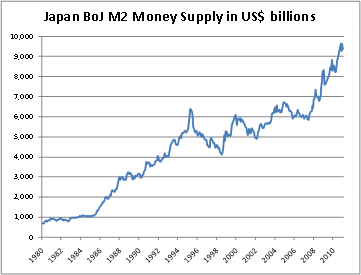
It is literally going to take months to figure out exactly how much damage has been done. Let us just hope that we don't see any more major earthquakes in the area. The Japanese are a very resilient people and the Bank of Japan is already vowing that it will be doing whatever is necessary to ensure the stability of the financial markets. The Bank of Japan has announced that it is going to provide as much liquidity as necessary to keep the Japanese economy functioning normally. But the truth is that the Bank of Japan has already been printing money like crazy....
Is a tsunami of new yen really going to solve the economic damage that has been done by the earthquake and the tsunami? Of course not. The truth is that the economy of Japan was already deeply struggling before this disaster. The national debt of Japan is now well over 200% of GDP and there seems to be no doubt that they will need to borrow massive amounts of money to deal with the aftermath of this crisis. Up until now the Japanese government has been able to borrow money at ultra-low interest rates of around 1.30 percent for 10-year bonds, drawing on a huge pool of savings from its own citizens. But in light of what has just happened, will the citizens of Japan still have enough resources to continue to fund the rampant spending of the Japanese government? At this point, it is estimated that this gigantic mountain of debt breaks down to 7.5 million yen for every single citizen of Japan. Politicians in Japan have been pledging for years to do something about all of this debt, but nobody has been able to make much progress. Even before this disaster, the major credit rating agencies were warning that they may have to downgrade Japanese government debt. The earthquake and the tsunami are certainly not going to make the Japanese even more credit-worthy. Hideo Kumano, the chief economist at Dai-ichi Life Research Institute, has said that a "tipping point" will come when world financial markets finally recognize that the government of Japan simply cannot afford to service its debt any longer....
Is the massive tsunami that just hit Japan such a tipping point? Other countries such as Greece and Ireland would have already collapsed if it had not been for the massive international bailouts that they received. So who is going to bail Japan out? This could potentially be one of the greatest economic disasters that the world has seen since World War 2. With the world already on the verge of a major financial collapse, this is the last thing that world financial markets needed. In fact, much of the rest of the world had been hoping that an influx of capital from Japan would help to stabilize things. For example, Japanese insurance companies had recently announced that they were planning on buying up lots of European sovereign debt, but now obviously those plans are on hold. As a result of this disaster, Japanese insurance companies will be forced to sell off assets like crazy in order to pay settlements. But as Zero Hedge is correctly pointing out, without Japanese financial institutions stepping in to soak up Eurozone bonds this is going to make the European sovereign debt crisis even worse. But right now the focus in on the devastation in Japan. At the moment it is unclear how much of the economic infrastructure of Japan has survived. For example, as USA Today is reporting, some factories cannot even be reached by phone at this point....
What is clear is that the cost of recovering and rebuilding after this disaster is going to put extraordinary financial stress on the Japanese government. Julian Jessop of Capital Economics certainly does not sound optimistic about what this is going to mean for the Japanese economy....
Hopefully the full extent of the damage is not as bad as many are now fearing. But the truth is that this is a huge, huge event for a world economy that was already on the verge of collapse. May our thoughts and our prayers be with the Japanese people at this time. This is truly one of the biggest disasters that any of us have ever seen, and Japan will never be the same again. |
| A new gold standard could be coming faster than anyone expects Posted: 11 Mar 2011 07:35 AM PST By Andrey Dashkov for Casey Research: Several legislative initiatives caught our attention recently. All of them are related to the monetary role of gold and range from proposals to return to the gold standard, to minting gold and silver as an alternative currency, to having all state transactions carried out in gold and silver coins, to permitting citizens to run their own mints. Do these proposals signal a significant attitude change among politicians and mainstream economic institutions toward gold? No. They are largely regarded as fringe ideas and dismissed out of hand. The third link above is written in a condescending tone that implies everyone knows that the gold standard is bad for an economy and it caused the Great Depression. Still, it’s quite telling that opinions that gold can be incorporated into a modern economy are becoming numerous, and actually making it onto the legislative agenda in various jurisdictions. ... Perhaps most telling of all, the world’s central banks were net buyers of gold in 2010 and in 2009, after being net sellers for the previous 20 years. As World Bank President Robert Zoellick said last November, gold has become the "yellow elephant in the room" that needs to be acknowledged by policymakers of major economies. No one can predict exactly how this will all shake out, but Doug Casey has long said that a return to a gold standard, or some modern equivalent, is... Read full article... More on gold: Gold SHOCKER: Alan Greenspan's stunning admission Rumors swirling: The U.S. gov't is planning to confiscate gold An incredible development is taking place in gold mining stocks |



 Sprott Money executives Eric Sprott (chairman) and Larisa Sprott (president), sing the praises of the "poor man's gold" in this exclusive interview with The Gold Report. "All the data supports the thesis that silver is undervalued," says Eric—who serves as chairman of Sprott Inc., as well as CEO, CIO and senior portfolio manager of Sprott Asset Management LP. "We'll certainly see a three-digit price," he adds. Larisa explains how the company's business model differs from others in the space and reveals plans to open Sprott Money USA within the year.
| You are subscribed to email updates from Gold World News Flash 2 To stop receiving these emails, you may unsubscribe now. | Email delivery powered by Google |
| Google Inc., 20 West Kinzie, Chicago IL USA 60610 | |

No comments:
Post a Comment