


Gold World News Flash |

- Haynes, Norcini, and Hathaway interviewed at King World News
- The New SuperHawks of the FED
- Rock on!!!! and buy silver!!!!!!
- DOLLAR DOOMED: Bob Chapman, Part 1 of 2
- Gold Investing Hits the Horoscopes
- American Fear
- Salivating at the Upside Potential of the Gold Market
- China's central bank sees strong commodities, weak dollar
- J.P. Morgan, HSBC May Have Gained Billions from Influencing Silver Prices
- US Dollar Under Acute Pressure As World seeks an Alternative Reserve Currency
- Ask and Listen
- Follow London's Biggest Demonstration In A Decade As 300,000 Protest Austerity And Public Sector Cuts
- The Best of the Week
- $500 Silver Bullion – If You Want It!
- $500 Silver Bullion – If You Want It!
- Things
- Federal Reserve Officials Talking The Dollar Up?Gold Down On Cue
- In The News Today
- Forcing the world’s most over-leveraged banks to accept massive write-downs on their assets, which would likely lead to the collapse of the some of the continent’s biggest banks – is a non-starter among Europe’s governing elite
- Fed Ponders Actions While Global Economy Reels
- Market Volatility Creates Resource Stocks Opportunity
- Gold No Breakout So Far, Silver Hits Strong Resistance
- Gold Bubble: Written in the Stars
- Completed Correction for Silver Wheaton (SLW) ?
- Gold Bubble : Written in the Stars
- Look who's calling Utah and gold 'eccentric'
| Haynes, Norcini, and Hathaway interviewed at King World News Posted: 26 Mar 2011 02:41 PM PDT 10:34p ET Saturday, March 26, 2011 Dear Friend of GATA and Gold (and Silver): Bill Haynes of CMI Gold and Silver and market analyst Dan Norcini review last week in the precious metals in interviews totaling 19 minutes at King World News here: http://kingworldnews.com/kingworldnews/Broadcast/Entries/2011/3/26_KWN_W... Also at King World News, Tocqueville Gold Fund manager John Hathaway muses about the event that could send gold up $100 or $200 and ignite the gold mining shares. You can listen to that interview here: http://kingworldnews.com/kingworldnews/Broadcast/Entries/2011/3/26_John_... CHRIS POWELL, Secretary/Treasurer ADVERTISEMENT Sona Drills 85.4g Gold/Ton Over 4 Metres at Elizabeth Gold Deposit, Company Press Release, October 27, 2010 VANCOUVER, British Columbia -- Sona Resources Corp. reports on five drillling holes in the third round of assay results from the recently completed drill program at its 100 percent-owned Elizabeth Gold Deposit Property in the Lillooet Mining District of southern British Columbia. Highlights from the diamond drilling include: -- Hole E10-66 intersected 17.4g gold/ton over 1.54 metres. -- Hole E10-67 intersected 96.4g gold/ton over 2.5 metres, including one assay interval of 383g of gold/ton over 0.5 metres. -- Hole E10-69 intersected 85.4g gold/ton over 4.03 metres, including one assay interval of 230g gold/ton over 1 metre. Four drill holes, E10-66 to E10-69, targeted the southwestern end of the Southwest Vein, and three of the holes have expanded the mineralized zone in that direction. The Southwest Vein gold mineralization has now been intersected over a strike length of 325 metres, with the deepest hole drilled less than 200 metres from surface. "The assay results from the Southwest Zone quartz vein continue to be extremely positive," says John P. Thompson, Sona's president and CEO. "We are expanding the Southwest Vein, and this high-grade gold mineralization remains wide open down dip and along strike to the southwest." For the company's full press release, please visit: http://sonaresources.com/_resources/news/SONA_NR19_2010.pdf Join GATA here: An Evening with Bill Murphy and James Turk https://www.amsterdamgold.eu/gata/index.asp?BiD=12 Or a colorful GATA T-shirt: Or a colorful poster of GATA's full-page ad in The Wall Street Journal on January 31, 2009: http://gata.org/node/wallstreetjournal Or a video disc of GATA's 2005 Gold Rush 21 conference in the Yukon: Help keep GATA going GATA is a civil rights and educational organization based in the United States and tax-exempt under the U.S. Internal Revenue Code. Its e-mail dispatches are free, and you can subscribe at: To contribute to GATA, please visit: http://www.gata.org/node/16 ADVERTISEMENT Prophecy Resource Spins Off Platinum/Palladium Venture: Company Press Release, January 18, 2011 VANCOUVER, British Columbia -- Prophecy Resource Corp. (TSX-V:PCY)and Pacific Coast Nickel Corp. announce that they have agreed that PCNC will acquire Prophecy's Nickel PGM projects by issuing common shares to Prophecy. PCNC will acquire the Wellgreen PGM Ni-Cu and Lynn Lake nickel projects in the Yukon Territory and Manitoba respectively by issuing up to 550 million common shares of PCNC to Prophecy. PCNC has 55.7 million shares outstanding. Following the transaction: -- Prophecy will own approximately 90 percent of PCNC. -- PCNC will consolidate its share capital on a 10 old for one new basis. -- Prophecy will change its name to Prophecy Coal Corp. and PCNC will be renamed Prophecy Platinum Corp. -- Prophecy intends to distribute half of its PCNC shares to shareholders pro-rata in accordance with their holdings. Based on the closing price of the common shares of PCNC on January 17, $0.195 per share, the gross value of the transaction is $107,250,000. For the complete announcement, please visit: http://prophecyresource.com/news_2011_jan18.php
|
| Posted: 26 Mar 2011 01:08 PM PDT
We have seen the Federal Reserve purchase the Maiden Lane assets from Bear Stearns. For an encore, they returned to do it again with AIG….twice. The Fed also started a series of special liquidity facilities, including one with that exact name. These facilities, like the Term Auction Facility, Primary Dealer Credit Facility, & the Term Securities Lending Faculties to name a few, were intended to enhance system liquidity. We have seen the Federal Reserve roll out Quantitative Easing 1.0 (buying of MBS), Quantiitative Easing “Lite” (the MBS roll off, and replacement with US Treasuries), & Quantitative Easing 2.0 (direct POMO operations to support treasury prices as needed anywhere in the curve). The sum of these actions are that the US Federal Reserve has generated credits on its own balance sheet, which have been used to buy up US assets at no *Actual* cost to the Federal Reserve. Their balance sheet has more than doubled in size during this short time frame as the Bank has injected liquidity into its member banks. The US dollar has experienced significant pain during this process, dropping against both other fiat currencies, but also against most commodities. Very recently, the market has been expecting some kind of comment on the continuation of Quantitative Easing, now expected to be called Q.E. 3.0. However, it now appears that the end of this cycle could be arriving. The much ballyhooed Quantitative Easing 3.0 has not yet been defined and, if the US economy continues to grow, may not be needed at all.
Lately, the historically outnumbered hawks on the Board have been waiting for a change in the rolls of voting members. This change has taken place, and with it a new voice of concern over the actions already taken has started to arise from voting members. The first of these comments caught my eye today. It was from the Philadelphia Federal Bank President Plosser, who announced a wish for the Federal Reserve to change its dual mandate of growth balance with controlled inflation, to an inflation-only focus. There are significant ramifications to this, if it were to happen. It is very interesting in the context of the future actions of this Fed, once we reach the stage when we need to unwind the Quantitative Easing already in play.
The news flow on this Friday was fascinating, with a burst of Federal Reserve Presidents making public comments on the same topic. It was very obvious, that this has been under discussion for awhile, and a new round of jaw boning is getting started. In a matter of hours, I counted no less than 5 comments from the Federal Reserve and its new club of hawks. The silence from the rest of the chorus was…. interesting!
It appears that votes are changing within the makeup of the Federal Reserve’s voting members. This could have serious implications in the coming months if the US economy slows down, and lack of liquidity starts to become significant again. Minneapolis Fed President Narayana Kocherlakota told reporters in Marseilles that the U.S. economy would need to worsen “materially” for the bank to consider further bond-buying. Evans comments, along with those of Atlanta Fed President Dennis Lockhart who said on Friday that “it’s a high bar” for the Fed to do more, suggest the debate at the Fed has moved away from a consideration of further easing. It appears that Q.E. 1, lite & 2.0 will be drawing to a close by the middle of this summer, if only for a few months, while the system attempts to see if it is capable of standing on its own without liquidity injections from the Fed.
I honestly expected that the events in Japan had green lighted the Fed to start Q.E. III. But it appears that the shift in the votes, along with expected massive stimulus expected to be generated in Japan, has slowed the need. It appears that Japan will be providing the world with liquidity, as it rebuilds its infrastructure. When you consider that the IMF (realistically a vehicle typically funded by the US Gov indirectly) is going to need to help bail out the European banking and sovereign debt markets again. It is possible that the Federal Reserve maybe be ready to firm up the value of the US dollar. It has been the proverbial one way trade for a while now. The words of the different Presidents of the US Federal Reserve in the last few days, and their actions and words in the coming weeks maybe pointing towards a change in the Bernanke Put. I expect we could see rates raised in 2011, and the start of a possible winding down the HEAVY hand. If so, the markets will be acting confused for a while, as major shifts in strategy take shape. The last thing anyone expects now, is a STRONG US Dollar. When you consider that Bill Gross has gone flat US Treasuries, and they are supposed to be 40% or so of his bench mark, a surprise small rate increase by the Federal Reserve would make more sense, than not, in my opinion. In fact, you could argue it’s already long over due.
WWW.JackHBarnes.com Confessions of a Macro Contrarian
|
| Rock on!!!! and buy silver!!!!!! Posted: 26 Mar 2011 07:17 AM PDT Up to 500,000 activists attend anti-cuts demo Share this:
|
| DOLLAR DOOMED: Bob Chapman, Part 1 of 2 Posted: 26 Mar 2011 05:23 AM PDT Share this:
|
| Gold Investing Hits the Horoscopes Posted: 26 Mar 2011 05:09 AM PDT |
| Posted: 26 Mar 2011 04:00 AM PDT Whether they realize it or not Americans live in a constant state of fear every day. I'm not referring to the fears of everyday life like losing a job or having an accident of some kind, but rather a more sinister and devious fear; a fear that Americans only dare talk about around the water cooler or at cocktail parties so as not to be taken seriously; a fear they try to mask with a with a whimsical tone of sarcasm or indifference. Whether Americans want to admit it or not, it's the single greatest fear in their lives: fear of the government. Right about now there are those reading this thinking: Don Cooper is a drunk. To which I reply: what's that got to do with it? Maybe more people should drink if that's what it takes to sober up and confront what they are really afraid of. In their defense, I'll admit that reality is scary. No argument that living in delusion is warmer, safer, cozier, and easier. Pretending is always more fun than reality, that's why we go to the movies. But fear of the government is a fear that invades a person's soul and – since the government intervenes in every aspect of our lives – it affects every move we make every day. Fear of the government is hard to recognize and acknowledge. It's a fear that we are taught early on in life and to which we become accustomed. We inevitably end up tucking it away in the far reaches of our minds in order to function "normally" every day and live our lives. But just as a car backfiring will trigger a sense of fear from a shell-shocked veteran, so too can the State trigger that sense of fear they've instilled in us. One need only ask: when you see a cop in your rearview mirror with his lights on, do you feel a sense of safety and comfort or do you get a shot of adrenaline from your body's "fight or flight" reflex? Do you immediately start asking yourself what he could possibly pull you over for, other than the fact that he was abused as a child, bullied at school and his mother didn't love him, and now he's going to whittle away at that chip on his shoulder by abusing you. As you search for your proof of government permission to drive (i.e., your license), and your government permission to own the car (i.e., your registration), and your proof of government mandated insurance, do you do so calmly and with a smile on your face and with gleeful anticipation of speaking with someone who gives of himself to serve and protect you, or do you do so nervously, fumbling through your papers hoping everything's up to date and acceptable to him for fear of being detained for whatever reason and having it affect your job, your family, and every aspect of your life? And when it's all over, do you feel glad that it happened or are you just glad it's over? Later that evening do you recount the story to others with a sense of pride, or do you do so with a sharp tongue and kick yourself for all the things you wish you would have had the presence of mind to say at the time but didn't? Do you feel happy that you have to pay $150 to the government because you were driving down the street faster than the government allows you to, or are you angry? And in the end, do you send the money to the government even though you don't agree with it? Even though you feel it's unfair to have to pay so much money yet you've harmed no one? Of course you do. And why? Because you're afraid of what the government will do to you if you don't. In the end, you'll retreat back into your cubby-hole of delusion in order to justify paying the fine by convincing yourself that what you did was wrong, the government was right, and you deserve the punishment. My favorite delusional argument from those still attached to the matrix is that they pay their taxes voluntarily. To these people I ask: when you do your tax returns, do you take as many deductions as the government will allow you? Of course, the answer is always yes. Then I ask them that if they could take enough deductions such that their tax liability was zero would they do so? Again, not surprisingly, the answer is yes. I then ask them that if their preference is to pay zero taxes then why don't they simply refuse to pay taxes. Inevitably, that's where their train of thought always runs out of track. Of course everyone knows the answer: because they're afraid of what the government will do. I challenge everyone to ask themselves: when was the last time you even thought about the possibility you might be robbed, your house broken into or shot at? Can you even remember? Now ask yourself when was the last time you were afraid of doing something that could be deemed "illegal" by the government and for which you could be fined, detained or arrested? Something like not wearing a seatbelt, speeding, making a U-turn, going through a yellow light, not crossing the street at the cross-walk, riding a bike on a sidewalk, forgetting your license at home, taking too many deductions on your taxes, talking on your phone while driving, not allowing strangers to touch you or your children at the airport, cutting down a tree on your own property, owning and transporting a gun, collecting rain water and the list goes on. I would wager the answer is: daily! The first word out of everybody's mouth when asked a normal, completely benign question these days is: "Well legally…" It's first and foremost on our minds, and why wouldn't it be, there are 76,000 pages to just the federal register alone. Some argue that everyone commits at least three felonies every day! Ignorance is a dangerous thing, and it must be stopped in our lifetime, fo' it kill somebody. At the end of the day, all government mandates are enforced at the end of the barrel of a gun, and that scares the hell out of everyone, as it should. But if we truly believe we are free then we have to start acting like it. It's time we cared about something bigger than ourselves. It's time we stopped living our lives in fear. Having said all that, I'm not holding my breath. It's proven to be difficult to convince people that freedom is more important than the real housewives of New Jersey. And that's why I drink! Regards, Don Cooper American Fear originally appeared in the Daily Reckoning. Daily Reckoning founder Bill Bonner recently wrote articles on stagflation and the great correction.
|
| Salivating at the Upside Potential of the Gold Market Posted: 26 Mar 2011 03:50 AM PDT Not long ago, as I recall, a pension fund in some foreign country, one of those Scandinavian ones I think, was ordered to invest no more than about 3% of its custody assets in gold, meaning that the fund had too much gold, and to sell part ... Read More...
|
| China's central bank sees strong commodities, weak dollar Posted: 26 Mar 2011 03:13 AM PDT By Langi Chiang, Kevin Yao, Aileen Wang, and Simon Rabinovitch http://www.reuters.com/article/2011/03/25/us-china-economy-overview-idUS... BEIJING -- Loose monetary policies in developed economies will place more upward pressure on global commodity prices and weigh on the dollar this year, the Chinese central bank said on Friday. In a report reviewing the performance of global financial markets, the People's Bank of China also warned of a deepening of the European debt crisis, though its broad view was colored with optimism. "We expect that the world economy will keep recovering, and the foundation for the recovery will be firmer," it said in the 125-page report. In a brief discussion of risks, it pointed to Europe's debt woes as well as inflation and the potential for asset bubbles in developing markets. ... Dispatch continues below ... ADVERTISEMENT The Gold Standard Now: It Can Work Today a dollar is worth 80 percent less than it was 40 years ago, and less than 5 percent of its value a hundred years ago. We deserve a dollar that is as good as gold, a dollar that will hold its value from year to year so we can be financially secure and our economy can generate more and better jobs. For most of America's history, our dollar was literally as good as gold. But on August 15, 1971, our politicians destroyed the link between gold and the dollar. They destroyed the foundations of our economic system. A new Internet site, TheGoldStandardNow.org, provides news and cutting-edge analysis about this most important issue and explains how the gold standard worked in the past and how it can work in the future. Visit us today: http://www.thegoldstandardnow.org/about/137-welcome-newsmax On balance, however, it said that the dollar would fare worse than the euro. "In 2011, the dollar will be on a downward trend overall, because of the slow recovery of its economy, low interest rates and twin deficits," the central bank said. "The possible spreading of European sovereign debt crisis and geopolitical risks may push up the dollar in some periods." It noted that short-term interest rates in major economies would gradually rise as their recovery solidifies. "But as the global recovery momentum is not strong, the increases will not be too large," it said. Looking at global commodities, it said that wealthy nations were printing money to kick-start their economies and this would inevitable push up prices. "Developed countries will continue with their loose policies and global liquidity will remain ample, which will keep prices of commodities, especially crude oil and grains at high levels," it said. Concerns about inflation would trigger demand for gold as a store of value, but the precious metal's bull run may be near its end, it added. "We need to note that gold prices have reached historical highs, and its downward risks should not be overlooked," the central bank said. It said the global recovery depended in large part on coordination between major economies. "All countries should avoid competitive devaluation of their currencies and pay more attention to risks brought by excessively loose policies on the back of a global recovery," it said. The central bank reiterated that China would make its currency more convertible under the capital account, a long-standing pledge that has resulted in only incremental progress so far. "We will relax restrictions on cross-border capital transaction activities in a selective and step-by-step manner, making sure that all risks are effectively under control," it said. Join GATA here: An Evening with Bill Murphy and James Turk https://www.amsterdamgold.eu/gata/index.asp?BiD=12 Or by purchasing a colorful GATA T-shirt: Or a colorful poster of GATA's full-page ad in The Wall Street Journal on January 31, 2009: http://gata.org/node/wallstreetjournal Or a video disc of GATA's 2005 Gold Rush 21 conference in the Yukon: Help keep GATA going GATA is a civil rights and educational organization based in the United States and tax-exempt under the U.S. Internal Revenue Code. Its e-mail dispatches are free, and you can subscribe at: To contribute to GATA, please visit: ADVERTISEMENT Prophecy Resource Spins Off Platinum/Palladium Venture: Company Press Release, January 18, 2011 VANCOUVER, British Columbia -- Prophecy Resource Corp. (TSX-V:PCY)and Pacific Coast Nickel Corp. announce that they have agreed that PCNC will acquire Prophecy's Nickel PGM projects by issuing common shares to Prophecy. PCNC will acquire the Wellgreen PGM Ni-Cu and Lynn Lake nickel projects in the Yukon Territory and Manitoba respectively by issuing up to 550 million common shares of PCNC to Prophecy. PCNC has 55.7 million shares outstanding. Following the transaction: -- Prophecy will own approximately 90 percent of PCNC. -- PCNC will consolidate its share capital on a 10 old for one new basis. -- Prophecy will change its name to Prophecy Coal Corp. and PCNC will be renamed Prophecy Platinum Corp. -- Prophecy intends to distribute half of its PCNC shares to shareholders pro-rata in accordance with their holdings. Based on the closing price of the common shares of PCNC on January 17, $0.195 per share, the gross value of the transaction is $107,250,000. For the complete announcement, please visit: http://prophecyresource.com/news_2011_jan18.php
|
| J.P. Morgan, HSBC May Have Gained Billions from Influencing Silver Prices Posted: 26 Mar 2011 03:00 AM PDT ¤ Yesterday in Gold and Silver After Thursday's late afternoon price adjustment by one of the usual not-for-profit sellers, the gold price remained in a quiet and very tight trading range up until 12:15 p.m. in New York. Then out of the blue...and for no reason I could see...someone decided to pull their bids and mark gold down about $13 in the space of half an hour. A bid appeared at 12:45 p.m...and gold recovered to close sixty cents below its Thursday close. Silver spent most of Friday up between thirty and fifty cents...but at 12:15 p.m. Eastern...the silver price got hit for more than sixty cents before recovering a lot of that going into the close of electronic trading at 5:15 p.m. in New York. You could be forgiven if you thought the timing of this price drop yesterday was more than coincidental, as it bore a remarkable resemblance to what happened to the price at the exact same time on Thursday in both metals. I can tell you that it pinned the need...
|
| US Dollar Under Acute Pressure As World seeks an Alternative Reserve Currency Posted: 26 Mar 2011 02:45 AM PDT The days and years of manipulation, fraud and criminal behavior are fast coming to an end. New alliances are evolving, as are outspoken advocates of a new world reserve currency. As a result more and more foreigners are bypassing Treasury and Agency bonds, as well as other US dollar denominated investments. We watch as other major nations accumulate gold and cannot help but think that the new world reserve currency will be gold backed.
|
| Posted: 26 Mar 2011 02:34 AM PDT
 The head of the Minneapolis Fed, Narayana Kocherlakota gave a presentation in Marseilles, France on Friday. This was another attempt at convincing the public that the Fed can fix anything provided they are left to their own devices and have unlimited capacity to print money. The presentation was a “No Sale” for me. 

“The bubble collapse has no impact on unemployment or output, given sufficiently accommodative monetary policy,”
In one of the paper's more surprising claims, Kocherlakota suggested that extending unemployment benefits -- sometimes seen as adding to the jobless rate because it can discourage those receiving benefits from actively seeking jobs -- actually reduces it.


|
| Posted: 26 Mar 2011 02:08 AM PDT
After leading to the collapse of the Portuguese government, anti-austerity anger is now ramping up at the very heart of the old continent, where the biggest demonstration in over a decade has struck in London. Per the Guardian: "More than a quarter of a million protesters against public sector cuts are expected to flood central London today in the biggest political demonstration for nearly a decade. Police sources, normally cautious about estimating numbers, said last night they were braced for up to 300,000 people to join the march – far higher than previous forecasts from TUC organisers. More than 800 coaches and at least 10 trains have been chartered to bring people to the capital from as far afield as Cornwall and Inverness. The Metropolitan police, under fire for their use of kettling in previous protests, said "a small but significant minority" plan to hijack the march to stage violent attacks. Organisers, however, insist it will be a peaceful family event. Union members are expected be joined by a broad coalition, from pensioners to doctors, families and first-time protesters to football supporters and anarchists. Ed Miliband said the government was dragging the country back to the "rotten" 1980s. Labour is calling today's event the "march of the mainstream"." Some of the protesters, already pigeonholed as "anarchists", have already become unruly as a splinter group has formed on the iconic Oxford street where it is engaged in altercations with the Police, including throwing smoke bombs, lightbulbs filled ammonia. The protest can be followed in real time on Sky News below.
The Guardian also has a live blog of the protest that can be followe here: Some of the most recent entries: 1.44pm: Richard Evans has been talking to PA News about his 166 miles trek from Cardiff to join the march.
Evans, a PCS union rep who was interviewed by the Guardian about his protest earlier this week, said the walk was worth it although his feet were "very sore".
1.39pm: Paul Lewis has just tweeted about police penning in protesters outside Downing Street. 1.39pm: Paul Lewis has just tweeted about police penning in protesters outside Downing Street. .bbpBox51634954513301500 { background: url("http://a3.twimg.com/profile_background_images/93269701/manchesterguardian.gif") repeat scroll 0% 0% rgb(208, 245, 235); padding: 20px; }p.bbpTweet { background: none repeat scroll 0% 0% rgb(255, 255, 255); padding: 10px 12px; margin: 0pt; min-height: 48px; color: rgb(0, 0, 0); font-size: 18px ! important; line-height: 22px; -moz-border-radius: 5px 5px 5px 5px; }p.bbpTweet span.metadata { display: block; width: 100%; clear: both; margin-top: 8px; padding-top: 12px; height: 40px; border-top: 1px solid rgb(230, 230, 230); }p.bbpTweet span.metadata span.author { line-height: 19px; }p.bbpTweet span.metadata span.author img { float: left; margin: 0pt 7px 0pt 0px; width: 38px; height: 38px; }p.bbpTweet a:hover { text-decoration: underline; }p.bbpTweet span.timestamp { font-size: 12px; display: block; } Reports of "light kettle" at Downing Street and rolling shop occupations at Picadilly #march26 #26march 1.31pm: Activists from Ukuncut, the peaceful direct action group that has closed down more than 100 high street stores accused of tax avoidance, are moving into position on Oxford Street. They are planning 14 different occupations of high street stores accused of tax avoidance, Matthew Taylor writes.
Bernard Goyder, a veteran of last year's student protests, said he had been "blown away" by today's turnout.
1.15pm: Tom Wills, a student journalist based in Brighton, has posted a set of photos from the march on Flickr, which give a sense of the mass turnout. 1.10pm: EastLondonLines, a news website run by the journalism department of Goldsmiths, has posted this Twitpic, which shows the protesters marching past police lines near Parliament. 1.04pm: Paul Lewis has sent through an update, describing the wide range of groups who have joined today's protest.
1.02pm: Matthew Taylor says thousands of people are still joining the march, with the total number estimated at around 400,000.
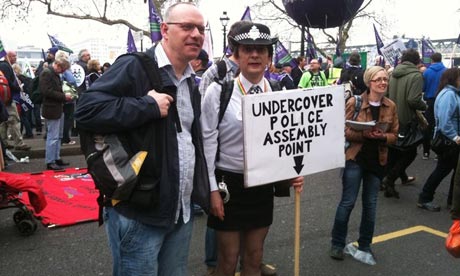
1.00pm: While this photo from Mary shows crowds gathering at Embankment. 12.58pm: This photo by Mary Hamilton pokes fun at undercover police officers - whose activities have recently been investigated by the Guardian. 12.45pm: Journalist Mary Hamilton - aka newsmary - has been posting photos of the march on Twitpic. 12.35pm: The Public and Commercial Services Union has set up its own live blog of the march. 12.30pm: Here's a map of the march route 9.15am: Good morning and welcome to the Guardian's live coverage of the mass protest in London against the coalition government's public sector cuts. Around 300,000 people are expected to join the March for the Alternative organised by the TUC, the biggest union-organised event for over 20 years and the largest in the country since the protest against the Iraq war in 2003. More than 800 coaches and 10 trains have been chartered to bring people to the capital from as far afield as Cornwall and Inverness. Union members are expected to be joined by a broad coalition, from pensioners to doctors, families and first-time protesters, to football supporters and anarchists. My colleague Matthew Taylor has written a guide to all the organisations - both official and unofficial - who will be taking part. The Metropolitan Police believe a small minority will try to hijack the anti-cuts march to stage violent attacks on property and the police. The TUC organisers of the event say they have organised a family-friendly demonstration with brass, jazz and Bollywood bands. But there are concerns that unofficial feeder marches, sit-down protests and a takeover of Trafalgar Square could turn from peaceful civil disobedience into stand-offs with the police. The march assembles on the Embankment from 11am but it will still be leaving at 2pm and possibly even later. The TUC has drawn up a set of tips for those planning to join the march. The protest will culminate in a rally in Hyde Park. Guardian reporters Matthew Taylor and Paul Lewis will be out on the streets covering the protest as it happens. If you're at the demo and want to send me any comments - or share any pictures, audio clips and videos - you can contact me either on david.batty@guardian.co.uk or on Twitter - @David_Batty
|
| Posted: 26 Mar 2011 01:21 AM PDT Synopsis: Welcome to the weekend edition of Casey's Daily Dispatch, a compilation of our favorite stories from the week for the time-stressed readers. Dear Reader, Welcome to the weekend edition of Casey's Daily Dispatch, a compilation of our favorite stories from the week for the time-stressed readers. Of course, if you want to read all of the Daily Dispatches from the week, you may do so in the archives at CaseyResearch.com.
|
| $500 Silver Bullion – If You Want It! Posted: 26 Mar 2011 01:10 AM PDT Share this:
|
| $500 Silver Bullion – If You Want It! Posted: 26 Mar 2011 01:10 AM PDT Share this:
|
| Posted: 26 Mar 2011 12:51 AM PDT The following is automatically syndicated from Grandich's blog. You can view the original post here. Stay up to date on his model portfolio! March 26, 2011 04:45 AM [LIST] [*]Say it ain’t so [*]The great pretender [*]Shame, shame, shame [*]Rangel is everything what’s wrong with Congress [*]The third terror war [*]Grandich on Korelin Radio – highlight segment 2 [*]Silver Quest Resources Interview – highlight segment 6 [*]One of my favorite websites for Middle East geopolitical stories [/LIST] [url]http://www.grandich.com/[/url] grandich.com...
|
| Federal Reserve Officials Talking The Dollar Up?Gold Down On Cue Posted: 25 Mar 2011 09:55 PM PDT View the original post at jsmineset.com... March 25, 2011 02:55 PM Dear CIGAs, It is no secret to those attuned to market action that the US Dollar’s technical chart picture is horrendous. It had broken through a critical support level near 77 on the USDX last week and had further descended down towards the tremendously important 75 level. No matter what appeared to be happening in the world, the US Dollar could not get much if any of a safe haven bounce. Currency traders had been moving to the Swiss Franc as their choice of a safe haven. The Aussie has been making new highs and the Canadian Dollar has been very strong as well. Now, it is also obvious that the US would dearly love to see the Dollar stay weak to help it deal with its massive debt load but the ugly truth is that the Dollar was on course for a major crisis if it violated the 75 level. Enter the Fed officials today and yesterday. Apparently the strategy was to get several of the FOMC governors to hit the airwa...
|
| Posted: 25 Mar 2011 09:55 PM PDT View the original post at jsmineset.com... March 25, 2011 02:03 PM Dear CIGAs, Keep focused. Gold's price is a product of debt levels and debt viability. Governments stand and fall on the condition of their debt and ability to borrow. Jim Sinclair's Commentary More from John Williams' Shadowstats.com. - Revised Industrial Production Shows Much Deeper Recession - February's Production Level Lowered by 2.6% "No. 360: Industrial Production Revisions" Web-page: [URL]http://www.shadowstats.com[/URL] Jim Sinclair's Commentary No fly zone? Syria Troops Open Fire On Protesters, Witness Says By ZEINA KARAM and BASSEM MROUE 03/25/11 11:35 AM DAMASCUS, Syria — Violence erupted around Syria on Friday as troops opened fire on protesters in several cities and pro- and anti-government crowds clashed on the tense streets of the capital in the most widespread unrest in years, witnesses said. Soldiers shot at demonstrators in the restive southern city...
|
| Posted: 25 Mar 2011 08:09 PM PDT Gold prices to rise with EU quantitative easing Share this:
|
| Fed Ponders Actions While Global Economy Reels Posted: 25 Mar 2011 08:00 PM PDT US dollar under pressure, the concerns of inflation with so much liquidity, unbearable pressure will come down on the Fed, will isolationism be brought in to the formula? No new ideas from politicians, fiscal pain for southern Europe, Bernanke Fed to help smaller banks, low consumer confidence, leaving Detroit.
|
| Market Volatility Creates Resource Stocks Opportunity Posted: 25 Mar 2011 07:39 PM PDT The terrible tragedy in Japan is shifting markets worldwide. Mike Kachanovsky, a consultant to both resource companies and institutional investors, believes the volatility has created a finite opportunity to scoop up resource stocks on the cheap. In this exclusive interview with The Gold Report, Mike explains what impact the devastation could play to the performance of rare earth companies, as well as how to navigate discounted stocks to avoid the duds.
|
| Gold No Breakout So Far, Silver Hits Strong Resistance Posted: 25 Mar 2011 07:32 PM PDT There are so many news items affecting precious metals, especially gold, these days. The precious metals glittered in their roles as havens as euro-zone debt worries resurfaced increasing the anxiety among market participants already jittery about $106 oil, the fighting in Libya, protestors killed in Syria and the nuclear crisis in Japan.
|
| Gold Bubble: Written in the Stars Posted: 25 Mar 2011 07:22 PM PDT Oh lordy! Gold investing is being tipped in tabloid horoscopes...Sell! "ARE YOU available for an interview this afternoon? I'd like to discuss the possibility that we're in a gold bubble!"
|
| Completed Correction for Silver Wheaton (SLW) ? Posted: 25 Mar 2011 07:16 PM PDT Silver Wheaton (SLW) plunged beneath yesterday's low at 43.38 to 43.19 this morning, but did not follow through to the downside. Instead, it has pivoted to the upside into a strong rally to 44.73 so far. This is powerful initial evidence that the decline from yesterday's high at 46.00 into this morning's low at 43.19 (-6.2%) represented a completed correction within the current upleg from the 37.85 low on March 16.
|
| Gold Bubble : Written in the Stars Posted: 25 Mar 2011 06:59 PM PDT Bullion Vault
|
| Look who's calling Utah and gold 'eccentric' Posted: 25 Mar 2011 06:30 PM PDT 2:37a ET Saturday, March 26, 2011 Dear Friend of GATA and Gold: There's revolution and war in the Middle East and Africa, devastation and nuclear contamination in Japan, and turmoil throughout the world financial system, but the Financial Times always has time to try to make fun of gold and those who see any virtue in it. In its Friday editorial, "In Gold They Trust," the FT finds humor in Utah's potential experiment with accepting gold and silver as currency, as allowed to states by the national Constitution. The FT writes: "Utah is no stranger to eccentric laws. This is, after all, the state whose citizens have, at various points, felt the need to outlaw both fishing from horseback and dispensing gunpowder as a headache cure. Now it has another legislative feat to match these illustrious forebears. The state's legislature has passed a bill that paves the way for gold and silver to become legal tender. All that remains is for Governor Gary Herbert to sign on the dotted line." ... Dispatch continues below ... ADVERTISEMENT The Gold Standard Now: It Can Work Today a dollar is worth 80 percent less than it was 40 years ago, and less than 5 percent of its value a hundred years ago. We deserve a dollar that is as good as gold, a dollar that will hold its value from year to year so we can be financially secure and our economy can generate more and better jobs. For most of America's history, our dollar was literally as good as gold. But on August 15, 1971, our politicians destroyed the link between gold and the dollar. They destroyed the foundations of our economic system. A new Internet site, TheGoldStandardNow.org, provides news and cutting-edge analysis about this most important issue and explains how the gold standard worked in the past and how it can work in the future. Visit us today: http://www.thegoldstandardnow.org/about/137-welcome-newsmax Ah, yes, the quaint American West, where more people earn their livelihoods by creating things than by shifting money around, and where the newspapers don't exploit their opportunities to reciprocate the fun with foreigners, as well they might do with a paper from enlightened London, capital of a country where the courts lately have taken to issuing injunctions keeping everything secret and prohibiting citizens from raising grievances with their elected representatives (http://www.telegraph.co.uk/news/uknews/law-and-order/8394566/Hyper-injun...), where the monarch is prohibited not only from marrying a Catholic but also from becoming one himself, (http://en.wikipedia.org/wiki/Act_of_Settlement_1701), and where every square yard of earth comes fully equipped with a tax collector and a closed-circuit television camera. The FT somehow thinks that gold's ever-higher price is more of a problem for the metal's monetization than the constant devaluation of government currencies is for their continuing to serve as money. Here's something even funnier than Utah's quaintness, a pretty good joke that seems lost on the FT -- a chart of gold priced in British pounds over the last decade: http://www.24hgold.com/english/interactive_chart.aspx?codecom=GOLD&chgec... The whole of the FT's oblivious mockery of Utah is below. Let's come back in a year or two and see who's still laughing. Let's hope that Britain itself, if not the FT, is even still there to laugh. CHRIS POWELL, Secretary/Treasurer * * * In Gold They Trust Financial Times, London http://www.ft.com/cms/s/0/3b3dee16-5721-11e0-9035-00144feab49a.html Utah is no stranger to eccentric laws. This is, after all, the state whose citizens have, at various points, felt the need to outlaw both fishing from horseback and dispensing gunpowder as a headache cure. Now it has another legislative feat to match these illustrious forebears. The state's legislature has passed a bill that paves the way for gold and silver to become legal tender. All that remains is for Governor Gary Herbert to sign on the dotted line. By the standards of the most fanatical hard-money purists, the plan is quite modest. Ron Paul, the Republican congressman who is the high priest of currency privatisation, has just reintroduced a bill that would allow everyone to mint their own coins. Both this and Utah's law are meant as rebukes to the US Federal Reserve, whose boundless enthusiasm for printing dollars has not exactly boosted confidence in the greenback. But Utah's unilateral gold standard has problems of its own. For one, it would mean very small coins. Under Utah's law, the value of the coins would reflect the gold (or silver) price. A troy ounce (roughly 31 grams) of gold is currently changing hands for more than $1,400. At that price a gold coin worth a dollar would weigh all of 22 milligrams. That may be great news for microscope makers but it will be pretty fiddly for anyone hoping to buy a coffee in Salt Lake City. Of course, bigger coins could be used. But then even the change for a gunpowder-free headache pill would run to several suitcases of the worthless greenbacks Utah's goldbugs so despise. If the gold price surged, those coins would have to become smaller still. A fall would not be much more helpful. Shopkeepers would presumably stop accepting coins worth less than their face value, bringing the economy to a juddering halt -- unless, that is, Utah's state government stepped in and guaranteed the coin's nominal value. Which sounds rather similar to the arrangement critics of the Fed are so upset about. Join GATA here: An Evening with Bill Murphy and James Turk https://www.amsterdamgold.eu/gata/index.asp?BiD=12 Or a colorful GATA T-shirt: Or a colorful poster of GATA's full-page ad in The Wall Street Journal on January 31, 2009: http://gata.org/node/wallstreetjournal Or a video disc of GATA's 2005 Gold Rush 21 conference in the Yukon: Help keep GATA going GATA is a civil rights and educational organization based in the United States and tax-exempt under the U.S. Internal Revenue Code. Its e-mail dispatches are free, and you can subscribe at: To contribute to GATA, please visit: http://www.gata.org/node/16 ADVERTISEMENT Sona Drills 85.4g Gold/Ton Over 4 Metres at Elizabeth Gold Deposit, Company Press Release, October 27, 2010 VANCOUVER, British Columbia -- Sona Resources Corp. reports on five drillling holes in the third round of assay results from the recently completed drill program at its 100 percent-owned Elizabeth Gold Deposit Property in the Lillooet Mining District of southern British Columbia. Highlights from the diamond drilling include: -- Hole E10-66 intersected 17.4g gold/ton over 1.54 metres. -- Hole E10-67 intersected 96.4g gold/ton over 2.5 metres, including one assay interval of 383g of gold/ton over 0.5 metres. -- Hole E10-69 intersected 85.4g gold/ton over 4.03 metres, including one assay interval of 230g gold/ton over 1 metre. Four drill holes, E10-66 to E10-69, targeted the southwestern end of the Southwest Vein, and three of the holes have expanded the mineralized zone in that direction. The Southwest Vein gold mineralization has now been intersected over a strike length of 325 metres, with the deepest hole drilled less than 200 metres from surface. "The assay results from the Southwest Zone quartz vein continue to be extremely positive," says John P. Thompson, Sona's president and CEO. "We are expanding the Southwest Vein, and this high-grade gold mineralization remains wide open down dip and along strike to the southwest." For the company's full press release, please visit: http://sonaresources.com/_resources/news/SONA_NR19_2010.pdf
|




| You are subscribed to email updates from Save Your ASSets First To stop receiving these emails, you may unsubscribe now. | Email delivery powered by Google |
| Google Inc., 20 West Kinzie, Chicago IL USA 60610 | |

No comments:
Post a Comment