


Gold World News Flash |

- All Paper is STILL a short position on gold
- Investment Legends: Dollar Collapse Inevitable
- Why Gold Is No Longer an Effective USD Hedge
- Proof That Gold Is Not a Bubble
- Why Central Banks of the West Hate Gold
- Gold Seeker Closing Report: Gold and Silver Rise To New Highs
- Goldman's Magnum Opus On The Economic Impact From Japan's Earthquake
- Gold and Silver, Look at the Big Picture
- Guest Post: I've Got a Funny Feeling About the Stock Market
- At King World News, Turk and Embry prepare for metal's big move
- The Silver Price Broke Out Today
- Readers Pick Doug Casey's Brain - Part 2
- Investment Legends: “Dollar Collapse Inevitable”
- Silver Cuts New Highs, Vulture Updates
- Mad Dog Gaddafi's Gold of Mass Destruction
- Precious metals portend dollar panic ahead
- Embry - Breakaway Move Coming in Gold, Oil $150 to $200
- Back when I was already 90% invested in gold and silver
- Purchasing Power Buckles Under Government Spending
- Yen action sets scene for return of carry trade
- LGMR: Gold Seen Nearing Cyclical Peak, Rises as Dollar Gains Amid New Euro Debt Fears
- The SLA has $50 in its sites. GIABO the most successful world revolution in history . . . and it’s got more than $450 to go!!!!
- 1 billion Zynga dollars = 1/1000th Oz. of Gold so Foursquare is worth -
- Gold futures notch record high
- Silver, gold gain on fast-changing global events
- Precious Metals – The Supply and Demand from Japan
- Hourly Action In Gold From Trader Dan
- In The News Today
- Jim?s Mailbox
- Gold’s Clear Message
| All Paper is STILL a short position on gold Posted: 23 Mar 2011 08:23 PM PDT FoFOA
|
| Investment Legends: Dollar Collapse Inevitable Posted: 23 Mar 2011 07:08 PM PDT Casey Research
|
| Why Gold Is No Longer an Effective USD Hedge Posted: 23 Mar 2011 07:00 PM PDT Sk Options Trading
|
| Proof That Gold Is Not a Bubble Posted: 23 Mar 2011 07:00 PM PDT Fool.com
|
| Why Central Banks of the West Hate Gold Posted: 23 Mar 2011 04:23 PM PDT For further market analysis and commentary, please see Trader Dan's website at www.traderdan.net Dear CIGAs, I wanted to post some brief comments to let some of the newer readers understand why many of us believe that there is a war being waged upon gold by the Central Banks of the West. Let me start this off by quoting from none other than former Fed Chairman Alan Greenspan more than 40 years ago:
What the former Fed Chairman was then saying was that absent a gold standard or some device for restraining the unlimited creation of fiat money, there was nothing to impede monetary officials from engaging in such activity to the extent that it would ultimately set in motion a process of inflation, which is really just another name for the erosion of the purchasing power of a nation's currency by debasing it. Inflation was and is in essence, the transfer of wealth from one class to another. Today we have the Fed engaging in the very process that Greenspan warned against back then. We also have the BOJ and the ECB effectively doing the same thing to an extent. Unlike Silver, Gold is the main metal that most analysts and commentators look to when attempting to decipher whether or not inflation is a serious problem. That means the reference point of gold has become a target for Central Banks which want the world to believe that they can create unlimited amounts of funny money with absolutely ZERO impact on inflation levels. In other words, that they can conjure up wealth and produce prosperity with the electronic equivalent of a printing press and produce no serious inflationary impact by so doing. A rising gold debunks their hubristic assertions to the contrary for it stands as a silent witness testifying against them. This is the reason the yellow metal is despised by so many Central Banks. It mocks their policies and displays their folly for all the world to see. Central Bankers, being the demigods that they are, will tolerate no rivals to their claims of economic omniscience. You see they have actually come to believe that it is their own wisdom and foresight which enables them to see through the fog that hinders and impedes our economic progress and that they are in a unique position to provide the rest of us with lasting prosperity. They attempt to do this by basically providing or withdrawing liquidity as they in their wisdom judge best and by the setting or manipulation of interest rates. Those of us who believe that it is free market capitalism and the industry and efforts of mankind that produce wealth and prosperity would beg to differ but that is another story altogether. I would add that it is my opinion that the world would be better off without this plague of locusts that actually devour a nation's wealth but the fact is that they are here. While they are here gold will attempt to move in such a manner that it either blesses or curses their policies. Now we all would love to have our policies approved by the vote of the market but what about those times in which the market frowns on our course of action and refuses to smile upon it? Why this is but a simple matter – attack the messenger! If one can somehow manage to keep the price of gold under wrap so that it does not move sharply higher then one can attempt to make the claim that inflation is not a serious problem. The comments usually go something like this: "Well Jerry, we are looking at the gold price and from what we can see, that while it is definitely higher, it is not soaring out of control. The market may be pricing in some gradual inflation but the action in the gold price is telling us that any fears of inflation getting out of control are definitely unwarranted. Besides, we all agree that some inflation is a good thing because the alternative is deflation and no one wants to see that". Imagine Fed Chairman Ben Bernanke testifying before Congress saying that the current rise in prices of many goods is only "temporary" and "relatively modest" if the gold price were soaring beyond $1650 and higher! Do you think anyone would take anything that the Chairman said seriously? Copper can soar higher and most will not notice it. Even if it does, it is generally explained as a positive because we are told it is a sign of strong economic growth ahead. Crude oil and energy prices can rocket higher and that can be attributed to geopolitical unrest among oil producing nations. Food can rise sharply and everyone notices that but such things are often explained away by citing weather conditions, supply constraints, etc. but a rising gold price? How does one explain that away? The only reason that gold has a sustained price rise is because of a lack of confidence in the monetary system. It does not rise sharply because of such things as jewelry demand or industrial demand – it rises when fear, distrust, doubt, suspicion and uncertainty over Central Bank policy reigns. It rises when REAL interest rates are negative and investors understand the insidious process of currency debauchment practiced by these monetary authorities is underway. It thus cries aloud and issues a warning to those who can hear it and what it shouts displeases many Central Bankers because they are among those who while they despise its message, are all too keenly able to hear that message. Thus the messenger, the prophet, the oracle, must be silenced or at the very least, his message blunted, toned down, marginalized, trivialized by whatever means possible. The mechanism employed to do just this is a subject for another time and place. Suffice it to say for now, without the efforts by the monetary officials of the West to discredit gold, it would be trading considerably higher. Even at that however, the ancient metal of kings refuses to go quietly and docilely into the night. It will yet have the final say.
|
| Gold Seeker Closing Report: Gold and Silver Rise To New Highs Posted: 23 Mar 2011 04:00 PM PDT Gold climbed $13.74 to as high as $1440.94 by late morning in New York before it fell back off a bit in the last few hours of trade, but it still ended with a gain of 0.74% and made a new record closing high. Silver climbed to a new 31-year high of $37.243 at about 1:15PM EST and ended with a gain of 2.29%.
|
| Goldman's Magnum Opus On The Economic Impact From Japan's Earthquake Posted: 23 Mar 2011 01:16 PM PDT
Goldman's Dominic Wilson has just released his magnum opus analysis on the situation in Japan and its aftermath. Unlike the lunatic drivel disseminated each and every week by GSAM's Jim O'Neill, which would interpret the imminent collapse of the Earth into a neutron star as the most bullish event in the (soon to be over) history of mankind, this report is actually one of more biased we have read from the Goldman strategists. That said, the natural bias to spin everything in a positive light still dominates the report (to which we retort: why not just blow up unpopulated pieces of America and rebuild them over and over: it does miracles for the Chinese "GDP" - it should work just as well in the US - plus Krugman would be in a constant state of Keynesian extasy). We obviously disagree: never before has there been the added precedent of nuclear fallout, or a pyschological intangible, to the mostly superficial infrastructural repairs that have to be undertaken. Goldman does acknowledge this as follows: "The ongoing nuclear risk at Fukushima has the potential to magnify the impact in other ways, although at the time of writing these risks seem to be fading." Based on what? Manipulated data reporting out of Japan, TEPCO and everyone else who is either guilty of strategic mismanagement, or is desperate to avoid a worldwide panic. It is this type of rushing to conclusions based on a complete lack of facts, that drives objective market observers furious with blind rage at the idiocy of the authors (and yes, "idiots" is what Sean Corrigan called all those who only see the upside in the Japanese catastrophe and ignore the massive human, economic and financial downside). Yet for all those who can bottle their rage for 15 minutes, we recommend reading the enclosed report as it is the very best that the Kool Aid crowd can serve at this point. Which, when applying some common sense, is not very much. From Goldman Sachs The Economic Impact of Japan’s Earthquake
The short-lived impact on economic activity is also confirmed by a range of other variables and is consistent with recent academic studies. Sequential IP growth falls sharply in the disaster month but then rebounds in the subsequent month. Export and import growth also both fall, in line with the overall reduction in output growth, before recovering in the next quarter. Investment growth dips but then accelerates strongly in the next 1-2 quarters, which suggests that the rebuilding of destroyed capital stock is an important component of post-disaster GDP resilience.
Policy rates tend to be reduced marginally on average, although this response generally is delayed until a few months after the disaster and there is a large degree of variation across cases. Equity returns dip in the month of the disaster but remain firmly in positive territory (at around 1%mom non-annualised on average), and then rebound sharply in the next month. Disasters have historically had a negligible impact on average on the short-term dynamics of inflation, government budget deficits and either nominal or real TWI exchange rates.
Key Differences with the East-Japan Earthquake
Our Japanese forecasts are currently under review, although the key uncertainty around the growth picture centres around the longevity and magnitude of power disruptions. Reflecting the downside risks to earnings, Kathy Matsui and our Asian Portfolio Strategy team have already shaved 12% off their FY2012 earnings estimate for Japan’s equity markets, and we now expect returns here to be more back-loaded.
|
| Gold and Silver, Look at the Big Picture Posted: 23 Mar 2011 12:39 PM PDT John Pugsley, author of the highly successful newsletter, The Stealth Investor, is struggling with some sudden health issues. But in this exclusive interview with The Gold Report, he shared his insight on how the global economic situation, including the catastrophe in Japan, is affecting the prospects for precious metals-related investments.
|
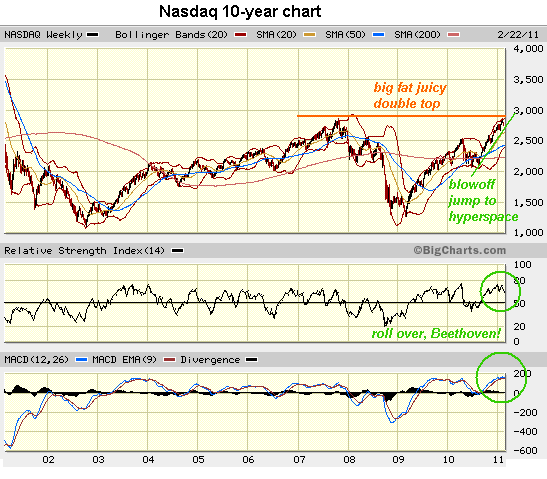
| Guest Post: I've Got a Funny Feeling About the Stock Market Posted: 23 Mar 2011 12:39 PM PDT
Submitted by Charles Hugh Smith from Of Two Minds Guest Post: I've Got a Funny Feeling About the Stock Market The dollar has reached a point of double-bind for the Fed: push it down further or allow it to rise, it won't matter: either way, stocks will fall off a cliff.
Notice that the dollar has been driven down to an important inflection point. If the Fed forces it below the 75 level, then that opens the way to 72 and a careening collapse below the line-in-the-sand at 71.
|
| At King World News, Turk and Embry prepare for metal's big move Posted: 23 Mar 2011 11:45 AM PDT 7:36p ET Wednesday, March 23, 2011 Dear Friend of GATA and Gold (and Silver): Eric King of King World News tonight cranks up the wattage for Radio Free Markets, interviewing GoldMoney founder James Turk and Sprott Asset Management's chief investment strategist, John Embry, about what may prove to be the big gold and silver breakouts. Turk notes that silver remains in backwardation despite its rising price. Embry sees $40 silver and $1,500 gold soon and remarks that big things will happen as the bullion banks discover that paper contracts for imaginary metal no longer satisfy investors. An excerpt of the interview with Turk is headlined "Silver Backwardation Near All-Time Record" and you can find it at the King World News blog here: http://kingworldnews.com/kingworldnews/KWN_DailyWeb/Entries/2011/3/23_Ja... An excerpt of the interview with Embry is headlined "Breakaway Move Coming in Gold, Oil $150 to $200" and you can find it here: http://kingworldnews.com/kingworldnews/KWN_DailyWeb/Entries/2011/3/23_Em... CHRIS POWELL, Secretary/Treasurer ADVERTISEMENT The Gold Standard Now: It Can Work Today a dollar is worth 80 percent less than it was 40 years ago, and less than 5 percent of its value a hundred years ago. We deserve a dollar that is as good as gold, a dollar that will hold its value from year to year so we can be financially secure and our economy can generate more and better jobs. For most of America's history, our dollar was literally as good as gold. But on August 15, 1971, our politicians destroyed the link between gold and the dollar. They destroyed the foundations of our economic system. A new Internet site, TheGoldStandardNow.org, provides news and cutting-edge analysis about this most important issue and explains how the gold standard worked in the past and how it can work in the future. Visit us today: http://www.thegoldstandardnow.org/about/137-welcome-newsmax Join GATA here: An Evening with Bill Murphy and James Turk https://www.amsterdamgold.eu/gata/index.asp?BiD=12 Or a colorful GATA T-shirt: Or a colorful poster of GATA's full-page ad in The Wall Street Journal on January 31, 2009: http://gata.org/node/wallstreetjournal Or a video disc of GATA's 2005 Gold Rush 21 conference in the Yukon: Help keep GATA going GATA is a civil rights and educational organization based in the United States and tax-exempt under the U.S. Internal Revenue Code. Its e-mail dispatches are free, and you can subscribe at: To contribute to GATA, please visit: http://www.gata.org/node/16 ADVERTISEMENT Sona Drills 85.4g Gold/Ton Over 4 Metres at Elizabeth Gold Deposit, Extending the Mineralization of the Southwest Vein on the Property Company Press Release, October 27, 2010 VANCOUVER, British Columbia -- Sona Resources Corp. reports on five drillling holes in the third round of assay results from the recently completed drill program at its 100 percent-owned Elizabeth Gold Deposit Property in the Lillooet Mining District of southern British Columbia. Highlights from the diamond drilling include: -- Hole E10-66 intersected 17.4g gold/ton over 1.54 metres. -- Hole E10-67 intersected 96.4g gold/ton over 2.5 metres, including one assay interval of 383g of gold/ton over 0.5 metres. -- Hole E10-69 intersected 85.4g gold/ton over 4.03 metres, including one assay interval of 230g gold/ton over 1 metre. Four drill holes, E10-66 to E10-69, targeted the southwestern end of the Southwest Vein, and three of the holes have expanded the mineralized zone in that direction. The Southwest Vein gold mineralization has now been intersected over a strike length of 325 metres, with the deepest hole drilled less than 200 metres from surface. "The assay results from the Southwest Zone quartz vein continue to be extremely positive," says John P. Thompson, Sona's president and CEO. "We are expanding the Southwest Vein, and this high-grade gold mineralization remains wide open down dip and along strike to the southwest." For the company's full press release, please visit: http://sonaresources.com/_resources/news/SONA_NR19_2010.pdf
|
| The Silver Price Broke Out Today Posted: 23 Mar 2011 11:44 AM PDT Gold Price Close Today : 1437.90 Change : 10.40 or 0.7% Silver Price Close Today : 37.202 Change : 0.931 cents or 2.6% Gold Silver Ratio Today : 38.65 Change : -0.705 or -1.8% Silver Gold Ratio Today : 0.02587 Change : 0.000464 or 1.8% Platinum Price Close Today : 1757.30 Change : 17.00 or 1.0% Palladium Price Close Today : 748.25 Change : 10.35 or 1.4% S&P 500 : 1,297.54 Change : 3.77 or 0.3% Dow In GOLD$ : $173.75 Change : $ (0.27) or -0.2% Dow in GOLD oz : 8.405 Change : -0.013 or -0.2% Dow in SILVER oz : 324.88 Change : 1.73 or 0.5% Dow Industrial : 12,086.02 Change : 67.39 or 0.6% US Dollar Index : 75.93 Change : 0.493 or 0.7% Sometimes no matter how much you feel like dragging your feet and holding back, you have to cast aside your reservations and follow the technical rules. I mean that markets are screwy. Stocks should have tanked, silver and gold should have corrected, and the very franticness of these markets keeps whispering in my ear, "Something ugly, something big, is happening where we can't see it." But I can't fight it any longer, and here's why. First, the SILVER PRICE broke out today, plainly, undeniably, and not for some little piddling move. It closed 3.2% above the previous (9 March 3604.3c) high, at 3720.2c, up 93.1c on Comex today alone. Next, the GOLD PRICE has reached its 1 March high ($1,437.20). Comex rose $10.40 today and came to rest at $1,437.90. Last missing piece of confirmation is a gold price close 2% above 3 January or $1,451. You'll see that soon enough, unless bottom falls out of silver and gold prices tomorrow. Meanwhile the Nice Government Men are in Hog Heaven manipulating the yen, euro, and dollar. Dollar index rose 49.3 basis points today, a big move of 0.63%, to end at 75.927. Yen barely moved, up 0.05% to 80.916 yen to the dollar ($123.58 cents to 100 yen). Euro played snooze and lose, down 0.61% to 1.4088. Euro may have left behind an island reversal, but can't tell until tomorrow. (For charts, see www.stockcharts.com, using symbols "$xeu", "$xjy", and "$usd".) Dollar's next move ought to be up, but who can read the minds of Nice Government Men, assuming of course they have minds. STOCKS began the day hanging their heads and ready to take a guilty beating, but about 12:30 a "friend" came along and took them up to 12,086.02 (up 67.39) and 1,297.54, up 3.77. Today's gain does nothing at all for pulling stocks out of their precarious position. Last 3 days on the 5 day chart look like something from Outer Space, two days practically dead flat, hovering just above 12,000 like snake doctors over a spring. I don't know anything except I don't want to own stocks. Yes, technically the Dow climbed above its 20 DMA (12,038.04), but that decline from the February high simply does not look complete. The GOLD PRICE cleared $1,430 resistance about 4:00 a.m. New York time and by NY open had traded up to $1,434. It took a small hit back to test that 1430 resistance ("final kiss good-bye"), then shot straight up to $1,440.90 and traded sidewise the rest of the day. Comex close caught gold $10.40 dearer than yesterday at $1,437.90. I can't stand in the way of strength like this. I bought gold today, and will buy more tomorrow if it doesn't run away. SILVER, sweet metal of the moon, you have me utterly baffled, but who dares stand athwart the path of such power? Once the silver price crossed 3660c resistance about 10:00 a.m. it marched right ahead, pushing through 3700c like John Wayne pushing through swinging doors in a saloon, and its progress never found a check until 3740c. Comex found silver -- with a telescope -- 93.1c higher at 3720.2c. Gold/silver ratio hit a new low today at 38.65 -- yet another sign of great strength. Silver seems to have set its mind on reaching 4000c, maybe 4200c or 4400c. Higher, in any event. Higher, against all currents. Oh, yeah, there will come a day when a panic bites and everybody runs the other way, but not yet. For now the steed has the bit in its mouth and will run away. Don't forget we need confirmation through higher gold and silver prices tomorrow. Here's is something yet weightier to think on. On this day March, 1775, to the Virginia House of Burgesses meeting in St. John's Church in Richmond, Patrick Henry spoke to persuade the house to mobilize for military action against the British. The speech is perhaps the most eloquent, most heart-moving you will ever read, filled with echoes of the Scriptures Henry had fed on since his childhood, but not as quotations alien to his matter, but as the warp and woof of life and action and character. Listen: "It is in vain, sir, to extenuate the matter. Gentlemen may cry, Peace, Peace -- but there is no peace. The war is actually begun. The next gale that sweeps from the north will bring to our ears the clash of resounding arms! Our brethren are already in the field. Why stand we here idle? What is it the gentlemen wish? What would they have? Is life so sweet, or peace so dear, as to be purchased at the price of chains and slavery? Forbid it, Almighty God! I know not what course others may take, but as for me, give me liberty, or give me death!" Later elected Virginia's wartime governor, Henry seemed four men. His energy, preparations, and activities reached in all directions. But most appealing of all, when he could retire from politics, he gladly did, to spend more time doing what he most enjoyed: romping on the floor with some of his seventeen children. Small wonder more Americans thought of Henry as the Father of their Country rather than Washington. Argentum et aurum comparenda sunt -- -- Gold and silver must be bought. - Franklin Sanders, The Moneychanger The-MoneyChanger.com © 2011, The Moneychanger. May not be republished in any form, including electronically, without our express permission. To avoid confusion, please remember that the comments above have a very short time horizon. Always invest with the primary trend. Gold's primary trend is up, targeting at least $3,130.00; silver's primary is up targeting 16:1 gold/silver ratio or $195.66; stocks' primary trend is down, targeting Dow under 2,900 and worth only one ounce of gold; US$ or US$-denominated assets, primary trend down; real estate in a bubble, primary trend way down. Whenever I write "Stay out of stocks" readers inevitably ask, "Do you mean precious metals mining stocks, too?" No, I don't. 
|
| Readers Pick Doug Casey's Brain - Part 2 Posted: 23 Mar 2011 11:30 AM PDT Author: Doug Casey Synopsis: Welcome to Part 2 of "Readers Pick Doug Casey's Brain," straight from the annual conference of the Prospectors & Developers Association of Canada. Welcome to Part 2 of "Readers Pick Doug Casey's Brain," straight from the annual conference of the Prospectors & Developers Association of Canada. Doug and Louis discuss reader questions, among them: The effects of stock market mergers... Will there be another gold confiscation?... Chinese demographics... The next big trends in science and technology... Special drawing rights (SDRs) as currency?... Is there enough physical gold and silver to actually be used as money? ... and much more. [In today's volatile markets, most investors have pressing questions: Where is the economy going, and how can I make money in this investing environment? How do I protect my wealth from the...
|
| Investment Legends: “Dollar Collapse Inevitable” Posted: 23 Mar 2011 11:17 AM PDT Jeff Clark, BIG GOLD What will happen to the U.S. economy and the dollar in the near term? Will inflation increase dramatically? What is the outlook for gold, and where should you put your money? BIG GOLD asked a world-class panel of economists, authors, and investment advisors what they expect for the future. Caution: strong opinions ahead... Jim Rogers is a self-made billionaire, author of the best-sellers Adventure Capitalist and Investment Biker, and a sought-after financial commentator. He was a co-founder of the Quantum Fund, a successful hedge fund, and creator of the Rogers International Commodities Index (RICI). Bill Bonner is the president and founder of Agora, Inc., a worldwide publisher of financial advice and opinions. He is also the author of the Internet-based Daily Reckoning and a regular columnist in MoneyWeek magazine. Peter Schiff is CEO of Euro Pacific Precious Metals (Peter Schiff?s Gold Company | Euro Pacific Precious Metals) and host of the daily...
|
| Silver Cuts New Highs, Vulture Updates Posted: 23 Mar 2011 11:04 AM PDT There we were, minding our own business, doing research into our own list of small resource company "faves," convinced we were on the cusp of a super-buying op in the near future. Wouldn't you know it, silver has broken out to new highs. The gold silver ratio falls to new lows. Gold is flirting with its all time highs, but the U.S. fiat dollar catches a bid by default - due to the mess in Portugal and in Ireland coming swiftly back into focus.
|
| Mad Dog Gaddafi's Gold of Mass Destruction Posted: 23 Mar 2011 10:59 AM PDT by Adrian Ash BullionVault Wednesday, 23 March 2011 Gold plus Gaddafi – what more sexing up could a story need? Well, quite a bit it would seem... EVEN Alan Greenspan knows that gold is always and everywhere about economic freedom. This isn't a moral point, just a fact. So sometimes, as we told the BBC World Service on Tuesday, it plays to the good of dictators; sometimes it plays to private individuals in terms of personal liberty. Gold enabled Great Britain, for instance, to buy arms and food from the United States during the first two years of WWII. The Pound Sterling's survival was by no means secure, whereas gold bullion – as Sir Alan of Greenspan reminds us – is "the ultimate form of payment in the world." Four decades later, sanctions-busting sales of the Krugerrand helped finance South Africa's apartheid regime, bagging 89% of the world's gold-coin market by 1980. Whereas today, the public in Vietnam is hoarding gold to try and survive the Communist regi...
|
| Precious metals portend dollar panic ahead Posted: 23 Mar 2011 10:33 AM PDT by Addison Wiggin The U.S. dollar index, despite a minor bounce today, remains beneath a low set last November. The greenback can't even catch a break from the PIIGS countries. … The European Union, meanwhile, has put off deciding whether to increase the size of its bailout fund, currently around $624 billion. Result: The euro is up against the dollar, trading right now for $1.414. "At some point, there is going to be a panic as the flight from the dollar moves from the relatively orderly retreat we are currently witnessing to a stampede. The charts are telling me that panic is about to begin." [source]
|
| Embry - Breakaway Move Coming in Gold, Oil $150 to $200 Posted: 23 Mar 2011 10:25 AM PDT  With upside moves in gold and silver, today King World News interviewed John Embry Chief Investment Strategist at Sprott Asset Management. When asked about the action in gold and silver Embry stated, "Well my first thought is what took so long? We know what took so long, basically there has been a lot of activity by the bullion banks and their sponsors. But I mean to me it's a very a simple equation, you can screw around with the paper market for a considerable period of time, but as the physical market gets tighter and tighter and this is really demonstrable in silver, I mean that is going to be what sets the price. What goes on in the physical market, when that takes over the prices are going much, much higher than they are today." With upside moves in gold and silver, today King World News interviewed John Embry Chief Investment Strategist at Sprott Asset Management. When asked about the action in gold and silver Embry stated, "Well my first thought is what took so long? We know what took so long, basically there has been a lot of activity by the bullion banks and their sponsors. But I mean to me it's a very a simple equation, you can screw around with the paper market for a considerable period of time, but as the physical market gets tighter and tighter and this is really demonstrable in silver, I mean that is going to be what sets the price. What goes on in the physical market, when that takes over the prices are going much, much higher than they are today."
This posting includes an audio/video/photo media file: Download Now |
| Back when I was already 90% invested in gold and silver Posted: 23 Mar 2011 10:18 AM PDT Share this:
|
| Purchasing Power Buckles Under Government Spending Posted: 23 Mar 2011 10:15 AM PDT What if I got right up in your face and told you that there is almost $2 trillion in government debt outstanding on which the government pays no interest? Would you think me insane? Would you look at me skeptically and say to me, "I've told you a thousand times that you are not allowed to make things up just because you don't know what you're talking about, you moron!" or something equally as rude? Well, I take umbrage at this, as this is one of those times when I am NOT making things up, but I admit that I still don't know what I am talking about. "But," I say, springing to the attack, "if you are so damned smart, then what happens to the interest that the government is paying on the $2 trillion in government and agency debt that the Federal Reserve owns? Huh? Who? Huh? Who?" I say this because, so the story goes, the Fed is not allowed, as a private bank, to profit from creating money, nor, I would say, from the ownership of the government bonds that it bought with money it created. And so the Fed, every year, remits all the money it gets back to the Treasury, except for a few billion in fees, charges, expenses, overhead, commissions, bonuses, additions to the petty cash accounts, and (probably, under "miscellaneous expenses") kegger parties with strippers. And as a guy who has gotten stuck with the check for a blow-out kegger party, I can tell you they ain't cheap, but I suspect that the Fed can afford it, as Ralph Benko of the American Principles Project, and writing in his essay "Gold, the States, and Federal Monetary Policy" here at The Daily Reckoning, notes, "Uncle Sam will spend $10 billion per day in 2011." This is in contrast to how "the federal government spent $15 billion from 1789-1900. Not $15 billion a year. $15 billion cumulatively." I look again at the government spending $10 billion per day, and then I look again at the government spending $15 cumulatively, and then I look again at $10 billion per day, and then again at $15 billion cumulatively for 111 years In A Freaking Row (IAFR). Then I look at Bill Buckler, who, in his Privateer newsletter, writes, "This year, the official budget for the US government is $3,700,000,000,000. That means the government will spend $10.13 billion every day – weekends and holiday included." Obviously, by noticing the way my head is swiveling to and fro, you know that you can bet your butt that I was ready to take this outrage and go off on a predictable Screaming Mogambo Rant (SMR) about the inflationary horrors of the Federal Reserve creating so much money and that such massive, deliberate devaluation of the dollar were even possible, and that the federal budget of $3.7 trillion doesn't include all of the $2 trillion or so that Congress will surely end up deficit-spending during the year, as hundreds and hundreds of billions of dollars more is spending is authorized during the year with "supplemental appropriations." Fortunately, Mr. Benko barreled ahead, cutting me off, by elaborating, "The federal government spends more every two days than it did altogether for more than America's first century." "Aha!" I thought to myself! "This is in nominal dollars! These are not inflation-adjusted dollars! Now, Mr. Benko! Now we'll see who will pay a price for cutting me off!" My Brave Mogambo Heart (BMH) was beating with a war-cry of victory – Hahahaha! – when I was suddenly quieted as, again suddenly, out of nowhere, he again cuts me off, and cuts the guts out my objection! I am, in a word, upset! Suddenly adrift in the bitter ashes of my defeat, I see he is leaving me with nothing except a sense of frustration and the incomparable phrase "cuts me off and cuts the guts out," which is, I guess, better than nothing, and maybe with a little editing, maybe a nice rhythmic percussion over a catchy tune, I could parlay it into a hit song, a recording career, fame and fortune, my own line of perfume ("Mogambo Mambo"), a reunion tour, and make tons and tons of money so that my revenge against Mr. Benko here, for cutting me off, would be even more sweet. What he actually said was, "Although these sums are not adjusted for inflation, they give a correct impression of the magnitude of the change from what our Founders set forth and our early statesmen delivered," which is not only perfectly correct and perfectly horrifying, but sounds so classy, too, as compared to my coarse scratchings, deepening my sense of embarrassment and frustration. "You want classy, eh?" I snarl. "Maybe if I come over there and piss on your shoe, then we'll see who has class and who ain't!" Well, to my surprise, making threats against footwear was the key to victory here! He then said, without any sense of his flowing lyricism of old, "The dollar today is worth less than a quarter was worth in 1971," which is plenty of testament to his "magnitude of the change" in the purchasing power of the dollar. The question that should come immediately to your lips is, "If that was 40 years ago, what will a dollar be worth in 40 years?" My answer comes immediately to my lips when I answer, "You won't care if you buy gold and silver with the dollar!" That elegant simplicity makes investing so easy that I say, "Whee!" The Mogambo Guru Purchasing Power Buckles Under Government Spending originally appeared in the Daily Reckoning. The Daily Reckoning now provides over half a million subscribers with literary economic perspective, global market analysis, and contrarian investment ideas.
|
| Yen action sets scene for return of carry trade Posted: 23 Mar 2011 10:11 AM PDT By Peter Garnham and Lindsay Whipp … The carry trade, in which the purchase of riskier, higher-yielding assets is funded by selling low-yielding currencies, is a popular investment employed by investors to take advantage of rising asset markets. … The Fed is due to end its "QE2" programme in June, the European Central Bank is expected to raise interest rates as early as next month, while the Bank of England is forecast to tighten policy later this year. The success of a carry trade investment strategy requires not just stability in asset markets, but a steadily weakening funding currency. The joint action from leading central banks to intervene to stem strength in the yen could help to provide both. Traders cite a range of factors that led to last week's spike…. "Should it have continued, it risked a significant destabilisation in the financial and economic foundation of Japan," says Camilla Sutton at Scotia Capital. Ms Sutton says the G7 stepped in to weaken the yen, not so much because the value of the Japanese currency had become extreme, but because the yen-dollar trading pattern had become disorderly and threatened global economic and financial stability. "This type of volatility in currencies threatens much more than the economic recovery of the world's third-largest economy. Above all the G7's role was to stabilise global markets," she says. The action, which drove the yen down to Y81, where it has stayed, helped shares recover their poise after a volatile week. Expectations of further currency intervention to come, combined with the Y40,000bn asset purchase programme announced by the Bank of Japan, means yen liquidity can only grow in coming months. Thus, the G7 has stabilised not only the asset side of the yen carry trade, but the funding side, too. [source] RS View: Any geologically-minded economist would rightly consider this couplet of market instability plus official response to be not a mere consequence of the natural disaster that recently hit Japan, but rather (and more ominously) an strong aftershock connected with the original global financial quake of 2007-2008 and the associated tsunami of official liquidity that inundated every shore like so much alphabet soup of national intervention and bailout programs.
|
| LGMR: Gold Seen Nearing Cyclical Peak, Rises as Dollar Gains Amid New Euro Debt Fears Posted: 23 Mar 2011 10:05 AM PDT London Gold Market Report from Adrian Ash BullionVault Tues 23 Mar., 10:20 EST Gold Seen Nearing "Cyclical Peak", Rises as Dollar Gains Amid New Euro Debt Fears THE PRICE OF PHYSICAL gold bullion rose sharply against all major currencies on Wednesday morning in London, touching near-two-week highs against the Dollar even as the US currency rose amid fresh European debt and budget concerns. Crude oil and world equity prices were little changed, but major-economy government bonds rose as UN air-strikes continued in Libya, targeting loyalist Gaddafi troops attacking the rebel-held town of Misrata. West Jerusalem saw 20 people killed in a bomb attack on an Israeli bus. The Japanese authorities warned of raised radiation levels in Tokyo tap water. "Although it still remains relatively weak," says Standard Bank's daily note, "[the] moderate strengthening in the Dollar has reduced the safe-haven appeal of precious metals. "Considering that the tensions in the...
|
| Posted: 23 Mar 2011 10:00 AM PDT Gold near record, silver tops $37 on safe-haven bid Share this:
|
| 1 billion Zynga dollars = 1/1000th Oz. of Gold so Foursquare is worth - Posted: 23 Mar 2011 09:47 AM PDT Foursquare Prepares To Launch Next Funding Round — Will Valuation Top $1 Billion Zynga Dollars? Share this:
|
| Gold futures notch record high Posted: 23 Mar 2011 09:46 AM PDT By Claudia Assis
Gold for April delivery rose $10.40, or 0.7%, to $1,438 an ounce on the Comex division of the New York Mercantile Exchange. That was enough to beat the previous record settlement of March 2, when gold closed at $1,437.70 an ounce. "Instead of looking for a reason to buy gold, no one can find a reason not to buy gold," said Adam Klopfenstein, a senior market strategist with Lind Waldock in Chicago. Unrest in the Middle East and North Africa, the destruction in Japan, continuation of the U.S. Federal Reserve's easing policy, and inflation are all working to support the metal, he added. Gold is likely to challenge $1,500 sooner rather than later, especially if prices firm around $1,475 an ounce in the coming sessions, Klopfenstein said. Gold gained momentum as the session progressed, leaving behind tepid early gains to rally as crude oil also jumped. Investors are worried about food and energy inflation on the back of rallying crude, said Charles Nedoss, a senior market strategist with Olympus Futures in Chicago. Crude-oil futures topped $106 a barrel before moderating some of their gains on Wednesday. … In Japan, authorities warned they had detected radioactive iodine in Tokyo's water supplies, and issued a warning saying infants in Tokyo and surrounding areas should not drink tap water. [source]
|
| Silver, gold gain on fast-changing global events Posted: 23 Mar 2011 09:37 AM PDT by Sandy Shore Silver for May delivery rose 92.9 cents, or 2.6 percent, to settle at $37.198 an ounce. Gold for May delivery gained $10.40 to settle at $1,438 an ounce. Portugal's minority government neared collapse as lawmakers were poised to vote against its proposal for more austerity measures designed to avoid a bailout. The political upheaval could lead to more turbulence for the 17 nations that use the euro. Meanwhile, speculation lingered about supply disruptions in the oil-rich region of the Middle East and North Africa as uprisings continued in a number of countries, including Libya. Investors are nervous as they wonder how those events will play out. That has supported precious metals, which have the reputation of being safer assets to hold during uncertain economic times. [source]
|
| Precious Metals – The Supply and Demand from Japan Posted: 23 Mar 2011 09:22 AM PDT Author: Vedran Vuk Synopsis: Premiums for gold and silver have steeply risen in Japan in the aftermath of the earthquake. Could the same happen elsewhere, and what do we learn from it? Also in this edition: AT&T Mobile – the mega-merger… Are governments too big to fail?... The reopening of the Egyptian stock exchange. Dear Reader, I've always found the "too big to fail" debate a bit ironic. Why? Well, it usually involves a demand for government regulators to reduce or limit the size of enormous financial institutions. However, the government itself is the most dangerous "too big to fail" risk out there. Supposedly, if financial institutions were smaller, there would be less risk of a single bad-apple firm tanking the whole economy. But why consider only companies? What about the governments and central banks? If they make a poor decision, the consequences ...
|
| Hourly Action In Gold From Trader Dan Posted: 23 Mar 2011 09:22 AM PDT View the original post at jsmineset.com... March 23, 2011 11:47 AM Dear CIGAs, One can clearly see the great effort being applied to thwart the metal from breaking higher. In a freely traded market, it would have already done so. The US monetary authorities are clearly terrified over the implications of a new all time high in gold as it would be the clearest signal yet that their QE policies are highly inflationary. Goldman and Morgan are going all out to prevent the plethora of headlines that would accompany such a significant development. Click chart to enlarge in PDF format with commentary from Trader Dan Norcini For further market analysis and commentary, please see Trader Dan's website at www.traderdan.net ...
|
| Posted: 23 Mar 2011 09:22 AM PDT View the original post at jsmineset.com... March 23, 2011 11:13 AM Dear CIGAs, I am counting down the days to my 70th birthday this coming weekend. My thoughts have been on what would be appropriate for a gold trader, gold explorer and now gold miner. I used to relax flying twin, single, land and sea planes, as well as rotorcraft with turbine transition. In between, I raced a purpose built world challenge Mustang with 750HP, weighing a mere 2000 pounds. That has led me to the perfect gift to me, by me. That is flying in an F-4 Phantom jet at mach 2 at 47,000 feet. I will let all you readers in Texas know when I am up in the air. Jim Sinclair’s Commentary Which is better, the devil that you know, or the devil that you do not know? Which one do you keep closer? Who are the Libyan rebels in the first place? They look a lot like mercenaries to me. The results of this will be higher oil, higher gold, a lower US dollar, more Middle East dislocations and gre...
|
| Posted: 23 Mar 2011 09:22 AM PDT View the original post at jsmineset.com... March 23, 2011 08:18 AM Explosive Setup in Gold and Gold Shares CIGA Eric Gold, following historical precedence, is leading. Gold led the gold shares until 2010 breakout. The gold shares, despite the constant wall of worry, have played an impressive game of catch since 2009. Gold is currently probing the upper trading channel (green circle). This is an explosive setup for both gold and gold shares. Yet, most investors ‘see’ only fear in the dips and doubt in the rallies. This suggests that recognition is still very early. Gold and Gold Stocks Side by Side Comparison: More…...
|
| Posted: 23 Mar 2011 09:22 AM PDT The 5 min. Forecast March 23, 2011 12:14 PM by Addison Wiggin - March 23, 2011 [LIST] [*]Gold approaches record... James Turk on the "clear message" it's sending [*]One announcement sends nuclear renaissance close to its grave... Byron King on what to do now [*]The asset class up 656% in seven months... yet you've just been handed a buying opportunity [*]Where's that housing recovery? Street's expectations smashed with latest data [*]Readers share opinions on everyone from Boone Pickens to Bernard von NotHaus to... Paris Hilton [/LIST] 0:00 Gold may well have set another record by the time you read this episode of The 5. The spot price as we write is $1,441 — just $3 off the high set earlier this month. Silver, at $36.81, could burst through $37 by day's end. 0:07 "The precious metals are giving a clear message," says GoldMoney's James Turk, "namely, that the dollar is in trouble. Gold and silver are near their recent highs, and this shows b...
|



| You are subscribed to email updates from Save Your ASSets First To stop receiving these emails, you may unsubscribe now. | Email delivery powered by Google |
| Google Inc., 20 West Kinzie, Chicago IL USA 60610 | |

No comments:
Post a Comment