


Gold World News Flash |

- My New Challenge: Make Money Predicting Spot Price Of Gold And Silver
- Gold & The Big Mkts: Sideways Action Ending!
- Where are the insider admissions about gold? ...
- Market has a JaPanic Attack
- Checking in on Relative Gold
- Gold Seeker Closing Report: Gold and Silver Fall Over 2% and 4%
- Unable to buy a 99¢ taco with 1 ounce gold coin (worth $1400)
- James Dines - It’s the End Game Now
- The Multi-Trillion Dollar Question For the Markets Pt 1
- The Multi-Trillion Question For the Markets Pt 1
- Grandich Client Timmins Gold
- Gold: How & When - March 2011
- Big banks investigated over LIBOR rate manipulation
- The Gold Price Fell Clean Through Three Supports, Further Than I Expected to Close at $1,392.60
- Does Disaster Drive the Gold Price?
- Defining Gold Investment
- 4 Hour Silver Chart - update
- Martin Armstrong released from federal prison!!!
- The Death of the Nuclear Power Renaissance
- The Japanese Crisis
- Gold Standard Institute letter cites another stunning admission by Fed Governor Warsh
- Gold, Silver and Mining Stocks Decline as Stocks Lead the Way
- Gold Daily and Silver Weekly Charts
- Tsunami May Sink the Uranium Sector and US Dollar
- Swissie The New Ultimate Safe Haven Currency?
- Jim?s Mailbox
- In The News Today
- Bob Moriarty: You Can't Eat Oil
- Nikkei Futures are moving off their Worst levels
| My New Challenge: Make Money Predicting Spot Price Of Gold And Silver Posted: 15 Mar 2011 07:39 PM PDT OK, I’m back from my latest (almost 2 months) travel outside of Europe and it was so much fun looking at my assets in gold and silver increasing in value – while spending paper money on fun activities. Since I’m a man that is bored without setting new challenges for himself, I’ve decided to set [...]
|
| Gold & The Big Mkts: Sideways Action Ending! Posted: 15 Mar 2011 07:13 PM PDT Graceland Update
|
| Where are the insider admissions about gold? ... Posted: 15 Mar 2011 06:30 PM PDT GATA
|
| Posted: 15 Mar 2011 04:56 PM PDT
Holy fucking shit. It is not often Money McBags wakes up to such a far reaching news story (even farther reaching than Ben Bernanke's logic) and a story of such epic proportions (even more epically proportioned than Ice-T's wife) that it dominates the headlines more than a Presidential election, has potentially more dire consequences on the global economy than the subprime meltdown of 2007, and causes the whole world to shut down and run to their computers to understand what is happening. But ladies, gentlemen, Hilda Solis, today was such a day. In fact, Money McBags will wager that years from now you will all remember where you were when you heard the news in the same way you remember where you were when the US invaded Iraq, when OJ sped away in his Ford Bronco, and when the late great Nipsey Russell passed away. That's right, this news threatens to change the world as we know it and that news of course is the release of topless NSFW Brooklyn Decker pictures. Unfucking believable. Now Money McBags doesn't believe in God (because if there were a God, the pictures would have been full frontal, and maybe WWII wouldn't have happened), but every once in a while he has to pause and wonder.
But that wasn't the only ginormous news of the day as the damage to nuclear reactors from the tsunami that blew through Japan like Karinne Stefens blew through the Wu-Tang clan continued to intensify due to aftershocks and a failure of the cooling system which led to the most fear in the streets of Japan since Rodan was hatched and caused the Japanese stock market to drop over 10%. Now look, Money McBags doesn't want to be overly flippant about this as as natural disasters aren't really that funny (except for Lindsay Lohan) so he'll refrain from anymore Godzilla references (though quietly hope someone evacuated all of the lizards from near the Fukushima Dai-ichi plant), he won't suggest that if Japan really wants to cool the reactors, instead of dropping water on them from a helicopter, they should drop Fonzie on them because that is one cool motherfucker, he won't share his research on the supermoon theory that could have caused the tsunami by pointing out that this might have been the supermoon responsible for it, and most of all, he won't make any jokes about bukkake, geishas, or geisha bukkake.
No, this is some serious shit and more than anything, Money McBags hopes the people of Japan are ok, the radiation turns out to be nothing more than fear, and this all gets cleaned up so we can go back to making fun of stupid shit like Angry Birds raising $42MM (which Money McBags thinks now makes them, Elated Fucking Birds) and a mom suing her 4 year old's school for hindering her daughter's chances to get in to an Ivy League school (and Dear Woman Suing The School, Fuck you. Love, Money McBags. Because first of all, as Money McBags can attest, an Ivy league education does not mean you won't find yourself unemployed, getting older, and writing dick jokes for free all day on the internet, and secondly, fuck you). So godspeed to all the people in Japan, even the ones in the library (and to be clear, the only things Money McBags condones in that video are the funbags), hopefully things only get better from here.
But shit, the Japan tsunami news drowned out the increasing tensions in the Middle East as Bahrain is once again making it rain bullets, and this time at the Saudis who sent in troops to defend the government (and we can only hope the reign in Bahrain does not mimic Hussein). Plus Qaddafi is getting closer to squashing the rebellion in Libya as he chased the resistance to the city of Benghazi while rebels try to get countries to approve a no fly zone over Libya (and Money McBags has been trying to get universal no fly zone approved for years). The point is there is so much shit going on in the world that Money McBags can't believe the VIX isn't spiking higher than Rebecca Black's new song on a list of things that cause cerebral hemorrhages. There is more uncertainty than in an episode of the Maury Povich Show and because of that Money McBags is more dumbstruck than Caitlin Upton in a pillow fight because shit, he could wake up tomorrow and learn radiation is heading towards Tokyo or the US, the Middle East has imploded in a sweeping and widespread civil war, or his penis defied natural selection and regrew a spine, so all Money McBags can do right now is tell you he hopes you are hedged and that we all come out of this with only a few more emotional scars.
Oh yeah, with all of this international turmoil, who the fuck could focus on the markets where the Fed released their monthly statement to no dissenting votes since Thomas "T. Ho" Hoenig was put on lay away which leaves the Governors free to engage in more group think than the members of a Sabrina Deep fan bang. The statement was less changed than Charlie Sheen after rehab (and did a fuckload less winning) with the only new interesting bit of language being around inflation and the Fed's belief that the spike in energy and commodity prices is "transitory," which is weird, because even Lloyd Blankfein doesn't think "transitory" means what they think it means. The Fed also said "The economic recovery is on a firmer footing, and overall conditions in the labor market appear to be improving gradually" before adding "now if we could just get that pesky labor force participation rate down even more, the labor market would be buzzing."
In the market, anything with ties to Japan was down including GE, AFL, and George Takei's taint (and Money McBags is not entirely sure what that means). The market basically served up a shit sandwich across the board except for the bastion of all that is good and titriffic, NFLX. NFLX soared almost 7% as it never met a dip in which it shouldn't be bought. Driving NFLX up was an upgrade by Goldman Sachs analyst Ingrid Chung who raised her price target to $300 (so still only one million percent below NFLX's true intrinsic value) on the thesis that video consumption is growing rapidly, NFLX has scale to keep competitors out, and there are almost 2.5 billion people in India and China so if just 198% of them earn enough money for a computer to stream videos, the stock should appreciate. When questioned further, Chung said NFLX is king.
If you've made it this far, congratulations. If you've made it this far and you don't want to go back to work, Money McBags always has plenty more at the award winning When Genius Prevailed. And feel free to tell a friend, an enemy, or Kate Upton (and if you know Kate Upton, you can also tell her that Money McBags has a very long asset portfolio) because all it costs is your dignity.
|
| Posted: 15 Mar 2011 04:27 PM PDT Relative Gold is also known as the real price of Gold. Its essentially a comparison of Gold against various asset classes. Why is this important? There are two reasons. First, the real price of gold tends to lead leverage performance (e.g the HUI/Gold ratio). Second, the real price of Gold often provides hints of the future direction of the nominal price of Gold. Keep in mind that Gold is the type of asset class that performs best when its strongly outperforming the other asset classes. This seems like an obvious statement but it is an important one. If stocks or bonds are performing very well then money (usually mainstream) flows into those asset classes and not Gold. If conventional asset classes perform well, there is little reason for the masses to go into Gold. In the chart below we show Gold against various asset classes. Gold has made a new high in nominal terms but hasn’t held it. One reason why could be the weak performance of Gold against...
|
| Gold Seeker Closing Report: Gold and Silver Fall Over 2% and 4% Posted: 15 Mar 2011 04:00 PM PDT Gold fell all the way to $1381.24 by about 8:30AM EST before it bounced back higher in New York, but it still ended with a loss of 2.22%. Silver dropped to as low as $33.577 before it also rallied back higher, but it still ended with a loss of 4.71%.
|
| Unable to buy a 99¢ taco with 1 ounce gold coin (worth $1400) Posted: 15 Mar 2011 03:23 PM PDT Share this:
|
| James Dines - It’s the End Game Now Posted: 15 Mar 2011 03:05 PM PDT  With the tragedy in Japan and paper currencies becoming more suspect, today King World News interviewed James Dines of the Dines Letter who is legendary for his bull market calls in uranium, rare earths, gold, silver and more. When asked about worries over food supplies globally Dines remarked, "Well I think you've got plenty of people all over the world worried about food supply. You know you have 20 years of a financial boom from 1980 to 2000 and since then we've had a boom in reality, hard assets and food." With the tragedy in Japan and paper currencies becoming more suspect, today King World News interviewed James Dines of the Dines Letter who is legendary for his bull market calls in uranium, rare earths, gold, silver and more. When asked about worries over food supplies globally Dines remarked, "Well I think you've got plenty of people all over the world worried about food supply. You know you have 20 years of a financial boom from 1980 to 2000 and since then we've had a boom in reality, hard assets and food."
This posting includes an audio/video/photo media file: Download Now |
| The Multi-Trillion Dollar Question For the Markets Pt 1 Posted: 15 Mar 2011 02:17 PM PDT The Multi-Trillion Dollar Question For the Markets Pt 1 Given the popularity of my previous article We've Broken All the Trendlines (Glenn Beck featured it on his show 3/15/11), I thought I'd present a follow up regarding the implications of those charts. When the Financial Crisis took total hold of the financial markets in 2008 (the early warning signs occurred in 2007), the Feds tried to regain control of the system via three tactics: 1) Suspending accounting standards for financial institutions 2) Pumping money directly into the system (to everyone from McDonalds to Hedge Funds) 3) Announcing an indirect money pump, Quantitative Easing, through which it allowed the primary dealer banks to flip their Treasuries for cash. The primary goal of all three of these was to shore up the large insolvent banks. However, the Feds presented these efforts as intending to save the financial system/ US economy (which, incidentally had been wrecked by those same insolvent banks). These efforts worked partially for a while. The system stopped imploding and most assets began rallying again (especially stocks). However, it was clear that these policies were at best, nothing more than a band-aid on the primary issues plaguing the financial system (too much debt, unchecked leverage, and a lack of trust induced by fraudulent accounting practices) and at worst nothing more than a giant "funnel taxpayer money to the banks" scheme. Anyone with a working brain can see this. Wall Street bonuses have returned to pre-Crisis levels while unemployment, food stamp usage, and the like EXPLODED higher. In simple terms, the only ones who have seen a recovery are the bankers. Everyone else has seen their situation worsen (not to mention their children and grandchildren who are now on the hook for TRILLIONS more in debt). Which brings us to today and the charts I showed in my earlier article. The liquidity induced rally of the last three years is now beginning to break down. This time in 2010, the Fed was pumping between $40-50 billion per month into the system to keep things afloat. Today it's $100+ billion. And yet, stocks are still breaking down. Sometime, and I cannot say when exactly, the markets will say "enough" to the Fed's money pumps. By "enough" I mean that additional liquidity will no longer have any effect on the markets. This will likely occur simultaneously with a US Dollar collapse or some kind of debt default in the US. When this happens, the REAL Crisis will hit. Those who think that 2008 was the REAL DEAL are mistaken. The US is heading towards a situation similar to that which occurred in Greece last year. The Multi-Trillion Dollar question is: IS it happening now? On that note, if you have not already taken steps to prepare your portfolio for what's to come, you need to do so NOW. Smart folks are already preparing their families and portfolios for what's to come. This is why I've recently published four reports designed to help folks cover all the bases in terms of protecting their loved ones, savings, and portfolios for what's coming. Three of these reports are devoted to preparing you for any disaster that could hit the financial system going forward. Together I call them the Phoenix Investor Personal Protection Kit. However, individually, they're titled Protect Your Family, Protect Your Savings, and Protect Your Portfolio.
Protect Your Family explains in stark detail, how the Financial Crisis came to be, and how to prepare your loved ones for the eventual collapse that will occur. This includes notes on how much Gold and Silver bullion to buy, what coins to purchase, how to buy them, where to store them, as well as tips of stockpiling food and other issues related to personal safety. In contrast, Protect Your Savings is devoted entirely to the banking system: which banks are safe, which aren't, which banks to avoid, how to insure your savings are eaten alive by inflation, and other issues related to beating the Fed's inflationary policies. Finally, Protect Your Portfolio is devoted to explaining the risks in the stock market today: which companies to own if you must remain invested in the stock market, how to take out Catastrophe Insurance on your portfolio (and make triple digit returns in the process), and more. All told, these reports contain over 50 pages of detailed information on how to protect these three areas of your life from disaster. The fourth report and final report is Part 2 of my Inflationary Storm Special Report. Its 18-pages are devoted to showing, in painstaking detail how inflation is already erupting in the US... and which three investments stand to profit from it the most. I'm talking about investments that will outperform even Gold and Silver as inflation explodes in the US. All told, between The Phoenix Investor Personal Protection Kit and my Inflationary Storm Part 2 Special Report you're talking about 70 PAGES of hard-hitting content devoted entirely helping you cover all the bases when it comes to preparing your loved ones, savings, and portfolios for what's coming. And I give ALL of them away with EVERY "trial" subscription to my paid newsletter Private Wealth Advisory. In fact, these report are yours to keep even if you choose to cancel your "trial" subscription and request a FULL refund during the first 30 days... How's that for a low risk opportunity? To pick up your copies today… Best, Graham Summers
|
| The Multi-Trillion Question For the Markets Pt 1 Posted: 15 Mar 2011 02:06 PM PDT
Given the popularity of my previous article We’ve Broken All the Trendlines (Glenn Beck featured it on his show 3/15/11), I thought I’d present a follow up regarding the implications of those charts.
When the Financial Crisis took total hold of the financial markets in 2008 (the early warning signs occurred in 2007), the Feds tried to regain control of the system via three tactics:
1) Suspending accounting standards for financial institutions 2) Pumping money directly into the system (to everyone from McDonalds to Hedge Funds) 3) Announcing an indirect money pump, Quantitative Easing, through which it allowed the primary dealer banks to flip their Treasuries for cash.
The primary goal of all three of these was to shore up the large insolvent banks. However, the Feds presented these efforts as intending to save the financial system/ US economy (which, incidentally had been wrecked by those same insolvent banks).
These efforts worked partially for a while. The system stopped imploding and most assets began rallying again (especially stocks). However, it was clear that these policies were at best, nothing more than a band-aid on the primary issues plaguing the financial system (too much debt, unchecked leverage, and a lack of trust induced by fraudulent accounting practices) and at worst nothing more than a giant “funnel taxpayer money to the banks” scheme.
Anyone with a working brain can see this. Wall Street bonuses have returned to pre-Crisis levels while unemployment, food stamp usage, and the like EXPLODED higher. In simple terms, the only ones who have seen a recovery are the bankers. Everyone else has seen their situation worsen (not to mention their children and grandchildren who are now on the hook for TRILLIONS more in debt).
Which brings us to today and the charts I showed in my earlier article. The liquidity induced rally of the last three years is now beginning to break down. This time in 2010, the Fed was pumping between $40-50 billion per month into the system to keep things afloat. Today it’s $100+ billion.
And yet, stocks are still beginning to break down.
Sometime, and I cannot say when exactly, the markets will say “enough” to the Fed’s money pumps. By “enough” I mean that additional liquidity will no longer have any effect on the markets. This will likely occur simultaneously with a US Dollar collapse or some kind of debt default in the US.
When this happens, the REAL Crisis will hit. Those who think that 2008 was the REAL DEAL are mistaken. The US is heading towards a situation similar to that which occurred in Greece last year.
The Multi-Trillion Dollar question is: IS it happening now?
Best Regards,
Graham Summers
PS. If you’re getting worried about the future of the stock market and have yet to take steps to prepare for the Second Round of the Financial Crisis… I highly suggest you download my FREE Special Report specifying exactly how to prepare for what’s to come.
I call it The Financial Crisis “Round Two” Survival Kit. And its 17 pages contain a wealth of information about portfolio protection, which investments to own and how to take out Catastrophe Insurance on the stock market (this “insurance” paid out triple digit gains in the Autumn of 2008).
Again, this is all 100% FREE. To pick up your copy today, got to http://www.gainspainscapital.com and click on FREE REPORTS.
PPS. We ALSO publish a FREE Special Report on Inflation detailing three investments that have all already SOARED as a result of the Fed’s monetary policy. You can access this Report at the link above.
|
| Posted: 15 Mar 2011 01:41 PM PDT The following is automatically syndicated from Grandich's blog. You can view the original post here. Stay up to date on his model portfolio! March 15, 2011 04:26 PM CEO on BNN [url]http://www.grandich.com/[/url] grandich.com...
|
| Gold: How & When - March 2011 Posted: 15 Mar 2011 12:45 PM PDT How & When 03-01-2011(function() { var scribd = document.createElement("script"); scribd.type = "text/javascript"; scribd.async = true; scribd.src = "/javascripts/embed_code/inject.js?1300218994"; var s = document.getElementsByTagName("script")[0]; s.parentNode.insertBefore(scribd, s); })();...
|
| Big banks investigated over LIBOR rate manipulation Posted: 15 Mar 2011 12:11 PM PDT By Brooke Masters, Patrick Jenkins, and Justin Baer http://www.ft.com/cms/s/0/ab563882-4f08-11e0-9c25-00144feab49a.html Regulators in the United States, Japan, and UK are investigating whether some of the biggest banks conspired to "manipulate" the benchmark interest rate used to calculate the cost of billions of dollars of debt. The investigation centres on the panel of 16 banks that help the British Bankers' Association set the London interbank offered rate, or Libor -- the estimated cost of borrowing for banks between each other. In particular, the investigation was looking at how Libor was set for US dollars during 2006 to 2008, immediately before and during the financial crisis, people familiar with the probes said. The probe came to light on Tuesday when the Swiss bank UBS disclosed in its annual report that it had received subpoenas from three US agencies and an information demand from the Japanese Financial Supervisory Agency. ... Dispatch continues below ... ADVERTISEMENT The Gold Standard Now: It Can Work On March 17 former Reagan Gold Commission member Lewis E. Lehrman, journalist James Grant, and Prof. James Salerno will testify before U.S. Rep. Ron Paul's Subcommittee on Domestic Monetary Policy. This is the most significant monetary policy hearing in at least a generation, probably in 40 years, possibly in our lifetimes. Today a dollar is worth 80 percent less than it was 40 years ago, and less than 5 percent of its value a hundred years ago. We deserve a dollar that is as good as gold, a dollar that will hold its value from year to year so we can be financially secure and our economy can generate more and better jobs. For most of America's history, our dollar was literally as good as gold. But on August 15, 1971, our politicians destroyed the link between gold and the dollar. They destroyed the foundations of our economic system. A new Internet site, TheGoldStandardNow.org, provides news and cutting-edge analysis about this most important issue and explains how the gold standard worked in the past and how it can work in the future. Visit us today: http://www.thegoldstandardnow.org/about/137-welcome-newsmax The bank said the regulators were focusing on "whether there were improper attempts by UBS, either acting on its own or together with others, to manipulate Libor rates at certain times." All the panel members are believed to have received at least an informal request for information -- an earlier stage in an investigative process before a subpoena. Witnesses had been interviewed by investigators from the US Securities and Exchange Commission, the Department of Justice, and the UK's Financial Services Authority, people familiar with the probe said. The inquiry has been under way for some months. At least one bank received its initial request for information in October, people familiar with the matter said. The BBA produces Libor rates for 10 currencies using eight to 20 contributor banks. The contributors submit the rates at which they think they could borrow on the open market. Outlying submissions are tossed out and the reported rate is the mean of the middle values. Critics of the process for setting Libor -- which is used as a reference rate for about $350,000bn in financial products -- have long claimed it is antiquated and lacking in transparency. Commentators complained bitterly during the financial crisis that the rates were distorted because they believed weaker banks were unwilling to admit higher borrowing costs. UBS declined to comment beyond its disclosure. The regulators declined to comment. The other banks on the panel at the time covered by the probe either declined to comment or spokesmen could not be reached. They are: Bank of America, Barclays, Citigroup, Credit Suisse, Deutsche Bank, HSBC, JPMorgan Chase, Lloyds, Rabobank, Royal Bank of Canada, Bank of Tokyo-Mitsubishi, Norinchukin Bank, Royal Bank of Scotland, and West LB. HBOS, which has since merged with Lloyds, was also a member. The BBA said: "We are committed to retaining the reputation and integrity of BBA Libor, which continues to be the authoritative benchmark of the wholesale money market. It has a straightforward and unambiguous calculation method, which excludes any rates which are significant outliers. It is fully transparent -- all of the data inputted by the contributor banks is publicly available, as is our methodology." Support GATA by purchasing a colorful GATA T-shirt: Or a colorful poster of GATA's full-page ad in The Wall Street Journal on January 31, 2009: http://gata.org/node/wallstreetjournal Or a video disc of GATA's 2005 Gold Rush 21 conference in the Yukon: Help keep GATA going GATA is a civil rights and educational organization based in the United States and tax-exempt under the U.S. Internal Revenue Code. Its e-mail dispatches are free, and you can subscribe at: To contribute to GATA, please visit: http://www.gata.org/node/16 ADVERTISEMENT Prophecy Resource Spins Off Platinum/Palladium Venture: Company Press Release, January 18, 2011 VANCOUVER, British Columbia -- Prophecy Resource Corp. (TSX-V:PCY)and Pacific Coast Nickel Corp. announce that they have agreed that PCNC will acquire Prophecy's Nickel PGM projects by issuing common shares to Prophecy. PCNC will acquire the Wellgreen PGM Ni-Cu and Lynn Lake nickel projects in the Yukon Territory and Manitoba respectively by issuing up to 550 million common shares of PCNC to Prophecy. PCNC has 55.7 million shares outstanding. Following the transaction: -- Prophecy will own approximately 90 percent of PCNC. -- PCNC will consolidate its share capital on a 10 old for one new basis. -- Prophecy will change its name to Prophecy Coal Corp. and PCNC will be renamed Prophecy Platinum Corp. -- Prophecy intends to distribute half of its PCNC shares to shareholders pro-rata in accordance with their holdings. Based on the closing price of the common shares of PCNC on January 17, $0.195 per share, the gross value of the transaction is $107,250,000. For the complete announcement, please visit: http://prophecyresource.com/news_2011_jan18.php <
|
| The Gold Price Fell Clean Through Three Supports, Further Than I Expected to Close at $1,392.60 Posted: 15 Mar 2011 11:46 AM PDT Gold Price Close Today : 1392.60 Change : (32.00) or -2.2% Silver Price Close Today : 34.116 Change : (1.700) cents or -4.7% Gold Silver Ratio Today : 40.82 Change : 1.044 or 2.6% Silver Gold Ratio Today : 0.02450 Change : -0.000643 or -2.6% Platinum Price Close Today : 1705.60 Change : -46.70 or -2.7% Palladium Price Close Today : 703.30 Change : -43.50 or -5.8% S&P 500 : 1,281.87 Change : -14.52 or -1.1% Dow In GOLD$ : $175.98 Change : $ 1.97 or 1.1% Dow in GOLD oz : 8.513 Change : 0.095 or 1.1% Dow in SILVER oz : 347.50 Change : -3.86 or -1.1% Dow Industrial : 11,855.42 Change : -137.74 or -1.1% US Dollar Index : 76.34 Change : -0.013 or 0.0% On one fell swoop the GOLD PRICE fell $32 (Comex closed $1,392.60), clean through support at $1,415, $1,405, $1,400, and as low as $1,382.50, even further than my expected $1,393. Bear in mind that $1,380 is strong support for gold, and co-incidentally the 50 DMA stands at $1,378.92. Below that ask whether $1,355 will catch it, or whether gold must drop lower still in a major correction. In other currencies, markets did not smile on gold today. In Euros the GOLD PRICE fell to 997, touching but not breaking through its 200 DMA and extending a downtrend begun after the December 2010 top. Gold's yen chart has swooned, falling from 11,880 to 11,270 today, below its 20 and 50 DMAs and hovering above the 200 DMA. Perhaps a blind optimist might deny that gold will fall further in yen, but he would be alone. Since May of 2009 gold's 150 [sic] day moving average has served as the unyielding safety net of every gold decline, yes, every one. Whether that will prove true for this decline remains to be seen, but the 150 DMA marks time now at $1,345.32, so that becomes a reasonable target. For a larger-degree correction, reckon with $1,250. My misgivings about platinum and palladium bore sad fruit today. Palladium dropped 4.75% ($46.70) to $1.705.60. Palladium lost more than any market except the Japanese Nikkei, down 5.8% ($43.50) to 703.30. Owch. Ever more volatile SILVER PRICE took a mighty whipping today, with rods, bullwhips, and barbed wire. It smashed resistance at 3400c from last Friday and fell to 33.54 on the New York open. Not the world's end, however, as buyers carried silver back to 3460c. But the nose-dive had wounded morale too deeply for a strong comeback. Comex closed 170c shy of yesterday's close, and stopped at 3411.6c. Gold dropped 2.25% while silver dropped 4.75%. What I said about the Dow above applieth also to silver: when you climb straight up, you don't leave footholds behind for the way down. Silver's first appears about 3200c, then 3120c. The SILVER PRICE could lose as much as 35% from its 3671c peak, falling to 2385c. If gold lost 12% it would hit $1,264, call it $1,250. Don't y'all bother sending me those smoking e-mails bawling me out for "betraying" precious metals. Am I your enemy because I tell you the truth? I don't swallow humiliating corrections any better than y'all, but I remember the great H.L. Hunt's words, "Never get down in defeat, and never get elated in victory." Rather, sleep well, knowing that SILVER and GOLD remain in a primary uptrend (bull market) that will run another three to 10 years, and that you own a bunch of it. Kiss your wife or husband, your children, enjoy your supper, and thank God for peace. No pleasure dwells in reporting a day like today. Too much pain, too many proud struck in their pride. The goofy US DOLLAR INDEX is holding on at that 76.40-ish low it made eight days ago. High today was 77.04, low came at 76.272, and right now it's trading down 1.3 basis points at 76.336. Chart plainly shows a double bottom with yesterday. Dollar tried to rise today, but met strong fire at 77 and retreated to yesterday's low. Looking at the 3 month chart we notice that the dollar yesterday fell beneath its ten day moving average (76.63) and tried to climb above it again today, but without any success. Should the dollar fail at 76.25, some support remains at 76.125, the 7 March intraday low. If it breaks 76.125, then 75.60 is the next target, and much, much lower.. Don't underestimate the stakes: the buck is straddling its uptrend line from the 2008 low (70.70). If it cannot walk that tightrope, it dives for 70. Meanwhile the euro has stalled at 1.3999 (up 0.51%). about the locale of its last high. It's a gappy, jumpy chart, but I have to admit an uptrend, as little as I trust it. The yen gapped up today to 123.85 yen to the dollar (80.74 cents to the yen). Not far overhead lies the last (October) high at 124.48. Yesterday I laid off the levitating yen to my suspicions that Nice Government Men from all countries were working together to keep the yen from melting down. Alternative explanation is that as with the 1995 Japanese Earthquake, markets expect Japanese will have to bring yen home for rebuilding, increasing demand for yen from other currencies. Take your pick. The Japanese stock market fell off a cliff with the earthquake. From Friday a week ago at 10,768.43 the Nikkei fell as low as 8,227 today, and closed at 8,605.15, down 20% in 7 days. STOCKS in the US didn't do much better. At one point today the Dow touched 11,696.25, down 297 points from yesterday's close. It rose from that low early in the day to close at 11,855.42, down only 137.74 (1.15%). andP500 lost 14,52 (1.12%) and closed at 1,281.87. The Dow is falling down steps like a Slinky in a hurry. Today from the open with its great long slide the Dow broke the 11,900 support of the past two days. Now 11,700 is support, but no lateral support stands there for purchase. That's the trouble with climbing straight up: you don't leave any footholds for the way down. Dow's first serious support comes at the November high of 11,450, and after that at 10,900. And this downleg the Dow is presently enjoying is a third leg down, the Serious One. Adding woe to wailing, the Dow crashed through its 50 DMA 3 days ago, so all its momentum pulls toward the earth's core, AND volume is rising. Stocks will fall much further before they find a safe and chastened place to roost. Stocks remain the out-of-date Cornish Game Hen in the Great Investment Poultry Market. Argentum et aurum comparenda sunt -- -- Gold and silver must be bought. - Franklin Sanders, The Moneychanger The-MoneyChanger.com Phone: (888) 218-9226 or (931) 766-6066 © 2011, The Moneychanger. May not be republished in any form, including electronically, without our express permission. To avoid confusion, please remember that the comments above have a very short time horizon. Always invest with the primary trend. Gold's primary trend is up, targeting at least $3,130.00; silver's primary is up targeting 16:1 gold/silver ratio or $195.66; stocks' primary trend is down, targeting Dow under 2,900 and worth only one ounce of gold; US$ or US$-denominated assets, primary trend down; real estate in a bubble, primary trend way down. Whenever I write "Stay out of stocks" readers inevitably ask, "Do you mean precious metals mining stocks, too?" No, I don't. 
|
| Does Disaster Drive the Gold Price? Posted: 15 Mar 2011 11:14 AM PDT |
| Posted: 15 Mar 2011 11:03 AM PDT |
| Posted: 15 Mar 2011 10:11 AM PDT [url]http://www.traderdannorcini.blogspot.com/[/url] [url]http://www.fortwealth.com/[/url] ...
|
| Martin Armstrong released from federal prison!!! Posted: 15 Mar 2011 09:53 AM PDT We have been long time followers of Martin's work and are very excited to deliver news that he has been released from prison! You can find his statement on his release right here [url]http://www.martinarmstrong.org/files/release%2003-08-2011.pdf[/url] Congratulations!!! Gold Speculator Editors...
|
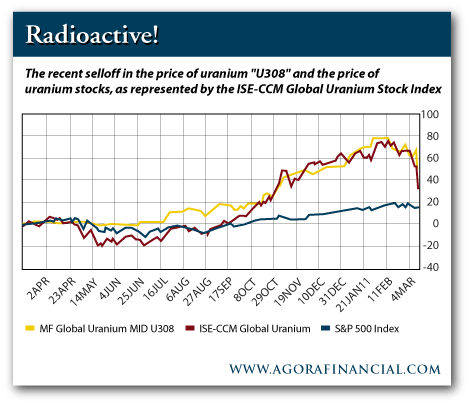
| The Death of the Nuclear Power Renaissance Posted: 15 Mar 2011 09:32 AM PDT Chris Mayer, editor of Mayer's Special Situations, shared this bit of investment wisdom with his subscribers yesterday: "Charlie Munger, the long-time Vice Chairman of Berkshire Hathaway, says there are three buckets where investment ideas go: 'Yes,' 'No' and 'Too Hard.' I think uranium is too hard." We would not quarrel with that logic; and we certainly would not quarrel with Chris's caution. As an early, and indefatigable, bull on uranium, Chris led his subscribers to some very large gains in the sector. After yesterday's selloff, some of those gains were much smaller than they had been. Nevertheless, Chris told his subscribers to "hit the bid" on two of the uranium plays he had recommended. "I think we should sell our two uranium holdings," Chris wrote. "We'll book a 73% gain on Kalahari Minerals (KAH:lsx) and a 10% gain on Paladin Energy (PDN:tsx; PALAF:pink sheets). The latter is down 23% today. Once, we were up 70% on the name. So this is a disappointment. But Kalahari is a very nice win for a stock we held little more than a year." Uranium is "too hard" indeed. On the other hand, nothing is very easy these days. Following the Nikkei's vertical plunge during the last two days, most stock markets around the globe also posted minus signs. From the highs of March 11 – the day the 9.0 quake struck – to the lows of today, Japan's Nikkei Index plunged more than 20%. The would-be buyers of Japanese stocks apparently decided that widespread devastation and smoldering nuclear power plants are not bullish phenomena. Following the Nikkei's example, the MSCI EAFE Index of international stocks dropped 7% during the last three trading sessions and erased its gains for the year-to-date. Here in the States, stocks are also wobbling. But buying interest seems to await every selloff. On Monday morning, the Dow Jones Industrial Average sliced through 12,000 immediately after the opening bell and fell as much as 140 points. But as the lunchtime hour was drawing to a close – about the time the third martinis were making their way to the lunch tables – investors regained their bravado. No tsunami carnage or atomic plumes were going to get in the way of their "Buy" orders! Nosirree! And no Middle East civil wars were either. After all, Warren Buffet bought Lubrizol. That had to count for something, right? By day's end, the Dow had trimmed its losses to a mere 51 points, while nearly reclaiming the 12,000 mark. In this morning's trading session, the Dow is attempting an encore. After tumbling nearly 300 points at the opening bell, the Dow has shaved its losses to only 150 points (as of this moment). Even so, the NASDAQ Composite Index has slipped into the loss column for the year-to-date, while the Dow and S&P 500 are flirting with a similar fate. Tomorrow is another day, of course. But tomorrow's news stories probably won't look dramatically different from today's. One possible exception may be the news stories circulating about the nuclear power industry. According to today's headlines, the post-quake crisis at several Japanese reactors is a "Three Mile Island event" that will stop the growth of nuclear power dead in its tracks. A gaggle of government officials around the world are saying as much…and we take them at their word, sort of. Obviously, the unfolding nuclear tragedy in Japan is not a non-event…as the harrowing volatility in global stock markets attests. The uranium sector, in particular, is in full meltdown mode: The ISE-CCM Global Uranium Stock Index has plummeted 27% during the last week. The price of uranium itself ("U308") is down a similar amount. Not a good week for the uranium bulls.
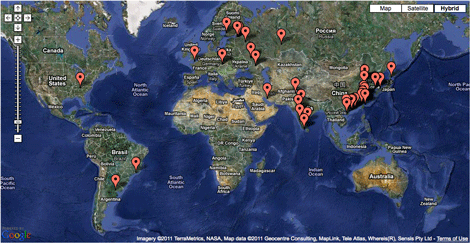
But just maybe, tomorrow's headlines about the fate of nuclear power will not resemble today's. Just maybe, tomorrow's headlines will be less bearish. Our respected colleague, Chris Mayer, is not optimistic. "The nuclear power renaissance is dead," he says flatly in the column below. Chris makes a compelling argument. And it almost never pays to disagree with the man (which is why we almost never do). But we suspect that nuclear power will live to fight another day…and will do so within an "investable timeframe." As regular readers of The Daily Reckoning may recall, your editor named uranium as his "Trade of the Decade." Two months ago, this call looked brilliant (or lucky). Today, not so much. Two months ago, uranium and uranium stocks were both sitting atop plump 50% gains for the decade-to-date. But those gains have shriveled to single digits. So where to from here? Admittedly, given the crisis in Japan, uranium might not be the "Trade of 2011." But we think uranium investments still have a solid shot at performing well throughout the rest of the decade. In other words, we'll keep dancin' with the one who brung us – not just for sentimental reasons, but for stone-cold economic reasons. Environmental disasters notwithstanding, nuclear power remains an extremely competitive and compelling alternative to fossil-fuel-powered electricity generation. The opponents of nuclear power tend to portray the contrast between nukes and hydrocarbon-generated electricity as a choice between adopting a rabid hyena or a Golden Retriever puppy. But the contrast is not quite that extreme or simplistic. A more accurate metaphor might be choosing between sleeping under a guillotine blade every night or sleeping in an airport smoking lounge. As long as the blade never falls, that's a much better – and healthier – place to sleep. That's the nuclear industry's critical challenge: preventing that blade from falling, no matter what. The newest nuclear technologies purport to achieve exactly that. Meanwhile, the world's coal-fired power plants are continuously converting the earth's atmosphere into a smoking lounge. This reality will not change, which is one very big reason why the demise of nuclear power may have been greatly exaggerated. Nuclear power has played – and continues to play – an essential role in worldwide power generation. More to the point of this discussion, nuclear power's role is growing most rapidly in the economies of the world that are growing most rapidly. The Fukushima disaster won't change that trend. To be sure, the world's newfound anxieties about nuclear power are probably not nothing; but they may not be very much of anything. For starters, many of the "concerned" individuals who are voicing anti-nuke viewpoints are individuals who happen to have an additional agenda or two in their hip pockets. Many of these individuals are either members of an opposition party in their particular country or are members of some group that has long opposed nuclear power. In the midst of the crisis, no one wishes to oppose these dissident voices. But once the crisis passes, the dissident voices may have to yell a little louder if they wish to be heard…and these voices might have to yell really, really loudly if the price of crude oil surges toward $150 or $200 a barrel. Secondly, many of the folks who are issuing the harshest anti-nuke remarks reside in countries like Germany and the US that were already hostile to nuclear power. The map below, courtesy of the World Nuclear Association, identifies the locations of nuclear power plants that are currently under construction. Of these, 42% reside in China; 16% in Russia and 11% in India. The G-7 countries, combined, account for only 3% of all nuclear plants currently under construction!
So if you are an investor in uranium, do you really care that Germany might not renew some nuclear power licenses or that Switzerland will find a new way to stall construction of three new nuclear plants? Even in the Developed World, the news for the nuclear industry is not all bad. At the very same moment that the Swiss and the Germans were pandering to their publics, the French, Spanish and Italians were promising full-speed ahead on their nuclear power programs. "France will continue to rely on nuclear power," Bloomberg News reports. "Spain, which is extending the life of existing plants, said Fukushima won't hold back its nuclear policy. Italy's environment minister said the earthquake won't make the country reconsider to build new plants." "We can't switch to renewables overnight," says French Environment Minister Nathalie Kosciusko-Morizet said. "For the foreseeable future, we will need nuclear." So will the rest of the world. Net-net, the long-term prognosis for nuclear power may not be as grim as the near-term headlines suggest. Eric Fry The Death of the Nuclear Power Renaissance originally appeared in the Daily Reckoning. The Daily Reckoning now provides over half a million subscribers with literary economic perspective, global market analysis, and contrarian investment ideas.
|
| Posted: 15 Mar 2011 09:31 AM PDT Author: Vedran Vuk Synopsis: The Japan crisis is getting worse as it impacts world economies, commodities, and even U.S. Treasuries. Casey Research Chief Economist Bud Conrad provides a status update. Also in this edition: How will the Japanese government react to the crisis? And what could happen to the Japanese nuclear reactors and the uranium market? Dear Reader, With the Japanese crisis unfolding, I'm thinking about the policy consequences ahead for the country. I'm positive that Japan will rebuild itself. As Kevin Brekke pointed out yesterday, the market was back within a year after the Kobe earthquake. Of course, a nuclear meltdown would surely push this time line further out, but eventually the nation would recover. However, bad political decisions may stick around for as long as radiation. This is the perfect time for politicians to enact poor policies that could...
|
| Gold Standard Institute letter cites another stunning admission by Fed Governor Warsh Posted: 15 Mar 2011 09:01 AM PDT 5:03p ET Tuesday, March 15, 2011 Dear Friend of GATA and Gold: The March edition of the newsletter of the Gold Standard Institute may be especially notable for its essay by financial analyst Louis Boulanger, who writes about GATA's favorite member of the Federal Reserve Board of Governors, Kevin M. Warsh, who in 2009 disclosed (perhaps inadvertently) the Fed's gold swap arrangements with foreign banks. (See http://www.gata.org/node/7819.) Boulanger seizes on another recent statement by Warsh and concludes that it is "an astonishing admission ... that the Fed is effectively price-fixing on a global scale." Boulanger's commentary is headlined ""False Belief No. 2: Risk-Free Investments," and you can find it with the rest of the Gold Standard Institute's March letter here: http://goldstandardinstitute.org/GSI/wp-content/uploads/2011/03/TheGoldS... CHRIS POWELL, Secretary/Treasurer ADVERTISEMENT Prophecy Resource Spins Off Platinum/Palladium Venture: Company Press Release, January 18, 2011 VANCOUVER, British Columbia -- Prophecy Resource Corp. (TSX-V:PCY)and Pacific Coast Nickel Corp. announce that they have agreed that PCNC will acquire Prophecy's Nickel PGM projects by issuing common shares to Prophecy. PCNC will acquire the Wellgreen PGM Ni-Cu and Lynn Lake nickel projects in the Yukon Territory and Manitoba respectively by issuing up to 550 million common shares of PCNC to Prophecy. PCNC has 55.7 million shares outstanding. Following the transaction: -- Prophecy will own approximately 90 percent of PCNC. -- PCNC will consolidate its share capital on a 10 old for one new basis. -- Prophecy will change its name to Prophecy Coal Corp. and PCNC will be renamed Prophecy Platinum Corp. -- Prophecy intends to distribute half of its PCNC shares to shareholders pro-rata in accordance with their holdings. Based on the closing price of the common shares of PCNC on January 17, $0.195 per share, the gross value of the transaction is $107,250,000. For the complete announcement, please visit: http://prophecyresource.com/news_2011_jan18.php Support GATA by purchasing a colorful GATA T-shirt: Or a colorful poster of GATA's full-page ad in The Wall Street Journal on January 31, 2009: http://gata.org/node/wallstreetjournal Or a video disc of GATA's 2005 Gold Rush 21 conference in the Yukon: Help keep GATA going GATA is a civil rights and educational organization based in the United States and tax-exempt under the U.S. Internal Revenue Code. Its e-mail dispatches are free, and you can subscribe at: To contribute to GATA, please visit: http://www.gata.org/node/16 ADVERTISEMENT The Gold Standard Now: It Can Work On March 17 former Reagan Gold Commission member Lewis E. Lehrman, journalist James Grant, and Prof. James Salerno will testify before U.S. Rep. Ron Paul's Subcommittee on Domestic Monetary Policy. This is the most significant monetary policy hearing in at least a generation, probably in 40 years, possibly in our lifetimes. Today a dollar is worth 80 percent less than it was 40 years ago, and less than 5 percent of its value a hundred years ago. We deserve a dollar that is as good as gold, a dollar that will hold its value from year to year so we can be financially secure and our economy can generate more and better jobs. For most of America's history, our dollar was literally as good as gold. But on August 15, 1971, our politicians destroyed the link between gold and the dollar. They destroyed the foundations of our economic system. A new Internet site, TheGoldStandardNow.org, provides news and cutting-edge analysis about this most important issue and explains how the gold standard worked in the past and how it can work in the future. Visit us today: http://www.thegoldstandardnow.org/about/137-welcome-newsmax
|
| Gold, Silver and Mining Stocks Decline as Stocks Lead the Way Posted: 15 Mar 2011 08:54 AM PDT It's been only a few days since we've posted our latest timing-related essay on gold and silver prices, and since that time the situation has changed dramatically. Before providing you with the main point of this essay ... Read More...
|
| Gold Daily and Silver Weekly Charts Posted: 15 Mar 2011 08:31 AM PDT |
| Tsunami May Sink the Uranium Sector and US Dollar Posted: 15 Mar 2011 08:17 AM PDT What a few days it has been. It was and continues to be a humanitarian disaster of grand proportions - and one that happened on an island where there is more high end video and cellphone cameras than almost anywhere in the world ... Read More...
|
| Swissie The New Ultimate Safe Haven Currency? Posted: 15 Mar 2011 08:11 AM PDT View the original post at jsmineset.com... March 15, 2011 09:18 AM Dear CIGAs, One development occurring in the midst of all this volatility is the seeming change occurring within the global investment community in regards to the US Dollar. The Dollar has historically been the ultimate safe haven currency during times of economic or geopolitical uncertainty. Just look back at the rally it staged in the latter part of 2008 as the Yen carry trade was unwound and a rush to the safety of the Dollar occurred when the "risk trades" were taken off. Recently it appears that whenever we see some sort of political or economic uncertainty the Dollar gets its usual knee jerk safe haven bid but then begins to fade and give up a large portion of its gains as the trading session wears on. The main beneficiary for a safe haven currency trade has become the Swiss Franc. The Swissie has always been a safe haven currency but so too has the Dollar. The fact that the Dollar is so weak, even during ...
|
| Posted: 15 Mar 2011 08:11 AM PDT View the original post at jsmineset.com... March 15, 2011 08:42 AM Dear Jim, How much weakness are you expecting in gold related to this situation in Japan? Do you think the Federal reserve will be quicker in announcing QE3? Respectfully CIGA V. Dear CIGA V, The trading range is $1369 to $1444. The solution to deflation is QE to infinity. If Japan’s nuclear situation worsens, God help them, the world markets will be liquefied to the extreme. You might call that QE3. Regards, Jim Jim, Would gold, coal, and oil go down in the midst of this craziness with Japan? That seems backwards to me. CIGA Bob Dear CIGA Bob, When the naughty house gets raided the piano player gets arrested as well. Regards, Jim Hello Jim, I hope your arm is healing well. I spoke with you at the AGM. After reading Monty’s release yesterday I am concerned/interpreting that we should sell our stocks in U.S and Canada. If oil does rise won’t Cana...
|
| Posted: 15 Mar 2011 08:11 AM PDT View the original post at jsmineset.com... March 15, 2011 08:37 AM Gold Action Explained: When the Naughty House gets raided even the piano player get arrested. In a very short period of time the piano player is released as he did not partake. Today, gold is the piano player. Very shortly he will be released. Gold will trade at $1650 and better. The reason for that is all crisis without exception are met with QE to Infinity. Jim Sinclair’s Commentary Don’t be silly. Hasn’t every government on the Globe stated that no radiation will hit them, including Japan? America on radiation alert: Japan faces world’s worst nuclear accident since Chernobyl as experts warn fallout may reach U.S. By David Derbyshire, Richard Shears and Daily Mail Reporter Last updated at 10:20 AM on 15th March 2011 Fears that America could be hit by the nuclear fallout from the Japan earthquake have dramatically increased as workers prepared to abandon a rea...
|
| Bob Moriarty: You Can't Eat Oil Posted: 15 Mar 2011 08:05 AM PDT The Gold Report submits: Well, you can't eat gold either. But at least gold is easier to carry around, says precious metals pundit Bob Moriarty. In this exclusive interview with The Gold Report, Moriarty lays out his forecast for the U.S. government (ousted), banks (collapsed) and why he still has significant stakes in precious metal equities despite his doomsday predictions. Complete Story »
|
| Nikkei Futures are moving off their Worst levels Posted: 15 Mar 2011 08:01 AM PDT [url]http://www.traderdannorcini.blogspot.com/[/url] [url]http://www.fortwealth.com/[/url] While the Nikkei is not yet open for trading for Wednesday's session, the futures market is moving up off of the 8400 level. It has obviously plummeted as it discounts the massive hit to the Japanese economy but it could be that traders are saying, "enough" for now. Of course, if the situation regarding the nuclear reactors were to worsen further, all bets are off; however, if the interprid Japanese can get those reactors under control, the Nikkei will probably commence a short covering rally with shorts booking profits under the idea that they have discounted the worse case scenario. Were that to occur it would pull up the US equity markets and probably send money flowing back into the commodity complex as longer term, demand for many commodities is going to be on the rise due to the amounts required for reconstruction purposes. Food stocks will also have to be replenished. Gold and silver ...
|
| You are subscribed to email updates from Save Your ASSets First To stop receiving these emails, you may unsubscribe now. | Email delivery powered by Google |
| Google Inc., 20 West Kinzie, Chicago IL USA 60610 | |




No comments:
Post a Comment