


Gold World News Flash |

- Gold Mocks World Spooked By Fed’s $600 Billion
- Crude Oil Stalls as Bearish News Flow Spurs Profit Taking, Gold Follows Through to th
- The Choice of an 'Accounting Yardstick'
- 'Midas Crush' - MarketWatch Attempts to Explain 'Why Gold is a Bad Investment'
- 5 ALARM FIRE AT COMEX: SILVER WILL SOAR ONCE AGAIN
- The Will Robinson Signal
- 681observer – crash jp morgan …buy silver …the writing on the walls
- Gene Arensberg: Big commercial shorts still covering in silver
- The Crash JP Morgan Buy Silver Manifesto or: How to Get Hedge Funds To Do Your Dirty Work For You (beta)
- The Gold Price Has Plenty of Support Around $1,355 I'll Buy Again at $1,375
- Dollar Continues to Control Gold, Oil & Equities
- sscam2001 – says “CRASH JP MORGAN BUY SILVER”
- Inflation Expectation Tuesday: Europe Takes Bernanke’s “Cash is Trash” Message a Little TOO Literally
- Inflation Expectation Tuesday: Europe Takes Bernanke’s “Cash is Trash” Message a Little TOO Literally
- Pay Attention
- Mike Shedlock: “Holding Dollars is Speculating”
- Be Careful What You Wish For
- The Long Term Implications Of QE2
- drutter – Crash JP Morgan – Own Physical Silver
- Fin. terror supporter Eric Mindich’s nightmare: Crash JP Morgan Buy Silver to create the silver bullett
- Gold Standards, the World Bank, and Fiscal Responsibility
- Follow the bouncing ball… if you can
- Can you spot the hedge in Eric Mindich’s portfolio that is going to blow up in his face next year?
- NOVEMBER 2010 - MAJOR MARKETS (DOW, S&P, GOLD, OIL) Technical Commentary
- State television suggests 1.2 billion Chinese buy some Silver (to f*** up roundeye JP Morgan)
- MONDAY Market Excerpts
- Ireland Given 24 Hour Ultimatum To Take Bailout Or Be Responsible For Pan-European Contagion
- Why Angela Merkel Wants Ireland to Take a Bailout
- Paulson Sells Large Portions Of BofA, Citi, Wells, Capital One, Dumps All Of Goldman, Adds 500,000 In Potash Merger Arb
- Bargain Gold?
- Ian McAvity: Be Careful What You Wish For
- Should gold miners be returning to hedging?
- Manhattan Project Use of Silver
- In The News Today
- Hourly Action In Gold From Trader Dan
- Jim?s Mailbox
- Inflation Is Coming! Inflation Is Coming!
- 2011 Predictions: Economic, Financial and Geopolitical Turmoil
- Gold Weekly Reversal
- Are Republicans Preparing For A Push To Eliminate The "Maximum Employment" Part Of The Fed's Dual Mandate?
- Jim Sinclair - Gold to Swing $100 to $300 in a Day
- Why Bernanke’s “Quantitative Easing” Isn’t Fooling Anyone
- 23 Financial Minds Join Forces to Publicly Rebuke QE2
- Gold: A Fate Worse Than the Cover of Time Magazine
- TRUE COST OF BUSH'S WARS – $4 TRILLION TO $6 TRILLION
- For week ending 12 November 2010
- Simple Asset Protection Secrets from Switzerland
- Kinross Strikes Gold With 3Q Results
- G20 and The U.S. Dollar Policy - A Presentation
- THE GOLD BUBBLE
| Gold Mocks World Spooked By Fed’s $600 Billion Posted: 15 Nov 2010 09:25 PM PST As this divide widens and self-interest reigns, investor confidence is likely to darken accordingly. To see that, look no further than gold.
|
| Crude Oil Stalls as Bearish News Flow Spurs Profit Taking, Gold Follows Through to th Posted: 15 Nov 2010 04:30 PM PST courtesy of DailyFX.com November 15, 2010 10:51 PM Recent declines in both crude oil and gold have yet to attract the attention of bargain hunters as European troubles continue to dominant the headlines. Commodities – Energy Crude Oil Stalls as Bearish News Flow Spurs Profit Taking Crude Oil (WTI) - $84.52 // $0.34 // 0.40% Commentary: Crude oil erased early gains to finish close to unchanged on Monday at $84.86. Price action for the day was in step with that of U.S. equity markets, with European sovereign debt concerns offsetting the bullish underpinnings of the financial markets, which include the Fed’s QE2 program, the improving U.S. labor market, and sizzling growth in the emerging market economies. This price action we are seeing in crude and equity markets is merely consolidation after enormous gains over the past few months. The European debt crisis and Chinese inflation fears are simply excuses for traders to lock in profits. After prices finish conso...
|
| The Choice of an 'Accounting Yardstick' Posted: 15 Nov 2010 03:27 PM PST Regardless of what currency you use to purchase gold bullion, after you have made the purchase you own ounces of gold. You don't own ounces of US$-denominated gold or euro-denominated gold. Gold is gold. Read More...
|
| 'Midas Crush' - MarketWatch Attempts to Explain 'Why Gold is a Bad Investment' Posted: 15 Nov 2010 01:58 PM PST Michael Shedlock submits: Jonathan Burton at MarketWatch attempts to present a case Why gold is a bad investment.
Complete Story »
|
| 5 ALARM FIRE AT COMEX: SILVER WILL SOAR ONCE AGAIN Posted: 15 Nov 2010 01:37 PM PST
|
| Posted: 15 Nov 2010 12:54 PM PST
With investors extremely bullish and company insiders extremely bearish and with the indicator constructed from the trends in gold, crude oil and yields on the 10 year Treasury flashing extremes, I am once again reminded of the robot from the hit 1960's TV show, "Lost In Space". When the boyish Will Robinson was in peril, the robot would fling his arms up and down and announce in robot voice: "Danger,Will Robinson, danger!" Historically, these set of market conditions should not be ignored. If the market hasn't topped out already, it should do so within a couple of percent of the recent highs. Rallies should be sold and stops tightened up. The market is prone to sudden sell offs. There will be better risk adjusted opportunities to buy in the future.
{click on image to enlarge}
|
| 681observer – crash jp morgan …buy silver …the writing on the walls Posted: 15 Nov 2010 12:43 PM PST
|
| Gene Arensberg: Big commercial shorts still covering in silver Posted: 15 Nov 2010 12:41 PM PST 8:35p ET Monday, November 15, 2010 Dear Friend of GATA and Gold (and Silver): The Got Gold Report's Gene Arensberg reports tonight that the U.S. Commodity Futures Trading Commission's traders report for November 9, released today, showed the large commercial shorts not selling heavily into gold's recent rise and actually reducing their short position in silver as it rose. Arensberg writes that this is "the sixth consecutive COT report that shows the big sellers reducing their net short position as the price of silver rose. That's very strange, very unusual, and downright stunning. Something has indeed changed in the tiny silver market." Arensberg's analysis is headlined "COT Surprise" and you can find it at the Got Gold Report's Internet site here: http://www.gotgoldreport.com/2010/11/cot-surprise.html CHRIS POWELL, Secretary/Treasurer ADVERTISEMENT Sona Drills 85.4g Gold/Ton Over 4 Metres at Elizabeth Gold Deposit, Company Press Release, October 27, 2010 VANCOUVER, British Columbia -- Sona Resources Corp. reports on five drillling holes in the third round of assay results from the recently completed drill program at its 100 percent-owned Elizabeth Gold Deposit Property in the Lillooet Mining District of southern British Columbia. Highlights from the diamond drilling include: -- Hole E10-66 intersected 17.4g gold/ton over 1.54 metres. -- Hole E10-67 intersected 96.4g gold/ton over 2.5 metres, including one assay interval of 383g of gold/ton over 0.5 metres. -- Hole E10-69 intersected 85.4g gold/ton over 4.03 metres, including one assay interval of 230g gold/ton over 1 metre. Four drill holes, E10-66 to E10-69, targeted the southwestern end of the Southwest Vein, and three of the holes have expanded the mineralized zone in that direction. The Southwest Vein gold mineralization has now been intersected over a strike length of 325 metres, with the deepest hole drilled less than 200 metres from surface. "The assay results from the Southwest Zone quartz vein continue to be extremely positive," says John P. Thompson, Sona's president and CEO. "We are expanding the Southwest Vein, and this high-grade gold mineralization remains wide open down dip and along strike to the southwest." For the company's full press release, please visit: http://sonaresources.com/_resources/news/SONA_NR19_2010.pdf Support GATA by purchasing a colorful GATA T-shirt: Or a colorful poster of GATA's full-page ad in The Wall Street Journal on January 31, 2009: CHRIS POWELL, Secretary/Treasurer ADVERTISEMENT Sona Drills 85.4g Gold/Ton Over 4 Metres at Elizabeth Gold Deposit, Company Press Release, October 27, 2010 VANCOUVER, British Columbia -- Sona Resources Corp. reports on five drillling holes in the third round of assay results from the recently completed drill program at its 100 percent-owned Elizabeth Gold Deposit Property in the Lillooet Mining District of southern British Columbia. Highlights from the diamond drilling include: -- Hole E10-66 intersected 17.4g gold/ton over 1.54 metres. -- Hole E10-67 intersected 96.4g gold/ton over 2.5 metres, including one assay interval of 383g of gold/ton over 0.5 metres. -- Hole E10-69 intersected 85.4g gold/ton over 4.03 metres, including one assay interval of 230g gold/ton over 1 metre. Four drill holes, E10-66 to E10-69, targeted the southwestern end of the Southwest Vein, and three of the holes have expanded the mineralized zone in that direction. The Southwest Vein gold mineralization has now been intersected over a strike length of 325 metres, with the deepest hole drilled less than 200 metres from surface. "The assay results from the Southwest Zone quartz vein continue to be extremely positive," says John P. Thompson, Sona's president and CEO. "We are expanding the Southwest Vein, and this high-grade gold mineralization remains wide open down dip and along strike to the southwest." For the company's full press release, please visit: http://sonaresources.com/_resources/news/SONA_NR19_2010.pdf Support GATA by purchasing a colorful GATA T-shirt: Or a colorful poster of GATA's full-page ad in The Wall Street Journal on January 31, 2009: http://gata.org/node/wallstreetjournal Or a video disc of GATA's 2005 Gold Rush 21 conference in the Yukon: * * * Help keep GATA going GATA is a civil rights and educational organization based in the United States and tax-exempt under the U.S. Internal Revenue Code. Its e-mail dispatches are free, and you can subscribe at: To contribute to GATA, please visit:http://www.gata.org/node/16 ADVERTISEMENT Prophecy Receives Permit To Mine at Ulaan Ovoo in Mongolia VANCOUVER, British Columbia -- Prophecy Resource Corp. (TSX-V:PCY, OTCQX: PRPCF, Frankfurt: 1P2) announces that on November 9, 2010, it received the final permit to commence mining operations at its Ulaan Ovoo coal project in Mongolia. Prophecy is one of few international mining companies to achieve such a milestone. The mine is production-ready, with a mine opening ceremony scheduled for November 20. Prophecy CEO John Lee said: "I thank the government of Mongolia for the expeditious way this permit was issued. The opening of Ulaan Ovoo is a testament to the industrious and skilled workforce in Mongolia. Prophecy directly and indirectly (through Leighton Asia) employs more than 65 competent Mongolian nationals and four expatriots. The company also reaffirms its commitment to deliver coal to the local Edernet and Darkhan powerplants in Mongolia." The Ulaan Ovoo open pit mine is 10 kilometers from the Russian border and within 120km of the Nauski TransSiberian railway station, enabling transportation of coal to Russia and its eastern seaports. Thermal coal prices are trading at two-year highs at Russian seaports due to strong demand from Asian economies. For the complete press release, please visit: http://prophecyresource.com/news_2010_nov11.php
|
| Posted: 15 Nov 2010 12:27 PM PST 1 – JP Morgan has a huge short position in Silver – tied to a huge, extremely precarious derivatives position some estimate to represent approximately 1.5 trillion in risk to its balance sheet. 2 – Various exchanges around the world have been caught manipulating the price of Silver using ‘naked’ short sales (no, there is [...]
|
| The Gold Price Has Plenty of Support Around $1,355 I'll Buy Again at $1,375 Posted: 15 Nov 2010 12:23 PM PST Gold Price Close Today : 1368.40 Change : 3.00 or 0.2% Silver Price Close Today : 26.088 Change : 0.150 cents or 0.6% Gold Silver Ratio Today : 52.45 Change : -0.188 or -0.4% Silver Gold Ratio Today : 0.01906 Change : 0.000068 or 0.4% Platinum Price Close Today : 1669.50 Change : -11.20 or -0.7% Palladium Price Close Today : 668.50 Change : -7.00 or -1.0% S&P 500 : 1,199.21 Change : -14.33 or -1.2% Dow In GOLD$ : $169.08 Change : $ (1.72) or -1.0% Dow in GOLD oz : 8.179 Change : -0.083 or -1.0% Dow in SILVER oz : 429.03 Change : -3.49 or -0.8% Dow Industrial : 11,192.58 Change : -90.52 or -0.8% US Dollar Index : 78.62 Change : 0.566 or 0.7% This morning the SILVER PRICE and the GOLD PRICE were up slightly over Friday. I glanced away and looked back and LO! Silver had jumped 20 cents. I looked at the overnight/over the weekend charts for silver and gold, and both appeared to have completed a downmove on Friday and traded sideways into this morning. Both appeared to be bursting for a run. I bought, expecting we had seen the last of correction. We hadn't. They peaked about noon Eastern time, then edged downward into the closes. When Comex closed silver had risen 15c from Friday to 2608.8c and gold had climbed $3.00 to $1,368.40. That wasn't much below my shopping basket ride at 2637.5 and 1371.30. Then the SILVER and GOLD PRICE simply fainted, plump! Gold fell as low as $1,355.90 and silver to 2540c. Both have since recovered, silver to 2573c now and gold to $1,362. What next? The main defense now is $1,355 and 2540c, but, heaven help me, that looks like the bottom of it. Either I misread the chart and got hit by one more leg down, or tomorrow those support levels will be broken and silver and gold will make one more move earthward. Gold has plenty of support around $1,355, but if that falters then you have to reckon with $1,330 or $1,315. Silver has solid support at 2500c - 2490c, a mere 40c below today's lows. Could see that tomorrow. Natural born durned fool that I am, if I come in here tomorrow and silver's above 2550c and gold over $1,375, I'll buy 'em again! However it turns out, I cling to my opinion that this entire correction from 9 November will not belong to the gigantic species but the midget, and is on the road to $1,600. I can't work up any enthusiasm for talking about stocks. They just stink. Dow today gained a silly 9.39 to 11,201.97 while the S&P500 dropped 1.46 to 1,197.75. Nasdaq Comp was down, along with the Nasdaq 100. It was a sloppy, messy day, accomplishing nothing to gainsay their established downtrend. DOLLAR INDEX today rose 56.6 basis points to 78.615. Euro dropped a US penny. Dollar index hath not reached its 50 dma (78.62) and must decide whether 'twill fish or cut bait. Looks like it wants to move higher. This is just a short term rally, my eyes say. Also, I've been ruminating and chewing on what Bozo Ben has in mind, and considering that he is a student of the Great Depression and an unrepentant Keynesian. That implies he has looked at Roosevelt's 41% devaluation of the US dollar (over a year) and come to a typically moronic Keynesian conclusion. After the devaluation, in 1937-38, the stock market crashed worse than 1929, and the Depression dragged on and on. What will Bonzo Ben Super-Keynesian conclude? "Roosevelt failed because he didn't devalue enough. Therefore I, Ben the Beneficient, will do what The Great Prevaricator could not do, I will depreciate even more and make it work." No, I haven't been a fly on his wall, but I'll bet a dead dog to a possum that's where he's headed. If I've rightly read his mind, all y'all without any silver or gold had better flee now to Mexico, where you'll come a lot nearer finding a job than you will in the US of A a twelvemonth hence. On this day in 1777 the Continental Congress approved the Articles of Confederation after 16 months of debate. In spite of what all the constitution worshippers say, the Articles government was far superior to the constitution at preserving both federalism and individual rights. Patrick Henry warned everybody during the ratification debates, y'all are giving up both the power of the sword and the power of the purse to a central government, and those are the only two powers worth having. Not enough listened. Argentum et aurum comparenda sunt -- -- Gold and silver must be bought. - Franklin Sanders, The Moneychanger The-MoneyChanger.com © 2010, The Moneychanger. May not be republished in any form, including electronically, without our express permission. To avoid confusion, please remember that the comments above have a very short time horizon. Always invest with the primary trend. Gold's primary trend is up, targeting at least $3,130.00; silver's primary is up targeting 16:1 gold/silver ratio or $195.66; stocks' primary trend is down, targeting Dow under 2,900 and worth only one ounce of gold; US$ or US$-denominated assets, primary trend down; real estate in a bubble, primary trend way down. Whenever I write "Stay out of stocks" readers inevitably ask, "Do you mean precious metals mining stocks, too?" No, I don't. 
|
| Dollar Continues to Control Gold, Oil & Equities Posted: 15 Nov 2010 12:20 PM PST Over the past few months it seems as though everything has been tied to the dollar. Simple inter-market analysis makes it obvious that almost everything in the financial market eventually has an affect on stocks and commodities in some way. But recently trading has really been all about the dollar. If you watch the SP500 and gold prices you will notice at times virtually every tick the dollar makes directly affects the price and direction of gold and the SP500 index. Let’s take a look at some charts to see the underlying trends and what they are telling us… Dollar Index – Daily Chart As you can see the trend is clearly down. Currently the dollar is trying to find a bottom as it bounces and pierces the previous high. The question everyone wants to know is if the dollar is about to rally and reverse trends or was Friday’s pierce of the October high just a shake out before the next leg down? Back in late August the dollar pierced the July high on ...
|
| sscam2001 – says “CRASH JP MORGAN BUY SILVER” Posted: 15 Nov 2010 12:20 PM PST
|
| Posted: 15 Nov 2010 12:16 PM PST
As the whole financial world now knows, Ben Bernanke wants to actively foster inflation by trashing the US Dollar. Setting aside the fact that this is absolute insanity (inflation has already hit the US), Bernanke’s made it clear that he wants to trash cash to keep stocks up.
The only problem for our esteemed Fed Chairman is that Europe’s banking system appears to be even MORE adept at currency destruction than Bernanke’s money printing trigger finger.
Indeed, the Euro was recently rejected by the upper trend-line of its long-term trading channel. This is EXTREMELY bearish as it means the Euro has posted yet another lower high in the last three years, which means we’re likely on our way to even lower lows… as in even LOWER than the June lows.
On one hand Bernanke must be proud that the European banking system has taken his “cash is trash” philosophy to heart. However, the bad news about the Euro collapsing is that it will force the US Dollar higher (the Euro accounts for over 50% of the US Dollar index). After all, the two currencies trade in near perfect inverse correlation to one another:
As the Euro collapses, we are likely to see more US Dollar strength, which will absolutely KILL Bernanke’s inflation expectations… at least in the near-term. Sadly for Bailout Ben, the US Dollar is still seen as something of a safe haven. And consequently the US currency will rally as risk hits the financial system again and the Euro collapses.
After all, investing in a country that will default on its debt in the future (the US) is a lot more attractive that investing in a country that is defaulting on its debt right now (Europe).
However, the BIG question for Gold investors is whether or not the precious metal will hold up during a serious US Dollar rally. Judging from the chart, we’ve got some decent risk to the downside:
As you can see, Gold has formed what appears to be a large bearish rising wedge pattern. This is a classic termination pattern which usually resolves in a sharp sell-off to its base (in this case around that would mean Gold around $800 per ounce).
Understand, I’m NOT saying Gold is going to $800 per ounce. I’m merely saying that if this pattern breaks out to the downside, it predicts a large price move down which could result in Gold breaking below $1,000.
However, in order for Gold to do this, we would first need to see the precious metal break below the lower trend-line of this pattern ($1,300) in a convincing fashion. After that we would need to take out support at $1,250, $1,165 and $1,100.
The only thing that could do this would be a recurrence I systemic risk a la 2008 (only an event of that nature could result in the deleveraging necessary to force Gold down to $1000 per ounce ).
Could it happen? Well, if Europe goes through anything like what we did in 2008, it’s definitely possible. But I would view most Gold corrections as buying opportunities. In choosing between an asset that has acted as a storehouse of value for 5,000 years (Gold) and an asset that is being printed by a lunatic who intentionally wants to devalue it (the US Dollar), I’d go with Gold anytime.
To conclude, my primary point is that we look to be on the verge of a serious US Dollar rally (courtesy of the Euro collapsing). This will bring commodities lower (including Gold) and cool some of the inflationary heat we’re feeling in the US today.
In this environment, Gold is likely to correct to at least $1,350 it not $1,325. However, if things get REALLY ugly and we have another 2008 event hit, then there is the potential for Gold to fall as low as $1,000 per ounce.
Personally, I’m hoping this is the case. After all, the gains you can generate from a 2008 style event are unbelievable.
Good Investing!
PS. If you’re worried about the future of the stock market and have yet to take steps to prepare for the Second Round of the Financial Crisis… I highly suggest you download my FREE Special Report specifying exactly how to prepare for what’s to come.
I call it The Financial Crisis “Round Two” Survival Kit. And its 17 pages contain a wealth of information about portfolio protection, which investments to own and how to take out Catastrophe Insurance on the stock market (this “insurance” paid out triple digit gains in the Autumn of 2008).
Again, this is all 100% FREE. To pick up your copy today, got to http://www.gainspainscapital.com and click on FREE REPORTS.
|
| Posted: 15 Nov 2010 11:59 AM PST Inflation Expectation Tuesday: Europe Takes Bernanke's "Cash is Trash" Message a Little TOO Literally
As the whole financial world now knows, Ben Bernanke wants to actively foster inflation by trashing the US Dollar. Setting aside the fact that this is absolute insanity (inflation has already hit the US), Bernanke's made it clear that he wants to trash cash to keep stocks up. The only problem for our esteemed Fed Chairman is that Europe's banking system appears to be even MORE adept at currency destruction than Bernanke's money printing trigger finger. Indeed, the Euro was recently rejected by the upper trend-line of its long-term trading channel. This is EXTREMELY bearish as it means the Euro has posted yet another lower high in the last three years, which means we're likely on our way to even lower lows… as in even LOWER than the June lows.
On one hand Bernanke must be proud that the European banking system has taken his "cash is trash" philosophy to heart. However, the bad news about the Euro collapsing is that it will force the US Dollar higher (the Euro accounts for over 50% of the US Dollar index). After all, the two currencies trade in near perfect inverse correlation to one another: As the Euro collapses, we are likely to see more US Dollar strength, which will absolutely KILL Bernanke's inflation expectations… at least in the near-term. Sadly for Bailout Ben, the US Dollar is still seen as something of a safe haven. And consequently the US currency will rally as risk hits the financial system again and the Euro collapses. After all, investing in a country that will default on its debt in the future (the US) is a lot more attractive that investing in a country that is defaulting on its debt right now (Europe). However, the BIG question for Gold investors is whether or not the precious metal will hold up during a serious US Dollar rally. Judging from the chart, we've got some decent risk to the downside:
As you can see, Gold has formed what appears to be a large bearish rising wedge pattern. This is a classic termination pattern which usually resolves in a sharp sell-off to its base (in this case around that would mean Gold around $800 per ounce). Understand, I'm NOT saying Gold is going to $800 per ounce. I'm merely saying that if this pattern breaks out to the downside, it predicts a large price move down which could result in Gold breaking below $1,000. However, in order for Gold to do this, we would first need to see the precious metal break below the lower trend-line of this pattern ($1,300) in a convincing fashion. After that we would need to take out support at $1,250, $1,165 and $1,100.
The only thing that could do this would be a recurrence I systemic risk a la 2008 (only an event of that nature could result in the deleveraging necessary to force Gold down to $1000 per ounce ). Could it happen? Well, if Europe goes through anything like what we did in 2008, it's definitely possible. But I would view most Gold corrections as buying opportunities. In choosing between an asset that has acted as a storehouse of value for 5,000 years (Gold) and an asset that is being printed by a lunatic who intentionally wants to devalue it (the US Dollar), I'd go with Gold anytime. To conclude, my primary point is that we look to be on the verge of a serious US Dollar rally (courtesy of the Euro collapsing). This will bring commodities lower (including Gold) and cool some of the inflationary heat we're feeling in the US today.
In this environment, Gold is likely to correct to at least $1,350 it not $1,325. However, if things get REALLY ugly and we have another 2008 event hit, then there is the potential for Gold to fall as low as $1,000 per ounce. Personally, I'm hoping this is the case. After all, the gains you can generate from a 2008 style event are unbelievable. Indeed, imagine if you'd bought puts on the S&P 500 in 2008... With that one trade, even a $1,000 investment could have turned into $20,000 or more. And if you'd bought a couple of options trades (say calls on the US Dollar combined with puts on various risk assets) you could have made a literal fortune. Well, it's looks like it's about to happen AGAIN. As any professional trader will tell you, the biggest gains are made when a trade gets overcrowded in one direction. When the herd finally makes for the exits (and they always do) you can make truly ENORMOUS returns. Well, right now, the whole world is betting that the US Dollar will soon collapse, and that stocks and precious metals will explode higher. I'm not being dramatic here either. Just a few weeks ago, the Commodities and Futures Trading Commission announced that investors have made more bearish bets on the US Dollar today than at ANY TIME IN HISTORY. That's right, more investors are betting on a US Dollar collapse today than they were in 2008, when the US Dollar was at an all-time low… I'm sure you remember what followed… the Dollar exploded higher as the trade reversed, kicking off a massive short-covering panic that kicked commodities and stocks in the teeth. Let me be clear what I'm talking about here. Personally I think the Dollar is doomed too. But it's going to take a lot longer to unravel than people expect. Why? Because Europe is literally imploding. Investors are going be fleeing the Euro. And since the Euro accounts for over 50% of the US Dollar index, this means the US Dollar will rally as the Euro drops. When this happens, all those US Dollar bears are going to have to cover their shorts... which will push the US Dollar EVEN HIGH crushing commodities and stocks a like. Just. Like. 2008. And once again, no one sees it coming. For that reason I am putting together a one-time Special Report detailing several options trades that will profit from this situation. And I'm giving it away for FREE to all Rapid Fire Options Alert subscribers. Why is this report Special? Normally the goal of Rapid Fire Options Alert is to produce double and triple digit profits as quickly as possible by trading one specific option at a time. Often times we only hold a trade for a few days. Of course, that hasn't stopped us from producing gains of 24%, 39%, 57%, even 101% in the past. However, in light of the situation brewing in Europe today, I'm about to issue a one-time cluster of trades (four total) that Rapid Fire Options Alert subscribers will be holding for several months. If the markets do what I expect they'll do, even a $1,000 investment in each of these four trades should return triple, if not quadruple digit gains during that time. I will be unveiling these trades in this morning's issue of Rapid Fire Options Alert if you would like to be on board to find out what they are… Thank you for reading. Now let's get ready for some REAL fireworks. Good Trading! Graham Summers PS. As with all my investment newsletters, I offer a "trial" subscription to Rapid Fire Options Alert. So when you sign up for Rapid Fire Options Alert, your purchase isn't a "done deal." Instead, I give you a full month (30 days) to try out these trades and the profits they produce. If, at any point during those 30 days, you decide Rapid Fire Options Alert is not for you, all you have to do is shoot me an email and I'll give you every single cent of your subscription cost back, NO QUESTIONS ASKED. Why do I offer this trial period? Because I am so confident in Rapid Fire Options Alert's ability to produce winning trades (again, we're up 15% without ever risking more than 5% of our portfolios at a time) that I know once you see the results, you'll never dream of cancelling. To get started with your trial subscription today...
|
| Posted: 15 Nov 2010 11:53 AM PST The following is automatically syndicated from Grandich's blog. You can view the original post here. Stay up to date on his model portfolio! November 15, 2010 03:33 PM I don’t expect much media attention on this (because the vast majority hate gold) but if you haven’t yet listen to me and others like GATA about the games being played in the precious metals market, take serious note. It was released today that George Soros “increased” his holdings in gold So why is that worthy? You know the old saying, “It’s not what they say but what they do”? Well good old George was wildly quoted during the third quarter about his claim “gold was in the ultimate bubble”. Tell me, do you increase your positions in ultimate bubbles? We know Tokyo Nitwit Rose said last week he’s a conservative gold player even though he then said it’s going to eventually fall 60% to 80%. I assume conservative in his mine is publishing daily re...
|
| Mike Shedlock: “Holding Dollars is Speculating” Posted: 15 Nov 2010 11:45 AM PST “Midas Crush” – MarketWatch Attempts to Explain “Why Gold is a Bad Investment”
|
| Posted: 15 Nov 2010 11:31 AM PST So have the bail-outs and stimulus seen the West through the worst of its financial crisis...? RECENTLY at the 36th New Orleans Investment Conference, held October 27-30, The Gold Report caught up with Deliberations on World Markets Writer Ian McAvity between sessions.
|
| The Long Term Implications Of QE2 Posted: 15 Nov 2010 11:16 AM PST Dear Friends, After the close of pit session trading in New York, several of the commodity markets began to slip lower in their electronic trading session. The culprit was the following chart action as evidenced by the daily price action of the US long bond. It smashed through the floor of support that had been established last week as if it was non-existent. The reason – bond traders began having second thoughts about the extent of the Federal Reserve's Quantitative Easing purchases and the duration of that program on account of the strong wave of criticism that has been unleashed against the Fed for pursuing what more and more people are becoming convinced is wrongheaded and ultimately fraught with serious long term implications towards the health of the US Dollar. It seems as if a growing majority are more concerned with the inflation that this sort of money creation is going to create than with any potential effect it might have on the US employment situation. That had traders and hedge funds pulling money out of various risk trades and left individual commodity markets exposed to another round of algorithm related selling as the US dollar began gathering late session strength against its fellows. Even those markets with extremely strong fundamentals such as corn and soybeans saw some late-in-the-session selling which took them off their best levels of the day. Corn, which had been limit down on Friday during the first avalanche of selling tied to talk of Chinese rate hikes, had nicely recovered and totally erased the entirety of those losses by moving more than 30 cents to the upside as the limits had been expanded by CME Group to 45 cents. When the bonds began to break down, corn surrendered some of those strong gains as even in that pit there was evidence of computer-based selling pressure. Silver was knocked lower into what is a strong support zone on the charts that extends from 25.50 down towards 25. The 25 level is very substantial so if the big Asian buyers do not show up near that level as we expect them to, it has the possibility of moving down to near 24 where formidable buying will emerge. Please note on the following two charts of the long bond (daily and weekly) the various markings and annotations. The weekly chart is particularly important as it gives us the longer term trend. You will note that the bonds have not been able to accomplish a single weekly close above the 75% retracement level from the late 2008 high and the mid 2009 low. The market spiked through that level but failed to hold the close over it. It has then moved back down after failing there where it initially found some support at the 61.8% retracement level. That too failed when it broke down last week. If it was going to hold, we would expect to see it then encounter buying near the critical 50% retracement level that comes in near 126^25. That level failed as well today after holding there earlier in the session. If the bond market does not climb back above this level by the end of trading this Friday, it is likely that they will fall down towards 123. I find this quite remarkable chart action because of its implications. The Fed is incurring great displeasure from more than a few quarters over its latest announcement for QE2. That process is deliberately designed to affect longer term interest rates by keeping them artificially lower. What is now happening is the action in the bond market is actually witnessing those same long term interest rates moving HIGHER. I am reading this price action as a vote of NO CONFIDENCE by the market in this next round of QE2. It is as if the collective market has said to the Fed: "You are not going to reduce unemployment and get the US economy moving forward with this policy. The only thing you are going to be doing is to unleash a wave of inflation". If that is indeed the case, we have reached an important crossroads for what is the Fed now supposed to do? If they do nothing, the stock market could very well fall out of bed which would work to kill consumer confidence and put consumers into a funk and a potential buyer's strike. That is the last thing they want because the main reason behind the program in the first place is to restore consumer confidence by having the price of paper assets move higher in a low interest rate environment which will (so the thinking goes) induce consumers to spend. That would then ignite additional borrowing which leads to some hiring and hopefully get the ball rolling on improving the employment front. If the stock market tanks – forgeddabout it! If they move forward with the plan, bond traders are liable to use any rallies that might result from Fed purchases to unload bonds which will work to short-circuit the intended impact of each round of QE purchases. They are liable to do just that because of growing doubts about the effectiveness of this approach to cure what ails the US economy. If after the QE purchase, rates which initially moved lower then sharply reverse course and move higher, then what? If that occurs, does the Fed then double down on its buys unleashing more potential for inflationary pressures or do they back off. I honestly have no idea but all I do know at this point in time is that the market action in the long bond is very troubling and signals that we are entering a period of incredible volatility and great uncertainty in the markets. Gold is not going to move much lower or stay down for long in such an environment. Click either chart to enlarge in PDF format with commentary from Trader Dan Norcini
|
| drutter – Crash JP Morgan – Own Physical Silver Posted: 15 Nov 2010 11:11 AM PST
|
| Posted: 15 Nov 2010 11:08 AM PST Winner of the Ag porn clip of the week award
|
| Gold Standards, the World Bank, and Fiscal Responsibility Posted: 15 Nov 2010 11:07 AM PST Since World Bank president Robert Zoellick put forth the idea for a new global currency that was influenced by the price of gold, the global media has pounced on his remarks, and completely misconstrued them to report that he was advocating for a ‘return to the gold standard’. First of all, (and I do apologize Mr. Zoellick if I myself misinterpret some of your statements inadvertently), what was most noteworthy about his statement was not so much that the new monetary instrument would be linked to gold, but that we need a new currency. He’s openly advocating for the replacement of the U.S. dollar as the official instrument of trade for the world, which is, in reality, the first meaningful step in repairing the global financial system and returning to a state of economic health. Small wonder it was the U.S. mainstream financial outlets that dominated the assault on Zoellick. So forget for a moment your preconceptions about a gold standard, and focus on...
|
| Follow the bouncing ball… if you can Posted: 15 Nov 2010 11:03 AM PST HEADLINE: Soros Bets on Health Care, Dumps Gold At the same time, the famed hedge fund manager notably shifted away from gold, one of his favorite investments. … One of the biggest position decreases for the Soros funds in the third quarter was gold. Soros decreased his stake in the SPDR Gold Trust…
Barrick Gold and Newmont Mining were also among the Top 10 position decreases for Soros in the past quarter. Soros also entirely sold off stakes in three mining companies: Ivanhoe Mines, Golden Star Resources and Gold Fields. Soros also sold out of some other notable stocks in the third quarter outside the mining sector… [source] HEADLINE: Soros Increased Gold Positions In Third Quarter Soros also owned 5,000,000 shares of the iShares Gold Trust at the end of the third quarter, according to the filing. Three months earlier, Soros held 5,244,697 shares of the SPDR Gold Trust, a portion of which was a shared position. The firm held no shares of the iShares Gold Trust at the end of June, according to the filing. Such regulatory filings don't include all positions held by investment firms. Many derivatives, direct commodity holdings and short positions aren't included. [source]
|
| Can you spot the hedge in Eric Mindich’s portfolio that is going to blow up in his face next year? Posted: 15 Nov 2010 10:51 AM PST Hedge fund manager, and ex-Goldmanite Eric Mindich’s latest portfolio shuffle Bought more of: * ASSURED GUARANTY LTD ~$15 million (500,000 shares) * BARRICK GOLD CORP ~$10 million (~800,000 shares) * JPMORGAN CHASE & CO ~$100 million (~ 2,000,000 shares) * MASCO CORP ~$6 million (500, 000 shares ) * NCR CORP NEW ~$20 million (~1,000,000) [...]
|
| NOVEMBER 2010 - MAJOR MARKETS (DOW, S&P, GOLD, OIL) Technical Commentary Posted: 15 Nov 2010 10:32 AM PST |
| State television suggests 1.2 billion Chinese buy some Silver (to f*** up roundeye JP Morgan) Posted: 15 Nov 2010 10:11 AM PST
|
| Posted: 15 Nov 2010 10:10 AM PST Gold futures settle higher on sovereign risk concerns The COMEX December gold futures contract closed up $3.00 Monday at $1368.50, trading between $1356.50 and $1376.60 November 15, p.m. excerpts: see full news, 24-hr newswire…
|
| Ireland Given 24 Hour Ultimatum To Take Bailout Or Be Responsible For Pan-European Contagion Posted: 15 Nov 2010 10:01 AM PST
Domino 2 is done. Europe's banks are about to be rescued again as Europe's taxpayers foot the bill. In other news, former SAC star money manager Ron Insana says Ireland does not seem to be that much of an issue. From the Guardian:
And some other front pages for tomorrow:
h/t @Lizzie363
|
| Why Angela Merkel Wants Ireland to Take a Bailout Posted: 15 Nov 2010 09:49 AM PST Ireland insists it doesn't need a bailout from the European Union, but today, the EU is all but insisting Ireland take one anyway. Let's review how Ireland got where it is today: The Irish government went on a spending binge starting in the 1990s. Housing prices tripled in just 10 years. When the bubble burst, the banks got in trouble and government revenue cratered. "Even an austerity movement after that is not going to help them with a decline in economic activity," we told Canada's National Post in a piece about the failure of stimulus throughout the Western world. "The problems were already inherent in the prosperity." So here's where we stand now: German Chancellor Angela Merkel – the leader who's taken a stand for fiscal probity through all the euro-nonsense of the last year – is among those pushing hardest for Ireland to take a bailout. From what we can piece together, her reasoning appears to be thus: She's keen on a plan to fix the situation once and for all by sticking future sovereign debt losses on the people who bought that sovereign debt, rather than German taxpayers. (Makes sense so far.) But as long as there's uncertainty about Ireland, it's harder for Merkel to convince other European leaders to buy in. So she wants the Irish to take a bailout…courtesy of German taxpayers (among others). Our mind wanders to George W. Bush saying of the 2008 bank bailouts, "I've abandoned free-market principles to save the free-market system." European Union finance ministers meet tomorrow in Brussels. Stay tuned. Addison Wiggin Why Angela Merkel Wants Ireland to Take a Bailout originally appeared in the Daily Reckoning. The Daily Reckoning, offers a uniquely refreshing, perspective on the global economy, investing, gold, stocks and today's markets. Its been called "the most entertaining read of the day."
|
| Posted: 15 Nov 2010 09:43 AM PST
John Paulson's September 30 13F has been released. Total long stock holdings reported amounted to $22.9 billion, unchanged from June 30. As expected, and following hot in the footsteps of David Tepper, Paulson dumped nearly 20% of his Bank of America and Citi stakes (30 million shares and 82.7 million shares respectively), sold about 11% of Wells Fargo and Capital One, and dumped his entire 1.1 million Goldman position. Keep in mind all this was before BofA stock got crushed in October: the next 13F will be even more interesting. Other divestitures included two thirds of his stake in Family Dollar Stores, a third of his position in Starwood Hotels, and over half of his Mead Johnson Nutrition position. While Paulson did not touch much of his gold exposure (he did sell 6% of Anglogold Ashanti), he kept GLD is biggest position (for the gold denominated holdings) at $4 billion, and added about 17 new positions, the biggest of which were Anadarko (13.4 MM shares), Hewitt Associates (7.6MM shares), NBTY (6.1 MM shares), McAfee (5 MM shares), and then some notable Merger arbs: Genzyme, Burger King and Potash, in which he added 500,000 shares. Either Paulson will now have to like Potash on its fundamentals, or he will have to sell this position. Oddly enough, today's market showed remarkable unwillingness on behalf of the arbs to dump their POT holdings. One wonders how long this will continue. Additionally, Paulson sold his entire half a billion dollar stake in Exxon, a position that he held for just one quarter. In other news, obviously, the love affair with financials is at least partially over, and at this point the future of the Recovery Fund may well be in doubt if even Paulson does not see the upside case for names such as BofA which a year ago he had a PT of $30 as of 2012.
|
| Posted: 15 Nov 2010 09:40 AM PST The 5 min. Forecast November 15, 2010 01:53 PM by Addison Wiggin [LIST] [*] Gold at $1,370… a buying opportunity? [*] Strange days: Ireland insists it doesn’t need a bailout, Germany insists it take one anyway [*] California back in the bond market, at the worst possible time [*] Chris Mayer identifies two commodities still available at bargain prices [*] Sleeping with the enemy? Spitzer consort becomes commodities trader [/LIST] We find ourselves in a peculiar position this morning. With gold cresting $1,370 the price to us presents a buying opportunity. Of course, today’s price is just shy of the all-time high hit last week. And for sure, it could it go lower in the short term. But the long-term trend, we contend, remains bullish… “Gold prices have jumped 13.4% since June 1,” says Vancouver favorite Frank Holmes from U.S. Global Investors. “Most of this appreciation came after the Fede...
|
| Ian McAvity: Be Careful What You Wish For Posted: 15 Nov 2010 09:32 AM PST Source: Karen Roche of The Gold Report 11/15/2010 The Gold Report caught up with [I]Deliberations on World Markets Writer Ian McAvity between sessions at the 36th New Orleans Investment Conference, held October 27–30. In fact, Ian was among the experts featured on the conference agenda, graphically updating his big-picture expectations for stocks, gold and the dollar. He continues here in that vein in this [/I]Gold Report exclusive. The Gold Report: Over time, Ian, you have accurately predicted the bull market in the '80s, the housing bubble and the credit crisis. So the obvious question: what are your key predictions going forward? Ian McAvity: Despite people thinking that with all of the bailouts and everything else in the last year somehow the crisis is over, I think basically that the crash of 2007 through 2009 was only the first half of a much larger problem. I don't want to say the worst is yet to come, but the second half may not be any more pleasant. T...
|
| Should gold miners be returning to hedging? Posted: 15 Nov 2010 09:25 AM PST by Lawrence Williams [source] RS View: It would seem that some people just never learn…
|
| Manhattan Project Use of Silver Posted: 15 Nov 2010 09:18 AM PST By David Liechty To obtain radioactive Uranium 235, Manhattan Project engineers created large devices called calutrons, which utilized large electromagnets. These electromagnets typically used copper wire to carry electric charge, but copper was in short supply at the time, and the engineers turned to silver instead, borrowing 14,700 short tons (429 million troy [...]
|
| Posted: 15 Nov 2010 09:11 AM PST View the original post at jsmineset.com... November 15, 2010 11:24 AM Jim Sinclair's Commentary The ECB will QE to infinity. That you can bank on. Currency problems anywhere have had an impact on gold everywhere. Greece admits breach of bailout terms as audit begins ATHENS (AFP) – – Greece acknowledged Monday it would breach conditions for a new instalment of a 110-billion-euro bailout as the IMF and European Union began an audit of the country’s austerity measures. Greece’s Socialist government faced a week of tough talks with its benefactors and although bolstered by sweeping successes in local elections on Sunday, the outlook is still overshadowed by gloom on the economic front. The Eurostat statistics agency issued its final revision of Greece’s accounts for the past four years, triggering a new forecast by Athens that its public deficit in 2010 would reach 9.4 percent of output, well above the 8.1-percent target. Greek bond yields, a measure of inve...
|
| Hourly Action In Gold From Trader Dan Posted: 15 Nov 2010 09:11 AM PST View the original post at jsmineset.com... November 15, 2010 11:19 AM Dear CIGAs, Click chart to enlarge today's hourly action in Gold in PDF format with commentary from Trader Dan Norcini ...
|
| Posted: 15 Nov 2010 09:11 AM PST View the original post at jsmineset.com... November 15, 2010 11:01 AM Jim, The interactive world debt map – from the Economist: [URL]http://buttonwood.economist.com/content/gdc[/URL] The map gives figures for 2011 and no end in sight. The Western world is doomed! Best regards, CIGA Christopher 1929-1944 & 2000-2015 Cycle Comparison: Are You Ready For The Next Step Down? CIGA Eric The more things change, the more the cycles stay the same. Are you ready for the next step down? 1929-1944 & 2000-Present Comparison: S&P 500 to Gold ($/oz) Ratio: More… An Economic Rebound Won't Take Place Until the Trend in Real Total Receipts Transitions from Down to Up CIGA Eric The "talk" about an economy on the verge or in the process of rebounding is hype until the trend in real (gold adjusted) total receipts transitions from down to up. There have been three major transitions since 1879 – 1898, 1937, and 1982. Real or Gold Adjusted Federal Total Receipts 1...
|
| Inflation Is Coming! Inflation Is Coming! Posted: 15 Nov 2010 09:00 AM PST If Paul Revere were around, maybe he'd get on his horse and start yelling, "Inflation is coming! Inflation is coming!" I think it is coming. In fact, in many ways, it's already here, just not yet widely recognized. The deflationists still hold sway in the bond market, where investors happily accept puny yields. The deflationists argue that the dollar will buy more tomorrow than it does today. It is inflation's opposite. When most people talk about inflation and deflation, this is what they mean. This definition would pain the old economists who were more careful in their use of language. Be that as it may, deflation today is an argument facing death by a thousand cuts. Every day, evidence rolls showing that the dollar is buying less. Today's Wall Street Journal points to the whale in the aquarium. One headline reads, "From Cereal to Helicopters, Commodity Costs Exert Pressure." The article goes on to point out what is painfully obvious to anyone who follows commodities and companies. The cost of nearly everything is going up. General Mills will boost the price of a quarter of its cereals to reflect rising prices for grains. Kraft is raising prices. Domino's Pizza hasn't said it will yet, but it did say the price of cheese is up 29% from a year ago. Profit margins are suffering in the meantime. There is a long list of companies battling rising costs of the commodities. As the Journal notes: "Corn is up 44%, milk is up 6.5%, hot rolled coil steel is up 4%, copper is up 29% and oil is up 14% from a year ago… Across Corporate America, more companies are wrestling with when and how much to raise prices as raw materials costs climb." Still, the Journal's article had no discernible effect on the optimistic bondholders. (Or should I write "bag holders"? For soon, they will be left holding the bag.) The bond market seemed bored and yields inched up just a touch today, such that the 10-year note recently paid a whopping 2.50%. By the time the bond market says inflation is here, it will be too late – too late for bondholders. In the meantime, the prices of gold and silver are up too. All of these things point to the obvious: The dollar is buying less. Why? Let us the count the ways. There is the US government bleeding red ink and heavily in debt. Both factors portend bad things ahead. How will they square the circle? The easiest – and the most politically expedient – way is to print more money. There is the jawboning going on between central banks of the world all trying to cheapen their currencies. The rationale is to stimulate exports. But don't be fooled; the real effect of a cheapened currency is that your dollar will buy less. There are all kinds of fancy names for what the Fed is doing – "quantitative easing" comes to mind. But at bottom, they all mean the Fed will create more money. I was at Grant's Fall Conference in NYC recently. Jim Grant, the host and editor of the excellent newsletter Grant's Interest Rate Observer, said: "Don't you sometimes get the feeling that the economists are pulling our leg? A bartender would call it watering the whiskey." That is a good way to think about it. More dollar-printing simply dilutes the buying power of all dollars. And so we see today the beginnings, the mere sprouts, of a fully-fledged inflation. It can and will get much worse. Don't pay attention to that thing called the Consumer Price Index, or CPI. It is running at about 2%. It is an engineered figure and not to be trusted. Oskar Morgenstern, who along with John von Neumann contributed so much to game theory, once described it as a "mere index of doubtful validity," as Grant relayed. Nonetheless, on the basis of this suspect fluff, the Fed tells us inflation is under control. In fact, the Fed is complaining that the inflation rate may be too low. As Grant quipped, "That's like the New York Police Department complaining about the lack of crimes." Bernanke would have us believe the Fed can calibrate inflation within tolerances of 100 basis points. But it way overestimates its powers. Once the inflation train gets going, it will be very hard to slow down. One day, the Fed will wish inflation were only 2%. In the meantime, what to do? I think we do what we have always done in my investment letter, Capital & Crisis: We try our best to invest intelligently. That includes investing in commodity companies that benefit from a higher inflation rate. Their selling prices will rise faster than their costs. The price of commodities adjusts quickly to the falling dollar. Wages always lag that. Plus, there are fixed costs that adjust more slowly – such as leases, for example. So there will be a window for commodity companies to make some serious hay. Investing intelligently also includes investing in good businesses at good prices, especially if they have the opportunity to grow much larger over time. Chris Mayer Inflation Is Coming! Inflation Is Coming! originally appeared in the Daily Reckoning. The Daily Reckoning, offers a uniquely refreshing, perspective on the global economy, investing, gold, stocks and today's markets. Its been called "the most entertaining read of the day."
|
| 2011 Predictions: Economic, Financial and Geopolitical Turmoil Posted: 15 Nov 2010 08:58 AM PST The next fall rally in gold and silver should commence after Thanksgiving. From the signals we see, this rally could be absolutely outstanding. Try your best to own physical gold and silver and trade the shares of the related companies. The next larger-faster phase of commodities trading can continue for another 7 years based upon previous historical cycles.
|
| Posted: 15 Nov 2010 08:21 AM PST courtesy of DailyFX.com November 15, 2010 06:45 AM Weekly Candles Prepared by Jamie Saettele Gold has formed 2 doji last week and a weekly key reversal. When combined with RSI divergence (waning momentum) and the long term resistance line (shown last week), the technical picture is bearish. Coming under 1315 would bolster the reversal scenario....
|
| Posted: 15 Nov 2010 08:20 AM PST
Any chance America has to curb the uncheckable 'central planning' mandate recently adopted by the Fed, which in the absence of any fiscal policy for the next 2 years, has been delegated to a control over the entire US economy, would have to come from Congress which sooner or later will have to adjust the Federal Reserve Act of 1913, and especially the 1977 provision for the Fed's dual mandate of maximum employment and stable inflation. With everyone increasingly concerned the Fed's policies may spark hyperinflation, it only makes sense that going forward the Fed should be limited to just that: focusing on inflation, and leaving employment to America's legislative bodies. This overture is precisely what Congressman Mike Pense noted on CNBC earlier, when he said (staring at 6:45 into the interview): "I appreciate the independence of the Fed, but I think it might be time to reconsider the dual mandate of the Fed, that was established in 1977. I think we ought to get the Fed back in the business of focusing on price stability and preventing inflation and not also on this dual mandate of full employment for the country. It's creating confusion here. Printing money is no substitute for sound fiscal policy. That's all we are really doing here and I think the reason you are seeing leaders across the country, and leaders across the world denouncing this action by the Fed is because they know it's going to be inflationary, and it seems to be an effort to monetize our debt... We out to get the Fed back on that individual mandate of price stability and controlling inflation and the money supply as opposed to also having a dual mandate of full employment... I think the Fed ought to be about the mission of focusing on protecting the fundamental strength and integrity of the dollar and protecting the assets of the American people."Is this the first shot across the bow of how the republicans plan on busting Blackhawk Ben's rotor? Full clip (relevant section starts 6:45 in):
|
| Jim Sinclair - Gold to Swing $100 to $300 in a Day Posted: 15 Nov 2010 08:17 AM PST "There is very little understanding of gold anywhere. The primary culprit that is threatening every country and that's currency induced cost push inflation.
|
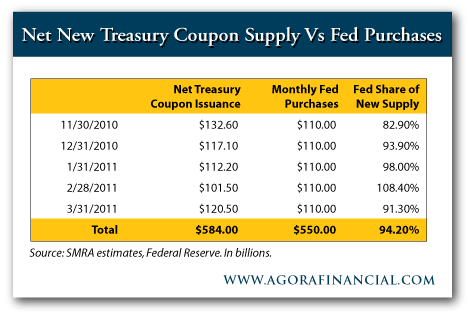
| Why Bernanke’s “Quantitative Easing” Isn’t Fooling Anyone Posted: 15 Nov 2010 08:01 AM PST According to the financial commentary of the moment, Federal Reserve Chairman, Ben Bernanke is either a genius or a moron. But your California editor would offer a slightly different perspective; he believes Bernanke to be a genius…engaged in moronic behavior. He is "too clever by half," as the old saying goes. The erudite Federal Reserve Chairman is an accomplished academic in possession of a 99th percentile vocabulary. He knows his way around a thesaurus as well as he knows his way around the esteemed monetary theories of past and present. But therein lies the problem. When a refined vernacular cavorts with monetarist musings they produce a bastard child like "quantitative easing." Chairman Bernanke portrays quantitative easing (QE) as, "just monetary policy. Monetary policy [always] involves the swapping of assets – essentially, the acquisition of Treasuries and swapping those for other kinds of assets." Not so, counters James Grant, editor of Grant's Interest Rate Observer. "The truth is that QE isn't about asset swapping but, rather, dollar conjuring." Your editor sides with Grant on this one. Quantitative easing is "just monetary policy" like pornography is "just cinema." QE and pornography both utilize the conventions of mainstream activities in order to conduct and legitimize questionable activities. Chairman Bernanke considers quantitative easing to be an oeuvre d'art – a monetary masterpiece. But to most of the outside world, QE looks like nothing more than monetary porn. The Chinese ratings agency, Dagong, scorned QE as "a practice resembling drinking poison to quench thirst… In essence the depreciation of the US dollar adopted by the US government indicates that its solvency is on the brink of collapse." Undeterred, Chairman Bernanke clings to his theories and his highfalutin euphemisms. Even though quantitative easing, at core, is nothing more than "dollar conjuring," Chairman Bernanke continuously portrays it as a highly sophisticated monetary tactic. To hear him tell the story, QE is the latest and greatest monetary invention – it is good for what ails you and producers no side effects…or at least none that we know about. From Bernanke's perspective, QE bestows all the sweetness and none of the calories of a legitimate monetary policy. And he is so sure of himself that he conducts his money-printing operation shamelessly – out in the open where everyone can see. Never has a genius behaved so moronically. In bygone eras, James Grant observes, the issuers of sovereign currency would "debase surreptitiously, as if [they] were ashamed of [themselves]…Bernanke, in contrast, is out in the open, as transparent as Facebook." Bernanke's proposed QE2 campaign is not merely transparent; it is audacious. The Fed plans to purchase almost 100% of the total net Treasury issuance. "For the next five months," Stone & McCarthy Research Associates observes, "Fed buying of $550 billion would be the equivalent of 94.2% of net Treasury issuance of $584 billion."
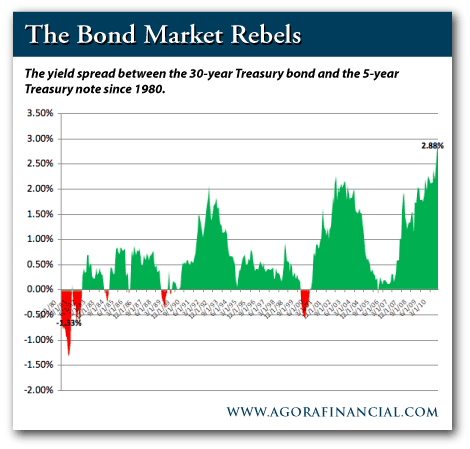
By conducting such transparent and audacious money-printing, Bernanke seems to be daring America's creditors to blink. For the moment, most creditors are simply rubbing their eyes in disbelief. "Hearing Bernanke, but not, at first, believing him," writes Grant, "America's creditors have just now come around to accepting the astonishing fact that the steward of the currency in which they denominate a substantial portion of their national wealth is bent on inflation (only a little, he says)." But America's creditors are not accepting this astonishing fact with resignation; rather, with rebellion. They are lightening up on dollar-denominated assets and they are tiptoeing away from the long end of the US Treasury market. Apparently, many investors are beginning to fear that the unknown side effects of Bernanke's QE2 will be fully known by the time a 30-year Treasury bond matures. Long-dated bond yields have been rising rather sharply during the last three months, even though short-dated bond yields have not. As a result, the yield curve is "steepening" and the yield spread between the 30-year Treasury bond and the 5-year Treasury note has reached the highest level in more than three decades.
To be sure, a variety of trends and influences could be contributing to this phenomenon. The QE process itself is helping to suppress yields at the short end of the yield curve, thereby skewing the connection between short-term and long-term yields. Nevertheless, the recent, sharp rise in long-term Treasury yields seems to be sending a very clear message: Inflation is coming. The soaring commodity markets and the slumping dollar corroborate this message. "It isn't just the paper dollar from which the gold buyers are fleeing," Grant asserts. "[They] are in flight from modern monetary doctrine, too… By exchanging currencies for Krugerrands or shares in a gold exchange-traded fund, individuals are implementing their own personal gold standards… "In our view," Grant concludes, "the rush to gold is a flight from bad ideas. The gold price is soaring – i.e., the value of the dollar is plunging – because central bankers have lost their bearings." Net-net, Bernanke's marvelous monetary sweetener may turn out to be as marvelous as cyclamates. To repeat a phrase that bears repeating, "If something sounds too good to be true, it usually is." Eric Fry Why Bernanke's "Quantitative Easing" Isn't Fooling Anyone originally appeared in the Daily Reckoning. The Daily Reckoning, offers a uniquely refreshing, perspective on the global economy, investing, gold, stocks and today's markets. Its been called "the most entertaining read of the day."
|
| 23 Financial Minds Join Forces to Publicly Rebuke QE2 Posted: 15 Nov 2010 08:00 AM PST Today, an open letter to Fed Chair Ben Bernanke appeared via the Wall Street Journal questioning the wisdom of the Fed's round two of quantitative easing. It's signed by 23 economists, financial writers, fund managers and others, including, to name just a few… * Richard X. Bove of Rochdale Securities It's a group that would not necessarily agree on wide range of issues, but that's on the same page when it comes to QE2 and the destruction it could potentially unleash on the US economy and wider financial markets. Here's a part of the text, as published in WSJ: "We believe the Federal Reserve's large-scale asset purchase plan (so-called 'quantitative easing') should be reconsidered and discontinued. We do not believe such a plan is necessary or advisable under current circumstances. The planned asset purchases risk currency debasement and inflation, and we do not think they will achieve the Fed's objective of promoting employment… "…We disagree with the view that inflation needs to be pushed higher, and worry that another round of asset purchases, with interest rates still near zero over a year into the recovery, will distort financial markets and greatly complicate future Fed efforts to normalize monetary policy. "The Fed's purchase program has also met broad opposition from other central banks and we share their concerns that quantitative easing by the Fed is neither warranted nor helpful in addressing either U.S. or global economic problems." The signatories are members of a group named, e21: Economic Policies for the 21st Century, so are in some way previously organized. However, they still seem to represent at least part of a rising and mainstream current of criticism directed toward the Fed's ambitious, unpredictable, and most likely ill-fated plan. In the political sense, the outcry came most quickly and loudly from leaders abroad, but the dissent now also appears to be growing increasingly fervent at home. If nothing else, the letter represents more collaborative outrage than we saw with the first round of QE, so, at least in that sense, it's a start… You can read the full text of the open letter, the complete list of signatories, and a Fed spokeswoman's rather boilerplate-sounding response, in the Wall Street Journal's post on an open letter to Ben Bernanke. Best, Rocky Vega, 23 Financial Minds Join Forces to Publicly Rebuke QE2 originally appeared in the Daily Reckoning. The Daily Reckoning, offers a uniquely refreshing, perspective on the global economy, investing, gold, stocks and today's markets. Its been called "the most entertaining read of the day."
|
| Gold: A Fate Worse Than the Cover of Time Magazine Posted: 15 Nov 2010 07:59 AM PST Volatility Trader submits: Anyone familiar with contrarian investing knows about the Time Magazine cover-story curse: If a company (or its CEO) or other investment appears on the cover of Time, it means that every last retail target buyer has been tapped, and so it's "time" for the smart money to sell. A newer twist on this kind of sociological indicator is the idea of "Jumping the Shark". The premise is that when a product (be it a TV show, story stock, or any other saleable asset) has run its course, the producers (or suppliers, in the case of stock and many other financial assets) resort to, or are taken in by, embarassingly stupid new "plots". Fonzie has to ski-jump over a shark, wearing his leather jacket and T-shirt over his swim trunks--only this time, The Fonz is gold. Complete Story »
|
| TRUE COST OF BUSH'S WARS – $4 TRILLION TO $6 TRILLION Posted: 15 Nov 2010 07:40 AM PST This was written a week before the mid-term elections. As the biggest dumbass on the planet – George W. Bush hawks his book on Fox News and they kiss his bony ass, the US citizens live with the consequences of his actions. He single handedly destroyed the finances of the United States and he is so stupid that he doesn't realize it or care. He blurts out bullshit about no terrorist attacks after 9/11. That is the same bullshit Obama uses about jobs saved by his stimulus. Bush needs to go crawl back under his rock in Crawford, Texas. You won't see this story on Fox Neo-Con Central. We've brought democracy to the Middle East. All hail Bush.
How the Wars Are Sinking the EconomyOctober 27, 2010 by Linda Bilmes Daily Beast As Election Day draws near, it's pretty clear: Voters are worried about jobs, the budget deficit and the rising national debt. But behind those issues—behind the ads and candidates' speeches, behind the rhetoric about "out-of-control" government spending—there lurks a hidden, less-talked-about issue: the cost of the ongoing wars. Already, we've spent more than $1 trillion in Iraq, not counting the $700 billion consumed each year by the Pentagon budget. And spending in Iraq and Afghanistan now comes to more than $3 billion weekly, making the wars a major reason for record-level budget deficits. Two years ago, Joseph Stiglitz and I published The Three Trillion Dollar War in which we estimated that the budgetary and economic costs of the war would reach $3 trillion. Taking new numbers into account, however, we now believe that our initial estimate was far too conservative—the cost of the wars will reach between $4 trillion and $6 trillion. For example, we recently analyzed the medical and disability claim patterns for almost a million troops who have returned from the wars, and, based on this record, we've revised our estimate upward to between $600 billion and $900 billion—a broad specter, yes, but certainly also a significant upward tick from our earlier projection of $400 billion to $700 billion, based on historical patterns. Similarly, our estimates for the economic and social costs associated with returning veterans can be expected to rise by at least a third—the staggering toll of repeated deployments over the past decade. The Bush administration not only vastly underestimated the cost of the wars but cut taxes twice—in 2001 and 2003—just as we were ramping up the war effort. This was the first time in U.S. history that a government cut taxes while also appropriating huge new sums to fight a war. And the consequence is that the wars added substantially to the federal debt. Between 2003 and 2008—before the financial crisis unfolded—the debt rose from $6.4 trillion to $10 trillion, and, at least one-quarter of this increase was directly attributable to the wars, first in Iraq and then in Afghanistan. For example, in March 2003—the month of the Iraq invasion—oil prices hovered just under $25 per barrel. Immediately afterward, however, prices started to soar, reaching $140 a barrel five years later. Add to that: for Americans, the war-spending left us with much less wiggle room domestically to deal with the financial crisis. In the run-up to the election, people have expressed concerns about the debt and the deficit, as well as the huge ongoing burden of funding the conflict, and the constraints they exert on the size of the economic stimulus package. Here is what we know: the legacy of the wars will continue to drag the economy down. The long-term costs of the conflicts in Iraq and Afghanistan will be higher than previous wars because of higher survival rates, greater incidence of PTSD and other mental-health disorders. Additionally, a higher percentage of veterans are claiming disability benefits, and far more veterans have served multiple tours of duty. Taken in context, history shows that the cost of caring for war veterans typically peaks 40 years after a conflict ends. The peak year for paying out disability claims to World War I veterans didn't occur until 1969; the peak for paying out World War II benefits was in the 1980s, and we have not yet reached the peak cost for Vietnam veterans. Even the Gulf War of 1991, which lasted just six weeks, now costs more than $4 billion a year in veterans' disability compensation. Hundreds of thousands of veterans have already been treated in VA medical facilities; and many will require care for the rest of their lives. Half-a-million people plus have filed for disability compensation. And the total lifetime cost of providing for these veterans is likely to tally between $600 billion and $900 billion, as mentioned above. But of course, even these huge numbers don't include the economic costs that are borne by veterans and their families, in terms of diminished quality of life, lost employment and long-term suffering. We will also to need to find billions of dollars to replace vehicles, weapons and other equipment that will never be repatriated. It is this spending (and the accompanying debt) that will one day need to be paid, that is truly haunting the November elections. We just don't care to connect the dots. Iraq and Afghanistan cast a long shadow. We will be living with their legacy for decades. Linda J. Bilmes is Daniel Patrick Moynihan Senior Lecturer in Public Policy at the Harvard Kennedy School. She is co-author with Joseph Stiglitz of the New York Times bestseller The Three Trillion Dollar War: The True Cost of the Iraq Conflict.
|
| For week ending 12 November 2010 Posted: 15 Nov 2010 07:37 AM PST [CENTER]Technically Precious with Merv [/CENTER] [CENTER] [/CENTER] Ouch! That was some decline on Friday, the worst single day decline since early Feb. The Feb decline ended the next day and gold took off for a $350 advance until this past week. Will it do the same again? [CENTER]GOLD [/CENTER] LONG TERM A day or two does not change the long term prognosis unless we have already had much negative action prior to the latest. So, the long term point and figure chart remains as it was last week while the indicators have not changed their message, although they might have firmed up a bit. Gold price remains comfortably above its positive sloping moving average line with no indication that it will plunge below the line very soon. The volume indicator is also in new high ground above its positive long term trigger line. It’s the momentum indicator that is changing, as one would expect. The momentum indicators are usually the first indicators to prov...
|
| Simple Asset Protection Secrets from Switzerland Posted: 15 Nov 2010 07:32 AM PST By Dr. Steve Sjuggerud Monday, November 15, 2010 As you read this, I'm in Zurich, Switzerland… My publisher is hosting a seminar there for our lifetime subscribers. We're covering the best ideas in asset protection today. From what I've seen, most Americans these days haven't even thought about protecting their assets. Until now, your assets have been safe in America. But it wasn't long ago that they were unsafe here… In the 1930s, the U.S. government confiscated everyone's gold. I'm not kidding! Today, your assets might not be as safe as you think… Our government is deeper in debt than ever. And the U.S. dollar is bound to lose value as our government is left paying its debts through the printing press. In this situation, a little asset protection (some of it outside the jurisdiction of the U.S. government) could go a long way… That's why we're in Switzerland. In short, Switzerland is the traditional home of asset protection. (For example, since the early 1970s, ...
|
| Kinross Strikes Gold With 3Q Results Posted: 15 Nov 2010 07:23 AM PST Zacks.com submits:
The results of the company were positively impacted due to the acquisition of the West African company, Red Back Mining Inc. (RBIFF.PK), in the third quarter of 2010. Due to this acquisition, Red Backs’ Chirano Gold Project in Ghana and the Tasiast Gold Mine in Mauritania were added to Kinross’ portfolio. Complete Story »
|
| G20 and The U.S. Dollar Policy - A Presentation Posted: 15 Nov 2010 07:06 AM PST
By Dian L. Chu, Economic Forecasts & Opinions Related Reading:
|
| Posted: 15 Nov 2010 06:30 AM PST If you think gold is in a bubble, read this from http://www.georgewashington2.blogspot.com/. Sunday, November 14, 2010 When everyone from Jim Cramer to Mr. T is hawking gold – and when the price has risen to all-time highs – it sure feels like a bubble. On the other hand, the super rich – who presumably know a thing or two about investing – are buying gold by the ton. Deutsche Bank's head commodities researcher Michael Lewis said last week that gold and agriculture are the safest long-term investments. Lewis wrote in September:
Lewis lists as factors driving gold higher:
Bloomberg notes:
Barron's points out:
University of Michigan economics professor Mark J. Perry noted in July that inflation-adjusted gold prices are lower now than in 1980: 
Frank Holmes, the CEO of US Global Investors said recently:
WJB Capital Group's John Roque pointed out in May that the current gold bubble is still much smaller than the bubble in the 1970s when priced against the S&P. MSN's Money Central noted last month:
In May, Arends wrote in the Wall Street Journal:
Tyler Durden notes:
(Durden points out that when derivatives are factored in, the percentages are even more dramatic). Aden Forecast argues in its November 12th forecast:
Many people think that the Federal Reserve's QE2 will boost gold prices. And since QE2 will continue for many months, that augers well for gold. With all of the money printing worldwide, it is not surprising that gold has continued to rally against all currencies. For extensive background information regarding gold, see this. Note: I am not an investment advisor and this should not be taken as investment advice. Even if the gold bull market has further to run, gold prices might correct sharply downward in the short-run, and you shouldn't buy gold unless you're willing to lose your investment. In addition, if the government decides to confiscate gold like it did in the 1930s – or to heavily tax gold – this could considerably change the cost-benefit analysis. Remember also that if the Fed raises interest rates, gold could fall rapidly.
|


 European Union officials are trying to push Ireland into taking bailout money of more than $680 billion, but the country is resisting and fears are heating up other EU nations could also find themselves in the same boat. Portugal's finance minister said that the country might have to leave the euro if the government cannot pass austerity measures to meet requirements. The SA London reported that Portugal would need bailout money, but later in the day the country's finance minister said there was "no imminent" plea for aid…




![[ROI_100524]](http://sg.wsj.net/public/resources/images/OB-IP413_ROI_10_NS_20100524192106.gif)
| You are subscribed to email updates from Save Your ASSets First To stop receiving these emails, you may unsubscribe now. | Email delivery powered by Google |
| Google Inc., 20 West Kinzie, Chicago IL USA 60610 | |

No comments:
Post a Comment