


Gold World News Flash |

- GoldSeek.com Radio Gold Nugget: Dr. Stephen Leeb & Chris Waltzek
- Gold Resource Corporation Q3 Production Results and Conference Call
- Gold Standard Manifesto
- China’s Dagong Lowers U.S. Credit Rating on Fed Monetary Policy
- Gold Seeker Closing Report: Silver Soars Over 4% Higher and Gold Climbs to a New All-Time High
- The Gold Mining Stocks are Still Cheap
- Using Calendar Spreads to Trade Gold
- The Dollar or Toilet Paper… Which is Shrinking Faster?
- Follow-Up To Bear Raid Posting 7:10PM EST
- Gold Takes One More Step Towards Center Stage Of The Monetary System! – Part 1
- Money Creation and Price Inflation Cause Justified Paranoia
- Tuesday Ramblings...
- As QE2 Hangover Wears Off, Will Market Wake Up in A Pool of Its Own Volatility
- Jim Rickards On Silver Margin Changes, Peter Schiff On A New World Gold Standard
- In The News Today
- CME Group Announces Money and Margin Requirement Increases
- Gold Daily and Silver Weekly Charts
- The Gold Price Posted First Half of a Key Reversal, Any Gold Price Close Above $1,425 or Silver Price Above 2933c Sets Off Another Balloon Ride
- Bummed About $1420 Gold
- PBOC Academic Adviser Questions Dollar’s Global Role
- Not just inflation fears boosting gold
- Gold at $7,800/oz, Or S&P 500 at 220? Take Your Pick
- Back door move toward a USD gold standard?
- Gold Nearing Long Term Resistance Line
- Uranium – Our “Trade of the Decade” Heats Up!
- Turn Around Tuesday - CME Style
- Gold Expected to Peak at Around $1500
- Fed Creates Parabolic Move In Gold And Silver, Climax Top?
- Dollar Rally Could Impact Gold
- Thanks for the Silver: An Open Letter to JPMorgan and HSBC
- Latam Fever in Gold Mining
- Jim Rickards - Three’s Company, Silver Margin Change
- End of the Statist Quo
- US Dollar Set To Rally
- Silver May Be Making a Blow-Off Top Today
- Dan Makes My Day
- Debt Bubble Chronicles: Does Bernanke REALLY Think QE Will Boost Home Prices… Or is He Simply Trying to Hide an Even Bigger Problem?
- The Ongoing Uranium Story: Profit Opportunities Continue
- Major Reversal Day On Gold and Silver, Could Be A Climax Top
- How Long And How High For Gold, And How To Play It
- Gold vigilantes are “The Untouchables.” The CME (Chicago Mercantile Exchange) is Al Capone.
- Fed Creates Parabolic Move In Gold And Silver
- China Lowers US Credit Rating
- A Note From Harry Schultz
- HUI/Gold Ratio and HUI/S&P 500 Ratio Charts From Trader Dan
- Hourly Action In Gold From Trader Dan
- When JPM/HSBC Don't Like The Results, The CME Just Changes The Rules: Full Revised Silver Margin Schedule
- Jim's Mailbox
| GoldSeek.com Radio Gold Nugget: Dr. Stephen Leeb & Chris Waltzek Posted: 09 Nov 2010 07:00 PM PST GoldSeek.com Radio Gold Nugget: Dr. Stephen Leeb & Chris Waltzek
|
| Gold Resource Corporation Q3 Production Results and Conference Call Posted: 09 Nov 2010 06:13 PM PST Gold Resource Corporation (GORO) (NYSE Amex: GORO) announced today that it is pleased with its first quarter of commercial production at its El Aguila Project and will host a shareholder conference call November 10, 2010. The Company produced 7,351 ounces of gold Q3 at a cash cost of $249/ounce. Gold Resource Corporation is a low-cost gold producer with operations in the southern state of Oaxaca, Mexico.
|
| Posted: 09 Nov 2010 06:09 PM PST A great quote from William Osler typifies the evolution of our current monetary system. He said: "The philosophies of one age have become the absurdities of the next, and the foolishness of yesterday has become the wisdom of tomorrow."
|
| China’s Dagong Lowers U.S. Credit Rating on Fed Monetary Policy Posted: 09 Nov 2010 04:08 PM PST Nov. 10 (Bloomberg) -- China's Dagong Global Credit Rating Co. reduced its credit rating for the U.S. to A+ from AA, citing a deteriorating intent and ability to repay debt obligations after the Federal Reserve announced more monetary easing. The credit outlook for the U.S. is "negative," as the Fed's plan to buy government debt will erode the value of the dollar and "entirely encroaches" on the interests of creditors
|
| Gold Seeker Closing Report: Silver Soars Over 4% Higher and Gold Climbs to a New All-Time High Posted: 09 Nov 2010 04:00 PM PST Gold chopped its way higher throughout most of world trade and rose to as high as $1424.20 a little after noon EST before it fell back off in the last half hour of trade, but it still ended with a gain of 0.48% at a new all-time high. Silver climbed to as high as $29.34 before it also fell back off a bit in the last half hour of trade, but it still ended with a gain of 4.53% at a new 30-year high. Both metals are falling rather markedly in after hours access trade.
|
| The Gold Mining Stocks are Still Cheap Posted: 09 Nov 2010 03:43 PM PST FGMR - Free Gold Money Report November 9, 2010 – It has been just one month since I stated on King World News that the gold mining stocks had begun a new bull market. The XAU Index of mining stocks closed that day at a new record high of 206.79. It closed yesterday at 220.17, up 6.5% over this period. That is a tremendous gain in such a short period of time. But do not let that spectacular performance keep you from buying and accumulating my recommended mining stocks. They remain good value, as is clear from the following chart that measures the XAU Index in terms of gold. What the above chart is saying is that: 1) The last sell signal in the mining stocks was given in early 1997, which coincides with the huge bubble surrounding Bre-X. Since then, the mining stocks have been closer to the buying area, and not even near the selling area. This means that the best strategy over this period is the one I have been recommending, namely, pursuing the ongoing acc...
|
| Using Calendar Spreads to Trade Gold Posted: 09 Nov 2010 01:37 PM PST Most market participants are aware that precious metals have been on fire rocketing higher only to consolidate briefly, gap higher, and leave slowly reacting traders in the dust. The parabolic moves in gold and silver have many potential ... Read More...
|
| The Dollar or Toilet Paper… Which is Shrinking Faster? Posted: 09 Nov 2010 01:24 PM PST In the middle of last month, before Bernanke's dream of QE2 became a reality, he described that "inflation is running at rates that are too low." By "too low," he meant of course that inflation is too low to keep artificially propping up asset prices, like the major market indices which in his opinion ought to give the US economy a shiny veneer of growth despite little underlying improvement in production. Given this intended outcome, quantitative easing is at best a gimmicky strategy. What makes it far more pernicious though, is the weak premise that inflation is actually too low. When you consider the methods he's relying upon for measuring it, you get the impression he wouldn't note so much as a mild inflation uptick for a hot air balloon lifting off of the ground… but, we'll explain more about measuring inflation below. First, assuming Bernanke will in fact be successful in sparking inflation, how will a rising-prices environment impact the average wage-earner? Gonzalo Lira takes a closer look: "Even in the best of economic times, wages and salaries do not rise in lockstep with an expanding economy. And we are currently not in an expanding economy. It is reasonable to assume that, during a period of steadily rising prices coupled with stagnant economic growth, wages and salaries will not rise for at least six months, if not longer… "Wages are key. If inflation hit consumer prices as well as wages in equal measure, the net effect would be zero—which is more or less what you see in ordinary expansion-driven inflation, the kind prevalent in healthy economies: There are price pressures on commodities, which eventually translate into higher prices at the supermarket—but there are also price pressures on wages, as the economy in toto is expanding, and therefore bidding up scarce labor as it grows. In an expanding economy, prices might be rising—but wages are rising too, so no complaints. "However, in a stagnating or contracting environment—such as what we are experiencing now in the American economy—there are obviously no pressures on wages: If anything, there are downward pressures on wages and salaries. So if commodity prices rise, people—especially the poor, the working poor, and the middle-class, but maybe even the upper-middle class—are really going to take a hit, as more of their after-tax income goes to paying for basic necessities. "Some people might think that the debasing of the dollar via QE2 will mean that the real cost of housing will fall, as rents and fixed mortgages will be undermined by inflation. They might think this is a good thing. But this only makes sense if your earnings are absolute: If you're boss is paying you in gold coins, or silver ingots. But if you live on a dollar income, especially a fixed income—as so many seniors do, let alone the average wage earner—even if your housing costs remain nominally static, rising food, transportation and clothing prices will still take bigger and bigger bites out of that dollar-based income." So what's problematic about measuring inflation? A vivid modern-day example can be seen in this infographic, which shows how even lowly toilet paper is shrinking in size right under our noses, so to speak. According to Gonzalo Lira, this subtle type of inflation, which occurs in stripped-down utility but not reduced prices, is not tracked by the CPI. As long as the same product is sold for the same price — despite markedly reduced customer value — prices are computed as holding level. Domestically, Bernanke and the Fed are likely anticipating that shoppers won't notice when they're paying the same price for less merchandise every time the cashier rings them up. Internationally, the Fed's employing a similar tactic, diminishing the dollar so US exports look less expensive abroad and so the US' massive debt appears a little bit less so. The US isn't the only nation adopting this "currency war" approach to global trade, but — given that the dollar is in many ways leading the major currencies in the devaluation race — let's hope Bernanke doesn't end up taking a few too many cues from toilet paper. You can read more details in Gonzalo Lira's post on how QE2 will have a boiling frog effect on the bottom 80 percent of the US population. Best, Rocky Vega, The Dollar or Toilet Paper… Which is Shrinking Faster? originally appeared in the Daily Reckoning. The Daily Reckoning, offers a uniquely refreshing, perspective on the global economy, investing, gold, stocks and today's markets. Its been called "the most entertaining read of the day."
|
| Follow-Up To Bear Raid Posting 7:10PM EST Posted: 09 Nov 2010 01:10 PM PST The following is automatically syndicated from Grandich's blog. You can view the original post here. Stay up to date on his model portfolio! November 09, 2010 04:08 PM At 1:45PM EST (you can always see what time a post went up if you highlight the post itself) today, I made this post. I saw the sell-off leading into the close and I suspected there would be a bear raid in the Access Market. Hello!!! I’m actually glad it occurred as you would know that I expressed in my two interviews this week that I was starting to become concern about a parabolic rise in gold and especially silver and if it would continue, I would actually start to look for a selling point. Such a concern has now been eased. The raising of margin has been IMHO a ploy to protect members who are usually short. I don’t recall ever (but I stand willing to be corrected) the Comex ever lowering margin requirements lower than normal in the days when gold kept heading lower. This “mother” of all ...
|
| Gold Takes One More Step Towards Center Stage Of The Monetary System! – Part 1 Posted: 09 Nov 2010 01:00 PM PST Before the Gold Forecaster came into being, it had become clear that gold was headed back into the monetary system. Why, you may well ask? It was because of the "Washington Agreement". This agreement changed the tone of central banker's approach to gold. This Agreement inspired the start of Gold Forecaster. Since then the newsletter has forecast the very events that are now taking place and has been right on each of gold's moves in price and in re-acceptance over this last decade.
|
| Money Creation and Price Inflation Cause Justified Paranoia Posted: 09 Nov 2010 12:52 PM PST I have to admit that I am getting so jaded by the horrific monetary and fiscal insanities of the Federal Reserve and the Congress that new horrific fiscal and monetary insanities seem to now sort of "bounce off" my numbed senses. I also seem to be more hypersensitive these days, which may or may not be associated with Mogambo Hysterical Syndrome (MHS), a tragic condition where the sufferer of MHS has the terrifying mental stress of carrying foretold knowledge of the certain economic doom of price inflation as a result of the creation of too much money, especially when used to fund the expansion of the welfare-and-government/bread-and-circuses state that the American economy has become. Sufferers of the tragedy of MHS, in case you were wondering, instinctively buy gold, silver, guns, good grub and build some kind of weird Mogambo Last Line Of Retreat (MLLOR) bunker out of, for example, sofa cushions, or perhaps steel-reinforced concrete bristling with surveillance gear and large-calib...
|
| Posted: 09 Nov 2010 12:46 PM PST It felt naked to not post something today, especially since I was a slackard about posting yesterday. I spent most of the trading day doing a lot of portfolio "repositioning" and flow trading/scalping. And Thursday I'm going to NYC for a long weekend so I won't be posting anything probably until Sunday night or Monday. So here's a flimsy brain-dump that I hope is somewhat value-added... I've noticed that there is a lot of "noise" coming from Wall Street, the media and even David Rosenberg about "no double dip" and "a strengthening economy." I'm not really sure what kind of hallucinogens these people are ingesting before they look at the evidence. One strategist who supposedly had called the current recession/depression - which is supposedly no longer a recession - said that he expects an economic bounce based on data that shows bank lending to small businesses is no longer contracting. Of course, it's not expanding but why argue over minor complications like that? After all, his firm High Frequency Economics, has to keep their investors invested or they don't earn fees. The fact of the matter is that the consumer is still largely dead (there is a very small bounce in the retail sales numbers ONLY if you look at the current data compared to the hideously low comparable numbers from a year ago). Given the destitute consumer, can anyone think of a business to which they would lend money, except maybe precious metals dealers? I'm not sure why Rosenberg has changed his mind. I just saw the headline and I wasn't interested in his view. I'm sure there was some pressure from his partners because his bearish tone was scaring off fee-paying clients. The fact of the matter is that the jobs report last Friday was very ugly, once you looked at the actual BLS statistics and read the full press release rather than relying on the headline number plus some CNBC b.s. The worst element of the jobs report was that the labor force, defined as those working plus those actively looking for a job, contracted to a 25 year low. So of course the unemployment rate (those working divided by the defined work force) held below 10%. But what if you added back all of the people who have given up looking? What if you did some kind of "hedonic" adjustment to account for the part-timers who want to full-timers? The real unemployment rate is easily in the high teens and creeping higher every month. How about that factoid that came out yesterday which disclosed that California is borrowing $40 million per day in order to fund unemployment insurance? Talk about a massive transfer of wealth from everyone in the 49 other States to the the state of California. It's horrifying and the wealth transfer effect is one which sucks economic lifeblood from everyone. Another statistic which hit the news blogs today showed that home prices, measured using a much more comprehensive data pool than Case-Schiller or the National Association of Realtors, started falling again in October. This isn't hard to believe as the "reverberations" from the home-buyer tax credit fade, foreclosure inventories rise (FNM/FRE both announced much higher REO inventories and forecast more weakness for the housing market) and interest rates on the longer end of the Treasury curve climb. Maybe these economic bulls want to believe that the lower dollar will stimulate exports and curtail imports, thereby creating some kind of "positive" feedback cycle which will create domestic business expansion. Unfortunately that idea is not supported by the trade deficit trend, which has been climbing again despite a weak economy and tanking dollar. That fact of the matter is that it will take a much lower dollar in order to enable the "J-curve" effect to trigger. Quite frankly I see continued economic and social decay, a lot more downside in housing values and inflation beginning to accelerate. The imported goods upon which our whole country rely will soon climb sharply in price. Ditto for the price of gasoline at the pump. In fact, I would argue that the steepening yield curve (the yield on the 30 yr. Treasury has blown out over 75 basis points in the last couple of months) reflects the market's expectation of accelerating inflation AND the risk of a lot more QE/dollar devaluation. This too is not good for housing. Of course, we can always hope my view is wrong... 
|
| As QE2 Hangover Wears Off, Will Market Wake Up in A Pool of Its Own Volatility Posted: 09 Nov 2010 12:17 PM PST
It was another lackluster day in the market as investors are still trying to regain their bearings from last week's quadruple news high of elections, QE2, the jobs report, and Kat Dennings nude photos being released. With all of the excitement of those events more than priced in to the market, investors have spent the last couple of days trying to figure out why printing a fuckload more money is good, how 17% (+/- "oh shit") unemployment is healthy, and who the fuck cares that Conan O'Brien returned to TV (seriously, the last time Money McBags watched a late night TV talk show was before DVRs, the internet, and shaved bush was in style). With news at a plateau as earnings season winds down, the market should struggle to find direction more than one of Randy Quaid's kids.
That said, macro news today was relatively light and irrelevant like CNBC or the SEC's findings on the flash crash (or the mini flash crashes that keep happening and will continue to happen until someone finally shuts that bastion of evil and market manipulation down known as Waddell and Reed. Shit, Money McBags has no idea why the Pentagon is wasting so much energy trying to figure out who fired a missile off the coast of California when we all know it was just some douchewad trader at Waddell and Reed trying to beat Joshua in a game of Global Thermonuclear War during his lunch break).
Small business optimism rose from "we're totally fucked" to "50% off sale." The National Federation of Independent Business (and it would be too easy to point out the oxymoronic nature of a federation of things that are supposed to be independent) said its small business index for last month rose 2.7 points to 91.7 which was the third consecutive monthly rise as well as the 34th consecutive month below 93. Now Money McBags has no idea what the difference is between 91.7 and 93 (except for 1.3) but when he writes it that way, it makes things seem as ominous as an invitation to participate in a Goldman MBS offering, and almost makes Money McBags feel like the muckraker he has always wanted to be.
Elsewhere wholesale sales were up .4% which was smallest increase since June while wholesale inventories skyrocketed up 1.5%, doubling analyst guesses and signaling companies are ramping up on pre-marked down items. This jump in wholesale inventories will make Q3 GDP look better (though not this good), but realistically, rising wholesale inventories may signal the economy becoming more backed up than a constipated John Edwards (because that guy is completely full of shit) as retailers stocking up for the holiday season may wind up more disappointed than Lisa Marie Presley on her wedding night or any jackass who is selling all of his worldly possessions in anticipation of 12/21/12.
Finally, the (No) Labor Department released data showing that job openings decreased by 163k in September to 2.93MM which means ~6 people are vying for every opening (unless that opening belongs to Brooklyn Decker, and then there are at least 60MM people vying for it). That said, two month old data on job openings is about as useful as a regression model with correlated errors so unless Money McBags finally discovers a hot tub time machine to go back to two months ago when that data may have been 1% useful (and trust that Money McBags has tested many hot tubs to find such a feature), he is going to give this a big fucking yawn. That said, Money McBags hopes the (No) Labor Department can find something more constructive to do with their time like find people some fucking jobs or figure out how this guy got a mouse up his ass (And if Money McBags ever gets caught with anything up his ass other than Kate Bosworth's tongue, he will also say he doesn't know how it got there).
Internationally, the yuan is at its highest level vs. the dollar since 1993 thanks to Benny B. getting his quantitative ease on and testing to see if he can make that which grows on trees worth more than money, thus putting an interesting twist on the old saying. Coming on the heels of this (like a determined podophiliac) is news that Chinese rating firm Dagong Global Credit Rating has downgraded their credit rating of the US debt from AA to A+ claiming the US economy is more virtual than Farmville's. They also said, and to loosely translate because Money McBags' Mandarin is still very bad, US GDP will continue to "eat a bag of dick for the foreseeable future." But it's not like the US relies on China to continue to sell debt to in order keep the economy going, so no big deal. Oh wait, shit.
In the market, Ambac finally filed for bankruptcy in the least surprising news since finding out that a priest may be in to porn as apparently insuring all of the shit that destroyed the largest global economy is a less profitable business than selling copies of Strunk and White at a Tea Party event (or to Money McBags).
As far as stocks go, Priceline was bid the fuck up after putting up its billionth consecutive huge quarter thanks to strength in international bookings, hotel bookings, and car rentals. Revenue was up 37% and EPS was up 57% to $5.33 which easily beat analyst guesses of $4.97 per share and was enough to win them a room at the Columbus, OH airport Hilton Suites. Also up was YHOO as the internet space rallies like it is 1998 when sites like hotornot.com were considered revolutionary and valued at the same levels as small Indonesian countries. YHOO was up on rumors that it is a take out target because apparently Pointcast and Geocities were asking too much.
Finally Dean Foods was down ~18% as a result of higher dairy costs thus figuratively squeezing the teet on which the company feeds and Sara Lee announced they are selling their North American bakery business to Grupo Bimbo from Mexico which in English roughly translates to "Group of Paris Hilton" (and yes that was a fucking horrible pun, but you get for what you pay, and Money McBags puts no value on your dignity).
If you missed it (though why would you have?), Money McBags got his fundamental analysis on yesterday in ways that would make the sell side blush. Even if you don't know the company, Money McBags is sure you will enjoy it. And if not, there is more on small cap stocks today at the award winning When Genius Prevailed.
|
| Jim Rickards On Silver Margin Changes, Peter Schiff On A New World Gold Standard Posted: 09 Nov 2010 11:47 AM PST
A couple of luminaries share their perspectives on recent developments in the precious metal space. First, we have Jim Rickards sharing his thoughts on what today's Comex margin hike means for trading. And second, and just as important, is Peter Schiff, who grades WB president Robert Zoellick's call for a new gold standards, and its implications for the future. Both are as always insightful and enlightening.
And Peter Schiff:
|
| Posted: 09 Nov 2010 11:44 AM PST Thought For This Evening I have never heard so much noise by so many vocal people who have no idea what they are talking about. This phenomena at this time is extremely dangerous. That noise is both inside and outside of our community. QE is not a choice. It is the only tool the Fed has left. Austerity at this time would prove to be more dangerous than QE. The new good guys and gals elected those with the tendency to select austerity as a solution are as dangerous as the other side. This situation has all the earmarks of a short fuse that has been set in motion by mistake, and few realize it. For years I have been telling you that there is NO PRACTICAL SOLUTION to the total of all the mistakes that have been made since Roosevelt, in a depression, started it all.
Thought For The Day The ultimate proof of a bull market is the increase of margin rates. They are a professional tool to cover shorts and dictated by the board of directors of the exchange, which means floor traders.
Jim Sinclair's Commentary Quantitative easing is the monetization of debt. It can take many forms from guaranteeing other obligations to outright purchase of Treasury instruments. The one trillion dollar Euro Rescue Program is without any doubt as big a QE program as Bernanke proposes. When will the fools that call themselves experts learn anything? When will our community truly understand what is happening now? The following is a definition of merit from Wikipedia. Monetizing debt In many countries the government has assigned exclusive power to issue or print its national currency to independently operated central banks. For example, in the USA the independently owned and operated Federal Reserve banks do this.[1] Such governments thereby disavow the overly convenient 'slippery slope' option of paying their bills by printing new currency. They must instead pay with currency already in circulation, or elsefinance deficits by issuing new bonds, and selling them to the public or to their central bank so as to acquire the necessary money. For the bonds to end up in the central bank it must conduct an open market purchase. This action increases the monetary base through the money creation process. This process of financing government spending is called monetizing the debt.[2] Monetizing debt is thus a two step process where the government issues debt to finance its spending and the central bank purchases the debt from the public. The public is left with an increased supply of base money.
Jim Sinclair's Commentary There are times when everything around you is so totally FUBAR that one has to have a change of pace. The world has finally lost whatever remained of its mind. The geniuses on Financial TV have solutions infinitely more dangerous in present time than QE over time.
Jim Sinclair's Commentary What makes anybody think that the solution to Ireland will be any different from the Greek solution? Should Ireland appeal because of the attack of the OTC derivative, credit default swaps, to the trillion dollar euro rescue fund then a single currency will be buying its own debt. That is defined as QE in Euroland
Jim Sinclair`s Commentary The US Treasury must raise money by selling bonds. The Chinese took two shots at the US Treasury market today. That was their first wrong play. That tactic raises, not lowers the need for QE, the Fed buying of Treasury paper. QE to infinity is the only the US Fed policy available now and will be the policy of the entire Western World before this chapter closes. California's unemployment fund has deficit of $10.3 billion California businesses already pay some of the highest unemployment taxes in the country – and the tab is likely to increase. The recession and the Legislature's decision years ago to raise benefits have drained the state unemployment insurance fund, which now has a estimated $10.3 billion deficit. The nonpartisan Legislative Analyst's Office, in a recent report titled "California's Other Budget Deficit," said the state will probably need to raise unemployment taxes on employers as well as reduce benefits to bring the fund back in balance. Raising the tax would require a two-thirds vote in both houses of the Legislature and might be politically impossible. Gov.-elect Jerry Brown has promised not to raise taxes without voter approval. But pressure is growing on Sacramento to fix the system soon – whether it wants to or not. California has borrowed about $8.5 billion from the federal government to keep benefits flowing, and the repayment obligations are coming due.
Jim Sinclair's Commentary What does this mean to a non interest bearing checking account? It might be very interesting for those that are holding funds for USA expenses. I will get back to you. Certainly this is MOPE and meat for maintaining confidence in the financial system. It however will only end up costing the FDIC big time. FDIC Approves Temporary Unlimited Deposit Insurance Coverage for Noninterest-Bearing Transaction Accounts FOR IMMEDIATE RELEASE The Board of Directors of the Federal Deposit Insurance Corporation (FDIC) today approved a final rule to implement section 343 of the Dodd-Frank Wall Street Reform and Consumer Protection Act (Dodd-Frank Act). Section 343 provides temporary unlimited coverage for noninterest-bearing transaction accounts. This separate coverage will become effective on December 31, 2010, and will end on December 31, 2012. The final rule revises the FDIC's deposit insurance regulations to include noninterest-bearing transaction accounts as a new temporary deposit insurance account category. All funds held in such accounts are fully insured, without limit, and this coverage is separate from, and in addition to, the coverage provided to depositors for other accounts at an insured depository institution. Noninterest-bearing accounts, as defined in the Dodd-Frank Act, include only traditional, noninterest-bearing demand deposit (or checking) accounts that allow for an unlimited number of transfers and withdrawals at any time, whether held by a business, individual or other type of depositor. The new temporary provision for unlimited coverage of deposit insurance for noninterest-bearing transaction accounts is similar to the FDIC's Transaction Account Guarantee Program (TAGP) but differs significantly in the definition of "noninterest-bearing transaction account." The TAGP, which expires December 31, 2010, includes low-interest NOW (negotiable order of withdrawal) accounts and Interest on Lawyer Trust Accounts (IOLTAs). The final rule expressly states that NOW and IOLTA accounts are not covered under the Dodd-Frank Act definition of noninterest-bearing transaction accounts and do not qualify for temporary unlimited coverage.
Jim Sinclair's Commentary This is war. NYSE Mid-Day Update China signaled its intention to drain excess cash from its financial system by unexpectedly raising the yield on bills at a central bank auction and announcing new rules to curb hot money inflows. Anecdotally, a ratings agency in China downgraded the U.S. to A+ from AA with a negative outlook because of QE2.
|
| CME Group Announces Money and Margin Requirement Increases Posted: 09 Nov 2010 11:37 AM PST Dear Friends, CME Group today announced a hike in the amount of money or margin needed to control a full-sized (5,000 ounces) silver contract. Margin for silver jumped to $6,500 from $5,000 or 30%. Several things to know about this: First, it is quite common to see this occur in markets that are undergoing sharp upmoves in price. The increasing price range can easily wipe out the entire margin amount in a single day with ease and this is designed to protect the integrity of the clearing houses and the brokerage firms. Customers who lose big cannot oftentimes meet margin calls and end up sticking the brokerage firm with losses. The idea is that the firms protect themselves by having more money at the clearing houses sufficient to cover potential losses. Second – members of the exchange generally tend to be on the short side of a market moving higher and once they get trapped, they begin to squeak, and quite loudly at that. Squeaky wheels get the grease and since the exchange membership brings with it voting rights, they generally get what they want. Thirdly – Small specs whose accounts are generally underfunded to begin with and who chase the markets higher based on the hype end up buying at relatively high levels. Once the margins get raised, these weak hands get forced out since they generally cannot meet margin calls and their exodus precipitates a wave of selling. That engenders more paper losses which then engenders more margin calls and the snowball effect occurs. Fourthly – strong hands on the long side will look to add on during such price retracements when it appears that the bulk of the weak-handed latecomers have been flushed out. Stronger hands on the short side who have been experiencing severe bleeding of their trading accounts will welcome the opportunity to finally cover some of their existing shorts in an attempt to minimize the amount of damage that they have incurred. Getting out with a small loss after sitting through a huge one is a psychological victory for trapped shorts. Fifthly – to believe that the bull market in the metals is now over and that gold in particular has topped, is to also believe that the US Dollar is about to somehow mysteriously repair itself in spite of the conditions that have been contributing to its recent decline. Gold is acting as a currency and will remain one. It is no longer trading as a commodity. Severe stress in the global monetary system assures that it will be well supported. Sixthly – the breakdown in the long bond is signaling that the market is fearful of inflation ahead. Gold and silver are your protection against such conditions. Summary – trading gold and/or silver is a vastly different thing than investing in either or both. Traders can get whacked if they do not respect what leverage can do to them and their trading accounts. You are playing with the big boys now and need to learn to be careful and avoid becoming complacent or overconfident about your existing positions. Failure to do so means immense pain. If you must trade, then use very short term time frames such as 5 or 15 minute charts to move in or out. Investors who buy the metals as a hedge against the Dollar can be much more long term focused and tune out the short term gyrations of the markets. This is what we have been warning about when we said to expect increased volatility. It works both ways going up and going down.
|
| Gold Daily and Silver Weekly Charts Posted: 09 Nov 2010 11:34 AM PST |
| Posted: 09 Nov 2010 11:27 AM PST Gold Price Close Today : 1409.80 Change : 7.00 or 0.5% Silver Price Close Today : 28.902 Change : 1.474 cents or 5.4% Gold Silver Ratio Today : 48.78 Change : -2.366 or -4.6% Silver Gold Ratio Today : 0.02050 Change : 0.000948 or 4.9% Platinum Price Close Today : 1787.80 Change : 20.30 or 1.1% Palladium Price Close Today : 719.10 Change : 34.65 or 5.1% S&P 500 : 1,213.40 Change : -9.85 or -0.8% Dow In GOLD$ : $166.38 Change : $ (1.70) or -1.0% Dow in GOLD oz : 8.048 Change : -0.082 or -1.0% Dow in SILVER oz : 392.59 Change : -2.28 or -0.6% Dow Industrial : 11,346.75 Change : -60.09 or -0.5% US Dollar Index : 77.75 Change : 0.723 or 0.9% The GOLD PRICE and the SILVER PRICE today posted what I have to interpret as a downside reversal. It looked like the first half of a key reversal (rise into new high territory with a lower close) if you take in the entire day's action. I'm inclined to do that as the Comex close becomes less and less a shibboleth with 24 hour computerized trading moving in. Looking at the Comex closes it was a banner day. Silver rose a lung-emptying 147.4c to a new high at 2890.2c and gold struck another new all-time high at $1,409.80, $7.00 higher than yesterday. Yet about Comex closing time (1:30 p.m. Eastern) it began falling, and kept on falling, from a high of $1,424.30 down to $1,409.80 at close to $1,382.70 at 3:45 Eastern. It quickly bounced off that low to about $1,394 now. Silver reached 2933c about 1:00, then fell sharply. By closing it had only fallen to 2890.2c, but afterwards it kept on tumbling to a low of 2643c, and has since traded up to 2694c. As silver and gold dropped, the ratio soared, ending as I write this at 51.73. All that action resembles the first half of a key reversal, but the second half must also be fulfilled, namely, a lower close the following day. That we will have to wait to tomorrow to observe. Repeatedly I have warned that this is a crazy market with dangerous volatility, so this shouldn't surprise any of y'all. I still believe that the top of this long move that began in February 2010 at 1,044.50 will not strike before it reaches $1,600. This correction will not unfold as a major event unless it breaches $1,315. 50 DMA lies at $1,317.50. Last intraday peak was $1,387.10. This may be nothing more than a one or two day affair, and even this move that began at $1,155.90 should move considerably higher before it ends. Silver might drop to support around 2500c, or even to the 20 DMA at 2464c or the 50 DMA at 2255c. It's wild, it's volatile, but it has not finished rising. One of those emotions you must control is the wild fear that grips your heart in a swiftly rising market. Here is the event you planned for, you waited for, you envisioned when everyone else could see only empty space and cigarette butts, and now it's happening! But it's so parabolic, so fierce and monstrous, it leaves even you wondering whether it's a bubble. Recall: bull markets always climb a wall of worry. Remember that you climbed on to ride the 15-20 YEAR primary trend, and we are only 9 years into that. On the upside, any GOLD PRICE close above $1,425 or SILVER PRICE above 2933c sets off another balloon ride. Why do we make rules for ourselves, especially trading rules? So that when the time comes to act, our emotions won't overcome and defeat us. Otherwise -- I promise -- at peaks or at troughs your emotions and indecision will paralyze you. That also explains why we tear the top off any chart we are analyzing, so our desires and fears won't warp our judgment. So today I came in to find the GOLD/SILVER RATIO at 48.3 to 1 (48.3 ounces of silver buy one oz of gold), and my stomach wanted to jump out of my mouth and run down the road. Whoa! I thought, I haven't had time to re-examine that ratio, maybe we ought to move that trigger down to 41:1! We don't want to leave 16% lying on the table! As it turned out, the market took me off the hook, but I'll explain that below. The US DOLLAR today made good its escape from the chains of 77 (remember yesterday late it was trading at 77.032) but first had to dip in the overnight market to 76.70. Thereafter the buck marched straight up all day, bouncing off 77.87. It added 72.3 basis points (0.93%) to 77.75. That's a meaty, respectable rise, and it carries the dollar above the previous high at 77.40, and adds another confirmation to a dollar rally. Dollar also closed above the 20 DMA (77.15) today, another confirmation of an upmove. Dollar's first target is 78.25, then 80. Seems to be aiming higher. STOCKS reached new lows against silver and gold today. Dow in Gold Dollars hit G$166.44 (8.052 oz); Dow in Silver Ounces hit 392.59 [sic]. In raw dollar terms, the Dow today lost 60.09 points to close at 11,346.75. S&P500 lost 9.85 to 1,213.40. I say it again as I have said it before, like Cato demanding the destruction of Carthage, stay away from stocks. Don't own 'em, don't short 'em (unless you have plenty of patience and deep pockets). Argentum et aurum comparenda sunt -- -- Gold and silver must be bought. - Franklin Sanders, The Moneychanger The-MoneyChanger.com © 2010, The Moneychanger. May not be republished in any form, including electronically, without our express permission. To avoid confusion, please remember that the comments above have a very short time horizon. Always invest with the primary trend. Gold's primary trend is up, targeting at least $3,130.00; silver's primary is up targeting 16:1 gold/silver ratio or $195.66; stocks' primary trend is down, targeting Dow under 2,900 and worth only one ounce of gold; US$ or US$-denominated assets, primary trend down; real estate in a bubble, primary trend way down. Whenever I write "Stay out of stocks" readers inevitably ask, "Do you mean precious metals mining stocks, too?" No, I don't. 
|
| Posted: 09 Nov 2010 11:03 AM PST The 5 min. Forecast November 09, 2010 02:16 PM by Addison Wiggin [LIST] [*] Gold tops $1,400… Why Byron King isn’t happy [*] Chinese denounce QE2’s “catastrophic influence”… what they’re doing in response… and how you can profit [*] Requiem for a bond insurer: Ambac files for bankruptcy [*] Plugging last week’s Fed’s statement into a “word cloud” for 545% gains [*] Reader sees a “slow boil” from dollar debasement… We suggest a solution [/LIST] “For as many times as I’ve said ‘Gold is going higher,’” says Outstanding Investments editor Byron King, “even this headline takes me by surprise: [CENTER]‘Gold Futures Extend Push Into Record Territory to Trade Atop $1,422 an Ounce’ [/CENTER] “And the news makes me very sad,” Byron continues. “The rising price of gold represents the decline of the dollar. It repres...
|
| PBOC Academic Adviser Questions Dollar’s Global Role Posted: 09 Nov 2010 10:49 AM PST To a visitor from outer space, it would seem "absurd" that the dollar holds that role, given problems in U.S. financial regulation and the country's economic difficulties, Li said at a forum in Beijing. The same assessment could be made of the nation's ability to keep issuing currency according to its own needs, he said.
|
| Not just inflation fears boosting gold Posted: 09 Nov 2010 10:35 AM PST What's more, gold expressed in euros managed to get above the early-September high. Gold expressed in U.S. dollars had risen substantially since then, and gold bears were pointing at the lack of progress in gold in other major currencies as evidence that the move was vulnerable. That argument has now failed.
|
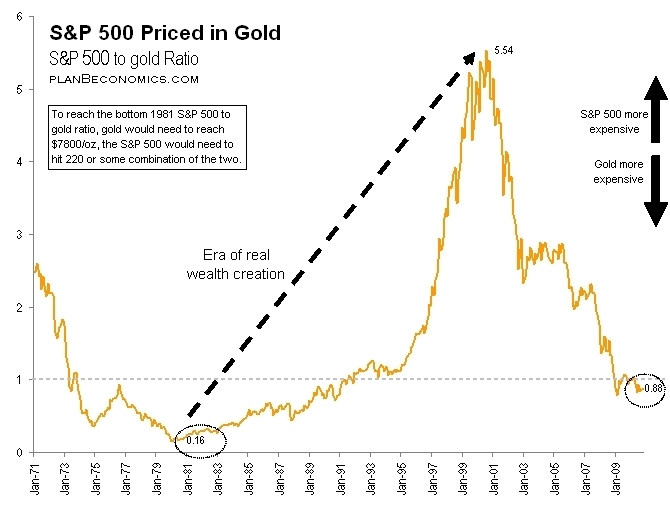
| Gold at $7,800/oz, Or S&P 500 at 220? Take Your Pick Posted: 09 Nov 2010 10:26 AM PST ![[Most Recent Quotes from www.kitco.com]](http://www.kitconet.com/images/quotes_2a.gif) The chart below shows yet another way to look at the value of the stock market and gold in relation to each other. The S&P 500 to gold ratio essentially prices the stock market in terms of gold. (Normally, it is priced in terms of dollars. Alternative reference points could include barrels of oil, acres of land or any other thing of value.) This helps provide a way to evaluate the market adjusting for a loss in purchasing power. A few observations:
 More Here.. 
|
| Back door move toward a USD gold standard? Posted: 09 Nov 2010 10:13 AM PST reaction to:
|
| Gold Nearing Long Term Resistance Line Posted: 09 Nov 2010 10:10 AM PST courtesy of DailyFX.com November 09, 2010 07:37 AM Weekly Bars Prepared by Jamie Saettele The freight train that is gold continues to chug along. 1400 proved no barrier and the metal is now closing in on its long term resistance line (connects 1999 and 2008 highs). The line is at 1483 this week, which is the next level of potential resistance....
|
| Uranium – Our “Trade of the Decade” Heats Up! Posted: 09 Nov 2010 10:00 AM PST At the start of the year, your California editor dubbed uranium the "Trade of the Decade." Uranium may or may not be the Trade of the Decade, but it has been a pretty decent trade of the year. So far in 2010, the uranium price has soared 35% – triple the return of the S&P 500 Index. The phrase, "Better lucky than good," comes to mind…and your California editor never hesitates to give Lady Luck her due. But sometimes, good fortune germinates and blossoms from the seeds of timely analysis and insight. Your financial market observers here at The Daily Reckoning did not simply toss their Trade of the Decade into the hat and walk away; they have continued to detail the bullish case for uranium – and for selected uranium mining companies – month after month. Early in 2010, for example, Chris Mayer, the mind behind both Capital & Crisis and Mayer's Special Situations, penned no less than five Daily Reckoning columns advocating investments in uranium. The last of these columns, "Cameco Corp. is a 'Buy'", extolled the virtues of North America's largest uranium miner. The stock has soared to 53% since then. Taking the baton from Chris in mid-summer, Byron King, editor of Outstanding Investments, sang uranium's praises in two additional Daily Reckoning columns, while also suggesting specific ways to play the trend. All three of the stocks he recommended in his October 25 column, "More Nukes!", have jumped spritely during the last two weeks.
After such impressive gains for stocks like Cameco, it is reasonable to ask if the uranium story is spent…or if it is just beginning to heat up. Your California editor posed that exact question yesterday to both Chris Mayer and Byron King. And both of these accomplished investors replied that the uranium bull market is far from over. Therefore, given the still-bullish outlooks of Messrs. Mayer and King – and the fact that uranium remains your California editor's Trade of the Decade – we will reprise a few key aspects of the bullish case for this unique energy source, as presented in the previous editions of The Daily Reckoning… From "Uranium – A Place to Hide" by Chris Mayer: Robert Mitchell, a general partner at Portal Capital, gives us the 21st-century version of some timeless investing advice. "In the world of commodities, demand is rarely the compelling reason to get long," Mitchell begins. "Instead, you want to own a commodity where supply is incapable of responding to even a small bump in bids." In other words, buy the commodities where it is most difficult to produce more. Though hardly a new insight, it's one that investors sometimes forget. One commodity that aces this simple test is uranium. As Mitchell sums up: "Uranium is well below cost of production, with a superb demand curve." We've made the demand case before, too, and we won't rehash it here. Suffice it to say that a slate of new nuclear plants means a robust demand for uranium for years to come. There are few commodities positioned as well for the next several years. From "Trade of the Decade: Sell Everything, Part II: by Eric Fry: Buy uranium. This unique energy source is a "backdoor play" on the growth of Emerging Markets. There are 436 nuclear reactors in 30 countries around the world. But here's the important thing; there are over 200 new plants in some stage of planning, engineering or construction. And most of these new plants will open in a Developing World nation. But there's not even enough uranium coming from the world's mines right now to supply the current power plants across the world, let alone a couple hundred more. Thus, the uranium story is really quite simple. It is a supply and demand story. There is a lot of demand and not much supply. Any questions so far? Mined supply of uranium satisfies only about 55% of total demand. The rest of the supply comes from somewhere else. These secondary sources of uranium come primarily from old nuclear warheads. But no one really knows how this enormous supply gap will resolve itself in the future. This is what we do know: when you get a supply deficit, prices rise. And I think that will be the case with uranium… One way to participate in a long-term rise in the uranium price would be to take a position in the Market Vectors Nuclear Energy ETF (NYSE:NLR). Most of the holdings of NLR are on foreign exchanges. So it's a great way to play nuclear energy on the New York Stock Exchange, yet obtain exposure to the international nuclear market without the hassle of foreign trading. This ETF is one of Byron King's recommendations. So if this trade works, I'll be back in 10 years to accept my high-fives; if it doesn't work, talk to Byron King about it. From Uranium and Specialty Metals: A Few of My Favorite Things, Part II by Chris Mayer: One of the best investments you can make right now is to pick up relatively secure, low-cost uranium – the feedstock for nuclear reactors… There is a surge in demand coming in the next decade from the hundred or so new reactors expected to come online. Yet the industry is about 400 million pounds short of meeting that demand, as shown in the chart below.
The market has been in deficit for years, as it burns off Cold War stockpiles, which are finite and dwindling. Another way to look at it: Uranium demand is on its way to hitting 226 million pounds per year. Yet last year, the top dogs – which make up 90% of the market – produced only about 110 million pounds of uranium. So essentially, the industry needs to produce almost four times that to meet the estimated new demand through 2018. On an annual basis, the industry will need to about double in size. It gets even more interesting… Most of the best mines are already in production. As with everything else in the resource world these days, the low-hanging fruit is all gone. Future grades will be lower, meaning we'll have to mine a lot more ore to get a given amount of uranium. Furthermore, the new mines are in more geologically and politically challenging locales. From "Uranium is Heating Up" by Byron King: Uranium prices appear to be bottoming, as China buys major supplies from Cameco (NYSE:CCJ). On June 24, China agreed to buy more than 10,000 tons of uranium oxide – yellowcake – over 10 years from Cameco. According to Thomas Neff, a physicist and uranium industry analyst at the Massachusetts Institute of Technology, China is buying unprecedented amounts of uranium. Based on public information, China may purchase about 5,000 metric tonnes of yellowcake this year. That's more than twice as much as China consumes. Clearly, China is building up stockpiles for its long list of new reactors. According to the China Nuclear Energy Association, China plans to build at least 60 new reactors by 2020. The average 1,000-megawatt reactor costs about $3 billion. Loading a new reactor requires about 400 tonnes of uranium to start. Take 60 reactors, times 400 tonnes each. That's 24,000 tonnes of uranium (over 52 million pounds) – about all of the world's current output for one year. New nuclear plants represent a game-changing aspect for future uranium demand and pricing…. Now we're going to see an explosion (no pun intended) of uranium demand from China, on top of the existing user base (plus other new demand from India and numerous other locales in the world)… Thus, don't be surprised to see uranium in shortage by the second half of this decade. Looking ahead, there's just not enough new production in the planning stages. The world needs new mines, but startup costs are much more expensive than 10 or 20 years ago. Meanwhile, much of the world's uranium comes from mines that have been in operation for a long time. That, and decommissioned nuclear warheads from the Cold War days. But this latter source is nearing exhaustion. Bottom line in all of this is that we're right at the bottom of the curve for uranium pricing. Going forward, we're watching as the new demand unfolds, to make uranium investments all that much more valuable. The uranium story isn't over yet. Stay tuned! Eric J. Fry Uranium – Our "Trade of the Decade" Heats Up! originally appeared in the Daily Reckoning. The Daily Reckoning, offers a uniquely refreshing, perspective on the global economy, investing, gold, stocks and today's markets. Its been called "the most entertaining read of the day."
|
| Turn Around Tuesday - CME Style Posted: 09 Nov 2010 09:51 AM PST Now that's a sell-down! On "turn-around Tuesday." On COT cutoff day. Much of it in the electronic after-market. On big volume. An "old fashioned" bone-crushing, sell-stop-triggering waterfall plunge knocking flat-footed hot-money specs and quant-running uber-fast computer-trading commodities locals for a mind-bending loop…
|
| Gold Expected to Peak at Around $1500 Posted: 09 Nov 2010 09:46 AM PST Regular readers of my articles on Gold over the past few years know that I have a theory on this Gold Bull market. In summary, it’s that we are in a 13 Fibonacci year uptrend that started in 2001, and now we are in the final 4 years of that uptrend. It is in this last 5 year window that I theorized started in August of 2009 that investors really get involved. As the crowd comes in, prices push higher and higher, and then more and more investors come in and so forth.
|
| Fed Creates Parabolic Move In Gold And Silver, Climax Top? Posted: 09 Nov 2010 09:37 AM PST After trading through both bull and bear markets and witnessing hysterias and panics I have learned that whatever method you use to buy stocks, you must have a discipline to sell. When I buy I look for support levels and oversold conditions so that a reversal could bring about a major gain and the downside risk is calculated. As I wrote in my buy signal in gold in late July, the conditions were ideal for a major move to the upside. Now the conditions are reaching the extreme opposite, it is overbought and surpassing measured moves and upper resistance lines which mark prior turning points.
|
| Dollar Rally Could Impact Gold Posted: 09 Nov 2010 09:35 AM PST We outlined our concerns about a possible dollar countertrend rally in Dollar Rally Still Quite Possible. If the dollar can rally for a time, it could impact the price of gold in a negative manner. Read More...
|
| Thanks for the Silver: An Open Letter to JPMorgan and HSBC Posted: 09 Nov 2010 09:27 AM PST Ted Butler, famous silver analyst and the guy who kept up the pressure about the corruption in the silver futures market for the last 15 years, is in the InvestmentRarities.com newsletter recently talking about silver, and notes dryly that ... Read More...
|
| Posted: 09 Nov 2010 09:26 AM PST Latin America holds big promise for Gold Mining investors...
|
| Jim Rickards - Three’s Company, Silver Margin Change Posted: 09 Nov 2010 09:25 AM PST  With the reaction in the metals today, Jim Rickards of Omnis made note of today's margin change in silver with a new exclusive piece for the King World News blog. Interestingly, Rickards had just discussed in his recent KWN interview the extent to which an exchange will alter the rules to protect its shorts. Well, the first shot has been fired. With the reaction in the metals today, Jim Rickards of Omnis made note of today's margin change in silver with a new exclusive piece for the King World News blog. Interestingly, Rickards had just discussed in his recent KWN interview the extent to which an exchange will alter the rules to protect its shorts. Well, the first shot has been fired.
This posting includes an audio/video/photo media file: Download Now |
| Posted: 09 Nov 2010 09:17 AM PST This can't go on. And so it won't, at last... HERE AT CASEY RESEARCH, we have been rather negative about the economy for many moons, writes David Galland, managing director of Casey Research. To be otherwise in the face of the decades-long trend toward ever more government – along with its increasingly destructive and expensive meddling in the free markets – would have been foolish. And, so far, we have been right. However, I for one am beginning to see some light at the end of the tunnel. It won't happen overnight, and maybe not in the next five to ten years, but it increasingly appears to me that the government's disastrous "problem solving" that has brought us to this place is approaching a limit. Case in point, governments the world over are now engaged in an insane race to the bottom for their currencies – which will only gain speed if the Fed goes ahead with a new round of quantitative easing. Should the Fed persist with this latest madness, countries all over the globe are likely to step up their own interventions – but that may very well lead to the fiat system breaking down completely, to be replaced by something more tangible. Likewise, given the increasingly dire need to spur economic growth, we could soon see an end to the growth in bureaucracy and the fire hose of taxes and regulations that those bureaucrats have been spraying over the global economy for decades. Put another way, having squandered so much of human progress through counterproductive policies, any leader that wants to retain power – and they all want to retain power – is soon going to be forced to return to policies that have been proven to allow businesses to blossom. This sea change won't happen all at once – and probably not without the global economy first going through a dark and troublesome period. But I have to believe that we'll soon see a widespread recognition that there are problems to be solved, and opportunities to be captured, by breaking from the herd. Thus, while one state tries to raise taxes to "solve" its budget problems, another will see the opportunity for growth to be had by lowering taxes. While one government passes more regulation to pander to a favored group, another will repeal legislation to lighten the dead hand of government in order to favor all. In reasonably quick order, the governments that reduce, rather than increase, their burden on their business communities will see their economies begin to prosper while others stagnate – just as they always have. The United States in its youth provides the paradigm of this principle, but Hong Kong, Singapore, Dubai, and a handful of other, less pure examples prove the point as well. In support of this general theme, subscriber D.W. recently sent along an interesting piece on boom times in a Swiss canton that is picking off the hedge fund managers being chased out of the UK by the 50% tax now being levied on earnings of over £150,000 a year. And I quote... "Switzerland's tempting tax regimes attract UK firmsWhy am I so confident that following another round or two of desperate, last-gasp efforts to maintain the statist quo, we'll see a shift to a global competition based on free-market policies and hard money? Simply because when there is only one path left, the choice of where to go next becomes obvious. Or as one anonymous pundit so well put it... "The world will soon wake up to the reality that everyone is broke and can collect nothing from the bankrupt, who are owed unlimited amounts by the insolvent, who are attempting to make late payments on a bank holiday in the wrong country, with an unacceptable currency, against defaulted collateral, of which nobody is sure who holds title."The very real problems now confronting the world – most of which were created by politically motivated politicos trying to solve real and manufactured problems for favored constituents – have now reached the point where they can only be solved by lowering the burden of government on entrepreneurs and letting the free market do what it does best. The countries that are first to jump on this bandwagon, or that are most vigorous in shedding their layers of obstructionist regulations and taxation, are going to be those that win the day. Conversely, any country that stubbornly tries to hold on to the statist quo is headed for even more serious troubles as its productive elements ship off to more favorable turf. Investment angle? Watch the news for signals indicating that a particular government is turning toward freer markets, smaller governments, and lower taxes – then pile in. Getting in early on such a turnaround could be hugely profitable, just as leaving money tied up in the markets overburdened by stubborn statists is a sure ticket to a big loss. Buying Gold today...?
|
| Posted: 09 Nov 2010 09:08 AM PST Gold and especially silver have had a great run since August as the US Dollar gets talked down more – especially by its own regulators in the form of the Federal Reserve. Obviously nothing goes straight up and the precious metals will take a breather in this final leg of the multiyear bull market. ...
|
| Silver May Be Making a Blow-Off Top Today Posted: 09 Nov 2010 09:07 AM PST The silver ETF normally trades 14 million shares per day (3-month average). Today as of 3:00 pm ET, it has traded 114 million shares or 691% above its average, which is very, very rare. We have been concerned about a rally in the dollar ... Read More...
|
| Posted: 09 Nov 2010 08:51 AM PST The following is automatically syndicated from Grandich's blog. You can view the original post here. Stay up to date on his model portfolio! November 09, 2010 01:07 PM Dear Peter, Please listen! You may have no idea of how many people like me are “out there”, listening to you. We are WAY to busy running our own businesses to do our own “due diligence” on gold stocks, etc. But being able to access your thoughts on a regular basis gives us the ammo that we need to do our own investing, rather than listen to some BS given to us by your run-of-the-mill broker, who only wants commissions. So THANK YOU for your 1:45pm comment about the possible bear raid, and the view that “this too shall pass” and we’ll be nicely higher by December. Those posts have a calming affect. Best, Dan M. Grand Rapids, MI [url]http://www.grandich.com/[/url] grandich.com...
|
| Posted: 09 Nov 2010 08:46 AM PST
Sometimes it’s worth putting things in context.
The world, particularly the US, has been in a bond bull market for roughly 30 years. During that time bond prices (black line) rose almost continuously, while interest rates (blue line) dropped.
So here we are, interest rates are the lowest they’ve been in 30 years, and Ben Bernanke wants to make them fall even lower. His public reasoning is he wants to maintain the housing market and spur investment in business.
But does it?
Interest rates have been at 0% for nearly two years. Despite this as well as a massive home-buyers tax credit, housing prices have, at best, stabilized a bit… but any claim that low interest rates have stimulated a housing recovery is flat out bogus.
As for low interest rates spurring investment in business, this claim is also nonsense. I don’t remember seeing any headlines about companies increasing their capital expenditures or hiring employees? Instead big business is putting its excess cash to work with buyback programs.
§ Time Warner Cable plans $4 billion stock buyback
§ CBS Broadcasts Solid 3Q Results, Announces Stock Buyback Program
§ Entergy 2011 EPS Target In Line With Views, Ups Share Buyback
§ Visa Says Quarterly Profit Rises, Sets $1 Billion Buyback Plan
§ Rent-A-Center Boosts Stock Buyback Plan 33% To $800M
Let’s be blunt here. Corporations know that the recovery is not real. Revenues at S&P 500 companies still remain 11% below their Spring 2008 levels. That’s why companies are not bothering to hire or expand their operations (cap ex). Instead, they’re buying stock in their companies.
After all, companies only issue stock buybacks for two reasons 1) they think shares are cheap or 2) they’ve got nothing better to do with the money. Given that the same corporate insiders voting to issue these buyback programs are dumping their PERSONAL shares hand over fist (the insider selling to buying ratio for the month of October ranged from 229 to an unbelievable 2,019), I somehow doubt these folks think their stocks are cheap.
Thus, both of Bernanke’s claims (that QE will help housing and spur business investment) are a crock. So what’s the REAL reason he’s frantic to kep interst rates low?
Derivatives.
According to the Office of the Comptroller of the Currency’s Quarterly Report on Bank Trading and Derivatives Activities for the Second Quarter 2010 (most recent), the notional value of derivatives held by U.S. commercial banks is around $223.4 TRILLION.
Five banks account for 95% of this. Can you guess which five?
Gee, that looks a bit like a list of the TOP banks Bernanke’s been bailing out/ backstopping/ funneling cash since the Financial Crisis began doesn’t it?
Now, why would Bernanke be so hell-bent on keeping interest rates low? After all, how much of the $223 TRILLION in notional value of derivatives is related to interest rates?
Try $188 TRILLION.
Yes, thirteen times the US’s entire GDP and nearly four times GLOBAL GDP. Now, of course, not ALL of this money is “at risk,” since the same derivatives can be traded/ spread out dozens of ways by different banks as a means of dispersing risk. However, given the amount of money at stake, if even 2% of this money is “at risk” and 10% of that 2% go wrong, you’ve wiped out ALL of the equity at the top five banks… and likely kicked off another systemic implosion at the same time.
If you think Bernanke isn’t aware of this, consider that his predecessor, Alan Greenspan, knew as early as 1999 that the derivative market, if forced into the open and through a public clearing house would “implode” the market.
Don’t buy ANY of Bernanke’s claims that he’s trying to help housing or business. If he had ANY interest in helping the little guy, his track record wouldn’t be so abysmal.
No, Bernanke is doing one thing and one thing only: trying to shore up the overleveraged, derivative-riddled balance sheets of the Too Big to Fails. He is sacrificing the US Dollar, middle class, savings, and possibly even the Republic just to aid his Wall Street masters.
Those who aren’t prepared for what’s to come as a result of this miscreants policies are going to lose a lot… maybe EVERYTHING.
Don’t be one of them. Good Investing!
PS. If you’re worried about the future of the stock market and have yet to take steps to prepare for the Second Round of the Financial Crisis… I highly suggest you download my FREE Special Report specifying exactly how to prepare for what’s to come.
I call it The Financial Crisis “Round Two” Survival Kit. And its 17 pages contain a wealth of information about portfolio protection, which investments to own and how to take out Catastrophe Insurance on the stock market (this “insurance” paid out triple digit gains in the Autumn of 2008).
Again, this is all 100% FREE. To pick up your copy today, got to http://www.gainspainscapital.com and click on FREE REPORTS.
|
| The Ongoing Uranium Story: Profit Opportunities Continue Posted: 09 Nov 2010 08:33 AM PST Just two weeks ago, in the October 25 edition of The Daily Reckoning, we offered a few kind words for the investment potential of uranium. "Nuclear energy is enjoying a global renaissance," we remarked, "one that will produce numerous profit opportunities for forward-looking investors." As it turns out, forward-looking investors did not have to look very far forward to seize said profit opportunities. Byron King, editor of Outstanding Investments, identified three specific "uranium plays" in that edition of The Daily Reckoning: Cameco (NYSE:CCJ), and Denison Mines (AMEX:DNN), as well as direct investments in uranium via Uranium Participation Corp. (TSX:U). These stocks have jumped 20%, 31% and 13% respectively during the two weeks since. So what gives? What's lighting a fire under the uranium price. We posed that question yesterday to a handful of knowledgeable investors. Chris Mayer, editor of Capital & Crisis was the first to respond: "It's nothing more than what we have already been talking about: the uranium price was so low it was not supporting new investment and we've got lots of demand on tap. Prices had to rise! Plus, there have been some production shortfalls at big mines." Chris is still bullish on uranium…and so are we… Eric Fry The Ongoing Uranium Story: Profit Opportunities Continue originally appeared in the Daily Reckoning. The Daily Reckoning, offers a uniquely refreshing, perspective on the global economy, investing, gold, stocks and today's markets. Its been called "the most entertaining read of the day."
|
| Major Reversal Day On Gold and Silver, Could Be A Climax Top Posted: 09 Nov 2010 08:22 AM PST After trading through both bull and bear markets and witnessing hysteria and panic, I've learned that whatever method you use to buy stocks, you must have a discipline to sell. When I buy, I look for support levels and oversold conditions so that a reversal could bring about a major gain and the downside risk is calculated. As I wrote in my buy signal in gold in late July, the conditions were ideal for a major move to the upside. Now the conditions are reaching the extreme opposite, it's overbought and surpassing measured moves and upper resistance lines which mark prior turning points.
The majority of traders become reckless at extremely overbought levels and are often stuck when markets correct to find support. They abandon their methods as their accounts grow in value and don't factor in how events may change. Right now gold is the easy trade as most of the reports from the media outlets are bullish for gold and silver in light of the second round of quantitative easing (QE2), but is it the prudent trade? Could events trade in Washington or globally which could put short-term pressure on commodity prices? The most dangerous trade is the painless trade, when siding with the consensus. People have a herding desire when coming to the market. They feel most comfortable when others are doing the same. This is the characteristic that's the downfall for most traders as the market humbles the greatest number of people. The best trades are the uncomfortable ones, when you go against the crowd. The best way to remain emotionless is sticking to a plan. If one has a method, he can avoid the psychological challenges that the markets present during panics or hysteria. Although it may not be popular, it eventually works out as the panic subsides. Many investors are now buying precious metals aggressively and borrowing on margin, which I believe is too late and dangerous. Many are concerned that they've missed the boat and are panicking into the gold and silver market. It's important to have a technical mechanism to move to the sidelines as latecomers chase the market higher. The volume on the Silver ETF (SLV) is reaching record highs and I'm concerned about a climax top. It's very hard to sustain a move of this magnitude without a major correction. Although it takes courage taking profits during a bubble, I've learned through many experiences how important it is to stick to a method and sell into strength. There's significant risk of a correction and limited potential on the upside short term. After being in the precious metals markets for years, I've learned its volatility. I've seen great euphorias followed by panics. Gold and silver is reaching a level of euphoria, so stay tuned for any signs of weakness.
|
| How Long And How High For Gold, And How To Play It Posted: 09 Nov 2010 08:10 AM PST Regular readers of my articles on Gold over the past few years know that I have a theory on this Gold Bull market. In summary, it's that we are in a 13 Fibonacci year uptrend that started in 2001, and now we are in the final 4 years of that uptrend. Read More...
|
| Posted: 09 Nov 2010 08:09 AM PST MK: The CME might as well raise margin requirements to 100% since we're going back to a 100% reserve based banking system anyway thanks to the Gold vigilantes destroying the racketeers on Wall St. and Chicago's CME. You come at us with increased margin, we come back at you with more buys. You start confiscating our PM's and we start sending you guys to the bankruptcy morgue. The Gold vigilantes are not joking around. This is a war between savers v. speculators and the savers have the angels of our better natures standing on our shoulders.
|
| Fed Creates Parabolic Move In Gold And Silver Posted: 09 Nov 2010 08:01 AM PST After trading through both bull and bear markets and witnessing hysterias and panics I have learned that whatever method you use to buy stocks, you must have a discipline to sell. When I buy I look for support levels and oversold conditions ... Read More...
|
| Posted: 09 Nov 2010 08:00 AM PST View the original post at jsmineset.com... November 09, 2010 12:44 PM Dear CIGAs, This is the Chinese equivalent of the US rating agencies that have been hammering the world. In the present conditions it does have significant clout. The fact that the US Fed exceeded the 500 billion level laid down a gauntlet. It is for economic and political reasons now that the Fed cannot back down from their position. In fact the austerity measure that others have taken threatens an immediate opening of a black hole sucking the euro zone down. QE is not correct but QE to infinity will be the Western Worlds play. Only china will stand tall. The market is questioning the Fed resolve on QE today because of today’s 10 year US Treasury auction participant results. It is just such a threat that calls for QE to infinity, but I would suspect that this is too refined for analysts interviewed to understand. Gold is going to $1650 and beyond. Speculation that the Fed will back off on QE is misplaced...
|
| Posted: 09 Nov 2010 08:00 AM PST View the original post at jsmineset.com... November 09, 2010 11:14 AM Jim Sinclair's Commentary The Dean of Gold and my dear friend of 45 years, Harry Schultz, utters these very important and milestone words. Heed the Dean! Dear CIGAs, Yesterday, Nov 8, 2010, was a day I've awaited for 40years, since President Nixon shut down the last vestiges of the gold standard. Yesterday, at last, a respected member of the ruling classes called for a discussion to readopt a modified global gold standard as a lynchpin for the monetary system. Robert Zoellick, World Bank President and a former US Treasury official, says a new system is needed (as called for in HSL for 20 years), using 5 main currencies, with gold as the international reference point for future currency values. He wondrously said "Although textbooks may view gold as the old money, markets are using gold as an alternative monetary asset today." I couldn't have put it better and in fact I have put it in those exact words, as has Ji...
|
| HUI/Gold Ratio and HUI/S&P 500 Ratio Charts From Trader Dan Posted: 09 Nov 2010 08:00 AM PST View the original post at jsmineset.com... November 09, 2010 11:04 AM Dear CIGAs, Click either chart to enlarge in PDF format with commentary from Trader Dan Norcini ...
|
| Hourly Action In Gold From Trader Dan Posted: 09 Nov 2010 08:00 AM PST View the original post at jsmineset.com... November 09, 2010 11:01 AM Dear CIGAs, Click chart to enlarge today's hourly action in Gold in PDF format with commentary from Trader Dan Norcini ...
|
| Posted: 09 Nov 2010 07:50 AM PST
Here is how the CME just changed the rules just as the Fed was losing the game. Full new margin schedule attached.
|
| Posted: 09 Nov 2010 07:42 AM PST Jim, It is open in plain view for those willing to open their eyes. The Kingmakers are consolidating the kingdoms and the majority of surfs do not see it coming, nor have insurance to protect themselves from one of the biggest shifts of wealth in history. You have been saying to us for years that a Revitalized and Modernized Federal Reserve Gold Certificate Ratio would rise from the ashes and shine! CIGA "The Gordon" Dear Gordon, So few understand that it is distressing. We are at the point of potential explosion. Gold is coming back into the world monetary system but not as a gold standard. All of this has been written about so many times that it has to be the dominating topic of articles in any of the Compendiums. Gold will be attached to a virtual currency which is the average of every major currency by a broad index of world liquidity. That is not a gold standard. The attachment has been explained a zillion times since 2004. Add to this that if the Fed stands it ground on QE gold is going to $1650 by January 14th 2011 If the Fed folds on to QE gold is going to no less than $5000 by June of 2011. The world economies are as weak in terms of balance sheets as they were in the middle of the crisis. History will see this period, until after the G20 meeting, as the turning point to perdition in this depression. The bottom can easily fall out so fast you cannot appreciate the risk point we are at. Gold is your only insurance. Put on your safety belts. Regards, Volcker Skeptical on Cooperation Ahead of G20 Former Federal Reserve Chairman Paul Volcker offered a downbeat assessment of international cooperation aimed at bolstering the world economy, pointing to domestic political "frustration" in the U.S. and other countries that is making it harder for them to work together. "There is a very large amount of frustration in the U.S., reflected in that little election we just had," Volcker said today in Beijing ahead of a meeting of the Group of 20 major economies in Seoul this week. At the same time, the recent wave of international criticism of the Federal Reserve's latest attempt to stimulate the U.S. economy "reflects the frustration in this part of the world and elsewhere," he said. "Something needs to be done to achieve accommodation of these concerns over time," he said, in remarks made to a meeting of the International Finance Forum, a Beijing-based talking shop he was invited to co-chair. Volcker didn't offer a concrete recommendation for how to address other countries' concerns about the Fed's bond-buying program, which officials in China and elsewhere have said threatens to push up inflation and create asset bubbles in their economies. China's central bank raised interest rates last month, and regulators have moved to tighten the nation's already strict controls on capital inflows.
Dear Eric, This is one part of the whys behind QE to infinity. You can be sure this is as true in the euro zone as it is in the USA. The euro zone yelling and screaming will join QE to infinity before middle 2011. Regards, Nearly All State Unemployment Funds in Deficit Deficits such as these are not limited to California. Illinois, Wisconsin, Texas, New York, New Jersey, and/or nearly ever State in the Union have drained their unemployment insurance funds and must start paying the federal government interest on the borrowed money in 2011. The markets already know that there's no way the States will not have the funds to service and repay the debt without massive cutbacks. Listen; if you want to still your head in the sand on this one, it's up to you. The States have a SERIOUS cash flow problem that will inevitably be "solved" by the Federal printing press. Headline: California's unemployment fund has $10.3 billion deficit California businesses already pay some of the highest unemployment taxes in the country – and the tab is likely to increase. The recession and the Legislature's decision years ago to raise benefits have drained the state unemployment insurance fund, which now has a estimated $10.3 billion deficit. Headline: Illinois to start paying interest on jobless benefits The $2.2 billion Illinois has borrowed from the federal government to pay for unemployment benefits is about to get hit with a hefty fee. As of Jan. 1, the federal government will start charging interest to the 32 states or territories that have borrowed money to bolster their unemployment insurance funds and still owe on their debt. Collectively, nearly $41 billion is owed, according to Department of Labor data. Headline: Texas may sell $2 bln of debt for unemployment fund Texas might refill its unemployment trust fund by selling $2 billion of debt later this year, a strategy that cut its borrowing costs in the last downturn, according to a state official. Texas, like many states around the nation, has seen the recession drain its unemployment insurance fund, which pays benefits to jobless workers Source: sacbee.com
|



| You are subscribed to email updates from Gold World News Flash To stop receiving these emails, you may unsubscribe now. | Email delivery powered by Google |
| Google Inc., 20 West Kinzie, Chicago IL USA 60610 | |







No comments:
Post a Comment