


Gold World News Flash |

- RED ALERT METALS REPORT: ** SILVER SET TO EXPLODE **
- Unemployment Figures Confirm the Precious Metals Bull
- Sprott Silver Trust IPO to Raise $500 Million
- COMEX’s Gold Price & Open Interest BEV Charts
- Revelations
- Crude Oil Rises as China Manufacturing PMI Surprises, Gold Awaits Fed Decision for Gu
- America’s long wave versus the global long wave
- Gold Market Update - Oct 31, 2010
- Silver Market Update - Oct 31, 2010
- David Morgan Explains Why Silver Is Catching Up
- WSJ: 'The World Does Not Need to End' A Gold Bull and His Prediction: $10,000 an Ounce
- Washington Post Idiocy: Calls for War With Iran to Save America's Economy
- Drinks With the President.
- Iran's holdings are likely another big omission in official gold data
- GDXJ Now Offers Long-Term LEAP Options
- Bank of England Head Mervyn King Proposes Eliminating Fractional Reserve Banking
- Murray Pollitt: Lessons from the 1970s for mining company investors
- At New Orleans conference Kitco interviews GATA on silver manipulation
- FX Intervention Fright Night?
- Iran Announces It Has Converted 15% Of Its $100 Billion+ In FX Reserves Into Gold
- Update
- Silver To Go Parabolic Next Week?
- The Utility of Gold
- Commodities Experts Say Where They Think Natural Resources and Gold Are Headed
- Gold Market Update
- Silver Market Update
- On the Upcoming US Congressional Elections
- Cash Sitting on the Sideline Will Find Its Way to Gold
- $50 Silver coming . . . Gold and Silver vigilantes are pouncing!
- Get On Board With Mongolia Mining
- Guess What’s Coming to Dinner: Inflation! (Part One of Two)
- Franz Kafka Would Be Proud: On America's End Of Liberty
- Founder's Remarks/Halloween Day, 2010
- Quantitative Easing: Economic Suicide Pill
- Gonzalo Lira's Redux On Signs Of An Upcoming Hyperinflation
- My Vote
- Precious Metals - Week of 10.31.10
- Yemen Says UPS Planes Never Take Off Or Land In It?
- Is Now a Bad Time to Be Short Silver?
- Gene Arensberg: Lust for silver returning
- Goldcorp Offers Shareholders a Halloween 'Treat'
- Silver Wheaton Up 4.36% on Friday
- FINAL LEG UP
- Not Just for “End of World” Types Anymore
- Will the Silver Breakout Hold?
| RED ALERT METALS REPORT: ** SILVER SET TO EXPLODE ** Posted: 31 Oct 2010 05:27 PM PDT
| ||||
| Unemployment Figures Confirm the Precious Metals Bull Posted: 31 Oct 2010 05:24 PM PDT Gold and silver forge on to new highs and all is looking well for the next up leg in this multi-year bull market. Yet all was not looking so sure some months back when the crash of the credit crunch was still echoing in people's ears, talk of a double dip recession was rife and the tower of bail-out debt threatened to tumble down on many a government. Yet, amidst all this fear, one technical indicator issued a long term buy signal for precious metals back in February 2010. It is an indicator based on the unemployment figures provided by the US Bureau of Labor Statistics and it has 80% accuracy over 40 years when precious metals prices were freed from state control. The underlying thesis of the indicator is simple – precious metals become a buy near an unemployment peak. The fundamentals behind this metals-unemployment link are clear. Using silver as the bellwether metal here, we know that silver is a more GDP-sensitive metal than gold due to the fact that industr...
| ||||
| Sprott Silver Trust IPO to Raise $500 Million Posted: 31 Oct 2010 05:17 PM PDT "SLV shows 2.7 million ounce withdrawal since Thursday. IMF sold 1.04 million ounces of gold in September. Interviews with Eric Sprott and John Embry. Consumer sentiment hits new low. Why capital controls aren't all bad!!! 'Pieces of Eight'... and much more. " Yesterday in Gold and Silver The gold price fell about seven dollars from the beginning of Far East trading, right up until 11:00 a.m. in London, when the dollar hit its zenith. From that moment onwards, the price began to rise as the dollar began its decline. A couple of times [around 8:00 a.m. and 12:30 p.m. Eastern] the price began to go parabolic, but a not-for-profit seller was waiting to make sure that things did not get out of hand. Gold finished close to its high of the day... which was $1,360.80 spot. The silver price graph was pretty much a carbon copy of gold's on Friday. The price declined two bits up until the 11:00 a.m. London dollar high... and then headed higher and, like gold, ...
| ||||
| COMEX’s Gold Price & Open Interest BEV Charts Posted: 31 Oct 2010 05:08 PM PDT Mark J. Lundeen [EMAIL="Mlundeen2@comcast.net"]Mlundeen2@comcast.net[/EMAIL] 30 October 2010 Since I've started my weekly market report in October 2008, I've written over 400,000 words, constructing thousands of charts and over 100 different reports in the process: time for a bit of a rest. With no DJIA 2%, or NYSE 70% A-D days for months now, it's a good time for me to sniff a few roses and relax. I'll be back and up to full speed again in January 2011, but then maybe not as a weekly report. Weekly market commentary, with all of the graphics I like to use, really consumes too much time for a one man operation such as mine. But while I'm relaxing, I expect I'll be writing a few articles whenever something interesting happens, like what's happening now in the gold and silver markets. Based upon my Bear's Eye View (BEV) analysis, I expect a big breakout soon in the gold and silver markets. But since I'll be taking it easy for awhile, I'll only be examining the...
| ||||
| Posted: 31 Oct 2010 05:02 PM PDT [U]www.preciousmetalstockreview.com October 30, 2010[/U] What a fantastic week for those in the camp who’ve known that all was not as it seemed in the Silver market. I delve a bit more into it later, but there are a few widely quoted “personalities” who have so much egg on their face now that it will take weeks or months to get every last crack clean. In general, the markets didn’t do a heck of a lot this past week, but the precious metals markets seem to have now resumed their upwards trajectory with nary a real correction which means I’m not positioned trading wise as of yet, but that should change over the next few trading days. Both the US elections and a major Fed meeting are taking place this coming week and I expect markets and metals to be volatile one way or the other. I think being cautious as these events unfold is the right approach. But I’ve been wrong before. Metals review ...
| ||||
| Crude Oil Rises as China Manufacturing PMI Surprises, Gold Awaits Fed Decision for Gu Posted: 31 Oct 2010 05:00 PM PDT courtesy of DailyFX.com October 31, 2010 10:51 PM Risk assets are getting a boost to kick off the new week as China’s manufacturing sector performs better than expected in October. Is gold in a topping process or resuming its longer-term uptrend? Commodities – Energy Crude Oil Rises as China Manufacturing PMI Surprises Crude Oil (WTI) - $81.82 // $0.39 // 0.48% Commentary: Crude oil prices are higher in overnight trade as the commodity gets a boost from strong manufacturing figures from China and a general increase in risk appetite ahead of this week’s much-anticipated Federal Reserve meeting on November 3rd. While financial market commentators remain obsessed about the Fed meeting, we have explained that the primary reason for the markets’ strength has been an improvement in the economic outlook. Markets are feeling more confident now that global economic growth will remain swift and that the U.S. is experiencing nothing more than a slow patch, no...
| ||||
| America’s long wave versus the global long wave Posted: 31 Oct 2010 04:58 PM PDT The stock market has always been a dynamic affair but until the turn of the century 10 years ago, there were always a few tried-and-true relationships you could always count on. For instance, in the 20th century it was almost always true that if the broad market as reflected by the Dow or the S&P was rallying and the gold and oil stocks were also rallying, the rise in the broad market was viewed as suspect and in most cases would soon reverse. It was said that “What’s good for gold/oil is bad for stocks.” Then along came the bull market of 2003-2007, which completely blew that relationship out of the water. There was also a long cherished market bromide that if the S&P was rising while the semiconductors weren’t, the S&P rally should be viewed with extreme suspicion. And for the most part the semiconductors had to confirm a broad market rally lest the market was more or less on weak legs. But then along came the rally of late 2004-2005, foll...
| ||||
| Gold Market Update - Oct 31, 2010 Posted: 31 Oct 2010 04:55 PM PDT Clive Maund Gold and silver at last staged the expected correction necessary to unwind the extremely overbought condition that had persisted for weeks. Once the correction started we had figured it would take gold down to about $1300, probably with a 3-wave movement, and although it did drop to about $1316 at its lowest point intraday, the bullish action late last week makes a return to the $1300 area much less likely. However, as it looks too early to start another upleg to new highs at this point, what is thought likely to happen now is that a trading range develops over the next 2 or 3 weeks between the lows of about a week ago and the highs, with a lower probability of a third wave drop below the lows of a week ago. Such a trading range will serve to further unwind the medium-term overbought condition and also accords with the bullish implications of the action late last week. Over the longer-term the outlook for gold and silver has never been brighter. Th...
| ||||
| Silver Market Update - Oct 31, 2010 Posted: 31 Oct 2010 04:51 PM PDT Clive Maund We saw a strong rally by silver on Friday that took it to a new closing high, although it did not get above earlier intraday highs. As we can see on our 6-month chart silver did just manage to stay above its uptrend line on the recent reaction, which gives it a chance short-term to break out to new highs, although given the outlook for gold it looks more likely that it will back and fill for a while between the lows of about a week ago and its recent new highs. The development of such a trading range would involve failure of the uptrend shown, which should not lead to the price dropping below the low of about a week ago, although there would be some chance of the price later dropping back towards the rising 50-day moving average. The action of the past week or so has been pretty much in keeping with what we were expecting, as the prolonged extremely overbought condition called for the reaction which we eventually got. However, the strength late last w...
| ||||
| David Morgan Explains Why Silver Is Catching Up Posted: 31 Oct 2010 04:47 PM PDT ... Why It's Broken Out and Where It Goes From Here Sunday, October 31, 2010 – with Ron Holland David Morgan The Daily Bell is pleased to present an exclusive interview with David Morgan (left). Introduction: David Morgan is a widely recognized analyst in the precious metals industry and consults for hedge funds, high net worth investors, mining companies, depositories and bullion dealers. He is the publisher of The Morgan Report on precious metals, author of "Get the Skinny On Silver Investing" (Morgan James Publishing, 2009), and featured speaker at investment conferences in North America, Europe and Asia. Daily Bell: David, welcome back and thank you for sitting down with us today. Remind us about the difference between silver and gold both as precious metals and money metals. David Morgan: "The major monetary metal in history is silver, not gold." – Nobel Laureate Milton Friedman in an interview with James Blanchard at the New Orleans ...
| ||||
| WSJ: 'The World Does Not Need to End' A Gold Bull and His Prediction: $10,000 an Ounce Posted: 31 Oct 2010 04:20 PM PDT The 44-year-old pension-fund manager from Texas, who spoke recently at a gold conference in Berlin, caused a stir among the roomful of gold aficionados. His provocation: A book that predicts the price of the precious metal could soar to $10,000 an ounce, more than seven times its current price.
| ||||
| Washington Post Idiocy: Calls for War With Iran to Save America's Economy Posted: 31 Oct 2010 04:19 PM PDT
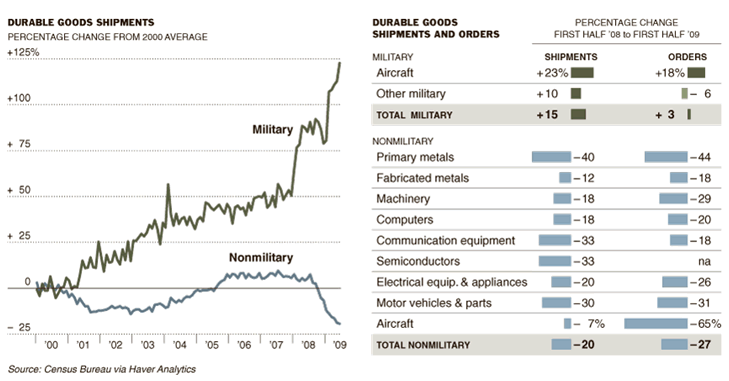
As many writers have documented, the corporate media is usually pro-war. See this. And so Washington Post hack David Broder's op-ed arguing that war with Iran will save America's economy is not all that surprising. Of course, China and Russia might not sit idly by and let their ally, Iran, be attacked. So there's the wee complication that bombing Iran could start WWIII. And, of course, attacking Iran would increase the level of terrorism. But forget politics and national security. Broder is also plain wrong on the economics. In a blog entry entitled "Has David Broder Lost His Mind?," Foreign Policy managing editor Blake Hounshell writes that Broder's proposal is "crazy for a number of reasons."
And as I have repeatedly pointed out, "military Keynesianism" - that is, launching wars to stimulate the economy, doesn't work. And as I have repeatedly pointed out, "military Keynesianism" - that is, launching wars to stimulate the economy, doesn't work. Nobel-prize winning economist Joseph Stiglitz has said that war can be very bad for the economy. For example, in 2003, Stiglitz wrote:
Stiglitz has said that this decade's Iraq war has been very bad for the economy. See this, this and this. And as the New Republic noted last year:
As I noted in January:
Indeed, Robert Reich lamented this month:
Back to my January essay:
As I wrote last month:
Even Admiral Mullen seems to agree:
Indeed, Mullen said:
Secretary of Defense Robert Gates agrees as well. As David Ignatius wrote in the Washington Post in May:
While morons like David Broder might want to start another war, America's top military leaders and economists say that would be a very bad idea.
| ||||
| Posted: 31 Oct 2010 03:56 PM PDT
President Barrack Obama certainly arrives at a party like a rock star. Three silver GM Suburbans flanking an armored black Cadillac limo screech to a halt with lights flashing, and all of the roads in the immediate vicinity closed to traffic. A dozen sunglass bedecked Secret Service agents leap out, immediately scanning the perimeter. The president bounds out and briskly walks to the plush Atherton home, where he enters through the kitchen of former EBay executive and California state controller, Steve Wesley. For a mere $30,400 donation to the Democratic National Committee, I received a sweaty handshake and an assembly line photo with the once South Chicago community organizer. A Koch brother I am not. The event came on the heels of the President’s 45 minute private audience with the Golden State’s own version of royalty, Apple’s (AAPL) Steve Jobs. It was all part of a broad swing through the Western states to rally the faithful, and to top off the DNC’s coffers, which has raised a record $50 million in California this year. Perhaps Obama just wants to be among friends. While his national job approval rating languishes at 47%, it is 55% here, and an eye popping 72% among Democrats. With a short two weeks until the election, the online betting site, Intrade (click here for their site at http://www.intrade.com/ ), is giving an 95% probability that the Republicans will win control of the house. But to me, this is all starting to take on the flavor of a consensus trade that I love to fade. The Democratic Party has become the BP of American politics. Expectations of its imminent demise may be greatly exaggerated, but not for the reasons you expect. Since the 2008 election, some 4 million “millennials”, “generation Y’s”, or “echo boomers” have gained the right to vote. Have you spoken to your kids lately? The only issues they care about, the environment, global warming, gay rights, and ending the war, are overwhelmingly Democratic ones. Another 2 million immigrants have also joined the rolls. Thanks to the racist rants by many Tea Party candidates – last week Nevada Senate candidate Sharon Angell said she thought many Mexicans looked like Asians—I would be surprised if any of these voted conservative. Sure, only 30% of these groups vote at all. But when election results swing on majorities that can be counted in the hundreds –think Florida in 2000, Ohio in 2004, and Minnesota in 2008—they could make a decisive difference. The Tea Party has already demolished any chance of a conservative win in the Senate by putting candidates the Republican leadership charitably describes as “wingnuts.” Witchcraft practicing masturbation advocate, Christine O’Donnell, took a safe Delaware seat from a 20% lead to a 20% deficit virtually overnight. Sharon Angell converted a campaign unseat the Senate majority leader, Harry Reid, in Nevada from a pushover to a dead heat. With Sarah Palin’s aid, Alaska’s Senate candidate, Joe Miller, ousted mainstream Republican Lisa Murkowski in the primaries, prompting her to launch an independent write in campaign and a three way split that could throw the election to the Democrats. The net net is that the Tea Party crashing on to the political scene has so far been hugely positive for Democrats. The polls we see reported daily are only taken of participants with land lines. So they may be undercounting both cell phone addicted, texting millennials, and immigrants. How many of your kids have land lines? My bet would be none. That could be another reason why the final results may differ from what we are being led to believe. Now, let me throw one big unknown out there. Thanks to the Supreme Court’s Citizens United vs. the Federal Election Commission decision, this is the first election to see unlimited anonymous corporate donations since the sixties. As a result, the number of election ads disclosing donors has fallen from 97% in 2006 to 32% this year. The Republican leadership is hoping this will be enough to turn the demographic tide against them. Where do you suppose BP, United Health Care, and Goldman Sachs is spending their money, all victims of Obama’s wrath? California’s proposition 23 is a perfect example of what this means. Billed as the “Save California jobs bill,” the measure was placed on the ballot and promoted by $6 million in financing from Texas base energy giant Tesoro Petroleum (TSO). And what is the company’s plan to create California jobs? Suspend the state’s stringent environmental regulations so it can build a new oil refinery in nearby Martinez. On top of this, you can toss into the mix Obama’s proven, but unquantifiable ability to engineer last minute surges among supporters. The bottom line is that things may not be all they appear to be in this election. Global markets are discounting a Republican win in the House of Representatives that may be much closer than advertised, or may not happen at all. In every postwar election, the party in power has lost an average 27 House seats in the midterm elections. The Democrats can lose 38 and still keep control. Obama knew this the day he walked into office. That is why the most radical parts of his agenda, like health care, were front end loaded. Expect to hear much about the President’s surprise, Clintonesque move to the middle in 2011, which was in fact, planned two years ago. If the Republican celebration that has been ongoing since March turns out to be for nothing, expect the shock to be immediate and global. A Democratic win will take all asset prices down, no matter how much QEII Ben Bernanke throws at them. Yes, I know, I should stick to my day job of calling every turn in the market. But for the next two weeks, that profession and making political prognostications have become one in the same. I can only say thank goodness that my hometown San Francisco Giants are not facing the Chicago White Sox in the World Series this week. There is more risk in markets today than traders and investors realize. We will find out exactly how much tomorrow. To see the data, charts, and graphs that support this research piece, as well as more iconoclastic and out-of-consensus analysis, please visit me at www.madhedgefundtrader.com . There, you will find the conventional wisdom mercilessly flailed and tortured daily, and my last two years of research reports available for free. You can also listen to me on Hedge Fund Radio by clicking on “This Week on Hedge Fund Radio” in the upper right corner of my home page.
| ||||
| Iran's holdings are likely another big omission in official gold data Posted: 31 Oct 2010 02:44 PM PDT No Need for Gold Imports for a Decade, Iran Says From Mehr News Agency, Tehran, Iran http://www.mehrnews.com/en/NewsDetail.aspx?NewsID=1181508 TEHRAN, Iran -- Iran has changed some 15 percent of its foreign exchange reserve into gold stockpiles and there is no need for gold imports for the next 10 years, Central Bank governor Mahmoud Bahmani said here on Saturday. Bahmani made the remarks at a national conference on development of the banking system. He also said that the country's foreign currency reserve has gained several billion dollars as a result of the rise in global gold prices. Bahmani said on October 23 that according to World Bank statistics Iran has $100 billion in foreign exchange reserves. ... Dispatch continues below ... ADVERTISEMENT Prophecy to Become Coal Producer This Year Prophecy Resource Corp. (TSX.V: PCY) announced on May 11 that it has entered into a mine services agreement with Leighton Asia Ltd. to begin coal production this year. Production will begin with a 250,000-tonne starter pit as planned in August, with production advancing to 2 million tonnes per year in 2011. Prophecy is fully funded to production and its management team includes John Morganti, Arnold Armstrong, and Rob McEwen. For Prophecy's complete press release about its production plans, please visit: http://www.prophecyresource.com/news_2010_may11.php Provided that the World Bank statistics are true, any country with this amount of reserves would never hit a dead end, the ISNA news agency quoted Bahmani as saying. It may be possible to exert pressure on a small country with $4 billion or $5 billion in reserves, but the situation in regard to Iran is different, he said in a reference to efforts by Western countries pressure Iran financially. He pointed to Iran's gold reserves and said they had multiplied several times in the past two years. Bahmani went on to say that currently gold consumption in the country is 30 tons per year and if the central bank doesn't add to its gold reserves there will remain ample supplies for the next 10 years. In August, Bahmani said that Tehran had withdrawn the assets held by its banks in Europe to counter new financial sanctions imposed on the country over its nuclear program. "The central bank has transferred bank assets from Europe. Currently there is no problem in regard to blocking of assets of the Iranian banks by the European Union," Bahmani added. The preemptive measure was a precautionary response to a potential European decision to freeze Iranian assets, he remarked. * * * From ZeroHedge.com http://www.zerohedge.com/article/iran-announces-it-has-converted-15-its-... As of today one of the world's top oil exporters announced that has exchanged about $15 billion of its FX reserves into gold. Earlier, Iran announced that the country has converted about 15 percent of its foreign exchange reserves into gold and "will not need to import the metal for the next 10 years." There is your mystery buyer to all that gold the International Monetary Fund was selling in Q3. And since Ahmadinejad said that Iran's total FX reserves exceed $100 billion, the amount of gold in stock held by Iran is more than $15 billion -- which is equivalent more than 345 tonnes at a closing price of about $1,350. Which also means that the World Gold Council's official gold holdings are in dire need of an update, as Iran does not appear anywhere on the IMF's listing of official gold holders, and with more 345 tonnes, it would make Iran a top-15 holder of the yellow metal. Support GATA by purchasing a colorful GATA T-shirt: Or a colorful poster of GATA's full-page ad in The Wall Street Journal on January 31, 2009: http://gata.org/node/wallstreetjournal Or a video disc of GATA's 2005 Gold Rush 21 conference in the Yukon: * * * Help keep GATA going GATA is a civil rights and educational organization based in the United States and tax-exempt under the U.S. Internal Revenue Code. Its e-mail dispatches are free, and you can subscribe at: To contribute to GATA, please visit:
| ||||
| GDXJ Now Offers Long-Term LEAP Options Posted: 31 Oct 2010 02:08 PM PDT
| ||||
| Bank of England Head Mervyn King Proposes Eliminating Fractional Reserve Banking Posted: 31 Oct 2010 02:02 PM PDT
Mervyn King - the governor of the Bank of England - has proposed abolishing fractional reserve banking. As the BBC noted last week:
Moreover, King wrote to Ben Dyson and stated:
As Dyson explains:
Ironically, while King is proposing the potential elimination of fractional reserve banking (i.e. a return to 100% reserves), Ben Bernanke has proposed the elimination of all reserve requirements (i.e. requiring no reserves):
| ||||
| Murray Pollitt: Lessons from the 1970s for mining company investors Posted: 31 Oct 2010 01:44 PM PDT 9:40p ET Sunday, October 31, 2010 Dear Friend of GATA and Gold: In his latest market letter, Murray Pollitt of investment house Pollitt & Co. in Toronto offers some perspective for and guidance to mining company investors. Pollitt's commentary is titled "Lessons from the 1970s" and you can find it at GATA's Internet site here: http://www.gata.org/files/PollittMarketLetter-10-27-2010.pdf CHRIS POWELL, Secretary/Treasurer ADVERTISEMENT Prophecy to Become Coal Producer This Year Prophecy Resource Corp. (TSX.V: PCY) announced on May 11 that it has entered into a mine services agreement with Leighton Asia Ltd. to begin coal production this year. Production will begin with a 250,000-tonne starter pit as planned in August, with production advancing to 2 million tonnes per year in 2011. Prophecy is fully funded to production and its management team includes John Morganti, Arnold Armstrong, and Rob McEwen. For Prophecy's complete press release about its production plans, please visit: http://www.prophecyresource.com/news_2010_may11.php Support GATA by purchasing a colorful GATA T-shirt: Or a colorful poster of GATA's full-page ad in The Wall Street Journal on January 31, 2009: http://gata.org/node/wallstreetjournal Or a video disc of GATA's 2005 Gold Rush 21 conference in the Yukon: * * * Help keep GATA going GATA is a civil rights and educational organization based in the United States and tax-exempt under the U.S. Internal Revenue Code. Its e-mail dispatches are free, and you can subscribe at: To contribute to GATA, please visit:
This posting includes an audio/video/photo media file: Download Now | ||||
| At New Orleans conference Kitco interviews GATA on silver manipulation Posted: 31 Oct 2010 01:26 PM PDT 9:21p ET Sunday, October 31, 2010 Dear Friend of GATA and Gold (and Silver): Kitco News reporter Daniela Cambone interviewed several participants in the New Orleans Investment Conference about manipulation of the silver market, including GATA Chairman Bill Murphy and your secretary/treasurer. The interviews are headlined "Conference Speakers Chime In on Silver Manipulation Story -- Oct. 31, 2010" and you can watch the video at Kitco here: http://www.kitco.com/KitcoNewsVideo/kitco_news.htm CHRIS POWELL, Secretary/Treasurer ADVERTISEMENT Prophecy to Become Coal Producer This Year Prophecy Resource Corp. (TSX.V: PCY) announced on May 11 that it has entered into a mine services agreement with Leighton Asia Ltd. to begin coal production this year. Production will begin with a 250,000-tonne starter pit as planned in August, with production advancing to 2 million tonnes per year in 2011. Prophecy is fully funded to production and its management team includes John Morganti, Arnold Armstrong, and Rob McEwen. For Prophecy's complete press release about its production plans, please visit: http://www.prophecyresource.com/news_2010_may11.php Support GATA by purchasing a colorful GATA T-shirt: Or a colorful poster of GATA's full-page ad in The Wall Street Journal on January 31, 2009: http://gata.org/node/wallstreetjournal Or a video disc of GATA's 2005 Gold Rush 21 conference in the Yukon: * * * Help keep GATA going GATA is a civil rights and educational organization based in the United States and tax-exempt under the U.S. Internal Revenue Code. Its e-mail dispatches are free, and you can subscribe at: To contribute to GATA, please visit:
| ||||
| Posted: 31 Oct 2010 12:46 PM PDT
Whoooosh... or just another DXY flash crash? If this was indeed a BoJ intervention, it is the worst money spent by a central bank in the history of Keynesianism, with a half life of less than 30 minutes. Elsewhere, gold is predictably nearing its all time highs.
| ||||
| Iran Announces It Has Converted 15% Of Its $100 Billion+ In FX Reserves Into Gold Posted: 31 Oct 2010 12:06 PM PDT
As of today, one of the world's top oil exporters announced that has exchanged about $15 billion of its FX reserves into gold. Earlier, Iran announced that the country has converted about 15% of its foreign exchange reserves into gold, and "will not need to import the metal for the next ten years." There is your mystery buyer to all that gold the IMF was selling in Q3... And since Ahmadinejad said that Iran's total FX reserves exceed $100 billion, the amount of gold in stock held by Iran is more than $15 billion. Which is equivalent more than 345 tonnes at a closing price of about $1350. Which also means that the WGC's official gold holdings are in dire need of an update, as Iran does not appear anywhere on the IMF's listing of official gold holders, and with over 345 tonnes, it would make Iran a top 15 holder of the yellow metal. From Bloomberg:
| ||||
| Posted: 31 Oct 2010 11:41 AM PDT The following is automatically syndicated from Grandich's blog. You can view the original post here. Stay up to date on his model portfolio! October 31, 2010 03:39 PM I ‘ll be back posting regularly on Wednesday. For now Know: [LIST] [*]Believe this period of time will prove to be major top in U.S. stock market [*]Correction in gold and silver over. More bear meat to be served up for the upcoming holidays [*]Little bounce in U.S. Dollar only a counter move to the long term trend – down, down, down [/LIST]I’m lousy on one foot! Here’s to the next month pasting real fast. [url]http://www.grandich.com/[/url] grandich.com...
| ||||
| Silver To Go Parabolic Next Week? Posted: 31 Oct 2010 10:51 AM PDT | ||||
| Posted: 31 Oct 2010 09:18 AM PDT Courtesy of CIGA Pedro Dear CIGAs, A popular argument against the utility of Gold at times of crisis is regularly offered up through the rather facile statement that it can't be eaten. This is then given as reason why, in times of great crisis Gold will not "perform" the way food stocks and other inferior alternatives will. Even the Financial Times' excellent journalist, Gillian Tett recently sang this refrain. It's becoming a tiresome argument, and it needs to be deconstructed. It is welcome that people are beginning to see the dichotomy between paper and hard assets. The predominant paper asset is (un-backed, fiat) currency. Hard assets, of course, are many and varied. But if people believe that wealth preservation can be reduced to a simple juxtaposition between paper representations of wealth and tangible wealth, they are misguided. That is only a partial explanation. There are other issues. One of them is the issue of portability. In times of economic disaster you can stock-pile food, yes, but what happens if you have to abandon your dwelling due to security issues. What happens if your "home garden" and livestock have to be defended? It is not a nice thought. In preparation for possible dislocations it is unwise to think that you may be able to remain in one place. This is one of the undervalued aspects of Gold. You can pack it up in a small case. Your wealth is mobile. At today's prices, half a million (USD equivalent) is easily portable. In a years' time a million or two may be just as easy to cart off in your hand. Things like paintings (especially miniatures) and gems perform a similar function. During a serious crisis like social-breakdown or war, it is not reasonable to assume you will be able to take all of your canned goods, water-filters, generators et al with you, in a vehicle that needs constant refuelling and repair… you're going to have to be lean, mean and fast on your "feet". Not weighed down by encumbrances. Ever wonder why people escaping Nazi Germany chose diamonds? Maximum wealth with smallest possible mass and weight. Quite simply, these "you can't eat Gold" theories, that supposedly undercut Gold's value, do not hold water. When people live in crisis situations, one usually finds not that goods aren't available – but that they are expensive. Fantastic food, caviar champagne and other "accoutrements" were available all over the Soviet Union (Mostly in hard-currency "bereoska"); a bottle of whiskey could even be found in remote American barracks during World War II – but the price, then, depending on location, was about a crisp $100 bill. (Then! … Not now.) Hoarding resets prices when demand goes up and supply crashes. Gold, a hoarded, not consumed, vehicle, performs perfectly in an environment when sought after goods are being restricted from the market and more so if paper currencies are under attack. Let's take the consumable issue one step further. If you buy a one lot of European barge delivered (ARA) gasoil, you can, theoretically, take delivery. But how, exactly does a non-configured layman deal with that reality? With great difficulty is the answer. Leaving aside the configuration issues of delivery (which are significant if you're not a professional oil product transport or storage entity), are you going to transfer it and then store it on your own while meeting legal safety and environmental requirements so that you don't (literally) blow up the neighbourhood? That's unlikely. Your parcel will likely become distressed and no one is going to even pick up the telephone to talk to you about how to get rid of your 100 tons of gasoil. Moreover, the owner of the much larger parcel your piece is consigned within will demand that you meet all sorts of other regulations to siphon off your little piece. (Doesn't this sound a little like sawing off your corner of that 400oz. London Good Delivery bar you were told by some Gold pool was "yours"?). It's no different in coffee, cocoa and sugar, the grains and other "softs". You'll never be able to store in proper condition, and even if you did, deterioration would set in after a few weeks/months. So you'd have to unload it quick, which defeats the whole purpose for which you took delivery. Commodity professionals have noses like bloodhounds for distressed parcels – so you will have your financial eyes gouged out when trying to get rid of your inventory. In something less than a perfect environmental regime, your physical will become worthless and you'll probably have to pay to get rid of it. What should additionally be evident from the above is the inherent price potential for physical Gold if delivery demands rise. Not many people are going to know what to do with a one lot of gasoil, coffee, wheat, etc., if they want it delivered. But one hell of a lot of people know EXACTLY what to do with a 100oz bar of Gold. Namely: Hold on to it – i.e. store it. This is what gives the possibility for a delivery squeeze in Gold such massive price outcomes – delivery and storage does not rely solely in the realm of the professional. The amount of people who could demand delivery of paper contracts, and feasibly take delivery is potentially massive. Of course, by the time such demands become manifest, it is unlikely paper claims will be honored. Just the scent of a delivery squeeze (as we learned from the Hunt Brothers experience) can cause mayhem. Lastly – for the "you can't eat Gold" crowd – how the logistics of an economic implosion play out vis a vis Gold are already evident in Zimbabwe. The forlorn and starving, including the elderly and sick, spend much of their day panning rivers and streams to amass the miniscule amounts of raw, unrefined, Gold, which is the only thing the hoarders will accept in exchange for the foodstuffs necessary to stay alive. For those who would like a real-life, current example of the "You can't eat Gold" theory in practice, go to You Tube and search under: "Gold for Bread – Zimbabwe", for a very harsh dose of reality (the video is not suitable for children and the faint of heart – it is, however, reality). CIGA Pedro
| ||||
| Commodities Experts Say Where They Think Natural Resources and Gold Are Headed Posted: 31 Oct 2010 08:59 AM PDT Frank Holmes submits: The “World’s Greatest Investment Event,” the 2010 New Orleans Investment Conference kicked off on Wednesday as gold and natural resources investors descended on the Crescent City for answers to today’s market questions. The list of speakers for this year’s conference reads like a who’s who of the natural resources and commodity world—Dr. Marc Faber, Newt Gingrich, Dennis Gartman, Dick Armey, Peter Schiff and others. Complete Story »
| ||||
| Posted: 31 Oct 2010 08:43 AM PDT Gold and silver at last staged the expected correction necessary to unwind the extremely overbought condition that had persisted for weeks. Once the correction started we had figured it would take gold down to about $1300, probably with a ... Read More...
| ||||
| Posted: 31 Oct 2010 08:42 AM PDT We saw a strong rally by silver on Friday that took it to a new closing high, although it did not get above earlier intraday highs. As we can see on our 6-month chart silver did just manage to stay above its uptrend line on the recent reaction ... Read More...
| ||||
| On the Upcoming US Congressional Elections Posted: 31 Oct 2010 08:34 AM PDT Carroll Quigley, mentor to former President Bill Clinton and chronicler of the Anglo-American establishment's influence on world affairs, once wrote in his book Tragedy and Hope: The argument that the two parties should represent opposed ideals and policies, one, perhaps, of the Right and the other of the Left, is a foolish idea acceptable only to the doctrinaire and academic thinkers. Instead, the two parties should be almost identical, so that the American people can "throw the rascals out" at any election without leading to any profound or extreme shifts in policy.When it comes to wars, or the relationship between banking elites and government, that statement rings true. But I'm not so sure these upcoming elections will be business as usual. At least not for the US Dollar. It remains to be seen how the Republicans act if/when they take control of the US House of Representatives, and possibly narrow the gap in the US Senate. The Republicans are promising to be the party of responsible financial stewardship, yet has anyone told these politicians running for office how our monetary system really works? Maybe they, or at least their party leadership already knows and they are only spewing forth what the electorate believes to be the truth? It seems like it was merely yesterday that a recent Democrat takeover of the Congress found itself working with a Republican White House, under George Bush, to "save" the banking system, if not Western Civilization as we knew it. All it took was for the Democrat leaders to be rounded up by Hank Paulson, then Treasury Secretary, and then lectured as to how our monetary system actually worked, how growing debt is required to keep the system from collapsing, and how spending incredible amounts of money was necessary or else, as George Bush put the impending economy's condition: "This sucker could go down." I wonder if Ben Bernanke is following this election closely. After all, if the Republicans take control, Keynesian fiscal spending will be curtailed and it will be Friedman Monetarism that will be in the spotlight. What does that mean to the size of QE2, 3, 4, and so on? What has the market priced in already? Either way, we are merely delaying the inevitable failure of a monetary system that seems to be nearing a tragic end. Printing more money only makes the future servicing of the debt that much more difficult to handle, and cutting Congressional spending now only accelerates the deflationary aspects of a severe depression. Damned either way as it will be the dollar that becomes the last victim. It is important to keep in mind that never in world history has any monetary system not collapsed. Eventually, monetary systems always do. It's the consequences of a monetary system's failure that are difficult to predict. We live in a world of extreme fragility - as Nassim Taleb has described. Money whirls around the world at lightning speed. Prices of everything are monitored and adjusted in milliseconds. Nations export inflation in mere days. And Monday thru Friday, there is always a market that is open somwhere. To borrow a phrase: The Sun never sets on the markets, but it does set on monetary systems. How will this upcomg election chnage things? We'll see. 
| ||||
| Cash Sitting on the Sideline Will Find Its Way to Gold Posted: 31 Oct 2010 08:26 AM PDT The official Credit Suisse policy is that investors should have 10% of their portfolio in gold. Parker doesn't like gold at its current prices and prefers investing in South African gold mines or better yet, Russian mines, which he says are ... Read More...
| ||||
| $50 Silver coming . . . Gold and Silver vigilantes are pouncing! Posted: 31 Oct 2010 08:16 AM PDT Protect Yourself Against This Guy
This posting includes an audio/video/photo media file: Download Now | ||||
| Get On Board With Mongolia Mining Posted: 31 Oct 2010 08:09 AM PDT
The 3:00 am phone call was scratchy, broken, and barely intelligible. Would I be willing to accept a collect call from Ulan Bator, the capital of Mongolia? My man on the ground there was on the line with a stock idea that I absolutely had to get involved with. Mongolia Mining (975:HK) had just listed its shares on the Hong Kong Stock Exchange at $7, had already moved up to $8.30, and was headed for higher altitudes.
| ||||
| Guess What’s Coming to Dinner: Inflation! (Part One of Two) Posted: 31 Oct 2010 08:00 AM PDT The US Bureau of Labor Statistics (BLS) recently reported that consumer price inflation (CPI) declined in September to a 59-year low of just 1.1% y/y. Excluding more volatile food and energy prices, the so-called core CPI rose only 0.8% y/y. This is not good news for the US Federal Reserve, which considers this a dangerously low rate of CPI. While the Fed lacks a formal CPI target–unlike many other central banks–it nevertheless seeks to keep inflation sufficiently above zero so that, should the economy weaken further, low inflation is unlikely to turn into outright deflation, something the Fed considers it necessary to avoid at all costs. With a range of economic indicators now suggesting that the rate of US economic growth has moderated of late, the Fed is preparing to add additional monetary stimulus to the economy, most probably in the form of expanded US Treasury purchases. This, the Fed appears to believe, will lower borrowing costs and perhaps further weaken the dollar somewhat. That in turn should stimulate economic activity such that the risks of consumer price deflation diminish. Now the Fed is not necessarily highly confident at this point that this is going to work. Indeed, there is an unusually large amount of dissent at the Fed at present. A number of senior Fed officials–most notably Thomas Hoenig, President of the Kansas City Fed–are skeptical that additional monetary stimulus will have the desired effect on the economy and, in fact, might be counterproductive. Why might additional stimulus be ineffective? After all, the Fed has a long track record of injecting monetary stimulus into the economy from time to time, supporting growth and preventing deflation. Indeed, as observed above, there has been no consumer price deflation in the US for two full generations, and no severe, prolonged deflation since 1934. Well there are signs that Fed stimulus to date is not having much effect. Notwithstanding near zero policy rates and a doubling of the monetary base, the economy is clearly struggling and CPI has continued to trend lower amidst spare capacity in many business sectors. With broad un- and underemployment currently at 17%, most US workers are not in a position to demand higher wages as firms seek ways to maintain profit margins amidst weak final demand. (Real final sales, which subtracts changes in inventories from GDP and thus is a more stable measure of economic activity, has grown at a mere 1% over the past two quarters.) The employment cost index (ECI), which measures the rate of growth of total compensation–wages and benefits–has risen a mere 1.8% over the past year, far below the 3-4% average of the past decade and barely above the 1.1% rate of CPI y/y. Until un- and under-employment declines substantially, additional money flooding into the financial system is unlikely to have much if any impact on wages and, hence, is unlikely to contribute, at least not directly, to a rise in CPI. But what about growth? Won't additional money creation stimulate business investment, eventually supporting the job market, wages and consumption, thereby pushing up CPI? Well that is certainly what the Fed would like to see, but with both business and consumer confidence extremely weak, it is far from clear that any additional money created will do anything other than push up banks' so-called "excess reserves", that is, money which the Fed has made available to the banks but which they have chosen not to lend out in some form. Many refer to this sort of situation as a Keynesian "liquidity trap". You can lead the horse to water (liquidity) but you can't make it drink (borrow/invest/spend). Keynes' solution to this problem was for fiscal policy to go where monetary cannot, which is to force additional spending, either indirectly, via a debt-financed tax cut or, directly, through increased government spending. The former can be considered "supply-side" and the latter "demand-side" forms of stimulus but from a broad macroeconomic perspective they amount to much the same thing: Both are, in effect, attempts to spend one's way out of an economic downturn brought about by excessive debt and financial leverage. The effects of such policies might look nice on the aggregate income statement for a time–in that economic activity remains artificially elevated–but the aggregate balance sheet is going to deteriorate as a result. And as any good financial analyst knows: The income statement is the past. The balance sheet is the future. A deteriorating balance sheet, or expectations thereof, normally would lead financial markets to demand a higher risk premium to hold a company's stock, which implies a lower price-to-earnings (P/E) ratio. This can come about, however, either through a decline in the price of the stock, an increase in the earnings yield, or some combination thereof. In the event of sovereign balance sheet deterioration, however, as described above, there is no "stock" per se, but there is a yield on a government bond. If global investors observe a deteriorating sovereign "balance sheet", they will demand a higher yield premium to hold that bond relative to some other asset. As the yield rises, the price of the bond declines, in effect devaluing the debt and reducing the "P/E ratio". But then what happens when the central bank resists a rise (or facilitates a decline) in bond yields by lowering policy rates or buys up bonds directly in permanent open market operations (POMOs), as the Fed is now doing? In this case, the required adjustment cannot fully take place via a higher bond yield, so instead, the price of the bond must decline in real rather than nominal terms. For this to happen, the currency must decline. It is no coincidence that, as the Fed has made it increasingly clear to financial markets that it is prepared, in principle, to expand the POMO program indefinitely until inflation (or expectations thereof) rises by a desired amount, the dollar has declined sharply versus nearly all other currencies. Regards, John Butler, [Editor's Note: The above essay is excerpted from The Amphora Report, which is dedicated to providing the defensive investor with practical ideas for protecting wealth and maintaining liquidity in a world in which currencies are no longer reliable stores of value.] Guess What's Coming to Dinner: Inflation! (Part One of Two) originally appeared in the Daily Reckoning. The Daily Reckoning, offers a uniquely refreshing, perspective on the global economy, investing, gold, stocks and today's markets. Its been called "the most entertaining read of the day."
| ||||
| Franz Kafka Would Be Proud: On America's End Of Liberty Posted: 31 Oct 2010 05:47 AM PDT
"Americans today are constantly watching their speedometers and trying to conform to every little rule yet there are so many rules that it's impossible for even the most honest and hard-working Americans not to be breaking some type of law on a daily basis. We are slaves in a criminal monetary system, where the Federal Reserve steals from the middle class through inflation and transfers this wealth to their banker friends on Wall Street. We are forced to accept pieces of paper of money while the US constitution defined only gold and silver as legal tender...We are now seeing countless signs on a daily basis that the US is headed for a complete societal collapse as we know it, forever." The government is finally being exposed for being the most systematic abuser of those primal human weaknesses known to Franz Kafka over a hundred year ago: namely - riddle people with guilt, force them to obey countless rules and regulations, many of which are in stark disagreement with each other, keep them preoccupied with superficial lies, provide them with a marginal education, prevent them from thinking for themselves, allow the constant deflection of individual responsibility, provide a society of countless lawyers where any infarction, no matter how minor, serves as the basis for substantial wealth loss, all the while hiding behind a system of increasingly insolvent welfare, whose sole purpose is to validate the destruction of labor product savings, and the devaluation of money. At the center of this nearly 100 year successful wealth transfer plan is none other than the Federal Reserve: a private institution controlled by wealthiest, whose tentacles reach into the government, into the media, and into every classroom (especially those of brainwashed Ivy League students). As Gerald Celente says, America has become a society where one is guilty until proven innocent. Is it any wonder that nobody respects the constitution any more? MERS fraud, financial collapse, unprecedented political corruption, and not one person found guilty or put in jail...How can one respect what America has become? Just over two hundred years after America's "independence", the country has reverted to a despotic state, at whose apex is the New Novus Ordo Seculorm, not that envisioned by the founding fathers, but its mutated, freakish descendant, which managed to survive Andrew Jackson's victory over the Second Bank of the United States, and is now controlling everything through the secret and unauditable decisions made in the halls of the Marriner Eccles building, and a stock market which is driven exclusively by the order flow emanating from Liberty 33. And even as America prepares for yet another theatrical farce of what Democracy has become in the form of the mid-term elections, whose outcome will have no bearing whatsoever on the future of this country, the far more important decision, that virtually no American has any control over, except for a few bankers and a few religious fundamentalists, is the Fed's decision to decisively do away with the reserve currency, appropriately due on the very same day. We suggest everyone watch the below clip documenting the end of US liberty, and its transition to a state that is everything that those who created America rebelled against.
h/t Robert
| ||||
| Founder's Remarks/Halloween Day, 2010 Posted: 31 Oct 2010 05:46 AM PDT As I page through the USAGOLD website, I am struck with the job well-done by our staff in making this website one of the best, if not, the best in the gold business in terms of communicating with our clientele — both current and prospective. • Randy Strauss does an extraordinary job posting the gold relevant articles at our News & Views page and then following up those postings with some of the most cogent, bedrock commentary in the industry. If you need a gut-check on why you own gold (or a reminder), simply read Randy's commentary each day. • Pete Grant does an incredible job daily with our Daily Market Report. Few among the thousands who visit this site daily know that the DMR was our first page — the page from which all others emanated. To me, it is still probably one of our most important because it gives the gold owner insights into what's going on in the gold market both from an independent point of view generated by Pete and USAGOLD, as well as snippets on daily developments from the mainstream media. The many links posted there for further examination of market dynamics are unmatched in the gold industry. If you were away for a year sans communication, the DMR page is where you would want to go to catch up. When we brought Pete aboard a few years ago, his experience in analyzing the forex markets played a prominent role. Little did we know that currencies would move front and center as the financial/credit crisis became a permanent fixture in the American economy. • There are others who labor behind the scenes who deserve much credit as well. • Back in June we resurrected our monthly newletter and renamed it USAGOLD News, Commentary & Analysis. There was a time when this firm's newsletter was a lonely voice consigned to the wilderness of economic opinion. Those who read it appreciated it and let us know in their occasional calls to the office — usually to place orders for gold when it was trading in the $300 to $400 range. When the internet came along, we switched our emphasis but we continued to publish the newsletter for those who, like me, still enjoy sitting down in the physical presence of the written word. Even now, we post the newsletter in both screen and print versions (pdf's) to accommodate both types of reader. It is surprising how many each month prefer to download the print version — something that took the younger group here at the office by surprise. The important element though is how many actually do read the newsletter. I still get calls from our clientele to make a comment or two on the content or ask a question. Talked with one fellow last week who has been reading the newsletter since the late 1990s and still ranks it among the best in the gold industry. • At present this site hosts between 30,000 and 45,000 visits per day — people from all over the world, but principally from the United States, Canada and United Kingdom of the English speaking nations. We get significant traffic from Asia as well — mostly Singapore, UAE, India Thailand, Hong Kong and Saudi Arabia (in that order). Most of continental European visitors originate from France, the Netherlands and Sweden. I am surprised we do not get more from Germany, since gold is such an important cultural element there. I have talked with people from all over the world in conncection with this site. The breadth and depth of the gold market has always amazed me. The one trait they all have in common is a deep curiosity about how the world economy works and their place in it. The other traits I would attribute to this group is a high degree of intelligence, education and financial independence. The mainstream press has always tried to profile this group as something they aren't as a means to scaring others away. If we were to throw a USAGOLD convention and invited the press as observers, they would either have to acknowledge we aren't what they say we are, or they would have to continue painting the false picture. The attendees would discover that their fellow gold owners are precisely what they might have expected — some of the best of the best, and their compatriots no matter the nationality. • From a brokerage point of view, the gold market is not as active as it was earlier in the year in terms of the number of phone calls and people making inquiries. At the moment, those buying gold are high-volume buyers. The number of sales is down, but the amount (weight) of gold per transaction is significantly larger. This tells me that high net worth individuals once again are moving to protect their portfolios against dangerous circumstances they see developing within our economy, even as the price has moved significantly higher since the end of the summer doldrums (August, roughly $1150/ounce). • I am regularly asked if we have reached a peak in the gold price in the mid-$1300s. Of course I was asked that at $650, $750, $850, etc. — all the way up. Short term fluctuations aside, I would say that gold's long-term uptrend will remain in place as long as the monetary authorities globally continue to sponsor ultra-loose monetary policies and the financial system continues to engage in practices that heighten systemic risk. The financial-credit crisis is far from over and, if you thought what the Fed had in mind previously was dangerous, wait until what you see what the Fed has planned for us in the future. The United States federal government and the Federal Reserve now appears poised to launch a money printing scheme only John Law could recommend. Ben Bernanke, alas, appears in fact every bit the reincarnation of that inveterate money printer in the contemporary era. We should all recall at the end of that fiat money misadventure, Law was caught just outside Paris with a wagonload of gold and silver trying to make his escape. • This time of year (and throughout this gold bull market), I have resurrected from time to time a piece of writing by Edgar Allan Poe which I have always thought of exceptional quality. It comes at the start of The Fall of the House of Usher and sets the tone for the rest of the novella. It both chills the temperature and draws the reader in: "DURING the whole of a dull, dark, and soundless day in the autumn of the year, when the clouds hung oppressively low in the heavens, I had been passing alone, on horseback, through a singularly dreary tract of country ; and at length found myself, as the shades of the evening drew on, within view of the melancholy House of Usher. I know not how it was – but, with the first glimpse of the building, a sense of insufferable gloom pervaded my spirit. I say insufferable ; for the feeling was unrelieved by any of that half-pleasurable, because poetic, sentiment, with which the mind usually receives even the sternest natural images of the desolate or terrible. I looked upon the scene before me – upon the mere house, and the simple landscape features of the domain – upon the bleak walls – upon the vacant eye-like windows – upon a few rank sedges – and upon a few white trunks of decayed trees – with an utter depression of soul which I can compare to no earthly sensation more properly than to the after-dream of the reveller upon opium – the bitter lapse into everyday life – the hideous dropping off of the veil." Substitute the words "House of Usher" with the words "economic situation" and it makes for a fitting Halloween 2010 contemplation. . . . . . A Happy All-Hallows to all! MK
| ||||
| Quantitative Easing: Economic Suicide Pill Posted: 31 Oct 2010 05:42 AM PDT The question being asked all across the world of business news is "will QE2 be successful?" Because this policy is literally economic suicide, the question becomes "will the Federal Reserve be successful in the assisted economic-suicide of the U.S. government?" I find this an utterly appalling question – which highlights the intellectual bankruptcy of government policy-makers, and the bankers which goad them onward. "Quantitative easing" is nothing more than a euphemism for printing money "out of thin air". Its one-and-only purpose is to destroy the currency being printed. It is pure dilution, and absolutely no different than a corporation vowing to improve its fiscal performance simply by printing-up a lot of new shares. We can illustrate the inherently evil nature of this monetary abomination by working through the "mechanics" of this policy. First, the explicit goal of "QE2" is to increase inflation. By now, all readers should be familiar enough about "inflation" to know that it is literally nothing more than the speed with which our currencies are being destroyed. In the case of the Federal Reserve, we understand all too well how "successful" it has been in creating inflation. Since it was invented in 1913, the Federal Reserve has been directly responsible for the U.S. dollar losing 97% of its value (i.e. inflation has raised prices by more than 20 times what they were in 1913) – despite the official mandate of the Federal Reserve for "price stability" (i.e. protecting the dollar). Now, Ben Bernanke (the Fed's latest and most potent dollar-destroyer) is vowing to "succeed" in destroying the remaining 3% of value of the world's reserve currency. Here is how printing-up money accomplishes Bernanke's "goal". First of all, as with any kind of dilution, printing-up new dollars makes all of the 'old' dollars worth less (worthless?). So, right there, the Federal Reserve is already 100% guaranteed of "success". In fact, the Federal Reserve has already been "very successful" in creating inflation – in the real world. Visit Shadowstats.com, operated by respected U.S. economist John Williams, and you will hear that U.S. inflation has been in the range of 8.5% - 9.5% all this year. Williams performs his calculations using the exact same methodology used by the U.S. government a generation ago, before the U.S. government intentionally incorporated various statistical lies into this measurement. Understand the enormous "rewards" which a government receives for lying, by grossly under-stating the rate of inflation. Pay-outs on $100's of billions of U.S. government benefits per year are indexed to the rate of "official" inflation. By grossly understating inflation (and cheating all of the recipients of those benefits), the U.S. government can get an instant, multi-billion dollar windfall from that one lie, alone (every year). Secondly, every quarterly and annual GDP report must be "deflated" by the real rate of inflation. The raw data must be stripped of all inflation, in order to accurately represent real, economic growth. By grossly understating the rate of inflation, the government falsely inflates the rate of GDP "growth" by several percentage points – et voila we have a "U.S. economic recovery". Immediately, we see Bernanke exposed for the charlatan that he is. He claims there is U.S. "economic growth", when all that "growth" actually represents is an illusion of doctored numbers. He claims the Federal Reserve has "failed" to create enough inflation (i.e. to destroy the U.S. dollar fast enough), when in fact the real data shows that Bernanke has been doing a wonderful job of destroying the dollar. However, the ultimate "indictment" of "QE2" as failed policy comes from the fact that "QE1" never ended. Of all the fraudulent shams perpetrated by the U.S. government and the Federal Reserve, none of them are as obvious as the U.S. government's manipulation of the market for U.S. Treasuries. Here are the facts. Previously, the U.S. government was able to find (real) buyers for its Treasuries, due to the need of other governments to recirculate/reinvest the money from their trade surpluses and fiscal surpluses. Thanks to the Wall Street-engineered "Crash of '08", the vast majority of those surpluses have disappeared. At the same time, the U.S. government is cranking-out much more "supply" than at any other time in the history of the United States. Thus, we are told by the U.S. government (and the Federal Reserve) that there are more "buyers" for U.S. Treasuries than at any time in history – despite the fact those buyers have no money. But that is literally less than half of this farce. Not only are we being told that buyers-with-no-money are purchasing more Treasuries than at any other time in history, we're also told that these buyers are joyfully paying the highest prices in history (by a large margin) for these debt instruments. However this still doesn't capture the absurdity of this scenario. | ||||
| Gonzalo Lira's Redux On Signs Of An Upcoming Hyperinflation Posted: 31 Oct 2010 04:23 AM PDT
Submitted by Gonzalo Lira Signs Hyperinflation Is Arriving This post is gonna be short and sweet—and scary: Such a run on commodities, I further argued, would inevitably lead to price increases and a rise in the Consumer Price Index, which would initially be interpreted by the Federal Reserve, the Federal government, as well as the commentariat, as a good thing: A sign that “the economy is recovering”, a sign that “normalcy” was returning.
| ||||
| Posted: 31 Oct 2010 04:01 AM PDT
If you give money to candidates the amount and beneficiary are made public. If you look me up you would see that I have contributed to Democratic candidates on a regular basis for a long time. Not this year. As a long time Dem, it is hard for me to describe my disappointment. There is very little that I can look to over the past two years and say, “They got this one right”. So this year I am going to vote with my feet. I think people like me are key to this election. 

| ||||
| Precious Metals - Week of 10.31.10 Posted: 31 Oct 2010 03:45 AM PDT IMF's Gold Sales Rose Sharply in September GATA (29 Oct 10)
| ||||
| Yemen Says UPS Planes Never Take Off Or Land In It? Posted: 31 Oct 2010 03:31 AM PDT SANA'A, Oct. 30 (Saba) – No UPS cargo planes left Yemen to other countries in the last days and there are no direct flights from Yemen to the United Kingdom or the United States, a Yemeni official said, after allegations that British and U.S. officials had found suspicious packages on planes that originated in Yemen. The official wondered how the media mentioned the name of Yemen reporting that an explosive device was found onboard a cargo plane that landed in London coming from Yemen. UPS planes never land or take off in Yemen, the official made clear. More Here.. UPS Yemen P.O. Box 1696 Al-Qiyada Street Sana Tel.: 967-1-416-751 Fax: 967-1-418-264 
| ||||
| Is Now a Bad Time to Be Short Silver? Posted: 31 Oct 2010 02:38 AM PDT Chris Mack submits: The pressure on silver shorts has been relentlessly increasing on a daily basis. On the heels of CFTC's statement of intention to actually enforce antitrust regulations in the silver market, two lawsuits were filed against JPM and HBC for manipulating the silver price. With the testimony of whistleblower Andrew Macguire and admission that there has been fraudulent activity in the silver market by CFTC Commissioner Bart Chilton, these lawsuits have a much larger chance of success than just a year ago. One of those lawsuits is seeking group or class action status if enough investors sign up. Silver investors who suffered from losses in 2008 and are interested in joining the lawsuit can contact the law offices of Christopher Lovell at 212-608-1900. Complete Story »
| ||||
| Gene Arensberg: Lust for silver returning Posted: 31 Oct 2010 02:15 AM PDT 9:12a CT Sunday, October 31, 2010 Dear Friend of GATA and Gold (and Silver): In the presentation he prepared for the New Orleans Investment Conference, the Got Gold Report's Gene Arensberg joins those anticipating silver's return as de-facto money. Arensberg's commentary is titled "Lust for Silver Returning" and you can find it at the Got Gold Report's Internet site here: http://www.gotgoldreport.com/2010/10/lust-for-silver-returning.html CHRIS POWELL, Secretary/Treasurer ADVERTISEMENT Prophecy Resource Goes Into Production A commission appointed by Mongolia's Ministry of Mineral Resources and Energy has conducted the final permit inspection at Prophecy Resource Corp.'s Ulaan Ovoo mine site and has instructed the company to begin coal production. Prophecy Resource (TSX.V: PCY) has begun production of its first 10,000 tonnes of coal as a trial run of supply to be taken by rail to electric power stations in Darkhan and Erdenet, Mongolia's second and third largest cities after the capital, Ulaanbaatar. The company is the second-ever Canadian mining company to get a permit to mine in Mongolia and start production there. For the company's complete announcement, please visit: http://www.prophecyresource.com/news_2010_oct14.php Support GATA by purchasing a colorful GATA T-shirt: Or a colorful poster of GATA's full-page ad in The Wall Street Journal on http://gata.org/node/wallstreetjournal Or a video disc of GATA's 2005 Gold Rush 21 conference in the Yukon: * * * Help keep GATA going GATA is a civil rights and educational organization based in the United States and tax-exempt under the U.S. Internal Revenue Code. Its e-mail dispatches are free, and you can subscribe at: To contribute to GATA, please visit:
| ||||
| Goldcorp Offers Shareholders a Halloween 'Treat' Posted: 31 Oct 2010 01:53 AM PDT Old Trader submits: It's certainly no secret that the precious metal miners don’t loom large (if at all) on the radar screens of income investors. A quick look at some of the more widely held miners (via BigCharts.com) shows GFI (Goldfields) paying 1.22%, ABX (Barrick) at a 1.00% yield, and FCX (Freeport-McMoRan) topping the charts at 1.27%. Frankly, I would say that FCX probably shouldn't be included in the list by virtue of the fact that it's primarily a copper miner, rather than gold and/or silver. In fact, a number of months ago, after I wrote an article for SA in which I listed my portfolio holdings and their weights, I received an email from a reader asking how I reconciled my holding in GG with my profile, where I state that my portfolio is structured to generate income/yield, preservation of capital and appreciation of capital, in that order. I responded to the reader that GG fell into the “preservation of capital” bucket. Complete Story »
| ||||
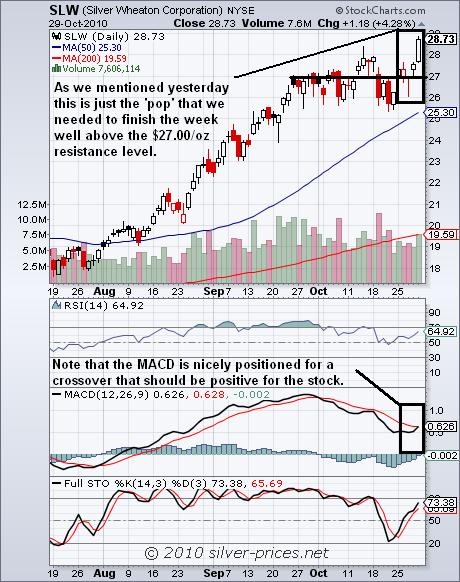
| Silver Wheaton Up 4.36% on Friday Posted: 31 Oct 2010 01:31 AM PDT Silver Wheaton Corporation (SLW) Up 4.36% Friday
As we mentioned in our update Thursday, this is just the ‘pop’ that we needed to finish the week well above the $27.00/oz level, which had been acting as resistance to Silver Wheaton’s progress. So it gave us great pleasure to watch this stock close at $28.75, for a gain of $1.20, or 4.36%. Complete Story »
| ||||
| Posted: 31 Oct 2010 01:08 AM PDT Certain conditions were met on Friday that convinced me that gold is now entering the final leg up in this particular phase of the ongoing C-wave advance. The final spurt higher last year tacked on a very healthy 19% in a little over 1 month.  A similar performance this year would drive gold to $1578. Although this year we have the added benefit that the entire sector is trading at new all time highs. It is the only sector in the world that is in this position. This is an incredibly powerful combination that could drive the precious metal sector even further than it did last year. At the moment there is a very low risk (-3%) entry for investors and traders to get on board this final run. I explained the setup in depth in the weekend report. For one day only I'm going to offer the 15 month yearly subscription rate again. That works out to a monthly price of $13.33. 15 months should be long enough to get investors not only through this final spurt higher but also back in for the final phase of the C-wave this spring. Get you out of the precious metals market in time to avoid the severe D-wave correction. And then back in to ride the next powerful A-wave advance. We have an incredible opportunity ahead of us over the next several months and year. If you want to take advantage of the discounted yearly subscription click here and follow the Paypal link.       
This posting includes an audio/video/photo media file: Download Now | ||||
| Not Just for “End of World” Types Anymore Posted: 30 Oct 2010 11:38 PM PDT This week's top mainstream financial media gold-as-a-curiosity-story (see the highlighted sections below) comes via this item in the Wall Street Journal about a guy who manages school teachers' retirement money in Texas. (Note that this story sounds awfully familiar, but no references could be found for it at the old blog.)
Yes, the dismissive tone is more evidence that there is probably a very long way to go for the precious metals bull market, but, gold going to $10,000 an ounce does seem like a stretch. Then again, you can get to over $6,000 an ounce simply by replicating the 1971 to 1980 move higher beginning at the cycle low of near $250 about ten years ago.
| ||||
| Will the Silver Breakout Hold? Posted: 30 Oct 2010 09:34 PM PDT Jeff Pierce submits: Silver had a big move this week as did gold, but after taking a look more closely I have some doubts as to whether it can maintain it’s gains. If you look at a daily chart these indicators are really not in an area where a big move starts or even continues from.
The chart below (click to enlarge) shows it’s fast move to previous highs. That sometimes is not such a good thing if the move is too fast. We’ll know by the end of the week if this is a breakout or a double top but if you want to try and get an edge, keep an eye on Pan American Silver (PAAS), Silver Wheaton (SLW). These two have had very clear breakouts and should not move below their confirmation line. Complete Story »
|





 There are gold bulls. And then there is Shayne McGuire. The 44-year-old pension-fund manager from Texas, who spoke recently at a gold conference in Berlin, caused a stir among the roomful of gold aficionados. His provocation: A book that predicts the price of the precious metal could soar to $10,000 an ounce, more than seven times its current price.
| You are subscribed to email updates from Gold World News Flash To stop receiving these emails, you may unsubscribe now. | Email delivery powered by Google |
| Google Inc., 20 West Kinzie, Chicago IL USA 60610 | |


No comments:
Post a Comment