


Gold World News Flash |

- GoldSeek.com Radio Gold Nugget: Michael Ruppert & Chris Waltzek
- In The News Today
- Jim?s Mailbox
- Hourly Action In Gold From Trader Dan
- Are You Taking A ‘No Brainer’ or ‘Head in the Sand’ Approach to Investing in Gold and Silver?
- Gold’s Performance to Continue to Lag the Stock Markets
- Pummeled by the Strong Arm of the Financial Ruin
- More Asian Recognition of Out of Control US Money Printing, Skyrocketing Gold Price
- Crude Oil Barely Moves Ahead of Inventory Data, Gold Shrugs off Dollar Rally and Adva
- Here Is What A Significant Selloff In Gold Might Look
- 20 Million More Ounces of Silver Needed!
- Gold Seeker Closing Report: Gold Ends Near Unchanged While Silver Jumps Over 1% Higher
- Financial Times: CFTC puts spotlight on silver trades
- CFTC Chairman Bart Chilton: Silver has been subject to attempted manipulation
- New tune for market as it B flatter than Mozart concerto
- A Comprehensive Presentation Of America's $1 Trillion Cash Hoard
- Gold in a Low-Inflation Environment, Part II
- Has Gold peaked?
- Gold's Performance to Continue to Lag the Stock Markets
- Is There Life After Sudden Death?*
- While the Dollar Rose Lustily Today, the Gold Price Was Not Disturbed, and Silver Positively Rioted
- Bonfire of the Currencies
- Gold Correction Over? Your Tactics Now
- Gold and SP 500 December Futures Daily Charts; SP Cash Weekly Chart
- Silver Money for Americans
- TUESDAY Market Excerpts
- Gonzalo Lira On The Identity Of The False Religion Behind The Mask Of Economic "Science"
- Rick Rule: Courage of Conviction
- A Quick Glance At Real World Inflation
- Dan Norcini: Thanks to Chilton, off with the tin-foil hats
- Gold 3rd Wave Decline Possibly Underway
- The Food Shock of 2011
- Grantham On The Ruinous Cost Of The Fed's Manipulation Of Asset Prices
- Poststeroids Economics
- Eric Sprott On Bonfire of the Currencies
- While everybody worries about fiat currencies, virtual currencies become a multi-billion dollar industry poised to redefine all the rules governing economics
- The New Sheriffs, Reconsidered
- The End of Cheap Food
- Jim's Mailbox
- Graceland Updates 4am-7am
- New “Virtual World Reserve Currency” in the Works, and it’s not the SDR
- Gold Correction Over? The Tactics!
- Deep Thoughts From Paul Tudor Jones On The Sino-US Relationship
- China Retaliates Again, Accuses US Of "Out Of Control" Dollar Printing
- GOLD: Further To Run
- Is the New Precious Metals ETF Worth Buying?
- The Business of Consumer Protection
- CityWire in London notes CFTC Commissioner Chilton's statement
- CityWire in London notes CFTC Commissioner Chilton's statement
- The Return to Good Money
| GoldSeek.com Radio Gold Nugget: Michael Ruppert & Chris Waltzek Posted: 26 Oct 2010 07:00 PM PDT GoldSeek.com Radio Gold Nugget: Michael Ruppert & Chris Waltzek
|
| Posted: 26 Oct 2010 06:25 PM PDT View the original post at jsmineset.com... October 26, 2010 05:54 PM Jim Sinclair's Commentary This certainly sounds good. Let see if it is for real as the only people with rights over the past many years have been the Banksters. An honest man in an amoral world? CFTC’s Chilton raises alarm about silver market WASHINGTON | Tue Oct 26, 2010 9:30am EDT WASHINGTON Oct 26 (Reuters) – There have been repeated attempts to influence prices in silver markets, Bart Chilton, a commissioner at the U.S. futures regulator, said on Tuesday. "There have been fraudulent efforts to persuade and deviously control that price," Chilton said in prepared remarks before a Commodity Futures Trading Commission meeting. Chilton said he could not pre-judge the outcome of the CFTC’s ongoing investigation of the silver markets, but said public deserves some answers to their concerns. More… CFTC Takes Aim at "Runaway Robotic Trades": Chilton By Christopher Doerin...
|
| Posted: 26 Oct 2010 06:25 PM PDT View the original post at jsmineset.com... October 26, 2010 12:14 PM Jim and Dan, Here's today's update: CIGA Stefaan Home prices fell in August, near lows: S&P CIGA Eric Sluggish to falling home prices are not keeping pace with the rate of currency devaluation. This underperformance is illustrated by a declining median home price to gold ratio. The chart reveals that the bounce within the steps is not only weakening but also shortening as the price of gold accelerates. U.S. Median Home Price (MHP) to Gold: Falling constant currency or "real" home prices means homebuilders struggle to remain profitable. S&P Homebuilders (HB) to Gold Ratio: Prices of single-family homes fell in August, hovering around recent lows after the expiration of popular homebuyer tax credits, according a Standard & Poor’s/Case-Shiller home price report on Tuesday. The S&P/Case Shiller composite index of 20 metropolitan areas declined 0.3 percent in August from Ju...
|
| Hourly Action In Gold From Trader Dan Posted: 26 Oct 2010 06:25 PM PDT View the original post at jsmineset.com... October 26, 2010 10:05 AM Dear CIGAs, The silver market was abuzz with news today about CFTC Commissioner, Bart Chilton, concerns over price manipulation. The fact that he has come out so publicly took many, outside the camp of GATA and others, by surprise and lit a fire under that market which took it up into a resistance area near $24 on the charts. Strength in silver then worked to pull up gold which had been under pressure from the falling Euro and the subsequent bounce towards 78 in the Dollar. You have to wonder about the many who have insulted GATA and its fine work over the years and ridiculed them in such a derogatory fashion whether they will now have the common decency to apologize for their shameless and contemptuous treatment of my friends Bill Murphy and Chris Powell and all the other dedicated members of the GATA board. The fact that Commissioner Chilton has come out so forcefully and chosen to use the words, "fraudulent" ...
|
| Are You Taking A ‘No Brainer’ or ‘Head in the Sand’ Approach to Investing in Gold and Silver? Posted: 26 Oct 2010 06:04 PM PDT It is genuinely amazing that so many economists and investment professionals continue to promote "business as usual" investment advice. Their clients will surely pay a steep price for this "head in the sand" approach to investing. Here's why.
|
| Gold’s Performance to Continue to Lag the Stock Markets Posted: 26 Oct 2010 06:03 PM PDT The recent very low negative correlation value of around -0.2 (very close to 0) indicates that gold and the stock market are decoupling. It means that gold may or not go up as the stock market keeps rally, or the stock market may or may not go down if gold declines. That is the exact market behavior we saw last week.
|
| Pummeled by the Strong Arm of the Financial Ruin Posted: 26 Oct 2010 06:02 PM PDT Casey's Gold & Resource Summit reports that "Casey Research's own resident economic genius Bud Conrad" is the "nonpareil whirling dervish of data points," which is an odd descriptor, and I interpret it as meaning a guy who knows how to send you into cardiac arrest with "a mind-boggling sequence of charts and graphs covering virtually every aspect of the economy."
|
| More Asian Recognition of Out of Control US Money Printing, Skyrocketing Gold Price Posted: 26 Oct 2010 05:51 PM PDT Next Media Animation, based in Taipei, Taiwan, has recently produced the animated news segment below on how a "gold rush sweeps the markets." Probably the most interesting part is what they highlight as the cause… Ben Bernanke, evil villain-style, is running the dollar printing press and the Fed building is spewing forth cash on celebrating people (likely bailout recipients) dancing in the streets. The increase in gold value is likened in several scenes to winning big money in a casino, which is not at all what the situation resembles for longtime suffers of the DR, who would have had a sense of what was coming at the beginning of the decade. Perhaps though, for investors piling in at record highs, the big win at the slot machine is basically their hope. Clearly, it's difficult to describe this bizarre, but fascinating, video. It's better to simply watch it… and it's worth viewing for Bernanke's animated evil-genius cackle alone. You can see the full clip below, which came to our attention via a post on The Daily Bail. More Asian Recognition of Out of Control US Money Printing, Skyrocketing Gold Price originally appeared in the Daily Reckoning. The Daily Reckoning, offers a uniquely refreshing, perspective on the global economy, investing, gold, stocks and today's markets. Its been called "the most entertaining read of the day."
|
| Crude Oil Barely Moves Ahead of Inventory Data, Gold Shrugs off Dollar Rally and Adva Posted: 26 Oct 2010 05:30 PM PDT courtesy of DailyFX.com October 26, 2010 10:53 PM Tuesday’s small ranges in crude oil and equity markets are characteristic of a bull market, but a bearish inventory report could derail the rally in crude. Gold broke from recent correlations with the U.S. Dollar, but can this disconnect last? Commodities – Energy Crude Oil Barely Moves Ahead of Inventory Data Crude Oil (WTI) - $82.14 // $0.41 // 0.50% Commentary: Talk about a boring day in financial markets on Tuesday. Crude oil had a daily range of 74 cents, or less than 1%, while the S&P 500 stock index fluctuated about 10 points from high to low, also less than 1%. Fitting for such a day, crude settled $0.03, or 0.04%, higher, to end at $82.55. Both crude and stocks are trading near the highest levels of this year, so it is little surprise that we aren’t seeing huge moves to the upside from here. Instead, prices are very gradually creeping higher, climbing the proverbial wall of worry. We would only expec...
|
| Here Is What A Significant Selloff In Gold Might Look Posted: 26 Oct 2010 05:26 PM PDT |
| 20 Million More Ounces of Silver Needed! Posted: 26 Oct 2010 04:02 PM PDT  You already have a market in silver that is close to choking because of supply constraints. Now some are estimating that 20 million ounces will be needed to fill an order for Sprott Asset Management's new Silver Trust. It seems to me that higher prices will be needed to fill an order of that magnitude. You already have a market in silver that is close to choking because of supply constraints. Now some are estimating that 20 million ounces will be needed to fill an order for Sprott Asset Management's new Silver Trust. It seems to me that higher prices will be needed to fill an order of that magnitude.
This posting includes an audio/video/photo media file: Download Now |
| Gold Seeker Closing Report: Gold Ends Near Unchanged While Silver Jumps Over 1% Higher Posted: 26 Oct 2010 04:00 PM PDT Gold remained near unchanged in Asia before it fell back off in London and saw a $10.65 loss at as low as $1328.05 by about 10AM EST, but it then rallied back higher for most of the rest of trade in New York and ended near its early afternoon high of $1342.05 with a loss of just 0.02%. Silver fell to as low as $23.159 before it also climbed back higher in the last few hours of trade and ended near its early afternoon high of $23.924 with a gain of 1.19%.
|
| Financial Times: CFTC puts spotlight on silver trades Posted: 26 Oct 2010 03:48 PM PDT By Gregory Meyer and Jack Farchy Financial Times, London Tuesday, October 26, 2010 FT.com / Commodities - CFTC puts spotlight on silver trades A senior US commodities regulator has alleged fraud in silver trading more than two years after investigators began a probe into the market. Bart Chilton, commissioner at the Commodity Futures Trading Commission, said "members of the public" and "publicly available documents" convinced him the silver markets are tainted by violations of federal commodities law. "I do believe that there have been repeated attempts to influence prices in the silver markets," Mr Chilton said on Tuesday at a meeting in Washington. "There have been fraudulent efforts to persuade and what I consider deviously control that price." The CFTC, the US watchdog, in September 2008 disclosed that it was investigating misconduct in the silver market. The announcement followed complaints by small investors that silver prices were artificially suppressed. ...
|
| CFTC Chairman Bart Chilton: Silver has been subject to attempted manipulation Posted: 26 Oct 2010 03:46 PM PDT Rob Mackinlay of CityWire in London has followed up on CFTC Commissioner Bart Chilton's remarks today, getting comment from silver market analyst Ted Butler and your secretary/treasurer. The CityWire story is headlined "Price of Silver Has Been Subject to Attempted Manipulation": Silver markets have been subject to 'repeated attempts to influence prices', according to Bart Chilton, commissioner at the Commodity Futures Trading Commission (CFTC). In a statement released today he said: 'There have been fraudulent efforts to persuade and deviously control that price. Any such violation of the law in this regard should be prosecuted.' Chilton (pictured) suggested that it would be too difficult to prove actual manipulation: 'Under existing law, to prove manipulation, the government is required to demonstrate not only specific intent; we also need to prove that as a result of the intent and market control, that activity caused an artificial price -- a point that can certa...
|
| New tune for market as it B flatter than Mozart concerto Posted: 26 Oct 2010 03:41 PM PDT
First of all, apologies for the fuckawful headline pun, but some days you simply have to play the cards you are dealt. That said, the market was quiet today as it digested marginal macro news and even more marginal earnings news while it continues to wait for next week's QE2 which promises to be a worse proposed sequel than Amistad II: The Return Trip Home.
On the QE2 front, New York Fed President and voting member of the FOMC member William "Dollar Bill" Dudley got his college on today at Cornell University (known as the Harvard of Ithaca, NY) where in a speech he said "The Fed cannot wave a magic wand and make the problems remaining from the preceding period of excess vanish immediately." He then explained "For the millionth time, we're not magicians, we're fucking witch doctors so we don't waive magic wands, we dance around fires and chant incantations to the great Jobu. Come on people, that's Wiccan 101 shit for you."
Dudley went on to say that QE2 would be unwarranted unless "the economic outlook were to evolve in a way that made me more confident we would see better outcomes for both employment and inflation before too long." And with that, Money McBags can see why some teabaggers want the Fed to be shut down since evolution is a myth and thus the economy can't evolve, it can only intelligently design itself to something better and do you trust these people to design anything intelligently?
As far as tangible macro news, consumer confidence rose slightly last month off of an unsurprisingly downwardly revised number and still remains near record lows as most consumers are only confident that the economy is getting worse than Bob Guccione's lungs (and Money McBags tips his jimmy hat to the great media mogul). Digging in to the number shows that the "jobs hard to get" index rose to 46.1% from 45.8%, the "jobs plentiful" index slipped to 3.5% from 3.8%, and the "jobs you're never going to get again" index rose to "oh fuck I'm screwed."
In other macro news, the Case Schiller index weakened, in what Money McBags calls the "no shit Sherlock" fact of the day. While the index rose 1.7% y/y which was below analyst guesses of 2.1%, it fell .2% sequentially or .3% on a seasonally adjusted basis. But here is what Money McBags loves most about the data, per the NY Times "S.& P. announced earlier this year that the unadjusted numbers were a more reliable indicator." So riddle Money McBags this Mr. Case, Mr. Schiller, and Standard and fucking Poor's, if the seasonally adjusted numbers are a worse indicator than the non-seasonally adjusted numbers, WHY THE FUCK DO YOU BOTHER ADJUSTING THEM? That is more mind boggling than the fact that they just now stopped making the Sony Walkman.
Seriously, why take shitty, dated, questionable data in the first place, and manipulate that data to make it even more worthless? It's like whatever the opposite of putting lipstick on a pig is (perhaps putting Rosie O'Donnell in a bikini or Alan Greenspan on CNBC?). So while the adjustment didn't matter this month, making data worse and then presenting that data as relevant can be more misleading than something called naked table building (which apparently involves no nudity, but plenty of wood), so why it is done is more perplexing to Money McBags than anything involving Randy Quaid.
One other piece of interesting news is that Warren Buffett, the original inspiration for the hit show Sister Wives, picked a successor to run the investment side of Berkshire Hathaway, a company that never saw a bail out it couldn't manipulate. The successor is a 39 year old named Todd Combs (and we're told he's no relation to Sean "Puffy" Combs) who won the competition to be the next curmudgeon after blowing Buffett away with his financial stock selections, his refusal to tip more than 13% for subpar service, and his stunning closing statement in the debate part of the competition where he vociferously argued the affirmative side of "Dodd was Graham's bitch."
Internationally, Standard and Poor's raised their outlook for Britain to AAA after running in to Lucy Pinder in a Heathrow bathroom. In addition to the ratings upgrade (though Money McBags cares what S&P rates Great Britain about as much as he cares what Stevie Wonder rates a fireworks show), Britain saw GDP expand by 0.8% from the previous quarter which was double analyst guesses and a result of the first dentist opening up shop in the country.
In the market, F posted their 6th consecutive profitable Q, announced they will be paying down debt, and then reiterated that GM and Chrysler are a bunch of ass hats. In WTF earnings of the day, Coach and Royal Caribbean Cruises both shot up 10%+ after putting up strong quarters in a signal that either the economy is not as weak as Money McBags thinks, or well, simply WTF? Elsewhere, steel makers were all down today as US Steel warned that demand was slowing, prices were falling, costs were rising, and no one is building shit anymore. And finally investment banking losses at UBS drove the stock down as revenue dropped in fixed income, currencies, commodities, and everything else people are no longer trading as they flock to gold while the market dances to beat of the algorithm of the night.
For more bad puns and some small cap analysis, check out Money McBags at the award winning When Genius Prevailed.
|
| A Comprehensive Presentation Of America's $1 Trillion Cash Hoard Posted: 26 Oct 2010 02:41 PM PDT
Perhaps the biggest, and most overtouted, silver lining of the US depression is the massive (presumably) amount of cash held by corporate America, built up over the past two years thanks to massive headcount reductions, overall cost-cutting, and record drops in CapEx investment. And while American non-financial companies currently do indeed have a record $943 billion of cash (of which however $233 billion is in short-term investments), they also have a record amount of debt to go with the cash: 3,394 billion at mid 2010. In addition, as we have long cautioned, nearly a quarter of this cash is held abroad and can not be repatriated. Furthermore, putting the $1 trillion in perspective, it is slightly higher than the total combined annual corporate capital spending and dividend payments by non-financial companies. As such, the cash buffer is certainly not as big as is touted by assorted permabulls. In fact, as even Moody's, which has just released the most comprehensive analysis on US corporate cash discloses, "companies are unlikely to spend their cash on expansion and hiring until there is greater certainty about the direction of the U.S. economy." The primary culprit: companies are all too aware of the record excess capacity slack, and that there is no need to invest for the future until others do so first. But we already knew that. And since we have already been digging underneath the surface of the US cash hoard, and uncovered a variety of unpleasant facts, it has been remarkable how quickly this topic is no longer a talking point among CNBC's anchors and is only brought up by its most clueless guests who don't realize only the dunces now use this argument (kinda like the whole "green shoots" thing that did miracles for Dennis Kneale's career). So here are all the details about the corporate cash stash, and a whole lot more. First, we present some big picture thoughts from Moody's, which to our surprise was also unable to come up with a favorable scenario that sees this cash as being promptly reinvested into the floundering economy:
And confirming that there are no organic growth opportunities in the US, a fact that the administration should be ashamed of more than any of its other disastrous economic policies, is Moody's osbervation that the only possible use for the record cash is not for capex and hiring, but for synthetic shareholder friendly actions:
In fact, by "adding businesses" companies will ultimately let even more people go! After all the primary driver of most M&A are "synergies" which is a prospectus-friendly way of saying mass layoffs. Essentially, the greater the corporate behemoth, the worse off the US middle class is. But far be it for us to point us such minor details on the grand scheme to a communist paradise. The chart below summarizes the total cash and short-term investment holdings of corporate America. It is notable, that while the total has grown since 2009, it has been purely due to the increase in short-term investments (we are confident companies would love to hear about another run on money markets that would lock their $233 billion in short-term holdings indefinitely).
Here are the key summary findings on America's cash:
As the chart below demonstrates, total cash has grown not so much as a function of cash from operations increasing notably (it hasn't), which has been flat for the past 4 years, but due to a massive cut in the outflow side of the equation: CapEx and Dividends.
While the much ignored concept of corporate debt is also at a record, the total debt/cash ratio has indeed dropped. However, since the end of 2009, it has once again started to creep back up, and is now at 3.6x from 3.58x at December 31.
And just like in the stock market, where a few companies are accountable for a majority of the action, so here, the top 20 US companies are responsible for 37% of the total cash and short-term investments, holding $346 billion of cash and ST investments.
A granular analysis of cash sources and uses indicates that in 2009 Working Capital was a notable source of cash, at a time when debt issuance dropped notably (but is again growing in 2010), while cash buybacks have been relatively flat.
Focusing specifically on Funds From Operations (net income):
In other words, companies are massively leveraged to economic improvement. It also means that record high corporate margins have only one way to go from here: down. The trade off to this record lean efficiency is 17% unemployment. And just as corporate cash levels will not drop any time in the near future, so will employment levels not improve. But at least corporate CEOs are better off. And they all have the chairman to thank. Next, we look at working capital:
Note the underlined text: during the next crisis, it will be prcisely working capital that will serve yet again as an in house cash flow substitute for short- and mid-term capital funding needs. Oddly enough, despite this so called "cautious approach" to inventory stocking, according to top down diffusion metrics, inventory levels are again creeping higher, meaning that going forward working capital will likely be a drain of cash once again, just like in the good old times. Lastly, the historically biggest source of cash in the pre-Lehman years was debt issuance. This will once again soon be at the forefront of cash sourcing. For now, companies are merely refinancing record amount of debt as part of the 2012-2013 cliff issue. Very soon, they will start incurring incremental debt, and the debt/cash ratio will once again start to rise drastically. We anticipate non-fin companies to accumulate over $4 trillion in total debt by the end of 2011, just because they can, and just because as BofA earlier noted, they would be stupid not to take advantage of virtually zero cost debt at a time when Bernanke has pretty much guaranteed he will not raise interest rates ever.
As for which industries are the biggest holders of excess cash, there are no surprises there:
The table below looks at the individual tech companies responsible currently for the biggest cash hoard in the world:
A total industry breakdown is as follows:
Next up, we will attempt to determine just how much of this $1 trillion in total cash is held abroad. Per Moody's it is $250 billion. According to others, the amount is as high as half a trillion. If the latter case is valid, it would mean that of the actual $710 billion in cash ($233 billion in ST investments aside, which are far less fungible), almost 70% of the cash is non-touchable! And even that aside, the bottom line is that companies have done nothing less than the inverse of what our Keynesian government is doing: they have cut all investment in future business to the benefit of building out a cash buffer (while the government has taken all future benefits to the present day courtesy of an unlimited taxpayer funded piggybank). And since this capex will need to be reinvested at some point, assuming some reversion to the corporate mean, it is only a matter of time before cash levels decline dramatically once again, only this time nominal debt levels, as pointed out previously, will be at fresh record high levels, courtesy of Bernanke's ZIRP insanity. At this point, we dare someone to bring up the cash on the sidelines theory: within a few months this will be as forgotten as the whole "green shoots" propaganda fiasco.
|
| Gold in a Low-Inflation Environment, Part II Posted: 26 Oct 2010 01:29 PM PDT by Adrian Ash BullionVault Tuesday, 26 October 2010 "There is too little money in the economy." – Bank of England governor Mervyn King, 19 October 2010 SO the FEDERAL RESERVE is dead-set on creating inflation, and it's plain to see why. Household debt in the US now stands so large, paying it down to 2001 levels – as a proportion of income – would require a drop in consumer spending of $2.7 trillion, some 18% of this year's gross domestic product. Deleveraging to 1990 levels of gearing (again, a then-record at the time) would cost US households $3.5 trillion, well over a quarter of their 2010 incomes. It ain't gonna happen, in other words. Not this side of Paul Krugman joining John Maynard Keynes in that eternal "long run" in the sky. So what's needed, or so the theory runs, is inflation in prices. It would make deleveraging very much easier, as happened during the last retrenchment, back in the early 1980s. Consumers got to pay down debt without...well, wi...
|
| Posted: 26 Oct 2010 01:00 PM PDT Even the media now treats G-20 meetings as either non-events or highlights the emptiness of their concluding resolutions. We shouldn't continue to look to them for real change or commitment. But this weekend's meeting produced more than expected in the statement that was made that nations had agreed to not continue 'competitive devaluations'.
|
| Gold's Performance to Continue to Lag the Stock Markets Posted: 26 Oct 2010 12:49 PM PDT Gold and silver have had a sharp move downward in response to China's first interest rate hike last week while the stock market continues to move forward begging the question: "Is gold decoupling from the stock market?" Read More...
|
| Is There Life After Sudden Death?* Posted: 26 Oct 2010 12:48 PM PDT -------------------------------------------------- * of the international banking system. position papers of professorfekete #8, October 27, 2010 The debate on the Real Bills Doctrine (RBD) within the sound money movement is important because the international banking system, financing world trade as well as domestic trade, is facing its greatest challenge in all history. Indeed, it may succumb to the sudden death syndrome, and all efforts to resuscitate it may fail. Worse still, banks have by now acquired such a bad name, and they have earned such a universal hatred for their role in the global destruction of capital and of individual savings, that any new financial institution in whose name the word “bank” figures may be rejected out of hand by the people, should anyone try to make a fresh start in the banking business after the collapse. Banking systems have been wiped out before under both deflationary and hyper-inflationary conditions. But the...
|
| While the Dollar Rose Lustily Today, the Gold Price Was Not Disturbed, and Silver Positively Rioted Posted: 26 Oct 2010 12:30 PM PDT Gold Price Close Today : 1338.00 Change : (0.30) or 0.0% Silver Price Close Today : 23.824 Change : 0.280 cents or 1.2% Gold Silver Ratio Today : 56.16 Change : -0.681 or... This is a summary only. Visit GOLDPRICE.ORG for the full article, gold price charts in ounces grams and kilos in 23 national currencies, and more!
|
| Posted: 26 Oct 2010 11:32 AM PDT World governments just can’t get enough conflict these days. They’ve now resorted to battling each other with money printing.1 The devaluation race is in full gear, and it’s tough to keep track of who’s winning. It’s been just wonderful for investors, of course. In addition to contending with 0% interest rates, they now have to navigate through increased currency volatility and uncertainties associated with potential inflation. Gold and silver are benefitting greatly from this ‘currency war’ as investors seek safe harbor in hard money. We can’t say we’re surprised to see gold and silver where they are, but it has been surprising to witness just how willing and open governments are to blasting their own currencies down in value. Although we have complete confidence that the economists at the world’s various central banks know exactly what they are doing, we’re content to own precious metals investmen...
|
| Gold Correction Over? Your Tactics Now Posted: 26 Oct 2010 11:30 AM PDT Stewart Thomson email: [EMAIL="stewart@gracelandupdates.com"]stewart@gracelandupdates.com[/EMAIL] email: [EMAIL="stewart@gracelandjuniors.com"]stewart@gracelandjuniors.com[/EMAIL] Oct 26, 2010 1. There is a battle going on in the silver market for the $25 level. A lot of silver investors that bought silver on the rebound after the 1980 collapse saw price stopped dead in its tracks at $25. Now, decades later, they want out at break-even. That is 99% of the reason why silver halted at $25. 2. The difference between the amateur and the professional investor can be summed up in one sentence by each group. 3. "We'll see what happens." –Amateur Investor. 4. "We'll respond to what happens." –Professional Investor. 5. As you know, I don't respond to statements such as, "price is getting away, buy now!", "you are missing out, buy now!", "China likes gold, buy now!", "price is going parabolic, buy now!", or "this time is different, buy now!". 6. I res...
|
| Gold and SP 500 December Futures Daily Charts; SP Cash Weekly Chart Posted: 26 Oct 2010 11:08 AM PDT |
| Posted: 26 Oct 2010 10:56 AM PDT I think that my readers will agree that there is a desperate need for some fresh thinking about money in the U.S. Many respected analysts worry that the expected action by the Fed to apply a new bout of QE after the coming elections is fraught with danger. Fiat money in the US is in an advanced stage of decomposition and when money rots, the whole social, economic and political structure of the nation rots with it. A return to sound money is urgent. More and more people are aware of the perilous road ahead if nothing is done. The problems facing the US are so gigantic in nature, that an all-round solution to them is impossible when analyzed in practical terms. A return to sound money is a return to gold and silver as currency. Gold is outstanding as money – but how to realize that goal? Silver is great for popular use – but again, how to regain it? The only way open to regain a sound footing of real money for the US economy must be by establishing a process through which there will be a gradual and natural return to sound money. It is impossible to reform or improve the present monetary system of the US any other way. The US abandoned sound money in a series of gradual steps; the first metal out of the monetary system was gold, in 1933; the second metal out of the system was silver, in 1965. The return to sound money would follow those steps, in inverse order: silver would return first, because silver has always been the money of the people; gold would return last, silver having opened the way. Why did silver coinage disappear from circulation in America? It disappeared because the dollar price of silver rose to a point, back in 1965, where the value of the silver in the silver coin was superior to the value of the coin itself. The result was that most silver coinage was melted down into bullion, which had a value greater than the monetary value of the melted coins. On October 20 a silver dime contained silver worth $1.72! (www.coinflation.com) Dollar inflation caused by expansion of the fiat money supply and expanding credit drove up the price of silver and thus drove silver coinage out of circulation. 
|
| Posted: 26 Oct 2010 10:07 AM PDT Gold chops sideways as dollar firms again The COMEX December gold futures contract closed down $0.30 Tuesday at $1338.60, trading between $1328.10 and $1343.80 October 26, p.m. excerpts: see full news, 24-hr newswire…
|
| Gonzalo Lira On The Identity Of The False Religion Behind The Mask Of Economic "Science" Posted: 26 Oct 2010 10:01 AM PDT
Submitted by Gonzalo Lira “Our God Is Money”: Economics Isn’t a Dismal Science—It’s an Ersatz Religion “Are you an Austrian?” I was asked recently, in the polite tones reserved for asking if I were, say, Jewish or Muslim or Christian.
|
| Rick Rule: Courage of Conviction Posted: 26 Oct 2010 09:57 AM PDT Source: Karen Roche of The Energy Report 10/26/2010 Rick Rule has mastered his fear. A renowned resources investment manager, Rick likes underdog sectors that have fallen out of favor with the wider investment world and has the fortitude to hold those stocks through volatility. In this exclusive interview with The Energy Report, Rick explains why he likes the pummeled natural gas sector and why he hopes he loses money on his sizable bullion holding. The Energy Report: I attended your speech at the recent Casey Conference, wherein you professed a love of bear markets because everything is cheap. Can you explain further? Rick Rule: People draw psychological comfort from increasing share prices; but, if trying to increase wealth, they also have to augment their assets. Assets are cheap during bear markets and expensive during bull markets. The virtues of bear markets are fairly obvious—assets are cheap and customers (the consumers of assets and providers of capita...
|
| A Quick Glance At Real World Inflation Posted: 26 Oct 2010 09:56 AM PDT
The Casey Report provides a useful glance at the real inflation currently ravaging items that are actually purchased by Americans, not those captured by the Fed's BLS statistics: "On average, our basic food costs have increased by an incredible 48% over the last year (measured by wheat, corn, oats, and canola prices). From the price at the pump to heating your stove, energy costs are up 23% on average (heating oil, gasoline, natural gas). A little protein at dinner is now 39% higher (beef and pork), and your morning cup of coffee with a little sugar has risen by 36% since last October." Of course, the ongoing deflation in items purchases requiring leverage will continue to skew the CPI so far south to make all those who bought 5 Year TIPS yesterday at negative yields end up losing money on the transaction. Chart of the Week: Inflation in the Real World, by Jake Webber of Casey Report As is often the case, there is a big difference between what the government statistics are reporting and what’s going on in the real world. According to the most recent inflation reading published by the Bureau of Labor Statistics (BLS), consumer prices grew at an annual rate of just 1.1% in August.
 On average, our basic food costs have increased by an incredible 48% over the last year (measured by wheat, corn, oats, and canola prices). From the price at the pump to heating your stove, energy costs are up 23% on average (heating oil, gasoline, natural gas). A little protein at dinner is now 39% higher (beef and pork), and your morning cup of coffee with a little sugar has risen by 36% since last October.
|
| Dan Norcini: Thanks to Chilton, off with the tin-foil hats Posted: 26 Oct 2010 09:26 AM PDT 4:21p CT Tuesday, October 26, 2010 Dear Friend of GATA and Gold (and Silver): JSMineSet.com market analyst Dan Norcini this evening has compliments for CFTC Commissioner Bart Chilton and for GATA as well as a result of Chilton's public statement today about manipulation of the silver market. Norcini urges precious metals investors to send their thanks to Chilton and adds: "From here on, those who refer to GATA and its supporters as 'the tin-foil hat' crowd are only making fools out of themselves and revealing themselves to be mere hacks of the bullion bank crowd." You can find Norcini's commentary at JSMineSet.com here: http://jsmineset.com/2010/10/26/hourly-action-in-gold-from-trader-dan-36... CHRIS POWELL, Secretary/Treasurer ADVERTISEMENT Prophecy Resource Goes Into Production A commission appointed by Mongolia's Ministry of Mineral Resources and Energy has conducted the final permit inspection at Prophecy Resource Corp.'s Ulaan Ovoo mine site and has instructed the company to begin coal production. Prophecy Resource (TSX.V: PCY) has begun production of its first 10,000 tonnes of coal as a trial run of supply to be taken by rail to electric power stations in Darkhan and Erdenet, Mongolia's second and third largest cities after the capital, Ulaanbaatar. The company is the second-ever Canadian mining company to get a permit to mine in Mongolia and start production there. For the company's complete announcement, please visit: http://www.prophecyresource.com/news_2010_oct14.php Join GATA here: New Orleans Investment Conference * * * Support GATA by purchasing a colorful GATA T-shirt: Or a colorful poster of GATA's full-page ad in The Wall Street Journal on http://gata.org/node/wallstreetjournal Or a video disc of GATA's 2005 Gold Rush 21 conference in the Yukon: * * * Help keep GATA going GATA is a civil rights and educational organization based in the United States and tax-exempt under the U.S. Internal Revenue Code. Its e-mail dispatches are free, and you can subscribe at: To contribute to GATA, please visit:
|
| Gold 3rd Wave Decline Possibly Underway Posted: 26 Oct 2010 09:22 AM PDT courtesy of DailyFX.com October 26, 2010 06:12 AM 60 Minute Bars Prepared by Jamie Saettele An impulsive decline from the high indicates that the larger trend has reversed. I wrote last week on Friday that “near term expectations are for a corrective advance back to 1350 before the decline accelerates.” A 3rd wave may be underway from 1350. Initial support on a break would be 1280 (100% extension)....
|
| Posted: 26 Oct 2010 09:15 AM PDT Every month, JP Morgan Chase dispatches a researcher to several supermarkets in Virginia. The task – to comparison shop for 31 items. In July, the firm's personal shopper came back with a stunning report: Wal-Mart had raised its prices 5.8% during the previous month. More significantly, its prices were approaching the levels of competing stores run by Kroger and Safeway. The "low-price leader" still holds its title, but by a noticeably slimmer margin. Within this tale lie several lessons you can put to work to make money. And it's best to get started soon…because if you think your grocery bill is already high, you ain't seen nothing yet. In fact, we could be just one supply shock away from a full-blown food crisis that would make the price spikes of 2008 look like a happy memory. Fact is; the food crisis of 2008 never really went away. True, food riots didn't break out in poor countries during 2009 and warehouse stores like Costco didn't ration 20-pound bags of rice…but supply remained tight. Prices for basic foodstuffs like corn and wheat remain below their 2008 highs. But they're a lot higher than they were before "the food crisis of 2008" took hold. Here's what's happened to some key farm commodities so far in 2010…
What was a slow and steady increase much of the year has gone into overdrive since late summer. Blame it on two factors…
America's been blessed with year after year of "record harvests," depending on how you measure it. So when crisis hits elsewhere in the world, the burden of keeping the world fed falls on America's shoulders. According to Soren Schroder, CEO of the food conglomerate Bunge North America, US grain production has filled critical gaps in world supply three times in the last five years, including this summer…
So what happens when those "record harvests" no longer materialize? In September, the US Department of Agriculture estimated that global grain "carryover stocks" – the amount in the world's silos and stockpiles when the next harvest begins – totaled 432 million tons. That translates to 70 days of consumption. A month earlier, it was 71 days. The month before that, 72. At this rate, come next spring, we'll be down to just 64 days – the figure reached in 2007 that touched off the food crisis of 2008. But what happens if the US scenario is worse than a "nonrecord" harvest? What if there's a Russia-scale crop failure here at home?
"When we have the first serious crop failure, which will happen," says farm commodity expert Don Coxe, "we will then have a full-blown food crisis" – one far worse than 2008. Coxe has studied the sector for more than 35 years as a strategist for BMO Financial Group. He says it didn't have to come to this. "We've got a situation where there has been no incentive to allocate significant new capital to agriculture or to develop new technologies to dramatically expand crop output." "We've got complacency," he sums up. "So for those reasons, I believe the next food crisis – when it comes – will be a bigger shock than $150 oil." A recent report from HSBC isn't quite so alarming…unless you read between the lines. "World agricultural markets," it says, "have become so finely balanced between supply and demand that local disruptions can have a major impact on the global prices of the affected commodities and then reverberate throughout the entire food chain." That was the story in 2008. It's becoming the story again now. It may go away in a few weeks or a few months. But it won't go away for good. It'll keep coming back…for decades. There's nothing you or I can do to change it. So we might as well "hedge" our rising food costs by investing in the very commodities whose prices are rising now…and will keep rising for years to come. "While investor eyes are focused on the gold price as it touches new highs," reads a report from Japan's Nomura Securities, "the acceleration in global food price is unrestrained. We continue to believe that soft commodities will outperform base and precious metals in the future." So how do you do it? As recently as 2006, the only way Main Street investors could play the trend was to buy commodity futures. It was complicated. It involved swimming in the same pool with the trading desks of the big commercial banks. And it usually involved buying on margin – that is, borrowing money from the brokerage. If the market went against you, you'd lose even more than your initial investment. Nowadays, an exchange-traded fund can do the heavy lifting for you, no margin required. The name of the fund is the PowerShares DB Agriculture ETF (DBA). There are at least a half-dozen ETFs that aim to profit when grain prices rise. We like DBA the best because it's easy to understand. It's based on the performance of the Deutsche Bank Agriculture Index, which is composed of the following:
So you have a mix here of 50% America's staple crops of corn, beans, wheat and sugar…25% beef and pork…and 25% cocoa, coffee and cotton. It might not be a balanced diet (especially the cotton), but it makes for a good balance of assets within your first foray into "ag" investing. The meat weighting in here looks especially attractive compared to some of DBA's competitors, which are more geared to the grains. It takes about six months for higher grain prices to translate to higher cattle and hog prices. You can capture that potential upside right now…and you'll be glad you did when you sit down to a good steak dinner a few months down the line. After all, it's going to cost you more. Regards, Addison Wiggin The Food Shock of 2011 originally appeared in the Daily Reckoning. The Daily Reckoning, offers a uniquely refreshing, perspective on the global economy, investing, gold, stocks and today's markets. Its been called "the most entertaining read of the day."
|
| Grantham On The Ruinous Cost Of The Fed's Manipulation Of Asset Prices Posted: 26 Oct 2010 08:46 AM PDT
Jeremy Grantham launches into his most aggressive and succinct anti-Fed diatribe yet. He is a man who gets it. 'If I were a benevolent dictator, I would strip the Fed of its obligation to worry about the economy and ask it to limit its meddling to attempting to manage inflation. Better yet, I would limit its activities to making sure that the economy had a suitable amount of liquidity to function normally. Further, I would force it to swear off manipulating asset prices through artificially low rates and asymmetric promises of help in tough times – the Greenspan/Bernanke put. It would be a better, simpler, and less dangerous world, although one much less exciting for us students of bubbles. Only by hammering away at its giant past mistakes as well as its dangerous current policy can we hope to generate enough awareness by 2014: Bernanke’s next scheduled reappointment hearing." Pretty much all familiar topics to Zero Hedge readers. And for those pressed for time, and unable to read the full 16 page must read letter (attached), here is a bulletized form of all Grantham's key issues of contention with our zombifying chairman.
Read the below letter (pdf link) in conjunction with the just released letter from Sprott on how to counteract the Fed's pervasive destruction.
|
| Posted: 26 Oct 2010 08:45 AM PDT
Here is my latest article in the October issue of Institutional Investor (see below). But first I want to bring to your attention two articles from the NY Times. The first one takes a deep look at Ordos, the infamous Chinese ghost town built for 1.5 million residents (here is a slideshow from Time magazine).?A few excerpts:
If excesses in the Chinese economy were limited to Ordos, it would just be a little multi-billion-dollar pimple on the pinkie of a $5-trillion economy. But unfortunately Ordos is symptomatic of much greater excesses all over China.
The second article in the Times tells the very depresseing story of what is taking place in Japan. A few excerpts:
This has a such a familiar ring to it; in fact it sounds exactly like the prediction we often hear that the GDP of the Chinese economy will overtake that of the US by 20xx. Though it may happen, I would not make this prediction solely on the basis of drawing straight lines to extend the growth of the last two decades into the future. This type of analysis is too simplistic, and dangerous. It is important to understand the roots of past success, and often past success is the precursor of a less-than-bright future — Japan is a great example of that!
I am a value investor and rarely have a view on currencies; I don’t know how to value them. But the yen hitting a fifteen-year high against the dollar makes no sense whatsoever. The US has plenty of problems but it is not Japan, at least not yet. In fact the strong yen in itself will likely lead to a substantial decline in the yen, as it is crippling Japan’s export-driven economy. Poststeroid EconomicsBy Vitaliy N. Katsenelson During the ’80s and ’90s, ignorance was bliss. The global economy was growing nicely, and analyzing it (or even paying attention to market cycles) seemed like a waste of time, as the economy came in only three flavors: good, great and awesome. Even if you misread the flavor, the downside was that you’d just make a little less money. Value investors prided themselves on being bottom-up-only analysts, focused on scrutinizing individual stocks, while top-down analysis — making investment decisions by looking only at the macro picture — became unfashionable, viewed as market timing. (I know the above statement may sound a bit over the top, but over the years I have read and listened to dozens of interviews with famous and successful investors who declared that they do bottom-up-only analysis and don’t pay attention to the economy.) Prolonged and virtually uninterrupted growth brought complacency, excesses, and debt. Bottom-up-only analysis worked until it stopped working, as investors discovered during the recent crisis that the global economy can come in additional flavors: bad, horrible, and downright nasty. Today the cost of misreading the economy is much higher. Two years ago the Great Recession waltzed in — to the great surprise of homeowners, the Fed, and the banks — and everyone discovered that house prices don’t always go up. The financial sector, the lifeblood of our economy, started to drown in the sea of bad debt. As the troubles in that sector began to spill into the real economy, the government felt it had no choice but to step in, and the bailouts and stimuli began. Today it is hard to take a walk through our economy and not meet a friendly Uncle Sam; he is everywhere. He’s buying long-term bonds and thereby keeping long-term interest rates artificially low. Since he took over the defunct (for all practical purposes) Fannie Mae and Freddie Mac, he is the U.S. mortgage market, because those organizations account for the bulk of mortgages originated. Of course, he is also on the hook for their losses. Our dear Uncle Sam rolls in style; he doesn’t know how to bail out or stimulate on the cheap. U.S. government debt (at least, the debt that is on the balance sheet) leapt from about 60 percent of GDP before the Great Recession to more than 100 percent in 2010. The party of overleveraged consumers has been crashed by an overleveraged government. To understand the consequences of the Great Recession, consider this analogy: The U.S. economy is like a marathon runner who runs too hard and pulls a hamstring, but finds himself with another race to run. So he’s injected with some industrial-strength steroids, and away he goes. As the steroids kick in, his pace accelerates as if the injury never happened. He’s up and running, so he must be okay — this is the impression we get, judging from his speed and his progress. What we don’t see is what is behind this athlete’s terrific performance: the steroids, or, in the case of our economy, the stimulus. Obviously, we can keep our fingers crossed and hope the runner has recovered from his injury, but there are problems with this thinking. Let’s address them one by one: • Serious steroid intake exaggerates true performance. Economic stimulus creates an appearance of stability and growth, but a lot of it is teetering on a very weak foundation of government intervention. • Steroids are addictive; once we get used to their effects, it is hard to give them up. When the first home-buyer tax credit expired, it was extended for anyone with the patriotic ambition to buy a house. It is hard to give up stimulus, because the immediate consequences are painful, but long-term gain has to be purchased by short-term discomfort. • The longer we use steroids, the less effective they are. Take Japan, which was on the stimulus bandwagon for more than a decade. With the exception of tripled government debt, Japan has nothing to show for its efforts; the economy is mired in the same rut it was in when the stimulus started. • Steroids damage the body and come with significant side effects. In the case of the economy, the side effects are higher future taxes and increased government debt, which brings on higher interest rates and thus below-average economic growth. The hopes that we’ll transition from government steroid injections back to an economy running on its own are overly optimistic. So what does this mean for investors? When we purchase a stock, we are buying a stream of future cash flows. By doing only bottom-up analysis, investors implicitly assume that external factors (the winds and hurricanes of the global economy) have no impact on these cash flows. That is a brave and careless assumption, especially in a poststeroid world. Instead, investors should take a more holistic approach, mixing bottom-up insights with top-down analysis. Vitaliy N. Katsenelson, CFA, is Chief Investment Officer at Investment Management Associates in Denver, Colo. He is the author of “Active Value Investing” (Wiley, 2007) and the upcoming The Little Book of Sideways Markets (Wiley, December 2010). To receive my future articles by email, click here Twitter thougts (you can follow me on Twitter http://twitter.com/vitaliyk ):
|
| Eric Sprott On Bonfire of the Currencies Posted: 26 Oct 2010 08:36 AM PDT
By Eric Sprott Bonfire of the Currencies World governments just can’t get enough conflict these days. They’ve now resorted to battling each other with money printing.1 The devaluation race is in full gear, and it’s tough to keep track of who’s winning. It’s been just wonderful for investors, of course. In addition to contending with 0% interest rates, they now have to navigate through increased currency volatility and uncertainties associated with potential inflation. Gold and silver are benefitting greatly from this ‘currency war’ as investors seek safe harbor in hard money. We can’t say we’re surprised to see gold and silver where they are, but it has been surprising to witness just how willing and open governments are to blasting their own currencies down in value. Although we have complete confidence that the economists at the world’s various central banks know exactly what they are doing, we’re content to own precious metals investments in the meantime until such a day arises when the currency war winner is finally announced. Just to make sure you’re up to date in currency war news, the most recent devaluation shot was fired by the Federal Reserve on August 17, 2010, when it initiated its permanent open market operations (POMO) to stimulate economic activity. The central bank announced its intention to reinvest the proceeds of its maturing mortgage-backed security holdings back into Treasury bonds. Combined with recent comments by the Federal Open Market Committee (FOMC) on increasing the US inflation rate (through money printing), world governments have been coerced into action. They’ll be damned if they let the US devalue against their own respective currencies and slam their exports, so everyone’s devaluing in tandem. It’s literally a "race to the bottom", with all major currencies on the potential fiat currency chopping block. By our count, no less than 23 separate countries have now intervened in the foreign exchange market in some way since September 21, 2010. The goal for all is to increase the supply of their respective paper currencies in order to drive them down in value. In the cases where countries can’t print outright, they have intervened through capital controls or "open mouth" operations (ie. talking down your currency in policy meetings, etc.). Both approaches have significantly increased the currency market’s volatility. Japan’s October 5th announcement of a "new fund" to purchase assets ranging from government to corporate bonds has forced other countries to pursue the same policy, and the world now awaits similar announcements from the United States and UK in the form of new Quantitative Easing programs.2 Investors aren’t clueless, however, and many are shifting capital to protect themselves. A large number of commodities are now benefitting from the uncertainty created by the devaluation race. Gold, silver, oil, copper, wheat, sugar and platinum are all on the run, and yet we have no reported inflation! Kudos go to the Central Banks for orchestrating that economic miracle. Nonetheless, regardless of what the CPI says, it’s clear that investors are proactively preparing themselves for more printing, and gold and silver seem to be the most popular choices for investors seeking safe harbor. If you haven’t participated in gold’s recent rise, don’t fret, because the fun has only just begun. While gold and silver bullion have increased by 20% and 32% since January 1, 2010, respectively, gold stocks as represented by the Market Vectors Gold Miners ETF (GDX), the Philadelphia Gold and Silver Index (XAU), the NYSE Arca Gold Bugs Index (HUI) and the S&P/TSX Global Gold Index have all trailed gold’s performance for the entire year. You wouldn’t expect the senior gold producers to be trailing behind gold in this environment. After all, at $1,300 gold, these companies literally have a license to print money. What better business is there to be in right now? These are companies that can process an ounce of gold for $800 and sell it for $1,300, with virtually no sales risk. What other investment sector can boast that kind of margin in this environment? Chart A
We believe the gold producers present an excellent investment opportunity right now. To explain why, consider the NYSE Arca Gold Bugs Index (HUI). The HUI is a modified equal-dollar weighted index of companies involved in major gold mining. The HUI was designed to give investors exposure to near-term movements in the gold price by focusing on companies that do not hedge their gold production beyond 1.5 years. The HUI was launched with a base value of 200 in March 1996 and includes some of the largest gold mining companies in the world. Despite a 35% increase in the price of gold since March 2008, the HUI has barely moved at all. As Chart A illustrates, this gold equity index is currently trading at the same approximate level it was when gold was barely over $1,000. The current HUI valuation doesn’t reflect the operating leverage that the $350 increase in the spot gold price could potentially have on earnings – which brings us to an important point that investors often overlook in gold stocks. Because of the nature of gold mining’s fixed costs, any increase above the total cost per ounce significantly increases a gold producer’s net income on a percentage basis. Consider a hypothetical gold producer with cash costs of ~$500 per ounce, which is around the industry average. At $1,000 gold, this company generates an EBITDA of $500 per oz per ounce mined. Simple enough. But most mining companies have extra costs on top of their operating expenses. For a new gold project these extra expenses will typically add another $300 or so per oz. So for every ounce mined, our gold mining company is now only generating $200 of margin based on 2009 input costs and $1,000 gold. With $1,350 gold, however, and the same cost structure of $500 in operating costs and $300 in additional costs, our hypothetical gold company has now increased its margin from $200 to $550 an ounce, representing an increase of 175%! We don’t believe current gold equity valuations reflect this potential margin increase at all, but they soon will. A re-rating is just around the corner. Class B
The bullish case for gold stocks is even more compelling if you consider the historical trend going back to 2000. Chart B plots the HUI index in gold terms. When this ratio is rising, it means that gold companies as measured by the HUI are outperforming gold. Conversely, when this ratio falls it means gold is outperforming the HUI. As you can see, the recent relative underperformance to gold is not in line with the historical trend. Chart B illustrates that gold stocks are currently trading at the same relative valuation they did when gold was priced at $313/oz! We were investing in gold stocks in 2003 and did not find them to be rich in valuation. We believe this discrepancy indicates that gold stocks have a ways to appreciate in order to match the underlying metal’s recent performance. For those readers who are more technically inclined, the HUI Index chart is signaling a very bullish uptrend. For a more astute confirmation, we asked our prime technical analyst Ross Clark from CIBC Wood Gundy to review the HUI’s technical patterns. Ross has always had a very accurate perspective on the gold market in our opinion. As he explained to us, "Capitulation in the dollar (October 1st) is generally followed by a low in mining stocks within six weeks. When the HUI is pushing through to new highs (as seen this month) it is normal for it to pause, making a three to four week correction. If it holds in the mid 400’s we can look forward to a three to four month run with an 80% to 90% rise (emphasis ours). This targets the upper 800’s in the HUI by the end of the first quarter." It is very rare to have fundamental and technical analysis align to predict such a strong move in an equity sector. Now is the time to own gold stocks. Most gold companies will report their Q3 earnings at the end of October. Due to a higher year-over-year average spot gold price (which has increased 27.8% to $1,228/oz in Q3 2010 vs. $961/oz in Q3 2009), virtually every precious metal company is forecast to exhibit substantial net income growth. These fantastic net income results will be augmented by higher by-product prices (average silver, copper, and zinc prices were up 28.7%, 24.2%, and 14.8% year-over-year), which should set the stage for banner year-over-year earnings increases. One of the best axioms for investing is painfully obvious, but so often forgotten by seasoned investors: it’s all about earnings. Earnings are what drive stock prices over the long term. Investors seek out earnings growth wherever they can find it, and we can’t think of a single equity sector that exhibits better year-over-year earnings growth potential than the gold producers. Despite the buzz you’ve heard about gold and silver over the last two months, the stocks haven’t caught up. We expect that to change over the next two quarters as investors realize how much stronger gold producers’ earnings will be at $1,350 gold. As countries decide to burn their currencies in the devaluation race, gold has responded, and now it’s the producers turn to perform. We’ll gladly take the earnings.
1 Wheatley, Jonathan (September 27, 2010) "Brazil in ‘currency war’ alert" Financial Times. Retrieved on October 22, 2010 from: http://www.ft.com/cms/s/0/33ff9624-ca48-11df-a860-00144feab49a.html 2 Ishiguro, Rie (October 5, 2010) "FACTBOX-BOJ to set up fund to buy JGBs, corporate debt" Reuters. Retrieved on October 22, 2010 from: http://www.reuters.com/article/idUSTOE69405K20101005
|
| Posted: 26 Oct 2010 08:35 AM PDT |
| The New Sheriffs, Reconsidered Posted: 26 Oct 2010 08:30 AM PDT The 5 min. Forecast October 26, 2010 11:56 AM by Addison Wiggin [LIST] [*] How the “New Sheriffs of Wall Street” are taking cues from Barney Fife [*] Fearless “consumer watchdog” becomes a Fed lapdog: How to profit from a looming regulatory debacle [*] Uh-oh… the White House sees “make-or-break event” for the dollar in 16 days [*] “Inflation becomes a self-fulfilling prophecy”… the wackiest TIPS auction ever [*] “Acceleration Alley” slams on the brakes, and other signs of a faltering recovery [/LIST] Why, we begin today, are the editors of Time obsessed with troikas of bureaucratic saviors? You’d think after The Committee became the butt of cocktail jokes during the Panic of ‘08… they’d have shied away from anointing the “New Sheriffs.” Alas, there it was, this spring, in feminine form. This time around, the joke is becoming apparent much faster: The...
|
| Posted: 26 Oct 2010 08:22 AM PDT Food is the ultimate regressive tax, which is why it might offer some of the most compelling investment opportunities of the next ten years. The prince dispenses the same number of tuppence for his crumpet as the pauper. But as a percentage of their respective incomes, the crumpet is much more costly for the pauper. This contrast is obvious, but the implications of this contrast for global food prices may be less obvious. The poor spend as much as they possibly can to nourish themselves. The wealthy spend as much as they wish. In fact, because the cost of food does not rise commensurately with incomes, the cost of food becomes so trivial to the wealthy that they end up tossing the stuff into trashcans. For perspective, consider the econo-caloric history of the United States, as it progressed from "Emerging Market" to Superpower. According to the Federal Reserve Bank of Dallas, the average American in 1919 had to work two hours and 38 minutes to buy a 3-pound chicken. Nowadays, it takes just 15 minutes. In statistical terms, Addison Wiggin observes in the latest edition of Apogee Advisory, "Americans spent 23.4% of their disposable income on food in 1929. By 1950 this number had dropped to 20.6%. By 1975, 13.8%. The number finally cracked single digits in 2000. And that figure includes meals eaten both at home and away from home.
"Compare that to Germans," Addison continues. "They spend 11.4% of disposable income just on meals eaten at home. The French, Japanese and South Koreans spend about 14-15%. Brazilians? 24.6%. And the Chinese spend 39.4% of their disposable income on meals eaten at home. "Even Canadians, with a much smaller population and their vast productive prairies, aren't as lucky as we are. They spend 9.2% of their disposable income on meals at home. That's nearly as much as Americans spend both home and away." Therefore, imagine a world in which the global population is rapidly increasing, and in which a growing percentage of that growing population is progressing from mere sustenance levels of existence to conditions of relatively greater prosperity. You don't need to imagine such a world; it has arrived. As the major Emerging Markets of the world like Brazil, India and China continue their progression from chronic underachievers to periodic overachievers, their national wealth will increase. And as this wealth increases, the recipients of it will certainly increase the quantity and/or quality of their diets. Even if the quantity does not increase much, improving the quality of diet would be sufficient to drive food prices much higher. Replacing one meal of beans and rice, for example, with a meal of chicken and rice may not seem very significant. But it requires 6 pounds of grain to produce one pound of chicken meat, according to the USDA. Therefore, if hundreds of millions of individuals begin opting for chicken over beans, the global grain markets would certainly feel the effects…and these effects would not be limited to the grain markets. As the organic food website, www.opes.biz points out, "It requires 700 gallons of water to produce one pound of chicken. Instead, farmers could produce 16 pounds of broccoli, or up to 20 pounds of other grains and vegetables… Also, it takes 8 times the amount of gasoline/fossil fuel for production of one pound of chicken as compared to one pound of protein from tofu." Therefore, forward-looking investors cannot afford to avert their gaze from global dietary trends. As the Emerging Markets continue to emerge, demand for the world's finite supplies of grain, water and energy will increased commensurately…and that means much higher prices. "Americans have become accustomed to cheap and abundant food," Addison winds up. "Probe the psyche of the average American and he'd probably tell you it's a birthright. Amber waves of grain and all that. They're about to get a rude surprise. After a century in which Americans have spent less and less of their incomes on food, the trend is about to reverse." Eric Fry The End of Cheap Food originally appeared in the Daily Reckoning. The Daily Reckoning, offers a uniquely refreshing, perspective on the global economy, investing, gold, stocks and today's markets. Its been called "the most entertaining read of the day."
|
| Posted: 26 Oct 2010 08:14 AM PDT Jim and Dan, Here's today's update:
CIGA Stefaan
Home prices fell in August, near lows: S&P Sluggish to falling home prices are not keeping pace with the rate of currency devaluation. This underperformance is illustrated by a declining median home price to gold ratio. The chart reveals that the bounce within the steps is not only weakening but also shortening as the price of gold accelerates. U.S. Median Home Price (MHP) to Gold: Falling constant currency or "real" home prices means homebuilders struggle to remain profitable. S&P Homebuilders (HB) to Gold Ratio: Prices of single-family homes fell in August, hovering around recent lows after the expiration of popular homebuyer tax credits, according a Standard & Poor's/Case-Shiller home price report on Tuesday. The S&P/Case Shiller composite index of 20 metropolitan areas declined 0.3 percent in August from July on a seasonally adjusted basis, as expected in a Reuters poll. The dip followed a 0.6 percent July gain. Source: finance.yahoo.com
TIPS Yield Goes Negative for First Time The threat has never been deflation. Yet, that's what they'll continue to spin, thus, many will believe. Those that suggest that 2000-present represents a comparison to 1929-1954 ignore the key difference in the U.S. dollar between the two periods. Roosevelt, desiring inflation through currency devaluation, had to confiscate gold as it was directly tied to the dollar. Once gold was confiscated (at $20/oz), it was promptly revalued at $35/oz by executive order. Check you pockets once. Do you find any $20 gold pieces? Any Federal Reserve notes convertible to gold? The U.S. dollar has no anchor and can be devalued at will. On going default through inflation is the real threat. The up turn in the TIPS to nominal long bonds reflects another reacceleration of inflation. It's not the magnitude of the ratio but rather than direction and acceleration that matters to capital. TIPS to Nominal Bond Ratio: In its bid to fight deflation, the Federal Reserve seems to be gaining some traction. On Monday, investors snapped up government securities designed to protect against inflation, generating so much demand that the Treasury was able to sell them with a negative yield, the first time that has happened. Source: online.wsj.com
The Fiscal Disaster Set to Explode in December Expect the moratorium on interest payments to be extended beyond December. The budgetary strains of the States have been and continue to be transferred to the Federal level. This transfer is increasingly supported by currency devaluation – better known as quantitative easing. US Federal Budget (Surplus or Deficit As A % of GDP, 12 Month Moving Average) and Gold London P.M. Fixed: As businesses lay off workers, fewer payroll tax dollars go into each state's unemployment insurance Since March of 2009, 31 states have borrowed billions from the federal government to continue paying out unemployment benefits while keeping their UI trust funds from insolvency. The federal stimulus provided for a moratorium on interest payments until December, 2010. And, as you likely know, that's a month from now. Source: minyanville.com
|
| Posted: 26 Oct 2010 08:13 AM PDT There is a battle going on in the silver market for the $25 level. A lot of silver investors that bought silver on the rebound after the 1980 collapse saw price stopped dead in its tracks at $25. Now, decades later, they want out at break-even. Read More...
|
| New “Virtual World Reserve Currency” in the Works, and it’s not the SDR Posted: 26 Oct 2010 08:00 AM PDT When discussing reserve currency alternatives to the US dollar, conversation almost inevitably returns to the International Monetary Fund's "synthetic reserve asset," the Special Drawing Right (SDR). However, the SDR basket of currencies is noticeably antiquated in its design, including only the currencies of industrialized nations… namely British Pounds, Euros, Japanese Yen, and US Dollars. This week, foreign exchange manager Overlay Asset Management has announced a currency basket it's launching in order to offer a more up-to-date "virtual world reserve currency." According to the Financial Times: "[Overlay Asset Management's] Wealth Preservation Currency Index consists of the currencies of the world's 15 largest economies, weighted by their gross domestic product, adjusted for purchasing power parity. The PPP element ensures a higher weighting to emerging market currencies than is commonplace in other currency baskets, with the Chinese renminbi (accessed through non-deliverable forward contracts) accounting for 16 per cent, Indian rupee 6 per cent and Brazilian real 4 per cent. "In contrast the International Monetary Fund's special drawing rights, the nearest approximation to a global currency, consists purely of a basket of developed world currencies. Overlay says the hedging tool has attracted the interest of sovereign wealth funds, particularly from the Middle East and East Asia, pension funds, insurance companies, wealthy individuals and family offices, while a number of central banks are purportedly keen to use it as a benchmark for their forex reserves… "…Overlay's rationale is that investment portfolios are often heavily exposed to the dollar, but many investors have doubts as to whether the greenback can retain its value and remain the world's primary reserve currency." The global "currency war" — as many are calling it — continues to heat up, with no obvious resolution in sight. While it wouldn't be a simple, quick, or painless process to replace the US dollar as reserve currency, it seems inevitable that calls for just such action are bound to increase, especially if currently loose US monetary policy – including quantitative easing in particular — continues unabated. You can read more details in Financial Times coverage of how a new world currency index has launched. Best, Rocky Vega, New "Virtual World Reserve Currency" in the Works, and it's not the SDR originally appeared in the Daily Reckoning. The Daily Reckoning, offers a uniquely refreshing, perspective on the global economy, investing, gold, stocks and today's markets. Its been called "the most entertaining read of the day."
|
| Gold Correction Over? The Tactics! Posted: 26 Oct 2010 07:41 AM PDT All those who urged you to keep selling into Gold $1156 (and all the other low points, but to buy into 1387), are now urging you to stand aside for "the correction". You should already be on the buy, not calling for higher or lower prices. Telling me your prediction of where price is going is a total waste of my time, and a much bigger waste of your time.
|
| Deep Thoughts From Paul Tudor Jones On The Sino-US Relationship Posted: 26 Oct 2010 07:40 AM PDT
And following up on the previous post demonstrating the escalating war of words vis-a-vis the increasingly hostile stance on Sino-US monetary relations, is the following recently released letter by Paul Tudor Jones in which the legendary traders discusses the critical relationship (among many other things) of the USD-CNY: "As someone who has traded foreign exchange since 1980, I believe the RMB/USD rate is currently the single most important of all exchange rates. It not only drives the largest foreign trade relationship in the world, it also drives virtually every other exchange rate globally. Dozens of other emerging market countries suppress their exchange rate against the US dollar because the RMB is effectively pegged to the dollar. And what is remarkable is the lack of any concrete policy initiative in the US to change this." In other words, we are stuck in an impasse that will not change for a long, long time, as both countries are terrified to really "defect", and neither country has a material advantage in any one regard, plus are entwined, despite all the jawboning, in a symbiotic relationship whose status quo is more valuable than standalone existence. Sorry Schumer. From Paul Tudor Jones Our extraordinary times offer extraordinary opportunities, but as with most opportunities, there will be winners and losers. Economies in the developed world find themselves with unemployment levels not seen since the Great Depression. The response from respective governments has been massive fiscal stimulus in conjunction with monetary easing. And now many of these governments, having exhausted all fiscal stimulus measures that are politically feasible, are about to embark on another round of quantitative easing. The Bank of England, the Bank of Japan and the US Federal Reserve have implemented, or are considering implementing, significant rounds of government securities purchases. Will these measures actually succeed in lowering the chronically high levels of unemployment? Or are the unemployment problems of these countries so structural in nature that these policies will have only limited impact? We’ve enlisted modeling and forecasting firm Macroeconomic Advisers, LLC to assist with answers to these questions. But, first, a story: About ten years ago I had an acute case of plantar fasciitis in the left foot, a condition in which the fascia, or the covering right beneath the skin, had become highly inflamed. I asked Pete Egoscue (egoscue.com), a renowned postural specialist but one without medical training, to take a look at my foot. Pete had, after all, healed a number of people I knew, including my wife. Because Pete was self-taught, I was a skeptic— as any good trader would be. Pete said that he did not need to look at my foot because my foot was not the problem— a response that suggested I was dealing with a quack. But I was patient and continued to listen. He proceeded to explain that the pain in my left foot was the consequence of a structural, postural deficiency in my hip alignment. My right hip was rotated in such a fashion as to make the left side of my body do all the work and bear all the weight, culminating in the inflammation of my left foot. “The pain you feel in your left foot is just the symptom,” Pete said. “If you treat it symptomatically and ignore the structural issue, you will never solve the problem.” I did not immediately grasp the full meaning of his words, but I followed his prescription,and in a few days the pain was gone. Some time later I realized that those words were probably the wisest I have ever heard from any human being, and that they apply to more than just the human body. The developed world, and the United States in particular, is suffering an economic malaise the likes of which we’ve seen only rarely in the last 100 years. Policy makers are searching for solutions, but they are too focused on the painful symptoms of unemployment to see the misshapen structure causing it. In so doing, they are presenting some of the more wonderful trading opportunities in quite some time: winners and losers. The root cause of the unemployment woes is quite obvious. In the United States alone, in the last two decades, nearly six million jobs in manufacturing have been lost overseas. This equates to nearly four percentage points of the current 9.7% US unemployment rate. As importantly, the migration of these jobs contributed to the most unsustainable economic imbalance in the world today—China’s persistent bilateral trade surplus with the United States. During the last decade, China accumulated almost $1.4 trillion of US debt and at least $2.3 trillion in global assets. These figures could grow to $3.8 trillion and $7 trillion, respectively, over the next decade if the current renminbi/US dollar (RMB/USD) exchange rate continues to be artificially suppressed from appreciating. One entity owning this much debt of one debtor, let alone a foreign government, creates too much risk concentration, and has possibly repressed volatility for debtor and creditor alike. The risk may seem manageable now, but who knows what the nature and temperament of the Chinese and American leaders will be in ten years? Isn’t it possible that either side could weaponize financial imbalances to the detriment of domestic and global stability? How did we get here? On January 1, 1994, China devalued its currency by 50% in a single day, and since then has experienced a manufacturing boom. After 15 years of impressive productivity gains relative to its trading partners, though, it now resists the smallest appreciation. (The IMF implies the RMB could be as much as 30% undervalued taking 2000 as a base, but absolute purchasing power parity would argue that undervaluation is even greater— possibly as much as 60%.) Clearly, there is a direct correlation between the six million manufacturing jobs lost in the US and the close to twelve million manufacturing jobs gained in China over the last two decades. Robert E. Scott, a Senior International Economist and Director of International Programs at the Economic Policy Institute, estimates that the growing trade deficit with China, a partial consequence of the undervalued RMB, cost the US 2.4 million jobs between 2001 and 2008 alone, the equivalent of 1.6% of the current unemployment rate. As someone who has traded foreign exchange since 1980, I believe the RMB/USD rate is currently the single most important of all exchange rates. It not only drives the largest foreign trade relationship in the world, it also drives virtually every other exchange rate globally. Dozens of other emerging market countries suppress their exchange rate against the US dollar because the RMB is effectively pegged to the dollar. And what is remarkable is the lack of any concrete policy initiative in the US to change this. For several years, the US Treasury has threatened to name China as a currency manipulator but has always found a basis for avoidance. Even if Treasury cited China, it would just set in motion more negotiations that would likely go nowhere. The lone serious attempt to impose a cost on China’s distortion of global financial markets this year was congressional action on the Currency Reform for Fair Trade Act, known as the Ryan Bill, which would allow US companies to file complaints against China’s currency policies with the Commerce Department, and would empower the Department to levy tariffs and countervailing duties on imports from China. The Ryan Bill passed in the House of Representatives a few weeks ago by a vote of 348 to 79 but is stalled in the Senate. It drew immediate ire from the Chamber of Commerce as well as from eight former US Trade Representatives to China. But it was the very advocacy of the Chamber of Commerce and those Trade Representatives that led us to our current trade deficit. As Einstein said, “Problems cannot be solved by the same level of thinking that created them.” That so many Americans continue to accept this suppression of a variety of exchange rates against the dollar is probably a function of the fact that for so long this suppression provided benefits such as cheap goods and cheap credit. In addition, for a while, manufacturing jobs seemed to be replaced by jobs in the service economy and construction industry without any economic disruption or any rise in the unemployment rate. However, the bursting of the credit bubble exposed the true structural decay that had occurred in the US economy. But, like zombies, many Americans still cling to the naive belief that we can return to the good times of the 90s and the earlier part of this decade, unable or unwilling to recognize that those high times were a debt-driven anomaly. This delusion is fueled by a myriad of financial pundits who warn about the dangers of disrupting free trade. They are quick to point out that the Ryan Bill is contrary to rules of the World Trade Organization. Incredibly, in the WTO’s rules of governance, there is not one reference in any of its documents to the underlying bilateral exchange rate between two countries when trying to reconcile trade differences. It is like trying to referee a World Cup match with a soccer ball that only the players can see. In the case of a controlled or manipulated exchange rate, it is patently unfair if the currency of one partner is grossly misaligned, as the RMB/USD rate is. Any serious attempt to address the structural imbalance is met with a chorus of boos from financial industry pundits who rail against “protectionism.” In discussions involving the Ryan Bill, these pundits have few qualms with lobbing into the mix, like grenades, those most dangerous of words: “Trade War.” They often invoke the specter of Smoot-Hawley, the infamous US tariff act that triggered a trade war in which American exports and imports were slashed by half, leading a number of economists to argue that its passage contributed significantly to the Great Depression. But what they fail to see, or neglect to acknowledge, is that in modern times there never has been free trade with China; the US has already been in a trade war for nearly two decades; and it is the only time in this nation’s history it surrendered without ever firing a shot. The United States lost six million jobs, indebted itself to China by $1.4 trillion, and received in return a host of consumer goods, many of which now reside in landfills across the country. “Trade War” is a very dangerous phrase. Clearly, China and the US are commercial competitors and not enemies. There is no reason for “combat” in any sense of the term. The Chinese have set the RMB/USD peg artificially low because they believed it was necessary in order to shift from an agrarian to an industrial-based economy. The United States also protected its nascent industrial sector when it did the same thing in the 19th century. Developing a significant export-oriented manufacturing base was part of an ambitious plan to relocate hundreds of millions of rural Chinese to cities where they could obtain manufacturing jobs and pursue a better life. It worked. China’s coasts now burst with export-dependent factories and cities. But now and going forward, China’s export strategy is completely unsustainable. In the intermediate term, much less the long term, it is becoming clear that the main buyer of China’s exports—the United States—can no longer foot the bill. A much better policy would be finding the right balance between domestic demand and exports through a stronger currency. Brazil did this brilliantly between 2005 and 2007. Their currency appreciated 34% against the dollar yet the economy grew 2% more than the prior three years and above what was thought previously to be the speed limit. The incoming Chinese administration of 2012 will be forced to contend with a population that has been relocated and retrained for jobs that may one day disappear, much as they did in the United States, all because China engaged in a futile attempt to avoid an inevitable re-equilibration of exchange rates. After all, one way or the other, the real US and Chinese exchange rate will find equilibrium– either through nominal movement or through relative inflation rates. Just as the Chinese elite have become dangerously wed to an unsustainable export-driven manufacturing model, the US elite have become indifferent to mercantilist assaults on the global trade framework. In mid-September, when the Bank of Japan intervened to suppress the value of the yen against the dollar, there was no response from America’s political, financial and media leaders. While these interventions might have been understandable six years ago, when Japan’s economy was relatively less well off than that of the United States, they are far from necessary today: Japan has an unemployment rate that is half that of the United States and it still runs a trade surplus. Nonetheless, Japan intervened to protect its export industry, and the United States, incomprehensibly, responded with not even a whimper, let alone a bang. h/t Richard via Deal Breaker
|
| China Retaliates Again, Accuses US Of "Out Of Control" Dollar Printing Posted: 26 Oct 2010 07:27 AM PDT
After taking heat from the White House for nearly a year for its currency peg, a fact that in itself will never get China to loosen its regime as it would be perceived as yielding to pressure from D.C., China has once again gone on the offensive, this time via its commerce minister who earlier today said that dollar issuance in the U.S. is "out of control" which in turn is leading to an inflation assault on China. Of course, one simple way to deal with said assault would be to revalue the currency, but why do so if the world's biggest export economy benefits from the stupidity of the Federal Reserve. After all, the Fed's China monetary policy allows the US to continue to export inflation and to provide cheap Chinese goods to America's great unwashed masses of Wal Mart shoppers who enjoy cheap (but increasingly more expensive) products. Plus it is not as if China is not printing trillion in money of its own, however in the form of what the US used to do in the past, and do so in the form of cheap, NINJA credit. All in all, this is just another instance of a pot calling a kettle black, even as nothing ever changes.Well, one thing may change: imminent bubbles in ever more rare earth minerals, and soon, rice and rubber, will soon add to pressure in all other already inflating commodities. How companies will be able to pass through these costs to consumers, nobody seems to have either any idea, or care. Certainly not the Fed, which is very myopically welcoming this price change. Via Reuters:
And here is all one needs to know:
In other words, status quo preserved.
|
| Posted: 26 Oct 2010 07:24 AM PDT Aden Article October 25, 2010 By Mary Anne & Pamela Aden Courtesy of Aden Forecast [CENTER][/CENTER] It's been an exciting month. Gold rose, surging well above the $1300 level. Silver and gold shares soared even more. We hear that gold is in a bubble, it can't rise much further and so on. Many wonder, why it's even risen so much? For that, you again have to look at history from a global perspective and it'll provide the answer. LOOKING BACK… We've often pointed out that gold is money. It has been for thousands of years. Paper money is not really money and there isn't one paper currency that has survived over time. Gold, on the other hand, has. It can't be created at will, it's durable and it's always maintained its purchasing power. In 1971 when foreign nations (particularly France) demanded that the U.S. settle its deficits with gold, Nixon, who was worried about the disappearing gold reserves, said "no." In doing so, he shu...
|
| Is the New Precious Metals ETF Worth Buying? Posted: 26 Oct 2010 07:06 AM PDT Hard Assets Investor submits: By Julian Murdoch Last week marked the launch of ETF Securities' Physical Precious Metal Basket of Shares (GLTR), a fund created to allow investors to obtain exposure to four precious metals in one go. To do this, 0.03 ounces of gold, 1.1 ounces of silver, 0.004 ounces of platinum and 0.006 ounces of palladium will back each share of the fund. Complete Story »
|
| The Business of Consumer Protection Posted: 26 Oct 2010 06:57 AM PDT Why, we begin today, are the editors of Time obsessed with troikas of bureaucratic saviors?
You'd think after The Committee became the butt of cocktail jokes during the Panic of '08… they'd have shied away from anointing the "New Sheriffs." Alas, there it was, this spring, in feminine form. This time around, the joke is becoming apparent much faster: The "new sheriffs" are bought and paid for. First, if you don't mind, we'll introduce them, left to right…
Now… Let's take a peek at how effective these new sheriffs are at laying down the law. In reverse order: Bair's FDIC is now so confident about the health of the banks that it's canceling their scheduled increase in deposit insurance payments – you know, the money the banks pay to the fund that "insures" your deposits. The fund is already $20.7 billion in the red. "We are not even close to a point where our financial institutions are truly sound," says Bruce Krasting, a former hedge fund manager who's taken to the blogosphere. "[Bair] folded to the big banks on this one." And when Bank of America took over a failing Merrill Lynch in 2008? It didn't bother informing its shareholders about the scope of Merrill's considerable losses…or bonuses. Schapiro's SEC sued BoA in August 2009…and settled the case the same day for the whopping sum of $33 million. The judge overseeing the case took the extraordinary step of rejecting this sweetheart deal, saying it "does not comport with the most elementary notions of justice and morality." In the end, he reluctantly agreed to a $150 million fine several months later. Chock another up for the tamers of the Wild West! What of Elizabeth Warren and her brainchild, the Consumer Financial Protection Bureau? "The CFPB," explains our stock market vigilante Dan Amoss, "is a new federal bureaucracy created when the president signed the Dodd/Frank bill into law three months ago." As a Harvard law professor, Warren pushed Congress hard to create the agency – much to the chagrin of the bankers. But since joining the administration six weeks ago, she's met with the heads of the 14 biggest banks. No more talk about "blood and teeth left on the floor" – her words to The Huffington Post last March. Now it's all about the government and the banks working together for the common good. "The thing that probably has surprised me most is how surprised they were by the conversation," Warren said last week, reflecting on her recent meetings. "They were very glad to be invited, and they had some very thoughtful insights." Still, knowing what we know about the new sheriffs, should we be surprised? The CFPB's funding comes from the Federal Reserve. Still, a crusading Ivy League academic has to do something to create the illusion of looking out for the little guy. So where to hunt for crooks? "Consumer finance companies," Mr. Amoss says, will be the first target of Warren's wrath, "including payday lenders and other lenders whose complex loans get their customers into a dangerous cycle of debt accumulation." Of course, consumer finance companies don't fund the Fed, and they're only slightly more popular than the operators of puppy mills. So they make an easy target. "A business model," intuits Dan, "that involves rolling customers from one loan to the next is going to be at the top of the CFPB's target list." Addison Wiggin The Business of Consumer Protection originally appeared in the Daily Reckoning. The Daily Reckoning, offers a uniquely refreshing, perspective on the global economy, investing, gold, stocks and today's markets. Its been called "the most entertaining read of the day."
|
| CityWire in London notes CFTC Commissioner Chilton's statement Posted: 26 Oct 2010 06:52 AM PDT 1:47p CT Tuesday, October 26, 2010 Dear Friend of GATA and Gold (and Silver): Rob Mackinlay of CityWire in London has followed up on CFTC Commissioner Bart Chilton's remarks today, getting comment from silver market analyst Ted Butler and your secretary/treasurer. The CityWire story is headlined "Price of Silver Has Been Subject to Attempted Manipulation" and you can find it here: http://citywire.co.uk/money/price-of-silver-has-been-subject-to-attempte... Or try this abbreviated link: CHRIS POWELL, Secretary/Treasurer ADVERTISEMENT Prophecy Resource Goes Into Production A commission appointed by Mongolia's Ministry of Mineral Resources and Energy has conducted the final permit inspection at Prophecy Resource Corp.'s Ulaan Ovoo mine site and has instructed the company to begin coal production. Prophecy Resource (TSX.V: PCY) has begun production of its first 10,000 tonnes of coal as a trial run of supply to be taken by rail to electric power stations in Darkhan and Erdenet, Mongolia's second and third largest cities after the capital, Ulaanbaatar. The company is the second-ever Canadian mining company to get a permit to mine in Mongolia and start production there. For the company's complete announcement, please visit: http://www.prophecyresource.com/news_2010_oct14.php Join GATA here: New Orleans Investment Conference * * * Support GATA by purchasing a colorful GATA T-shirt: Or a colorful poster of GATA's full-page ad in The Wall Street Journal on http://gata.org/node/wallstreetjournal Or a video disc of GATA's 2005 Gold Rush 21 conference in the Yukon: * * * Help keep GATA going GATA is a civil rights and educational organization based in the United States and tax-exempt under the U.S. Internal Revenue Code. Its e-mail dispatches are free, and you can subscribe at: To contribute to GATA, please visit:
|
| CityWire in London notes CFTC Commissioner Chilton's statement Posted: 26 Oct 2010 06:52 AM PDT 1:47p CT Tuesday, October 26, 2010 Dear Friend of GATA and Gold (and Silver): Rob Mackinlay of CityWire in London has followed up on CFTC Commissioner Bart Chilton's remarks today, getting comment from silver market analyst Ted Butler and your secretary/treasurer. The CityWire story is headlined "Price of Silver Has Been Subject to Attempted Manipulation" and you can find it here: http://citywire.co.uk/money/price-of-silver-has-been-subject-to-attempte... Or try this abbreviated link: CHRIS POWELL, Secretary/Treasurer ADVERTISEMENT Prophecy Resource Goes Into Production A commission appointed by Mongolia's Ministry of Mineral Resources and Energy has conducted the final permit inspection at Prophecy Resource Corp.'s Ulaan Ovoo mine site and has instructed the company to begin coal production. Prophecy Resource (TSX.V: PCY) has begun production of its first 10,000 tonnes of coal as a trial run of supply to be taken by rail to electric power stations in Darkhan and Erdenet, Mongolia's second and third largest cities after the capital, Ulaanbaatar. The company is the second-ever Canadian mining company to get a permit to mine in Mongolia and start production there. For the company's complete announcement, please visit: http://www.prophecyresource.com/news_2010_oct14.php Join GATA here: New Orleans Investment Conference * * * Support GATA by purchasing a colorful GATA T-shirt: Or a colorful poster of GATA's full-page ad in The Wall Street Journal on http://gata.org/node/wallstreetjournal Or a video disc of GATA's 2005 Gold Rush 21 conference in the Yukon: * * * Help keep GATA going GATA is a civil rights and educational organization based in the United States and tax-exempt under the U.S. Internal Revenue Code. Its e-mail dispatches are free, and you can subscribe at: To contribute to GATA, please visit:
|
| Posted: 26 Oct 2010 06:40 AM PDT Once again I'm indebted to a reader for passing along a superlative concept and essay on a practical means of returning to "good money" (i.e. some sort of precious metals-based currency). While most precious metals commentators (including myself) strongly advocate the return to some sort of "gold standard", devising a plausible process for moving away from the worthless paper we carry in our wallets today has proven problematic. If we follow the path of "converting" fiat paper-currencies back to precious metals-backed money, we immediately see only two options. Either we get all of the world's major currencies to simultaneously convert their paper-currencies (an extremely unlikely event), or we must do this in some step-by-step process – which must begin with the world's "reserve currency" (currently the U.S. dollar). In my own attempt to reconcile this enormous logistical issue, I previously proposed a two-stage process: first switching from the U.S. dollar to China's renminbi as the new reserve-currency, and then backing the renminbi with gold. My reasoning was that if the two changes were insituted (more or less) simultaneously that there would be an horrific plunge in the U.S. dollar – as a world full of U.S. dollar-holders all sought to rid themselves of their inferior paper in favor of gold-backed renminbi at the same time. The only alternative to that approach for converting fiat-paper to gold- or silver-backed money would be to attempt to 're-back' the U.S. dollar with gold. There are even worse problems confronting this idea. To begin with, most people now believe that the U.S. only has a tiny fraction of the gold reserves it pretends to have. This is the only rational conclusion with respect to any person/entity who claims to hold much more of something than anyone else in the world – but refuses to ever let anyone see it! With no official audit of the U.S. "gold reserves" having been conducted for more than fifty years (despite the relentless efforts of groups like GATA, and the indefatigable Ron Paul), the question has now become not "does the U.S. have as much gold as it claims?" but rather "does the U.S. own any gold, at all?" Compound that problem with the near-infinite trillions of dollars of debts and liabilities amassed by the U.S. government, and it is obvious that the only possible way that the U.S. paper-dollar could ever be converted back to good money would be after the inevitable national default of the U.S. government. With no especially attractive ideas before us, this is what got me so excited when I read the thoughtful proposal of Hugo Salinas Price, the President of the Mexican Civic Association Pro Silver. Readers may recall that Price spearheaded a drive within Mexico to return their own currency to a silver standard. That movement eventually fizzled-out – undoubtedly in part due to the enormous pressure which the U.S. government would have applied to prevent this change. With the U.S.'s large population of Mexican migrants, there would immediately have been a massive influx of that silver money into the U.S. This would be followed by first the U.S.'s Latino population, and soon most Americans ditching their U.S. dollars in favor of Mexican silver-pesos. Not only would such a development be incredibly embarrassing to the U.S. government, but it would have accelerated the paper dollar's devolution toward zero – through being rejected by the U.S.'s own, domestic population. Price solves this problem with the innovative concept of having parallel currencies. To be fair, we can't give Price all of the credit for this idea – since a similar concept has already been implemented in Indonesia. While the official paper-currency remains the "rupiah", along-side the paper, government-minted gold "dinar" and silver "dirham" now also circulate in that economy. A clip reporting on this development provided an anecdote from a middle-class Indonesian man, who opened his first bank-account in 2000, got himself a credit card and debit card – and then noticed how as soon as he allowed his wealth to be held by bankers that the purchasing-power of his paper-currency began rapidly declining. In 2004, the man closed his bank account, and converted all his paper currency to gold and silver money. He reported that Indonesia's inflation-rate soared to 20% shortly thereafter – and not only did his gold and silver money not lose any of its wealth (i.e. purchasing-power), but he earned a gain on his money (net of inflation) versus the value of the official paper. It is in looking at how this Indonesian man (and his fellow-citizens) were completely shielded from the ravages of banker-produced inflation that we see the key to Price's proposal. In order for gold and silver to function as parallel currencies, they must not be assigned some (arbitrary) "legal tender" denomination, but rather must be valued strictly according to the weight of the metal. |


 I’d been asked the question while discussing macro-economic policy in the United States—
 They don’t, of course: The mathematical models economist spend all their time building are simply not up to the task of faithfully reproducing the macro-economic reality, and thereby predicting it.


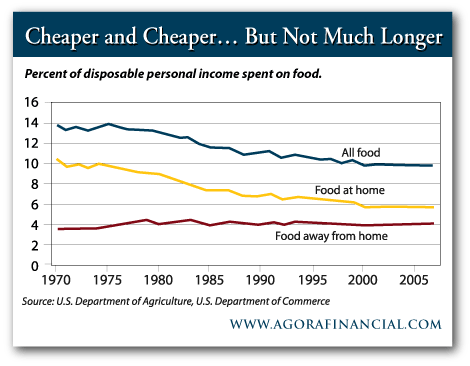


| You are subscribed to email updates from Gold World News Flash To stop receiving these emails, you may unsubscribe now. | Email delivery powered by Google |
| Google Inc., 20 West Kinzie, Chicago IL USA 60610 | |


No comments:
Post a Comment