


Gold World News Flash |
- Craig Hemke: Silver & Gold – DB Turns State’s Evidence, The Flood Gates Are Now Open! - The Daily Coin
- How The American Neoconservatives Destroyed Mankind’s Hopes For Peace
- Negative Rates May Be Positive for Gold
- James Turk – Silver Is Going To Shock The World In 2016!
- Boston Fed Says "Markets Are Wrong," Rates Are Going Higher, Sooner
- British Pound Caught In Strong Trading Range
- The Whole System Is Built Upon Lies And "We're In The Terminal Phase"
- Saudi Arabia threatening Economic Blackmail against U.S.?
- A2A with John Butler
- Nine Meals From Anarchy
- Gold/Silver Price Rigging Admitted by Deutsche Bank, Canada Sues – Craig Hemke
- Armstrong thinks himself omniscient but knows nothing about anti-trust law
- Gold Price Closed up $0.50 or 0.04%
- Peter Schiff : Real Economic Earthquake Is In Our Future, Not Our Past
- Michael Savage Donald Trump Interview - April 18, 2016 - Before New York Primary
- Dollar About To Die
- Gold Is the Specter Haunting Our Monetary System
- 7 Gold And Silver Mining Investment Tips For 2016
- The Man I’m Betting $5 Million On…
- WARNING: "Zika Virus Expected To Outbreak In United States" Agenda 21"?
- John Embry: A bad week for the market riggers
- Edging Toward the “Liberation” of Gold
- Oil Price Plunges Again
- 5 Small Cap Out-Performers Hitting New 52 Week Highs $NNO.V $LAC.TO $BFF.V $PE.V $NUG.V
- Do The Rothschild Rule The World?
- The Fed Rapidly Losing Control, Creating an Inflationary Storm
- Negative Interest Rates May Be Positive for Gold
- Billion Dollar Lawsuits for Gold, Silver Price Rigging, as Saudis Threaten to Dump U.S. Treasuries
- Looming Zinc Supply Shortage Good News for Producers and Explorers: Stefan Ioannou
- Gold Trading Model and COT Data Are in Conflict
| Posted: 18 Apr 2016 11:00 PM PDT Sprott Money | ||||||||||||||||||||||||||||||||||||||||||||||||||||
| How The American Neoconservatives Destroyed Mankind’s Hopes For Peace Posted: 18 Apr 2016 09:00 PM PDT by Paul Craig Roberts, Paul Craig Roberts:
I know about this, because I was part of it. I helped Reagan create the economic base for bringing the threat of a new arms race to a failing Soviet economy in order to pressure the Soviets into agreement to end the Cold War, and I was appointed to a secret presidential committee with subpeona power over the CIA. The secret committee was authorized by President Reagan to evaluate the CIA's claim that the Soviets would prevail in an arms race. The secret committee concluded that this was the CIA's way of perpetuting the Cold War and the CIA's importance. The George H. W. Bush administration and its Secretary of State James Baker kept Reagan's promises to Gorbachev and achieved the reunification of Germany with promises that NATO would not move one inch to the East. The corrupt Clintons, for whom the accumulation of riches seems to be their main purpose in life, violated the assurances given by the United States that had ended the Cold War. The two puppet presidents—George W. Bush and Obama—who followed the Clintons lost control of the US government to the neocons, who promptly restarted the Cold War, believing in their hubris and arrogance that History has chosen the US to exercise hegemony over the world. Thus was mankind's chance for peace lost along with America's leadership of the world. Under neocon influence, the United States government threw away its soft power and its ability to lead the world into a harmonious existance over which American influence would have prevailed. Instead the neocons threatened the world with coercion and violence, attacking eight countries and fomenting "color revolutions" in former Soviet republics. The consequence of this crazed insanity was to create an economic and military strategic alliance between Russia and China. Without the neocons' arrogant policy, this alliance would not exist. It was a decade ago that I began writing about the strategic alliance between Russia and China that is a response to the neocon claim of US world hegemony. http://www.rense.com/general77/tus.htm The strategic alliance between Russia and China is militarily and economically too strong for Washington. China controls the production of the products of many of America's leading corporations, such as Apple. China has the largest foreign exchange reserves in the world. China can, if the government wishes, cause a massive increase in the American money supply by dumping its trillions of dollars of US financial assets. To prevent a collapse of US Treasury prices, the Federal Reserve would have to create trillions of new dollars in order to purchase the dumped financial instruments. The rest of the world would see another expansion of dollars without an expansion of real US output and become skepical of the US dollar. If the world abandoned the US dollar, the US government could no longer pay its bills. Europe is dependent on Russian energy. Russia can cut off this energy. There are no alternatives in the short-run, and perhaps not in the long run. If Russia shuts off the energy, Germany industry shuts down. Europeans freeze to death in the winter. Despite these facts, the neocons have forced Europe to impose economic sanctions on Russia. What if Russia responded in kind? NATO, as US military authorities admit, has no chance of invading Russia or withstanding a Russian attack on NATO. NATO is a cover for Washington's war crimes. It can provide no other service. | ||||||||||||||||||||||||||||||||||||||||||||||||||||
| Negative Rates May Be Positive for Gold Posted: 18 Apr 2016 08:00 PM PDT by John Browne, Euro Pacific Capital:
In the first 14 weeks of the New Year, gold rose 16%. The first quarter qualified as its best beginning year performance in 30 years (CNBC, E. Rosenbaum, 4/14/16). The reversal was prompted by stumbling stock markets and a series of sharply dovish turns from central banks around the world. Perhaps the main reason people buy gold is as a hedge against inflation. But uncertainty and fear contributed undoubtedly to gold's stellar first quarter rise. But will it continue? Opinions vary among some of the most revered gold analysts in large financial firms. They remain focused almost exclusively upon the major historical influence of the inflation outlook and possible rate hikes. And as a result, the mainstream financial firms have yet to alter their decidedly bearish outlook on gold. This could prove positive for those who take the contrarian position. In March, Kitco reported that Robin Bhar, head of metals research for Societe General, forecast an average gold price of $1,150 an ounce for 2016. Combined with the likelihood that fear and uncertainty are receding, Bhar believes that there may be a growing realization that "the risk of an imminent U.S. recession, while not negligible, is far lower than the markets are currently factoring in." He expects the Fed could deliver multiple rate hikes in 2016 and perhaps several during the course of 2017. If this were to happen, the dollar should strengthen and gold should fall. Mr. Bhar's view is supported by Goldman Sachs' global head of commodities, Jeff Currie, who in a CNBC TV interview on April 5threcommended not just a sell of gold, but a short sale. Given the drift of central bank policies around the world, it's hard to imagine why these banks can hold to these beliefs. This is particularly true in light of how widely and rapidly negative interest rates are spreading around the world. Bloomberg reports that as of Feb. 9, 2016, over $7 trillion of bonds, comprising some 29 percent of the Bloomberg Global Developed Sovereign Bond Index, offered negative yields. Another $9 trillion yielded zero to one percent. It is widely accepted that this number will grow rapidly as central banks push yields deeper into negative territory. These rates have already started to be passed through to consumers, who are being charged interest on their bank deposits. Negative rates are now looming so large that on April 15, the Wall Street Journal dedicated almost its entire "Money & Investing" section to the global consequences of negative rates, a phenomenon that has no precedent in human financial history. The section included five separate articles that detailed the absurdities of negative rates, the strains they are placing on the financial system now, and the risks they create for the future. When bank charges are leveled on cash deposits that earn no interest, which are held in debased fiat currency, it may become tempting for more and more individuals to withdraw their funds. Their alternatives could be to buy stock investments, or to hold physical cash in the form of bank notes (which may or may not be stuffed into mattresses). A fall in bank deposits could hurt banks just when they may be hit with fines and increased regulation. Furthermore, even if arguably remote, falling deposits could trigger a cycle of further withdrawals. Given that central banks may confront such a scenario with even more currency debasement, precious metals could become an alternative form of cost-free cash. | ||||||||||||||||||||||||||||||||||||||||||||||||||||
| James Turk – Silver Is Going To Shock The World In 2016! Posted: 18 Apr 2016 07:55 PM PDT
With gold and silver consolidating recent gains, today James Turk told King World News that the price of silver is going to shock the world in 2016! James Turk: “There has been an important development in the precious metals since we last spoke, Eric. Silver has finally | ||||||||||||||||||||||||||||||||||||||||||||||||||||
| Boston Fed Says "Markets Are Wrong," Rates Are Going Higher, Sooner Posted: 18 Apr 2016 07:25 PM PDT Gold and bond prices dropped and stocks popped as yet another open-mouth operation went underway this evening from none other than Boston Fed president Eric Rosengren. Ahead of next week's FOMC meeting, and just days after another Fed president said no April hike, Rosengren spewed firth that "I don't think financial markets have it right." Of course, what this preacher means is that while stock markets are perfectly efficient (and correct), bonds and rate futures areclearly inefficient and "investor outlooks for Fed rate hikes are too pessimistic," because "the US economy is fundamentally sound."
Seriously!!
Of course, after a day of oil/stock rebounds on dismal disappointment in Doha, this makes perfect sense...
yeah you are probably right - what is wrong with this US economy?
Ignore this though he say - it's wrong too!!
As WSJ notes, however, Rosengren, currently an FOMC voter, has long skewed toward the dovish end of the Fed scale.
There was some reaction in markets...
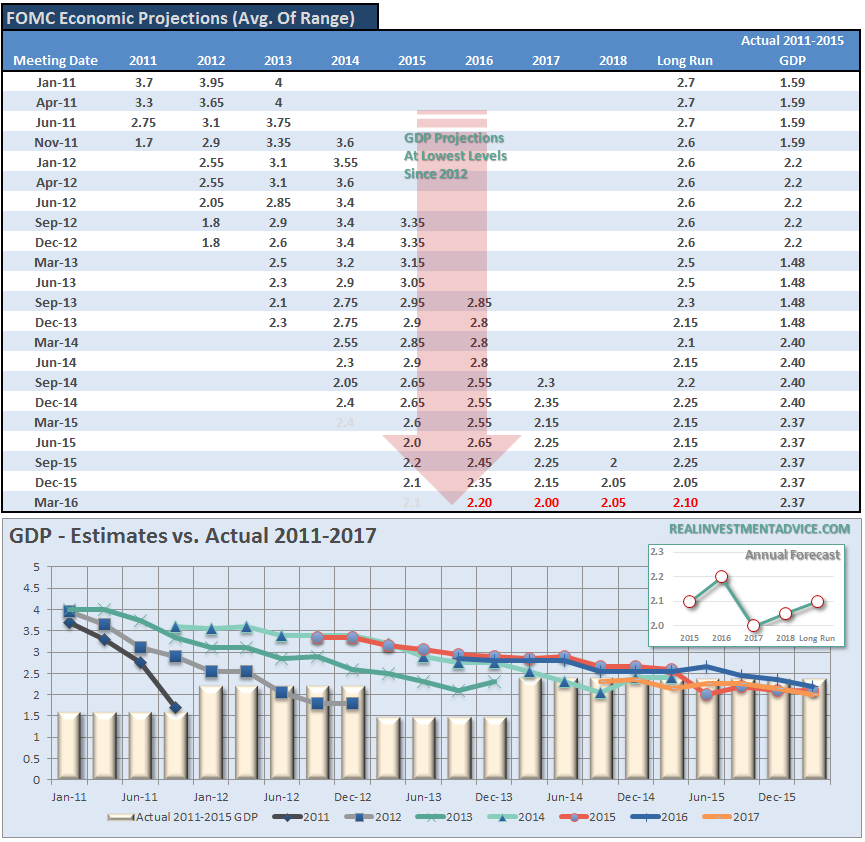
So - interest-rate markets are wrong; macro data is mostly wrong (apart from the jobs data); and The Fed is right? As we showeed in our discussion of the Fed’s forecasts, these predictions have continued to fall short of reality.
And here is Alan Greenspan meeting with Dixie Noonan et al on March 31, 2010:
This comes from the person in charge of the most powerful central bank in the world; a world which now is reliant exclusively on central bankers for its day to day pretend existence. | ||||||||||||||||||||||||||||||||||||||||||||||||||||
| British Pound Caught In Strong Trading Range Posted: 18 Apr 2016 06:53 PM PDT Currency markets have had some difficulty in establishing trends for most of the year, and this has made it harder for traders to establish a strong stance when dealing with the majors. The Euro, US Dollar, and the Japanese Yen have all shown themselves to be clear examples of this but when we look at recent activity in the British Pound it is looking as though some different conclusions can be drawn. | ||||||||||||||||||||||||||||||||||||||||||||||||||||
| The Whole System Is Built Upon Lies And "We're In The Terminal Phase" Posted: 18 Apr 2016 06:30 PM PDT Submitted by Mac Slavo via SHTFPlan.com, At this point, despite major highs in U.S. stock markets and reassurances from no less than President of the United States himself that the economy is sound, one only need to look around to understand that we are on the cusp of what researcher and collapse strategist Michael Snyder of The Economic Collapse Blog calls the “early chapters of a total meltdown.” In his latest interview with Future Money Trends Snyder notes that the fundamental economic problems we face can be seen across the globe. The United States, Europe, Asia, and South America are all crashing and no one will be immune to what comes next.
Full Interview via Future Money Trends: While most Americans think that near-record breaking stock markets are a sign of recovery and revival in the U.S. economy, Snyder goes on to warn that what we’ve seen in Greece, Cyprus, and Argentina, and what’s happening right now in Venezuela, is a coming reality to Americans. That could mean everything from bank holidays wherein governments authorize the seizure of account holders’ deposits, to a full-on collapse scenario like Venezuela where food, toilet paper and basic necessities become totally unavailable. Michael Snyder explains that the one asset class to protect and preserve wealth in the midst of crisis is precious metals and well known billionaire investors have been rapidly acquiring everything they can their hands on in recent months. And as we’ve seen just this year, when panic is the order of the day capital shifts into gold and silver as a crisis hedge. But that’s not all you can do to prepare for the next wave, says Snyder, and diversifying your approach to collapse-proofing your life will be critical because we simply don’t know exactly how events will play out over coming months and years:
But an emergency fund may not be enough, because when the global economy detonates it could bring serious monetary and financial problems with it. And that means supply chains for core essentials like food could dry up because of credit freezes like we saw in Greece. Or, your money will be worth so little because of hyperinflation that you simply won’t have enough of it to put food on the table. And that’s why Snyder advocates owning alternative hard assets and supplies:
The whole system is built upon lies. And while the powers that be tout stability, what they’ve created is anything but. And when the house of cards comes tumbling down you can be sure that the elite will be safely tucked away in their bunkers watching it all play out live on their satellite feeds. They’ve already started preparing for the meltdown by diversifying into precious metals, buckets of food, personal defense armaments and other tangible assets that will be impossible to find during a crisis event. | ||||||||||||||||||||||||||||||||||||||||||||||||||||
| Saudi Arabia threatening Economic Blackmail against U.S.? Posted: 18 Apr 2016 06:02 PM PDT Fox News National Security Analyst KT McFarland on Saudi Arabia's threat of selling hundreds of billions of dollars' worth of U.S. assets, and Russian jets buzzing a U.S. Navy ship. The Financial Armageddon Economic Collapse Blog tracks trends and forecasts , futurists , visionaries ,... [[ This is a content summary only. Visit http://www.newsbooze.com or http://www.figanews.com for full links, other content, and more! ]]  | ||||||||||||||||||||||||||||||||||||||||||||||||||||
| Posted: 18 Apr 2016 05:40 PM PDT by Turd Ferguson, TF Metals Report:
Just a few of the topics addressed in this extraordinarily insightful podcast include: The possibility/likelihood of new gold-backed currencies or notes TF Click HERE to Listen | ||||||||||||||||||||||||||||||||||||||||||||||||||||
| Posted: 18 Apr 2016 05:35 PM PDT Submitted by Jeff Thomas via InternationalMan.com, In 1906, Alfred Henry Lewis stated, “There are only nine meals between mankind and anarchy.” Since then, his observation has been echoed by people as disparate as Robert Heinlein and Leon Trotsky. The key here is that, unlike all other commodities, food is the one essential that cannot be postponed. If there were a shortage of, say, shoes, we could make do for months or even years. A shortage of gasoline would be worse, but we could survive it, through mass transport or even walking, if necessary. But food is different. If there were an interruption in the supply of food, fear would set in immediately. And, if the resumption of the food supply were uncertain, the fear would become pronounced. After only nine missed meals, it’s not unlikely that we’d panic and be prepared to commit a crime to acquire food. If we were to see our neighbour with a loaf of bread, and we owned a gun, we might well say, “I’m sorry, you’re a good neighbour and we’ve been friends for years, but my children haven’t eaten today – I have to have that bread – even if I have to shoot you.” But surely, there’s no need to speculate on this concern. There’s nothing on the evening news to suggest that such a problem even might be on the horizon. So, let’s have a closer look at the actual food distribution industry, compare it to the present direction of the economy, and see whether there might be reason for concern. The food industry typically operates on very small margins – often below 2%. Traditionally, wholesalers and retailers have relied on a two-week turnaround of supply and anywhere up to a 30-day payment plan. But an increasing tightening of the economic system for the last eight years has resulted in a turnaround time of just three days for both supply and payment for many in the industry. This a system that’s still fully operative, but with no further wiggle room, should it take a significant further hit. If there were a month where significant inflation took place (say, 3%), all profits would be lost for the month for both suppliers and retailers, but goods could still be replaced and sold for a higher price next month. But, if there were three or more consecutive months of inflation, the industry would be unable to bridge the gap, even if better conditions were expected to develop in future months. A failure to pay in full for several months would mean smaller orders by those who could not pay. That would mean fewer goods on the shelves. The longer the inflationary trend continued, the more quickly prices would rise to hopefully offset the inflation. And ever-fewer items on the shelves. From Germany in 1922, to Argentina in 2000, and to Venezuela in 2016, this has been the pattern whenever inflation has become systemic, rather than sporadic. Each month, some stores close, beginning with those that are the most poorly capitalised. In good economic times, this would mean more business for those stores that were still solvent, but in an inflationary situation, they would be in no position to take on more unprofitable business. The result is that the volume of food on offer at retailers would decrease at a pace with the severity of the inflation. However, the demand for food would not decrease by a single loaf of bread. Store closings would be felt most immediately in inner cities, when one closing would send customers to the next neighbourhood seeking food. The real danger would come when that store also closes and both neighbourhoods descended on a third store in yet another neighbourhood. That’s when one loaf of bread for every three potential purchasers would become worth killing over. Virtually no one would long tolerate seeing his children go without food because others had “invaded” his local supermarket. In addition to retailers, the entire industry would be impacted and, as retailers disappeared, so would suppliers, and so on, up the food chain. This would not occur in an orderly fashion, or in one specific area. The problem would be a national one. Closures would be all over the map, seemingly at random, affecting all areas. Food riots would take place, first in the inner cities then spread to other communities. Buyers, fearful of shortages, would clean out the shelves. Importantly, it’s the very unpredictability of food delivery that increases fear, creating panic and violence. And, again, none of the above is speculation; it’s a historical pattern – a reaction based upon human nature whenever systemic inflation occurs. Then … unfortunately … the cavalry arrivesAt that point, it would be very likely that the central government would step in and issue controls to the food industry that served political needs rather than business needs, greatly exacerbating the problem. Suppliers would be ordered to deliver to those neighbourhoods where the riots are the worst, even if those retailers are unable to pay. This would increase the number of closings of suppliers. Along the way, truckers would begin to refuse to enter troubled neighbourhoods, and the military might well be brought in to force deliveries to take place. But why worry about the above? After all, inflation is contained at present and, although governments fudge the numbers, the present level of inflation is not sufficient to create the above scenario, as it has in so many other countries. So, what would it take for the above to occur? Well, historically, it has always begun with excessive debt. We know that the debt level is now the highest it has ever been in world history. In addition, the stock and bond markets are in bubbles of historic proportions. They will most certainly pop, but will that happen in a year? Six months? Next week? With a crash in the markets, deflation always follows as people try to unload assets to cover for their losses. The Federal Reserve (and other central banks) has stated that it will unquestionably print as much money as it takes to counter deflation. Unfortunately, inflation has a far greater effect on the price of commodities than assets. Therefore, the prices of commodities will rise dramatically, further squeezing the purchasing power of the consumer, thereby decreasing the likelihood that he will buy assets, even if they’re bargain priced. Therefore, asset holders will drop their prices repeatedly as they become more desperate. The Fed then prints more to counter the deeper deflation and we enter a period when deflation and inflation are increasing concurrently. Historically, when this point has been reached, no government has ever done the right thing. They have, instead, done the very opposite – keep printing. A by-product of this conundrum is reflected in the photo above. Food still exists, but retailers shut down because they cannot pay for goods. Suppliers shut down because they’re not receiving payments from retailers. Producers cut production because sales are plummeting. In every country that has passed through such a period, the government has eventually gotten out of the way and the free market has prevailed, re-energizing the industry and creating a return to normal. The question is not whether civilization will come to an end. (It will not.) The question is the liveability of a society that is experiencing a food crisis, as even the best of people are likely to panic and become a potential threat to anyone who is known to store a case of soup in his cellar. Fear of starvation is fundamentally different from other fears of shortages. Even good people panic. In such times, it’s advantageous to be living in a rural setting, as far from the centre of panic as possible. It’s also advantageous to store food in advance that will last for several months, if necessary. However, even these measures are no guarantee, as, today, modern highways and efficient cars make it easy for anyone to travel quickly to where the goods are. The ideal is to be prepared to sit out the crisis in a country that will be less likely to be impacted by dramatic inflation – where the likelihood of a food crisis is low and basic safety is more assured. Editor’s Note: Unfortunately most people have no idea what really happens when a currency collapses, let alone how to prepare… We think everyone should own some physical gold. Gold is the ultimate form of wealth insurance. It’s preserved wealth through every kind of crisis imaginable. It will preserve wealth during the next crisis, too. But if you want to be truly “crisis-proof” there's more to do… | ||||||||||||||||||||||||||||||||||||||||||||||||||||
| Gold/Silver Price Rigging Admitted by Deutsche Bank, Canada Sues – Craig Hemke Posted: 18 Apr 2016 05:20 PM PDT from CrushTheStreet: | ||||||||||||||||||||||||||||||||||||||||||||||||||||
| Armstrong thinks himself omniscient but knows nothing about anti-trust law Posted: 18 Apr 2016 05:05 PM PDT 8:10p ET Monday, April 18, 2016 Dear Friend of GATA and Gold: In commentary yesterday market analyst and newsletter writer Martin Armstrong minimized and misrepresented Deutsche Bank's admission that it manipulated the gold and futures derivatives markets with other banks. Purporting to answer a subscriber's question -- https://www.armstrongeconomics.com/armstrongeconomics101/basic-concepts/... -- Armstrong wrote that the crowing being done by "gold bugs" about Deutsche Bank's admission "is rather pathetic. It demonstrates how ignorant they are about trading and the marketplace." ... Dispatch continues below ... ADVERTISEMENT Silver Coins and Rounds with Employee Pricing and Free Shipping Grab your Silver Starter Kit at cost from Money Metals Exchange, the company named "Precious Metals Dealer of the Year" by industry ratings group Bullion Directory. Simply go to MoneyMetals.com and type "GATA" in the radio box at the top of the page. This special silver offer contains 4 ounces of silver coins and rounds in the most popular 1-ounce, half-ounce, and 10th-ounce forms. Claim yours now, because GATA readers get employee pricing and free shipping. So go to -- -- and type "GATA" in the radio box at the top of the page. Armstrong continued: "The banks have been clipping people for decades ('manipulation'). ... This 'manipulation' has always been present in every market. The dealers know where the stops are, and if they are within striking distance, they 'manipulate' the market to execute them. ... If you have never traded size, you are not qualified to comment. You obviously have never seen how banks move spreads to clip clients all the time." But the class-action lawsuit in which Deutsche Bank has just admitted violating the law and has pledged to provide evidence incriminating its co-conspirators is emphatically not about running the stops, not about "moving the spreads," and not about what Armstrong asserts is so routine. Rather the lawsuit is about violation of anti-trust law -- that is, about collusion among major participants in the gold and silver derivatives markets, about conspiracy. Here are excerpts from the accusation in the lawsuit's complaint, with emphasis added in italics: "Defendants agreed to systematically suppress the gold benchmark rate through the submission of low net demand during the fixing process and through the publication of a rate that does not reflect actual supply and demand. ... "Defendants reached specific agreements to manipulate the price of gold on particular days on which they expected to buy large quantities of physical gold or execute or settle futures positions. In carrying out those agreements, defendants agreed to submit net demand levels that do not actually reflect their order books. "Defendants' joint action was required to carry out such manipulation, as the submission of fake small orders to buy or large orders to sell by just one defendant would not be sufficient to alter the fixing process significantly so to produce a depressed price. "Defendants entered into fictitious trades so as to create artificial supply or demand at the time of the PM fixing. ... "Defendants, knowing the outcome of the PM fixing ahead of time, used this nonpublic, valuable information to execute transactions on the futures market and reap additional profits at class members' expense, while agreeing to keep this blatant misconduct hidden from their customers and from the public." The full complaint is posted at GATA's Internet site here: http://www.gata.org/files/DeutschBankClassActionLawsuit.pdf While Armstrong considers himself ominiscient even after serving seven years in federal prison, he knows nothing about anti-trust law. Indeed, he knows nothing about the class-action lawsuit about which he presumes to draw conclusions. He "knows" only that markets can move only when he thinks they should move. Really, now: If what Deutsche Bank has just admitted is, as Armstrong says, merely routine, why has the bank agreed to pay financial damages and to provide evidence incriminating its fellow conspirators? Don't Deutsche Bank's lawyers know that Armstrong is omniscient? Or, if Armstrong told them of his omniscience, would they just consider him pathetic? CHRIS POWELL, Secretary/Treasurer Support GATA by purchasing recordings of the proceedings of the 2014 New Orleans Investment Conference: https://jeffersoncompanies.com/landing/2014-av-powell Or by purchasing DVDs of GATA's London conference in August 2011 or GATA's Dawson City conference in August 2006: http://www.goldrush21.com/order.html Or a colorful poster of GATA's full-page ad in The Wall Street Journal on January 31, 2009: http://gata.org/node/wallstreetjournal Help keep GATA going GATA is a civil rights and educational organization based in the United States and tax-exempt under the U.S. Internal Revenue Code. Its e-mail dispatches are free, and you can subscribe at: To contribute to GATA, please visit:
This posting includes an audio/video/photo media file: Download Now | ||||||||||||||||||||||||||||||||||||||||||||||||||||
| Gold Price Closed up $0.50 or 0.04% Posted: 18 Apr 2016 04:42 PM PDT
I don't say this every day, but every so often it needs saying. There ain't much gold & silver in the world. Viewed against history, gold & silver are insanely undervalued. I saw an article today by a famous economist who claimed that to back (really back, not gold plate) the US dollar with gold would call for a price at $10,000 an ounce. Whoa!! Slap your face. Forget the fear & greed & be sober. The door into the silver & gold markets is surpassingly narrow & the lintel quite low. Large crowds cannot simultaneously press through. You must pass through BEFORE the crowds arrive. We sell a LOT of Austrian 100 coronas. Why? Because they are so much cheaper than other gold coins (except Mexican 50 pesos). I can sell them cheaper than one ounce gold bars, and who wouldn't rather have a coin than a cheesy bar? Besides, over time premium always disappears, so dollars spent on premium today will not return when you sell at market peak. (Did your dealer bother to tell you that? Or was he too busy taking orders? Or was he a website? Maybe you ought to call us.) Lately Austrian 100s are teaching me again that there ain't much gold & silver in the world. They're the lowest cost buy on the market, and they've vanished. Can't find 'em. Always get the most gold and silver you can get for your money. Compare this: On a $40,000 purchase today, buying Austrian 100 coronas nets you 0.9475 ounce more gold than American Eagles, or 0.723 oz. more than Krugerrands. At market peak, nobody will care what KIND of ounces you have, only HOW MANY. Over time, premium always disappears. TODAY'S MARKETS: Somebody ought to pour some salt on that US Dollar Index, slug that it is. It broke upside out of a falling wedge last week, then acted like a roach facing a can of Raid at the 50 DMA. Headed for the woodwork. Today it fell again, 22 basis points (0.23%) to 94.47. Mighty lot of teetering & tottering for a market meaning to rise. Recall that the dollar index stands at a crucial crossroad. If it falls through 93.62 (last low), it enters peril of dropping far, far lower. If it holds here and rises, it might rally the rest of the year. Stocks' bear market rally is so baseless & so stubborn that I am beginning to see the Invisible Hand of the Nice Government Men behind it. One wonders why they are so stupid as to stand commanding the sea to rise, like King Canute but without as much class. Dow today rose 106.70 (0.6%) to 18,004.16. S&P500 gained 13.61 (0.65%) to 2,094.34. Walkin' on air. Gold rose 50 little cents to $1,233.60 on Comex. Silver pared off six cents to 1624.9¢. Given the overnight panic over oil dropping, I thought gold held up very well. Of course, the dollar index fell, too, which didn't hurt. I got to feeling like a lunatic, expecting silver to rise through the top of this trading channel, seen here. http://schrts.co/vJfxKN Mark, however, that silver has in fact traded clean through -- not much, but through -- the downtrend line from the April 2011 high. Maybe I'm not such a lunatic. Maybe silver will power on through. Gold was lethargic today trying to punch through it s20 & 50 day moving averages, practically at the same place ($1,234.81 and $1,234.26). MACD has turned down, ROC is pointing down, & RSI is neutral. Prepare yourself for a little drop. Gold will hang on as long as it doesn't close below $1,218. Chrt's here, http://schrts.co/4N1Q5n I keep scratching my scalp and asking, "Why ain't gold & silver breaking down? What are we not seeing? What are they whispering?" I reckon before too long they'll commence shouting. Aurum et argentum comparenda sunt -- -- Gold and silver must be bought. - Franklin Sanders, The Moneychanger The-MoneyChanger.com © 2016, The Moneychanger. May not be republished in any form, including electronically, without our express permission. To avoid confusion, please remember that the comments above have a very short time horizon. Always invest with the primary trend. Gold's primary trend is up, targeting at least $3,130.00; silver's primary is up targeting 16:1 gold/silver ratio or $195.66; stocks' primary trend is down, targeting Dow under 2,900 and worth only one ounce of gold or 18 ounces of silver. US $ and US$-denominated assets, primary trend down; real estate bubble has burst, primary trend down. WARNING AND DISCLAIMER. Be advised and warned: Do NOT use these commentaries to trade futures contracts. I don't intend them for that or write them with that short term trading outlook. I write them for long-term investors in physical metals. Take them as entertainment, but not as a timing service for futures. NOR do I recommend investing in gold or silver Exchange Trade Funds (ETFs). Those are NOT physical metal and I fear one day one or another may go up in smoke. Unless you can breathe smoke, stay away. Call me paranoid, but the surviving rabbit is wary of traps. NOR do I recommend trading futures options or other leveraged paper gold and silver products. These are not for the inexperienced. NOR do I recommend buying gold and silver on margin or with debt. What DO I recommend? Physical gold and silver coins and bars in your own hands. One final warning: NEVER insert a 747 Jumbo Jet up your nose. | ||||||||||||||||||||||||||||||||||||||||||||||||||||
| Peter Schiff : Real Economic Earthquake Is In Our Future, Not Our Past Posted: 18 Apr 2016 03:00 PM PDT Peter Schiff on Alex Jones InfoWars 4/15/2016 Peter Schiff is a well-known commentator appearing regularly on CNBC, TechTicker and FoxNews. He is often referred to as "Doctor Doom" because of his bearish outlook on the economy and the U.S. Dollar in particular. Peter was one of the first... [[ This is a content summary only. Visit http://www.newsbooze.com or http://www.figanews.com for full links, other content, and more! ]]  | ||||||||||||||||||||||||||||||||||||||||||||||||||||
| Michael Savage Donald Trump Interview - April 18, 2016 - Before New York Primary Posted: 18 Apr 2016 02:30 PM PDT April 18, 2016 - Michael Savage Donald Trump Interview - Before New York Primary The Financial Armageddon Economic Collapse Blog tracks trends and forecasts , futurists , visionaries , free investigative journalists , researchers , Whistelblowers , truthers and many more [[ This is a content summary only. Visit http://www.newsbooze.com or http://www.figanews.com for full links, other content, and more! ]]  | ||||||||||||||||||||||||||||||||||||||||||||||||||||
| Posted: 18 Apr 2016 02:00 PM PDT The Financial Armageddon Economic Collapse Blog tracks trends and forecasts , futurists , visionaries , free investigative journalists , researchers , Whistelblowers , truthers and many more [[ This is a content summary only. Visit http://www.newsbooze.com or http://www.figanews.com for full links, other content, and more! ]]  | ||||||||||||||||||||||||||||||||||||||||||||||||||||
| Gold Is the Specter Haunting Our Monetary System Posted: 18 Apr 2016 01:25 PM PDT This post Gold Is the Specter Haunting Our Monetary System appeared first on Daily Reckoning. For a century, elites have worked to eliminate monetary gold, both physically and ideologically. This began in 1914, with the UK's entry into the First World War. The Bank of England wanted to suspend convertibility of banknotes into gold. Keynes counselled wisely that the bank should not do so. Gold was finite, but credit elastic. By staying on gold, the UK could maintain its credit, and finance the war effort. This transpired. The House of Morgan organised massive credits for the UK, and none for Germany. This finance was crucial, and sustained the UK until the US abandoned neutrality and tipped the military balance against Germany. Despite formal convertibility of sterling to gold, the Bank of England successfully discouraged actual conversion. Gold sovereigns were withdrawn from circulation and turned into 400-ounce bars. This form of bullion limited gold ownership to the wealthy, and confined gold's presence to vaults. A similar disappearance of gold as a circulating currency occurred in the US. In 1933, US President Franklin Roosevelt issued an executive order making ownership of gold a crime. FDR relied on the Trading with the Enemy Act of 1917 as statutory authority for this edict. Since the US was not at war in 1933, the enemy was presumably the American people. In 1971, US President Richard Nixon ended convertibility of US dollars into gold by trading partners of the US. Closing the gold window was said by Nixon to be temporary. Forty-five years later the window is still closed. In 1973, the G7 nations, and the IMF demonetised gold. IMF members were no longer required to hold gold reserves. Gold was now just another commodity. The view of the monetary elites was that gold was dead. Yet, like Banquo's ghost, gold insists on its seat at the monetary table. The US holds 8,133 tons of gold. The members of the eurozone and ECB hold 10,788 tons. China reports holdings of 1,788 tons, but actual holdings are closer to 4,000 tons, based on reliable data from Hong Kong exports and Chinese mining. Russia has 1,447 tons, and has been acquiring over 200 tons per year. Mexico, Kazakhstan, and Vietnam, among other nations, have added to their gold reserves recently. (Pity the UK, which sold more than half its gold at rock-bottom prices between 1999 and 2002.) After decades as net sellers of gold, central banks became net buyers in 2010. A scramble for gold has begun. What drives gold's new allure? In some cases, central banks are constructing a hedge against US dollar inflation. China has $3.2 trillion in reserves, over half of which is denominated in US dollars, mostly US Treasury notes. The dollar has no greater friend than China because its wealth is held in dollars. Still, inflation looms. China cannot dump its Treasury notes; the Treasury market is deep, but not that deep. If Chinese selling of Treasuries became a threat to US interests, a US president could freeze Chinese accounts with a phone call. The Chinese know this. They are stuck with their dollars. They fear, rightly, that the US will inflate its way out of its $19 trillion mountain of debt. China's solution is to buy gold. If dollar inflation emerges, China's Treasury holdings will devalue, but the dollar price of its gold will soar. A large gold reserve is a prudent diversification. Russia's motives are geopolitical. Gold is the model 21st-century weapon for financial wars. The US controls dollar payments systems and, with help from European allies, can eject adversaries from the international payments system called Swift. Gold is immune to such assaults. Physical gold in your custody cannot be hacked, erased, or frozen. Moving gold is a simple way for Russia to settle accounts without US interference. Countries are also acquiring gold in advance of a collapse of the international monetary system. The system has collapsed three times in the past century. Each time, major financial powers came together to write new rules. This happened at Genoa in 1922, Bretton Woods in 1944, and the Smithsonian Institution in 1971. The international monetary system has a shelf life of about 30 years. It has been 30 years since the Louvre Accord (an upgrade to the Smithsonian Agreement). This does not mean the system will collapse tomorrow, but no one should be surprised if it does. When the financial powers next convene to reform the system, there will be no appetite for the dollar's exorbitant privilege. The Chinese yuan and Russia ruble are not true reserve currencies. The only feasible benchmarks for a new system are the IMF's world money, called special drawing rights, and gold. Critics claim there is not enough gold to support the financial system. That's nonsense. There is always enough gold, it's just a matter of price. Based on the M1 money supplies of China, the eurozone, and the US, and with 40% gold backing, the implied non-deflationary price of gold is $10,000 per ounce. At that price, a stable gold-backed monetary system could be sustained. When it comes to monetary elites, watch what they do, not what they say. While elites disparage gold at every opportunity, they are buying it, hoarding it, and preparing for the day when one's gold determines one's seat at the table of systemic reform. It's past time to claim your seat with an asset allocation to physical gold. Regards, Jim Rickards P.S. Be sure to sign up for The Daily Reckoning — a free and entertaining look at the world of finance and politics. The articles you find here on our website are only a snippet of what you receive in The Daily Reckoning email edition. Click here now to sign up for FREE to see what you're missing. The post Gold Is the Specter Haunting Our Monetary System appeared first on Daily Reckoning. | ||||||||||||||||||||||||||||||||||||||||||||||||||||
| 7 Gold And Silver Mining Investment Tips For 2016 Posted: 18 Apr 2016 01:20 PM PDT This article is based on a live webinar which was hosted by InvestingHaven.com on Wednesday April 13th during which 15 questions where answered by panelist Rob Tovell, market analyst at RobTovell.com and investor/trader for 4 decades covering all markets including precious metals, and panelist John Newell who manages the “Global Precious Metals Program” fund at Field House Capital. The first part of the webinar was focused on gold and silver mining questions, and the second part about the gold/silver price as well as gold futures market. | ||||||||||||||||||||||||||||||||||||||||||||||||||||
| The Man I’m Betting $5 Million On… Posted: 18 Apr 2016 12:44 PM PDT This post The Man I’m Betting $5 Million On… appeared first on Daily Reckoning. GUALFIN, Argentina – Our recently retired ranch manager, Jorge, came up on Saturday. So, we organized a party for him. More about that tomorrow… Today, we turn our attention back to the shabby world of money… and to a big decision we've made about our own finances. A Remarkable PerformanceAs you may know, we just made a deal with longtime friend and star analyst Chris Mayer. [Watch Bill explain why here.] I say "star" because over the past 10 years, Chris's recommended portfolio has outperformed the best billionaire money managers. We had an independent CPA examine the track record of Chris's Capital & Crisis newsletter (which he no longer edits). Turns out, if you invested $100,000 in Chris's advice in 2004, you would have been sitting on over $480,000 a decade later. As you can see below, against even the best investors in the world – guys like Warren Buffett, Carl Icahn, and David Einhorn – that performance is remarkable.
Our deal with Chris works as follows… Chris will pick stocks using his own methods. We will follow. Later this month, we'll start investing $5 million of our family money in Chris's recommendations. Always in DoubtWe had mixed feelings about it… We have great faith in Chris. But we don't like investing in stocks. When you "invest" in a ranch in Argentina, you make no money… but at least you enjoy yourself. You meet new and interesting people. You confront new challenges. You learn things you didn't know. Stocks give us no such pleasure. Never once has a stock said so much as "hello," no matter how much money we put into it. Also, we believe this is the worst time to invest in the stock market in the last eight years – for the many reasons we've discussed in the Diary. For the record, we still expect U.S. stocks to perform badly in 2016… and beyond. But the guiding principle of the Diary is doubt… We doubt that this is a good time to buy stocks. We doubt that the feds' managed currency system will survive. We doubt that our "Deep State" government serves us well. But we also doubt that God tells us His plan for the stock market. Chris has made a lot of money for his readers over the last decade – through good times and bad. Our investments – heavy with gold, cash and real estate – did less well. The next decade could go either way. We'll stick with our big positions in gold, cash, and real estate. But… bowing to doubt… we'll hedge our bets, too, with stocks. A "Good" Business?Some things you do for profit. Some you do for fun. Some things you do because you don't know any better. And some you do just for the hell of it… We're not sure which category to put this in. If Chris does anywhere near as well as he has for the last 10 years, we will say we did it for the money. If we lose money, we'll say we were right about stocks all along. Like everyone else, we've read many books on investing. We've followed the debates between proponents of the Efficient Market Hypothesis (who claim you can't make outsized returns as an investor without taking outsized risks) and their critics. We've studied the evidence and looked at the results. But all of this "book learning" has been overshadowed by what we have learned from running our own business. In the stock market, you make money by finding good businesses… and sticking with them. The problem is it's hard to know what a good business is. Coca-Cola is a good business. It has a product that costs little to make. And people like it. Many are almost addicted to it. But there are plenty of carbonated drinks around; new ones come along every day. So it is not obvious why Coke should be a winner. That's why people usually can't tell how good a business is, even when they are right in the middle of it. In 1888, for example, Asa Candler bought the formula for Coca-Cola from its inventor, John Pemberton, and other shareholders for just $550. And in 1961, the McDonald brothers – Richard and Maurice – sold their fast-food sandwich shops to Ray Kroc for $2.7 million. And in 1976, the third founding partner of Apple, Ronald Wayne, sold his 10% stake in the company (today worth over $62 billion) for just $800. If founders and owners don't know what their businesses are worth, how can outside investors? Buffett's Big BetMost of the time, the answer is: They can't. Eight years ago, Warren Buffett bet $1 million that a group of hedge funds chosen by New York City-based money management firm Protege Partners would underperform the S&P 500 over the following 10 years. This bet still has two years to run. But so far, Buffett is winning by a large margin. The S&P 500 is up by about 65%… versus the roughly 22% average gain for the five hedge funds Protege Partners selected. If the hot shots running hedge funds can't beat the indexes, who can? All we know for sure is that Chris Mayer has. He's beaten the big money managers, and the S&P 500, over the last 10 years – by a wide margin. Will he do so over the next 10 years? As the SEC reminds us, past performance is no guarantee of future performance. Still, it's all we have to go on. Tilting the OddsOne of the things Chris does to shift the odds in his favor: He pays attention to the people running the business. Again, from our own experience, there are a lot of people running businesses who are more interested in their careers and their compensation than the health of the business itself. Especially, now… and thanks largely to the corruption of the entire system wrought by today's credit-based money… managers and investors tend to be very short-term oriented. But real growth and real profits are rarely produced quickly. Businesses are best understood as learning, not money-making, machines. The ones that succeed are the ones that learn more quickly – at low cost… by trial and error… over a long time. Try to goose up profits in the short run and, most often, you cut off long-term learning. That's why companies bought and sold by professional investors, funds, or private equity firms are almost always a disaster. These predators strip out real assets, load up the company with debt, and then try to sell the husk of the company to unsuspecting investors. That's why Chris favors businesses where the operator has his heart in it. He will do what he has to do to help his business succeed. Again, it's no guarantee. But it's a small edge. Chris (who started his career as a loan officer in a bank) also spends a long time studying company reports and adding up the numbers. Often, he finds they don't add up at all. This doesn't necessarily put him onto winners… but it helps him eliminate the losers. We've known Chris for years. We trust him to pick stocks as much as I trust anyone. Does this mean we will make money following his advice? We don't know. But we're going to find out. And you are, too… We're making our own bet – five times as big as Warren's. We're betting that Chris can not only beat the S&P 500… but also that he can keep us from losing a lot of money, even if the market turns down. Regards, Bill Bonner P.S. Be sure to sign up for The Daily Reckoning — a free and entertaining look at the world of finance and politics. The articles you find here on our website are only a snippet of what you receive in The Daily Reckoning email edition. Click here now to sign up for FREE to see what you're missing. The post The Man I’m Betting $5 Million On… appeared first on Daily Reckoning. | ||||||||||||||||||||||||||||||||||||||||||||||||||||
| WARNING: "Zika Virus Expected To Outbreak In United States" Agenda 21"? Posted: 18 Apr 2016 12:00 PM PDT Could Zika be a pestilence from God because of our persistent disobedience?Has GMO Mosquitoes caused the "Outbreak" of the Zika Virus and the birth defect of Microcephaly The Financial Armageddon Economic Collapse Blog tracks trends and forecasts , futurists , visionaries , free... [[ This is a content summary only. Visit http://www.newsbooze.com or http://www.figanews.com for full links, other content, and more! ]]  | ||||||||||||||||||||||||||||||||||||||||||||||||||||
| John Embry: A bad week for the market riggers Posted: 18 Apr 2016 11:01 AM PDT 2p ET Monday, April 18, 2016 Dear Friend of GATA and Gold: Sprott Asset Management's John Embry tells King World News that last week was a bad one for the market riggers, with Deutsche Bank's confession and discontent rising in Saudi Arabia and China. An excerpt from Embry's interview is posted at KWN here: http://kingworldnews.com/great-dangers-now-threaten-to-destroy-the-globa... CHRIS POWELL, Secretary/Treasurer ADVERTISEMENT Free Storage with BullionStar in Singapore Until 2016 Bullion Star is a Singapore-registered company with a one-stop bullion shop, showroom, and vault at 45 New Bridge Road in Singapore. Bullion Star's solution for storing bullion in Singapore is called My Vault Storage. With My Vault Storage you can store bullion in Bullion Star's bullion vault, which is integrated with Bullion Star's shop and showroom, making it a convenient one-stop-shop for precious metals in Singapore. Customers can buy, store, sell, or request physical withdrawal of their bullion through My Vault Storage® online around the clock. Storage is FREE until 2016 and will have the most competitive rates in the industry thereafter. For more information, please visit Bullion Star here: Support GATA by purchasing DVDs of GATA's London conference in August 2011 or GATA's Dawson City conference in August 2006: http://www.goldrush21.com/order.html Or a colorful poster of GATA's full-page ad in The Wall Street Journal on January 31, 2009: http://gata.org/node/wallstreetjournal Help keep GATA going GATA is a civil rights and educational organization based in the United States and tax-exempt under the U.S. Internal Revenue Code. Its e-mail dispatches are free, and you can subscribe at: To contribute to GATA, please visit: | ||||||||||||||||||||||||||||||||||||||||||||||||||||
| Edging Toward the “Liberation” of Gold Posted: 18 Apr 2016 10:30 AM PDT GoldBroker.com | ||||||||||||||||||||||||||||||||||||||||||||||||||||
| Posted: 18 Apr 2016 09:08 AM PDT This post Oil Price Plunges Again appeared first on Daily Reckoning. And now… today's Pfennig for your thoughts… Good day, and a marvelous Monday to you! Front and center this morning, the price of oil has plunged $3 as the oil ministers meeting in Doha, ended with no agreement to slow production, just like I told you last week that there wouldn’t be an agreement. I find this to be quite interesting in that I get the feeling from the rhetoric there that the oil ministers are feeling pretty cocky right now, and believe they would be better off going on their own, and not part of an oil producing group. And that’s got to send shivers down the spines of those with oil-related investments, for the supply glut would probably just grow to enormous size under those parameters. At least that’s how I see it all playing out. It appears that the Canadian dollar/loonie, and the Russian ruble are being taken to the woodshed for their association with oil. The other petrol currencies from Norway (krone), and Brazil (real) aren’t reacting as violently as rubles and loonies at this point in the day. The real may in fact open up on the positive side of the ledger, given that Brazil’s Lower House voted to impeach President Dilma Rousseff. I do believe there’s one more step in this impeachment process and it goes now to the senate, where all they need is a simple majority vote. It doesn’t look good right now for Rousseff, and real traders are very happy about that prospect, given her time as president, she did everything she could do to weaken the real. The risk sentiment that was all over the place on Friday, has switched back to safe haven buying, which means gold, yen, euros, and treasuries are being bought, and really nothing else. All the hoopla and high-fiving in the currencies on Friday, has ended. For now that is! In Australia, their last Reserve Bank of Australia (RBA) meeting minutes will print tonight. The problem with the minutes as I see them is that they will appear to be stale, given that since the meeting, Aussie employment smacked another ball out of the park, and the currency hasn’t exactly taken off to the moon, although it has been up and down, mostly up each day. I would think that any comments in the statement tonight regarding the strength of the currency would be hollow given that there’s no rate cut on the horizon right now. And the New Zealand dollar/kiwi, is seeing some love this morning, not a lot, just a little, as their latest CPI (inflation) was stronger in the month at 0.2% than expected at 0.1%… So for that, kiwi gets some love this morning, and continues the recent trend of outperforming the A$. The G20 meeting in Washington didn’t come up with anything new. I did think it was interesting that the G20 members decided that would add some verbiage in the communique that talked about the need for member countries to end their prolonged, excessive reliance on unconventional monetary policy to power growth. So, why did I find that interesting? Because the IMF had just issued a statement that called for the established countries to do more with their monetary policies to promote growth, which the IMF had just downgraded for 2016. So, we had the IMF calling for an opening of the monetary policy spigot, and G20 calling for the spigot to be closed. Getting back to the Rousseff Impeachment process… I wanted to mention that it’s important to note that while the Brazilian real is getting the benefits of this impeachment process, it could all unravel very quickly. You see, the markets/traders/investors all believe that getting Rousseff out is important, so they can get a government in that makes decisions that would pull the Brazilian economy out of its economic funk. But what happens if the “new guys” are as inept as the “old guys”? Well, I’ll tell you what I see happening if that happens. And that the real’s gains get unwound. So, the impeachment is important to the real, but even more important will be the performance of the new government. The euro has a small gain this morning that has pushed the euro back over the 1.13 handle. But like I said above, it’s safe haven buying that’s doing the trick here, for there hasn’t been any data to speak of from the Eurozone. The G20 meeting this past weekend, did begin a discussion about BREXIT, and the horrors that will be tied to that. You’ve gotta love these G20 guys and girls, for they love to over dramatize things. Expect more of this talk from future G20 meetings. The Chinese renminbi saw a HUGE appreciation in the fixing last night! And when the fixing was being announced, a Chinese finance official made certain that his audience understood that he believes there are signs that China’s economy has turned the corner. Recall that on Friday last week, I told you that I believed that China’s economy showed signs of building momentum. So, the Finance official confirmed what I believed! After a tough week prior to Friday for gold, the shiny metal was able to post a $6 ($6.50) on Friday, and is up about $5 this morning, as it slowly rebuilds back to $1,250. The days of production needed to cover the short positions in gold remains at about 70. And for silver it’s around 185. That’s sad isn’t it? That the firms can have that many short positions that would require so many days of production to cover them? Oh well, it is what it is. There’s nothing I can do about this, but tell you so that you have an idea of what the metals are up against, but still manage to carve out gains. The U.S. Data Cupboard does not have any Tier 1 data for us today, and actually it only has something called the Housing Market Index. Friday’s Data Cupboard was another disappointment. March Industrial Production (IP) printed negative again at -0.6%, and Capacity Utilization (CAPU) fell from a revised downward 75.3% (was 76.7% when it originally printed) to 74.8%. Uh-Oh, folks, that’s going in the wrong direction! And CAPU is one of the few forward looking pieces of data. UGH! The U. of Michigan sentiment index for the first two weeks of April fell from 91 to 89.7, and was expected to rise to 92. For What It’s Worth. I saw this a couple of places this weekend, so it should be good to go. I took this one from this website and the entire article can be found here, and here’s the snippet:
Chuck again. Well here we go! I always wondered what it was going to take to get these class-action suites going. And with that, let’s get this week going! I hope you have a marvelous Monday, and be good to yourself! Regards, Chuck Butler P.S. Be sure to sign up for The Daily Reckoning — a free and entertaining look at the world of finance and politics. The articles you find here on our website are only a snippet of what you receive in The Daily Reckoning email edition. Click here now to sign up for FREE to see what you're missing. The post Oil Price Plunges Again appeared first on Daily Reckoning. | ||||||||||||||||||||||||||||||||||||||||||||||||||||
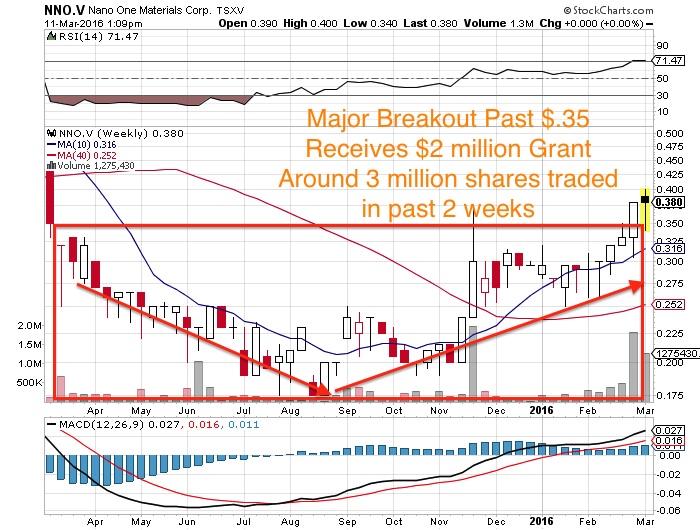
| 5 Small Cap Out-Performers Hitting New 52 Week Highs $NNO.V $LAC.TO $BFF.V $PE.V $NUG.V Posted: 18 Apr 2016 07:58 AM PDT I have just returned back to work after taking a week off to mourn the loss Meanwhile in my absence gold and lithium continues to remain quite strong. In the lithium sector, Lithium Americas (LAC.TO or LACDF) continues to hit Another stock to watch for a major breakout is Pure Energy Minerals (PE.V Keep your eyes on Nevada Energy Metals (BFF.V or SSIMF) which just put one
so this is a great stock to watch for significant gains. See my recent interview with one of the most successful Canadian Entrepreneurs by clicking here…
Disclosure: I own all these stocks and they are all sponsors. Do your own _______________________________________________________ Sign up for my free newsletter by clicking here… Order premium service by clicking here… Please see my disclaimer and full list of sponsor companies by clicking here… To send feedback or to contact me click here… Tell your friends! Please forward this article to a friend or share the link on Facebook, Twitter or Linkedin. For informational purposes only. This is not investment advice. May contain forward looking statements. | ||||||||||||||||||||||||||||||||||||||||||||||||||||
| Do The Rothschild Rule The World? Posted: 18 Apr 2016 06:30 AM PDT Do The Rothschilds Rule The World? They're the world's richest family. They have a stake in nearly every bank on Earth. If money is power, do the Rothschilds rule the world? The Financial Armageddon Economic Collapse Blog tracks trends and forecasts , futurists , visionaries , free... [[ This is a content summary only. Visit http://www.newsbooze.com or http://www.figanews.com for full links, other content, and more! ]]  | ||||||||||||||||||||||||||||||||||||||||||||||||||||
| The Fed Rapidly Losing Control, Creating an Inflationary Storm Posted: 18 Apr 2016 06:13 AM PDT The Fed is rapidly losing control. Core inflation has already broken above 2% despite a complete collapse in commodity prices (the cost of living for many household items). | ||||||||||||||||||||||||||||||||||||||||||||||||||||
| Negative Interest Rates May Be Positive for Gold Posted: 18 Apr 2016 06:00 AM PDT As 2015 came to a close, most investors believed that 2016 would be a year dominated by a series of Fed rate hikes. That conviction solidified in mid-October when comments from multiple Fed officials convinced many that prior hints that the Fed would stay at zero percent rates had been false alarms. The Fed delivered on its promise in mid-December by actually raising rates by 25 basis points. Based on this, gold declined by 10% from October 14 to the end of the year, nearly matching its six year low. Many on Wall Street thought the declines would continue into 2016. They were decidedly wrong. | ||||||||||||||||||||||||||||||||||||||||||||||||||||
| Billion Dollar Lawsuits for Gold, Silver Price Rigging, as Saudis Threaten to Dump U.S. Treasuries Posted: 18 Apr 2016 03:54 AM PDT Gold Stock Bull | ||||||||||||||||||||||||||||||||||||||||||||||||||||
| Looming Zinc Supply Shortage Good News for Producers and Explorers: Stefan Ioannou Posted: 18 Apr 2016 01:00 AM PDT The outlook for zinc appears bullish, says Stefan Ioannou of Haywood Securities, spearheaded by mine closures, dwindling production and the dearth of replacement projects. This looming supply gap could mean increased zinc prices by the end of the year, explains Ioannou in this interview with The Gold Report, a prospect that would bode well for one of the few pure-play zinc producers, as well as for an Australian explorer that may be on the cusp of a world-class discovery. | ||||||||||||||||||||||||||||||||||||||||||||||||||||
| Gold Trading Model and COT Data Are in Conflict Posted: 18 Apr 2016 01:00 AM PDT Technical Analyst Jack Chan says his trading model is indicating that the gold sector is on a new major buy signal, but the COT data is bearish, so he is waiting for the COT to return to bull market values. |
 When Ronald Reagan turned his back on the neoconservatives, fired them, and had some of them prosecuted, his administration was free of their evil influence, and President Reagan negotiated the end of the Cold War with Soviet President Gorbachev. The military/security complex, the CIA, and the neocons were very much against ending the Cold War as their budgets, power, and ideology were threatened by the prospect of peace between the two nuclear superpowers.
 As 2015 came to a close, most investors believed that 2016 would be a year dominated by a series of Fed rate hikes. That conviction solidified in mid-October when comments from multiple Fed officials convinced many that prior hints that the Fed would stay at zero percent rates had been false alarms. The Fed delivered on its promise in mid-December by actually raising rates by 25 basis points. Based on this, gold declined by 10% from October 14 to the end of the year, nearly matching its six year low. Many on Wall Street thought the declines would continue into 2016. They were decidedly wrong.


 Every week, we try to give you access to some of the smartest and most knowledgeable people in the precious metals sector and this week doesn’t disappoint. John Butler is an analyst, author and executive at GoldMoney. He’s also one of the smartest guys you’re ever going to come across. Be sure you give this podcast a thorough listen.
| You are subscribed to email updates from Save Your ASSets First. To stop receiving these emails, you may unsubscribe now. | Email delivery powered by Google |
| Google Inc., 1600 Amphitheatre Parkway, Mountain View, CA 94043, United States | |

No comments:
Post a Comment