


Gold World News Flash |

- Do gold manipulation deniers really know the secrets of central banking?
- Asian Metals Market Update
- Another ‘SANDY' Excuse: PAMP’s American Arm & CME Gold Depository Declares Force Majeure, Located “Very Close” to NY Fed
- Hungry For The Holidays: 20 Facts About Hunger In America That Will Blow Your Mind
- The Economic Deception At The Heart Of The Fiscal Cliff
- Turk - The LBMA Is Moving To Cover Up Silver Manipulation
- Philippines Eyeing Silver Extraction Liberalization?
- The Gold Market Through China's Eyes
- A New Concept In Precious Metals Storage
- An Age Of Illusionists
- Silver Update 112612 Cloudy Confusion
- Guest Post: The New Future Of Energy Policy
- Commodity Technical Analysis: Gold May Still Extend Through 1770
- David Rosenberg: "What A Joke" - A Realistic Thanksgiving Postmortem
- Last Week S&P 500 and Gold Rallied; News was Negative
- The Gold Price Has a Clear Track to Rise for Months Can it reach $2,700 by Spring 2013?
- Source: Deutsche Bank Fulfilled Recent Gold Repatriation Request With Tungsten Salted Gold
- LOVE & MARRIAGE
- Ted Butler: A silver manipulation timeline
- There?s No Rationale For Owning Gold Mining Equities ? It?s As Close As You Can Get To Insanity! Here?s Why
- Goldrunner: HUI Index Could Go As High As 1000 in 2013! Here?s Why
- Gold Seeker Closing Report: Gold and Silver End Slightly Higher
- Gold Daily and Silver Weekly Charts - Option Expiration Tomorrow
- Gold and Silver Disaggregated COT Report (DCOT) for November 26
- The Gold Market Through Chinas Eyes
- The Japanese Are About To Enter The Gold Market In Size
- Fund Managers Face Off in the Quest for Mining Profits
- Massive shorting of gold and silver is being challenged, Embry says
- When "More" Isn't "Better"
- Gold Will Not Be Confiscated, But Your Guns Will Be
| Do gold manipulation deniers really know the secrets of central banking? Posted: 27 Nov 2012 08:04 AM PST Having gotten quite curious -- curious enough even to bring lawsuits -- GATA has obtained over the years grudging admissions from the Federal Reserve, Bank of England, Bank for International Settlements, and German Bundesbank that they are secretly active in the gold market and that they will be damned if they let the world know exactly how and why they are active. If Williams, Maund, and others who contend that the gold market is completely free of surreptitious controls are so confident in their assertions because they have been made privvy to the great secrets of central banking, it would be awful nice of them to let us know.
|
| Posted: 27 Nov 2012 12:01 AM PST European finance ministers cut Greece's interest rates and gave it more time to pay back rescue loans while dismissing for now calls for debt relief that may be needed to keep the country afloat over the longer term. Greece has been given the aid it needs and it will be short term gains for the euro against the US dollar and other major currencies but in 2013 Greece, Italy and others will resurface and that can result in sharp losses for the euro.
|
| Posted: 26 Nov 2012 11:53 PM PST from Silver Vigilante:
|
| Hungry For The Holidays: 20 Facts About Hunger In America That Will Blow Your Mind Posted: 26 Nov 2012 11:52 PM PST from The Economic Collapse Blog:
Read More @ TheEconomicCollpaseBlog.com
|
| The Economic Deception At The Heart Of The Fiscal Cliff Posted: 26 Nov 2012 10:40 PM PST by Daniel R. Amerman, Gold Seek:
"The United States is running massive deficits that are bankrupting the country. These deficits are so high because of the Bush era tax cuts. So if we just end the tax cuts that caused this deficit in the first place, and make the rich return to paying their fair share of taxes, then much of the deficit problem is solved." For millions of people in this country this is a compelling narrative, and understandably so. Because if we're so heavily into debt because of tax cuts that were given to the privileged, we need to just end the tax cuts and then the downward spiral ends — which seems fair enough.
|
| Turk - The LBMA Is Moving To Cover Up Silver Manipulation Posted: 26 Nov 2012 10:01 PM PST  Today James Turk spoke with King World News about steps which are being taken by the LBMA and Western central planners to cover up the corruption and manipulation in the gold and silver markets. This is the first in a series of interviews with James Turk that will be released today which reveals what is going on behind the scenes of the increasingly desperate Western central bank gold and silver price suppression scheme. Today James Turk spoke with King World News about steps which are being taken by the LBMA and Western central planners to cover up the corruption and manipulation in the gold and silver markets. This is the first in a series of interviews with James Turk that will be released today which reveals what is going on behind the scenes of the increasingly desperate Western central bank gold and silver price suppression scheme. Here is what Turk had to say about what is now taking place: "They (the LBMA) are making it more and more opaque. Less and less information is being made available. Specifically, what's happened here is that the LBMA had been reporting the silver lending rate and comparing it to the LIBOR rate."
This posting includes an audio/video/photo media file: Download Now |
| Philippines Eyeing Silver Extraction Liberalization? Posted: 26 Nov 2012 09:55 PM PST from Silver Vigilante:
Is the Philippines looking to hasten its pace down the path of its own resource extraction by foreign interests? With developers being implored to develop regions by silver mines, the 7th most populated Asian country is planning ahead in its traditional fashion – but, then again, so are the foreign interests looking to pull the resources out of the country for hoards and the open market… Because other countries in the region are updating their infrastructure in anticipation of a "ballooning" silver market, Philippine developers have been implored by The Retirement and Healthcare Coalition (RHC) to start erecting full-fledged retirement villages and not the typical "sleeping quarters."
|
| The Gold Market Through China's Eyes Posted: 26 Nov 2012 09:20 PM PST by Jeff Clark, Casey Research:
Since 2007, China's demand for gold has risen 27% per year. Its share of global demand doubled in the same time frame, from 10% to 21%. And this occurred while prices were rising. Americans are buying precious metals, no doubt. You'll see in a news item below that gold and silver ETF holdings just hit record levels. The US Mint believes that 2012 volumes will surpass those of 2011. But let's put the differences into perspective. This chart shows how much gold various countries are buying relative to their respective GDPs.
|
| A New Concept In Precious Metals Storage Posted: 26 Nov 2012 08:40 PM PST by Kerry Lutz, FinancialSurvivalNetwork.com:
Some people believe in the efficacy of foreign-based metal depositories. They prefer London, Zurich, Dubai, Singapore or Hong Kong. Jim Willie believes that the only remaining safe overseas depository in the world is Hong Kong. He thinks that all the other financial centers have either been infiltrated or taken over by the "Banksters" or they present certain geopolitical risks. For example, Dubai ranks high in integrity, but it's precariously perched in the volatile Mideast. Read More at FinancialSurvivalNetwork.com
|
| Posted: 26 Nov 2012 08:29 PM PST Authored by Steve Hanke, originally published at GlobeASIA, Watching Barack Obama and Mitt Romney duel in the presidential campaign should have convinced the spectators that we live in an age of illusionists. Few of the assertions and conjectures thrown around have been subjected to what the political chattering classes deem to be the indignity of factual verification.
As a point of departure from illusion to factual reality, I present the accompanying chart, which traces the evolution of federal government expenditures, as a percent of GDP, since 1952. Based on the data, from 1952 until 2008 – when President Obama was first elected – we would expect, with an assurance of 95%, that the relative size of the federal government would fall in a range of 16.5% to 23.4% (see the accompanying chart). Since President Obama's election, in 2008, the federal government has been in uncharted territory. Today, for example, federal government expenditures, as a percent of GDP, register at 24.3%. This is nine tenths of a percentage point higher than the high end (23.4%) of the so-called 95% historical range. For many people and businesses, this unusually elevated level of government spending is a source of uncertainty and anxiety. Before proceeding, another inconvenient little fact must be mentioned. The economic cost of a dollar's worth of government expenditures is more than a dollar, because taxes must be imposed to finance government expenditures. These taxes impose distortions (costs) on the economy, and these distortions cut the economy's potential and reduce economic productivity. The costs created by taxes are referred to as the "excess burden" of taxation. Since 1992, even the White House Office of Management and Budget (OMB) has recognized the existence of the excess burden. For purposes of evaluating federal projects, the OMB requires that an excess burden of 20% be employed. A wide range of scholarly research indicates that the average excess burden of the federal tax system is actually closer to 35%. Accordingly, the real economic cost of a dollar's worth of federal spending is $1.35, not $1.00. To put this fact into context requires us to expand the level of government expenditures by 35%. After we do that, federal government expenditures, as a percent of GDP (including the excess burden of taxes), rise from their current level of 24.3% to a whopping 32.8%. By adding this little inconvenient fact into the mix, the "big" versus "small" government debate comes into sharper relief.
The accompanying table allows for a more precise look at the fiscal record of U.S. Presidents. Let us begin with President Bill Clinton. The Clinton presidency was marked by the most dramatic decline in the federal government's share of the U.S. economy since Harry Truman left office. The Clinton administration reduced the relative size of government by 3.9 percentage points. Since 1952, no other president has even come close. At the end of his second term, President Clinton's big squeeze left the size of government, as a percent of GDP, at 18.2%. What is noteworthy is that the squeeze was not only in defense spending, but also in non-defense expenditures. Indeed, the non-defense squeeze accounted for 2.2 percentage points of President Clinton's 3.9 total percentage point reduction in the relative size of the federal government. Since 1952, the only other President who has been able to reduce non-defense expenditures was Ronald Reagan. The Clinton squeeze didn't last long, however. By President George W. Bush's second year in office, the federal government's expenditures (both defense and non-defense) were exploding. By the time he left office, his administration had added a whopping 2.6 percentage points (equally split between defense and non-defense expenditures) to the federal government's share of the economy. With President Obama, the size and scope of the federal government has expanded at an accelerating rate. In his first four years, President Obama has operated in the twilight zone, with government expenditures, as a percent of GDP, exceeding the top of the 95% historical range in each year of his first term. In just four years, President Obama's administration has added a record 3.5 percentage points to the federal government's share of the economy. It took George W. Bush eight years to reach what was then a near-record increase (2.6 percentage points). The astounding thing about this brief account of the evolution of the relative size of the federal government is President Clinton's change of mind. During his presidency, Clinton squeezed and squeezed hard, and his rhetoric matched his actions. Recall that in his 1996 State of the Union address, he declared that "the era of big government is over." By contrast, the champion of "big government" – in both rhetoric and deeds – is President Obama. And who was a champion of the President's reelection? None other than President Clinton – the illusionist? This brings us to the sharp pencil people in the Obama administration, specifically the OMB. They claim to know what the relative size of the federal government will be in 2016, at the end of President Obama's term. According to the OMB's plans, the federal government, as a percent of GDP should be 22.5%. That's a 1.8 percentage point drop from the current level. Given that President Obama's first term recorded a record growth in the relative size of the federal government, and that the President campaigned on a platform of more big government, it is doubtful that he will come close to meeting his own OMB forecasts, in his second term. Yes, the illusionists, not the President's sharp pencil people, will probably carry the day. What will make the President's task even more onerous is money – as in the money supply. It turns out that the Obama administration, led by U.S. Treasury Secretary Timothy Geithner, has embraced the imposition of more stringent capital requirements on banks. And, the Obama administration isn't alone. All the major powers have backed the use of Basel III bank capital requirements. These elevated bank capitalization mandates, when applied in the middle of a slump, are misguided and dangerous. They have forced banks to deleverage on a massive scale. In consequence, bank money (the portion of the money supply created by the banking system) has contracted in most countries. And, since this portion of the money supply is so much larger than that accounted for by state money (the portion of the money supply produced by central banks), the net result has been a tight monetary reality in most countries – with a few exceptions, such as Canada, Germany, and several Asian countries. This explains why we are witnessing so many credit crunches at the same time central banks are pouring out liquidity. The Obama administration (and the Bernanke-led Federal Reserve) isn't the first to be caught wrong-footed by the embrace of more stringent bank capital requirements. In 1988, Basel I was approved. It had been supported by President George H.W. Bush and then-chairman of the Fed Alan Greenspan. As the accompanying chart shows, the money supply growth rate slowed sharply in anticipation of the more stringent capital requirements, as banks reined in loan growth.
The result was a mild recession; one that cost H.W. Bush a second term. In the case of both Basel I and Basel III, the illusion of "safer banks" ultimately weakened the economy and made the banks less safe. Back to Basel III and President Obama's money supply woes. As the accompanying chart shows, the Fed has dramatically increased the supply of state money (Monetary Base) since the fall of 2008, when Lehman Brothers collapsed.
But, state money only makes up roughly 15% of the total U.S. money supply. Bank money is the elephant in the room, and due to the anticipation of more stringent capital requirements (Basel III), bank money has been contracting. In consequence, the total money supply (Divisia M4, excluding treasuries) has slumped. Since money dominates, the economy has failed to ever recover to its trend rate of growth. A U.S. growth recession – growth, but below the trend rate – at best, will make it very difficult to push government expenditures, as a percent of GDP, down into the normal range, let alone reach the fanciful OMB target of 22.5% by 2016. It would seem that the President's promises of future cuts are nothing more than an election-year illusion. Thanks to Basel III, the U.S. money supply isn't the only one creating growth headwinds. Europe faces significant money supply deficiencies (see the accompanying table).
It's no surprise that the Eurozone has just fallen into a recession. When it comes to the money supply, just about the only bright spots are in Asia (see the accompanying table).
Will Asia continue to be the world's locomotive? We will have to wait and see. At present, though, one thing is certain – an age of illusionists has arrived.
|
| Silver Update 112612 Cloudy Confusion Posted: 26 Nov 2012 08:22 PM PST from BrotherJohnF:
|
| Guest Post: The New Future Of Energy Policy Posted: 26 Nov 2012 07:45 PM PST Submitted by Gregor Macdonald of Peak Prosperity, Flood myths are common to human culture. Swollen rivers, tidal storms, and tsunamis make their appearance frequently in literature. But Hurricane Sandy, which has drawn newly etched high-water marks on the buildings of lower Manhattan (and Brooklyn), has shifted the discussion from storytelling to reality. Volatility in climate has drawn the attention of policy makers for a decade. But as so often is the case, a dramatic event like superstorm Sandy – the largest storm to hit New York since the colonial era – has punctured the psyche of the densely populated East Coast, including the New York-Washington, DC axis where U.S. policy is made. Not surprisingly, in the weeks since the historical hurricane made landfall, new attention is being paid to the mounting costs that coastal world megacities may face. Intriguingly, however, this new conversation about climate, energy policy, and America's reliance on fossil fuels comes after a five-year period in which the U.S. has dramatically lowered its consumption of oil and seen an equally dramatic upturn in the growth of renewable energy. America's production of CO2 in the first quarter of 2012 fell to twenty-year lows. The country is using less coal, increasing its use of natural gas, and (like the rest of the OECD) is seeing its transportation demand migrate from cars and trucks to rail. While Europe is often cited as being at the forefront of renewable power, the U.S. has also started to produce very strong growth rates for wind and solar power:
The combination of declining oil use and a greater reliance on the global powergrid is going to shape energy and climate policy. Especially at a time when the concerns of climate change – or, rather, rising seas and the greenhouse dangers of fossil fuel dependency – are being increasingly raised. This will make for a rather muddled and complex array of diverging policy initiatives. Moreover, as the oil-based economy (which was harder to meter) gives way to the electricity-based economy, policy makers will find there are more levers to shape energy demand in their economies. The Oil Age was a more natural fit for free-spirited individualism. The Electricity Age will see an era more comprehensively dominated by policy, as the powergrid becomes the mechanism for governments to shape the future of energy demand. Rebounding to the GridThe oil age went into decline roughly ten years ago. Oil's share of total global energy demand, which had been on the rise since the 1930s, peaked in the mid-1970s but held steady for over twenty years until the new millennium. But starting early last decade, through a combination of oil's repricing and the industrialization in the Non-OECD, oil's market share in the global energy mix retreated.
This decline of oil in the global economy explains perfectly why the weak rebound since the 2008 financial crisis has grown along the contours of the powergrid. It's not just the United States. In Japan, and especially in Europe, oil use has continued to decline right through "the recovery," as increasing numbers of car drivers are taken off the road, as jet travel declines, and as trucking has given way to higher deployment of freight rail. However, this opens up a number of new constraints as well as new opportunities, because while there is high growth in solar and wind power, the growth of global electricity is largely driven by coal. That means awareness of coal's role is going to widen among populations, and governments are going to be drawn into action over coal. Carbon Taxes, Renewable Portfolio Standards, and Feed-In TariffsGlobal coal markets have recently sputtered in the face of slower growth in China as well as the rise of natural gas in the United States, which has dislocated consumption of its own coal. If glanced at quickly, this looks like an interruption in the supertrend. Alas, no such interruption is taking place. Instead, the coal which Americans are no longer consuming is being exported to the rest of the world. Even Europe is taking greater volumes of U.S. coal, which in 2012 is on pace to see the highest level of exports in U.S. history. But a more important phenomenon to understand regarding global energy consumption is that much of the upswing in Asian coal demand over the past decade, especially in China, is really just an offshoring of OECD manufacturing capacity. In other words, an increasing proportion of goods purchased by Westerners since the year 2000 is the result of goods made in Asia. And these goods are made in factories powered by coal-fired electricity generation. Clothing, appliances, electronic devices – yes, iPhones, too – are made in facilities powered by coal. This is why, as policy is increasingly driven either by concerns about climate, increased distaste for dependency on fossil fuels, or both, the clamor for carbon taxation is going to grow. In a recent essay, Forget Kyoto: Putting a Tax on Carbon Consumption, the author takes note of the emerging emphasis on the global trade of energy use:
Politically speaking, carbon taxation has been a very tough sell, especially in the United States. Interestingly, there have been trial balloons since the election that the Obama Administration may even tie together (or try to tie together) new carbon taxes as a way to lower the U.S. budget deficit. That, too, is unlikely to have much political appeal, though it does signify the shift coming in the wake of Hurricane Sandy and this summer's extraordinary drought. However, there are interesting divergences about the effectiveness of carbon taxation among those who work in the areas of energy and climate policy. Chris Nelder, writing in Smart Planet, Why America Needs a Feed-in-Tariff, makes the case that a carbon tax policy will not necessarily spur construction of renewable energy. Essentially, if getting renewable energy infrastructure built is the ultimate goal shared by both climate policy and energy policy, then why not pursue a national FiT (feed-in tariff), of the kind deployed in Europe?
But while it's true that growth of wind and solar power is already growing at a very strong rate in the U.S. (as discussed previously), it's not clear this will continue at the same rate. California's RPS (renewable portfolio standard) has triggered the construction of a great deal of new utility-grade solar power. However, this is small in comparison to California's overall energy challenge, as it sees its own dependency on out-of-state power supply continue to expand. As I have addressed previously, California's energy production from all sources is at 50-year lows. This comes at a time when, just as in the rest of the country and the world, transportation demand is switching over from cars and trucks to the grid as light rail is built out in its cities. New Energy, Climate, and Urban Infrastructure
(image: Thames Flood Barrier, Greater London, UK) Western cities are aging, and the forecast for rising sea levels may hold true regardless of any climate policy. In a recent post, Roger Pielke Jr notes that mitigation of rising sea levels through aggressive CO2 reduction may not change the current trajectory all that much:
If cities like New York are compelled instead to construct tidal barriers, and other coastal cities in the U.S. follow, then changes in global energy consumption and in the public's perception of climate issues may see governments drawn in more closely than ever before to such policy making. After all, the construction costs for mitigation through infrastructure will come through state and federal partnership. Indeed, the discussion about tidal barriers for New York has already begun. Given the extent of recent flooding, this is no surprise. And subsequent storms will only push such initiatives along further. The New Policy EraThe decline of oil's share in the global economy marks the end of a kind of free-ranging era in which individual discretion over energy use reached spectacular heights. Cheap oil gave rise to cities such as Los Angeles, where the freedom to drive all distances was a luxury enjoyed by most people. It's not surprising that the cultural adjustment to a new era, where individual choice in energy use will be redefined, is proving cantankerous. Moreover, as new oil supplies emerge from domestic American sources, the dream of resurrecting this cheap oil era will no doubt come back around several more times. But none of these new resource plays will change the trajectory of global oil supply much, nor will they lower the price of oil. So far, new oil supply mostly offsets declines elsewhere – but at substantially higher marginal cost. This should now be clear. In Part II: Investing Strategies for the New Energy Era, we take a look at some of the risks but also opportunities that will present themselves to investors, as the global powergrid rises and comes under heavier scrutiny from government regulation. While renewable energy is growing almost exponentially, coal still remains the global anchor for many of the most important electricity networks, especially in the developing world. The inevitable switch to the powergrid will draw two competing forces: 1) massive new investment, with many losers and winners, and 2) the attention of governments who will see the grid as a way to implement climate policy and to raise revenue.
|
| Commodity Technical Analysis: Gold May Still Extend Through 1770 Posted: 26 Nov 2012 07:40 PM PST courtesy of DailyFX.com November 26, 2012 06:34 PM Daily Bars Chart Prepared by Jamie Saettele, CMT Commodity Analysis: “Gold bounced from the 50% retracement of the rally from 1672.50 Thursday but what bothers me about being bullish is the corrective nature of the rally from the low (3 waves). However, the low on day 3 of the month and emotional trade at the low (11/2 was a JS Thrust day) suggests that price is likely to stay above 1672.50 for the remainder of November. Perhaps a complex correction is underway (series of 3 wave movements) throughout November.” Commodity Trading Strategy: “I’m on the lookout for a wave 2 or B top below the October high at higher levels.” 1770/80 is of interest as a reversal zone. LEVELS: 1719 1727 1736 1763 1771 1780...
|
| David Rosenberg: "What A Joke" - A Realistic Thanksgiving Postmortem Posted: 26 Nov 2012 06:01 PM PST David Rosenberg is not amused. Or maybe he is. In a world in which supreme absurdity is an everyday occurence, who knows, or cares, any more. From Gluskin Sheff What A Joke The Saturday Globe and Mail (page 811 ran with this special feature: Ready to Spend: An American Comeback Story Once again, I have to stress that the true measure of a country's standard of living is national income, not narcissistic spending. And the critical driver of income, beyond working-age population growth, is productivity. Not just labour, but multi-factor productivity. All the talk is about the revival of the consumer, but as we see in this post-Thanksgiving period, retailers are stepping over themselves to lure in shoppers by opening earlier than ever and discounting like they never have before. Call it deflationary growth. But what the article fails to notice is the downtrend in business capital spending. The article doesn't mention that there has been no capital deepening in the USA. in well over a decade. And what the article does seem to heed is the message that was so clearly delivered by Ben Bernanke last week, which is that the U.S. economy's non-inflationary speed limit is in secular decline. And with that, as I put my market strategist hat on. I would say the fair-value P/E multiple is really only being supported now by the artificial manipulation by the Fed to drive real interest rates into record negative terrain. * * * And some other thoughts from Rosie: Beware of all the talk of how great the post-Thanksgiving sales have been. All the comparisons are with year-ago levels, and a year ago, sales were not being pulled into Thanksgiving day as they were this time around, so these are not apple-to-apples benchmarks (the sort of person that leaves the family dinner on Thursday to head to Best Buy, Toys R Us, Target and Wal mart so as to be the first to line up for the 8 PM door-opening blockbuster deserves some social commentary — I'm not sure that is what the pilgrims had in mind when it came down to giving thanks). We heard the same blow-out Black Friday and Cyber Monday data this time in 2011 and the rest of the shopping season was a bit of a dud (see Early Push for Sales Undercuts Black Friday on page B1 of today's NYT). Meanwhile, the spending culture is alive and well in America, nonetheless, with ShopperTrak data showing 300 million store visits on Black Friday alone (that's almost the entire population — didn't anyone make it to work?). It's not "Black Friday" any more but it has now become a four-day "Black Weekend" and as such, year-over-year data are very misleading (nobody can accuse the retailing lobby from not being creative — it is trying to make it a five-day weekend now with the extension to Mobile Tuesday I kid you not — see page 32 of the NYT). While Cyber Monday could provide a lift (after all, for the first time, over half of consumers said they shopped on-line over the weekend), this does not detract from the view that what the retailing community has done is condition the consumer to conduct as much of the holiday shopping as possible over one weekend. Again, remember last year's pattern... if you loaded up on the S&P retailing group in mid-November of 2011, you ended up losing money by the end of the year... despite the initial "bullish" holiday spending data. So the one conclusion to make right is it is too early to tell how the holiday shopping season will unfold, but we came off a Q3 where both the quarterly rate and YoY pace was 2% in real terms which is actually close to half the long-term trend. Retail sales slipped 0.3% in October if memory doesn't escape me. And real personal incomes excluding government handouts peaked and began to roll over in July. Retailers have a declining personal savings rate to thank because the sort of low-paying jobs that are being created are hardly generating anything close to an enthusiastic trend on household incomes. I realize that the latest "bullish" University of Michigan consumer sentiment data captured everyone's attention, but the weekly tracking by Rasmussen is actually showing that the influence from lower gas prices and higher equity/home values may be waning — this index slipped to 89.1 as of November 23rd from 95.2 on November 9th to stand at a six-week low. Moreover, it will be interesting to see the extent to which the 40% of the five million Americans that received unemployment insurance react ahead of the possible expiry of their emergency benefits (see page A4 of today's WSJ — Deadline Looms for Long-Term Unemployed) The spending impact could be as much as a $60 billion annual rate. And business sentiment is certainly moribund, underscored not only by the survey data but also by the IPO calendar, which is devoid of any new deals in the pipeline both this week and next (see A Cold December for IPOs on page C3 of today's WSJ). THE BIG PICTURE We remain in the throes of a secular era of disinflation. We also are in a long-term period of sub-par economic growth and below-average returns. This has become so well entrenched that U.S. pension plans now have more exposure to bonds than to stocks, as we highlighted two weeks ago. Look, this is not about being bearish, bullish or agnostic. It's about being realistic and understanding that in our role as market economists, it is necessary to provide our clients with information and analysis that will help them to navigate the portfolio through these stressful times. Our crystal ball says to stick with what works in an uncertain financial and economic climate — in other words, maintain a defensive and income-oriented investment strategy. It is our contention that in this post-bubble, mean-reverting process, the ability for policymakers to re-create the credit cycle, reflate asset values and ignite a consumer-led recovery is going to be thwarted by secular changes in attitudes towards borrowing, saving, discretionary spending and homeownership. In other words, even after enough debt is paid off, the baby boomers' spending years will be focused on putting their money in the coffee can. The first of the boomers are now turning 65 and the median boomer is now 55, going on 56. At the margin, they will now be forced to plan for retirement by setting aside an ever-greater part of their paycheques as opposed to relying on the perceived level of their future net worth, which had become the norm over the past two decades as inflated asset values, first in equities and then in residential real estate, triggered unrealistic expectations of the intrinsic value and capital gains potential of their asset base — an asset base concentrated in inherently unproductive items such as the house. The missing piece in most analysis regarding the efficacy of government policy in terms of rejuvenating a new cycle of borrowing and spending is the extent of trauma that has taken place on the household balance sheet since the housing bubble popped in 2006 and the equity bull market reversed course in 2007. We estimate that the cumulative loss of household net worth, even with the recovery in recent years. is $4.7 trillion. In other words, a 7% hole has been driven into the household balance sheet over a five year span, which has not happened since the 1930s. Household wealth is no higher today than it was in 2006, and this realization is really only now setting in. The process of a secular rise in the U.S. personal savings rate and the dampening effect this will have on aggregate demand will be incredibly disinflationary for some time. While fiscal stimulus indeed cushioned the blow, the current reality is one of restraint, at a time when the output gap is closer to 6% — where it normally is in periods of deep recessions, not year-four of an expansion. From a top-down perspective, what drives inflation is the shape and interaction of two different curves — the economy's aggregate supply curve and the aggregate demand curve. The movements in these curves tell us where the "output gap" is at any moment in time—the "gap" between where the economy is actually operating and the level it would be operating at if it were running flat out at full employment. In other words, the "gap" measures the degree of slack in the labour and product markets, and this "gap" at 6% currently augurs for 'fair-value' or 'equilibrium' policy rates to be -2.4% according to our research, which is why at the zero bound. the Fed has been and will continue to focus on non-conventional measures aimed at lowering the cost of capital.
|
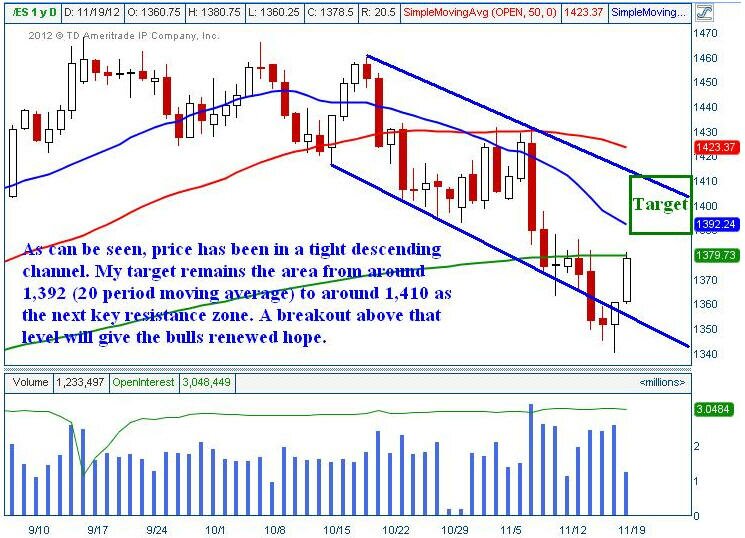
| Last Week S&P 500 and Gold Rallied; News was Negative Posted: 26 Nov 2012 05:17 PM PST Last Week S&P 500 and Gold Rallied; News was NegativeCourtesy of JW Jones of TRADERS VIDEO PLAYBOOK The amount of negative news that we have seen recently has been mind-blowing. Europe is going into recession, Greece and several other countries are on the verge of bankruptcy, the Middle East is a powder-keg, and the U.S. is facing a fiscal cliff. Shockingly for most retail traders, the past week has produced a very strong return for U.S. equity indexes as well as risk assets in general. Retail investors often times lose money because they focus on the financial media and all of the negative news that is out there. However, there is never an absence of negative news or potentially poor economic possibilities. Markets certainly can decline, but news is overrated as a driver. The markets are cyclical in nature and never move in a straight line. Based on what I was reading from most of the financial blogosphere recently, you would think that the entire world was about to end. A few blogs were calling for an all out collapse late last week or a possible crash this past Monday, November 19. As is typically the case, the market prognosticators were wrong with the calls for a crash in financial markets. At TradersVideoPlaybook, we were expecting higher prices. At our service, we lay out regular videos covering a variety of underlying assets from the S&P 500 Index and oil futures, to gold and treasury futures. The focus is purely on analysis of various underlying assets across multiple time frames. We cover intraday time frames as well as daily and weekly swing time frames throughout the week with videos and written updates. To put into perspective what we were seeing in the marketplace on Monday November 19, the following chart was sent out to our members during intraday trading that day.
The target we were expecting was at the top of the recent channel. As shown directly on the chart above was my comment that if the 1,410 level on the S&P 500 Index could be taken out to the upside, the bulls would have an opportunity to move prices higher into the end of the year. The daily chart of the S&P 500 Index after the close on Friday November 23:
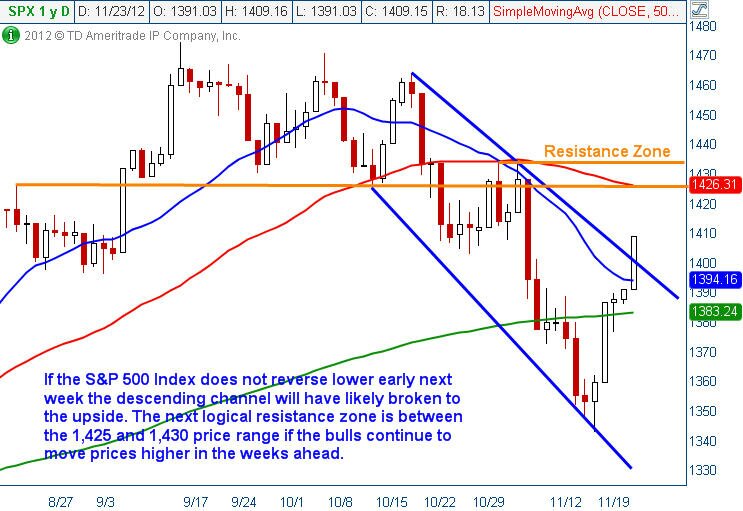
The S&P 500 Index moved right into the expected target price range and closed literally at the very top end of the range shown above. If prices move considerably higher, the bulls will have broken the descending channel and higher prices are likely. Next week's price action is going to have a dramatic impact on the price direction of the broader market indexes. One important aspect is that the large move higher shown above came on exceptionally light volume due to the holiday week. In light of that, a strong reversal cannot be ruled out. Caution is warranted. One of the most important charts to monitor over the past few weeks has been the U.S. Dollar Index futures. Typically a stronger Dollar has been bearish for equities and risk assets in general. On Friday we saw a very strong selloff in the U.S. Dollar Index futures as shown below.
As can be seen above, the U.S. Dollar Index futures closed on Friday right at a key support level having given back much of the recent gains. If the Dollar continues to move lower it should put a floor under stock indexes and push risk assets higher overall. Two major moves higher occurred in light of this weakening Dollar on Friday in both gold and silver futures. The precious metals had a very strong move higher after the U.S. Presidential election and have been consolidating now for a few weeks. Prices in both gold and silver had strong moves higher on Friday which were accompanied by very strong volume. The daily chart of gold futures is shown below.
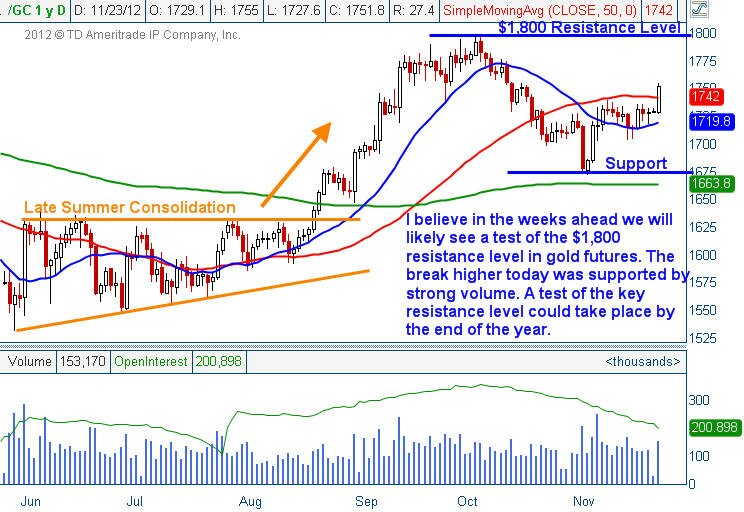
Gold futures had a huge move higher supported by strong volume. I believe that we will see the $1,800 / ounce resistance level tested in the near term. This time of the year is bullish for gold and silver and should the strong seasonality correspond with a weak U.S. Dollar, higher prices are likely in the precious metals sector. I was expecting strong action in both gold and silver when they broke higher after nearly testing their 200 day moving averages. I think the quarters ahead should be strong for both metals. Time will tell whether oil futures and the broader equity markets will also move higher. Monitoring the Dollar Index futures closely is an important part of assessing the market's directional bias. JW
Click here for the RISK-FREE 30-DAY TRIAL to Traders Video Playbook, only $1 for the first 30 days!
For more reasons to be bullish, read this week's Market Shadows Newsletter: From Fed, With Love. In the newsletter, Lee Adler discusses how the Fed tanked the markets in 2008. Lee Adler and Richard Chappell discuss reasons for a bullish bias. Richard and Dr. Paul Price share the details on what they are buying and why. Special offer from Phil's Stock World: Sign up for a free trial to Phil's Stock World/Stock World Weekly by clicking on this link.
This material should not be considered investment advice. J.W. Jones is not a registered investment advisor. Under no circumstances should any content from this article or the TradersVideoPlaybook.com website be used or interpreted as a recommendation to buy or sell any type of security or commodity contract. This material is not a solicitation for a trading approach to financial markets. Any investment decisions must in all cases be made by the reader or by his or her registered investment advisor. This information is for educational purposes only.
|
| The Gold Price Has a Clear Track to Rise for Months Can it reach $2,700 by Spring 2013? Posted: 26 Nov 2012 04:16 PM PST Gold Price Close Today : 1749.60 Change : -1.80 or -0.10% Silver Price Close Today : 34.137 Change : 0.021 or 0.06% Gold Silver Ratio Today : 51.252 Change : -0.084 or -0.16% Silver Gold Ratio Today : 0.01951 Change : 0.000032 or 0.16% Platinum Price Close Today : 1622.00 Change : 10.90 or 0.68% Palladium Price Close Today : 661.20 Change : 12.95 or 2.00% S&P 500 : 1,406.29 Change : -2.86 or -0.20% Dow In GOLD$ : $153.28 Change : $ -0.33 or -0.21% Dow in GOLD oz : 7.415 Change : -0.016 or -0.21% Dow in SILVER oz : 380.04 Change : -1.47 or -0.39% Dow Industrial : 12,973.37 Change : -42.31 or -0.33% US Dollar Index : 80.19 Change : -0.076 or -0.09% The GOLD PRICE leapt $23.50, clean over all that $1740 resistance to $1,751.40. Silver jumped 77.2 cents on Friday to close over 3400c at 3411.6c. Today both metals were digesting those gains. The GOLD PRICE backed off $1.80, nothing at all, to $1,749.60 and silver gained 2.1 cents to 3413.7c. Just how good was Friday's leap? Plumb delicious. The SILVER PRICE cleared its 50 day moving average (3321c) and now standeth above its 200, 300, 20, and 50 DMAs in that order. Only thing standing between silver and eternal fame is now 3550, and it will slice through that like Jim Bowie slicing ripe peaches. That gold looks just about as fine as silver. Punched through that 50 DMA ($1,742.39) on Friday, and also stands above its 150, 200, 20, and 50 DMAs now. And look at the RSI and MACD! Just like silver, gold has a clear track in front of it and can rise for another couple of months before it begins to look overbought. Now, before y'all back up to that boot tree and start kicking yourselves, let me tell you that right here at a breakout is the time to buy. This rise will run into next spring and gold will reach $2,300 - $2,700. If the ratio drops to 30:1 by then, silver could stand at 9000c (that's $90 to y'all who can't cipher so quick). Buy it now. Key to all this was the US dollar index' collapse on Friday. Lost 67.4 basis points (0.83%) to 80.267. Trading today at 80.191. So what? Since December 2011 the US dollar index has been forming a giant Head and Shoulders top. Left shoulder peaked at 81.78 in January, came back to a 78.10 - 78.60 neckline, rose to an 84.10 head in July, fell back to 78.60 neckline in September, then last week topped that Right Shoulder at 81.46. Although it has not yet broken down through the neckline (now about 78.60) it has plunged through the 200 DMA (80.75) and the 20 DMA (80.66). Looks sick as a hog eating tomatoes. Won't last long at these altitudes. Destined for lower ground. Meanwhile the Euro is making hay. Crossed above the 50 DMA ($1.2917) on Friday, and closed today at $1.2970, a skootch under unchanged. I'll be mildly interested to see if it can break through the downtrend line about $1.3050, but not interested enough to buy the nasty thing. Makes no difference which of these scabby fiat currencies you look at, yen, dollar, or euro, all are destined for doom, and, we hope, history's dustbin. Swap fiat for silver or gold. Yen, by the by, has been talked down 4% or more in the last two weeks by politicians. Bank of Japan needed take no action, just let the politicos run their mouths and they've driven the yen from 126.43 cents in mid-November to 121.93 today. Hard as it is either to imagine or to swallow, the Japanese economy is even more indebted and in worse shape than the US. When Humpty Shirakawa falls off that wall, he will splatter egg yolk all over east Asia. Stock investors and brokers are critters of habit. They heard stocks usually rise this time of year, and will bite on a rumor like that every time. On Friday the Dow rose 172.79 to close at 13,009.68. S&P500 added 18.13 (both rose 1.3%) to 1,409.15. Both backed off today, Dow by 42.31 to 12,967.37 and the S&P500 by 2.86 to 1,406.29. Any of y'all ever heard of the Tulip Bubble? This works a lot the same way. Don't ne'er a one of y'all point a finger at me and say I didn't warn y'all, 'cause I did. I kept telling y'all silver and gold had bottomed and y'all ought to buy. The only thing worse than somebody who doesn't listen is somebody who keeps saying, "I told you so!" Yeah, I know: I'm crazy. People been telling me that for years, some of 'em official NGM. But I'm not making this up. If you want to spend a couple of weeks slaving over a hot chart, you'll come to the same conclusions. But mercy! I'm nothing more than a natural born fool from Tennessee. Don't listen to me. I have to ask you birdwatchers something. Any of y'all ever seen a FLOCK of red-headed woodpeckers? Driving down the road Saturday I saw more than a dozen of 'em chasing and playing with each other, then today about as many showed up in my front yard, having a field day on the branches. Any idea what motivated them, other than having a good time and jubilating with each other? SPECIAL OFFER: DUTCH GOLD One of the most commonly traded gold coins in the world (thanks to their empire) is the Netherlands Ten Guilder containing 0.1947 troy ounce fine gold. These are all minted before 1934. These small coins usually cost 6% to 8% or more over their gold content. I bought a batch of them right and can sell these at about the same price as the big Mexican fifty pesos. Prices are based on gold spot at $1,749.60 and silver spot at $34.137. All lots are sold subject to the special conditions below, no exceptions. I have only 29 lots. ONE LOT consists of Ten (10) each Netherlands ten guilders at a 4% premium over their gold content or $354.25 each. So the total cost of one lot will be 10 x $354.25 = $3,542.50 plus $25 shipping = $3,567.50. Limit four lots per customer, please. Special Conditions: If I have miscounted my inventory and come up short, the LAST person to order will receive fewer coins, at a price reduced to reflect the smaller quantity. First come, first served, and no re-orders at these prices. I will write orders based on the time I receive your e-mail. We will not take orders for less than the minimums shown above. All sales on a strict "no-nag" basis. We will ship as soon as your check clears, but we allow Two weeks (14 days) for your check to clear. Calls looking for your order two days after we receive your check will be politely and patiently rebuffed. If you want faster shipping, please send a wire (wire instructions will appear on your trade confirmation). ORDERING INSTRUCTIONS: 1. You may order by e-mail only to offers@the-moneychanger.com. No phone orders, please. Please do NOT order by replying to this email, because it will delay your email. Your email must include your complete name, address, and phone number. We cannot ship to you without your address. Sorry, we cannot ship outside the United States or to Tennessee. Repeat, you must include your complete name, address, and phone number. Our clairvoyant quit without warning last week and we can no longer read your mind. 2. Orders are on a first-come, first-served basis until supply is exhausted. 3. "First come, first-served" means that we will enter the orders in the order that we receive them by e-mail. 4. If your order is filled, we will e-mail you a confirmation. If you do not receive a confirmation, your order was not filled. 5. You will need to send payment by personal check or bank wire (either one is fine) within 48 hours. It just needs to be in the mail, not in our hands, in 48 hours. 6. "No Nag Basis" means that we allow fourteen (14) days for personal checks to clear before we ship. Want your order faster? Send a bank wire, but that's not required. Once we ship, the post office takes four to fourteen days to get the registered mail package to you. All in all, you'll see your order in about one month if you send a check. 7. Mention goldprice.org in your email. Argentum et aurum comparenda sunt -- -- Gold and silver must be bought. - Franklin Sanders, The Moneychanger The-MoneyChanger.com 1-888-218-9226 10:00am-5:00pm CST, Monday-Friday © 2012, The Moneychanger. May not be republished in any form, including electronically, without our express permission. To avoid confusion, please remember that the comments above have a very short time horizon. Always invest with the primary trend. Gold's primary trend is up, targeting at least $3,130.00; silver's primary is up targeting 16:1 gold/silver ratio or $195.66; stocks' primary trend is down, targeting Dow under 2,900 and worth only one ounce of gold; US$ or US$-denominated assets, primary trend down; real estate bubble has burst, primary trend down. WARNING AND DISCLAIMER. Be advised and warned: Do NOT use these commentaries to trade futures contracts. I don't intend them for that or write them with that short term trading outlook. I write them for long-term investors in physical metals. Take them as entertainment, but not as a timing service for futures. NOR do I recommend investing in gold or silver Exchange Trade Funds (ETFs). Those are NOT physical metal and I fear one day one or another may go up in smoke. Unless you can breathe smoke, stay away. Call me paranoid, but the surviving rabbit is wary of traps. NOR do I recommend trading futures options or other leveraged paper gold and silver products. These are not for the inexperienced. NOR do I recommend buying gold and silver on margin or with debt. What DO I recommend? Physical gold and silver coins and bars in your own hands. One final warning: NEVER insert a 747 Jumbo Jet up your nose. No, I don't. 
|
| Source: Deutsche Bank Fulfilled Recent Gold Repatriation Request With Tungsten Salted Gold Posted: 26 Nov 2012 04:15 PM PST An Austrian banking source has reportedly claimed that Deutsche Bank 'fulfilled' one gold repatriation in recent years with the help of Tungsten and further claims that the tungsten salted gold bars have turned up in Asia. In 2009, Rob Kirby … Continue reading
|
| Posted: 26 Nov 2012 02:36 PM PST Star Parker is a little bent out of shape over same sex marriage becoming law in 4 states. I'm not upset about same sex marriage. The real problem is what she describes later in the article. In 1960, 72% of adults were married. Today, that number is 51%. The percentage of children born out of wedlock is now 41%. The breakdown by race is even more telling: 29% of white children are born to unmarried women, 53% of Latinos and 73% of black children. These statistics tell the true story of poverty, lack of educational achievement, and the degradation of our society. Children raised by two parents have a much greater chance of success in life. Fatherless households are destined to create ignorant, uneducated, parasites on society who will follow the same path of dependency and poverty taught to them by those who brought them into the world. Government policies encourage and reward the very behavior that is destroying our country. Tough love and forcing the ignorant to become self reliant is the only way out. Redefining marriage a sign of a lost societySunday, November 25,2012 One significant development in the recent election was that voters in four states approved same-sex marriage initiatives. Until now, all previous state referendums to approve same-sex marriage — 32 of them — failed. The Wall Street Journal editorial page — where conservatives usually turn to for intellectual capital — saw this as cause for celebration. According to the Journal, marriage definition should come from voters, not from court orders. Americans, they argue, have "shown themselves more than capable of changing their views on gay marriage the democratic way." In other words, our definition of marriage should follow process, not principle. Let voters decide. "As views on gay marriage change, and a growing number of Americans support it, politics will follow. This is how it's supposed to work." I'd guess if I asked the Wall Street Journal editors if the U.S. Constitution should be viewed as a "living document" — if our understanding of its words and what they mean should be open to change to reflect attitudes of the moment — they would say "no." Liberals think the Constitution should be re-engineered every few years like an iPad. So it is not surprising when liberals, for whom tradition is meaningless, trash once-sacred institutions in favor of impulses of the moment. But it does surprise me when those whose politics are supposedly right of center, who view America's founding documents as sacrosanct and give the highest priority to preserving their integrity, are cavalier regarding the integrity of an institution thousands of years older than our Constitution. But it's a point of view not uncommon. In the 1850s, Stephen Douglas proposed solving the dilemma of whether slavery should be permitted in new states by suggesting that they should just vote. What could be more American than submitting the question of slavery to the democratic process of each state? To this Abraham Lincoln observed: "God did not place good and evil before man telling him to make his choice. On the contrary, he did tell him there was one tree, of the fruit of which he should not eat, upon pain of certain death. … I should scarcely wish so strong a prohibition against slavery in Nebraska." Lincoln's rejoinder to the idea of "popular sovereignty" — that states should vote to determine if slavery would be legal — was that there are core truths — truths that define right and wrong, good and evil — that precede the democratic process. To reject this premise is to buy into moral chaos. Which is what we are approaching today. The claim that somehow it is a sign of a healthy, free society that by way of the vote we can rewrite our language, our dictionary, our oldest, time-tested traditions is a sign of how lost we are. Same-sex marriage advocates argue that their efforts will save the embattled institution of marriage. But this takes a symptom of the disease and calls it a cure. As American society has become more self-centered and materialistic, family and marriage have been imploding. According to the Pew Research Center, 72 percent of American adults were married in 1960. This dropped to 51 percent in 2011. Marriage and family form the pillar of any healthy society. Marriage is the institution through which children are born and raised and through which time-tested truths and values are transmitted from one generation to the next. To deal with the crisis of the collapse of family and marriage by redefining what they are is the sign of a society losing its way. Fortunately, America is still a free country. Individuals can make their own choices about how they choose to live. But taking personal choices to deviate from our social standards of right and wrong, true and false, and decide to change those truths and standards, so that nothing is any longer considered deviant, is a bridge to nowhere. Star Parker is an author and president of CURE, Center for Urban Renewal and Education. Contact her at www.urbancure.org.
|
| Ted Butler: A silver manipulation timeline Posted: 26 Nov 2012 02:24 PM PST 4:21p ET Monday, November 26, 2012 Dear Friend of GATA and Gold: Silver market analyst and newsletter writer Ted Butler today provides, via GoldSeek's companion site, SilverSeek, "A Manipulation Timeline," describing the history of manipulation of the silver price from the early 1980s to the present as the concentrated short position in the futures market was rotated from Drexel Burnham Lambert to AIG, Bear Stearns, and then JPMorganChase: http://www.silverseek.com/commentary/manipulation-timeline-7831 CHRIS POWELL, Secretary/Treasurer ADVERTISEMENT Fred Goldstein and Tim Murphy open All Pro Gold Longtime GATA supporters Fred Goldstein and Tim Murphy have brought their many years of experience in the precious metals and numismatic coins to All Pro Gold as metals brokers who specialize in the delivery of gold and silver bullion bars and coins as well as numismatic gold and silver coins. Fred and Tim follow these markets closely and are assisted by a team of consultants in monitoring market trends. All Pro Gold offers GATA supporters competitive pricing on all bullion products and welcomes inquiries. Tim can be reached at 602-299-2585 and Tim@allprogold.com, Fred at 602-799-8378 and Fred@allprogold.com. Ask about their ratio strategy and the relationship of generic $20 dollar gold pieces to 1-ounce gold bullion coins. Visit their Internet site at http://www.allprogold.com/. Join GATA here: Vancouver Resource Investment Conference * * * Support GATA by purchasing DVDs of our London conference in August 2011 or our Dawson City conference in August 2006: http://www.goldrush21.com/order.html Or by purchasing a colorful GATA T-shirt: Or a colorful poster of GATA's full-page ad in The Wall Street Journal on January 31, 2009: http://gata.org/node/wallstreetjournal Help keep GATA going GATA is a civil rights and educational organization based in the United States and tax-exempt under the U.S. Internal Revenue Code. Its e-mail dispatches are free, and you can subscribe at: To contribute to GATA, please visit: ADVERTISEMENT Opinion Around the World Is Changing When Deutschebank calls gold "good money" and paper "bad money". ... http://www.gata.org/node/11765 When the president of the German central bank, the Bundesbank, pays tribute to gold as "a timeless classic". ... http://www.forbes.com/sites/ralphbenko/2012/09/24/signs-of-the-gold-stan... When a leading member of the policy committee of the People's Bank of China calls the gold standard "an excellent monetary system". ... http://www.forbes.com/sites/ralphbenko/2012/10/01/signs-of-the-gold-stan... When a CNN reporter writes in The China Post that the "gold commission" plank in the 2012 Republican platform will "reverberate around the world". ... http://www.thegoldstandardnow.org/key-blogs/1563-china-post-the-gop-gold... When the Subcommittee on Domestic Monetary Policy of the U.S. House of Representatives twice called on economist, historian, and gold standard advocate Lewis E. Lehrman to testify. ... World opinion is changing in favor of gold. How can you learn why and what it will mean to you? Read the newly updated and expanded edition of Lehrman's book, "The True Gold Standard." Financial journalist James Grant says of "The True Gold Standard": "If you have ever wondered how the world can get from here to there -- from the chaos of depreciating paper to a convertible currency worthy of our children and our grandchildren -- wonder no more. The answer, brilliantly expounded, is between these covers. America has long needed a modern Alexander Hamilton. In Lewis E. Lehrman she has finally found him." To buy a copy of "The True Gold Standard," please visit: http://www.thegoldstandardnow.com/publications/the-true-gold-standard
|
| Posted: 26 Nov 2012 02:13 PM PST Hedge fund manager Hugh Hendry has stated, “There is no rationale for owning gold mining equities. [B]It is as close as you get to insanity. The risk premium goes up when the gold price goes up.” Indeed, the notion that*adding gold and other commodities to one’s portfolio produces a higher expected return with lower risk failure has failed of late and can be illustrated through the following charts. [/B]Words: 808 So says Brennan Basnicki ([url]http://tradersvideoplaybook.com/[/url]) in edited excerpts from his original article* posted on Seeking Alpha entitled The Fallacy Of Owning Gold Mining Equities. [INDENT]Lorimer Wilson, editor of [B][COLOR=#0000ff]www.munKNEE.com (Your Key to Making Money!), may have edited the article below to some degree for length and clarity – see Editor's Note at the bottom of the page for details. This paragraph must be included in any article re-posting to avoid copyright infringement.[/COLOR][/B] [/INDENT]Basnicki goes on to say, in...
|
| Goldrunner: HUI Index Could Go As High As 1000 in 2013! Here?s Why Posted: 26 Nov 2012 02:13 PM PST [/CENTER] *So says Goldrunner (www.GoldrunnerFractalAnalysis.com) in edited excerpts from his most recent newsletter to subscribers posted here with permission. Goldrunner offers a subscription service which provides detailed technical analysis of where the price of gold, silver and precious metal stocks are going in each stage of their respective bull runs. This service comes with detailed charting based on conventional technical analysis and our proprietary fractal analysis based on the ’70s. Below are some of*the latest comments from Goldrunner with his rationale for expected price movements in*precious metals stocks*(without illustative charts which are only available to subscribers). Go here to subscribe to Goldrunner’s service for indepth proprietary fractal analysis and charts, charts, charts supporting his future price projections for: [LIST] [*]Gold [Read: Goldrunner: Gold's Extremely Bullish Backdrop Setting Stage for Run to $2,050, Then $2,400, Then $4,500 a...
|
| Gold Seeker Closing Report: Gold and Silver End Slightly Higher Posted: 26 Nov 2012 02:12 PM PST Gold fell $5.86 to $1745.14 by a little before 5AM EST before it climbed up to $1752.27 and then fell back near its earlier low in morning New York trade, but it then bounced back higher in afternoon trade and ended with a gain of 0.07%. Silver slipped to $33.88 before it rose to $34.20 and then also fell back off in morning New York trade, but it then rose to as high as $34.16 in afternoon trade and ended with a gain of 0.12%.
|
| Gold Daily and Silver Weekly Charts - Option Expiration Tomorrow Posted: 26 Nov 2012 02:07 PM PST |
| Gold and Silver Disaggregated COT Report (DCOT) for November 26 Posted: 26 Nov 2012 02:05 PM PST HOUSTON -- This week's Commodity Futures Trading Commission (CFTC) disaggregated commitments of traders (DCOT) report was released at 15:30 ET Monday, delayed from the usual Friday release by the Thanksgiving holiday. Our recap of the changes in weekly positioning by the disaggregated trader classes, as compiled by the CFTC, is just below. In the DCOT table above a net short position shows as a negative figure in red. A net long position shows in black. In the Change column, a negative number indicates either an increase to an existing net short position or a reduction of a net long position. A black figure in the Change column indicates an increase to an existing long position or a reduction of an existing net short position. The way to think of it is that black figures in the Change column are traders getting "longer" and red figures are traders getting less long or shorter. All of the trader's positions are calculated net of spreading contracts as of the Tuesday disaggregated COT report.
|
| The Gold Market Through Chinas Eyes Posted: 26 Nov 2012 01:55 PM PST Casey Research
|
| The Japanese Are About To Enter The Gold Market In Size Posted: 26 Nov 2012 01:06 PM PST  Today 25-year veteran Caesar Bryan told King World News that the Japanese are getting ready to enter the gold market in size. Here is what Bryan, from Gabelli & Company, had to say about this fascinating situation: "There are a couple of things in the gold market that we should be focused on. First off, we should be focusing our attention to the East. I say that because there have been some developments in Japan which are interesting for the gold market." Today 25-year veteran Caesar Bryan told King World News that the Japanese are getting ready to enter the gold market in size. Here is what Bryan, from Gabelli & Company, had to say about this fascinating situation: "There are a couple of things in the gold market that we should be focused on. First off, we should be focusing our attention to the East. I say that because there have been some developments in Japan which are interesting for the gold market."
This posting includes an audio/video/photo media file: Download Now |
| Fund Managers Face Off in the Quest for Mining Profits Posted: 26 Nov 2012 01:01 PM PST The Gold Report: Adrian, you are a long-term, value investor. That makes company selection critical. How do you evaluate what companies would fit your needs? Adrian Day: We manage money in all areas, not just gold and resources. I try to find good quality companies, buy them when they're selling for less than their value and hold on to them for a long time. I tend to be a very patient holder so long as the company itself doesn't change course or make disastrous decisions. I'm much less concerned about the outside environment so long as the company is doing what it said it was doing and continuing to grow, or earn cash flow. We have some very, very long-term holdings. In fact I just sold HSBC Holdings Plc (HSBA:LSE), which was the first stock we bought in 1991. That is an extraordinarily long holding period. TGR: What made you decide to sell? AD: I have been concerned about HSBC for a little while. I think the culture has changed. It made some disastrous mistakes in the U.S. sub-pr...
|
| Massive shorting of gold and silver is being challenged, Embry says Posted: 26 Nov 2012 12:43 PM PST 2:42p ET Monday, November 26, 2012 Dear Friend of GATA and Gold (and Silver): Massive shorting is occurring in the gold and silver futures market, Sprott Asset Management's John Embry tells King World News today, but the open interest keeps rising because, it seems, buyers who are not easily shaken out have figured out the paper game and are challenging the market riggers. An excerpt from Embry's interview is posted at the King World News blog here: http://kingworldnews.com/kingworldnews/KWN_DailyWeb/Entries/2012/11/26_W... Meanwhile, market analyst Ron Rosen tells King World News why he thinks Friday's rally in the monetary metals foreshadows their continued rise: http://kingworldnews.com/kingworldnews/KWN_DailyWeb/Entries/2012/11/25_R... And fund manager Robert Fitzwilson tells King World News why he thinks a chaotic phase in the world economy is about to begin: http://kingworldnews.com/kingworldnews/KWN_DailyWeb/Entries/2012/11/25_C... CHRIS POWELL, Secretary/Treasurer ADVERTISEMENT Opinion Around the World Is Changing When Deutschebank calls gold "good money" and paper "bad money". ... http://www.gata.org/node/11765 When the president of the German central bank, the Bundesbank, pays tribute to gold as "a timeless classic". ... http://www.forbes.com/sites/ralphbenko/2012/09/24/signs-of-the-gold-stan... When a leading member of the policy committee of the People's Bank of China calls the gold standard "an excellent monetary system". ... http://www.forbes.com/sites/ralphbenko/2012/10/01/signs-of-the-gold-stan... When a CNN reporter writes in The China Post that the "gold commission" plank in the 2012 Republican platform will "reverberate around the world". ... http://www.thegoldstandardnow.org/key-blogs/1563-china-post-the-gop-gold... When the Subcommittee on Domestic Monetary Policy of the U.S. House of Representatives twice called on economist, historian, and gold standard advocate Lewis E. Lehrman to testify. ... World opinion is changing in favor of gold. How can you learn why and what it will mean to you? Read the newly updated and expanded edition of Lehrman's book, "The True Gold Standard." Financial journalist James Grant says of "The True Gold Standard": "If you have ever wondered how the world can get from here to there -- from the chaos of depreciating paper to a convertible currency worthy of our children and our grandchildren -- wonder no more. The answer, brilliantly expounded, is between these covers. America has long needed a modern Alexander Hamilton. In Lewis E. Lehrman she has finally found him." To buy a copy of "The True Gold Standard," please visit: http://www.thegoldstandardnow.com/publications/the-true-gold-standard Join GATA here: Vancouver Resource Investment Conference * * * Support GATA by purchasing DVDs of our London conference in August 2011 or our Dawson City conference in August 2006: http://www.goldrush21.com/order.html Or by purchasing a colorful GATA T-shirt: Or a colorful poster of GATA's full-page ad in The Wall Street Journal on January 31, 2009: http://gata.org/node/wallstreetjournal Help keep GATA going GATA is a civil rights and educational organization based in the United States and tax-exempt under the U.S. Internal Revenue Code. Its e-mail dispatches are free, and you can subscribe at: To contribute to GATA, please visit: ADVERTISEMENT Fred Goldstein and Tim Murphy open All Pro Gold Longtime GATA supporters Fred Goldstein and Tim Murphy have brought their many years of experience in the precious metals and numismatic coins to All Pro Gold as metals brokers who specialize in the delivery of gold and silver bullion bars and coins as well as numismatic gold and silver coins. Fred and Tim follow these markets closely and are assisted by a team of consultants in monitoring market trends. All Pro Gold offers GATA supporters competitive pricing on all bullion products and welcomes inquiries. Tim can be reached at 602-299-2585 and Tim@allprogold.com, Fred at 602-799-8378 and Fred@allprogold.com. Ask about their ratio strategy and the relationship of generic $20 dollar gold pieces to 1-ounce gold bullion coins. Visit their Internet site at http://www.allprogold.com/.
|
| Posted: 26 Nov 2012 12:40 PM PST November 26, 2012 [LIST] [*]When "smart money" looks dense: Typical hedge fund underperforms the S&P [*]Fabulously successful gold mining exec on the one factor that will drive gold to $13,000 (and it's not the Fed) [*]A "great unraveling" in Japan that could be less than a month away: Dan Amoss outlines your best defense [*]Busting a suggestive Internet myth... The 5 readership begins to turn on one another... one couple's unique solution to 2013's higher taxes... and more! [/LIST] Here's a factoid that might shake you out of your leftover turkey-tryptophan stupor: You're better off putting money in an index fund than a hedge fund. That was the most interesting tidbit to emerge over the long holiday weekend: "Occupy Wal-Mart" was a bust. "Black Friday" sales improved on last year -- barely. And Greece was fixed for the umpteenth time. Thus, the euro soared on Friday, and the dollar got stomped -- which drove up stocks and precious m...
|
| Gold Will Not Be Confiscated, But Your Guns Will Be Posted: 26 Nov 2012 12:21 PM PST Jim Sinclair's Mineset My Dear Extended Family, Every governor of every state by law can create and many have created a state defense force. That is not the national guard. As the name implies, it is a state defense force. It is rumored that these organizations are in the crosshairs of the Administration. The moment you see these state defense forces under the control of the state governor disbanded, the end has come. The Constitution will no longer exist and the next day I will be writing you from Buckreef in Tanzania. You are all invited to come with me, but I will not be selling you anything. U.S. reverses stance on treaty to regulate arms trade By Arshad Mohammed WASHINGTON | Wed Oct 14, 2009 11:56pm EDT (Reuters) - The United States reversed policy on Wednesday and said it would back launching talks on a treaty to regulate arms sales as long as the talks operated by consensus, a stance critics said gave every nation a veto. The decisi...
|
 According to CNBC, as Super Storm Sandy flooded lower Manhattan, it also flooded the vaults of at least one gold depository
  All over America there are millions of people that will be missing meals and going hungry this holiday season. Even as much of the country indulges in the yearly ritual of
  Among many politicians and much of the media there is an accepted narrative about deficits, taxes and the so-called "Fiscal Cliff". It goes something like the following:
 Have you ever wondered what the typical Chinese gold investor thinks about our Western ideas of gold? We read month after month about demand hitting record after record in their country – how do they view our buying habits?
 If you buy precious metals, you have a problem, where's the safest place to store them? Unfortunately, every storage option has its inherent limitations and risks. After the financial crisis, there are grave concerns about the trustworthiness of any bank or its safety deposit boxes; their contents are subject to seizure by the government, creditor claims or falling under state abandoned property laws (escheatment). If the bank goes out of business, it may be difficult or impossible to redeem the contents. Paper based precious metals, ETF's such as GLD and SLV or even their more transparent brethren; the well audited Canadian closed end funds (CEF, GTU, SVRZF) also raise concerns. Do you believe these funds really have what they claim? In an "emergency" will the government expropriate their metal stocks in exchange for worthless paper currency? If there's a financial market meltdown, what value if any will your ETF holdings have?



| You are subscribed to email updates from Save Your ASSets First To stop receiving these emails, you may unsubscribe now. | Email delivery powered by Google |
| Google Inc., 20 West Kinzie, Chicago IL USA 60610 | |


No comments:
Post a Comment