


Gold World News Flash |

- You Will Not Believe What Some People Are Willing To Do For A Paycheck These Days
- Is The Global Collapse Being Engineered?
- Video: Vote for Silver
- Gold Retraces Friday Rally
- Ranting Andy Hoffman – Real Time Gold Rigging – It’s So Obvious It’s Pathetic
- COLLAPSE OF THE STATUS QUO
- Random Europe
- Gold Seeker Closing Report: Gold and Silver Fall With Stocks
- Gold & Silver Market still in stagnation for the summer holidays
- Which Way Will the Pendulum Swing for Gold?
- Guest Post: The Keys To Understanding The Collapse Of The Status Quo - Credibility And Expectations
- Alan Simpson Confirms Reality: "All The Things You Love Will Not Come To Pass"
- Ann Barnhardt–Godless Existence Is The Cause Of The Economic Collapse 13.Aug.12
- Ranting Andy–Real Time Gold Rigging-It’s So Obvious-It’s Pathetic 13.Aug.12
- Sandeep Jaitly: A squeeze for bullion – and especially silver – is brewing
- Pent Up Silver Demand and The CFTC Linchpin
- A Silver Coin to Save the Common Man
- Your Complete, One-Stop Presidential Election Guide
- Tyler Gallagher– Regal Assets Is Making Sure You Have A Golden Retirement–Part 1 13.Aug.12
- Your Financial Bomb Shelter
- Currency's Days Seen Numbered: Investors Prepare for Euro Collapse
- Volume Crashes As S&P 500 Breaks Winning Streak And VIX Plunges To Five Year Lows
- Gold Daily and Silver Weekly Charts - Zzzzzz
- Why A Mining Giant Is Partnering With A Project Generator In Colombia
- Turk sees gold pulling up from $1,580, silver from $27
- If there's ever serious journalism about gold, ask central banks these questions
- If there's ever journalism about gold, ask central banks these questions
- Housing: Look Out Below
- Deutsche Bank: Further QE Might Actually Be BAD for Gold Prices! Here?s Why
- Turk - Tight Gold & Silver Markets To Spark Massive Breakout
| You Will Not Believe What Some People Are Willing To Do For A Paycheck These Days Posted: 14 Aug 2012 12:00 AM PDT from The Economic Collapse Blog:
Read More @ TheEconomicCollpaseBlog.com
|
| Is The Global Collapse Being Engineered? Posted: 13 Aug 2012 11:30 PM PDT from TheAlexJonesChannel : Alex also covers the latest news, including yet another large ammunition purchase by the federal government and mega-banks preparing for imminent financial collapse. Alex also takes your calls on today's worldwide broadcast.
|
| Posted: 13 Aug 2012 11:05 PM PDT Silverstockreport
|
| Posted: 13 Aug 2012 09:14 PM PDT courtesy of DailyFX.com August 13, 2012 02:19 PM Daily Bars Prepared by Jamie Saettele, CMT A bearish triangle remains possible but presentation of an alternate count is appropriate given that gold is nearing the top of its range. The alternate would treat consolidation from 1640.80 as a B wave triangle. A break above 1640.80 would confirm that wave C is underway towards 1700 (Fibonacci extension is just below that level and the 2/10 low is just above 1700). “After breaking the triangle pattern, gold has dropped well into its former range. Other than calling this a range, there really is no reason to waste time trying to figure out where this market is headed next. In fact, one can make the argument that the triangle remains underway (latest top composing wave C), in which case this market will get even more frustrating to follow over the next few months.” LEVELS: 1563 1584 1602 1626 1630 1641...
|
| Ranting Andy Hoffman – Real Time Gold Rigging – It’s So Obvious It’s Pathetic Posted: 13 Aug 2012 08:30 PM PDT from FinancialSurvivalNetwork.com:
This posting includes an audio/video/photo media file: Download Now |
| Posted: 13 Aug 2012 07:43 PM PDT Great article by Charles Hugh Smith. The collapse has already begun. Rich people are pulling their money out of stocks, banks, and risk assets; stashing money away somewhere they believe is safe. People have lost faith in the stock market, 80% of which is either manipulated or run by computers. The government is bankrupt, both [...]
|
| Posted: 13 Aug 2012 07:06 PM PDT It is a lazy summer day here in Texas, and the market and investment news front is rather quiet as well. But that will change before too long. We should enjoy the relative calm while we can, because Europe will soon be back in full crisis mode, coming off the summer. In today's Outside the Box we'll look at three brief pieces that may give us a preview of the near future, as well as an incisive retrospective on the recent past. The first is from Roubini Global Economics. It's part of a longer piece by Megan Greene, looking at what lies ahead in Europe. The fun & games there promise to ramp back up all too quickly. Then we have another extract from a longer piece by Kiron Sarkar, looking at Germany, that echoes some of the themes from last week's Thoughts from the Frontline. The German leadership has not really been transparent with their people, but then you can't hide trillion-dollar commitments very easily. Finally, we wrap with Ambrose Evans-Pritchard's lat...
|
| Gold Seeker Closing Report: Gold and Silver Fall With Stocks Posted: 13 Aug 2012 07:00 PM PDT Gold edged up to $1625.43 in London, but it then fell to as low as $1607.58 in early afternoon New York trade and ended with a loss of 0.75%. Silver slipped to as low as $27.73 and ended with a loss of 1.28%.
|
| Gold & Silver Market still in stagnation for the summer holidays Posted: 13 Aug 2012 06:29 PM PDT Gold and Silver Market still in stagnation for... [[ This is a content summary only. Visit my website http://goldbasics.blogspot.com for full Content ]] 
|
| Which Way Will the Pendulum Swing for Gold? Posted: 13 Aug 2012 06:00 PM PDT In the spirit of the events this summer, BTN Research compared gold's advancement from the beginning of the games in Beijing to the London Olympics.
|
| Guest Post: The Keys To Understanding The Collapse Of The Status Quo - Credibility And Expectations Posted: 13 Aug 2012 05:45 PM PDT Submitted by Charles Hugh Smith from Of Two Minds The Keys To Understanding the Collapse of the Status Quo: Credibility and Expectations When expectations are raised to impossible heights based on the promise of exponential financialization, the credibility of the Status Quo is doomed. Data is important, but not all trends can be quantified. Longtime readers know that I value data and often use charts to explain the forces of transition/collapse. But there are profound dynamics that are not easily quantified, instances in which quantification may obscure our understanding. Credibility and expectations are two such dynamics. Both credibility and expectations are very real forces, despite their status as inner states immune to direct measurement. Beneath the surface of financial statistics, the real bedrock of any political and financial Status Quo is its credibility in the minds of its subjects. Once the people lose faith in the system, it will collapse under its own weight, a process I described in When Belief in the System Fades (March 12, 2008).
The loss of credibility in the European Union, China, Japan and the U.S. is now in full swing. Credibility is like a sand castle; every false promise, every half-truth, every simulacra "solution," every secret deal, every surrender to vested interests, every politically expedient but ultimately disastrous "fix" removes a handful of sand from beneath the sand castle. When enough sand has been removed, the castle collapses under its own weight. The most interesting characteristic of this hollowing out process is the apparent stability of the Status Quo until the sudden "nobody saw it coming" collapse. In the current era, the Arab Spring is a regional example of this hollowing out of credibility; in the late 1980s, the process was exemplified by the "nobody saw it coming" implosion of the Soviet Empire. In 2007-08, the exposure of phantom wealth tracked a similar pathway, with apparently "solid" institutions imploding "unexpectedly." Can anyone seriously claim the European Union, the European Central Bank and its alphabet-soup programs still retain a shred of credibility? Every EU/ECB "save" is fictitious, every "fix" expedient, every promise empty, every face-saving summit a living lie. Ultimately, all the posturing, promises and saves come down to an impossibility: "rescuing" phantom assets purchased with astounding levels of debt by issuing even more astounding levels of debt. Does anyone truly believe this absurdity is anything more than a transparent fraud designed to extend the life of a failed, corrupt system constructed on fantasies and lies? Those with assets are fleeing for less fantastic and dangerous climes. The handful of French millionaires who are supposed to magically bail out a failed-state that absorbs 55% of GDP are busy transferring their assets out of France, a mass exodus of capital that is also playing out in China, where those who embraced the slogan "to get rich is glorious" are transferring their wealth, ill-gotten or well-earned, overseas. So vast is this outflow of wealth that for the first time the outflow of capital from China exceeds the inflow of investment capital. The smart money is exiting, and the last batch of credulous "China story" rubes are dumping their capital down a rathole. The same process is visible in global stock markets, where the smart money is selling. The loss of credibility in the digital bucket shop known as the U.S. stock market is evidenced by the outflow of some $200 billion over the past few years. To some degree, this has been offset by the influx of foreign capital desperate to escape the black hole of the euro, but the steady erosion of faith in the U.S. stock market is striking: as noted last week, 80% of the trading is either invisible, officially sanctioned manipulation or computers trading. If the U.S. legal system weren't hopelessly compromised, the U.S. stock markets would be shuttered as corrupted beyond redemption. Globally, the erosion of petrocapitalism (more on that later this week, via correspondent Ray W.) and the self-destruction sequence of financialization are laying waste to the credibility of politicos' promises. It was so easy to be a politico when financialization (exponential expansion of debt and leverage) raised the global tide, lifting all boats; extravagant promises based on everlasting "growth" could be issued, votes bought and the vested interests of crony-capitalist cartels and public employees lavishly rewarded. In this environment, expectations were raised to impossible heights. Expectations are the yin to credibility's yang: together they form a unity, as credibility is linked to the fulfillment of expectations. If expectations are raised and then dashed, credibility is eroded and then lost entirely. Expectations everywhere have been raised to heights so lofty that the air has become thin: all these expectations are like debt-money claims on the real world: the claims can expand to near-infinity, but the real world remains stubbornly limited. As lofty expectations are unmet, the credibility of the Status Quo inevitably decays and implodes. We are as yet in the early stages of this process. Let's check back in 2014 to see if the sand castle of the Status Quo has collapsed in a heap of wet sand, or if it is merely sagging in the pre-collapse phase.
|
| Alan Simpson Confirms Reality: "All The Things You Love Will Not Come To Pass" Posted: 13 Aug 2012 04:30 PM PDT Conjuring images of Jack Nicholson in 'A Few Good Men', Alan Simpson laid out the sad and terrible truth that none of us or our politicians can handle in a very direct and sincere interview with Bloomberg TV's Deirdre Bolton. "Medicare costs stand to squeeze out the rest of domestic government spending," Simpson said, "it is on automatic pilot. It will use up every resource in the government." Simpson also said that the current path of debt, deficit and interest is "totally unsustainable" confirming once again the facade that his 18 years in Washington proved to him that he "never saw any projection of any economist ever come true." From Paul Ryan's plan to the 'simple math' of CBO budget projections, and whether older Americans should be afraid, Simpson pulls no punches as he sums up American society thus: "we don't care about our money, all we want is more money for our money."
Simpson on Paul Ryan and whether older Americans should be worried about his plan to rework Medicare:
On those who say that Ryan's plan will trickle down and hurt the people that will need support the most.
On whether Simpson-Bowles accounted for the slowing economy:
On Ryan's plan and its call for huge cuts on almost every piece of domestic spending:
On the CBO's budget projections:
On whether it's possible to reach a compromise that is good for society:
|
| Ann Barnhardt–Godless Existence Is The Cause Of The Economic Collapse 13.Aug.12 Posted: 13 Aug 2012 04:28 PM PDT www.FinancialSurvivalNetwork.com presents Ann Barnhardt was living her dream. She had a successul commodities firm, helping farmers across the US and Canada to hedge their crop risks. Then MF Global blew up and Ann realized that no matter how carefully she invested her clients' money, it could always be stolen right out from underneath them. Therefore, in good conscience she couldn't continue the business, so she liquidated the assets and paid off her clients in full, so that they would never have to suffer an MF Global meltdown. She has mixed thoughts about it to this day, but she's absolutely certain she did the morally correct act. And while Ann's business ethics are very much intertwined with her religious beliefs, she's decided that she cannot liver her life any other way. And we have to admit, there's something nice about being able to sleep at night, regardless what your religious beliefs may be. Go to www.FinancialSurvivalNetwork.com for the latest info on the economy and precious metals markets.
This posting includes an audio/video/photo media file: Download Now |
| Ranting Andy–Real Time Gold Rigging-It’s So Obvious-It’s Pathetic 13.Aug.12 Posted: 13 Aug 2012 04:26 PM PDT www.FinancialSurvivalNetwork.com presents Ranting Andy Hoffman the ace observer of gold price manipulation and a perpetual thorn in the cartel's backside joined us for the Monday Rant. While we were watching, gold got hammered and at one point was over $12 in the red. As a wise man said, we no longer have markets, just a series of ongoing governmental interventions. And if you don't believe it, just look at the price charts. They tell the whole story and it's not a pretty one at that. In the Elite's effort to prop up the markets and give the appearance of normalcy, they regularly manipulate the markets, all in the name of economic stability. But what we will wind up with is far from stability. Instead, they will cause the mother of all crashes. And us average Americans will be left to pick up the pieces and pay the piper. Go to www.FinancialSurvivalNetwork.com for the latest info on the economy and precious metals markets.
This posting includes an audio/video/photo media file: Download Now |
| Sandeep Jaitly: A squeeze for bullion – and especially silver – is brewing Posted: 13 Aug 2012 04:07 PM PDT Stacy Summary: Here is a special commentary from Sandeep Jaitly of www.feketeresearch.com. He'll be on this Saturday's episode of Keiser Report talking about Austrian economics, gold standards and more. You can follow Sandeep on Twitter. ======================== A squeeze for bullion … Continue reading
|
| Pent Up Silver Demand and The CFTC Linchpin Posted: 13 Aug 2012 03:50 PM PDT As scandal after financial scandal take their toll on public confidence in the economic morass curiously called the financial system, what will be the trigger for a short covering panic in the metals markets? With countries the size of Spain lining up to get bailed out and a lagging global economy, the United States is not that far behind Europe as individual states and local governments find it harder to stay afloat. Consequently, what you can purchase with a U.S. Dollar will continue to diminish. The inventories for precious metals are dwarfed in relation to the amount of paper silver contracts used to keep prices controlled. When the eventual covering of contracts occurs, heavy buying will come from the large entities that unofficially represent or are literally the working arms of the central banks, exacerbating the panic. Chilton Refutes FT Article On August 5th, the UK financial daily, the Financial Times published an article entitled, "Four Year Silv...
|
| A Silver Coin to Save the Common Man Posted: 13 Aug 2012 03:47 PM PDT The interrelationships between money, credit and the banking system mean that the stability of the current system is dependent upon the ability to service credit expansion, or in general the debt/GDP ratio. With very few exceptions, every country and financial system in the world share the same fiat money platform with credit-money creation through fractional reserve banking. Due to its lack of diversity and a solid base, the entire system is at great risk, and has already started to implode as evidenced by the current steaming pile of economic turmoil which exists in the European Union. These very same dynamics helped to create the problems that built up in the global economy between countries running trade surpluses and those absorbing ever-rising credit flows. Credit Expansion and the Risk of Systemic Failure Due to the consolidation of the banking system into larger and larger corporate entities, the system has become less diverse where banking activity...
|
| Your Complete, One-Stop Presidential Election Guide Posted: 13 Aug 2012 03:46 PM PDT With less than three months to go, the outcome of the November election remains highly uncertain. SocGen notes that, as always, economic performance over the coming months will be a key determinant of who wins and who loses. If the elections were held today, the most likely outcome would be a Republican win in both Congressional races and a Democratic win in the race for the White House. This means that any new significant legislation will almost certainly have to be a product of compromise. In this sense, we may very well be looking at a status quo in terms of bipartisanship and gridlock which have dominated Washington politics over the past few years. This would be bad news at a time when the country faces a number of serious challenges with significant long-term implications. From the economy to long-term fiscal health, and from the debt-ceiling to Housing, Healthcare, and energy policy differences, the following provides a succinct review.
Societe Generale: American Themes - US Elections There is a strong need for leadership in Washington. The economy is performing poorly and monetary policy options have been nearly exhausted. Unfortunately, the ongoing split promises more of the same from Washington: politics instead of leadership. A close race for president, coupled with uncertain congressional power. A split in the Congress can inhibit the agenda no matter who wins the presidential race. Unless the president's party makes gains in Congress, it will be difficult to agree on any changes. The healthcare overhaul was achieved with a Democratic congress during President Obama's first year in office. Reversing course requires not just a Republican president but a cooperative Senate. Sadly, gridlock is likely to prevail. In Washington, there is widespread support for fiscal stimulus, at least for immediate support within the context of long-term discipline. Specifically, there is support to reduce the anticipated fiscal drag of higher tax rates and spending cuts that are set for 1 January 2013. Election-year politics prevent current action. Congress may take action immediately after the election to reduce onerous tax rate increases or may wait until the new government takes office in January before acting. This uncertainty comes at a cost to markets and indeed to the economy in the short-term. Key main assumptions and potential for surprises:
Election scenarios – latest odds Much could still change between now and the 6 November election. However, based on the latest indications from online prediction markets, the Republican Party is seen as the likely winner of both Congressional races. Democrats are still seen as the favorite in the race for the White House, with President Obama winning re-election. In any case, it is unlikely that one party will control all three institutions. Moreover, any one party in the Senate is unlikely to hold the 60 seats (out of 100) needed to avoid filibusters. Therefore, in the absence of the majority needed for any post-election scenario, significant new legislation will require bipartisanship and compromise. In this context, the risk of gridlock remains high.
With less than three months to go, the outcome of the November election remains highly uncertain. As always, economic performance over the coming months will be a key determinant of who wins and who loses. If the elections were held today, the most likely outcome would be a Republican win in both Congressional races and a Democratic win in the race for the White House (see Charts 1a-c above ). This would give Republicans an improved standing relative to the current configuration (in which they only control the House), but it would nonetheless leave power divided. The latest indications from online prediction markets suggest only a 40% probability that any one party will end up controlling both houses of Congress and the White House, leaving a 60% probability of a split scenario (see Chart 2 below).
It is also very unlikely that any party will win a filibuster-proof super-majority. This means that any new significant legislation will almost certainly have to be a product of compromise. In this sense, we may very well be looking at a status quo in terms of bipartisanship and gridlock which have dominated Washington politics over the past few years. This would be bad news at a time when the country faces a number of serious challenges with significant long-term implications. US election issues – what's at stake There is a lot at stake as we look to 2013. Immediately after the new Congress and/or administration take over, they will have to deal with the fiscal cliff as well as the long-term fiscal challenges, healthcare and financial regulation, and lastly, with energy policy, which is also crucial for long-term economic sustainability. We discuss these issues in greater detail in the following sections. 1. Economy The first and perhaps the most important decision to be made by the incoming Congress and/or administration will be resolving the fiscal cliff in a way that does not undermine the still fragile economic recovery. If all of the planned spending cuts and tax increases go into effect as scheduled, the economy will experience a reverse stimulus of $600bn next year, or about 3.5% of GDP. A shock of this magnitude would almost certainly lead to a contraction in activity in the first half of 2013, which in turn could push unemployment toward 9.5-10%. The alternative, which is to extend all expiring tax provisions and do away with planned spending cuts, is unfortunately not viable. Maintaining the status quo on fiscal policy would result in a continuation of large deficits which would push the debt/GDP ratio above 90% by the end of the decade. Without addressing entitlements, the ratio would start rising even more rapidly after 2020, largely due to the effects of the aging population. The ideal outcome is one that addresses long-term fiscal challenges, while recognizing the near-term fragility of the economy. This could be accomplished via a plan which phases in gradual tax increases and spending cuts over the next 10 years. The risk is that a post-election gridlock may lead to a more rapid fiscal consolidation, with adverse implications for the US economy. Given the high odds of a split government, as highlighted above, this is not a non-negligible risk. The most likely scenario is that some portion of the planned fiscal contraction will be delayed. But it is very unlikely that all of it will be legislated away. For example, payroll tax cuts look unlikely to be extended, which by itself could shave about 0.7% from next year's growth. In our central forecast for the US economy, we have discounted a fiscal drag of about 1.3% in 2013. Our central economic forecast does not rely on any specific assumption about the outcome of the November election. Indeed, we can envisage our economic scenario under a number of post-election configurations. First, it must be noted that both presidential candidates recognize the need for fiscal reform, and at the same time, neither wants to do consolidation in a way that would significantly undermine the US economy. And, although there are significant distributional differences between their prospective fiscal plans, both will most likely have to work with the opposing party in order to pass any significant legislation. This, then, leads us to two key conclusions. First, the early phases of post-election negotiations may prove highly disruptive, with a non-negligible risk of a gridlock scenario resulting in greater fiscal restraint than is desirable. Second, after all the dust settles, the ultimate fiscal deal could well end up resembling the Simpson-Bowles blueprint which itself was a product of compromise and bipartisanship.
2. Long-term fiscal health In the tables below, we offer a summary of where the two candidates stand on key issues with respect to fiscal finances and the economy. We also include the Simpson-Bowles recommendations which we consider to be a benchmark for a balanced and pragmatic approach to fiscal reform.
There are significant differences in how the two candidates plan to achieve fiscal balance. President Obama's plan relies on a combination of revenue increases (to 19.7% of GDP by 2020) and spending cuts (to 22.5% of GDP by 2020), with spending cuts spread across both defense and non-defense budgets. In contrast, Governor Romney's plan aims to cut taxes further, increase defense spending relative to the baseline and offset the budgetary impact by very large cuts to discretionary spending (see Table 1 for details). Under his plan, federal spending would eventually be capped at 20% of GDP. These ambitious cuts would bring spending below the long-term average despite the aging population and the projected growth in mandatory spending. As a benchmark, the Simpson-Bowles proposal aimed to stabilize federal spending at 22% while bringing revenues to 20.5% by 2020.
Tax Policies Under Competing Proposals
Discretionary Spending Policies Under Competing Proposals
Mandatory Spending Policies Under Competing Proposals
3. Debt ceiling The debt limit will soon rear its ugly head, but only after the 6 November elections. Fortunately US Treasury debt limits do not overlap the immediate election calendar. In August 2011, politics intertwined with debt ceilings and Congress appeared near the brink of a technical default. The rising risk of dysfunction and the impact it would have had on debt was partly the reason for Standard & Poor's downgrade of the US' long-term debt. The US Statutory Debt Limit is $16.394 trillion. At the end of July 2012, the Treasury had just under $500bn of borrowing authority. Further, Treasury estimates its borrowing need in the second half of 2012 at nearly $600bn – calling it close. Treasury already indicated it could hit debt limit at the end of the year. Importantly, hitting the debt limit and the need for Congress to approve an increase will not occur until after the elections. The US Treasury is very likely to temporarily suspend certain debt transactions and could delay hitting the debt limit until Spring 2013. At that point a new Congress can consider legislation that is free of an immediate election. Congress can tie in the debt limit to legislation to reduce the "Fiscal cliff." 4. Dodd–Frank Regulation Reversing elements of the Dodd-Frank financial regulation has been a talking point among many Republican candidates. Yet concrete plans are thin. Romney calls for replacing Dodd-Frank with a streamlined, modern regulatory framework. Streamlining may be hard to differentiate from normal evolutions that would occur in the aftermath of such a major overhaul in financial regulations. Regulation of financial institutions following the crisis is a force influencing global markets, regulators and economies. Voter sentiment against financial institutions is too strong at the moment. The best scenario may be no more than to dial down the anti-"fat cat" rhetoric. The Republican party may have differing views. The essence of the Tea Party is a grassroots, main-street effort to change the business-as-usual practices of both Washington and New York. Dodd-Frank legislation is already two years underway. Many important provisions, regulatory bodies and market exchanges have yet to be implemented. Nonetheless, considerable progress has been achieved in defining these functions, rules, markets, etc. Re-steering at the margins rather than any major repeal would be a more likely scenario with a Romney presidency. Even the current government, that passed Dodd-Frank legislation, would find needs to modify elements at the margins during a second term. Chances for a major reform is low. 5. Healthcare The Republican party is more uniform on its healthcare positions, relative to financial regulations. Futile repeals of Obama's healthcare law (Affordable Care Act) were passed in the Republican controlled House of Representatives, but progressed no further. Repealing what is now termed Obama-care would require a Republican President and Congress. A simple majority in the Senate might not be enough. Healthcare would be the biggest game in play with a Republican president. Assuming also a Republican Congress in 2013, efforts to repeal the Affordable Care Act would gain momentum. The US Supreme Court only narrowly upheld key portions of the heathcare reforms. Taxation and choice are unifying elements to counter the government-led widespread health insurance coverage advocated. By the next election, 2016, Obama-care, or Affordable-care will be far more deeply ingrained in the US economy. Modifications rather than a reversal would be more likely. This election is most likely the last chance on a major reversal of the 2009 legislation. Yet the voter interest is not there. Governor Romney has not succeeded in capitalizing on healthcare repeal as a significant campaign issue. 6. Energy policy - no fracking difference Broadly speaking, the US has not historically had a strong energy policy, in terms of market impact – that is, in terms of the fundamentals and pricing of energy, especially petroleum and natural gas. This has been true since the twin oil crises of the 1970s and it remains true today. For Obama and Romney, the common ground on energy far outweighs the differences. The bottom line is that growing US natural gas and oil roduction is good for the economy. It should directly boost GDP, it will narrow the trade deficit and it should be supportive for the dollar. In conclusion, no matter who wins the election, we believe that energy policy will not be dramatically different, especially given the likelihood of some sort of divided government in Washington. The emphasis will be on encouraging growth in US oil and natural gas production. This pretty much means getting fracking regulations resolved, in coordination with states and industry, and then getting out of the way. We do not expect the election results to have any impact on oil and natural gas prices. 7. Housing—GSE reform Although not included in the debt figures reported by the government, the US government has moved to more explicitly to support the soundness of obligations of Freddie Mac and Fannie Mae, starting in July 2008 via the Housing and Economic Recovery Act of 2008, and the 7 September 2008 Federal Housing Finance Agency (FHFA) conservatorship of both government sponsored enterprises (GSEs). The on- or off-balance sheet obligations of those two independent GSEs was just over $5tr at the time the conservatorship was put in place, consisting mainly of mortgage payment guarantees. The extent to which the government will be required to pay these obligations depends on a variety of economic and housing market factors. The federal government provided over $110bn to Fannie and Freddie by 2010. 8. President without re-election President Obama is a known commodity, at least he is perceived that way. As a second-term President, Obama may take a different turn. Without pressures of re-election, President Obama could return to early promises to move beyond partisan politics and build the future by taking steps to control long-term fiscal trends. Tackling long-term deficit trends was too dangerous for the president seeking re-election. Simpson-Bowles offers a blue-print for bipartisan support. This is hopeful – but may be unrealistic. Pressures to take action on the deficit, however are building. The bi-partisan groups in Congress offer some reflection on this. Grassroot efforts are also building and the Tea Party owes its start to one extreme effort to control deficits. For financial markets, a President intent on building a legacy on long-term deficit reduction would be a positive-risk scenario for financial markets in the medium term. It is doubtful, however, that any immediate market response will occur on deficit reduction. Conclusion Following the elections, Washington will focus on the fiscal cliff, that is the currently legislated tax increases and spending cuts that would materially slow the US economy at the start of 2013. Election-year gamesmanship prevents pre-emptive efforts to reduce this fiscal drag on the US economy. A lameduck Senate may not take immediate action on tax cuts, and rapid action may be required in January. This is more timing uncertainty, and path uncertainty, but not eventual outcome uncertainty. At least not for major elements to reduce the threat from a fiscal drag. The most likely scenario of President Obama and a Republican Congress suggest status quo. Importantly, however, status-quo reduces uncertainty surrounding fiscal policies as well as recently passed legislation on healthcare and regulation. The upside surprise would be a second-term president that wants to build a legacy of long-term deficit control. The downside risk would be a failure to reach compromise on the fiscal cliff despite overwhelming similarities in the party positions. Within the Congressional elections, the risk versus our scenario would be that the Democrats maintain control of the Senate. This would be more of the status quo. Lack of a super majority in the Senate and a Republican-controlled House of Representatives would still foster gridlock on major economic and financial market legislation. A split Congress would make it difficult for President Obama to reach on a compromise on legacy building. In the presidential elections, the surprise would be a victory by Governor Romney. With a Republican Congress, there are greater chances to repeal or substantially modify the recent healthcare overhauls. Additionally, reducing fiscal drag in early 2013 would be less complicated. Lastly, with full Republican control, we would expect lower taxes in the medium term and greater efforts on cost control. Drastic changes under a Romney presidency would likely hinge on the degree of control by Republicans in the Senate. Control of the Senate is likely to be razor thin. In the end, the election alone is unlikely to produce major legislative changes. Responses to market, economic and demographic pressures are more likely the triggers for significant legislative action in the next few years.
|
| Tyler Gallagher– Regal Assets Is Making Sure You Have A Golden Retirement–Part 1 13.Aug.12 Posted: 13 Aug 2012 02:49 PM PDT www.FinancialSurvivalNetwork.com presents Regal Assets is located in the People's Republic of California. But don't let the location fool you. They're big believers in gold and silver because of these metals' ability to protect and preserve your wealth. Tyler Gallagher is the CEO and he specializes in helping you get physical metal into your retirement account. He's also a show sponsor and we partnered because his record is impeccable (BBB A+ Rating) and the unparalleled level of support and communication Every order gets shipped within 7 days. And you always have a personal contact to connect to handle any questions or concerns. In fact, I'm in the process now of getting my retirement account into gold and you know who I'll be using. Go to www.FinancialSurvivalNetwork.com for the latest info on the economy and precious metals markets.
This posting includes an audio/video/photo media file: Download Now |
| Posted: 13 Aug 2012 02:41 PM PDT Synopsis: A precious metals expert reveals a simple formula to determine exactly how much gold and silver you need to protect yourself from inflation. Dear Reader, I'm just back from a fantastic teaching experience in Lithuania, where I heard that one of my students heard what I had to say about becoming an investor, taught himself how to trade, and is now making about $10,000 per month. But that's not the most amazing thing: he reinvests 40% of his income, saves 50%, and lives on just 10%. I know how bright my students are, but I was stunned – and very proud. Speaking of saving, Jeff Clark has a timely article this week on just how much we need to save and what to save it in, if we want to harden our financial assets against the coming inflationary storm that we see on the horizon. I do hope all of us take heed, because it could make all the difference in what shape our future takes. Sincerely, Louis James Senior Meta...
|
| Currency's Days Seen Numbered: Investors Prepare for Euro Collapse Posted: 13 Aug 2012 02:29 PM PDT 13-Aug (Der Spiegel) — Banks, companies and investors are preparing themselves for a collapse of the euro. Cross-border bank lending is falling, asset managers are shunning Europe and money is flowing into German real estate and bonds. The euro remains stable against the dollar because America has debt problems too. But unlike the euro, the dollar's structure isn't in doubt. Otmar Issing is looks a bit tired. The former chief economist at the European Central Bank (ECB) is sitting on a barstool in a room adjoining the Frankfurt Stock Exchange. He resembles a father whose troubled teenager has fallen in with the wrong crowd. Issing is just about to explain again all the things that have gone wrong with the euro, and why the current, as yet unsuccessful efforts to save the European common currency are cause for grave concern. He begins with an anecdote. "Dear Otmar, congratulations on an impossible job." That's what the late Nobel Prize-winning American economist Milton Friedman wrote to him when Issing became a member of the ECB Executive Board. Right from the start, Friedman didn't believe that the new currency would survive. Issing at the time saw the euro as an "experiment" that was nevertheless worth fighting for. [source]
|
| Volume Crashes As S&P 500 Breaks Winning Streak And VIX Plunges To Five Year Lows Posted: 13 Aug 2012 02:27 PM PDT The cash S&P 500 closed very modestly in the red - but tried its best into the end of the day-session to get green to make it seven-in-a-row. After-hours, amid heavier block size, S&P 500 e-mini futures (ES) pushed up to the overnight highs and tried to hold green but failed. NYSE volume plunged - almost unbelievably to be frank - to its lowest non-holiday-trading day volume in over a decade. Intraday ranges remain tiny and average trade size unremarkable as ES is still suffering from the post-Knight slashing in volume. Credit underperformed once again - though a late-day surge up to Friday's closing VWAP in HYG (on decent volume) suggested sizable sellers as opposed to buyers (though some arb against intrinsics is likely too). All-in-all, an odd day (again): TSYs unch (though was -3-4bps intra), USD -0.18% (EUR +0.38%), Gold/Silver -1.2%, WTI unch (after a plungefest earlier that recovered about half its loss), Copper -0.7%. VIX clattered down to a 13 handle into the close - the lowest close in over 5 years - but notably unlike March when we were down here - the term-structure is considerably steeper. Tech and Financials were the only sectors green today as Materials and Energy underperformed. Equities and broad risk-assets remained relatively in sync and correlated but by the close, US stocks had become modestly rich. Are we witnessing Gross' death of equities?
Stunningly - today's NYSE volume was 3 standard-deviations below its 9 year trend lower on an EXPONENTIAL chart!!! - this is easily the lowest NYSE volume day of trading that is not a holiday!! Just to be clear - and with no hyperbole - NYSE volume has trended exponentially lower for over 8 years and today's volume was still a 3-Sigma outlier to the downside!!
Clearly something broke with Knight's algo going full-retard! ES volume since has plunged from an average over the last 4 months of 2.2 million contracts to an average over the last few days of only 1.25 million contracts - a 45% plunge instantaneously!!
The plunge in realized volatility given the extremely low ranges of the last few days has dragged VIX to five-year lows - though the term-structure is at its steepest in years also now...
and credit remains a notable underperformer (despite HYG's cheapness relative to NAV)...
across asset classes, risk remained relative well-behaved - with VXX/TLT/HYG all staying closely in sync with SPY (despite some early exuberance by SPY -upper left). CONTEXT, our broad risk aset proxy - remained highly correlated, drove risk-off into the European close - but then US equities reovered notably more into the close...
Charts: Bloomberg and Capital Context
Bonus Chart: Group-OFF!
|
| Gold Daily and Silver Weekly Charts - Zzzzzz Posted: 13 Aug 2012 02:20 PM PDT |
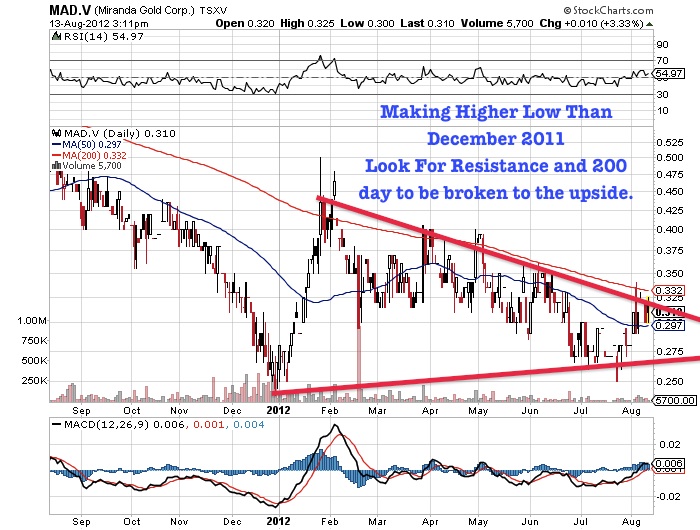
| Why A Mining Giant Is Partnering With A Project Generator In Colombia Posted: 13 Aug 2012 02:16 PM PDT Miranda has recently announced a significant alliance with Agnico Eagle, a $7.5 billion mining giant, to explore for gold in Colombia, one of the best countries to work in South America. Miranda already has a working relationship with Agnico in Nevada and Ester Dome in Alaska. According to CEO Ken Cunningham, this deal will put over $2 million dollars into the Miranda treasury over two years, strengthening the companies financial position at a time when it is challenging for exploration companies to raise capital. In addition, Agnico will be picking up 70% of exploration costs and overhead in Colombia. Currently, the major miners are looking to invest in Colombia. Mining is a depleting business and the big boys need large and long living mines in politically friendly jurisdictions. We have witnessed the rise of resource nationalism and violence in Argentina, Bolivia, Mexico and Peru. Some of the majors such as Barrick and Pan American are putting holds on giant projects due to rising costs. Colombia is transforming itself into a mining friendly jurisdiction and possibly the top place to work in South America. For this reason, Miranda has been working diligently in Colombia for about two and a half years and have developed an impressive exploration database. Agnico Eagle who is focusing on growth is able to jump start their Colombian exploration by joining forces with Miranda who has experienced exploration geologists and technical personnel already there. The major miners such as Agnico use their in house exploration personnel around operative mines to attempt to replenish reserves. The majors look to Miranda to provide high powered, boots on the ground and grassroots exploration team for Agnico in Colombia. Miranda has a myriad of catalysts in the pipeline in the second half of 2012 at their Nevada, Colombian and Alaskan Projects. Drilling and assaying are currently underway. It must be remembered that they are only one significant drill hole away from a major discovery on any one of their multiple projects located in mining friendly Alaska, Nevada and Colombia. During these difficult and volatile time in the marketplace, project generators like Miranda can preserve their treasury and at the same time provide shareholders with a chance of participating in a major discovery.
Disclaimer: Long Miranda and Miranda is GST featured company.
|
| Turk sees gold pulling up from $1,580, silver from $27 Posted: 13 Aug 2012 02:01 PM PDT 4p ET Monday, August 13, 2012 Dear Friend of GATA and Gold: GoldMoney founder and GATA consultant James Turk today tells King World News that the monetary metals seem to be pulling up from their key technical points, $1,580 for gold and $27 for silver. Turk doesn't see them going back there again. But does Fed Chairman Ben Bernanke? It sure would be fun to get a candid interview with him. An excerpt from Turk's interview is posted at the King World News blog here: http://kingworldnews.com/kingworldnews/KWN_DailyWeb/Entries/2012/8/13_Tu... CHRIS POWELL, Secretary/Treasurer ADVERTISEMENT Sona Discovers Potential High-Grade Gold Mineralization From a Company Press Release VANCOUVER, British Columbia -- With its latest surface diamond drilling program at its 100-percent-owned, formerly producing Blackdome gold mine in southern British Columbia, Sona Resources Corp. has discovered a potentially high-grade gold-mineralized area, with one hole intersecting 13.6 grams of gold in 1.5 meters of core drilling. "We intersected a promising new mineralized zone, and we feel optimistic about the assay results," says Sona's president and CEO, John P. Thompson. "We have undertaken an aggressive exploration program that has tested a number of target zones. Our discovery of this new gold-bearing structure is significant, and it represents a positive development for the company." Sona aims to bring its permitted Blackdome mill back into production over the next year and a half, at a rate of 200 tonnes per day, with feed from the formerly producing Blackdome mine and the nearby Elizabeth gold deposit property. A positive preliminary economic assessment by Micon International Ltd., based on a gold price of $950 per ounce over eight years, has estimated a cash cost of $208 per tonne milled, or $686 per gold ounce recovered. For the company's complete press release, please visit: http://www.sonaresources.com/_resources/news/SONA_NR18_2011-opt.pdf Join GATA here: Toronto Resource Investment Conference New Orleans Investment Conference * * * Support GATA by purchasing DVDs of our London conference in August 2011 or our Dawson City conference in August 2006: http://www.goldrush21.com/order.html Or by purchasing a colorful GATA T-shirt: Or a colorful poster of GATA's full-page ad in The Wall Street Journal on January 31, 2009: http://gata.org/node/wallstreetjournal Help keep GATA going GATA is a civil rights and educational organization based in the United States and tax-exempt under the U.S. Internal Revenue Code. Its e-mail dispatches are free, and you can subscribe at: To contribute to GATA, please visit: ADVERTISEMENT Prophecy Platinum Announces Wellgreen Preliminary Economic Assessment: Company Press Release VANCOUVER, British Columbia, Canada -- Prophecy Platinum Corp. (TSX-V: NKL, OTC-QX: PNIKF, Frankfurt: P94P) reports the results of an independent NI 43-101-compliant preliminary economic assessment for its fully owned Wellgreen nickel-copper-platinum group metals project in the Yukon Territory. The independent assessment, prepared by Tetra Tech, evaluated a base case of an open-pit mine (with a mining rate of 111,500 tonnes per day), an on-site concentrator (with a milling rate of 32,000 tonnes per day), and an initial capital cost of $863 million. The project is expected to produce (in concentrate) 1.959 billion pounds of nickel, 2.058 billion pounds of copper, and 7.119 million ounces of platinum, palladium, and gold during a mine life of 37 years with an average strip ratio of 2.57. The financial highlights of the preliminary economic assessment, shown in U.S. dollars, are as follows: Payback period: 3.55 years Prophecy Chairman John Lee says: "We are pleased with the preliminary economic assessment results. The numbers indicate that Wellgreen is one of most exciting mineral projects in the Yukon. The company is drilling to upgrade and expand the resource base. The infrastructure is excellent as the project is only 1,400 meters in altitude and 14 kilometers from the paved Alaska Highway, which leads to the Haines deep seaport. Discussions are under way with support from local stakeholders regarding permitting and logistics." For the complete press release, please visit: http://prophecyplat.com/news_2012_june18_prophecy_platinum_announces_res...
|
| If there's ever serious journalism about gold, ask central banks these questions Posted: 13 Aug 2012 01:56 PM PDT For years GATA has been glad to respond to the occasional question about the gold market from financial journalists in the mainstream news media but has always urged them to question the primary actors in the market, central banks, in light of the documentation we have amassed showing or suggesting their often-surreptitious intervention in the market:
|
| If there's ever journalism about gold, ask central banks these questions Posted: 13 Aug 2012 01:27 PM PDT 3:40p ET Monday, August 13, 2012 Dear Friend of GATA and Gold: For years GATA has been glad to respond to questions about the gold market from financial journalists in the mainstream news media but we have always urged them to question the primary actors in the market, central banks, particularly in light of the documentation we have amassed showing or suggesting their often-surreptitious intervention in the market: http://www.gata.org/taxonomy/term/21 As far as we know, no such journalists have yet tried to question central banks about gold and reported the answers or refusals to answer, even as the efforts to question Germany's central bank, the Bundesbank, by the Canadian market analyst Rob Kirby in 2009 and the German freelance journalist Lars Schall in 2010 extracted some sensational confirmations in the form of denials: So to make it easy for mainstream news media financial journalists in case they ever want to pursue the gold story seriously, GATA compiles below some critical questions for central banks. ... Dispatch continues below ... ADVERTISEMENT Sona Discovers Potential High-Grade Gold Mineralization From a Company Press Release VANCOUVER, British Columbia -- With its latest surface diamond drilling program at its 100-percent-owned, formerly producing Blackdome gold mine in southern British Columbia, Sona Resources Corp. has discovered a potentially high-grade gold-mineralized area, with one hole intersecting 13.6 grams of gold in 1.5 meters of core drilling. "We intersected a promising new mineralized zone, and we feel optimistic about the assay results," says Sona's president and CEO, John P. Thompson. "We have undertaken an aggressive exploration program that has tested a number of target zones. Our discovery of this new gold-bearing structure is significant, and it represents a positive development for the company." Sona aims to bring its permitted Blackdome mill back into production over the next year and a half, at a rate of 200 tonnes per day, with feed from the formerly producing Blackdome mine and the nearby Elizabeth gold deposit property. A positive preliminary economic assessment by Micon International Ltd., based on a gold price of $950 per ounce over eight years, has estimated a cash cost of $208 per tonne milled, or $686 per gold ounce recovered. For the company's complete press release, please visit: http://www.sonaresources.com/_resources/news/SONA_NR18_2011-opt.pdf These are only a start and we'll welcome ideas for additional questions. These questions also may be used to turn away those financial writers who disparage complaints of gold market manipulation without ever having first put a critical question to a central bank. For the Federal Reserve 1) What are the Fed's gold swap arrangements with foreign banks that were acknowledged by Fed Governor Kevin M. Warsh in his adjudication of GATA's freedom-of-information request in September 2009?: http://www.gata.org/files/GATAFedResponse-09-17-2009.pdf 2) What are the other parties to these gold swap arrangements? 3) Have such arrangements ever been implemented? If so, when, how, and why? 4) What are the other gold-related documents the Fed succeeded in withholding from disclosure in GATA's freedom-of-information lawsuit against the Fed in February 2011? Will the Fed disclose them now? If not, why? For former Federal Reserve Board of Governors member Kevin M. Warsh 1) In your commentary in The Wall Street Journal on December 6, 2011, you wrote that "policy makers are finding it tempting to pursue 'financial repression' -- suppressing market prices that they don't like." You added, "Efforts to manage and manipulate asset prices are not new." http://www.gata.org/node/10839 Which prices did you mean as being subject to "financial repression"? 2) Which previous "efforts to manage and manipulate asset prices" did you mean? 3) Did you learn about "financial repression" during and because of your service at the Fed? For the U.S. Treasury Department 1) In the last 20 years has the U.S. government tried to influence the price of gold, openly or surreptitiously, directly or through intermediaries? If so, when, how, and for what purpose? 2) Has the Treasury Department or any other agency of the U.S. government, including the Exchange Stabalization Fund, undertaken gold swaps or gold swap arrangements or other gold transactions in the last 20 years? 3) Are the gold-related records of the U.S. government, including those of the Treasury Department and the Exchange Stabilization Fund, fully available to the public? If not, why? For the Bank of England and the United Kingdom Treasury 1) In December 2011 the Bank of England acknowledged that it had been active surreptitiously in the gold market prior to 2007 and did not want its gold transactions known to the market generally: http://www.gata.org/node/10778 With whom were these transactions undertaken and what were their purposes? 2) Will the Bank of England and the U.K. Treasury fully disclose their gold-related records? If not, why? For the Deutsche Bundesbank 1) In August 2009 the Bundesbank replied to an inquiry from the Canadian financial writer Rob Kirby about the Bundesbank's handling of Germany's gold reserves. The Bundesbank wrote: "The Deutsche Bundesbank keeps a large part of its gold holdings in its own vaults in Germany, while some of its gold is also stored with the central banks located at major gold trading centres. This has historical and market-related reasons, the gold having been transferred to the Bundesbank at these trading centres. Moreover, the Bundesbank needs to hold gold at the various trading centres in order to conduct its gold activities. It is common practice for central banks to keep part of their gold reserves abroad." In December 2010 the Bundesbank replied to an inquiry from the German freelance journalist Lars Schall. The Bundesbank wrote: "In managing foreign reserves, the Bundesbank fulfils one of its mandated tasks as an integral part of the European System of Central Banks. We trust you will understand that we are not able to divulge any further information regarding this activity. Particularly with respect to the confidential nature of information about where gold holdings are kept, we are unable to go into any greater detail concerning exact locations and the quantities stored at each of these. Likewise, owing to the strategic nature of the activity, we are not at liberty to provide you with more detailed information about gold transactions." What are the "gold activities" cited in the reply to Kirby? What is the "strategic ... activity" cited in the reply to Schall? 2) Has the Bundesbank undertaken any gold swaps or gold swap arrangements with the U.S. Federal Reserve, U.S. Treasury Department, or any agency of the U.S. government or other government? If so, when, and what were the purposes of the swaps? 3) Will the Bundesbank make its gold records fully available for public inspection? If not, why? For the International Monetary Fund 1) Where is the IMF's gold kept? Is it kept in the IMF's own vaults, in the vaults of IMF member nations, or elsewhere? 2) Is the IMF's gold actually in the IMF's possession or is it essentially just a claim on the gold reserves of its member nations? 3) When during the last 20 years the IMF said it was selling gold, did any gold actually leave any vault? If so, how much, and from which vaults did it leave and to which vaults was it delivered? 4) Will the IMF make its gold records fully available for public inspection? If not, why? For the Bank for International Settlements 1) What is the "gold pool" cited by BIS President Karl Otto Pohl in his interview with the financial journalist Edward Jay Epstein published in the November 1983 edition of Harper's magazine? http://www.gata.org/node/11622 2) Exactly how and why does the BIS trade in gold on its own behalf or on behalf of its members? Is information about this trading fully available to the public? If not, why? 3) A presentation made by the BIS to prospective central bank members at a meeting at BIS headquarters in Basel, Switzerland, in June 2008 -- http://www.gata.org/node/11012 -- includes, among a list of BIS services, interventions in the gold market. What are these interventions and their purposes and exactly how are they undertaken? Are they public or secret? If they are secret, why? 4) In a speech delivered at a conference at BIS headquarters in Basel in June 2005 -- -- William S. White, head of the BIS' Monetary and Economic Department, said that among the major purposes of international central bank cooperation is "the provision of international credits and joint efforts to influence asset prices (especially gold and foreign exchange) in circumstances where this might be thought useful." In the last 20 years what efforts has the BIS made or assisted to influence asset prices, particularly gold prices? Of which such efforts is the BIS aware? 5) Did the BIS undertake any gold transactions simultaneous with the devaluation of the Swiss franc in September 2011? For every central bank 1) What is the central bank's policy toward gold? 2) Has the central bank loaned or swapped gold or does it have gold swap arrangements with other central banks or government agencies? If so, who are the counterparties of these swaps and swap arrangements and what is their purpose? 3) Is it the bank's policy to support the gold derivatives market by making the bank's gold available for sale, swap, lease, other exchange, or hypothecation? If so, why? 4) Are the bank's gold-related records fully available for public inspection? If not, why? For JPMorgan Chase & Co.: 1) Are the enormous interest rate derivatives positions and the monetary metals positions on the bank's books the positions of JPMorgan Chase & Co. itself or are they essentially the positions of the U.S. government or other governments? http://news.goldseek.com/GoldSeek/1249407911.php CHRIS POWELL, Secretary/Treasurer Join GATA here: Toronto Resource Investment Conference New Orleans Investment Conference * * * Support GATA by purchasing DVDs of our London conference in August 2011 or our Dawson City conference in August 2006: http://www.goldrush21.com/order.html Or by purchasing a colorful GATA T-shirt: Or a colorful poster of GATA's full-page ad in The Wall Street Journal on January 31, 2009: http://gata.org/node/wallstreetjournal Help keep GATA going GATA is a civil rights and educational organization based in the United States and tax-exempt under the U.S. Internal Revenue Code. Its e-mail dispatches are free, and you can subscribe at: To contribute to GATA, please visit: ADVERTISEMENT Prophecy Platinum Announces Wellgreen Preliminary Economic Assessment: Company Press Release VANCOUVER, British Columbia, Canada -- Prophecy Platinum Corp. (TSX-V: NKL, OTC-QX: PNIKF, Frankfurt: P94P) reports the results of an independent NI 43-101-compliant preliminary economic assessment for its fully owned Wellgreen nickel-copper-platinum group metals project in the Yukon Territory. The independent assessment, prepared by Tetra Tech, evaluated a base case of an open-pit mine (with a mining rate of 111,500 tonnes per day), an on-site concentrator (with a milling rate of 32,000 tonnes per day), and an initial capital cost of $863 million. The project is expected to produce (in concentrate) 1.959 billion pounds of nickel, 2.058 billion pounds of copper, and 7.119 million ounces of platinum, palladium, and gold during a mine life of 37 years with an average strip ratio of 2.57. The financial highlights of the preliminary economic assessment, shown in U.S. dollars, are as follows: Payback period: 3.55 years Prophecy Chairman John Lee says: "We are pleased with the preliminary economic assessment results. The numbers indicate that Wellgreen is one of most exciting mineral projects in the Yukon. The company is drilling to upgrade and expand the resource base. The infrastructure is excellent as the project is only 1,400 meters in altitude and 14 kilometers from the paved Alaska Highway, which leads to the Haines deep seaport. Discussions are under way with support from local stakeholders regarding permitting and logistics." For the complete press release, please visit: http://prophecyplat.com/news_2012_june18_prophecy_platinum_announces_res...
|
| Posted: 13 Aug 2012 01:15 PM PDT The July employment and unemployment numbers published today, August 3rd, were worthless and likely misleading. What has been done in the last couple of decades to the reporting methodologies for monthly labor data, compounded by distortions introduced into the system from the economic collapse of the last five years, has left the heavily-followed employment and unemployment series seriously impaired as to significance, and potentially subject to direct political manipulation - John Williams, Shadow StatisticsI thought I would briefly summarize where I think we stand with the housing market. This will be conceptual, but conceptual based on links and data I have presented on this blog, and specifically data and trends so far this year. If I make any claims that need empirical back-up in your mind, please search the archives for 2012. An ongoing debate in the media this year has been over whether or not the housing market has bottomed and is poised to move higher. This "debate" is largely skewed to toward the "bottom is in, blue skies ahead" camp, as that is the overwhelming editorial bias of the U.S. media at large. Unfortunately, the mass perception of anything economic is formed by looking at headlines and hearing sound bytes. And the sound bytes have been bullishly optimistic. The truth is that, yes, there has been a slight bounce in home sales this year and slight bounce in prices. Please accept that this is nothing more than a proverbial "dead cat" bounce. After all, markets never go straight down to their eventual bottom - there's always a counter-trend "bounce" before the next leg down reasserts its ugly head. Housing is no different, especially when you factor in the trillions of dollars printed up and borrowed in order to keep the banks from collapsing and giving them room to "reload" on housing debt - albeit under much more stringent credit guard rails than the first time around. In addition, record low mortgage finance rates, plunging home prices and a shortage in apartment inventory has fueled an investor binge on "investment rental" properties, which has created an illusion of "organic" home sales. Furthermore, the Government, using your tax money, has been subsidizing the cost of mortgages for those who refi, subsidizing the mortgage principal reduction programs designed to keep people in their homes and subsidizing the transfer of a massive amount of foreclosed homes from FNM/FRE to rental investors. This dynamic, combined with the massive foreclosure moratorium for most of 2011, has created the dangerous illusion of growth in home sales and low inventory. Meanwhile, we have seen a big bounce in housing starts over the past year, fueled primarily by an usually large number of starts in multi-family units. This of course is the market adjusting to the shortage in apartment inventory. Over the next six months, this "shortage" will swing back to oversupply, as new apartment inventory competes with a large inventory of rental homes on the market. Interestingly, in driving around downtown Denver this past weekend, plus perusing the rental listings in craigslist, I have noticed that apartment rental prices has already started to soften up again. Lower apartment rent will once again start another "negative feedback" cycle which will take house rental rates lower and ultimately force home prices lower. Oh ya, one more point on housing prices. Because of the nature of statistical measurement error, the claim that housing prices are actually rising is quite questionable. The various surveys have shown slight month-to-month increases during 2012. But, as anyone who has taken Statistics 101 knows (and being a U of Chicago grad, I had to suffer through some rigorous statistics courses), it is more accurate to characterize small changes over short periods of time as being attributable to data sample "noise" - measurement errors and the general nature of random sampling not necessarily being "random." Therefore, what has been characterized as "rising prices" by the media, Wall Street and the Government is more likely to be some sideways bouncing along a tenuous level of support which was put in place with a couple trillion dollars in Fed/Government stimulus programs. So what next? We are already seeing a significant acceleration in the number of foreclosures this year. I have posted a couple links recently which show this. Fannie and Freddie specifically unloaded inventory in order to make room for another big round of foreclosures. Big banks sitting on a massive number of McMansions in default are now being forced to start foreclosing. I have seen this in several high-end neighborhoods in Denver and personally know a couple people who have been tossed out of their big homes. In other words the "shadow" inventory of homes is starting to transition into real inventory. Not coincidentally, I have noticed a lot "for sale" signs popping up this month. Ironically, we are transitioning into a seasonally slower period for real estate sales. It will be interesting to see what the affect on prices will be by the end of this year by what I believe is going to be a large increase in "for sale/for rent" inventory. Finally, to tie in the quote at the top from John Williams on unemployment, it is completely useless to even think about discussing a bottom for the housing market until this country figures out a way to fix the unemployment and joblessness problem. How can we possibly have true, organic demand for housing when the size of the labor force - the amount of people who are actually working - continues to shrink? Did I miss something magical about the demand for housing not being dependent on the number of people who can actually afford to buy a home? 
|
| Deutsche Bank: Further QE Might Actually Be BAD for Gold Prices! Here?s Why Posted: 13 Aug 2012 01:11 PM PDT Gold bulls often argue that the yellow metal will only go up as long as central banks continue to employ easy monetary policy however this thesis has been around so long that it might not even work anymore. That’s the gist of what Deutsche Bank suggests in their most recent outlook for precious metals prices. In a note to clients, they write: So says Matthew Boesler ([url]www.businessinsider.com[/url]) in edited excerpts from his original post*. [INDENT]Lorimer Wilson, editor of [B][COLOR=#0000ff]www.munKNEE.com (Your Key to Making Money!) and www.FinancialArticleSummariesToday.com (A site for sore eyes and inquisitive minds) has edited the article below for length and clarity – see Editor's Note at the bottom of the page. This paragraph must be included in any article re-posting to avoid copyright infringement.[/COLOR][/B] [/INDENT]Boesler goes on to say, in part: In a note to clients, Deutsche Bank writes: [INDENT]Gold trading volumes have tumbled recently as investors ...
|
| Turk - Tight Gold & Silver Markets To Spark Massive Breakout Posted: 13 Aug 2012 01:00 PM PDT  Today James Turk told King World News, "I had the chance to read John Embry's comments today on KWN about the tightness in the physical gold market, and I wholeheartedly agree with him." Turk also said, "This tightness is further evidence of the backwardation in the gold market I spoke about in our last interview. The most powerful rallies are the ones driven by a tight gold market, and that is exactly what we see right now." Today James Turk told King World News, "I had the chance to read John Embry's comments today on KWN about the tightness in the physical gold market, and I wholeheartedly agree with him." Turk also said, "This tightness is further evidence of the backwardation in the gold market I spoke about in our last interview. The most powerful rallies are the ones driven by a tight gold market, and that is exactly what we see right now." Here is what Turk had to say: "Both gold and silver don't appear to be doing much since we last spoke, Eric, but appearances can sometimes be misleading. The action in the precious metals over the past couple of weeks has been very constructive, and here's the important point. Slowly but steadily gold has been pulling away from $1580, while silver has been pulling away from $27. As I have been saying, I think those prices are history. We won't see them again."
This posting includes an audio/video/photo media file: Download Now |
 It is absolutely amazing what some people will do to make a living in this economy. Desperate times call for desperate measures, and we have not seen this kind of desperation for jobs in America since the Great Depression of the 1930s. What some people are willing to put up with just to bring home a paycheck these days will totally shock you. For example, would you slaughter dogs all day long even though you are really a dog lover? Would you personally train your replacement from China even though you knew he was about to take your job? Would you trade sex for a job? There are people out there actually doing all these things and worse. Every night in America, millions upon millions of people roll around endlessly in their beds and stare at their ceilings for hours because they can't sleep. They are sick to their stomachs because their money is gone and nobody will hire them. They can't provide even the basics for their families and they feel worthless. Unemployment can be absolutely soul crushing and it can suck the life right out of you. Things were supposed to be better by now, but they aren't. The month after Barack Obama took office the unemployment rate broke the 8 percent barrier and it has stayed above it ever since. But the truth is that the "official" unemployment number greatly understates the real amount of suffering that is going on out there. In reality, the percentage of working age Americans that have jobs is lower today than when
  Ranting Andy Hoffman the ace observer of gold price manipulation and a perpetual thorn in the cartel's backside joined us for the Monday Rant. While we were watching, gold got hammered and at one point was over $12 in the red. As a wise man said, we no longer have markets, just a series of ongoing governmental interventions. And if you don't believe it, just look at the price charts. They tell the whole story and it's not a pretty one at that. In the Elite's effort to prop up the markets and give the appearance of normalcy, they regularly manipulate the markets, all in the name of economic stability. But what we will wind up with is far from stability. Instead, they will cause the mother of all crashes. And us average Americans will be left to pick up the pieces and pay the piper.


| You are subscribed to email updates from Save Your ASSets First To stop receiving these emails, you may unsubscribe now. | Email delivery powered by Google |
| Google Inc., 20 West Kinzie, Chicago IL USA 60610 | |


No comments:
Post a Comment