


saveyourassetsfirst3 |

- SilverFuturist: Silver up 4% and counting!!
- Martin Armstrong: Dominoes Don't Always Fall in a Straight Line
- EM: Silver Chart Update 6.6.12
- Who Is Right – Gold Or Stocks?
- Gold/Silver Ratio: Critical Levels of Support & Resistance
- Silver Vs. Gold: Let's Settle This
- 2 'Must Own' Gold Stocks For A Weak Economy
- US T-Bonds: Black Hole Dynamics
- “Bear Channel Broken” for Gold, But “Professional Traders Need to Come Back” as European Banking Problems Spread
- Thoughts On Forward Inflation Expectation
- Tilting at Windmills
- Have Gold, Silver & Mining Stocks Bottomed?
- Gold Bullion: A Modest Proposal
- The Waffle House
- The real cost of not owning gold
- ECB: decrease of oz764,16 in gold and gold receivables
- Wisconsin Recap: Thanks to Obama, American Left Lies in Smoldering Wreckage
- What’s next for the U.S. Dollar? QE3?
- The 18 reasons to buy senior gold mining companies – Dr John Wolstencroft talks to Dominic Frisby
- Soros gets gold advice from Keiser Report
- Now It's Jedi Mind Tricks & Other Fed Tactics
- Why the US Dollar will Hyperinflate
- Gold and Dow Flash the Same Warning Signal
- Gold Prices ‘Break Above Bear Channel’ on Euro Worries
- In a Gold Standard, How Are Interest Rates Set?
- ECB rate cut talk lifts gold
| SilverFuturist: Silver up 4% and counting!! Posted: 06 Jun 2012 07:00 AM PDT |
| Martin Armstrong: Dominoes Don't Always Fall in a Straight Line Posted: 06 Jun 2012 06:53 AM PDT Martin Armstrong, noted market analyst extraordinaire, joined FSN for a far reaching interview about the current direction of the economic system and the future of the Euro, Gold and the Dollar. His new book is due out just before the election and it promises to be a real bombshell. from financialsurvivalnet: Martin's done what few people have had the desire or commitment to: he went back to the Great Depression and analyzed the sovereign debt defaults and the true underlying causes.While this time is definitely different, there are many striking parallels. Sovereign debt defaults are the rule, not the exception, this time as well as last. The politician's inability, lack of desire and incomprehension are the same this time as well. The attempt to print the world's way out of the jam is another recurring theme. Which just proves that the more things change, the more they stay the same. Try telling that to Congress! Go to http://www.FinancialSurvivalNetwork.com for the latest info on the Economy, Markets and Precious Metals. ~TVR |
| EM: Silver Chart Update 6.6.12 Posted: 06 Jun 2012 06:47 AM PDT |
| Who Is Right – Gold Or Stocks? Posted: 06 Jun 2012 06:33 AM PDT
from zerohedge.com: From early October of last year (Grand Plan and Global CB intervention) until the start of the LTRO program in Europe, Gold and Stocks (and Treasuries and the USD) all traded in sync with one another. Since the LTRO program, the equity market has generally been on its own in terms of belief. While growth hope, Europe's recovery, and the Bernanke Put (as well as a short-squeeze of epic proportions) were at play, it seems to us that the Fed's Twist program has been ignored by the money-printing crowd (since Twist was sterilized and did not expand the monetary base (excess reserves) – which gold reacts to; but did provide flow – helping stocks – as the Fed's DV01 increased; implicitly devaluing the currency even though Fed's efforts to dissuade have worked) while the ECB's LTRO provided a liquidity overhang that at-first-glance removed one short-term structural risk from US markets (the Europe contagion). Since we made clear that LTRO is in fact an encumbrance and not 'clean' debt monetization (which fits with gold not moving as much), equity markets in Europe have retraced all of those gains – leaving US still elevated. Keep on reading @ zerohedge.com |
| Gold/Silver Ratio: Critical Levels of Support & Resistance Posted: 06 Jun 2012 05:07 AM PDT Charleston Voice |
| Silver Vs. Gold: Let's Settle This Posted: 06 Jun 2012 05:05 AM PDT By Bulls and Bears: The silver vs. gold debate has strong proponents on either side, but which asset class will outperform? I expect silver to outperform gold under the current U.S. dollar monetary system, but gold will ultimately reclaim its status as the one true monetary king. Silver vs. Gold: The investment thesis for both precious metals is exceptionally strong, but to determine which metal will outperform, investors should look at the individual investment thesis of each metal under the current U.S. dollar monetary system; and consider what the monetary system will be post U.S. dollar. Why The U.S. dollar Monetary System Is Ending: The U.S. is having a balance sheet recession, which takes much longer to work through than a typical inventory recession, due to the need for massive deleveraging. Corporations' balance sheets are strong again, but the toughest part of the deleveraging process is just starting, as countries must Complete Story » |
| 2 'Must Own' Gold Stocks For A Weak Economy Posted: 06 Jun 2012 04:31 AM PDT By Ry Frank: The U.S. Labor Department reported Friday that the unemployment rate had risen to 8.2%, as businesses added a scant 69,000 jobs in May. The data led to increased speculation that the Federal Reserve may step in, specifically considering taking steps towards further quantitative easing - yes, the dreaded QE3. Perhaps the most significant impact of the information was that stocks had their worst day of 2012 and the VIX index, the standard measure of volatility in the market, spiked by over 10%. The fall puts all of the major indexes into correction territory, with the Dow crossing into negative territory for the year while the S&P 500 is holding on to a less that 2% year-to-date (YTD) return. This confluence of events led gold to spike by over 4%, making it the single largest up day for gold in the previous two years - spot gold climbed by approximately $66 Complete Story » |
| US T-Bonds: Black Hole Dynamics Posted: 06 Jun 2012 04:30 AM PDT Man-made financial phenomena imitate nature, but more importantly they are subject to the powerful laws of economic nature. The Wall Street financial engineers have built vast structures, which tragically are crumbling and soon will fall to the ground. Vast illusory wealth will be lost, never truly garnered. The fiat currency system has required tremendous efforts not only to build the financial skyscrapers ever higher each year, but also to provide support structures that prevent their topple. With the aid of the subservient press, an illusion of wealth, prosperity, and stability has been fashioned and defended. It is all being blown away by the powerful storms known as the global financial crisis. The term has even earned an acronym for the popular lexicon GFC. My alternative view is that the global monetary war is in full swing, World War III with the USDollar at the epicenter of the conflict and pecuniary violence. A few years ago in June 2005, the Jackass penned an obscure article entitled "Financial Market Physics" just for amusement. Thanks to Vronsky and his intrepid work, the Gold-Eagle archive still lives (for old article CLICK HERE). In it was described momentum, pendulums, traction, leverage, resistance, support, inertia, coiled springs, meltdowns, high versus low pressure differentials, flow dynamics, imbalances, and the infamous black hole. The final concept is of extreme relevance today.
My objective is to explain how the crumbling USTreasury Bond tower has an effect on the ground. Last article dealt with the inevitable collapse of the tower, since its support buttress in the Interest Rate Swap has begun to rupture. My best source claims a trigger mechanism has been pulled from deep within the USTBond/IRSwap system managed by JPMorgan. The collapse is assured. It cannot be stopped. It will continue until its conclusion. In the wake of the collapse are dynamics on the ground, at the site of the tower. A grand black hole will be formed, complete with tremendous power to suck down all assets. The process has already started, sucking down weak sovereign bonds and junk corporate bonds. My purpose will be to describe the process from the top down, then the bottom up, as lost faith in all things paper gathers like a gigantic storm that covers the entire earth. The great power is seen an the following image, a great piece of Fotoshop work in itself. Money vanishes in the hole. Notice how in the past few years, grand bank aid has come, $trillions tosses at the banking structures. Yet they are still insolvent, in ruins. The money went into the Black Hole, which should include Fannie Mae and AIG in a wider focus.
The tremendous power in nature for similar anomalies can be seen in a gorgeous water hole, whose location could not be verified with a little research. Also the awesome beauty of the inter-stellar black hole has been captured probably by the Hubble telescope. The intense gravitational field traps all matter, all wave elements (such as transmissions), even light itself. Black Holes in nature occur when a star dies, its mass collapses, to produce a gravitational field beyond what can be managed in a stable system. That star is the USDollar core and revolving USTBond system, which are collapsing. Some scientists believe alternative universes lie on the other side of such voyages through the eye. The water that descends into the hole goes into the ecosystem, recycled, maybe purified, only to emerge elsewhere on the other side. If only the Western bankers could be forced to travel through the astronomical eye, suffer the crush, and emerge in another world far enough away not to harm the population. Could the light flashes be dragon breath on each side? The poles could be viewed as producing future Gold demand.
JUNK BOND RELEASE VALVE The top has many forces. The impaired higher risk bonds are shed like yesterday's trash with newspaper wrappers (prospectus filings). In the Hat Trick Letter May report, the topic of widening junk bond spreads was exposed. Mistakenly in my view, the Seeking Alpha author describes the junk bonds as offering good value, only because their yields are higher than before. Those yields will go higher still, much higher, corresponding to much lower values. In the process of shedding the high risk bonds, investors will turn to the supposed safe haven of USTreasury Bonds. The author points out that in the last month alone, the situation has worsened. He wrote, "As I mentioned in a recent article, high-yield spreads to Treasuries, as measured by the BofA Merrill Lynch US High Yield Master II Option-Adjusted Spread, recently reached a new high for 2012, now at 7.17%, up 123 basis points in the past month alone." It has risen 17 basis points so far in June alone, in only three active trading days. If still rising, the junk bond value continues to fall. He went on to compare to historical levels, without paying much attention to the acute risk of the spread widening considerably further. The junk spread can move fast, as seen in the last crisis chapter. It went from 3.73% in January 2006, to 5.92% in December 2007, to 21.8% in December 2008. It could repeat such exaggerated moves in the current crisis. See the Seeking Alpha article (CLICK HERE). The multi-year chart shows the early stage of another eruption.
A closer view was given just a couple weeks ago. Notice the divergence process underway, as the junk bond yield index moves up and up, but the USTBond index moves down and down. In the last couple weeks, my forecast of a 1.5% USTBond yield on the 10-year came true. That was one of the easiest calls in my memory. The trajectory on the junk yield (in blue to the sky) continues to go higher, while the trajectory on the USTreasury yield (in brown like feces) continues to go lower. Next will come the more mainstream corporate bonds, tomorrow's potential junk bonds, which will be sold off in favor of the USTBond for perceived safety. We are already starting to hear the chorus on the favorable performance of USTreasurys, the lone winner in the crowd. The financial press anchors and analysts simply do not comprehend that the USTBond is the final asset bubble, how its rise means the failure of other assets, how the implosion has its epicenter powered by 0% by the USFed itself. The faith shown to the USFed has become a more desperate hope. Ignored has been the 30-year USTBond. If its yield goes from 2.65% currently to 2.0% as is likely, a ripe 15% profit can be gathered. Not bad in today's ugly climate.
THE PRIMARY QUESTION WITHIN THE CRISIS SETTING SHOULD BE: WILL THE SYSTEM IMPLODE BEFORE THE 10-YEAR YIELD REACHES 1.0% ???
DISTORTED MONEY MANAGEMENT An interesting little exchange occurred this week between the Jackass and Tyler Durden, the crack analyst editor at Zero Hedge. My point was that he misses the point of capital destruction from the ZIRP policy of enforced 0% as official rate. He argued two excellent points that did sink into the stubborn Jackass brain stem. Artificially low interest rates enable consumers to spend improperly and unwisely. The setting was prepared by an unusually enlightening debate between Rick Santelli and Gary Kaminsky on CNBC, the official Wall Street public address system wall with loudspeakers. They argued that the now status quo financial repression identified by low interest rate and QE environment are not good for the USEconomy. How true!! But this spout of wisdom occurs in the mainstream. Santelli cannot be suppressed, too smart, too experienced, too outspoken. Durden wrote, "Borrowing and saving are really about whether to consume more now or later (or more later and less now). We agree with Professor Antony Davies that these decisions are best left to individuals, and not the Nanny State Fed. Each person's judgment of what is best for them is replaced by the Federal Reserve's judgment and the free market interest has become a thing of the past (for now). Lower rates don't mean more spending; they mean more spending now and less in the future." See the Zero Hedge article (CLICK HERE).
Low interest rates far below where they belong encourage a new car that should not be bought, a boat that should not be bought, those items of jewelry (or furniture or lawn ornaments) that should not be bought. They even encourage a bigger house that should not be bought. Many such purchases end up in a liquidation sale, a yard sale, a repo sale, or a foreclosure sale much later after the spending high wears off and the bill is due. Great bottom up argument by Durden. The larger point in parallel is that artificially low interest rates bring about a misallocation of capital, far beyond the misjudged consumer spending.
The second excellent point made by Tyler Durden was that inadequate capital investment has led to a decline in corporate profitability, due to a deteriorating capital base. The working capital of big Western firms, perhaps to some extent in Japan also, has resulted in a dilapidated aging asset base that produces a declining cash flow. An absent capital expenditure (CAPEX) reinvestment will lead to amortization and depreciation to the point of no return. See the disaster in Venezuela where Chavez has driven their petroleum business down hard, well over 25% to 30% lower output. Economist David Rosenberg used to be a favorite economist of mine, but he embraces the nonsense about a recovery when the USEconomy has been stuck in a semi-permanent recession of minus 3% to minus 5% for four years running. Despite that errant position, Rosey pointed out earlier that corporations are forced to spend the bulk of their cash on dividend payouts, courtesy of ZIRP which has collapsed interest income. They must also replenish flagging pension programs subject to lofty forward views. Companies have less to invest in new equipment, new workers, and research & development. In other words, the business sector cannot invest properly in their own main product lines. Ultimately, the corporate profit margins suffer from neglect and age, like an old car. The USFed sponsored 0% rate shifts capital allocation equations, so that ever less cash is going into replenishing asset bases. In many cases the threshold of useful asset life has been crossed. Job cuts and the savings involved cannot breathe renewed life into any business. Besides, most companies are already cutting into the bone. Once the depreciation and amortization cliff is reached, the cash flow will be much worse. See the Zero Hedge article (CLICK HERE) for an excellent survey of capital investment, working capital, debt reduction, R&D, acquisitions, stock buybacks, dividends, and more.
The problem is as diverse as it is perverse. The low mortgage bond yields, coupled with cratering commercial paper, has attacked the corporate sector. It does not produce the cash flow from stored cash anymore. Compare to a human body whose heart pumps much less blood within the circulatory system, and the body slowly starves of oxygen. The artificially low USFed ZIRP policy of zero percent interest rate has resulted in a disaster of mammoth proportions. Corporations and fund managers, including pension funds, have made decisions to accept higher risks since the safe USTBond complex has offered such paltry returns. The risk has backfired since 2007 in a big way. Having lost their core, they direct their remaining assets into USTBonds which earn tiny interest, but are seen finally as safe. The USGovt is not a good business investment, a grandiose money loser. A rally is occurring in bonds for USA Inc, which is losing $1.5 trillion per year, a horrible investment. Again, more misallocation of capital as funds chase the USTBond Tower of Babel. The fund managers have gone from risk ON to risk OFF, as the economic and financial worlds hurtle toward implosion and systemic failure. On the consumer household side, the low 0% rate has hit savers too. They cannot live off savings income. Retirees are the new poverty stricken class, forced to choose between food or medication, sometimes opting for dogfood. The fact of economic life not reported by the financial anchors and supposed expert analysts is that the official 0% acts to suppress economic activity, not to stimulate it. It is a gigantic wet blanket. The collection of savers has twice the volume as consumer loans. The interest income is twice that of interest paid. Therefore the USEconomy grinds slower.
PRIVATE PENSION FUNDS A jet assist will be given to the Black Hole swirl when the USGovt makes its next horrendous decision on treatment of private pension funds. The mass of 401k, IRA, and Keough funds enjoys a tax deduction benefit on much of the incoming investments from the payroll side. That might soon end with a forced directive by the USGovt in all its limitless short-sightedness, if not stupidity, surely desperation. They must find buyers of USTBonds, just like Japan twenty years ago. Japan forced all public pension funds, postal also, into Japanese Govt Bonds, even though they earned squat for interest. The same will happen in the United States. The discussion has been tossed around for months, a very tempting concept indeed. Imagine the $16 trillion in US retirement funds being redirected in part into USTBonds. Just attacking the personal 401k, IRA, and Keough funds would bring a cool $2 trillion at least, maybe more. They would declare the tax benefit as lost on new income entering the private pension funds, unless they purchased USTBonds. A more extreme decision would be to force old money in the funds to exit their stock investments and enter USTBond investments instead. Even if only on the margin of new entering funds, the effect would be huge. A backfire on the stock market would occur, to be sure. If the extreme option were declared law, then the stock market effect could be another 10% sudden decline or worse. My point is that forced personal pension funds into USTreasury Bonds would add considerable new force to the Black Hole that sucks capital from the system, and pushes it into the natural toilet.
CAPITAL DESTRUCTION FROM 0% For some reason, after considerable observations, the Jackass has been unable to find more than one or two other analysts that pay any attention whatsoever to the very important effect of 0% official rate. The Capital Destruction effect is profound and damaging. Few if any economists or financial analysts seem to comprehend that a sustained 0% rate kills capital. The dynamic is simple, mentioned every third or fourth public article by the stubborn Jackass. As 0% prevails for the return on money, the investment community pursues alternatives to the empty USTBond savings window. The investors seek out investment alternatives like commodities, while others rely upon the commodity sector as a hedge against inflation. Whichever the point of view, the result is that commodity prices rise and the cost structure rises. The brunt is felt in higher industrial feeder system costs, and higher household costs like with food and utilities. The profit margins shrink for businesses, and for the diverse business segments. The final product price cannot keep pace with a rising pattern, not with the intense competition in China, as well as Japan and the entire Pacific Rim. Product prices cannot rise to maintain a constant profit margin. So capital dies in a vicious cycle as the USEconomy weakens further with each passing month.
As the profit margins are reduced, entire businesses along with certain business segments shut down. They take their equipment off line. They retire their capital. In some cases after a period of time, they liquidate their equipment in order to raise needed cash. The result overall is a destruction of capital, a retirement of capital, a shrinking of the economic capital base. This is the biggest blind spot in the collection of American, British, and Western European economists. They believe the ZIRP is a stimulus. It is a stimulus only to speculation, which has turned on its masters to destroy their ill-fated elaborate but flimsy structures. ZIRP has systematically been destroying working capital. The standing permanently declared 0% monetary policy assures an endless recession, and no recovery ever. Worse, the free cost of money distorts all financial markets, all asset pricing, everything. It is an epitaph on monetary rule.
The ZIRP will continue forever, or until the USGovt debt default, or until the systemic failure signaled by the JPMorgan major losses. The two major reasons why no Exit Strategy is available to the USFed and USDept Treasury are that 1) USGovt borrowing costs would rise to uncontrollable levels, adding to already unmanageable deficit levels, and 2) the Interest Rate Swap control apparatus would implode, leading to $100 trillion in losses or more. So the Zero Interest Rate Policy will go on forever, until the USTBond Tower of Babel falls, or until the entire financial structure based on the fiat USDollar collapses. Arguments to the contrary are both baseless and have been proved wrong by events of the last four years. No recovery, no remedy, no liquidation, endless war, deficits to the sky. Systemic failure awaits.
GOLD RISE DURING SYSTEMIC BREAKDOWN The official ZIRP is the calling card of the Gold Bull Market. What commodities are for investments and hedges in the tangible arenas, Gold & Silver are to the financial arena. As long as the Zero Percent Interest Policy is in force, the Gold Bull Market will persist and thrive. The ZIRP assures that the inflation adjusted real interest rate, like with the 10-year bond or 30-year bond, will remain negative. Take the 2.5% yield or 1.5% yield, subtract the actual price inflation of 7% to 9% in order to arrive at a negative 6% interest return in real terms. The negative real rate has persisted for over ten years, and assures an ongoing Gold Bull Market. It requires repeating. The official ZIRP is the calling card of the Gold Bull Market.
The battles on the ground are more full of intrigue. One should never lose sight of the sinister motive to disrupt nations, to enable overthrow of tyrant leaders, with the side benefit to capture their gold as booty. The raid in Libya of 144 tons, the raid in Greece of 112 tons, cannot be dismissed as asterisks when they might have been the primary objective. The Arab Spring saw other gold released from vaulted bases, like in Tunisia, a story long forgotten. The capture of gold bullion in movement from political instability occurs on the periphery of the black hole. Almost no central bank gold remains from any major country, as almost none is left in any central bank vault. The Bank of England attracted attention several months ago by sending into circulation very old gold bars, easily identified by markings. Switzerland has a different problem, caught in their own web of deceit and fraud. They have been ransacking private Allocated accounts for years. Von Greyerz has pointed out how investors wishing to transfer their gold bars find themselves wrestling with bullion bankers who do not any longer have the bars in possession. Proof is the new serial number stamps on bars, whose dates make liars out of the bullion bankers, since those dates are newer than the accounts. The bars held are a few years younger than the initial investment time frames. Only the smaller countries seem to have gold, along with Russia and China and India. These small countries are vulnerable, subject to raids.
The SPDR Gold Trust will be the final gold victim of the black hole forces. It has been dubbed the central bank of gold bullion bankers. It recently saw a reduction in bar volume equal to the amount that was just increased in the Sprott Gold Fund (symbol PHYS). The Sprott Funds are loaded with integrity, as honest as the GLD fund is dishonest and corrupted. As the flight to true safety increases, money (in form of gold bars) will fly out of the GLD corrupt corner caves. The hapless clueless dumbfounded GLD investors will be holding paper certificates in their empty hands. They will pursue legal avenues, replete with lawsuits, seeking clawbacks from emptied vaults. In time, the GLD share price will be 20% to 30% below the gold spot price. The proof lies in its price discount relative to spot. Take the GLD quoted price today at 158.9 per share and compare to the gold spot price of 1637 per ounce. Factor in the 10:1 ratio, and arrive at a hefty 3.0% discount of GLD to spot gold price. The Sprott Funds typically have a notable premium in price since they actually purchase the gold bars. The SPDR Gold Trust relies heavily upon paper certificates, and permits routine and frequent short raids out its back door that drag down the share price.
My position has been laid out clearly in recent weeks. The biggest factor behind the gold price (with corrupted paper futures discovery aspect) is the Eastern Coalition. Their grand raids have resulted in 5000 metric tons pulled out of New York, London, and Swiss banks, and sent East, principally China, but not exclusively China. Their motivated raids are intended to weaken the Anglo bankers to the point that they are rendered toothless to defend their massive naked short positions. My excellent reliable gold trader source has pounded the table for over a year, that the gold cartel is net short over 20 thousand tons from improper illicit illegal usage of Allocated accounts. Their nightmare is only beginning.
The gold price can be viewed apart from the background wartime battles, which have left plenty of blood on the fields, offices, and delivery ramps alike. The JPMorgan troubles have underscored the vulnerability of the USTBond complex, and exposed the Interest Rate Swap as a reinforcement device. The truth is slowly emerging. The declared JPMorgan losses are soon to exceed $20 billion. CEO Dimon has admitted the Delta Hedge strategy that manages the Interest Rate Swaps has gone somewhat out of control. His tormented elite financial engineer staff cannot even estimate the losses. During the lifting of the curtain to show the world the vast machinery at work creating a facade of safety and security in the USTreasury Bonds themselves, money moves into Gold. During the last few weeks, anyone with an IQ greater than the Bush family can notice the USEconomy is hurtling into a recession. All indicators scream recession. With strained facial expressions and almost apologetic tone for reporting a more truthful picture, the financial news networks cannot avoid the reality of a recession. They report the dire stream of economic news with sheepish regret.
The USTBonds will benefit from the recession outlook, but talk has already begun in two important messages. First, that the strong performance of the USTBonds signals a recession and widespread damage to the USEconomy, along with even greater USGovt deficits. Second, that the USTBonds might be the only successful investment in town. The latter speaks directly to my point of the USTreasury Bond sucking all capital, inducing sales of all asset classes, and purchasing the US sovereign bond since it is the supposed safe haven, the only asset that is not losing value. The USTBonds will fail from their own success, as instability enters the base while the Tower of Babel goes higher. Again, the biggest question in my mind is whether the 10-year USTBond yield (the TNX) will reach the next important target of 1.0% before the systemic breakdown. My intermediate target of 1.25% will be achieved, but only after the USEconomy is recognized by the dumbest people in the room, the USGovt stat rats. As the USTBonds continue to rally, the Gold price will rally alongside it. Eventually, the USTBonds will be regarded as toxic paper, the cause of a Black Hole, subject to severe default writedowns in a debt restructure. Then Gold will rise without competition, unimpeded by a phony USTreasury safe haven. by Jim Willie CB June 6, 2012 home: Golden Jackass website THE HAT TRICK LETTER PROFITS IN THE CURRENT CRISIS. From subscribers and readers: At least 30 recently on correct forecasts regarding the bailout parade, numerous nationalization deals such as for Fannie Mae and the grand Mortgage Rescue.
"In my 40 plus years of business experience that includes stints in public and private companies as well as entrepreneurial ventures, I have read numerous newsletters in an effort to stay abreast of a rapidly changing world. In my opinion, you seem to be tying the pieces together better than any other source." (BobT in Maine) "Your monthly reports are at the top of my list for importance, nothing else coming close. You are the one resource I can NOT do without! You have helped me and countless others to successfully navigate the most treacherous times one can possibly imagine. Making life altering decisions during tough times means you must have all the information available with direct bearing on the decision. Jim Willie gives you ALL the needed information, a highly critical difference. You cant afford to be wrong in today's world." (BrentT in North Carolina) "You have warned over and over since Fall of 2009 that Europe would come apart and it sure looks like exactly that is happening. You have warned continually about the COMEX and now the entire CME seems to be unraveling. You must receive a lot of criticism regarding your analysis, trashing the man, without debate. Your work is appreciated. I do not care how politically incorrect or how impolite your style is. What is happening to our economy and financial system is neither politically correct or polite." (DanC in Washington) "The best money I spend. Your service is the biggest bang for the buck." (DaveJ in Michigan)
Jim Willie CB is a statistical analyst in marketing research and retail forecasting. He holds a PhD in Statistics. His career has stretched over 25 years. He aspires to thrive in the financial editor world, unencumbered by the limitations of economic credentials. Visit his free website to find articles from topflight authors at www.GoldenJackass.com. For personal questions about subscriptions, contact him at JimWillieCB@aol.com
|
| Posted: 06 Jun 2012 04:28 AM PDT "Bear Channel Broken" for Gold, But "Professional Traders Need to Come Back" as European Banking Problems Spread U.S. DOLLAR gold prices climbed to a one-month high at $1640 an ounce ahead of Wednesday's US session – a gain of more than 7% from May's low – while stocks, commodities and the Euro also ticked higher and major government bond prices fell, with London markets open again after a two-day public holiday. Silver prices climbed to over $29.50 an ounce – a 3.3% gain on the week so far, and a near 10% rise from last month's low. "[Gold] is consolidating last Friday's aggressive move from $1546 to $1629," says the latest technical analysis from bullion bank Scotia Mocatta. Barclays Research meantime note that gold prices have broken above its "2012 bear channel", adding that gold has hit "strong demand [in the] "1522-33 area" on downswings over the past 12 months. "This week there will be plenty of opportunities for gold to either pass the safe haven test or reverse back into its old risk-on shell," added a note from UBS this morning. The European Central Bank announced its latest monetary policy decision on Wednesday, which saw the ECB leave its main interest rate on hold at 1%. Following Wednesday's ECB decision and press conference, the Bank of England makes its latest policy announcement on Thursday, shortly followed by US Federal Reserve chairman Ben Bernanke's testimony to Congress. When Bernanke appeared before Congress at the end of February, gold prices dropped $100 an ounce in less than an hour. Back here in Europe, "the ECB might want to wait for further corroborating data to conclude that its second-half-of-the-year recovery expectations are challenged," reckons Royal Bank of Scotland economist Silvio Peruzzo. "The problem in the Eurozone," adds Steve Barrow, currency analyst at Standard Bank in London, "much more than the US and UK, is that the banking sector is broken. As it fights for its survival, so credit growth to firms and individuals is sacrificed." "European institutions must open up and help us facilitate bank recapitalizations," said Spanish Treasury minister Cristobal Montoro yesterday. "The market is no longer open. The risk premium is telling us that Spain as a state has a problem accessing the market when we need to refinance our debt." Yields on 10-Year Spanish government bonds breached 6.7% last week, and despite easing since remain above 6%. European leaders agreed last July that the European Financial Stability Facility, the Eurozone's temporary bailout fund set up two years ago, should be able to make loans for the purposes of bank recapitalization, although such loans would go to sovereign governments rather than to banks directly. Ratings agency Moody's meantime cut its credit rating for six German banks on Wendesday, including Commerzbank, while it also cut its rating for the German arm of Italian bank UniCredit. Three Austrian banks also had their ratings cut. "Today's rating actions are driven by the increased risk of further shocks emanating from the Euro area debt crisis in combination with the banks' limited loss-absorption capacity," said a Moody's statement. The European Commission today announced its plans for a resolution regime to deal with failing banks, including "early supervisory intervention" and powers to sell all or parts of banks deemed to be failing. In addition, the Commission states, "if market funding is not available…supplementary funding will be provided by resolution funds which will raise contributions from banks proportionate to their liabilities and risk profiles." Opposing the so-called banking union, one German politician today described it as "a new, admittedly creative, way to tap German solvency." "Our savers cannot be liable [for other countries' banks]," added another, Michael Fuchs, who is a member of Chancellor Merkel's CDU party. Following a conference call on Tuesday, G7 leaders said they will coordinate their response to the Eurozone crisis. "[They] said they will speed up their efforts to resolve those problems, which was encouraging to us," said Japanese finance minister Jun Azumi, adding that "Japan is ready to provide support if there is anything we can do." The Bank of Japan was one of six central banks that took part in a coordinated action on November 30 last year, when the cost of overnight Dollar funding to banks was cut by 50 basis points (0.5 percentage points). Despite the ongoing crisis, the Euro rallied this morning, at one point trading above $1.25, 1.7% up on last week's two-year low. Euro gold prices meantime hit their highest levels since the end of February, rising to €42,290 per kilogram (€1315 per ounce). The gold price in Euros has only been higher than €42,000 kilograms on 36 previous trading days, first in September 2011 and then again in February of this year. Over in the US, the so-called speculative net long position held by gold futures and options traders on the Comex fell just over 5% in the week ended last Tuesday, data published Friday by the Commodity Futures Trading Commission show. The spec net long – defined as the difference between bullish and bearish contracts held by noncommercial traders, as opposed to industry players such as gold mining companies – fell by the equivalent of 17.2 tonnes of gold bullion, hitting its lowest level since December 2008. Since last Tuesday, gold prices have rallied back above $1600 an ounce, following Friday's disappointing nonfarm payrolls report. "We are positive on gold," says Nikos Kavalis, global banking and markets analyst at RBS. Ben Traynor Gold value calculator | Buy gold online at live prices Editor of Gold News, the analysis and investment research site from world-leading gold ownership service BullionVault, Ben Traynor was formerly editor of the Fleet Street Letter, the UK's longest-running investment letter. A Cambridge economics graduate, he is a professional writer and editor with a specialist interest in monetary economics. (c) BullionVault 2011 Please Note: This article is to inform your thinking, not lead it. Only you can decide the best place for your money, and any decision you make will put your money at risk. Information or data included here may have already been overtaken by events – and must be verified elsewhere – should you choose to act on it.
|
| Thoughts On Forward Inflation Expectation Posted: 06 Jun 2012 04:27 AM PDT By Calafia Beach Pundit: Contrary to a recent post on Zero Hedge which notes that 5-yr, 5-yr forward inflation expectations according to Bloomberg's calculations have turned negative for the first time ever, I have updated my chart using Bloomberg's calculations of this variable (USGG5Y5Y Index, for those interested). Rather than falling to unprecedented lows, forward inflation expectations have now risen to their highest level since last August. My own calculations of this rate confirm Bloomberg's numbers, so I'm at a loss as to how ZH got the story backwards. Click to enlarge: In any event, as I noted in a previous post, it is very interesting that forward inflation expectations are rising at a time when 10-yr Treasury yields have plunged. Moreover, it's very interesting that this has happened while gold has fallen, commodities have fallen, and the dollar has risen. It suggests that the driving force behind collapsing Treasury yields (and this includes Complete Story » |
| Posted: 06 Jun 2012 04:27 AM PDT Excerpted from the June 3 edition of Notes From the Rabbit Hole, NFTRH190: On June 20th the Federal Open Market Committee is going conclude a two-day meeting and release a summary of their view of the economy, most likely including an 'unwelcome' decline in inflation. That of course would signal a dreaded deflation, which are the windmill 'giants' to our Dear (monetary) Leader's Don Quixote… "What giants?" asked Sancho Panza. "Those you see over there," replied his master, "with their long arms. Some of them have arms well nightwo leagues in length." "Take care, sir," cried Sancho. "Those over there are not giants but windmills. Those things that seem to be their arms are sails which, when they are whirled around by the wind, turn the millstone." Lower prices that would result from deflation are considered evil and battle must be done against this evil. An uncomfortable decline in inflation simply will not do in a system dependent on ever-increasing asset prices. The rich (asset owners) must get richer, the poor must get poorer (and more dependent on central authorities) and the middle must be wiped out. That is the implied message in the age of Inflation onDemand. So on June 20 (if not before), we will see if Friday's 'Jobs' induced counter-broad market explosion in the precious metals was the expected 'first mover' event to a coming inflationary policy panic. T Minus 17 days… The setup is taking shape now. In 2005 I wrote an article called 'Inflation Hounds' with the idea that the gold stocks would be the first to sniff out any coming inflationary policy that would result from deflationary phases like the one we are in now. I do not have mystical answers as to why the gold miners led the big construct down into today's deflationary fright fest, nor do I know why traders suddenly got 'smart' on Friday and bought with both hands in the face of the latest and most compelling deflationary signal, a paltry +69,000 'jobs' report. They were theoretically doing the right thing in buying the sector that depends on economic contraction and the counter cycle for its fundamental improvement. But how often do traders impulsively do the right thing? Some people might claim that Friday was simply a massive short covering rally. But previously, a bad economic report and a tanking stock market would have seen traders pressing their gold stock shorts, not covering them. Now, I am sure there was a considerable element of short covering going on Friday, but it was likely in response to very real buying for very real reasons. The same fundamental reasons NFTRH has put forth since the precious metals corrective consolidation began out of last summer's top during Euro Crisis, phase 1. I hope you will forgive those times when I get a little [frustrated] as a blogger with little tolerance for destructive information flying around that hurts real people trying to make real decisions in their real lives. When people seek to look smart by calling trends that are already fully mature (not to mention ready to reverse) or issuing 'instructions' to what they perceive as unthinking flocks of 'followers', I find it upsetting. That is because I find the way the entire system is run and the way some people self promote within this system as if they have its ultimate answers… upsetting. There are no tried and true answers within a leveraged, late stage system that continually tries to cleanse itself but is denied at every (deflationary) turn.  The picture above is one of the troubadours at the Federal Reserve and US Treasury having escorted the huddled masses into the 'safety' of long-term Treasury debt. The Fed stated it was buying these bonds but it is likely that Joe Sixpack (or his pension/401k manager) has now taken over the heavy lifting. Asset markets are in free fall (conveniently, still above our 'best' targets), the T bond is maxed, the precious metals are leading and some people are even wondering why commodities are not participating if the gold stocks are sniffing out a new inflationary cycle. In short, the mis-perceptions game is in full swing and our long-awaited opportunity is at hand. So let's get to some analysis… NFTRH190 then goes on for 25 pages to illustrate why our preferred plan is now engaged and why opportunity for patient investors who have managed risk awaits. I invite you to review the service for yourself. http://www.biiwii.blogspot.com Subscribe to our free eNewsletter: http://www.biiwii.com/NFTRH/eletter.htm
|
| Have Gold, Silver & Mining Stocks Bottomed? Posted: 06 Jun 2012 04:16 AM PDT While both gold and silver appear likely to have formed a major bottom or are in the process of forming a major bottom, I continue to believe that gold miners are offering more potential upside. |
| Gold Bullion: A Modest Proposal Posted: 06 Jun 2012 03:59 AM PDT Gold Bullion investment is distorted and discouraged by the UK tax system. Why...? |
| Posted: 06 Jun 2012 03:52 AM PDT
from tfmetalsreport.com: No, the title isn't intended for those who lacked courage/conviction to hold and buy over the past few weeks. It's simply a reference to where I had breakfast this morning. Just great stuff. Not a better breakfast to be had anywhere on the planet. Well, we finally got our silver short squeeze today. Very nice to see. As you know, I've been telling you for a while that the spec shorts were being drawn in and set up for a massive short squeeze. Maybe $100 in gold and $3 in silver doesn't yet count as "massive" but it's gratifying, nonetheless. Enough of that, though, the key question now is: Where do we go from here? From a technical standpoint, gold is ahead of silver as it has been for almost all of 2012. Recall that gold WON its first Battle Royale in late January. From there, it proceeded to rally another $100 before The Forces of Evil stepped in and drove it back down. In classic technical fashion, gold "rode" the Battle Royale line down until it intersected with long-term horizontal support near 1525. Now, having found and solidified a bottom, gold is rolling. It should continue to do so, in stages, until it reaches the line I've called "Battle Royale II", which connects the Labor Day highs of last year with the Leap Day highs of this year. As you can see, BR2 is currently around 1720 but by the time gold catches up to it, it will likely be on the 1700-1710 range. Keep on reading @ tfmetalsreport.com |
| The real cost of not owning gold Posted: 06 Jun 2012 03:00 AM PDT Bloomberg recently published an illustrative slideshow titled "The Real Cost of Owning Gold". As usual when dealing with precious metals, in an attitude that is widespread among the ... |
| ECB: decrease of oz764,16 in gold and gold receivables Posted: 06 Jun 2012 02:17 AM PDT |
| Wisconsin Recap: Thanks to Obama, American Left Lies in Smoldering Wreckage Posted: 06 Jun 2012 02:15 AM PDT By Matt Stoller, a fellow at the Roosevelt Institute. You can follow him on Twitter at http://www.twitter.com/matthewstoller. On Tuesday, Wisconsin Republican Governor Scott Walker humiliated his Democratic opponent, Tom Barrett, by easily turning back a popular recall attempt sponsored by unions and liberal activists. The numbers in the election, which were supposed to be close, were ugly, in favor of the Republican. But this wasn't just any Republican, Scott Walker is THE Republican, the politician who made his governorship a referendum on a hard right agenda, in a blue state. Walker waged a direct and very public attack on the major constituencies of the Democratic Party, rolling back rights for women, the working class, and the young with measures such as ending collective bargaining for state employees, privatizing state assets, and repealing Wisconson's equal pay provisions for women. His agenda provoked a fierce reaction – – Wisconsin citizens occupied the Statehouse for months - and then a recall. Yesterday, Walker's agenda was ratified by the voters of Wisconsin, the state where public sector unions were born. It's hard to overstate how bad this is – Wisconsin is now on the road to becoming a right-to-work state, in what is likely to become a right-to-work country. Right-to-work laws are provisions that allow individual employees to withdraw from unions, and they make it much harder for unions to organize. And the deeper you look into the race, the worse it looks. By calling for a recall instead of a general strike after Walker stripped collective bargaining rights and cut benefits for workers, labor and Democratic leadership in the state diverted and then subverted populist energy, channeling it into an electoral process (at least one union, one very active in the occupation of the Capitol, stood apart from the electoral stupidity). Then, Barrett, an anti-labor centrist, won the Democratic primary by crushing his labor-backed opponent, Kathleen Falk. Finally, Barrett himself was destroyed by Scott Walker, who outspent Barrett 7-1 with corporate money. In other words, first, liberals lost a policy battle, then they failed to strike, then they lost a primary election, then they lost a general election to the most high-profile effective reactionary policy-maker in the country. The conservative beat the moderate who beat the liberal. And had Barrett won, he wouldn't even have rolled back Walker's agenda. Somehow, in a no-win electoral situation, Democrats and labor managed to lose as badly as they possibly could. What happened? I wish I could say I had a new insight, but it's basically the same problem I've been writing about for years. Put simply, it's that Obama's policy framework is now the policy framework of the Democratic Party, liberals, and unionism. Up and down the ticket, Democrats are operating under the shadow of the President, associated with unpopular policies that make the lives of voters worse and show government to be an incompetent, corrupt handmaiden to big business. So they keep losing. It should be obvious that if you foreclose on your voters, cut their pay, and legalize theft of their wealth by Wall Street oligarchs, they won't be your voters anymore. Somehow, Democratic activists continue to operate as if policy doesn't matter to voters, or that policy evaluation is a Chinese menu of different stuff, some of which you like and some of which you don't, as in "Oh I'll take a pro-choice moderate, with a bailout, and gay rights. And a Pepsi". But that's not how it works – voters' lives get better, or they don't. And under Obama, stuff has gotten worse. Obama's economic policies have made economic inequality sharper than it was under Bush, due to his bailout of banks and concurrent elimination of the main source of wealth of most Americans, home equity. With these policy choices, Obama destroyed the Democratic Party and liberalism – under Obama's first two years, the fastest growing demographic party label was "former Democrat." Liberalism demands that people pay for a government, but why should anyone want to pay taxes for the terrible governance Obama has implemented? We saw Democrats lose elections badly in 2009 and 2010 because of this dynamic. They didn't self-correct, instead doubling down on Obama. Then, in Illinois and Maryland in April, liberal labor-backed candidates were absolutely wrecked in primaries. I noted at the time in a piece titled "Why Is the Left Slice of the Democrats Getting Crushed?" that this is a consequence of Obama's policies and a general discrediting of liberalism. In Wisconsin, the stage was much more high-profile, but the dynamics were the same. This quote could just as easily apply to either contest.
But it's not complete to say this is just Obama's doing. Obama has done everything he's done with the support of labor leaders, Democratic supportive groups like Moveon, foundations, liberal pundits, African-American church networks, feminist groups, LGBT groups, and technology interests. Any of these could have stopped him by withdrawing support and overtly attacking him, but only the LBGT community fought for their rights. This American labor bureaucracy, which simply does not strike and therefore has no leverage against capital, operates largely as a group of fragmented business unionists. Unfortunately, business unions don't exist when business decides it doesn't want unions. And that's what global business elites have decided, as this piece published on this very site titled The Liquidation of Society versus the Global Labor Revival shows.
In September of 2011, I suggested that Democrats replace Barack Obama on the top of the ticket. My rationale was that Obama's policy framework is a disaster, and the failure to stand up to him is causing a meltdown of institutional elements of the Democratic Party. Ahead of the Wisconsin recall, emails from liberal internet groups flooded supporters asking for money and time, saying your dollars or your vote matters. But they didn't matter. And in terms of 2012, your voice won't matter. Here's what I said in 2011.
That's still true. Of course, that's not what high profile Democratic consultants are going to tell you. Here's former White House official and current Democratic SuperPAC operative Bill Burton, retweeting former Clinton political consultant Paul Begala.
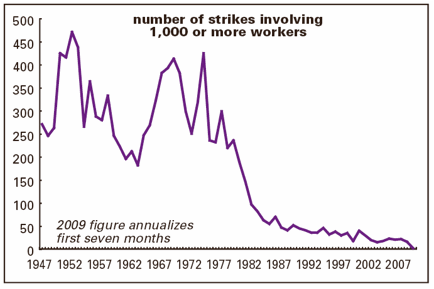
Obama has largely insulated himself from the consequences of his policies, so far, with a strong and aggressive PR campaign that has kept his approval ratings high enough to potentially win in 2012. This PR campaign blames everyone else for policy failures, from Democrats in Congress to Republicans in Congress to the Eurozone. Regardless of what happens, Obama will reap enormous monetary rewards for what he's done, as Bill Clinton's $80 million post-election payday shows. And if Obama loses, the recriminations will start, and liberals will take the blame for not allowing Obama to be centrist enough. At this point, the Democratic Party is hopelessly broken and overrun by the same interests that are running the Republican Party. I hate to be the bearer of such awful news, so I'll end this on an up note. We are not alone, and the system is weak. There is an international movement, led at this moment by Alexis Tsipras of Greece (though he could betray or lose), to reject the destructive neoliberalism that has run our world for forty years. These movements are contagious. Meanwhile, the financial system is teetering on another meltdown, and meltdowns do create opportunities for new social movements and elite shifts in opinion. If we can figure out how to interrupt the stream of profit and commerce, or persuade a slice of the elites that they do not want to live in the nice gilded parts of what is increasingly becoming a global prison, then the revival can come much quicker than anyone imagines. Thanks to Doug Henwood for the invaluable chart on strikes.
|
| What’s next for the U.S. Dollar? QE3? Posted: 06 Jun 2012 01:58 AM PDT
from news.goldseek.com: The dismal U.S. jobs report for May, released last Friday, caused the price of gold to soar as the market appears to be pricing in an ever-greater chance of "QE3" – another round of quantitative easing by the Federal Reserve (Fed). But given that 10-year government debt is already down at 1.5%, the Fed may dive deeper into its toolbox in an effort to jumpstart the economy. Investors may want to consider taking advantage of the recent U.S. dollar rally to diversify out of the greenback ahead of QE3. To a modern central banker, it may be very simple: if the economy does not steam ahead, sprinkle some money on the problem. The Fed has done its sprinkling; indeed, the Fed has employed what one may consider a fire hose. But after QE1 and QE2, we continue to have lackluster economic growth, unable to substantially boost employment. Never mind that the real problem the global monetary system is facing is that the free market has been taken out of the pricing of risk: Keep on reading @ news.goldseek.com |
| The 18 reasons to buy senior gold mining companies – Dr John Wolstencroft talks to Dominic Frisby Posted: 06 Jun 2012 01:15 AM PDT Private investor Dr John Wolstencroft and the GoldMoney Foundation's Dominic Frisby talk about investing in senior gold mining companies. Wolstencroft presents his 18 thoughts on why the big ... This posting includes an audio/video/photo media file: Download Now |
| Soros gets gold advice from Keiser Report Posted: 06 Jun 2012 01:14 AM PDT The Eurozone debt crisis is getting dangerously close to the monetary union's powerhouse – Germany. Moody's has cut the ratings of several German banks, including the country's second biggest lender. Austria is also affected. Max Keiser, RT's financial guru and host of The Keiser Report smells a rat in all this. He says, the crisis is the chance for some to make a fast buck. from russiatoday: ~TVR |
| Now It's Jedi Mind Tricks & Other Fed Tactics Posted: 06 Jun 2012 01:07 AM PDT Gold prices added over 1% ahead of the ECB rate-setting meeting this morning as the post US jobs data-sparked Friday rally continued to unfold. The gold market's net speculative length is at or very near multi-year lows. |
| Why the US Dollar will Hyperinflate Posted: 06 Jun 2012 12:49 AM PDT
from dollarvigilante.com: Imagine a scenario. One fine morning you turn on the television, and all the channels are preoccupied with an imminent speech from the president of the United States. People are excited, as the supposed biggest pop star in the world walks to the podium to make his speech. Maybe he is finally going to solve the financial crisis. Maybe he is going to follow the sage advice of Paul Krugman and announce another massive increase in spending, and this time it will be enough for these economic green shoots to turn into solid oak trees, built to last for generations. He finally arrives on the stage, looks calmly at his teleprompter and starts to read out aloud in his own unique style: 'Citizens of America, I address you today to give you an honest appraisal of our financial situation. We are broke. We cannot afford to pay the promises we have made to people. We owe $16 trillion to our creditors, and our government is not in a position to pay this back. We have according to some estimates $75 trillion in unfunded future liabilities. Keep on reading @ dollarvigilante.com |
| Gold and Dow Flash the Same Warning Signal Posted: 06 Jun 2012 12:43 AM PDT
from usawatchdog.com: On Friday, both gold and the Dow flashed the same warning signal—the economy is in deep trouble. The Dow plunged nearly 275 points on the news of a weak jobs report, and gold rocketed higher by $66 on speculation global bankers are going to print money to resuscitate a dying financial system. You do not get this kind of tandem move in opposite directions by coincident. Last week, both the stock and gold markets appeared to stop pretending and acknowledged the vortex of debt and insolvency that could suck us all into a black hole. Renowned gold expert Jim Sinclair of JSMineset.com said Friday, "Those popular gold writers calling for much lower gold prices are simply out of their mind and disconnected from reality." Sinclair has been calling for "QE to infinity" (money printing) for years now, and he's been right. Of course, money printing masked the recession/depression since 2008; and now, it looks like more of the same bad medicine is on the way—only a much higher dose. My only question is when does the money printing stop working and turn the currency into confetti? It appears we will find out sooner than later. Keep on reading @ usawatchdog.com |
| Gold Prices ‘Break Above Bear Channel’ on Euro Worries Posted: 06 Jun 2012 12:08 AM PDT Gold prices hit a one-month high at $1,640 per ounce ahead of Wednesday's US session – up more than 7% from May's low – while stocks, commodities and the euro also ticked higher and major government bond prices fell. |
| In a Gold Standard, How Are Interest Rates Set? Posted: 05 Jun 2012 11:49 PM PDT
from news.goldseek.com: Today, short-term interest rates are set by the diktats of the central bank. And long-term interest rates are set in a "market" in which the central bank is obliged to keep coming back to buy ever more bonds, and speculators front-run the central banks to buy ahead of them. The result has been that, for 30 years and counting, the bond price has been rising, which is the same as to say that the rate of interest has been spiraling into the black hole of zero. When it gets there (and probably sooner) the entire monetary system will collapse. This is the terminal stage of the disease of irredeemable paper currency. They have banished money (gold) from the monetary system, and the result is a positive-feedback-loop that destabilizes the rate of interest. The rate of interest has a propensity to fall, just like the value of the paper currency itself. Keep on reading @ news.goldseek.com |
| Posted: 05 Jun 2012 11:39 PM PDT
from goldmoney.com: The "flight to safety" in the US dollar and Treasury market has eased somewhat over the last couple of days, amid hints that the European Central Bank could announce an interest rate cut following a policy meeting today. The European Commission is also due to release a 156-page document today detailing dramatic new powers that regulators will have to deal with failing banks. Though such regulation will not take effect until 2014, it is adding to the market's general impression that politicians are slowly getting a grip on the eurozone situation. But with the Spanish finance minister warning yesterday that Spain's credit markets are freezing up and that his country is "too big" to be rescued by the EU bailout mechanisms, any such market relief may only be fleeting. As with Asian and European shares, gold and silver have crept slowly higher in trading this morning, fired on by the prospect of looser ECB monetary policy. The ECB is currently targeting 1%, which is slightly higher than the Bank of England's 0.5% rate, the Federal Reserve's 0.15% and the Bank of Japan's rate, which is close to 0.00%. Ordinarily one would expect easier monetary policy to translate into a weaker currency – meaning in this case that the euro would continue to fall against other currencies if the men in Frankfurt cut rates today. Keep on reading @ goldmoney.com |




| You are subscribed to email updates from Gold World News Flash 2 To stop receiving these emails, you may unsubscribe now. | Email delivery powered by Google |
| Google Inc., 20 West Kinzie, Chicago IL USA 60610 | |

No comments:
Post a Comment