


Gold World News Flash |

- Government's Looking To Raise Cash Anyway They Can
- Just How Cheap Are The Junior Mining Stocks?
- The Greatest Bull Market, A Gold Standard & Silver Shortages
- As Part Of Its NEW QE Q&A, Goldman Warns Of Possibility For $50-$75 Billion “Flow” Program
- Jim's Mailbox
- MAJOR BOTTOMS IN STOCKS, GOLD, AND COMMODITIES HAVE FORMED
- Will Tuesday Be Terrible or Happy?
- Greek election changes nothing, 'fear event' ahead, Turk tells King World News
- "Textbook Economics" Quote Of The Day
- “This Thing is Coming Down,” Says Gerald Celente
- In The News Today
- Zorggk - The Exceedingly Great!
- Sheldon Adelson
- The G-20 Farce: Saving The Eurozone From Collapse
- Plunge in Family Net Worth Supports Portfolio Gold Diversification
- As Part Of Its NEW QE Q&A, Goldman Warns Of Possibility For $50-$75 Billion "Flow" Program
- Plunge in family net worth supports gold diversification
- The Gold Price Lost Only $1.30 to Close $1,625.70 I Don't Expect Prices Lower than $1,610 Ever Again
- Guest Post: How to Save Your Money And Your Life
- Gold COT (CFTC - Commitment of Traders) for Period 6/6-6/12/2012
- Got Gold Report – Chart Appendix for June 18, 2012 GGR
- Silver COT (CFTC - Commitment of Traders) for Period 6/6-6/12/2012
- Market Manipulation: No Fun No More
- JC Penney President Mike Francis Came, Saw, Collected $10 Million, And Quit Nine Months Later
- Waiting On Greece
- Credit Slumps But VIX Dump Drives Equity Pump
- Gold Seeker Closing Report: Gold and Silver End With Slight Gains
- Gold Daily and Silver Weekly Charts - Band-Aids and Butterfly Kisses
| Government's Looking To Raise Cash Anyway They Can Posted: 18 Jun 2012 05:21 PM PDT Italian police seize gold worth €2m at Swiss border
| |
| Just How Cheap Are The Junior Mining Stocks? Posted: 18 Jun 2012 04:18 PM PDT Short answer: historically cheap. For those who want an explanatory answer, continue reading. Anyone who participates in or follows the mining stock sector has read the numerous commentaries recently describing the extreme relative undervaluation of the mining stocks, especially the juniors. In fact, I saw an article this past weekend which demonstrated that the last time the mining stocks, in general, were as undervalued as they are right now was in 1924. Regardless of which relative value thesis to which you are want to subscribe, there's no question that the mining stocks as a sector have become extreme value plays. "Value" as opposed to high growth rate speculative plays (like Facebook, for instance). And while it's true that vs. "benchmark" metrics, the miners are cheap, for my investing capital nothing reveals "market truth" like a point of trade. "Point of trade" being that economic intersection at which a buyer is willing for fork over money and a seller is willing to fork over the goods. Monday provided us the with truth benchmark of an actual trade. Yamana (AUY) bought Extorre Gold (XG-TO, TSE-listed) for $414 million, mostly cash/some stock. If you net out the cash on XG's balance sheet of $27 million, this price represents $161/oz of XG's total 43-101 resource of 2.4 million gold-equivalent ounces (XG's defined gold plus silver converted to "gold equivalent"). The price was a 68% premium to XG's closing price on Friday. The high premium to Friday's close is one way to view the current relative undervaluation of these mining stocks by the stock market. Furthermore, the $161/oz price is substantially higher than the "generic" $100/oz price of some recent acquisitions. To be sure, the high quality attributes of XG's deposit - like the expected high metallic recovery from the ore and anticipated low cash costs of production - would induce an acquirer to "pay up" a bit for XG. But these highly attractive features are offset by the fact that XG's trophy property is in Argentina, which presumably poses considerable political risk now that Argentina's Government has demonstrated a willingness to nationalize foreign-owned oil companies. The Wall Street genius analysts, in their desire to come up with reasons to try and convince institutional investors to avoid the sector because Wall Street has very little ability to make money off the mining stock sector by shuffling around paper financing deals and skimming big fees, would tell you that the political risk of most mining stocks is the best reason to avoid them. In fact, not one single U.S.-based brokerage firm covers Extorre: LINK I guess Wall Street's finest have plenty of ideas up their ass that will generate a 68% gain... Throwing Wall Street aside, besides the fact that this Truth Revealing trade shows just how cheap the mining stocks are - especially the junior miners - it also tells me that the most sophisticated possible buyer of mining assets - an actual successful industry operator - has determined the political risk in South American countries like Argentina is substantially less than is being discounted by the market. As a result, I expect to see several smaller junior mining stocks experience a strong price move higher. One company I like that has substantial exposure in Argentina is McEwen Mining - MUX. MUX has had the crap beaten out of it because of the perceived political risk of Argentina. MUX traded up over 6% today. Most of that gain is attributable to the AUY/XG deal. But MUX is still 57% below its 52-week high of $7. I am betting that MUX closes that gap relatively quickly and move a lot higher than $7 as the next big move in this sector unfolds. Oh, by the way, Rob McEwen of McEwen Mining is the same McEwen who guilt Goldcorp into one of the largest and most successful gold mining companies in the world. 
| |
| The Greatest Bull Market, A Gold Standard & Silver Shortages Posted: 18 Jun 2012 03:30 PM PDT from KingWorldNews:
"At that point you saw gold recover some, while stocks gave up the overnight enthusiasm they enjoyed in the futures markets. At the end of the day, Europe is a mess, and it is still up to the Europeans to decide what to do to get out of this situation. Stephen Leeb continues @ KingWorldNews.com
| |
| Posted: 18 Jun 2012 03:08 PM PDT from Zero Hedge:
| |
| Posted: 18 Jun 2012 02:38 PM PDT Jim, Since I haven't read this public information anywhere yet today, I thought I might try to cheer you up a bit. After all these years of not being able to speak of gold in public company, I am beginning to have a smile on my face. If gold isn't money, it sure seems Continue reading Jim's Mailbox
| |
| MAJOR BOTTOMS IN STOCKS, GOLD, AND COMMODITIES HAVE FORMED Posted: 18 Jun 2012 02:22 PM PDT It is time to do quick recap of the big picture view, which is unfolding pretty much as I expected. The CRB is now in the process of putting in a three year cycle low (this should correspond with a three year cycle top in the dollar) and stocks have put in an intermediate cycle bottom. As I expected gold bottomed slightly ahead of the stock market and stocks. The trend is now up for all assets and all we are waiting on is confirmation that oil has bottomed. Once oil and energy stocks join the party the bull will be firing on all cylinders. The economy will continue to respond to Keynesian economic policies until commodity prices surge into a final parabolic advance and prick the bubble. However that isn't due until sometime in late 2014 when the dollar forms its next three year cycle low, so I think the perma bears are just kidding themselves if they think the US is ready to rollover into a recession right now. The recent stock market decline was just a normal intermediate cycle correction in an ongoing bull market. Yes it was rather severe, but this was just a normal regression to the mean event triggered by an extreme stretch above the 200 day moving average that was generated by the European LTRO and Operation Twist. I expect stocks will continue to grind higher this year and start to stagnate next year as commodity prices began to pressure profit margins. By early 2013 the stock market should begin rolling over into what I expect will be a very drawn out, and volatile bear market as deteriorating fundamentals do battle with ever greater liquidity injections. This is the prescription for multiple violent bear market rallies in what I expect will be a very long agonizing grind lower as commodity prices gradually pick up momentum and move into the final parabolic spike in 2014. Gold has started a new C-wave advance that should at least test the $1900 level sometime this fall. Don't expect a breakout to new highs until next spring at the earliest though. Gold may enter the final bubble phase of the bull market in late 2013 & 2014, although I think a more realistic scenario would be that this just evolves into another garden-variety C-wave, topping around $3500-$4000 in late 2014 or early 2015 followed by a severe correction into the eight year cycle low in 2016 and a vicious rebound and final bubble phase of the gold bull in 2017-2018.       
| |
| Will Tuesday Be Terrible or Happy? Posted: 18 Jun 2012 02:07 PM PDT from TF Metals Report:
Wednesday is, quite obviously, the BIG day for this week. The FOMC meeting begins tomorrow but we won't get anything out of them until a "statement" at 12:30 EDT on Wednesday. For tomorrow, we almost have to be counter-intuitive. Recall that recently, any formal Fed statement has been met with serious, paper selling. The past several of these beatdowns were preceded by strong UP days the day before as the brainless, momentum-chasing algos were sucked in only to get blown back out by The Cartel the next day. If we get a strong move tomorrow, one where gold finally blows through 1630 and heads toward 1640 and silver breaks through 29, we must expect that its a coordinated headfake by The Cartel. Read More @ TF Metals Report.com
| |
| Greek election changes nothing, 'fear event' ahead, Turk tells King World News Posted: 18 Jun 2012 01:53 PM PDT 10:15a HKT Tuesday, June 19, 2012 Dear Friend of GATA and Gold: GoldMoney founder and GATA consultant James Turk today analyzes the European situation for King World News and concludes that the election in Greece has changed nothing, that neither banks nor governments can borrow at ordinary rates anymore, and that gold will soar this summer as part of a "fear event." An excerpt from the interview is posted at the King World News blog here: http://kingworldnews.com/kingworldnews/KWN_DailyWeb/Entries/2012/6/18_Tu... CHRIS POWELL, Secretary/Treasurer ADVERTISEMENT Prophecy Platinum Announces Wellgreen Preliminary Economic Assessment: Company Press Release VANCOUVER, British Columbia, Canada -- Prophecy Platinum Corp. (TSX-V: NKL, OTC-QX: PNIKF, Frankfurt: P94P) reports the results of an independent NI 43-101-compliant preliminary economic assessment for its fully owned Wellgreen nickel-copper-platinum group metals project in the Yukon Territory. The independent assessment, prepared by Tetra Tech, evaluated a base case of an open-pit mine (with a mining rate of 111,500 tonnes per day), an on-site concentrator (with a milling rate of 32,000 tonnes per day), and an initial capital cost of $863 million. The project is expected to produce (in concentrate) 1.959 billion pounds of nickel, 2.058 billion pounds of copper, and 7.119 million ounces of platinum, palladium, and gold during a mine life of 37 years with an average strip ratio of 2.57. The financial highlights of the preliminare economic assessment, shown in U.S. dollars, are as follows: Payback period: 3.55 years Prophecy Chairman John Lee says: "We are pleased with the preliminary economic assessment results. The numbers indicate that Wellgreen is one of most exciting mineral projects in the Yukon. The company is drilling to upgrade and expand the resource base. The infrastructure is excellent as the project is only 1,400 meters in altitude and 14 kilometers from the paved Alaska Highway, which leads to the Haines deep seaport. Discussions are under way with support from local stakeholders regarding permitting and logistics." For the complete press release, please visit: http://prophecyplat.com/news_2012_june18_prophecy_platinum_announces_res... Join GATA here: Standard Chartered's Earth Resources Conference Hong Kong Gold Investment Forum Toronto Resource Investment Conference New Orleans Investment Conference * * * Support GATA by purchasing DVDs of our London conference in August 2011 or our Dawson City conference in August 2006: http://www.goldrush21.com/order.html Or by purchasing a colorful GATA T-shirt: Or a colorful poster of GATA's full-page ad in The Wall Street Journal on January 31, 2009: http://gata.org/node/wallstreetjournal Help keep GATA going GATA is a civil rights and educational organization based in the United States and tax-exempt under the U.S. Internal Revenue Code. Its e-mail dispatches are free, and you can subscribe at: To contribute to GATA, please visit: ADVERTISEMENT Sona Discovers Potential High-Grade Gold Mineralization From a Company Press Release VANCOUVER, British Columbia -- With its latest surface diamond drilling program at its 100-percent-owned, formerly producing Blackdome gold mine in southern British Columbia, Sona Resources Corp. has discovered a potentially high-grade gold-mineralized area, with one hole intersecting 13.6 grams of gold in 1.5 meters of core drilling. "We intersected a promising new mineralized zone, and we feel optimistic about the assay results," says Sona's president and CEO, John P. Thompson. "We have undertaken an aggressive exploration program that has tested a number of target zones. Our discovery of this new gold-bearing structure is significant, and it represents a positive development for the company." Sona aims to bring its permitted Blackdome mill back into production over the next year and a half, at a rate of 200 tonnes per day, with feed from the formerly producing Blackdome mine and the nearby Elizabeth gold deposit property. A positive preliminary economic assessment by Micon International Ltd., based on a gold price of $950 per ounce over eight years, has estimated a cash cost of $208 per tonne milled, or $686 per gold ounce recovered. For the company's complete press release, please visit: http://www.sonaresources.com/_resources/news/SONA_NR18_2011-opt.pdf
| |
| "Textbook Economics" Quote Of The Day Posted: 18 Jun 2012 01:35 PM PDT For our quote of the day, we go to none other than the Fed's favorite mouthpiece, the WSJ's Jon Hilsenrath:
No... not the textbooks... Does this mean... Economics 101 is... nothing but one epic lie, based on Ponzi assumptions which work in a world of constant and gradual leveraging, and completely fall apart in a deleveraging world such as the one we have now? And will the Fed, in its attempt to prove its blind faith in voodoo correct, destroy the real world by stuffing the CTRL-P channel full of increasingly more meaningless electronic dollar equivalents, merely to confirm once and for all that the Keynesian utopia may be an illusion, but nobody will be left to enjoy the aftermath of the biggest lie of the past century unraveling?
| |
| “This Thing is Coming Down,” Says Gerald Celente Posted: 18 Jun 2012 01:32 PM PDT by Dominique de Kevelioc de Bailleul, Beacon Equity Research:
"This thing [financial system] is coming down," Celente told KWN's Eric King. The outcome of the Greek election is not important, according to the founder of Trends Research Institute. What's happening in any country is not particularly important, per se; it's the collective symptoms of a global financial collapse that investors should focus their minds upon before considering what to do to protect their wealth. "The entire financial system is under collapse," Celente forcefully continued. "It's not about the Greeks; it's not about the Spanish; it's not about the Italians; it's not about the English; it's not about the Americans; it's not about the Chinese; it's about everybody."
| |
| Posted: 18 Jun 2012 01:20 PM PDT by Jim Sinclair, JS Mineset:
Of all the madness I have seen in markets over the last 50 years, today takes the cake. My take on it is: Mrs. Merkel can already taste the joy of being President of Euroland. Hollande is getting ready to set the stage for his growth solution to the euro mess. The entire western world economy is falling off a cliff. The West wants to bomb Syria into the dark ages but might meet Russia head on there. Gold continues to overcome the bears. The shorts of the euro are emboldened, but not necessarily as right as they think they are. Dollar strength has no fundamental backing, but benefits from the mirror image of the euro. I recommend that you shut your ears to the multitude of experts, especially those on Financial TV that claim to have never been wrong.
| |
| Zorggk - The Exceedingly Great! Posted: 18 Jun 2012 01:11 PM PDT I am dreading that it is now again time for me to make another of my stupid periodic reports to Zorggk The Exceedingly Great, who is the new Supreme Overlord of this barren outpost in this quadrant of the galaxy, and who isn't happy about it. I mean, if he is so exceedingly great, what is he doing way out here, out across the tracks, in this backwater, low-rent, low-IQ section of the universe? And his famously bad mood about his new position is only one of the things that make this reporting period so forbidding to me. For one thing, he thinks that our beer tastes "funny" and that our pornography is weird, involving, as it does, a total absence of bare, glistening tentacles, particularly long, shapely tentacles heaving and breathing lustily in raw, feverish passion, twining and intertwining in a forbidden dance of love, and together (for Zorggk, anyway) they count as Strike One and Strike Two against this stupid planet, as seemingly unfair as that is. Rumor has it that Zorggk is considering just eliminating our whole planet because we are 1) now sending our low-IQ, mutant spoor into space aboard probes (a term which he thinks is riotously funny, as in "Bend over, here come the probes!" Hahaha!), but which is bad because 2) he is seriously probe-o-phobic. No, in rereading that last sentence, I now see that the "2)" is not right, although if you have ever pondered the many meanings of the word "probe", you will understand how anyone would think it was number 2! Get it? Hahaha! Now that I am embarrassed to see that my little joke has fallen short, let me blithely go on as if nothing has happened, where I breezily announce that the REAL 2) reason to kill us all is because we Earthlings, whom my people call "Maize," are a really stupid bunch of lowlife boneheads such that we cannot even understand the all-important importance of not having inflation in consumer prices, as emphatically implied by a ridiculously redundant -- plus stupid-sounding at no extra cost! -- phrase, namely "all-important importance." In my initial briefing with Zorggk, which I remember with a shudder to this day, I was to bring him up to speed about this planet you call Earth, which my people call "Maize." Eagerly, like the cowardly servile little worm that I am, I agreed with him about how he deserved a better posting than this, and that it's all politics, especially that whole Andromeda crowd that thinks it's so hot, but are not, but they got the power, that's what. . The little rap tune broke the ice, and we soon shared a laugh about the stupidity of not having a stable money supply, as achieved with gold as money, and I was starting to tell him about the bizarre fascination on the planet Maize, which you call Earth, with, instead of a gold money, ridiculous paper currencies! Hahaha! He laughed, but it was not mirthful. It was cold and heartless, as he, too, knew what this meant. But he roared, or perhaps guffawed, we don't know which, when I described the insane levels of fractional-reserve banking, where the banks have a few lousy cents in deposits for every few THOUSANDS of dollars that they created, literally out of thin air, so that the banks could lend it out in some gigantic flood of new money, and new credit, and new debt, of which a staggering $6.3 trillion was used to buy government debt so that the hopelessly embarrassing Obama administration could deficit-spend it -- the whole $6.3 trillion! -- in basically Three Lousy Years (TLY)! Doubling the entire national debt in less than 4 years! Insane and suicidal! Even the Glorb people, a newly-discovered kind of invertebrate slug on the planet Glorb, which my people call "Maize" and which is even farther out in the barren hinterlands of the galaxy, understand this gold/money concept completely, despite not having any discernable brain, and have a monetary system is a gold standard! Even though there is no actual gold on the planet! I mean, how weird is that? The lesson is that inflation in prices, as a result of such massive increases in the money supply by both the evil Federal Reserve and the other dirtbag central banks around the world because they are not constrained by gold, is going to have a profound effect. "What kind of effect?" you ask with a quiver in your voice. Well, I am happy to say that we professional economists have a technical, very-precise term for what happened every time in the last 4,500 years that this kind of monetary insanity got out of control. We call it Everything Goes To Hell (EGTH). One of the more interesting details of studying the historical evidence of EGTH is that not quite everything goes to, you know, hell. Gold and silver soar, soar, SOAR in price, and thus the Gigantic Mogambo Revelation (GMR), enlightenment perhaps not unlike that found by a young Buddha under a bodhi tree, which is that gold and silver will, this time, just like all the other times, soar in price. And thus (follow my logic closely here) those who wisely bought gold and silver (and oil) will be an exclusive club, namely the "new rich," where "rich" is defined as "The sheer tonnage of cool stuff and tasty treats you bought and the additional tonnage of stuff you can still easily afford to buy." Ah, but the delight of the prosperous few will be more than matched by the desperate, fearful outrage of the many, who are looking for scapegoats. In that case, let me offer that it was all made possible by the evil Federal Reserve actually creating the fiat money, an evil Supreme Court that treacherously ruled that a fiat money was the same as a gold money despite what the Constitution said, a long series of corrupt, low-IQ Congresses that encouraged disastrous monetary profligacy so as to continually fund outrageous budget deficits, a woefully-ignorant and/or mentally-defective economics profession shot-through with the now-proven idiocies of Keynesian econometric economics, the one that actually links interest rates with spending and prescribes deficit-spending regardless of size, and a brain-dead population of voters that kept electing the same "Who else wants a free lunch?" weenies, time after time, all these years since the '60s. A pox upon all their houses, of course, but the point is that, as they say, "It is an ill wind that doesn't blow somebody some good." In this case, it is the wise, intelligent, good-looking, cool people who bought gold, silver and oil stocks who will be blown some good. And since physical gold and physical silver are still so amazingly cheap and so easy to buy, and the result being so obviously guaranteed by 4,500 years of history, what can one say except, gleefully, "Whee! This investing stuff is easy!"? 
| |
| Posted: 18 Jun 2012 01:10 PM PDT by Andrew Hoffman, MilesFranklin.com:
Democalypse 2012 – Cash of the Titans, Sheldon Adelson backs Romney Sheldon Adelson, a casino mogul worth $25 billion, is CEO of Las Vegas Sands Hotel, which made a killing expanding into the Chinese market by opening casinos via his Sands Macao investment vehicle…
| |
| The G-20 Farce: Saving The Eurozone From Collapse Posted: 18 Jun 2012 11:22 AM PDT Wolf Richter www.testosteronepit.com The first summit of the G-20 in today’s configuration took place in November 2008 in Washington, DC, during the heady days after the Lehman collapse. Before, it was limited to finance ministers. Since then, twice a year, 19 heads of state, the President of the EU, finance ministers, the heads of the IMF and the World Bank, a gaggle of central bankers, and a whole slew of lesser characters get together to solve the problems of the world. G-20 summits have a checkered history of accomplishments though they don’t lack in grandiose announcements. At the summit in London in April 2009, French President Nicolas Sarkozy announced with fanfare, “The era of bank secrecy is over.” Its big accomplishment: a blacklist of tax havens. And a whole new game of political football, namely deciding which country would get to see its name on the list and which wouldn’t. Yet, tax havens have since sprouted around the world far faster than President Obama’s “green shoots.” But the crowning achievement was the G-20 summit in November last year in Cannes, France. At the beginning of the week, participants were still thinking that their sojourn in the ritzy town on the Côte d’Azur would be a relaxed affair of photo ops, handshakes (or stiff air kisses between German Chancellor Angela Merkel and Sarkozy), and fancy dinners, interrupted by rubber-stamping with great hoopla the previously negotiated Grand Plan to bail out Greece, or rather its public bondholders. It was its second bailout package, and it would be huge and solve all problems once and for all. And in between, attendees would also put Italy back on some kind of unspecified track though Prime Minister Silvio Berlusconi was mired up to his neck in legal problems while his country’s finances were spiraling out of control. And with the summit being heavily mediatized in France, Sarkozy would make it his jump-off platform for his reelection campaign, demonstrating panache, leadership, and crisis management skills. Just then, Giorgios Papandréou, Prime Minister of Greece, who wasn’t even in the G-20, fired his bazooka. With a single sentence about letting Greeks decide via referendum whether or not they wanted that Grand Plan, he knocked the world’s financial markets into a vertigo-inducing tailspin—which blew up the summit. The final communique was a bland slop that talked about a “worldwide strategy” for growth and employment, a “more resilient and stable monetary system,” and once again “reforming the financial sector.” It suggested that the world would need to get a grip on the “volatility of commodity prices,” as well as “promote agriculture,” and continue “the fight against climate change.” Meanwhile, the Eurozone had begun to disintegrate. So they all arrived at the current G-20 summit in Los Cabos, Mexico, with their own agendas. While tiny Greece is still front and center, the summit has been escalated: bailing out Greece wouldn’t be enough. Now it would be about bailing out the entire 17-nation Eurozone and its currency. And even broader. President Obama made his agenda clear: he wanted everybody else to do “what’s necessary to stabilize the world financial system.” But the finger-pointing already started. “Frankly, we are not coming here to receive lessons,” said European Union President Jose Manuel Barroso. Lest the most powerful man on earth should forget, Barroso added that the euro debt crisis “was originated in North America.” Presumably, if it hadn’t been for US subprime mortgages blowing up, Spain’s housing bubble could have continued ad infinitum, along with Greece’s profligate ways, and the debt crisis wouldn’t even exist. “But we are not putting the blame on our partners.” Indeed, President Obama is going to be busy handing out lessons. There will be Russian President Vladimir Putin on Syria and Iran, Chinese President Hu Jintao on the yuan, and of course Merkel. Obama will push her to hand Greece unlimited amounts of money, bail out Spain and Italy while she is at it, and do whatever it takes to bail out the Eurozone as a whole. She would also have to calm the markets. But above all, she’d have to make sure that none of this euro effluent would cross the Atlantic and muck up his reelection chances. Merkel, whose patience is running thin these days, has already preempted any unnecessary hopes Obama might have had by declaring, once again, for those who’d missed it the first 33 times, that the bailout terms wouldn’t be renegotiated and that the new Greek government would have to meet the commitments made to international lenders. And on the eve of the election, she’d expressed her exasperation with the Greek method of “making promises, breaking promises, and doing nothing.” It simply could not continue, she said, that those who didn’t fulfill their commitments could lead all others “by the nose through the ring.” Even if Germany wanted to, it could not bail out teetering Eurozone countries to the extent needed to save the euro because the unstoppable juggernaut has built its recent success on a fragile and now shaking foundation. Read.... Relying on Fake German Strength. But the world has other problems. As NATO-aided rebels in Libya overwhelmed Muammar Qaddafi’s forces, 36,000 Chinese engineers, tradesmen, and technicians fled Libya, leaving $20 billion in infrastructure and oil projects behind. China’s refusal to support the NATO attacks didn’t sit well with the rebels. Yet, less than one year later, China is back. Read.... The New Cold War.
| |
| Plunge in Family Net Worth Supports Portfolio Gold Diversification Posted: 18 Jun 2012 11:10 AM PDT The Fed’s triennial Survey of Consumer Finances (SCF) came out last week and the results were nothing short of astounding. The data show that the Great Recession wiped out nearly 40% of the typical American family’s net worth. “Data from the 2007 and 2010 SCF show that median income fell substantially and that mean income fell somewhat faster, an indication that income losses, at least in terms of levels, were larger for families in the uppermost part of the distribution. Overall, both median and mean net worth also fell dramatically over this period—38.8 percent and 14.7 percent, respectively.”
| |
| Posted: 18 Jun 2012 11:07 AM PDT Not like it should come as any surprise that the bank that first among peers "discovered" that flow, not stock matters, implying the Fed may literally never be able to stop monetizing, is expecting the FOMC to "ease monetary policy on June 20", but nonetheless here is the full just released Q&A from Goldman's Jan Hatzius, who just happens to be a Pound and Pence drinking buddy of former Goldmanite Bill Dudley, who just happens to run the New York Fed. Connects the dots. Implicit is that a big dollop of Large Scale Asset Purchases is imminent. That said, if the Fed does disappoint on June 20, and merely extends the maturity of bonds that it will sell as part of a Twist extension from 3 to 4 years, as the bond market appears to be implying (as first warned by Zero Hedge), then all bets are truly off. On the other hand, note where Goldman says: "However, it is also possible that the program would be specified as a "flow" of purchases of perhaps $50bn-$75bn per month." If that happens, gold is going to $2000, $3000, hell, $10,000 very soon, as it means the Fed will not stop printing ever again. Period. From Goldman: FOMC Preview: QE or Not QE (Hatzius) We expect the Federal Open Market Committee (FOMC) to ease monetary policy on June 20, in response to the weaker economic data and increased downside risks from the intensifying crisis in Europe. The form of the easing is a closer call. Our baseline is a new asset purchase program that involves an expansion of the balance sheet, but an extension of Operation Twist and/or a further lengthening of the short-term interest rate guidance in the FOMC statement beyond the current "late 2014" formulation are also possible. Q: Will the FOMC ease monetary policy? A: Probably. Although renewed Fed easing by mid-2012 has been our forecast all year, we felt more uncertain about this view a few months ago given the temporarily better data and the apparent shift of the Fed's reaction function in a more hawkish direction. But at this point, we would be quite surprised if we saw no easing this week. Q: Why? A: In her June 6 speech, Vice Chair Yellen listed three alternative criteria for further easing: …[i]f the Committee were to judge that the recovery is unlikely to proceed at a satisfactory pace (for example, that the forecast entails little or no improvement in the labor market over the next few years), or that the downside risks to the outlook had become sufficiently great, or that inflation appeared to be in danger of declining notably below its 2 percent objective... (emphasis ours). We believe criterion 1 has been met. As shown in Exhibit 1, we expect the committee to lower its forecast for real GDP growth and raise its forecast for the unemployment rate significantly in the Summary of Economic Projections to be collected at the meeting. If we are right in thinking that the "central tendency" forecast still shows the unemployment rate at 6.9%-7.6% at the end of 2014, many committee members may view this pace of improvement as insufficient, and be inclined to ease accordingly Exhibit 1: Out Estimates for the Fed's Summary of Economic Projections…
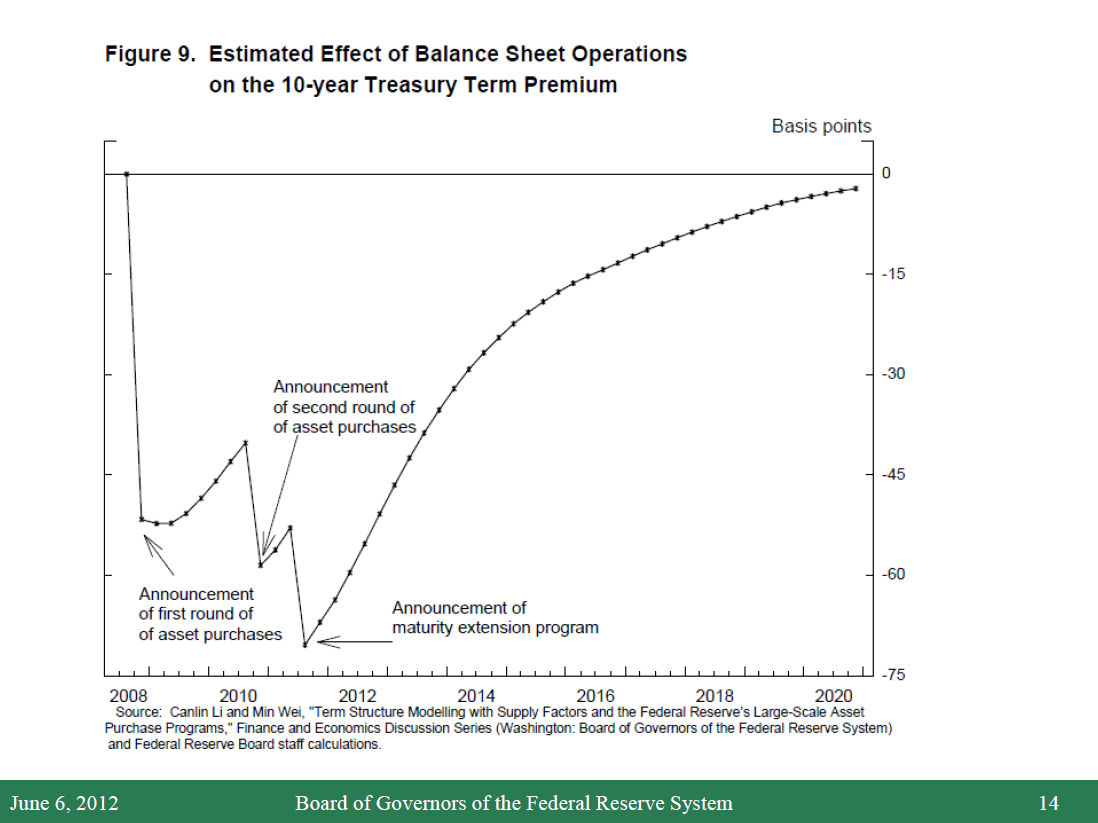
Criterion 2 may also have been met given the deterioration of the European crisis and the tightening of financial conditions of about 30 basis points (bp) since the April FOMC meeting. This tightening is a key reason why our statistical model of FOMC decisions implies that additional easing in June is likely. Criterion 3 has probably not been met in the committee's view. As shown in Exhibit 1, we expect only the headline inflation forecasts to be revised downward, while the core inflation numbers are likely to be largely unchanged. However, our own view is that there are signs that underlying inflation pressure is actually starting to come off quite sharply, so this criterion may well be met at a subsequent meeting. In addition, it is important to note that a decision not to ease is tantamount to a tightening. The reason is that the impact of unconventional easing--unlike that of conventional short-term interest rate policy--"decays" over time. This is the implication of our own research, and Figure 9 in Yellen's speech shows that Fed officials have come to the same conclusion. We estimate that this "decay" would push up the 10-year Treasury yield by about 30 basis points (bp) between now and the end of 2013 if no further balance sheet action is taken and the forward guidance is not extended, and Yellen's estimates seem to be similar. This decay factor kicks in only gradually, so one could argue that it need not be a reason to expect further easing in the near term. However, there are two other reasons besides the decay to believe that the impact of not acting could be sizable even in the near term. First, the market now clearly discounts some probability of easing, so financial conditions would likely tighten if the Fed did nothing. And second, we have found that a small part of the impact of asset purchases on bond yields occurs via the "flow" of Fed purchases than the "stock" of Fed holdings; this implies that very long yields should rise when the purchases stop. Q: So how will they ease? A: This is much more uncertain. However, our baseline remains a return to balance sheet expansion, with purchases of mortgage-backed securities (MBS) and Treasuries. There are three reasons why we believe MBS purchases would feature prominently. First, these may be more powerful than Treasury purchases in boosting economic activity on a dollar-for-dollar basis, as MBS yields are not nearly as close to the zero bound as Treasury yields. Second, Fed officials have repeatedly mentioned housing as a key headwind to a stronger recovery, so a policy that directly targets housing would make sense. .Third, there may be more support among the public for MBS purchases because of the implied support for US homeowners as opposed to government deficits. Q: How large will the program be? A: If it is specified as a "stock" of purchases, we would expect a similar size as in past programs, i.e. $400bn-$600bn over 6-9 months. However, it is also possible that the program would be specified as a "flow" of purchases of perhaps $50bn-$75bn per month. Although there has been little talk about the latter option, it enables the committee to respond more flexibly to changing economic conditions and may be optically more attractive if the committee is worried about a political backlash domestically or abroad against further balance sheet expansion. Economically, the effects of the two options are likely to be quite similar because financial markets are forward-looking; for example, if markets believe that a purchase flow of $60bn per month will be sustained over 8 months, this would be equivalent to a $480bn stock announcement. Q: Will the purchases be sterilized? A: This is a tough call, but on balance we think yes. The argument in favor of expecting sterilization--which involves financing a Fed balance sheet increase via term deposits and/or reverse repurchase agreements as opposed to yet more excess bank reserves--is that the cost-benefit analysis looks quite promising. Economically, we believe the choice whether to finance a balance sheet increase via overnight liabilities (bank reserves) or 1-week/4-week liabilities (reverse repos/term deposits) matters very little. However, there is a belief among some investors and commentators that increases in the monetary base are more inflationary than increases in other types of Fed liabilities; if so, sterilization may be a low-cost way of reducing the risk of a rise in inflation expectations or a political backlash against "printing money." The substantive argument against sterilization is that it would put upward pressure on interest rates at the very short end of the yield curve (because the Fed would borrow additional funds at a 1-4 week maturity). Moreover, there has been relatively little talk about it since a Wall Street Journal article in March that floated the idea, so it is possible that the idea has fallen out of favor. Q: Are they also likely to extend the forward guidance from the current "late 2014" to "mid-2015"? A: This is not quite our baseline but very possible, especially if the committee decides against renewed balance sheet expansion (see below). After all, such a shift would roughly restore the forward guidance to the same three-year horizon as at the January FOMC meeting, when the "late 2014" formulation was first adopted. At a minimum, we think that the funds rate forecasts from individual FOMC participants in the SEP are likely to move toward a later exit date (see Exhibits 2).
Exhibit 2: …and the Timing of the First Rate Hike
Q: What if they decide against expanding the balance sheet? A: The leading alternative to balance sheet expansion is a small extension of Operation Twist, i.e. a sale of the remaining $200 billion or so of Treasury securities with a remaining maturity of 3 years or less, and a corresponding purchase of longer-term Treasuries and/or mortgage-backed securities. If the committee decides to confine itself to an extension of Operation Twist, this would further increase the probability of a lengthening of the forward guidance from the current "late 2014" formulation to "mid-2015" in order to reduce the risk of doing too little and also to mitigate any upward pressure on short-term rates that might otherwise result from selling yet more short-term Treasuries. Even so, we believe that an extension of Operation Twist could well be insufficient on its own and could thus be followed by additional easing action before long. Recall from the discussion above that the "decay" of unconventional policy could boost 10-year yields by 30 basis points over the next 18 months. Using standard estimates, a further $200bn twist combined with a lengthening of the guidance would offset only about half of this impact. More than this is likely to be needed eventually. Q: Could the committee make an extension of Operation Twist more powerful by selling intermediate-maturity Treasuries (e.g. 4-years)? A: In principle yes, but we do not find strategy very attractive. The main reason is the risk of putting upward pressure on intermediate yields and thereby sending very mixed signals about monetary policy. If the committee wants to do significantly more than implied by a further $200bn twist alone, balance sheet expansion is likely to be needed. Q: Do you expect a cut in the interest rate on excess reserves (IOER)? A: No. We believe that the committee views the forward guidance as a better way of mitigating upward pressure on short-term rates than a cut in the IOER because it seems less likely to interfere with money market functioning. Q: Do you expect additional Fed easing to be effective? A: Only moderately. While we believe that a sufficiently large program focused on the mortgage market would help, it is unlikely to be very powerful. That doesn't mean Fed officials shouldn't do it, since we view the costs of additional easing as low. The risk of inflation is remote, and even when it becomes less remote Fed officials should be easily able to tighten policy sufficiently. But it does mean that it makes sense to think about other forms of policy easing. Obvious candidates would be fiscal policy or purchases of non-government guaranteed assets, but these require the cooperation of Congress and are therefore probably not feasible. Instead, a move in the direction of "unconventional unconventional" options holds more promise. These include the Evans proposal of promising not to raise rates until the unemployment rate has fallen to a specific level and a nominal GDP level target. We do not expect these to be adopted in the short term, but they could be more effective than balance sheet action and date-based forward guidance on their own. They may therefore represent the next frontier for Fed policy should the recovery continue to disappoint.
| |
| Plunge in family net worth supports gold diversification Posted: 18 Jun 2012 10:41 AM PDT by Peter Grant The Fed’s triennial Survey of Consumer Finances (SCF) came out last week and the results were nothing short of astounding. The data show that the Great Recession wiped out nearly 40% of the typical American family’s net worth.[INDENT][INDENT] “Data from the 2007 and 2010 SCF show that median income fell substantially and that mean income fell somewhat faster, an indication that income losses, at least in terms of levels, were larger for families in the uppermost part of the distribution. Overall, both median and mean net worth also fell dramatically over this period—38.8 percent and 14.7 percent, respectively.” [/INDENT][/INDENT]Median family net worth plunged from $126,400 in 2007 to $77,300 in 2010, close to levels not seen since the 1992 survey. The median, as the Los Angeles Times pointed out is “the point smack in the middle of those richer and poorer.”...
| |
| The Gold Price Lost Only $1.30 to Close $1,625.70 I Don't Expect Prices Lower than $1,610 Ever Again Posted: 18 Jun 2012 10:30 AM PDT Gold Price Close Today : 1625.70 Change : (1.30) or -0.08% Silver Price Close Today : 28.665 Change : (0.069) or -0.24% Gold Silver Ratio Today : 56.714 Change : 0.091 or 0.16% Silver Gold Ratio Today : 0.01763 Change : -0.000028 or -0.16% Platinum Price Close Today : 1482.60 Change : -3.10 or -0.21% Palladium Price Close Today : 631.85 Change : 2.75 or 0.44% S&P 500 : 1,342.84 Change : 1.94 or 0.14% Dow In GOLD$ : $162.34 Change : $ (0.18) or -0.11% Dow in GOLD oz : 7.853 Change : -0.008 or -0.11% Dow in SILVER oz : 445.39 Change : 0.19 or 0.04% Dow Industrial : 12,767.17 Change : -25.35 or -0.20% US Dollar Index : 81.95 Change : 0.407 or 0.50% The silver and GOLD PRICE surprised me mildly, as I thought taking the pressure of Greek elections off them might send gold back for a visit to $1,610, but it didn't. Low today fell only to $1,615.95, but above gold could reach no higher than $1,630.22. GOLD PRICE closed Comex down a measly $1.30 at $1,625.70. This is equivocal, but not bad as gold keeps a foothold in that $1,625 - $1,633 resistance zone. The GOLD PRICE must work its way through that barrier. This could take a while, but I believe the danger of a plunge has passed. I don't expect to see prices lower than $1,610 ever again -- But I could be wrong. The SILVER PRICE lost 6.9 cents on Comex to close 2866.5c. range was small and quiet today, too, from 2881.3 to 2829c. that 2829c low leaves a double bottom on the five day chart. On the longer term chart the SILVER PRICE has just stalled, but above its 20 DMA (2842). Silver is still fighting that 2900c hurdle. Until it jumps that, it will be marking time. Be patient. It will come. Markets today looked like the Three Stooges after somebody shouted "Grenade!" They had all clapped their hands over their ears, ducked, then, to their surprise, there was no explosion and they were still alive and breathing. So today after the Greek election. Big build up with a little mouse-burp outcome. Left markets confused. European stocks rose strongly, then fell. US stocks were mixed. Silver and gold dropped, but only a wee bit. Dollar index rose 0.49%, Euro fell 0.52%. Welcome to Bewilderworld. Man, ain't that central bank stability something grand? Punchdrunk stocks couldn't figure out what they wanted to do. Dow fell, S&P rose, neither one much to amount to anything. Dow lost 25.35 (0.2%) to 12,741.82. Unwilling to play along, the S&P500 rose 1.94 (0.14%) to 1,344.78. Stocks will move higher, not for any fundamental reason but only for the perfervid imagination of naïve investors who know not the many alternatives the world offers which actually have some chance of making money some day and are not in a primary bear market. Stocks may reach their highs of earlier this year, but oh! What pain, weeping, wailing, and gnashing of teeth will follow. US dollar index rose 40.7 basis points or 0.49% to trade now at 81.954. 20 day moving average stands above at 82.25, and unless the Dollar Index can at least cross above that, nothing big is happening. The Greeks' electing the sell-out party did the euro no good. It sold off 0.52% to $1.2576. Appears the yen only gained last week from fear of a euro disaster, since it lost 0.58% today to 126.41c/Y100 (Y79.11/US$1). SPECIAL OFFER U.S. $5 and $10 modern commemoratives. These are US $5 and $10 gold commemoratives minted over the last 30 years to the ancient US standard. The US gold $5 commemorative contains 0.2418 oz gold and costs US$409.00 while the US gold $10 commem contains just twice as much gold, 0.4838 oz, and costs US$818.00. Premium over gold content value for these is a tiny 4%. I will sell lots of Six (6) each $5 gold commems ($409.00 each) for $2,454 + $25 shipping = $2,479.00 per lot. A $10 gold counts as two $5 golds, so you can order one $10 and four $5s and that equals six $5s, or two $10s and two $5s also equals six $5s, or three $10s equals six $5s. However, I reserve the right to mix the orders as suits me, but have roughly equal ounces of each, so you'll most likely get some $10s. Limit ten (10) lots per customer. Special Conditions: First come, first served, and no re-orders at these prices. I will write orders based on the time I receive your e-mail. We will not take orders for less than the minimums shown above. All sales on a strict "no-nag" basis. We will ship as soon as your check clears, but we allow Two weeks (14 days) for your check to clear. Calls looking for your order two days after we receive your check will be politely and patiently rebuffed. If you want faster shipping, please send a wire. Spot gold basis for all prices above is $1,625.70. ORDERING INSTRUCTIONS: 1. You may order by e-mail only to orders@the-moneychanger.com. No phone orders, please. Your email must include your complete name, address, and phone number. We cannot ship to you without your address. Sorry, we cannot ship outside the United States or to Tennessee. Repeat, you must include your complete name, address, and phone number. Our clairvoyant quit without warning last week and we can no longer read your mind. 2. Orders are on a first-come, first-served basis until supply is exhausted. 3. "First come, first-served" means that we will enter the orders in the order that we receive them by e-mail. 4. If your order is filled, we will e-mail you a confirmation. If you do not receive a confirmation, your order was not filled. 5. You will need to send payment by personal check or bank wire (either one is fine) within 48 hours. It just needs to be in the mail, not in our hands, in 48 hours. 6. "No Nag Basis" means that we allow fourteen (14) days for personal checks to clear before we ship. Want your order faster? Send a bank wire, but that's not required. Once we ship, the post office takes four to fourteen days to get the registered mail package to you. All in all, you'll see your order in about one month if you send a check. 7. Mention goldprice.org in your email. Argentum et aurum comparenda sunt -- -- Gold and silver must be bought. - Franklin Sanders, The Moneychanger The-MoneyChanger.com 1-888-218-9226 10:00am-5:00pm CST, Monday-Friday © 2012, The Moneychanger. May not be republished in any form, including electronically, without our express permission. To avoid confusion, please remember that the comments above have a very short time horizon. Always invest with the primary trend. Gold's primary trend is up, targeting at least $3,130.00; silver's primary is up targeting 16:1 gold/silver ratio or $195.66; stocks' primary trend is down, targeting Dow under 2,900 and worth only one ounce of gold; US$ or US$-denominated assets, primary trend down; real estate bubble has burst, primary trend down. WARNING AND DISCLAIMER. Be advised and warned: Do NOT use these commentaries to trade futures contracts. I don't intend them for that or write them with that short term trading outlook. I write them for long-term investors in physical metals. Take them as entertainment, but not as a timing service for futures. NOR do I recommend investing in gold or silver Exchange Trade Funds (ETFs). Those are NOT physical metal and I fear one day one or another may go up in smoke. Unless you can breathe smoke, stay away. Call me paranoid, but the surviving rabbit is wary of traps. NOR do I recommend trading futures options or other leveraged paper gold and silver products. These are not for the inexperienced. NOR do I recommend buying gold and silver on margin or with debt. What DO I recommend? Physical gold and silver coins and bars in your own hands. One final warning: NEVER insert a 747 Jumbo Jet up your nose. No, I don't. 
| |
| Guest Post: How to Save Your Money And Your Life Posted: 18 Jun 2012 09:47 AM PDT Submitted by Doug Casey of Casey Research How to Save Your Money And Your Life I think there are really only two good reasons for having a significant amount of money: To maintain a high standard of living and to ensure your personal freedom. There are other, lesser reasons, of course, including: to prove you can do it, to compensate for failings in other things, to impress others, to leave a legacy, to help perpetuate your genes, or maybe because you just can't think of something better to do with your time. But I'll put aside those lesser motives, which I tend to view as psychological foibles. Basically, money gives you the freedom to do what you'd like – and when, how and with whom you prefer to do it. Money allows you to have things and do things and can even assist you to be something you want to be. Unfortunately, money is a chimera in today's world and will wind up savaging billions in the years to come. As you know, I believe we're into at least the fourth year of what I call The Greater Depression. A lot of people believe we're in a recovery now; I think, from a long-term point of view, that is total nonsense. We're just in the eye of the hurricane and will soon be moving into the other side of the storm. But it will be far more severe than what we saw in 2008 and 2009 and will last quite a while – perhaps for many years, depending on how stupidly the government acts. Real Reasons for OptimismThere are reasons for optimism, of course, and at least two of them make sense. The first is that every individual wants to improve his economic status. Many (but by no means all) of them will intuit that the surest way to do so is to produce more than they consume and save the difference. That creates capital, which can be invested in or loaned to productive enterprise. But what if outside forces make that impossible, or at least much harder than it should be? The second reason for optimism is the development of technology – which is the ability to manipulate the material world to suit our desires. Scientists and engineers develop technology, and that also adds to the supply of capital. The more complex technology becomes, the more outside capital is required. But what if sufficient capital isn't generated by individuals and businesses to fund further technological advances? There are no guarantees in life. Throughout the first several hundred thousand years of human existence, very little capital was accumulated – perhaps a few skins or arrowheads passed on to the next generation. And there was very little improvement in technology – it was many millennia between the taming of fire and, say, the invention of the bow. Things very gradually accelerated and improved, in a start-stop-start kind of way – the classical world, followed by the Dark Ages, followed by the medieval world. Finally, as we entered the industrial world 200 years ago, it looked like we were on an accelerating path to the stars. All of a sudden, life was no longer necessarily so solitary, poor, nasty, brutish or short. I'm reasonably confident things will continue improving, possibly at an accelerating rate. But only if individuals create more capital than they consume and if enough of that capital is directed towards productive technology. Real Reasons for PessimismThose are the two mainsprings of human progress: capital accumulation and technology. Unfortunately, however, that reality has become obscured by a morass of false and destructive theories, abetted by a world that's become so complex that it's too difficult for most people to sort out cause and effect. Furthermore, most people in the OECD world have become so accustomed to good times, since the end of WW2, that they think prosperity is automatic and a permanent feature of the cosmic firmament. So although I'm very optimistic, progress – certainly over the near term – isn't guaranteed. These are the main reasons why the standard of living has been artificially high in the advanced world, but don't confuse them with the two reasons for long-term prosperity. The first is debt. There's nothing wrong with debt in itself; lending is one way for the owner of capital to deploy it. But if a society is going to advance, debt should be largely for productive purposes, so that it's self-liquidating; and most of it would necessarily be short term. But most of the scores of trillions of debt in the world today are for consumption, not production. And the debt is not only not self-liquidating, it's compounding. And most of it is long term, with no relation to any specific asset. A lender can reasonably predict the value of a short-term loan, but debt payable in 30 years is impossible to value realistically. All government debt, mortgage debt and consumer debt and almost all student loan debt does nothing but allow borrowers to live off the capital others have accumulated. It turns the debtors into indentured servants for the indefinite future. The entire world has basically overlooked this, along with most other tenets of sound economics. The second is inflation. Like debt, inflation induces people to live above their means, but its consequences are even worse, because they're indirect and delayed. If the central bank deposited $10,000 in everyone's bank account next Monday, everyone would think he were wealthier and start consuming more. This would start a business cycle. The business cycle is always the result of currency inflation, no matter how subtle or mild. And it always results in a depression. The longer an inflation goes on, the more ingrained the distortions and misallocations of capital become, and the worse the resulting depression. We've had a number of inflationary cycles since the end of the last depression in 1948. I believe we're now at the end of what might be called a super-cycle, resulting in a super-depression. The third is the export of dollars. This is unique to the US and is the reason the depression in the US will in some ways be worse than most other places. Since the early '70s, the dollar has been used the way gold once was – it's the world's currency. The problem is that the US has exported about $7 trillion in exchange for good things from around the world. It was a great trade for a while. The foreigners get paper created at essentially zero cost, while Americans live high on the hog with the goodies those dollars buy. But at some point quite soon, dollars won't be readily accepted, and smart foreigners will start dumping their dollars, passing the Old Maid card. Ultimately, most of the dollars will come back to the US, to be traded for the title to land and businesses. Americans will find that they traded their birthright for a storage unit full of TVs and assorted tchotchkes. But many foreigners will also be stuck with dollars and suffer a huge loss. It's actually a game with no winner. What's NextThese last three factors have enabled essentially the whole world to live above its means for decades. The process has been actively facilitated by governments everywhere. People like living above their means, and governments prefer to see the masses sated. The debt and inflation have also financed the growth of the welfare state, making a large percentage of the masses dependent, even while they've also resulted in an immense expansion in the size and power of the state over the last 60-odd years. The masses have come to think government is a magical entity that can do almost anything, including kiss the economy and make it better when the going gets tough. The type of people who are drawn to the government are eager to make the state a panacea. So they'll redouble their efforts in the fiscal and monetary areas I've described above, albeit with increasingly disastrous results. They'll also become quite aggressive with regulations (on what you can do and say, and where your money can go) and taxes (much higher existing taxes and lots of new ones, like a national VAT and a wealth tax). And since nobody wants to take the blame for problems, they'll blame things on foreigners. Fortunately (the US will think) they have a huge military and will employ it promiscuously. So the already bankrupt nations of NATO will dig the hole deeper with some serious – but distracting – new wars. It's most unfortunate, but the US and its allies will turn into authoritarian police states. Even more than they are today. Much more, actually. They'll all be perfectly fascist – private ownership of both consumer goods and the means of production topped by state control of both. Fascism operates free of underlying principles or philosophy; it's totally the whim of the people in control, and they'll prove ever more ruthless. So where does that leave us, as far as accumulating more wealth than the average guy is concerned? I'd say it puts us in a rather troubling position. The general standard of living is going to collapse, as will your personal freedom. And if you're an upper-middle-class person (I suspect that includes most who are now reading this), you will be considered among the rich who are somehow (this is actually a complex subject worthy of discussion) responsible for the bad times and therefore liable to be eaten. The bottom line is that if you value your money and your freedom, you'll take action. There's much, much more to be said on all this. I've said a lot on the topic over the past few years, at some length. But I thought it best to be brief here, for the purpose of emphasis. Essentially, act now, because the world's combined economic, financial, political, social and military situation is as good as it will be for many years... and a lot better than it has any right to be. No new advice here, at least as far as veteran readers are concerned. But my suspicion is that very few of you have acted, even if you understand why you should act. Peer pressure (I'm confident that you have few, if any, friends, relatives or associates who think along these lines) and inertia are powerful forces. That said, you should do the following.
One more thing: Don't worry too much. All countries seem to go through nasty phases. Within the lifetime of most people today, we've seen it in big countries such as Russia, Germany and China. And in scores of smaller ones – the list is too long to recount here. The good news is that things almost always get better, eventually.
| |
| Gold COT (CFTC - Commitment of Traders) for Period 6/6-6/12/2012 Posted: 18 Jun 2012 09:39 AM PDT Commercials sold off -7,521 longs and covered 4,853 shorts to end the week with 54.94% of all open interest, a very minor change since last week, and now stand as a group at -15,879,200 ounces net short, only 250,000 added net ... Read More...
| |
| Got Gold Report – Chart Appendix for June 18, 2012 GGR Posted: 18 Jun 2012 09:37 AM PDT
To continue reading, please log in or click here to subscribe to a Got Gold Report Membership
| |
| Silver COT (CFTC - Commitment of Traders) for Period 6/6-6/12/2012 Posted: 18 Jun 2012 09:21 AM PDT Commercials sold off -7,521 longs and covered 4,853 shorts to end the week with 54.94% of all open interest, a very minor change since last week, and now stand as a group at -15,879,200 ounces net short ... Read More...
| |
| Market Manipulation: No Fun No More Posted: 18 Jun 2012 09:01 AM PDT Mark J. Lundeen [EMAIL="Mlundeen2@Comcast.net"]Mlundeen2@Comcast.net[/EMAIL] 15 June 2012 Governments and their central banks have inflated the global-bond markets into a bubble that will long be remembered, and written about by market historians. Look at the US Treasury bond chart below; since this bond series was issued in August, 1997, US Treasury debt has increased by 200% while bond yields have consistently decreased; bond prices have been increasing for the past fifteen years. In a functioning free-market, free from Federal regulators, (say like for moonshine, heroin or crack cocaine), a 200% increase in supply on the streets could cause the price in these markets to collapse if demand didn’t increase to match the increase in supply. But many prominent money managers, such as PIMCO’s Bill Gross, and central banks have publically gone on record that they have exited, or will reduce future purchases of US Treasury debt; still the yields for US Treas...
| |
| JC Penney President Mike Francis Came, Saw, Collected $10 Million, And Quit Nine Months Later Posted: 18 Jun 2012 08:54 AM PDT If anyone is wondering why the darling stock of Bill Ackman and Whitney Tilson, for whom every collapse of JCP is a buying gift from god, namely JCPenney, is plunging after hours, it is because the company's president, Michael Francis, hired October 4, 2011, has just quit. To wit: "J. C. Penney Company, Inc. ("jcpenney") (JCP) today announced that Michael Francis will be leaving the Company, effective today. Chief Executive Officer Ron Johnson will assume direct responsibility and oversight of the company's marketing and merchandising functions." And to think that just 9 months ago the company CEO Ron Johnson announced, that "I am thrilled to welcome Michael to our team... He is an extremely talented executive with the vision and courage to re-imagine the department store experience. His ability to innovate and deep understanding of the industry will be invaluable as we set out to transform J.C. Penney into America's favorite store." And while his ability to do anything else appears to have been a dud, his ability to read the fine print in his contract, especially where it talks about his perks, was second to none. Because despite leaving just 9 months after his hiring, Francis is entitled to collect a whopping $9 million in pro-rated signing bonus (alongside $100,000/month in salary): all in all - a tidy package of $10 million for shooting the breeze while observing a sinking retail ship. Not bad for a company whose stock has just plunged to September 2010 levels. From the firm's proxy statement:
With such generous shareholders, is it any wonder the stock has collapsed on the news? That, and of course the stamp of disapproval that the now former President has given the firm. Here is the stock probing fresh 52 week lows.
| |
| Posted: 18 Jun 2012 08:53 AM PDT [U]www.preciousmetalstockreview.com June 16, 2012[/U] We’ve supposedly got Greek elections coming up this weekend, or do we? Apparently the ballot box folks are thinking of striking and putting this gong show in high gear. All I do know for sure is that markets are waiting with baited breath for something, anything to happen over there. The markets have been in a pretty tame range now for the past week and a half or so but they are looking to move soon. We need some sort of spark to push them one way or another and honestly I have no preference as we can make money in an up, or down market. It’s this rangebound trading that is pretty boring and doesn’t offer much chance at making a profit so it’s best avoided. We are set for a large move though and I’m primed and ready to pounce on it. Our next cycle is about to begin and this is when we make the big money swing trading. Metals review Gold...
| |
| Credit Slumps But VIX Dump Drives Equity Pump Posted: 18 Jun 2012 08:22 AM PDT Echo. In a slightly less aggressive replay of last Sunday/Monday's reaction to news from Europe, equity futures (and FX markets) opened gap-up and faded significantly to end modestly green after touching the 50DMA briefly. A 20pt drop from its open last night in S&P 500 e-mini futures on the less-than-Armageddon-but-more-of-the-same-disaster scenario played out, which then retraced around 50% of its drop during the day session. Equities diverged strongly from a notably decompressing IG and HY credit market (and significant weakness in HYG - the high-yield bond ETF). Treasuries and FX markets also remain disconnected (implying weaker levels in US stocks) as broadly speaking risk-assets did not feel the same love as stocks today. It would appear that, given the heavy volatility action, drop in Short-term vol (VIX), and recent divergence from stocks, that there was heavy vol selling today which supported a higher equity market in a virtuous manner until later in the afternoon when VIX and SPX had recoupled and stocks then limped lower to VWAP. Treasuries ended the day relatively unchanged from Friday's close after opening 6bps higher in yield, rallying 10bps from there as equities and FX plunged, and recovering higher in yield as the US day session progressed. EURUSD held under 1.26, diverging lower from equity strength from just before the US open leaving the USD higher by 0.45% from Friday's close - even as AUD strengthened notably. Commodities generally ignored USD strength with Copper, Gold, and Silver practically unch from Friday's close while WTI dropped over 1% to around $83 by the close. Financials underperformed as a sector (as Tech and Discretionary gained) but the majors were the worst hit having given up all their gains from Friday's MS lost 3.4%, Citi -2.6% and BofA & GS -2% with JPM close behind. VIX had 'decoupled' more bearishly (higher) from equity markets last week (just like credit) but it seemed today gave the opportunity to bring the two markets back together as VIX compressed dramatically back into line with stocks by the middle of the afternoon - once that 'technical had lifted, stocks leaked back off their day-session highs to close near VWAP (only to see an after-hours pop back up to the highs
VIX saw its biggest drop in over 2 months (and 2nd biggest drop in eight months), ending below its 50DMA for the first time in over 5 weeks. We do not that the lat two times we have seen a drop of this magnitude, the following day saw a 14% and 22% jump in the short-term vol measure)...
but credit was telling a very different tale today as HY and IG were notably worse on the day (dark and light red) and despite a late-day save in HYG (green), even the high-beta driver lost decent ground early on though the afterhours ramp to highs in ES (blue) was 'interesting'...
ES was noisy but basically tested above Last Monday's opening highs at its open, faded to test Friday's lows, after falling off a cliff as it passed Friday's close. Once the day session had started (orange oval) ES remained between Friday highs and VWAP finishing up at a low volume node (an area that had not been tested much during the day - red arrow)...
led by energy and financial weakness as the major TBTFs gave up all their Friday gains...
Across broad risk assets, correlation broke down notably this afternoon (lower right chart) - after being relatively high in the European session. Between HYG and VXX softness, SPY was dragged lower in the late afternoon (upper left chart) but recoupled by the close as HYG regained its footing. CONTEXT (a proxy for broad risk assets) diverged weakly from equity's strength from the middle of the European session (upper right chart) but VIX was rather notably decoupling lower (lower left chart) from its longer-term fair-value with credit and equity markets as it saw one of its largest single-day drops in months...
ES volume was below average and average trade size remains on a downward trend. Stocks remain unsupported by FX, credit, and Treasury markets.
Any VIX technical is lifted now after today's convergence and ES tested and failed at its 50DMA today. For now we are less systemically trading but with the financials lagging rather notably today, we wonder just how high the conviction of a Bernanke-save later in the week really is. Charts: Bloomberg and Capital Context
| |
| Gold Seeker Closing Report: Gold and Silver End With Slight Gains Posted: 18 Jun 2012 08:19 AM PDT Gold dropped $11.70 to $1614.50 at about 10AM EST, but it then rallied back higher into the close and ended near its early afternoon high of $1630.24 with a gain of 0.07%. Silver slipped to $28.269 in early New York trade, but it then rallied back to $28.83 by midday and ended with a gain of 0.28%.
| |
| Gold Daily and Silver Weekly Charts - Band-Aids and Butterfly Kisses Posted: 18 Jun 2012 08:15 AM PDT |
 Today acclaimed money manager Stephen Leeb, told KWN, "the world is rapidly heading toward what you would call a 'de facto' gold standard," and that we will see "shortages of silver over the next 5 to 10 years, massive shortages." Leeb, who is Chairman & Chief Investment Officer of Leeb Capital Management, also told King World News that investors are now "looking toward what I believe is going to be the greatest bull market of our lifetime — the one in junior miners." But first, here is what Leeb had to say about the situation in Europe: "For a few hours after the Greek results were announced, investors were breathing a sigh of relief. Initially we saw a big uptick in stocks, commodities, but gold was trading lower. Then investors realized the elections didn't mean a whole lot."
 Not like it should come as any surprise that the bank that first among peers "discovered" that
  Hard to say. Since last Tuesday, silver is relatively unchanged in price and in OI. Gold is up a little in price but OI is up 2%. Chances are that the caps at 1630 and 29 will stay in place, at least for another day. However, since Wednesday is another "Fed Day", we must be vigilant.
 In a lively Saturday interview on King World News,Gerald Celente began by ridiculing the media's propensity to jump from one hyped event to the next during the global financial crisis, providing a unnecessary distraction from the all-important final outlook he forecasts for investors.
 My Dear Extended Family,
 While watching the only RELIABLE news source in the United States of Censorship – the Daily Show with Jon Stewart – I came across a story that DEFINES American stupidity – particularly from BILLIONAIRES who should know better. I'm willing to give Warren Buffett a pass because his JOB is to lie and cheat the American public – or Bill Gates for being unwittingly asked to speak of a topic he knows NOTHING about (gold). However, for the "average billionaire tycoon" NOT entrenched in the government machine, it is truly shocking to see such IDIOCY in action…


| You are subscribed to email updates from Save Your ASSets First To stop receiving these emails, you may unsubscribe now. | Email delivery powered by Google |
| Google Inc., 20 West Kinzie, Chicago IL USA 60610 | |


No comments:
Post a Comment