


saveyourassetsfirst3 |

- The Peak Of Fear
- Has Gold Reached Bottom Or Is More Downside Ahead?
- A Look Down Under
- Nearing A Bottom On Gold
- How Gold Demand Remains Resilient
- Bottom in, but is it September 2008 or October 2008?
- Precious Metals Market Manipulation? -- Doug Casey
- Is Major Decline in the Precious Metals Stocks Underway?
- Why Gold & Silver & the Mining Shares will be Impelled Even Higher, and Soon
- MAJOR LONG-TERM BOTTOMS FORMING IN GOLD AND COMMODITIES
- “Counterattack by Bulls” Sets Up Gold for Weekly Gain, Greek “Can of Worms” Could Be “Messy” for Investors
- Major Long-Term Bottoms Form in Gold & Commodities
- German politicians face searching questions about gold
- Blinder and Kudlow on Gold
- Chris Powell Answers Doug Caseys Questions About Gold Manipulation
- Greg hunter: Weekly Wrap Up
- ‘Counterattack by Bulls’ Sets Up Gold for Weekly Gain
- Help Is On The Way
- Bullion Higher Amid Wide-Ranging Outlooks
- Austrian School Economics and the Croatian gold market explained by Sven Sambunjak
- Commodities Have Scope to Rise into Trading Week End
- Philly Fed survey boosts gold
- The Correction Is Coming
- Gold Rebounds, Awaits European & Fed Actions
- Who will pay for the massive US public debt?
- Silver supply to pass the billion ounce mark this year
| Posted: 18 May 2012 06:23 AM PDT By John DiCecco: Are we witnessing the peak of fear once again in the capital markets? In what is becoming an almost quarterly ritual, investors are running for the hills as the fear of a European meltdown is driving down equity prices and hammering down yields on US treasury notes. On May 17, 2012 the U.S. 10-Year Note Yield closed at an all-time low of 1.702%. Will the global capital markets finally tumble into the abyss or will we step back from the brink once again, and see another unexpected relief rally? We noticed something very interesting: the TLT (TLT) closed at 124.17 today. Over the last 12 months any time the TLT has traded above 122 it has signaled the end of equity sell-offs (peak of fear) and the beginning of a new equity bull run. Let's look at what happened to the SP500 on the two previous dates Complete Story » |
| Has Gold Reached Bottom Or Is More Downside Ahead? Posted: 18 May 2012 06:15 AM PDT By Robert Kientz: "Calm waters may make for smooth sailing but they do not make a good sailor." Never have truer words been spoken in the precious metals markets. If you have spent any time in them, you know there are never smooth upward or downward trending lines. The path to precious metals investing success instead lay over jagged rocks and sinkholes. Caveat emptor to the timid buyer! But those who brave the storms of investing in precious metals come out stronger and more resilient, in my experience. Indeed as I write this article gold is up 2.5% and silver 3%, which are pretty serious moves for a single day's time. Looking at gold price chart since 1975 we see what looks like a rough sea pattern. Gold rises, falls, rises, falls, and rises again. On a long chart such as the one above, it appears as though gold reached Complete Story » |
| Posted: 18 May 2012 05:49 AM PDT By TradersHuddle: In more sanguine market environments, there are myriad reasons to consider investing in Australia, the world's thirteenth-largest economy. Known as the land down under, Australia a developed market that is home to one of the more stable systems of government in the world. But despite that stability and the obvious advantages that come with being a developed market, Australia is also rich in natural resources such as coal, gold and natural gas. That trait coupled with the country's proximity to scores of fast-growing Asian emerging markets makes Australia a developed market play with an emerging markets kicker. A good thing when commodities and emerging markets in style and a bad thing when investors are shelving risk. Such is life for the iShares MSCI Australia Index Fund (EWA) these days. While financials account for almost 46% of EWA's weight, the $2.4 billion ETF is by no means short on commodities exposure Complete Story » |
| Posted: 18 May 2012 05:29 AM PDT By David Urban: Gold (GLD) (DGP) investors have been worried since the beginning of the year over the decline in the per ounce price of the yellow metal. Even more confounding is its inability to act as a hedge to the stock market as gold is supposed to trade inversely to the broader market. But this is all about to change over the coming months. In Greece, the ECB has stopped providing liquidity to Greek banks which are not sufficiently recapitalized. Bank runs are occurring in Greece and Spain as depositors flee those institutions which appear to be either nationalized or without backstop from the ECB. Ratings cuts by Moody's on Italian banks with Spanish banks along with Fitch lowering the credit rating on Greek debt citing the risk of a euro exit have raised the fear factor among investors. Money is now flowing out of stock markets and they have very few Complete Story » |
| How Gold Demand Remains Resilient Posted: 18 May 2012 05:24 AM PDT By Frank Holmes: Demand for gold was relatively resilient in the first quarter of 2012, with global demand falling 5 percent on a year-over-year basis, says the World Gold Council. Marcus Grubb, managing director of investment, calls this slight quarter decline in demand "noise in the context of 22 percent rise" in the price of gold compared to first quarter of 2011. Also, gold demand was very strong in the first three months of last year. Gold faced a complex quarter, as you can see by looking at jewelry demand by country. There was a significant rise in demand for jewelry from Russia, Egypt, Indonesia, Taiwan, and China, according to the World Gold Council (WGC) compared to the first quarter of 2011. Demand from Russia, which increased 28 percent compared to the same time last year, not only reflects stock building, but WGC says consumers had the wind behind their Complete Story » |
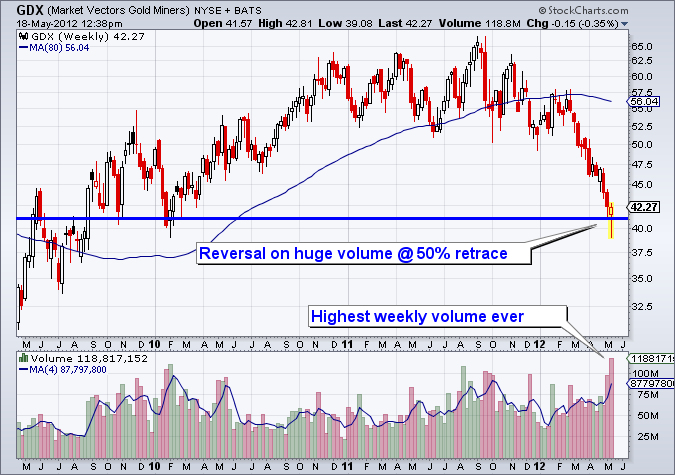
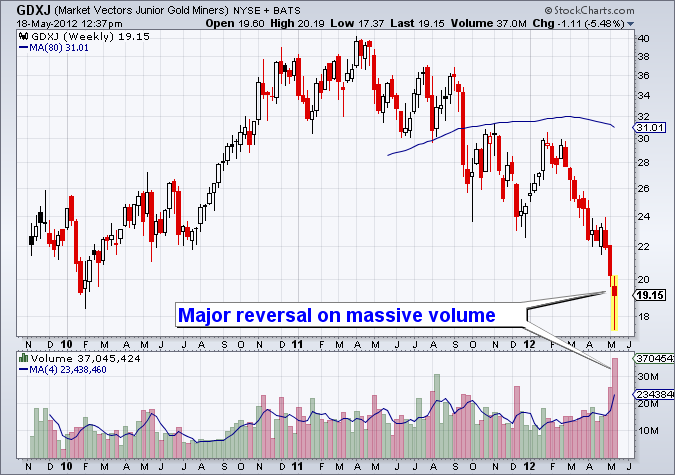
| Bottom in, but is it September 2008 or October 2008? Posted: 18 May 2012 04:37 AM PDT We began the week by making a ballsy prediction about the precious metals complex. We believed a major bottom could happen this week. In the wake of the European debt crisis and potential "credit events," the precious metals became extremely oversold based on a number of metrics. Technically, we saw that Gold and Silver were nearing the December lows which produced a good rally. The gold stocks were nearing the 50% retracement of their 2008-2011 bull move. The combination of an extreme oversold condition and technical support usually produces bottoms. It wasn't a difficult call but putting it on paper was. With the low in, the question now becomes, is this an interim bottom or will it be the major low we initially expected? In this piece we are going to look at the equities because they lead the metals at key turning points. This was the case in 2007-2008, the end of 2008 and most recently, in 2011. Predictably, the mining equities will lead the next rebound. Below we show a weekly chart of GDX. GDX was down 9 of the last 11 weeks and until yesterday, 10 of the last 12. The market has formed a very bullish reversal candlestick at the 50% retracement and on the highest weekly volume. Next we show GDXJ, the "juniors" though it is comprised of mid-tier producers and larger explorers and developers. GDXJ has declined in 13 of the past 16 weeks. The market plunged at the start of the week but has now reversed most of the losses. The volume has been massive this week. Look at the tail on that candlestick! Ok Jordan, those charts are great and all, but how do they compare to 2008? First, let's compare the breadth which is a fancy word for how much of the sector is going up or down. One breadth indicator anyone can use is the bullish percent index (bpi) which shows the percentage of stocks on a Point & Figure buy signal. In the chart below we compare 2008 and 2012 using the BPI. During the initial respite in August and September of 2008, the BPI (using a 5-day moving average) bottomed at 32%. Presently, the BPI is at 11%. At the ultimate low in 2008, the BPI was at 5%. Next I want to compare the current price action to the price action in 2008. Presently, the gold stocks put in a great weekly reversal, at the 50% retracement after declining in nine of the past 11 weeks. In the summer of 2008, the gold stocks attempted to rally after declining for five straight weeks. The HUI formed a bullish hammer at the 50% retracement (2000-2008) after declining in seven of the past eight weeks (with one week being a push). Judging from the technicals and recent sentiment data (presented in our Monday editorial), it is clear that the gold stocks are currently more oversold and much closer to a major bottom relative to the failed recovery in the summer of 2008. Breadth is far more oversold and the market has been in decline for several more weeks. Moreover, in our previous update we noted how sentiment indicators were nearing October 2008 levels. On Wednesday, the daily sentiment index for Gold reached 5% bulls. Assets in the Rydex Fund, which were $350 Million at one point, fell in three days from $103 Million to $91 Million. We can form a conclusion based on the technicals and sentiment but developing events can can have an unforeseen and unpredictable impact. There are two fundamental forces that will impact the charts. First, we need to consider the ongoing turmoil in Europe and how and when it could negatively impact the market. Second, we have to juxtapose that with the inevitable monetary response which will be very bullish for Gold and gold shares. At the same time, we need to weigh those events with the market's response. Currently, the gold shares have begun a predictable rebound, and this rebound will go a long way in confirming or not confirming our previous prediction. If you'd be interested in professional guidance along the way, then we invite you to learn more about our service. Good Luck! Jordan Roy-Byrne, CMT
|
| Precious Metals Market Manipulation? -- Doug Casey Posted: 18 May 2012 04:17 AM PDT By Doug Casey, Casey Research For many years now, a meme has been floating around that the prices of gold and silver are being manipulated, which is to say suppressed, by various powers of darkness. This is not an unreasonable assertion. After all, the last thing the monetary powers-that-be want is to see is the price of gold skyrocketing. That would serve as an alarm bell, possibly panicking people all over the world, telling them to get out of the dollar. It's assumed, by those who believe in the theory, that the US Treasury is behind the suppression scheme, in complicity with a half-dozen or so large bullion banks that regularly trade in the metals. The assertion is bolstered by the fact that governments in general, and the US in particular, are always intervening in all kinds of markets. They try to control the price of wheat and corn with various USDA programs. They manifestly manipulate the price of credit (interest rates), now keeping it as low as possible to stave off financial collapse. And they may well be active, through the so-called Plunge Protection Team, in propping up the stock market. They were largely responsible for the boom in property, through numerous programs and parastatals like Fannie Mae and Freddie Mac. Why, therefore, shouldn't they also be involved in the monetary metals? Central banks regularly intervene in (i.e., manipulate) each others' currencies. So it's not unreasonable to imagine they'd try to manipulate gold as well. In fact, the US and other governments did try to suppress the gold price from 1961 to 1968 through what was known as the London Gold Pool. The US alone persisted in trying to do so until Nixon devalued the dollar and closed the gold window in 1971. But if it was ever doable, that was the time. Although nobody knows exactly how much gold there is above ground, a reasonable guess might be six billion ounces. There was a possibility of controlling the price, in the days of the London Gold Pool, when there were only three billion ounces in existence and when all the gold in the world was worth only $105 billion ($35 x 3 billion = $105 billion). Today, however, the value of the world's gold is around $10 trillion ($1,650 x 6 billion = $10 trillion), nearly 100 times as much. And governments own about a billion ounces, only 16% of it, whereas the last time they tried to control the price they owned about 1.1 billion ounces, which was about 35% of the world supply. And the governments, their central banks and almost all large commercial banks are bankrupt; they have vastly less financial power than they did in the days of the London Gold Pool. Why would they try to do something that's so obviously a losing game? I'm not at all disinclined to believe tales of manipulation of markets by the state; I expect it, and as a speculator I relish it. But I like to see evidence for everything. And extraordinary claims demand extraordinary evidence. I've read the stuff these guys have written for years and have seen nothing but strident assertions and accusations. I'm completely willing to believe central bankers are capable of any kind of nefarious foolishness, but I'd like to see proof. I'm constantly reading assertions of how "the boys" come along at "precisely" 1p.m. or 2 p.m. or perhaps "precisely" 11:37 a.m. or 12:16 p.m. and, on a purely not-for-profit basis, decide to "smack down" the market for gold or silver or both. Meanwhile the market has been hitting new highs for a dozen years. As you might imagine, I know most of the believers in the precious metals manipulation theories personally and am only a phone call or email away from those I don't know. And I'm curious. So I ask questions of these folks, who are generally intelligent, well informed and sophisticated. But I don't get answers that I find make sense. There have been readily identifiable reasons for other government manipulations in the past. It's obvious why a government wants low interest rates. It's obvious why they want high real estate and stock markets. But why – in today's world – would they really want to spend billions keeping gold (or especially silver) down? You'd think they might have tried to control the price of uranium when it ran to $140 a few years ago. Or perhaps the price of sugar when it ran to 28 cents last year; everybody uses sugar. Despite the fact that gold can act as an alarm bell, few Americans – or anyone, for that matter – among the hoi polloi care or even know the stuff exists except as an academic matter. Suppressing the gold price is not only vastly harder but much less important than it was during the last market. Here are some questions I'd like answered: MORE HERE |
| Is Major Decline in the Precious Metals Stocks Underway? Posted: 18 May 2012 03:52 AM PDT
All eyes are on Greece which is heading toward national elections six weeks after the last vote. Many feel that a Greek euro exit would be a chance to cauterize a festering wound and move on. There are also those that feel that Greece could be the first of several dominoes to fall, much larger economies such as Spain, Italy, for example. Meanwhile, Spain's 10-year borrowing costs had hit as much as 6.5 per cent on Wednesday with the risk of the country paying astronomical prices to borrow in the future. Spain has now issued more than half of its total debt needed for this year, yet concerns that Madrid will struggle to meet its deficit reduction targets for this year and next have pushed the risk premium between German and Spanish 10-year bonds to the highest in the history of the single currency. What is the most likely scenario if Greece exits the Eurozone? It isn't pretty for Greece. The Greek government (if one is formed soon) could legislate that all corporate and personal savings in Greek banks will be denominated in Drachma. The Drachma would swoon so that almost immediately Greek consumers will need more Drachmas to buy one Euro. A run on the banks would be most likely followed by a run on the Drachma, with Greeks constantly converting their drachmas into Euros, or other currency. The drachma constantly plunging against foreign currencies could cause a new crisis of hyperinflation. Of course, there are examples of other countries that have left what's effectively a common currency zone without suffering hyperinflation. A Greek exit could stimulate the same growth dynamic that's recharged Iceland and Argentina. Greece will once again become a cheap country, attracting tourism and with attractive exports. Having briefly discussed the political and economic events, let's move on to today's essay technical part. Before analyzing the recent developments in the mining stocks, let's see what's happening in the general stock market (charts courtesy by http://stockcharts.com.). In the long-term S&P 500 Index chart (related ETF: SPY), we see that prices moved lower this week and are at the long-term support line. Last week we wrote the following: Taking a relative comparison to the similar rally that we saw in the second half of 2010 with the current price patterns, it seems quite possible that we could have simply seen a correction with a rally now to follow. This is the long-term support line based on previous highs and if it holds the decline, higher prices could be seen for the short term. If the support line is broken, however, significantly lower prices are likely. In other words, stocks would be expected to begin a medium-term decline. Since the support line was not broken so far, the above picture is bullish. However, the financial sector provides us with a very different signal. In the Broker Dealer Index chart (a proxy for the financial sector), we see that the financials are below the lowest Fibonacci retracement level based on the previous rally. Since they have broken below it, further weakness and additional moves to the downside appear likely. So, all in all, the situation in the general stock market is rather mixed – a bounce or breakdown will tell us what type of medium-term move we should expect: a rally or a decline. This is what makes the situation similar to what is seen in the HUI Index (proxy for gold stocks; related ETF: GDX) In this week's long-term HUI Index chart (if you are reading this essay on sunshineprofits.com, you may click the above chart to enlarge), we see that the current decline has been more significant than previous ones. Only the decline of 2008 was greater. At this point we can no longer say that the current decline is very similar to other declines and that it's not similar to the 2008 one. This is a bearish development and the RSI levels also suggest that a major decline might be underway. This is concerning, because once the RSI level moved below the thick horizontal line in the chart, downside momentum has increased in the past. It now seems that after a sharp consolidation, further similarities to the 2008 decline may be seen. This is something which has become apparent only in the past few days. Based on the RSI level and the HUI confirmed move below the 395 level, the outlook here has changed considerably this week. Summing up, the continuation of the decline in the general stock market appears unlikely based on the long-term support line. However, since we have bearish signals from the financial sector, the situation is mixed for stocks and there are no specific implications for the precious metals sector at this time. The situation in mining stocks is mixed as well (even though miners bounced on Thursday and Friday) as the recent decline make a repeat of 2008 more probable than was the case previously. To make sure that you are notified once the new features are implemented, and get immediate access to my free thoughts on the market, including information not available publicly, we urge you to sign up for our free e-mail list. Gold & Silver Investors should definitely join us today and additionally get free, 7-day access to the Premium Sections on our website, including valuable tools and unique charts. It's free and you may unsubscribe at any time. Thank you for reading. Have a great and profitable week! P. Radomski * * * * *
Sunshine Profits provides professional support for Gold & Silver Investors and Traders.
All essays, research and information found above represent analyses and opinions of Mr. Radomski and Sunshine Profits' associates only. As such, it may prove wrong and be a subject to change without notice. Opinions and analyses were based on data available to authors of respective essays at the time of writing. Although the information provided above is based on careful research and sources that are believed to be accurate, Mr. Radomski and his associates do not guarantee the accuracy or thoroughness of the data or information reported. The opinions published above belong to Mr. Radomski or respective associates and are neither an offer nor a recommendation to purchase or sell securities. Mr. Radomski is not a Registered Securities Advisor. Mr. Radomski does not recommend services, products, business or investment in any company mentioned in any of his essays or reports. Materials published above have been prepared for your private use and their sole purpose is to educate readers about various investments. By reading Mr. Radomski's essays or reports you fully agree that he will not be held responsible or liable for any decisions you make regarding any information provided in these essays or reports. Investing, trading and speculation in any financial markets may involve high risk of loss. We strongly advise that you consult a certified investment advisor and we encourage you to do your own research before making any investment decision. Mr. Radomski, Sunshine Profits' employees and affiliates as well as members of their families may have a short or long position in any securities, including those mentioned in any of the reports or essays, and may make additional purchases and/or sales of those securities without notice.
|
| Why Gold & Silver & the Mining Shares will be Impelled Even Higher, and Soon Posted: 18 May 2012 03:48 AM PDT "When the Federal Reserve took its first steps down the road of debt monetization with the first quantitative easing program (QE1), we knew there were going to be more. QE2 followed QE1. QE lite – the Fed promised to keep interest rates low until the end of 2014 – followed QE2. And QE3 is on the way… "It's going to happen – as surely as we'll see QE4, QE5, and on and on and on. "That's the problem with reckless money printing. It's like jumping into a swimming pool. You can't ever 'un-jump.' "So now it's just a question of timing the announcement for maximum impact…." "Traders Prepare for More Money Printing", Jeff Clark, The Growth Stock Wire, 05/15/2012 Old news it is to most readers, that a Cartel (Note 1) of Mega-Bankers and Allies has for years, and is, engaged in Ongoing Price Suppression of Gold and Silver and their Miners' shares. Increasingly wide acknowledgement of Gold and Silver as the Ultimate Stores and Measures of Value (i.e. Real Money) would further devalue their Paper Treasury Securities and Fiat Currencies, and diminish their immense power. Thus their ongoing Price Suppression intensifies. Indeed, it is no surprise to us that The Cartel has successfully (thus far) waged a battle against pro-Gold and Silver Sentiment since last September, 2011, and especially since the end of February, 2012. And they have been helped recently by Fears of Economic Deflation arising from of the Eurozone Crises. Specifically, Greece moves ever nearer to Default and Spain and Italy are too Big to Bail, but both the latter are at increasing Risk of Economic Meltdown, as reflected in their 10yr Treasury Securities Yields moving back up over the Toxic 6% level. One consequence of The Cartel's Real Assets Price Takedowns is that the Continuous Commodity Index (CCI) recently made a 19 month low. And, significantly, the recent strengthening in the U.S. Dollar and U.S. Treasuries (both of which Deepcaster earlier forecast) has led to large Bullish Options Bets on ten-year Treasuries. The yield level implied from these options Prices is about 1.4% on the U.S. 10-year. No surprise to us. And Equities Markets are recently down on these Deflation and other Fears. But the French and Greek people have spoken. They will have no more Austerity. However, note well that Soybeans, Wheat, and Corn Prices have already rebounded strongly from their recent Takedowns. (Essential Tangible Assets hold their value notwithstanding Central Bank Money Printing.) All this (but rebounding grain prices) adds up to the "Nightmare the Monetary Authorities Dread – DEFLATION" to borrow the Graphically Accurate Language of Trader Dan Norcini. Europe, via the ECB, must certainly print more Money, lots of it, and soon (QE 4, however it is disguised – the ECB's LTRO and Fed's ongoing Operation Twist are de factor QE 3). But this European Reality mandates a major Ripple Effect which is not widely recognized. Have you wondered why, even in light of the Ever-Worsening Eurozone Crises, the Euro does not depreciate even more than it has vis-à-vis the U.S. Dollar? That is because it is not in the self-interest (the U.S. Fed is a private for-profit entity after all) of the Major Central Banks around the World to allow one currency (e.g. the Euro) to depreciate too rapidly vis-à-vis the rest. The Central Bankers implement this NO-Dramatic-Depreciation policy by coordinating the same-sizing (approximately) of their money printing. If the ECB prints more Fiat Currency, as it surely will soon, The Fed and other CB's must follow suit. This monetary Hyper-Inflation leads eventually to Price Hyper-Inflation as it already has in the U.S. (9.9% -- see Note 2) and creates superb Profit Opportunities along the way (see Note 3). Nonetheless, Gold and Silver Prices are still vulnerable to Cartel Takedown attempts. Even so QE4 is coming. And at the First Whiff that a QE 4 will be implemented, we can expect Gold, Silver, and especially the miners to accelerate their recent launch up. We look forward to more closely Forecasting the launch date of their durable Uptrend as it draws nearer. Gluskin Shelf Chief Economist, David Rosenberg, wisely observes "there is a very good opportunity in Gold" and "it will eventually hit $3,000." We agree. We shall be watching very closely "Signals" from the CB's, and watching even more closely what they actually do, however well it is disguised. Best regards, Deepcaster May 17, 2012 Note 1: We encourage those who doubt the scope and power of Overt and Covert Interventions by a Fed-led Cartel of Key Central Bankers and Favored Financial Institutions to read Deepcaster's December, 2009, Special Alert containing a summary overview of Intervention entitled "Forecasts and December, 2009 Special Alert: Profiting From The Cartel's Dark Interventions - III" and Deepcaster's July, 2010 Letter entitled "Profit from a Weakening Cartel; Buy Reco; Forecasts: Gold, Silver, Equities, Crude Oil, U.S. Dollar & U.S. T-Notes & T-Bonds" in the 'Alerts Cache' and 'Latest Letter' Cache at www.deepcaster.com. Also consider the substantial evidence collected by the Gold AntiTrust Action Committee at www.gata.org, including testimony before the CFTC, for information on precious metals price manipulation. Virtually all of the evidence for Intervention has been gleaned from publicly available records. Deepcaster's profitable recommendations displayed at www.deepcaster.com have been facilitated by attention to these "Interventionals." Attention to The Interventionals facilitated Deepcaster's recommending five short positions prior to the Fall, 2008 Market Crash all of which were subsequently liquidated profitably. Note 2: *Shadowstats.com calculates Key Statistics the way they were calculated in the 1980s and 1990s before Official Data Manipulation began in earnest. Consider Bogus Official Numbers vs. Real Numbers (per Shadowstats.com) Annual U.S. Consumer Price Inflation reported May 14, 2012 2.30% / 9.94% U.S. Unemployment reported May 4, 2012 8.2% / 22.3% U.S. GDP Annual Growth/Decline reported April 27, 2012 1.62% / -2.17% U.S. M3 reported May 7, 2012 (Month of March, Y.O.Y.) No Official Report / 3.02% (e) Note 3: Recent moves (correctly forecast by Deepcaster) in Gold, Silver, the U.S. Dollar, and U.S. Treasuries have been catalyzed by Macro-Events and Cartel Manipulation. Similarly, recent Equities and Commodities Takedowns have been catalyzed by Eurozone Realities (Spain is too Big to Bail and Greece may be on the verge of Debt Repudiation), the China Slowdown, and by what the J.P. Morgan Chase Debacle portends for the Derivatives Disease in the Financial Markets. The BIS (the Central Bankers' Bank) says that as of June, 2011 there were over $700 Trillion National Value of Derivatives Outstanding – about $100 Trillion more than just before the 2007-2008 Financial Crisis. But Jim Sinclair says the Actual Amount is over A Quadrillion(!) Dollars because the BIS changed the definition of "Derivatives". We agree with Sinclair, and with Buffet that they are "Time Bombs". The fact that JPM publically admitted its error before unwinding its "$2 billion" (now reportedly $3 billion) plus Loss testifies to the seriousness of the Derivatives Threat. Regulators should implement the Volcker Rule etc. forthwith, so that Taxpayers' Bank Deposits and "Insurance" (via, e.g., the FDIC) will not be again at risk from Mega-Banks taking Mega-Risks. But the Positive News it that the Opportunities we have described in recent Letters and Alerts are approaching Maximum Attractiveness. And there will likely be a Very Major Catalyst soon to begin to realize this Profit Potential. See our latest Alert -- "Opportunities Knocking Louder: Forecasts: Key Commodities, incl. Gold, Silver, Grains, Copper, Crude Oil; Equities, U.S. Dollar/Euro, U.S. T-Notes, T- Bonds, & Interest Rates" just posted in 'Alerts Cache' at deepcaster.com. One such Opportunity flows from ongoing and increasing Mega-Bank Money Printing. But perhaps the Greatest Opportunities will likely result from that Very Major Catalyst referred to above. |
| MAJOR LONG-TERM BOTTOMS FORMING IN GOLD AND COMMODITIES Posted: 18 May 2012 03:33 AM PDT Once every year gold and stocks form a major yearly cycle low. Commodities form a major cycle bottom every 2 1/2 to 3 years. Every once in a while all three of these major cycles hit at the same time. I'm pretty sure that's what is happening right now.  The implications are that once the CRB has completed this major cycle bottom we should see generally higher prices over the next year and a half to two years, presumably topping during a major currency crisis as the dollar drops into its next three year cycle low in the fall of 2014. I think the 30 point rally in gold today is signaling that gold has put in its yearly cycle bottom. Since gold did not break below the December low of $1523 I think we can assume that this is a B-wave bottom and should be followed by the consolidation phase of a new C-wave that should breakout to new highs either later in the fall or next spring. The next two years should generate an even more impressive advance than the 2009-2011 rally, possibly even generating the bubble phase of the bull market in late 2014 or early 2015 as the dollar crisis reaches a crescendo.  As gold usually leads the stock market by a few days, we should see the stock market put in its yearly cycle low sometime in the next several days. However the outlook for stocks is not as bright as the commodity sector. While I do think continued currency debasement will probably drive the stock market to at least marginal new highs I also think an increasing inflationary environment is going to compress profit margins and constrict consumer spending. After a long topping process the stock market and economy will probably roll over and follow the dollar down into that 2014 bottom.  While I'm not ruling out one more quick dip below $1523 to wash out stops below that technical level, I think gold is in the initial stages of the next leg of the secular bull market. This last C-wave from 2009 – 2011 was the C-wave of silver with a 400%+ gain at the parabola top in May of last year.  This next C-wave will be the C-wave of the mining stocks. During the irrational selling over the last eight months mining stocks have reached levels of undervaluation that have only been seen one other time in history(2008). That drove a 300% rally over the next two years.  I suspect we will see something similar or even larger as the market gets busy correcting this irrational undervaluation. I think we are at, or very close to what is likely to be a once or twice a decade opportunity in the metals sector, especially the mining stocks. $10 one week trial to the premium newsletter.
|
| Posted: 18 May 2012 03:28 AM PDT
WHOLESALE MARKET gold prices climbed as high as $1594 an ounce during Monday morning's London trading, jumping 1.5% in the first two hours, while Eurozone stocks looked to have stemmed four days of losses despite Greece and Spain seeing negative ratings decisions. A day earlier, Dollar prices to buy gold jumped 2% in two hours during Thursday's US trading. "The bulls staged a big counterattack," says the latest technical analysis note from Scotia Mocatta, a bullion bank. "In terms of the longer-term technical [though], the picture is still bearish so long as we remain below last week's high at $1642." On the currency markets, the Euro recovered some ground against the Dollar this morning, after sinking to a four-month low in Friday's Asian session, during which time gold prices held most of the previous day's gains. Heading into the weekend, gold prices looked set for a slight weekly gain by Friday lunchtime in London – having risen 4% from Wednesday's low. "We'd like the market to hold at $1,550-$1,560," says Nick Trenethan, Singapore-based senior metals strategist at ANZ . "If it does that, then I think there's a fair chance we could continue higher towards the $1,600 level, perhaps re-establishing the range there…but if the headlines out of Europe continue poorly, we may retest the lows." Over in India, the world's largest source of gold demand in 2011, "demand has come down [from Thursday]" said Ketan Shroff, director at Mumbai-based wholesaler Pushpak Bullion, speaking this morning. "People were waiting for a correction and all of a sudden prices went up yesterday. If prices go up further then we may see more fall in demand." By contrast, the world's largest gold ETF, the SPDR Gold Trust (GLD), added 2.1 tonnes to its gold bullion holdings Thursday, taking them to their highest level this month at 1278.7 tonnes. Silver prices meantime rallied as high as $28.66 an ounce this morning – though they remained 2% down on the week by Friday lunchtime. Here in Europe meantime, the European Commission and European Central Bank are planning for scenarios whereby Greece leaves the Euro, according to European Union trade commissioner Karel De Gucht. "A year and a half ago there maybe was a risk of a domino effect," De Gucht tells Belgian Dutch-language newspaper De Standaard. "[But] a Greek exit [now] does not mean the end of the Euro, as some claim." Ratings agency Fitch however cut Greece's credit rating by a further two notches Thursday evening, reflecting "the heightened risk that Greece may not be able to sustain its membership of Economic and Monetary Union." Fellow ratings agency Moody's last night downgraded 16 Spanish banks, including the Eurozone's biggest bank Santander, following its downgrade of 26 Italian banks on Monday. "Amidst the ongoing Euro area debt crisis, the Spanish government's rising budget deficit and the renewed recession, sovereign creditworthiness has declined," said a Moody's statement. Despite the downgrades, shares in Spanish banks were among the biggest gainers in Friday morning's trading, with Bankia – which was partly nationalized last week – seeing its shares bounce by over 30% at one point following losses in recent days. Spain's government has hired Goldman Sachs to undertake an independent valuation of Bankia, according to Spanish newspaper Expansion. Spain is also expected to name independent auditors later today to determine how big a bailout the banking sector needs. Yields on 10-Year Spanish bonds meantime eased slightly this morning, though remained above 6%. "Volumes are light," reports one trader, "just bits and pieces on the screens…there's a [potential] can of worms to be opened [if Greece leaves the Euro]and it can become very messy and people don't want to be too involved." As gold spiked this morning, yields on German 10-year bunds fell to fresh all-time lows below 1.4% at one point, as investors pushed up the price of German government debt. "To see a return of gold reacting positively to macro stresses is indeed refreshing," says a note from Swiss investment bank UBS. "But it is still far too early to make any firm conclusions from here that gold has indeed turned the corner…[gold] will have to consistently exhibit its safe haven properties, and do so for some time to attract strategic buying." Gold prices by Friday lunchtime remained 3.3% down from their levels on May 6, when Greek elections failed to produce a government. European stock markets managed to pare early losses on Friday, with the Euro Stoxx 50 Index – which tracks blue-chip Eurozone stocks – showing a gain on the day by lunchtime following four straight days of losses. Here in London however the FTSE was still showing a 0.8% daily fall as we headed towards US open. Across the Atlantic, stock market futures trading suggested the S&P 500 would open higher Friday, with Facebook set for its first day's trading. Ben Traynor Gold value calculator | Buy gold online at live prices Editor of Gold News, the analysis and investment research site from world-leading gold ownership service BullionVault, Ben Traynor was formerly editor of the Fleet Street Letter, the UK's longest-running investment letter. A Cambridge economics graduate, he is a professional writer and editor with a specialist interest in monetary economics. (c) BullionVault 2011 Please Note: This article is to inform your thinking, not lead it. Only you can decide the best place for your money, and any decision you make will put your money at risk. Information or data included here may have already been overtaken by events – and must be verified elsewhere – should you choose to act on it.
|
| Major Long-Term Bottoms Form in Gold & Commodities Posted: 18 May 2012 02:17 AM PDT Once every year gold and stocks form a major yearly cycle low. Commodities form a major cycle bottom every 2 1/2 to 3 years. Every once in a while all three of these major cycles hit at the same time. I'm pretty sure that's what is happening right now. |
| German politicians face searching questions about gold Posted: 18 May 2012 02:00 AM PDT In recent weeks pressure has been building on the German Bundesbank after the tabloid newspaper Bild started a media campaign questioning the location of Germany's gold reserves. The ... |
| Posted: 18 May 2012 01:48 AM PDT |
| Chris Powell Answers Doug Caseys Questions About Gold Manipulation Posted: 18 May 2012 01:40 AM PDT |
| Posted: 18 May 2012 01:29 AM PDT There are two sets of meeting over the next four days that are likely to make big news. One is at Camp David with the G8 and one in Chicago with NATO. Forget the protests, that is just noise and distraction. There are three big problems that will be talked about at these meetings. from usawatchdog: Syria is in the middle of a revolution, and Russia has warned the West to stay out. Nothing is settled there, and the cease fire was short lived. Any NATO action, such as what happened in Libya, could spark World War III. The European debt crisis is getting worse, not better. Spanish banks are in trouble, more than two dozen Italian banks have been downgraded and the Greeks took nearly a billion dollars (700 million euros) out of the banks there. Germany is under Pressure to come to the rescue, but Angela Merkel is in trouble from all the bailouts. The fear is if Greece leaves the EU, then other countries will follow, and the banks could all take big losses. The other big topic for discussion will be the Iranian nuclear program and the big meeting in Iraq next week. The last meeting in April with the U.S., Germany, France, Britain, China and Russia ended with nothing more than an agreement for the meeting next week. Israel is not happy and, basically, said Iran was free to enrich uranium. Iran has repeatedly said its nuclear program is for the peaceful production of energy. The U.S. Senate is working on new economic sanctions on Iran, and word there is that containment of Iran is not an option. JP Morgan's $2 billion loss will probably turn into a $3 billion loss and may go higher. It will not sink JP Morgan, but this shows how risky derivatives are, and all the banks are backed by the FDIC. This is a warning flare that big financial icebergs are ahead. At some point, the loss might be big enough to trigger another meltdown. Goldman Sachs, for example, had $44 trillion in derivatives and a little more than $100 billion in assets. The banks will tell you that this is all hedged risk, it's called bilateral netting. This is done to keep losses tiny, if any occur. But we know how well that worked with AIG, Lehman, MF Global and, now, JP Morgan. Finally, there is a new story on the internet about how President Obama was born in Kenya. It seems Obama's literary agent accidentally released it. Please remember, a few months ago, Arizona Sheriff Joe Arpaio alleged the President's birth certificate was a forgery. The MSM ignored the story, but it might be harder to ignore now. Greg Hunter has analysis of these stories and more on the Weekly news Wrap-Up. ~TVR |
| ‘Counterattack by Bulls’ Sets Up Gold for Weekly Gain Posted: 18 May 2012 12:56 AM PDT Wholesale market gold prices climbed as high as $1,594 an ounce during Friday morning's London trading, jumping 1.5% in the first two hours, while Eurozone stocks looked to have stemmed four days of losses despite Greece and Spain seeing negative ratings decisions. |
| Posted: 18 May 2012 12:43 AM PDT SOUTHEAST TEXAS -- We happened to grow up at a time that fell between wars, just barely missing the Vietnam conflict by a couple years. However, close friends were not so time-lucky, and a compadre of ours was involved in the South Vietnamese jungles in horrific battles with the enemy they collectively called "Charlie." Although the stories have now mostly faded; stories listened to in awe as a young, full-of-spit-and vinegar pup who worshipped a sure-enough war hero might, a few mental images will never fade completely. The one we recall today is an example – inspired, believe it or not, by the action in the AMEX Gold Bugs Index or HUI.
A few hundred U.S. army and marines were in a tight spot. The marines had the high ground, their only advantage, but, as our warrior said modestly, "It was about 300 (U.S.) marines and army against maybe 2,500 VC (Viet Cong) so we figured it was about even. To tell the truth today, it could have gone either way." After an intense, non-stop barrage and numerous casualties (we have forgotten the numbers but remember they were frightful), near dawn, with our side's artillery ammunition running low, Charlie was very obviously staging for an all-out assault. At any moment the tired, beleaguered warriors could be overrun and wiped out. As the veteran told the story some forty-odd years ago, "About then the radioman got his "incoming" message and we grunts heard the best five words in the English language, bar none! Incoming meant we needed to hunker down because we had close air support incoming – and they would be coming in really close because that's where Charlie was. They about had to thread a needle with the nape (napalm) but they could see our smoke so unless they just (expletive) up, we were about to have a Charlie Roast."
Our hero cleared his throat, as if to keep from choking on emotion. He looked down to make sure we younger pups understood that what he was about to say was something special, something important. He said: "The five best words in the English language a company that is about to be overrun by a superior enemy force are, "help is on the way." Nothing sounds so sweet to a pinned down, surrounded battalion of fighters facing near certain annihilation or worse - than those five words. Nothing. They created instant hope to replace overwhelming dread. They gave our heroes the idea they just might make it out of that hell hole alive. And they did … make it out alive, that is. At least our hero did and a majority of his comrades. The Navy and Air Force pilots came in, low and frighteningly close, in waves, blanketing the jungle surrounding that horrible hill in a gulf of gelatinous gasoline fire and wicked strafing, forcing Charlie to retreat back into the steaming rain forest, leaving dozens, if not hundreds of casualties. A few days later the vanguard of a much larger U.S. force arrived to take over the hill and our favorite marine boarded a Huey for the first leg of his long-awaited trip home. Back to the U.S.A home. The firefight mentioned occurred exactly two weeks prior to the end of his second tour. It would be the last "action" he would see in Vietnam. Thank God for that. Today we are reminded of those important five words because yesterday we saw the HUI finally outperforming, maybe even like it means it, looking like it is more than just a relief bounce. The HUI turned in a 4.5% advance while gold was up 2%, silver up 2.4% and the smaller stock ETFs, like the GDXJ (+5.7%), answered. We lean toward the former as we hit the road for the coast and some badly needed fishing time. It's about time that people started moving into gold as a safe haven instead of paper promises. And the miners have been pinned down far too long in our own opinion.
|
| Bullion Higher Amid Wide-Ranging Outlooks Posted: 18 May 2012 12:36 AM PDT Gold prices rallied by more than 2% on Thursday and by nearly 1% early this morning as the US dollar appeared to slow its upward progress on the trade weighted index. Nevertheless, the dollar – trimmed gains and all – was still up for a 15th day in a row... |
| Austrian School Economics and the Croatian gold market explained by Sven Sambunjak Posted: 18 May 2012 12:00 AM PDT Sven Sambunjak, organiser of the 2nd Precious Metals Conference in Zagreb, Croatia, and the GoldMoney Foundation's Alasdair Macleod talk about the Croatian gold market, the Croatian economy and ... This posting includes an audio/video/photo media file: Download Now |
| Commodities Have Scope to Rise into Trading Week End Posted: 17 May 2012 11:05 PM PDT Commodity prices are showing diverging performance in early European trade. Growth-sensitive crude oil prices are following shares lower but likewise sentiment-linked copper is essentially flat. Meanwhile, gold and silver are on the upswing. |
| Posted: 17 May 2012 11:00 PM PDT The gold price has bounced back in some fashion over the last 24 hours, hurtling back above $1,550 and now probing the $1,600 mark. Silver is also on a tear and is back trading around $28.50. One ... |
| Posted: 17 May 2012 10:59 PM PDT
from peaktheories.com: An alternative title for this note is Flight to Liquidity Is Lifting for Takeoff, but the word "correction" stands out more for most with the two titles meaning the same thing and that is a mass investor exodus from equities and commodities and into the relative and perceived safety of US dollars and Treasurys. Put more politely, this correction could be called a flight to safety by some or even primly, a flight to quality, but when looking at the decade-long monthly charts of the dollar index, 10-year Treasury yield, S&P, VIX, $BPSPX, CRB Index with a little Russell 2000 thrown in there for good measure, there's nothing prim or proper about what's coming and that is a potentially devastating correction and probably soon. Rather than getting lost in semantics, though, let's just jump straight to those long-term charts that show the forest rather than the trees as was the case in 2007 and 2008 looking first at the chart that suggests a real risk-on asset drain and that is the dollar index. Keep on reading @ peaktheories.com |
| Gold Rebounds, Awaits European & Fed Actions Posted: 17 May 2012 10:48 PM PDT Gold futures bucked the trend of the broader market and jumped $38 or 2.5% on Thursday, the largest percentage increase since Oct. 25, 2011. The S&P 500 fell almost 2% while Euro Stoxx 50 and crude oil both dropped 1.5%. The US Dollar Index rose for 14 consecutive days. |
| Who will pay for the massive US public debt? Posted: 17 May 2012 10:38 PM PDT
from mybudget360.com: Now that tax seasons is mostly finished for your average American and people can exhale and take a breather, some interesting data is released by the IRS. Audit data is fascinating because it highlights that in terms of those getting an audit, the more you make the more likely you are to be audited. It is useful to get a sense of how this plays out. The IRS is unlikely to audit the average American making $25,000 a year because in reality, the cost and return of going after this group is so minimal. As the famous bank robber Willie Sutton once replied to a reporter as to why he robbed banks, "because that's where the money is." The government is running lean and as many of you know, carrying over a $15 trillion in public debt is starting to become a burden. Keep on reading @ mybudget360.com |
| Silver supply to pass the billion ounce mark this year Posted: 17 May 2012 10:29 PM PDT
from mineweb.com: Newly refined market economy silver supply is set to surpass one billion ounces for the first time in 2012, according to CPM Group's Silver Yearbook 2012. Keep on reading @ mineweb.com |


| You are subscribed to email updates from Gold World News Flash 2 To stop receiving these emails, you may unsubscribe now. | Email delivery powered by Google |
| Google Inc., 20 West Kinzie, Chicago IL USA 60610 | |

No comments:
Post a Comment