


saveyourassetsfirst3 |

- Orex Initiates Drilling at Barsele Gold Project, Northern Sweden
- AngloGold Ashanti: An Even Stronger Buy After Earnings
- LVPS Opportunity Examples
- Silver: Shorting Consumes, Investing Conserves
- Gold Demand Growing Among Institutional Investors
- Silver Market Could Be Rattled For Days
- Will the Eurozone Crisis Send the Gold Price Soaring?
- Gold Over EUR 1300 – On Its Way to ‘Infinity’?
- LISTEN: A Street View of the Current Gold Market
- Why Gold Exploration Stocks Are Primed to Explode
- Gold Over EUR 1,300 - On Way to ‘Infinity’ on Eurozone Contagion?
- Markus Kerber talks to James Turk
- Swiss National Bank earns 5,8 billion Swiss francs on Gold profits
- WATCH: Jim Rogers on Gold and Silver
- Gold to $2,000 by Year's End
- WATCH: Gold & Silver Analysis with Jim Wyckoff
- Preface to "The Jolly Roger Dollar"
- MF Global Bankruptcy Could Rattle Silver Market for Days
- WATCH: Markus Kerber talks with James Turk
- Bundesbank gold location kept secret
- "The price of gold can go to infinity" - Ron Paul
- Gold has reached a critical juncture
- The world's best silver company just reported a huge increase in profits
- Gold zooms to record high, crosses Rs 29,000
- Europe is dumb enough to have lost its gold, Farage tells King World News
- Europe is Dumb Enough to Have Leased Out All Its Gold: Nigel Farage
- Is Italy Next to Fail and Will Gold Go to $3,000 an Ounce?
- The Collapse of Our Corrupt, Predatory, Pathological Financial System Is Necessary and Positive
- Gold & Silver Market Morning, November 9, 2011
- Berlusconi resignation pledge encourages investors
| Orex Initiates Drilling at Barsele Gold Project, Northern Sweden Posted: 09 Nov 2011 06:32 AM PST Orex Minerals Inc. – (REX: TSX-V, ORXIF.PK) ("Orex") is pleased to announce that Protek Norr AB of Skellefteå Sweden has been retained to carry out a 5000-meter diamond drill program at our Barsele Gold Project (the "Project"). In this first phase of drilling, 12 to 15 holes are planned, with a completion date estimated to be mid March, 2012. The initial goal of this drilling program is infill and expansion of the known gold resource in the Central and Avan areas of the Project. It is also planned to drill test new gold and base metal targets outlined by the recent geophysical surveys within the Project. |
| AngloGold Ashanti: An Even Stronger Buy After Earnings Posted: 09 Nov 2011 05:59 AM PST By Bret Jensen: As the yield on the Italy 10 year rapidly approaches 7.5% and the country implodes faster than predicted, the ramifications for our market will be borne out over the next several weeks. One area of the market that should do well is gold and gold mining stocks due to uncertainty with sovereign debt in the Western world. One of my favorite gold mining stocks just reported extremely solid earnings and is a strong buy is AngloGold Ashanti (AU). Key data points from earnings report
AngloGold Ashanti – "AngloGold Ashanti Limited primarily engages in the exploration and production of gold. It also produces silver, uranium oxide, and Complete Story » |
| Posted: 09 Nov 2011 05:07 AM PST HOUSTON -- From the mail bag. "Thank you for spending time and talking with me … I am interested in the LVPS strategy you talked about in New Orleans. Could you provide some examples of the LVPS that are going on now? I am not sure I understand what to look for and more important when a good "vulture time" to pounce is." – Vulture Dr. W. E., New York. This is one of our favorite subjects, Doc. A Low-Volume-Panic-Spike or LVPS is where a liquidity vacuum or buyer's strike exists for an extended period of time, taking an issue down in very high percentages but the big sell-down is not, repeat not, supported by enough volume to justify the move. It is somewhat subjective, but we end up "knowing it when we see it," kind of like what U.S. Supreme Court Justice Potter Stewart said about the definition of hardcore pornography in 1964, when he said, "I shall not today attempt further to define the kinds of material I understand to be embraced within that shorthand description ("hard-core pornography"); and perhaps I could never succeed in intelligibly doing so. But I know it when I see it, and the motion picture involved in this case is not that." Continued… A precise definition of an LVPS would be a daunting thing to write, but we know them when we see them and so will you. The rule is that if there is any question in the mind as to whether or not an LVPS is in play, it isn't in play. We know them when we see them. The reason we like them is because it is our experience that most (not all but most) LVPS events are reversed in large percentages once the buyer's strike or shareholder disappointment that caused them finally ends.Key is that there has been no material or lethal change in the company and that one has confidence in the company and its management, otherwise we wouldn't even be looking at the play in the first place. Probably the best way to demonstrate LVPS events is to show one that occurred in the past and its resolution, and then show some of the companies we are tracking that appear to be in an LVPS event now. Later on, once things settle down to what will pass for "normal" in the (hopefully near) future, we can take a look to see if they are reacting as they "should" as a "recovering LVPS." First, a historic LVPS play we had a "good time" with from 2008. It is one of our favorite examples. Millrock Resources, monthly chart (above). We are actively tracking and gaming Greg Beischer's Millrock Resources, by the way. We are very close to naming it as a fully fledged Vulture Bargain issue for the second time, so convinced are we that Millrock is on a path to shareholder value. Note the fresh news the company issued today in the VultureInReview section. Why is Millrock the classic LVPS? Very clearly we can see that it sold off very disproportionately to the volume during the period of June to October of 2008. (Remember this is a monthly chart.) Even the October volume did not rise to the level that would signal a shareholder exodus or support such a drastic move lower. Our good friend and Guru Brien Lundin was pounding the table then, in 2008 for Millrock and as Vultures already know, we agreed and set up on the bid right near its ultimate lows. The notations on the chart tell part of the story. On the opposite side of the LVPS "valley" note the very strong and steady recovery once the panic event had passed and a little time had elapsed. Very large, high percentage moves that are not supported by high volume are often reversed in time. That is the simple strategy of trading LVPS events. (Interestingly, it works both ways too, more about that in a future offering.) Examples of Current Possible LVPS Events An example of one that we follow closely, Canada Energy Partners (CE.V or CNDPF) is just below. The notations in the graph tell much of the story. Another company we follow closely and have enjoyed building a Trophy Shares position in (and have very recently taken another stake in because of the LVPS) is Paragon Minerals (PGR.V or PAONF). We earned Trophy Shares from our positioning in 2010 on Paragon – for the second time. Paragon is back down to approximately the level where we entered in 2010, by the way, and our Vultures already know we have just recently chosen to take a third bite at the Paragon apple, for what it is worth. We dearly love "repeaters," don't you? For those new to our Vulture Bargain Hunting methods, "Trophy Shares" refers to the part of the original position we retain after taking profits at least twice on a play. Once to arrive at what we call "Free Shares," usually at least at a "double" from the initial stake. We then decide to sell a part of the Free Shares at some point, usually at an even higher level for profit or to build up our Bargain War Chest for later deployment, leaving us with Trophy Shares. We figure Trophy Shares (TS on our charts) have "earned the right to stay in our 'ports' until doomsday, or until we become disenchanted with the company or its management." We love holding zero-risk Trophy Shares in these very volatile, very risky issues, because doing so removes the "risk" part of the "high-risk-high-reward" condition. We think it is the very best way to build a portfolio of small, but promising Guru-chosen miners and explorers, some of whom are going to grow up to be "somebody" someday, or get gobbled up by the "Somebody's" of the resource world. Perhaps another good way to describe an LVPS is to show an example of what is NOT an LVPS. Consider Argentex Mining which has been pummeled by a recent political change in Argentina involving capital controls in-country. Note the high volume with the recent plunge, which is indicative of a shareholder exodus as opposed to a low volume buyer's strike. The high volume suggests the move is more or less justified and more likely to "stick" going forward unless the conditions that prompted the event change. Summation Very large, very high percentage collapses are not at all unusual in the small resource company (SRC) universe, because all (or nearly all) of these small or micro-cap issues are inherently very volatile. The liquidity almost always rushes in too fast for the sellers to keep up or rushes out too fast for the available buyers creating over-sized and game-able volatility for Vultures – over time. For us here at Got Gold Report, when we Vulture speculators can identify the issues that have been pummeled NOT because of company news, NOT because of a lethal company-specific event, but rather because of a market-wide buyer's strike. Or perhaps merely just a toe-stub by the company with resultant modest shareholder disappointment selling into a buyer-poor environment, resulting in a low-volume-panic-spike (LVPS) event, we become very, very confident at what we consider the areas likely to show us overwhelming support, or "OS" on the charts, but that is another story for another time – including the circumstance that we might have an OS event show at two separate levels before the event concludes. That's normal actually. As long as Vultures understand that it is easy to take a position in or just after an LVPS event, but seemingly very difficult for most of the ADD-infected, terribly impatient retail shareholders to hang onto their cheaply-bought position long enough to enjoy the full potential of their play … as long as Vultures understand that we have to allow the market to determine the length of time the play shall run, (weeks, months or even years sometimes), then LVPS hunting is a worthy strategy. Otherwise, there are other ways to skin the SRC gaming cat, but they are not nearly as much "fun" to very patient, and far-sighted Vultures, and normally not nearly as predictably profitable.
Vik sez: "Heck and dang, if it was easy, they'd be girl scouts doing this Vulture Bargain Hunting stuff, don't you know."
That is all for now but there is more to come. Disclosure: Members of the GGR team hold long positions in all of the companies mentioned, except Argentex. Link to Potter quote: http://en.wikipedia.org/wiki/I_know_it_when_I_see_it |
| Silver: Shorting Consumes, Investing Conserves Posted: 09 Nov 2011 03:37 AM PST It is a very simple proposition to explain how "shorting" is an activity which relentlessly, inevitably destroys markets, while investing is a benign activity which inevitably "heals" markets which are out of balance. What makes it difficult to understand this concept is years of media brainwashing branding investors as "speculators" and/or "hoarders". To pierce this brainwashing, I will explain these simple principles of arithmetic using an example to which we can all relate. Let's assume that instead of JP Morgan hating silver that it hated chocolate bars instead. And so to destroy that market (and deprive the world of chocolate bars) JP Morgan began to ruthlessly "short" chocolate bars. For the sake of argument, let's assume that this ruthless shorting drove the price of chocolate bars to 10 cents apiece (since shorting always depresses prices). What would happen then? The immediate, obvious consequence is that chocolate bars would be cleaned-out on all the shelves of all the stores around the world, as people stampeded to take advantage of this incredible "sale" on chocolate bars. However, the full consequences of this shorting are far, far worse. Virtually no chocolate bar-makers on the planet could manage to "break even" selling chocolate bars at 10 cents apiece, as the cost of their materials alone would greatly exceed that price. Most of the world's chocolate bar-makers would be bankrupted, creating a much, much more severe chocolate bar shortage. Most importantly, the chocolate bar "crisis" would never end unless/until prices rose substantially. At that artificially low price, it is a mathematical impossibility for there to ever be sufficient supply to meet demand. Enter the investor. What happens if "investors" began competing to buy up the tiny, remaining supply of chocolate bars? The price would start to rise. That rise in price then "magically" accomplishes two necessary goals: it discourages demand while simultaneously stimulating supply, because as the price goes up more and more chocolate bar-makers can return to the sector. As the price continues to rise, the market continues to heal. Demand moderates and supply rises until the two meet in equilibrium. Healing complete. Now, again for the sake of argument, let's suppose that "investing" in chocolate bars causes the price to rise "too high". What happens then? The rising price continues to depress demand, while over-stimulating supply, and the pendulum swings past the point of equilibrium. This causes inventories to grow. This growth in inventories then depresses prices, as buyers are no longer willing to pay high prices for a plentiful good, and the market would swing back toward equilibrium. It is an economic tautology that the price for a good cannot be "too high" if inventories are not growing, as the terms "too high" and "too low" are defined by supply/demand dynamics. If inventories are falling, price are too low. If inventories are rising, prices are too high (assuming that inventories are at historical norms). Now that these basic principles of arithmetic have been laid out in elementary terms, let's apply those principles to the silver market and see where our analysis leads. First of all, it is a matter of common knowledge that JP Morgan is the largest "silver short" in the history of the world. It has maintained that massive short position for several decades, despite the fact that in percentage terms its short position is much larger than the "long" position of the Hunt Brothers when they were accused of "cornering the market" (i.e. manipulating the silver market) back in 1980. What has been the impact of that ruthless, relentless shorting? During the 1990's, the price of silver was manipulated by JP Morgan to a 600-year low (in real dollars). We know this was "manipulation" because it was below the cost of production for nearly every silver mine on Earth, and well over 90% of all silver mines were driven into bankruptcy. Now that is how you destroy supply! |
| Gold Demand Growing Among Institutional Investors Posted: 09 Nov 2011 02:54 AM PST by Roman Baudzus, GoldMoney.com:
During the trading days from October 25 to November 1, the number of long and short positions held by large fund managers and institutional investors increased by 12,477 and 1,320, respectively. During this period, net-long positions held by institutional investors rose to 138,846. Mirroring this, gold producers have been acquiring more short positions and are continuing to offset long contracts. This is a sign that gold producers are back into the hedging business in order to protect their future production against price fluctuations in the gold markets. |
| Silver Market Could Be Rattled For Days Posted: 09 Nov 2011 02:52 AM PST
It now appears that the 200 year old trading and processing firm MFGlobal will go into bankruptcy following rumors that the firm did not have enough capital on hand to protect accounts. The company, which has seen its share price tumble by more than 85% this year, is expected to send several waves through the commodities market, mostly due to its expansive reach. Through a restructuring plan that would allow the CME Group to go public, the operator of major global exchanges privatized market-making and clearing functions to companies like MF Global. Earlier on Monday, it was reported that smaller firms which routed orders to MF Global for batch processing were experiencing difficulties placing trades. Later, it was made public that MF Global would not process new trades, and instead only allow for the liquidation of investments held by the firm on behalf of clients. |
| Will the Eurozone Crisis Send the Gold Price Soaring? Posted: 09 Nov 2011 02:49 AM PST by Richard Evans, Telegraph.co.uk:
The price of gold bullion climbed above $1,800 an ounce on Tuesday, rallying to its highest level in almost seven weeks. This is not surprising, given its traditional role as a safe haven in turbulent times. And the economy could hardly be more precarious, with the euro apparently on the brink of collapse. |
| Gold Over EUR 1300 – On Its Way to ‘Infinity’? Posted: 09 Nov 2011 02:47 AM PST Gold Over EUR 1,300 – On Way to 'Infinity' on Eurozone Contagion? from GoldCore:
Gold is trading at USD 1,783.10, EUR 1,307.50, GBP 1,116.30, CHF 1,612.20, JPY 138,315 and CNY 11,309 per ounce. Gold's London AM fix this morning was USD 1,780.00, GBP 1,112.50, and EUR 1,300.41 per ounce. Yesterday's AM fix was USD 1,794.00, GBP 1,114.49, and EUR 1,301.51 per ounce. Risk has returned with a vengeance as Italian debt markets have gone into meltdown leading to falls in European equity indices. Gold remains near a seven week high and has risen to above EUR 1,305/oz due to the deepening Eurozone crisis and contagion risk. |
| LISTEN: A Street View of the Current Gold Market Posted: 09 Nov 2011 02:20 AM PST From McAlvany Weekly Commentary: A Look At This Week's Show:
Gold Insider Conversations: Roy's experience as an institutional gold trader over a 32 year period brings insight into the present day gyrations in the precious metals markets. We discuss past present and future events as they relate to Gold, and the various issues which are immediately impacting the price of the metals. He can discuss his views freely as a long time friend, but in confidence. We have left his name and the remainder of his bio out so he can share his thoughts with candor. Much more @ McAlvanyWeeklyCommentary |
| Why Gold Exploration Stocks Are Primed to Explode Posted: 09 Nov 2011 01:51 AM PST |
| Gold Over EUR 1,300 - On Way to ‘Infinity’ on Eurozone Contagion? Posted: 09 Nov 2011 01:39 AM PST |
| Markus Kerber talks to James Turk Posted: 09 Nov 2011 01:35 AM PST An interesting interview. I don't guess this man will be eating a French meal any time soon. :haha: some tidbits
Markus Kerber talks to James Turk (39 min 02 sec): http://www.youtube.com/watch?v=1RfAP9F_0j0 info from YouTube: Prof. Markus C. Kerber, Professor at TU Berlin, and James Turk, Director of the GoldMoney Foundation, talk about the European rescue fund. Prof. Kerber explains that the fund is in violation of the monetary union treaty. He talks about the current expansion and expected future expansions of the fund. They talk about the rogue behaviour of the ECB. Prof. Kerber explains that the central bank's quantitative and qualitative easing is beyond its authority and against the spirit and letter of the treaties that created it. It has created a discriminatory credit market, is engaging in fiscal policy and creates market instability. He comments on the legal action currently ongoing in Luxembourg to bring the ECB to account and condemn its out of bounds behaviour. Prof. Kerber explains that the system of checks and balances is broken down when it comes to the ECB and tells of the public outcry in Germany when the Bundesbank tried to sell its gold. He talks about the very strong discussions over whether to let Greece exit the euro. The position that no country would be allowed to fail set the stage for all the further bailouts. He comments on the German rejection of the French attitude that the euro is a political project and that price is no object. He talks about the danger of Germany losing its creditworthiness. This interview was recorded on September 30th 2011 in Vienna. |
| Swiss National Bank earns 5,8 billion Swiss francs on Gold profits Posted: 09 Nov 2011 01:32 AM PST |
| WATCH: Jim Rogers on Gold and Silver Posted: 09 Nov 2011 01:31 AM PST Jim Rogers on ET discussing the bull in gold, silver, oil, and agriculture. ~TVR |
| Posted: 09 Nov 2011 01:31 AM PST Italy's bond yields hit crisis level. |
| WATCH: Gold & Silver Analysis with Jim Wyckoff Posted: 09 Nov 2011 01:30 AM PST Jim Wyckoff discusses Gold and Silver technicals with Daniella Cambone. |
| Preface to "The Jolly Roger Dollar" Posted: 09 Nov 2011 01:19 AM PST Barbarous Relic |
| MF Global Bankruptcy Could Rattle Silver Market for Days Posted: 09 Nov 2011 01:14 AM PST It now appears that the 200 year old trading and processing firm MFGlobal will go into bankruptcy following rumors that the firm did not have enough capital on hand to protect accounts. The company, which has seen its share price tumble by more than 85% this year, is expected to send several waves through the commodities market, mostly due to its expansive reach. |
| WATCH: Markus Kerber talks with James Turk Posted: 09 Nov 2011 12:37 AM PST Prof. Markus C. Kerber, Professor at TU Berlin, and James Turk, Director of the GoldMoney Foundation, talk about the European rescue fund. Prof. Kerber explains that the fund is in violation of the monetary union treaty. He talks about the current expansion and expected future expansions of the fund. They talk about the rogue behaviour of the ECB. Prof. Kerber explains that the central bank's quantitative and qualitative easing is beyond its authority and against the spirit and letter of the treaties that created it. It has created a discriminatory credit market, is engaging in fiscal policy and creates market instability. He comments on the legal action currently ongoing in Luxembourg to bring the ECB to account and condemn its out of bounds behaviour. Prof. Kerber explains that the system of checks and balances is broken down when it comes to the ECB and tells of the public outcry in Germany when the Bundesbank tried to sell its gold. He talks about the very strong discussions over whether to let Greece exit the euro. The position that no country would be allowed to fail set the stage for all the further bailouts. He comments on the German rejection of the French attitude that the euro is a political project and that price is no object. He talks about the danger of Germany losing its creditworthiness. This interview was recorded on September 30th 2011 in Vienna. |
| Bundesbank gold location kept secret Posted: 09 Nov 2011 12:27 AM PST Bundesbank gold location kept secret Published: 8 Nov 11 12:00 CET Online: http://www.thelocal.de/money/20111108-38731.html Share12 As pressure grows for Germany to tap its gold reserves amid the European sovereign debt crisis, the Bundesbank is refusing to end its silence on where its more than 3,000 tonnes of the precious metal is stored.Economics Minister Philipp Rösler firmly ruled out digging into the country's reserves to help rescue the euro. "German gold reserves must remain untouchable. I say this explicitly as Economics Minister, as representative of the Chancellor and as [COLOR=blue !important][COLOR=blue !important]party[/COLOR][/COLOR] chairman of the Free Democrats," he said on Monday on ARD television. On Tuesday, the daily [COLOR=blue !important][COLOR=blue !important]Financial[/COLOR][/COLOR] Times Deutschland examined the speculation on where Germany's horde of gold is being kept. The country's estimated 3,401 tonnes is the second largest national reserves after that of the United States. Much of Germany's gold would appear to be still in America, where it was held during the Cold War to ensure it never would fall prey to invading Soviet forces. Although the Second World War had left Germany in ruins, the economic miracle of the 1950s which was largely based on exports, quickly built up enormous gold reserves. By 1968 Germany had 4,000 tonnes, the most it has ever held, the paper said. Yet most of this was never moved to German soil – such a transport would be a logistical nightmare to organize, while insurance cover would be impossible to get. The gold changed hands on the [COLOR=blue !important][COLOR=blue !important]trading[/COLOR][/COLOR] floors of New York, London and Paris, while the metal bars themselves never moved. West Germany's financial centre Frankfurt, the home of the mighty Bundesbank, was in any case not considered safe enough – it was only an hour's car drive from the Fulda Gap – the crucial weak spot in the German-German border where NATO planners feared an invasion by the Red Army could take place. Former Bundesbank chairman Hans-Helmut Kotz told Stern magazine in 2004, "The largest share of our gold reserves are held in the [COLOR=blue !important][COLOR=blue !important]Federal [COLOR=blue !important]Reserve [/COLOR][COLOR=blue !important]Bank[/COLOR][/COLOR][/COLOR], the Bank of England and the Banque de France. In that order." His successors have never offered so much detail. Even a written parliamentary question last November could not evince further information – only that the Bundesbank does have the gold in physical form, not in the form of delivery promises. Rumours abound that the Federal Reserve lends the gold in order to earn interest, allowing banks to keep the [COLOR=blue !important][COLOR=blue !important]gold [COLOR=blue !important]price[/COLOR][/COLOR][/COLOR] artificially low by short selling it on [COLOR=blue !important][COLOR=blue !important]the [COLOR=blue !important]market[/COLOR][/COLOR][/COLOR] – something which the FTD said would profit many actors apart from gold owners and mine operators. Even though the central banks' own gold reserves would be worth less in such a case, they would benefit from the stability indicated by a low gold price. But as the FTD said on Tuesday, either the Bundesbank is lying or this theory of the gold price being depressed in this way does not fly – the paper was told by the Bundesbank that, "at the moment no gold is on loan." Critics suggested the storage of Germany's gold in the United States was – and remains – a kind of political deposit, to ensure that West Germany remained tightly bound to the West. This was disputed by the Bundesbank, whose spokeswoman said, "We are led by security, cost-efficiency and liquidity." Metals expert Thorsten Schulte told the paper that diplomatic considerations also probably played a role. "Taking the gold out of the US would be a sign of mistrust of the first order," he said. Karl Blessing, Bundesbank president in the 1960s is said to have written a letter to the American high commissioner in Germany promising not to convert the gold into dollars, the paper said. Having large parts of German gold in New York, London and Paris would be useful in terms of saving on transport costs when it comes to selling. Around 60 central banks are said to have gold reserves in New York. "There are also serious sources which say the Bundesbank often brings small amounts to Germany," said Schulte. The reserves currently held in Mainz and Frankfurt are considered to be more than the four percent often cited – the Bundesbank told the FTD "a large share of the gold reserves" are in Germany. http://www.thelocal.de/national/20111108-38731.html |
| "The price of gold can go to infinity" - Ron Paul Posted: 09 Nov 2011 12:13 AM PST :bandit::bandit::bandit: |
| Gold has reached a critical juncture Posted: 08 Nov 2011 11:47 PM PST From Kimble Charting Solutions: Key resistance test is back at hand for the gold ETF (GLD). GLD has rallied from the bottom of its channel to the top of the channel of late. Numerous times the top of the channel either slowed or stopped a rally over the past... Read full article (with must-see chart)... More on gold: The biggest threat gold investors face today History says we could see a BIG year-end gold rally Hilarious video shows the media is still completely clueless about gold |
| The world's best silver company just reported a huge increase in profits Posted: 08 Nov 2011 11:38 PM PST From The Daily Crux: The world's best silver company keeps getting better. Silver royalty company Silver Wheaton just reported a 96% increase in third-quarter profits. The company is also moving to boost its "embarrassingly" low dividend by tripling payouts to $0.09 per share next quarter. Read full article... More on precious metals stocks: Top manager Einhorn is making a big bet on gold stocks The world's greatest silver stock could soon be even better Casey Research: Gold mining stocks are dramatically undervalued |
| Gold zooms to record high, crosses Rs 29,000 Posted: 08 Nov 2011 11:00 PM PST |
| Europe is dumb enough to have lost its gold, Farage tells King World News Posted: 08 Nov 2011 09:48 PM PST |
| Europe is Dumb Enough to Have Leased Out All Its Gold: Nigel Farage Posted: 08 Nov 2011 09:06 PM PST ¤ Yesterday in Gold and SilverThe gold price certainly didn't do much of anything yesterday...and a rally worthy of the name didn't really get started until 12 o'clock noon in New York trading. Once the price broke through the $1,800 price level, willing not-for-profit sellers showed up...and by 2:50 p.m. Eastern time...had gold down about $25 from its high tick of the day, which Kitco reported as $1,804.10 spot. Gold recovered a bit going into the close of the New York Access Market, but finished down $10.50 on the day at $1,785.10 spot. The net volume traded was around 107,000 contracts...about the same as Monday's volume.
The silver price was...how shall we say it...more 'volatile' during the Tuesday trading day. The big noon rally in New York got dispatched shortly after the silver price blasted through $35 the ounce...which was the price ceiling on Monday...and obviously the price ceiling yesterday as well. The timing of the not-for-profit sellers was the same in silver as in gold And it wasn't only the noon rally that got squashed...every other rally also got sold off the moment that the price was about to go vertical in what is probably turning into a 'no ask' market. In plain English, that means that the only short sellers left are the bullion banks...and if they weren't there as not-for-profit sellers, or short sellers of last resort, the silver price would have been a very large number within hours...and I'm not talking about $50 the ounce, either. The silver price recovered most of its losses by the close of electronic trading in New York...and 'only' finished down eight cents on the day at $34.90 spot. The CME showed net volume on Tuesday as 29,000 contracts.
The gold stocks followed the gold price around like a virtual shadow again yesterday. It was almost unnatural to watch. The gold shares got sold off at the precise moments that the gold price got hit in the New York Access Market. There was no lag time at all...none. Bang!..and down they went. It almost appeared that gold and silver...and their associated shares...all got sold off in a co-ordinated fashion. I'm not saying that's what happened, but if it looks like a duck...and walks like a duck... The HUI finished down 0.79% on the day.
With silver down only eight cents on the day, the associated shares were a mixed bag...and Nick Laird's Silver Sentiment Index was up a hair...0.07%.
(Click on image to enlarge) The CME's Daily Delivery Report showed that 20 gold and 70 silver contracts were posted for delivery on Thursday. The link to this action is here. There was activity in both GLD and SLV yesterday...and both showed increases. GLD took in another 272,400 troy ounces of gold...and SLV added 827,055 ounces of silver. It was very quiet over at Switzerland's Zürcher Kantonalbank last week, as they reported virtually no change in either their gold or silver ETFs. Carl Loeb, the reader that provides this data on a weekly basis, found this rather strange. So did I. There was a sales report of sorts from the U.S. Mint yesterday. They sold 1,500 ounces of gold eagles...1,000 one-ounce gold buffaloes...and 140,000 silver eagles. Month-to-date the mint has sold 7,500 ounces of gold eagles...1,500 one-ounce gold buffaloes...and 516,000 ounces of silver eagles. This month's sales are off to a very slow start...and I'm being kind. There was some activity over at the Comex-approved depositories on Monday. No silver was received, but 382,274 troy ounces were shipped out...all of it from HSBC, USA. The link to this action is here. Here's a very interesting chart that was sent to me by Washington state reader S.A yesterday. It's a plot of the gold price vs. the Italian stock market.
I have a lot fewer stories today than I did yesterday, so I hope you can get through them all. One has to wonder what forces are at work in the world's financial system that keeps this monetary house of cards still standing. Is Italy Next to Fail...and Will Gold Go to $3,000 an Ounce? Bundesbank gold location kept secret. Interviews with John Embry and Eric Sprott. Thomas Jefferson Warned The Nation To Beware The Power Of The Banks. ¤ Critical ReadsSubscribeThomas Jefferson Warned The Nation To Beware The Power Of The BanksBefore there was John Kenneth Galbraith or Joe Stiglitz or Nouriel Roubini, or Simon Johnson or Niall Ferguson or Occupy Wall Street– there was one of the Founding Fathers, Thomas Jefferson giving an advance warning of 2008...some 200 years ago. An awesome foreboding it was, too. "I believe that banking institutions are more dangerous to our liberties than standing armies," Jefferson wrote. " If the American people ever allow private banks to control the issue of their currency, first by inflation, then by deflation, the banks and corporations that will grow up around(these banks) will deprive the people of all property until their children wake up homeless on the continent their fathers conquered." "The issuing power of currency shall be taken from the banks and restored to the people, to whom it properly belongs." We should all meditate on that amazing prediction of things to come that are not necessarily beneficial to the 99%– but only to the 1%. This is the entire 4-paragraph op-ed piece that appeared in Forbes on Sunday. I stole it from yesterday's King Report...and the link to the hard copy is here.  The Collapse of Our Corrupt, Predatory, Pathological Financial System Is Necessary and PositiveI was recently challenged by a contributor to write something positive, and so I decided to write about the single most positive outcome of the current financial crisis in Europe: the complete collapse of the corrupt, predatory, pathological global banking sector and its dealers, the central banks. Exploring why this is so reveals the insurmountable internal conflicts in our current financial system, and also illuminates the systemic political propaganda which is deployed daily to prop up a parasitic, corrupting, pathologically destructive financial system. This longish read, authored by Charles Hugh Smith, is posted over at the oftwominds.com website...and is well worth your time. I thank Roy Stephens for digging it up on our behalf...and the link is here.  The medieval, unaccountable Corporation of London is ripe for protestSo, dear reader, you think you know London? Well, think again! Working beyond the authority of parliament, the Corporation of London undermines all attempts to curb the excesses of finance. It's the dark heart of Britain, the place where democracy goes to die, immensely powerful, equally unaccountable. But I doubt that one in 10 British people has any idea of what the Corporation of the City of London is and how it works. This could be about to change. Alongside the Church of England, the Corporation is seeking to evict the protesters camped outside St Paul's cathedral. The protesters, in turn, have demanded that it submit to national oversight and control. What is this thing? Ostensibly it's the equivalent of a local council, responsible for a small area of London known as the Square Mile. But, as its website boasts, "among local authorities the City of London is unique". You bet it is. There are 25 electoral wards in the Square Mile. In four of them, the 9,000 people who live within its boundaries are permitted to vote. In the remaining 21, the votes are controlled by corporations, mostly banks and other financial companies. The bigger the business, the bigger the vote: a company with 10 workers gets two votes, the biggest employers, 79. It's not the workers who decide how the votes are cast, but the bosses, who "appoint" the voters. Plutocracy, pure and simple. If I had to pick one story from today's column that I consider an absolute must read...this would be it...and be prepared for an education. I thank reader U.D. for sending me this article that was posted in the October 31st edition of The Guardian...and the link is here.  Sarkozy and Obama's Netanyahu gaffe broadcast via microphonesThe French president, Nicolas Sarkozy, described the Israeli prime minister, Binyamin Netanyahu, as a "liar" in a private exchange with Barack Obama at last week's G20 summit in Cannes that was inadvertently broadcast to journalists. "I cannot stand him. He's a liar," Sarkozy told Obama. The US president responded by saying: "You're fed up with him? I have to deal with him every day." Neither leader apparently realised that microphones that had been attached for a press conference had already been switched on, allowing journalists waiting for a press conference to hear the conversation. This story was posted in The Guardian last evening...and I thank Australian reader Wesley Legrand for sending it along. The link is here.  Papandreou's Demise: Euro Crisis Heralds the End of an Era in GreeceThey were roommates in college. But now, fallen Greek Prime Minister Giorgios Papandreou and opposition leader Antonis Samaras are bitter rivals. Their two parties are to join in a unity government, but most in the country aren't hopeful that their misery will end soon. One of the two men, Georgios Papandreou, 59, was the politician Europe had favored, the model schoolboy. He implemented what his country's partners in the euro zone wanted from the Greeks. He designed cost-cutting plans, until the protests in front of the parliament building in Athens became larger and more violent. In response to marching orders from Brussels -- or, as many of his fellow Greeks say, from Berlin -- he raised taxes and fees, and he tried to trim down a sprawling government bureaucracy, until it bit back in resentment. He risked -- and lost -- his popularity among supporters who had voted him into office as his country's savior. And when all of this did not have the desired effect, the reliable leader suddenly veered off course, in the eyes of his handlers. He proposed that citizens vote in a referendum to decide whether he had a sufficient mandate for such draconian measures. Suddenly, Papandreou's relationship with his European partners soured. The other man, Antonis Samaras, 60, Papandreou's conservative and nationalist rival, was Europe's bogeyman. He was a member of the Greek administration that carried political nepotism and clientelism to the extreme -- and submitted bogus budget figures to Brussels. Samaras, now the opposition leader, rejected all austerity measures, saying that when he comes into power, he doesn't want to be "running a ruined country." This story was posted on the German website spiegel.de yesterday...and is another Roy Stephens offering. The link is here.  Once Greece goes, the whole euro project will unravelFar from promoting growth and political solidarity, which is what the single currency was supposed to do, the euro is in fact achieving the opposite effect, by condemning the eurozone to long-term recession and now extreme political infighting. Again, it cannot be right to persist with something which is achieving the opposite of what it was meant to simply because the alternatives are thought to be worse. By suggesting that there will be no support for Italian bond markets until Italy reforms itself, the European Central Bank is playing god in a way which is almost certain to end badly. Whatever Silvio Berlusconi's faults, which are undoubtedly many, since when was it thought acceptable for the central bank to effectively decide on what the government in Italy should be? The now repeated imposition of supra-national policy by an unelected elite on the citizens of the eurozone has got to be ultimately unsustainable. The dangers of extreme populist backlash followed in short order by Balkanisation are all too obvious. If the euro goes, so does the European Union, Angela Merkel keeps saying. Actually, it is the other way around. Persistence with the euro is straining the whole EU to breaking point. Th |
| Is Italy Next to Fail and Will Gold Go to $3,000 an Ounce? Posted: 08 Nov 2011 09:06 PM PST  Europe is approaching the end game. Credit markets and other governments know what its leaders won't admit, namely the euro is failing. And then gold, more than the dollar, is set to rocket in value as the crisis unfolds. |
| The Collapse of Our Corrupt, Predatory, Pathological Financial System Is Necessary and Positive Posted: 08 Nov 2011 09:06 PM PST  I was recently challenged by a contributor to write something positive, and so I decided to write about the single most positive outcome of the current financial crisis in Europe: the complete collapse of the corrupt, predatory, pathological global banking sector and its dealers, the central banks. Exploring why this is so reveals the insurmountable internal conflicts in our current financial system, and also illuminates the systemic political propaganda which is deployed daily to prop up a parasitic, corrupting, pathologically destructive financial system. |
| Gold & Silver Market Morning, November 9, 2011 Posted: 08 Nov 2011 09:00 PM PST |
| Berlusconi resignation pledge encourages investors Posted: 08 Nov 2011 08:45 PM PST Gold and silver prices put in strong performances yesterday, with gold testing resistance at $1,800 per ounce and silver moving briefly above $35 per ounce. However, news late in the afternoon (GMT) ... |
 Now that the gold price has gone through a correction phase, many investors are showing renewed interest in gold. After defending support at $1,610, yesterday the gold price nudged the $1,800 per troy ounce level. Should the gold price break this level to the upside in coming days, it could be on the way to reaching $2,000 per ounce. Last week's data by the Commodity Futures Trading Commission (CTFC) also showed that institutional investors and funds are back to buying gold at the futures and options markets.
 MF Global Bankruptcy Could Rattle Silver Market for Days
 Is gold about to go through the roof? The price has been creeping up again, after falling by about $200 from its previous record highs of around $1,900.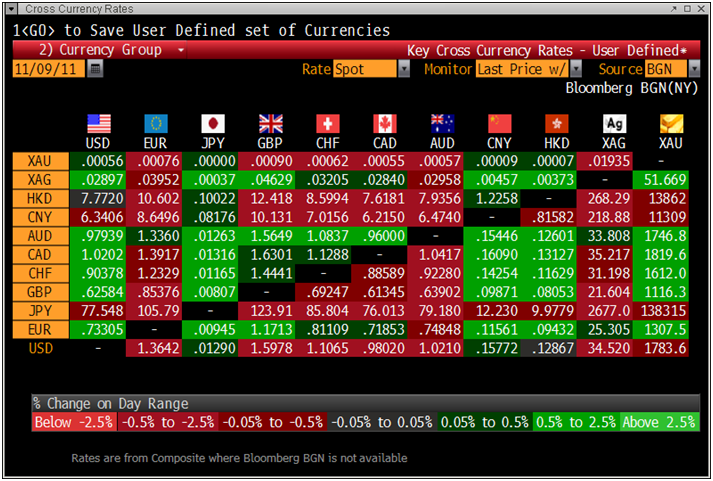


| You are subscribed to email updates from Gold World News Flash 2 To stop receiving these emails, you may unsubscribe now. | Email delivery powered by Google |
| Google Inc., 20 West Kinzie, Chicago IL USA 60610 | |

No comments:
Post a Comment