


saveyourassetsfirst3 |

- CFTC's evasion after 3 years investigating silver is answer enough
- CFTC's Evasion After 3 Years Investigating Silver is Answer Enough
- Gold Reacts to Europe
- After The Collapse – Who Will Your Neighbors Be?
- Hi-Ho, Silver Summit
- 6 Bonds To Consider Buying Right Now
- Launching the NC Fundraiser!
- 10 Biggest Gold Mines in the World [PHOTOS]
- CME Increases Margin Requirements to 100%, Bank of America Dumps Toxic Assets on Taxpayers and “Its Gone!”
- Today’s Winners and Losers
- By the Numbers for the Week Ending November 4
- The Members of European Parliament (MEP) Sideshow
- EFSFs, CDOs, CDSs … Or Just Gold?
- Bart Chilton: “There is Manipulation in the Silver Market”
- Rogers: “There Will Be Nothing Anybody Can Do”
- Silver's Secrets Exposed: A Timeline Tells All
- Bart Chilton - "There is Manipulation in the Silver Market"
- Gold’s nominal vs. ‘real’ price – updated
- Coin Show Report - Chattanooga, TN
- Gold Seeker Weekly Wrap-Up: Gold and Silver End Mixed on the Week
- Extreme Poverty Is Now At Record Levels – 19 Statistics About The Poor That Will Absolutely Astound You
- COT Silver Report - November 4, 2011
- Italy: One Step Closer to the Endgame
- Most gold stock analysts are out to lunch, Hathaway tells King World News
| CFTC's evasion after 3 years investigating silver is answer enough Posted: 05 Nov 2011 05:23 AM PDT Under renewed pressure by Commissioner Bart Chilton to account for itself, the U.S. Commodity Futures Trading Commission today issued a statement about its 3-year-old investigation of manipulation of the silver market, asserting only that the investigation continues. | ||||||||||||
| CFTC's Evasion After 3 Years Investigating Silver is Answer Enough Posted: 05 Nov 2011 12:13 AM PDT ¤ Yesterday in Gold and SilverIt was a very quiet trading day in gold everywhere on Planet Earth yesterday. There was a bit of a pop with the release of the jobs numbers at 8:30 a.m. Eastern time in New York yesterday morning, but it sure didn't amount to much...and got put in its place in very short order. The New York low came around 10:40 a.m...and the price didn't do much after that. Gold closed down $10.40 on the day at $1,754.00 spot. Net volume was a tiny 81,000 contracts, give or take.
Silver's high price tick of the day came shortly after the London open...and it was all down hill from there, with the low for Friday coming at 10:40 a.m. Eastern time, the same as gold. From there, the silver price basically traded sideways into the close. Nothing to see here, folks. Net volume was about 20,500 contracts...and the silver price closed at $34.13 spot, down 35 cents on the day.
The dollar wasn't doing much until the jobs numbers were release at 8:30 a.m. Of course the dollar blasted off on the 'good news'...and by 10:45 had reached its zenith...up about 65 basis points from its 8:30 a.m. low. As you can see from the above gold and silver charts, both metals were rallying right along with the dollar until for about twenty minutes, before a willing seller showed up.
The gold stocks gapped down about a percent at the open...and hit their nadir at gold's low and the dollar's high tick...around 10:40 a.m. Eastern. The stocks recovered just about all their losses on the day by the close of trading...and the HUI only finished down 0.69%.
All things considered, most of the silver stocks turned in a pretty decent, if mixed, performance...and Nick Laird's Silver Sentiment Index close down a miniscule 0.18%.
(Click on image to enlarge) The CME's Daily Delivery Report showed almost no action at all, as only 3 gold and 8 silver contracts were posted for delivery on Tuesday. As of this column, I will no longer report November deliveries on a daily basis, because there just aren't enough to warrant the effort. I will begin again with First Day Notice for the December delivery month...and that will be posted on the CME's website on November 30th. The GLD ETF showed an increase of 48,645 troy ounces yesterday...and there were no reported changed in SLV. The U.S. Mint had a small sales report yesterday. They sold 1,500 ounces of gold eagles and 351,000 silver eagles. November sales from the mint are off to a very slow start. It was a big day over at the Comex-approved depositories on Thursday, as they reported receiving 1,824,127 troy ounces of silver...three semi-trailers full...and only shipped 31,029 ounce out the door. The bulk of the receipts were at HSBC and Brinks...and the link to the action, which is worth a peek, is here. Yesterday's Commitment of Traders Report, for positions held at the close of trading on Tuesday, November 1st, showed that the Commercial traders decreased their net short position in silver by a smallish 674 contracts. As of Tuesday, the Commercial net short position stood at 22,842 contracts, or 114.2 million ounces. As of that date, the '4 or less' commercial traders were short 157.0 million ounces...and the '5 through 8' commercial traders were short 42.9 million ounces of silver. So the 8 largest traders in the Commercial category combined, were short a hair under 200 million ounces...or 25.0 million ounces apiece on average. The COT report shows a total of 42 traders holding short positions in the Commercial category. Grade 3 arithmetic yields the fact that the balance of the short positions in the Commercial category [110.3 million ounces to be precise] were held by 34 traders. Again, using Grade 3 arithmetic, that works out to be 3.24 million ounces per small trader...Ted Butler's raptors. Which group of traders do you feel has more control over the price? The 8 traders that hold 200 million ounces short between them...which works out to 175% of the entire Commercial net short position...or the 34 small traders that are short 3.24 million ounces each? It was a completely different story in gold, as the bullion banks increased their net short position by a very chunky 14,286 contracts, or 1.43 million ounces of gold. The Commercial net short position in gold is now back up to 18.2 million ounces. Of that amount, the '4 or less' Commercial traders are short 14.0 million ounces...and the '5 through 8' traders are short 4.8 million ounces of gold. Straight addition shows that the '8 or less' Commercial traders [mostly all bullion banks] are short 18.8 million ounces, which is a hair over 100% of the entire Commercial net short position in gold. At 100% of the Commercial net short position, you can see that the big bullion banks have a stranglehold on the gold price...but in silver, these same 8 bullion banks have a death grip on the silver price as they are short 175% of the total net short position. The Bank Participation Report for November was also released. The data for it was compiled from Tuesday's COT report...and this is the one day every month when we can compare apples to apples. Here's the Reader's Digest version of the report. In silver, 3 or less U.S. bullion banks [probably only two...JPMorgan and HSBC USA] increased their short position in silver from 14,388 Comex contracts in October's report, to 16,120 Comex contracts as of the close of trading on Tuesday, November 1st. That's equivalent to 80.6 million ounces. Now if you got back to the COT report for Tuesday...the 8 largest commercial traders in the short category were short a hair under 200 million ounces of silver...so JPMorgan and HSBC are short 80.6 million ounces of that amount all by themselves. So you've got six traders left that are short about 120 million ounces between the six of them...about 20 million ounces short apiece. And don't forget the other 36 small commercial traders/raptors that are short 3.24 million ounces [on average] each. It's very obvious that JPMorgan is the main crook...and the ringleader of this price management scheme. As for the 12 non-U.S. banks in this report, they are actually net long 144 Comex contracts, which is down a hair from the long position they held in October. These 12 banks, on average, are net long 12 Comex contracts apiece...which is 60,000 ounces per bank. So they are obviously not a factor in the silver price manipulation. In gold, the 4 U.S. banks reported increasing their Comex short positions by 8,265 contracts...and the 19 non-U.S. banks increased their Comex short position by 7,088 contracts. It's obvious from these numbers that virtually all of the world's bullion banks increased their short positions in the Comex futures market during October...to the tune of 15,353 contracts. As of last Tuesday's COT report, these 23 banks were short 110,935 Comex contracts, which translates into 11.1 million ounces of gold. Last Tuesday's COT report showed that the Commercial net short position was 18.2 million ounces. So these 19 banks are short 61% of the Commercial net short position in gold. In silver, 15 banks are short 70% of the Commercial net short position in silver...and of that 70%...JPMorgan holds virtually all of it. I got a very interesting e-mail from a reader yesterday regarding MF Global...and here's what he had to say..."Well, I am one of the unfortunate investors in MF Global. I have NOT been able to trade my position yesterday, or the day before that, or at all since this bankruptcy has been filed [no metals trading allowed]. I was able to "cover" one Nasdaq short two days ago, however I am still "long" one big December silver future. The good news is that silver is up today, but the bad news is that I don't know when I will be able to sell that position, but more importantly, if I ever will be able to see any of the money in my account again." Here's a graph that Washington state reader S.A. sent my way yesterday. It's entitled The Debt that Overwhelms All Others. That is the U.S. Every other country combined pales into insignificance.
(Click on image to enlarge) I have more stories than I care to talk about today, so I hope you get the time to pick through most of them over the weekend. I wish we had more clarity at the moment, but we don't...as the situation is very fluid...and I'm making this up as I go along, at least for the time being. CFTC Says Silver-Market Probe Continues After 100,000 Documents Analyzed. Chart of the Day: gold vaults filling up fast. The Death of Money. ¤ Critical ReadsSubscribeMissing MF Global funds at J.P. Morgan: reportMissing customer funds from MF Global Holdings Ltd. have been found in a custodial account at J.P. Morgan Chase & Co., Bloomberg News reported Friday, citing two people close to the matter. This marketwatch.com piece was sent to me by Florida reader Donna Badach yesterday...and the link is here.  JPMorgan Denies Holding Missing MF Global FundsJP Morgan Chase shot down a report that it was holding hundreds of millions of dollars in missing MF Global client funds. JP Morgan told CNBC Friday that, much like other banks, it has been holding MF funds and awaiting instructions from the bankrupt company's trustee. The bank said the funds are not the missing client funds and the account has always been "transparent" to MF and its trustee. The link to this cnbc.com story, which I dug up myself, is here.  Gensler won't participate in MF Global reviewGary Gensler, the chairman of the Commodity Futures Trading Commission, and Jon Corzine, who recently resigned as MF Global's chief executive, worked at Goldman Sachs Group Inc at the same time and held prominent positions. They both left the investment bank in the late 1990s. "I don't know if there is an official recusal but he's said he's not going to participate in the MFG inquiry. He's done with it," said a source who has participated in meetings on MF Global. This Reuters story was posted in The Baltimore Sun shortly after midnight. I thank Washington state reader S.A. for sending it my way...and the link is here.  Jefferies faces possible liquidity crunchThe contagion from the rapid downfall of the once little-known financial firm MF Global continues to spread through Wall Street. The investment bank Jefferies is the latest potential casualty. Dozens of Jefferies hedge fund clients are scrambling to find another investment bank where they can warehouse client's money and execute trades, according to sources in the prime brokerage divisions at three competing banks. These sources said they spent all day Thursday fielding calls from hedge funds who could be potential clients. An exodus of hedge fund clients that use Jefferies prime brokerage services could hamper the bank's ability to fund itself. However, it was not clear how many clients -- if any -- have left Jefferies. Jefferies, at most, would be one of the smaller traders in The Commercial category of the COT. I've mentioned their name numerous times regarding deliveries in gold and silver in the CME's Daily Delivery Report. [MF Global is another trader in the Commercial category as well] This item was sent to me by Ilona Pluschau, for which I thank her. It's certainly a must read...and the link to this money.cnn.com story is here.  CME Goes To Collateral DefCon 1: Makes Maintenance Margin Equal To Initial For... Everything!?The most important news announcement of the day was not anything to came out of Cannes (as nothing did), nor from Greece (the merry go round farce there continues unabated). No, it was a brief paragraph distributed by the CME long after everyone had gone home, and was already on their 3rd drink. It is critical, because not only is this announcement a direct consequence of what happened with MF Global several days ago, but because also it confirms one of our biggest concerns: systemic liquidity is non-existent. This zerohedge.com story was all over the Internet last night and, quite frankly, I'm prepared to admit that I'm not exactly sure what it means...although Tyler Durden has gone apoplectic about it. Dr. Dave Janda, of WAAM 1600 fame in Ann Arbor, Michigan was the first one through the door with this story yesterday evening...and it's an absolute must read. We'll find out o | ||||||||||||
| Posted: 04 Nov 2011 10:53 PM PDT Gold rose for a second straight session on concern that Europe's leaders won't do enough to stem the region's debt crisis, boosting demand for the metal as a haven investment.
"Policy makers ruled out tapping the European Central Bank's balance sheet to boost the region's rescue fund and outlined plans to aid banks. Gold also rose on concern that U.S. monetary policy aimed at shoring up growth will spur inflation. Federal Reserve Vice Chairman Janet Yellen said on October 21 that a third round of large-scale securities purchases may become warranted to boost the U.S. economy." "Gold is being pushed up as a safe-haven bet," Fred Schoenstein, a trader at Heraeus Precious Metals Management in New York, said in a telephone interview. "Everyone wants to know the details from Europe." "Bullion is in the 11th year of a bull market and futures reached a record $1,923.70 on September 6 as investors sought to diversify away from equities and some currencies. Before today, the metal gained 15% this year." "Gold investor interest has stabilized, and physical demand continues to emerge, albeit at softer levels," Suki Cooper, an analyst at Barclays Capital in New York, wrote today in a report. 'We continue to expect gold prices to be cushioned amid the seasonally strong period for demand, and this remains key before investment demand returns to the driver's seat. We retain our positive view on gold, given the macro backdrop." Silver futures for December delivery rose 1.6% to $31.685 an ounce. Before today, prices climbed 3.7% this month. – Nicholas Larkin and Debarati Roy 10-24-11 Bloomberg.net         This posting includes an audio/video/photo media file: Download Now | ||||||||||||
| After The Collapse – Who Will Your Neighbors Be? Posted: 04 Nov 2011 10:28 PM PDT A frightening outcome like this one could occur if things truly become desperate: After The Collapse – Who Will Your Neighbors Be? H/T John Roll Likely Related Posts The End is Getting Close "Caring" Politicians versus Impersonal Markets What Will It Be Like After the Collapse? Share/Save | ||||||||||||
| Posted: 04 Nov 2011 10:00 PM PDT | ||||||||||||
| 6 Bonds To Consider Buying Right Now Posted: 04 Nov 2011 09:46 PM PDT By The Financial Lexicon: For those investors looking for some diversity in an income portfolio and having trouble finding the right combination of yield and risk profile, consider these six individual bonds (in no particular order): Alcoa (AA) describes itself on its website as the "world's leading producer of primary aluminum and fabricated aluminum, as well as the world's largest miner of bauxite and refiner of alumina." Its Senior unsecured note (CUSIP: 013817AJ0) maturing 2/1/2027 has a coupon of 5.90% and is currently asking 99.486 cents on the dollar (5.951% yield-to-maturity before commissions). It has a make whole call, conditional puts for a change of control, and pays interest semi-annually. Moody's currently rates the bond at Baa3, S&P at BBB-. Best Buy (BBY) describes itself on its website as a "multinational retailer of technology and entertainment products and services with a commitment to growth and innovation." Its Senior unsecured note (CUSIP: 086516AL5) maturing 3/15/2021 Complete Story » | ||||||||||||
| Posted: 04 Nov 2011 09:14 PM PDT One of the things that I suspect has brought many of you to Naked Capitalism is the hard lesson that conventional wisdom in finance and economics has been very costly to ordinary citizens around the world. If you had believed the prevailing world view of early 2007, that markets were efficient and bad actors would of course be found out and shunned, that were were in the midst of a Great Moderation and could expect to enjoy continued prosperity, punctuated by shallow recessions, and that financial innovation was a boon and therefore to be encouraged, you had an ugly awakening. The global financial crisis imposed tremendous costs on investors and society at large, via unemployment, a housing bust, plunging tax revenues, cuts in government services and increasing political discord. Yet no one in power before the crisis has been punished or even suffered much. In fact, 2009 and 2010 Wall Street bonuses exceeded the record levels of 2007. As former IMF chief economist Simon Johnson described in a May 2009 Atlantic article, the US instead suffered a quiet coup, with the top end of the financial services industry becoming more concentrated, more powerful, even more concentrated and more firmly in charge of the political apparatus. Most of you understand this. It's awfully hard not to notice that we have a two-tier system of justice, in which the major financial firms get to flout the law and violate their own contracts, yet are able to get their agreements enforced against seemingly everyone, from credit card, mortgage, and student debt borrowers to municipalities who entered into risk-laden swaps they didn't understand to nations like Greece, where a clearly insolvent borrower cannot get a deep enough restructuring out of fear of triggering payouts on credit default swaps. But complexity, leverage, and opacity have been the big banks' best friends in executing this program of looting. You've come here to get educated so you won't be so easily taken next time. So the lies that the elite financiers have peddled appeared to be free, when in fact, many of them were sold via clever messaging and lobbying. Look at how the expression "free markets" is widely seen as positive. It stands for the presumption that less, better yet no, regulation is better. In fact, many fields of enterprise have a tendency to evolve to a concentrated format, which allows for monopoly/oligopoly pricing, which any economist will tell you is a Bad Thing. And unregulated markets also feature races to the bottom, where providers willing to cut corners to boost their profits drag their competitors with them. This tendency is particularly pernicious in fields like financial services, where many customers cannot evaluate the quality of the produce they are offered, and go on misleading proxies, like the demeanor of their salesman (any wonder why so many polished sociopaths wind up on Wall Street?) But getting the truth is not free. It take time, effort, expertise, and resources. One of the great resources we have developed here at NC is an engaged and informed reader community. I learn a ton from comments (even when it is sometimes painful, as in when I've stepped in it in one of my posts). We've broken some significant stories thanks to input from our reader community, such as the so-called New York trust theory (which basically means the securitization industry has no clean fixes for the mess they created by their failure on a large scale to convey mortgages properly to securitization trust, and explains why they have been forced to resort to widespread fraud in the courtroom) and the Magnetar story (how a single hedge fund's toxic CDO program played an major role in turning what would have otherwise been a contained subprime bubble into a global financial crisis) in ECONNED. I want to keep spending more time on the blog. But that means I need your help. Some of it results from the fact that as the readership has grown, it takes more to support it: better hosting, more help with offloading tasks so I can respond to more input and leads via e-mail and the comment section. But it also comes about from the fact that the nature of blogging in the wake of the crisis has changed. As reader and sometimes guest blogger John Bougearel aptly described it, the crisis was like a massive rock landing in a seemingly placid pool. It was pretty simple to figure out what to follow during the crisis; I'd roll out of bed and see what new wheels were falling off the financial system. But the rings from that initial impact keep widening. There are now more threads to follow, and many of them, like mortgage-related developments, take a certain amount of digging to get right. As I look over my archives over time, even though the number of posts per day is pretty much the same, they've become more analytically intensive over time. So I'm often juggling a tradeoff between more thorough investigation and getting posts out. So I also feel fortune to have a cadre of talented and expert guest bloggers like Matt Stoller, Philip Pilkington, Michael Hudson, Richard Smith (who also does a great deal of behind the scenes work, like troll patrol), Satyajit Das, Marshall Auerback and Rob Parenteau, who cover certain beats in these expanding circles of interest better than I can. We are also glad to have well-regarded fellow bloggers like Ed Harrison, Steve Keen, George Washington, and Bill Black cross posting on Naked Capitalism. What you get here is something I honestly believe you do not find anywhere else on the Web in the finance and economics sphere, and certainly not in the mainstream media, which is a willingness to question institutions and individuals in power, and get behind skillful sloganeering to uncover sloppy thinking, bad practices, intellectual capture, corruption, and destructive policies. We name names and get granular when their conduct is not on the up and up. This is a role that traditional journalists aspire to play, but shrinking news budgets, accelerating news cycles, the native complexity of finance-related material, and the collusive game of access journalism have defanged the press. We know this sort of hard-hitting, skeptical coverage is something many of you value; the caliber and thoughtfulness of the comments section proves it. So we hope that those of you who are able will invest in this site in a more tangible way. So here is how the fundraiser will work. Our target is 750 donors over the next week. We've already had nearly 80 generously make contributions as a result of our discussing a possible fundraiser, and we are grateful for your early action. We are looking to get broad-based participation from the NC community. So if you are a student or took a financial setback in the crisis and can only make a small contribution, we'd still appreciate that, because we also have readers such as successful private investors, attorneys, executives, entrepreneurs, and fund managers, who cam make much bigger donations. We will also put forward specific things we intend to do with your donations and will tell you when we've hit each of these monetary goals. The first one is to upgrade our hosting and tech support. Our current webhost MEV Inc. has been graciously giving us free hosting (we do pay for our mirror website) as a result of a pretty rough transition from Blogger. We also get a break on regular tech support in return for being on a non-priority basis. As traffic has grown, they've had to be pretty enterprising to keep load times from being annoyingly slow, but on busy days, the site can be sluggish. And on big news days, or when we have very popular posts, traffic spikes can and do take the site down. The last thing we want to have happen is to have the site be offline when a crisis break loose (which give the state of affairs in Europe, is a matter of when not if) and you want to get information and communicate with each other, and I want to get posts out. So we need to move to a heavy duty host. Given the state of technology, that is not foolproof, but a service upgrade will considerable increase responsiveness and greatly reduce the incidence and duration of site outages. In addition, we'd also like to get faster turnaround from MEV on other matters, which necessitates an upgrade with them as well. The two combined is roughly $4700, which is our first target. Once we've hit that, we'll let you know what our next item is. There are multiple channels for donating. The first are here on the blog, the "Donate" and "Subscribe" buttons in the upper right, both of which take you to PayPal. If you are allergic to PayPal, you can send a check (or multiple post dated checks, if you want to spread out payments) in the name of Aurora Advisors Incorporated to Aurora Advisors Incorporated, 903 Park Avenue, 8th Floor, New York, NY 10075. Please also send an e-mail to yves@nakedcapitalism.com with the headline "Check is in the mail" (and just the $ en route in the message) so we can count your contribution in the total number of donations. If neither of these work for you (say for people outside the US who are PayPal averse, since my non-TBTF bank gives appallingly bad foreign exchange rates on non-dollar checks), please use this link. I very much encourage you to use PayPal or a check, since donations via the link must be processed manually (the e-mail address in the form will not be retained, it's there in case we need to communicate with you about the transaction. Separately, I feel guilty that the volume of donations means that I won't be sending individual "thank you" messages. This is symptomatic of the state of my life. I hope this fundraiser will help me to a place where I have the bandwidth to express my gratitude formally). Thanks again for your interest and generous support!
| ||||||||||||
| 10 Biggest Gold Mines in the World [PHOTOS] Posted: 04 Nov 2011 05:40 PM PDT | ||||||||||||
| Posted: 04 Nov 2011 03:22 PM PDT Zerohedge.com has reported that the COMEX is raising the maintenance margin to 100% of the initial spec margin. It is unclear what the exact impact will be, but some are predicting chaos on Monday: "Which means that by close of business Monday, millions of options and futures holders will be forced to deposit billions [...] | ||||||||||||
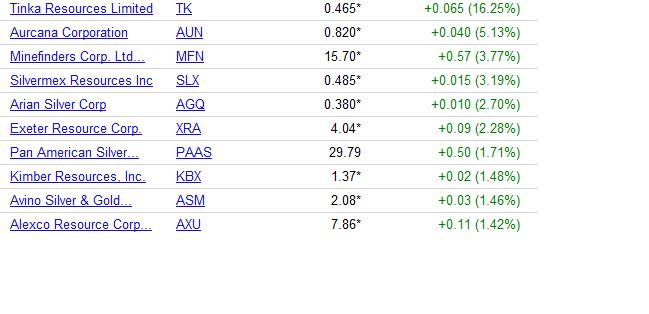
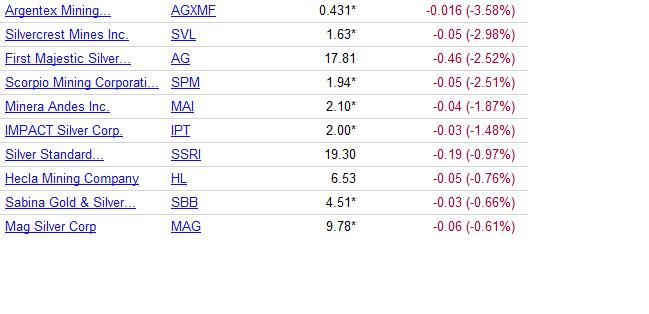
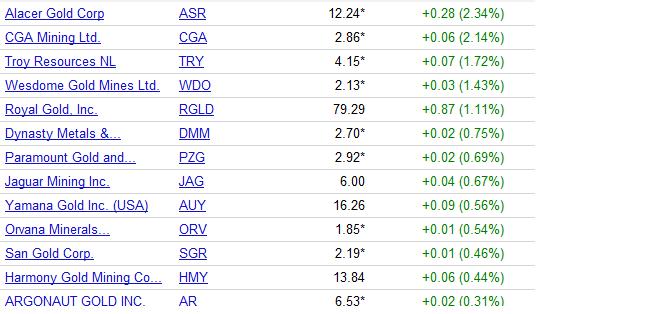
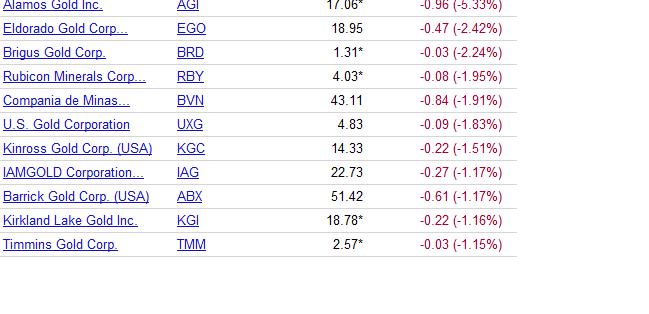
| Posted: 04 Nov 2011 02:36 PM PDT GDX declined by -0.86% while GDXJ declined by -0.95% and SIL declined by -0.44%
Here are today's best performing Silver stocks:
Here are today's worst performing Silver stocks:
Here are today's worst performing Gold stocks:
| ||||||||||||
| By the Numbers for the Week Ending November 4 Posted: 04 Nov 2011 02:05 PM PDT HOUSTON -- Just below is this week's closing table, with brief commentary this time, followed by the CFTC disaggregated commitments of traders (DCOT) recap table for the week ending October 28, 2011.
Comments: Choppy week for metals and equities markets. Uncertainty jacked up by Greece with the on-off referendum, enough to keep traders guessing and hugging the sidelines. Capital flight evident, flowing into in USD and gold in Euros. Gold slightly stronger in USD, up 3.2% in Euro, but silver cannot answer with so much troubling news. Slightly positive money flow for metals ETFs (neutral). Note the small change in price Tues/Tues for both gold and silver on COT reporting day. COMEX commercials add to net shorts in gold, but not in silver, a "tell" we think. Commercials seem to want no part of the silver short side at the moment. Mining shares tread water, but interestingly refused to sell off on the largest down day for the metals (Tuesday). USD up big, nearly two "big figures" and ICE commercial traders covered a big 12,161 lots or nearly one-third of their greenback net shorts. Gold/Silver ratio back over 50, not a bullish sign very short term. Ted spread too high for comfort, but we wonder if it will fall early next week with the Greek no-confidence vote over. Contraction in the hi-lo spreads for gold and silver suggests indecision by traders in a consolidating environment. Look for hi-lo spreads to widen measurably in the days ahead – we think. Finally, note the reduction in the Thurs/Thurs open interest for silver, which suggests short covering on the modest dip – a bullish sign.
Vultures, (Got Gold Report Subscribers) please note that updates to our linked technical charts, including our comments about the COT reports and the week's technical changes, should be completed by the usual time on Sunday (18:00 ET). In the DCOT table below a net short position shows as a negative figure in red. A net long position shows in black. In the Change column, a negative number indicates either an increase to an existing net short position or a reduction of a net long position. A black figure in the Change column indicates an increase to an existing long position or a reduction of an existing net short position. The way to think of it is that black figures in the Change column are traders getting "longer" and red figures are traders getting less long or shorter. All of the trader's positions are calculated net of spreading contracts as of the Tuesday disaggregated COT report. (DCOT Table from Friday, November 4, for data as of the close on November 1. Source CFTC for COT data, Cash Market for gold and silver. We shall devote a goodly amount of time to the COT report in this weekend's full Got Gold Report, as we believe it is attempting to show us an important "tell.") That is all for now, but there is much more to come... Edit: 23:56 to correct the DCOT table Swap Dealer position. | ||||||||||||
| The Members of European Parliament (MEP) Sideshow Posted: 04 Nov 2011 10:00 AM PDT German reporters were thrown out of the European Parliament back in 2008. The reason? They filmed politicians signing in on time sheets and then leaving. The practice enhanced Members of the European Parliament's pay to more than the German Chancellor's, while their true work rate was pitiful in comparison - and in absolute terms. Some Members of European Parliament (MEP) were so eager not to be filmed by the German TV crew they physically ran into walls trying to escape. It made for great TV. We don't really blame the politicians though. Brussels isn't a nice place to stick around in. Several years later, the Members of European Parliament are in the limelight again, expected to solve their fellow politicians' fiscal problems. Once again, they are bouncing off walls - this time figuratively, as far as we know. Alongside them are central bankers, IMFers and gaggles of other geese ruffling each other's feathers. What's odd about MEP messing in fiscal affairs like the EFSF is that the European Parliament doesn't really deal in fiscal problems on a regular basis, if at all. (Apart from appearing as an expense on the books of the various countries that is.) The IMF has a track record of ruining countries. And central bankers' low interest rates were what encouraged the politicians' spending in the first place. So do any of them have any experience? Credibility? Ability? Nah. But they are looking important. Similar Posts:
| ||||||||||||
| EFSFs, CDOs, CDSs … Or Just Gold? Posted: 04 Nov 2011 10:00 AM PDT The combination of political deadlock in Greece and the fact that the European Financial Stability Facility (EFSF) will be funded by debt and not money printing has caught investors off guard recently. They failed to discount the ability of politicians to find other options in their attempts to exhaust all other options before turning to the inevitable one. Hence the falling markets of late.
The largest risk to these forecasts is the sovereign debt and banking problems in the euro area, Louise Bowman explains at Euromoney the sort of thing these people come up with to try and solve the crisis: 'If one were tasked with designing a CDO that would be guaranteed to fail it would be hard to come up with a better structure than what the EU is proposing for the EFSF.' Now Wall Street, to the small extent that it is still capitalist, has wound down many of the ridiculous practices of the boom years. Like issuing CDOs doomed to fail. But the politicians have other ideas. They want to use those very practices to bolster their bailout fund, the EFSF, to size. It reminds us of this quote:
'The central irony of financial crisis is that while it is caused by too much confidence, too much borrowing and lending and too much spending, it can only be resolved with more confidence, more borrowing and lending, and more spending.' That's not irony. It's a number of other things we won't write. So the MEPs and their friends are off on a mission to create a bailout fund they call the EFSF. They want more confidence when there is too much. They want more borrowing and lending when debt is the problem. They want governments, on whose payroll MEPs are, to be able to continue running deficits. And they are going to achieve these noble goals using the same method that triggered the financial crisis of 2008. More of what Larry Summers calls 'irony'. There is an even more groan-worthy aspect to this. The EFSF will use credit default swaps (CDSs) to guarantee some percentage of some countries' sovereign debt. If you missed Wednesday's Daily Reckoning, CDS have been called into question, to put it lightly, by their failure to protect Greek bondholders from the 50% haircuts. In other words, they don't work. Just another 'irony' of the plan. These kinds of political and legal shenanigans simply outweigh the effects of economics on the markets in the short run. The bi-polar nature of politicians is turning markets bi-polar. Our trading analyst Murray Dawes of Slipstream Trader fame reckons it's nigh untradeable. For now. But the laws of economics always win out over CDOs, CDSs, EFSFs and the rest in the end. The last act of desperation by those who see themselves as 'in charge' of the economy will be a flood. In central banking terms, that means a flood of cash. This is probably what markets are discounting - a snazzy way of saying they include it in their forecasts. It's the reason they haven't truly crashed. Money printing inflates stock prices too. But those of you two steps ahead might notice that the debt the EFSF will issue in its attempt to resemble a doomed CDO is just the kind of debt that central banks like to buy. And are authorised to buy. The Germans, by allowing the creation of the EFSF to buy sovereign debt and by allowing the ECB to buy the debt of the EFSF, may have been skilfully outmanoeuvred in their quest to prevent true quantitative easing in Europe. If you're confused, you've got the gist of it. We'll try and overcome the confusion with a little creativity. The dialog of the past few weeks might have looked a little something like this:
(From this point on, we are speculating as to what will happen next)
PIIGS: ECB, ECB, wherefore art thou ECB? Shakespeare might not approve of the script. But reality is said to be more entertaining than fiction. So yes, we still expect more quantitative easing and high inflation to make an appearance at some stage. But the conclusion you might want to reach in this period where political uncertainty dominates the market, is to avoid complexity in your own investment decisions. Don't depend on legal definitions, especially ones that are easy to change. Give as many middle men the boot as possible. Sometimes middlemen introduce more risk than they make up for in convenience. This may come a little late for about 8000 Australian CFD users, after their broker MF Global found itself on the wrong side of the sovereign-debt trade. But the point is that the uncertainty caused by political uncertainty has a different nature - and sting to it - than the economic uncertainty that investors are more used to facing. Don't get tangled in it. These are (some of) the reasons why the Daily Reckoning likes physical gold in wealth portfolios. It has no middle man and no counterparty. It's yours if it's yours. And, short of messing with the periodic table or new developments in alchemy, governments can't do much to mess with it. Can they? More on that next week... Until next week, Nickolai Hubble.
| ||||||||||||
| Bart Chilton: “There is Manipulation in the Silver Market” Posted: 04 Nov 2011 09:32 AM PDT From KWN: Bart Chilton continues: Continue reading @ King World News | ||||||||||||
| Rogers: “There Will Be Nothing Anybody Can Do” Posted: 04 Nov 2011 09:25 AM PDT Jim Rogers on currencies, bailout, and collapse. From Reuters TV 11.4.11. | ||||||||||||
| Silver's Secrets Exposed: A Timeline Tells All Posted: 04 Nov 2011 09:24 AM PDT From Brittany Stepniak of WealthWire.com: Silver has long enjoyed its history, adored and coveted by all. Desired for it's lustrous appeal; used both for beautiful, and often ornate, jewelry and decoration but also as a safe and practical form of currency – thriving especially in times of economic woe when fiat currencies suffer. Smart entrepreneurs and investors have been capitalizing on silver's potential for years. And their patience has truly paid off; this year especially amidst the wildy volatile markets and weakening currencies plaguing the global community.
Facts About Silver
The white pegs on the map (below) of the United States represent locations of silver mines.
Globally, silver production is a key component to the wealth of many nations. See how production rates compare from country to country:
In terms of supply and demand, the most demand for silver revolves around industrial uses. With the explosion of growing industries to combat the jobs crisis, silver demand is set to soar beyond 2011…It's demand for use in photography and jewelry tails close behind. Silver's least amount of demand comes from its use as coins, medals, and silverware.
Comparatively, here's a breakdown of the silver supply:
Since the 1970s, the silver market has changed greatly. In the 70s, silver hovered around $5 per ounce. Just before the 80s, two brothers – Nelson Bunker Hunt and William Herbert Hunt – became knows as silver hoarders. "Bullion prices were rising on a mix of inflation and geopolitical tensions and silver rode high – up from just over $6 an ounce to nearly $35." By January of 1980, silver spiked over $50 an ounce making it a year to remember for silver investors. In the summer of 1982, silver fell back down to prices familiar to the 1970s. Prices rebounded to just over $8 an ounce after Mexico said they would nationalize banks. Throughout that 1990s, silver fell even lower – all the way down to $3.40 an ounce. By February of 1998, infamous investor Warren Buffet and his company purchased 130 million ounces of silver. Prices peaked at $7.40 that February. From 2004 onward, silver futures prices climbed steadily and even dramatically at times. In 2006, silver was stable at about $10 per ounce. Two years later, the commodity markets gained more mainstream attention because of the stock market crash of '08 and silver prices more than doubled. And very recently, we've seen silver dancing around the $50 range in lieu of the fiscal messes facing the U.S. and Europe. Data referenced from InsideFutures.com | ||||||||||||
| Bart Chilton - "There is Manipulation in the Silver Market" Posted: 04 Nov 2011 09:08 AM PDT  Bartman Chilton is a real hero  Bart Chilton - There is Manipulation in the Silver Market Read all about it over at KWN. http://kingworldnews.com/kingworldne...er_Market.html | ||||||||||||
| Gold’s nominal vs. ‘real’ price – updated Posted: 04 Nov 2011 08:29 AM PDT
Gold's nominal price worked off the euro hysteria excess for the most part, and its real price (vs. broad commodities) is still healthy and back up against resistance. A rising real price of gold is of course generally indicative of economic deceleration and bad market stuff. More and more the indicators are pointing to a shelf life for the great Hope & Greed rally of '11. 
| ||||||||||||
| Coin Show Report - Chattanooga, TN Posted: 04 Nov 2011 07:49 AM PDT Today, I went to the 1st day of the 3-day Tennessee State Numismatic Society Fall coin show. I got there about 5 minutes after the show opened to the public. When I got to the venue, it was packed with people and I had to find a parking space that was further away from the venue. Before I headed inside, I decided to check what spot gold and silver prices were. Spot silver at the time that I arrived that the show was $34.08/oz and spot gold at that time was $1753.40. When I got inside, I showed the front desk my postcard that I got in the mail a few weeks before the show started. They usually require photo ID to get in and I had mine ready to show but since one of the people there recognized me from past Chattanooga coin shows, I did not have to show my photo ID. When I got in the main area where the bullion was, there were lots of people looking at bullion and coins, and it was hard to move around at times. There were also a lot of dealers that I knew from past coin shows that I went to and they recognized me since I bought from them in the past. Of course my main objective for me was to find silver art bars that were very interesting to me to add to my collection. As I was searching for them, I have observed a few prices on other various gold and silver items and here is what I saw: .999 generic silver (1-oz rounds and 1-oz bars) - $35 to $37 1/10 oz Gold Eagles - $195 to $205 1-oz Gold Eagle - $1800 SAE's - $38 to $40. A 1996 SAE was selling for $60.00 Silver art bars = starting at spot (for gold plated silver art bars) to the highest price that I heard of $55.00. 1-oz 2012 Lunar Silver Dragons - $110.00. There were another table that had 2012 Lunar Dragons but I did not ask how much they were. As I mentioned, this was a crowded show and it seemed that it was more crowded than last year around this time. I saw young and old buyers. Most of the dealers from what I saw appeared to be older than me (I'm 38). They also had a 20th Anniversary SAE set but I did not see any 25th Anniversary SAE sets at the show. Of course they also had 90%, numismatic gold and silver and non-PM coins. I did see some selling but it was specific items and not necessarily bullion. Overall, even though there was plenty of silver to be had for decent premiums, I was disappointed in that they did not have many silver art bars that I was looking for. I did find a few that I liked and I paid between $36 and $45 for them. I also picked up a sports-themed silver art round for $35.00. I did ok but not great IMO and it took me several walks around the dealer tables to find what little I bought. I left the show around 2:15 PM but I came back a short while later to buy another silver art bar that I saw earlier and left shortly after I made that purchase. I did meet some other silver art bar collectors at this show and I spoke to them and they did not find many silver art bars that they were looking for. I did spend some time talking to some of the dealers that knew me. This coin show continues to tomorrow (Saturday) and the last day is Sunday. I plan to back to the show tomorrow to see if I have any more luck tomorrow on my silver art bar hunt. I do not plan to go back to the show on Sunday. | ||||||||||||
| Gold Seeker Weekly Wrap-Up: Gold and Silver End Mixed on the Week Posted: 04 Nov 2011 07:28 AM PDT Gold fell $14.65 to $1749.25 by about 11AM EST before it bounced back higher into the close, but it still ended with a loss of 0.47%. Silver dropped down to $33.793 before it also bounced back higher into the close, but it still ended with a loss of 1.13%. | ||||||||||||
| Posted: 04 Nov 2011 07:06 AM PDT 
Tonight, there are more than 20 million Americans that are living in extreme poverty. This number increases a little bit more every single day. The following statistics that were mentioned in an article in The Daily Mail should be very sobering for all of us....
Sadly, the wealthy and the poor are being increasingly segregated all over the nation. In some areas of the U.S. you would never even know that the economy was having trouble, and other areas resemble third world hellholes. In most U.S. cities today, there are the "good neighborhoods" and there are the "bad neighborhoods". According to a recent Bloomberg article, the "very poor" are increasingly being pushed into these "bad neighborhoods"....
Of course they don't have much of a choice. They can't afford to live where most of the rest of us do. Today, there are many Americans that openly look down on the poor, but that should never be the case. We should love the poor and want to see them lifted up to a better place. The truth is that with a few bad breaks any of us could end up in the ranks of the poor. Compassion is a virtue that all of us should seek to develop. Not only that, but the less poor people and the less unemployed people we have, the better it is for our economy. When as many people as possible in a nation are working and doing something economically productive, that maximizes the level of true wealth that a nation is creating. But today we are losing out on a massive amount of wealth. We have tens of millions of people that are sitting at home on their couches. Instead of creating something of economic value, the rest of us have to support them financially. That is not what any of us should want. It is absolutely imperative that we get as many Americans back to work as possible. The more people that are doing something economically productive, the more wealth there will be for all of us. That is why it is so alarming that the ranks of the "very poor" are increasing so dramatically. When the number of poor people goes up, the entire society suffers. So just how bad are things right now? The following are 19 statistics about the poor that will absolutely astound you.... #1 According to the U.S. Census Bureau, the percentage of "very poor" rose in 300 out of the 360 largest metropolitan areas during 2010. #2 Last year, 2.6 million more Americans descended into poverty. That was the largest increase that we have seen since the U.S. government began keeping statistics on this back in 1959. #3 It isn't just the ranks of the "very poor" that are rising. The number of those just considered to be "poor" is rapidly increasing as well. Back in the year 2000, 11.3% of all Americans were living in poverty. Today, 15.1% of all Americans are living in poverty. #4 The poverty rate for children living in the United States increased to 22% in 2010. #5 There are 314 counties in the United States where at least 30% of the children are facing food insecurity. #6 In Washington D.C., the "child food insecurity rate" is 32.3%. #7 More than 20 million U.S. children rely on school meal programs to keep from going hungry. #8 One out of every six elderly Americans now lives below the federal poverty line. #9 Today, there are over 45 million Americans on food stamps. #10 According to the Wall Street Journal, nearly 15 percent of all Americans are now on food stamps. #11 In 2010, 42 percent of all single mothers in the United States were on food stamps. #12 The number of Americans on food stamps has increased 74% since 2007. #13 We are told that the economy is recovering, but the number of Americans on food stamps has grown by another 8 percent over the past year. #14 Right now, one out of every four American children is on food stamps. #15 It is being projected that approximately 50 percent of all U.S. children will be on food stamps at some point in their lives before they reach the age of 18. #16 More than 50 million Americans are now on Medicaid. Back in 1965, only one out of every 50 Americans was on Medicaid. Today, approximately one out of every 6 Americans is on Medicaid. #17 One out of every six Americans is now enrolled in at least one government anti-poverty program. #18 The number of Americans that are going to food pantries and soup kitchens has increased by 46% since 2006. #19 It is estimated that up to half a million children may currently be homeless in the United States. Sadly, we don't hear much about this on the nightly news, do we? This is because the mainstream media is very tightly controlled. I came across a beautiful illustration of this recently. If you do not believe that the news in America is scripted, just watch this video starting at the 1:15 mark. Conan O'Brien does a beautiful job of demonstrating how news anchors all over the United States are often repeating the exact same words. So don't rely on the mainstream media to tell you everything. In this day and age, it is absolutely imperative that we all think for ourselves. It is also absolutely imperative that we have compassion on our brothers and sisters. Winter is coming up, and if you see someone that does not have a coat, don't be afraid to offer to give them one. All over the United States (and all around the world), there are orphans that are desperately hurting. As you celebrate the good things that you have during this time of the year, don't forget to remember them. We should not expect that "the government" will take care of everyone that is hurting. The reality is that millions of people fall through the "safety net". Being generous and being compassionate are qualities that all of us should have. Yes, times are going to get harder and an economic collapse is coming. That just means that we should be more generous and more compassionate than we have ever been before. | ||||||||||||
| COT Silver Report - November 4, 2011 Posted: 04 Nov 2011 06:33 AM PDT COT Silver Report - November 4, 2011 | ||||||||||||
| Italy: One Step Closer to the Endgame Posted: 04 Nov 2011 06:17 AM PDT Bullion Vault | ||||||||||||
| Most gold stock analysts are out to lunch, Hathaway tells King World News Posted: 04 Nov 2011 05:31 AM PDT |





| You are subscribed to email updates from Gold World News Flash 2 To stop receiving these emails, you may unsubscribe now. | Email delivery powered by Google |
| Google Inc., 20 West Kinzie, Chicago IL USA 60610 | |

No comments:
Post a Comment