


saveyourassetsfirst3 |

- By the Numbers for the Week Ending October 28
- Peter Grandich: Confessions of a Wall Street Whiz Kid
- James Turk: “The Value Is In The Metal Itself”
- Already troubles brewing with new European "Deal"/gold steady/ silver rise
- Why Sound Money is a Basic Human Right: Alasdair Macleod
- European bailout inadequacy, seasonality to support metals, Davies tells Eric King
- Royal Canadian Mint offers its own convertible gold ETF
- James Turk reviews Jim Rickards' 'Currency Wars'
- Back To Capitalism
- Gold: India’s Capital Asset through History
- Today’s Winners and Losers
- The Natural Chaos of Markets
- Will Precious Metals Go Up Along with the General Stock Market?
- Recapping Recent Events
- Searching for Gold and Silver mines in US
- coin show on-site grading? advice needed
- SONG: Gold Price Song
- WATCH: Confessions of a Gold Scammer
- It’s Bank Bashing Season – Yeeehaaaw
- Be Honest – The European Debt Deal Was Really A Greek Debt Default
- Ten weird candy facts for Halloween
- What are you staring at Dennis?
- Gold Seeker Weekly Wrap-Up: Gold and Silver Gain About 7% and 13% on the Week
- CMC Metals Reports Grades on 10% of its Bulk Sample
- Gold set to crash to $1000/oz in 3 years on potential surplus
- Argonaut Gold Interview 10-28
- Sean Brodrick 10-27
- Costless, Limitless, Meaningless Money, Part I
| By the Numbers for the Week Ending October 28 Posted: 29 Oct 2011 03:25 AM PDT NEW ORLEANS -- Just below is this week's closing table, followed by the CFTC disaggregated commitments of traders (DCOT) recap table for the week ending October 28, 2011.
Vultures, (Got Gold Report Subscribers) please note that updates to our linked technical charts, including our comments about the COT reports and the week's technical changes, should be completed sometime on Monday, October 31. In the DCOT table below a net short position shows as a negative figure in red. A net long position shows in black. In the Change column, a negative number indicates either an increase to an existing net short position or a reduction of a net long position. A black figure in the Change column indicates an increase to an existing long position or a reduction of an existing net short position. The way to think of it is that black figures in the Change column are traders getting "longer" and red figures are traders getting less long or shorter. All of the trader's positions are calculated net of spreading contracts as of the Tuesday disaggregated COT report.
|
| Peter Grandich: Confessions of a Wall Street Whiz Kid Posted: 29 Oct 2011 02:59 AM PDT
From New Jersey, Peter Grandich discusses his new book, Confessions of a Wall Street Whiz Kid. More @ KEReport
|
| James Turk: “The Value Is In The Metal Itself” Posted: 29 Oct 2011 02:49 AM PDT
From Spain, James Turk opines on gold, silver and the reality of the situation in Europe. 10.29.11 More @ KEReport
|
| Already troubles brewing with new European "Deal"/gold steady/ silver rise Posted: 29 Oct 2011 02:34 AM PDT This posting includes an audio/video/photo media file: Download Now |
| Why Sound Money is a Basic Human Right: Alasdair Macleod Posted: 29 Oct 2011 12:47 AM PDT ¤ Yesterday in Gold and SilverIt was a very quiet trading day in the gold world yesterday. The price traded within ten dollars of its Thursday close. The gold price finished down $2.30 on the day...closing at $1,743.40 spot. Net volume reflected the price action, as only 99,000 contracts or so contracts changed hands.
The silver price action was a little more exciting...but only just. The price made at least three attempts to break through the $35.50 price level, but got sold off every time. The price closed at $35.29 spot, which was up 20 cents on the day. Net volume was around 31,000 contracts.
Despite the subdued price action in gold, plus the flat close to the U.S. equity markets, the gold stocks spent virtually the entire day in positive territory...with the HUI finishing very close to its high of the day...up 2.55%.
For the week, the gold price was up $101...and the HUI jumped 12.6%...which takes it back into slightly positive territory for the year overall. The silver stocks had a decent day as well...and Nick Laird's Silver Sentiment Index closed up 1.88% on the day. Nick said that the index closed up 16.1% on the week.
(Click on image to enlarge) The CME's last Daily Delivery Report for October showed that only 8 gold and zero silver contracts were posted for delivery on Monday. First Day Notice for Tuesday, November 1st wasn't very exciting either, as November is not much of a delivery month for either gold or silver. Only 227 gold, along with 32 silver contracts were posted for delivery on that day...and the link to the action is here. There were no reported changes in GLD yesterday, but the SLV ETF reported a deposit of 924,502 ounces of silver. The U.S. Mint had a very small sales report...3,500 ounces of gold eagles and nothing else. There was a small amount of activity over at the Comex-approved depositories on Thursday. 10,024 ounces of silver were received...and 98,313 troy ounces were shipped out. I wasn't enamoured with yesterday's Commitment of Traders Report. In silver, the Commercial net short position rose by 4,742 contracts. About 1,700 contracts of that was the small commercial traders [Ted Butler's raptors] selling their long positions for a profit. That was no surprise, as this was expected as the price rose. What Ted wasn't happy about [and rightly so] was the fact that the '4 or less' Commercial traders went short the other 3,000 contracts. Was it JPMorgan...or a new Commercial [bullion bank] short seller? Don't know...and I know that Ted will have more to say about it in his weekend review coming out later today. In gold, the Commercial net short position deteriorated by 13,703 contracts. Once again it was mostly the raptors taking profits...and the new short positions were placed by the '5 through 8' Commercial traders. Ted said that the deterioration in gold looked "pretty normal"...if there is such a thing. This is not a trend I wanted to see and, without a doubt, there's been further deterioration in the Commercial net short positions in both metals since the Tuesday cut-off, as we've had some pretty serious rallies in both since then. So, it looks like the same old situation, with the bullion banks going short against all the new longs coming into the market. However I'll reserve final judgment until I see next Friday's COT report, but at the moment, it ain't lookin' good. Having said all that, there are still miles to go to the upside before we get into a monstrously overbought position...and I would expect that a major rally in both metals is still in the cards before the end of the year. By the look of it, it's already started. Here's a chart from the FDIC that Washington state reader S.A. sent me yesterday...and it requires no further comment from me.
Here's another nifty chart that Nick Laird sent me in the wee hours of this morning. It shows how everything performed in the world during the last week. Silver came in a close second.
(Click on image to enlarge) As usual, I'm emptying my in-box into today's column. There's not really that many stories, so I have hope you have time over the weekend to peruse them all. If this world-wide banking crisis doesn't make you run screaming to your favourite bullion dealer, I don't know what will. Royal Canadian Mint offers its own convertible gold ETF. James Turk reviews Jim Rickards' 'Currency Wars'. Silver was the second best performing 'commodity' this past week. ¤ Critical ReadsSubscribeAnother Weapon for OWS: Pull Your Money Out of BofAMy good friend Nomi Prins has a great new piece out that I just caught on Zero Hedge, chronicling 10 reasons why depositors should pull out of Bank of America. Obviously Goldman, Sachs has become the great symbol of investment banking corruption, and other companies like AIG and Countrywide have become poster children for problems with businesses like insurance and mortgage-lending. But when it comes to commercial banking, Bank of America is as bad as it gets. The markets, of course, have lately come to agree, as B of A has lately been downgraded again to just above junk status. The only reason the bank is not rated even lower than that is that it is Too Big To Fail. The whole world knows that if Bank of America implodes – whether because of the vast number of fraud suits it faces for mortgage securitization practices, or because of the time bomb of toxic assets on its balance sheets – the U.S. government will probably step in to one degree or another and save it. This relatively short Matt Taibbi blog posted over at Rolling Stone magazine late yesterday morning, is Roy Stephens first offering of the day. It's well worth your time...and the link is here.  Bank of America, Chris Whalen...and King World NewsHere's a really incredible interview that Eric sent me at 3:14 a.m. Eastern time this morning, just as I was about to hit the send button on this column. I stuck it here, as it fits perfectly with the Matt Taibbi piece above. It's an absolute must listen...and the link is here.  William K. Black...OWS...and Arresting the BankstersBill says that the current crisis is about seventy times larger than the S&L debacle, yet nobody has gone to jail over it. This 3:54 minute must watch youtube.com video was sent to me by reader Doug Beiers yesterday...and the link is here.  Credit Rating Firms Favor Those Who Pay MostHere's a short 2-minute Bloomberg video clip that's well worth your time. Credit-rating companies award higher rankings to debt issued by banks and corporations that pay them the most, according to a study by scholars at Indiana University, American University and Rice University. Why am I not surprised? I thank Washington state reader S.A. for sending this along...and the link is here.  Goldman Hit With $1.1B Lawsuit Over CDOGoldman Sachs Group Inc has been hit with a new $1.07 billion lawsuit for having allegedly sold risky debt that it expected would tumble in value to an Australian hedge fund, causing that fund to become insolvent. The lawsuit by the Basis Yield Alpha Fund alleges fraud, breach of contract and negligence, and seeks to recoup $67 million of losses plus $1 billion of punitive damages. It was filed Thursday with a New York state court in Manhattan. Basis Yield was managed by Sydney-based Basis Capital Funds Management Ltd. This is Washington state reader S.A.'s second offering in a row. It's a story posted over at the foxbusiness.com website...and the link is here.  A Letter from Goldman Sachs: Concerning Occupy Wall StreetThe following is a letter released on October 17th by Lloyd Blankfein, the chairman of banking giant Goldman Sachs: Dear Investor: Up until now, Goldman Sachs has been silent on the subject of the protest movement known as Occupy Wall Street. That does not mean, however, that it has not been very much on our minds. As thousands have gathered in Lower Manhattan, passionately expressing their deep discontent with the status quo, we have taken note of these protests. And we have asked ourselves this question: How can we make money off them? The answer is the newly launched Goldman Sachs Global Rage Fund, whose investment objective is to monetize the Occupy Wall Street protests as they spread around the world. At Goldman, we recognize that the capitalist system as we know it is circling the drain – but there's plenty of money to be made on the way down. I thank reader Nick Vrionis for sharing this touching human interest story with us. It's posted over at the borowitzreport.com website...and the link is here.  NY Fed's $40 Billion Iraqi Money TrailIt has been called the largest airborne transfer of currency in the history of the world. But finding out what happened to all the money involved has become one of the biggest financial mysteries of all time. Beginning in the very earliest days of the war in Iraq, the New York Federal Reserve shipped billions of dollars in physical cash to Baghdad to pay for the reopening of the government and restoration of basic services. The money was packed onto pallets inside a heavily guarded New York Federal Reserve compound in East Rutherford, New Jersey, trucked to Andrews Air Force Base outside of Washington, and flown by military aircraft to Baghdad International Airport. This 3-page essay posted over at the cnbc.com website on Tuesday, is your first big read of the day...and it's an incredible story. I thank West Virginia reader Elliot Simon for sharing it with us...and the link is here.  |
| European bailout inadequacy, seasonality to support metals, Davies tells Eric King Posted: 29 Oct 2011 12:47 AM PDT  Hinde Capital CEO Ben Davies told King World News yesterday that gold and silver will be strongly supported by the inadequacy of the latest European bailout plan and by seasonal strength in metal demand. An excerpt from the interview is posted at the KWN website...and the link is here. The chart included in the blog makes it worth the trip all by itself. |
| Royal Canadian Mint offers its own convertible gold ETF Posted: 29 Oct 2011 12:47 AM PDT  The Royal Canadian Mint is pleased to announce its initial public offering of exchange-traded receipts (ETRs) under the mint's new Canadian Gold Reserves program. Each ETR provides evidence of ownership in physical gold bullion held in the custody of the mint at its facilities in Ottawa, Ontario. The Canadian Gold Reserves program marks the expansion of the mint's successful core bullion and refinery business. |
| James Turk reviews Jim Rickards' 'Currency Wars' Posted: 29 Oct 2011 12:47 AM PDT  Here's another story that only fits on a weekend. Fortunately, this one was posted yesterday on the GATA website...and, as I am wont to do at times, I've stolen Chris Powell's preamble. As you know, I have all the time in the world for whatever Jim Rickards has to say...and from what I've read of Turk's book review, it should be a best seller. The review is posted over that Free Gold Money Report Internet site...and the link is here. |
| Posted: 28 Oct 2011 09:32 PM PDT John Rubino speculates on a world without Goldman Sachs and other TBTF financial institutions: If Goldman Sachs, JP Morgan Chase, Deutsche Bank, Crédit Lyonnais and five or six of their peers ceased to exist tonight, what would happen? Would their absence change the number of factories, hospitals, farms, biotech research labs, oil wells, or gold [...] |
| Gold: India’s Capital Asset through History Posted: 28 Oct 2011 08:58 PM PDT Mises.org |
| Posted: 28 Oct 2011 06:43 PM PDT
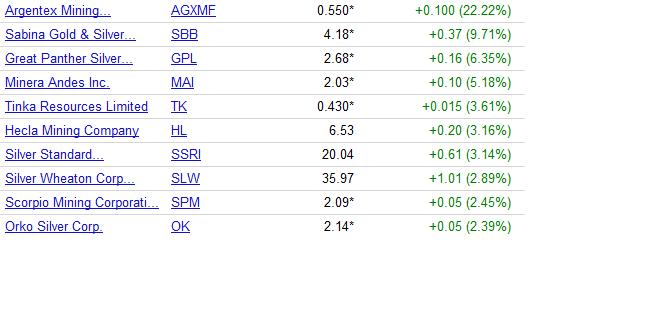
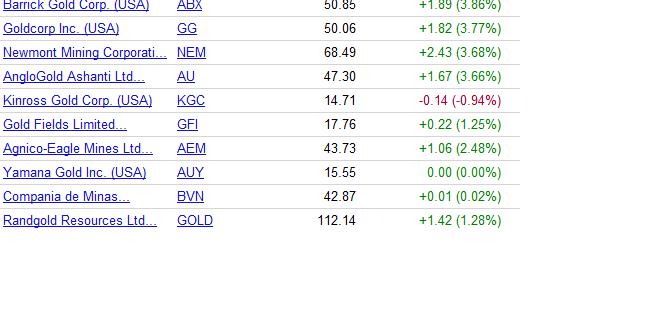
GDX gained by 2.32% while GDXJ declined by -0.09% and SIL declined by 1.71%
Here are today's best performing Silver stocks:
Here are today's best performing Gold stocks:
|
| Posted: 28 Oct 2011 05:22 PM PDT By Sell on News, a global macro equities analyst. Cross posted from MacroBusiness Having just watched the second episode of All Watched Over By Machines of Loving Grace by my favourite documentary maker Adam Curtis, in which he tells the "story of how our modern scientific idea of nature, as a self-regulating ecosystem, is actually a machine fantasy", I am once again struck by what an absurd body of ideas, or more accurately, self delusions, much of modern economic prejudice-masquerading-as-theory is. Curtis, in this episode, shows that the idea that there was a balance of nature was always flimsy, never supported by the empirical evidence, and based on extreme, self proving over simplifications. Ecological thought is about on the same level as economic thought, it seems. Nature is not in balance at all. Consequently all those ideas about self correcting systems — you know, Adam Smith's so called invisible hand — also turn out to be a fantasy. The neo-liberal assumption that markets are like an ecology, a natural system that will self correct provided it is left alone, is also looking rocky. If, indeed, markets are natural systems — and they are not, they are created systems — then they will not self correct. The vegetative metaphor is extremely unpersuasive. Curtis does not explore the implications for economics, his interest lies more in how we have given up the power to act because we have allowed machine driven systems to take us over. But what he traces is extremely damaging for General Equilibrium theory, a central plank of much economic "theory" and the basis of micro-economics. General Equilibrium theory basically borrows the vegetative metaphor, that there is a "balance of nature" and applies it to markets. This was always a nonsense move, because markets are not natural, they are artificial. As Curtis shows, it is double nonsense, because even if the metaphor holds, it leads to the opposite conclusion. That markets will probably not incline towards equilibrium at all. Quelle surprise. In one sense, the assumption that there will eventually move towards equilibrium is typical of the kind of circular arguments of which economists are so fond. Balance is implied in the transactional structures. Balance sheets have to, well, balance; assets must match liabilities. Prices must reflect some sort of balance between supply and demand. That is what a price is. Debts must be repaid from income. And so on. In the artificial rules of finance, equilibrium is implicit. But of course that is not what happens, especially when you allow markets to be "free", and especially when you allow financial markets to be "free" to make up their own rules. They are not self organising systems that incline towards balance. They become out of control exercises in chaos that move towards anything but equilibrium. I cite the GFC, the Great Depression, the Latin American debt crisis, Japan's asset bubble, the Asian financial crisis and ever so much more, even back to Tulipmania. Accordingly, what needs to happen, in financial markets in particular, is that equilibrium is ENFORCED, and continually at that. I recognise that such enforcement is difficult in today's global markets, but the idea that if things are left free, the system will self correct — which was Alan Greenspan's now exploded assumption — is just plain wrong. It is a system of rules. When traders are left to make up their own rules, the system of rules will be weakened and may collapse. Ergo, continually enforce the rules to ensure that the necessary balances are maintained. Curtis goes on to show how the vegetative metaphor was used to justify the networking of machines, especially the internet and social media. That is exactly the type of shift that has occurred in finance, with machines being used increasingly to unleash the forces of financial "freedom" (derivatives, algorithmic trading, the mechanisation of risk models, etc.) that is supposed to lead to a self correcting system but which actually leads to its exact opposite. It must, quite frankly, be stopped before it does more harm to our system of money. Not that I see much hope of that happening. It is always fascinating how bad ideas become so poular. No-one is better than Curtis at showing how it happens, although he does not really explain why it happens. Perhaps it is simply mysterious. Perhaps it is what Chesterton meant when he said that when people give up older beliefs they do not then believe in nothing, they believe in anything. Perhaps it is just that metaphors are powerful, we must have them, and we have become susceptible to very bad ones. I don't know. What I do know is that it is about time to jettison the assumption that markets, left free, will be self correcting and incline towards equilbrium. The opposite is the case. And human beings need to be put at the centre of human systems, not pushed to the side as just components in a "system" (how that is happening now is beautifully documented by Curtis). That, in turn, means putting the consideration of morality (an equilibrium that actually makes some sense) back into the consideration of economics. Tomas Sedlacek's book, The Economics of Good and Evil: The Quest for Economic Meaning from Gilgamesh to Wall Street, might be a good place to start to reconstruct the entire discipline from the ground up. This is what he had to say in a recent interview:
|
| Will Precious Metals Go Up Along with the General Stock Market? Posted: 28 Oct 2011 04:09 PM PDT
Based on the October 28th, 2011 Premium Update. Visit our archives for more gold & silver analysis. The yellow metal, money for more than three millennia, has a close relationship to other forms of money. Some argue that it isn't gold that has risen in value in the last decade, as much that fiat currencies have lost value against gold. Ever since gold began its spectacular rise a decade ago, the U.S. dollar has lost over 80% of its purchasing power. The other currencies have not fared much better. The euro and the Japanese yen have lost over 70%. Gold is the only form of money that governments cannot create out of thin air which is why the supply of fiat currencies is expanding exponentially faster than gold supplies, which increase by about only 3% per year.
We like to pay close attention to currencies and to the multi-front currency war because of the effect on gold. In the "currency war," neutrality does not pay as Switzerland discovered when it recently had to set a floor rate at 1.20 franc per euro by selling francs. The Swiss currency had gained because it was considered a safe haven. Now that the luster of the franc has dimmed somewhat, gold is more attractive than ever as a choice for wealth preservation.
The latest battle in this currency war is heating up between the U.S. and China and a trade war between the two most important economies in the world is certainly a cause for worry. For much of the past two years China has been under pressure from the US to allow the yuan to appreciate. For its part, China has accused the U.S. of lowering the value of the dollar by printing so much of it. Others suggest that both China and the US are "winning" the currency war by holding down their currencies while pushing up the value of the Euro, Yen and currencies of some emerging economies. To see if you might win in the precious market in the following days, let's move on to the technical part of the essay, namely to the analysis of the long-term US Treasury interest rates chart (charts courtesy by http://stockcharts.com.) We start with the 30-year US Treasury long-term interest rates chart (if you're reading this essay on SunhineProfits.com, you can click the above chart to enlarge it) since it is instrumental in putting everything which follows into proper perspective. We have been including this chart pretty regularly in recent weeks since it is truly influencing most, if not all of the markets that we cover on a regular basis. There was only a minimal change in rates this week but the rate-of-change (ROC) Indicator did move higher because rates held their previous gains and makes our current situation more closely resemble what was seen in 2008. This was the only time where long-term rates declined as severely and then bounced sharply. The precious metals markets started a long-term rally soon thereafter. It is possible that we will see this once again (note that no market moves in a straight way either up or down).
Having said that, let's move on to the general stock market. In the long-term S&P 500 Index chart, we see that the 50% Fibonacci retracement level recently provided support and stocks have moved higher since reaching this level. A very strong resistance line based on 2007 and 2011 tops will be in play very soon however. This will likely cause at least a pause in the current rally and the present upside target level for the S&P 500 Index is between 1330 and 1340. In the short-term SPY ETF, the recent price action has been very bullish. After declining, prices moved back up quickly on significant volume suggesting that there is buying power out there. It appears likely that higher prices will be seen in the near term and then a strong (combined with the long-term one) resistance line will come into play. If Thursday's performance is duplicated Friday or Monday, the target level will likely be reached and a local top will likely be seen. The general trend however is still to the upside partly influenced by the long-term interest rate situation. In the Broker Dealer Index (proxy for the financial sector) chart, strong price action was seen on Thursday, but the index is not above its declining resistance line yet. The trend of the rebound suggests higher index levels are likely but there is an important resistance line slightly above current levels. A pause in the rally and period of consolidation are therefore likely to be seen soon. A subsequent move to the upside would then be possible. Now, let's take a look at the correlations across the PM market. In this week's Correlation Matrix , we see rather mild signals. The short-term, 30-day column values are quite weak at this time as no relationship is apparent. The 10-day column however shows more of a tendency which suggests that the general stock market is more likely to confirm the bullish scenario for metals in the immediate term. This is in line with our recent essays. For instance, in our latest essay (21st October, 2011) on the possible rally in gold we wrote: We are inclined to think that we're relatively close to an upswing in gold. The point here is if a decline is seen before the upswing, it could simply be the formation of a double bottom with the rally yet to come. So a short move down did not invalidate any rally this week since the rally had not yet begun. We have simply seen a rebound after an initial bottom with a second bottom now being formed. As long as the two support levels in the $1,600 range hold, the outlook remains bullish. What happened with gold afterwards largely confirmed what we had written. As of now, we are still inclined to think that in the very-short term a move up in gold is more possible than not. This obviously doesn't alter our long-term bullish outlook in any way. Summing up, the analysis of long-term interest rates and of the general stock market suggests possible higher prices across the PM sector in the immediate (!) term. To make sure that you are notified once the new features are implemented, and get immediate access to my free thoughts on the market, including information not available publicly, we urge you to sign up for our free e-mail list. Gold & Silver Investors should definitely join us today and additionally get free, 7-day access to the Premium Sections on our website, including valuable tools and unique charts. It's free and you may unsubscribe at any time. Thank you for reading. Have a great and profitable week! P. Radomski * * * * * Interested in increasing your profits in the PM sector? Want to know which stocks to buy? Would you like to improve your risk/reward ratio? Sunshine Profits provides professional support for Gold & Silver Investors and Traders. Apart from weekly Premium Updates and quick Market Alerts, members of the Sunshine Profits' Premium Service gain access to Gold Charts, Gold Investment Tools and Analysis of Gold & Silver Prices Naturally, you may browse the sample version and easily sign-up for a free weekly trial to see if the Premium Service meets your expectations. All essays, research and information found above represent analyses and opinions of Mr. Radomski and Sunshine Profits' associates only. As such, it may prove wrong and be a subject to change without notice. Opinions and analyses were based on data available to authors of respective essays at the time of writing. Although the information provided above is based on careful research and sources that are believed to be accurate, Mr. Radomski and his associates do not guarantee the accuracy or thoroughness of the data or information reported. The opinions published above belong to Mr. Radomski or respective associates and are neither an offer nor a recommendation to purchase or sell securities. Mr. Radomski is not a Registered Securities Advisor. Mr. Radomski does not recommend services, products, business or investment in any company mentioned in any of his essays or reports. Materials published above have been prepared for your private use and their sole purpose is to educate readers about various investments. By reading Mr. Radomski's essays or reports you fully agree that he will not be held responsible or liable for any decisions you make regarding any information provided in these essays or reports. Investing, trading and speculation in any financial markets may involve high risk of loss. We strongly advise that you consult a certified investment advisor and we encourage you to do your own research before making any investment decision. Mr. Radomski, Sunshine Profits' employees and affiliates as well as members of their families may have a short or long position in any securities, including those mentioned in any of the reports or essays, and may make additional purchases and/or sales of those securities without notice.
|
| Posted: 28 Oct 2011 02:31 PM PDT By Calafia Beach Pundit: Yesterday was a big day, even though the Europeans didn't do much to solve their underlying problem, which is governments that have grown too big and taken on more debt than they can service. Debt write downs and bank recapitalizations such as were announced yesterday help address the threat of bank defaults, and that in turn reduces the threat of systemic failure and an economic collapse. But they don't solve the problem. Eventually, Greece must either throttle back its government, or abandon the euro and return to the drachma, which would then mean a sizable devaluation and a significant decline in living standards for all Greeks. Either the public sector bites the bullet, or everyone does, because the market will no longer willingly lend government the money to continue its profligate ways. (The ECB may do so, of course, and the German taxpayers may also help, but that's only a Complete Story » |
| Searching for Gold and Silver mines in US Posted: 28 Oct 2011 01:32 PM PDT OK, don't laugh. So would anyone know where would one start if you were interested in finding out what/where the geological areas of the US might have dormant Gold or Silver mines that are needing to be rediscovered? I'm specifically interested in the NC, SC, TN, VA, WV areas. I'm askin because it is my understanding that some of these original US mines were located there. I'm thinking that I might want to go prospecting...... Just asking, RK |
| coin show on-site grading? advice needed Posted: 28 Oct 2011 12:31 PM PDT i'm planning on going to money show of the southwest (houston) in december. do grading services offer on-site grading at coin shows? i have a mexican coin i would like graded......wondering what my odds are of getting it done anyone done this? how long does it take? i've googled some - seems that ngc does some US coins at select shows. don't know about pcgs or the other graders thanks for any help/advice |
| Posted: 28 Oct 2011 10:26 AM PDT This is the story of the price of gold ~DF |
| WATCH: Confessions of a Gold Scammer Posted: 28 Oct 2011 10:24 AM PDT A story of Jamie Campany and Global Bullion Exchange from ABC Morning 10.28.11. |
| It’s Bank Bashing Season – Yeeehaaaw Posted: 28 Oct 2011 10:15 AM PDT Europe's political system of bread and circuses is making up for the lack of bread with more circuses. Guess who is in charge of the EU's meeting of finance ministers? The Polish Finance Minister, who recently predicted war in Europe within 10 years! And in Germany the media is up in arms because Germany's gold reserves may be used as collateral for the bonds that will finance the bailout fund. Best of all, the politicians are trying to force the banks to write down sovereign debt and increase capital - at the same time. This is like entering a one-legged man in a butt kicking contest so he doesn't feel left out. But there is plenty happening closer to home too. While the Europeans are trying to save their banks, Australians are having a whinge. It's bank earnings season in the land down under. Which means it's bank bashing season too. For the next few weeks you will get to hear journalist after journalist rattle off their thoughts about the gadzillion dollar profits three of the big four pillars of the Aussie banking system will report. What fun. Our favourite piece out so far on the gouging bankers is the ironically titled 'Last Word' column on the back of last weekend's Australian Financial Review. 'Last Laugh' would be a better title. The article is a wonderful mish mash of contradictions, ignorance and completely missing the point. For example, the writer could have written about the inherent fraud of fractional reserve banking, which allows banks to loan more money than they hold in deposits. Or about the ridiculous advantage banks have in being backstopped by the central bank, the government with bailouts and the government again with deposit guarantees and a third time with mortgage-backed security purchases. (Yes, your government is buying the same stuff that blew up in the US.) Perhaps the writer might have mentioned that NAB is seeking the right to evict renters from foreclosed properties without notice. But no. The writer takes the bank to task on a bunch of things that are completely nonsensical. Take this amusing statement:
'The shock jocks have never understood that banks protected from takeover, and licensed to operate in an economic environment in which the tax system heavily favours mortgages over other forms of investment, will consistently spit out return on equity of 10 to 20 per cent unless there is government intervention.' What? Protected from takeover, licensed to operate, tax system heavily favours mortgages - these are examples of government intervention, not the absence of it! And, apart from the licensing, these are not reasons why the banks manage a certain return on equity. Competition always reduces returns to the point where they reflect risk. If banking is so safe and favoured, it should get lower returns, as there are fewer risks. Another reason bank bashing is popular, according to the writer, is that the banks have not assured the public they will be passing on any interest rate cuts from the Reserve Bank. But why haven't they? The writer provides the answer: 'It is now illegal to give guidance on rates as it is regarded as price signalling.' Huh? Banks can't announce interest rate changes in advance? And then people get grumpy at them when they don't. Strangest of all in all this bank bashing is that banks pay out so much of their earnings in dividends. That means they return it to the shareholders. They don't keep it for themselves. The idea of a company wanting money for the sake of keeping it for the company is inherently ludicrous, but don't tell the Occupy Wall Street protesters in Sydney and Melbourne or they might stop protesting. The real issue with the banks is that they represent time bombs, which bankers are paid to sit on top of. Philosopher and options trader Nassim Taleb does a great job of explaining this point. If banks need bailouts every couple of years, then we should consider the banks utilities. And pay bankers as such. Allowing them to rake in commissions when times are good and rely on bailouts when things go wrong is not a feasible business model. Unless you own politicians, that is. What we have here is the typical example of government intervention worsening the problems it is trying to address. The more intervention, regulation and safety measures the government creates, the bigger the crisis when it comes. ROE v WACC But why do banks need bailouts every couple of years? Why are bankers sitting on time bombs? The answer lies deep in the murky world of corporate finance and bank financial management. Return on Equity (ROE) is how much a company makes relative to how much was invested in it. According to the banks, their ROE sits somewhere in the middle of the pack for the top 50 Aussie companies. It's the Weighted Average Cost of Capital (WACC) that makes you realise how fragile banking is. It is the figure that tells you how much it 'costs' a bank to obtain funds. There are two ways to obtain those funds - debt and equity. The WACC averages out the costs of the two based on how much debt and how much equity a bank, or company, uses to fund itself. The cost of debt is obvious - it's the interest rate. The cost of equity is a theoretical concept, making the WACC difficult to calculate. But here is the point. If the ROE is more than the WACC, the bank is doing fine. Its investments are returning more than it cost to finance them. If the WACC is greater than the ROE, the cost of funding is greater than the bank's return, which indicates the bank is in trouble. What makes banking so dangerous is that it treads a fine line when it comes to ROE v WACC in all sorts of ways. Banks' returns aren't much greater than their cost of funds. It's just that a lot of funds are involved, so the profits seem large. But a small move in ROE or WACC can mean a big change in profits. Because the banks' business is debt - and they rely on debt to fund the debt they lend - debt flows are crucial to them. It affects both their costs and their revenues. If the debt flow is interrupted - a liquidity crisis - banks cannot finance their activity. And their profits vanish at the same time, because there is less lending taking place. Worst of all, the value of their debt must often be revised down, so the balance sheet is in trouble too. The demand for debt in the absence of willing suppliers sends the cost of debt soaring in these circumstances. That in turn sends the WACC soaring for banks. You could say they get WACCed. Worse still is the 'maturity mismatch'. The banks' business model is to borrow short and lend long. That's another way of saying they borrow money regularly for short amounts of time and lend money to people for longer periods. Because long-term interest rates tend to be higher, the banks make a profit on the difference. But when there is a liquidity crisis, it's the reliance on short-term financing that trips banks up. They cannot pay their regularly maturing debts with more short-term debt, as there isn't any available. It only takes a few days of liquidity crisis before the banks are in deep trouble, whereas companies that borrowed for long periods can delay their borrowing much more easily. So, basically, when things go wrong for banks, everything goes wrong at the same time. No wonder bankers want bonuses. When their bank gets WACCed, they could be out of a job at almost no notice. But while things are still plain sailing in the Aussie economy, why worry? Big banks to bring home $17.5bn bacon Rip and reap, baby! Before it's too late... Nickolai Hubble.
|
| Be Honest – The European Debt Deal Was Really A Greek Debt Default Posted: 28 Oct 2011 09:31 AM PDT 
The big message that Europe is sending to investors is that when individual nations get into debt trouble they will be allowed to default and investors will be forced to take huge haircuts. As this reality starts to dawn on investors, they are going to start demanding much higher returns on European bonds. In fact, we are already starting to see this happen. The yield on two year Spanish bonds increased by more than 6 percent today. The yield on two year Italian bonds increased by more than 7 percent today. So what are nations such as Italy, Spain, Portugal and Ireland going to do when it costs them much more to borrow money? The finances of those nations could go from bad to worse very, very quickly. When that happens, who will be the next to come asking for a haircut? After all, if Greece was able to get a 50% haircut out of private investors, then why shouldn't Italy or Spain or Portugal ask for one as well? According to Reuters, German Chancellor Angela Merkel is already trying to warn other members of the EU not to ask for a haircut....
But investors are not stupid. Greece was allowed to default. If Italy or Spain or Portugal gets into serious trouble it is likely that they will be allowed to default too. Investors like to feel safe. They want to feel as though their investments are secure. This Greek debt deal is a huge red flag which signals to global financial markets that there is no longer safety in European bonds. So what is coming next? Hold on to your seatbelts, because things are about to get interesting. Around the globe, a lot of analysts are realizing that this European debt deal was not good news at all. The following is a sampling of comments from prominent voices in the financial community.... *Economist Sony Kapoor: "The fact that a deal has been agreed, any deal, impresses people. Until they start de-constructing it and parts start unravelling." *Economist Ken Rogoff: "It feels at its root to me like more of the same, where they've figured how to buy a couple of months" *Neil MacKinnon of VTB Capital: "The best we can say is that the EU have engineered a temporary reprieve" *Graham Summers of Phoenix Capital Research:
*Max Keiser: "There will be another bailout required within six months - I guarantee it." The people that are really getting messed over by this deal are the private investors in Greek debt. Not only are they being forced to take a brutal 50% haircut, they are also being told that their credit default swaps are not going to pay out since this is a "voluntary" haircut. This is completely and totally ridiculous as an article posted on Finance Addict pointed out...
European politicians may believe that they have "solved" something, but the truth is that what they have really done is they have pulled the rug out from under the European financial system. Faith in European debt is going to rapidly disappear and the euro is likely to fall like a rock in the months ahead. The financial crisis in Europe is just getting started. 2012 looks like it is going to be an extremely painful year. Let us hope for the best, but let us also prepare for the worst. |
| Ten weird candy facts for Halloween Posted: 28 Oct 2011 09:20 AM PDT From Mental Floss: Here’s a little conversation fodder you can pass out on Monday along with the fun-size candy bars: 1. Remember the Seinfeld episode where a Junior Mint falls into the open chest cavity of a patient? M&M's and Life Savers turned down the show before the Junior Mints people signed on. No money changed hands. 2. The 3 Musketeers originally included three smaller bars: one vanilla, one chocolate, and one strawberry. (Hence the name.) When the ingredients became too costly during World War II, the 3 Musketeers became a single chocolate bar. 3. Toblerone is a portmanteau of the creator's name, Theodor Tobler, and "torrone," an Italian word for a type of nougat. 4. The M&M in M&M's stand for... Read full article... More Cruxallaneous: Today's entertainment: The E-Trade baby gets smoked Hilarious video shows the media is still completely clueless about gold Drunken Ben Bernanke tells everyone at neighborhood bar how [expletive] the U.S. economy really is |
| What are you staring at Dennis? Posted: 28 Oct 2011 08:45 AM PDT Dennis Gartman from the New Orleans Investment Conference 2011. ~TVR |
| Gold Seeker Weekly Wrap-Up: Gold and Silver Gain About 7% and 13% on the Week Posted: 28 Oct 2011 07:16 AM PDT Gold climbed up to $1752.38 in early Asian trade before it fell back to $1732.45 by a little after 8AM EST, but it then bounced back higher in New York and ended with a loss of just 0.05%. Silver rose to $35.521 in Asia before it fell back to $34.72, but it also rallied back higher in late trade and was able to close with a gain of 0.23%. |
| CMC Metals Reports Grades on 10% of its Bulk Sample Posted: 28 Oct 2011 07:01 AM PDT StockWatch & CMC Metals Reports: CMC Metals Ltd. has relased the assay average for the high-grade direct ship ore that is prepared and ready for shipping. Approximately 10 per cent of the ore bags were sampled to determine the average grade of the ore. The sample mean of the 15 samples demonstrated an average grade of 13 per cent lead, 24 per cent zinc, 0.79 per cent copper and 5,000 grams per tonne silver. Samples were prepared and assayed by ALS Laboratory Group in Vancouver, an ISO-qualified assay facility. Silver values were determined using fire assay method with gravimetric finish. All other assays were by 4AR-ICP method. Standard samples and blanks were used for quality assurance and quality control for sample analysis. Final values may vary once all the ore bags are tested. A total of 116 ore bags are ready for shipping for an estimated 174 tonnes. The company is waiting for confirmation of the initial test shipment to its customer once the terms and conditions have been finalized. The company will continue to process the remaining 1,500 tonnes of lower-grade ore for shipment over the next few weeks. In compliance with NI 43-101, Don Wedman, PEng, president and chief executive officer of the company, is the qualified person who prepared or supervised the preparation of the technical information presented in this news release.
|
| Gold set to crash to $1000/oz in 3 years on potential surplus Posted: 28 Oct 2011 06:58 AM PDT http://www.commodityonline.com/news/Gold-set-to-crash-to-$1000oz-in-3-years-on-potential-surplus-43291-3-1.html NEW YORK (Commodity Online): Gold may be headed downward to $1000 an ounce within three years as a potential surplus in the commodity will see lower prices as investor demand saps off, according to Christoph Eibl, founding partner of Tiberius Asset Management said in an interview to Reuters. COMEX gold is trading around $1750 after prices had peaked to $1920 and subsequently crashed to $1530 in a global sell-off triggered by risk aversion.The investor sentiment has been mixed with some believing that gold will propel to $10,000/oz on the global recession while others maintaining that gold prices are too high. Positive indications from the US, especially a strong Q3 GDP and company earnings have been negative for gold. Eibl says that gold and Silver will crash eventually and actually prefers Platinum because it is now for the first time in years, cheaper then gold. 'A surplus in Gold will Lead to price falls three years from now and investors should focus on the supply side of commodities like Copper and oil' Reuters sums up Christoph's advice in an interview. Eibl advises investors to focus more on the supply issue of a commodity than blindly looking into the demand picture. He argues that gold is stored via ETF's and in vaults. And ultimately when the gold bubble bursts, prices will come down. This is unlike other commodities like copper and oil, where the supply in very tight. Copper is in fact in deficit for 2011 and will be so in 2012. For oil, the scenario is unlike 2008, where inventories were higher. Today oil inventories have come down and this provides a strong case for bullishness. |
| Posted: 28 Oct 2011 06:54 AM PDT Have a listen to our interview with Pete Dougherty, CEO of Argonaut Gold. Jeb Handwerger also joined us in the interview. Argonaut is a sponsor of this website.
|
| Posted: 28 Oct 2011 06:33 AM PDT Here is my interview with Sean Brodrick of Weiss Research. Sean is the editor of Red Hot Global Resources & Global Resource Hunter. See his blog here. In this interview we discuss the gold stocks, their fundamental driving forces and a few companies are discussed near the end.
|
| Costless, Limitless, Meaningless Money, Part I Posted: 28 Oct 2011 06:21 AM PDT Bullion Vault |



| You are subscribed to email updates from Gold World News Flash 2 To stop receiving these emails, you may unsubscribe now. | Email delivery powered by Google |
| Google Inc., 20 West Kinzie, Chicago IL USA 60610 | |


No comments:
Post a Comment