


saveyourassetsfirst3 |

- Delaware Attorney General Sues MERS Over Deceptive Practices, Asks for Halt of Foreclosures Relying on MERS
- ‘D-Day’ Near For GLD
- Barrick Gold's CEO Discusses Q3 2011 Results - Earnings Call Transcript
- Forex Review: China Walks the Currency Tightrope
- Gold: A Case of Mistaken Identity
- Gun ownership is soaring to 18-year highs
- One Tonne Coin
- Selloff over: Why gold could now be headed over $2,000
- Extorre Responds to New Argentine Foreign Currency Transfer Regulations
- Saving the Euro
- Gold & Silver Market Morning, October 27, 2011
- Paper Currency Has Too Much Bull, Not Enough Bullion: Globe and Mail, Toronto
- Gold & Silver Bull Market Will Continue to Roar: Gerald Celente
- India's gold and silver imports jump 80% to $31.1bn over six months
- BrotherJohnF: Silver Update – “Dollar Vigilante” Part 1
- Restructure my Portfolio: Part IV
- Nine blows against the gold price suppression scheme
- Gold - Recovery and Resurrection
- Hands Off Germanys Gold!!!
- Guide to investing in gold and silver bullion
- Silver Waits to Break Out
- Its the London Gold Pools collapse all over again, Embry tells King World News
- Eurozone on the verge of triggering a shift in trends
- Saving Money in a Debt-Soaked Economy
- 1 Tonne Gold Coin
- 7 more trading days for silver direction
- Today’s Winners and Losers
- Magic Formula of Currency Creation is Taxes
- Rumours that EFSF to be Leveraged "several" fold/gold and silver rise
- Happy Diwali
| Posted: 27 Oct 2011 06:15 AM PDT The mortgage securitization industry has just had a new major front open on its battle with those who are less than happy with the way it has run roughshod over the law. While there are a significant number of court rulings questioning foreclosures in the name of MERS or other practices commonly associated with the use of MERS (for instance, in Oregon, its violation of recording requirements mandated at the state level), no major regulator or public official (beyond county registers of deeds) has gone after MERS in a serious way (New York's AG has opened an investigation, but it has not led to any litigation). This has changed with the Delaware attorney general Beau Biden's filing. The suit takes the interesting angle of pursuing MERS for engaging in deceptive consumer practices. Nevada's attorney general has also used the deceptive practices argument in suing Countrywide for violation of HAMP procedures. The damages sought are substantial, $10,000 per violation. Since MERS is a tiny company, with under 50 employees and many of its operations outsourced (and no reason for it to maintain a substantial balance sheet), success in court would almost certainly mean bankruptcy for MERS. In theory, a new consortium or private investors could buy the database out of bankruptcy, but how would one structure its operations so as to not run afoul of the law? Yet with so many mortgages recorded in the MERS database (the registry has claimed over 60 million) the banks will need to find a way to keep it going and operate it more in line with the law. I've not yet seen the claim, but DelawareOnline gives an overview of the case:
Yves here. Notice the emphasis on the opacity and inaccuracy of the system. Back to the overview:
So interestingly, Biden considered the filing fee issue but decided the deceptive practices angle was more germane. The dollar amounts that could be obtained under a recording-fee action are a fraction of the ones at issue here. Recording fees saved were typically in the range of $35, and the use of MERS would have saved typically 2 or 3 recording fees, or $70 to $105 per mortgage, versus the $10,000 civil penalty for each consumer violation here. It is still mind-boggling that the securitization industry saw it fit to run roughshod over the property records of this country to save such small amounts over money (over an entire 5000 mortgage securitization, the savings would be $350,000 which in all likelihood was ripped out in more fees rather than passed on to consumers). Bloomberg adds some details:
Unless MERS gets injunctive relief, these two provisions effectively stop foreclosures in MERS's name in Delware. MERS has repeatedly said it does not hold any interest in the property or note in depositions. And the mortgage registry system had also quietly put out a notice to members months ago telling members to stop foreclosing in the name of MERS. Not allowing MERS members (servicers, banks, and their foreclosure attorneys) to assign mortgages out of MERS will stop the foreclosure apparatus cold. This is a legitimate legal strategy to get a foreclosure freeze and force the servicing industry to the table to negotiate a much bigger fix. Consumers are very upset about MERS (I find it resonates with readers more than many of the other securitization abuses). The sketchy details of the draft settlement release leaked thus far suggest that it would include actions related to the creation of mortgage securities, which may well be construed to include the use of and reliance on MERS. This is going to get interesting. This action raises the embarrassment level and political risk of any state signing on to the so-called 50 state attorney general mortgage settlement. It also points out the degree to which the Federal bank regulator eight week investigation into mortgage securitizations and subsequent actions have been a cover-up. There were plenty of legal theories the Feds, HUD, and the DoJ could have used to apply pressure to get real reform and fix a broken securitization model. But that was never the intent of this exercise. I hope readers will write Biden's office and thank him for his action at Attorney.General@State.DE.US
|
| Posted: 27 Oct 2011 05:39 AM PDT The SPDR Gold Trust, more commonly known by its NYSE ticker symbol "GLD", represents a triumph of "bankster engineering" in the gold market. While it is supposedly a convenient way for small investors to hold "gold", what it is actually is an extremely convenient tool for the banksters to dilute the investor dollars flowing into the bullion market, and thus delay the rise in the price of gold. It can be thought of as the "twin" of the iShares Silver Trust (or "SLV"). Because of the much more complex nature of the gold market versus the silver market, it is not as easy to draw inferences on the true purpose of this banker trading vehicle in the gold market based only on the trading taking place in that market. However, unquestionably it shares much in common with its silver twin. As with SLV, the "custodian" for all the gold claimed to be held in this trust is the largest short-seller of gold in the world, UK banking behemoth, HSBC. Thus as with SLV, on its very surface GLD represents a massive conflict of interest. Any small gains for GLD unit-holders translate into enormous losses for the custodian, meaning that HSBC has a huge financial interest in limiting the profits of unit-holders as much as possible. Further evidence that GLD was a creation for the benefit of bankers (and specifically HSBC) rather than shareholders can be obtained by any close scrutiny of the prospectus. Back in July 2010, I engaged in such an analysis, which I titled The Seven Sins of GLD. Regular readers will recall that I made several startling discoveries upon such scrutiny. To begin with, there is no absolute requirement for the fund to invest all (or any) of the proceeds from the sale of units into the purchase of gold. The official "investment objective" of the fund is merely to "reflect the performance of the price of gold bullion" [emphasis mine]. In other words, rather than being structured as a genuine "gold trust" it is actually a self-described index fund – required to only track the price of gold, rather than being required to fully invest in bullion. Indeed, the strongest statement which the fund Sponsor was prepared to make in terms of a "warranty" to unit-holders was that it "believes that for many investors the shares represent a cost-effective investment in gold". However, the prospectus expressly defines that warranty as a "forward-looking statement". It then later adds that with any/every forward-looking statement that "They are only predictions. Actual events or results may differ materially." What this boils-down to is that the Sponsor offers unit-holders nothing more than its "belief" that the fund will maintain its holdings in gold bullion, while warning investors that they cannot rely upon that belief. The glaring lack of any firm guarantee for unit-holders becomes increasingly significant when we examine other clauses within the prospectus. To the credit of the Sponsor and custodian, they do warn investors how little protection or guarantees they have in their investment in the section on "Risk Factors". Here the Sponsor does make one, firm guarantee: that the fund will continue to become more and more diluted over time. Specifically, while the original "intention" of the fund was for each unit to represent 1/10th ounce of gold, the Sponsor guarantees to investors that the gap between that original 1/10th ounce of gold and what unit-holders actually own will continue to increase over time. Immediately we see one enormous difference between units of GLD and real bullion: real gold does not "evaporate" over time. Of course that difference is rather trivial compared to a much more glaring difference: the "counterparty risk" to which GLD unit-holders expose themselves. Hold an ounce of gold in a safety deposit box, home safe, or buried in some secret "hiding place", and no matter what our lemming-leaders do to the global economy, that one ounce of gold will continue to be one ounce of gold. In comparison, GLD unit-holders have maximum counterparty risk. |
| Barrick Gold's CEO Discusses Q3 2011 Results - Earnings Call Transcript Posted: 27 Oct 2011 05:30 AM PDT Barrick Gold (ABX) Q3 2011 Earnings Call October 27, 2011 9:30 am ET Executives Ivan Mullany - Senior Vice President of Capital Projects Kelvin P. M. Dushnisky - Executive Vice President of Corporate and Legal Affairs Deni Nicoski - Vice President of Investor Relations Jamie Sokalsky - Chief Financial Officer and Executive Vice President Robert Krcmarov - Senior Vice President of Global Exploration Peter J. Kinver - Chief Operating Officer and Executive Vice President Aaron W. Regent - Chief Executive Officer, President, Director and Member of Environmental, Health & Safety Committee Analysts Jorge M. Beristain - Deutsche Bank AG, Research Division Brian MacArthur - UBS Investment Bank, Research Division Adam P. Graf - Dahlman Rose & Company, LLC, Research Division John D. Bridges - JP Morgan Chase & Co, Research Division Paretosh Misra - Morgan Stanley, Research Division Greg Barnes - TD Newcrest Capital Inc., Research Division Pawel Rajszel - Complete Story » |
| Forex Review: China Walks the Currency Tightrope Posted: 27 Oct 2011 02:03 AM PDT
The U.S. dollar was going to rally, rally, and then rally more on the strength of the huge rally in U.S. bonds. The euro was falling apart faster than Jed Clampet's jalopy – so the next stop for the U.S. Dollar had to be much higher. This idea turned out to be wrong – but not for the reasons you'd expect. The rumors of a deal on Greek debt helped to push the euro higher. The euro got stronger, and the U.S. dollar got weaker against nearly every major currency. Now the deal has been adopted, but it's really not much more than what's been done already. And it doesn't address the solvency problems the euro currency creates for it's member countries. Many people think the euro deal can't work in the long run. I pointed out in the last report that the German High court won't let Germany put more funds into the EFSF unless it gets approval from their parliament. And in many ways, even taking a write down on Greek debt is kicking the can down the road. What about Ireland and Portugal? What about Spain? What about – shudder – Italy? All of these countries have huge debt problems that aren't going away – and aren't solved by the current deal on the table from the Eurozone. EFSF funding tends to be at a higher rate than these countries would like. But this doesn't seem to be all that's going on in the currency markets. There is too much back and forth movement to be explained just by a euro deal. It won't be a surprise to the readers of Mercenary Trader to discover China is involved… It's back and forth response to massive problems – are a big driver of these schizophrenic movements in the currency markets. Sign Up For the Mercenary Dispatch Get our best content delivered FREE to your inbox! Check out the Mercenary Dispatch page to learn more. China can't live with the U.S. Dollar – but can't live without it either Let's face it – China faces gigantic internal problems. Jack and Mike have pointed out these problems many times:
At the same time, it faces massive external pressures and concerns:
There isn't a single, clear path for China. These problems demand contradictory currency solutions. Yet, all of these problems are huge. Any single one of them could result in a recession or depression – or even a revolution for China. The usual solution for China is to boost exports. This has been their go-to solution for the last 20 years. But there isn't enough U.S. demand for Chinese goods to make this a viable solution. The economies of the U.S. and Europe are so weak there is little demand for China's exports. So which is the right choice? What should China do?
These aren't choices – they are suicide pacts.  But we do know one thing – the current range of currency prices "work" for China. They don't strangle their manufacturing base entirely, and the U.S. economy has so-so economic growth. The Eurozone seems calm with the EURUSD trading around 1.4000. The simplest possible solution for China is to keep the currency markets in a range. It doesn't solve their problems, but it doesn't make anything worse either. And that's just what we've seen over the last few weeks. The recent U.S. Dollar strength and the subsequent tumble in value can be partially traced to China's response to it's problems. The U.S. dollar strength was their initial response to internal worries about their slowdown in manufacturing and the value of their massive currency reserves. But, because a stronger U.S. dollar implies a weaker euro, this caused panic about a Europe collapse. So China shifted it's currency purchases slightly, and helped to support the euro. This pushed the U.S. dollar down again. Too much lower in the EURUSD makes people really nervous about euro exploding any day. Too much higher and the implied EUR/Yuan rate is too strong for Germany's export machine to make money. At these levels, the U.S. economy won't die out right – and it won't cause China's manufacturers to loose business either. Don't look for the EURUSD to go much over 1.4500, or much below 1.3500, no matter how good the news out of the Eurozone. China can't afford to let the EURUSD move much beyond these levels in either direction. Look for range bound currency markets over the next 3-4 months as China tries to walk the tightrope over their economic doom. With this in mind, and the recent Euro deal, I am going to start looking for what might be the upper limit in the euro move. EURUSD – What Goes Up, Must Come Down I do expect more upwards movement in the euro during the warm afterglow of a deal for Greece and the rest of the eurozone.I am EURUSD bull in a fundamental way –if the euro didn't have any sovereign debt problems, it would be trading 1.6000+ today. But it does have problems. So the EURUSD trades much lower in the 1.3500-1.4500 range. We can't and shouldn't ignore the massive sovereign problems for Europe. The write downs on Greek debt are a good first step. But why would Ireland and Portugal accept punitive interest rates on their debt, and not get write downs too? How about Spain? The recent deal on Greek debt is big news. Still, we've had big news out of Europe before. And We've seen what happens at least 4 times over the last few years:
This isn't a new script. We also need to remember that Germany benefits greatly from a EURUSD lower than 1.5000. Exports account for about 40% of German GDP, so a weak euro means a good German economy. Their incentive is the keep the euro problems big enough to hold down the euro and provide a boost to their export machine – but contained enough so Greece, Ireland, and Portugal don't leave the euro. Then, with China actively worried about big movements in the EURUSD rate, they will try to walk the tightrope over their economic problems. So expect a range trade in the currency markets – it will be a big range, but both China and Germany have strong incentives to limit movements in the EURUSD to a range.
|
| Gold: A Case of Mistaken Identity Posted: 27 Oct 2011 01:48 AM PDT |
| Gun ownership is soaring to 18-year highs Posted: 27 Oct 2011 01:19 AM PDT From Zero Hedge: ... According to Gallup, "Forty-seven percent of American adults currently report that they have a gun in their home or elsewhere on their property. This is up from 41% a year ago and is the highest Gallup has recorded since 1993, albeit marginally above the 44% and 45% highs seen during that period." Considering the social situation "out there," and the fact that the world is one badly phrased or translated headline away from a complete HFT-facilitated market collapse, this is hardly all that surprising... Read full article... More on firearms: How to choose a firearm for self-defense 23 facts you need to know about firearms If you have recently purchased a gun, it's time to take the next step |
| Posted: 27 Oct 2011 01:04 AM PDT It has been killing me having to keep this under wraps www.1tonnegoldcoin.com The idea was conceived by Acumen Design as part of their pitch to win the contract to renovate our shop and exhibition. I ran that project until recently and I loved the idea but it was considered impossible (maybe because I wanted it to be 3 tonnes, which would have given it about 1.5m or 5ft diameter). It was our CEO, Ed Harbuz who really got behind it and challenged our guys to work out how to do it, saying that if the Egyptians could make Tutankhamun's gold coffin then surely we could do the same with modern technology. A few trial runs were made in smaller sizes to get the right mold material and to solve problems dealing with that much molten metal, eg thermal shock. My favorite part of the making video is using a router to cut in the milled edge serrations - if you ever want to "work" pure gold apparently normal wood router bits work just fine. A silly indulgence to out do the Canadian Mint? Probably, but it will generate some nice publicity and draw tourists to our exhibition and shop so we'll recover the cost of fabrication in time.  |
| Selloff over: Why gold could now be headed over $2,000 Posted: 27 Oct 2011 12:56 AM PDT From Gold Scents: In my last post, I hypothesized that the bear market in stocks had finally sunk its teeth into the precious metals sector. I was looking for a final move down into a true D-wave bottom, coupled with the HUI dropping down to test the 200-week moving average. I could not have been more wrong! Instead, gold formed a double bottom at $1600 and yesterday confirmed a trend change to a pattern of higher highs and higher lows. As is usually the case, the miners played "follow the leader" and reversed their downtrend also... Read full article (with charts)... More on gold: Gold is approaching a "major crossroads" Casey Research: Gold mining stocks are dramatically undervalued A cheap new place to buy gold and silver you probably haven't considered |
| Extorre Responds to New Argentine Foreign Currency Transfer Regulations Posted: 27 Oct 2011 12:39 AM PDT Extorre Gold Mines Limited (TSX: XG) (AMEX: XG) (Frankfurt: E1R.F) ("Extorre" or the "Company") wishes to inform shareholders of the events in Argentina that led to today's drop in its share price. |
| Posted: 26 Oct 2011 09:11 PM PDT Retiring European Central Bank President Trichet Throws His Fourth Hail Mary Pass To Save A Dying Euro. "Trichet Throws Away Script Reminding American Skeptics Euro Built to Last." "Jean-Claude Trichet stood on a stage at Washington's Willard Hotel, leafed through his prepared speech, and cast it aside. The reason for the European Central Bank president's September 23 ad-libbing: a desire to rebut what he called the "particularly gloomy" economic outlook of the previous panel featuring former U.S. Treasury Secretary Lawrence Summers and Pinco's CEO, Mohamed El-Erian." "The overall picture when you look at the Euro area as a whole is very, very different from the perception," Trichet said in his Washington speech to a conference organized by the Bretton Woods Committee. Taking on American economists and investors has become a regular feature of Trichet's final days atop the ECB. Since mid- June he has delivered three speeches in the U.S. defending his 17-nation economy against critics who say it's riddled with fault-lines threatening the single currency he helped build in three decades of policy making. His tenure ends October 31. 'Trichet says that the Euro-area's strengths are too often "overlooked," as are its similarities with the U.S., and he suggests the region's monetary and fiscal policies are misunderstood. His argument resonates because nay-sayers were taking potshots at the Euro even before it began trading in 1999." "Among the Euro skeptics was Harvard University Professor Martin Feldstein, who wrote in a 1998 paper that monetary union would prove an "economic liability" because divergent economies couldn't fit under one monetary roof. Milton Friedman, the Nobel laureate who died in 2006, said "it's highly unlikely that it's going to be a great success," and would splinter as soon as the "global economy hits a real bump." "Former Federal Reserve Chairman Alan Greenspan disclosed in the German version of his 2007 memoir that he had doubted the Euro would happen. Nobel laureate Paul Krugman warned its economy may be dogged by deflation. U.S. Treasury Secretary Timothy F. Geithner is also pressuring Europe, saying October 6 its crisis poses a "significant risk to global recovery 'Nevertheless, the 19-month debt turmoil is hardening the opinions of doubters. Feldstein …on September 2 said the Euro has proven a "failure" and Greece should take a "holiday" from it. Krugman wrote in his New York Times column the Euro could collapse in "a matter of days." "Pimco's El-Erian said at the September Willard Hotel event that the rot has reached Europe's "core," at least one Euro member will restructure its debts, and that politicians needed to choose between a fiscal union or smaller Euro zone. Summers, who in 1997 said there are "serious economic challenges that will have to be overcome" if the Euro is to succeed, complained of "grudging, incrementalist" policy decisions in Europe and urged leaders to fix the continent rather than focus on Greece." "Critics may also be underestimating the will of politicians to hold the Euro together given it partly evolved from the desire to avoid another war. German Chancellor Angela Merkel said yesterday after talks with French President Nicolas Sarkozy that the region's two main economies would defend the single currency "with all our strength" and turn it into a "stability union." The leaders gave themselves three weeks to devise a plan to recapitalize banks, get Greece track and fix Europe's economic governance." -Simon Kennedy 10-10-11 Bloomberg.net Avoiding a European war was one of the reasons for the Euro but Russia no longer threatens Europe and instead seeks commercial partnerships with them. Obama has neutered NATO with Russia and Putin soon resumes his dictatorship. Most of the Euro reasons were for trade convenience and more importantly to promote the One World Government and Currency that is now failing throughout the world in Greater Depression II. Trichet is flailing at straws as Greece, Portugal, and Ireland go down with larger Italy and Spain close behind. The cards are tumbling and they cannot be stopped. The November 1 bailout plan cannot work but can delay the inevitable using media power. -Editor This posting includes an audio/video/photo media file: Download Now |
| Gold & Silver Market Morning, October 27, 2011 Posted: 26 Oct 2011 09:00 PM PDT |
| Paper Currency Has Too Much Bull, Not Enough Bullion: Globe and Mail, Toronto Posted: 26 Oct 2011 08:57 PM PDT ¤ Yesterday in Gold and SilverGold didn't do a whole heck of a lot in Far East trading on Wednesday, but the price was up about a percent shortly after 2:00 p.m. Hong Kong time...and that was the high print for the gold price in the Far East. From there it went into a very slow, quiet decline that lasted until minutes after the New York open yesterday morning. The price bottomed at Tuesday's closing price in New York...and after that, a rally began. This rally ended just a few minutes before the 1:30 p.m. Eastern time Comex close...and the gold price pretty much traded sideways from there. By the close of the New York electronic market at 5:15 p.m. Eastern time, gold was up $20.90 at $1,725.50 spot. Net volume was around 140,000 contracts.
The silver price pattern was a totally different animal to gold's price action yesterday...and was far more 'volatile' and, if you hadn't already noticed, it has a tendency to be more 'volatile' every day compared to gold. It was obvious to me that every time that the silver price tried to break out anywhere in the world on Wednesday, a not-for-profit seller was close by. The high of the day [probably a hair over $34.00 spot] came shortly before the London a.m. silver fix at noon local time. After that, the price was never allowed to get very far...and had a downward bias for the rest of the day. Silver closed up one thin dime from Tuesday's close at $33.37 spot. Volume was pretty decent at around 34,000 contracts net.
Here's the New York Spot Bid price for silver yesterday, to give you a closer look at the price action in the market where it really matters. You can see the actions of the not-for-profit seller quite clearly...although there is a chance that this could have been the small Commercial traders [Ted Butler's raptors] dumping their long positions for a profit. However, it's a stretch to think that a 'for profit' seller would ever exit a profitable long position in such a price-disrupting manner.
The stocks did just OK yesterday, but I'm hard pressed to explain the decline in the gold stocks starting about 10:25 a.m. Eastern time. In the space of less than 20 minutes, the HUI declined three percentage points. There was a tiny $12 drop in the gold price during that time frame, but a sell off of that size in the shares to go along with it, seemed like a bit of an overreaction. But, when all was said and done, the HUI still finished up 1.04% on the day.
Despite the fact that silver was only up a dime on the day, most of the silver shares did much better than that...and Nick Laird's Silver Sentiment Index closed up a respectable 1.85%.
(Click on image to enlarge) The CME's Daily Delivery Report showed that 66 gold and 7 silver contracts were posted for delivery on Friday. Most of the delivery action in gold centered around JPMorgan. The link to the 'action' is here. There were no changes reported in either GLD or SLV yesterday. The U.S. Mint had a smallish sales report yesterday. They sold 1,500 ounces of gold eagles along with 40,000 silver eagles. And, for the second time in a week, the action at the Comex-approved depositories on Tuesday is not worth mentioning. 1 Tonne Gold Kangaroo Coin Up until yesterday, Canada held the record for the largest gold coin in the world...a 100 kilogram monster that was produced by the Royal Canadian Mint some years back. My good friend Bron Suchecki at The Perth Mint sent along this photo of the world's now-largest gold coin in the world...a 1,012 kilo leviathan.
(Click on image to enlarge) There's also a way to view it in three dimensions...and see how it was made. The link to that is here...and is a must read/watch/listen. The West Australian newspaper also did a big story on it...and here's the link to that. Silver analyst Ted Butler posted his mid-week commentary yesterday for his paying subscribers...and I've expropriated a couple of paragraphs for you. "As far as the timing of the implementation of the all-months-combined position limits [in silver], it would appear to be at least a year or two from now. Upon first hearing of the time delay, most come to the conclusion that the silver manipulation will remain a crime in force for the next year or two. Perhaps that will turn out to be the case, but I don't think so. Markets have a way of discounting and adjusting to certain known events before enactment, even manipulated markets. Further, a trader would garner unwanted regulatory attention were he to play over position limits up until the deadline. "Of more concern is the current level of proposed silver position limits of over 4,500 contracts (22.5 million oz). This level is three times the 1,500 contract level requested by thousands in the public comments. The question becomes is the level so high as to negate the anti-manipulative protections promised by legitimate position limits? While I could make the case for 1,500 contracts in my sleep, the staff's formula is a good first step in silver position limits. Everything is relative. 1,500 contracts would be a better level than 4,500 contracts, but 4,500 is a heck of a lot better than what we have now, which is no limit at all, thanks to the CME which only seems to exist to reward its biggest members and punish the public by promoting manipulative trading practices . Certainly, JPMorgan is currently short more than three times the amount of the proposed silver position limit, so one would think they have some short covering in store or some fancy explaining to do. Time will tell, but my reaction to what just transpired is positive. I have the usual number of stories for you again today...and, once again, I will leave the final edit up to you. Since that low in the gold price on September 26th, it appears that the shares are now outperforming the metal itself. Let's hope this trend continues. India's gold and silver imports jump 80% to $31.1bn over six months. Remonetizing silver is well-supported in Mexican Congress - Hugo Salinas Price. The best mistake you'll ever make: Jeff Clark ¤ Critical ReadsSubscribeOverwhelming Majority: Merkel Wins Parliament Vote on Fund LeveragingThe German parliament has voted in favor of the controversial leveraging of the euro rescue fund by a large majority, with 503 out of 596 members of parliament backing the motion, 89 opposing it and four abstaining. The outcome is expected to strengthen Chancellor Angela Merkel at a summit on the debt crisis in Brussels on Wednesday night. The leveraging, intended to boost the firepower of the €440 billion rescue fund, is part of a package of measures designed to tackle the debt crisis and protect the single currency. Other steps are expected to include a Greek debt cut of up to 60 percent and a plan to recapitalize European banks to shield them from the resulting write-downs of their bond holdings. This Roy Stephens offering was posted at the German website spiegel.de yesterday...and the link is here.  Thank you Germany: Ambrose Evans-PritchardAlone among EU leaders, Chancellor Angela Merkel went to last night's summit in Brussels with an iron-clad mandate. It is a remarkable moment. Never before – to my knowledge – has a national parliament demanded and held a prior vote on an EU summit accord. Had this principle been established a long time ago, we might have avoided much of the relentless Treaty creep and EU aggrandizement advanced by secret deals at the Bâtiment Justus Lipsius. Thank you Germany. Thank you too, judges of the Verfassungsgericht, for giving the Bundestag a veto on EU encroachments on fiscal sovereignty. The court is seemingly the only tribunal willing and able to defend the liberties of European citizens against EU over-reach, and is therefore my supreme court too even as a British citizen. This story from The Telegraph yesterday is another Roy Stephens offering...and the link is here.  EU summit: crisis rumbles on as EU leaders produce half-finished dealEU leaders are anxiously awaiting the verdict of the financial markets after the latest attempt to solve the euro crisis reached deadlock. Crucial talks with private creditors over the losses they would take on Greek government bonds ran into a roadblock after a second euro summit in four days had earlier endorsed plans to recapitalise Europe's weaker banks by €106.5bn. Proposals to increase the €440bn bailout fund's firepower "several fold" or closer to €1trn according to a draft statement, were also put on hold. The man leading the Greek "haircut" talks on behalf of the banks and insurance companies, Charles Dellara of the Institute for International Finance (IIF), said there was "no agreement on any element of a deal," raising the threat of a default by Greece. The banks have offered to accept write-downs of 40% but the EU, led by German chancellor Angela Merkel, insists on at least 50% – and perhaps up to 60%. This story was posted very late last night in The Guardian...and I thank Roy Stephens for sending it along. The link is here.  Banks threaten to derail EU debt crisis strategyThe world's biggest banks have threatened to disrupt Europe's plan for Greece to default on its debt, a move which raises the stakes as EU leaders seek a deal tonight to settle the sovereign debt crisis. With only hours to go before the leaders gather for an emergency summit, the banks have warned that they will not go along with Europe's proposal for a "voluntary" initiative to write off "60 per cent or more" of Greece's national debt. This story showed up in the Irish Times yesterday...and I thank Roy once again for sharing this story with us. The link is here.  Tensions boil over in Italian parliamentItalian deputies exchanged blows in parliament today as tensions over a tough economic reform programme came to a head. At least two deputies from the Northern League, a member of the ruling centre-right coalition, fought with members from the opposition FLI party of speaker Gianfranco Fini. Two deputies grabbed each other by the throat as other parliamentarians rushed to separate them.  Europe Agrees to Basics of Plan to Resolve Euro CrisisEuropean leaders, in a significant step toward resolving the euro zone financial crisis, early Thursday morning obtained an agreement from banks to take a 50 percent loss on the face value of their Greek debt. The accord was reached just before 4 a.m. after difficult bargaining. The severe reduction would bring Greek debt down by 2020 to 120 percent of that nation's gross domestic product, a figure still enormous but more sustainable for an economy driven into recession by austerity measures. The leaders agreed on Wednesday on a plan to force the Continent's banks to raise new capital to insulate them from potential sovereign debt defaults. But there was little detail on how the Europeans would enlarge their bailout fund to achieve their goal of $1.4 trillion to better protect Italy and Spain. This New York Times story was posted just before midnight Eastern time. This is the news that will greet the markets when they open both in Europe and North America. It&# |
| Gold & Silver Bull Market Will Continue to Roar: Gerald Celente Posted: 26 Oct 2011 08:57 PM PDT  "I make it very clear I'm in gold & silver. I was just primarily in gold and now I'm hedging with silver. I've been following gold since 1978 on a daily basis. I remember very well that collapse of gold in 1980 and this is nothing like it. This is not a collapse as I see it, this is not a bubble that's bursting. A number of things were different back then from what is happening now...this is a global game." Eric sent me this King World News blog yesterday morning...and the link is here. |
| India's gold and silver imports jump 80% to $31.1bn over six months Posted: 26 Oct 2011 08:57 PM PDT  Investors in India appear to be moving out of cash and into gold and silver. As poorly performing equities hit valuations, analysts and traders insist there is an acceleration in the investing community to asset switch into precious metals. Traders said revival of buying by stockists and jewellers at existing lower levels was meant to meet seasonal demand and the festival of lights coming up next week, while reports of a firming trend in the Asian region had mainly pushed up both gold and silver prices. ``People feel more safe investing in bullion, which might not be that rocky as compared to stocks,'' said Pradeep Jumla, bullion trader with an investment firm here. |
| BrotherJohnF: Silver Update – “Dollar Vigilante” Part 1 Posted: 26 Oct 2011 08:47 PM PDT Brother John discusses silver and reads us an interview in the 10.27.11 Silver Update. ~TVR |
| Restructure my Portfolio: Part IV Posted: 26 Oct 2011 05:49 PM PDT Gold Forecaster |
| Nine blows against the gold price suppression scheme Posted: 26 Oct 2011 05:46 PM PDT |
| Gold - Recovery and Resurrection Posted: 26 Oct 2011 05:43 PM PDT |
| Posted: 26 Oct 2011 05:40 PM PDT |
| Guide to investing in gold and silver bullion Posted: 26 Oct 2011 04:30 PM PDT Investing the Middle Way |
| Posted: 26 Oct 2011 03:58 PM PDT Investing Advice |
| Its the London Gold Pools collapse all over again, Embry tells King World News Posted: 26 Oct 2011 03:55 PM PDT |
| Eurozone on the verge of triggering a shift in trends Posted: 26 Oct 2011 03:28 PM PDT I am not one to discuss fundamentals or macro views, but this situation in Europe is beginning to morph into a media frenzy. Price action in the marketplace is changing rapidly in short periods of time based on the latest press releases coming from the Eurozone summit. I cannot help but comment on the seemingly arbitrary actions coming from this high profile meeting. Nothing has happened that market participants were not already privy too. The European Union is going to strengthen their EFSF fund by levering it up roughly 4 : 1. I have yet to hear how exactly they plan on doing this, but this action was no surprise to anyone that has read an article about the sovereign debt crisis in the past month. There was also discussion about backstopping European banks' capital position. Since European banks are holding billions (Euros) of risky sovereign debt instruments, it would make sense that their capitalization is a primary concern of Eurozone leaders based on current fiscal conditions. I would argue that the banks should be well capitalized regardless of economic or fiscal conditions in order for a nation to have a strong, vibrant economy that has the potential to grow organically. The final piece of this week's political nonsense involves write-downs on Greek debt in the neighborhood of 50% – 60% in order to stabilize Greece's debt to GDP ratio. Apparently Eurozone leaders want to structure the write down so as to avoid payouts by credit default swaps which act as insurance against default. How does a bond take a 50% – 60% valuation mark down without a creating an event that would trigger the payout of CDS swaps? If a write down of that magnitude does not trigger the CDS swaps, then I would argue they are useless as a tool to hedge against the default risk carried by sovereign debt instruments. If the CDS swaps do not payout as projected by European politicians, the risk assumed by those purchasing government debt obligations around the world would be altered immediately. The impact this might have on the future pricing of risk for government debt instruments could be extremely detrimental to their ability to raise funds in the private market. Additionally, the write downs would hurt European banks' capital positions immediately. If the CDS swaps were to pay out, bank capital ratios would suffer as those who took on counter party risk would be forced to cover their obligations thereby straining capital positions even further potentially. Price action today suggested that the equity markets approved of the package that European leaders were working on. However, the biggest push higher came when news was released that China was interested in purchasing high quality debt instruments as a means to help prop up poorly capitalized banks and sovereign nations in the Eurozone through an IMF facility. The market did an immediate about-face which saw the Dollar selloff while the S&P 500 rallied higher into the close reversing a great deal of Tuesday's losses. Inquiring minds wish to know where we go from here? I would be lying if I said I knew for sure which direction Mr. Market favored, however that did not stop me from looking for possible clues. It has been a while since I checked out the short-term momentum charts that are focused on the number of stocks in U.S. domestic equity markets that are trading above their 20 & 50 period moving averages. The charts below illustrate the current market momentum: Equities Trading Above the 20 Period Moving Average
It is rather obvious that when we look at the number of stocks trading above their 20 period moving average that momentum is running quite high presently. This chart would indicate that in the short-term time frames equities are currently overbought. Equities Trading Above the 50 Period Moving Average
A similar conclusion can be drawn when we look at the number of stocks trading above their 50 period moving averages. It is rather obvious at this point in time that in the short to intermediate term time frames, stocks are currently at overbought levels. This is not to say that stocks will not continue to work higher, but a pullback is becoming more and more likely. Additional evidence that would support the possibility that a pullback is likely would be the recent bottom being carved out in the price action of the U.S. Dollar Index. The U.S. Dollar has been under selling pressure since the beginning of October, but has recently started to show signs that it could be stabilizing and setting up to rally higher. The daily chart of the U.S. Dollar Index is shown below:
The U.S. Dollar Index is sitting right at major support and is oversold based on historical price action. If the Dollar begins to push higher in coming days and weeks it is going to push equity prices considerably lower. Other risk assets such as gold, silver, and oil would also be negatively impacted by higher Dollar prices. Members of my service know that I focus on several sectors to help give me a better idea about the broader equity markets. I regularly look at the financial sector (XLF), the Dow Jones Transportation Index (IYT), emerging markets (EEM), and the Russell 2000 Index (IWM) for clues about future price action in the S&P 500. During my regular evening scan I noticed that all 4 sector/index ETF's are trading at or near major overhead resistance. With the exception of the Dow Jones Transportation Index (IYT), the other 3 underlying assets have yet to breakout over their August 31st highs. The significance of August 31st is that is the date when the S&P 500 Index put in a major reversal right at the 1,230 price level before turning lower. It took nearly two months to regain the 1,230 level and its significance continues to hold sway. The daily chart of IWM is shown below illustrating its failure to breakout over the August 31st highs:
The chart above illustrates clearly that IWM has failed to breakout above the August 31st highs. I am going to be watching IWM, XLF, & EEM closely in coming days to see if they are able to breakout similarly to the S&P 500. If they start to rollover, it will not be long before the S&P 500 likely follows suit. Currently the underlying signals are arguing for lower prices in the short to intermediate term. While it is entirely possible that the S&P 500 rallies higher from here, it is without question that current market conditions are overbought in the short to intermediate terms. Key sectors and indices are not showing follow through to the upside to help solidify the S&P 500′s recent break above the key 1,230 price level. Additionally, the U.S. Dollar Index is currently trading right at key support in addition to being oversold. At this time I am not playing the S&P 500 in either direction, but I will be watching the underlying price action in the U.S. Dollar Index closely. I will be watching for additional clues in the days ahead. Market and headline risk is high presently. Subscribers of OTS have pocketed more than 150% return in the past two months. If you'd like to stay ahead of the market using My Low Risk Option Strategies and Trades check out OTS at http://www.optionstradingsignals.com/specials/index.php and take advantage of our free occasional trade ideas or a 66% coupon to sign up for daily market analysis, videos and Option Trades each week. By: Chris Vermeulen & JW Jones This material should not be considered investment advice. J.W. Jones is not a registered investment advisor. Under no circumstances should any content from this article or the OptionsTradingSignals.com website be used or interpreted as a recommendation to buy or sell any type of security or commodity contract. This material is not a solicitation for a trading approach to financial markets. Any investment decisions must in all cases be made by the reader or by his or her registered investment advisor. This information is for educational purposes only. |
| Saving Money in a Debt-Soaked Economy Posted: 26 Oct 2011 02:49 PM PDT Last time we looked, yesterday, stocks were falling. We're on a plane bound for Madrid this morning. So, we're just going to forget the markets and move directly to the economy that supports them. Both The International Herald Tribune and The Financial Times signal that the American economy has hit a bad patch. Both refer to consumer confidence as a cause of the problem. Consumers aren't willing to borrow or spend...say the papers...because they lack confidence. What they really lack, of course, is money. They don't have enough money to continue spending at the bubble era rate...and they have little hope of getting any. "Gloom holds back the US economy," says the FT. The Conference Board does an index of consumer sentiment. It's at its lowest point in 40 years. And no wonder. More Americans are unemployed now than there were 40 years ago, or any time in between. And never have house prices fallen so much. The Case-Shiller index puts house prices nearly 4% lower than they were 12 months ago. If all of America's housing stock has a value of around $20 trillion...this represents a loss of about $800 billion over the last year. "It was all on paper anyway," you might say. But that was the paper that the baby boomers had hoped to use to finance their retirements. Seventy million of them are supposed to retire over the next 15 years. Few have actually saved enough money. Some looked to the stock market for the money they needed. Others counted on selling their houses. Now, they're in a jamb. Stocks and houses have gone nowhere in the last 10 years. These years should have been the "peak retirement savings" years for the boomers...when their earnings were peaking out and the beaches of sunny Florida beckoned to them like Lorelei on the banks of the Rhine. But they blew it. They took their peak earnings...invested in stocks or real estate...or simply spent the money. Now, what have they got? They've got to do a lot of saving! The trouble with saving money is that it is incompatible with a debt-soaked economy. If your earnings are increasing you can pay back your loans with your extra money. It doesn't take anything away from the economy. But if your earnings aren't increasing, you have to reach into your pocket and take out money that was earmarked for other things. This has the inconvenient consequence of reducing consumer spending...which sends the economy into a funk. Even the mainstream press is beginning to understand how this works. Here's a piece from Atlanta Home:
How Debt Deleveraging Killed the Economy But now, the feds pump furiously, still raising debt levels in the public sector, but the tide goes out for almost everyone else. It sweeps millions of households out to sea with it. They are now drowning in debt, 'underwater,' with little hope of ever getting back to the surface. The best they can do is to let go the burden of mortgages, student loans, credit cards...all the debt that is dragging them down. Then what? Then, they have to cut back...and save real money for retirement. And you already know what this does to the economy. And more thoughts... "Well, Mr. Smarty Pants," said our better half, "What's your solution?" "I don't have a solution. I only have a resolution." "What's that?" "Let the markets sort it out. Let the chips fall where they may. Give bankruptcy a chance." "But it was the markets that got us into this mess. It was the markets that got people into so much debt. It was the markets that made them think houses would go up forever. It was the markets that rewarded Wall Street for its financial engineering." "Well...yes...it was the markets reacting to a lot of bad cues and misinformation supplied by the feds." "Maybe...but if the markets could make such huge mistakes...how do you know they won't make more of them?" "Hey, the markets never know what anything is worth. They always make mistakes. But they are always finding out what things are worth. And when they realize they've been suckered into a bad position, they correct. They're always correcting their mistakes. And that's why we have a Great Correction on our hands today." "But how do you know the correction will be any better than the mistake?" "You're asking tough questions. I thought we were on a vacation." "You're the one who is always talking about these things..." "Of course, we never know anything for sure. That's why we have markets. They don't know anything either. But they're always discovering. It's sloppy. It's painful. But that's just the way it works. "And what's the alternative? The Soviets tried to eliminate markets. They got smart people together and let them decide how capital was to be allocated, who got what...and at what price. It was the greatest economic experiment ever conducted. And they stuck to it. Over a 70-year period. If people objected, they sent them to Siberia. Some tried to get out of it by jumping over the Berlin Wall; many were shot by the guards. We really should erect some monument to the Soviets for such steadfast zeal and earnest commitment to economic experimentation. Maybe they should get a Nobel Prize. They certainly have done much more than Keynes or Krugman to help us understand how markets work. Sensible people would have dropped the experiment after a few months. But the Soviets kept going. "And now we know. Seven decades after it began, Russia was poorer than when it began. "But that's the problem with a command economy. It corrects too, but only very reluctantly. Usually after a revolution. "And that's what we see right now. The private sector — a market economy — is correcting the errors made in the bubble years. It is correcting its debt. It is de-leveraging. But the public sector? Government is a command economy. Decisions are made by bureaucrats, lobbyists and glad-handers. Capital is allocated according to political considerations; they are not guided by the invisible hand of the market. So they don't correct. They just keep making the same mistake — running up debt — until a correction is forced upon them." *** A driver was stuck in a traffic jam on the highway outside Washington, DC. Nothing was moving. Suddenly, a man knocks on the window. The driver rolls down the window and asks, "What's going on?" "Terrorists have kidnapped Congress, and they're asking for a $100 million dollar ransom. Otherwise, they are going to douse them all in gasoline and set them on fire. We are going from car to car, collecting donations." "How much is everyone giving, on average?" the driver asks. The man replies, "Roughly a gallon." *** Electile Dysfunction: the inability to become aroused over any of the choices for president put forth by either party in the 2012 election year. Regards, Bill Bonner
|
| Posted: 26 Oct 2011 02:22 PM PDT Excuse me for gloating, Perth Mint now hold record for biggest coin - http://www.1tonnegoldcoin.com/ Any takers? 5% coin premium on $55 million metal value = $2,750,000 :eek: |
| 7 more trading days for silver direction Posted: 26 Oct 2011 01:22 PM PDT Used to post under different name. Lurked for 10 years In the bull from the start. Great track record. My take; If we can close 3 days above 33.50 in next 7 trading days, no resistance till 38. After that I shall assess at that time. Current guess would be 45, then 18% retrace, then 49. We will bust through 50 by years end but will finish year end mid to upper 40's. Spring rally to 70, back to 50 for summer, 2012 fall rally to 100, end 2012 70. I have been buying in 28-31 range. Looks unlikley we correct below 26. 18-26...don't bet on it. 26 would be intra-day. Wild card event withstanding. I am a 2012 guy. Not so much the Mayan thing, but all factors are accelerating. Wild card also to metals being utterly destroyed. Advice; 30% metals, 30-50% cash, all the bullets and beans you can afford. End of world situation; it will come fast and quick, i.e, natural disasters, economies collapsing, wars, etc. 3 day to 3 weeks for it all to play out. Bunkers worthless. Elites ****ed in the end...they are so ****ing clueless if they think they can ride it out and be even more ****ed when they leave this reality. It's a holographic experience. Reality is an illusion. When the **** hits the fan don't go into fear. 90% of population will go into major fear and there exit from this reality will not be pleasant. Be strong in mind, body and spirit for them. They will need you. don't criticize the sheeple. Pray for them and forgive them, for they not know what they do. I am a personal trainer in the Detroit area. I am the last personal trainer you will ever need and specialize in getting folks in armegedden condition in body and spirit. Strong spiritual suburban warriors. You cannot place a value on my service. God bless.:36_3_13: mycatmagnus@yahoo.com |
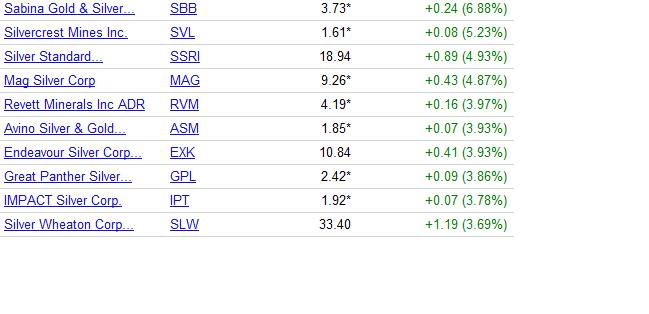
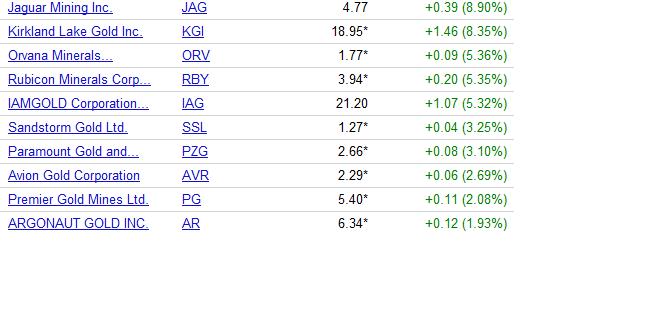
| Posted: 26 Oct 2011 12:31 PM PDT GDX gained by0.91% while GDXJ gained by1.71% and SIL gained by 1.77%
Here are today's best performing Silver stocks:
|
| Magic Formula of Currency Creation is Taxes Posted: 26 Oct 2011 12:10 PM PDT Description: Politicians who talk about paying down the debt and living within our means don't understand that doing so would collapse the whole economy. In his keynote presentation at the Casey Summit "When Money Dies," precious metals expert Michael Maloney explains why our modern fiat currency system could not exist without taxes. The first step is to understand the financial hocus-pocus by which currency is created, Mike says. First, the U.S. Treasury creates a bond, which it auctions off to large institutional banks called "prime dealers." Then the U.S. Federal Reserve, the central bank of the United States, buys back the bond from the banks. The bond serves as an IOU by which the Treasury promises to pay the banks back for the cash they paid for the bond plus interest. "Then the Treasury deposits all that currency into the various branches of the government," Mike says. "Our government does some deficit spending on public works, social programs, and we throw a few wars. And then all of those government employees, contractors and soldiers deposit that cash in their bank accounts. Now it's in the commercial banks, and now something called fractional reserve lending comes into play." This posting includes an audio/video/photo media file: Download Now |
| Rumours that EFSF to be Leveraged "several" fold/gold and silver rise Posted: 26 Oct 2011 11:26 AM PDT This posting includes an audio/video/photo media file: Download Now |
| Posted: 26 Oct 2011 11:00 AM PDT What's significant to gold investors is that India makes up a considerable part of the world's population that has a strong cultural bond with gold. This Love Trade identifies a key differentiator between the East and the West. |
 Can you belive these currency markets? Just a few weeks ago, everyone was a U.S. Dollar Bull.


| You are subscribed to email updates from Gold World News Flash 2 To stop receiving these emails, you may unsubscribe now. | Email delivery powered by Google |
| Google Inc., 20 West Kinzie, Chicago IL USA 60610 | |


No comments:
Post a Comment