


saveyourassetsfirst3 |

- Today In Commodities: All About Safety
- Bears At Family Dollar, Retailer Considers Wrong Alternatives
- Gold Correction Makes Small- And Medium-Sized Miners Prime Takeover Targets
- Marc Faber's October Outlook: Forget EU Debt Crisis, A China Meltdown Is The Real Threat
- Your Portfolio Vs. October's Sometimes-Perfect Storm
- All Against WTI Crude Oil
- Dendreon Revisited: What Management Is Saying About Provenge
- The Great Commodities Heist
- Rocks, Hard Places and Gold Bullion
- Gold Up as Equity Markets Fall on Greek Debt Debacle
- The "smart money" thinks silver is going higher now
- The Market Could Soon Bottom and Nobody Knows It
- Fed members dropping hints on QE3
- Qatar plans $10bn investment in gold producers, why not silver too?
- James Turk talks to Eric Sprott
- View From the Turret: Looking Over the Edge
- Gold — Bubble or Not?
- Gold price up 8% over third quarter
- "Surprising" Rally for Gold despite "Vulnerability" on Futures Market
- Invest in Precious Metals: Always Start with Bullion
- LISTEN: Oversold Silver – A Licence to Steal
- Philip Pilkington: Marginal Utility Theory as a Blueprint for Social Control
- Steven Butler: Equities Drop Opens Opportunities
- On the Brink: World-Changing Events in All Markets
- Gold Market Update
- Mark Provost: Occupy Boston – Day One (and Other OccupyWallStreet Updates)
- This past week in gold
- Peak Gold ! A Primer on the Economics of Gold Mining. Part V
- Sad Silver Sacks
- The Three Safe Havens Where Big Money is Going
| Today In Commodities: All About Safety Posted: 03 Oct 2011 08:00 AM PDT By Matthew Bradbard: Money is fleeing risk assets, i.e. commodities and stocks and finding its way to Treasuries and the US dollar. Our take is some type of intervention or plan will halt further appreciation in Treasuries and the dollar and prevent a complete price collapse in the stock and commodity markets…stay tuned. Oil is approaching its lows hit in August; down by 2.6% as of this post. We have advised clients to buy trades below $80 so they have started to scale into longs in the recent session but if we see a new settlement low we may advise them to cut losses on longs…stay tuned. We have opted for no new fresh entries in natural gas for clients and will be using any jump in price as exit opportunities for open longs. Prices appear to be cheap but they keep getting cheaper. Stocks start the week with a bang 3-6%. December Complete Story » |
| Bears At Family Dollar, Retailer Considers Wrong Alternatives Posted: 03 Oct 2011 07:45 AM PDT By Takeover Analyst: Discount retailer Family Dollar Stores (FDO) recently named Edward Garden of Trian Partners to the board under the agreement that his fund both withdraw its hostile bid and not acquire more than 9.9% of the outstanding stock without board approval. Trian currently owns 8.29% of the stock, while fellow activist investor Pershing Square owns 9.23%. Bill Ackman believes that the company is an LBO target and is said to be pleased with the board change. With the enterprise value trading at 7.9x EBITDA and a low dividend yield 1.4%, the company is not tremendously undervalued compared to peers, if at all. While it has a strong brand name, margins and productivity savings have largely been maximized and are expected to decline slightly in the next few years as the company expands to lower margin goods. I am slightly more optimistic than other analysts and believe that EBIT margins will actually Complete Story » |
| Gold Correction Makes Small- And Medium-Sized Miners Prime Takeover Targets Posted: 03 Oct 2011 07:44 AM PDT By David Zanoni: After the recent sell-off, gold has become oversold. Gold has had corrections like this a few times since its bull run in 2002. Every time it hit the oversold level, Gold would rise back up and make new highs. I think that this current correction in gold is a consolidation before a run up to $2,000 per ounce. I believe this because nothing has changed that would cause gold to drop on a long-term basis. There are no strong dollar policies, risk of recession is still on the table (the fear trade), and physical demand for gold will exceed its supply in the long-term. I also think that the recent sell-off has created a lot of value among small gold miners. The larger gold miners such as Barrick Gold (ABX), Goldcorp (GG), Newmont Mining (NEM), Anglo Gold (AU), Kinross Gold (KGC) and Rio Tinto (RIO) are in a good position Complete Story » |
| Marc Faber's October Outlook: Forget EU Debt Crisis, A China Meltdown Is The Real Threat Posted: 03 Oct 2011 07:32 AM PDT By Nathaniel Crawford: Marc Fabe r is out with the latest issue of his famous Gloom, Boom and Doom Report, which is always a must read for serious investors. Unlike most of the other talking heads, Faber has an excellent track record. He correctly predicted the top in the equity markets in Nov. 2007, and caught the bottom in March 2009, making his subscribers a lot of money. Here is a summary of his October 2011 report: Stocks--Yes, stocks are very oversold, but that does not mean they cannot go lower. The dreadful price action in both Copper and the Shanghai Composite points to new lows for the equity markets. After US stocks make a new low below 1100 on the S&P 500 (SPY), there could be a year-end rally followed by a more meaningful decline into 2012. Investors should use any bounce in stocks as an opportunity to reduce their equity exposure. Complete Story » |
| Your Portfolio Vs. October's Sometimes-Perfect Storm Posted: 03 Oct 2011 07:21 AM PDT By Thomas Zhou: October. Just the word is enough to drive fear into the hearts of investors. It is a month in which we've seen the three worst crashes in stock market history, from Black Tuesday, which kicked off the Great Depression, to Black Monday, in which international markets got punched in the gut, to the 27% dip in the S&P in October 2008.
We're not ready. The US is still reeling from the last recession. Housing markets are down. A quarter Complete Story » |
| Posted: 03 Oct 2011 07:19 AM PDT By Graziano Nanetti: It seems that WTI crude oil has ended its bull market and now it could begin a major downturn lasting for some months, or even years. At least three main factors are in favour of this new bear market:
I think that in the long term oil could go even to its starting point, at 35 dollars: recession could be long and the commodities are always the first to go down, often before the stocks, as in this case. In the middle term Complete Story » |
| Dendreon Revisited: What Management Is Saying About Provenge Posted: 03 Oct 2011 07:00 AM PDT By Smith On Stocks: Investment Overview In the aftermath of the 70% meltdown in the price of Dendreon (DNDN) stock caused by sharp lowering in expected sales of Provenge in 2011, investors are struggling to balance the positives and negatives of the investment case. I believe that the essential starting point for arriving at a new investment thesis is to listen closely to what management is saying about its business. It is naïve to think that an outsider can independently gather all of the information needed to make a sound investment judgment without management input. However, managements can be and often are wrong in their outlook. While it is critically important to understand what management believes is going on in its business as a starting point, it is the job of the investor to judge whether the company's expectations are realistic. The purpose of this report is to understand the expectations of management. It Complete Story » |
| Posted: 03 Oct 2011 03:54 AM PDT It is all so very simple when we view "the big picture". Bankrupt and near-bankrupt Western governments are stealing billions of dollars worth of various commodities from commodity-producers around the world. The evidence goes well beyond merely suggestive – into the realm of absolutely conclusive. What makes this scenario so unequivocal is that we have the equivalent of "signed confessions" of the crimes these governments are committing. Exhibit "A" is the monetary policy titled with the vile euphemism "competitive devaluation". It is the deliberate attempt by governments to destroy the value of their currencies – as fast as possible (i.e. "competitively"). Destroying the value of our currencies as rapidly as possible means exactly the same thing as raising prices as fast as possible. Which brings us to global commodity markets. If our governments (primarily Western governments) are deliberately trying to raise prices as fast as possible with their excessive money-printing, how can commodities prices have tumbled so far? Arithmetic tells us there is only one possible answer. Global commodity markets have been fraudulently manipulated lower through the use of the primarily "paper" futures markets. Given the scope and magnitude of this commodities take-down, it can only be the result of coordinated actions by many governments and (of course) the multinational bankers who pull their strings. The "prime suspects" are all of the Western deadbeat-debtors (who are nearly all large importers of commodities) and any/all major commodity importers – with Japan and now China being the obvious culprits. The arithmetic here is absolute: as long as our governments engage in competitive devaluation all prices of everything can only go higher. There is but one exception to this simple equation: any good and/or service for which there is excessive supply. The obvious example here is the U.S. housing market. With the most grossly over-supplied housing market in human history (and in addition a market saturated with fraud), the downward price-pressure caused by this massive housing glut currently exceeds the upward inflationary pressures of competitive devaluation. The situation in commodity markets is also unequivocal: stockpiles of virtually all commodities are either at historical averages, below historical averages, or already at critical levels. In other words, in terms of economic fundamentals there is no downward pressure on prices – only (additional) upward pressure. There can be no rational/economic explanation for the severe plunges in commodity prices other than the fraudulent manipulation of markets. Sadly, fraud has become a way of life for Western governments since they were first seduced and then enslaved by the multinational bankers. "Competitive devaluation" itself is nothing but a massive sham, with absolutely no economic validity whatsoever. To begin with, there has never been a period in history where the global economy (as a whole) has been able to "stimulate" itself with "rising exports". However, this is the stated and only goal of competitive devaluation. The reason it is a complete fraud is because again as a matter of arithmetic trade is a "zero sum" game. For every "trade surplus" there must be a corresponding "trade deficit". Furthermore (also as a matter of simple arithmetic), you can never create an economic advantage in trade simply by devaluing your own currency. Mathematically, the gain in exports can never equal the collective reduction in our standards of living which is the obvious consequence of driving-up prices. Making everyone substantially poorer so that a small portion of the economy can be "stimulated" is just more economic suicide. |
| Rocks, Hard Places and Gold Bullion Posted: 03 Oct 2011 02:46 AM PDT The world has a debt mountain to deal with. The solution will be bad news for savers and investors... |
| Gold Up as Equity Markets Fall on Greek Debt Debacle Posted: 03 Oct 2011 01:41 AM PDT |
| The "smart money" thinks silver is going higher now Posted: 03 Oct 2011 01:31 AM PDT From Mineweb: Some encouragement for the beleaguered silver investor may come from the latest CFTC figures on COMEX commercial net short positions for the precious metal. The figures as of Tuesday, September 27 showed silver net short positions plunged to the lowest level since November 2008 – the point where the silver price started its runup from a little over $10 to almost $50 achieved at end April this year. Silver has since fallen back, at one time to around $26... but is currently, at the time of writing, a little over $30.80 an ounce. Gene Arensberg's Got Gold report has published an extremely interesting graphic plotting the COMEX commercial net short positions against the silver price... Read full article... More on silver: This is how high gold and silver could climb Short-sellers continue to hammer this popular silver stock Precious metals are SURGING back: Silver up over 26% from yesterday's lows |
| The Market Could Soon Bottom and Nobody Knows It Posted: 03 Oct 2011 01:18 AM PDT Dave Banister – www.MarketTrendForecast.com The prevailing universal sentiment is neutral to bearish by advisors and the general investing public. Who can really blame them given the Euro-Zone mess, the potential bank contagion collapse effect, and the weak economic trends both here and overseas. However, the work I do is almost entirely behavioral based analysis looking at crowd or herd behavioral patterns. Right now, things are adding up to a market bottom as early as the October 7th-11th window of time and no later than October 28th . The figures I have had for a long time are 1088 for a bottom with a possible worst case spillover of 1055-1062 in the SP 500. We are already eyeing the Gold stocks as bottoming out as well and have begun to nibble and will add on further dips. Let's examine some of the evidence and then look the charts as well:
Bottom line is the SP 500 has withstood a ton of pots and pans and bad news over the past 8 weeks. The market tends to price in a soft patch in the economy way before it becomes evident in the data. To wit, when we topped at 1370 in May of this year, it was an exact 78.6% retracement to the upside of the 2007 highs to 2009 lows. The pullback to 1101 is an exact 38% Fibonacci retracement of the 2011 highs and the 2009 lows. Markets are not as random as everyone things, and if you can lay out a roadmap in advance and understand where key pivots are, you can swing the opposite direction of the herd and profit quite handsomely. This is what I do every week at my ActiveTradingPartners.com trading service; go against the crowd for handsome profits. Below are two charts showing two likely outcomes in the SP 500 index in the coming several days to few weeks:
Forewarned is forearmed as they say. If you'd like to stay ahead of the curve on Gold, Silver, and the SP 500 on a consistent basis, take a look at www.MarketTrendForecast.com , where you can sign up for occasional free reports and/or take advantage of a temporary 33% off coupon to join us! |
| Fed members dropping hints on QE3 Posted: 03 Oct 2011 01:00 AM PDT Even though the gold price suffered a sharp drop in September, at the end of the third quarter the yellow metal was trading 8% higher than the previous quarter. Many have taken advantage of the lower ... |
| Qatar plans $10bn investment in gold producers, why not silver too? Posted: 03 Oct 2011 12:47 AM PDT Somebody asked why the Qataris are not looking for silver mines? Well silver tends to be produced as a by-product of large copper mines and they are very expensive and closely held. That makes it far more difficult to ramp up silver production than gold, and with silver reserves already less than a hundredth those of gold the price implications are interesting to say the least. |
| James Turk talks to Eric Sprott Posted: 03 Oct 2011 12:41 AM PDT Eric Sprott (www.sprott.com) and James Turk, Director of the GoldMoney Foundation, talk about how there isn't enough silver in the silver market to back existing 'paper silver' ... |
| View From the Turret: Looking Over the Edge Posted: 02 Oct 2011 11:39 PM PDT
Most traders couldn't wait to see the end of Q3 2011, the worst quarter for the markets since Q1, 2009 – when all hell was breaking loose and the global financial system was coming apart at the seams. The good news is that we've finally closed the books – with the S&P logging more than a 14% loss and the Dow down roughly 12%. The bad news is that there's n indication that market's have fully capitulated yet – with plenty of room for more carnage in the fourth quarter. Of course if you're a nimble, disciplined trader, the last quarter didn't have to be painful. The Mercenary portfolios finished the quarter with positive returns in the mid to high single digit range – keeping our capital protected and taking moderate trade setups only when the potential reward justified the risk. All trades are documented and time-stamped in real time via the Mercenary Live Feed. As we power up the screens for the final quarter this year, we enter the period with modest exposure – but a number of increasingly attractive setups on our radar. One of the primary issues that we're looking at before pulling the trigger is a break from the broad range that the market has been trading in. For the last two months, the S&P has been stuck in a wild and volatile range from the 1,120 to 1,230 price points. This is roughly equivalent to a 10,600 to 11,700 range on the Dow Jones Industrial Average. Friday's sell-off into the close has put the indices within striking distance of a true breakdown – and economic risks across the globe are poised to offer any number of catalysts which could send investors scurrying for the exits. At this point, we're not "predicting" a breakdown, but we're stocking up on bearish ideas in case this scenario pans out. Of course there are a number of attractive deep-value opportunities that will become even more exciting if prices are forced lower – and we're exploring a few different approaches to setting up trades for these situations. There's no guarantees when it comes to the market direction this quarter, but we can be assured that it will be a volatile period with so many areas of uncertainty waiting for resolution. Below the jump are a few of the areas we are monitoring for trades this week… China's Internet Fraud Sends Stocks Spiraling There's nothing like a rumor of fraud to stir up even more volatility… Last week, a "source" confirmed that the US Justice Department is investigating accounting fraud at more than one Chinese internet companies which are listed on US exchanges. The news sent traders scrambling for the exits as no one wanted to be left holding the bag when it was announced exactly which Chinese firms were being investigated. Want to trade like a Global Macro pro? Learn the secrets of the Global Macro titans. Sign up for your FREE Report now! The knee-jerk reaction was a drop in price for the most liquid Chinese internet names like Baidu Inc. (BIDU) and Sina Corp. (SINA). Both of these companies were already on our bearish watch list – BIDU because of slowing growth expectations, and SINA because of an unreasonably expensive price multiple and a developing bearish chart pattern. While both firms have publicly stated that they have not received any notification from the US Justice Department, last week's action may very well set up an attractive short entry for both companies. For both BIDU and SINA, the real issue isn't likely to be fraud within the companies. With concerns over a potential economic hard landing in China, coupled with a "risk-off" mentality for investors, it would not be surprising to see more selling in this sector – and in these two stocks particularly. From a trading perspective, the best entry would likely come after a few days of consolidation or drift higher. This would give us an opportunity to identify a resistance point which would help in establishing a risk point – and give us a chance to put on a more high-probability trade once the stock resumes its downtrend.
Dividend Yields Still Attract Capital In a zero interest rate world, investors are having to search harder to find income. Last week we discussed the danger for municipal bonds. The entire asset class has been bid higher as rates on treasuries have been pushed lower. But with credit risk, potential for a significant amount of supply hitting the market, and the threat of a shift in tax policy, these bonds are looking more risky by the day. Blue chip stocks with high dividend yields are next on the income list – and many are attracting "safe" capital from investors who rely on investment income to meet annual expenses.One of the income names on our list became particularly interesting last week when the company landed one of the Department of Energy's loan guarantees at the 11th hour. Exelon Corp. (EXC) received one of 4 loans from a green energy program which expired on Friday. Exelon should be able to use the capital to fund an alternative energy project – and the financing terms should be much better than EXC could have received from the private sector. As a utility, EXC enjoys a very steady cash flow business – and distributes much of this cash to investors through its quarterly dividend payments. Right now, investors are receiving a 5.0% yield, while still owning a company at a price that appears to be a very good valuation. Of course we're not particularly interested in holding a stock long-term to receive a 5% yield, but the attractive dividend and the strong sector should attract capital and send the stock price higher. EXC looks like an attractive opportunity, provided it remains above key moving average support and yields stay low for alternatives that would compete for investor capital.
 Retail: Anywhere But Middle of the Road This continues to be a tough environment for retailers. An economic report out last week noted that household income had its first drop since October 2009 – with real disposable income down 0.5% in August. The savings rate dropped to 4.5% as high food and energy costs cut into income – leaving less spending available for other items. The information comes at a critical time for retailers. Stores are now stocking up for the holiday season, and investors are preparing for the so-called "Santa Claus" rally – which typically boosts stocks ahead of the holiday sales period. This year analysts are still predicting growth in holiday spending, but the growth rate will likely be lower than last year's robust increase. For traders, the key will be determining exactly which retailers will perform well during the season. Looking at a broad assortment of retailers, traders can cut the sector into three main categories:
While it may seem that the middle class retailers have a broader target market, the environment is very difficult for the middle income consumer. Affluent consumers may be pulling back some with the drop in the stock market, but this group of spenders is still very slow to change their spending patterns. Most in this group have ample savings which can help pad spending for the holidays, and the unemployment rate is much lower for high-income earners. Stores catering to the low-end consumers are benefiting from more middle-class consumers "trading down" to lower-priced goods, and this is helping to support stores like 99(cents) Only Stores (NDN) and Dollar General Corp. (DG). Middle of the road retailers are also dealing with increasing labor and materials costs (we have seen a spike int he price of cotton), which crimps margins and leads to lower profits. Early indications also point to a significant amount of discounting in the pipeline – which also points to lower profit margins. PVH Corp. (PVH) is a good example of a vulnerable "middle class retailer." The retailer sells dress shirts, sportswear, footwear, and accessories; usually offered at a fair price – but PVH is not considered a "luxury" retailer. Analysts have begun revising next year's earnings expectations lower and the stock has struggled to remain above key moving average support. A fresh breakdown for the stock – along with weakness in the retail group and the market in general – should attract short sellers and raise concern for longer-term investors.
An hour before the open, the futures look mild with a the US dollar advancing modestly. But considering the meetings in Europe, the policy issues that must be resolved in the US, and the uncertain environment, this could very well be the calm before the storm. We're trading light and tight at this point – with most of our capital safely parked on the sidelines. But with strong potential for the volatile range to be broken, we're ready to put that capital to work quickly when the situation shifts. Trade 'em well this week! |
| Posted: 02 Oct 2011 11:25 PM PDT An interesting perspective on gold is shown in the following graphic: Gold has dropped since the chart was created. According to the analyst, gold at its recent high was not a bubble when compared to its relative value to other financial assets. That is one way of looking at gold. There are other analysts who [...] |
| Gold price up 8% over third quarter Posted: 02 Oct 2011 10:15 PM PDT European and Asian stocks have fallen in trading today following confirmation on Sunday that the Greek government will miss its deficit targets for this year. Greece had agreed to make austerity ... |
| "Surprising" Rally for Gold despite "Vulnerability" on Futures Market Posted: 02 Oct 2011 09:01 PM PDT |
| Invest in Precious Metals: Always Start with Bullion Posted: 02 Oct 2011 09:00 PM PDT How to start investing in precious metals with bullion. |
| LISTEN: Oversold Silver – A Licence to Steal Posted: 02 Oct 2011 08:39 PM PDT In another great interview, SGT interviews David Schectman, founder of Miles Frankilns, who suggests the bottom is precious metals are "a steal" and "a gift, courtesy of the bullion banks". Part One Part Two Much more @ SGTReport.com |
| Philip Pilkington: Marginal Utility Theory as a Blueprint for Social Control Posted: 02 Oct 2011 07:15 PM PDT By Philip Pilkington, a journalist and writer living in Dublin, Ireland
A prisoner kneels before the watchtower in a drawing of Jeremy Bentham's 'Panopticon'. The Panopticon was an architectural form that Bentham envisioned for a variety of social institutions. The idea was to have a central platform where an observer could cast their gaze over all the observed, thus making them feel constantly under watch and ensuring, in Bentham's own words, "a new mode of obtaining power of mind over mind, in a quantity hitherto without example." Jeremy Bentham is also the father of modern utility theory – a theory often associated with individual liberty, which is actually at heart a blueprint for social control. It's not hard to forget just how nonsensical, simplistic and childish the so-called theory of marginal utility is. Personally, I hadn't encountered it directly for a number of years. But reading a review copy of Steve Keen's excellent new revised edition of 'Debunking Economics' encouraged me to pull out the old Samuelson and Nordhaus textbook once more. While Keen shows quite clearly in that book that even within its own narrow and absurd definitions the theory is internally inconsistent, I propose here to take a more general look at this intellectual masturbatory appendage that passes for a theory of individual and societal desire – and to try to substantially demonstrate that, far be it from being an expression of individual liberty, it is, in fact, a vision of a controlled and deterministic society, not unlike it's father Jeremy Bentham's other invention, the Panopticon. "But it's not psychological!" The theory of marginal utility is, like most concepts in neoclassical microeconomics, quite simple. It begins, also like most concepts in neoclassical microeconomics, with a tautology. The economists claim that people choose that which maximises their pleasure and minimises their displeasure. They refer to this as people 'optimising their utility' – 'utility' here being this supposedly innate tendency to choose that which satisfies us most. As any even a half-blind observer will note this is complete claptrap. People often make choices that turn out later not to 'maximise their satisfaction' (whatever that crude phrase might mean). Have you ever gone clothes shopping and bought an expensive pair of jeans that you never wore? Well, that's hardly utility maximising behaviour. In fact people often make choices that lead to less than satisfactory outcomes. This seems to be by design rather than anything else. If we always made the choices that ensured constant satisfaction we would soon find that we had no motivation to do anything new and would simply sit and stew in our own narrow and static world. That we occasionally make less than satisfactory choices allows us to continue to pursue satisfaction all the more. Nothing would smother our drives, our ambitions and our aspirations quite like a constant state of satiation. But saying any of this is far too psychological for the average economist. After all, they insist that the theory of utility is not psychological. From Samuelson and Nordhaus' 'Economics' (15th Edition):
The sheer amount of qualifying statements in those sentences is outstanding. But let us ignore such brazen tautology and meandering qualifying rhetoric for a moment, as there is something far more important and interesting going on here. Why does Samuelson insist that this is not a psychological 'function'? After all, we have just shown that the theory of utility contains a strongly psychological dimension in which it gives a very definitive view of human psychology. This is a classic shunning of intellectual responsibility on the part of Samuelson. He assures us – and with us, himself – that he is not passing psychological judgement. He does this by insisting that we are engaged here in 'science' (whatever that means). Of course, the critical observer can see that this is a strongly psychological argument with absolutely psychological foundations, but Samuelson doesn't want to know anything about this. Why? Because that would lead him to be questioned regarding the psychological basis of his assertions and that would cause his neoclassical worldview to crumble, strip him of scientific authority and show him to be doing what he is, in fact, doing; namely, using a scientific 'style' to try to convince the reader that the unlikely psychology that he puts forward is in fact objective, scientifically verified reality. Ever diminishing returns Adding to the theory of utility the theory of marginality doesn't really make things any better. The newly constructed theory of marginal utility states that we will derive an ever diminishing amount of satisfaction (that is, utility) from any given product or circumstance. Impressive, right? Not really. And not strictly true either. An obvious counter-example would be that of the collector who derives an increase in satisfaction from accumulating a greater number of a certain item. Not to mention the eager capitalist who views money as an end in itself rather than a means to an end and so tries to accumulate ever-increasing amounts right up to infinity. Eccentrics, surely? Not really. Many people have a passion for collecting a variety of different items and there are certainly no shortage of burgeoning capitalists in this age of popularised stock markets and online Forex trading. There's also the issue that advertising can often try to convince consumers to buy ever-increasing volumes of a product – even if the price of the product increases due to the brand becoming more popular. This is often remarkably successful and seems to fly in the face of the theory of marginal utility. In fact, it contradicts it at a very fundamental level. It shows that consumers are not the rationally calculating agents that marginal utility theory says they are. Instead they are agents caught up in trends and fashions and subject to irrational drives that marketers know well how to tap in to. These objections are not quite as damning as those raised above with regards to utility theory more generally. Indeed, economists will often try to subordinate these secondary objections to their basic so-called laws. In doing so they will bend the 'laws' to contain clauses that accommodate for wholly contradictory phenomena. Such a practice is, in itself, evasive and shows clearly that the theory of marginal utility is not an enterprise in science that attempts to broaden our view of reality. Instead it is an exercise in ideology that attempts to shut down our view of the world and channel all observable phenomena into a few neat assertions – assertions, remember, that were not derived experimentally. This practice goes right to the heart of neoclassical microeconomics itself. It is, for the most part, a belief system imparted to people to close off how they view reality. In this it is like a strict religion or a cult. Everything can be explained through a few key precepts and when something seems to contradict these precepts we alter the interpretation of the phenomenon itself and make it fit with the precepts rather than questioning the precepts. It's a bit like a religious fundamentalist endlessly reinterpreting scripture as new phenomena emerge, rather than simply questioning the scripture itself in light of the new empirical evidence. Although we will look in more detail at this in a moment, it is worth noting here that much of neoclassical economics is in a fact a vast system of collective fantasy. In it the world in all its richness is turned away from and a narrow system of beliefs and assertions is upheld. For the most part, although we will discuss this in more detail in what follows, it appears that this fantasy system is – like many cult systems – designed to ward off anxiety in the adherent and give them a sense of place in the world. That this place is, in a very real sense, malevolent we hope soon to show. Utility theory slowly builds towards determinism and death Out of these ridiculous and obviously falsifiable precepts neoclassical economists go on to construct mathematical models. These models say very little beyond the original tautological precepts, but that is not their point. The real point of these models is that they are neat and easy to understand and that they convey the worldview in a way that covers up the dark vision that, in fact, is being imparted to the initiate. The models show the constraints placed upon the consumer and the possible paths of action that can be taken by him. Samuelson puts it as such:
Let us remember first that the consumer is supposed to always follow the path to his maximum utility. With that firmly in mind the consequences of the above statement can be fully understood. What is happening here – contrary to what many would have you believe – is that the economists are trying to establish a deterministic system. They are trying to quash the notion that we are actually individuals who make free choices. Instead we are being viewed here as calculating machines with static preferences that respond to price signals. Here's how it works. Neoclassical economists do recognise personal taste (although, as Keen shows in his book, they abolish it when it leads to contradictions), but they view it as fixed, innate and essentially static. We are seen to have fixed tastes in the sense that if we are given a table full of items and the prices of these items are held to be fixed we will always choose certain combinations of these items due to our own static personal tastes. Change in behaviour only really comes from market signals. When the price of a given good rises or falls, we reorder our preferences – still in line with our supposedly innate tastes, but now accommodating the new price system. The astute observer can see the determinism here. We are assumed to act, in essence, not only without any meaningful free choice but also as a completely static slave to our drives. But the idea that people have wholly static tastes is not only offensive, but absurd. Any person who showed such characteristics would be considered beyond simply eccentric – indeed, they would be downright neurotic and chronically so. Samuelson provides a caveat that sums up exactly this view of people:
First of all, Samuelson is being far too modest here. If people are not seen to have almost wholly static tastes the theory of marginal utility is worthless. If peoples' tastes are constantly changing due to personal development, outside influence etc. then price signals will be of secondary importance and psychological and cultural changes will have to brought to the fore as explanations for consumer behaviour toward anything beyond the most simple commodities. This aside however, Samuelson's vision of man is quite bizarre. He seems to assume that anyone who doesn't have static tastes and who doesn't lead an eccentric and neurotic existence must be 'miserable'. Once again we see the psychology that is so unquestionably at the heart of this theory. And what a strange psychology it is. It tells us that we have to learn to do the same thing over and over again ad nauseum, only changing our habits based on price signals (or other costs, such as time expended) and if we don't do this we will suffer. Beyond being absurd, this is a rather morose vision where the individual is punished time and again for not treading the proverbial hamster wheel of destiny. This reminds one of the horrifying concept of the 'eternal return' that can be found in the writings of the great German philosopher Friedrich Nietzsche. A wonderful depiction of this philosophical and literary device was put forward by the Irish writer Flann O' Brien in his book 'The Third Policeman':
O' Brien is right, of course. Samuelson's vision is not one of contentment, but instead one of suffering and interminable neurosis. It is a vision of the 'compulsion to repeat' that psychologists have recognised since Freud. The tendency for people – usually neurotic people – to repeat the same thing interminably without deriving any satisfaction from it. Freud, and those that followed him, recognised this as one of the most innately destructive features of the human psyche. Indeed, Freud himself came to view this as a movement by the organism toward death. And yet Samuelson assumes that something similar must be the norm! Samuelson seems to assume that people will be miserable if they don't engage in repetitive behaviour because they might make 'mistakes'. At the risk of sounding a tad corny: are not the most satisfying experiences of life precisely those that come at the risk of error? This vision, reaching back to Bentham but alive and well in the economics textbooks of today, is far more sinister and grim than the silly little graphs that represent it imply. It is, at heart, a deterministic doctrine that attempts to construct a world in which everything remains in its right place and almost nothing happens. A nihilistic vision of a world of death and purgatory that never truly moves or goes anywhere. Pretty disgusting theory – why is it so popular? When trying to understand the popularity of such a vision one cannot help but think of the more perverse of the old religious cults, because in many ways neoclassical economics is a cult of despair and abnegation. That it's most fundamental psychological underpinnings manifest these characteristics is then of no surprise. The primary reason that the theory of marginal utility – and to a large extent neoclassical microeconomics more generally – is popular is because it appeals to its adherents as a sophisticated fantasy of control. This may seem strange. After all, haven't we shown above that the theory of marginal utility is strongly deterministic? And wouldn't this seem to imply that the adherent has, in fact, very little control of his life – subject as he is to primitive, static impulses and market price fluctuations? Certainly on the surface that would seem to be the case but scratch a little deeper and we find something a little different. By being able to conceive of this great system one gains a great deal of power. Or, more accurately, in one's fantasy one gains a great deal of power. In such a vision of the world everyone's motivations are wholly transparent and one only need to think about so-called 'market forces' to understand the big questions of why everything happens – and where everything should go. This also puts the neoclassical economist in a seat of power. Imagine for a moment the regal – nay, divine – position these people think they occupy. While the rest of humanity follows their marginal utility, the economists sit back with a panoptic, God's eye view of the world. Like a sort of dark crystal ball that can be gazed in to in order to understand it all. The power! The original theorist of utility was, of course, Jeremy Bentham who, as we have noted, also came up with the Panopticon. The Panopticon, as noted, was a totalitarian prison system wherein every prisoner was to be watched constantly by a central observer who monitors their behaviour. Bentham thought that this model could be extended to a variety of social institutions, giving rise to a terrifying vision of a totalitarian hell which was later to be captured in 20th century novels such as Orwell's '1984' and Huxley's 'Brave New World'. Bentham's vision was downright paranoid, of course. But it says a lot about the psychology behind his theorising. This man was not a prophet of human freedom and actualisation. No, he was the harbinger of a dark vision of totalitarian control. And his theory of utility was but another manifestation of his own slightly villainous technocratic tendencies. This is why the theory of marginal utility is still so popular today. It satisfies the controlling desires of its adherents – if only in fantasy. It provides a sort of imaginary Panopticon in which the adherent can sit and watch humanity and ensure that they are acting in the appropriate manner. From such a position the neoclassical can then dictate to governments and populations what sorts of policies should be enacted to ensure that everyone acts as much in line with their fantasies as possible. And then people tell me that neoclassical economics is the doctrine of individual liberty!? Please! Only a half-educated fool could think such a thing. Neoclassical economics is an advanced system of technocratic control. It has been since Bentham laid down its first postulates, since he first formulated his desires to establish "new modes of obtaining power of mind over mind, in a quantity hitherto without example."
|
| Steven Butler: Equities Drop Opens Opportunities Posted: 02 Oct 2011 07:00 PM PDT Steven Butler, senior precious metals analyst at Canaccord Genuity, didn't expect mining equities to fall as hard as they did after the gold price tumbled from a high of $1,900/oz. But the unexpected... Visit the aureport.com for more information and for a free newsletter |
| On the Brink: World-Changing Events in All Markets Posted: 02 Oct 2011 05:47 PM PDT Gold Forecaster |
| Posted: 02 Oct 2011 05:39 PM PDT |
| Mark Provost: Occupy Boston – Day One (and Other OccupyWallStreet Updates) Posted: 02 Oct 2011 04:57 PM PDT Yves here. Police efforts to contain OccupyWallStreet have had the opposite effect to what the officialdom no doubt assumed would happen: that the demonstrators would either become discouraged or become violent, which would make it easy to discredit them. Instead, the macing of a group of women last weekend, followed by the arrest of over 700 people on Brooklyn Bridge on Saturdy, has given the movement legitimacy and media attention. It was the lead item on the BBC website over the weekend. Press efforts to diminish the potential of this effort are now shifting. The initial MSM responses tended to the patronizing, emphasizing the fact that the group was small, camped out on the periphery of Wall Street, and harmless (harmless = weak, particularly when pitted against the might of the plutocrats). Now that the ranks of participants are growing and prominent individuals like Nobel Prize winner Joseph Stiglitz have stopped by to show support, the new tactic is to attribute the increased interest to gawking rather than solidarity. For instance, the Financial Times headline is "Fed up and curious swell anti-Wall Street ranks." So in one neat sentence, that suggests there is a hard (and by implication, not large) core of protestors, joined by malcontents and sensation seekers along for the ride. But the experience of the protestors provides considerable evidence of broad based support: they've gotten more in pizza donations and socks than they need; many of the cops express sympathy; the overwhelming majority of passengers in cars that drove by them on Brooklyn Bridge waved at them or otherwise signaled approval. And images are arresting. Just as televised footage from Vietnam made it impossible to sanitize the brutality of a ground war in Asia, so to are digital cameras and the ease of using social media and blogs to distribute images impeding the efforts of the officialdom to pretend that the protestors are not like the rest of us. Today's photos include Marines who depict Wall Street as their new enemy:
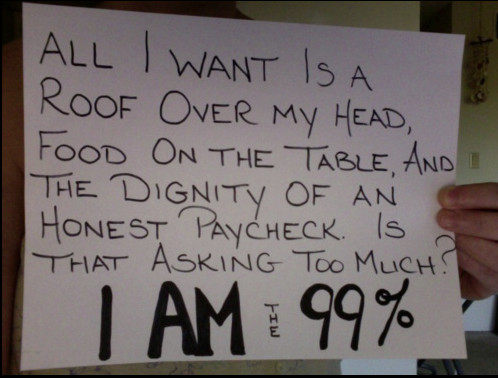
…and stories on We Are the 99 Percent:
"We are the 99%" is brilliant, and Mark Provost highlights that theme in his post below. It puts the spotlight on the core issue: how economic and political control has moved into the hands of a tiny, irresponsible elite and its minions. It undermines the class-warfare-label-as-denigration strategy because social classes have roots, history, and at least once upon a time, some legitimacy. By contrast, the rise of an oligarchy of the top 1% (actually, more like the top 0.1%) is recent and its actions have been destructive to communities and established social arrangements. Needless to say, following the Venezuelan saying, "A politician is someone who gets in front of a mob and tries to call it a parade," one confirmation of OccupyWallStreet's rising fortunes is that some soi-disnat progressive groups are trying to use it to burnish their brand (click to enlarge):
Maybe I am a bit jaded, but a lot of news organizations have also interviewed members and leaders of the OccupyWallStreet movement, and they don't try to lay claim to them. For a mainstream left conference that was no doubt organized weeks if not months ago to put OccupyWallStreet forward as if it was their lead act is awfully disingenuous. I hope the organizers are smart enough to come out of this transparent effort at co-option as the users rather than the used. By Mark Provost, economic journalist focused on US income and wealth inequality living in Manchester, New Hampshire. You can reach him at gregsplacenh (at) gmail.com My interpretation of the previous two days as a participant and journalist in Occupy Boston does not reflect the views of other members of the "99 percent" movement, or Occupy Boston as a whole. The $64 trillion dollar question, "When will Americans hit the streets like people in other countries?" has been answered. Over the last several days, occupations have spread from Wall St., and erupted in more than 50 cities across America. The "99 percent" are rising to voice their grievances against an economic and political system which has disenfranchised them for too long. We share painful stories and common concerns, and want profound changes to how this country is governed—and for whom it is governed. I drove from New Hampshire Friday afternoon and arrived in Beantown to kickoff Occupy Boston. Dewey Square, the site of the occupation in the heart of the financial district, was easy to find thanks to police and media helicopters hovering overhead. But rush hour traffic and Boston's circuitous one-way streets channeled me far from the site, to an expensive garage. I asked a well-dressed young man exiting work for directions to the park. He didn't know the location, and I didn't tell him why I was going (fearing he may intentionally misdirect me). Unfortunately, my cover was blown when 'Brian' asked a coworker for the whereabouts. Brian pointed me in the direction of South Station and offered his opinion, "I work for an investment bank. I am a capitalist…but I don't agree with American-style capitalism." Without pause, he refined his thoughts, "I am a socialist." I was running late, so I simply nodded. He repeated this heresy, and wished me luck. Earlier Friday, a huge demonstration organized by 'Right the City' protested in front of Bank of America, demanding a moratorium on foreclosures and continued their march to Dewey Square. Most of protestors went home, but some stayed to help launch Occupy Boston. I met the acquaintance of three young men from Stoneham, one of whom just lost his job as an eyeglass technician. Luckily his friend, a marine biologist with $60,000 in student debt, just landed a job. "We switched places" they realized, and gave each other a high five. Gatherers mostly engaged in small groups without direction, waiting for something to happen. The confusion subsided and we got down to business. The group began to communicate using the famed 'people's microphone'. When someone calls for a 'mic check', the whole group repeats their message in short sentences. We organized into seven separate teams: tactical, direct action, legal aid, food & medical, media, local outreach, and creative artists. Soon, Dewey Square was a rain-soaked and muddy experiment in direct democracy. Our strength swelled to over 1,000 people. (4) Ages ranged from 7 to 77, men and women, middle class and homeless, gay and straight, bisexual and transgender, anti-war activists and Marine Corps veterans, African Americans and immigrants, Arab and Jewish, Asians and Latinos, unemployed and overworked, working class and Ivy-League educated. We are committed to an innovative, democratic process which is a testament of our vision. The late Howard Zinn believed that the hallmark of a successful social movement is its ability to cultivate both democratic means and democratic objectives. One reinforces the other. This is a leaderless movement without a central ideology. We are bound only by the understanding that we are part of the 99% of Americans getting shafted by the top 1%. After we built our encampment and ate a hot meal, roughly 400 occupants hit the streets at 11:00 PM and declared our galvanizing message: "We are the 99 percent! We are the 99 percent! You are the 99 percent!" Countless cars honked in support, loaded Bostonians and passers-by cheered (and a couple jeers), some joined the march, while others grabbed smartphones and cameras to record the rebirth of America in the city that started it all more than 200 years ago. The 99% movement has been ignored and derided in the mainstream press—yet the overwhelming response from the people of Boston is revitalizing. If you join the movement, you will not be stigmatized. On the contrary, your dedication will be praised, honored, and thanked by fellow citizens. One by one, we will break the silence which has devoured this country. Owing to the gravitational pull of truth-telling, the march returned to camp larger than when it departed. Suddenly, Dewey Park emptied as hundreds of us charged across State St. towards the Federal Reserve Bank of Boston. We chanted "We are the 99%, You are the 99%" (pointing to the phalanx of police officers lining the front of the building) and "F*** the Fed!" The roar echoed from the thick glass walls and stone ground. It was tense, but officers remained disciplined while demonstrators played music, sang, and danced. Unlike other cities like New York and San Francisco, the BPD has made no attempt to corral us, has not tried to block or channel our marches, has not tried to disperse us, and has entered the encampment once due to a medical emergency. So far, hats off to the BPD. If they respect our right to protest, it makes it easier for us to protect their right to collectively bargain. By 1:00 AM, it was pouring rain and I told my new friend Murph that I would drive him home to Watertown in exchange for his help finding my vehicle. I returned to New Hampshire, caught five hours of sleep, filled my car with supplies, and headed back to the occupation. So far, the media has largely ignored the 99 percent movement. A nationwide uprising focused on addressing extreme economic and political inequality is just not newsworthy. Journalists claim that we lack coherence, and ask in a quixotic tone, "Why are they protesting?" Have they not read their own articles or watched their own television reports. Each one of us knows why we are here, and we want to listen to everyone's ideas. We are a multitude—and we are occupying Boston for a multitude of reasons. The more relevant question is: Will you join us and contribute to the awakening? (7) Update 2:00 AM: Lambert Strether has just posted that the police have sent out a notice that OccupyWallStreet can no longer use Zuccotti Park in Manhattan. Clearly they've become too successful and must be denied a base camp. This is gonna get interesting, and I am sure the officials hope it will be in a way that discredits OccupyWallStreet. 6. Why Do You Occupy?:
|
| Posted: 02 Oct 2011 04:36 PM PDT By Jack Chan at www.simplyprofits.org 10/01/2011  GLD – on sell signal.  SLV – on sell signal.  GDX – on sell signal.  XGD.TO – on sell signal.  CEF – on sell signal. Summary Here is a chart we posted for our subscribers recently, quite a shocker for gold bulls. This is not a prediction or forecast, just what the chart is telling us to be cautious. Disclosure End of update
|
| Peak Gold ! A Primer on the Economics of Gold Mining. Part V Posted: 02 Oct 2011 04:00 PM PDT |
| Posted: 02 Oct 2011 02:39 PM PDT It seems to me that there are a lot of Sad Silver Sacks with the recent downturn. Why? Did you believe the cheerleaders that were insisting that Silver was going 'to the moon!'? Really? I'm going to guess that almost every damn one of you got into metals for any other reason than to make a quick ounce. Those who did by 'tickets' to board the Silver Streak had fantastical expectations of Silver and what it could do for your net worth. Stop it. Invest wisely and with a sober and open mind. Shelve the 'fantastical expectations' and simply park your FRNs into your chosen vehicle of wealth storage. To expect anything more is folly. Personal Example: I bought Palladium at sub $700. It was a simple diversification of my holdings with no expectation of great returns. Back in February I saw Pd striving toward $850, and got greedy and missed the boat because I didn't know about how prices drop just before Contract Expiry. Lesson learned. So, when Pd reached $835 in August 'just before Expiry' I sold with the folks at my local dealer looking at me in disbelief (since I NEVER sold) and pretty much questioning my reason to sell. "The time is ripe" was my response. With Pd hovering near $600 as I type shows that I made the right decision, which was based on fundamentals and not on 'emotion'. Shelve your emotion and do not lament that Silver has corrected to $30. Encourage others to save up their FRNs and be prepared to buy when the price reaches $25. Trust me, they'll be buying before then and they won't lament that it may reach $23. Those who have the balls to pull the trigger now will be the strong hands to hold tight for the next 3-5 years. Forget about those who will not pull the trigger, ever. There is no hope for them. |
| The Three Safe Havens Where Big Money is Going Posted: 02 Oct 2011 01:35 PM PDT It seems everyone is looking for a place to put their hard earned money as uncertainty around the globe continues to rise. Oil, Gold, and Silver which have been the hot investments for the past few years took it on the chin over the past month with oil falling 13%, gold dropping 15%, and silver with a whopping 30% decline. We did actually see sharply lower prices, but last week these oversold commodities had a bounce and recouped some of their losses. It has been a month since I covered the dollar index in detail and back on August 31st I pointed to a potentially large shift in the US dollar. The charts were pointing to a sizable rally which would likely send stocks and all commodities crashing lower. Since then we have seen just that and the so called safe havens (Gold, Silver, Oil) have dropped taking most investment and retirement accounts down with them. I did talk about these so called safe havens a couple weeks back stating my point of view on them. My Cole's Note Summary: "I do not consider any investment vehicle a safe haven if it can drop 15% in value within 1-2 days. And I would never put a large position of my account especially a retirement account into these investments if I were over 50 yrs of age." So where are the big, smart, and conservative traders putting their money to work? Let's dig down and take a quick look at the charts… The 20 Year Bond – Daily Chart:
US Dollar – Daily Chart:
Utility Sector (Dividend Paying Stocks) – Daily Chart:
Weekend Trading Conclusion: In short, I feel both stocks and commodities are oversold but need more time to bottom and we may see a few more days of lower prices in the near future. I see the dollar starting to get toppy on the daily chart and once that rolls over then stocks should bottom along with gold, silver, and oil. Once equity prices start to bounce I anticipate money to flow out of the safe haven (Bonds) and into stocks where there are much larger potential gains to be had. All this could play out in a couple days so I am keeping a very close eye on everything. Last week we bought the inverse SP500 etf (SDS) anticipating another surge higher in the dollar which would send stocks down in value. So far we are sitting with a gain of 8.2% and the potential for another 4 – 10% if things play out as I expect. If you would like to receive my daily pre-market trading videos so you know exactly what to expect each session along with my ETF trades be sure to join my free newsletter and get my free book here: http://www.thegoldandoilguy.com/trade-money-emotions.php Chris Vermeulen |








| You are subscribed to email updates from Gold World News Flash 2 To stop receiving these emails, you may unsubscribe now. | Email delivery powered by Google |
| Google Inc., 20 West Kinzie, Chicago IL USA 60610 | |


No comments:
Post a Comment