


saveyourassetsfirst3 |

- Silver TA update
- Gold New Record High in Euros (€1,375/oz) on Greek Default and Eurozone Contagion Risk
- Gold stock breakout no surprise
- Gold New Record High In Euros – €1,375/oz
- Extorre Nears Completion of Initial Resource Definition Drilling for Zoe at Cerro Moro - High Gold-Silver Grades Continue
- WATCH – Jim Rickards on CNBC 9.12.11
- Once Upon A Time - the Hstory of the Gold Standard - FOFOA - Must Read IMHO
- A major new trend in gold stocks could be starting now
- Jim Sinclair – Gold Is Never Easy
- Positive Money Flow into Gold and Silver ETFs
- "Dr. Doom" Marc Faber: Obama's job plan is "a complete joke"
- Five reasons the U.S. economy won't collapse
- WATCH – Peter Grandich from GoldRush 2011
- Why you need a new passport...
- Why Concentration in Gold and Silver Assets Will Continue to Trump Diversification
- View From the Turret: More Volatility
- The Great Silver Heist
- Gold price in euros makes new high at €1,350 per troy ounce
- Gold Declines as Investors Rush to Cover Equity Margins
- Gold & Silver Market Morning, September 12, 2011
- Jurgen Stark = Credit Anstalt 2.0 (and Euromarkets Reacting Accordingly)
- Peter Grandich at GATA Gold Rush 2011
- Gold price building up energy
- Dimon Says US Banks Should Dictate to Regulators
- Gold and the Trade Deficit
- Rising gold price attracts theft
- Gold Market Update
- Sept 12, 1919 : Ritual dating from 1919 sets price of gold
- A More Perfectly Bankrupt Union
- The Gold-Demonetization Hoax
| Posted: 12 Sep 2011 05:02 AM PDT A lot of people are confusing my silver calls with the "Silver Update" Video's that BrotherJohnF does, please dont confuse the two. Silver has hit the 50 day MA, it has broken my trend line. The next two days are critical for the short term trend to continue. It seems like Gold wants to gravitate to the GLD equivalent of $165 again. In such an event expect silver to get straight fucked up, again. The next two days will be critical. Get to work Blythe. I suspect the usual fuck job of crushing it intraday to set off all the sheep stops, then on we go. No one said this was going to be easy. I remember a stock I was in that they shook the tree so many times I literally fell out and paralyzed myself. Expect nothing less then violence. I am now coining a new term. "Crimes against Silvanity" it should be punishable similar to crimes against humanity.   |
| Gold New Record High in Euros (€1,375/oz) on Greek Default and Eurozone Contagion Risk Posted: 12 Sep 2011 03:43 AM PDT |
| Gold stock breakout no surprise Posted: 12 Sep 2011 03:38 AM PDT |
| Gold New Record High In Euros – €1,375/oz Posted: 12 Sep 2011 02:19 AM PDT There has been a sharp increase in risk aversion with the euro and stocks internationally falling sharply due to concerns about the coming Greek default and the real risk of contagion in the Eurozone. The euro got off to a rocky start in Asia, falling to fresh six-month lows against the dollar and a 10 year low on the yen as downside momentum picked up after several key technical levels gave way recently.
Gold could see weakness today due to dollar strength and the possibility of margin calls for leveraged players on the COMEX. However, bargain hunting bullion buyers are present at these price levels and gold is likely to be supported above $1,800/oz. While dollar strength would normally result in gold weakness it is very possible that both the dollar and gold could rise together in the short term. This would result in gold making sharper gains in pounds, Swiss francs, euros and other fiat currencies. Read More @ Zerohedge |
| Posted: 12 Sep 2011 01:59 AM PDT Extorre Gold Mines Limited (AMEX:XG; TSX:XG; Frankfurt: E1R, "Extorre" or the "Company") is pleased to announce that the drilling required for a new National Instrument 43-101 compliant resource estimate at Cerro Moro has now been completed. The new Cerro Moro resource estimate is expected to be released in October 2011 and include contributions from recent discoveries at the Zoe, Martina, Carla, and Esperanza-Nini zones. Drilling with at least 5 rigs will continue to test high priority targets on the Zoe structure and elsewhere on the property. |
| WATCH – Jim Rickards on CNBC 9.12.11 Posted: 12 Sep 2011 01:32 AM PDT The always perceptive Jim Rickards, from CNBC 9.12.11: |
| Once Upon A Time - the Hstory of the Gold Standard - FOFOA - Must Read IMHO Posted: 12 Sep 2011 01:17 AM PDT A very detailed and informative read about where we have been, and more important - where we're going.:yes: Snip: "The story I am about to relate to you was first told in a lecture hall at the School of Political Sciences in Paris (L'École des Sciences Politiques) on March 17, 1932, from the depths of the Great Depression. It is, perhaps, more relevant today than it was on the day Jacques Rueff delivered it. Rueff began with this: "The story I am going to relate covers a long period. It is the life story of the gold standard, now afflicted with so grave an ailment that only time will tell if the victim will succumb or be left, at the very least, in a state of virtual paralysis." [1] He said "only time will tell"… well, some time has passed, and it did "tell". So what grave ailment was he talking about in 1932? What did time reveal since then? And how has this important story been misread over the years? I will try to answer these questions and to retell Rueff's story the way I think it should be told today. And my hope is that this will, in your mind, bring together many dissonant concepts, as it did in mine, into a grand, unified, long-line view of Freegold. Jacques Rueff told the story of two different monetary conferences, two "committees of experts" that both met in Genoa, and changed the course of monetary history. The first committee gathered in October, 1445, and the second one began in April, 1922, so Rueff's lecture had ten years on this second conference. The two committees gathered under similar circumstances, to respond to monetary disorder in the aftermath of a protracted war, yet they came to opposite conclusions. The first committee declared gold the new, sole monetary reserve, unleashing its 500-year reign as the governor of supply and demand that would act as the natural counter-balance to international trade for the next half a millennium. The second committee, under the guise of improving this system, destroyed it, laying the groundwork for the unchecked growth of global imbalance, perpetual malinvestment and the series of periodic monetary crises we have experienced for the last 90 years."... Piqued your interest yet? Read the rest here: [url]http://fofoa.blogspot.com/2011/09/once-upon-time.html :36_1_11: FYI, R. |
| A major new trend in gold stocks could be starting now Posted: 12 Sep 2011 01:03 AM PDT From Gold Stock Trades: Recently two mining giants – Goldcorp (GG) and Barrick Gold (ABX) – published their bullish earnings reports showing increasing margins due to a rising gold price. Here is a perfect example of a report that's trying to tell us something. The hidden message in these glowing statements is of great significance to gold traders. What is the other side of the story? The fly in the ointment may be that the majors need new blood. They are having difficulty making progress with their next generation mines, experiencing delays and shortfalls. There is a sense of urgency in their pronouncements of increasing the capital they are going to spend on exploration and development of two key emerging assets. Goldcorp specifically identified the El Morro Project in Chile, where it's partnered with New Gold (NGD), and which has the largest potential increase in reserves. New Gold has had a major breakout at $12 and a phenomenal month in August. Read the writing on the wall. The future of the majors lies not so much in glowing statements but in... Read full article... More on gold stocks: Ron Paul reveals his favorite gold stocks Keep an eye on these gold mining stocks Top gold analyst Doody reveals some of his favorite mining stocks |
| Jim Sinclair – Gold Is Never Easy Posted: 12 Sep 2011 12:59 AM PDT
There is simply no fix to the mess that Western finance is in. No games of twist will influence banks to lend on rationale terms, if at all. QE3 is unavoidable in both the USA and Euroland. The managers of Western finance have lost control and kicking the can down the road takes a force ten times as strong as the one it took only one year ago. The strength of the dollar from the recent low is but a mirror image of the weakness in the euro from the recent high. The safest of safe havens is in gold. Read More @ JSmineset |
| Positive Money Flow into Gold and Silver ETFs Posted: 12 Sep 2011 12:57 AM PDT As gold declined a net $27.19 Friday to Friday in USD terms and rose about €34.96 in euros, SPDR Gold Shares (NYSE:GLD), the largest gold ETF in the world, reported positive money flow into the trust (more buying pressure than selling pressure). The authorized market participants for GLD issued new shares, in return for adding to metal holdings by 9.6 tonnes this week, to 1,241.92 tonnes of allocated, LBMA-approved, so called "good-delivery" gold bars held for investors by a custodian in London.
As of Friday's close the metal held in trust for GLD was worth about $73.9 billion. All five of the gold ETFs sponsored by the World Gold Council also reported an increase, of 9.6 tonnes to a collective 1,543.66 tonnes of gold metal (about 49.6 million ounces worth $91.9 billion). GLD and most physical-backed gold ETFs add metal and increase the number of shares in the trading float in response to periods of aggressive buying pressure - when there is more positive liquidity than negative liquidity. The reverse is also true. iShares COMEX Gold Trust (IAU), now our preferred gold ETF, also reported positive money flow, adding 1.12 tonnes to their metal holdings, to show 168.06 tonnes of good-delivery gold bars. IAU's expense ratio is lower than GLD's (0.25% vs 0.40%), but liquidity and option depth is better with GLD. SLV Metal Holdings Metal holdings for BlackRock's iShares Silver Trust (NYSE:SLV) increased this past week as SLV authorized market participants issued new shares in return for adding 65.13 tonnes of allocated, LBMA-approved commercial good-delivery silver bars, held by SLV's custodian in London (JP Morgan Chase, London). Note that we saw positive money flow into both gold and silver ETFs even though the USD price of the metals was lower.
Like GLD, the authorized market participants for SLV add silver (and increase the number of shares in the trading float) in response to more buying pressure than selling pressure and vice versa. Clearly there has been positive money flow for gold and silver ETFs over the past week. Not a lot, but positive nonetheless. |
| "Dr. Doom" Marc Faber: Obama's job plan is "a complete joke" Posted: 12 Sep 2011 12:53 AM PDT From Newsmax: President Barack Obama's recently unveiled $447 billion job-creating bill is "a complete joke" and won't work because the economy needs less spending not more, says Marc Faber, editor of the Gloom, Boom and Doom report. The package is "another complete failure of Keynesian economics and corrupt interventions," Faber tells CNBC.com. "This all amid talk of deficit reductions," he says, adding... Read full article... More from Marc Faber: Marc Faber: Sell stocks now... buy this instead Must-see video from Marc Faber's latest "no-holds barred" interview "Dr. Doom" Marc Faber shocks CNBC anchor with rant on poor people |
| Five reasons the U.S. economy won't collapse Posted: 12 Sep 2011 12:51 AM PDT From Pragmatic Capitalism: I keep repeating that the debate over a double dip is meaningless. Why? Because we've been in one long balance sheet recession this entire time. So, a good way to think about this is to think of the U.S. like a boxer. We were knocked flat on our back in 2008 and have since struggled to one knee. We never got back to our feet, though. So these conversations that imply we might be on the verge of falling down again are rather pointless. Sure, we might fall down again, but we already have one knee on the canvass! The point is, with this much slack in the economy, it's unlikely that any economic downturn from here will be substantial. Does that mean I think the U.S. economy can't contract from here? No. But I would be very surprised if we were to experience another blow similar to the 2008 recession where real GDP fell 5%. To put this argument in some perspective... Read full article... More on the economy: Where to find the best jobs in the world Steve Forbes: Obama and Bernanke are finished Why the White House and mainstream economists are wrong on jobs |
| WATCH – Peter Grandich from GoldRush 2011 Posted: 12 Sep 2011 12:50 AM PDT Peter Grandich talks with Jam about gold, silver, platinum and palladium. He explains the US Treasury bubble and that no debt crisis is ever solved by adding more debt.He talks about mining companies and their underperformance relative to the price of gold.He agrees with James Turk that gold is not a commodity, but that gold is money. Interview recorded in London on August 6th 2011. ~TVR |
| Why you need a new passport... Posted: 12 Sep 2011 12:48 AM PDT From Sovereign Man: I wanted to dedicate today's Q&A to a topic that we have been receiving a huge volume of questions about lately: passports. This subject is becoming quite popular as the developed world continues to deteriorate, and I want to shed some light on the issue based on my own extensive personal experiences: First, Phillip asks, "Simon, what is the point of having a second passport? There are a lot of websites talking about it, but nobody ever says why." Great question. A second passport is a really useful insurance policy in the event of things like social unrest, political turmoil, major lawsuit, economic collapse, etc. To give you an example, some friends of mine in... Read full article... More Cruxallaneous: Gold alert: An alarming update from Europe Porter Stansberry: You must prepare for a crisis NOW What you need to know if you're detained by the police |
| Why Concentration in Gold and Silver Assets Will Continue to Trump Diversification Posted: 12 Sep 2011 12:36 AM PDT |
| View From the Turret: More Volatility Posted: 11 Sep 2011 11:52 PM PDT
As markets sold off into the final hours of last week's trading, it was unclear whether traders were reacting to global economic uncertainty (renewed European crisis, disappointment over Obama's jobs speech, a profit warning from Texas Instruments – TXN) or whether traders were hesitant to hold positions into the weekend with a credible threat of another terrorist attack. Regardless of the reasoning, the selling is continuing this week with Europe markets leading US futures lower. Reuters highlights a sobering quote from Makoto Noji this morning which puts the crisis in perspective:
Heading into the week, our gross exposure still remains relatively light. With volatility levels so high, we can trade in smaller size and still generate healthy returns from winning positions. More importantly, with a higher level of uncertainty, smaller positions keep our risk levels low – protecting our capital for periods with more clarity. But despite the turbulence and uncertainty, there are a few areas that are setting up very attractive reward-to-risk scenarios. In today's market environment, we're increasingly looking at positions in terms of "industries, groups and themes." High levels of correlation, as portfolio managers react to broad market gyrations, cause securities to move in tandem. Below the jump are a few of the areas we are focusing on this week…
Interview With a Trading Legend 30-Year audited track record with 41.6% compounded annual returns. How did he do it?? Get your FREE download of the interview here. US Dollar Resurgence Midway through last week, Jack posted some thoughts on why the dollar could surprise traders. At that time, the US dollar index was just beginning to break above it's negative trendline dating back more than a year. As the week drew to a close, traders were flocking to the relative safety of the dollar, and our bearish positions in EURUSD, GBPUSD and AUDUSD were all moving south. Despite its many problems, the US dollar is still seen as a "safe" currency – especially when compared to the uncertainty in Europe. Weakness in commodity prices also pressure Australian and Canadian currencies because of their reliance on natural resource exports. At this point, we're sitting on a number of positions that should benefit from US dollar strength, and we're watching for areas to pyramid exposure while tightening risk points – making the most out of what appears to be a major trend change for the dollar.
Gold Miners Still Leading With the US dollar strengthening, it's very interesting to see gold prices remaining stable. Typically, a stronger dollar would make hard-assets cheaper, and gold is seen as a good inflation hedge (which would be unnecessary when the dollar is rising).But once again, the major trend in this market appears to be a flight to safety – with managers placing capital in asset classes that are likely to protect the purchasing power of their overall portfolio. Over the weekend, Barron's published an interview with Martin Murenbeeld – a 40-year market veteran and expert on precious metals. While Murenbeeld is still bullish on spot gold prices, he believes that the best opportunities are in "gold equities." Many of the gold miner stocks have bullish patterns, but haven't kept up with the overall ramp in gold prices. This is largely because investors don't believe that gold will remain at elevated levels, and they don't expect long-term production to be able to be sold at these high prices. But the longer gold prices remain high, the better the case for a higher price tag on gold miners with ample reserves and long-term production plans. A number of our gold positions are at – or close to – new highs on their charts. Gold miners are at a critical juncture with many leading stocks breaking highs set in late 2010 or early this year, and investors allocating capital based on the quality – and price – of underground reserves. We continue to have a material amount of capital in gold miners and are watching this breakout carefully. A sharp push higher this week would give us an opportunity to tighten our risk points, while a consolidation could eventually lead to inflection points from which we could pyramid into larger positions.
 Niche Retail Stocks Still Questionable Last week's report by Lululemon Athletica (LULU) cast more doubt on the fate of high-end consumer retailers. The company grew earnings by 73% and quarterly revenue was up 39% over last year. While these figures beat analyst expectations, there were some concerns raised. Sales in the company's home country (Canada) grew at a slower rate, which could indicate market saturation, and while the company appears to have fixed its supply chain issues, rising material and labor costs are pressuring profit margins. LULU gapped lower on the news, but tried to rebound late in the day. If the stock can hold above key EMA support, it will likely signal that retail investors still believe the affluent consumers have the ability to continue spending. But if LULU breaks down from this level, it could have a major psychological affect on other luxury retailers. Considering the "industry groups and themes" focus, we're watching Tiffany & Co. (TIF), Coach Inc. (COH), Saks Inc. (SKS), and other names in the group for potential trades if the area breaks down.
Once again, the stage is set for a major market dislocation. But the potential for a nasty short squeeze is also in the cards providing plenty of risk for both the bull and the bear camp. When a NFL running back hits a line of defenders, the key is to keep his center of gravity low, lead with his pads (defensive posture) and keep his feet driving with forward momentum. Our approach is similar. We're keeping exposure levels low, protecting our capital with proper risk points, and continuing to drive the research process to identify promising trade setups. Trade 'em well this week! |
| Posted: 11 Sep 2011 11:45 PM PDT Good read...... (Editors Note: One of the perks of editing "the Bear" allows me to post my own rants. I originally published The Great Silver Heist in November, 2004. We recently published an incredibly well researched exposé entitled "The Silver Stealers" by our good friend, Charles Savoie. Through his research, we gain a much greater understanding of the methods and motives of "the Darkside" in their megalomanical attempts to rule the world. We thought it would be a good time to repost "The Great Silver Heist" as it dovetails with Mr. Savoie's research. In our opinion, you must understand the causes of a problem before you stand a chance of solving it. - JSB)) I founded the Silver Bear Cafe in the spring of 2002 for the purpose of raising the awareness of everyone I could, concerning the importance and value of precious metals to our liberties, our freedoms and our American way of life. As the editor of the Silver Bear Cafe, I find myself continually "telling Noah about the flood", as our membership is made up, generally, of "community members." By community, I mean the relatively small group of contrarians that frequents web sites such as "the Bear" and sites of a like nature such as Silver Investor, Financial Sense Online, 321 Gold, Gold-Eagle, and many others of the same ilk. These "community members" are generally already in tune with the causes and effects of the downward economic spiral we find ourselves in. Still, I find myself driven to "spread the word" and extend my reach to include "Joe Six Pack" on Main Street, USA. The subjects I personally editorialize are concerned with the wholesale attack on our freedom and liberty, the theft of our assets through inflation, and the socialistic mind set of the puppet masters, who are bound and determined to destroy the Republic. Unfortunately, "Joe Six Pack" hasn't got a clue. I constantly attempt to refrain from the discussion of politics in my examinations, as I view the left-right debate as a contrived distraction. The more important issue is the battle being waged by collectivists against individualists, which can be more easily understood by grasping the "Y axis" rather than the "X axis". On the "Y axis", totalitarianism occupies the top extreme and libertarianism occupies the bottom. For a graphic explanation of this concept, please follow this link and take the test. If you have been paying the least bit of attention to the underlying theme of my rants you would also realize that I consider the "Dark Side" to be made up of institutional wealth in the hands of multinational corporations, the various banking cartels, and "Old Money" elitists that were not responsible for creating the wealth but rather are simply endowed with the ability to wield the power that comes with such wealth. These factions are, IMO, grossly abusing their powers and, as a result, selling out America. They are disrupting the course of natural evolution. For instance, the natural process of food production has been altered through the genetic manipulation of seeds. This process renders the seeds with unnatural characteristics. This is primarily done, not to improve the various strains, but rather to enable the manipulators to patent the strains and control them in the market place for profit. The same thing is occurring in the pharmaceutical industries where known herbal remedies, which are free to all, are genetically altered, in order to sell them. The consequences of these alterations on the human body are dismissed as superfluous and unimportant. The profit motive pervades every action of the "Dark Side." Don't get me wrong. I am as much of a capitalist as any good, patriotic American should be. I do not believe, however, that my profit should come from the detriment and suffering of others. Altruism plays no part in the "Dark Side's" agenda. World domination through economic control is their goal. The technology of the "Dark Side" owned media has reached the point where it has achieved the power of creating realities for the people that are distorted and unnatural. As corporations merge, so that they control more and more of the technology and want to use more advertising to create false needs, the costs of basic human survival will continue to escalate. Most imperative is the "Dark Side's" obsession with increasing government power and surveillance. Citing a need to combat drug dealers and terrorists, the government has infringed more and more on the liberties of the citizen. Through Patriot Acts I & II, the Bill of Rights has been effectively dismantled. Get ready for Patriot Act III. Cash transactions are being restricted and the Internet fully monitored. The next step will be forcing the move to a cashless society, controlled by a central authority. All we need is electronic credit money, devoid of all checks and balances, and a system by which we can all be tracked on a 24/7 basis, cradle to grave, and the central banker conspiracy will be complete. This growth toward a central, spiritless governmental authority in a high tech, virtual world, divorced from natural processes, where food, water, and the routines of living have been commoditized and distorted, marks the beginning of the end, of the world as we know it, for everyone. Which brings me to the topic of precious metals. Who among us believes that, along with all the other economic malfeasance, the price of precious metals has not been manipulated? The evidence is staggering, but the motives of the manipulators have not been exposed cohesively enough for "Joe Six Pack" to understand. "Joe" still rolls his eyes back and wonders why anyone would consider the possibility that there are forces, behind the scenes, controlling high levels of government in our country that are not working in "We the People's" best interest. Drawing on some of the research of Charles Savoie (Editor's note: Mr. Savoie's archives are housed on David Morgan's Silver-Investor site. Click on the link and scroll down to Mr. Savoie's archive) I would like to attempt to bring these motives into the light of day. I want to concentrate on silver. In an attempt to continue to purvey the "big picture" in the silver market, here are some interesting facts for your consideration. Silver is as important a strategic commodity as oil. The need for a supply of silver in times of war is so essential, that a shortage of the metal could pose dire and direct consequences to the continued well being of our country. With the evolution of technology, silver has become so intrinsically important, that a lack of it will adversely affect America's national security. Meanwhile, as a result of the collusion between industrial users, central bankers, the Commodity Futures Trade Commission, (CFTC), the Chicago Board of Trade, (CBOT), and government regulators, spanning the past fifty years, inventories have all but disappeared. How and why have our silver reserves been so radically depleted? The major causal factor for the growing scarcity of silver in the United States is an organization called the Silver Users Association, (SUA). This group was founded in 1947 for the sole purpose of controlling the price of silver, and has since manned a small army of lobbyists. These lobbyists represent some of the biggest corporations in the country. As the industrial uses for silver are quite diverse, so are the types of companies that engage the services of the SUA. It is their job to lobby politicians and persuade them to suppress, depress, repress, oppress, or do what ever it takes to maintain a grip on the price of silver. The SUA co-ordinates campaign contributions between association members and complicit politicians in return for quasi-legal legislation designed to keep the price down. It does not matter to them whether the means of suppression are legal or illegal, so long as the price does not rise. The chief purpose of the Silver Users Association, when it was formed 54 years ago, was to lobby and convince the US Government to dispose of its immense stockpile of silver, as much as 4 billion ounces of silver, at as favorable a price as possible. Of course, when I say "favorable", I'm talking about as low a price as possible to the members of the SUA. The prices were decidedly "unfavorable" to the owners of that silver, the citizens of the United States. But, in any event, the SUA was successful beyond imagination. In my opinion they conspired to hold down prices and that's an anti-trust violation. The SUA achieved an almost impossible feat. They made off with the world's largest known stockpile of silver. Let's see - the US Government had billions of ounces of silver the year the SUA was formed, and 54 years later, the US announced it would have no silver left this year. That is truly remarkable. And the best part (or worst part, if you are a regular citizen) is that the SUA got a real "steal" of a price on that silver, roughly one dollar an ounce. Slick and successful would be mild words when judging the accomplishments of the Silver Users Association. So would price fixing. - Taken from Ted Butler's 2001 essay entitled"Silver Users, Silver Abusers" SUA members include corporations like Eastman Kodak and Polaroid who use great quantities of silver for the production of film. Obviously, the price of silver plays an important role in their bottom lines and it is of great advantage to keep the price of silver as low as possible. Other clients include Lockheed Martin, Raytheon, General Dynamics, American Superconductor, and Intermagnetics General who use even greater quantities of silver for the production of super conducting cables, missiles and torpedoes. All companies that produce electrical components for use in weapons, high tech aircraft, fighting vehicles, ships, communication devices, almost everything that has to do with the war machine, depend heavily on silver. An interesting thing to point out is that when a missile or torpedo explodes, as much as 1400 ounces of silver is vaporized. This is one of the industrial reasons why the above ground stockpiles of silver have already been depleted to the point of scarcity. The artificial capping of the price of any commodity is not unlike the insertion of a huge cork in a volcano. This can result in nothing less than the massive explosion of its price in the immediate future. Members of the SUA also include Union Carbide, Dow Chemical, Du Pont, Goldman Sachs, and JP Morgan Chase. Why would Goldman Sachs and J.P. Morgan Chase be members of an organization whose sole purpose is to suppress the price of silver? Well, from a central banker's standpoint, a worldwide recognition of the superiority of silver, as money, over their "funny money" would be a disastrous occurrence. Am I singing to the choir here? The Federal government, apparently to make the paper dollar appear worth more than it is, allows artificial price depressive tactics aimed at silver and gold---Constitutional money. When Federal regulators default on their duties, it is up to state officials including you to take action. If anyone attempted to sell short 22 times the number of Ford Motor shares in existence, the SEC would lock that person up for 200 years. Yet, in silver, the CFTC allows such insanity. Such insanely huge and totally un backed short positions cannot help but have the effect of smashing the price to the ground, a situation on the COMEX complained about by high-ranking Mexican and Peruvian government officials as far back as 1971 (see New York Times, June 10, 1971, page 67, and June 21, 1971, page 42). Producers are cheated of fair prices for this commodity, and thousands are out of work because of this and central bank silver "leasing." Taken from a letter written by Charles Savoie to Drew Edmondson, the Oklahoma State Attorney General, on September 29th, 2003. Again let me state, the radical depletion of our country's strategic silver reserve and the incessant, illegal action of the naked COMEX shorts who routinely sell 22 times more silver than is available for delivery is illegal, abhorrent, and reprehensible. Common gambling, so-called, was a crime. The gambling of the exchanges was legitimate and legalized, and the men who thus gambled with the resources of the nation were esteemed as highly respectable and responsible leaders of the community. For a penniless man to sell anything he did not own, or which was not in existence, was held as a heinous crime and was severely punished by a long prison term. Gustavus Myers in History of the Great American Fortunes (1907) page 303 This demented and evil activity has served two purposes: First, it has unjustly enriched large, soulless corporations, renegade COMEX traders, and central bankers. This unjust enrichment has contributed greatly to their wealth and power. Second, to greatly diminish America's ability to continue to defend itself because of its growing reliance on imported silver. The regulators, politicians, corporations, traders, administrators, bankers, financiers, soleless opportunists and scallywags that have been complicit in the activities of the SUA are guilty of no less than treason, and should be dealt with accordingly. Borrowing again from the research of Charles Savoie the following excerpt was taken from his recent essay, War and Silver "Today not a missile goes aloft from Cape Canaveral, not a jet plane from Idlewild that does not contain some silver. A good 25,000,000 or more ounces of silver are used each year in the U.S. in the form of solders and brazing alloys in refrigerators and air conditioners, electric appliances, aircraft and rockets. About 19,000,000 ounces are estimated to go into electric contacts in appliances and electronic equipment. More than 1,000,000 ounces are consumed in ceramic colors and pigments. About 1,500,000 ounces are used in making silver-zinc batteries for jet aircraft, missiles and portable TVs and silver-cadmium batteries for portable equipment. Silver goes into such miscellaneous products as mirrors, pharmaceuticals, dental alloys, plating of fine copper wires, medical and scientific instruments. In certain high temperature applications, as in space vehicles, silver is ideal. Research is finding new uses every year. During World War II new brazing alloys of silver were developed by Handy & Harman. The automobile, the airplane and the telephone all call for the use of silver in their structure. The demand for silver in high temperature applications in guided missiles, jet and rocket aircraft has soared." "Silver is a noble and versatile metal. It resists corrosion and so is ideal for chemical vessels and the lining of metal cans. Silver nitrate is used in hair dyeing and making indelible inks. Extremely ductile, a gram of silver may be drawn out into a wire 180 meters long. Malleable, silver may be beaten into a leaf 0.00025 millimeters thin. In making phonograph records, a thin deposit of silver is employed in making the matrix." - Economist Herbert Bratter, writing in The Commercial & Financial Chronicle, December 10, 1959, page 2422. Remember, it's not just the U.S. that needs silver, it's also everyone that we are fighting, or will be fighting soon, that needs it just as badly as we do. The collusion, between the bankers, industrial users represented by the SUA, and the government, has left us in an extremely uncomfortable situation. This collusion was motivated solely for the profit of everyone involved, politicians included, much to the detriment of every other American citizen. There are, and have been anti-trust laws in place that should have precluded this collusion, but the laws were systematically ignored. Placing themselves above the law, in this manner, goes against every tenet of justice and fair play in the book. When the stinky stuff finally hits the mix master, it's not going to be pretty. There were some folks who realized the nature of the SUA conspiracy as long ago as the early 1950s, but it wasn't until the 1970s that anyone stepped up to the plate and tried to do anything about it. In 1970 the price of silver was at $1.50/oz. The Hunt brothers, Bunker and Herbert, of Texas oil fame, were both acutely aware of the wholesale theft of the Nation's silver stockpile that had been taking place through the actions of the SUA. (For an in-depth examination of the Hunt brother's attempt to corner the world silver market, see H.L. Hunt's Boys and the Circle K Cowboys by Larry LaBorde.) When Nixon removed the dollar from the last vestiges of the gold standard in 1971, the brothers also realized that the New York Eastern banking establishment, led by the Rockefellers, was now free to work its diabolical monetary magic. Through the insidious contrivance called inflation, they could effectively transfer a portion of the Hunt's oil fortune into their coffers. The brothers started buying silver. Over the next nine years, as the Hunt's predicted inflation accelerated and racked the economy, Bunker and Herbert continued to use silver to hedge their assets with a vengeance. By the accumulation of more and more silver, they effectively protected their family's property and, single-handedly remonetized the white metal. Throughout the world people began to remember that real wealth consists of real assets, not paper money, and that real assets include gold and silver. In the summer of 1979 the SUA and their cronies in the COMEX and the CBOT, along with their co-conspirators at the CFTC, (a governmental regulatory bureau), started to panic. Obviously, the world's recognition of the monetary realities of precious metals was an untenable threat to the central bankers, and their "funny money". The elevated price of silver would also seriously impair the ability of the SUA to continue to swindle "We the People" out of our Nation's strategic silver reserve. But the main reason for their panic was that many members of the COMEX and CBOT had illegal financial interests in the silver market through their substantial silver short positions and were facing financial ruin. It should be apparent to everyone that these financial interests would obviously constitute insider trading and should have brought on a slew of indictments from the Justice Department. Rather than to allow the Hunts to legally wipe out their short positions, they illegally changed the rules. The CFTC promptly backed up the rule change. Even after illegally changing the margin requirements on futures contracts, the market, fueled by the Hunts momentum, continued to go against them so the COMEX illegally suspending trading in silver. They would only accept liquidation orders. Then, through their continued selling of massive quantities of silver that they did not have, (naked short selling), they finally managed to, once again, artificially bring the price under control. The "Dark Side" owned media was quick to let "Joe Six Pack" know that the whole debacle was simply a one sided manipulation attempted by a couple of greedy Texas oilmen. In reality, the shorts and the Eastern establishment had just as much, if not more, at stake than the Hunts. The final result was that the Hunt's would be fleeced for about $3.5 billion, and the world would once again be safe for the SUA, the central bankers, and the corrupt politicians to ply their trade. And ply their trade is just what they have done. The central bankers, through their control of the Fed, in collusion with the Treasury Department, have diluted the value of Federal Reserve notes, (FRNs), to the point that the Russians, Chinese, Japanese, and Indians have begun dumping U.S. dollars and U.S. Treasury paper with abandon. These countries make up the single largest bloc of U.S. bond speculators in the world. As I have mentioned many times before, the FED may set short-term interest rates, but bond speculators set long-term rates. The liquidation of the U.S. currency holdings could cause the collapse of our economy. Please do not take what I just stated lightly. The FED, in collusion with the U.S. Treasury Department, has inflated the worldwide credit bubble to such an obscene extent that they have left our economy defenseless against the forced repatriation of our own dollars. We can't possibly absorb that much liquidity without first suffering the throes of hyperinflation. As a result, all four countries have us over a barrel. They will demand some major concessions, in the near future, if they are to refrain from cashing in their chips too fast. How did we get in this predicament? Where did our system of checks and balances break down? What constitutional subjugation's took place that could of allowed us to arrive at this juncture? When I began researching this essay my initial idea was to pose a solution. We have since gone through a national election, the results of which have come under extreme scrutiny. Discrepancies in electronic vote tabulation have surfaced, throwing the whole process in doubt. I am now convinced that, at most, a survival strategy, rather that a solution, may exist. I would implore you to consider how we got to where we are today. Those of you that are familiar with my rants are already aware of my frustration with the present state of our democracy. In fact I have received numerous emails admonishing my depiction of a society that has been conditioned to vote for a free lunch. So, in an attempt to clarify my feelings concerning our democratic system I will elucidate. There are two fatal flaws in our current system. Curiously, they would seem to be offsetting on the surface, but upon closer examination they emanate from the same collective mind set. If these two flaws could be remedied, our Constitutional way of life could be preserved. Unfortunately, the underlying causes have been so ingrained in the system, that their effects are probably irreversible. The first flaw was initiated by FDR, (see one of my previous essays, The Patriotic and Moral Imperative for Owning Gold and Silver), when he started handing out taxpayer money and thereby created "the dole". Since then politicians have refined their ability to use taxpayer money to buy votes until it has evolved into a catastrophically successful ploy to redistribute the wealth of, and as a result decimate, America's middle class. If "We the People" demanded that a law was enacted that would prohibit anyone from voting, in a national election, so long as they remained "on the dole", (OTD), half of the problems with our "bastardized democracy" would immediately go away. If the people couldn't vote for a hand out, politicians couldn't simply pander a handout in return for a vote, which is essentially all they do now. I'm not simply talking about welfare recipients, although they make up a significant portion of those who should not be eligible. I'm talking anyone who is OTD. Any receiver of any Federal support should not be eligible to vote. The Constitution provided no Federal support for anyone, period. This would include grant recipients, those who receive Federal entitlements, farmers receiving subsidies, employees of any Federally subsidized business, even employees of companies benefiting from trade sanctions. Taken to the extreme, we should un-entitle Federal employees including members of the Armed Forces, Congress, Federal Law Enforcement, Treasury Department, Justice department, and the Judicial Branch. You see, each one of these persons harbors a personal agenda and is apt to vote for whoever promises him/her more. When you're OTD, staying OTD is job one. Have you noticed the most important thing for a politician to accomplish while in office these days, is to get re-elected. That's the problem with the "Free Lunch" mind set. There is no such thing. The second flaw concerns the passing down of institutional wealth. The "Dark Side" is peopled with old money. The patriarchs that init |
| Gold price in euros makes new high at €1,350 per troy ounce Posted: 11 Sep 2011 11:15 PM PDT Europeandacute;s sovereign debt crisis is escalating and spreading. Juergen Stark, chief economist of the European Central Bank (ECB), resigned on Friday. According to the official statement, Stark gave ... |
| Gold Declines as Investors Rush to Cover Equity Margins Posted: 11 Sep 2011 11:02 PM PDT going to be one helluva volatile day in the market. http://www.bloomberg.com/news/2011-0...en-demand.html |
| Gold & Silver Market Morning, September 12, 2011 Posted: 11 Sep 2011 09:00 PM PDT |
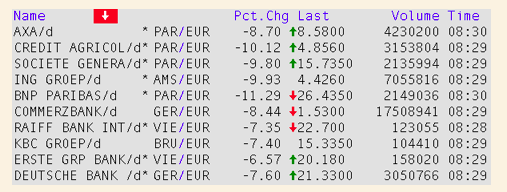
| Jurgen Stark = Credit Anstalt 2.0 (and Euromarkets Reacting Accordingly) Posted: 11 Sep 2011 08:41 PM PDT It is remotely possible that the EU officialdom will temporarily reverse the train wreck that started last Friday with the resignation of Jurgen Stark from the ECB. That was seen as a sign that Germany has adopted bailout fatigue as official policy. That in turn would mean that Greece will not get any more money lifelines (which as commentators predicted some time ago, means a likely banking crisis, which was the reason for them not to exit the Eurozone). Mr. Market is giving a big vote of no confidence in European leadership, although the FTSE has reversed some of its early-session losses. The Dax is down 3.1%, the FTSE is off 1.6% (v. 2.2% earlier), and the CAC is down 4.1%. The Euro is at 1.4 (a recovery from when I started on this post) and gold is off about a half a percent (versus a bit over 1% earlier in the day). But the other big development of last week, the ruling of the German constitutional court on the European Financial Stability Fund, was a major, and likely fatal, blow to the Eurozone. As first our Ed Harrison and more recently Wolfgang Munchau of the Financial Times explain, the ruling makes it well nigh impossible for the Eurozone to implement measures that would create a fiscal authority (such as eurobonds) or even allow for an permanent backstop device (the European Stability Mechanism, due to go live in 2013. Note that the ruling did not address the ESM specifically, but the logic of the ruling appears to make a challenge to the ESM a slam dunk). The other way out is for the ECB to step into the breach and "print", but the Germans have been firmly opposed to that, and Stark's abrupt exit firmly underscored that point. If you had any doubts as to the implications of these actions, the Germans appear to harbor no such illusions. Per Ambrose Evans-Pritchard, this is a calculated effort to put Greece to the lash:
The Eurozone is addicted to a failing remedy. Even if it could get its integration act in gear, austerity, as we predicted, is only making matters worse. Greece's finance minister just revised down the 2011 forecast from a 3.8 % contraction to 5.3%. (An interesting anomaly, as Clusterstock points out, is that Greek debt isn't getting trashed further this morning). And this is clearly a campaign. Reader Swedish Lex points us to a Reuters story, "ECB's Stark tells Ireland to ramp up austerity" with the note, "The man must be mad." Key extracts:
As we've pointed out earlier, Ireland is the poster child of "austerity makes debt hangovers even worse." Its nominal GDP (which is what counts in measuring the impact on ability to pay) has contracted nearly 20%. And while the German actions puts the future of the Eurozone very much in question, the immediate pressure on Greece comes not just from the news out of Germany but also from countries like the Netherlands that are demanding that Greece post more collateral to support the 109 billion euro facility supposedly agreed to last June. The most important casualties of a Greek default would be French and German banks. One of the reasons for the continued sell off is the fear that Moodys will downgrade French banks. A snapshot on the bloodbath, courtesy FT Alphaville (hat tip Ricard Smith):
In the Great Depression, it was the failure of Credit Anstalt that set off a series of banking failures and debt defaults. In our rerun of sorts, it looks like Jurgen Stark's rigid adherence to a failed dogma that will set of an even bigger disaster. So much for the idea that economists had learned from financial crises and developed better reflexes. Economics has to an increasing degree become an exercise in promoting ideologies to defend the privileges of the rentier classes. They look to be about to be hoist on their own petard. Unfortunately, a very large number of innocent bystanders will suffer along with them.
|
| Peter Grandich at GATA Gold Rush 2011 Posted: 11 Sep 2011 08:30 PM PDT Peter Grandich, of The Grandich Letter, talks to the GoldMoney Foundation about gold, silver, platinum and palladium. He explains the US Treasury bubble and that no debt crisis is ever solved by ... |
| Posted: 11 Sep 2011 08:00 PM PDT The price of gold is down below $1,850 per troy ounce for spot gold today as it continues to bounce sharply between $1,800 support level and resistance at $1,900. This movement is like the winding up ... |
| Dimon Says US Banks Should Dictate to Regulators Posted: 11 Sep 2011 06:48 PM PDT Now that Steve Jobs has retired from Apple, Jamie Dimon seems determined to assume his role as the CEO with the most effective reality distortion sphere. You can infer that from the magnitude of the whoppers he is telling and the size of the audience he is trying to bamboozle. But while Jobs' Svengali tendencies have gotten more than occasional mention, they weren't a major failing. Jobs not only saved Apple, but he spearheaded the development of important new product categories. By contrast, Dimon has long been a bully, a smart and capable bully, but a bully nevertheless (I have reports going back to his first year at Harvard Business School, and it takes some doing to be memorably obnoxious by dint of the competition in that category). Now on the surface, Dimon's latest brazen remark isn't quite as gross as my headline suggests. He is merely saying that US banks should not be subject to the new incoming international bank rules, known as Basel III. That might seem to be a narrower statement, but as we show, when you parse his logic, it amounts to banking uber alles. Here is the relevant section of an interview published today in the Financial Times:
Let's start with some background. Treasury secretary Geithner said repeatedly during the Dodd Frank process that the shortcomings in the legislation didn't matter all that much, since having banks carry larger capital buffers would do the trick, and that was coming with Basel III. In other words, Geithner argued the higher capital requirements to be imposed by international rulemaking process was where the critical banking regulatory fix would happen. And this is what Dimon is now, loudly, out to undermine. Let's go to the Dimon argument, such as it is. What about "international" does he not understand? If you want to play outside America's borders, you can expect to be subject to different rules. The Eurozone, much to the consternation of US and UK players, has basically told the Anglo private equity firms to go to hell. They are forbidden both from doing deals in EU countries and from raising funds there unless they register and obey local rules. The Eurozone has gotten sick of rapacious foreign players buying decent European companies, cutting jobs, saddling them with lots of debt, and shrugging their shoulders when they miscalculate (often) and the rent extraction kills the company. The EU rules, among other things, will restrict how much a PE firm could lever up a portfolio company. There is also what I assume is a deliberate misrepresentation on the part of Dimon. The Basel III rules are not implemented verbatim by national regulators; there is a more than a bit of tweaking and adjustment going on. Given the loud support that Geithner has given to the Basel III process (and the damage it would do to the US reputation in international bodies when emerging economies are already questioning the Anglo-Saxon model and demanding a bigger role), it's hard to imagine the US acting on Dimon's demands and repudiating the Basel III process. But he may be using this temper tantrum to get the US implementation to cut some slack on some issues near and dear to his heart. Dimon interestingly assumes that the US can defy the will of other regulators. That's probably true now, given that regulators in advanced economies all seem to adhere to neoliberal dogma. The interesting and glaring exception is the UK, which is forcing its banks to ring-fence their retail operations. The new standards ("Vickers," for the commission's chairman) require a capital cushion of up to 20%, with the largest ringfenced banks having at least 17% of equity and bonds and a further loss-absorbing buffer of up to 3% if "the supervisor has concerns about their ability to be resolved without cost to the taxpayer". If Basel III's 9.5% capital requirement is "anti American", then how "anti British", in Dimon's world, is Vickers? But it isn't at all a given. Dimon's assumption is that he has nothing to lose by pushing for his aggressive ask. But the Eurozone implemented Basel II before the US. Its banks are likely to howl about the costs of the equity and liquidity provisions, but they happen to be preoccupied right now, and the near certainty of further state intervention on their behalf is likely to weaken their ability to press for waivers when the Eurocrisis abates. As we have stated before, both the ECB and the Fed could implement binding requirements on major international banks. Any real bank needs access to the central bank-run settlement systems in the dollar and euro; you need to be a full scale player in those currencies, and going through correspondents to get access to those clearing systems would be very cumbersome and costly (I had a client look at it for the US and conclude it was a non-starter). There is no way for the banks to innovate around these systems. The next bizarre bit in Dimon's rant is his characterization of Basel III as "anti-American." What, because it is named for a Swiss city? If you believe the PR of the US regulators (and this is one case where bank analysts agree with their take), US banks are better capitalized that Eurobanks. Forcing everyone to adhere to new capital standards will work to the competitive advantage of US banks, since they are further along. But anyone with an operating brain cell knows that Dimon's real beef is not on the effect on American bank's competitive standing, but on his pay package, which is a function of its bottom line. Any effort to make banking safer will lower their profits. That is what Dimon objects to; the specifics of his argument are simply to serve as cover for his real beef. Dimon manages to play yet another jingoistic card, acting as if Basel III singles out US banks when a majority of the financial firms subject to the most stringent rules are outside the US. And he raises the truly bizarre specter of "Asian" hordes invading the US. Huh? Does he mean HSBC? I presume not, that's a UK bank. The only Asian bank in the top 10 is Mitsubishi UFJ, and the Japanese are not likely to be in aggressive expansion mode (they've never gotten the knack institutionally of hiring and managing good top level foreigners; I know of a very few Japanese executives who have figured it out and did a good job when they were posted in the US, but as soon as they were rotated back to Japan, their successors made a hash of what they had put in place). The Chinese are even less likely to move in near term (long term is a completely different matter). First, the Chinese were apparently interested in investing in US players in the crisis and were rebuffed. But having worked repeatedly with foreign banks in the US, building a denovo operation (or using small acquisitions as a platform) is a completely different kettle of fish. And going from the Chinese market of heavy state control and limited product scope to the US is like saying a drayage company can operate a supersonic plane because both are in the transportation business. I've seen what a hard time foreign banks have had in the US with a vastly lesser skill gap (one they closed over a period of decades). The Chinese are too far behind skill-wise to constitute a threat in the US until they can acquire the skills via a major acquisition (and that was not the scenario Dimon was hinting at). And it goes without saying that Dimon made clear that he believe that what is good for banks is good for the US, when that has been demonstrably false for at least the last decade. What's striking about Dimon's comments is how brazen they are. He's not making clever, narrowly accurate but substantively misleading comments. Much of what he says and implies is unadulterated bunk. The fact that he peddles this tripe shows how confident he is that his message will go unchallenged. And that in turn reveals that he is secure in his belief that the banks have won the war; all he is caviling about is the speed of the mop-up operation.
|
| Posted: 11 Sep 2011 06:08 PM PDT New World Economics |
| Rising gold price attracts theft Posted: 11 Sep 2011 06:04 PM PDT |
| Posted: 11 Sep 2011 05:56 PM PDT |
| Sept 12, 1919 : Ritual dating from 1919 sets price of gold Posted: 11 Sep 2011 04:43 PM PDT Reuters |
| A More Perfectly Bankrupt Union Posted: 11 Sep 2011 04:23 PM PDT --The sober, level-headed, prudent financial minds are starting to leave the Euro project. Juergen Stark, the European Central Bank's chief economist, tendered his resignation on Friday. He said it was for "personal reasons". That's superficially true, if by personal he meant, "I'm personally opposed to the ECB buying heaps of Spanish and Italian government debt". --You wouldn't exactly call the current state of affairs in Europe a financial civil war. But it sure does feel like the old, anti-inflationary, mostly German guard of European monetary policy is losing a turf war with the new guard. The new guard is probably people like Italy's Mario Draghi, who will become the new ECB president at the end of October. --The new guard is in favour of expanding the European Financial Stability Facility. The new guard is in favour of expanding Europe's political and financial union. The new guard is in favour of using the ECB to buy government bonds at lower interest rates (two-year Greek government debt yields nearly 60% at the moment). The new guard is responsible for what you see on the chart below.  --The Australian market was down as much as three per cent this morning. Is this an over-reaction to far away events that don't have any obvious impact on the Australian economy? After all, if Greece defaults on its debt, it's a Greek problem and a German problem and a European problem. Why should Australian stocks get clobbered because Greece can't pay its bills? --We chatted with Slipstream Trader Murray Dawes about it. Murray reckons the market is failing to hold the price distribution above 4100. The price action this morning has put a lot of recent buying out of the money. That could lead to even more selling. That's what the price action is telling you. --But again, why should Greece matter? Well, a Greek default is going to cause losses for European banks (and for the ECB). Banks will have to be recapitalised. And beyond Greece, there is the issue of losses faced by banks on Italian and Spanish debt too. --In other words, we are right back to where we were in 2007-2008, with basic doubts about the solvency of the banking system. That is what investors have to worry about. In 2008, the freezing up of the credit markets left Australia high and dry. Risk capital hunkered down in US Treasury bonds and notes. --Australia is a nice place for capital to visit when the sun is shining and banks are solvent. But in a synchronised global solvency crisis, the money runs home to momma. The Aussie dollar is trading down at $1.04 to the US dollar. --Is this just another peak of anxiety? We asked our resident German expert, Nick Hubble, to enlighten us on events. His take is below. The Germans bunker down ... or leave The German Federal-Constitutional Court ruling on Wednesday may have gone off without a hitch for the International Bailout Party politicians of Europe. But other unknown unknowns came out to bite. The financial media blamed Friday's European and Wall Street sell-off on the resignation of a senior German central banker. At first it may seem like the media has once again plucked a random event out of the news and attributed the stock markets move to it. But they may be on to something... You see, Juergen Stark is the second senior Bundesbanker to resign in months. Axel Weber, heir to the ECB's top post, left only a few months ago. And here is the key: both resigned, according to German newspaper insiders, because of ECB and Bundesbank internal bickering. Put simply, they both opposed the ECB's policy of buying government bonds. That put them in a minority, making their expected ascendance to ECB leadership problematic. From a German's perspective, those charged with keeping hyperinflation a historical concept are now gone. Germans gave up monetary independence by joining the Euro and they are rapidly losing monetary influence at the ECB. This is dangerous, as it only leaves the Germans with their federal government to hit out at if they want to express displeasure at Europe's policies. Remembering that your editor's German grandmother described these policies as 'blowing German money up other countries backsides', the outlook of German voters does not bode well for pro-bailout governments. And so Chancellor Merkel has responded. Her coalition is drawing up plans to save German banks from Greece's inevitable default. (Inevitable based on the market's current valuation of Greek bonds, which implies a default is more than 90% likely). John Mauldin points out in his free newsletter that the Germans are basing their really bad-case scenario on a 50% default by Greece. That means Greek bondholders would get half their money back. The problem is that a 90% default is more likely, leaving the German plan 40% short. And the Greek default will only be the first round. Imagine the contagion effects. At least the German government is being partially realistic, although there is speculation that won't last either. Outspoken German finance minister, Wolfgang Schaeuble can expect the sack sometime soon in the same way Axel Weber and Juergen Stark did. His views are similar to the central bankers and that puts him in the minority too. Being right comes second to being flexible in politics ... and economics apparently. If Schaeuble leaves, that will leave the rout of anti-bailout Germans complete. The International Bailout Party will be in government in Europe and the US. The euro will be free to fall...or in free fall. Dan Denning, |
| Posted: 11 Sep 2011 04:00 PM PDT |

 Gold is never easy is and only going to get harder. The algorithms are fighting the cash market as margins rise. It is only natural that the cash market takes on more strength when margin is headed to cash anyway.
 The volatility continues as we work our way through September – a traditionally difficult month for equities…


| You are subscribed to email updates from Gold World News Flash 2 To stop receiving these emails, you may unsubscribe now. | Email delivery powered by Google |
| Google Inc., 20 West Kinzie, Chicago IL USA 60610 | |

No comments:
Post a Comment