


Gold World News Flash |

- 9/11 and the War on Terror: Polls Show What People Think 10 Years Later
- Gold is about understanding the events that got us here and how they will unfold
- Closing Tables for Week Ending September 9
- Gold Seeker Weekly Wrap-Up: Gold and Silver Fall Slightly on the Week
- Here Comes The Non-Boring Weekend: G7 Says “Central Banks Ready To Provide Liquidity As Required”
- Gold/Silver Ratio – Pt. 2
- The IMF Proudly Presents.... "Threat To The International Monetary System" Part Three
- The IMF Proudly Presents.... "Threat To The International Monetary System" Part Three
- Gold Price Close Today at 1,856.40 Silver Price Closed Today at $41.57
- The Obama Jobs Plan: 10 Reasons Why It Is A Bad Joke
- If Hitler Was A Goldbug...
- Guest Post: Gold Stocks Prognosis: Catalyst, Please
- Merk sells Euro to buy Australian Dollar
- Jim Rogers: Market At New Low As Euro Sells Off - pt.2
- Here Comes The Non-Boring Weekend: G7 Says "Central Banks Ready To Provide Liquidity As Required"
- Here Comes The Non-Boring Weekend: G7 Says "Central Banks Ready To Provide Liquidity As Required"
- Jim Rogers: What's Next for the U.S.? - pt.1
- Royalties Race in Latin America
- Gold Stocks Prognosis: Catalyst, Please
- Gold Stocks Have The Spotlight
- LGMR: Policymakers "Limit Upside" for Stock Markets
- From Bailouts to Bubbles in a Government-Centric America
- Credit Underperforms As ES Misses VWAP Target Into Close
- The Costs of War
- Sprott: “Silver’s a 30-bagger from here (that’s $1,200 an Oz.)”
- Gold Daily and Silver Weekly Charts - Currency Wars, Margin Hikes, Failed Raids, Silver $1,200
- Jim Rogers Explains To Bob "Not a Cheerleader" Pisani Why He Is Short Stocks, Long Commodities, And Wants Europe To Fail
- Eric Sprott: From Here Silver is a 30 Bagger to $1,200
- Eric Sprott - From Here Silver is a 30 Bagger to $1,200
- The Agony of Defeat – For the Gold Cartel
| 9/11 and the War on Terror: Polls Show What People Think 10 Years Later Posted: 09 Sep 2011 06:00 PM PDT #000099;">Polls Show that Americans Think We Overreacted, Overspent and Weakened Ourselves Through the War on TerrorAs the Brooking Institution reported yesterday, Americans that the government overreacted and overspent in reaction to 9/11:
(Incidentally, top American military leaders agree, saying that the war on terror has weakened our national security). Rasmussen has repeatedly noted that Americans are strongly opposed to further military or other types of intervention in Arab countries:
This was true for Libya. And it is true elsewhere. For example, the overwhelming majority of Americans are also opposed to intervention in Syria. #000099;">Polls Show Widespread Doubt About Official ExplanationsThe results of polls on peoples' beliefs about 9/11 around the world might surprise you:
|
| Gold is about understanding the events that got us here and how they will unfold Posted: 09 Sep 2011 06:00 PM PDT FoFOA
|
| Closing Tables for Week Ending September 9 Posted: 09 Sep 2011 04:07 PM PDT Just below is this week's closing table, followed by the CFTC disaggregated commitments of traders (DCOT) recap for the week ending September 9, 2011.
Continued… Gold and Silver Disaggregated COT Report (DCOT) In the DCOT table below a net short position shows as a negative figure in red. A net long position shows in black. In the Change column, a negative number indicates either an increase to an existing net short position or a reduction of a net long position. A black figure in the Change column indicates an increase to an existing long position or a reduction of an existing net short position. The way to think of it is that black figures in the Change column are traders getting "longer" and red figures are traders getting shorter.
|
| Gold Seeker Weekly Wrap-Up: Gold and Silver Fall Slightly on the Week Posted: 09 Sep 2011 04:00 PM PDT Gold climbed $30.75 to $1885.75 in Asia before it plummeted down to $1823.10 by about 6:30AM EST, but it then rallied back higher in New York and ended with gain of 0.11%. Silver rose to $42.67 before it dropped down to $41.258 and then also rallied back higher in New York, but it still ended with a loss of 2.1%.
|
| Posted: 09 Sep 2011 03:20 PM PDT Courtesy of Zero Hedge The G-7 is in full panic mode. The organization for the prevention of harm to the Status Quo was expected to release a communique possibly over the weekend, but the speed with which one was dropped for mass circulation is stunning and confirms that its members are in full meltdown as [...] 
This posting includes an audio/video/photo media file: Download Now |
| Gold/Silver Ratio – Pt. 2 Posted: 09 Sep 2011 02:46 PM PDT |
| The IMF Proudly Presents.... "Threat To The International Monetary System" Part Three Posted: 09 Sep 2011 02:19 PM PDT It's that time again when the IMF has just telegraphed something very big and very bad is about to happen. But let's back up, and paraphrase our post from March: "Back in April 2010, before Waddell and Reed sold a few shares of ES, effectively destroying the market on news that Europe was insolvent, we made the following observation: "The IMF has just announced that it is expanding its New Arrangement to Borrow (NAB) multilateral facility from its existing $50 billion by a whopping $500 billion (SDR333.5 billion), to $550 billion." Little did we know that our conclusion "something big must be coming" would prove spot on just a month later after Greece, then Ireland, then Portgual, and soon Spain, Italy, Belgium, and pretty much all other European countries would topple like dominoes tethered together by a flawed monetary regime. Well, based on news from Dow Jones we can now safely predict the following: "something bigger must be coming." The specific reason for this prediction was the following: "the International Monetary Fund is expected to soon activate a special funding pool that will boost the fund's ability to prevent or resolve economic crises." Sure enough something bigger came, and then some: Greece received its second bailout package about 4 months later, only to see the entire Eurozone hang by a thread following the political fallout that has since ensued. Well, it is time to shift from the comparative to the superlative: "something biggest must be coming." According to Dow Jones the "International Monetary Fund will likely re-activate a $580 billion resource pool in coming weeks to ensure it has funds to help cover Europe's worsening sovereign-debt crisis, according to several people close to the matter." Why is this a big flashing red light? "According to the IMF, the pool of supplementary resources are only to be activated when "needed to forestall or cope with a threat to the international monetary system." So it is settled: just like on the previous two occasions, the biggest load of feces yet is about to hit the fan. The only real question is: how many trillions will the real global backstopper, China, be forced to match this massive expansion of the former world rescuer with... Also, what comes after "biggest"? From Dow Jones:
And while America is guaranteed to foot the bill once again (with China below the US in terms of priority payments despite its much higher cost basis and implicit investment into Europe), it will do so only on a provisional basis - none of the biggest IMF contributors have enacted the formal quota increase. Which means that the US will be stuck in legal limbo when Europe pulls a Greece, collects American cash, and then finds it has no collateral to pay back with.
There is little we can add here that was not said during one of the two prior massive IMF intervention attepts, both of which predicted a huge global shake up within months. Which is why we will end this post with the same words we ended the previous iteration in the IMF global rescue series: "US taxpayers: our condolences."
|
| The IMF Proudly Presents.... "Threat To The International Monetary System" Part Three Posted: 09 Sep 2011 02:19 PM PDT
It's that time again when the IMF has just telegraphed something very big and very bad is about to happen. But let's back up, and paraphrase our post from March: "Back in April 2010, before Waddell and Reed sold a few shares of ES, effectively destroying the market on news that Europe was insolvent, we made the following observation: "The IMF has just announced that it is expanding its New Arrangement to Borrow (NAB) multilateral facility from its existing $50 billion by a whopping $500 billion (SDR333.5 billion), to $550 billion." Little did we know that our conclusion "something big must be coming" would prove spot on just a month later after Greece, then Ireland, then Portgual, and soon Spain, Italy, Belgium, and pretty much all other European countries would topple like dominoes tethered together by a flawed monetary regime. Well, based on news from Dow Jones we can now safely predict the following: "something bigger must be coming." The specific reason for this prediction was the following: "the International Monetary Fund is expected to soon activate a special funding pool that will boost the fund's ability to prevent or resolve economic crises." Sure enough something bigger came, and then some: Greece received its second bailout package about 4 months later, only to see the entire Eurozone hang by a thread following the political fallout that has since ensued. Well, it is time to shift from the comparative to the superlative: "something biggest must be coming." According to Dow Jones the "International Monetary Fund will likely re-activate a $580 billion resource pool in coming weeks to ensure it has funds to help cover Europe's worsening sovereign-debt crisis, according to several people close to the matter." Why is this a big flashing red light? "According to the IMF, the pool of supplementary resources are only to be activated when "needed to forestall or cope with a threat to the international monetary system." So it is settled: just like on the previous two occasions, the biggest load of feces yet is about to hit the fan. The only real question is: how many trillions will the real global backstopper, China, be forced to match this massive expansion of the former world rescuer with... Also, what comes after "biggest"? From Dow Jones:
And while America is guaranteed to foot the bill once again (with China below the US in terms of priority payments despite its much higher cost basis and implicit investment into Europe), it will do so only on a provisional basis - none of the biggest IMF contributors have enacted the formal quota increase. Which means that the US will be stuck in legal limbo when Europe pulls a Greece, collects American cash, and then finds it has no collateral to pay back with.
There is little we can add here that was not said during one of the two prior massive IMF intervention attepts, both of which predicted a huge global shake up within months. Which is why we will end this post with the same words we ended the previous iteration in the IMF global rescue series: "US taxpayers: our condolences."
|
| Gold Price Close Today at 1,856.40 Silver Price Closed Today at $41.57 Posted: 09 Sep 2011 12:37 PM PDT Gold Price Close Today : 1,856.40 Gold Price Close 02-Sep : 1,873.70 Change : -17.30 or -0.9% Silver Price Close Today : 41.57 Silver Price Close 02-Sep : 43.02 Change : -1.45 or -3.5% Platinum Price Close Today : 1,837.90 Platinum Price Close 02-Sep : 1,884.80 Change : -46.90 or -2.6% Palladium Price Close Today : 737.10 Palladium Price Close 02-Sep : 781.10 Change : -44.00 or -6.0% Gold Silver Ratio Today : 44.66 Gold Silver Ratio 02-Sep : 43.55 Change : 1.10 or 1.03% Dow Industrial : 11,295.81 Dow Industrial 02-Sep: 11,493.57 Change : -197.76 or -1.8% US Dollar Index : 76.23 US Dollar Index 02-Sep : 74.49 Change : 1.74 or 2.3% Important Note: Franklin Sanders is on vacation until the 19th of September. Franklin's parting commentary can be viewed here : http://silver-and-gold-prices.goldprice.org/2011/09/gold-and-silver-prices-today-proved.html While Franklin Sanders is away we will be documenting some of the many charts, calculators, and tools available on goldprice.org and silverprice.org. There are so many of them and we are developing new features all the time, that many of our visitors probably don't know they exist. If you have any questions on how to use any of our charts or feedback please feel free to contact us: goldprice+help@gmail.com Today we are featuring some of our most popular charts. The 3 day chart is great for looking at the short term movements in the gold and silver price. The 3 day charts include the daily high and low price in the top left and the price change in $ and the % change for the last 3 days in the top right. All of these charts we are documenting today are available on our SPOT GOLD page http://goldprice.org/spot-gold.html. You can find a link to this page in the menu of the website or by clicking on the 24 hour chart at the top of the front page. The SPOT GOLD page updates automatically every minute, so there is no need to refresh the page in your browser to get the latest gold price. 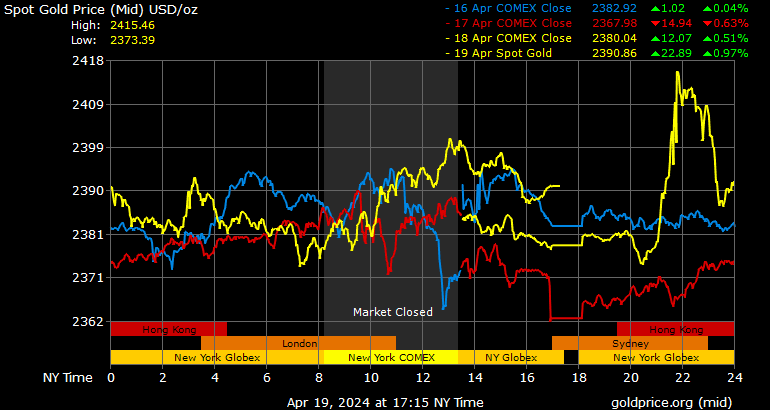 3 day Spot Gold Price Chart - Available at http://goldprice.org/spot-gold.html in 27 national currencies in ounces, grams and kilos. 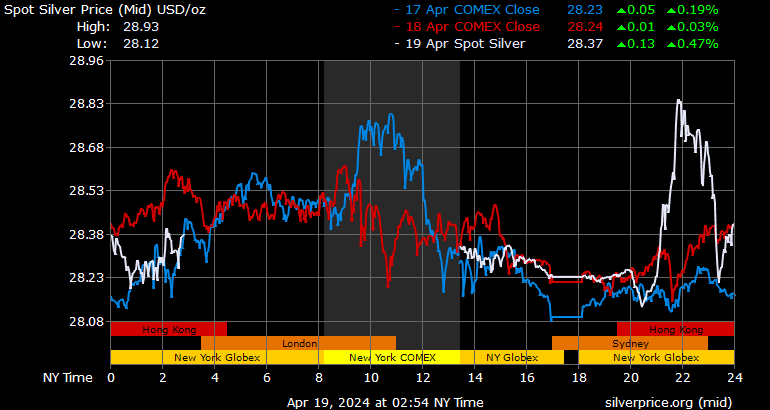 3 day Spot Gold Silver Chart - Available at http://goldprice.org/spot-gold.html in 17 national currencies in ounces and kilos. 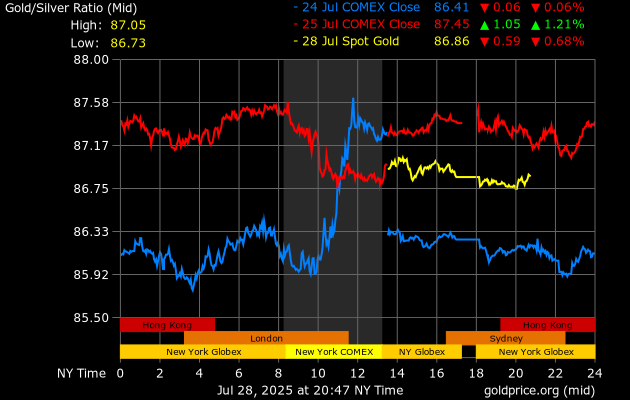 3 day Gold Silver Ratio Chart - Available at http://goldprice.org/spot-gold.html The Silver Gold Ratio Chart is also available.  60 Day Gold Price Chart - Available at http://goldprice.org/spot-gold.html in 27 national currencies in ounce, grams and kilos. Other time frames available include 30, 60 days, 6 months, 1, 2, 5, 10 15, 20, 30 years and all data which goes back to 1973.  60 Day Silver Price Chart - Available at http://goldprice.org/spot-gold.html in 17 national currencies in ounces and kilos. Other time frames available include 30, 60 days, 6 months, 1, 2, 5, 10 15, 20, 30 years and all data which goes back to 1973. 
|
| The Obama Jobs Plan: 10 Reasons Why It Is A Bad Joke Posted: 09 Sep 2011 12:33 PM PDT from The Economic Collapse Blog:
Read More @ TheEconomicCollapseBlog.com
|
| Posted: 09 Sep 2011 11:38 AM PDT ... all it would take to end his regime would be a few CME margin hikes. Of course, if Hitler had somehow survived those 2008 margin calls, we would all be living under the 3rd Reich now with gold at all time highs. And for those who are sick of all the Hitler parodies, here is another one. h/t Igoryek1979
|
| Guest Post: Gold Stocks Prognosis: Catalyst, Please Posted: 09 Sep 2011 10:40 AM PDT Submitted by Jeff Clark of Casey Research Gold Stocks Prognosis: Catalyst, Please It's probably the #1 question on every gold investor's mind right now: Why are gold stocks underperforming gold? Aren't they supposed to bring us leverage to the gold price? Yes, they are, and their performance been both disappointing and puzzling. There are some exceptions, to be sure, but in the majority of cases the stocks are lagging the metal. And it's been happening for most of the year. What's going on? I think part of the answer lies in the state of our current environment. Recent headlines and developments around the globe have ratcheted up fear… from the S&P's downgrade to European bank solvency, from fears of another recession to worse-than-expected unemployment. The nervous climate has pushed investors toward gold for safety, simultaneously reducing the demand for gold equities. You don't say, "Hey, I need a new iPad!" when you live in hurricane alley and a storm is coming. You make sure you've got protection for your family. Likewise, fears of Europe's debt problems ruining their economy don't exactly make investors run out and buy Barrick. They buy gold. First, let's get a handle on how gold producers are performing relative to the metal. Here's a chart that logs the weekly performance of GDX (the Gold Miners ETF) in relation to GLD (the metal ETF). Positive numbers represent the percentage by which GDX outperformed gold that week; negative numbers signal how much it underperformed the metal.
(Click on image to enlarge) As you can see, while there have been periods this year when gold stocks have outperformed the metal, roughly half the time they haven't kept pace with surging gold prices. This is not the picture of an asset that's supposed to bring a leveraged return to gold. So what's going to move them? If I were a physician and gold stocks were my patient, I'd say, "Take two catalysts and call me in the morning." Like some of these… Less Fear, More Greed: We probably need a shift in the investing climate before gold stocks excel like we want and expect. An environment full of fear will draw investors toward safe havens and away from stocks. We don't necessarily need a "roaring twenties" type of atmosphere (though that would help); we just need one where there's a lack of constant bad news. Once investors feel the sharks have left the beach, they'll be more apt to look for ways to gain a higher return than metal can bring. What if Doug Casey is right about a Greater Depression, and fear is high for years? I think the better gold stocks still outperform in that environment. For starters, investors may fear that other assets won't make much money; this has been the case with the S&P this year… and bonds could be next. A shift into stocks could also take place when inflation turns higher, as investors scramble to earn a higher real return. Last, history has shown that the natural progression is to move from the metal to the equities in a bull market. I think that's our future, sooner or later. Keep in mind the good news here: The gold you own is performing exactly as it should be in response to current events. We own gold for protection against the very things for which it's supposed to provide shelter: failing currencies, lagging economies, and fear of inflation. This is proof that holding gold has been the right call and will continue to be the right call for the foreseeable future. I don't know when the shift from fear to greed will take place, but I'm convinced it will. And I suspect that the change in sentiment could be sudden. Competitive Dividend Yields: Many gold companies have increased their dividend payments over the past year. In fact, every gold producer in the BIG GOLD portfolio except one has initiated or increased its dividend this year, many of them several times. Growing dividends could raise the eyebrows of investors and broaden the investor base. That said, this is not a catalyst that will kick in next week. The current dividend yield of the gold industry is 0.75% (GDX is 0.70%); while this is up significantly since 2001, it is still less than half the S&P average of about 2.0%. However, as yields approach the levels of the broader market, institutional investors will be drawn to our little sector. Gold stocks could become core holdings, opening the door to an entirely new audience of investors. That's a group that could light a fire under prices. Governments: The CME hiked margin requirements on gold twice recently and five times on silver earlier this year. At some point a hike could be one too many, prompting investors to slow down on gold and turn to the undervalued equities to capture bigger returns. Another catalyst could be a government announcing they're lowering tax rates on miners – a shock in the current rapacious environment that could see new money pour into the sector overnight. The Usual Suspects: The usual sparks could ignite interest in gold stocks: a company announcing a large gold discovery… a sudden or unexpected surge in inflation… the gold price soaring 20% overnight due to some world-changing event... the public recognizing the potential in gold stocks and not just gold. Or how about a well-known investor or analyst outside the gold industry announcing he's buying gold stocks? Could you imagine the impact on our tiny sector if, say, Warren Buffett declared he was adding gold companies to his portfolio? (He's not exactly pro-gold, but you get the idea.) I'm not saying any of these things will come to pass or are imminent. There are certainly other potential catalysts, too. My point is that sooner or later investors will be drawn – or perhaps even forced – into buying gold stocks. The investment implications here are twofold. First, if I'm right, then the strategy should be to buy when shares are relatively cheap and hold for the duration of the bull market. You may think we'd suffer "opportunity loss" if we have to wait too long, but that could be a dangerous game; you could buy after they take off and miss out on some of the easier gains. Further, I don't know of another sector that is both cheap and imminently poised to break out. The second implication is that corrections wouldn't be a time to get out, but a time to consider getting in. The ultimate prognosis, in my opinion, is that gold stocks are headed much higher. Sooner or later a catalyst will ignite interest in our sector, and the rush will be on. Now is the time to build positions in the stocks you want to own.
|
| Merk sells Euro to buy Australian Dollar Posted: 09 Sep 2011 10:22 AM PDT Given that many know Merk Investments as "euro bulls", arguing that the euro can thrive despite all the turmoil in the Eurozone, we wanted to share with our investors and the public that in our hard currency strategy, currently with over $700 million in assets, we sold over U.S. $90 million worth of euros late Thursday to re-allocate to the Australian dollar. This re-allocation was an acceleration of a recent trend to deploy euro holdings elsewhere. The strategy is now underweight in euros. Our move was motivated by recent European Central Bank (ECB) and U.S. Federal Reserve communication: [LIST] [*]A more dovish tone by ECB President Trichet leads us to believe the ECB may err on the side of easing earlier than previously anticipated; the ECB raised interest rates twice earlier this year. A rate cut may take place in the Eurozone as early as next month so that Trichet's successor Mario Draghi, who will succeed Trichet this November, won’t hav...
|
| Jim Rogers: Market At New Low As Euro Sells Off - pt.2 Posted: 09 Sep 2011 10:07 AM PDT A look at what's happening with the euro/dollar relationship and what's next for currencies, with Jim Rogers
|
| Posted: 09 Sep 2011 10:04 AM PDT The G-7 is in full panic mode. The organization for the prevention of harm to the Status Quo was expected to release a communique possibly over the weekend, but the speed with which one was dropped for mass circulation is stunning and confirms that its members are in full meltdown as the weekend comes. It is now certain that the G-7 will attempt some major intervention over the next 48 hours to inject a last dose of hope into capital markets, or else the Monday open will be an epic collapse. G-7 Statement on Tackling Slowdown, Supporting Banks "We met at a time of new challenges to global economic recovery, with significant challenges to growth, fiscal deficits and sovereign debt, stemming from past accumulated imbalances. This is reflected in heightened tensions in financial markets. There are now clear signs of a slowdown in global growth. We are committed to a strong and coordinated international response to these challenges. "We are taking strong actions to maintain financial stability, restore confidence and support growth. In the U.S., President Obama has put forward a significant package to strengthen growth and employment through public investments, tax incentives and targeted job measures, combined with fiscal reforms designed to restore fiscal sustainability over the medium term. Euro area countries are implementing the decisions taken on July 21 to address financial tensions, notably through the flexibilization of the EFSF, reaffirming their inflexible determination to honor fully their own individual sovereign signatures and their commitments to sustainable fiscal conditions and structure reforms. Japan is implementing substantial fiscal measures for reconstruction from the earthquake while ensuring the commitment to medium-term fiscal consolidation. "Concerns over the pace and future of the recovery underscore the need for a concerted effort at a global level in support of strong, sustainable and balanced growth. We must all set out and implement ambitious and growth-friendly fiscal consolidation plans rooted within credible fiscal frameworks. Fiscal policy faces a delicate balancing act. Given the still fragile nature of the recovery, we must tread the difficult path of achieving fiscal adjustment plans while supporting economic activity, taking into account different national circumstances. "Monetary policies will maintain price stability and continue to support economic recovery. Central Banks stand ready to provide liquidity to banks as required. We will take all necessary actions to ensure the resilience of banking systems and financial markets. In this context we reaffirm our commitment to implement fully Basel III. "We reaffirmed our shared interest in a strong and stable international financial system, and our support for market- determined exchange rates. Excess volatility and disorderly movements in exchange rates have adverse implications for economic and financial stability. We will consult closely in regard to actions in exchange markets and will cooperate as appropriate. "We look forward to working with our colleagues in the G20 and the IMF in the coming weeks to rebalance demand and strengthen global growth. As previously agreed, structural reforms will make an important contribution in this regard."
Translation: the great experiment in encroaching statism, failed monetary policy and central planning continues... Until imminent failure.
And select soundbites of last ditch desperation courtesy of Reuters:
FRENCH FINANCE MINISTER FRANCOIS BAROIN "The G7 reaffirmed its comittment to safeguarding the solidity of sovereign ratings." "We have to get away from the idea there is only one solution for all... It's not rigour versus growth." "It was a G7 where everything was raised. There was no dead time." BANK OF FRANCE GOVERNOR CHRISTIAN NOYER "There is an extreme tension on the markets, what's important is that very strong measures are taken by governments concerned." "It was really a meeting of great cohesion and force. There was a determination by everyone to meet challenges." G7 OFFICIAL "The G7 sees a need for a concerted effort at global level in support of strong, sustainable and balanced growth. "We must all set out and implement ambitious and growth-friendly fiscal consolidation plans rooted within credible frameworks. "The G7 affirmed its interest in a strong, stable international financial system." EARLIER COMMENTS U.S. TREASURY SECRETARY TIMOTHY GEITHNER "It is completely within the capacity of the stronger members of the euro area to absorb those costs. Those costs would be much, much greater for them and their economies if they sit here and do nothing and they recognize that." CANADIAN FINANCE MINISTER JIM FLAHERTY "I hope we would all agree we have to stay the course, that we have to go through the pain of fiscal consolidation. It's not easy, it creates stresses in some countries, but it's necessary, we have to get through this rough patch. "There's no point kicking the can down the road. If we don't deal with it now we'll have to deal with it later and we know that these problems do not get better with the passage of time." EU ECONOMIC AND MONETARY AFFAIRS COMMISSIONER OLLI REHN "We support the United States in its work so that the U.S. recovery can continue, while in Europe we have our own challenges related to fiscal consolidation and restoring confidence in the European economy." On bank funding: "Solutions should be found from private markets, from private investors and if that is not is possible there should be national backstops in place to ensure recapitalisations or restructuring for these banks."
|
| Here Comes The Non-Boring Weekend: G7 Says "Central Banks Ready To Provide Liquidity As Required" Posted: 09 Sep 2011 10:04 AM PDT
The G-7 is in full panic mode. The organization for the prevention of harm to the Status Quo was expected to release a communique possibly over the weekend, but the speed with which one was dropped for mass circulation is stunning and confirms that its members are in full meltdown as the weekend comes. It is now certain that the G-7 will attempt some major intervention over the next 48 hours to inject a last dose of hope into capital markets, or else the Monday open will be an epic collapse. G-7 Statement on Tackling Slowdown, Supporting Banks "We met at a time of new challenges to global economic recovery, with significant challenges to growth, fiscal deficits and sovereign debt, stemming from past accumulated imbalances. This is reflected in heightened tensions in financial markets. There are now clear signs of a slowdown in global growth. We are committed to a strong and coordinated international response to these challenges. "We are taking strong actions to maintain financial stability, restore confidence and support growth. In the U.S., President Obama has put forward a significant package to strengthen growth and employment through public investments, tax incentives and targeted job measures, combined with fiscal reforms designed to restore fiscal sustainability over the medium term. Euro area countries are implementing the decisions taken on July 21 to address financial tensions, notably through the flexibilization of the EFSF, reaffirming their inflexible determination to honor fully their own individual sovereign signatures and their commitments to sustainable fiscal conditions and structure reforms. Japan is implementing substantial fiscal measures for reconstruction from the earthquake while ensuring the commitment to medium-term fiscal consolidation. "Concerns over the pace and future of the recovery underscore the need for a concerted effort at a global level in support of strong, sustainable and balanced growth. We must all set out and implement ambitious and growth-friendly fiscal consolidation plans rooted within credible fiscal frameworks. Fiscal policy faces a delicate balancing act. Given the still fragile nature of the recovery, we must tread the difficult path of achieving fiscal adjustment plans while supporting economic activity, taking into account different national circumstances. "Monetary policies will maintain price stability and continue to support economic recovery. Central Banks stand ready to provide liquidity to banks as required. We will take all necessary actions to ensure the resilience of banking systems and financial markets. In this context we reaffirm our commitment to implement fully Basel III. "We reaffirmed our shared interest in a strong and stable international financial system, and our support for market- determined exchange rates. Excess volatility and disorderly movements in exchange rates have adverse implications for economic and financial stability. We will consult closely in regard to actions in exchange markets and will cooperate as appropriate. "We look forward to working with our colleagues in the G20 and the IMF in the coming weeks to rebalance demand and strengthen global growth. As previously agreed, structural reforms will make an important contribution in this regard."
Translation: the great experiment in encroaching statism, failed monetary policy and central planning continues... Until imminent failure.
And select soundbites of last ditch desperation courtesy of Reuters:
FRENCH FINANCE MINISTER FRANCOIS BAROIN "The G7 reaffirmed its comittment to safeguarding the solidity of sovereign ratings." "We have to get away from the idea there is only one solution for all... It's not rigour versus growth." "It was a G7 where everything was raised. There was no dead time." BANK OF FRANCE GOVERNOR CHRISTIAN NOYER "There is an extreme tension on the markets, what's important is that very strong measures are taken by governments concerned." "It was really a meeting of great cohesion and force. There was a determination by everyone to meet challenges." G7 OFFICIAL "The G7 sees a need for a concerted effort at global level in support of strong, sustainable and balanced growth. "We must all set out and implement ambitious and growth-friendly fiscal consolidation plans rooted within credible frameworks. "The G7 affirmed its interest in a strong, stable international financial system." EARLIER COMMENTS U.S. TREASURY SECRETARY TIMOTHY GEITHNER "It is completely within the capacity of the stronger members of the euro area to absorb those costs. Those costs would be much, much greater for them and their economies if they sit here and do nothing and they recognize that." CANADIAN FINANCE MINISTER JIM FLAHERTY "I hope we would all agree we have to stay the course, that we have to go through the pain of fiscal consolidation. It's not easy, it creates stresses in some countries, but it's necessary, we have to get through this rough patch. "There's no point kicking the can down the road. If we don't deal with it now we'll have to deal with it later and we know that these problems do not get better with the passage of time." EU ECONOMIC AND MONETARY AFFAIRS COMMISSIONER OLLI REHN "We support the United States in its work so that the U.S. recovery can continue, while in Europe we have our own challenges related to fiscal consolidation and restoring confidence in the European economy." On bank funding: "Solutions should be found from private markets, from private investors and if that is not is possible there should be national backstops in place to ensure recapitalisations or restructuring for these banks."
|
| Jim Rogers: What's Next for the U.S.? - pt.1 Posted: 09 Sep 2011 09:47 AM PDT The dollar a massive move against the euro today as yields on Greek government bonds hit new highs. Where the dollar is headed, with Jim Rogers
|
| Royalties Race in Latin America Posted: 09 Sep 2011 09:40 AM PDT Author: Vedran Vuk Synopsis: As the prices of gold, silver, and other metals continue to rise, a severe case of royalty fever has struck Latin America. And it could spread to the US and Canada. Dear Reader, Though we're soon to be reminded of 9/11 with another anniversary, I don't think that many folks deeply consider why the World Trade Center was attacked. I don't mean this statement in a geopolitical or foreign policy sense. Most people have some clear opinion from that angle. I'm specifically referring to the prime target – the World Trade Center (WTC). Why not any other buildings? Timothy McVeigh's bombing in Oklahoma City sent shockwaves around the country as well. The terrorists didn't have to choose the World Trade Center complex. For one thing, the WTC was a symbol of America and New York City. Yes, that's clearly obvious; however, it's symbolic in a very ...
|
| Gold Stocks Prognosis: Catalyst, Please Posted: 09 Sep 2011 09:34 AM PDT It's probably the #1 question on every gold investor's mind right now: Why are gold stocks underperforming gold? Aren't they supposed to bring us leverage to the gold price? Read More...
|
| Gold Stocks Have The Spotlight Posted: 09 Sep 2011 09:08 AM PDT Morris Hubbartt Weekly Market Update Excerpt posted Sep 9, 2011 US Dollar Dead Cat Chart Dollar Commentary [LIST] [*]All fiat currencies appear to be in a race to the bottom. When a nation’s currency is based on the questionable word of a man, rather than real assets of a nation, at minimum, there is a substantial door that opens up for… abuse. Without the fiat currency of the United States government, reckless spending could not have occurred to the degree that we all have lived through, in horror. CNBC seems to want you to believe that gold is a bubble. I think what is happening is an awakening. [*]The great gold awakening has begun. The US government keeps spending without pause. Your government’s only solution to the crisis is to have the Federal Reserve monetize more and more debt. These policies could create worldwide inflation. The dollar moved a bit higher on Tuesday, but not due to its own strength. This tiny rally was simply due t...
|
| LGMR: Policymakers "Limit Upside" for Stock Markets Posted: 09 Sep 2011 08:59 AM PDT London Gold Market Report from Ben Traynor BullionVault Friday 9 September, 08:20 EDT Gold Continues "White-Knuckle Ride" as "Uninspiring" Policymakers "Limit Upside" for Stock Markets U.S. DOLLAR gold prices plunged sharply Friday morning in London, hitting a low of $1826 per ounce – 4.9% down on Tuesday's all-time high – while stocks and commodities also fell and European government bonds gained. Going into the weekend, the gold price at Friday lunchtime looked headed for 3.3% weekly drop after speeches from US and European policymakers did little to calm market nerves. "Gold prices enjoyed a white-knuckle ride this week," says a note from French investment bank Natixis. "There are very good reasons why people long on gold may be taking profits," Jesper Dannesboe, analyst at Societe Generale, told Bloomberg this morning when asked about Friday morning's sudden drop. Dannesboe cited a stronger Dollar, as well as the technical explanation that gold prices are forming a s...
|
| From Bailouts to Bubbles in a Government-Centric America Posted: 09 Sep 2011 08:53 AM PDT The Dow Jones Industrial Average tumbled 119 points yesterday because, according to Bloomberg News, Ben Bernanke "avoided offering new growth plans." The Dow continued plummeting another 300+ points today because President Obama is not doing enough to "create jobs" and the European Central Bank is not doing enough to prevent a Greek default. All-in, the Dow has shed nearly 500 points because central banks and politicians are not doing enough to fix the stuff that's broken. (The carnage in the European stock markets has been even more grisly). Perhaps the problem is exactly the opposite — central bankers and politicians are meddling so incessantly that the stuff that's broken has no opportunity to repair itself. It's true that the Federal Reserve Chairman, throughout his speech in Minneapolis yesterday, refrained from promising a new barrage of monetary stimulus measures. But he did not say he would do nothing. To the contrary, he assured his audience, "the Federal Reserve has a range of tools that could be used to provide additional monetary stimulus… The Federal Reserve will certainly do all they can to help restore high rates of growth and employment in a context of price stability." The stock market did not seem to believe him…or care. But the gold market had no doubts. With every word the Chairman uttered about "additional monetary stimulus," the gold price ratcheted higher. By the end of the New York trading day, the gold price had jumped $53 dollars an ounce to $1,870. The comatose stock market — like the lively gold market — can trace its roots to an economy that made a few wrong turns during the last few years. The lousy stock market and robust gold market can also trace their roots to governments that refuse to let failure fail. Instead of letting failure fail, a succession of Federal Reserve Chairmen, Treasury Secretaries, Presidents and Congressmen have chosen to help failure succeed…or at least to not hurt very much. Every time the slightest hint of adversity drifted our way, out came the rescue packages and stimulus measures to make sure that no harm came to those who deserved it. Thus the bailout of Long-Term Capital Management in 1998 begat the Nasdaq Bubble of 1999, which begat the Housing Bubble of 2005-6. Throughout this bubble era, the US economy seemed relatively robust. So almost no one bothered to worry about the long-term side-effects of failure-prevention. And even fewer folks seemed to worry about the expanding reach of the Federal government into almost every aspect American life. The tragedy of September 11, 2001 opened the door to this sweeping federal intrusion. And that door remains open to this day. The tentacles of state-sponsored do-gooding and we-know-what's-best-for-you regulation are blindly flailing about in every aspect of America life and latching on to whatever happens to pass within their reach. This coming weekend, we Americans will solemnly recall the tragic events of September 11, 2001. Ten years have passed since that infamous day, but the agony of bereavement remains as acute as ever for those who lost loved ones in the Twin Towers. No pain can compare to the pain of losing someone who had made your life worth living. It is simply a tragedy…and there were 3,497 such tragedies on 9/11. But the tragedies of 9/11 would not end that day. Instead, they would multiply. 9/11 triggered a national response that has produced a very long and lamentable list of tragedies, great and small. Topping the list of tragedies, 4,683 US soldiers and 100,000-plus Afghani and Iraqi civilians have perished since the launch of "Operation Enduring Freedom" on October 7, 2001. Lesser tragedies would include the death of various American civil liberties, the creation of the Transportation Safety Administration and the rebranding of the "US Customs Service" as "US Customs and Border Protection." "Customs Service" sounds civilized and helpful, "Customs and Border Protection" sounds savage and paranoid. Perhaps the subtle name change means nothing at all, or perhaps it means everything about where we are heading as a nation. US customs agents strut around the baggage claim area of international flights, packing loaded SIG-Sauer P229Rs on their hip. Really? Is this necessary? When was the last time you read about a shootout at baggage claim? Couldn't a friendly guy or gal, armed only with a smile, get the job done just as well…or better? Not anymore, apparently. Not in post-9/11 America. Eric Fry From Bailouts to Bubbles in a Government-Centric America originally appeared in the Daily Reckoning. The Daily Reckoning provides 400,000+ readers economic news, market analysis, and contrarian investment ideas. The 5 Best Ways to Invest in Gold was previously featured in the Daily Reckoning.
|
| Credit Underperforms As ES Misses VWAP Target Into Close Posted: 09 Sep 2011 08:52 AM PDT The algo-driven levitation of the last hour or so today seemed all about making it back to the magical VWAP line so more selling could occur but even though we were rising, average trade size rose notably into the cash close which is very suggestive of pros selling into the lift (as deltas were definitely weak). This little burst was enough to drag equity into outperformance today relative to credit markets which had a very weak day.
Chart: Bloomberg It certainly didn't have the normal Friday liftathon into the close feel and we note that IG and HY credit indices closed pretty much at their wides of the day - HY +54bps at 737bps and IG +7bps to 132bps. These are among the largest single-day close-to-close moves in these indices we have seen.
Single-names outperformed the indices (though were still notably wider with massively weak breadth) as it was clear that broad risk overlays were preferred (liquidity) and that stress was even more evident with bid-ask spreads widening throughout the day. For some context of where stand in credit spread land - the charts above and below show HY has taken out JUN10's wides while IG remains just below those same-period wides (which makes sense from a risk aversion/cycle perspective). HY spreads are now back to NOV10 levels.
Cash bond markets saw net-buying from the buy-side which quite frankly surprised us a little though given the focus of net-buying in 1-3Y and >12Y and net-selling in 3-12Y - we suspect some were playing a more levered version of the QE3-off trade (the butterfly compression). TSY 2s10s30s fell significantly further to as low as 40bps and we note TSYs (ended the week 5-7bps lower in yield from last Friday.
A little more apples-to-apples comparison of credit spreads (the above charts reflect the back-adjusted on-the-run CDS indices and hence contain a string of slightly differing composition portfolios), the chart below shows the current series 16 portfolios intrinsic values over the past 21 months or so. The picture is similar in terms of HY underperforming IG relative to last summer's decompression but it is very clear that while these levels are wide, they are hardly unprecedented and furthermore, so many transitory onlookers forget how quickly a liquidity event becomes a drama in HY credit markets - especially when new issue concessions (if there is ever a HY bond issued again) will reprice secondaries and start the ramp wider going again.
Yesterday, we discussed the nuances of the index options vol market and the fact that implied correlation was sending us a message - well we heard it loud and clear today as the market cracked and implied correlation rose to record highs for Jan2012 expiration. Realized correlations remain very high (but typically it is IG correlations that drop faster as low beta names are picked up first in any sustainable recovery from a fall). HY names remain very systemically driven - which is something we have discussed for a while as broad hedges are applied to cover portfolios that are too big to unwind into the illiquid circus for now - as the basis widens (which it has done even more this week), the risk managers start to come knocking and liquidations occur (though everything could just come up roses of course). We do note that correlations will be biased to turning back up as the latter days of the rolling 20-day window drop off.
Metals and oil ended the day lower though Gold was the best performer with a drop of around 0.7% as opposed to copper -3.5% and oil -2.1% though given the strength in the USD (DXY +1.27% perhaps not entirely surprising). EUR was among the weakest and JPY strongest currencies relative to the USD today - hardly reassuring as the G-7 meets this weekend.
Charts: Bloomberg
|
| Posted: 09 Sep 2011 08:43 AM PDT Addison Wiggin – September 9, 2011
With the 10th anniversary of Sept. 11 on Sunday, there's a "specific, credible" terrorism threat involving Washington. Or maybe it's New York. The threat is "unconfirmed" and the government officials who put it out there yesterday — anonymously — presented no evidence to support its existence. But "there were very, very specific facts that were made known in this threat," said Rep. Peter King (R-N.Y.). "I would tell people right now to go about their lives. There's no need to panic. We don't know if this threat is real yet.." And so it goes. For the last 10 years: Go about your life… but be afraid. If these terrorism threats seem rather vague and amorphous… imagine calculating the total cost of the decade post-Sept. 11 in money and in personal liberty. Approaching the anniversary of the largest terrorist attack on U.S. soil, we found such a task a bit too daunting. So we rounded up a few nuggets of pertinent data we thought you might find useful instead. Fair warning, today's is one somber issue of The 5.
You'll recall it was $14.29 trillion in the buildup to the phony summer showdown in Washington. Then it was raised $400 billion on Aug. 2. But that was only enough to tide Uncle Sam over until next week. So another $500 billion came yesterday when the president requested it and the Senate went along. This is supposed to keep Uncle Sam borrowing worry-free for another four or five months. And has nothing to do with the additional "jobs" spending the president proposed in his bicameral address before Congress last night.
That's if you go by the record so far: Add up the wars in Iraq, Afghanistan, Pakistan, Libya, Yemen and Somalia… plus the cost of veterans' health care, plus the Homeland Security complex, plus interest on the debt incurred for these other war-related expenses. "If all the wars were to end today without a single penny appropriated for military operations, etc., for the upcoming fiscal year (2012)," according to Winslow Wheeler of the Center for Defense Information, "the federal costs already incurred would be from $3.2-3.9 trillion." "If the wars were to run their course — as currently (and optimistically) estimated by the Congressional Budget Office — the costs (together with additional interest payments for the required deficit spending out to the year 2020) would come to an additional $1.45 trillion." "All that would make a total cost from $4.7 to $5.4 trillion — assuming everything in the future goes according to plan." As wars always do…
"I am off of the committee if we are going to talk about further defense cuts," he told the American Enterprise Institute on Wednesday. "Cuts" in Washington-speak means trimming the rate of spending growth, not actually shrinking the spending. And that's still enough for Kyl to announce he would step down from a committee that had yet to hold its first meeting.
The deficit is "hovering around $1.6 trillion for the current fiscal year," he notes. As for Afghanistan, "the United States is spending $10 billion per month in hope of pacifying a country with a total annual gross domestic product of perhaps $27 billion." Correcting these two things, Bacevich submits, will "staunch the hemorrhaging of American power." Perhaps, it's too late. But professor Bacevich's argument is worth considering — especially as he examines how we reached this state. He traces it even farther back than Sept. 11 — as you can see in today's Whiskey & Gunpowder.
The Patriot Act authorized "sneak and peek" search warrants — where you, the suspect, don't have to be notified of the search until after the fact. If you're a patriot and thought those powers would be used to fight terrorism, well you would be wrong. 
A similar complex is being built near San Antonio. By 2015, according to journalist James Bamford, the NSA will store data equivalent to 1 septillion printed pages. That's a 1 followed by 24 zeroes. "Somewhere between Sept. 11 and today," wrote Bamford yesterday, "the enemy morphed from a handful of terrorists to the American population at large, leaving us nowhere to run and no place to hide…" "At the NSA, thousands of analysts who once eavesdropped on troop movements of enemy soldiers in distant countries were now listening in on the bedroom conversations of innocent Americans in nearby states…" "A surveillance system capable of monitoring 10 million people simultaneously this year will be able to monitor 100 million the next year — at probably half the cost. And every time new communications technology appears on the market, rest assured that someone at the NSA has already found a way to monitor it. It's what the NSA does." Isn't technology great?
The answer turns up on a micro level with stories like the one we had last week in New England — where the Vermont National Guard's helicopters, sorely needed for flood relief, were stuck instead in Iraq. And it turns up when government can no longer afford to follow through on its promises — like Social Security benefits. That's why future benefits are due to be keyed to an even lower phony rate of inflation than they are now. This is another wrinkle to the forecast we issued this summer — about an unsustainable government spending spree and the consequences it will have for you, very close to home. If you haven't reviewed this forecast in a while, give it a look today. It's just as relevant now.
No wonder, given that the hints of a $300 billion scheme turned out to be $447 billion — most of which is to be made up by spending cuts or tax increases that are supposed to be enacted by future Congresses with reps and senators as yet unelected and unknown. The intent of the bicameral session, we suppose, was to ensure confidence in the "professional politicians." If the markets are any indication, "the public" didn't like being chastised for and asked to pay more for the nation's unemployment rate.
Meanwhile, a top official in the European Central Bank, Juergen Stark, is stepping down for "personal reasons." Stark is one of the hawks who opposed the ECB's decision last month to print money by buying bonds of the PIIGS countries. Major European indexes closed down 3-4% today. Analysts at Morgan Stanley are anticipating a dramatic announcement before Asian markets open on Sunday night in North America: "The negative feedback loop between weak growth and soggy asset markets makes a coordinated monetary policy easing move more likely — perhaps as early as the G7 meeting this weekend." "The Fed, the ECB, the BoJ and the BoE could all participate in a coordinated move with a mix of rate cuts and quantitative easing." Ooh, shades of 2008 and Hank Paulson coming up with a new plan to save the world every Sunday — can't wait.
The dollar index, as a result, has zoomed above 77 to a six-month high. [Ed. Note: As a result of these moves, it's been a very good week for readers of Strategic Currency Trader. Not only did Abe Cofnas nail it with his call for a sharply weaker Swiss franc — that was good for nearly a double in a week's time — there are also these gains:
Even if the other half doesn't work out by day's end, that's still impressive for three recommendations Abe made only three days ago. But that's how it works in the market Abe follows — Everything plays out in a week or less. He'll issue a new batch of recommendations on Monday. If you'd like to be on board, here's where to begin.]
Not bad in light of the dollar's strength, eh? Silver, meanwhile, trades for $42.22.
For Ashley Madison, a website that describes itself as a "married dating service for discreet encounters," business started taking off in early 2009  In hard times, "who wants to pay $40,000 for a divorce when you can pay $49 for an affair?" Noel Biderman, CEO of the site's parent company, asks CNBC. For that sum, you're able to chat with about 20 other members, umn, discreetly. "We're not a recession-proof business, we're a recession-growth business," he says. Business is especially strong, he says, in housing-bust states like Michigan, Nevada and Arizona. "People are basically confessing in their profile," says Biderman, "that 'the marriage is really over — we're just waiting for the market to recover.'" Hmmnn, could be a long wait.
"Private-sector jobs are lost when the middle class is struggling to make ends meet and can't buy goods and services at a normal rate; private-sector jobs are created when badly needed construction work is performed on our infrastructure and the end result is the spending ability of middle-class families increases and businesses can sell more product." "Please keep your salt handy when this kind of garbage is spouted by so-called experts who cannot see the reality in our economy. You would be better off listening to Sen. Bernie Sanders. He actually gets it." The 5: Oy. "So corporations are the enemy and the government is our best friend," writes Mr. Pento in reply. "Let me ask you a question. When the government spends money, where does the money come from? Since they don't have a factory or a mine on Mars, they take it from you — the productive portion of the economy. Government funds are sourced either honestly through direct or deferred taxation or through inflation, which is a regressive and furtive form of taxation." "The middle class takes it on the chin either way. Especially when a government has borrowed so much money that it has outstripped the tax base. That's where we are now in America. Our ability to borrow and print money with impunity has come to an end. The U.S. now faces the end of the dollar as the world's reserve currency. We are on the precipice of rapidly rising interest rates, intractable inflation, falling GDP, increased taxation and a completely eradicated middle class." "The president's plan calls for us to borrow yet more money to spend on whatever 'the government' deems necessary. The problem here is that the government is a miserable allocate of capital. There is no vetting process to determine if the money 'invested' will increase the productive capacity of the economy or improve our standard of living." "Therefore, nonviable construction projects are allowed to persist, yet the debt will remain and accumulate. The president seems to have missed the fact that gross debt as a percentage of GDP is now at 100% and growing at a 10% of GDP per annum." "The trend cannot end well."
"My guess is the federal bank examiner folks were directed to lean on their banks to get loans moving or they were going to make life miserable for them. "If you look at the new job postings on a service like Topix in my area you see a large percentage of the very recent postings are for the Army National Guard, the Veterans Administration Hospital and other government or government-supported agencies. They did not need anyone two months ago, but now they need a lot of new employees." "Seems like the current administration has commanded its minions to create jobs so unemployment will go down. It does not matter whether they need new people or not. It does not matter whether the new loans meet the bank's normal lending criteria or not. Obama needs the reported numbers to improve if he hopes to be re-elected." "Just wondering if other 5 readers had observed anything similar in their areas?" The 5: Well, what say ye? While you're thinking it over, have a good weekend, Addison Wiggin P.S. The date Sept. 11 means different things to different people. In Chile, Sept. 11, marks the date in 1973 when the United States carried out "regime change." A military coup overthrew the elected government of Salvador Allende. "I don't see why we need to stand by and watch a country go communist due to the irresponsibility of its own people," said Secretary of State Henry Kissinger at the time. "The issues are much too important for the Chilean voters to be left to decide for themselves." And with that, the 16-year rule of Gen. Augusto Pinochet was ushered in. It turned out to be one of Latin America's more brutal dictatorships — replete with torture, murder, even a car bombing on Embassy row in Washington, D.C., targeting the former foreign minister.  Coming to a Country Near You? Limits |
| Sprott: “Silver’s a 30-bagger from here (that’s $1,200 an Oz.)” Posted: 09 Sep 2011 08:39 AM PDT Eric King interviews Eric Sprott
|
| Gold Daily and Silver Weekly Charts - Currency Wars, Margin Hikes, Failed Raids, Silver $1,200 Posted: 09 Sep 2011 08:31 AM PDT |
| Posted: 09 Sep 2011 07:58 AM PDT
Jim Rogers was on CNBC earlier, discussing the recent intervention by the SNB and the overnight plunge in Europe, in the process generating yet another amusing episode of market "non-cheerleader" Bob Pisani attempting spin the global economic collapse in a favorable light on not one, not two but on three separate occasions, and being soundly rejected by the far more, informed shall we say, Rogers. Specifically, to Pisani's repeated attempt to get Rogers to admit the uber-secret of which stocks he is long (CNBC Ponzi playbook 101), the former Quantumanite responds that not only is he not long anything, he is mostly short stocks and very much long commodities for two simpler reasons: "if the world economy gets better i'm going to make money in commodities because of shortages that are developing. Especially in agriculture and precious metals. If the world economy doesn't get better, Bob, you're not going to make any money in Toyota or IBM but you might make money in commodities because they're going to print more money. It's the wrong thing to do but they will print money. Bernanke is already printing money again. You have to protect yourself. I'm short stocks but i don't expect the world economy to get better. Not much better anyway, if it does and I am long commodities as a protection." And on some other topic like the Chairsatan, "Bernanke has been lying to us again", on the SNB intervention attempt: "This is a terrible mistake" and on what should happen to Europe: " It would be good for the world, though, if they let people go bankrupt." Full clip: Transcript: Rogers: "I own some euros, I'll lose money if it happens. It would be good for the world, though, if they let people go bankrupt. My portfolio, I own commodities, especially precious metals and agriculture. I own some currencies. I'm short stocks in Europe and America and the emerging markets." Pisani: You're long commodities but short stocks. explain how this fits in with the global growth story. Is there a global growth story and why are you long commodities -- wouldn't you still be long some commodities stocks, for example? Rogers: No. well, I have some left over from 15 years ago. No, if the world economy gets better i'm going to make money in commodities because of shortages that are developing. Especially in agriculture and precious metals. If the world economy doesn't get better, Bob, you're not going to make any money in Toyota or IBM but you might make money in commodities because they're going to print more money. It's the wrong thing to do but they will print money. Bernanke is already printing money again. You have to protect yourself. I'm short stocks but i don't expect the world economy to get better. Not much better anyway, if it does and I am long commodities as a protection. he's already -- you said bernanke is already printing money. has a new program been announces? that brings us to the u.s. dollar, of course, jim, which today is stronger against the euro. i would assume, though, that your long-term forecast for the dollar is not a particularly positive one. On what currencies Rogers likes and why: Rogers: Long-term forecast on the u.s. dollar is disaster, catastrophe. Having said that, as i said on cnbc several times in the past few months i'm long the u.s. dollar. The only reason i'm long is because everybody in the world has been terribly pessimistic. Whenever that happens you should take the other side of the trade. I'm long US. dollar. I have no confidence in it. It's going to be a disaster. But as you speak i probably owned more US dollars than many years. Bob, (with attempt #2 to get Rogers to appear "bullish"): So you're bullish? Rogers: Bob, to your point, Bernanke has been lying to us again. He announced in early august that he was going to keep interest rates at a very low rate for two years. Now, Bob, how is he going to do that? You can't just say the words. You have to go into the market and force interest rates down. Come on. What is this, you believe in the tooth fairy? He's in there. That's the only way he can do it. If you don't believe the theory of monetary policy works, get out the unadjusted numbers since the beginning of august and you will see they shot up starting at the beginning of august as soon as he said we're going keep interest rates down. So he's in the market. He may be lying to us, they usually do, But he's in there. Be prepared. On whether the SNB intevention will work. Rogers: No, of course it's not. No central bank in the world has ever been able to control its currency in the long run. Many countries have tried, but the market always has more. The british tried it 15 or 20 years ago. Everybody has tried it. In the end the market has more money. The swiss will have two things happen. One, they will drive their currency down so much that they will no longer be a financial center, or it will go up again and they will lose money on all the currencies they're buying. This is a terrible mistake. The way you sort things out is you let the market take its course, the cure for high prices is high prices. That's how you sort things out. And attempt number 3 by Pisani to present global economic reality as "better than expected" results in yet another epic failure: Pisani: Jim, give us a couple of thoughts. China came out with their inflation numbers this morning. Appeared to be a little bit under control. chinese will probably not be hiking interest rates any time soon. gdp not as strong as it was maybe a year ago. but still looking pretty good. what's your thoughts here? Rogers: China is trying to slow its economy down. They've raised interest rates six times. I wish america raised its rates six times. They raised reserve requirements 12 times. They're trying to slow things down. India the same way. Many countries acknowledge inflation and trying to slow things down. That's why i'm not so optimistic about the economy going forward.
|
| Eric Sprott: From Here Silver is a 30 Bagger to $1,200 Posted: 09 Sep 2011 07:54 AM PDT from King World News:
With stocks plunging and gold and silver still consolidating recent gains, today King World News interviewed billionaire Eric Sprott, Chairman of the $10 billion strong Sprott Asset Management to get his take on the action. When asked about gold Sprott replied, "I think it's explosive. As you know James Sinclair said, 'When it goes through $1,764 it's going to $12,000,' and I for one am not ruling out that kind of development here. It could be very explosive as more and more people worry about one, fiat currencies, two, sovereign debt and three, bank deposits. It would take very little to spill into gold to make a dramatic difference in where the price will be." When asked about the mining shares Sprott stated, "I think it's becoming obvious to everyone that it's the one area that you can feel safe to invest in. We are witnessing events unfolding that are suggesting to us that we are finally seeing a differentiation in the market between gold stocks and general stocks.
|
| Eric Sprott - From Here Silver is a 30 Bagger to $1,200 Posted: 09 Sep 2011 07:38 AM PDT Let's use Jim Sinclair's $12,000 target, that would suggest $1,200 silver, which is a thirty bagger from here...The biggest reason it (silver) ...
|
| The Agony of Defeat – For the Gold Cartel Posted: 09 Sep 2011 07:37 AM PDT by Ranting Andy – Babybulls I hope everyone's getting the picture that we reached "MANIPULATION SATURATION" this summer, per my July 27th RANT (http://babybulltwits.wordpress.com/2011/07/27…ion-saturation/). In other words, NO MATTER WHAT the Cartel attempts, NO MATTER WHAT new weapons they throw at the market (such as yesterday's "Death Star"), GOLD and SILVER will continue to [...] 
This posting includes an audio/video/photo media file: Download Now |

 So that was what we have been waiting for? That was what all the hype was about? With a little over a year until the next election, that was the "best shot" that Obama has for fixing the unemployment crisis in this country? The Obama Jobs Plan (also now known as "the American Jobs Act") is going to cost $447 billion and it is going to do next to nothing to create more jobs. Many Americans were hoping for something bold and new from Obama, but instead what they got was a bad joke. When Obama stated that there is "nothing radical in this bill", he was not kidding. Instead of addressing the fundamental issues that are causing job loss, Obama wants us to spend half a trillion dollars on measures that will only create a very small number of jobs. Sadly, much of what Obama is proposing actually consists of huge bribes to middle class voters. Obama is trying to keep his own job, and he appears willing to pile up even more debt in order to make that happen.


 Since we're only 30 miles from Washington, D.C., we're supposed to be afraid today. Or not. We're not sure.
 First, a housekeeping note that will set some context: The U.S. debt ceiling is up to $15.19 trillion this morning.
 Roughly one-fifth of the $500 billion granted to the Treasury yesterday will be spent prosecuting the Afghan "war" that began 10 years ago Sunday.
 For many people in Washington, these staggering sums still aren't enough. Sen. Jon Kyl is already threatening to quit the "super Congress" tasked with developing a plan to get the national debt "under control."
 "Together the deficit and the Afghanistan war exemplify the chronic imbalances that unless corrected will accelerate American decline," says Boston University professor Andrew Bacevich, an Army colonel in Vietnam who now teaches international relations at Boston University.
 Here's one measure of the wars' cost in terms of personal liberty.
 Meanwhile, the National Security Agency (NSA) has opened a massive $2 billion, 1 million-square-foot complex in the Utah desert… devoted to storing and sorting through emails, web searches and business transactions. Perhaps yours.
 Can any country afford to station — and these are the Pentagon's figures from 2007 — 190,000 troops and 115,000 civilians in 909 bases scattered across 46 countries?
 So much for the market rally. The Dow is down nearly 300, clinging to 11,000 and losing whatever grip remains.
 The losses are being chalked up in part to "skepticism over President Obama's economic stimulus spending plans," says a Reuters report.
 Adding to the losses: New stress in the eurozone. Traders in the credit default swap market have upped Greece's probability of default to a record 94%.
 The euro is finally getting the whacking it's had coming all summer. After trading the last three months between $1.40-1.45, the Esperanto currency plunged today to, as of this writing, $1.365.
 Another day, another wild ride for gold: As high as $1,887 and as low as $1,822 in the last 18 hours, the spot price is presently $1,866.
 We have located one business today that's booming despite the gnarly economy. It doesn't involve alcohol — at least not directly.
 "Michael Pento," a reader writes of the newest member of our team, "apparently, is another disciple of the Reaganomics trickle-down theory which has never worked and will never work. The fact is that the jobs program the president is seeking is the only kind of program which will work because corporations are increasing profits and hiding in overseas tax shelters and have shown no intent of adding employees.
 "Banks in Kentucky are now lending as of about eight weeks ago," writes a reader cluing us in to a potential shift in money flows. "Some at 0% down. Several at 3.5% down. Low rates, fairly low origination fees.
| You are subscribed to email updates from Save Your ASSets First To stop receiving these emails, you may unsubscribe now. | Email delivery powered by Google |
| Google Inc., 20 West Kinzie, Chicago IL USA 60610 | |


No comments:
Post a Comment