


saveyourassetsfirst3 |

- The S&P 500 Breaks March 2009 Lows When Priced in Gold
- COT report update, QE3 possibly already commenced
- John Embry interview with James Turk at GATA's Gold Rush 2011
- Eric Sprott Interview with James Turk
- Gold will be the safe haven in the coming meltdown
- Physical gold demand is taking over
- Gold: Not Just for Nutjobs
- Vietnamese hold between 300 and 500 tons of Gold – Central Bank
- Gold and Silver withstand Raid/Jefferson county rejects debt proposal/ More problems in Japan
- Will the Stock Rollercoaster Trigger a Rollover in Gold?
- Gold, US Dollar...and the "Greater Depression" - Doug Casey
- Resource Clips interviews GATA London speaker John Brimelow
- Economic environment near perfect for gold to shine
- Rush to gold shakes up staid French market
- $2,000 Gold Shortly, Then $2,500, $5,000 & $10,000 - Richard Russell
- Beyond the tipping point: Alasdair Macleod
- Hugo Salinas Price: Re-monetization of silver in the US
- FRNs in savings, or buy metals
- Gold up 5% on Week, "Allocated Gold Preferred", Short Sell Ban "Worst Thing They Can Do
- Don’t Forget America’s Failed States
- Links 8/13/11
- “Freedom Versus Markets”
- Market Sage Says Fearful Fortnight an Opportunity
- Dont Forget Americas Failed States
- The Early Gold Wars
- Texas Hedges of Barrick
- To Barrick or to be Barricked, That is the Question
- Stock Market Parallels to 2000 and 2008 Should Not Be Ignored
- Garnering Gains in The New Abnormal: Gold, Silver, Equities, Commodities & Interest Rates
- Paperbugs won’t get it until it is too late
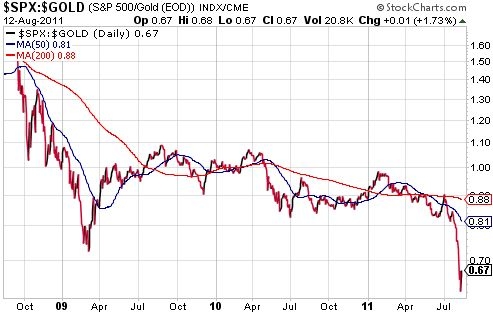
| The S&P 500 Breaks March 2009 Lows When Priced in Gold Posted: 13 Aug 2011 04:37 AM PDT By Dr. Duru: Apparently, the Federal Reserve cannot print money quite fast enough. On Monday, August 8, the S&P 500 priced in terms of gold finally broke the March 2009 lows. Note that the ratio of the S&P 500 to gold was 0.75 at the end of March 2009. The ratio hit 0.65 on August 8, 2011). This decline continues an historic decline for the stock market versus gold that goes back at least to 1998 (the data I had available at the time I wrote Priced In Gold, the Stock Market Continues to Struggle.) Since Chairman Ben Bernanke does not think gold is money – unlike his predecessor Alan Greenspan – this slide in the stock market's value is definitely not keeping him up at night. However, I like to check in on this S&P 500-to-gold ratio to remind me how poorly the stock market has preserved value even when Complete Story » |
| COT report update, QE3 possibly already commenced Posted: 13 Aug 2011 04:22 AM PDT Okay, obviously this week has been one for the records books as the Bears 7 video said it would be. Maybe not to the death and murder tune, but a few bankers, as you are about to see got smoked this week in Gold. Gold COT report: Large specs have sold off 32,586 long contracts and as of Tuesday the 9th, have added 11,016 short to their pile. (Dumb.) And for the real players, the Commercials such as the Morgue: They ADDED 8,458 long, and COVERED a ridiculous massive sum of 29,970 contracts. So, going into next week, I suspect the new large spec shorts will be squeezed like lemons if we test $1800 again. This may be confirmed by the fact that Gold did not sell off as much as they wanted it too this week. So if the price ticks up, watch for another strong move past $1800, and onto $1870. As for the Silver COT report: the large and small specs are useless and been wiped out from the May 1st 53 margins hikes. The commercials is what we need to focus on: They added 5,953 Long and COVERED 3294 contracts. If anyone is confused by this report, I will spell it out for you. The big banks like the morgue and HSBC just covered an insane amount of shorts, and have added more long. This is encouraging. ____________________________________________________________________ I have received an email from a dedicated blogger informing me of the fact that "Berscmucknanke" may already be printing. Lets take a look. According to the data on the Federal Reserve webpage found at Click here for entire data... The Fed may already be surreptitiously flooding the system with printed money. M1 is growing at annual rate of 23% and M2 is growing at an annual rate of 16%. These are incredibly steep increases from what we had three months ago, when QE2 wound down. This growth is shockingly high, and almost hard to believe, so if someone can confirm its validity please do so. It also seems that the growth in M1 and M2 is coming from leakage from excess reserves. Required reserves (which banks must set aside to backstop loans that they make)- are growing incredibly strongly in the past two months Click here for entire data... If anyone can explain these anomalies, please do so as the Jackson Hole QE3 debate grows like an erection by the minute...  |
| John Embry interview with James Turk at GATA's Gold Rush 2011 Posted: 13 Aug 2011 04:00 AM PDT John Embry (www.sprott.com) and James Turk, Director of the GoldMoney Foundation, talk about the price of gold and the US debt downgrade. They discuss Sinclair's $1,764 level and how the ... |
| Eric Sprott Interview with James Turk Posted: 13 Aug 2011 03:45 AM PDT Eric Sprott (www.sprott.com) and James Turk, Director of the GoldMoney Foundation, talk about how there isn't enough silver in the silver market to back existing 'paper silver' commitments. ... |
| Gold will be the safe haven in the coming meltdown Posted: 13 Aug 2011 02:15 AM PDT John Embry (www.sprott.com) and James Turk, Director of the GoldMoney Foundation, talk about how the price of gold will react in another market meltdown similar to 2008, and whether there will be a ... |
| Physical gold demand is taking over Posted: 13 Aug 2011 02:00 AM PDT John Embry (www.sprott.com) and James Turk, Director of the GoldMoney Foundation, talk about the price of gold and the US debt downgrade. They discuss Sinclair's $1,764 level and how the ... |
| Posted: 13 Aug 2011 01:42 AM PDT |
| Vietnamese hold between 300 and 500 tons of Gold – Central Bank Posted: 13 Aug 2011 01:23 AM PDT |
| Gold and Silver withstand Raid/Jefferson county rejects debt proposal/ More problems in Japan Posted: 13 Aug 2011 01:13 AM PDT This posting includes an audio/video/photo media file: Download Now |
| Will the Stock Rollercoaster Trigger a Rollover in Gold? Posted: 13 Aug 2011 01:00 AM PDT SunshineProfits |
| Gold, US Dollar...and the "Greater Depression" - Doug Casey Posted: 13 Aug 2011 12:57 AM PDT ¤ Yesterday in Gold and SilverThe gold price declined in fits and starts during Far East and early London trading on Friday...and was down about ten bucks by the time the Comex open rolled around in New York at 8:20 a.m. Eastern time. Just minutes after the New York open, the price decline accelerated...and by around 10:45 a.m. Eastern, the gold price was down another thirty-five bucks. That turned out to be the low tick of the day...and from there, the price gained back about twenty-two dollars by the close of the New York Access market at 5:15 p.m. The spot gold price closed down $21.30 on the day. Volume was well down from previous days this week, but still very chunky nonetheless.
The silver price remained slightly positive right up until 2:00 p.m. Hong Kong time...and then began to decline right into the London silver fix, which came shortly after noon British Standard Time. Then the price began to rise...but every attempt that silver made to blast off got sold off...and the price rise was kept in check right up until the close of Comex trading at 1:30 p.m. in New York. From there it traded sideways until the electronic market closed for the weekend at 5:15 p.m. Eastern. For a change, volume was extremely light.
The dollar traded over a 50 basis points range yesterday...and finished unchanged from its late Thursday afternoon close in New York. Here's the dollar chart for the week that was. The chart finished basically unchanged on the week, so it's obvious that the dollar played no part in what went on in the gold and silver markets since Monday.
The gold stocks bottomed at the same time as the gold price...around 10:45 a.m...and the HUI gained back ten points after that...but still closed down 1.23%. Here's the HUI for the week just past.
Most silver stocks were down yesterday...especially some of the juniors...and Nick Laird's Silver Sentiment Index showed a smallish decline of 0.70% on Friday.
(Click on image to enlarge) The CME Daily Delivery Report yesterday was a bit of a surprise, as there were no gold contracts posted for delivery on Tuesday. But the real surprise was in silver where Jefferies, a small commercial trader, delivered a chunky 150 contracts. The big long holders on the receiving end were the Bank of Nova Scotia with 108 contracts...and JPMorgan. They stopped/received 33 contracts. There were declines in both GLD and SLV yesterday. The withdrawal at GLD was 408,989 contracts. In the last two business day's GLD has shed a bit over 1.1 million ounces. The withdrawal over at SLV was a chunky 3,799,661 troy ounces. That's quite a bit. For a change, the U.S. Mint had no sales report. The Comex-approved depositories were pretty busy on Thursday, as they reported receiving 883,284 troy ounces of silver, but only shipped 26,921 ounces out the door. The link to that action is here. Well, the Commitment of Traders Report for positions held at the close of trading on Tuesday, August 9th did not disappoint. Both Ted Butler and I had been looking forward to this report all week. In silver, the Commercial traders decreased their net short position by a huge 9,247 contracts, or 46.2 million ounces. They did this by adding 5,953 contracts to their long positions...and reducing their short positions by 3,294 contracts. As of Tuesday's cut-off, the Commercial net short position had been reduced all the way down to 176.7 million ounces. The '4 or less' bullion banks had reduced their short position down to 182.6 million ounces...so these four bullion banks [led by JPMorgan] are short 6.1 million more ounces than the entire Commercial net short position. The '5 through 8' bullion banks hold an additional 22.1 million ounces short. There are currently 43 commercial traders holding short-side positions in the Comex futures market. If you remove the big eight, you're down to 35 traders that hold the balance of the short positions in the Commercial category. If you do the math, these 35 traders are net long the market to the tune of about 28.2 million ounces. These are all small traders...and would all fit nicely into Ted Butler's 'raptor' category. The gold COT was a whopper as well, as the Commercial net short position fell by 38,428 contracts...or 3.84 million ounces of gold. That's the biggest one-week drop I can remember in gold. They did the deed by adding 8,458 long contracts...and covering 29,970 short contracts. As the open interest numbers were indicating for the reporting week, the rally in gold was pretty much all caused by short covering by the Commercial traders...and the declines in silver were all from the bullion banks rigging the price lower and forcing the brain-dead tech funds to puke up their long positions. Different circumstance and method... but the same end result...with the critical difference being the price action. Positive in one, negative in the other. Talk about a bifurcated market! You couldn't make this stuff up if you tried. Based on the price action since the cut-off on Tuesday afternoon, I would guess that the bullion banks have covered even more of their short positions since then. I've got a whole lot of reading, watching and listening for you this weekend. Most of the items are the speeches that were given by the various speakers at the GATA conference in London, so a lot of them are quite long. I hope you're able to wade through them. If the bullion banks can engineer a further sell-off in the gold price, there's not a lot of blood left to wring out of the silver stone as far as the number of contracts left available to liquidate. Who will put the gold questions to central banks? - Chris Powell. Rush to gold shakes up staid French market. How Nixon stopped backing the dollar with gold and changed global finance. ¤ Critical ReadsSubscribeGoldman's new money machine: warehousesIn a rundown patch of Detroit, enclosed by a cyclone fence and barbed wire, stands an unremarkable warehouse that investment bank Goldman Sachs has transformed into a money-making machine. The derelict neighbourhood off Michigan Avenue is a sharp contrast to Goldman's bustling skyscraper headquarters near Wall Street, but the two operations share one important element: management by the bank's savvy financial professionals. This is a Reuters piece that was picked up by yahoo.com about two weeks ago...and because I was at the London conference, I didn't have time to post it until now. Roy Stephens sent me this very long in-depth article. It's certainly worth the time if you have it...and the link is here.  How algorithms shape our world: Kevin SlavinHere's a short speech that was posted over at ted.com. It was given in July. If you want to know the inside scoop on high frequency trading, Kevin lays it all out here. Slavin argues that we're living in a world designed for -- and increasingly controlled by -- algorithms. In this riveting talk from TEDGlobal, he shows how these complex computer programs determine: espionage tactics, stock prices, movie scripts, and architecture. And he warns that we are writing code we can't understand, with implications we can't control. I consider this 15:23 video a must watch...and I once again thank Roy Stephens for sharing it with us. The link is here.  High-Frequency Firms Tripled Trading as S&P 500 Plunged 13%As I mentioned above, that TED video is from last month...and the following story was posted over at Bloomberg yesterday...and dovetails with it nicely.  How Nixon stopped backing the dollar with gold and changed global financeHere's an essay that appeared in Business Week magazine on Saturday, August 5th after I'd already posted my Saturday column before leaving for London. It's written by Roger Lowenstein, the author of the book When Genius Failed: The Rise and Fall of Long-Term Capital Management.  Who will put the gold questions to central banks? - Chris Powell, GATAHere is the first of many speeches from GATA's conference at the Savoy Hotel in London that I will be posting in this column. These are GATA's secretary treasurer, Chris Powell's remarks...and if you're only going to read one speech out of the ones posted today, this is the one you should chose. The link is here.  How to bring central bankers to heel? Ask them some questionsAmbrose Evans-Pritchard of the London Telegraph is a world-class financial journalist and his commentary today, appended here, analyzing the venality of the Federal Reserve is probably as incisive as anything in the financial press. But he poses and then fails to answer the question he concludes his commentary with: "How can we bring these central bankers to heel?" This is another GATA release...this one from just a few days ago. I've already posted the story that's imbedded in this release, but Chris Powell's preamble [in the light of his London speech above] is well worth the read on its own...and the story from Wednesday's edition of The Telegraph is worth a second look as well. The link is here.  Silver money again for the U.S. too: Hugo Salinas PriceThe presentation made at GATA's Gold Rush 2011 conference in London by Hugo Salinas Price, president of the Mexican Civic Association for Silver, "Dorothy's Silver Shoes -- or the Re-monetization of the Silver Currency of the United States of America," has been posted at the association's Internet site, Plata.com. I stole the above introduction from Chris Powell, but the first one through the door on this speech was Roy 'Hawkeye' Stephens...and the link is here.  Resource Clips interviews GATA London speaker John Brimelow Posted: 13 Aug 2011 12:57 AM PDT  The name John Brimelow may not mean a lot to you, but he's been a gold analyst for a very long time...and there are few people in the gold world he's not plugged into. Kevin Michael Grace of Resource Clips has done a wonderful interview with John, who spoke at GATA's Gold Rush 2011 conference in London last weekend. Brimelow discusses the observations offered at the conference by geopolitical analyst James G. Rickards and reviews ways of buying gold. The interview is headlined "Brimelow on How to Buy Gold". I stole the above introduction...and the story...from a GATA release...and the link is here. |
| Economic environment near perfect for gold to shine Posted: 13 Aug 2011 12:57 AM PDT  Here's a story that was posted over at the irishtimes.com website yesterday...and it was sent to me by reader Roy Stephens. |
| Rush to gold shakes up staid French market Posted: 13 Aug 2011 12:57 AM PDT  In a week in which market jitters about debt risks hit France and its banking sector, growing demand was apparent on rue Vivienne, close to the old Paris stock exchange and home to Paris' gold brokers where shops reported a wave of new customers. |
| $2,000 Gold Shortly, Then $2,500, $5,000 & $10,000 - Richard Russell Posted: 13 Aug 2011 12:57 AM PDT  With tremendous volatility in gold, silver and stocks, the Godfather of newsletter writers Richard Russell had this to say in his commentary this week, "I think what I'm most interested in now is whether and to what effect the fading market has on the US economy. I honestly don't think most people are taking this market decline seriously. After all, we "have the marvelous Fed" and the Fed has always come through in an emergency. Besides, probably 90% of living Americans have never seen or lived through what I call really "hard times." |
| Beyond the tipping point: Alasdair Macleod Posted: 13 Aug 2011 12:57 AM PDT  Here is the presentation of economist and former banker Alasdair Macleod to GATA's Gold Rush 2011 conference in London, titled "Beyond the Tipping Point". |
| Hugo Salinas Price: Re-monetization of silver in the US Posted: 13 Aug 2011 12:46 AM PDT "The smartest man in Mexico"  06/August/2011 Dorothy's silver shoes or the re-monetization of the silver currency of the United States of America Hugo Salinas Price Address presented at the GATA Gold Rush 2011. London, England, August 6, 2011. http://www.plata.com.mx/Mplata/artic...ush%202011.pdf Why not re-monetize the silver dollar? Re-monetization could put the silver dollar and its subsidiary silver coinage into circulation in parallel with FRNs – "Federal Reserve Notes". There are several reasons that make this action possible, and only one that might be considered as an unimportant material obstacle. In favor: The silver dollar is the money that is still the Constitutional "coin of the realm", defined by Act of Congress as 371.25 grains of pure silver. (The Troy ounce contains 480 grains.) The silver dollar is familiar or at least known to almost all Americans. A considerable quantity of these silver dollars is owned by Americans. The silver dollar is a cherished symbol of a great past. The monetized silver dollar would ignite a desire to save such as America has perhaps never seen before. The very first thing that must be done, to encourage people to save, is to give them something worth saving. As the US government gallops toward the abyss of bankruptcy by unlimited spending, the American people desperately require a refuge for their savings! In this writer's opinion, a large majority of the American people can see themselves as owners of silver money and, if a poll were taken, one can imagine that most Americans would express themselves in favor of silver money. Not so with gold, towards which the American people have little emotional attachment: gold is seen as the money of the élite. William Jennings Bryan exploited this fundamental attitude of the American people with his "Cross of Gold" speech. (Note: this should not be taken as disparaging gold; it is simply the statement of an opinion about the attitude of Americans regarding gold.) Against: The silver dollar bears a value stamped upon it: "One Dollar". *** The branch of government which the Constitution has designated as the agency "to coin money [and] regulate the value thereof" is the Treasury. If the Treasury were to monetize the silver dollar coin by attributing to it a monetary value in terms of FRNs - "Federal Reserve Notes" - the public would very probably ignore the inscription of "One Dollar" upon the coin and accept it as legal tender money for the amount of the Treasury quote given to it. It would not be necessary to explain that twice, to anyone owning a silver dollar coin! In a short time, people would regard the term "One Dollar" as the name of a coin, rather than as a numeric indicator of legal tender value. Determining the value of the silver dollar falls quite nicely into the Constitutional mandate to the Treasury: "To coin money [and] regulate the value thereof…" How would the Treasury go about determining a quote to regulate the value of the silver dollar? Let bureaucrats and lawyers write books about how it should be done; here it is in a few words: Suppose the price of silver bullion is $35 per ounce. The silver dollar contains 77.34166% of a Troy ounce. $35 X .7734166 = $27.07, the value of the silver in the silver dollar. The Treasury will quote the silver dollar's value in FRNs, with a margin of 15%, and round the figure to the next highest multiple of four: $27.07 X 1.15 = $31.13, rounded up to $32. The silver dollar as a legal tender coin worth $32 FRNs. The American public would eagerly purchase these silver dollars, worth $32 FRN dollars, and which could be used for all transactions without any haggling. The silver dollar worth $32 FRNs could even be deposited for that value in banks, if anyone had a mind to do such a thing. If the price of silver rose to $37.61, the margin of profit of the Treasury, or seigniorage as it is formally known, would be reduced to 10%; at that point, a new and higher quote would be issued, to restore the 15% profit of the Treasury: $37.61 X .7734166 = $29.09 value of silver in the silver dollar X 1.15 = $33.45, rounded up to $36 FRNs - 36 being the next highest multiple of four. Why "the next highest multiple of four"? Because by doing so, the result would be the re-monetization of the entire silver currency system of the United States as it existed up until the Sixties of the last century. In the last example, the silver half-dollars would automatically be worth $18 FRNs, the quarter-dollars would be worth $9 FRNs, and the dimes would be worth one-tenth of the silver dollar: $3.60 FRNs. As pointed out in many articles at www.plata.com.mx, in the section in English, the last quote of the Treasury would remain firm and not subject to reduction, just as if the value in FRNs had been re-stamped upon the coin. The Treasury quote would simply take the place of a stamped quote, which cannot be reduced. The Treasury quote would only be raised, to follow the rising price of silver. In this way, the silver dollar would be a coin that would remain in use permanently. This program would return the silver dollar and its subsidiary silver coinage of half-dollars, quarters and dimes to the American people in such a way as never to disappear again: all rises in the price of silver would be matched with rises in the quoted monetary value of the silver dollar and by derivation, of its subsidiary coinage: the silver half-dollar, the quarter and the dime. This program would not cost the Federal Government – or the taxpayers that support it – one single cent! And yet, it would constitute the greatest gift to the American people that any US Congress could possibly invent, next only in importance to the return of the Gold Standard. The restoration of the silver currency of the United States to circulation, in parallel with the fiat FRN, can be considered the prelude to the revived Gold Standard. By paying the Treasury a premium of 15% over the bullion price of silver, the American people would actually be subsidizing the Treasury's work of monetization. This cost would be a one-time cost of obtaining real money of permanent value and utility, independent of the Fed and the banking system. The re-monetization of the silver currency of the United States would create a new, vast market for physical silver and drive the price of silver very much higher. Those who might not be able to afford the purchase of monetized silver dollars could purchase half-dollars, quarters or dimes, which would provide the same security: they too, would rise with the rise in the price of silver. The rise in the price of silver would affect gold, which would also rise in price. In order to facilitate larger transactions in silver, the Treasury could once again issue "Silver Certificates" attesting to the existence of silver held in its vaults. With regard to the present faux-silver coinage in circulation, the American people are too intelligent to be deceived by it; this coinage may remain in circulation until the Treasury issues new coins for the purpose of making change in small transactions. Though the restored silver currency may legally circulate, in practice it will be saved in its entirety and only be used in cases of emergency. Its "velocity of circulation" will be effectively close to zero. *** Dorothy wore silver shoes, in L. Frank Baum's classic book. Silver shoes on the yellow brick road! Dorothy symbolized then and still does today, the American people. Dorothy was unaware of the magic power of her silver shoes – and the American people are still equally unaware of the magic power of the re-monetized silver dollar: the power to recover America as the land of Hope and Opportunity! What are the obstacles to regaining the silver dollar as money which can circulate in parallel with Federal Reserve Notes? The main obstacle will be the weapon of fear wielded by the entrenched interests of banking and the Federal Reserve, the intellectual centre of the banking cartel. These fiat money-mongers will rely on generating fear of the consequences of silver money so that they can maintain their huge fraud of fiat money FRNs; the Fed and the "Too Big to Fail" Banks are deathly afraid of the competition of silver. They know that the slightest crack in their monopoly of issuing fiat money will expose their scheme. The Fed and the banking system will without doubt claim that "silver money is very costly", but they will certainly not mention that the American people will fall over themselves to acquire it and even pay a premium of 15% to the Treasury, for the blessing of owning real money. Nor will the Fed and the banking system ever mention the gigantic costs that the depreciating FRNs have inflicted upon American savers; nor will they wish to recognize that the fiat FRN and the Fed are directly responsible for the present financial and economic destruction of the once great United States of America. Another objection which will be put forward forcefully is that what the American economy requires is more spending on the part of the public. They will argue that more savings on the part of the American people spells doom for the economy: "More drink for the drunkard" is essential, according to the prevailing Keynesian thinking. However, the humbug wizard has already been exposed and the Fed has lost its prestige forever. Toto has drawn the curtain! The State of Utah has already voiced its dissatisfaction with the present monetary system, by legislating in favor of gold and silver as legal tender money. If this project - monetizing the silver dollar by the Treasury's giving it a numeric monetary value in FRNs, which immediately places it alongside the Federal Reserve Note as money – if this project comes to the notice of the several States of the Union, they together may force the issue. The present policy is to "kick the can down the road" and postpone the final reckoning. But, the end of the road is already in sight! The condition is one of utter helplessness. The re-monetization of the silver dollar is the first step toward regaining health for the economy of America. Paper, fiat money will probably remain in use for some time, but the presence of the monetized silver dollar will force the Federal Reserve, the banking system and the US Government itself, to a more prudent financial course. It will be possible to regain financial health, because an alternative is available. Savings, the foundation of prosperity, will bloom as Americans opt for massive voluntary austerity by saving monetized silver dollars, half-dollars, quarters and dimes. The banking system in the United States will be anxious to receive the massive savings in silver of the American people as deposits, but this will only be possible when the price of silver bullion has stabilized. Thus, the American people will have the upper hand; they will bend the banking system to their will by refusing to deposit their silver in the banks and thus force the banking system to reform itself to prudent monetary practice and desist from inflating by expanding credit out of nothing. After a stabilization of the banking system, the way would be open to a resumption of the Gold Standard. Americans are today caught in a financial calamity with no parallel in history. They are being told this every day by every medium of communication. But they watch their crumbling economy in utter paralysis, because there is no alternative to which they may turn. The whole world is a mirror of their plight. The restoration of the silver currency of the United States of America by the very simple procedure outlined here can provide the life-saving alternative. There is, at present, no other practical proposal for a viable action in the field of money. Perhaps there can be no other practical proposal? Perhaps a return to silver money is the only path out of the present crisis of civilization? Let us hope that a political leader in the United States understands this message. The popular appeal of silver is universal; "silver shoes" will take that leader far – and the American people will follow him on that road! http://www.plata.com.mx/Mplata/artic...idarticulo=171 |
| FRNs in savings, or buy metals Posted: 12 Aug 2011 10:52 PM PDT Does anyone here keep a few thousand $ of FRNs (say ~ $1-5k), above and beyond your normal operating expenses, at home or in the bank, for emergencies that may come up? OR Do you take nearly all of your extra FRNs and put them into PMs, thinking that you can convert them quickly at any time to cover unexpected expenses? |
| Gold up 5% on Week, "Allocated Gold Preferred", Short Sell Ban "Worst Thing They Can Do Posted: 12 Aug 2011 09:01 PM PDT |
| Don’t Forget America’s Failed States Posted: 12 Aug 2011 09:00 PM PDT Dollar Collapse |
| Posted: 12 Aug 2011 07:46 PM PDT Another ash cloud soon 'unlikely' BBC Fracking sand emissions caught on tape Colorado Independent To defuse 'flash' protest, BART cuts riders' cell service. Is that legal? Christian Science Monitor (hat tip reader Balaji) Leaked AT&T Letter Demolishes Case For T-Mobile Merger Broadband Reports The Excessive Calls for Curbing Freedom of Expression & Civil Liberties in the Aftermath of the London Riots FireDogLake Feral Capitalism Hits the Streets David Harvey (hat tip reader Foppe) An Open Letter to David Cameron's Parents Nathaniel Tapley (hat tip Richard Smith) First rioter given eviction notice Wandsworth Council. Notice the "rioter" in question has only been charged, not convicted. For all you need to know about Rupert Murdoch, look at his lawyers John Dean, Guardian (hat tip Buzz Potamkin and reader May S) What the Germans are reading Credit Writedowns This could be worse than what followed the fall of Lehman Brothers New Statesman (hat tip reader May S) Appeals court strikes down health overhaul requirement that most Americans must buy insurance Washington Post Obama under water in N.Y. Politico. This is a big deal. Paul, Santorum and the Sixth War (on Iran) Juan Cole (hat tip reader James B) A County in Alabama Puts Off Bankruptcy New York Times. This is patently ridiculous, which raises the question of who the governor is trying to protect. My 83 year old mother, who lives in Jefferson County, had figured out 5 years ago that bankruptcy was the way out. SEC Reviews S&P Math, Possible Leak of Rating Bloomberg. This suggests the SEC is looking into the issue we raised, that of selective disclosure. Is The Earnings-Yield Divergence Unprecedented? EconomPIc Data Some $50bn goes to money market funds Financial Times Consumers, Cast Your Vote Katie Porter, Credit Slips Consumer sentiment at 30-year low in US Financial Times UNDER ATTACK | REAL ESTATE BAR ASSOCIATION (REBA) SENDS CEASE AND DESIST LETTER TO REGISTER OF DEEDS JOHN O'BRIEN 4ClosureFraud Capitalism with a human face? Emanuel Derman, Reuters (hat tip reader Peter J). Another fan of financial firms as utilities. That Weimar Feeling Matt Stoller, Politico Antidote du jour:
|
| Posted: 12 Aug 2011 05:11 PM PDT Yves here. Blogger Sell on News echoes an argument made in ECONNED, namely, that "free markets" are a contradictory and incoherent construct, albeit from a different perspective. He also advocates another view near and dear to our heart, namely getting rid of economists (actually, that is overkill and will never happen. Keynes had it right: "If economists could manage to get themselves thought of as humble, competent people on a level with dentists, that would be splendid.") By Sell on News, a macro equities analyst . Cross posted from MacroBusiness Probably the most wicked intellectual subterfuge of the last three decades — and goodness knows there have been many — has been the pretence that democracy and markets are two sides of the same coin. Both have been extolled under the banner of "liberty". "Free markets" are somehow the hallmark of democracy and they should be allowed to roam free, untrammeled by evil governments who never doing anything right. Any number of commentators, coincidentally funded by right wing think tanks, warned us that constraining markets represents an attack on basic freedoms. Such elision is, of course, rubbish; and in many cases deliberate deceit. In a market one dollar equals one vote. The more money you have, the more votes you get. In a democracy it is one person, one vote. You can only be one person at a time (except in Florida, it seems). With this in mind, I was intrigued to see a response from Rob Windt mid week about the aftermath of the Icelandic bankruptcy:
This, I would suggest, is real liberty at work. And it is probably an early example of what I expect will become an increasingly political debate, rather than a managerialist debate, about the direction of developed economies. As Jeremy Grantham in his fine piece pointed out mid-week, there has been an unholy alliance between corporate profits and government spending, something he said he "never saw as a faint possibility". It turns out that business is not in a virtuous war with government; the only victim in America is the ordinary worker. One only has to see the film Inside Job to see how government and the financial system have worked in tandem, in large part because it is the same people playing both sides of the fence. Grantham puts it down to childishness in the political arena, run by a president he calls "President No-Show". I think it is not just a matter of maturity, it is a deeper and more pernicious political contest. At the heart of it is a question about the proper role of self organisation. Democracy is, or should be, a self organising system. So are markets. That obviously has advantages over central planning, but it also has potential dangers. The shortcomings are especially problematic in the case of financial markets, which are by necessity a system of rules. Allowing financiers to self organise the rules, means that they can do exactly what has happened — go a long way to destroying the system while enriching themselves to an absurd extent. Thus they made up rules for everything: credit default swaps, collateralised debt obligations, derivatives on the weather, high frequency trading, more high frequency trading … you name it. Allowing that kind of self organisation is fundamentally absurd because in the end such invention of new rules rely for their validity on the underlying rules that must be set by governments and regulators (The Fed's interest rate, the underlying cost of money, being the basic one). So when it is allowed to spin out of control, it will inevitably bring the whole system down, as it still threatens to do. Allowed to run amok, it becomes like the serpent that consumes itself. Which is why the Icelandic example is interesting. The people, then the government, self organised and simply said: we don't accept the bankers' rules. "Why should they?" one might reasonably ask. The Icelandic move is where we are heading. The rule makers in the financial system, who think they can make up rules as they go, are on a collision course with those who have to assent to the rules — the people and the governments they appoint. So far, it is mostly presented as a management problem — how can governments manage their fiscal and monetary levers — but it will become more than that. It will become a question about who has the right to set rules and possess power. The outcome is not a foregone conclusion, even in democracies. Grantham argues that there needs to be more income distribution, a reversal of the money grab of the rich in the United States, in order to return to a more balanced form of economic growth. But that is by no means inevitable, indeed it is not even the norm. More normal is what happened in South America in the 60s, 70s and 80s where the middle classes were gutted and the rich ruled with increasing violence. As Grantham shows, America is heading the same way — its middle class has been progressively eviscerated for about 40 years, while corporations and the rich have thrived. The history of human behaviour tells us that, unless stopped, the powerful will enslave the weak and America is heading in that direction. One thing that is needed is an understanding of the right place for self organisation and the wrong place for self organisation. The looters in London did some marvellous self organisation, pursued their liberty to smash windows. Did that make it right? Those who cleaned up the mess also did some marvellous self organisation. The degree of self organisation does not tell us nearly enough. We need to look at how to set the frameworks in which self organisation occurs; after all there must be frameworks if it is not to be mere chaos. The role of civil society which fed such actions as the London clean up needs to be revisited. The downgrading, or monetisation, of civil society has been one more unfortunate consequences of four decades of market worship. And it is time to see slogans like "liberty", "freedom", nonsense about the "invisible hand" as the sleight of hand that they are. Such slogans may have made some sense during the Cold War, but that was last century. A seminal political contest is occurring and there needs to be a new understanding of the role of self organisation (not least because industrial self organisation along industrial-era lines will not be sufficient to deal with the problems of pollution that the world faces, they will make them much worse). It also means, by the way, abolishing the so called discipline of economics. Disqualifying it on the grounds of its dismal history of spewing out self serving, circular arguments that have led us to assume that transactions come first and humans second, and that the civic and legal bases on which modern democratic societies depend are inevitable, a force of nature, and can be abused at will.
|
| Market Sage Says Fearful Fortnight an Opportunity Posted: 12 Aug 2011 04:58 PM PDT HOUSTON -- In more than 30 years of investing, with the possible exception of September/October of 2008, we cannot remember a time of so much frantic, choppy volatility. The past two weeks have been a wild, extremely volatile experience for market participants. Frank Holmes, of San Antonio based U.S. Global Investors summed it up pretty well Friday. Holmes wrote: "The S&P 500 Index has fallen 15 percent since July. This has happened only fives times since 1960: The 1987 Crash, the Asian financial crisis in 1998 and twice in 2008, according to research from Desjardins. In each of these instances, markets gained an average 9 percent the following month." Continued... Frank continued: "The CBOE Volatility Index (VIX) rose more than 46 percent to break the key 40 level, signaling an extreme event. In general, any time the VIX rises above 30 indicates conditions are volatile. Above 40, it's clear the only thing at a premium in this market is fear." Holmes spoke of the S&P 500, but virtually all markets were in the same high-anxiety sausage grinder since the end of July. Just below is a chart of the Dow Index with a few comments for reference. Whew! August is off to quite the start, is it not? Check the volume over the past week. This qualifies as an extreme event in anyone's book. We are living though yet another period people will be talking about and writing research papers and collegiate thesis' on for years hence.
Holmes advises clients to look for opportunity during this news-driven drama - while checking their emotions at the door. Well, sort of. Just below is this week's closing table. We are still reviewing and digesting the changes, some of which are stunning and so outside the norm that it will be challenging to develop our impressions of the markets this weekend.
Gold and Silver Disaggregated COT Report (DCOT)
All of the trader's positions are calculated net of spreading contracts as of the Tuesday disaggregated COT report. We plan to update our linked charts for subscribers by the usual time on Sunday (by 18:00 ET). Have a good weekend everyone.
|
| Dont Forget Americas Failed States Posted: 12 Aug 2011 04:54 PM PDT Dollar Collapse |
| Posted: 12 Aug 2011 04:45 PM PDT The Privateer |
| Posted: 12 Aug 2011 04:00 PM PDT Gold University |
| To Barrick or to be Barricked, That is the Question Posted: 12 Aug 2011 04:00 PM PDT Gold University |
| Stock Market Parallels to 2000 and 2008 Should Not Be Ignored Posted: 12 Aug 2011 02:15 PM PDT By Chris Ciovacco: Before you read your favorite author's work relative to the outlook for today's markets, we invite you to go back into their article archives and see what they were saying in early 2008 and the summer of 2008. On February 13, 2008, with the S&P trading at 1,348, we published Technical Breakdowns May Call For More Hedging. Unfortunately, much of our analysis from early 2008 applies to the current market, which is showing indications that a new bear market may be on the horizon. We are not yet in bear market territory, but we have seen enough to go to a significant cash position complimented by silver (SLV) and gold (GLD). We still have exposure to stocks (SPY) since similar markets have recovered in the past (1994, 1998, and 2004). Even in the context of a bear market, the S&P 500 could rally back to the 1,260 to 1,280 level, Complete Story » |
| Garnering Gains in The New Abnormal: Gold, Silver, Equities, Commodities & Interest Rates Posted: 12 Aug 2011 01:58 PM PDT |
| Paperbugs won’t get it until it is too late Posted: 12 Aug 2011 01:50 PM PDT Gold Versus Paper |



| You are subscribed to email updates from Gold World News Flash 2 To stop receiving these emails, you may unsubscribe now. | Email delivery powered by Google |
| Google Inc., 20 West Kinzie, Chicago IL USA 60610 | |


No comments:
Post a Comment