


Gold World News Flash |

- Closing Tables for Week Ending August 26
- Ben Davies - Monetary Blunders & How it Will Impact Gold
- James Turk - Expect a Spectacular Short Covering Rally in Gold
- Bob Chapman's Friday Report: In An Unsustainable System, A Warning of Collapse
- Gold Seeker Weekly Wrap-Up: Gold and Silver Fall About 3% on the Week but Miners Gain
- So What Happens to the Gold and Critical Records Stored on Wall Street During Hurricane Irene?
- Guest Post: Bernanke In A Box
- 9,173 Ounces Of Gold Transferred From HSBC To JP Morgan Gold Vaults Overnight
- Gold report from Trader Dan
- Exclusive: SGT Speaks With GATA's Bill Murphy About Gold & Silver
- Bernanke’s Incantation
- Gold & Silver - Deep Correction Due? - Part 2
- Expect spectacular short-covering rally in gold, Turk tells King World News
- Michael Pento - Here is Why Gold is Soaring After Hours
- Both Silver and Gold Prices Will Rally Further
- Bernanke’s Incantation
- Jim's Mailbox
- The Daily Market Report
- Is Gold and Silver Money?
- Is Chavez the new De Gaulle?
- Guest Post: Apocalypse Trades: Neither Things Nor Bureaucracy
- GoldSeek's Peter Spina describes bypassing the mainstream media
- Shares starting to outperform bullion, Lassonde tells King World News
- Michael Pento: Here is Why Gold is Soaring After Hours
- With gold soaring, up $50 in access market trading to over $1,820, today King World News asked Michael Pento the reasons for the big move in gold as well as his thoughts on Bernanke’s speech
- Gold Daily and Silver Weekly Charts - Option Expiration Manipulation - Q. E. D.
- Ned Naylor-Leyland: Real metal is beating paper in the gold market
- InfoWars.com Special Report
- Russian c.bank to offer gold-backed loans at 7 pct
- Physical market overpowers gold cartel, Murphy tells Resource Clips
| Closing Tables for Week Ending August 26 Posted: 26 Aug 2011 05:31 PM PDT Just below is this week's closing table, followed by the CFTC disaggregated commitments of traders (DCOT) recap for the week ending August 26, 2001.
Continued… Gold and Silver Disaggregated COT Report (DCOT)
| ||
| Ben Davies - Monetary Blunders & How it Will Impact Gold Posted: 26 Aug 2011 05:30 PM PDT  In this piece exclusively for the King World News blog, Ben Davies, CEO of Hinde Capital, gives KWN readers his take on Bretton Woods II, the Swiss factor and much more. In Davies' brand new interview he also discusses unprecedented demand for gold around the world and many other key factors influencing the gold market. In this piece exclusively for the King World News blog, Ben Davies, CEO of Hinde Capital, gives KWN readers his take on Bretton Woods II, the Swiss factor and much more. In Davies' brand new interview he also discusses unprecedented demand for gold around the world and many other key factors influencing the gold market.
This posting includes an audio/video/photo media file: Download Now | ||
| James Turk - Expect a Spectacular Short Covering Rally in Gold Posted: 26 Aug 2011 04:15 PM PDT  With gold accelerating today's gain in access market trading to over $57, King World News interviewed James Turk to get his thoughts on where gold and silver are headed from here. When asked about the action in gold Turk stated, "This was a big day and a great close to the week. The strength that gold displayed suggests that we are going to probe $1,900 very quickly, possibly as soon as next week. What seems apparent is that a lot of people jumped on the short side and are now caught, so the short covering rally could be quite spectacular." With gold accelerating today's gain in access market trading to over $57, King World News interviewed James Turk to get his thoughts on where gold and silver are headed from here. When asked about the action in gold Turk stated, "This was a big day and a great close to the week. The strength that gold displayed suggests that we are going to probe $1,900 very quickly, possibly as soon as next week. What seems apparent is that a lot of people jumped on the short side and are now caught, so the short covering rally could be quite spectacular."
This posting includes an audio/video/photo media file: Download Now | ||
| Bob Chapman's Friday Report: In An Unsustainable System, A Warning of Collapse Posted: 26 Aug 2011 04:05 PM PDT | ||
| Gold Seeker Weekly Wrap-Up: Gold and Silver Fall About 3% on the Week but Miners Gain Posted: 26 Aug 2011 04:00 PM PDT Gold climbed to $1794.24 by about 7:40AM EST before it fell back to $1765.20 in the next 45 minutes of trade, but it then rallied to as high as $1795.00 in New York and ended with a gain of 1.95%. Silver fell to $40.205 in Asia and rose to $41.30 in London before it fell back to $40.096 by a little after 10AM EST in New York, but it then rallied back higher into the close and ended with a gain of 0.49%. Both metals are rising to new highs in afterhours access trade as well.
| ||
| So What Happens to the Gold and Critical Records Stored on Wall Street During Hurricane Irene? Posted: 26 Aug 2011 03:41 PM PDT By Catherine Austin Fitts I am a suspicious person. When the dollar started to soar and gold tank on Tuesday shortly before an earthquake hit the East Coast delivering cracks into the Washington Monument and the National Cathedral and disrupting Congress, it seemed a remarkable coincidence. Minor earthquakes followed on the West coast that evening [...]
| ||
| Posted: 26 Aug 2011 03:38 PM PDT From Jeff Snider of Atlantic Capital Management Bernanke In A Box His statement spoke volumes without saying anything. Yes, he disappointed the hardcore debasement enthusiasts called stock investors, but only at first. In between the lines of what he did say, it was crystal clear: Chairman Bernanke wants to do more QE. "Want" is not really the right word because it doesn't really go far enough into Bernanke's canon. I think it is abundantly clear he believes the Fed needs to do it as soon as operationally possible. His concern on the economic issues is expected – anyone with rudimentary economic knowledge knows long-term unemployment can have lasting productive and social impacts or "scars". He still seems confused about those headwinds, but at least has resigned himself and monetary policy to the fact that they are very real. Rather, his attention to "financial uncertainty" and his view of the damage to "expectations" that comes with it is what really stands out now. Because the Fed is wedded to the rational expectations theory, financial uncertainty can become ingrained into investor psychology, flowing through to consumers and businesses. If consumers believe banks will be in trouble in the near future, they will act on those fears today. It is a mortal threat to the carefully cultivated, though utterly useless, appearance that everything is normal and good. The Fed has created trillions of dollars so that stocks will signal a robust future – and consumers and businesses will act today in the expectation of validity to that rosy, rainbow vision. The beginning stages of another financial crisis or credit crunch change those expectations radically. This has to be nipped now, long before it permeates too far into the consciousness of the populace (not just in the US, but globally). "We discussed the relative merits and costs of such tools at our August meeting. We will continue to consider those and other pertinent issues, including, of course, economic and financial developments, at our meeting in September." He said QE 3.0, without really saying it. The markets, seeing the enlarged schedule for the September meeting and interpreting the likelihood of heavy discussions, have gotten the message. Stocks threw off the daily mortal struggle that is life as Bank of America and bid for the QE future that is now September (good riddance to August apparently). Gold prices followed on those expectations of a resumption to the willful and wanton dollar destruction that QE purely represents. If the Chairman can influence a major market rally without ever having to face the growing dissent within the FOMC ranks, then his speech has proven to be a stroke of genius. That is the essence of rational expectations, making others believe you have magical powers so that they do your bidding without any actual work or direct engagement on your part. But there is a huge downside to waiting, and Bernanke knows it. The financial crisis grows while the economy is sliding further into contraction. Time is not on his side. So why does he wait? Simple, Bernanke and QE is in a box – conditions currently in the wholesale money markets, especially the repo market, will not suffer more QE. As the unsecured Fed funds and eurodollar markets have effectively frozen for banks outside the primary dealer network, wholesale funding has been left to repos. However, there is already a shortage of treasury bills, the prime, vital collateral of nearly all post-2008 repo funding arrangements. QE is nothing more than an extraction of those bills (and notes), creating that shortage in the first place. So while the primary dealers are loaded up with Fed-created bank reserves, they are not forwarding them to the wider marketplace out of well-founded fears of PIIGS exposures and currency mismatches between assets and liabilities. Despite an ocean of liquidity at the center, the wider system is now a desert. The Fed is held hostage by the operational realities of the design of the Federal Reserve system. Should the Fed embark on a new QE program today, it would simply extract more of that vital collateral, exacerbating the shortage to the point of significant voluntary capital destruction – banks would be forced to take on t-bills at greater and greater negative rates. This kind of situation is purely deflationary, and nothing scares Bernanke more than that dreaded d-word. As long as the unsecured markets remain in limbo, and they will as long as the global banking system is hiding its problems, the Fed CANNOT launch another round of QE, no matter how much Bernanke might want to. In the calculus of monetary primacy, the banking system will win every time, even at the potential expense of stocks and rational expectations. So the Chairman is forced to jawbone stock investors into believing QE is not yet appropriate (they are constantly monitoring the economic situation), but is still imminent. Meanwhile, the Fed is actively engaged in expanding the reverse repo program to help alleviate the bill shortage. While no one was looking, it has taken its aggregate of reverse repo transactions to nearly $100 billion, from only $65 billion at the beginning of August. Reverse repos are an exit strategy, not monetary accommodation. But, in the context of the wider wholesale market freeze, reverse repos expand the amount of treasuries, especially bills, available to be used as collateral by financial institutions outside the primary dealer network. As much as the Fed adheres to flawed ideology and oft-times inconsistent theoretical constructions, it is not likely to engage in monetary programs that are directly contradictory. Reverse repos and QE would cancel each other out. The cue for more QE, then, is t-bill rates. If the shortage resolves itself at some point in the coming weeks, then the green light is on. There is no doubt that given that green light, Bernanke will take it – he has to if for no other reason than monetizing the debt (which may not be a problem right now, but it will be at some point). The question for September is, among other pressing concerns, whether or not the unsecured markets thaw enough to remove the squeeze in repo collateral. If that does not happen, stocks are certainly not positioned for a second consecutive episode of crushed QE expectations. It may not matter anyway. The selling we saw in early to mid-August was precipitated by the banking squeeze to begin with. Should that intensify, the expectations of stock investors outside the general banking system will be the least of our problems. For now, Bernanke's mystique will be tested in the coming weeks. Moral suasion is good for the textbooks, but it usually has little use during a real crisis.
| ||
| 9,173 Ounces Of Gold Transferred From HSBC To JP Morgan Gold Vaults Overnight Posted: 26 Aug 2011 03:16 PM PDT While we have no information as to who or why (we do know when and where) engaged in a transfer of 9,173 ounces of eligible gold (for a total of about $16.5 million) from HSBC's gold depository into that of JP Morgan, according to today's closing CME Group Metal Depository Statistics, we can merely point out that it happened. One back of the envelope hypothesis: we have counterparty risk at the bank level (which is currently manifesting itself at both the CDS, the stock price, and the Li(E)bor level; are we going to start seeing counterparty concerns at the gold depository level next? What next: a run on the [ ] gold depository in a self-fulfilling prophecy? The second hypothesis is by now well known- JPM needs all the gold it can get. But a paltry 9,173 ounces? Of course, the last hypothesis is that the two precisely 9,173 ounce transactions are in no way related.
| ||
| Posted: 26 Aug 2011 03:13 PM PDT From Trader Dan 4 hour gold chart Trying to explain the reasons for the price action in the markets today is an exercise in futility as there are far too many cross currents at work and far too many hedge fund computers sloshing money all over the place. And this does not even take into [...] 
This posting includes an audio/video/photo media file: Download Now | ||
| Exclusive: SGT Speaks With GATA's Bill Murphy About Gold & Silver Posted: 26 Aug 2011 02:50 PM PDT SGT talks to GATA's Bill Murphy about gold & silver price manipulation, and other precious metals current events.
| ||
| Posted: 26 Aug 2011 01:00 PM PDT Author: David Galland Synopsis: Wondering why the market was breathlessly awaiting Bernanke's remarks today, David Galland does some historical spelunking and finds good reason for skepticism. Also in today's issue: the parallels between body surfing and the current gold market; and a summary of upcoming Casey Research events and staff appearances. Dear Reader, As I sit down to write this early morning, Mr. Market is teetering on the edge of his seat, waiting breathlessly for Fed Chairman Ben to open his bearded maw in order to issue a proclamation of such divine import as to determine the very fate of the global economy. Finally, the world hopes, the Bernanke will step up to a microphone and intone words such as "stimulus," "intervention" and "liquidity" in the correct order – an order known only to those who have attained the highest levels of academ...
| ||
| Gold & Silver - Deep Correction Due? - Part 2 Posted: 26 Aug 2011 01:00 PM PDT The rise in the gold price has continued and shown a break up above the trend line. This has always been a sign that the gold, silver prices have 'spiked'. This has always been a signal to be ready to take profits and be ready to go back in lower down.
| ||
| Expect spectacular short-covering rally in gold, Turk tells King World News Posted: 26 Aug 2011 12:34 PM PDT 8:35p ET Friday, August 26, 2011 Dear Friend of GATA and Gold (and Silver): GoldMoney founder James Turk tells King World News tonight that short covering well may send gold back to $1,900 very quickly, that silver likely will follow to $44, and that he is very impressed by the strength of the mining shares. An excerpt from Turk's interview, headlined "Expect a Spectacular Short-Covering Rally in Gold," can be found at the King World News blog here: http://kingworldnews.com/kingworldnews/KWN_DailyWeb/Entries/2011/8/27_Ja... CHRIS POWELL, Secretary/Treasurer ADVERTISEMENT Sona Drills 85.4g Gold/Ton Over 4 Metres at Elizabeth Gold Deposit, Company Press Release, October 27, 2010 VANCOUVER, British Columbia -- Sona Resources Corp. reports on five drillling holes in the third round of assay results from the recently completed drill program at its 100 percent-owned Elizabeth Gold Deposit Property in the Lillooet Mining District of southern British Columbia. Highlights from the diamond drilling include: -- Hole E10-66 intersected 17.4g gold/ton over 1.54 metres. -- Hole E10-67 intersected 96.4g gold/ton over 2.5 metres, including one assay interval of 383g of gold/ton over 0.5 metres. -- Hole E10-69 intersected 85.4g gold/ton over 4.03 metres, including one assay interval of 230g gold/ton over 1 metre. Four drill holes, E10-66 to E10-69, targeted the southwestern end of the Southwest Vein, and three of the holes have expanded the mineralized zone in that direction. The Southwest Vein gold mineralization has now been intersected over a strike length of 325 metres, with the deepest hole drilled less than 200 metres from surface. "The assay results from the Southwest Zone quartz vein continue to be extremely positive," says John P. Thompson, Sona's president and CEO. "We are expanding the Southwest Vein, and this high-grade gold mineralization remains wide open down dip and along strike to the southwest." For the company's full press release, please visit: http://sonaresources.com/_resources/news/SONA_NR19_2010.pdf Join GATA here: Toronto Resource Investment Conference http://cambridgehouse.com/conference-details/toronto-resource-investment... The Silver Summit http://cambridgehouse.com/conference-details/the-silver-summit-2011/48 New Orleans Investment Conference http://www.neworleansconference.com/ Support GATA by purchasing gold and silver commemorative coins: https://www.amsterdamgold.eu/gata/index.asp?BiD=12 Or by purchasing a colorful GATA T-shirt: Or a colorful poster of GATA's full-page ad in The Wall Street Journal on January 31, 2009: http://gata.org/node/wallstreetjournal Or a video disc of GATA's 2005 Gold Rush 21 conference in the Yukon: Help keep GATA going GATA is a civil rights and educational organization based in the United States and tax-exempt under the U.S. Internal Revenue Code. Its e-mail dispatches are free, and you can subscribe at: To contribute to GATA, please visit: ADVERTISEMENT Lewis E. Lehrman on How to Solve the U.S. Debt Problem Lewis E. Lehrman, chairman of the Lehrman Institute, sponsor of The Gold Standard Now project, advises that to reduce the $1 1/2 trillion U.S. deficit, the Republican Party must initiate an investment program. Working Americans are not saving, which enables the banks to lead the country into a cycle of debt, leverage, boom, panic, and bust. To read more and to sign up for The Gold Standard Now's free, noncommercial, weekly report, "Prosperity through Gold," please visit: http://www.thegoldstandardnow.org/gata
| ||
| Michael Pento - Here is Why Gold is Soaring After Hours Posted: 26 Aug 2011 12:18 PM PDT Gold soared on the belief that the now two-day meeting in Septemper would offer even more monetary stimulus.
| ||
| Both Silver and Gold Prices Will Rally Further Posted: 26 Aug 2011 11:38 AM PDT Gold Price Close Today : 1,794.10 Gold Price Close 19-Aug : 1,848.90 Change : -54.80 or -3.0% Silver Price Close Today : 4095.2 Silver Price Close 19-Aug : 4242.8 Change : -147.60 or -3.5% Gold Silver Ratio Today : 43.810 Gold Silver Ratio 19-Aug : 43.577 Change : 0.23 or 0.5% Silver Gold Ratio : 0.02283 Silver Gold Ratio 19-Aug : 0.02295 Change : -0.00012 or -0.5% Dow in Gold Dollars : $ 130.02 Dow in Gold Dollars 19-Aug : $ 120.95 Change : $ 9.07 or 7.5% Dow in Gold Ounces : 6.290 Dow in Gold Ounces 19-Aug : 5.851 Change : 0.44 or 7.5% Dow in Silver Ounces : 275.56 Dow in Silver Ounces 19-Aug : 254.96 Change : 20.59 or 8.1% Dow Industrial : 11,284.54 Dow Industrial 19-Aug : 10,817.65 Change : 466.89 or 4.3% S&P 500 : 1,176.80 S&P 500 19-Aug : 1,123.53 Change : 53.27 or 4.7% US Dollar Index : 73.710 US Dollar Index 19-Aug : 73.993 Change : -0.283 or -0.4% Platinum Price Close Today : 1,832.70 Platinum Price Close 19-Aug : 1,876.00 Change : -43.30 or -2.3% Palladium Price Close Today : 762.00 Palladium Price Close 19-Aug : 750.00 Change : 12.00 or 1.6% I have never before seen a market make TWO (2) Key reversals in four days, but that is what the GOLD PRICE did. Now you ought to understand that normally, a key reversal will change a markets direction for a little while. Key Reversals occur in two parts. A downward Key Reversal happens when (1) a market trades into new high territory intraday but closes lower that day than the day before, then (2) the market closes lower still next day. An upward Key Reversal happens when (1) a market trades into new LOW territory intraday but closes HIGHER that day, and then (2) closes higher still next day. Monday and Tuesday made a downward Key Reversal. Wednesday and Thursday GOLD made an Upward Key Reversal. To ice that donut, the GOLD PRICE today rose $34.30 to close comex at $1,794.10, then rose another $30 in the aftermarket! Looking at the way GOLD bounced off $1,712 on Thursday, then closed ABOVE $1,750 support/resistance, the only safe path is to buy gold. Next week may prove me wrong, but this week's action shouts that gold's rally has not near-about ended. SILVER's low for the week came at 3905c, which I count as establishing 3900c as strong resistance now. SILVER made a sort of double-bottom there on Wedensday and Thursday. Thursday it gained an astounding 158.3c. Our confusion will be cleared up when the SILVER PRICE closes above the last high at 4428c, or drops below 3875c. Right now, you have to say that silver is trending upward in a series of higher lows and higher highs. Wednesday's plunge did NOT break the uptrend line. The slow-burn panic continues driving investors into silver and gold. SILVER continues to gain status alongside gold. Unless SILVER and GOLD PRICES weaken off terribly on Monday (below $1,700 and 3900c), I am buying. Both SILVER and GOLD PRICES will rally further. Big correction has not struck yet. It lieth ahead somewhere. Remember that Our Bosses in government, central bank, and Wall Street have only two weapons in their arsenal of panic control: inflation and blarney. Inflation adds liquidity to ease the panic, blarney calms the affrighted herd. I don't care how many "tools" they claim to have, they all boil down to inflation and blarney. As far back as 1895 or 1907, the arch-banker John Pierpont Morgan was shooting his Blarney Cannon: "The man who is a bear on the future of the United States will always go broke." Ahhh, who could doubt one of our Big Bosses? We know from yesterday's events that Our Bosses are terrified, because they loaded the mouth of their biggest Blarney Cannon and fired it: Warren Buffett. Banks US and European are puking sick dogs, and Bank of America sickest amongst 'em. How, O, How will we gull the public into buying bank stocks? We'll get Warren Buffett to announce he's buying $5 billion of preferred stock in BoA. Now Warren ain't operating a charity, so the great humanitarian will not lose a dime on this deal. The preferred stock pays a 6% dividend and has the primary claim on BoA's assets, even before bondholders. Blarn! Blarn! Hear the Blarney Cannon! Didn't work. Dow sank 170.81, after the early morning Buffet Blarney Barrage. Then today Our Bosses fired another gun in their Blarney Battery: the Bernanke Blarney Blaster. Bernancubus gave a speech which everyone hoped would explain how he would save the world. Alas, the Bernanke Blarney Blaster mis-fired. Not even enough powder to blow the ball out of the tube. Beside confirming his utterly incurable cluelessness, the Bernancubus blustered like some cheap, shabby magician that he has Tools You Know Not Of. Mmmmm, 'bout time to dig them tools out, Ben, and put 'em to work! Result of this was something only rarely seen every millennium, back to back Key Reversals in the gold market, which says to me -- and I am nothing but a natural born fool from Tennessee and have never even drawn nigh to them high-falutin' Harvards and Yales where Our Bosses are educated and made Perfect to Decide Our Pissant Destinies -- that not a single shot of the blarney cannons hit anything, and investors remain terrorized by the banks' condition. Proof? The crowds flee still gold- and silverward. Boom! Boom! Say the Blarney Cannon. Bust! Bust! Says the people. Uh - oh. What's that other sound I hear? Is that snickering at the back of the room?? Surely you disrespectful scoundrels are not LAUGHING at Our Bosses? STOCKS burned up immense amounts of buying power ammunition this week for a small gain. But the Nice Government Men did pull stocks back from disappearing into the abyss. Only succeeded though in lifting the Dow to 11,300 resistance. Dow today closed up 134.72 or 1.21%, while the S&P50 close up 17.53 (1.51%) at 1,176.80. Dow finally touched it 20 DMA (11,290) but missed closing above it. Upside the Dow must now close above 11,530 to prove an uptrend. 200 DMA, likely target of countertrend rally, stands at 11,987, as far as the sky above the earth. A close below 10,600, still to come I trow, sends the Dow spinning out of control on its next leg earthward. Buy stocks, because it will be a vote of confidence in the ability of the Federal Reserve and US government to direct the economy. That'll show all those gold-and-silver-buying croakers AND it will earn you a bed at the I-40 Under-The-Culvert Retirement Home. The Nice Government Men managed to keep the US DOLLAR INDEX in its 75.5 - 73.5 range again this week. Today, likely on the strength of the Bernanke Blarney Blanster's speech, the dollar index fell 56.9 basis points to 73.71. As long as the dollar index stays above 72.70, my opinon remains that the dollar is meditating a rally. The euro on "mysterious" strength rallied today to 1.4498, up 0.82% and bumping on the top of its 1.4530 range. If it broke out above that it would signal a rally, and it would signal that the world is even more lunatic than I already surmise. The Japanese yet closed today at 130.45c/Y100 (Y76.66/$). It remains at the top of its range, with a new all time high 5 days ago, and momentum continues upward. WARNING AND DISCLAIMER. Be advised and warned: Do NOT use these commentaries to trade futures contracts. I don't intend them for that or write them with that short term trading outlook. I write them for long-term investors in physical metals. Take them as entertainment, but not as a timing service for futures. NOR do I recommend investing in gold or silver Exchange Trade Funds (ETFs). Those are NOT physical metal & I fear one day one or another may go up in smoke. Unless you can breathe smoke, stay away. Call me paranoid, but the surviving rabbit is wary of traps. NOR do I recommend trading futures options or other leveraged paper gold and silver products. These are not for the inexperienced. NOR do I recommend buying gold & silver on margin or with debt. What DO I recommend? Physical gold and silver coins & bars in your own hands. One final warning: NEVER insert a 747 Jumbo Jet up your nose. Y'all enjoy your weekend. Argentum et aurum comparenda sunt -- -- Gold and silver must be bought. - Franklin Sanders, The Moneychanger The-MoneyChanger.com © 2011, The Moneychanger. May not be republished in any form, including electronically, without our express permission. To avoid confusion, please remember that the comments above have a very short time horizon. Always invest with the primary trend. Gold's primary trend is up, targeting at least $3,130.00; silver's primary is up targeting 16:1 gold/silver ratio or $195.66; stocks' primary trend is down, targeting Dow under 2,900 and worth only one ounce of gold; US$ or US$-denominated assets, primary trend down; real estate in a bubble, primary trend way down. Whenever I write "Stay out of stocks" readers inevitably ask, "Do you mean precious metals mining stocks, too?" No, I don't. 
| ||
| Posted: 26 Aug 2011 10:50 AM PDT Synopsis: Wondering why the market was breathlessly awaiting Bernanke's remarks today, David Galland does some historical spelunking and finds good reason for skepticism. Also in today's issue: the parallels between body surfing and the current gold market; and a summary of upcoming Casey Research events and staff appearances. Dear Reader, As I sit down to write this early morning, Mr. Market is teetering on the edge of his seat, waiting breathlessly for Fed Chairman Ben to open his bearded maw in order to issue a proclamation of such divine import as to determine the very fate of the global economy. Finally, the world hopes, the Bernanke will step up to a microphone and intone words such as "stimulus," "intervention" and "liquidity" in the correct order – an order known only to those who have attained the highest levels of academic mysticism – to form an incantation of sufficient power to bring Harry Potter himself to his knees in awe.
So powerful, in fact, that once uttered, the Bernanke's incantation will sweep the globe, chasing away the gloom and opening the skies to a new era of global peace and prosperity. As we aren't in Jackson Hollow where the Fed is meeting, we can't know what words the Bernanke will mumble later today, but we can paw through the entrails of his past incantations in the hopes of uncovering clues. For instance, back in July 2005, when my dear friend and colleague Doug Casey was writing in Casey's International Speculator… "… based on my review of various data, trends and anecdotal evidence, I am increasingly concerned that the wheels are about to come off the US economy. And maybe China. Elsewhere in the world, we have near total mayhem in the Middle East and confidence in the EU is (correctly) crumbling. If all the stuff that is, or could be, soon hitting the fan actually does so, we could witness an economic debacle on a global scale." …the Bernanke was saying… "We've never had a decline in house prices on a nationwide basis. So, what I think what is more likely is that house prices will slow, maybe stabilize, might slow consumption spending a bit. I don't think it's going drive the economy too far from its full employment path, though." And in February of 2006, which, as you can see from the chart here, was within spitting distance of the very peak of the housing bubble, the Bernanke spoke as thus: "Housing markets are cooling a bit. Our expectation is that the decline in activity or the slowing in activity will be moderate, that house prices will probably continue to rise."
(Click on image to enlarge) And in March 2007, the very month that Doug Casey wrote in Casey International Speculator… "As in 1970, 1974, 1980, 1987 and 2000, the economy is at a turning point. But this time there is no good direction for it to go. The gentlest we can expect is a monetary crisis as bad as any in living memory… "Ordinarily a country threatened with currency collapse would lean toward tight money, perhaps contracting its domestic money supply. That would push interest rates upward and compensate foreigners for holding on to the currency despite the depreciation risk. And it would soften that risk. …the Bernanke went on record as thus… "At this juncture, however, the impact on the broader economy and financial markets of the problems in the subprime market seems likely to be contained. In particular, mortgages to prime borrowers and fixed-rate mortgages to all classes of borrowers continue to perform well, with low rates of delinquency." (For the record, roughly a year and a half later, the subprime princelings Fannie Mae and Freddie Mac blew up and were taken over by the government.) Undaunted, in May 2007, the Bernanke reinforced his positive outlook with these fine words: "All that said, given the fundamental factors in place that should support the demand for housing, we believe the effect of the troubles in the subprime sector on the broader housing market will likely be limited, and we do not expect significant spillovers from the subprime market to the rest of the economy or to the financial system. The vast majority of mortgages, including even subprime mortgages, continue to perform well. Past gains in house prices have left most homeowners with significant amounts of home equity, and growth in jobs and incomes should help keep the financial obligations of most households manageable." Then, in June 2008, almost to the day that Casey Research Chief Economist Bud Conrad was summing up our economic outlook for the inaugural edition of The Casey Report as follows… "Finally, it is important to recognize that the world remains in the throes of a deep and serious crisis. While many analysts will express the view that the worst is over or that, after a modest downturn, things will bounce back just like they always have, our view is that what we will actually witness going forward is a fairly steady occurrence of crisis and panic. The crisis will accelerate, moving faster, even, than in previous major shifts such as that witnessed in the 1970s. "While history may find we are too pessimistic at this point in time, in our view it is far better to prepare for a worsening crisis and hope that it does not materialize, than to expect business as usual." …the Bernanke was intoning… "The risk that the economy has entered a substantial downturn appears to have diminished over the past month or so." And even as recently as August 2010, the Bernanke stated confidently… "The financial crisis appears to be mostly behind us, and the economy seems to have stabilized and is expanding again." Hey, hold the phone! Looking over those pronouncements and many, many more along the same lines, one can only come to the conclusion that the Bernanke is either a fool or a liar. Strong words, I know. But seriously, can one draw any other conclusion? I mean, he missed every possible sign of the impending economic train wreck… and, even with boxcars landing in burning heaps on both sides of the tracks, continued to insist the train of the economy was proceeding at a steady pace toward Happyville Station. If he actually believed any of that, he is obviously a fool. Glancing over the Bernanke's academic achievements, we confirm that he didn't leave school early in order to pursue a promising career wringing chicken necks down at the local poultry house. So we can only surmise the man is not a fool; therefore he has to be a knave. Yet Mr. Market still awaits his words with great anticipation. Becauuuusssse??? Well, on that point, we can only further conclude that Mr. Market doesn't know his hindquarters from a (Jackson) hole in the ground. In fact, the record is stunningly clear that any time the Bernanke proffers an economic prediction, you should rush out and bet that exactly the opposite will come true – it's a sure-fire way to make a killing in the markets. And with that, we turn our attention to the Bernanke's latest incantation, which has just now found its way out of the Hole in Jackson. Just minutes ago, he rose to the microphone and said… "With respect to longer-run prospects, however, my own view is more optimistic. As I will discuss, although important problems certainly exist, the growth fundamentals of the United States do not appear to have been permanently altered by the shocks of the past four years." The Bernanke, Jackson Hole, August 26, 2011 So, with our newfound understanding of the inverse relationship between Bernanke's stated views and how things ultimately work out, how should we act?
I think this graphic pretty well sums it up. (For those dinosaurs among you still using devices unable to view graphics, the caption is "WE'RE ALL DOOMED!") Well, technically, not everyone is doomed. Just those who actually still assign even a scintilla of credibility to Bernanke's words versus, say, listening to Doug Casey, Bud Conrad and others who, based on the record, actually understand what's going on and aren't afraid to say so. But the truth of the matter should be apparent to anyone willing to have faith in their own powers of observation. The social fabric of this nation, and many others as well, is currently being held together (barely) by the weak glue of government deficit spending. As that glue is strained to the breaking point by fundamental economic realities… as the checks for the long-term unemployed stop… as municipalities around the nation follow Jefferson County, Alabama toward bankruptcy… as the banks are ultimately forced to eat their own toxic cooking… as the wealth of the nation's elderly is decimated by a combination of falling housing prices and the Fed's low interest rate policy… as it dawns on the youth of the nation, especially those of minority populations, just how the state education has let them down, and how poor their prospects are… we will begin to see signs of systematic failures in the monetary system and, in time, the status quo that has allowed the stultified government to continue to operate even though its negatives now outweigh any benefits. Despite the Bernanke's fine words to the contrary, the outlook for the short term, the medium term, and unfortunately, even the longer term, is anything but good. I know that is a strong statement, but based on the track record, I believe that it is a far more realistic assessment than anything that is likely to emanate from the Bernanke's mouth.
A dim view is called for considering the reality that the US, in parallel with many of the world's biggest governments, has built bureaucratic castles out of cards and placed them on towering piles of the dry tinder of unpayable debt. The collapsing housing bubble – a bubble in no small part encouraged by the Fed's own loose money policies – provided the spark that set that bonfire alight. But then, rather than isolating the burning embers and letting the fire run its course, quickly burning away the bad debt and misallocated capital, the Fed stepped in and attempted to smother the licking flames with helicopter loads of newly created dollars, only making matters much worse. With each passing day, the conflagration worsens. By the time it has singed Bernanke's beard and he retires in disgrace, it will have immolated the wealth of much of the populace. At the risk of sounding like a broken record, tangible assets, ideally diversified internationally, remain the best bet for protecting your wealth against what's coming. And holding those assets in tax-advantaged structures, as much as possible, will be seen in hindsight as a really good idea. Whatever you do, don't believe the Bernanke, and don't give a minute's thought to the latest gyrations of Mr. Market. The first is a proven knave and the latter an unstable fool.
| ||
| Posted: 26 Aug 2011 10:29 AM PDT Follow the Money, Not Opinions CIGA Eric Ramon, Emotions prevent much of the world from seeing beyond the daily noise. Eric Maybe it's time for the world to review Jim's formula. Also, the GLD Puke Indicator (buy signal triggers whenever GLD tonnes in trust drop >1% in one day) flashed Continue reading Jim's Mailbox
| ||
| Posted: 26 Aug 2011 10:21 AM PDT Dregs in the Punchbowl…For Now
Stocks originally sold off on Bernanke's speech, then rebounded as the chairman's words were evaluated by seasoned Fed watchers, familiar with the nuances of Fedspeak. Gold down-ticked modestly early on, then continued to retrace the sharp correction that commenced after the yellow metal set a new all-time high at 1911.69 on Monday. Gold closed on its highs for the day, with nearly 61.8% (an important Fibonacci retracement) of the entire correction from 1911.69 to 1702.95 recouped. Despite the volatility this week, gold ended up down just 1.3%. If more Fed "juice" is indeed forthcoming, as the market clearly seems to expect, gold will likely continue it's march higher. However, what do we really stand to gain? US Q2 GDP was revised lower on Friday to a paltry 1.0%, and that anemic growth was during the midst of the Fed's QE2 campaign. I'm not sure that we can expect much better results if additional asset purchases are in the offing, and Bernanke himself has expressed concerns about further expansion of the Fed's balance sheet. There was an interesting article on the Project Syndicate website this week by Stephen Roach, entitled One Number Says it All. The number to which Roach refers is 0.2%, "the average annualized growth of US consumer spending over the past 14 quarters – calculated in inflation-adjusted terms from the first quarter of 2008 to the second quarter of 2011." Roach goes on to say, "Never before in the post-World War II era have American consumers been so weak for so long." That is indeed a terrible number, perhaps even downright devastating for an economy that is 70% driven by consumption. It also drives home a point that I've been making for some time about deficit and debt projections being based on a wildly optimistic growth outlook. Roach concurs, saying, "persistent weakness in consumption and GDP growth puts the US economy on a much weaker growth trajectory than that which is built into the government's long-term budget estimates." The CBO just upped their estimate of the FY2011 deficit to $1.3 trillion, and that too is likely to be revised higher over time. Meanwhile, Congress compromised on the debt ceiling hike by promising to cut $917 bln in spending…over the next 10-years! The first rule for getting out of a hole: Stop digging! As the US is saddled with an ever greater debt burden, the Fed may indeed be obliged to offer further accommodations 'to infinity and beyond' (to borrow a phrase from Buzz Lightyear), lest debt servicing costs become such an oppressive percentage of GDP that all-hope of recovery is dashed. But even with more easing, it is unlikely to end our consumption malaise. That won't happen until household debt has been deleveraged and Americans are once again feeling secure in their jobs. Bernanke must be aware of this reality; and perhaps that figured into his decision today to keep his remaining powder dry and chastise Congress for its ineptness in crafting any kind of meaningful fiscal policy response. Getting out of the debt hole can not be simply left on the Fed's doorstep as a matter of political expediency. Monetary policy is a blunt instrument. The Fed does us no favors by printing money and artificially suppressing yields indefinitely through asset purchases, but our elected officials have done neither the Fed nor us any favors by shirking their responsibilities on the fiscal side. Given the realities within the beltway, it is likely that we have years of slow growth and high unemployment ahead of us, with severe bouts of systemic risks to boot. If by some miracle, our lawmakers put their partisan ways aside and America takes her bitter medicine, its going to burn like hell going down, but we just might come out of this stronger on the other side. Arguably the former is far more likely; but however this ultimately shakes out, gold will continue to serve as a critical hedge and means of wealth preservation.
| ||
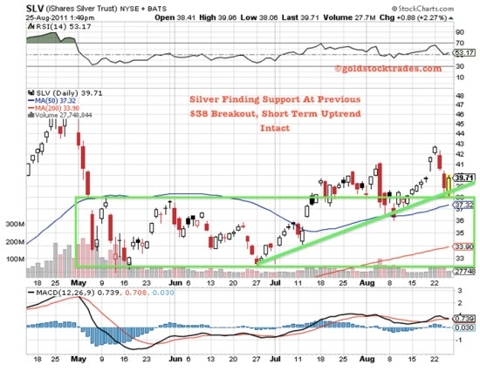
| Posted: 26 Aug 2011 09:36 AM PDT Readers continue to express an abiding interest in silver, also known as the "poor man's gold." Prominent among the questions they raise: Quo vadis silver? Recently the noble white metal experienced a rapid run-up to the halcyon heights of $50, only to retreat precipitously to the low $30s. This on-again, off-again action was due to a technical response to silver's inherent volatility as both an industrial and a safe haven metal. In order to quell such ebullient action, the Comex lowered the boom by a series of increasing margin requirements similar to what is occurring now in gold futures. I've written that such moves were in the cards with silver in late April, and gold more recently. Too much hot, speculative money was entering this market in late April (and early August in gold). Moreover, the big banks and hedge funds grew uncomfortable with their growing short interest positions. The actions of the Comex arrived just in time to save the day for the big fellows. Furthermore, the $50 area represents formidable overhead resistance dating back to January 1980 when the Hunt Brothers drove prices from $11 to $50 an ounce. It did not come as a surprise when we saw the possibility that this overhead resistance would be subject to a Newtonian "equal and opposite reaction" to the mean that had been established in the low $30 area. Where do we go from here? Short and Medium Term: Recently silver has broken its 10-week base, and in the short term may have gotten ahead of itself on the breakout, as the 50-day moving average flattens and commences an upward slope.
Look for a rendezvous with the 20- or 50-day moving average or its short-term uptrend for a secondary buy point. Long Term: My firm believes that silver will recapture its $50 heights sooner rather than later. The establishment of a base in the low $30 area has been a healthy and a necessary one for the technical resumption of the upward, long-term trend. In confirmation, silver has made a triple top breakout on the point and figure chart. This formation is one of the strongest technical indicators that auger a pending upward rise. Readers have asked whether silver is rising too fast in comparison to gold. My response is that we have only to look at the gold-silver equation. What had been historically a dominating ratio of gold to silver is readjusting to reduce the preponderance of gold in this formula. It might appear that silver is rising too fast, however it is playing catch-up to what has been a narrowing of the gold-to-silver proportion. My firm believes that, since the historic breakout in silver in 2010, the gold-to-silver metric would significantly decrease. Silver operates from a dual base, acting as a safe haven for the rising middle class as well as its vital use in industry. Demand is soaring, while supply from existing mines is diminishing. This supports the bullish thesis. Whether the US dollar can maintain its safe haven status is questionable. Add to this the tenuous position of the Eurozone and the future of the euro. The supply of silver is extremely tight. There are few pure silver plays as it is mostly produced as a byproduct. For these reasons demand exceeds existing supply. Investors unable to do specific stock research should take a look at the Global X Silver Miners ETF (SIL). Is silver the new gold? Is it going to be more of a safe haven as margin requirement increases hit gold? Interestingly, the biblical terms for money and silver are synonymous. My firm believes that the appellation "poor man's gold" is not derogatory. Instead, it refers to universality and feasibility as a medium of easy exchange in the banking and public sectors. When Dr. Paul asked Dr. Bernanke, "Is gold money?," the answer might have been, "Yes, but silver is more so." By federal law, silver is money, exchangeable more easily than gold for goods and services. Silver represents a rising area of importance in our everyday lives. It is ever present and growing in the age of the plagues of uncertainty, instability, turbulence, revolutions and fiat money. We expect silver to hit new highs, along with the miners, in 2011. Stay tuned to my daily bulletin for specific stock research and market timing.
| ||
| Posted: 26 Aug 2011 09:26 AM PDT Flashback: De Gaulle and the Gold Standard
| ||
| Guest Post: Apocalypse Trades: Neither Things Nor Bureaucracy Posted: 26 Aug 2011 09:24 AM PDT Submitted by JM Apocalypse Trades: Neither Things Nor Bureaucracy Given the utter implosion of the American consumer and Hurricane Irene, it is fashionable to be apocalyptic these days. One should be disinclined to acquiesce to such visions. One should not be blamed for being seduced: a Federal Reserve apparatchik dictates the path of every asset class by his whim. Regrettably, there is no reliability in predicting such whims of fate. There is, of course, value in speculating to the end of anticipating probable decisions. But it is sometimes best to ignore these perturbations as best one can and undertake reasonable, empirical explorations that buy what is cheap and sell what is dear. Remember the words of the wise: "there is nothing new under the sun." It is commonly held that financial markets are "gamed" against retail investors. Fair enough assessment of some dreadful practices. But for the enterprising, this rigging itself creates opportunity through market volatility. One can game the game by buying into volatility spikes, that is, when all are pressing the sell switch. This takes patience and discipline. One should not condescend to buy shares of a mature business so disrespectful of its owners that it offers no dividend: tosh on these. One should not nurture delusions that an established company with a multiple reflective of 200x earnings is capable of growing into it: insufferable presumption. Above all, one should trust in people and their businesses to navigate uncertain waters, and view with distrust things and bureaucracies. It is prudent to hold small tangible stores of wealth as a counterpoint to ever-increasing financial complexity, but only in small quantities purchased at fair prices. This not said to be injurious. It is said because bargain investments in people are most desirable. People are creative, pliant, and resilient in ways that metals, commodities, or bureaucracies can never approach. Firms and concerns of that sort are options on people, bounded by their limitations and fueled by unlimited desires. In contrast, bureaucracies are condensates of other institutions, deadening instruments with negative carry on the human soul. Some exceptions will arise. The Scourge of Bureaucracy The "bread and circuses" theatrical in the United States Congress last month ended with a stop-gap, thoroughly provisional approach to resolving the debt ceiling. It led to some relief at the front end of the treasury CDS curve, which was ominously inverted. This inversion is a measure of the childish depravity politicians now represent.
Notably, these curves are illiquid. At the 5Y mid, the most liquid point on the curve, there has been a 7% increase in premium in the month following the debt ceiling deal. This is nothing short of dramatic. The CDS market is simply the prevailing view of a given crowd regarding the credit worthiness of a referenced entity. The crowd in question here comprises tier 1 banks, bond market dealers and a few other agents at the margin. It is their view that prevails here. The short-term resolution, if it can be called that, is more than offset by the long-term deterioration in credit-worthiness by their estimation. There are no easy remedies for this state of affairs. But provocation that aggravates the situation serves no good. The United States can borrow virtually unlimited sums for 10 years at 2% interest. This capacity should not be spoiled due to the whims of the Crassus' and Brutus' in Washington D.C. Drastic cuts in public expenditure will surely contribute to greater unemployment. But without earnest action that aligns expenses closer to revenues, the problem of credit-worthiness reflected in CDS will invariably lead to limits on borrowing at precisely the worst time. Neither austerity, nor total avoidance of painful responsibility is the right course Aristotle was right: the mean course is virtue. The mean is anathema to apocalypse. The Superfluity of Things Tangible stores of wealth are indeed seductive, and apocalyptic overtones add to their allure. But what is tangible can be taken. Trading in apocalyptic settings has minimal gain and even the most tangible things carry risk: there is no profit in an unshakable faith in them. The only unshakable faith should be in one's capacity to foster a world worthy of wonderful and useful ideas, avoiding religious matters. It is here that the rules themselves change in unpredictable ways. Bureaucracies collapse: the largest predators in the food chain become extinct. The best hope is to rise out of it and rise quickly and the smaller, nimbler, and more cunning can live to see brighter days. There is no science to living in such circumstances. But perhaps there is an art in it. If the world does melt under the unlaboring stars, one should not despair of it. There will always be ways to support something good in this world. And with all respect for wise words, there are new things under the sun. There are always opportunities to bring something new and vibrant into this world in spite of surrounding gloom. There was an admirable resiliency in his society, in some sense enduring to this day. Desperate, homeless young men and women formed close-knit groups led by their teachers. These teachers held great honor and did more than impart knowledge of subjects. They imparted knowledge of living, shared food and clothing, and gave encouragement. This young man was lucky to have this teacher. He was rather timid and not talkative at all, a bonchan, but his teacher always encouraged him and pushed him to learn. The teacher imparted that learning was not a game at all. It was something very serious that imparts what is genuinely wonderful onto the coldness of the world. If there are such things as guardian angels, then the connection between this teacher and this student is an example of such divine work. Perhaps it was simple inexplicable luck. During this time, life became harder and harder, but the young man went deeper and deeper into study as a response. He describes this obsession for knowledge as similar to an alcoholic's thirst. After the war, he wanted to continue his studies and become a professor. Finances and circumstances forced him to accept being an elementary school teacher instead. But he never lost his thirst for knowing, reading Sugaku on his way to and from work in a country rapid being rebuilt from nearly absolute devastation. He learned a spectrum of general topics like sheaves, algebras, and categories. In his mind he came to see remarkable relationships between analysis, geometry, and algebra and he had a desire to unify them. He came across a problem that shocked the mathematical world of the 1950s: there were linear partial differential equations with variable coefficients that had no solutions in the space of distributions, not even local ones! He developed a solution to this problem and in the process created a framework to convert functional analysis into a coherent whole instead of scattered fragments united only by common techniques. He saw that a manifold is the geometric analogue of an algebraic commutative ring. In an amazing step, he saw that going to the non-commutative case led to a powerful treatment of partial differential equations. These ideas were radical indeed. Gradually the novelty and just plain weirdness of them wore off and some people began using these ideas in a garden variety kind of way. Algebraic analysis still remains somewhat unexplored by the mainstream to this day, save the French. The French above all others have an impeccable feeling for the truly profound. The man was Mikio Sato, and few living mathematicians exceed him. What is most fascinating is the extent to which his world collapsed around him, and how swiftly it was rebuilt. In less than a generation, equity markets were destroyed then booming again and personal wealth exploded upward. Opportunity returned in spite of radiation, physical destruction, political and economic collapse. So it was, so it will be. Japan's rebuilding is more than a copy of its former state. One can argue that the solar panels on virtually every roof and the integration of robotics and the virtual world intertwine with the time-honored tea ceremony in ways that front-run the rest of the world. Mikio Sato was a part of this rebirth, enriching it, making the world more interesting and full of new vistas, simply by pursuing his own personal need to understand. People's needs transcend things. There are always material needs like food, shelter, and clothing: satisfying these alone makes one no better than an animal. There are social needs that make some men rise to be little lower than angels and some men descend into nothing more than demons. These are best understood as thirsts: sometimes twisted into a thirst for dominance and power, sometimes is a simple longing for closeness and belonging. But there is a thirst much nobler in man. He creates ideas to nurture and cherish. These rebuild and give something to all. "They can take land and money and all your things, but they can never steal what is in your mind." A friend told me these words. They were told to a son from a father living in 1930s China to explain why all of a possible inheritance did not leave land or silver for an only son. Instead his father poured the inheritance into a physics degree from Peking University. He told his son those words, which he in turn passed on to his own daughter. I passed them on to my sons. I have no illusion of being extraordinary or that what I do changes the world: I use mathematical methods, but I am no great mathematician. What I do simply supports both the beauty and the ugliness in the world. At my best, I can make the world better by my actions. Anyone can. Should new things under the sun realize the worst of men's fears, should epic fail overtake me because I honor the time-honored, I shall be open and receptive. I shall still support the world in ways that will never fail to unfold.
| ||
| GoldSeek's Peter Spina describes bypassing the mainstream media Posted: 26 Aug 2011 09:11 AM PDT 5:05p ET Friday, August 26, 2011 Dear Friend of GATA and Gold: Peter Spina, founder of GoldSeek.com, attended GATA's Gold Rush 2011 conference in London this month and in an interview there with GoldMoney's James Turk described how his Internet site strove to provide information about the gold market that the mainstream news media would not cover. Spina also remarked on the difference between producing mining companies and junior explorers and the geopolitical risks of mining. The interview is 12 minutes long and you can watch it at the GoldMoney Internet site here: http://www.goldmoney.com/video/spina-turk-interview.html?gmrefcode=gata CHRIS POWELL, Secretary/Treasurer ADVERTISEMENT Prophecy Platinum Drills 49.5 Meters Grading 1.27 g/t PGM+Au at Yukon Wellgreen Project Company Press Release Prophecy Platinum Corp. (TSX-V: NKL, OTC-QX: PNIKF, Frankfurt: P94P) announces results from its 2011 drilling program for its first completed hole on the Wellgreen Project in the Yukon Territory, Canada. Borehole WS11-184 encountered 472.6 meters of mineralization grading 0.43% The geology transitioned from blebby disseminated to net-textured to massive sulphide approaching the footwall contact grading 6.3% nickel, 1.7% copper, 2.7 grams per ton platinum, 1.6 grams per ton palladium, 0.17 grams per ton gold, and 3.4 grams per ton silver. The drilling zones and results are tabulated here, with more information: http://www.prophecyplat.com/news_2011_aug22_prophecy_platinum_wellgreen_... Join GATA here: Toronto Resource Investment Conference http://cambridgehouse.com/conference-details/toronto-resource-investment... The Silver Summit http://cambridgehouse.com/conference-details/the-silver-summit-2011/48 New Orleans Investment Conference http://www.neworleansconference.com/ Support GATA by purchasing gold and silver commemorative coins: https://www.amsterdamgold.eu/gata/index.asp?BiD=12 Or by purchasing a colorful GATA T-shirt: Or a colorful poster of GATA's full-page ad in The Wall Street Journal on January 31, 2009: http://gata.org/node/wallstreetjournal Or a video disc of GATA's 2005 Gold Rush 21 conference in the Yukon: Help keep GATA going GATA is a civil rights and educational organization based in the United States and tax-exempt under the U.S. Internal Revenue Code. Its e-mail dispatches are free, and you can subscribe at: To contribute to GATA, please visit: ADVERTISEMENT Golden Phoenix Q2 2011 Conference Call Posted at Company Internet Site The second quarter 2011 conference call of Golden Phoenix Minerals Inc. (GPXM) has been posted at the company Internet site for immediate playback. The call includes updates on the start of gold production at the company's Mineral Ridge gold project in Nevada, the letter of intent to acquire the Santa Rosa gold mine in Panama, and the company's due-diligence efforts to secure a senior stock exchange listing. The conference call is 18 minutes long and you download an mp3 of it here: http://www.goldenphoenix.us/audio/GPXMCC071211.mp3 Or play back the call here: http://goldenphoenix.us/conferencecalls/ Golden Phoenix is a U.S. mining company with international exposure to gold, silver, and strategic metals. The company's business model combines project generation and royalty mining that offers the potential for exploration upside, coupled with the backing of production and future royalty streams. View company videos here:
| ||
| Shares starting to outperform bullion, Lassonde tells King World News Posted: 26 Aug 2011 08:58 AM PDT 4:56p ET Friday, August 26, 2011 Dear Friend of GATA and Gold: Mining entrepreneur Pierre Lassonde this week told King World News that gold mining stocks are starting to outperform bullion. Lassonde expects that this will continue. An excerpt from his remarks can be found at the King World News blog here: http://kingworldnews.com/kingworldnews/KWN_DailyWeb/Entries/2011/8/26_La... CHRIS POWELL, Secretary/Treasurer ADVERTISEMENT Golden Phoenix Q2 2011 Conference Call Posted at Company Internet Site The second quarter 2011 conference call of Golden Phoenix Minerals Inc. (GPXM) has been posted at the company Internet site for immediate playback. The call includes updates on the start of gold production at the company's Mineral Ridge gold project in Nevada, the letter of intent to acquire the Santa Rosa gold mine in Panama, and the company's due-diligence efforts to secure a senior stock exchange listing. The conference call is 18 minutes long and you download an mp3 of it here: http://www.goldenphoenix.us/audio/GPXMCC071211.mp3 Or play back the call here: http://goldenphoenix.us/conferencecalls/ Golden Phoenix is a U.S. mining company with international exposure to gold, silver, and strategic metals. The company's business model combines project generation and royalty mining that offers the potential for exploration upside, coupled with the backing of production and future royalty streams. View company videos here: Join GATA here: Toronto Resource Investment Conference http://cambridgehouse.com/conference-details/toronto-resource-investment... The Silver Summit http://cambridgehouse.com/conference-details/the-silver-summit-2011/48 New Orleans Investment Conference http://www.neworleansconference.com/ Support GATA by purchasing gold and silver commemorative coins: https://www.amsterdamgold.eu/gata/index.asp?BiD=12 Or by purchasing a colorful GATA T-shirt: Or a colorful poster of GATA's full-page ad in The Wall Street Journal on January 31, 2009: http://gata.org/node/wallstreetjournal Or a video disc of GATA's 2005 Gold Rush 21 conference in the Yukon: Help keep GATA going GATA is a civil rights and educational organization based in the United States and tax-exempt under the U.S. Internal Revenue Code. Its e-mail dispatches are free, and you can subscribe at: To contribute to GATA, please visit: http://www.gata.org/node/16 ADVERTISEMENT Prophecy Platinum Drills 49.5 Meters Grading 1.27 g/t PGM+Au at Yukon Wellgreen Project Company Press Release Prophecy Platinum Corp. (TSX-V: NKL, OTC-QX: PNIKF, Frankfurt: P94P) announces results from its 2011 drilling program for its first completed hole on the Wellgreen Project in the Yukon Territory, Canada. Borehole WS11-184 encountered 472.6 meters of mineralization grading 0.43% The geology transitioned from blebby disseminated to net-textured to massive sulphide approaching the footwall contact grading 6.3% nickel, 1.7% copper, 2.7 grams per ton platinum, 1.6 grams per ton palladium, 0.17 grams per ton gold, and 3.4 grams per ton silver. The drilling zones and results are tabulated here, with more information: http://www.prophecyplat.com/news_2011_aug22_prophecy_platinum_wellgreen_...
| ||
| Michael Pento: Here is Why Gold is Soaring After Hours Posted: 26 Aug 2011 08:57 AM PDT from King World News:
Michael Pento continues: Read More @ KingWorldNews.com
| ||
| Posted: 26 Aug 2011 08:56 AM PDT Michael Pento – Here is Why Gold is Soaring After Hours
| ||
| Gold Daily and Silver Weekly Charts - Option Expiration Manipulation - Q. E. D. Posted: 26 Aug 2011 08:55 AM PDT | ||
| Ned Naylor-Leyland: Real metal is beating paper in the gold market Posted: 26 Aug 2011 08:54 AM PDT 4:53p ET Friday, August 26, 2011 Dear Friend of GATA and Gold: Ned Naylor-Leyland, investment director for Cheviot Asset Management in London and a speaker at GATA's Gold Rush 2011 conference there this month, told CNBC Europe the other day that a change is under way in the "price discovery mechanism" for gold, a change toward real metal and physical delivery: http://www.cheviot.co.uk/news/video/2011/08/commodities-corner/ Naylor-Leyland elaborates on this in a brief essay drawn in part from his comments at the GATA conference. He writes: "At any cost the existing mechanism will resist delivery, which is what makes the recent demand by Hugo Chavez to repatriate Venezuelan gold reserves so interesting. This move toward delivery by the Venezuela leader plays into the same important dynamic as the Pan Asia Gold Exchange." You can find Naylor-Leyland's essay at the Cheviot Internet site here: http://www.cheviot.co.uk/news/2011/08/the-pan-asia-gold-exchange-and-hug... CHRIS POWELL, Secretary/Treasurer ADVERTISEMENT Sona Drills 85.4g Gold/Ton Over 4 Metres at Elizabeth Gold Deposit, Company Press Release, October 27, 2010 VANCOUVER, British Columbia -- Sona Resources Corp. reports on five drillling holes in the third round of assay results from the recently completed drill program at its 100 percent-owned Elizabeth Gold Deposit Property in the Lillooet Mining District of southern British Columbia. Highlights from the diamond drilling include: -- Hole E10-66 intersected 17.4g gold/ton over 1.54 metres. -- Hole E10-67 intersected 96.4g gold/ton over 2.5 metres, including one assay interval of 383g of gold/ton over 0.5 metres. -- Hole E10-69 intersected 85.4g gold/ton over 4.03 metres, including one assay interval of 230g gold/ton over 1 metre. Four drill holes, E10-66 to E10-69, targeted the southwestern end of the Southwest Vein, and three of the holes have expanded the mineralized zone in that direction. The Southwest Vein gold mineralization has now been intersected over a strike length of 325 metres, with the deepest hole drilled less than 200 metres from surface. "The assay results from the Southwest Zone quartz vein continue to be extremely positive," says John P. Thompson, Sona's president and CEO. "We are expanding the Southwest Vein, and this high-grade gold mineralization remains wide open down dip and along strike to the southwest." For the company's full press release, please visit: http://sonaresources.com/_resources/news/SONA_NR19_2010.pdf Join GATA here: Toronto Resource Investment Conference http://cambridgehouse.com/conference-details/toronto-resource-investment... The Silver Summit http://cambridgehouse.com/conference-details/the-silver-summit-2011/48 New Orleans Investment Conference http://www.neworleansconference.com/ Support GATA by purchasing gold and silver commemorative coins: https://www.amsterdamgold.eu/gata/index.asp?BiD=12 Or by purchasing a colorful GATA T-shirt: Or a colorful poster of GATA's full-page ad in The Wall Street Journal on January 31, 2009: http://gata.org/node/wallstreetjournal Or a video disc of GATA's 2005 Gold Rush 21 conference in the Yukon: Help keep GATA going GATA is a civil rights and educational organization based in the United States and tax-exempt under the U.S. Internal Revenue Code. Its e-mail dispatches are free, and you can subscribe at: To contribute to GATA, please visit: ADVERTISEMENT Lewis E. Lehrman on How to Solve the U.S. Debt Problem Lewis E. Lehrman, chairman of the Lehrman Institute, sponsor of The Gold Standard Now project, advises that to reduce the $1 1/2 trillion U.S. deficit, the Republican Party must initiate an investment program. Working Americans are not saving, which enables the banks to lead the country into a cycle of debt, leverage, boom, panic, and bust. To read more and to sign up for The Gold Standard Now's free, noncommercial, weekly report, "Prosperity through Gold," please visit: http://www.thegoldstandardnow.org/gata
| ||
| Posted: 26 Aug 2011 08:48 AM PDT Part 1: A 45 minute Infowars Special Report with Alex Jones and Lew Rockwell. Alex covers the latest on Libya, the carbon tax shutdown of coal plants, Homeland Security's latest flying taser drones and much more. Special guest Lew Rockwell, former campaign manager for Ron Paul, breaks down the Texas Congressman's rise in 2012 presidential polls, the entrance of establishment favorite Gov. Rick Perry, the End of the Dollar and much more.
| ||
| Russian c.bank to offer gold-backed loans at 7 pct Posted: 26 Aug 2011 08:45 AM PDT August 26 (Reuters) — Russia's central bank will offer gold-backed loans for up to 90 days at an interest rate of 7 percent, it said in a statement on Friday, expanding its lending facilities for dealing with any future liquidity crunch in the banking system. The gold-backed lending was approved by the board of directors at a meeting on Friday. The rate on the facility is in line with the central bank's Lombard rate on borrowing secured against high-quality bonds. [source]
| ||
| Physical market overpowers gold cartel, Murphy tells Resource Clips Posted: 26 Aug 2011 08:40 AM PDT 4:35p ET Friday, August 26, 2011 Dear Friend of GATA and Gold: Also predicting a quick resumption of gold's rise this week was GATA Chairman Bill Murphy when interviewed Wednesday by Kevin Michael Grace for Resource Clips. Asked about the smashing down of gold, Murphy said: "My guess is that this will be very brief because the physical market will catch on fire again. This has been GATA's whole premise, and why we've been right since gold was at $250 to $300 and all the way up. We said that the key to the future is the physical market overpowering the gold cartel. Years ago you may recall that everyone said the key to gold was what the dollar did. GATA said no; that's not correct. It is the physical market's ability to overpower the gold cartel." You can find the interview at Resource Clips here: http://resourceclips.com/2011/08/25/bill-murphy-on-the-gold-crash/ CHRIS POWELL, Secretary/Treasurer ADVERTISEMENT Sona Drills 85.4g Gold/Ton Over 4 Metres at Elizabeth Gold Deposit, Company Press Release, October 27, 2010 VANCOUVER, British Columbia -- Sona Resources Corp. reports on five drillling holes in the third round of assay results from the recently completed drill program at its 100 percent-owned Elizabeth Gold Deposit Property in the Lillooet Mining District of southern British Columbia. Highlights from the diamond drilling include: -- Hole E10-66 intersected 17.4g gold/ton over 1.54 metres. -- Hole E10-67 intersected 96.4g gold/ton over 2.5 metres, including one assay interval of 383g of gold/ton over 0.5 metres. -- Hole E10-69 intersected 85.4g gold/ton over 4.03 metres, including one assay interval of 230g gold/ton over 1 metre. Four drill holes, E10-66 to E10-69, targeted the southwestern end of the Southwest Vein, and three of the holes have expanded the mineralized zone in that direction. The Southwest Vein gold mineralization has now been intersected over a strike length of 325 metres, with the deepest hole drilled less than 200 metres from surface. "The assay results from the Southwest Zone quartz vein continue to be extremely positive," says John P. Thompson, Sona's president and CEO. "We are expanding the Southwest Vein, and this high-grade gold mineralization remains wide open down dip and along strike to the southwest." For the company's full press release, please visit: http://sonaresources.com/_resources/news/SONA_NR19_2010.pdf Join GATA here: Toronto Resource Investment Conference http://cambridgehouse.com/conference-details/toronto-resource-investment... The Silver Summit http://cambridgehouse.com/conference-details/the-silver-summit-2011/48 New Orleans Investment Conference http://www.neworleansconference.com/ Support GATA by purchasing gold and silver commemorative coins: https://www.amsterdamgold.eu/gata/index.asp?BiD=12 Or by purchasing a colorful GATA T-shirt: Or a colorful poster of GATA's full-page ad in The Wall Street Journal on January 31, 2009: http://gata.org/node/wallstreetjournal Or a video disc of GATA's 2005 Gold Rush 21 conference in the Yukon: Help keep GATA going GATA is a civil rights and educational organization based in the United States and tax-exempt under the U.S. Internal Revenue Code. Its e-mail dispatches are free, and you can subscribe at: To contribute to GATA, please visit: ADVERTISEMENT Lewis E. Lehrman on How to Solve the U.S. Debt Problem Lewis E. Lehrman, chairman of the Lehrman Institute, sponsor of The Gold Standard Now project, advises that to reduce the $1 1/2 trillion U.S. deficit, the Republican Party must initiate an investment program. Working Americans are not saving, which enables the banks to lead the country into a cycle of debt, leverage, boom, panic, and bust. To read more and to sign up for The Gold Standard Now's free, noncommercial, weekly report, "Prosperity through Gold," please visit: http://www.thegoldstandardnow.org/gata
|




 With gold soaring, up $50 in access market trading to over $1,820, today King World News asked Michael Pento the reasons for the big move in gold as well as his thoughts on Bernanke's speech. Pento had this to say when asked about the explosive situation in gold, "Chairman Bernanke reiterated yet again that the fed would do whatever it takes to restore prosperity to the U.S. economy. The academic/politician still doesn't understand that this is a balance sheet recession and all he has accomplished is to offer inflation along with zero growth."
| You are subscribed to email updates from Save Your ASSets First To stop receiving these emails, you may unsubscribe now. | Email delivery powered by Google |
| Google Inc., 20 West Kinzie, Chicago IL USA 60610 | |


No comments:
Post a Comment