


Gold World News Flash |

- “Well he owns a big chunk of Moody’s doesn’t he? Moody’s hasn’t lowered their rating, so somebody is mistaken, it’s either Moody’s or S&P. It stands to reason that Buffett would say his competitor was mistaken rather than himself.”
- Richard Russell - Gold & Markets Signal More “Great Recession”
- SocGen, Unicredit On "Brink Of Disaster"?
- Gold Soars Past $1,700 As Debt Crisis Spirals Out Of Control
- The First Euro Bond Prints Are In, And The Loser Is...
- Time for the Marlboro man to use gold and silver patches
- Schiff - Gold up $27, Dow Futures Down 276, Buffett Wrong
- Bill Gross Tells The Truth: "S&P Finally Got It Right. They Are Enforcing Some Discipline. My Hat Is Off To Them"
- Bill Gross Tells The Truth: "S&P Finally Got It Right. They Are Enforcing Some Discipline. My Hat Is Off To Them"
- Richard Russell - Gold & Markets Signal More “Great Recession”
- Japan Rice Futures Surge 40%, Trigger Circuit Breaker On Concerns Fukushima Radiation Will Destroy Crops
- Forum 1700
- So Much For QE2: The Market Indexed For Dollar Devaluation Is Now Back To Jackson Hole Levels
- We Are Not AAA
- Jim Sinclair and Jim Sinclair on gold and US debt
- Jim Sinclair is interviewed by GoldMoney’s James Turk
- GATA’s London conference draws nearly 400 from 38 countries
- Silver is ‘investment of the next decade,’ Sprott says in GoldMoney interview
- Chris Powell: Who will put the gold questions to central banks?
- As many as 20 owners for each bullion bank gold bar, Rickards tells King World News
- Central Banks Hint: It’s Not Too Late To Buy Gold
- Gold Decline Prompted By Selling To Meet Margin Calls Elsewhere; Uptrend Still Seen As Intact
- Chinese buy Orkney gold mine for R150m, plan R525m capital injection
- Gold massively underinvested – silver data overwhelming: Eric Sprott
- Commodities other than gold to fall on U.S. ratings downgrade – Analysts
- Gold and Commodities
- G-7 Seeks to Avert Collapse in Confidence
- Junior Gold & Silver Shares Can Perform When Other Equities Do Not?
- Gold Market Update
- Junior Gold and Silver Shares Can Perform When Other Equities Do Not?
| Posted: 07 Aug 2011 07:55 PM PDT Schiff – Gold up $27, Dow Futures Down 276, Buffett Wrong
| ||||||
| Richard Russell - Gold & Markets Signal More “Great Recession” Posted: 07 Aug 2011 07:33 PM PDT My belief is if market continues down, Wall Street will be telling us that the Great Recession still lives, & remainder of the Great Recession lies ahead.
| ||||||
| SocGen, Unicredit On "Brink Of Disaster"? Posted: 07 Aug 2011 06:57 PM PDT Over the past 48 hours we had heard pervasive rumors that at least one, maybe more, banks in Europe are on the verge of collapse. Our thought was, naturally, Dexia, which is the modern equivalent of AIG, not to mention the bank most rescued by none other than the Federal Reserve. Well, we were wrong. And if the Daily Mail is correct, the two banks about to kick the bucket are French SocGen and Italy's UniCredit. While the fact that these two banks are in trouble has not been lost on the market, which has been sending their CDS to near record highs, the speculation that they are far closer to implosion likely means that the equity value of the European banking sector is about to be decimated. As the News reports: "The merest hint a major bank might fall is likely to reignite panic tomorrow in the stock market, which is already feared to react badly to the credit downgrade of the U.S. by rating agency Standard & Poor's." Well, it's now tomorrow. More from the UK mag:
Next up: bank runs.
Naturally, no depositors will wait for this to happen, or for these news to be confirmed or denied. They will merely walk up to the teller window, submit a withdrawal ticket and proceed to close their accounts. And here is where the story gets downright surreal:
Remember where we said that the last thing left is for China to float the CNY? Well, pushing for the SDR is pretty much the same thing. In the meantime, keep an eye on the price of Unicredit and SocGen tomorrow. Despite SocGen's and UniCredit's repeated statements that the article in Mail on Sunday was "false, irresponsible" the damage may have already been done. And something tells us the downside limits will be hit very quickly, leading to a Lehman-like self-fulfilling prophecy. We wonder if in addition to PIIGS bonds, the ECB is ready and prepared to buy stocks of insolvent European banks...
| ||||||
| Gold Soars Past $1,700 As Debt Crisis Spirals Out Of Control Posted: 07 Aug 2011 06:44 PM PDT Gold soared to a new all time high over $1,700 in Asian trading after the credit downgrade of the United States by Standard & Poors and news that the ECB would conduct large scale purchases of Italian and Spanish bonds. These two event have escalated the debt crisis in Europe and the United States to [...]
| ||||||
| The First Euro Bond Prints Are In, And The Loser Is... Posted: 07 Aug 2011 06:42 PM PDT On Friday, when we discussed that the EFSF could potentially be expanded to a ridiculous E3.5 trillion, we made the following observation in advance of the prediction that Germany would eventually throw up all over the creeping euro bailout proposal, we said: "In the meantime, short Bunds (or to borrow a Gartmanism, go long gold in Bund terms) ahead of the market's realization that peak risk transfer from the periphery to the core is now in process." Well, the first eurobond prints are in (we already know where gold is trading), and the losers (and winners) are...
Yes Germany: it is one thing for us to predict that your country will soon foot the bill for all of peripheral Europe. It is another for the market to agree. It is still not too late.
| ||||||
| Time for the Marlboro man to use gold and silver patches Posted: 07 Aug 2011 06:30 PM PDT Peter Souleles
| ||||||
| Schiff - Gold up $27, Dow Futures Down 276, Buffett Wrong Posted: 07 Aug 2011 05:25 PM PDT  With gold at new all-time highs trading up $27 in overnight trading in Asia and Dow futures down 276 points, today King World News interviewed Peter Schiff, CEO of Europacific Capital to get his take on what to expect in this week's trading. When asked about gold Schiff stated, "The dollar used to be the safe haven, Treasuries used to be the safe haven, well if you are downgrading US Treasuries, obviously they are not the safe haven anymore. With gold at new all-time highs trading up $27 in overnight trading in Asia and Dow futures down 276 points, today King World News interviewed Peter Schiff, CEO of Europacific Capital to get his take on what to expect in this week's trading. When asked about gold Schiff stated, "The dollar used to be the safe haven, Treasuries used to be the safe haven, well if you are downgrading US Treasuries, obviously they are not the safe haven anymore.For those people who believed foolishly that Treasuries were the safe haven, S&P is finally saying they're not. In fact they (Treasuries) are on negative watch for a reason, I think S&P is going to downgrade again...by then I'm sure Moody's and Fitch will have also downgraded US Treasuries."
This posting includes an audio/video/photo media file: Download Now | ||||||
| Posted: 07 Aug 2011 04:59 PM PDT After all the hollow rhetoric and scapegoating over the past few days about S&Ps "treasonous act" from Friday, we were delighted to finally hear one person say the truth. "I have been criticizing them and Moody's and Fitch for a long time. Moody's and Fitch are on the "S" list. I think S&P finally demonstrated some spin. S&P finally got it right. They spoke to a dysfunctional political system and deficits as far as the eye can see. They are enforcing some discipline. My hat is off to them." The person in question: PIMCO's Bill Gross, who says what everyone is thinking but afraid to say it for fear it would insult our oh so sensitive, and so incompetent, administration. Because if criticizing S&P over being far too late to the subprime party is justified, at least they have the guts (unlike those tapeworms from Moody's) to finally step against the tide of conventional sycophantic wisdom and tell everyone even a modest part of the whole truth. If that is not the first step toward penitence, then nothing is. And yes, America's real credit rating at the current level of deficit accumulation most certainly does not begin with the letter A, or B or even C for that matter. Because what America is doing is heading straight for default, however not by officially filing in the Southern District of New York, but by terminally hobbling its own currency in hopes of stimulating rampant inflation thereby cutting its debt load through devaluation. A sad side effect of that of course is the wipe out of its own middle class as well. But all is fair in love and preserving the wealth of the status quo. Gross transcript: Gross on the ECB bond purchasing program:
| ||||||
| Posted: 07 Aug 2011 04:59 PM PDT
After all the hollow rhetoric and scapegoating over the past few days about S&Ps "treasonous act" from Friday, we were delighted to finally hear one person say the truth. "I have been criticizing them and Moody's and Fitch for a long time. Moody's and Fitch are on the "S" list. I think S&P finally demonstrated some spin. S&P finally got it right. They spoke to a dysfunctional political system and deficits as far as the eye can see. They are enforcing some discipline. My hat is off to them." The person in question: PIMCO's Bill Gross, who says what everyone is thinking but afraid to say it for fear it would insult our oh so sensitive, and so incompetent, administration. Because if criticizing S&P over being far too late to the subprime party is justified, at least they have the guts (unlike those tapeworms from Moody's) to finally step against the tide of conventional sycophantic wisdom and tell everyone even a modest part of the whole truth. If that is not the first step toward penitence, then nothing is. And yes, America's real credit rating at the current level of deficit accumulation most certainly does not begin with the letter A, or B or even C for that matter. Because what America is doing is heading straight for default, however not by officially filing in the Southern District of New York, but by terminally hobbling its own currency in hopes of stimulating rampant inflation thereby cutting its debt load through devaluation. A sad side effect of that of course is the wipe out of its own middle class as well. But all is fair in love and preserving the wealth of the status quo. Gross transcript: Gross on the ECB bond purchasing program:
| ||||||
| Richard Russell - Gold & Markets Signal More “Great Recession” Posted: 07 Aug 2011 04:50 PM PDT  With tremendous volatility in the markets and the US debt downgrade, the Godfather of newsletter writers Richard Russell had this to say in his latest commentary, "Gold -- For the last two years gold has advanced steadily above a 150-day moving average. This MA has been tested five times in the last two years.
Most recently amid the gold weakness, gold has never declined to within even a few points of its 150-MA. I call this a successful test of strength. The 150-day MA now stands at 1471. As of today, gold stands 188 points above its 150-day MA, which I think is a generally bullish performance. During (this week's) carnage, December gold rose intra-day to a record, and then settled down to 1659 (basis December)." With tremendous volatility in the markets and the US debt downgrade, the Godfather of newsletter writers Richard Russell had this to say in his latest commentary, "Gold -- For the last two years gold has advanced steadily above a 150-day moving average. This MA has been tested five times in the last two years.
Most recently amid the gold weakness, gold has never declined to within even a few points of its 150-MA. I call this a successful test of strength. The 150-day MA now stands at 1471. As of today, gold stands 188 points above its 150-day MA, which I think is a generally bullish performance. During (this week's) carnage, December gold rose intra-day to a record, and then settled down to 1659 (basis December)."
This posting includes an audio/video/photo media file: Download Now | ||||||
| Posted: 07 Aug 2011 04:22 PM PDT 70 years after rice futures trading was halted on the Tokyo Grain Exchange, it was finally reopened today... only to be halted immediately. The reason: concerns that Fukushima radiation would destroy rice crops and collapse supply sent the contract price soaring from the reference price of Y13,500 to a ridiculous Y18,500 at which point it was halted. Note the tick chart below which puts any of our own stupid vacuum tube-induced HFT algos to outright shame. That said, the move should not come as a surprise at least to our readers after we predicted the day Fukushima blew up (and even before) that very soon rice prices would surge to record highs. Little by little, that realization is dawning on everyone.
More from Bloomberg:
Sadly, this development means that Thailand and Vietnam, and the rast of the major rice exporters, are suddenly going to find they have quite a bit in marginal pricing power for this core Japanese staple. It also means that food riots may be imminent if indeed, as futures indicate, the price of rice is about to jump by 40%.
| ||||||
| Posted: 07 Aug 2011 04:16 PM PDT Tuesday, January 1, 2002 - Launch of euro notes and coins Friday, February 8, 2002 - GOLD ABOVE $300 Monday, December 1, 2003 - GOLD ABOVE $400 Thursday December 1, 2005 - GOLD ABOVE $500 Monday, April 17, 2006 - GOLD ABOVE $600 Tuesday, May 9, 2006 - GOLD ABOVE $700 Friday, November 2, 2007 - GOLD ABOVE $800 Monday, January 14, 2008 - GOLD ABOVE $900 Monday, March 17, 2008 - GOLD ABOVE $1000
| ||||||
| So Much For QE2: The Market Indexed For Dollar Devaluation Is Now Back To Jackson Hole Levels Posted: 07 Aug 2011 03:34 PM PDT While the notional level of the market is still modestly higher than late August 2010, when indexed for that other component which everyone always forgets, yet which is an integral part of any net purchasing power calculation, the devaluation of the dollar, the S&P is now precisely at the levels at which Bernanke let QE2 loose with his Jackson Hole speech. Which means the time for QE3 has come. Of course, the notional value at the end will be that little bit higher, offset by yet another major drop in the value of the AA+ (outlook negative) US currency.
| ||||||
| Posted: 07 Aug 2011 02:05 PM PDT
I have received many emails and a few calls from friends, asking one question: What are the consequences of the downgrade? So I decided to put my thoughts on paper. I break up the consequences into three categories: fundamental (the impact on the economy), emotional (the short-term impact on the market), and political (will it change anything in Washington DC?). Fundamental: AA+ is the new AAA. The indirect impact of the downgrade is worrisome, however, because unknowns are simply … unknown. The AAA government debt rating is a foundation stone of the world financial system, and when it shifts, even a little, other things may shift as well. Unintended consequences may be surprising. For instance, until Lehman collapsed it was hard to imagine that the Reserve Fund (the first US money market fund) would see its price decline a few pennies bellow the dollar, causing a massive exodus out of money market funds and a resultant freezing of the commercial paper market – the lifeblood of corporate America. The federal government had to step in and guarantee all money markets to stop the bleeding. Scandinavian countries and Switzerland are probably the only true AAA nations left, but their economies are not big enough for them to field reserve currencies, and in fact Switzerland is trying to devalue its currency, as its exporters are hurting from the highly appreciated Swiss franc. The US's cost of borrowing is unlikely to increase, not yet, not while PIIGS (Portugal, Italy, Ireland, Greece, and Spain) are rampaging through Europe. The US still has the largest, most robust, most diversified economy, and despite our problems we are in better shape than Western Europe, which is chained to a common currency and whose banks are overleveraged through their exposure to PIIGS. The only downgrade that will really matter to our cost of borrowing in the long run is the one imposed by the bond markets. Credit agency ratings are important in the short run, because their ratings are deeply embedded in the financial system by regulators (and governments), but in the longer run it is the markets' own ratings that will matter. Markets will perform their own credit analysis of countries and will do their own debt downgrading, i.e., they'll demand higher interest rates. Japanese debt was downgraded to AA- in January 2011. It was a nonevent. Despite being the most indebted developed nation, Japan is still borrowing at the same pre-downgrade rates, which are half of the rates the US government pays on its debt. On the other hand, Italy's 10-year bond rates jumped to 6% in August without any downgrade by credit agencies: the markets did their own credit analysis. The chance the US will default on its debt in a traditional sense is zero. Yes, zero. All of our obligations are in US dollars. Governments that can print their own currencies don't go through traditional default, they default through the printing press (i.e., by inflation). It will take a few more dollars to buy bread, vodka, potatoes, and cigarettes (I am going authentic here) year after year. The US government will honor its obligations in nominal terms (ignoring inflation), meanwhile defaulting on its debt in real terms (adjusted for inflation). Emotional Consequences I was going to write a note on this topic before the S&P downgrade, so I'll expand it a bit further. I was on a radio show on Friday, and I was asked why the markets declined 7% this week. I said, "Markets were ignoring bad news for a while and now decided to stop ignoring it." I sounded smart; I even patted myself on the back. But a few hours later I was driving home and started thinking what baloney that was. The market declined because it declined. There is no need for an explanation, because there really is not one. We don't need an explanation why the market goes up, we consider it our birthright. But a market decline seems somewhat unnatural to us. Financial TV explains to us in great detail the market's tick by tick movements. For example, on Friday the jobs report came out – the US economy added 117,000 jobs. The Dow went up 150 points or so right away, as financial TV explained that the market was expecting a worse number, so this was a good surprise. Then, two hours later, the market declined 250 points (that is, down 400 points from the opening high); and the explanation we heard was that the job number was not really that good, after all, because we needed 150,000 jobs or so just to maintain our current same employment level, because of population growth, so in reality employment had declined by 33,000 jobs. I understand why financial TV does this. You are not going to stay tuned to financial TV all day long if all you hear is that the market went up 150 points because it did, and then declined 250 points because it does that from time to time. This would be some boring TV. In reality, market movements – including intraday, daily, and monthly movements – are largely random and not predictable. Explaining what they do tick by tick on a continuous basis has as much value as trying to come up with a rational explanation why the ball landed on the 9 on the roulette table in Bellagio instead of 10. This brings me to the question of how markets will react to the downgrade. I have no idea. If they were to decline, I would not mind, as we have a little bit less than 30% cash, and I want to put it to work (we bought a few stocks last week). Also, a bulk of the companies in our portfolio are actively buying back a meaningful amount of their stock in the open market, and I want them to buy their stock cheaper, as it will raise their earnings power. But if you are an investor you need to have a time horizon longer than a week or a month. Political Consequences Hallelujah! Last week I wrote about the Pyrrhic victory of the debt-ceiling debate: A Pyrrhic victory is so-called after the Greek king Pyrrhus, who, after suffering heavy losses in defeating the Romans in 279 B.C., said to those sent to congratulate him, "Another such victory over the Romans and we are undone." Dictionary.com A quick thought on the debt-ceiling debacle. I believe that by August 2nd we'll see the debt ceiling increased, as the cost of not doing so is simply unknown and most likely too high. However, it will be a Pyrrhic victory for whatever side claims it, as the victory will undoubtedly undermine the world's trust in the US dollar and its debt ($37.5 billion leaving money-market funds that invest in Treasuries in one week proves the latter point already). And this is what S&P delicately wrote about our politicians: Our opinion is that elected officials remain wary of tackling the structural issues required to effectively address the rising U.S. public debt burden in a manner consistent with a 'AAA' rating and with 'AAA' rated sovereign peers. An AAA-rated nation doesn't threaten a default to achieve its political agenda; this is what you'd expect a banana republic to do. I really hope the downgrade was the slap on the face our politicians so badly needed. Both parties represent a class, not Americans who share the same sky and constitution, but rich and poor. Each party wants to solve the debt problem at the expense of the other class. Unfortunately, we have a government we cannot af | ||||||
| Jim Sinclair and Jim Sinclair on gold and US debt Posted: 07 Aug 2011 01:46 PM PDT Filed under: Asia, austerity, Buy Gold, Buy Precious Metals, Buy Silver, China, commodity trades, currency systems, debt ceiling, debt limit, Economic crisis, euro system, Eurozone, federal debt ceiling, federal reserve system, futures market, Global finance, gold price, hyperinflation, index futures, international monetary system, market crash, market manipulation, members of congress, Mining, Oil, Precious Metals, price [...] 
This posting includes an audio/video/photo media file: Download Now | ||||||
| Jim Sinclair is interviewed by GoldMoney’s James Turk Posted: 07 Aug 2011 01:31 PM PDT GATA 5p BST Sunday, August 7, 2011 Dear Friend of GATA and Gold: Just after his presentation to GATA's Gold Rush 2011 conference in London, gold trader and mining entrepreneur Jim Sinclair was interviewed by GoldMoney founder James Turk about how he calculates his price expectations for gold, the likely acceleration of gold's upward trend, the "embarrassment" of the U.S. government's latest debt-ceiling legislation, and debt contagion in the Western world. The interview is 10 minutes long and you can watch it at the GoldMoney Internet site here: http://www.goldmoney.com/video/sinclair-turk-interview.html CHRIS POWELL, Secretary/Treasurer Help keep GATA going GATA is a civil rights and educational organization based in the United States and tax-exempt under the U.S. Internal Revenue Code. Its e-mail dispatches are free, and you can subscribe at: To contribute to GATA, please visit:
| ||||||
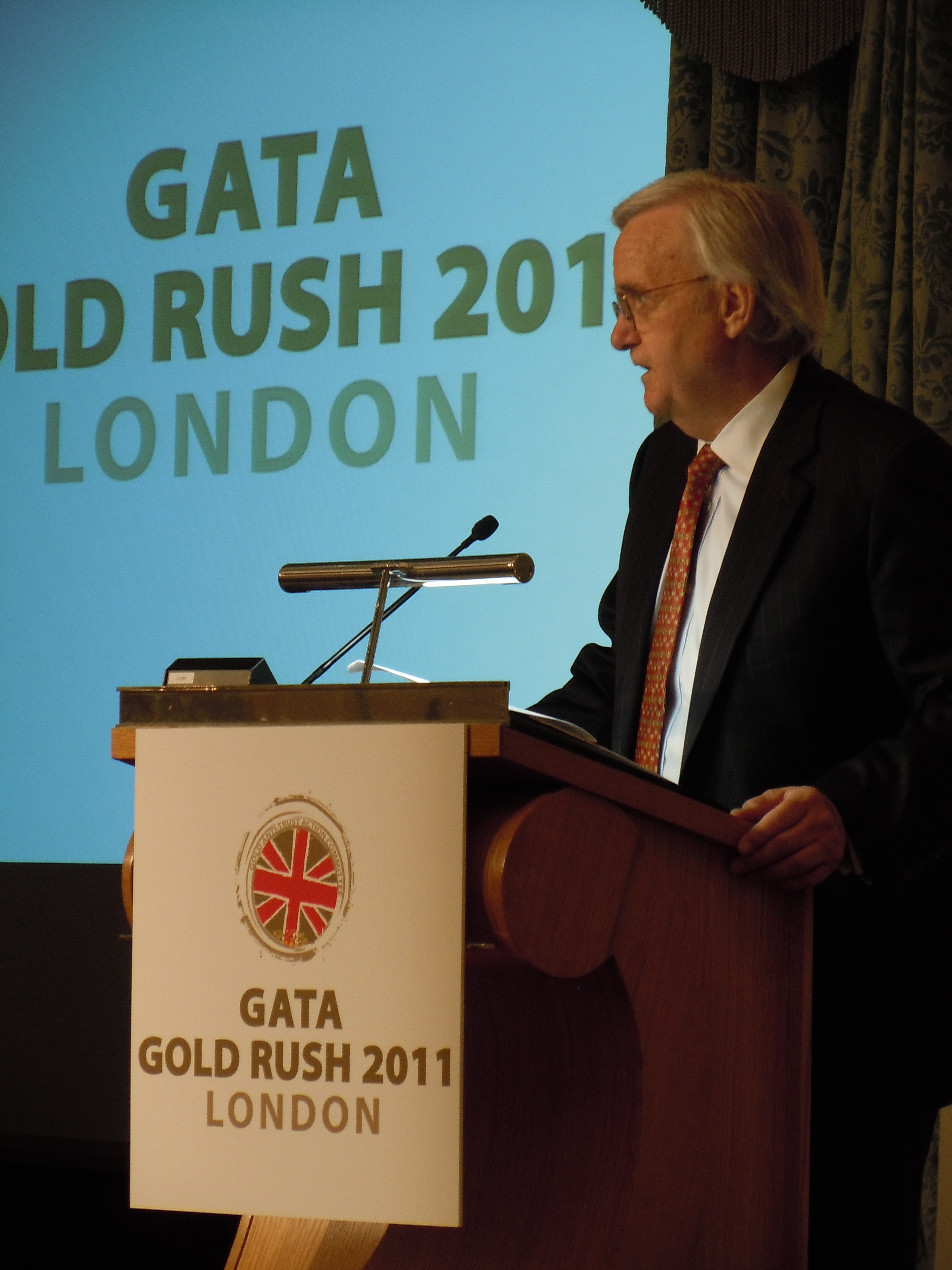
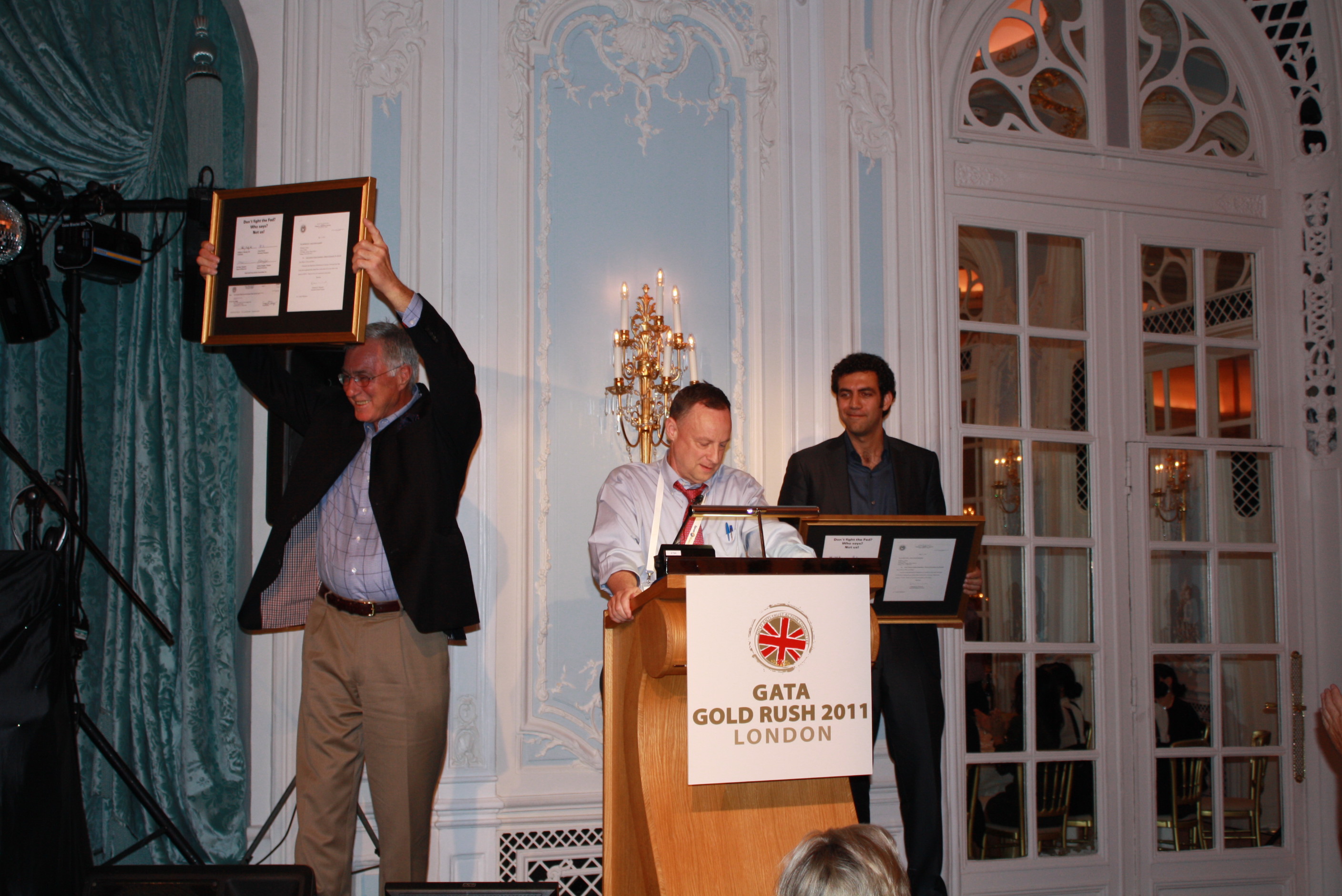
| GATA’s London conference draws nearly 400 from 38 countries Posted: 07 Aug 2011 01:31 PM PDT GATA 12:06p BST Sunday, August 7, 2011 Dear Friend of GATA and Gold: Nearly 400 people from 38 countries attended GATA's Gold Rush 2011 conference at the Savoy Hotel in London this week, and it seems to have been a great success, for which we must thank our speakers — most of the best minds in the gold world — and our corporate and individual sponsors. The greatest sensation was caused by gold trader and mining entrepreneur Jim Sinclair, proprietor of JSMineSet.com, who made his first conference appearance in eight years. His audience simply couldn't get enough of him, peppering him with questions during his formal presentation and then surrounding him afterward. Sinclair is shown answering questions here: http://www.gata.org/files/JimSinclair-GATALondon-08-05-2011.jpg GATA expressed special thanks to the conference's two largest sponsors, Sprott Asset Management CEO Eric Sprott and Houston, Texas, fund manager Sasan Sadegpour, by presenting them with framed copies of documents signifying GATA's victory this year over the Federal Reserve in our freedom-of-information lawsuit. The documents include the Fed's letter to GATA's lawyers conveying a check to GATA for $2,870 in attorney's fees, the check itself, and a statement signed by GATA board members Bill Murphy, Ed Steer, Adrian Douglas, and your secretary/treasurer reading: "Don't fight the Fed? Who says? Not us!" A photograph of the presentation, with Sprott on the left, Sadegpour on the right, and your secretary/treasurer at the podium, has been posted here: http://www.gata.org/files/LondonConferenceGifts.JPG There was much interest at the conference in comments made by geopolitical analyst James G. Rickards about the possibility of something approaching martial law being declared in the United States and confiscation by the U.S. government of gold and silver. Rickards' comments confirmed GATA's correspondence with the U.S. Treasury Department in 2005 about invocation of the Trading with the Enemy Act of 1917 and the International Emergency Economic Powers Act of 1977. That correspondence can be found here: Thanks to the generous assistance of the GoldMoney Foundation, the conference was videotaped and GATA plans to put the presentations on DVD for sale in a few weeks. We'll keep you posted about that. CHRIS POWELL, Secretary/Treasurer Help keep GATA going GATA is a civil rights and educational organization based in the United States and tax-exempt under the U.S. Internal Revenue Code. Its e-mail dispatches are free, and you can subscribe at: To contribute to GATA, please visit:
This posting includes an audio/video/photo media file: Download Now | ||||||
| Silver is ‘investment of the next decade,’ Sprott says in GoldMoney interview Posted: 07 Aug 2011 01:31 PM PDT GATA 11a BST Sunday, August 7, 2011 Dear Friend of GATA and Gold (and Silver): GoldMoney founder James Turk this week interviewed Sprott Asset Management CEO Eric Sprott about the factors Sprott believes will make silver "the investment of the next decade," factors including the huge naked short position in the metal. Sprott says silver is suppressed in large part to put downward pressure on gold. Both Turk and Sprott spoke at GATA's Gold Rush 2011 conference in London this week. The first part of the interview is not quite seven minutes long and you can find it at GoldMoney's Internet site here: http://www.goldmoney.com/video/silver-price-update-from-james-turk-and-e… CHRIS POWELL, Secretary/Treasurer Help keep GATA going GATA is a civil rights and educational organization based in the United States and tax-exempt under the U.S. Internal Revenue Code. Its e-mail dispatches are free, and you can subscribe at: To contribute to GATA, please visit:
| ||||||
| Chris Powell: Who will put the gold questions to central banks? Posted: 07 Aug 2011 01:31 PM PDT GATA Remarks by Chris Powell, Secretary/Treasurer Those of you who have been following GATA for a long time are owed a bit of an apology from me today. For I will say some things you have heard before, as they may be new to others here, as I'm reminded of the advice given to me some years ago by a friend who was twice elected to Connecticut's state legislature, three times to the U.S. House of Of course that was before he disgraced the state, was caught taking gifts from government contractors, resigned under threat of impeachment, pleaded guilty to a federal corruption charge, and was sent to prison for a year. But I guess he didn't get everything wrong. GATA is still about what it was about when it was founded in January 1999 — exposing and opposing the rigging of the gold market and related markets. Why is the gold market rigged? It's rigged because, despite Federal Reserve Chairman Ben Bernanke's insistence the other day that gold is not money, just "tradition," gold is indeed a currency that competes brutally with government-issued currencies and helps determine not only the value of those currencies but also the level of interest rates and the value of government bonds. This was all documented in an academic study published in June 1988 in the Journal of Political Economy written by Harvard economics professor Lawrence Summers and University of Michigan economics professor Robert Barsky. This Summers-Barsky study was unearthed and interpreted by another speaker at this conference, gold price suppression litigator Reg Howe. The study implied that if governments could get control of the gold price, they could also get control of interest rates. Of course Summers went on to become U.S. treasury secretary, an office in which expertise in controlling the gold price is highly desirable. How is the gold price rigged, and by whom? It is rigged openly through outright sales of gold by central banks, as it was rigged openly in the 1960s by the association of Western central banks known as the London gold pool, and, since the gold pool's collapse in 1968, rigged both openly and surreptitiously through central bank sales and leases and by bullion bank short positions and derivatives that are backstopped by access to Western central bank gold. GATA has established this extensively from official sources whose admissions are compiled in the "Documentation" section of our Internet site: http://www.gata.org/taxonomy/term/21 That is, the gold price suppression scheme is not what it is disparaged as being, "conspiracy theory." Rather it is a matter of public record — at least for those who want to look at the record. I would welcome an opportunity to examine and discuss this record in detail, document by document, with any doubters in a public forum. Some of the most incriminating material remains posted at Federal Reserve Internet sites. But the official record of gold price suppression is not merely historical. Thanks to GATA's work, it is very contemporary as well. That's what I'd like to update you about today. Two years ago, using the federal Freedom of Information Act, GATA asked the Federal Reserve to provide access to its gold records, particularly its records involving gold swaps. Gold swaps are trades of gold between central banks, enabling one central bank to intervene in the gold market at the behest of another, keeping the other's fingerprints off the intervention. Gold swaps are a primary mechanism of the gold price suppression scheme. While the Fed refused to give us access to its gold records, in adjudicating our request internally the Fed did make, perhaps inadvertently, a sensational disclosure. On September 17, 2009, the member of the Fed's Board of Governors who was acting as the judge of our request, Kevin M. Warsh, wrote a letter to GATA's lawyer, William Olson of Vienna, Virginia, confirming the Fed's denial of access. Among the records being withheld from us, Warsh disclosed, were records about the Fed's gold swap arrangements with foreign banks, which, he wrote, "is not the type of information that is customarily disclosed to the public": http://www.gata.org/files/GATAFedResponse-09-17-2009.pdf This admission of gold swap arrangements plainly contradicted previous statements by the Fed that it was not involved in the gold market in any way. Unwilling to let Fed Governor Warsh's letter be the last word on access to the Fed's gold records, on December 31, 2009, GATA sued the Fed in U.S. District Court for the District of Columbia. The Fed told the court that the Fed really couldn't find many records involving gold. Implausible as this was, unfortunately the judge, Ellen Segal Huvelle, denied GATA's request to interrogate Fed officials under oath about what seemed to us to be their wholly inadequate search. Whereupon the judge reviewed, privately in her chambers, the few documents the Fed had submitted, and on February 3 this year she ruled that the Fed could keep secret all but one of those records. She ordered the Fed to disclose that one record to GATA within two weeks. On February 18 this year the Fed released the document — the minutes of the April 1997 meeting of the G-10 Gold and Foreign Exchange Committee as compiled by an official of the New York Federal Reserve bank. The minutes showed government and central bank officials conspiring in secret to coordinate their gold market policies. Perhaps of equal interest, the Fed claimed not to be able to find minutes of any other meeting of the G-10 Gold and Foreign Exchange Committee. Either the the G-10 Gold and Foreign Exchange Committee has met only that once, in April 1997, or the Fed was not represented at any other such meetings, or such minutes were conveniently misplaced for the purposes of GATA's lawsuit. Thus GATA's lawsuit established that the Fed, despite its protests of innocence, has many gold secrets after all even as we managed to pry a couple of those secrets loose and publicize them — first, that the Fed has gold swap arrangements, and second, that in 1997 the Fed was conspiring with other central banks to coordinate their gold market policies, and that there was no announcement of this. Almost as gratifying to us was that, since the court found that the Fed had illegally withheld that one document from us, Judge Huvelle ordered the Fed to pay court costs to GATA, which the Fed did in May, sending us a check for $2,870, which we'll display here later today. But the revelations about central bank gold swaps don't end there. In August 2009, while GATA was waging its freedom-of-information battle against the Fed, our consultant, Rob Kirby of Kirby Analytics in Toronto, wrote to the German central bank, the Bundesbank, about a report that most of the German national gold was being kept outside Germany, particularly in New York, presumably at the New York Fed. The Bundesbank replied to Kirby as follows: "The Deutsche Bundesbank keeps a large part of its gold holdings in its own vaults in Germany, while some of its gold is also stored with the central banks located at major gold trading centres. This has historical and market-related reasons, the gold having been transferred to the Bundesbank at these trading centres. Moreover, the Bundesbank needs to hold gold at the various trading centres in order to conduct its gold activities." So the Bundesbank says it keeps much of its gold at "trading centers" so that it may conduct its "gold activities." What are those activities exactly? In late 2010 the German journalist Lars Schall, who is here at this conference today, sought to follow up with the Bundesbank, posing 13 questions about those "gold activities," particularly as to whether the Bundesbank has any gold swap arrangements with the United States. The Bundesbank replied to Schall as follows: "In managing foreign reserves, the Bundesbank fulfils one of its mandated tasks as an integral part of the European System of Central Banks. We trust you will understand that we are not able to divulge any further information regarding this activity. Particularly with respect to the confidential nature of information about where gold holdings are kept, we are unable to go into any greater detail concerning exact locations and the quantities stored at each of these. Likewise, owing to the strategic nature of the activity, we are not at liberty to provide you with more detailed information about gold transactions." That seems like a pretty good confession that the Bundesbank has undertaken gold swaps as part of what it considers "strategic activity." Another pretty good confession of the secret maneuvers being played with gold came at the hearing held by U.S. Rep. Ron Paul's House Subcommittee on Domestic Monetary Policy and Technology on June 23 this year, a hearing I attended. The Treasury Department's inspector general, Eric M. Thorson, testified that he had been told that no part of the U.S. gold reserve was encumbered. But he did not say exactly who told him this, so his comment was only hearsay. And when Thorson was asked just where the gold pledged by the United States to the International Monetary Fund is kept and how it is accounted for, Thorson couldn't say. Three years ago when GATA put similar questions to the IMF — "Exactly where is your gold, and do you possess it or is it just a claim on the gold reserves of your member nations?" — the IMF was at first evasive and then abruptly cut off the correspondence without answering. But then most official gold data is actually disinformation. For the six years prior to 2009 China reported to the IMF that it held 600 tonnes of gold. But in April 2009 China reported that its gold reserves had increased by 76 percent, from 600 tonnes to 1,054 tonnes. Had China obtained the new 454 tonnes only in the past year? Of course not; China had been accumulating gold steadily without reporting it for six years. In June 2010 the World Gold Council reported that Saudi Arabia had increased its gold reserves by 126 percent since 2008, from 143 tonnes to 323 tonnes. But a few weeks later the governor of the Saudi Arabia Monetary Authority said Saudi Arabia had not been purchasing gold lately and that the 143 tonnes in question had been held all along in what he called "other accounts" — held in accounts not being reported by Saudi Arabia. That is, the true disposition of national gold reserves is a secret more sensitive than the disposition of nuclear weapons. For gold is a weapon just as powerful — a weapon crucial to market rigging, the secret knowledge of the financial universe. And while nuclear weapons can be used for blackmail, market rigging is a far more effective mechanism for looting the world. Many of you have heard about the looting of Europe undertaken by the Nazi German occupation during World War II. But most of that looting did not take place as it is imagined, at the point of a gun. No, it took place through the currency markets. This looting through the currency markets was spelled out by the November 1943 edition of a military intelligence letter published by the U.S. War Department, a letter called Tactical and Technical Trends. Of course the Nazi occupation seized whatever central bank gold reserves had not been sent out of the occupied countries in time. But then the Nazi occupation either issued special occupation currency that could not be used in Germany itself or, in countries that had strong banking systems, took over the domestic central bank and enforced an exchange rate much more favorable to the reichsmark. Or else the Nazi occupation simply printed for itself and spent huge new amounts of the regular currency of the occupied country. It was this control of the currency markets that drafted everyone in the occupied countries into the service of the occupation and achieved a one-way flow of production, a flow out of the occupied countries and into Nazi Germany. For a few years Nazi Germany had one hell of a trade deficit — and couldn't have cared less about it. For controlling the currencies of occupied Europe, Nazi Germany never had to cover that deficit, at least not as long as the military occupation continued. Since the United States now issues the reserve currency for the world, the dollar, the United States now more or less occupies most countries economically, even those countries that have their own currencies, since even those countries hold most of their foreign exchange reserves in dollars. Thus the current one-way flow of production — out of the rest of the world and into the United States. This exploitation is not well-publicized but it is no secret. In the 1960s France's finance minister called it an "exorbitant privilege" for just one country — the United States — to be able to issue the world reserve currency. In 2004 the deputy chairman of the Bank of Russia, Oleg Mozhaiskov, told the London Bullion Market Association conference held in Moscow: "Although there are several reserve currencies, the blatant lack of discipline is demonstrated by the U.S. dollar. I am leaving aside the main aspects of this problem, such as the social and economic injustice of a world order that allows the richest country in the world to live in debt, undermining the vital interests of other countries and peoples. What is important for us today is another aspect, which is connected with the responsibility of the state issuing the reserve currency and for the international community preserving that currency's buying power." Incidentally, the only words of English spoken by Mozhaiskov in that speech were "Gold Anti-Trust Action Committee." The Bank of Russia long had been following our work without our knowledge. And just this week Russia's prime minister, former president, and perhaps future president, Vladimir Putin, called the United States a "parasite" on account of its huge external debt and the dominance of the dollar. The whole gold price suppression scheme — a dollar-support scheme — is exposed by any serious questioning. But who will ask the questions? The scheme survives only because of negligent journalism about the true reserve currency, gold. The falsity of the data about the gold market practically screams at financial journalists: – There is the omission from official gold reserve reports of leased and swapped gold. – There are the sudden huge changes in official gold reserve totals. – And there are the deception and conflicts of interest built into the prospectuses of gold and silver exchange-traded funds, whose metal custodians happen also to be the world's biggest gold and silver shorters. Valid documentation about the gold market also practically screams at financial journalists: – There are the huge and disproportionate gold, silver, and interest rate derivative positions built up at just a few international banks, positions that never could be undertaken without the expressed or implicit underwriting of government, particularly the U.S. government. – There are the many official records, collected and publicized by GATA over the years, demonstrating the explicit plans and desire of the U.S. government to suppress and control the price of gold. Most obvious is the question that should follow the common disparagement of gold, a question that somehow is never asked. You've heard it: the constantly reported observation that gold has not come close to keeping pace with inflation over the last 30 years. Oil has kept up, food has kept up, other metals have kept up, but not gold. So why not? Why hasn't gold kept up with inflation? Could it be that someone found a way to vastly increase the supply of gold without having to go through the trouble of mining it — to dishoard and lease it from central bank reserves and then issue certificates against gold that never existed in the first place? "Why" is supposed to be a basic question of journalism. But it has fallen out of financial journalism when it comes to gold. In May I spent an hour in New York with the commodities reporter of The Wall Street Journal. That newspaper has been given much of the documentation GATA has collected but has not yet published anything about it. Also in May a nationally broadcast television program interviewed me for an hour, with the cameras rolling, on the steps of the Federal Reserve in Washington. That program has all the documentation too. Nothing has been broadcast yet, though I'm hopeful. Over the last year I've spent much time briefing a reporter for a major news agency, at her request. At my urging, unlike all other reporters, she even called the Fed and got a very telling "no comment" about the gold swaps. But last I heard from her, she couldn't get her editor's permission to write a gold story. Frustrating as all this is, it can't be too surprising. After all, who are the major advertisers in the financial news media and the major sources of news? The market manipulators and governments themselves. And journalists seem to take for granted that central banks operate in secret, particularly in regard to gold, so there's no point in questioning them. Well, maybe someday some journalist somewhere will put to a central banker a critical question about gold. Maybe it will be one of the journalists we met at our press conference yesterday. In any case, whenever I come to this great city I can't help falling into June 1940 mode and reminding myself that liberty is worth contending for no matter how bad the odds — that there really isn't much else. The other day a few blocks from here I went through the museum that has been made out of the old Cabinet War Rooms, where the rescue of all decent civilization was arranged even as the bombs of the most evil totalitarianism fell all around and Britain, at Churchill's urging, heroically faced them alone. At the museum there was, of course, a photo of General DeGaulle, who refused to accept the fall of France and flew to London to fight on. For the time being, De Gaulle decided, in exile he would be France, and he was — though maybe, years later, he thought himself to be France even after France was once again able to do the job itself. From GATA's beginning I have wondered whether we could really presume to speak for gold. And not just for gold, of course — we are not idolaters — but for the economic and political liberty it serves and stands for. With gold always under attack precisely for what it represents, and with no others coming forward to defend it for what it represents, with the gold mining industry's main trade association refusing to acknowledge the attack, we have hoped that any presumption on our part might be forgiven. We remain largely amateurs. At the outset we did not half understand what was going on and what we were setting about to do. Our name preserves that imperfect understanding. We thought we had discovered just another anti-trust violation. It was a while before we perceived that we were up against government policy and that most of what we were discovering had been discovered long ago, at least in principle, just not well taught, publicized, preserved, and made timely again. Because it can work only through surreptitiousness and deceit, this government policy will be defeated when it is more widely understood — and every day it is being better understood. Just yesterday GATA Chairman Bill Murphy was invited on CNBC Europe — GATA's first invitation on CNBC in 12 years. And two more speakers at this conference, James Turk and Ben Davies, were on CNBC Europe this morning. The word is getting around now, and thanks to you and the speakers who have come here today, we are no longer alone. That, I think, will prove decisive. Some of our speakers will talk about what should be. At this turbulent time for its financial system, the world surely needs new options. But with your support GATA will keep working to reveal what is. This is, we think, a great cause. And as Churchill said even as the bombs fell on this city, "When great causes are on the move in the world, we learn that we are spirits, not animals, and that something is going on in space and time, and beyond space and time, which, whether we like it or not, spells duty." Help keep GATA going GATA is a civil rights and educational organization based in the United States and tax-exempt under the U.S. Internal Revenue Code. Its e-mail dispatches are free, and you can subscribe at: To contribute to GATA, please visit:
This posting includes an audio/video/photo media file: Download Now | ||||||
| As many as 20 owners for each bullion bank gold bar, Rickards tells King World News Posted: 07 Aug 2011 01:31 PM PDT GATA 1:10p ET Sunday, August 7, 2011 Dear Friend of GATA and Gold: Interviewed by King World News from London, where he spoke at GATA's Gold Rush 2011 conference, geopolitical analyst James G. Rickards suggests that much central bank gold leasing is done to facilitate deceptive bookkeeping at bullion banks. The gold really at risk, Rickards says, is not that of central banks but rather the unallocated gold of bullion bank customers who don't take delivery and don't pay for allocated storage. Rickards remarks that under the current bullion banking system there might be as many as 20 supposed owners for each bar of gold. Rickards endorses GATA's calls for transparency in the gold market and auditing the U.S. gold reserve. The interview is fascinating and 23 minutes long and you can find it at King World News here: http://www.kingworldnews.com/kingworldnews/Broadcast/Entries/2011/8/6_Ji… CHRIS POWELL, Secretary/Treasurer Help keep GATA going GATA is a civil rights and educational organization based in the United States and tax-exempt under the U.S. Internal Revenue Code. Its e-mail dispatches are free, and you can subscribe at: To contribute to GATA, please visit:
| ||||||
| Central Banks Hint: It’s Not Too Late To Buy Gold Posted: 07 Aug 2011 01:30 PM PDT
South Korea's fashionably late to a party started over a decade agoBy Myra P. Saefong, MarketWatch SAN FRANCISCO (MarketWatch) — Central banks in emerging markets have decided that it's not too late to join gold's party. South Korea and Mexico are among the nations whose central banks have been ramping up gold holdings lately — and they're willing to pay the highest-ever prices for an ounce of gold to do it, even though gold's latest rally began more than a decade ago. Admittedly, it's not new trend for all central banks, but one that's speeding up as the world loses faith in the U.S. dollar and global markets. Read about Thursday's 513-point drop in the Dow. "The trend of greater purchases by emerging-market central banks and slowing sales by European central banks had been under way for three years, although it has accelerated of late," said Natalie Dempster, director of government affairs for the World Gold Council. Central banks became net buyers of gold last year for the first time in two decades, adding 76 metric tons to their reserves, she said — and in the first half of this year, they bought almost three times that amount. In February and March, Mexico added around 93 metric tons to its reserves, Russia purchased 48 metric tons during the first half of this year, and Thailand bought 17 metric tons in June, according to data from the World Gold Council. This week, the Bank of Korea confirmed that it made its first purchase of gold since the Asian financial crisis of 1997-1998, buying 25 metric tons of gold in June and July of this year. The purchase by South Korea, a country which relies heavily on support by the U.S. government, is "significant, as it represents the first purchase of gold by the East Asian country in over a decade," said Nick Barisheff, chief executive officer of Bullion Management Group Inc. "It would seem South Korea has joined the ranks of those countries that have lost faith in the U.S. dollar." And "it is no coincidence that many of these central banks are from emerging-market economies," he said. "Many of these countries have experienced the grim reality of enduring a currency crisis first-hand." Barisheff pointed out that in the last 20 years, there have been many currencies crises: in Mexico in 1994, the Asian financial crisis of 1997, the Russian financial crisis of 1998, the Argentine economic crisis of 1999-2002 and the Zimbabwean financial crisis, which is ongoing after consuming much of the last decade. "The emerging markets can now see what lies ahead for the United States," he said. "Gold is the ultimate safe haven, and many central banks are diversifying out of U.S. dollars and into gold to protect their country's wealth." Feeding the frenzy The value of the U.S. dollar has certainly been a key concern for investors around the world, and that has made gold, as usual, much more attractive. Read about how to invest in gold. "The bull market in gold is and has always been about the collapse of the dollar as a reserve currency and international facilitator of trade," said Edmond Bugos, director of mining finance at Strategic Metals Research & Capital. "Exuberant spending and excessive debt has led the United States to a financial situation that has passed the point of no return," Barisheff said. "A currency crisis will eventually happen, and there will be dire consequences for the U.S. dollar, which has already lost over 80% of its purchasing power over the last decade compared to gold." But there are other factors feeding gold's price rally. Central banks have been adding to their gold reserves as "a combination of rapid foreign-exchange accumulation and stagnant gold holdings has meant that gold's share in total reserves has dropped sharply in many countries," said Dempster. The U.S., the world's top holder of gold, has 74.7% of its reserves in gold, according to data from the World Gold Council, as of July. Russia, No. 8 on the list of gold holders, has just 7.8% of its reserves in gold, even though it's added gold to them nearly every month since the start of 2007, data show. Global financial assets are valued at an estimated $200 trillion, but the world's total above-ground gold has been valued at "a modest" $3 trillion, said Barisheff, adding that "about half of that is owned by central banks." And lately, most of the buying, though not all, is coming from emerging markets whose economic fortunes are very much tied to the West, said Peter Grant, senior metals analyst at USAGold-Centennial Precious Metals Inc. "Many have accumulated large amounts of dollar-denominated assets in reserve and are rightfully worried about the mounting currency risk," he said, so they can either choose to shift into assets denominated in some other fiat currency with a more reasonable risk profile, or choose to allocate into a hard asset without counter-party risk, such as gold. "The prudent ones are increasingly opting for the latter," Grant said. Asian elephants But with emerging markets, it has always been tough to figure out the "who, what, where, when and how" on gold purchases. "Central banks are often reluctant to declare the exact state of their gold holdings and gold policies," said Mark O'Byrne, executive director at international bullion dealer GoldCore. "The elephant in the room is the central banks of China and India and their gold buying," he said, though "informed analysts are confident that they are quietly continuing to accumulate gold." Even though China has 1,054 metric tons of gold in its reserves, ranked as the world's sixth-largest gold holding, that's only 1.6% of its total reserves, according to data from the World Gold Council. "Watch China above all else," said Dennis Gartman, editor of the Gartman Letter in Suffolk, Va. "The Chinese have a reputation for being savvy traders, but in reality they are slow to the game, and they have been." He points out that China could take the world's production of gold for several years and still not get the diversification job done adequately. "To become a major player in international finance, traditionally a central bank needs to have a large reserve in gold," said Jeffrey Wright, senior analyst of metals and mining equity research at Global Hunter Securities. China has actually "left the ranks of an emerging market across multiple metrics, and the amount of gold held by their central bank is one of these metrics," Wright said. "China, as well as Russia, do not want more exposure to unstable and depreciating assets, such as the U.S. dollar and euro. They see better long-term stability and growth prospects in gold," he said. Yet despite rising investment demand and purchases from central banks over the last decade, Barisheff said, gold production has actually remained flat over the last two decades, increasing only marginally by an average of 0.7% per year. "Gold is at record highs, but for solid fundamental reasons," said Steve Gillette, president of Cirrus Commodities Exchange. "Gold is not at a frenzied high and is not in a bubble."
| ||||||
| Gold Decline Prompted By Selling To Meet Margin Calls Elsewhere; Uptrend Still Seen As Intact Posted: 07 Aug 2011 01:30 PM PDT
04 August 2011, 2:07 p.m. (Kitco News) – Analysts are describing gold's about-turn lower Thursday as profit-taking and liquidation to raise cash to cover losses in other markets rather than any kind of reversal of the longer-term uptrend. Further, they suggested that a pullback was likely to be used as a buying opportunity in a market that still views gold as a safe haven, and that appeared to be occurring even as they spoke. As of 1:36 p.m. EDT, gold for December delivery was down $7.70, or 0.5%, to $1,658.60 an ounce on the Comex division of the New York Mercantile Exchange. It fell from an earlier peak of $1,684.90 that is a record for a most-active contract. However, the market is already back up from a session low of $1,642.20 hit early this afternoon. The weakness came on a day when the Dow Jones Industrial Average has been lower by as many as 372 points on worries about the health of the economy. Nearly every commodity is also weaker. Gold initially traded higher before getting caught up in the downdraft. "It's a little bit of liquidation to free up funds for elsewhere," Sterling Smith, commodity trading adviser and analyst with Country Hedging, commented that gold had a "tremendous" run since the start of July. At the session high, the December futures were up $203.90, or 14%, from the July 1 low. "The weakness in the equity market can very often be hard on the gold market when people have to raise cash and get nervous, and often positions with a large profit get sold in order to meet margin requirements and loosen up capital…," Smith said. "I don't think this is the end of the bull market in any way, shape or form. I do think, however, as long as the equity market remains in trouble, we could see some weakness and selling in gold." Gold similarly fell when equities tumbled as the 2008 financial crisis hit, before the metal later went on to new highs, he said. Some of the weakness is also from traders opting to book profits, besides selling to meet margin calls elsewhere, said Frank Lesh, analyst and broker with FuturePath Trading. Many futures traders use trailing sell stops that will kick them out of a market, thereby protecting their profit, when prices pull back. Stops are pre-placed orders triggered when certain chart points are hit. "I always trail stops so if a market comes back off, it takes me out," Lesh said."Then you just buy lower and get back in." Some of the stops, however, were no doubt also from traders who just bought at the recent highs and were trying to limit their losses. "But this isn't that much liquidation," Lesh said. "As a matter of fact, it's healthy when you get a bit of a sell-off. You don't want the thing to go straight up…You want a slow, steady build." There is an old market adage that parabolic moves in one direction are often followed by parabolic moves in the other when markets become overextended. "Seeing this weakness should not surprise anyone, given the nature of the market," Smith said. "It is a little bit overbought. You have a lot of longs with profits." The most recent data from the Commodity Futures Trading Commission showed that as of July 26, the net length of the non-commercial accounts—often referred to as the funds—stood at 269,489 contracts for futures and options combined, which was the most since October. The figure shows how many more contracts in which funds have bought gold than sold. Robin Bhar, senior metals analyst with Credit Agricole CIB, issued a report Thursday saying he looks for more gains in gold. "However," he cautioned, "given the sharp increase in speculative longs on Comex, the correction when it occurs, could be sizeable." Otherwise, he said, supportive influences include concerns about sovereign-debt burdens, the long-term value of certain reserve currencies, inflation fears, uncertainty about economic growth and the trend in which central banks are increasing their gold holdings.
| ||||||
| Chinese buy Orkney gold mine for R150m, plan R525m capital injection Posted: 07 Aug 2011 01:30 PM PDT Chinese company SSC Mandarin of Hong Kong has bought Pamodzi Gold's Orkney gold mine out of liquidation for R150-million. A capital injection of more than R525-million on mine development and on erecting a new gold plant is anticipated, in order to restore the operations and prepare the mine for a resumption to full production within 12 months from the date of completion of the agreement.
| ||||||
| Gold massively underinvested – silver data overwhelming: Eric Sprott Posted: 07 Aug 2011 01:30 PM PDT Speaking at GATA's sold-out Gold Rush conference in London, Eric Sprott affirmed his strong views on gold and his even more positive thoughts on silver.
| ||||||
| Commodities other than gold to fall on U.S. ratings downgrade – Analysts Posted: 07 Aug 2011 01:30 PM PDT Analysts expect commodities, with the exception of gold, to fall on Asian markets early in the week, but don't think this will be panic selling as Chinese demand seen as staying strong.
| ||||||
| Posted: 07 Aug 2011 01:24 PM PDT Oil and Silver had their typical 10-15x rise seen in previous Commodities bull markets but the market likes to fool the most, and this time each commodity is doing its parabolic rise at different times keeping traders guessing. Read More...
| ||||||
| G-7 Seeks to Avert Collapse in Confidence Posted: 07 Aug 2011 01:20 PM PDT From Bloomberg Group of Seven nations sought to head off a collapse in global investor confidence after the U.S. sovereign-rating downgrade and a sell-off in Italian and Spanish debt intensified threats to the world economic recovery. The G-7 will take "all necessary measures to support financial stability and growth," the nation's finance ministers and central [...] 
This posting includes an audio/video/photo media file: Download Now | ||||||
| Junior Gold & Silver Shares Can Perform When Other Equities Do Not? Posted: 07 Aug 2011 01:00 PM PDT A Junior mining stock is a mining company in its early days. It may have successfully explored and found a good deposit; it may have completed a feasibility study on the deposit and have raised the finance to develop it into a mine. The earlier an investor finds such a company (that does become a healthy profitable company) the more return an investor is likely to make. The risks on such a company are great so an investor needs to have his finger on the pulse of the company to keep and profit on his investment.
| ||||||
| Posted: 07 Aug 2011 12:30 PM PDT What happens to gold if the markets crash? This is the question that many would like an answer to, as it is looking rather likely after the announcement, conveniently made after the markets closed on Friday, that Standard and Poor were lowering their rating for US debt.
| ||||||
| Junior Gold and Silver Shares Can Perform When Other Equities Do Not? Posted: 07 Aug 2011 12:10 PM PDT A Junior mining stock is a mining company in its early days. It may have successfully explored and found a good deposit; it may have completed a feasibility study on the deposit and have raised the finance to develop it into a mine. Read More...
|


| You are subscribed to email updates from Save Your ASSets First To stop receiving these emails, you may unsubscribe now. | Email delivery powered by Google |
| Google Inc., 20 West Kinzie, Chicago IL USA 60610 | |

No comments:
Post a Comment