


saveyourassetsfirst3 |

- A Policy-Driven Silver Crash
- Precious metals trading and investment
- Steve Palmer: Bearish on Gold, but Bullish on Select Juniors
- Monday Interest Rate Brief
- The Next Commodities Bubble, Coming Sooner Than You Think
- Fun With Dick (AGQ), Jane (ZSL) and Spot (SLV): Examining the Performance of Leveraged Funds
- Folding Commodities and the Week Ahead
- GBP/CHF the Clear Loser Over Last 4 Years
- Why the U.S. and China Want a Cheap Dollar
- Adrian Day: Gold Prices Due for a Correction
- India Markets Monday Wrap-Up: Markets Maintain Status Quo
- Silver's Destiny With Its 200 Day Moving Average
- Costatas Silver Open Forum
- Using the ISM Cycle as an Investment Guide
- Significant Turnaround for 11 Oil Companies
- James Turk : Silver Will Hit New Highs in a Matter of Weeks”
- Fridays Session Produced Key Levels to Watch in Stocks, Dollar, and Commodities
- Indian & Chinese Money "Buys the Bloodbath" in Gold & Silver
- How gold predicted the recent commodities crash...
- Why mining stocks could go higher no matter what silver does next
- China to U.S.: "Plunging" dollar to blame for surging food and energy inflation
- RESPITE: Silver prices set to rebound this morning
- Gold and Silvers Daily Review for May 8th 2011
- The Passing Storm
- Orex Initiates Airborne Geophysical Survey Over Barsele Gold Project, Sweden
- View From the Turret: Folding Commodities
- James Turk - “Silver Will Hit New Highs in a Matter of Weeks”
- NY TImes Article: Response to Volatility in Silver Takes Hold
- Asian gold buying surging
- Whos Stockpiling Gold?
| Posted: 09 May 2011 04:22 AM PDT Silver has once again stolen the investment market spotlight. Margin requirements for silver trading rose 84 percent last week, which prompted a major sell-off. Silver posted its worst four-day drop since 1980 and was down more than 25% after the CME Group raised the costs for investors to trade the metal four consecutive times within a week. |
| Precious metals trading and investment Posted: 09 May 2011 03:34 AM PDT Boston Metal Exchange is a broker in the metal markets (we trade the actuals with 2:1 leverage up to 4:1 depending on your risk tolerance level, Personally we trade 2:1 on a conservative level) and can also facilitate delivery of metals to qualified investors. Our Team analyzes the metal markets to provide you with a custom-based portfolio on your return objectives, your risk tolerance, your existing portfolio, and the amount of capital you want to invest in our trading program. We offer an affordable and accurate way to enter and track your LIVE 24hr online metal trading account. Please visit our websites at www.BostonMetalExchange.com for more information. Thanks and please feel free to call me or email me with any questions Best Regards, Dana O'Keefe Senior Account Executive 100 Franklin Street, 3rd Floor Boston, MA 02110 Direct: 617-307-4904 Cell: 774-521-6394 Fax: 617-670-0193 dana@BostonMetalExchange.com |
| Steve Palmer: Bearish on Gold, but Bullish on Select Juniors Posted: 09 May 2011 03:01 AM PDT |
| Posted: 09 May 2011 02:56 AM PDT Andrew Wilkinson submits: An early Monday morning commodity price rebound was insufficient to keep government bond prices downtrodden despite rising risk appetite in most parts. Dealers in the United States treasury market also tried pushing bond prices lower ahead of an auction of further supply but even that wasn't enough to keep worrywarts satisfied. An S&P downgrade for Greek long-term debt has soured the earlier positive tone and caused the dollar to find favor as government bonds come back in to favor. Eurodollar futures – The U.S. market faces now economic data although $72 billion of new government supply will once again pepper the trading day with some color. Eurodollar futures continue to break away over and above the November heights breached Friday following payroll data as investors extend their view of little chance of any move from the Fed in the quarters ahead. The six-month highs for Eurodollar contracts sees the market Complete Story » |
| The Next Commodities Bubble, Coming Sooner Than You Think Posted: 09 May 2011 02:51 AM PDT Keith Fitz-Gerald submits: To hear the mainstream media tell it, the commodities bubble has burst. "Pit Panic" and the Commodities BubbleThough you may be surprised by my predictions, I have to confess that this isn't rocket science. Several clues point the way. For instance:
Complete Story » |
| Fun With Dick (AGQ), Jane (ZSL) and Spot (SLV): Examining the Performance of Leveraged Funds Posted: 09 May 2011 02:44 AM PDT Ron Rowland submits: Seventeen years ago we saw the first leveraged mutual fund with daily reset. Now we have dozens of them along with ETFs that work the same way. Yet after all this time, many investors still don't understand what leveraged funds can and cannot do. Even professional investors ignorantly called these products "failures" because the long-term performance is not a multiplicative factor of the unleveraged performance. Numerous hypothetical examples attempt to "prove" that leveraged funds will lose money over time. To paraphrase a famous line: "Hypos? We don't need no stinkin' hypos." Why use hypothetical examples when we have real-life actual examples right in front of us? Today we will examine leveraged performance over more than one day. This is not rocket-science. It is elementary school math. So in our real-life example I will call on some old friends from elementary school: Dick and Jane, and their dog Spot. Being just Complete Story » |
| Folding Commodities and the Week Ahead Posted: 09 May 2011 02:43 AM PDT Mercenary Trader submits: By Mike McDermott
The major action last week revolved around a broad rotation out of commodities. After inflating a liquidity-fed bubble in hard assets from agriculture to metals to oil, managers turned tail and hit the panic button. Silver took the biggest hit – losing 26% over just five trading sessions (And that was after a slight bounce on Friday). The price action is another reminder of just how quickly the tables can turn when risks are high and sentiment reaches extreme levels. Entering a new week, managers are likely to continue the "safety bid" – moving capital out of speculative areas and into traditionally stable groups such as healthcare, utilities, and consumer staples. Meanwhile, investors continue to face a number of significant questions regarding the end of QE2, a housing market that still isn't showing much of a recovery, and "peak" corporate earnings with fewer beats and more cautious Complete Story » |
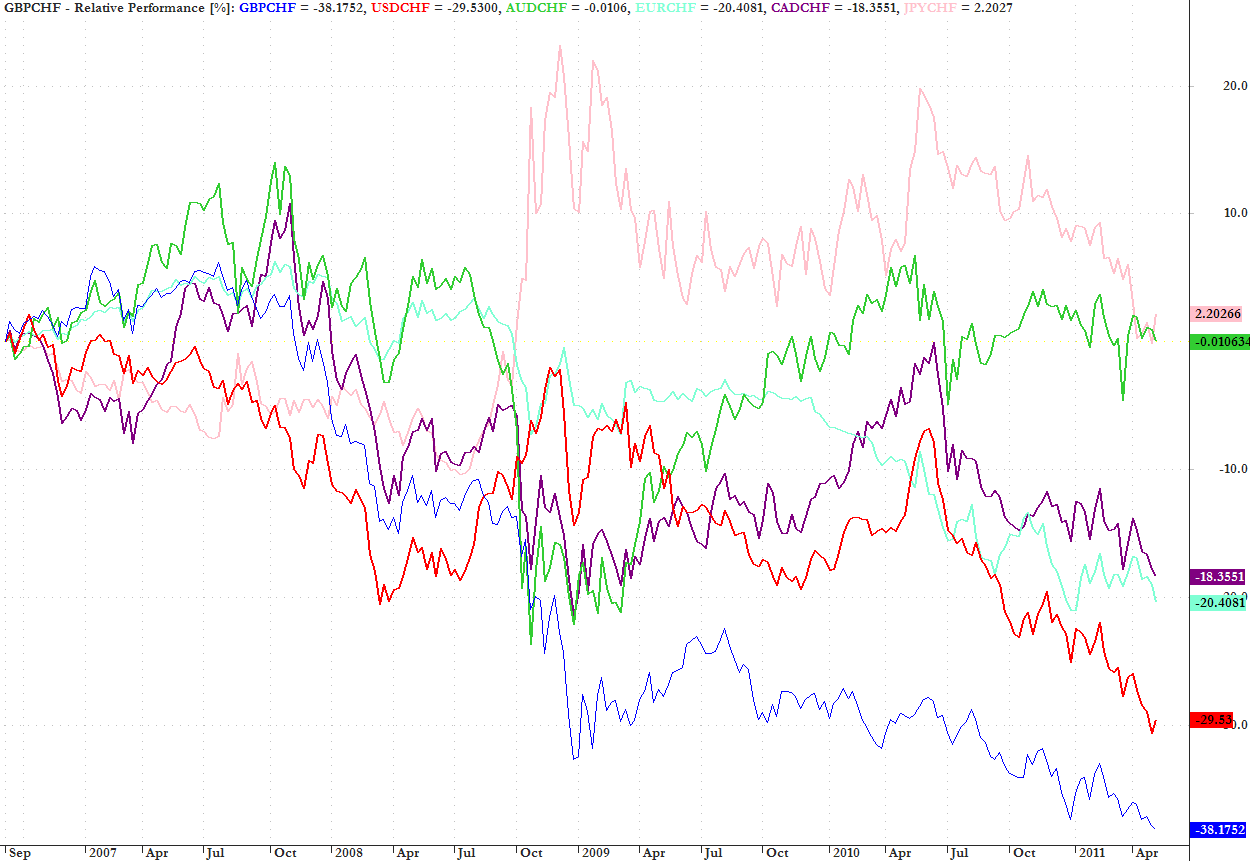
| GBP/CHF the Clear Loser Over Last 4 Years Posted: 09 May 2011 02:38 AM PDT Clive Corcoran submits: Measuring the relative strength of various currency pairs can be done using a separate benchmark such as determining the price of gold for each currency, and then creating an index to see how much more or less the gold price in that currency is now, rather than it was priced at the base period for the index. [Click to enlarge] The method chosen to prepare the chart above is simply to contrast the current relative performance of six major currency pairs, each with the Swiss franc as the base currency. The starting period chosen is the end of July 2007, which marked an important inflection point for most FX pairs. The results clearly show that GBP/CHF is the weakest pair, and as of the May 6 closing price, sterling is 38% less valuable against the Swiss franc than it was at the end of July 2007. The other results are Complete Story » |
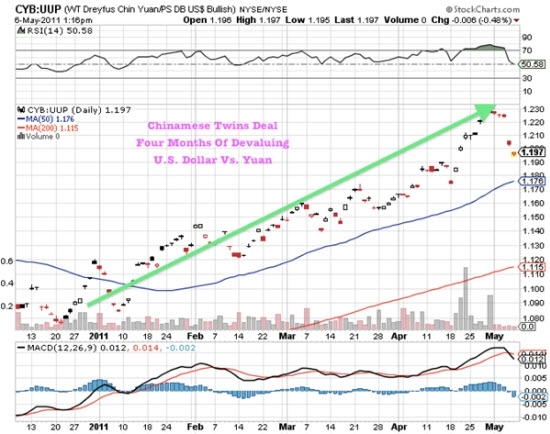
| Why the U.S. and China Want a Cheap Dollar Posted: 09 May 2011 02:24 AM PDT Jeb Handwerger submits: In early January of 2011, a top secret candlelight dinner was held at the White House. There was no fanfare. Present were the industrial, military and governmental heads of both China and the United States. Our government had just digested the failures of Lehman Brothers, AIG and other corporate icons by creating massive bailouts and running up trillion dollar budgetary deficits. China was also concerned about inflation and soaring prices due to the intentional debasement of the U.S. currency by the Federal Reserve. Both sides reached a modus vivendi, so they could mutually profit from these agreements. Please see my January 2011 article on the "Chinamese Twins" to understand these past few weeks. Since my January article was published, the yuan has steadily risen versus the greenback. China had long wanted to enter the American financial markets. It had abundant U.S. dollars to make acquisitions and at Complete Story » |
| Adrian Day: Gold Prices Due for a Correction Posted: 09 May 2011 02:15 AM PDT |
| India Markets Monday Wrap-Up: Markets Maintain Status Quo Posted: 09 May 2011 02:04 AM PDT Equitymaster submits: At the end of a very volatile session, the benchmark indices in the Indian stock markets finally settled near the dotted line. The BSE-Sensex gained a marginal 10 points whereas the NSE-Nifty closed with a status quo. The smaller indices also ended the session practically unchanged. The BSE Mid-Cap and BSE Small-Cap indices gained 0.1% each. FMCG and telecom stocks led the gainers. Most of the other Asian indices closed flat to negative with Hong Kong leading the gainers. Europe was trading mixed. The rupee was seen trading at Rs 44.71 to the dollar at the time of writing. Hindustan Unilever reported its results for 4QFY11. The company registered a top line of Rs 50 bn, up 13.5% YoY. The increase was on the account of a hike in the average prices and higher volumes. The company reported a bottom-line of Rs 5.7 bn , down 2% YoY. The net Complete Story » |
| Silver's Destiny With Its 200 Day Moving Average Posted: 09 May 2011 01:52 AM PDT Financial Sense submits: It's not every day that you get to witness a four standard deviation event. Last week was one of them. If a stock moves 4 standard deviations above or below its mean, you know that there is a 99.994% chance that it should reverse. Last Thursday our silver technical indicator flashed a warning that we were 3.97 standard deviations (just a hair shy of 4) from historical averages, slightly higher than the last peak 5 years ago. Looking at prior parabolic moves in silver, what most likely lies ahead is silver's destiny with its 200 day moving average (200d MA), which currently rests at $28.79 an ounce. Bob Farrell's Rule # 4 Bob Farrell was a Wall Street legend who began his career in the late 1950s and sat through the last secular bear market of the 1970s and the secular bull market that began in 1982. Out of his Complete Story » |
| Posted: 09 May 2011 01:50 AM PDT |
| Using the ISM Cycle as an Investment Guide Posted: 09 May 2011 01:49 AM PDT Cullen Roche submits: We're at an interesting point in the business cycle. There are signs that growth is waning, however, it doesn't yet appear like a time to panic. The ISM index has been particularly notable. Last week's ISM Services index showed a steep decline despite continued growth. As a diffusion index the ISM indices undergo cyclical patterns. The recent high readings are reassuring, but unlikely to sustain themselves. As growth peaks the investment cycle changes dramatically. Goldman Sachs has a very good note on this change. They see the ISM index as forecasting a slowing business cycle, but not a collapse in growth. This warrants a more defensive investment posture:
Complete Story » |
| Significant Turnaround for 11 Oil Companies Posted: 09 May 2011 01:45 AM PDT Michael Filloon submits: Most oil stocks are trading at a significant discount to 52 week highs. Even quality names that have significantly outperformed. The jobs numbers on May 6th helped push the stock market higher. There were several names with a significant turnaround on Friday:
Complete Story » |
| James Turk : Silver Will Hit New Highs in a Matter of Weeks” Posted: 09 May 2011 01:43 AM PDT King World News |
| Fridays Session Produced Key Levels to Watch in Stocks, Dollar, and Commodities Posted: 09 May 2011 01:40 AM PDT |
| Indian & Chinese Money "Buys the Bloodbath" in Gold & Silver Posted: 09 May 2011 01:33 AM PDT Bullion Vault |
| How gold predicted the recent commodities crash... Posted: 09 May 2011 01:28 AM PDT From Pragmatic Capitalism: May's big drop in commodities unfolded with a lot of help from the CME Group, which upped the margin requirements on silver repeatedly. And it led hedge funds and other portfolios to start selling other commodities to meet margin calls. It might seem like this selloff was solely caused by the intervention of the exchange officials adjusting the rules, but it arrives right on schedule, according to the leading indication from gold prices. The way it works is that gold prices travel down the road first, and commodities follow in the same footsteps about four months later. The price plot of gold in this week's chart is shifted forward by 80 trading days to reveal how its patterns get repeated in the CRB Index. This effect also works if you use the old CRB Index, now called the Continuous Commodity Index (CCI). The dip underway in the CRB Index matches one that occurred in gold back in January, and even the triple top pattern in gold got repeated by the CRB Index. It is worth noting that... Read full article... More on commodities: "McFlation": Why $5 hamburgers are coming to the U.S. An unusual phenomenon that's placing a strong floor under gold What Barrick Gold's huge copper purchase means for commodities and inflation |
| Why mining stocks could go higher no matter what silver does next Posted: 09 May 2011 01:21 AM PDT From Mineweb: Silver producers are likely to take this week's precipitous drop in metal prices in stride and keep turning big profits even if the bearish mood persists. For silver investors, the best news is that few analysts believe the reversal that gripped the market in recent days is the start of a long-term trend. Strong fundamentals also mean exploration projects are unlikely to slow. Silver producers can still make a king's ransom, analysts say, even if prices languish or fall further. Major silver companies report production costs ranging from $4 to $8 an ounce, a mere fraction of the current spot price of around $35. "The silver companies are making very good money at $35 an ounce. They'd be making very good money at $30, and most of them would be making very good money at $25," said Charles Oliver, a senior portfolio manager at Sprott Asset Management, one of Canada's top mining industry investors. "The long-term story for precious metals is... Read full article... More on mining stocks: If you own gold or silver stocks, this analysis could surprise you Porter Stansberry: This is the only way you'll ever get RICH in stocks Casey Research reveals the top takeover targets in the junior mining sector |
| China to U.S.: "Plunging" dollar to blame for surging food and energy inflation Posted: 09 May 2011 01:20 AM PDT From Bloomberg: Treasury Secretary Timothy F. Geithner will urge China to allow higher interest rates when he meets with Chinese leaders this week, as the U.S. extends its push for a stronger yuan. Geithner will say China should relax controls on the financial system and give foreign banks and insurers more access, said David Loevinger, the Treasury Department's senior coordinator for China. Officials from both nations are meeting in Washington today and tomorrow as part of the annual Strategic and Economic Dialogue. U.S. officials argue that a yuan kept artificially cheap to help exporters also makes it harder for China to lift interest rates and curb an inflation rate that hit a 32-month high in March. China, led at the talks by Vice Premier Wang Qishan, blames record U.S. budget deficits for contributing to lopsided flows of trade and investment. "It's pretty clear that the current system is hurting them in their inflation fight," said Dan Dorrow, head of research at Faros Trading LLC, a currency trading firm in Stamford, Connecticut. "The reason for that is the improperly priced exchange rate." The Chinese currency was at 6.4960 per dollar today as of 2:53 p.m. in Shanghai. China has raised interest rates four times since mid-October and lenders' reserve requirement seven times. The benchmark one-year lending rate increased 0.25 percentage point to 6.31 percent on April 5. The one-year deposit rate stands at 3.25 percent. Inflation Eases The median forecast of 30 economists surveyed by Bloomberg News is for an annual inflation rate in April of 5.2 percent, down from 5.4 percent in March. Vice Finance Minister Zhu Guangyao said on May 6 that China is paying "close attention" to U.S. efforts to reduce its budget deficit, and his country will focus on improving the quality of its exchange-rate mechanism. China says a loose monetary policy in the U.S. has helped lower the value of the dollar, stoking global inflation in food and energy. A commentary today by the official Xinhua News Agency said the "plunging" dollar "has become the source of many current global economic problems." China held $1.15 trillion in Treasurys at the end of February, more than any other country. The U.S. trade deficit with China came to $18.8 billion in February. Top Officials Geithner and Wang will meet alongside Secretary of State Hillary Clinton and State Councilor Dai Bingguo at this week's meetings, which will draw about 30 top Chinese officials. The Obama administration and U.S. lawmakers say China's currency policy gives the nation's exporters an unfair competitive advantage, costing American jobs. Geithner is trying to convince Chinese officials that a stronger yuan has benefits for their economy. Geithner said last week that allowing the yuan to rise and making the financial system less dependent on government-controlled interest rates would give Chinese leaders an "enhanced" ability to damp inflation. The Treasury argues that higher interest rates on deposits will also encourage consumer spending in China, another way to reduce imbalances. "We're going to encourage China to move more quickly in lifting the ceiling on interest rates on bank deposits in order to put more money into Chinese consumers' pockets," Loevinger said at a briefing last week in Washington. Limited Gains Investors are betting the yuan's rise may be limited over the next 12 months. Twelve-month non-deliverable yuan forwards dropped 0.81 percent last week to 6.3520 per dollar on May 6, their biggest weekly loss of the year, on speculation that China won't allow faster appreciation to reduce inflation. The yuan traded little changed today, after last week ending a run of seven weekly gains that drove the currency to a 17-year high of 6.4892 on April 29, according to the China Foreign Exchange Trade System. John Frisbie, president of the U.S.-China Business Council, said support for a stronger yuan among Chinese leaders has increased in the past year. "The strong hand has switched over to those who are saying that the exchange rate can help us fight inflation," Frisbie said in a telephone interview. He said his group, whose members include companies such as Apple Inc., JPMorgan Chase & Co. and Coca-Cola Co., wants China to resume opening its financial services sector to allow more foreign investment. Foreign Banks The American Chamber of Commerce in China said last month that foreign banks play an "insignificant role" in China. Foreign lenders' market share in China has dropped since the government first opened the industry in December 2006. Banks such as New York-based Citigroup Inc. and London-based HSBC Holdings Plc want to tap household and corporate savings that reached $10 trillion in January as China overtook Japan to become the world's second-biggest economy. The U.S. has delayed its semi-annual foreign-exchange report, which had been due on April 15, until after this week's meetings. The previous report, due on Oct. 15, 2010, was released on Feb. 4 and declined to brand China a currency manipulator while saying the No. 2 U.S. trading partner has made "insufficient" progress on allowing the yuan to rise. The yuan goes beyond the U.S. and China to become "a multilateral issue, in terms of the impact on Brazil, Korea, Thailand and India," said Edwin Truman, a former Federal Reserve and Treasury official who is now a senior fellow at the Peterson Institute for International Economics. 'Causing Trouble' The "slow" appreciation of the yuan "relative to the dollar in an environment where the dollar is going down against other currencies is causing trouble for other countries and currencies," Truman said. Diplomats at the Strategic and Economic Dialogue also will discuss events in the Middle East, including military operations in Libya and the ramifications of the region's popular uprisings. Officials are likely to discuss efforts to revive six-party talks on North Korea's nuclear program. Negotiations between the two Koreas, Russia, Japan, China and the U.S. stalled in December 2008 and tensions flared on the peninsula after North Korea's Nov. 23 bombing of a South Korean island. "We want to compare notes on where we stand with respect to North Korea, and we will be very clear on what our expectations are for moving forward," Kurt Campbell, assistant secretary of state for East Asia, said on May 5. To contact the reporters on this story: Rebecca Christie in Washington at rchristie4@bloomberg.net; Ian Katz in Washington at ikatz2@bloomberg.net. To contact the editor responsible for this story: Chris Wellisz at cwellisz@bloomberg.net. More on China: The single best number that shows how China is taking over the world China's military takes a big step forward: First aircraft carrier just revealed China's shocking weekend announcement: Proposes to dump the majority of its dollar holdings |
| RESPITE: Silver prices set to rebound this morning Posted: 09 May 2011 01:15 AM PDT From Bloomberg: Silver futures rebounded from the worst weekly slump since at least 1975 and gold gained on speculation investors will return to commodity markets after concerns over the global recovery eased and the dollar weakened. The Standard & Poor's GSCI Index of 24 commodities declined 11 percent last week, the most since December 2008, led by the 27 percent tumble in silver futures. The dollar fell as much as 0.5 percent against six major currencies today. Precious metals typically move inversely to the greenback. "Gold and silver may regain strength as traders perceive last week's commodities washout to be excessive and it isn't viewed as a trend reversal," said Park Jong Beom, Seoul-based trader with Tongyang Futures Co. "There's no change in the outlook for a weaker dollar as well." Silver for July delivery gained as much as $2.128, or 6 percent, to $37.415 an ounce and traded at $37.27 by 11:30 a.m. London time on the Comex, while the metal for immediate delivery climbed 4.6 percent to $37.27 an ounce. Silver futures dropped as much as 34 percent from a 30-year high of $49.845 an ounce set April 25 after Comex owner CME Group Inc. announced an 84 percent rise in margin requirements. A bear market is defined by some investors as a decline of 20 percent or more. Silver spot prices climbed to a record $49.79 on April 25. Gold for June delivery rose $15.40, or 1 percent, to $1,507 an ounce on the Comex after last week slipping 4.2 percent, the most in almost a year. The metal reached a record $1,577.40 on May 2. Immediate-delivery bullion increased 0.8 percent to $1,507.47. Silver 'Stampede' Before last week, gold futures gained 9.5 percent and silver rallied 57 percent this year as concern about faster inflation, Europe's debt crisis, a weakening dollar and conflict in the Middle East and North Africa boosted demand for a protection of wealth. European Union officials agreed in an unannounced meeting on May 6 to reconsider the terms of the 110 billion-euro ($158 billion) lifeline Greece received last year. Speculators' "stampede for the exit was responsible for last week's ugly descent," Edel Tully, an analyst at UBS AG in London, said today in a report to clients. "We don't believe that investors and speculators have completely altered their outlook for silver, however, and though hopes for $50 have suffered a blow, they have not disappeared." Slower growth in U.S. service industries and fewer German manufacturing orders helped drive commodities lower last week. The dollar today weakened against its major peers after advancing 2.6 percent last week, the most since August. Gold, wheat and zinc rebounded at the end of the week as U.S. payrolls exceeded economists' forecasts, reducing concern that demand will weaken. 'Buying Opportunity' "It might be a buying opportunity," said Peter Fertig, the owner of Quantitative Commodity Research Ltd. in Hainburg, Germany. "The dollar has weakened and this is positive for precious metals." Combined holdings of exchange-traded products backed by precious metals fell to $119.4 billion last week from $132.1 billion, data compiled by Bloomberg show. Silver assets held in ETPs tumbled 1.2 percent to 14,367.77 metric tons on May 6, the lowest level in six months, the data show. Palladium for immediate delivery was up 1.2 percent at $729.50 an ounce. Platinum rose 0.5 percent to $1,794.80 an ounce. To contact the reporters on this story: Nicholas Larkin in London at nlarkin1@bloomberg.net; Kyoungwha Kim in Singapore at kkim19@bloomberg.net. To contact the editor responsible for this story: Claudia Carpenter at ccarpenter2@bloomberg.net. More on silver: Where the massacre in silver could end Report: Resource guru Sprott is dumping silver shares When the parabolic move in silver is done, this is how far it could fall |
| Gold and Silvers Daily Review for May 8th 2011 Posted: 09 May 2011 01:15 AM PDT Gold Forecaster |
| Posted: 09 May 2011 01:08 AM PDT So far, so good. The storm has either passed or we are simply in the eye. I guess we'll know if a few days. For now, you might go back and re-read this: http://tfmetalsreport.blogspot.com/2011/05/cinqo-de-bottomo.html In silver, we can finally feel like we're making progress, maybe not so much in price but certainly from a technical perspective. All the panic liquidations seem to be over and we now have clear levels to watch for support and buying/selling points. Here's a 30-minute chart to help for today:   http://tfmetalsreport.blogspot.com/2011/04/where-were-you-on-super-bowl-weekend.html As a bonus, there's a silver chart in there from before the meltdown. Ah...the good old days. Anyway, as discussed in that note, the only tools the Fed has left in their "controlled demolition" of the dollar are talk and fear. They tried "talk" a few weeks ago but the "calvin" didn't hold. This time they're trying fear: "OOhhh, dat spooky EU gonna bweak up. Bettuh buy da dollah. Safe haven, ya know". This latest "calvin" has once again spiked the POSX back up to its primary trendline. Where it goes from here is the real question. History would suggest that the next move is straight back down but, given all of the unusual and desperate craziness of the past week, it's impossible to say for sure.  The damage to the chart is real though and it will take some time to fix. If you're long, you need the area around $98 to continue to hold as it has become rather critical support.  OK, let's go get em. I have lasts of 1502 and 36.83. Good luck today. TF  |
| Orex Initiates Airborne Geophysical Survey Over Barsele Gold Project, Sweden Posted: 09 May 2011 12:29 AM PDT "This is the beginning of Orex's exploration program at Barsele, which will include both airborne and ground geophysical surveys, diamond drilling and bulk sampling. Our intent is to enhance and expand the known resources, as well as start the definition and drill testing of new targets, within the 32,700 hectares of our concessions." |
| View From the Turret: Folding Commodities Posted: 09 May 2011 12:14 AM PDT
Silver took the biggest hit – losing 26% over just five trading sessions (And that was after a slight bounce on Friday). The price action is another reminder of just how quickly the tables can turn when risks are high and sentiment reaches extreme levels. Entering a new week, managers are likely to continue the "safety bid" – moving capital out of speculative areas and into traditionally stable groups such as healthcare, utilities, and consumer staples. Meanwhile, investors continue to face a number of significant questions regarding the end of QE2, a housing market that still isn't showing much of a recovery, and "peak" corporate earnings with fewer beats and more cautious guidance. It's still too early to call a broad top for equities in general, but the landscape is undergoing a significant transformation. Leadership is shifting, asset bubbles are beginning to burst, and trading opportunities are looking more attractive. We're seeing a bit more clarity as these events develop and expecting to be able to put more capital into play as inflection points set up. Below are a few of the trades we are stalking for the week ahead… Energy Drain The energy complex took it on the chin this past week with oil slicing through all support levels and dropping under $100 per barrel. Oil weakness hit hedge fund managers, mutual funds, and individual investors alike. With cheap liquidity flooding domestic as well as international economies, commodities had become the medium of choice for hedging inflation. Unrest in the Middle East certainly added to the speculative bid, so when oil began breaking support levels, bulls found themselves trapped in positions that were quickly losing value. Thursday's action had the feel of "forced liquidation" – the type of environment where margin calls require leveraged bulls to sell whether they like it or not. It will be interesting to see whether there is a material recovery this week or more liquidation…
Oil prices have a ripple effect when it comes to the rest of the energy complex (and for the broad economy as well). Natural gas producers have had a strong run as higher oil prices have helped to increase use of alternative fuel sources. Even though the spot price for natural gas has remained very low, the producers have benefited from stronger demand and a huge increase in reserves due to advances in the fracking process for shale gas. But if oil prices continue to drop substantially, the competitive advantage of natural gas may face a more narrow margin. Once again, long investors may be trapped in an over-crowded trade – with potential for nimble traders to capitalize on falling equity prices.
Utilities, on the other hand, have the potential to benefit from lower oil prices. If the overall energy complex pulls back, it will reduce costs for power producers and help to stabilize profit margins across the board. On top of the fundamental drivers, utilities are also benefiting from capital rotation into safer investments. The group has traditionally paid a solid dividend, and enjoyed stable profit margins. The Japanese nuclear issue hit a few utility companies with exposure to nuclear energy. But in the last few weeks, investors as well as management teams have become more optimistic in terms of expected nuclear approvals. The initial bearish reaction to the Japanese incident may turn out to be an excellent buying opportunity as the group attracts new capital.
 Airlines: Lower Costs, Higher Traffic The airline group got an initial pop early last week after a number of members released positive traffic data. Travel picked up for the month of April and the industry enjoyed strong pricing power as well. Although there was some concern that industry capacity may be advancing faster than demand, the positive traffic helped to increase optimism for the group. Of course the following drop in oil prices didn't hurt the bullish sentiment as lower fuel costs will only add to increasing profit margins. Most stocks in this sector are trading with single digit earnings multiples and decent growth assumptions. The cheap valuation could lead to a sustained run if the group falls back into favor with investors. Breakouts this week were encouraging and now we wait to see whether the initial move can ignite a larger trend.
Base Metals Out of Favor Precious metals got a lot of attention last week as silver dropped 26%. The coverage makes sense – especially considering the degree to which institutional and retail investors have become committed to the area. But base metals experienced their own significant slide last week – and may be even more attractive from the short side. Precious metals are in the early (and quite volatile) stages of reversal. Base metals on the other hand, have been topping out for some months now and may offer a better risk / reward trade off when setting up a short position. On 4/29, the Mercenary Live Feed took a short position in copper using the iPath DJ AIG Copper (JJC) as a proxy. At this point, the base metal has broken all significant areas of support and should continue to compound profits. Any consolidation could give us a chance to pyramid our position – adding either vertical exposure (more capital allocated to this short position) or horizontal exposure (taking short positions in other base metal opportunities).
The environment is certainly in flux right now. With a number of major trends under pressure or reversing, we are being particularly careful in picking out targets. Trend changes can be some of the most profitable environments, but also the most dangerous. We're closely monitoring risk points, watching support and resistance areas, and expecting more volatility as events unfold. It's going to be an interesting week! Trade 'em well this week, |
| James Turk - “Silver Will Hit New Highs in a Matter of Weeks” Posted: 08 May 2011 11:54 PM PDT is Turk fully of taffy, or something else? :biggrin: James Turk - "Silver Will Hit New Highs in a Matter of Weeks" With tremendous volatility in gold and silver, today King World News interviewed James Turk out of Spain, and subsequently Turk sent the following piece below exclusively for the KWN blog. When asked about gold Turk remarked, "I'm taking my cue here from the mining stocks. The XAU once again held above the 200 level which has been the bottom of its trading range. That suggests to me that both the mining shares and gold are sold out here and due for a big bounce." Attachment 7814 Turk continues: "The action in gold this week will be important as strength here will indicate the beginning of a move back toward its record high. I expect that high to be probed by the end of this month. After all Eric, nothing has fundamentally changed. The dead cat bounce in the dollar has not altered the bullish outlook for gold." When asked about silver specifically Turk stated, "At times like this it is important to stand back and take a look at the big picture. So the key point here Eric is to focus on the chart (above) which does a great job of illustrating this. If we put last week's price drop into context and focus on all of the factors that have been driving silver higher for ten years, it's logical to conclude that the big price jump in silver is still ahead of us. Eventually there will be a mania in silver, but in the fullness of time what we just witnessed will be seen as a first act. The fact is that the final parabola in silver during the climax of the third stage or manic phase will be one for the history books." http://kingworldnews.com/kingworldne..._of_Weeks.html |
| NY TImes Article: Response to Volatility in Silver Takes Hold Posted: 08 May 2011 11:47 PM PDT May 8, 2011 They didn't realize it, but they were about to take the first step toward popping a bubble in global commodities prices. Worried about the speculative run-up and the increased volatility of the silver market, the officials concluded that it was time to raise the amount of money that buyers and sellers had to put down as collateral to guarantee their trades. The first increase in so-called margin requirements took hold the next day, effectively making it more expensive for speculators and other kinds of traders to play in the market. But the price kept going up, reaching nearly $50 a troy ounce on April 28. Over the next week or so, the exchange decided to raise collateral requirements even higher, in four more steps that would kick in every couple of days. Silver prices finally halted their ascent — and went into free fall. Last Thursday, the rout spread to a wide range of commodities, including coffee, cotton and oil, as investors looked at silver's plunge, as well as global interest rate trends and other economic news, and concluded that the yearlong boom in commodities prices was ending. "The tremors felt in silver started reverberating throughout the entire commodity patch," said Richard J. Feltes, vice president of research of R. J. O'Brien, a large commodities broker. Silver ended the week down 27 percent. Crude oil was down 15 percent, and most other commodities also fell significantly. The futures exchanges have been struggling for months to cope with the challenges posed by rapid price increases and head-snapping volatility in many commodities. Those who rely on the commodity exchanges to hedge risks in their businesses, like farmers, food makers and mining companies, have complained that increased betting by speculators has made it much more difficult for them to use the markets. Besides changing margin requirements, exchanges are taking other steps in reaction to the volatility. The InterContinental Exchange, a rival to the CME Group, is using computer programs to make the markets more efficient by better matching buy and sell orders in sugar and other commodities. It is also looking at strengthening various types of circuit breakers to halt or slow trading during volatile periods. Some players in the markets say the exchanges use margin requirements to actively push down prices. But the exchanges say they are not price-setting tools. Kimberly S. Taylor, president of CME Clearing, which processes transactions in silver futures and other commodities, said the recent margin changes in silver were intended to reduce risk for investors and the exchange. The market's measure of volatility in silver had been rising precipitously. "That is a very good indication that losses they will suffer day-to-day tomorrow are higher than losses they suffered in the past," Ms. Taylor said. As prices for commodities go up, exchanges routinely increase the margin requirements, which function as a deposit on contracts bought and sold. When prices move up or down quickly, it increases the possibility that some traders will have to put up more collateral unexpectedly. If they do not have the money, they have to sell their positions. Silver, which is traded on the CME's Comex unit in New York, is not the only market where margin requirements were increased recently. CME also raised margin requirements on corn, crude oil, ethanol and other products. The InterContinental Exchange increased cocoa margins in February, March and April, and cotton margins went up twice in February. Margins on the Brent crude oil contract, the benchmark oil traded in London, have increased eight times this year. In sugar, however, where prices have declined for much of this year after last year's sharp rise, margins were lowered in March. CME says it makes margin changes regularly. Silver margins were raised five times and lowered once in 2010, for example. Corn margins were raised 36 percent in one day last October. The final increase in silver margins is to kick in after the market closes on Monday. That will bring the margin to as much as $21,600 for each new futures contract, 84 percent higher than it was before CME began the recent increases. One contract covers 5,000 troy ounces, worth about $176,000 at Friday's closing price. (Commodity margins are typically much smaller than the 50 percent required for stocks.) Mr. Feltes said that the repeated margin increases on silver were a warning sign. "When you see almost a straight-up market, record highs in a market, as with silver, and successive margin increases, that's a red flag for experienced commodity traders, an early indication that we could be topping out and getting frothy," he said. The financier Wilbur L. Ross Jr., known for his investments in distressed assets, said that speculation in commodities had obviously gotten a little out of hand. "It's pretty clear that, for example, $10 to $20 of the price of a barrel of oil was mostly due to speculators and there were probably similar proportions in other commodities," Mr. Ross said. Even though many policy makers in Washington, from President Obama on down, have complained that run-ups in commodity prices may have gone too far, there was no direct nudging from regulators to raise the silver margins, the CME said. But regulators will soon have the power to lay down their own rules for trading in commodities and derivatives. The Dodd-Frank Act, passed after the 2008 financial crisis, gave the Commodity Futures Trading Commission the authority to alter margin rules and set position limits to combat excessive speculation and manipulation in the markets. The commission has proposed rules on position limits, which would restrict the maximum number of contracts any single investor or firm could control. The agency has yet to propose any rules on margins, preferring to concentrate instead on dozens of other new financial rules it must set under the Dodd-Frank legislation. But the agency has come under pressure from members of Congress to act on margin requirements more quickly. Senator Bill Nelson of Florida has led a group of about a dozen Democratic senators who have urged the commission's chairman, Gary Gensler, to take steps to raise the margin requirements on oil contracts and other commodities. The senators also urged fast action on position limits and blamed "Wall Street and the financial industry" with seeking to draw out the rule-making process, delay new rules or exempt broad categories of commodities. Ultimately, the recent margin increases in silver and some other commodities may have been more of a psychological signal that the long bull market in commodities had run its course than a significant financial constraint for most speculators. Herman S. Kohlmeyer Jr., a commodities broker in New Orleans who is a managing director of Michael J. Nugent & Company, said that, in general, margins had little effect on speculators. "The traders are not small," Mr. Kohlmeyer said. "The traders are very well capitalized, very large funds, and I don't think to the George Soros-type trader that margins are a focus at all." http://www.nytimes.com/2011/05/09/bu...ines&emc=tha25 |
| Posted: 08 May 2011 10:00 PM PDT Roman Baudzus writes -- The price correction in global commodity markets last week was preceded by a massive rise in volume on the Dubai Gold and Commodity Exchange (DGCX). The exchange announced ... |
| Posted: 08 May 2011 08:32 PM PDT Perth Mint |


| You are subscribed to email updates from Gold World News Flash 2 To stop receiving these emails, you may unsubscribe now. | Email delivery powered by Google |
| Google Inc., 20 West Kinzie, Chicago IL USA 60610 | |

No comments:
Post a Comment