


saveyourassetsfirst3 |

- Don't Ignore Stocks in Favor of Gold
- Malcolm Gissen: China, India Key to Commodities Prices
- Long-Term Play Sees Gold Stuck in Range
- The Turn to 'Global Currencies': Gold, Silver and Oil
- April Key Events and the Outlook for Equities
- Believing in Trichet - Or Not
- How the West Was Lost: China Drinks U.S. Economy's Milkshake
- State Street Launches Fundamental Corporate Bond ETF
- Timberline Cuts 10-Plus Ounces per Ton Gold in Montana
- Gold May Fall on ECB Rate Rise but Rising Interest Rates Likely to Lead to Much Higher Prices
- What could happen to gold when interest rates rise
- Silver's Long-Run Value
- Where Is America's Gold?: The Mystery of Ft. Knox
- Wilson Signed The Federal Reserve Into Motion December 24, 1913
- Currency Status to Further Boost Gold as it Breaks New Records
- Marc Faber: Bernanke is killing the middle class
- Gold: 40 years of turmoil
- Lew Rockwell: Use the dollar or else
- On CNBC Asia, Ben Davies explains why gold is better than gold ETFs
- The Casey Report’s David Galland: Major Policy Shift Ahead
- Tracking Gold’s Rise Against Faux Money and Fiat Currencies
- Bullion Bank Trading – A Closely Guarded Secret!
- Hardin City, Nevada and its lost silver mine
- The Case for Position Limits: What is the Spot Price of Gold and Silver And How Is It Set?
- Hut, Hut, Hike
| Don't Ignore Stocks in Favor of Gold Posted: 07 Apr 2011 06:14 AM PDT Marc Lichtenfeld submits: Gold bugs are celebrating, though they haven't thrown the victory party just yet. Many bullish investors believe the price of gold will reach $2,000. Some predict $5,000 as a realistic target. It very well may be. But more than a century of data suggests that investing in stocks, rather than gold, is a better way to go. Over the past 110 years, gold has risen by an average of 3.95% per year. On the other hand, the Dow Jones Industrial Average has appreciated 4.89%, not including dividends. Add in a dividend yield even at the historic low-water mark average of 3.2%, and the return rises above 8% -- double the return of gold. The stock market just posted its largest first quarter gain in 13 years. Through April 1, the Dow was up 6.4%. The Oxford Trading Portfolio, which I help manage, has performed even better, gaining nearly 11% over Complete Story » | ||||||||||||||||||||||||||||||||||||||||||||||||||||||||||||||||||||||||||||||||||||||||||||||||||
| Malcolm Gissen: China, India Key to Commodities Prices Posted: 07 Apr 2011 06:03 AM PDT Hard Assets Investor submits: By Hard Assets Investor Mike Norman (Norman): Hi, folks, welcome back. It's Mike Norman here on HardAssetsInvestor.com, with my guest, Malcolm Gissen, who is the co-manager of the Encompass Fund. Malcolm, now … your vehicle … you use equities, you invest in companies that mine or produce raw materials. What are some of your favorite stocks, your favorite companies? Malcolm Gissen, co-manager, Encompass Fund (Gissen): Mike, I should clarify, the fund has a wide variety of companies and sectors represented, but clearly the major focus has been resource companies — metals companies and energy companies of all kinds. Among the companies that we like, I would mention right now a company called Extorre, symbol XG. As of yesterday [March 9, 2011], it started trading on the New York Stock Exchange. Norman: What do they do? Gissen: They're in the gold and silver business in South America. It was a spinoff Complete Story » | ||||||||||||||||||||||||||||||||||||||||||||||||||||||||||||||||||||||||||||||||||||||||||||||||||
| Long-Term Play Sees Gold Stuck in Range Posted: 07 Apr 2011 05:47 AM PDT optionMONSTER submits: By Chris McKhann As the precious metal hit another new high yesterday, one trader appears to have made a long-term bet that shares of the GLD exchange-traded fund will stay in a narrow range. ] As gold hit another new high yesterday, one trader appears to have made a long-term bet that shares of the GLD exchange-traded fund will stay in a narrow range. The SPDR Gold Shares ETF, which seeks to replicate the performance of gold bullion, finished the day at $142.62, just off the highs of the day and adding 0.23 percent to yesterday's strong performance. Shares have trended up from $110 a year ago and have recently broken out of the range that had lasted for the previous six months. Overall option action in the GLD has been heavy, but one trade in particular caught our attention. Our systems show that 8,000 each of Complete Story » | ||||||||||||||||||||||||||||||||||||||||||||||||||||||||||||||||||||||||||||||||||||||||||||||||||
| The Turn to 'Global Currencies': Gold, Silver and Oil Posted: 07 Apr 2011 05:25 AM PDT Michael T. Snyder submits: The following is one statement that you should get used to seeing: "The price of gold set another record today." Today, spot gold reached a new all-time record of $1461.91 an ounce before settling back a little bit. Silver is also skyrocketing. At one point today, silver hit $39.75 an ounce. It seems inevitable that at some point we are going to be talking about $50 silver. The price of oil is also continuing to relentlessly march upwards. At last check, U.S. oil was at about $108 a barrel. All of this is great news for those that are investing in gold, silver and oil, but all of this is also really bad news for the U.S. economy. Why? Well, because when these commodities go up in price, it is a sign that the U.S. dollar is dying and that our country is getting closer to economic collapse. Traditionally, there Complete Story » | ||||||||||||||||||||||||||||||||||||||||||||||||||||||||||||||||||||||||||||||||||||||||||||||||||
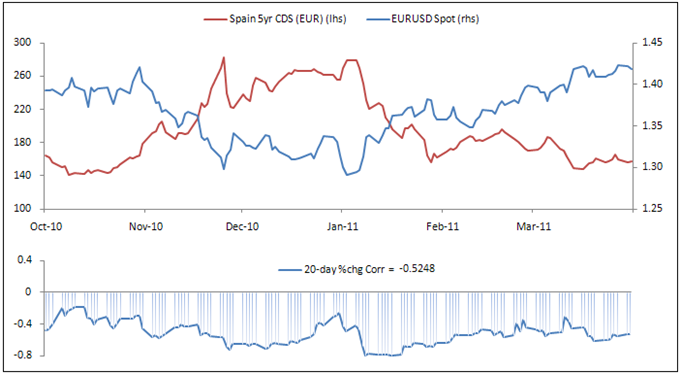
| April Key Events and the Outlook for Equities Posted: 07 Apr 2011 05:22 AM PDT Amalgamator submits: April is a month of key events. 7th April: ECB Rate Decision A rate rise is priced in. The euro is currently threatening to break out from long term resistance against the U.S. dollar, but the bearish sentiment against the dollar suggests a bounce is overdue. If the euro does break out then dollar index support levels at 75 and then 72 may provide that dollar rally. Although Portugal is closer to a bailout, the euro strength reflects the fact that Spain's troubles have eased, as shown in the inverse relationship in the chart below. It appears the markets are confident that bailouts will be limited to the smaller economy nations. Click to enlarge 11th April: U.S. earnings season starts A lack of earnings pre-announcements suggest a lack of earnings surprises, but will earnings be slightly compressed by higher input costs (rising commodities)? If so, higher sales Complete Story » | ||||||||||||||||||||||||||||||||||||||||||||||||||||||||||||||||||||||||||||||||||||||||||||||||||
| Posted: 07 Apr 2011 05:08 AM PDT Marc Chandler submits: The U.S. dollar is mixed, though the euro is clearly lower ahead of the ECB meeting and, more importantly, Trichet's press conference. Everyone and his sister expects a 25 bp hike, but the guidance going forward is important ... or maybe not. Observers recall that Trichet's past, suggesting that a tightening cycle is not at hand, has not proved to be advice to bank on. My idea of heightened risk of "buy the rumor, sell the fact" type of of activity was not solely based on the likelihood that Trichet may try to calm market anxiety about the extent and pace of hikes. Rather, it was also on market positioning -- the euro has been trending higher since early January on ideas ECB was going to hike. And not just hike, but hike ahead of the U.S., something it has not done in a generation. The interest rate market, it Complete Story » | ||||||||||||||||||||||||||||||||||||||||||||||||||||||||||||||||||||||||||||||||||||||||||||||||||
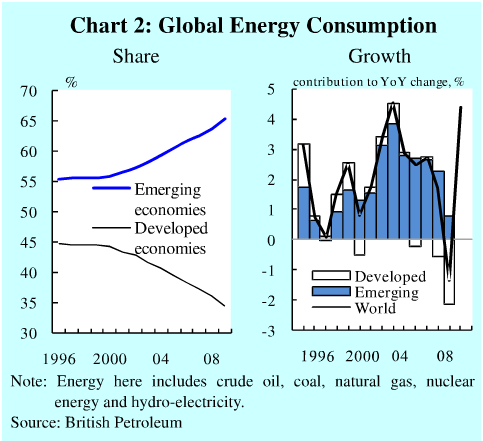
| How the West Was Lost: China Drinks U.S. Economy's Milkshake Posted: 07 Apr 2011 05:00 AM PDT Kevin McElroy submits: While the leadership in the United States quibbles about whether we're at war in Libya or we're not (hint: We are), or whether we should reduce our deficit by 0.23% or not (that's the $33 billion Congress is currently debating), the developing world continues to care less and less. Take a look at the charts below, which I gleefully borrowed from a recent Bank of Japan report on commodities: [Click all to enlarge] We're well past the point of being equal partners in the usage of the world's energy resources. If the chart on the left is any indication, we're actually well on our way to becoming rather inconsequential as a global energy consumer. And it's pretty clear that any growth in developing world energy consumption means a commensurate decrease in energy consumption on a percentage basis. But what might not be so clear from the chart on the right: Complete Story » | ||||||||||||||||||||||||||||||||||||||||||||||||||||||||||||||||||||||||||||||||||||||||||||||||||
| State Street Launches Fundamental Corporate Bond ETF Posted: 07 Apr 2011 04:47 AM PDT Michael Johnston submits: Innovation continues to be a defining characteristic of the quickly-growing fixed income ETF space as evidenced by the launch of the SPDR Barclays Capital Issuer Scored Corporate Bond ETF (CBND) on Thursday by State Street. The new ETF will seek to replicate the performance of the Barclays Capital Issuer Scored Corporate Index, a benchmark that includes U.S. dollar denominated corporate issues that are rated investment grade (Baa3/BBB- or higher) by at least two of the big three ratings agencies. CBND will be unique from existing products in the Corporate Bonds ETFdb Category because of the manner in which the underlying index is constructed. That methodology involves both determining the weightings attributed first to individual issuers and then to security weights. Individual issuers in the related benchmark are weighted based on three fundamental financial ratios (only debt issued by companies with publicly-traded stock are eligible for inclusion). Those ratios include:
Complete Story » | ||||||||||||||||||||||||||||||||||||||||||||||||||||||||||||||||||||||||||||||||||||||||||||||||||
| Timberline Cuts 10-Plus Ounces per Ton Gold in Montana Posted: 07 Apr 2011 03:37 AM PDT Gold attempting a sure-enough breakout, this time supported by mining shares, sort of. Yesterday our Vulture Bargain #4 and our Top Pick for 2011 Timberline Resources (NYSE-AMEX: TLR, TSX: TBR.V) reported solid underground drill results from their Butte Highlands JV in Montana. The well-written TLR press release begins: Coeur d'Alene, Idaho - April 6, 2011 - Timberline Resources Corporation (NYSE Amex: TLR; TSX-V: TBR) ("Timberline" or the "Company") today announced results from underground drilling at the Butte Highlands Gold Project in southwestern Montana, including Hole BHUG-006 which returned 33.6 feet (10.2 metres) grading 1.65 ounces per ton (opt) (56.5 grams per tonne (g/t)) gold, including a 5-foot (1.5 metre) interval grading 10.45 opt (357.9 g/t) gold. Results reported today are from the first 24 holes in a planned 86-hole, 49,500-foot (15,000-metre) underground diamond drilling program, designed for detailed delineation of the mineralization and underground mine planning at the project where production development is well underway as a result of Timberline's innovative joint venture financing. Paul Dircksen, Timberline's President and CEO, said, "We are extremely pleased with these results from our underground drill program at Butte Highlands. This current program serves to outline the first several years of production for mine planning purposes. These results contribute to our objective of advancing the Butte Highlands project from exploration through to production and positive cash flow. We expect to continue this model with similar results at our other projects. …" | ||||||||||||||||||||||||||||||||||||||||||||||||||||||||||||||||||||||||||||||||||||||||||||||||||
| Gold May Fall on ECB Rate Rise but Rising Interest Rates Likely to Lead to Much Higher Prices Posted: 07 Apr 2011 01:55 AM PDT gold.ie | ||||||||||||||||||||||||||||||||||||||||||||||||||||||||||||||||||||||||||||||||||||||||||||||||||
| What could happen to gold when interest rates rise Posted: 07 Apr 2011 01:15 AM PDT From Mineweb: So frequently today we rely on economically established perceptions that fail time and again, simply because the conditions in which they were established have changed. One economic cliché is that exchange rates will rise if interest rates rise. You can be sure that if there was still a Spanish Peseta or Greek Drachma and they were paying the sort of interest rates their sovereign bonds were paying now, these currencies would still be falling, Many feel that if interest rates rise, gold will automatically fall. But is that going to be true? There's a great deal more involved to this story than just interest rates... Read full article... More on gold: What all gold investors should know about the crisis in Japan Porter Stansberry: What every American needs to know about gold Gold is breaking out to new highs... This is where the rally could end | ||||||||||||||||||||||||||||||||||||||||||||||||||||||||||||||||||||||||||||||||||||||||||||||||||
| Posted: 07 Apr 2011 12:09 AM PDT The bluntest difference between gold and silver? Warren Buffett... | ||||||||||||||||||||||||||||||||||||||||||||||||||||||||||||||||||||||||||||||||||||||||||||||||||
| Where Is America's Gold?: The Mystery of Ft. Knox Posted: 06 Apr 2011 11:48 PM PDT Where Is America's Gold?: The Mystery of Ft. Knox by Chris Weber What Do They Have to Hide? In a few months we'll "celebrate" the 40th anniversary of the day when the US Government declared bankruptcy. Oh, they didn't call it that at the time. But what happened on August 15, 1971 was that the US defaulted on its promise to pay gold for dollars. It is now clear that they didn't have very much gold left to pay. My new book, Good As Gold? is now available. I've tried to make it a clear and readable history of what happened to the gold confiscated from Americans and put into Fort Knox in the 1930s. I've used the government's own words and statements to paint a picture I think is shocking. There has never been an accounting of this gold. There has never been a real audit of it. (I know people say there was one in 1953, but after reading my book, I wonder if anyone really can believe this.) At every turn when the government was asked to provide proof of either the amount of gold they have left, or the quality of it, they have answered with lies and evasions. They have been acting like they have something to hide. What we do know is that until August 15, 1971 any foreign central bank could go to the US Treasury and buy official US gold at $35 per ounce. It was the last link to the international gold standard. Before then, all currencies were defined in terms of the US dollar, and the US dollar was defined in terms of gold. A dollar equaled 1/35th of an ounce of gold; $35 equaled one troy ounce of gold. But on that day the gold window closed. Since then, no more US government gold has been exchanged for US paper money. In my book, I uncover a 1975 letter from the Washington DC director of the General Accounting Office. Quoting US Treasury sources, the GAO director pretty much comes out and says that there was almost no more "good delivery" gold left. This means that the gold that would be acceptable on international markets and have a purity of .995 or better was almost gone by the time Nixon closed the gold window. They knew that there was almost nothing left that was of a purity acceptable to foreign central banks. We can only guess at what remains, and the purity of it. In fact, we could do more than guess, if the government only let sunlight in. The technology now exists to scan each bar of gold and see how much gold it really contains. There could be independent accountants and a generally public procedure to show how much the US government has. To be sure, the US government puts out a report each year detailing the official numbers of what they have. Here is the latest one from a few weeks ago:
Deep Storage: Deep-Storage gold is the portion of the U.S. government- owned Gold Bullion Reserve that the U.S. Mint secures in sealed vaults, which are examined annually by the Department of Treasury's Office of the Inspector General. Deep-Storage gold comprises the vast majority of the Reserve and consists primarily of gold bars. This portion was formerly called "Bullion Reserve" or "Custodial Gold Bullion Reserve." Working Stock: Working-Stock gold is the portion of the U.S. government-owned Gold Bullion Reserve that the U.S. Mint uses as the raw material for minting congressionally authorized coins. Working-Stock gold comprises only about 1 percent of the Reserve and consists of bars, blanks, unsold coins, and condemned coins. This portion was formerly listed as individual coins and blanks or called "PEF Gold." So this is what the US government says they have, and where they have it. In fact, by their own words, nearly all of it is in what they call "Deep Storage". The gold here is not examined annually. Instead, the "sealed vaults" are examined annually. But what this means is that they just do a cursory check to see if the seal has been broken. By the way, the "book value" of this gold is absurd. It is officially valued at $42.22 per ounce. This is because that was the last "official" value of the US dollar. A few months after the August 15, 1971 closing of the gold window, Nixon devalued the US dollar. This was on December 17, 1971. The official gold price was raised from $35 to $42.22. But this new price meant nothing. They still weren't going to sell gold at this new, slightly higher rate. It was really a sham. Other countries had long been after the US to raise the official gold price, so Nixon finally did it. But what good did that do when this was the price at which the US would not – repeat, not – redeem its paper dollars into gold? As I hope my book shows, there has been the atmosphere of a sham – even a fraud – about the US policy toward gold for generations. The Nixon fraud was only one in a series of sham acts. I don't understand why today's government would be afraid to open the vaults and publicly count and assay the gold. After all, if a lie was revealed they could say that it wasn't their fault: they weren't even born when these policies were put into place. Officially, the US has by far the largest government reserves of gold in the world. Here are the top eight nations and the amount they have in millions of troy ounces:  So, officially, the US has much more than twice its nearest rival, Germany. It has nearly eight times as much as China – again, officially. But China has quietly become the world's largest producer of gold, and the Chinese central bank buys 100% of all production at the market price. I'm sure they make certain this gold is of the utmost purity. I'm suspicious of the "official" Chinese total, which I really believe is a state secret, and may be much higher than they state here. In any event, it is the US gold this article is all about. We need to finally see what is left of the gold that was confiscated from the American people in 1933. We need to know how much is left from the 702 million ounces the US had in 1949, when this was by far the most gold held by one owner in history. There are elected members of Congress, in both parties, who are ready to try to open the vaults. One of them, Ron Paul, wrote the forward to my book. Even if a person doesn't understand the importance of gold as an investment, this is a sort of mystery story: What Happened to the Gold? Why have they been acting as if they had something to hide? April 7, 2011 Chris Weber [send him mail] writes the Weber Global Opportunities Report. He has been an investor since 1971. | ||||||||||||||||||||||||||||||||||||||||||||||||||||||||||||||||||||||||||||||||||||||||||||||||||
| Wilson Signed The Federal Reserve Into Motion December 24, 1913 Posted: 06 Apr 2011 09:04 PM PDT Thus began the downfall of the United States Monetary System Held In The Iron Fist Of Crooked Bankers And Their Corporate Henchmen-Cabal. Based Upon What This Act Has Done To The World And To America, It Should Have Been Stillborn. "The Federal Reserve System (also known as the Federal Reserve, and informally as The Fed) is the central banking system of the United States. It was created in 1913 with the enactment of the Federal Reserve Act, largely in response to a series of financial panics, particularly a severe panic in 1907." "Over time, the roles and responsibilities of the Federal Reserve System have expanded and its structure has evolved. Events such as the Great Depression were major factors leading to changes in the system. Its duties today, according to official Federal Reserve documentation, are to conduct the nation's monetary policy, supervise and regulate banking institutions, maintain the stability of the financial system and provide financial services to depository institutions, the U.S. government, and foreign official institutions." -Wikopedia
And; Now Just This Week In March, 2011…. "The justices today left intact a court order that gives the Fed five days to release the records, sought by Bloomberg News's parent company, Bloomberg LP. The Clearing House Association LLC, a group of the nation's largest commercial banks, had asked the Supreme Court to intervene."
"The order marks the first time a court has forced the Fed to reveal the names of banks that borrowed from its oldest lending program, the 98-year-old discount window. The disclosures, together with details of six bailout programs released by the central bank in December under a congressional mandate, would give taxpayers insight into the Fed's unprecedented $3.5 trillion effort to stem the 2008 financial panic. "I can't recall that the Fed was ever sued and forced to release information" in its 98-year history, said Allan H. Meltzer, the author of three books on the U.S. central bank and a professor…" "Under the trial judge's order, the Fed must reveal 231 pages of documents related to borrowers in April and May, 2008, along with loan amounts. News Corp.'s Fox News is pressing a bid for 6,186 pages of similar information on loans made from August, 2007 to November, 2008." "The records were originally requested under FOIA, which allows citizens access to government papers, by the late Bloomberg News reporter Mark Pittman. (Editor: What happened to Mr. Pittman? Also, we noticed this story was pulled from the Bloomberg site after we received it. "As a financial crisis developed in 2007, "The Federal Reserve forgot that it is the central bank for the people of the United States and not a private academy where decisions of great importance may be withheld from public scrutiny," said Matthew Winkler, editor in chief of Bloomberg News. "The Fed must be accountable to Congress, especially in disclosing what it does with the people's money." http://www.zerohedge.com/article/final-count-pittman-1-fed-0-supreme-court-refuses-grant-confidential-data-disclosure-appeal- We Have A Gang Of Private Bankers-Industrialists Managing USA Money With No Controls. "The Federal Reserve System's structure is composed of the presidentially appointed Board of Governors (or Federal Reserve Board), the Federal Open Market Committee (FOMC), twelve regional Federal Reserve Banks located in major cities throughout the nation, numerous privately owned U.S. member banks and various advisory councils." "The FOMC is the committee responsible for setting monetary policy and consists of all seven members of the Board of Governors and the twelve regional bank presidents, though only five bank presidents vote at any given time. The responsibilities of the central bank are divided into several separate and independent parts, some private and some public." "The result is a structure that is considered unique among central banks. It is also unusual in that an entity outside of the central bank, namely the United States Department of the Treasury, creates the currency used." "According to the Board of Governors, the Federal Reserve is independent within government in that "its decisions do not have to be ratified by the President or anyone else in the executive or legislative branch of government." However, its authority is derived from the U.S. Congress and is subject to congressional oversight. Additionally, the members of the Board of Governors, including its chairman and vice-chairman, are chosen by the President and confirmed by Congress. The government also exercises some control over the Federal Reserve by appointing and setting the salaries of the system's highest-level employees. Thus the Federal Reserve has both private and public aspects. The U.S. Government receives all of the system's annual profits, after a statutory dividend of 6% on member banks' capital investment is paid, and an account surplus is maintained. The Federal Reserve transferred $78.4 billion to the U.S. Treasury in 2010." US Dollar Is One Sick Puppy But We Think Support Holds For Now.         This posting includes an audio/video/photo media file: Download Now | ||||||||||||||||||||||||||||||||||||||||||||||||||||||||||||||||||||||||||||||||||||||||||||||||||
| Currency Status to Further Boost Gold as it Breaks New Records Posted: 06 Apr 2011 08:38 PM PDT ¤ Yesterday in Gold and SilverGold hit its low, such as it was, in morning trading in the Far East...and from that low, it climbed ever so slowly to it's high of the day, which was the London p.m. gold fix at 10:00 a.m. Eastern. From that high, such as it was, gold got sold off to it's New York low around $1,454 spot shortly after 12:30 p.m. Eastern. Gold gained back about five dollars of that loss before the close of electronic trading at 5:15 p.m. Volume was light.
Silver's early price direction on Wednesday was pretty aimless as well...with the high of the day coming at the same time as gold's...the London p.m. fix. Then silver price followed gold price almost right to the tick. Volume was light as well.
And, in case you missed it, gold closed at a new record high price on Wednesday...and silver closed at a new 31-year high. Can a new record high price for silver be too far off? The dollar was under a bit of selling pressure most of the day...and closed down about 35 basis points. I suppose one could say that the gold price was influenced by the happenings in the currency markets...but it could have been a coincidence as well.
Gold's high price of the day at the 10:00 a.m. Eastern gold fix is pretty easy to spot on this chart...and the stocks pretty much followed the gold price around for the entire New York trading session after that as well. With the HUI finishing up a miniscule 0.05%...that's as close to flat on the day as you're likely to ever see.
Even though the silver price was in the black all day yesterday...there were a lot of nervous sellers out there...and the silver stocks finished mixed. Here's Nick Laird's "Silver Sentiment Index" one more time.
The CME Daily Delivery Report had almost no action worthy of the name...as only 37 gold and zero silver contracts were posted for delivery on Friday. I would suspect that the bulk of April's gold deliveries are already behind us...as gold's open interest in the April contract continues to contract at a very brisk pace. On Tuesday, the GLD ETF showed that 48,000 ounces were added...but, despite the positive price action, a rather large 234,022 ounces of gold were withdrawn on Wednesday. I don't know what to make of that. The SLV ETF showed no change yesterday. The U.S. Mint had another sales report yesterday...and it was of the smallish variety...only 3,000 ounces of gold eagles. That was all. It was another quiet day over at the Comex-approved depositories on Tuesday. Only 19,996 ounces of silver were received...and 5,972 ounces were shipped out. There was one strange thing to report...and that was a negative adjustment over of Brinks...as 277,179 troy ounces of silver were adjusted out of existence. Silver analyst Ted Butler had another commentary out for his paying subscribers yesterday...and that is where I 'borrowed' the following..."So what's going on at JPMorgan and the Exchange? What are they thinking? I'm a big believer in putting yourself in the other guy's shoes whenever possible; to try to think things through from someone else's perspective. I think it's safe to say that JPMorgan and the CME Group wish this silver situation never evolved to the point it has. If either JPM or the CME or any silver short could just blink their eyes or click their ruby slippers and make the whole silver problem go away, it would have happened already. But that's not how things work. If you short anything, you must buy it back or deliver against it eventually. A short position is an open transaction; it is not a completed transaction until delivered against or bought back. I think that JPMorgan and the other big shorts at the CME are increasingly aware of the open nature of their short positions. It may be that they know higher prices will be necessary to induce others to sell so that they canbuy. Here's a graph worth noting...and I think I stole this from a Frank Holmes piece on the weekend. It's titled "Gold as a Percent of Global Financial Assets"...and it needs no further embellishment from me.
If either JPM or the CME or any silver short could just blink their eyes or click their ruby slippers and make the whole silver problem go away, it would have happened already. Lew Rockwell: Use the dollar or else. Gold: 40 years of turmoil. Portugal: 'We need European aid.' The Casey Report's David Galland: Major Policy Shift Ahead ¤ Critical ReadsSubscribeRepeal of purchase reporting law 1099 passes Senate, goes to presidentHere's a story I found in a GATA release yesterday. Kitco News reported that the U.S. Senate has joined the House in repealing the law requiring merchants, including coin dealers, to file reports with the Internal Revenue Service for every purchase made by customers greater than $600. The repeal legislation now goes to President Obama for final decision. This is worth the read as it's the bill we've all been waiting for...and the link is here.  Marc Faber: Bernanke is killing the middle classChris Powell saved me some more wordsmithing with this GATA release last night. Market analyst and newsletter editor Marc Faber told King World News that the markets increasingly are recognizing that gold and silver are currencies, not industrial commodities, even as the Federal Reserve's money printing is driving commodity prices up and destroying the middle class. The link to the KWN blog is here.  Our Unaccountable Fed"I will maintain to my deathbed that we made every effort to save Lehman, but we were just unable to do so because of a lack of legal authority." So said Federal Reserve Chairman Ben Bernanke in 2009. Not having a real budget means the Federal Reserve doesn't have to compete with anyone for scarce resources. What the central bank needs is a little money competition. This op-ed piece was posted in yesterday's edition of The Wall Street Journal...and is a GATA release, as it's subscriber protected. The link is here.  Unreported Soros Event Aims to Remake Entire Global EconomyOn April 8th, a group he's funded with $50 million, is holding a major economic conference at Bretton Woods in New Hampshire...and Soros's goal for such an event is to "establish new international rules" and "reform the currency system." It's all according to a plan laid out in a November 4, 2009 Soros op-ed calling for "a grand bargain that rearranges the entire financial order." Have no doubt about it: This is a Soros event from top to bottom. Even Soros admits his ties to INET are a problem, saying, "there is a conflict there which I fully recognize." He claims he stays out of operations. That's impossible. The whole event is his operation. I thank reader Michael McKay for sending me this story that was posted at the end of March in the online version of The Wall Street Journal...and the link is here.  Germany's Future Rising in East as Exports to China Eclipse U.S.With its consumers and companies sating their appetite for power turbines, cars and electronics, China became Germany's largest non-European customer at the end of last year. "This is a turning point in Germany's economic history," said Andreas Rees, chief Germany economist at UniCredit Markets and Investment in Munich. "China could become the largest export market of all by 2015." Washington state reader S.A. provided this longish Bloomberg story from yesterday...and the link is here.  Portugal: 'We need European aid'Portugal is now another piggy at the European Bailout Reserve trough. In a televised evening address to the nation last night, Prime Minister Jose Socrates said: "I want to inform the Portuguese that the government decided today to ask...for financial help, to ensure financing for our country, for our financial system and for our economy." Reader Roy Stephens sent me the story the moment that it showed up on The Telegraph's website last night...and the link is here.  Currency status to further boost gold as it breaks new recordsI only have a small number of gold-related stories for today's column...and the first one is this mineweb.com story from yesterday that was sent to me by reader George Findlay. Speaking on Mineweb.com's Gold Weekly podcast, Nicholas Brooks, head of Research and Investment strategy at ETF Securities said the growing demand for gold as an alternative currency, which has built up steadily since the financial crisis of 2008, is one of the key factors underlying the current strength in the gold price and, is one that is likely to continue. The link to the story is here.  Lew Rockwell: Use the dollar or elseHere's another GATA release where I'm going to let Chris Powell do the honours...because you'll find out real quick that I can't improve on his preamble one bit. Rockwell writes: "A nation that is confident about its money's future would not fear currency competition. A nation with a dying money uses every possible means to crush the competition. That is precisely what is happening in the case of the so-called Liberty Dollar." As Seth Lipsky wrote in The Wall Street Journal, "it's a loser's game to suppress private money that is sound in order to protect government-issued money that is unsound." This is a must read...and the link is here. Marc Faber: Bernanke is killing the middle class Posted: 06 Apr 2011 08:38 PM PDT  Chris Powell saved me some more wordsmithing with this GATA release last night. Market analyst and newsletter editor Marc Faber told King World News that the markets increasingly are recognizing that gold and silver are currencies, not industrial commodities, even as the Federal Reserve's money printing is driving commodity prices up and destroying the middle class. The link to the KWN blog is here. | ||||||||||||||||||||||||||||||||||||||||||||||||||||||||||||||||||||||||||||||||||||||||||||||||||
| Posted: 06 Apr 2011 08:38 PM PDT  Gold prices hit a new high of $1,462.93 an ounce on Wednesday, setting a record for a second-consecutive day on inflation fears and a falling US dollar. Here, we look at the key moments in gold trading over the past 40 years. This is essential reading for the rookie gold investor...and a nice review for anyone who has been around for sixty years...or longer. I thank Florida reader Charles Dubelier for sharing this story from yesterday's edition of The Telegraph...and the link is here. | ||||||||||||||||||||||||||||||||||||||||||||||||||||||||||||||||||||||||||||||||||||||||||||||||||
| Lew Rockwell: Use the dollar or else Posted: 06 Apr 2011 08:38 PM PDT  Here's another GATA release where I'm going to let Chris Powell do the honours...because you'll find out real quick that I can't improve on his preamble one bit. Rockwell writes: "A nation that is confident about its money's future would not fear currency competition. A nation with a dying money uses every possible means to crush the competition. That is precisely what is happening in the case of the so-called Liberty Dollar." As Seth Lipsky wrote in The Wall Street Journal, "it's a loser's game to suppress private money that is sound in order to protect government-issued money that is unsound." | ||||||||||||||||||||||||||||||||||||||||||||||||||||||||||||||||||||||||||||||||||||||||||||||||||
| On CNBC Asia, Ben Davies explains why gold is better than gold ETFs Posted: 06 Apr 2011 08:38 PM PDT  Touring the world promoting gold as an alternative form of money [and his fund as a good way of investing in it], Hinde Capital CEO Ben Davies turned up on CNBC Asia's "Squawk Box" program Sunday and explained why gold is under-owned, why governments wage war against it, and why exchange-traded funds are not the most efficient and reliable way of investing in gold. The interview is a little more than 6 minutes long and the link is here. | ||||||||||||||||||||||||||||||||||||||||||||||||||||||||||||||||||||||||||||||||||||||||||||||||||
| The Casey Report’s David Galland: Major Policy Shift Ahead Posted: 06 Apr 2011 08:38 PM PDT  Today's last reading item is not gold-related...but it's your big read of the day, so I left it right to the end. | ||||||||||||||||||||||||||||||||||||||||||||||||||||||||||||||||||||||||||||||||||||||||||||||||||
| Tracking Gold’s Rise Against Faux Money and Fiat Currencies Posted: 06 Apr 2011 06:03 PM PDT
By Joel Bowman  04/06/11 Buenos Aires, Argentina – Gold $1,460…Oil $109 (Brent $123)…Dow 12,400… Good Golly…what isn't going up?! Commodities…equities…monies. They're all on the march. Yes, you read that right, Fellow Reckoner. Money is going up too. It's going to the moon…and back. We mean real money, of course…not that flim flam fiat junk the Feds pass off as cash. We're talking about gold. Gold and, to a lesser extent, silver. Look above at that first number again. Quite a bit higher than the $1,150 per ounce the Midas metal fetched a year ago, eh? Or the $650 it went for five years back? Or the $250 mark, where it started the new millennium. [Silver, by the way, has performed even better. As we write this morning, an ounce of gold's perennial bridesmaid is just a few dimes shy of $40 per ounce...quite a ways from the $5 per ounce at which it began the millennium.] And all this while the naysayers were out with their…well, naysaying. "Gold has no industrial use," they said. "It is a relic of the past…a 'barbarous' throwback to a bygone era." Leaving aside for a moment the fact that gold does have industrial uses (albeit in a relatively limited area), the fact remains that gold's primary function in an economy is as money, not as circuitry, dentistry or other. Why? As Aristotle explained more than a few years ago, gold is the best money because it exhibits the necessary characteristics that make an acceptable money more so and better than any of the known alternatives. That is, it is durable, divisible, consistent, convenient, and has value in itself. In our time, as in that of the Ancient Greeks, we have come across no more reliable store of value, no superior medium of exchange, than this simple, humble, nobody-else's-debt metal. While substitutes are invariably debased, debauched and devalued, gold mostly just keeps to itself, watching with amusement as the government-issued paper currencies commonly used to measure it dance in the wind, whimsical as the empty political promises that back them. As Doug Casey explains, "The paper we use today is a medium of exchange – it got that way because governments made it illegal not to accept it – but it's not a good store of value. And it's rapidly and radically becoming less of a store of value. What we use as money today is actually not money; it's currency. Technically, that's simply a word that indicates a government substitute for money." So yes, gold is up…as measured in dollars. More correctly, substitute money is down…and headed much lower before this plays out once more as it always, everywhere does… Read more: Tracking Gold's Rise Against Faux Money and Fiat Currencies http://dailyreckoning.com/tracking-golds-rise-against-faux-money-and-fiat-currencies/#ixzz1Ionvxd1R
| ||||||||||||||||||||||||||||||||||||||||||||||||||||||||||||||||||||||||||||||||||||||||||||||||||
| Bullion Bank Trading – A Closely Guarded Secret! Posted: 06 Apr 2011 05:57 PM PDT
| ||||||||||||||||||||||||||||||||||||||||||||||||||||||||||||||||||||||||||||||||||||||||||||||||||
| Hardin City, Nevada and its lost silver mine Posted: 06 Apr 2011 05:00 PM PDT Ghost Towns | ||||||||||||||||||||||||||||||||||||||||||||||||||||||||||||||||||||||||||||||||||||||||||||||||||
| The Case for Position Limits: What is the Spot Price of Gold and Silver And How Is It Set? Posted: 06 Apr 2011 04:45 PM PDT Jesse's Cafe | ||||||||||||||||||||||||||||||||||||||||||||||||||||||||||||||||||||||||||||||||||||||||||||||||||
| Posted: 06 Apr 2011 04:30 PM PDT
Mercenary Links Roundup for Wednesday, April 6th (below the jump).
04-06 Wednesday
| ||||||||||||||||||||||||||||||||||||||||||||||||||||||||||||||||||||||||||||||||||||||||||||||||||


| You are subscribed to email updates from Gold World News Flash 2 To stop receiving these emails, you may unsubscribe now. | Email delivery powered by Google |
| Google Inc., 20 West Kinzie, Chicago IL USA 60610 | |

No comments:
Post a Comment