


Gold World News Flash |

- Gold Seeker Weekly Wrap-Up: Gold and Silver Rise Almost 1% and 5% on the Week to New Highs
- In The News Today
- Jan Hatzius Friday Night Bomb: "We Are Downgrading Our Real GDP Growth Estimate To 1¾% From 2½%"
- Capital Context Update: OPEX Omnipotence
- Buying Gold on the Price Inflation Guarantee
- Is the Gold price really rising?
- Can You Pass The 2011 Gold Quiz?
- The Gold Price Broke Out, So Buy
- Looking for Value in PMs and Finding Adventure
- The REAL Silver High
- The Tracks of Mankind
- Financial No-Man’s Land
- “The bedrock of all portfolios must be gold. In my opinion, physical metals outside the banking system should be a full one third of your portfolio”
- Guest Post: Did The World’s Largest Futures Exchange Enable $200 Oil?
- Gold rallies to record; silver hits 31-year high
- Silver's verdict on Max Keiser's “10 o'clock live” appearance – new 30 year high
- Retail Sales: The Next Chapter of the Financial Crisis
- $42.9913 Sticksave
- G-20 nears deal on imbalances as China maintains currency plan
- Silver $43
- Silver delivery problems likely, Rule tells King World News
- Brian Ostroff: Looking for Value in PMs and Finding Adventure
- What Is Silver Screaming About?
- Financial No-Man’s Land
- Gold Daily and Silver Weekly Charts - Something Wicked This Way Comes - We Will Rock You
- Hourly Action In Gold From Trader Dan
- Can You Pass The 2011 Gold Investing Quiz?
- Silver Screaming Inflation
- Grandich Interviewed in MarketWatch
- What Does Silver’s Recent Performance Relative to Crude Oil Mean For Investors?
| Gold Seeker Weekly Wrap-Up: Gold and Silver Rise Almost 1% and 5% on the Week to New Highs Posted: 15 Apr 2011 04:00 PM PDT Gold traded mostly modestly higher in Asia and London before it accelerated up in late morning New York trade and ended near its new all-time high of $1487.30 with a gain of 0.94%. Silver soared to a new 31-year high of $42.85 and ended with a gain of 2.06%.
|
| Posted: 15 Apr 2011 03:57 PM PDT Today's Best Trade I gave my daughter a car which requires no less than 91 octane. In return she owes me four baby doll sheep, two goats and two horses. Historically, any country on the path of liquidity as deeply as that which has occurred, gets the sought after title of Banana Republic.
Jim Sinclair's Commentary The making of the Squid! "When plunder becomes a way of life for a group of men living together in society, they create for themselves in the course of time a legal system that authorizes it and a moral Code that glorifies it."
Jim Sinclair's Commentary Gold is debt. Debt is set. Gold will go ballistic soon.
Jim Sinclair's Commentary Gold is going to and through $1650 like it did not exist. Why gold could hit $5,000 With turmoil overseas and energy prices on the rise, investors are worried. They're worried about geopolitical risk. They're worried about a falling dollar. And they're worried about inflation becoming entrenched as the Federal Reserve continues to administer its cheap-money medicine despite signs of inflation. As a result, gold is on the move again. For much of last year, gold moved higher over worries about Europe's debt crisis and a "double dip" recession in the United States. Prices fell into a funk in the fall, though. Now, a new set of concerns has gripped the hearts and minds of investors. Fear has returned. And the yellow metal has taken flight. Prices hit a new closing high at 1,474.10 last week, and seem headed past $1,500 an ounce. So how high can it go? Believe it or not, some analysts are calling for prices to move close to $5,000 — not immediately, but sooner than you may think.
|
| Jan Hatzius Friday Night Bomb: "We Are Downgrading Our Real GDP Growth Estimate To 1¾% From 2½%" Posted: 15 Apr 2011 02:35 PM PDT
Nobody could have seen this coming: "With most of the news on first-quarter growth now in, the GDP “bean count” looks even softer than it did a couple of weeks ago. The most recent disappointments have come on the export side—with trade now set to subtract significantly from growth in the quarter—and from inventories. Consequently, we are downgrading our real GDP growth estimate to 1¾% (annualized), from 2½% previously (and from 3½% not too long ago)." Some other things nobody will be able to predict: Goldman's downgrade of PMs, Kostin's 2011 S&P500 price target reduction by 20%, and Goldman getting its New York Fed branch to commence monetizing $1.5 trillion in debt some time in October. From Goldman: Do Consumers Have Enough Fuel?
With most of the news on first-quarter growth now in, the GDP “bean count” looks even softer than it did a couple of weeks ago. The most recent disappointments have come on the export side—with trade now set to subtract significantly from growth in the quarter—and from inventories. Consequently, we are downgrading our real GDP growth forecast to 1¾% (annualized), from 2½% previously (and from 3½% not too long ago). Other indicators still point to solid activity in Q1, but markets have become increasingly concerned about growth in the remainder of the year as well. Growth-sensitive equities have suffered in recent days, and some forecasters have taken down their expectations for growth later in the year. A key reason for concern is the sharp rise in gasoline prices so far in 2011, which has the American public—and policymakers—on edge. Retail pump prices are approaching their peak levels in the summer of 2008 (Exhibit 1). The extra cost of about 70 cents per gallon, relative to prices at the end of 2010, is siphoning off household income at a run rate equivalent to $100 billion per year—income that otherwise could have been spent on other goods and services. Despite these higher fuel costs, consumer spending looks to have grown at a 2½% pace in real terms in Q1, and—given strength towards the end of the quarter—is headed for a stronger pace in Q2. Solid growth in consumer spending will be essential if the US economy is to post above-trend growth for the remainder of 2011, as we continue to expect. But will households have enough “fuel” from income growth to sustain such an expansion, especially with fiscal and monetary stimulus reaching their peak? In the next few pages we look at the prospects for household income growth in 2011 and 2012. We find that the payroll tax holiday has helped consumers to absorb the increase in gasoline prices over the past few months. Put another way, higher oil prices have fully offset the impact of the payroll tax cut. Going forward, a reacceleration in spending growth is possible, but will require a fortuitous combination of circumstances—a modest further pickup in the labor market, gasoline price relief, and a benign asset price environment that encourages consumers to gradually reduce saving. Moderate Income Growth, with Risks from Taxes and Oil Our US economic forecast envisions personal income from wages and salaries, assets, and transfers should grow at roughly a 5% nominal rate through most of 2011 and 2012. 1. Wages and salaries should grow at a 4%-4½% clip. This assumes payroll growth in the 200,000 range (just about a 2% annual growth rate—see Exhibit 2), a small increase in hours per worker, and growth of about 1½%-2% in wages per hour (similar to recent growth in private sector average hourly earnings or the Labor Department’s employment cost index; see Exhibit 3). Ultimately, it’s labor income that is needed to fuel a self-sustaining expansion, and this is more important than ever now that fiscal policy is turning towards restraint. 2. Asset income—weak interest, but growing dividends and business income. A continued low-rate environment should dampen interest income, but the rebound in the economy should lead to further gains in dividend income and small business income (proprietors’ income). We envision this component growing at a 3-5% nominal rate through 2012. 3. Transfer income will be more restrained. Aside from the annual cost-of-living increase in Social Security in early 2012, which should be more robust next year due to higher headline inflation this year, transfer income should grow relatively slowly. In particular, unemployment benefits should dwindle as individuals find jobs or exhaust their extended benefit eligibility. Modeling each component of income growth separately suggests some downside risk to asset income and transfer income relative to our current forecasts, but potential upside risk to our current numbers on wages and salaries. Overall, we see some small downside risk to our current disposable income forecast, perhaps about half a percentage point. If we assume trend-like headline inflation of 1½%-2% over remainder of 2011 and 2012, these calculations would imply real disposable income growth in the 3% range. Exhibit 4 illustrates the recent paths of wage and salary income, disposable income, and real disposable income with our forecasts (in shaded area) through the end of 2012. The spike in mid-2010 is due to the labor market improvement in that period, which in turn was partly the result of temporary Census hiring. The data for recent months show clearly the offsetting effects of the payroll tax holiday and rising gasoline prices. Wage and salary growth (dotted line) has been reasonably steady in the 3%-4% range, while disposable income (the gray line) has accelerated to more than 6% annualized with the cut in payroll taxes. However, in real terms (black solid line), there has been no acceleration in income, as higher headline inflation has absorbed the increase in nominal aftertax income. As for the future, there are two main risks to a “steady as she goes” income path. The first—fittingly, given that it’s tax day—is the increase in payroll tax rates slated for the beginning of 2012, when the partial payroll tax holiday expires. This will decrease households’ after-tax income by roughly $110 billion (about 1%), clearly visible as a drop in income growth in early 2012 in Exhibit 4. Of course, it’s possible the payroll tax cut will be extended—next year is an election year, after all—but right now there is no call to do so either from Democrats or Republicans. The second risk is the path of commodity prices; continued increases in gasoline prices in particular would pose a serious threat, especially if they occurred alongside a reversion to the higher payroll tax rate. Households currently devote 3.6% of their income to gasoline, on average, so a 10% shock to gasoline prices is worth 36bp on real disposable income growth. This is only a “first-round” effect, and leaves out any feedback into employment (i.e. if lower spending caused companies to become more cautious on hiring, that in turn could affect future spending) or via other sectors of the economy. The bottom line: we see modest downside risk (unfortunately, a phrase we have been using a lot lately) to our household real disposable income forecasts in 2011 and 2012. The best chance for exceeding our forecasts is either a substantial acceleration in the labor market and/or a large drop in gasoline prices. Will Consumers Loosen the Purse Strings? Our forecast has real consumer spending growth at a brisk 4% pace in Q2 and Q3, decelerating to 3.5% late in the year and to 3% by late 2012. Given the more modest path for real disposable income discussed in the previous section, this implies a drop of somewhere between one and two percentage points in the household saving rate by the end of 2012. This would be a meaningful loosening of the purse strings, though mild by the standard of either of the last two economic expansions. To test the plausibility of such a drop in saving, we update our model of the household financial balance. This measure equals after-tax household income less consumer spending and net residential investment. It is a broader measure of households’ financial stance than the saving rate alone. Since households think about home purchases and renovations as part of their spending, we think it makes more intuitive sense, and it also turns out that we can fit models to it with slightly more accuracy. Statistically, the key drivers of the household financial balance are 1) asset prices—higher asset prices are associated with a lower balance, i.e. more spending and investment, 2) credit conditions—with easier credit also associated with more spending, and 3) nominal interest rates—with lower rates typically discouraging saving and boosting spending. Our model, illustrated in Exhibit 5, is estimated only on data through 2005, but has continued to track actual behavior quite closely since then: the tightening in credit and collapse in asset prices beginning in late 2007 are consistent with the observed sharp rise in the financial balance. However, the latest improvement in the financial environment—particularly the rally in the equity market over the past several months—suggests that consumers may be willing to “loosen the purse strings” at least somewhat in 2011. The forecast for the financial balance in the remainder of 2011 and 2012 is about two percentage points below the current actual level, implying a desire by consumers to spend a greater fraction of their after-tax income. Note this forecast is contingent in part on a continued rise in equity prices (per our strategists’ forecasts) and gradual easing in credit conditions. Flat equity prices would still imply a decline in the household balance, but a somewhat smaller one. Where does all this leave us? The models suggest that our income and spending forecasts are feasible and internally consistent. But they also suggest a lot of things will need to go right for our optimistic view on spending to become a reality. First, the labor market will need to continue its improvement, and probably accelerate slightly, to provide the requisite income growth. Second, gasoline prices need to stop rising, and ideally retrace at least part of their recent gains, to ensure that income growth passes through into increases in real spending. Third, overall asset values need to rise—i.e. equity price gains need to more than offset modest home price declines—to ensure households feel comfortable loosening the purse strings. Finally, of course, households need to behave roughly in the way our model suggests they should! Cash Flow Growth is Healthy One other perspective on households’ spending power is provided by our measure of “consumer discretionary cash flow”. To calculate this, we take the estimates of disposable income from the previous section, net out non-cash income, add cash flow from borrowing or asset sales, and subtract essential outlays for food, energy, medical care, and financial obligations. Finally, we deflate the remaining series using an adjusted core PCE price index. This approach paints a somewhat more optimistic picture (Exhibit 6). Near term, cash flow grows more strongly than income. The faster growth of cash flow occurs mainly because recent data on credit extension suggest a noticeable acceleration—in particular, nonrevolving consumer credit (auto loans) has grown steadily over the past six months after declining gradually over the prior two years. We expect this positive “credit impulse”—a positive second derivative of credit outstanding—to persist through most of 2011. That in turn would be consistent both with continued growth in consumer spending and a decline in the saving rate (and household financial balance). A Divergent Impact Across Households It’s worth noting that the broad macro themes outlined here have very divergent implications across households. Households with high exposure to equity prices—typically those at the top end of the income spectrum—have become more willing to spend as their net worth recovered quickly following the crisis. Households with relatively more exposure to housing, and/or who spend a higher proportion of their income on gasoline—typically those at the lower to middle income brackets—continue to feel considerable pressure to economize. Using data on relative exposure to gasoline costs from the Labor Department’s Consumer Expenditure Survey, and to asset prices from the Fed’s Survey of Consumer Finances, Exhibit 7 illustrates the hypothetical impact of changes in asset values and oil prices since 2005 on spending by the top, middle, and bottom income quintiles of US households. The concentration of the negative “wealth effect” among higher-income households is consistent with the sharp drop in luxury spending and disproportionate damage to higher-end retailers in the early part of the crisis. Since then, spending at the higher end seems to have recovered more rapidly, consistent with the implication of the chart. (The payroll tax cut had a broadly similar effect across most households, except among the top quintile where it represented a smaller percentage change in after-tax income.)
|
| Capital Context Update: OPEX Omnipotence Posted: 15 Apr 2011 02:14 PM PDT
From Capital Context  Aside from the pre-open activity S&P futures closed at their highs, thanks to a late (after-hours) 5pt pop to end the week at what appears like a critical support level (same as last Friday's swing low and Wednesday's pre-open swing high) as it seemed option expirations and an incessant focus on the VIX (which we have discussed at length as being less than relevant currently - see Midday Movers today for more color) had a pull of their own to whoever was trading. As we note in the upper chart, volume was abysmal once again (not just for S&P futures but for NYSE in general it was on par with recent low averages - which for an OPEX is negative). Credit closed near the tights of the day, as equity outperformed both IG and HY for the first time in over a week, but was notably shy of Wednesday's tights (as opposed to stocks which traded and held at that day's highs). We also note that fairly significant technicals were impacting the major credit indices in credit derivative land as the monolines (most specifically MBIA in this case) saw major compression on the back of the mortgage settlements. In fact the compression in the latest HY index was almost entirely due to MBIA's compression alone (2.4bps of the 3.1bps that HY16 intrinsics tightened today). The MBIA compression was even more marked at the short-end of the maturity curve (relatively speaking) which notably compressed legacy investment grade indices and we are sure involved some hasty index hedging (in the on-the-run IG) by the correlation desks (as the monolines are such frequent members of CDO underlyings).
The excuse that the macro-economic data's relative improvement (or lack of serious misses) was what saved the market today given the poor earnings and performance of BAC and GOOG is a little weak in our opinion as there really was very little rerisking going on in any markets. Stocks were pretty much in a world of their own with 2s10s30s not playing along, AUDJPY (or any carry pairs) not helping much, gold and silver at new highs, oil breaking back above Goldman's downgrade level, individual name vols generally rising, vol skews steepening, vol term structure steepening, and of course credit not conducive (US limped better and EUR was very weak). Trying to pin action down to this or that factor is irrelevant on a day like this and we leave it to your opinion to consider if it was anything but opex momentum and pin action.
Europe was the story of the day, although it quickly disappeared off the radar once it had closed and talking heads could focus on the 'market's resilience' and how low VIX was (sigh). A gentle drift up in the USD (based on DXY, ADXY, and TWI), thanks to some impact from EUR weakness was not enough to slow commodities down (and we note Silver offered above $43 in late day trading!) and while stocks levitated, US Treasuries saw yields drop (buying) aided by some lunchtime POMO of course. 5y saw the largest absolute yield compression (9bps) while 2s and 30s were about the same at 5-6bps and 10Y -8bps - hence the butterfly compression against equity improvement quandary. The fact that stocks rallied late with very little impact on Treasuries combined with the late grab for silver and gold makes us wonder if something is coming from Europe this weekend? Maybe most noteworthy in the credit/govvie complex was the underperformance of Bunds relative to Treasuries as 10Y TSY to Bunds dipped to 2bps (-4bps on the day) closing at 3bps, near the 0.5bps lows in NOV09 and jun09 when we first broke positive post crisis. We have discussed previously the rise in Bund yields, both inflation and rate hike-driven expectations, but we wonder that with the EFSF mechanisms starting to show whether this is more buanced and investors are pricing in the implicit risk transfer from periphery to core.
Merkel and her mates won't like it but we point out that the cost of German protection has risen 6.5bps this week alone to 45bps with Germany shifting back to being more costly than the USA after creeping inside briefly late last week. Contextually , the same theme of the last few days remains in place with vol and CDS being derisked for lower quality names and relatively rerisked for higher quality names. Stocks were a much more mixed bag today with crossover names outperforming the high and low quality names on average. Financials (monolines aside) were the only sector in which equity and credit deteriorated together on average while equity outperformed credit in all the others (aside from Telecoms which saw slightly more spread compression than the equity moves would have assumed). All-in-all , a mixed bag that definitely didn't feel as positive in vol or credit as stocks made it look and even though index values improved, we remains cautious. Our credit-equity disconnect gauge has reverted back to fair, bottom-up, and while top-down we still see room in our ETF Arb , the z-scores have come in and we will start to consider lifting the trade at a healthy profit early next week (short at $17.4, closed at $15.5). Europe What can we say - bloodbath. Denmark was the lone sovereign CDS market that did not deteriorate today (though liquidity there is anything but clear in credit land) as the PIIGS rose 20bps on average to an average of 540bps with Greece the stand out as they started to sell off islands and boats (sarcasm sorry) and their 5Y CDS broke 1150bps (157bps wider on the week) and the cash markets crushed in the short-end with even 2Y blowing out (only to be followed late in the US day with some ridiculous comment that debt levels ARE sustainable). Ireland was not pretty either and Spain broke above 230bps back to mid March levels and notably pulling away from Italy. This obviously impacted SovX (the most liquid credit index represneting sovereign risk in Europe) as it popped 5bps to 177.5bps (and intrinsics over 6bps). GDP-weighted sovereign risk in Europe rose another 4bps today to 124bps (17bps on the week!) and yet the EUR (vs the USD) fell only 50pips or so on the week (perhaps reflecting the relative perceptions of these two currencies better than structural weakness in the Euro-zone - though of course this morning's inflation data over there didn't help). The sovereign fears spread (rightly so) to financials and we saw subordinated financial debt spreads jump a little more (especially relative to seniors). Banks were the worst hit but it is starting to leak into non-financials once again also as the trend of Main Ex-FINLs (the most liquid corporate credit index in Europe) actually increased in risk the last 2 days along with its financials brother. XOver did not shift so much, perhaps due to a lesser financial-contagion aspect but Dixons managed some solid gains that spurred it on and rather surprisingly given Greece's situation, Hellenic Telecoms was also a solid performer on the day. CEEMEA was mixed with no real theme among the names but it outperformed SovX Asia Good overnight performance in Asian corporates and sovereigns - perhaps as all attention focused on Europe and pulled our bleeding eyeballs from Fukushima. ITRX Japan (Japanese corporate credit index) recovered yesterday's losses and gained a little more as Asia ex-Japan continued its +/-2bps hop around this week. Australia saw its first compression day of the week with an almost notable them of financials outperforming non-financials - which is against the trend of the last week or so. This was the same theme we saw in Asia - that of financials outperforming - we humbly suggest this was part of a relative-value play against Europe/US banks as opposed to any vehement positivity. Index/Intrinsics Changes CDX16 IG -1bps to 94 ($0.04 to $100.23) (FV -0.43bps to 92.81) (26 wider - 66 tighter <> 65 steeper - 53 flatter) - No Trend. Spreads were tighter in the US as all the indices improved. IG trades 2.8bps wide (cheap) to its 50d moving average, which is a Z-Score of 0.9s.d.. At 94bps, IG has closed tighter on 128 days in the last 590 trading days (JAN09). The last five days have seen IG flat to its 50d moving average. HY trades 17.9bps wide (cheap) to its 50d moving average, which is a Z-Score of 0.9s.d. and at 439.88bps, HY has closed tighter on only 55 days in the last 590 trading days (JAN09). Indices generally outperformed intrinsics with skews mostly narrower. Comparing the relative HY and IG moves to their 50-day rolling beta, we see that HY underperformed by around 2.4bps. Interestingly, based on short-run empirical betas between IG, HY, and the S&P, stocks outperformed HY by an equivalent 2.9bps, and stocks outperformed IG by an equivalent 0.3bps - (implying IG underperformed HY (on an equity-adjusted basis)). Among the IG names in the US, the worst performing names (on a DV01-adjusted basis) were CA, Inc. (+2bps) [+0.02bps], MDC Holdings Inc (+2bps) [+0.02bps], and United Parcel Service Inc. (+1.86bps) [+0.02bps], and the best performing names were Loews Corporation (-4.5bps) [-0.04bps], Marsh & McLennan Companies, Inc. (-3bps) [-0.02bps], and Anadarko Petroleum Corp. (-3bps) [-0.02bps] // (absolute spread chg) [HY index impact]. Among the HY names in the US, the worst performing names (on a DV01-adjusted basis) were Energy Future Holdings Corp. (+27.94bps) [+0.19bps], Nova Chemicals Corp. (+8.72bps) [+0.09bps], and Residential Capital, LLC (+8.19bps) [+0.08bps], and the best performing names were MBIA Insurance Corporation (-339.98bps) [-2.23bps], Liz Claiborne Inc. (-18.11bps) [-0.17bps], and First Data Corp (-16.1bps) [-0.15bps] // (absolute spread chg) [HY index impact].
|
| Buying Gold on the Price Inflation Guarantee Posted: 15 Apr 2011 01:31 PM PDT At my age, I have pretty much figured out that people don't like me because they fear me. I don't know why, exactly, but perhaps they fear me because I am a cynical, paranoid, gold-bug old man who thinks that the Federal Reserve has turned into an evil institution by creating So Freaking Much Money (SFMM), now so that it can commit the sin of monetizing new government debt by the truckload, increasing the money supply and guaranteeing a roaring inflation that hurts the poor, and hurts the almost-poor, and hurts the not-quite-poor, and (now that I think about it) it hurts everybody, which hurts me personally because they come whining to me to give them some of MY money! The lesson is that everybody suffers from higher prices to one degree or another. Or maybe people fear me because I know that The Only Thing To Do (TOTTD) when the money supply is being so seriously expanded is to buy silver and gold as a defense against the inflation that will result, and even though I have litera...
|
| Is the Gold price really rising? Posted: 15 Apr 2011 01:00 PM PDT If we look at the gold price in the euro, we see it holding between €1,010 and 1,020 for the last couple of weeks. In the Swiss Franc it is doing much the same. However, in the dollar it has been rising, hitting new highs at $1,475. Today it jumped to €1,026 and through $1,480.
|
| Can You Pass The 2011 Gold Quiz? Posted: 15 Apr 2011 12:58 PM PDT http://www.caseyresearch.com/editorial.php?page=articles/can-you-pass-2011-gold-quiz&ppref=TBP207ED0411B CPM Group recently released their 2011 Gold Yearbook, an invaluable resource for us gold analysts. Mostly a reference book, even a gold enthusiast might find it dry reading. But I loved it, and as I studied it on a plane, I kept finding data that made me perk up. To have a little fun [...]
|
| The Gold Price Broke Out, So Buy Posted: 15 Apr 2011 12:45 PM PDT Gold Price Close Today : 1,485.30 Gold Price Close 8-Apr : 1,473.40 Change : 11.90 or 0.8% Silver Price Close Today : 4256.6 Silver Price Close 8-Apr : 4060 Change : 196.60 cents or 4.8% Gold Silver Ratio Today : 34.894 Gold Silver Ratio 8-Apr : 36.291 Change : -1.40 or -3.8% Silver Gold Ratio : 0.02866 Silver Gold Ratio 8-Apr : 0.02756 Change : 0.00110 or 4.0% Dow in Gold Dollars : $ 171.79 Dow in Gold Dollars 8-Apr : $ 173.69 Change : $ (1.91) or -1.1% Dow in Gold Ounces : 8.310 Dow in Gold Ounces 8-Apr : 8.402 Change : -0.09 or -1.1% Dow in Silver Ounces : 289.98 Dow in Silver Ounces 8-Apr : 304.93 Change : -14.95 or -4.9% Dow Industrial : 12,343.16 Dow Industrial 8-Apr : 12,380.05 Change : -36.89 or -0.3% S&P 500 : 1,319.68 S&P 500 8-Apr : 1,328.17 Change : -8.49 or -0.6% US Dollar Index : 74.873 US Dollar Index 8-Apr : 74.869 Change : 0.004 or 0.0% Platinum Price Close Today : 1,791.50 Platinum Price Close 8-Apr : 1,810.90 Change : -19.40 or -1.1% Palladium Price Close Today : 769.70 Palladium Price Close 8-Apr : 796.25 Change : -26.55 or -3.3% Just the facts, ma'am. What says the scoreboard at week's end? The SILVER PRICE blew past everybody else with a 196.6c gain, or 4.8%. The GOLD PRICE gained less in a week of correction. The gold silver ratio fell 3.8%. Stocks and the US dollar were flat as Blundering Ben Bernanke's head. STOCKS ended the week lower than they began, a net loss. This market has double-topped, and it's doubtful -- as doubtful as a hog learning table manners -- that stocks will go higher before they go lower. The Dow in Gold Dollars has worked down to the verge of support of the last six month's range. Today it closed at G$171.79 or 8.310 ounces of gold to buy the Dow. I won't even talk about stocks in silver, which this week fell from 304.93 ounces to buy the Dow to 289.98, another new low. These indicators are hinting that stocks are about to lose value sharply to silver and gold. The US DOLLAR INDEX stole back today about 2/3 of what it lost yesterday. Watching the dollar the last few days has been almost as much fun as waiting for eggs to hatch. It has been chained in a tight range of 74.65 to 75 -- aww, be generous and call it 75.10. Can't move. This might show the dollar trying to begin bottoming, but if it closes below 74.25, it will sink like a safe pushed off the 17th floor. Euro could not make any headway against this week's new intraday high at 1.4519, and once again might be making an island reversal. The pride of Japan, the Yen, gained this week at least back to the range it had traded in from November through March. Closed today at Y83.04/$ (120l.42c/Y100). Nothing much remains to be said about gold. It set up what resembles an upside down head and shoulders from November through March, and broke out this past week through the neckline headed for at least $1,525, maybe $1,600. Y'all can argue with that if you want, but it will get you no further than arguing with a steam roller. Today alone the gold price rose $13.60 to $1,485.30 and in the aftermarket is trading $1,486.40. I checked out the 20 and 200 day moving averages and gold's position relative to those is NOT YET overbought, not at all. That whispers that gold can rise much higher. Logic and sound trading strategy demand you buy (1) on a correction toward the bottom channel line, or (2) on a breakout. The gold price broke out, so buy. Volatile SILVER has become manic. Not only did it rise 4.8% this week, it added 90.5c today alone to close on Comex at 4256.6c. In the aftermarket it rose to 4304.5c. Clearly the SILVER PRICE is on some wild tear I can't quite parse, yet I checked its relation to the 20 and 200 day moving averages, and it has not yet reached the extreme overbought levels of previous peaks. That suggests the silver price can climb quite a bit more. If gold reaches $1,600 and the gold/silver ratio drops to 32, that brings us to $50 silver. Yet some time not too far distant there will come a correction. That's why I recommend locking in your silver profits IN OUNCES OF GOLD by swapping silver for gold now. SILVER will go higher next week. Seasonal charts warn that some peak may lie close ahead. SPECIAL OFFER: Modern issue US commemorative $5 and $10 gold pieces carry no appreciable premium over gold. I bought some and want to move them on, so I can sell them at $372 for the $5 and $744 for the $10 Olympic commemorative. The gold $5 commem contains 0.2418 ounce of gold and the gold $10 contains 0.48375 oz, so I'm selling these at a 3.5% premium over their gold content. I will sell lots of Seven (7) each $5 gold commems for $2,604 plus $25 shipping. A $10 gold counts as two $5 golds, so you can order one $10 and five $5s and that equals Seven $5s. I have only forty-seven (47) of the $5s and nine (9) of the $10s. Once they are gone I cannot re-order at these prices. Here are two other specials: I have only Fifty-two each Netherlands ten guilders containing 0.1947 oz fine gold. I'll sell these in lots of Eight (8) coins at $299.50 each plus $25.00 shipping, or a total of $2,421. No re-orders or back-orders at these prices, which are 3.5% over melt. In the back of the drawer were Seven only pre-1915 German 20 marks with 0.2304 ounces of gold each. I will sell this lot of seven for $354.50 apiece plus $25 shipping or a total of $2,506.50 (3.5% premium over gold). Also hidden back there were 80 Swiss 20 francs and 90 French 20 francs. Twenty francs contain 0.1867 troy ounce of fine gold. I'll sell them at a 4.5% premium over gold or $290.00 each in lots of ten coins each plus $25 shipping for $2,925.00. I also have a lot of Fifteen Italian 20 Lira, same 0.1867 troy ounce of gold, as a single lot for $4,375.00 with shipping. We will not enter orders for less than the minimums shown above. You may order more than one lot, but not in increments of less than one lot. That is, you may order 8 Netherlands ten guilders or 16 or 24, but not 9 or 17. First come, first served, and no re-orders at these prices. I will write orders based on the time I receive your e-mail. Spot gold basis for all prices above is $1,486.40. Ordering Instructions: 1. You may order only by e-mail to Your email MUST include your complete name, address, and phone number. Please mention you saw this offer on goldprice.org. We cannot ship to you without your address. Sorry, we cannot ship outside the United States or to Tennessee. 2. Orders are on a first-come, first-served basis until supply is exhausted. 3. "First-come, first-served" means that we will enter the orders in the order that we receive them by email. 4. If your order is filled , we will email you a confirmation. If you do not receive a confirmation, you order was not filled. 5. You will need to send payment by personal check or bank wire (either one is fine) within 48 hours. It just needs to be in the mail, not in our hands, in 48 hours. 6. We will allow fourteen (14) days for personal checks to clear before we ship. If your hurry is greater than that, you can send a bank wire. Once we ship, the post office takes four to fourteen days to get the registered mail package to you. All in all, you'll see your order in about one month. Next week several of us will be out of the office and so we will not make any shipments next week (18-22 April). Argentum et aurum comparenda sunt -- -- Gold and silver must be bought. - Franklin Sanders, The Moneychanger The-MoneyChanger.com To avoid confusion, please remember that the comments above have a very short time horizon. Always invest with the primary trend. Gold's primary trend is up, targeting at least $3,130.00; silver's primary is up targeting 16:1 gold/silver ratio or $195.66; stocks' primary trend is down, targeting Dow under 2,900 and worth only one ounce of gold; US$ or US$-denominated assets, primary trend down; real estate in a bubble, primary trend way down. Whenever I write "Stay out of stocks" readers inevitably ask, "Do you mean precious metals mining stocks, too?" No, I don't. 
|
| Looking for Value in PMs and Finding Adventure Posted: 15 Apr 2011 11:08 AM PDT Finding companies with growth potential is just the start for Windermere Capital, according to Managing Director Brian Ostroff. An active philosophy and deep technical expertise allow the firm to invest "anywhere along the spectrum" from exploration to production, all the way to operation. In this exclusive interview with The Gold Report, Brian delves into the gold-silver value proposition.
|
| Posted: 15 Apr 2011 10:59 AM PDT There is much ballyhoo about recent rise in silver's Nominal price, but the REAL high is far, far away. Silver is closing in on the Silver Thursday high of $48.70 set in 1980. The REAL high is still miles away, so don't start worrying about reaching the top. We all know that $48.70 in 2011 does not buy you anywhere near what it did in 1980. If we factor that record 1980 price in silver using the governments rigged inflation numbers, that would mean that the REAL inflation adjusted high of silver is $132.07. This means that we are still 68% below the REAL high in silver. If we use that same inflation calculator for gold, we would see that the REAL high for gold, is $2,305. This means we are still 38% below that record. (Notice how that all things being equal, you still have a much better opportunity investing in silver than you do in gold.) 
|
| Posted: 15 Apr 2011 10:12 AM PDT syndicate: 1 Synopsis: David Galland muses about the tracks we leave, and their possible implications, particularly as economic conditions seem poised to fall again; Bud Conrad analyzes oil price's influence on GDP and stocks. And we have Friday Funnies, too. Dear Reader, It is my observation that, like any animal, we humans leave tracks. In fact, while some animals are quite hard to track, the tracks of mankind typically stand out like moose tracks in the snow. As a consequence, even a casual examination of the lives of pretty much anyone you come into contact with allows you to quickly learn much. And I'm not referring just to, say, a body covered with tattoos and filled with piercings as tracks possibly leading back through time to a troubled childhood. For instance, my desk is a mess, and always has been. Reflect on that for a minute and you might conclude, correctly, that as a child I was only rarely made to clean my room. But the tracks need not be physical to be recognizable. For instance, the character of the individuals we associate with as friends, or surround ourselves with in business, is like fresh scat revealing much about our own character. An old Chinese saying goes, "If you sleep with dogs, you wake up with fleas." To my mind, you would only sleep with flea-ridden dogs if you yourself are a dog (metaphorically speaking, of course). The tracks of man can also be seen in what we read and watch. On spotting a "Save the Planet" bumper sticker on a car, I can instantly tell the occupant skews toward the soft-headed socialism that is currently wreaking economic havoc on the human inhabitants of said planet. Conversely, a sticker reading, "If you want to save the planet, start by killing yourself" would indicate the opposite, with a dab of antisocial behavior added in. (Almost completely off topic: As the result of concocting all manner of activities to avoid falling asleep while driving – something I have always struggled with – I once made an effort to quantify whether cars festooned with bumper stickers are more likely to be driven by a male or female. The results were conclusive that the market for bumper stickers is dominated by the females of the species. There is probably some deep psychological meaning to that – this needing to broadcast a message to people who randomly drive up behind you – but I drift…) Of course, some people understand this general point about leaving signs as to their true character – serial killers, con men, and politicians, for example – and so are quite adroit at covering their tracks. Ted Bundy and Ted Kennedy both came across as personable fellows, but only as the result of deliberately masking profound character flaws and dark aspirations. More relevant in the situation today, consider the tracks laid down by our current president. Roaring in to office on a wave of anti-Bushism – an easy wave to catch – Obama dazzled a gullible public with visions of paradise on earth: a place free of pollution, evil capitalists, fat cat bankers, war mongering militarists, anti-humanist free marketers, and corrupt politicians. A place where free health care was a native right and a succoring government would kiss the boo-boos of all who suffered. Yet, almost coincident with his gaining the power he so eagerly sought, Obama tracks revealed him as pursuing an agenda of politics as usual that surprised even his detractors – starting with loading up his cabinet with the very sort of Wall Street insiders, political hacks, and military hawks one might have found sharing a scotch down at the club with Bush. I mean, could a more-inside insider have been found to take over Treasury than Tim Geithner? While some efforts were made to cover the tracks of the true character of the president and his administration – for example by appointing people with the right progressive credentials to positions in agencies such as the EPA – even a casual examination of the president's actions reveal him and his associates for the sociopaths they are. For proof, look no further than the health-care package, a pathetic mishmash of politically calculated pandering and payoffs. Or the recent budget cuts, loudly hyped as securing "deep cuts" of $38 billion out of this year's budget. Well, not exactly. According to the Congressional Budget Office, when all is said and done, the cuts actually amount to just $352 million. This from the Washington Post (via TheDailyCrux.com): The Congressional Budget Office estimate shows that compared with current spending rates the spending bill due for a House vote Thursday would cut just $352 million from the deficit through Sept. 30. About $8 billion in cuts to domestic programs and foreign aid are offset by nearly equal increases in defense spending. And it's not just the President who is lying about the budget. Here's Republican House Speaker John Boehner on the topic of those very same cuts: "We are cutting $38.5 billion of money that has already been authorized and appropriated,"he said. "And anybody that does not believe this money would not be spent if we do not act is kidding themselves because this is real money and these are real cuts." Well, this may be "real money" and "real cuts," but in substance they amount to nothing more than flicking an ant off the back of an elephant when you consider that the U.S. government is currently burning through close to $11 billion a day, each and every day. If the CBO is right, then the cuts amount to something like 45 minutes'worth of spending. Thus, ignoring the theatrics around the recent budget fight, the tracks of fiscal reality lead to only one conclusion: the leadership of the US is actively lying to the public.
|
| Posted: 15 Apr 2011 10:00 AM PDT The 5 min. Forecast April 15, 2011 12:24 PM by Addison Wiggin – April 15, 2011 [LIST] [*]Gold back near record levels, as upper-middle-class Chinese look for a new place to park cash [*]Doug Casey with advice on surviving in a “financial no-man’s land” [*]Three commodities you’ve probably never heard of that jumped up to 735% in two weeks [*]“Fun tax facts” by reader concerned with income inequality… and more from us… without any more clarity than that with which we began… [/LIST]It was a good effort…. but “federal debt held by the public would double under the President’s budget,” says the Congressional Budget Office (CBO). While we were exploring gold storage, junior miners and asset protection in Zurich, the CBO did some heavy lifting on the budget proposal advanced by Mr. Obama on Wednesday. Even as the president promises to raise taxes, protect consumers and cut spending, the CB...
|
| Posted: 15 Apr 2011 09:55 AM PDT Gold's Inverse H&S: Rocket Time! Share this:
|
| Guest Post: Did The World’s Largest Futures Exchange Enable $200 Oil? Posted: 15 Apr 2011 09:37 AM PDT
Submitted by Deep Fritz Petrochop - A Sign of a Petrocurrency Shift Did the world’s largest futures exchange enable $200 oil? What happened?
On the surface, this appears to be a reasonable product suite offer from the CME. These contracts are financially-settled and rely on the US dollar oil contracts that trade on ICE, the Intercontinental Exchange. These contracts should make certain trading functions more streamlined for oil exporters to and oil consumers in the Euro-zone. For some users, no need to buy US dollars to effect oil trades. Seems like a nothing-to-see-here moment….
What if US dollar hegemony in oil settlements changes?
1. CME Energy products update April 14, 2011 http://www.cmegroup.com/trading/energy/online-marketing/energy-update-041411.html#3
3. Asian Central Banks Consider Alternatives to Big Dollar Holdings Phillip Day The Wall Street Journal , 5 February 2004 http://yaleglobal.yale.edu/content/asian-central-banks-consider-alternatives-big-dollar-holdings 7. The hidden hand of American hegemony : petrodollar recycling and international markets / David E. Spiro. Ithaca, NY : Cornell University Press, 1999. xiv, 177 p. ; 25 cm. LOC call 8. A New American Century? Iraq and the hidden euro-dollar wars by F. William Engdahl 9. February 2004 http://www.globalresearch.ca/articles/ENG401A.html 10. Libya All About Oil, or Central Banking by Ellen Brown Asia Times Online April 14, 2011.
|
| Gold rallies to record; silver hits 31-year high Posted: 15 Apr 2011 09:31 AM PDT By Myra P. Saefong and Deborah Levine "Gold prices remain supported on the back of its appeal as a hedge against inflation, amidst emerging inflationary concerns in the U.S., Europe and China," analysts at ICICI Bank wrote in a note to clients. Gold futures for June delivery rose $13.60, or 0.9%, to close at $1,486 an ounce on the Comex division of the New York Mercantile Exchange. It ended the week with a gain of 0.8%. The day's settlement price beat out the previous record close of $1,474.10 an ounce seen a week ago. In electronic trading on Globex shortly after the close of regular trading, June gold tacked on another $3 to $1,489.
… "We view upside inflation risks as more likely than positive growth shocks in the U.S.," analysts at Deutsche Bank wrote in a weekly report issued Friday. "This should mean that when the [Federal Reserve] eventually tightens monetary policy, it will not derail the rally in precious metals." Gold thrives on inflation fears, as it is considered the ultimate store of wealth. … Meanwhile, the dollar index, which measures the greenback against a basket of six currencies, recovered to 74.847 from 74.683 late Thursday, when it had dipped as far as 74.617 — the lowest since December 2009. A weaker dollar supports gold, which is usually priced in the U.S. currency. "Ongoing weakness in the U.S. dollar should sustain the uptrend in precious metal prices," analysts at Deutsche Bank said. [source]
|
| Silver's verdict on Max Keiser's “10 o'clock live” appearance – new 30 year high Posted: 15 Apr 2011 09:30 AM PDT The silvergod is speaking. He likes what he sees and hears. The market is doing our work for us. It's bankrupting the paper bugs while making us wealthy. This silver bull is climbing a wall of 'conspiracy theory' and its got hundreds of dollars left to climb. Last night's debate with David Mitchell and his [...]
|
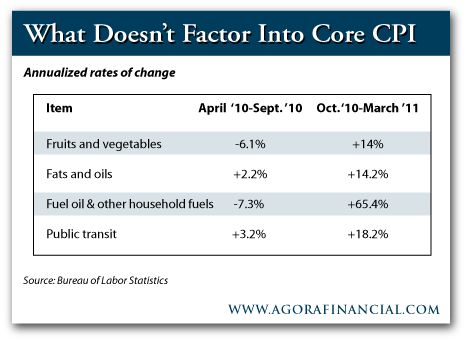
| Retail Sales: The Next Chapter of the Financial Crisis Posted: 15 Apr 2011 09:16 AM PDT It was a good effort…but "federal debt held by the public would double under the President's budget," says the Congressional Budget Office (CBO). While we were exploring gold storage, junior miners and asset protection in Zurich, the CBO did some heavy lifting on the budget proposal advanced by Mr. Obama on Wednesday. Even as the president promises to raise taxes, protect consumers and cut spending, the CBO shows the federal portion of the national debt held by the public growing from $10.4 trillion (69% of GDP) at the end of 2011 to $20.8 trillion (87% of GDP) at the end of 2021…adding $9.5 trillion to the nation's debt in nine years. "Even if the president could persuade Congress to enact all of his proposed tax increases," Alan Reynolds from the Cato Institute adds, "in addition to surtaxes already included in [the health care reform bill], the CBO finds we would still face endless budget deficits averaging 4.8% of GDP…" What kind of solution, we humbly ask, is that? "We are in a financial no-man's land," muses our friend Doug Casey, surveying the landscape. "'Investing' is problematic because of a deteriorating economy, unpredictable and increasing regulation, rising interest rates and wildly fluctuating prices. "Nothing is cheap in today's investment world. Because of the trillions of currency units that governments all over the world have created – and are continuing to create – financial assets are grossly overpriced. Stocks, bonds, property, commodities and cash are no bargains. "Meanwhile, real wages are slipping rapidly among those who are working, and a large portion of the population is unemployed or underemployed. "The next chapter in this sad drama will include a rapid rise in consumer prices. Raw commodities are the first things to move in an inflationary boom, largely because they're essential to everything. "Retail prices are generally the last to move," Doug sums up, citing a couple of themes we've been keeping our eyes on, "partly because the labor market will remain soft and keep that component down, and partly because retailers cut their margins to retain customers and market share." Retail may, indeed, be moving now. This morning, the Bureau of Labor Statistics (BLS) announced the consumer price index rose 0.5% last month. The "core" rate that strips out food and energy – the one the Federal Reserve watches to determine whether we have any "inflation" – was a tame at 0.1%. But look these annualized rates of change:
The first column of numbers is for the six months ended last September. The second column is for the most recent six months. Over the last 12 months, the CPI has risen 2.7%, according to the BLS. John Williams at Shadow Government Statistics, who crunches the numbers the way the government did during the Carter presidency, comes up with a slightly higher figure of 10.2%. "It's Atlas Shrugged time," Doug Casey chimes back in…and by that he doesn't mean tonight's release of the movie based on the novel. "Few large fortunes have been made by investing. Most are made by creating, building and running a business. But running an active business is increasingly problematical. "Sure, there will be plenty of people out there to hire – but in today's litigious and regulated environment, an employee is a large potential liability as much as a current asset. "Business itself is seen as a convenient milk cow by bankrupt governments – and it's much easier to tap small business than taxpayers at large. Unless it's a special situation, I'd be inclined to sell a business, take the money, and run." Atlas Shrugged, indeed. Addison Wiggin Retail Sales: The Next Chapter of the Financial Crisis originally appeared in the Daily Reckoning. The Daily Reckoning recently featured articles on stagflation, best libertarian books, and QE2 .
|
| Posted: 15 Apr 2011 09:05 AM PDT
It seems like only yesterday that silver took out $42. Oh wait... Luckily, it did not succeed in moving a full buck today. Instead it closed, per the Bloomberg feed, at $44.9913. Other feeds that price based on the offer, however, may see $43.0163. For the shorts, neither will be much of a consolation.
As a reminder, here is Reuters on asset class performance YTD...
...which for some reason ignores silver.
|
| G-20 nears deal on imbalances as China maintains currency plan Posted: 15 Apr 2011 09:03 AM PDT By Simon Kennedy and Rebecca Christie … The G-20 wants to smooth uneven trade and investment flows that helped spark the credit crisis by being faster to spot flaws in individual economies and prescribing policies to fix them before they roil the global economy. China's concern that it's being bullied into letting its currency appreciate faster is slowing discussions, and the final agreement may still suffer from the lack of an enforcement tool. … Officials are trying to avoid a repeat of the last expansion when trade imbalances opened, which then helped spark the deepest global recession in seven decades. China and other Asian nations recycled the dollars from their trade surpluses into U.S. bonds, depressing global yields, while U.S. consumers relied on the low interest rates to drive an unsustainable global spending spree and record trade deficit. … At talks in Paris in February, officials agreed to monitor indicators, including budget deficits, the external imbalance and private savings rates. In a sign of the discord that still simmered today, the Chinese obtained omission of foreign exchange reserves and diluted the final language so that it mentioned the current account's components and not its title. … Today's agreement will outline how G-7 economies will be assessed using four gauges, one focused on the specific economy and three forms of comparison to other countries, the official from a G-20 country said on condition of anonymity. Countries breaching two of the four benchmarks will be identified and subjected to more monitoring, the official said. [source] RS View: Bureaucrats are proficient at cluttering up what a simple, internationally open physical gold market can do efficiently and automatically. Don't worry, they'll eventually stumble onto it at the trail broadens into a highway through evolutionary effects — perhaps characterized as a natural human migration at this time of the economic season.
|
| Posted: 15 Apr 2011 08:59 AM PDT Share this:
|
| Silver delivery problems likely, Rule tells King World News Posted: 15 Apr 2011 08:50 AM PDT 4:46p ET Friday, April 15, 2011 Dear Friend of GATA and Gold (and Silver): King World News yesterday interviewed resource stockbroker Rick Rule about the increasing tightness in the silver market, and he speculated that there could be defaults in some near-month contracts. Rule also remarked incisively that gold is the only currency without a political constituency for devaluation. An excerpt from the interview is headlined "Extreme Silver Tightness Causing Delivery Problems" and is posted at the King World News blog here: http://kingworldnews.com/kingworldnews/KWN_DailyWeb/Entries/2011/4/15_Ri... Or try this abbreviated link: CHRIS POWELL, Secretary/Treasurer ADVERTISEMENT The Gold Standard Now: It Can Work Today a dollar is worth 80 percent less than it was 40 years ago, and less than 5 percent of its value a hundred years ago. We deserve a dollar that is as good as gold, a dollar that will hold its value from year to year so we can be financially secure and our economy can generate more and better jobs. For most of America's history, our dollar was literally as good as gold. But on August 15, 1971, our politicians destroyed the link between gold and the dollar. They destroyed the foundations of our economic system. A new Internet site, TheGoldStandardNow.org, provides news and cutting-edge analysis about this most important issue and explains how the gold standard worked in the past and how it can work in the future. Visit us today: http://www.thegoldstandardnow.org/about/137-welcome-newsmax Join GATA here: An Evening with Bill Murphy and James Turk Gold Rush 2011 https://www.amsterdamgold.eu/gata/index.asp?BiD=12 Or by purchasing a colorful GATA T-shirt: Or a colorful poster of GATA's full-page ad in The Wall Street Journal on January 31, 2009: http://gata.org/node/wallstreetjournal Or a video disc of GATA's 2005 Gold Rush 21 conference in the Yukon: Help keep GATA going GATA is a civil rights and educational organization based in the United States and tax-exempt under the U.S. Internal Revenue Code. Its e-mail dispatches are free, and you can subscribe at: To contribute to GATA, please visit: http://www.gata.org/node/16 ADVERTISEMENT Prophecy Resource Spins Off Platinum/Palladium Venture: Company Press Release, January 18, 2011 VANCOUVER, British Columbia -- Prophecy Resource Corp. (TSX-V:PCY)and Pacific Coast Nickel Corp. announce that they have agreed that PCNC will acquire Prophecy's Nickel PGM projects by issuing common shares to Prophecy. PCNC will acquire the Wellgreen PGM Ni-Cu and Lynn Lake nickel projects in the Yukon Territory and Manitoba respectively by issuing up to 550 million common shares of PCNC to Prophecy. PCNC has 55.7 million shares outstanding. Following the transaction: -- Prophecy will own approximately 90 percent of PCNC. -- PCNC will consolidate its share capital on a 10 old for one new basis. -- Prophecy will change its name to Prophecy Coal Corp. and PCNC will be renamed Prophecy Platinum Corp. -- Prophecy intends to distribute half of its PCNC shares to shareholders pro-rata in accordance with their holdings. Based on the closing price of the common shares of PCNC on January 17, $0.195 per share, the gross value of the transaction is $107,250,000. For the complete announcement, please visit: http://prophecyresource.com/news_2011_jan18.php
|
| Brian Ostroff: Looking for Value in PMs and Finding Adventure Posted: 15 Apr 2011 08:36 AM PDT Source: George Mack of The Gold Report 04/15/2011 Finding companies with growth potential is just the start for Windermere Capital, according to Managing Director Brian Ostroff. An active philosophy and deep technical expertise allow the firm to invest "anywhere along the spectrum" from exploration to production, all the way to operation. In this exclusive interview with The Gold Report, Brian delves into the gold-silver value proposition and names a couple of promising players in the Abitibi. The Gold Report: Brian, let's start with you telling us about Windermere Capital. Brian Ostroff: Windermere is an investment manager. We currently oversee two hedge funds with a natural resource focus. The Breakaway Strategic Resource Fund and the Navigator Fund are both offshore hedge funds based in the Cayman Islands. They serve high net-worth individuals, family offices and institutional investors. TGR: Do they have an open-ended structure or are investors committed to a cu...
|
| What Is Silver Screaming About? Posted: 15 Apr 2011 08:26 AM PDT Who wants gold when silver looks to offer turbo-charged inflation protection instead...? The Current Surge in bids to buy silver might seem dramatic, but it's more measured by far - to date, at least - than the true silver bubble ... Read More...
|
| Posted: 15 Apr 2011 08:24 AM PDT by Addison Wiggin – April 15, 2011
While we were exploring gold storage, junior miners and asset protection in Zurich, the CBO did some heavy lifting on the budget proposal advanced by Mr. Obama on Wednesday. Even as the president promises to raise taxes, protect consumers and cut spending, the CBO shows the federal debtportion of the national debt held by the public growing from $10.4 trillion (69% of GDP) at the end of 2011 to $20.8 trillion (87% of GDP) at the end of 2021… adding $9.5 trillion to the nation's debt from in 9nine years. “Even if the president could persuade Congress to enact all of his proposed tax increases,“ Alan Reynolds from the Cato Institute adds, “in addition to surtaxes already included in [the health care reform bill], the CBO finds we would still face endless budget deficits averaging 4.8% of GDP…” What kind of solution, we humbly ask, is that?
“Nothing is cheap in today’s investment world. Because of the trillions of currency units that governments all over the world have created — and are continuing to create — financial assets are grossly overpriced. Stocks, bonds, property, commodities and cash are no bargains. “Meanwhile, real wages are slipping rapidly among those who are working, and a large portion of the population is unemployed or underemployed.” “The next chapter in this sad drama will include a rapid rise in consumer prices. Raw commodities are the first things to move in an inflationary boom, largely because they’re essential to everything.” “Retail prices are generally the last to move,“ Doug sums up, citing a couple of themes we've been keeping our eyes on, “partly because the labor market will remain soft and keep that component down, and partly because retailers cut their margins to retain customers and market share.”
The “core” rate that strips out food and energy — the one the Federal Reserve watches to determine whether we have any “inflation” — was a tame at 0.1%. But look these annualized rates of change:  The first column of numbers is for the six months ended last September. The second column is for the most recent six months. Over the last 12 months, the CPI has risen 2.7%, according to the BLS. John Williams at Shadow Government Statistics, who crunches the numbers the way the government did during the Carter presidency, comes up with a slightly higher figure of 10.2%.
“Few large fortunes have been made by investing. Most are made by creating, building and running a business. But running an active business is increasingly problematical.” “Sure, there will be plenty of people out there to hire – but in today’s litigious and regulated environment, an employee is a large potential liability as much as a current asset.” “Business itself is seen as a convenient milk cow by bankrupt governments – and it’s much easier to tap small business than taxpayers at large. Unless it’s a special situation, I’d be inclined to sell a business, take the money, and run.” Atlas Shrugged, indeed.
“An entrepreneur is ‘one who takes between,’ to go back to the French roots of the word. Buy here for a dollar, sell there for two dollars – a good business if you can do it with a million widgets, hopefully all at once and on credit. An entrepreneur ideally needs few employees and little fixed overhead.” “Just as a speculator capitalizes on distortions in the financial markets, an entrepreneur does so in the business world. The more distortions there are in the market, the more bankruptcies and distress sales, the more variation in prosperity and attitudes between countries, the more opportunities there are for the entrepreneur. “The years to come are going to be tough on investors and businessmen, but full of opportunity for speculators and entrepreneurs. Keep your passports current, your powder dry, and your eyes open. I suggest you reform your thinking along those lines.” Doug is famous, if nothing else, for taking the “flight” side of the “fight or flight” question that’s the central theme of this year’s Agora Financial Investment Symposium. He’ll be back for this year’s shindig… along with last year’s top-rated speaker, offshore oil pioneer Marcio Mello; perennial favorite Rick Rule; Bill Bonner… and a host of others. You can still grab a discount on admission, but seats are filling fast. You don’t want to wait till the end of the month, only to find we’re sold out. Check out this year’s agenda and secure your early-bird rate right here.
In recent months, China’s government has raised interest rates and required down payments to try to put a lid on urban property prices… and it’s starting to work. “These households possess sufficient capital to purchase investment property,” says the report, “but do not have the same degree of access to investment vehicles such as private equity funds and retail property” that the super-rich do. Thus, Chinese demand for gold coins and bars rose 70.5% in 2010. [Ed. Note: If you have any interest in fast-moving junior gold stocks, Chris Mayer is out this week with a special report naming two of his undervalued favorites. One sits adjacent to the “Golden Staircase” in northern Canada that’s been yielded up treasure for more than a century. The other sits on a mountainside in Colombia — an opportunity Chris dug up during our visit last month. Get the story right here.
But for all that, the dollar index still has yet to crack 75. Against the new save-haven currency of choice, the greenback hit an all-time low this week. It now takes $1.12 to equal one Swiss franc.
 “The more important relationship is the franc against the euro,” he goes on. “The Swiss economy depends more on exports to Europe than the U.S., and therefore, a weaker Ffranc against the euro is desirable.” And with the European Central Bank raising rates last week, a weaker franc becomes more likely. “From a trading perspective,” Abe concludes, buying euro and selling Swiss has huge upside.”  You can bet Abe will be watching for trading opportunities. The next one could come as early as Monday. In the meantime, Abe and his readers they booked a 57% gain in three days this week on the Canadian dollar. By day’s end it could turn into a 200% gain. That comes on the heels of 104% gains last week on the British pound, 170% the week before on the yen, and 239% on the pound the week before that. Abe is rapidly acquiring legions of fans who write appreciative emails like this: “I decided to ride out the GBPUSD 1.6325 binary and that is a 308% profit trade! It is a very decent amount for a complete beginner like me.” Every trade is “in on Monday, out by Friday” in the market Abe follows. No other North American trading advisory covers it. And for a limited time, you can still join at the charter-member rate. Please review your invitation here.
Check out this performance between March 28 and this past Monday:
These are rare earth elements – the metals whose production is presently 97% controlled by China. These prices reflect a government crack down on illegal strip -mining. “The black market for rare earth materials has amounted to as much as 40% (maybe more) of total output, up until recently,” Byron King wrote in this space on Jan. 20. The crackdown has resulted in a supply squeeze. Noting the price increases, JPMorgan raised its buy-up-to price on the industry darling Molycorp, from $74 to $90.
“It might be a good day- trade play, if you have nothing better to do than stare at the screen and react to every twitch.” Byron got readers of his premium advisory, Energy & Scarcity Investor, out of Molycorp in January — with a 178% gain in four months. Now he’s moving them into a rare-earth play with far greater potential — a company surely flying under mainstream analysts’ radar. In fact, this firm delivered some promising news just yesterday — putting it on the fast track to beat Molycorp and all the other “usual suspects” into production. Byron clues you in right here.
“So I’d say that the bubble is in fiat currency, and not gold.” “If anything, my best guess is that gold has been manipulated to create the misperception in the tree, to the advantage of the tree., and tTherefore, if there is an unwind, it will likely be that in the future, metal will be able to buy more trees, rather than trees being able to buy more metal.”
The 5: We invited folks to continue the tax philosophy discussion on the blog site, which they have… but this one looked like too much fun. So we added a few more digits of our own:
“Especially interesting was the observation that while Britain financed World War I by taxation, Germany financed it by borrowing, a major contribution to monetary instability leading to the collapse of the Mmark. Thanks for the recommendation.” The 5: Well, it’s not exactly beach reading, but Fergusson succeeded in making the subject a page-turner. If you are interested in reading it, but haven't yet, you can get the book for the cost of shipping and handling, plus a one-month trial of Chris Mayer’s Capital & Crisis free, here. Have a good weekend, Addison Wiggin P.S. We left Zurich yesterday,. tToday we're in Stockholm. We attended a presentation this morning at the Stockholm School of Economics of our efforts to introduce Agora Financial to the Chinese market. It was a bit like looking in the mirror (after a late night)… more on Monday. Accordingly, on this apt Tax Day premier date, we won’t have a chance to see Atlas Shrugged as it gets released in 391 cities across the country. Incredibly, the film has scored a “0” to date on Rotten Tomatoes, which may be unprecedented in the history of that website. “I suspect only someone very familiar with Rand’s 1957 novel could understand the film at all,” writes Roger Ebert, “and I doubt they will be happy with it.” Half the criticism comes from people who appear not to “get it,”, which you might expect. Does anyone really believe the effort will attract a popular audience? The other half say it looks sloppy and amateurish, which could be a problem. We'll reserve our judgment until we see ift for ourselves. If you have a chance to catch it, let us know what you think. P.P.S. Less than 72 hours are left for you to take advantage of an offer we’ve never made before on our most expensive service. It’s never been easier to take advantage of Bulletin Board Elite. Learn how here.
|
| Gold Daily and Silver Weekly Charts - Something Wicked This Way Comes - We Will Rock You Posted: 15 Apr 2011 08:18 AM PDT |
| Hourly Action In Gold From Trader Dan Posted: 15 Apr 2011 08:17 AM PDT Dear CIGAs, Click chart to enlarge in PDF format with commentary from Trader Dan Norcini For further market analysis and commentary, please see Trader Dan's website at www.traderdan.net
|
| Can You Pass The 2011 Gold Investing Quiz? Posted: 15 Apr 2011 08:06 AM PDT Jeff Clark, BIG GOLD writes: CPM Group recently released their 2011 Gold Yearbook, an invaluable resource for us gold analysts. Mostly a reference book, even a gold enthusiast might find it dry reading. But I loved it, and as I studied it on a plane, I kept finding data that made me perk up. To have a little fun with it, I thought I’d summarize what I read in the form of a quiz. See how many you can get correct. Regardless of your score, I’m sure you’ll agree with the ramifications each point makes for the gold market.
|
| Posted: 15 Apr 2011 08:01 AM PDT Who wants gold when silver looks to offer turbo-charged inflation protection instead...? The CURRENT SURGE in bids to buy silver might seem dramatic, but it's more measured by far – to date, at least – than the true silver bubble of Sept. 1979 to Jan. 1980.
|
| Grandich Interviewed in MarketWatch Posted: 15 Apr 2011 07:52 AM PDT The following is automatically syndicated from Grandich's blog. You can view the original post here. Stay up to date on his model portfolio! April 15, 2011 10:12 AM MarketWatch • Commodities Corner April 15, 2011, 12:19 p.m. EDT Gold investing: what to do and how to do it By Myra P. Saefong SAN FRANCISCO (MarketWatch) — Investors can still make a lot of money in the gold market — or prevent losing it, if they do their homework before they wade through a sea of investment choices. "The good news for gold and silver is the 'mother' of all bull markets has further to go," said Peter Grandich, editor of The Grandich Letter. "The bad news is the opportunity to double or triple one's money is behind us." Click here to read the full story [url]http://www.grandich.com/[/url] grandich.com...
|
| What Does Silver’s Recent Performance Relative to Crude Oil Mean For Investors? Posted: 15 Apr 2011 07:50 AM PDT Gold market witnessed a bumpy roller coaster ride during the week. An interesting thing to observe was the reasons that economic commentators gave for price fluctuations. On Tuesday gold for June delivery lost $14.50 to settle at $1,453.60 an ounce at the Comex division of the New York Mercantile Exchange. The gold price has traded as high as $1,468.50 and as low as $1,445 while the spot gold price was shedding more than $11. The reasons for the decline were explained by falling oil prices and by a Goldman Sachs report with a short-term bearish call on oil and copper, the industrial bellwethers. (The term “bellwether” refers to the practice of placing a bell around the neck of a castrated ram leading his flock of sheep so that the movements of the flock could be noted by hearing the bell).
|




 It was a good effort…. but “federal debt held by the public would double under the President's budget,” says the Congressional Budget Office (CBO).
 “We are in a financial no-man’s land,” muses our friend Doug Casey, surveying the landscape. “‘Investing’ is problematic because of a deteriorating economy, unpredictable and increasing regulation, rising interest rates and wildly fluctuating prices.
 Retail may, indeed, be moving now. This morning, the Bureau of Labor Statistics (BLS) announced the consumer price index rose 0.5% last month.
  “It’s Atlas Shrugged time,” Doug Casey chimes back in… and by that he doesn’t mean tonight’s release of the movie based on the novel.
 In contrast, “the years to come are going to be tough on investors and businessmen, but full of opportunity for speculators and entrepreneurs,” Doug continues.
 Gold is holding on to most of the gains it made yesterday. At $1,473, the spot price is less than $6 away from the all-time record reached less than 24 hours ago. Silver has powered above $42, currently at $42.18
 As China’s torrid housing market is showing signs of cooling off, the country’s “mass affluent” are shifting to gold, according to a new report from J.P. Morgan Chase.
 Major U.S. stock indexes are ruler-flat as we write. At 1,314 the S&P 500 sits 30 points below the high it set in February.
 The dollar is moving up as the PIIGS take to the slop in Europe once again. Moody’s downgraded Ireland today, and Greek bond yields blew out yesterday.
 Still, “this move might be temporary” cautions our currency trading expert Abe Cofnas, “if Ben Bernanke signals concern about inflation and raises expectations of rising interest rates.”
 While most commodities are pulling back from record highs, one sector remains on fire. Guess which one.
 “Molycorp is overvalued,” Byron tells us in an email from Moscow. Heh.
 “Gold is priced in paper,“ writes a reader weighing in on the gold bubble debate, “and there is a higher degree of misperception associated with a fragment of a tree than a piece of metal.
  “Key Tax Facts” writes another reader:
 “I’m reading your recommendation,
| You are subscribed to email updates from Save Your ASSets First To stop receiving these emails, you may unsubscribe now. | Email delivery powered by Google |
| Google Inc., 20 West Kinzie, Chicago IL USA 60610 | |


No comments:
Post a Comment